EP3996449B1 - Verfahren und vorrichtung zur uplink-informationsübertragung und speichermedium - Google Patents
Verfahren und vorrichtung zur uplink-informationsübertragung und speichermedium Download PDFInfo
- Publication number
- EP3996449B1 EP3996449B1 EP19938577.4A EP19938577A EP3996449B1 EP 3996449 B1 EP3996449 B1 EP 3996449B1 EP 19938577 A EP19938577 A EP 19938577A EP 3996449 B1 EP3996449 B1 EP 3996449B1
- Authority
- EP
- European Patent Office
- Prior art keywords
- pusch
- pucch
- information
- channel
- priority
- Prior art date
- Legal status (The legal status is an assumption and is not a legal conclusion. Google has not performed a legal analysis and makes no representation as to the accuracy of the status listed.)
- Active
Links
Images




Classifications
-
- H—ELECTRICITY
- H04—ELECTRIC COMMUNICATION TECHNIQUE
- H04W—WIRELESS COMMUNICATION NETWORKS
- H04W72/00—Local resource management
- H04W72/50—Allocation or scheduling criteria for wireless resources
- H04W72/56—Allocation or scheduling criteria for wireless resources based on priority criteria
- H04W72/566—Allocation or scheduling criteria for wireless resources based on priority criteria of the information or information source or recipient
- H04W72/569—Allocation or scheduling criteria for wireless resources based on priority criteria of the information or information source or recipient of the traffic information
-
- H—ELECTRICITY
- H04—ELECTRIC COMMUNICATION TECHNIQUE
- H04W—WIRELESS COMMUNICATION NETWORKS
- H04W72/00—Local resource management
- H04W72/12—Wireless traffic scheduling
- H04W72/1263—Mapping of traffic onto schedule, e.g. scheduled allocation or multiplexing of flows
- H04W72/1268—Mapping of traffic onto schedule, e.g. scheduled allocation or multiplexing of flows of uplink data flows
-
- H—ELECTRICITY
- H04—ELECTRIC COMMUNICATION TECHNIQUE
- H04W—WIRELESS COMMUNICATION NETWORKS
- H04W72/00—Local resource management
- H04W72/20—Control channels or signalling for resource management
- H04W72/21—Control channels or signalling for resource management in the uplink direction of a wireless link, i.e. towards the network
-
- H—ELECTRICITY
- H04—ELECTRIC COMMUNICATION TECHNIQUE
- H04W—WIRELESS COMMUNICATION NETWORKS
- H04W72/00—Local resource management
- H04W72/20—Control channels or signalling for resource management
- H04W72/23—Control channels or signalling for resource management in the downlink direction of a wireless link, i.e. towards a terminal
Definitions
- the present disclosure relates to mobile communication technology, and more particularly, to an uplink information transmission method, device and storage medium.
- the high-priority services such as Ultra-reliable low latency (URLLC) service are involved in the communication system.
- URLLC Ultra-reliable low latency
- R1-1907194, InterDigital, "UCI Enhancements for eURLLC”, 3GPP TSG RAN WG1 #97, 13-17 April 2019 relates to several proposals to make further progress on HARQ-ACK reporting and on how to specify handling of resource collisions between UL data/control transmissions, where proposals include that HARQ-ACK is multiplexed on PUSCH of equal or lower priority with PUSCH duration less than x symbols, otherwise PUSCH is dropped, and includes that SR is multiplexed on PUSCH of lower priority with PUSCH duration less than y symbols, otherwise PUSCH is dropped.
- Embodiments of the present disclosure provide a method and a device for transmitting uplink information, and a storage medium, which can ensure transmission reliability of a high-priority service.
- the invention is set out in the appended set of claims. Any examples or embodiments that do not fall within the scope of the appended claims are non-claimed embodiments, which are presented only as information.
- NR New Radio
- UE user equipment
- two transmission manners i.e., discarding the PUSCH or carrying the Uplink Control Information (UCI) in the PUCCH on the PUSCH, are supported.
- UCI Uplink Control Information
- the flexibility of the PUCCH and PUSCH architecture design makes their start symbol and end symbol not necessarily aligned.
- a fixed timing requirement must be met between the PUCCH and the PUSCH, so that the PUCCH can be multiplexed to the PUSCH, otherwise the UE will discard the PUSCH.
- the fixed timing requirement that must be met for multiplexing the PUCCH with the PUSCH include the following two timing requirements.
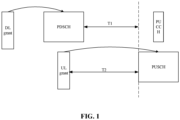
- the time difference (e.g., T1 illustrated in FIG. 1 ) between the first Orthogonal Frequency Division Multiplexing (OFDM) symbol of the earliest transmitted channel of the PUCCH and PUSCH overlapped in time domain and the last OFDM symbol of the PDSCH scheduled by the DCI scheduling HARQ-ACK is longer than N1+1 OFDM symbols.
- N1 is the capability of the UE to process the PDSCH as reported by the UE.
- the time difference (e.g., T2 illustrated in FIG. 2 ) between the first OFDM symbol of the earliest transmitted channel of the PUSCH and PUSCH overlapped in time domain and the last OFDM symbol of the latest DCI (DCI for scheduling the PUSCH or DCI for scheduling the PUCCH) is greater than N2+1 symbols.
- N2 is the time for the UE to prepare the PUSCH as reported by the UE.
- the PUSCH is discarded directly on the time slots where the PUCCH is overlapped with the PUSCH in time domain, and the PUCCH is transmitted, so that the PUCCH encoding manners on multiple time slots are ensured to be same, the PUCCHs on multiple time slots can be combined, and the reception performance of the PUCCH can be ensured.
- the UCI types carried on PUSCH include Hybrid Automatic Repeat reQuest (HARQ)-response (ACK) and Channel State Information (CSI).
- HARQ-ACK and CSI The mapping order of HARQ-ACK and CSI is: HARQ-ACK, and CSI.
- Each type of UCI is encoded independently, and proportion of the number of Resource Elements (REs) occupied by the UCIs in all the REs resources in the PUSCH is determined through the ratio of the total load size of these UCIs (including the load size of the Cyclic Redundancy Check (CRC)) to the total load size of the uplink data.
- REs Resource Elements
- the transmission reliability requirement of the UCIs is higher than the data transmission reliability requirement
- different code rate compensation factors ⁇ offset are introduced for different UCIs in calculating this proportion.
- the higher layer signaling configuration parameter ⁇ is introduced to limit the upper limit of the number of REs occupied by each type of UCI information.
- the number of REs occupied by the HARQ-ACK is calculated through formula (1):
- O ACK is the number of HARQ-ACK bits
- L ACK is the number of CRC bits
- ⁇ offset PUSCH is the code rate compensation factor of HARQ-ACK
- M sc UCI l is the number of sub-carriers available for carrying UCIs on symbol l
- ⁇ l 0 N symb
- M sc UCI l represents the number of REs available for carrying UCIs on the PUSCH
- the denominator ⁇ r 0 C UL ⁇ SCH ⁇ 1 K r represents the payload size of the uplink data.
- the number of REs occupied by the CSI part I is calculated through the formula (2):
- O CSI-1 is the bit number of CSI part I.
- the number of REs occupied by the CSI part II is calculated through the formula (3):
- O CSI-2 is the bit number of CSI part II.
- a URLLC service is introduced.
- the feature of the URLLC service is that the ultra-high reliability (e.g., 99.999%) transmission can be implemented within an extreme delay (e.g., 1 ms).
- the UCIs in the PUCCH are multiplexed into the PUSCH to implement transmission of two types of information (UCI and data). If the timing requirement is not met, the UCI in the PUCCH is preferentially transmitted. When a PUSCH carries URLLC data, the transmission of the PUSCH is stopped, resulting in additional delay, which may cause that the traffic delay requirement cannot be met.
- the downlink grant (DL grant) is after the uplink grant (UL grant), which cannot be supported by the existing standard, thus the DL grant and UL grant are ignored and the PUCCH and PUSCH will not be transmitted. Therefore, this scheduling constraint may cause additional delay.
- an embodiment of the present disclosure provides a method for transmitting the uplink information.
- the method for transmitting the uplink information of the embodiment of the present disclosure can be applied to various communication systems, such as a Long Term Evolution (LTE) system, an LTE Frequency Division Duplex (FDD) system, an LTE Time Division Duplex (TDD) system, a Universal Mobile Telecommunications System (UMTS) communication system, a 5G system, or a future communication system.
- LTE Long Term Evolution
- FDD Frequency Division Duplex
- TDD Time Division Duplex
- UMTS Universal Mobile Telecommunications System
- the communication system 300 may include a network device 310.
- the network device 310 may be a device that communicates with a terminal device 320 (or referred to as a communication terminal, or a terminal).
- the network device 310 may provide communication coverage for a specific geographic area and may communicate with a terminal device within the coverage.
- the network device 310 may be an Evolutional Node B (eNB or eNodeB) in an LTE system, a base station (gNB) in an NR/5G system, or a wireless controller in a Cloud Radio Access Network (CRAN).
- eNB Evolutional Node B
- gNB base station
- CRAN Cloud Radio Access Network
- the network device may be a mobile switching center, a relay station, an access point, a vehicle-mounted device, a wearable device, a hub, a switch, a bridge, a router, a network-side device in a 5G network, a network device in a future evolutionary Public Land Mobile Network (PLMN), or the like.
- PLMN Public Land Mobile Network
- the communication system 300 further includes at least one terminal device 320 within the coverage of the network device 310.
- the "terminal device” includes, but is not limited to, being connected via a wireline, for example, being connected via a Public Switched Telephone Networks (PSTN), a Digital Subscriber Line (DSL), a digital cable, and a direct cable; and/or another data connection/network; and/or being connected via a wireless interface, for example, being connected via a cellular network, a Wireless Local Area Network (WLAN), a digital TV network such as a DVB-H network, a satellite network, an Amplitude Modulation-Frequency Modulation (AM-FM) broadcast transmitter; and/or an equipment of another terminal device, herein the equipment is configured to receive/transmit a communication signal; and/or an Internet of Things (IoT) device.
- PSTN Public Switched Telephone Networks
- DSL Digital Subscriber Line
- AM-FM Amplitude Modulation-Frequency Modulation
- IoT Internet of
- the terminal device configured to communicate through a wireless interface may be referred to as a "wireless communication terminal", a “wireless terminal” or a “mobile terminal”.
- the mobile terminal include, but are not limited to, a satellite phone or a cellular phone; a Personal Communications System (PCS) terminal that may combine the cellular radio phone with data processing, fax, and data communication; a Personal Digital Assistant (PDA) that may include radio telephone, pager, Internet/intranet access, Web browser, memo pad, calendar, and/or Global Positioning System (GPS) receiver; and a conventional laptop and/or a palmtop receiver or other electronic devices including radio telephone transceiver.
- PCS Personal Communications System
- GPS Global Positioning System
- the terminal device may refer to an access terminal, a UE, a user unit, a user station, a mobile station, a mobile platform, a remote station, a remote terminal, a mobile device, a user terminal, a terminal, a wireless communication device, a user agent or a user device.
- the access terminal may be a cell phone, a cordless phone, a Session Initiation Protocol (SIP) phone, a Wireless Local Loop (WLL) station, a PDA, a handheld device with a wireless communication function, a computing device, another processing device connected to a wireless modem, a vehicle-mounted device, a wearable device, a terminal device in 5G network, a terminal device in the future evolutionary PLMN or the like.
- SIP Session Initiation Protocol
- WLL Wireless Local Loop
- D2D Device to Device
- a 5G system or 5G network may also be referred to as an NR system or an NR network.
- FIG. 3 exemplarily illustrates a network device and two terminal devices.
- the communication system 300 may include multiple network devices, and another number of terminal devices may be included within the coverage of each network device. There are no limits made thereto in the embodiments of the disclosure.
- the communication system 300 may further include other network entities such as a network controller and a mobility management entity. There are no limits made thereto in the embodiments of the disclosure.
- the device with a communication function in the network/system in the embodiments of the disclosure may be referred to as a communication device.
- the communication device may include a network device 310 and a terminal device 320 which are with communication functions.
- the network device 310 and the terminal device 320 may be the specific devices described above and are not further elaborated herein.
- the communication device may also include other devices in the communication system 300, for example, may also include other network entities such as a network controller, and a mobility management entity, which are not limited in the embodiments of the disclosure.
- the network device 310 or the terminal device 320 in the communication system 300 may be referred to as an information transmission device.
- the method for transmitting the uplink information includes: determining whether a time domain resource of a PUCCH and a time domain resource of a PUSCH overlap in a time domain, and responsive to that there is an overlap, determining a transmission manner for the PUCCH and/or the PUSCH according to a priority parameter.
- the priority parameter includes: an information priority of the PUCCH; or the information priority of the PUCCH and the information priority of the PUSCH.
- the time domain resource of the PUCCH and the time domain resource of the PUSCH overlap in the time domain, only the information on the PUCCH or only the information on the PUSCH is transmitted, or part or all of the information on the PUCCH is multiplexed to the PUSCH for transmission.
- the information on the PUCCH includes UCI
- the information on the PUSCH includes UCI and data.
- the method for transmitting the uplink information provided by the embodiment of the present disclosure may be performed by a terminal device or a network device. Taking that the method for transmitting the uplink information provided in the embodiment of the present disclosure is performed by the terminal device as an example, as illustrated in FIG. 4A , the method includes operations S401a to S403a.
- the terminal device determines whether the time domain resource of the PUCCH and the time domain resource of the PUSCH overlap in the time domain.
- the terminal device determines a transmission manner for at least one of the PUCCH or the PUSCH according to the priority parameter.
- the terminal device transmits the information of at least one of the PUCCH or PUSCH according to the determined transmission manner.
- the terminal device receives the DL grant sent by the network device, schedules the PDSCH according to the received DL grant, and determines the HARQ-ACK feedback resource (i.e, the resource of the PUCCH) for the scheduled PDSCH according to the received DL grant.
- the determined PUCCH resource includes a time domain resource and a frequency domain resource.
- the terminal device receives the UL grant sent by the network device, and determines the PUSCH resource according to the received UL grant.
- the determined PUSCH resource includes the time domain resource and frequency domain resource.
- the terminal device receives the semi-static signaling and the corresponding Downlink Control Information (DCI) trigger signaling sent by the network device, and determines the PUSCH resource according to the semi-static signaling and the corresponding DCI trigger signaling.
- the PUSCH resource includes a frequency domain resource and a time domain resource.
- the semi-static signaling includes a configured grant configuration (ConfiguredGrantConfig) and a semi-static scheduling configuration (SPS-Config).
- the DCI trigger signaling includes the DCI of which the CRC is scrambled by a Configured Scheduling RNTI (CS-RNTI).
- the terminal receives a semi-static signaling (e.g., SchedulingRequestResourceConfig, or CSI-ReportConfig) sent by the network side, to determine a PUCCH resource carrying a Scheduling Request (SR) or CSI.
- a semi-static signaling e.g., SchedulingRequestResourceConfig, or CSI-ReportConfig
- the method for transmitting the uplink information provided in the embodiment of the present disclosure is implemented by the network device as an example, as illustrated in FIG. 4B , the method includes the operations S401b to S403b.
- the network device determines whether the time domain resource of the PUCCH and the time domain resource of the PUSCH overlap in the time domain.
- the network device determines the transmission manner for at least one of the PUCCH or the PUSCH according to the priority parameter.
- the network device detects and receives the information transmitted by the terminal device according to the determined transmission manner.
- the network device determines the PUCCH resource and the PUSCH resource according to the information carried in the message sent from the terminal device, and the message used to determine the PUCCH resource and the PUSCH resource is the same as the message used by the terminal device to determine the PUCCH resource and the PUSCH resource. Details are not elaborated herein.
- the priority parameter includes one of the following two cases:
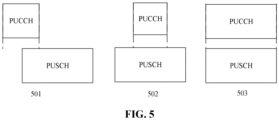
- the manner that the time domain resource of the PUCCH and the time domain resource of the PUSCH overlap in the time domain includes: partially overlapped as illustrated in 501, inclusion as illustrated in 502, and completely overlapped as illustrated in 503.
- the attribute parameter of the PUCCH and the attribute parameter of the PUSCH are determined, and the information priority of the PUCCH and the information priority of the PUSCH are determined according to the attribute parameter of the PUCCH and the attribute parameter of the PUSCH, respectively.
- the information priority is determined according to at least one of the following attribute parameters: a service type, a service reliability requirement, or a transmission delay requirement.
- the service type may include: enhanced mobile broadband (eMBB), mass machine type communication (mMTC), uRLLC, and the like.
- the reliability requirement of the service may be represented by different reliability identifiers.
- the reliability requirement includes: first-level reliability, second-level reliability, and third-level reliability, which are sequentially sorted from high to low according to the reliability as: the first-level reliability, the second-level reliability, and the third-level reliability.
- the transmission delay requirement of the service may be represented by different delay identifiers.
- the transmission delay requirement includes: a first-level delay, a second-level delay, and a third-level delay, which are sequentially sorted from high to low according to the delay requirement as: the first-level delay, the second-level delay, and the third-level delay.
- the information priority of the PUCCH or the information priority PUSCH may be determined according to the level of the current attribute parameter.
- the attribute parameter includes multiple types of attribute parameters
- the information priority of the PUCCH or the information priority of the PUSCH may be determined according to multiple attribute parameters.
- the attribute parameters include multiple types of attribute parameters
- the levels corresponding to different attribute parameters are determined, and multiple levels quantization results are weighted and summed to obtain the information priority of the PUCCH or the information priority of the PUSCH.
- the attribute parameter includes multiple types of attribute parameters, the level corresponding to each attribute parameter is determined, and the highest level is determined as the information priority of the corresponding channel.
- the information priority of the PUCCH or the information priority of the PUSCH is indicated through any one of the following manners: being explicitly indicated by the DCI; being implicitly indicated by the DCI; being implicitly indicated by an attribute of a channel; or being predetermined by a terminal device and a network device.
- the attribute of the channel may include parameter such as the number of symbols of the channel, the period, or the like.
- the network device or the terminal device may directly determine the transmission manner for the PUCCH and the PUSCH according to the information priority of the PUCCH and the information priority of the PUSCH, or may determine the transmission manner for the PUCCH and the PUSCH according to the relationship between the PUCCH and PUSCH and the multiplexing transmission condition.
- the method includes: when the PUCCH and the PUSCH do not satisfy the multiplexing transmission condition, determining to transmit one of the PUCCH and the PUSCH according to the information priority of the PUCCH and the information priority of the PUSCH.
- the PUCCH and the PUSCH do not satisfy the multiplexing transmission condition, the PUCCH is not multiplexed into the PUSCH, and only the PUCCH or only the PUSCH is transmitted according to the priority information of the PUCCH and the priority information of the PUSCH.
- the PUCCH and the PUSCH satisfy the multiplexing transmission condition, part or all of the UCIs on the PUCCH are multiplexed into the PUSCH, and the UCI sorting of the UCIs of the PUCCH multiplexed into the PUSCH is determined according to the priority information of the PUCCH.
- a first timing and a second timing corresponding to the earliest uplink channel of the PUCCH and the PUSCH are determined.
- the first timing e.g., T1 illustrated in FIG. 1
- the second timing is the time difference between the first OFDM symbol of the earliest transmitted channel of the PUSCH and PUCCH overlapped in time domain and the last OFDM symbol of the latest DCI (DCI scheduling the PUSCH or DCI scheduling the PUCCH).
- the multiplexing transmission condition includes a first timing requirement corresponding to the first timing and a second timing requirement corresponding to the second timing.
- the first timing requirement is: greater than N1+1 OFDM symbols.
- N1 is the time for the UE to process the PDSCH as reported by the UE.
- the second timing requirement is: greater than N2+1 OFDM symbols.
- N2 is the time for the UE to prepare the PUSCH as reported by the UE.
- the first timing does not satisfy the first timing requirement, or the second timing does not satisfy the second timing requirement, it is determined that the first timing and the second timing do not satisfy the multiplexing transmission condition.
- the first timing satisfies the first timing requirement and the second timing satisfies the second timing requirement, it is determined that the first timing and the second timing satisfy the multiplexing transmission condition.
- the rule content of the multiplexing transmission condition is not limited.
- the operation of determining to transmit one of the PUCCH and the PUSCH according to the information priority includes at least one of the following manners.
- the channel level of the PUCCH and the channel level of the PUSCH are determined, and the one with a higher channel level between the PUCCH and the PUSCH is transmitted.
- the information priorities of the PUCCH and PUSCH are different, the information priorities are used as the basis for selecting the transmitted channel.
- the PUCCH is transmitted when the information priorities of the PUCCH and the PUSCH are different and the information priority of the PUCCH is higher than the information priority of the PUSCH.
- the PUSCH is transmitted when the information priorities of the PUCCH and the PUSCH are different and the information priority of the PUCCH is lower than the information priority of the PUSCH.
- the channel level is used as a basis for selecting the transmitted channel.
- the PUCCH and the PUSCH have the same information priority, and the PUCCH has a higher channel level than the PUSCH, then the PUCCH is transmitted. In another example, the PUCCH and the PUSCH have the same information priority, and the PUSCH has a lower channel level than the PUSCH, then the PUSCH is transmitted.
- the transmission manner for transmitting the PUCCH and the PUSCH is determined according to the information priority
- only the first manner may be used for the determination
- only the second manner may be used for the determination
- both the first manner and the second manner may be used for the determination.
- the operation of determining the transmission manner for at least one of the PUCCH or the PUSCH according to the information priority further includes at least one of:
- the transmission of the channel having a lower information priority is stopped.
- the PUCCH is transmitted, and the transmission of the PUSCH is stopped.
- the PUSCH is transmitted, and the transmission of the PUCCH is stopped.
- the PUCCH has the same information priority as the PUSCH, and the PUCCH has a higher channel level than the PUSCH, then the PUCCH is transmitted and the transmission of PUSCH is stopped.
- the PUCCH has the same information priority as the PUSCH, and the PUCCH has a lower channel level than the PUSCH, then the PUSCH is transmitted and the transmission of PUCCH is stopped.
- a transmitted channel is referred to as a first channel
- a channel where the transmission is stopped is referred to as a second channel.
- the first channel is the PUCCH
- the second channel is the PUSCH.
- the transmission of PUCCH is stopped, the first channel is the PUSCH, and the second channel is the PUCCH.
- the manner of stopping transmitting the second channel includes at least one of: stopping transmitting the entire second channel; stopping transmitting a portion of the second channel corresponding to a time period during which the second channel overlaps with the first channel in time domain; or stopping transmitting the portion of the second channel after the start position at which the second channel overlaps with the first channel in the time domain.
- the transmission of the second channel may be stopped by using one or more of the above three stopping manners.
- the stopping manner for stopping transmitting the second channel includes: being predetermined by the terminal device and the network device; being configured by the network device; or being determined according to a chronological order between a time point at which the terminal device is capable of determining a conflict and a time point for transmitting the second channel.
- the conflict is that the PUCCH and the PSUCH conflict in the time domain, i.e., the overlapping.
- the network device may transmit the configured manner to the terminal device through a set parameter, so that the terminal device acquires the manner configured by the network device.
- the terminal device may notify the network device of the determined manner through a set parameter, so that the network device acquires the manner determined by the terminal device.
- the first channel is a PUCCH and the second channel is a PUSCH, which is taken as an example of the manner for stopping transmitting the second channel.
- the stopping manner predetermined by the terminal device and the network device is to stop transmitting the portion of the PUSCH corresponding to the time period during which the PUSCH overlaps with the PUCCH in the time domain
- the portion of the PUSCH corresponding to the time period during which the PUSCH overlaps with the PUCCH in the time domain is stopped transmitting when the PUSCH is stopped.
- the stopping manner configured by the network device is to stop transmitting the portion of the PUSCH after the start position at which the PUSCH overlaps with the PUCCH in the time domain
- the portion of the PUSCH after the start position at which the PUSCH overlaps with the PUCCH in the time domain is stopped transmitting when the PUSCH is stopped.
- the stopping manner is determined according to the chronological order between the time point that the terminal device can determine a conflict and the time point for transmitting the PUSCH
- the transmission of entire PUSCH is stopped when the time point that the terminal device can determine the conflict is before the time point for transmitting the PUSCH. Otherwise, the transmission of PUSCH is partially stopped. For example, as illustrated in FIG.
- the terminal may anticipate the position of the PUCCH (the PUCCH overlaps with the PUSCH in the time domain) according to the DL grant, when the terminal makes the decision to stop the PUSCH, the terminal stops transmitting the entire PUSCH. As illustrated in FIG. 7 , the terminal does not receive the DL Grant until after the PUSCH transmission has started, and then finds that the PUCCH and the PUSCH overlap in the time domain based on the received DL grant, then part of the PUSCH is stopped transmitting.
- the operation of determining the transmission manner for at least one of the PUCCH or the PUSCH according to the information priority of the PUCCH includes: determining the UCI sorting according to the information priority of the PUCCH; and multiplexing the UCIs in the PUCCH into the PUSCH according to the UCI sorting.
- all or part of the UCIs in the PUCCH may be multiplexed into the PUSCH.
- the UCIs in the PUCCH are multiplexed into the PUSCH according to the UCI sorting.
- the UCIs in the PUCCH are multiplexed into the PUSCH
- the UCIs are multiplexed into the PUSCH based on the UCI sorting which is determined according to the priority information of the PUCCH.
- the UCI may include SR, HARQ-ACK/NACK, and CSI.
- the CSI includes a Channel Quality Indicator (CQI), a Precoding Matrix Indicator (PMI), and a Rank Indication (RI).
- CQI Channel Quality Indicator
- PMI Precoding Matrix Indicator
- RI Rank Indication
- the sorting rule of the UCI sorting is determined through one of the following manners: being predetermined by a terminal device and a network device; or being determined according to the sorting configuration of the network device.
- the sorting rule followed by the terminal device or the network device to sort the UCIs may be predetermined by the terminal device and the network device, or may be indicated by the network device based on the sorting configuration.
- the network device sends the sorting configuration to the terminal device, and the terminal device sorts the UCIs in the PUCCH based on the received sorting configuration.
- the sorting rule of the UCI sorting is determined according to the information priority corresponding to the UCI.
- multiple UCIs are sorted according to the information priority of each of multiple UCIs.
- the UCIs in the PUCCH include UCI1, UCI2, and UCI3.
- the sorted UCIs obtained according to the information priority are: UCI1, UCI2, and UCI3, and the number of resources occupied by UCI1, UCI2, and UCI3 are 2, 2, and 3, respectively.
- UCI1, UCI2, and UCI3 are multiplexed into the PUSCH, and the UCI3 which is sorted later is discarded.
- UCI1, UCI2, and UCI3 are multiplexed into the PUSCH with the UCI sorting, i.e., UCI1, UCI2, and UCI3.
- the UCIs in the PUCCH are multiplexed into the PUSCH to reduce the resources used by the PUSCH, thereby reducing the transmission reliability of the PUSCH.
- the UCIs in the PUCCH are multiplexed into the PUSCH in a certain UCI order based on the information priority of the UCI, so that the resource allocation between the PUCCH and the PUSCH can be balanced, thereby ensuring the reliability requirements of the two channels.
- the sorting rule of the UCI sorting includes one of the following:
- part or all of the UCI types are distinguished with the information priority.
- SR, HARQ-ACK/NACK, and CSI are distinguished with information priorities.
- SR and HARQ-ACK/NACK are distinguished with the information priority, and CSI does not be distinguished with the information priority.
- sorting according to the information priority includes: sorting the UCI with a high information priority in front; or sorting the UCI with a low information priority in front.
- the services corresponding to the UCIs include the URLLC and the eMBB, and the information priority of the URLLC is higher than the information priority of the eMBB.
- All the UCI types of the URLLC are before all the UCI types of the eMBB, the UCIs with a service type include the HARQ-ACK and the CSI, and the order of the UCIs may be URLLC HARQ-ACK>URLLC CSI>eMBB HARQ-ACK >eMBB CSI.
- the services corresponding to the UCIs include the URLLC and the eMBB
- the information priority of the URLLC is higher than the information priority of the eMBB
- the UCI types include the HARQ-ACK
- the CSI are not classified into the service types, then the UCIs may be sorted as: URLLC HARQ-ACK>eMBB HARQ-ACK>CSI.
- the services corresponding to the UCIs include the URLLC and the eMBB, and the information priority of the URLLC is higher than the information priority of the eMBB.
- the sorting rule of the UCI sorting may be that: the SR and HARQ-ACK of the URLLC have a higher priority than the SR and HARQ-ACK of the eMBB, and the CSI.
- the UCI sorting is: URLLC SR>URLLC HARQ-ACK>eMBB HARQ-ACK>CSI.
- the UCI sorting is: URLLC SR> URLLC HARQ-ACK>eMBB HARQ-ACK>eMBB SR>CSI.
- the CSI does not be distinguished with service type.
- the services corresponding to the UCIs include URLLC and eMBB.
- the specified service type is eMBB and the specified UCI is HARQ-ACK, then the UCI sorting may be: eMBB HARQ-ACK>URLLC HARQ-ACK>CSI.
- the multiplexing of the UCIs in the PUCCH into the PUSCH will reduce the resources used by the PUSCH, which will reduce the reliability of the PUSCH transmission. Therefore, when the UCI is multiplexed into the PUSCH, it needs to balance the resource allocation between the PUCCH and the PUSCH, thereby ensuring the reliability requirements of the two channels.
- the resources for transmitting the UCIs are very limited.
- the HARQ-ACK sorting rule cause that the HARQ-ACK information cannot be completely multiplexed into the PUSCH. That is, a part of the HARQ-ACK is lost.
- the URLLC HARQ-ACK, the eMBB HARQ-ACK and the PUSCH illustrated as 801 overlap in the time domain.
- the URLLC HARQ-ACK and the eMBB HARQ-ACK may be obtained as the sorting 802 according to the time order of the corresponding data channel PDSCH 801.
- the URLLC HARQ-ACK may be sorted later, and the URLLC HARQ-ACK information may not be completely multiplexed in the PUSCH.
- the multiplexing result on the PUSCH is illustrated as 803, the URLLC HARQ-ACK is lost, which will affect the transmission reliability of high-priority services.
- the UCIs illustrated as 901 in FIG. 9 are the same as those illustrated as 801 in FIG. 8 .
- the sorting result according to the information priority is illustrated as 902 in FIG. 9
- the multiplexing result on the PUSCH is illustrated as 903 in FIG. 9 , so as to ensure the transmission of the UCIs corresponding to the high-priority service.
- the code rate of the UCI in FIG. 8 and the code rate of the UCI in FIG. 9 are the same.
- the transmission manner is to multiplex the UCIs in the PUCCH into the PUSCH
- the number of resource elements occupied by the UCIs is obtained according to the code rate compensation factor
- the code rate compensation factor is associated with the service type of the service corresponding to the UCIs.
- a bit rate compensation factor can be defined as ⁇ Stype, offset , where Stype is the service type.
- Stype is the service type.
- ⁇ URLLC offset is the code rate compensation factor of the service type URLLC
- ⁇ eMBB offset is the code rate compensation factor of the service type eMBB.
- the code rate compensation factors corresponding to UCIs with different services types are independent; or the code rate compensation factors corresponding to different types of UCIs with same service type are shared or independent.
- the code rate compensation factors corresponding to UCIs with different service types are independent, there is no relationship between the code rate compensation factors corresponding to the different service types.
- the code rate compensation factor corresponding to URLLC HARQ-ACK is independent from the code rate compensation factor corresponding to eMBB HARQ-ACK.
- the code rate compensation factors corresponding to different types of UCIs with the same service type may be same or different.
- the resource calculation manner is similar to HARQ-ACK, but the code rate compensation factor may be independently set or used with HARQ-ACK.
- the resource elements occupied by URLLC HARQ-ACK may be calculated according to the formula (4):
- the resource elements occupied by eMBB HARQ-ACK can be calculated according to the formula (5):
- code rate compensation factors corresponding to different service types may be set to be different.
- the resource calculation is similar to HARQ-ACK, but the ⁇ _offset may be set independently or used with the HARQ-ACK. Further, the SR may not be distinguished with services, that is, service factors are not included in the resource calculation.
- the code rate compensation factors of some UCIs are associated with the service types, and the code rate compensation factors of some UCIs are independent of the service type and do not be distinguished with the service type.
- the resource calculation is similar to HARQ-ACK, but the code rate compensation factors may be set independently or shared with HARQ-ACK. Further, the SR may not be distinguished with service.
- the UCIs illustrated in 1001 of FIG. 10 are the same as 801 of FIG. 8 .
- the sorting result according to the information priority is illustrated in 1002, which is the same as in 902 of FIG. 9 .
- the UCIs are encoded according to different code rate compensation factors, and the multiplexing result on the PUSCH is illustrated in 1003 of FIG. 10 .
- Low code rate is used for the UCIs corresponding to the information priorities and multiple REs are occupied, thereby ensuring the transmission of the UCIs corresponding to the high-priority services and the transmission reliability of the transmission of the high-priority services.
- UCIs with different service types correspond to the same code rate compensation factor, the number of occupied resource elements is the same.
- UCIs with different service types may adopt different code rate compensation factors, so that the code rates of UCIs with different service types can be flexibly set, and high transmission reliability of UCIs of high priority level can be ensured according to actual requirements.
- the interaction process for the terminal device and the network device is illustrated in FIG. 11 .
- the network device configures the PUCCH resource and the PUSCH resource.
- the network device sends a message indicating the configured PUCCH resource and PUSCH resource.
- the message may include DL grant, UL grant, semi-static signaling, DCI trigger signaling, or the like.
- the terminal device determines the PUCCH resource and the PUSCH resource based on the received message, and determines whether the PUCCH resource and the PUSCH resource overlap in the time domain.
- the terminal device determines the transmission manner for the PUCCH and the PUSCH.
- the transmission manner may include: multiplexing the UCI of the PUCCH into the PUSCH, transmitting the PUCCH and stopping the transmission of the PUSCH, and transmitting the PUSCH and stopping the transmission of the PUCCH.
- the terminal device transmits at least one of the PUCCH or PDCCH based on the determined transmission manner.
- the network device determines the transmission manner for the PUCCH and the PDCCH.
- the network device detects and receives at least one of the PUCCH or PDCCH transmitted by the terminal based on the determined transmission manner.
- step S 1106 executed by the network device may also before step S 1105 and belong to the implementation behavior, and the execution time of step S 1106 is not limited in the embodiment of the present disclosure.
- the method for transmitting the uplink information provided in the embodiment of the present disclosure is described by different examples.
- the terminal device and the network device have the same implementation in determining the transmission manner.
- the method for transmitting the uplink information provided in the embodiment of the present disclosure is described by using an example that the information transmission device is a network device.
- the UCI is multiplexed into the PUSCH. Therefore, only the case where the UCI is multiplexed into the PUSCH is mentioned in the first example.
- the UCI may not be multiplexed into the PUSCH, or other overlapping manners such as transmitting one channel may be used.
- An optional method for transmitting uplink information includes operations at S1201 to S1204.
- the terminal determines the PUCCH resource and the PUSCH resource.
- the terminal receives the DL grant sent by the network side, the DL grant is used to schedule the downlink data PDSCH and indicate the HARQ-ACK feedback resource for the PDSCH. That is, the terminal determines the PDSCH resource and the PUCCH resource based on the DL grant.
- the terminal receives the UL grant transmitted by the network side, and the UL grant schedules the uplink data PUSCH (indicating the PUSCH resource). That is, the terminal determines the PUSCH resource based on the UL grant.
- the terminal side may also receive semi-static signaling (e.g., Configured Grant Config, and SPS-Config) and corresponding DCI trigger signaling (e.g., DCI of which CRC is scrambled by CS-RNTI) sent by the network side, and determine the PUSCH resource based on the received semi-static signaling and DCI trigger signaling.
- the terminal may also receive semi-static signaling (e.g., SchedulingRequestResourceConfig, or CSI-ReportConfig) sent by the network side to determine the PUCCH resource carrying SR or CSI.
- the UCIs carried in the PUCCH are multiplexed into the PUSCH.
- the overlapping of the PUCCH and the PUSCH in the time domain includes partial overlapping, inclusion (as illustrated in FIG. 8 ), and completely overlapping.
- the terminal determines the UCI sorting based on the order of information priorities.
- the UCI sorting may be a protocol agreement, or a network configuration.
- the sorting rule for the UCI sorting may include the following rules.
- URLLC HARQ-ACK and URLLC SR (if present) have the highest priority.
- the URLLC HARQ-ACK and/or URLLC SR information can be thrown away as little as possible or will not be thrown away in case that the UCI multiplexing resources are limited, thereby ensuring the normal transmission of the high-priority service.
- the priority of URLLC SR and HARQ-ACK is higher than the priority of eMBB SR and HARQ-ACK, and higher than CSI.
- eMBB SR is not transmitted when PUCCH and PUSCH overlap in time domain: URLLC SR>URLLC HARQ-ACK>eMBB HARQ-ACK>CSI, or eMBB SR is transmitted when PUCCH and PUSCH overlap in time domain: URLLC SR>URLLC HARQ-ACK>eMBB HARQ-ACK>eMBB SR>CSI.
- the PUSCH includes the uplink resource request information and does not lie in the PUSCH demodulation delay, the priority of eMBB SR is not high.
- Second sorting rule the priority of eMBB HARQ-ACK is higher than the priority of URLLC HARQ-ACK.
- eMBB HARQ-ACK may be thrown away as little as possible or not be thrown away in case that the UCI multiplexing resources are limited, thereby reducing the low efficiency of redundant retransmission, especially when the eMBB data is large and the retransmission consumes more system resources.
- Manner 1 the priority of eMBB HARQ-ACK is higher than that of URLLC HARQ-ACK, the priority of CSI is lower than that of HARQ-ACK of all service types, and the CSI sorting does not distinguish service. For example, eMBB HARQ-ACK > URLLC HARQ-ACK > CSI.
- eMBB SR URLLC SR > eMBB HARQ-ACK>URLLC HARQ-ACK >CSI is not transmitted when PUCCHs and PUSCHs overlap in time domain
- eMBB SR URLLC SR > eMBB HARQ-ACK>URLLC HARQ-ACK >eMBB SR >CSI is transmitted when PUCCHs and PUSCHs overlap in time domain.
- the priority of eMBB SR is not high.
- Third sorting rule the terminal receives the UCI sorting information configured by the network, and configures the UCI sorting according to the received sorting information.
- the priority configured by the network side is: URLLC HARQ-ACK > eMBB HARQ-ACK > CSI.
- the method that the terminal determines the information priority may include: determining the information priority corresponding to the UCI through physical layer or higher layer indication information.
- the physical layer may be explicitly indicated by a DCI (e.g., an indication field for the information priority in the DCI) or implicitly be indicated by the DCI (e.g., an RNTI scrambling the DCI, a search space in which the DCI is located, a physical characteristic of PUCCH or PUSCH (e.g., a number of time domain symbols, a period of periodic resources), etc.), and the higher layer indication may be indicated by an explicit indication (e.g., an indication field for information priority is added in the higher layer configuration signaling) or an implicit indication (e.g., implicitly indicated by the configuration result of other configuration parameters (e.g., a number of time domain symbols)).
- a DCI e.g., an indication field for the information priority in the DCI
- implicitly be indicated by the DCI e.g., an RNTI scram
- the terminal determines the UCI multiplexing resource and the multiplexed UCIs according to the UCI sorting.
- Each type (including the information priority classification) of UCI is encoded independently in sequence according to the UCI sorting at S 1202.
- the same type of UCIs for different services are encoded independently, which can not only meet the reliability requirements of high-reliability services, but also improve the system efficiency and avoid allocating excessive resources to low-reliability services.
- the proportion of the number of REs occupied by the UCIs in all RE resources in the PUSCH is determined according to the ratio of the total payload size of the UCI (including the payload size of the CRC) to the total payload size of the uplink data.
- different code rate compensation factors ⁇ _offset are introduced for different UCIs.
- the UCI information does not occupy all the RE resources, which is implemented by introducing a higher layer signaling configuration parameter ⁇ , and this parameter is used to limit the upper limit of the number of REs occupied by each type of UCI information. The UCI exceeding the upper limit is thrown away and will not be transmitted.
- the number of REs occupied by URLLC HARQ-ACK and eMBB HARQ-ACK is calculated through formulas (4) and (5).
- the service type factor may be added, and the number of REs occupied by different service types of CSI may be calculated based on the service type factor.
- the resource calculation manner is similar to that of HARQ-ACK, but the ⁇ _offset may be set independently or shared with the HARQ-ACK. Further, the SR may not be distinguished with services, that is, the resource calculation does not include the service factor.
- the multiplexed UCIs are multiplexed into the PUSCH and are sent out with the PUSCH.
- the multiplexed UCIs are mapped to the PUSCH based on the resources occupied by the respective UCIs based on the operation at S1204, and are sent to the network device through the PUSCH.
- the chronological order of UCIs 801 illustrated in FIG. 8 is taken as an example.
- 901 is the HARQ-ACK information to be transmitted, and for the UCI sorting,it is taken that the URLLC priority is high into account.
- the sorting result is illustrated in 902, and 903 is the mapping result of the HARQ-ACK information actually multiplexed into the PUSCH.
- the HARQ-ACK uses a low code rate and occupies multiple REs.
- the UCI multiplexing resources is limited by ⁇ to ensure the reliability of PUSCH.
- the multiplexing result illustrated in FIG. 9 can preferentially ensure the transmission of HARQ-ACK information transmission of the URLLC, thereby ensuring reliable transmission and delay requirements of such high-priority services.
- the URLLC HARQ-ACK is encoded independently, which can use a lower code rate to improve the reliability of the URLLC HARQ-ACK transmission.
- an optional method for transmitting uplink information includes operations at S1301 to S1303.
- the terminal determines the PUCCH resource and the PUSCH resource.
- the terminal receives the DL grant sent by the network side, the DL grant is used to schedule the downlink data PDSCH and indicate the HARQ-ACK feedback resource for the PDSCH. That is, the terminal determines the PDSCH resource and the PUCCH resource based on the DL grant.
- the terminal receives the UL grant transmitted by the network side, and the UL grant is used to schedule the uplink data PUSCH (indicating the PUSCH resource). That is, the terminal determines the PUSCH resource based on the UL grant.
- the terminal side may also receive semi-static signaling (e.g., Configured Grant Config, and SPS-Config) and corresponding DCI trigger signaling (e.g., DCI of which CRC is scrambled by CS-RNTI) sent by the network side, and determine the PUSCH resource based on the received semi-static signaling and DCI trigger signaling.
- the terminal may also receive semi-static signaling (e.g., SchedulingRequestResourceConfig, or CSI-ReportConfig) sent by the network side to determine the PUCCH resource carrying SR or CSI.
- the overlapping of the PUCCH and the PUSCH in the time domain includes partial overlapping, inclusion, and completely overlapping.
- the terminal determines the transmission manner for the PUCCH and the PUSCH based on the information priority.
- the determining manner that the terminal determines the transmission manner for the PUCCH and PUSCH based on the information priority includes, but is not limited to, the following two manners.
- First determining manner the terminal determines, based on the first condition, whether the UCIs are multiplexed into the PUSCH for transmission or only one channel is transmitted. If only one channel is transmitted, the terminal determines which channel is to be transmitted based on the second condition.
- the first condition may be a timing requirement, and the setting principle for the timing requirement is to ensure that the PUSCH has sufficient preparation time, and that the HARQ-ACK has sufficient determination time. That is, there is enough time to demodulate the PDSCH, which is illustrated as "the timing requirement for the multiplexing of the PUCCH and PUSCH" in FIG. 1 .
- the second condition may be information priority.
- the principle that the terminal selects one channel for transmission according to whether the information priorities are the same includes the following principles.
- the channel on which the service with high priority is located is preferentially transmitted.
- Second principle same service level, and channel level principle
- the priority of the channel type is considered (that is, the priority of the PUCCH is higher than that of the PUSCH), so that the transmission of the high-reliability service is preferentially guaranteed.
- the priority of the service may be a protocol agreement. For example, the priority of URLLC is always high.
- the priority of the service may also be configured by a network.
- the terminal receives the information priority message configured by the network, and preferentially transmits the information related to the eMBB when the network side configures the eMBB with a high priority.
- the terminal selects one channel for transmission.
- Case 1 the terminal determines that the data carried in the PUSCH is URLLC data, and the PUCCH is feedback for eMBB, then the terminal transmits the PUSCH and does not transmit the PUCCH (service level principle is used).
- Case 2 the terminal determines that the data carried in the PUSCH is URLLC data, and the PUCCH is feedback for URLLC, then the terminal transmits the PUCCH and stops the transmission of PUSCH (the service level is the same, and the channel level principle is used).
- Case 3 the terminal determines that the data carried in the PUSCH is eMBB data, and the PUCCH is feedback for URLLC, then the terminal transmits the PUCCH and stops the transmission of PUSCH (service level principle is used).
- the PUSCH may be completely or partially stopped, which includes the following three stopping modes.
- Stopping manner 1 the transmission of the entire PUSCH is stopped.
- Stopping manner 2 the PUSCH transmission is stopped only in a time period during which the PUSCH and the PUCCH overlap in time domain.
- Stopping manner 3 the subsequent PUSCH transmission starting from the start position, at which the PUSCH and the PUCCH overlap in time domain, is stopped.
- the stopping manner that the terminal uses may be predetermined (for example, stopping manner 1 is used) or configured by a network, or a stopping manner for the PUSCH is determined based on the third condition.
- the third condition is the time point at which the terminal can determine the conflict.
- the efficiency optimization can be achieved under condition that the third condition can be implemented by the terminal.
- the terminal may anticipate the position of the PUCCH (the PUCCH overlaps with the PUSCH in the time domain) according to the received DL grant, when the terminal makes the decision to stop the PUSCH, the manner of stopping the entire PUSCH transmission is used. As illustrated in FIG. 7 , the terminal does not receive the DL Grant until after the PUSCH transmission has started, and then finds that the PUCCH and the PUSCH overlap in the time domain, then part of the PUSCH transmission is stopped.
- Second determining manner the terminal determines which channel is to be transmitted based on only the second condition.
- the second condition may be information priority.
- the terminal When the terminal needs to select a channel for transmission, the terminal first preferentially transmits the information with a high priority according to the service corresponding to the bearer information in the channel.
- the priority of the channel type is then considered, that is, the priority of PUCCH is higher than the priority of PUSCH.
- the priority of the service may be a protocol agreement. For example, the priority of URLLC is always high.
- the priority of the service may also be configured by a network. For example, the terminal receives the information priority message configured by the network, and preferentially transmits the information related to the eMBB when the network side configures the eMBB with a high priority.
- the terminal transmits the uplink signal based on the determined transmission manner for PUCCH and PUSCH.
- the method for transmitting the uplink information according to an embodiment of the present disclosure has the following technical effects.
- an embodiment of the present disclosure further provides a device for transmitting the information transmission.
- the device 1400 for transmitting information includes:
- the information transmission device is a terminal device or a network device.
- the information priority is determined according to at least one of following attribute parameters: a service type, a reliability requirement of a service, or a transmission delay requirement of the service.
- the information priority of the PUCCH or the information priority of the PUSCH is indicated through any one of following manners:
- the manner determining unit 1402 is further configured to: when the PUCCH and the PUSCH do not satisfy a multiplexing transmission condition, determine to transmit one of the PUCCH and the PUSCH according to the information priority of the PUCCH and the information priority of the PUSCH.
- the manner determining unit 1402 is further configured to:
- a manner of stopping transmitting the second channel includes at least one of:
- the manner of stopping transmitting the second channel includes:
- the manner determining unit 1402 is further configured to:
- the UCIs in the PUCCH are multiplexed into the PUSCH according to the UCI sorting.
- a sorting rule for the UCI sorting is determined through one of following manners:
- the sorting rule for the UCI sorting includes one of:
- part or all of the UCI types are distinguished with the information priority.
- sorting according to the information priority includes:
- a number of resource elements occupied by the UCI is obtained according to a code rate compensation factor, and the code rate compensation factor is associated with a service type of a service corresponding to an UCI.
- code rate compensation factors corresponding to UCIs with different service types are independent; or code rate compensation factors corresponding to different types of UCIs with a same service type are shared or independent.
- An embodiment of the present disclosure further provides a device for transmitting information.
- the device includes a processor and a memory for storing a computer program capable of being executed on the processor.
- the processor is configured to perform, when the computer program is executed, the steps of the method for transmitting the uplink information executed by the above-mentioned terminal device.
- FIG. 15 is a schematic structure diagram of the hardware of an electronic device (i.e., information transmission device) according to an embodiment of the disclosure.
- the electronic device 1500 includes at least one processor 1501, a memory 1502, and at least one network interface 1504.
- the respective components of the electronic device 1500 are coupled together by a bus system 1505.
- the bus system 1505 is for implementing the connection and communication among the components.
- the bus system 1505 includes a power bus, a control bus, and a status signal bus. However, for clarity, the various buses are marked as the bus system 1505 in FIG. 15 .
- the memory 1502 may be a volatile memory or a nonvolatile memory, or may include both the volatile memory and nonvolatile memory.
- the nonvolatile memory may be a ROM, a Programmable Read-Only Memory (PROM), an Erasable Programmable Read-Only Memory (EPROM), an Electrically Erasable Programmable Read-Only Memory (EEPROM), a Ferromagnetic Random Access Memory (FRAM), a Flash Memory, a magnetic surface storage, a Compact Disk (CD), or a Compact Disc Read-Only Memory (CD-ROM).
- the magnetic surface storage may be a disk storage or a magnetic tape storage.
- the volatile memory may be a Random Access Memory (RAM), and is used as an external high-speed cache.
- RAMs in various forms may be adopted, such as a Static Random Access Memory (SRAM), a Synchronous Static Random Access Memory (SSRAM), a Dynamic Random Access Memory (DRAM), a Synchronous Dynamic Random Access Memory (SDRAM), a Double Data Rate SDRAM (DDRSDRAM), an Enhanced SDRAM (ESDRAM), a SyncLink DRAM (SLDRAM) and a Direct Rambus RAM (DRRAM).
- SRAM Static Random Access Memory
- SSRAM Synchronous Static Random Access Memory
- DRAM Dynamic Random Access Memory
- SDRAM Synchronous Dynamic Random Access Memory
- DDRSDRAM Double Data Rate SDRAM
- ESDRAM Enhanced SDRAM
- SLDRAM SyncLink DRAM
- DRRAM Direct Rambus RAM
- the memory 1502 in the embodiments of the disclosure is to store various types of data so as to support the operation of the electronic device 1500.
- data includes any computer programs for executing in the electronic device 1500, such as an application program 15021.
- the program for implementing the methods of the embodiments of the disclosure may be included in the application program 15021.
- the methods disclosed in the above-mentioned embodiments of the disclosure may be applied to the processor 1501 or implemented by the processor 1501.
- the processor 1501 may be an integrated circuit with signal processing capabilities. During implementing the foregoing methods, the steps of the foregoing methods can be accomplished by integrated logic circuits in the form of hardware or by instructions in the form of software in the processor 1501.
- the foregoing processor 1501 may be a general-purpose processor, a Digital Signal Processor (DSP), or another programmable logic device, a discrete gate, a transistor logic device, a discrete hardware component, or the like.
- DSP Digital Signal Processor
- the processor 1501 may implement or perform the various methods, steps, and logical block diagrams described in the embodiments of the disclosure.
- the general-purpose processor may be a microprocessor, any conventional processors or the like.
- the steps of the methods described in combination with the embodiments of the disclosure may be directly performed by the hardware decoding processor or be performed by the combination of hardware and software modules in the decoding processor.
- the software modules may be located in a storage medium in the memory 1502.
- the processor 1501 reads the information in the memory 1502, and implements the steps of the foregoing methods in combination with its hardware.
- the electronic device 1500 may be implemented through one or more Application Specific Integrated Circuit (ASIC), DSP, Programmable Logic Device (PLD), Complex Programmable Logic Device (CPLD), FPGA, general-purpose processor, controller, MCU, MPU, or other electronic components, to perform the aforementioned methods.
- ASIC Application Specific Integrated Circuit
- DSP Digital Signal processor
- PLD Programmable Logic Device
- CPLD Complex Programmable Logic Device
- FPGA general-purpose processor
- controller MCU, MPU, or other electronic components, to perform the aforementioned methods.
- the embodiment of the disclosure also provides a computer-readable storage medium for storing a computer program.
- the storage medium may be applied to the information transmission apparatus in the embodiment of the present disclosure, and the computer program causes the computer to execute the corresponding flow in the methods in the embodiment of the present disclosure.
- the computer program causes the computer to execute the corresponding flow in the methods in the embodiment of the present disclosure.
- the computer program instructions may be provided to the processor of a general-purpose computer, a special-purpose computer, an embedded processor, or other programmable data processing devices to produce a machine, such that the instructions executed by the processor of the computer or of other programmable data processing devices can produce a module for implementing the functions specified in one or more processes of the flowchart and/or in one or more blocks of the block diagram.
- These computer program instructions may be also stored in a computer-readable memory that can direct a computer or other programmable data processing devices to operate in a particular manner, such that the instructions stored in the computer-readable memory produce a manufacture including the instruction device.
- the instruction device implements the functions specified in one or more processes of the flowcharts and/or in one or more blocks of the block diagrams.
- the computer program instructions may be also loaded into a computer or other programmable data processing devices, such that a series of operation steps are performed on the computer or other programmable devices to produce the computer-implemented processes, and further the instructions executed on the computer or other programmable devices provide steps for implementing the functions specified in one or more processes of the flowcharts and/or in one or more blocks of the block diagrams.
Landscapes
- Engineering & Computer Science (AREA)
- Computer Networks & Wireless Communication (AREA)
- Signal Processing (AREA)
- Mobile Radio Communication Systems (AREA)
Claims (13)
- Verfahren zum Übertragen von Uplink-Informationen, umfassend:
Bestimmen (S401a), ob eine Zeitbereichsressource eines physischen Uplink-Steuerkanals, PUCCH, und eine Zeitbereichsressource eines physischen Uplink-Gemeinschaftskanals, PUSCH, in einem Zeitbereich überlappen, und als Reaktion darauf, dass eine Überlappung zwischen der Zeitbereichsressource des PUCCH und der Zeitbereichsressource des PUSCH besteht, Bestimmen (S402a) einer Übertragungsweise für zumindest einen von dem PUCCH oder dem PUSCH gemäß einem Prioritätsparameter, wobei der Prioritätsparameter umfasst:eine Informationspriorität des PUCCH oderdie Informationspriorität des PUCCH und eine Informationspriorität des PUSCH,wobei als Reaktion darauf, dass die Übertragungsweise darin besteht, UCIs im PUCCH in den PUSCH zu multiplexen, eine Anzahl von Ressourcenelementen, die durch UCI belegt sind, gemäß einem Coderatenkompensationsfaktor erhalten werden, und dadurch gekennzeichnet, dass der Coderatenkompensationsfaktor einem Diensttyp eines Diensts entsprechend den UCI zugeordnet ist,wobei Coderatenkompensationsfaktoren entsprechend UCIs mit verschiedenen Diensttypen unabhängig sind oderCoderatenkompensationsfaktoren entsprechend verschiedenen Typen von UCIs mit einem selben Diensttyp gemeinsam genutzt werden oder unabhängig sind. - Verfahren nach Anspruch 1, wobei das Verfahren durch eine Endvorrichtung oder eine Netzwerkvorrichtung durchgeführt wird.
- Verfahren nach Anspruch 1, wobei die Informationspriorität gemäß zumindest einem von folgenden Attributparametern bestimmt wird: einem Diensttyp, einer Zuverlässigkeitsanforderung eines Diensts oder einer Übertragungsverzögerungsanforderung des Diensts;
wobei die Informationspriorität des PUCCH oder die Informationspriorität des PUSCH durch eine beliebige der folgenden Weisen angegeben wird:durch Downlink-Steuerinformationen (DCI) explizit angegeben;durch die DCI implizit angegeben;durch ein Attribut eines Kanals implizit angegeben oderdurch eine Endvorrichtung und eine Netzwerkvorrichtung vorbestimmt. - Verfahren nach einem der Ansprüche 1-3, wobei das Bestimmen (S402a) der Übertragungsweise für zumindest eines des PUCCH oder des PUSCH gemäß der Informationspriorität des PUCCH und der Informationspriorität des PUSCH umfasst:
wenn der PUCCH und der PUSCH eine Multiplexübertragungsbedingung nicht erfüllen, Bestimmen, einen des PUCCH und des PUSCH gemäß der Informationspriorität des PUCCH und der Informationspriorität des PUSCH zu übertragen. - Verfahren nach Anspruch 4, wobei das Bestimmen, einen des PUCCH und des PUSCH gemäß der Informationspriorität zu übertragen, zumindest eines umfasst von:wenn die Informationspriorität des PUCCH von der Informationspriorität des PUSCH verschieden ist, Übertragen eines mit einer höheren Informationspriorität zwischen dem PUCCH und dem PUSCH oderwenn die Informationspriorität des PUCCH dieselbe ist wie die Informationspriorität des PUSCH, Bestimmen einer Kanalebene des PUCCH und einer Kanalebene des PUSCH und Übertragen eines mit einer höheren Kanalebene zwischen dem PUCCH und dem PUSCH, wobei die Kanalebene eine Priorität eines Kanaltyps darstellt.
- Verfahren nach Anspruch 4, wobei, wenn die Übertragungsweise darin besteht, einen ersten Kanal des PUCCH und des PUSCH zu übertragen und das Übertragen eines zweiten Kanals des PUCCH und des PUSCH zu stoppen, eine Weise zum Stoppen des Übertragens des zweiten Kanals zumindest eines umfasst von:Stoppen des Übertragens eines gesamten zweiten Kanals;Stoppen des Übertragens eines Abschnitts des zweiten Kanals entsprechend einem Zeitraum, während dessen der zweite Kanal den ersten Kanal im Zeitbereich überlappt; oderStoppen des Übertragens eines Abschnitts des zweiten Kanals nach einer Startposition, an der der zweite Kanal den ersten Kanal im Zeitbereich überlappt.
- Verfahren nach Anspruch 6, wobei die Weise zum Stoppen des Übertragens des zweiten Kanals umfasst:durch eine Endvorrichtung und eine Netzwerkvorrichtung vorbestimmt;durch die Netzwerkvorrichtung konfiguriert odergemäß einer chronologischen Reihenfolge zwischen einem Zeitpunkt, an dem die Endvorrichtung in der Lage ist, einen Konflikt zu bestimmen, und einem Zeitpunkt zum Übertragen des zweiten Kanals bestimmt.
- Verfahren nach einem der Ansprüche 1-3, wobei das Bestimmen (S402a) der Übertragungsweise für zumindest eines des PUCCH oder des PUSCH gemäß der Informationspriorität des PUCCH umfasst:Bestimmen (S1202) eines Einordnens von Uplink-Steuerinformationen (UCI) gemäß der Informationspriorität des PUCCH undMultiplexen (S1203) von UCIs im PUCCH in den PUSCH gemäß dem Einordnen der UCI.
- Verfahren nach Anspruch 8, wobei, wenn der PUCCH und der PUSCH eine Multiplexübertragungsbedingung erfüllen, die UCIs im PUCCH gemäß dem Einordnen der UCI in den PUSCH gemultiplext werden.
- Verfahren nach Anspruch 8, wobei eine Einordnungsregel für das Einordnen der UCI eines umfasst von:Einordnen zuerst gemäß einer Informationspriorität und Einordnen gemäß einem UCI-Typ für eine selbe Informationspriorität;Einordnen zuerst gemäß dem UCI-Typ und Einordnen gemäß der Informationspriorität für einen selben UCI-Typ.
- Verfahren nach Anspruch 10, wobei das Einordnen gemäß der Informationspriorität umfasst:Einordnen einer UCI mit einer hohen Informationspriorität vorn oderEinordnen einer UCI mit einer niedrigen Informationspriorität vorn.
- Vorrichtung (1500) zum Übertragen von Informationen, umfassend einen Prozessor (1501), zumindest eine Netzwerkschnittstelle (1504) und einen Speicher (1502) zum Speichern eines Computerprogramms, das in der Lage ist, auf dem Prozessor (1501) ausgeführt zu werden, wobei der Prozessor (1501) zum Durchführen der Schritte des Verfahrens zum Übertragen der Uplink-Informationen nach einem der Ansprüche 1-11, wenn das Computerprogramm ausgeführt wird, ausgelegt ist.
- Speichermedium, auf dem ein ausführbares Programm gespeichert ist, das, wenn es durch einen Prozessor ausgeführt wird, den Prozessor zum Implementieren des Verfahrens zum Übertragen der Uplink-Informationen nach einem der Ansprüche 1-11 veranlasst.
Applications Claiming Priority (1)
| Application Number | Priority Date | Filing Date | Title |
|---|---|---|---|
| PCT/CN2019/097790 WO2021012284A1 (zh) | 2019-07-25 | 2019-07-25 | 一种上行信息传输方法、设备及存储介质 |
Publications (3)
| Publication Number | Publication Date |
|---|---|
| EP3996449A1 EP3996449A1 (de) | 2022-05-11 |
| EP3996449A4 EP3996449A4 (de) | 2022-06-29 |
| EP3996449B1 true EP3996449B1 (de) | 2024-08-28 |
Family
ID=74193064
Family Applications (1)
| Application Number | Title | Priority Date | Filing Date |
|---|---|---|---|
| EP19938577.4A Active EP3996449B1 (de) | 2019-07-25 | 2019-07-25 | Verfahren und vorrichtung zur uplink-informationsübertragung und speichermedium |
Country Status (4)
| Country | Link |
|---|---|
| US (1) | US20220150918A1 (de) |
| EP (1) | EP3996449B1 (de) |
| CN (1) | CN113678549A (de) |
| WO (1) | WO2021012284A1 (de) |
Families Citing this family (13)
| Publication number | Priority date | Publication date | Assignee | Title |
|---|---|---|---|---|
| CN112654093B (zh) * | 2019-10-12 | 2022-08-02 | 维沃移动通信有限公司 | 一种信息传输、接收方法、终端及网络侧设备 |
| US11792802B2 (en) * | 2020-01-10 | 2023-10-17 | Qualcomm Incorporated | Uplink shared channel feedback piggybacking |
| US11558887B2 (en) * | 2020-01-31 | 2023-01-17 | Qualcomm Incorporated | Uplink control information piggyback restrictions for ultra-reliable/low-latency communications |
| US20230035066A1 (en) * | 2020-02-05 | 2023-02-02 | Lg Electronics Inc. | Method, user device and storage medium for transmitting uplink channel, and method and base station for receiving uplink channel |
| US11490414B2 (en) | 2020-02-14 | 2022-11-01 | Qualcomm Incorporated | Techniques for intra-user equipment and inter-user equipment cancelation of overlapping communications |
| US12610367B2 (en) * | 2020-02-24 | 2026-04-21 | Nokia Technologies Oy | Transmission of UCI via re-configurable PUCCH |
| CN113939021B (zh) * | 2020-07-13 | 2025-07-08 | 维沃移动通信有限公司 | 信息复用方法、装置及用户设备 |
| CN115175332B (zh) * | 2021-04-06 | 2026-02-17 | 维沃移动通信有限公司 | 上行信道传输方法、装置、终端及网络侧设备 |
| CN115334652B (zh) * | 2021-05-10 | 2025-11-25 | 维沃移动通信有限公司 | 上行控制信息uci传输方法、装置、用户设备及介质 |
| EP4597877A4 (de) * | 2022-09-30 | 2025-10-15 | Beijing Xiaomi Mobile Software Co Ltd | Relaiskommunikationsverfahren und -vorrichtung sowie speichermedium |
| CN118301754A (zh) * | 2023-01-04 | 2024-07-05 | 北京紫光展锐通信技术有限公司 | 信息确定方法及相关设备 |
| US20250126615A1 (en) * | 2023-10-12 | 2025-04-17 | Samsung Electronics Co., Ltd. | Ue-initiated operations |
| WO2025130078A1 (en) * | 2024-08-09 | 2025-06-26 | Zte Corporation | Uplink and downlink scheduling for wireless communication systems |
Family Cites Families (11)
| Publication number | Priority date | Publication date | Assignee | Title |
|---|---|---|---|---|
| WO2012011775A2 (ko) * | 2010-07-22 | 2012-01-26 | 엘지전자 주식회사 | 다중 반송파 시스템에서 상향링크 제어 정보 전송 방법 및 장치 |
| CN106470089B (zh) * | 2015-08-14 | 2021-05-11 | 中兴通讯股份有限公司 | 一种上行控制信息的发送方法及装置 |
| CN108811135B (zh) * | 2017-05-05 | 2020-02-07 | 电信科学技术研究院 | 一种数据传输方法及装置 |
| US10873966B2 (en) * | 2018-01-02 | 2020-12-22 | Samsung Electronics Co., Ltd. | Signaling of control information in a communication system |
| WO2019139369A1 (en) * | 2018-01-11 | 2019-07-18 | Samsung Electronics Co., Ltd. | Method and apparatus for csi reporting in wireless communication system |
| CN110035531B (zh) * | 2018-01-12 | 2021-12-03 | 华为技术有限公司 | 上行控制信息传输方法及装置 |
| US10863524B2 (en) * | 2018-04-04 | 2020-12-08 | Qualcomm Incorporated | Multiplexing rules for mixed communication protocols |
| EP3939368B1 (de) * | 2019-03-15 | 2023-08-16 | Fg Innovation Company Limited | Verfahren und vorrichtung zum multiplexing von uci |
| US20220150026A1 (en) * | 2019-03-25 | 2022-05-12 | Sharp Kabushiki Kaisha | COLLISION HANDLING and UCI MULTIPLEXING for URLLC PUCCH and eMBB PUSCH |
| CN117793935A (zh) * | 2019-04-15 | 2024-03-29 | 华为技术有限公司 | 上行传输方法和通信装置 |
| CN114073161B (zh) * | 2019-07-12 | 2024-03-08 | 松下电器(美国)知识产权公司 | 终端、基站、通信方法及集成电路 |
-
2019
- 2019-07-25 EP EP19938577.4A patent/EP3996449B1/de active Active
- 2019-07-25 WO PCT/CN2019/097790 patent/WO2021012284A1/zh not_active Ceased
- 2019-07-25 CN CN201980092823.2A patent/CN113678549A/zh active Pending
-
2022
- 2022-01-25 US US17/648,851 patent/US20220150918A1/en active Pending
Non-Patent Citations (1)
| Title |
|---|
| CATT: "UL control enhancements for URLLC", vol. RAN WG1, no. Xi'an, China; 20190408 - 20190412, 3 April 2019 (2019-04-03), XP051707434, Retrieved from the Internet <URL:http://www.3gpp.org/ftp/tsg%5Fran/WG1%5FRL1/TSGR1%5F96b/Docs/R1%2D1905360%2Ezip> [retrieved on 20190403] * |
Also Published As
| Publication number | Publication date |
|---|---|
| EP3996449A1 (de) | 2022-05-11 |
| US20220150918A1 (en) | 2022-05-12 |
| EP3996449A4 (de) | 2022-06-29 |
| WO2021012284A1 (zh) | 2021-01-28 |
| CN113678549A (zh) | 2021-11-19 |
Similar Documents
| Publication | Publication Date | Title |
|---|---|---|
| EP3996449B1 (de) | Verfahren und vorrichtung zur uplink-informationsübertragung und speichermedium | |
| US11647503B2 (en) | Information transmission method, terminal device, and network device | |
| US20230345496A1 (en) | Determining physical channel resources in a wireless network | |
| RU2454006C2 (ru) | Базовая станция, терминал пользователя и способ управления связью, используемый в системе мобильной связи | |
| US8189518B2 (en) | Systems and methods for using a format of an uplink control channel to transmit a channel quality indicator | |
| TW201921884A (zh) | 支援具有不同上行鏈路/下行鏈路分時雙工配置之頻帶間載波聚合之系統及方法 | |
| JP2018504053A (ja) | 拡張キャリアアグリゲーションのためのソフトバッファ管理 | |
| US11825297B2 (en) | Method and apparatus of handling control signaling for inter-user equipment (UE) coordination information in a wireless communication system | |
| CN113412595B (zh) | 无线通信方法、终端设备和网络设备 | |
| CN115190596B (zh) | 一种uci在pusch上传输的方法、终端及设备 | |
| CN114070488B (zh) | Uci传输方法、接收方法、终端和网络设备 | |
| AU2018442433A1 (en) | Information transmission method and device and storage medium | |
| CN114599093B (zh) | 上行控制信息传输方法、接收方法、终端和网络设备 | |
| TWI870758B (zh) | 上行鏈路控制資訊傳輸方法、終端、網路設備、裝置及存儲介質 | |
| EP3993475B1 (de) | Drahtloskommunikationsverfahren und endgerätevorrichtung | |
| CN113039851B (zh) | 无线通信方法、网络设备和终端设备 | |
| CN114599092B (zh) | 上行控制信息传输方法、接收方法、终端和网络设备 | |
| TW202019221A (zh) | 一種回饋資源配置方法、終端設備及網路設備 | |
| CN117280727A (zh) | 信息报告方法、装置、设备及存储介质 | |
| TWI786585B (zh) | 資訊傳輸方法及裝置 | |
| CN116998122A (zh) | 一种信息传输方法、电子设备及存储介质 | |
| CN115175324B (zh) | 一种信道复用方法、装置及通信设备 | |
| WO2021184223A1 (zh) | 通信方法、装置、设备及可读存储介质 | |
| CN115549879B (zh) | 一种用于数据传输的方法及装置、通信设备、存储介质 | |
| CN116489791A (zh) | 上行传输方法、终端设备和网络设备 |
Legal Events
| Date | Code | Title | Description |
|---|---|---|---|
| STAA | Information on the status of an ep patent application or granted ep patent |
Free format text: STATUS: THE INTERNATIONAL PUBLICATION HAS BEEN MADE |
|
| PUAI | Public reference made under article 153(3) epc to a published international application that has entered the european phase |
Free format text: ORIGINAL CODE: 0009012 |
|
| STAA | Information on the status of an ep patent application or granted ep patent |
Free format text: STATUS: REQUEST FOR EXAMINATION WAS MADE |
|
| 17P | Request for examination filed |
Effective date: 20220204 |
|
| AK | Designated contracting states |
Kind code of ref document: A1 Designated state(s): AL AT BE BG CH CY CZ DE DK EE ES FI FR GB GR HR HU IE IS IT LI LT LU LV MC MK MT NL NO PL PT RO RS SE SI SK SM TR |
|
| REG | Reference to a national code |
Ref country code: DE Free format text: PREVIOUS MAIN CLASS: H04W0072060000 Ref country code: DE Ref legal event code: R079 Ref document number: 602019058132 Country of ref document: DE Free format text: PREVIOUS MAIN CLASS: H04W0072060000 Ipc: H04W0072120000 |
|
| A4 | Supplementary search report drawn up and despatched |
Effective date: 20220601 |
|
| RIC1 | Information provided on ipc code assigned before grant |
Ipc: H04W 72/12 20090101AFI20220525BHEP |
|
| DAV | Request for validation of the european patent (deleted) | ||
| DAX | Request for extension of the european patent (deleted) | ||
| STAA | Information on the status of an ep patent application or granted ep patent |
Free format text: STATUS: EXAMINATION IS IN PROGRESS |
|
| 17Q | First examination report despatched |
Effective date: 20230511 |
|
| REG | Reference to a national code |
Ref country code: DE Ref legal event code: R079 Free format text: PREVIOUS MAIN CLASS: H04W0072120000 Ipc: H04W0072566000 Ref country code: DE Ref legal event code: R079 Ref document number: 602019058132 Country of ref document: DE Free format text: PREVIOUS MAIN CLASS: H04W0072120000 Ipc: H04W0072566000 |
|
| GRAP | Despatch of communication of intention to grant a patent |
Free format text: ORIGINAL CODE: EPIDOSNIGR1 |
|
| STAA | Information on the status of an ep patent application or granted ep patent |
Free format text: STATUS: GRANT OF PATENT IS INTENDED |
|
| RIC1 | Information provided on ipc code assigned before grant |
Ipc: H04W 72/21 20230101ALN20240229BHEP Ipc: H04W 72/1268 20230101ALN20240229BHEP Ipc: H04W 72/566 20230101AFI20240229BHEP |
|
| INTG | Intention to grant announced |
Effective date: 20240402 |
|
| RIC1 | Information provided on ipc code assigned before grant |
Ipc: H04W 72/21 20230101ALN20240318BHEP Ipc: H04W 72/1268 20230101ALN20240318BHEP Ipc: H04W 72/566 20230101AFI20240318BHEP |
|
| GRAS | Grant fee paid |
Free format text: ORIGINAL CODE: EPIDOSNIGR3 |
|
| GRAA | (expected) grant |
Free format text: ORIGINAL CODE: 0009210 |
|
| STAA | Information on the status of an ep patent application or granted ep patent |
Free format text: STATUS: THE PATENT HAS BEEN GRANTED |
|
| AK | Designated contracting states |
Kind code of ref document: B1 Designated state(s): AL AT BE BG CH CY CZ DE DK EE ES FI FR GB GR HR HU IE IS IT LI LT LU LV MC MK MT NL NO PL PT RO RS SE SI SK SM TR |
|
| REG | Reference to a national code |
Ref country code: CH Ref legal event code: EP |
|
| REG | Reference to a national code |
Ref country code: DE Ref legal event code: R096 Ref document number: 602019058132 Country of ref document: DE |
|
| REG | Reference to a national code |
Ref country code: IE Ref legal event code: FG4D |
|
| P01 | Opt-out of the competence of the unified patent court (upc) registered |
Free format text: CASE NUMBER: APP_49648/2024 Effective date: 20240902 |
|
| REG | Reference to a national code |
Ref country code: LT Ref legal event code: MG9D |
|
| PG25 | Lapsed in a contracting state [announced via postgrant information from national office to epo] |
Ref country code: NO Free format text: LAPSE BECAUSE OF FAILURE TO SUBMIT A TRANSLATION OF THE DESCRIPTION OR TO PAY THE FEE WITHIN THE PRESCRIBED TIME-LIMIT Effective date: 20241128 |
|
| REG | Reference to a national code |
Ref country code: AT Ref legal event code: MK05 Ref document number: 1719289 Country of ref document: AT Kind code of ref document: T Effective date: 20240828 |
|
| PG25 | Lapsed in a contracting state [announced via postgrant information from national office to epo] |
Ref country code: NL Free format text: LAPSE BECAUSE OF FAILURE TO SUBMIT A TRANSLATION OF THE DESCRIPTION OR TO PAY THE FEE WITHIN THE PRESCRIBED TIME-LIMIT Effective date: 20240828 Ref country code: PT Free format text: LAPSE BECAUSE OF FAILURE TO SUBMIT A TRANSLATION OF THE DESCRIPTION OR TO PAY THE FEE WITHIN THE PRESCRIBED TIME-LIMIT Effective date: 20241230 Ref country code: PL Free format text: LAPSE BECAUSE OF FAILURE TO SUBMIT A TRANSLATION OF THE DESCRIPTION OR TO PAY THE FEE WITHIN THE PRESCRIBED TIME-LIMIT Effective date: 20240828 Ref country code: FI Free format text: LAPSE BECAUSE OF FAILURE TO SUBMIT A TRANSLATION OF THE DESCRIPTION OR TO PAY THE FEE WITHIN THE PRESCRIBED TIME-LIMIT Effective date: 20240828 Ref country code: GR Free format text: LAPSE BECAUSE OF FAILURE TO SUBMIT A TRANSLATION OF THE DESCRIPTION OR TO PAY THE FEE WITHIN THE PRESCRIBED TIME-LIMIT Effective date: 20241129 |
|
| PG25 | Lapsed in a contracting state [announced via postgrant information from national office to epo] |
Ref country code: BG Free format text: LAPSE BECAUSE OF FAILURE TO SUBMIT A TRANSLATION OF THE DESCRIPTION OR TO PAY THE FEE WITHIN THE PRESCRIBED TIME-LIMIT Effective date: 20240828 |
|
| PG25 | Lapsed in a contracting state [announced via postgrant information from national office to epo] |
Ref country code: LV Free format text: LAPSE BECAUSE OF FAILURE TO SUBMIT A TRANSLATION OF THE DESCRIPTION OR TO PAY THE FEE WITHIN THE PRESCRIBED TIME-LIMIT Effective date: 20240828 |
|
| REG | Reference to a national code |
Ref country code: NL Ref legal event code: MP Effective date: 20240828 |
|
| PG25 | Lapsed in a contracting state [announced via postgrant information from national office to epo] |
Ref country code: IS Free format text: LAPSE BECAUSE OF FAILURE TO SUBMIT A TRANSLATION OF THE DESCRIPTION OR TO PAY THE FEE WITHIN THE PRESCRIBED TIME-LIMIT Effective date: 20241228 Ref country code: AT Free format text: LAPSE BECAUSE OF FAILURE TO SUBMIT A TRANSLATION OF THE DESCRIPTION OR TO PAY THE FEE WITHIN THE PRESCRIBED TIME-LIMIT Effective date: 20240828 |
|
| PG25 | Lapsed in a contracting state [announced via postgrant information from national office to epo] |
Ref country code: HR Free format text: LAPSE BECAUSE OF FAILURE TO SUBMIT A TRANSLATION OF THE DESCRIPTION OR TO PAY THE FEE WITHIN THE PRESCRIBED TIME-LIMIT Effective date: 20240828 |
|
| PG25 | Lapsed in a contracting state [announced via postgrant information from national office to epo] |
Ref country code: ES Free format text: LAPSE BECAUSE OF FAILURE TO SUBMIT A TRANSLATION OF THE DESCRIPTION OR TO PAY THE FEE WITHIN THE PRESCRIBED TIME-LIMIT Effective date: 20240828 Ref country code: RS Free format text: LAPSE BECAUSE OF FAILURE TO SUBMIT A TRANSLATION OF THE DESCRIPTION OR TO PAY THE FEE WITHIN THE PRESCRIBED TIME-LIMIT Effective date: 20241128 |
|
| PG25 | Lapsed in a contracting state [announced via postgrant information from national office to epo] |
Ref country code: RS Free format text: LAPSE BECAUSE OF FAILURE TO SUBMIT A TRANSLATION OF THE DESCRIPTION OR TO PAY THE FEE WITHIN THE PRESCRIBED TIME-LIMIT Effective date: 20241128 Ref country code: PT Free format text: LAPSE BECAUSE OF FAILURE TO SUBMIT A TRANSLATION OF THE DESCRIPTION OR TO PAY THE FEE WITHIN THE PRESCRIBED TIME-LIMIT Effective date: 20241230 Ref country code: PL Free format text: LAPSE BECAUSE OF FAILURE TO SUBMIT A TRANSLATION OF THE DESCRIPTION OR TO PAY THE FEE WITHIN THE PRESCRIBED TIME-LIMIT Effective date: 20240828 Ref country code: NO Free format text: LAPSE BECAUSE OF FAILURE TO SUBMIT A TRANSLATION OF THE DESCRIPTION OR TO PAY THE FEE WITHIN THE PRESCRIBED TIME-LIMIT Effective date: 20241128 Ref country code: NL Free format text: LAPSE BECAUSE OF FAILURE TO SUBMIT A TRANSLATION OF THE DESCRIPTION OR TO PAY THE FEE WITHIN THE PRESCRIBED TIME-LIMIT Effective date: 20240828 Ref country code: LV Free format text: LAPSE BECAUSE OF FAILURE TO SUBMIT A TRANSLATION OF THE DESCRIPTION OR TO PAY THE FEE WITHIN THE PRESCRIBED TIME-LIMIT Effective date: 20240828 Ref country code: IS Free format text: LAPSE BECAUSE OF FAILURE TO SUBMIT A TRANSLATION OF THE DESCRIPTION OR TO PAY THE FEE WITHIN THE PRESCRIBED TIME-LIMIT Effective date: 20241228 Ref country code: HR Free format text: LAPSE BECAUSE OF FAILURE TO SUBMIT A TRANSLATION OF THE DESCRIPTION OR TO PAY THE FEE WITHIN THE PRESCRIBED TIME-LIMIT Effective date: 20240828 Ref country code: GR Free format text: LAPSE BECAUSE OF FAILURE TO SUBMIT A TRANSLATION OF THE DESCRIPTION OR TO PAY THE FEE WITHIN THE PRESCRIBED TIME-LIMIT Effective date: 20241129 Ref country code: FI Free format text: LAPSE BECAUSE OF FAILURE TO SUBMIT A TRANSLATION OF THE DESCRIPTION OR TO PAY THE FEE WITHIN THE PRESCRIBED TIME-LIMIT Effective date: 20240828 Ref country code: ES Free format text: LAPSE BECAUSE OF FAILURE TO SUBMIT A TRANSLATION OF THE DESCRIPTION OR TO PAY THE FEE WITHIN THE PRESCRIBED TIME-LIMIT Effective date: 20240828 Ref country code: BG Free format text: LAPSE BECAUSE OF FAILURE TO SUBMIT A TRANSLATION OF THE DESCRIPTION OR TO PAY THE FEE WITHIN THE PRESCRIBED TIME-LIMIT Effective date: 20240828 Ref country code: AT Free format text: LAPSE BECAUSE OF FAILURE TO SUBMIT A TRANSLATION OF THE DESCRIPTION OR TO PAY THE FEE WITHIN THE PRESCRIBED TIME-LIMIT Effective date: 20240828 |
|
| PG25 | Lapsed in a contracting state [announced via postgrant information from national office to epo] |
Ref country code: SM Free format text: LAPSE BECAUSE OF FAILURE TO SUBMIT A TRANSLATION OF THE DESCRIPTION OR TO PAY THE FEE WITHIN THE PRESCRIBED TIME-LIMIT Effective date: 20240828 Ref country code: DK Free format text: LAPSE BECAUSE OF FAILURE TO SUBMIT A TRANSLATION OF THE DESCRIPTION OR TO PAY THE FEE WITHIN THE PRESCRIBED TIME-LIMIT Effective date: 20240828 Ref country code: RO Free format text: LAPSE BECAUSE OF FAILURE TO SUBMIT A TRANSLATION OF THE DESCRIPTION OR TO PAY THE FEE WITHIN THE PRESCRIBED TIME-LIMIT Effective date: 20240828 |
|
| PG25 | Lapsed in a contracting state [announced via postgrant information from national office to epo] |
Ref country code: EE Free format text: LAPSE BECAUSE OF FAILURE TO SUBMIT A TRANSLATION OF THE DESCRIPTION OR TO PAY THE FEE WITHIN THE PRESCRIBED TIME-LIMIT Effective date: 20240828 |
|
| PG25 | Lapsed in a contracting state [announced via postgrant information from national office to epo] |
Ref country code: CZ Free format text: LAPSE BECAUSE OF FAILURE TO SUBMIT A TRANSLATION OF THE DESCRIPTION OR TO PAY THE FEE WITHIN THE PRESCRIBED TIME-LIMIT Effective date: 20240828 |
|
| PG25 | Lapsed in a contracting state [announced via postgrant information from national office to epo] |
Ref country code: SK Free format text: LAPSE BECAUSE OF FAILURE TO SUBMIT A TRANSLATION OF THE DESCRIPTION OR TO PAY THE FEE WITHIN THE PRESCRIBED TIME-LIMIT Effective date: 20240828 Ref country code: IT Free format text: LAPSE BECAUSE OF FAILURE TO SUBMIT A TRANSLATION OF THE DESCRIPTION OR TO PAY THE FEE WITHIN THE PRESCRIBED TIME-LIMIT Effective date: 20240828 |
|
| REG | Reference to a national code |
Ref country code: DE Ref legal event code: R097 Ref document number: 602019058132 Country of ref document: DE |
|
| PLBE | No opposition filed within time limit |
Free format text: ORIGINAL CODE: 0009261 |
|
| STAA | Information on the status of an ep patent application or granted ep patent |
Free format text: STATUS: NO OPPOSITION FILED WITHIN TIME LIMIT |
|
| 26N | No opposition filed |
Effective date: 20250530 |
|
| PG25 | Lapsed in a contracting state [announced via postgrant information from national office to epo] |
Ref country code: SE Free format text: LAPSE BECAUSE OF FAILURE TO SUBMIT A TRANSLATION OF THE DESCRIPTION OR TO PAY THE FEE WITHIN THE PRESCRIBED TIME-LIMIT Effective date: 20240828 |
|
| PGFP | Annual fee paid to national office [announced via postgrant information from national office to epo] |
Ref country code: DE Payment date: 20250724 Year of fee payment: 7 |
|
| PGFP | Annual fee paid to national office [announced via postgrant information from national office to epo] |
Ref country code: GB Payment date: 20250722 Year of fee payment: 7 |
|
| PGFP | Annual fee paid to national office [announced via postgrant information from national office to epo] |
Ref country code: FR Payment date: 20250722 Year of fee payment: 7 |
|
| REG | Reference to a national code |
Ref country code: CH Ref legal event code: H13 Free format text: ST27 STATUS EVENT CODE: U-0-0-H10-H13 (AS PROVIDED BY THE NATIONAL OFFICE) Effective date: 20260224 |
|
| PG25 | Lapsed in a contracting state [announced via postgrant information from national office to epo] |
Ref country code: LU Free format text: LAPSE BECAUSE OF NON-PAYMENT OF DUE FEES Effective date: 20250725 |
|
| REG | Reference to a national code |
Ref country code: BE Ref legal event code: MM Effective date: 20250731 |
|
| PG25 | Lapsed in a contracting state [announced via postgrant information from national office to epo] |
Ref country code: BE Free format text: LAPSE BECAUSE OF NON-PAYMENT OF DUE FEES Effective date: 20250731 |
|
| PG25 | Lapsed in a contracting state [announced via postgrant information from national office to epo] |
Ref country code: CH Free format text: LAPSE BECAUSE OF NON-PAYMENT OF DUE FEES Effective date: 20250731 |