EP3997552B1 - Virtuelle benutzerschnittstelle mit verwendung einer peripheren vorrichtung in umgebungen der künstlichen realität - Google Patents
Virtuelle benutzerschnittstelle mit verwendung einer peripheren vorrichtung in umgebungen der künstlichen realität Download PDFInfo
- Publication number
- EP3997552B1 EP3997552B1 EP20746809.1A EP20746809A EP3997552B1 EP 3997552 B1 EP3997552 B1 EP 3997552B1 EP 20746809 A EP20746809 A EP 20746809A EP 3997552 B1 EP3997552 B1 EP 3997552B1
- Authority
- EP
- European Patent Office
- Prior art keywords
- user interface
- virtual
- artificial reality
- peripheral device
- hmd
- Prior art date
- Legal status (The legal status is an assumption and is not a legal conclusion. Google has not performed a legal analysis and makes no representation as to the accuracy of the status listed.)
- Active
Links
Images








Classifications
-
- G—PHYSICS
- G06—COMPUTING OR CALCULATING; COUNTING
- G06F—ELECTRIC DIGITAL DATA PROCESSING
- G06F3/00—Input arrangements for transferring data to be processed into a form capable of being handled by the computer; Output arrangements for transferring data from processing unit to output unit, e.g. interface arrangements
- G06F3/01—Input arrangements or combined input and output arrangements for interaction between user and computer
- G06F3/048—Interaction techniques based on graphical user interfaces [GUI]
- G06F3/0487—Interaction techniques based on graphical user interfaces [GUI] using specific features provided by the input device, e.g. functions controlled by the rotation of a mouse with dual sensing arrangements, or of the nature of the input device, e.g. tap gestures based on pressure sensed by a digitiser
- G06F3/0488—Interaction techniques based on graphical user interfaces [GUI] using specific features provided by the input device, e.g. functions controlled by the rotation of a mouse with dual sensing arrangements, or of the nature of the input device, e.g. tap gestures based on pressure sensed by a digitiser using a touch-screen or digitiser, e.g. input of commands through traced gestures
- G06F3/04883—Interaction techniques based on graphical user interfaces [GUI] using specific features provided by the input device, e.g. functions controlled by the rotation of a mouse with dual sensing arrangements, or of the nature of the input device, e.g. tap gestures based on pressure sensed by a digitiser using a touch-screen or digitiser, e.g. input of commands through traced gestures for inputting data by handwriting, e.g. gesture or text
-
- G—PHYSICS
- G02—OPTICS
- G02B—OPTICAL ELEMENTS, SYSTEMS OR APPARATUS
- G02B27/00—Optical systems or apparatus not provided for by any of the groups G02B1/00 - G02B26/00, G02B30/00
- G02B27/0093—Optical systems or apparatus not provided for by any of the groups G02B1/00 - G02B26/00, G02B30/00 with means for monitoring data relating to the user, e.g. head-tracking, eye-tracking
-
- G—PHYSICS
- G02—OPTICS
- G02B—OPTICAL ELEMENTS, SYSTEMS OR APPARATUS
- G02B27/00—Optical systems or apparatus not provided for by any of the groups G02B1/00 - G02B26/00, G02B30/00
- G02B27/01—Head-up displays
- G02B27/017—Head mounted
-
- G—PHYSICS
- G06—COMPUTING OR CALCULATING; COUNTING
- G06F—ELECTRIC DIGITAL DATA PROCESSING
- G06F1/00—Details not covered by groups G06F3/00 - G06F13/00 and G06F21/00
- G06F1/16—Constructional details or arrangements
- G06F1/1613—Constructional details or arrangements for portable computers
- G06F1/163—Wearable computers, e.g. on a belt
-
- G—PHYSICS
- G06—COMPUTING OR CALCULATING; COUNTING
- G06F—ELECTRIC DIGITAL DATA PROCESSING
- G06F1/00—Details not covered by groups G06F3/00 - G06F13/00 and G06F21/00
- G06F1/16—Constructional details or arrangements
- G06F1/1613—Constructional details or arrangements for portable computers
- G06F1/1633—Constructional details or arrangements of portable computers not specific to the type of enclosures covered by groups G06F1/1615 - G06F1/1626
- G06F1/1684—Constructional details or arrangements related to integrated I/O peripherals not covered by groups G06F1/1635 - G06F1/1675
- G06F1/1686—Constructional details or arrangements related to integrated I/O peripherals not covered by groups G06F1/1635 - G06F1/1675 the I/O peripheral being an integrated camera
-
- G—PHYSICS
- G06—COMPUTING OR CALCULATING; COUNTING
- G06F—ELECTRIC DIGITAL DATA PROCESSING
- G06F3/00—Input arrangements for transferring data to be processed into a form capable of being handled by the computer; Output arrangements for transferring data from processing unit to output unit, e.g. interface arrangements
- G06F3/01—Input arrangements or combined input and output arrangements for interaction between user and computer
- G06F3/011—Arrangements for interaction with the human body, e.g. for user immersion in virtual reality
-
- G—PHYSICS
- G06—COMPUTING OR CALCULATING; COUNTING
- G06F—ELECTRIC DIGITAL DATA PROCESSING
- G06F3/00—Input arrangements for transferring data to be processed into a form capable of being handled by the computer; Output arrangements for transferring data from processing unit to output unit, e.g. interface arrangements
- G06F3/01—Input arrangements or combined input and output arrangements for interaction between user and computer
- G06F3/017—Gesture based interaction, e.g. based on a set of recognized hand gestures
-
- G—PHYSICS
- G06—COMPUTING OR CALCULATING; COUNTING
- G06F—ELECTRIC DIGITAL DATA PROCESSING
- G06F3/00—Input arrangements for transferring data to be processed into a form capable of being handled by the computer; Output arrangements for transferring data from processing unit to output unit, e.g. interface arrangements
- G06F3/01—Input arrangements or combined input and output arrangements for interaction between user and computer
- G06F3/03—Arrangements for converting the position or the displacement of a member into a coded form
- G06F3/0304—Detection arrangements using opto-electronic means
-
- G—PHYSICS
- G06—COMPUTING OR CALCULATING; COUNTING
- G06F—ELECTRIC DIGITAL DATA PROCESSING
- G06F3/00—Input arrangements for transferring data to be processed into a form capable of being handled by the computer; Output arrangements for transferring data from processing unit to output unit, e.g. interface arrangements
- G06F3/01—Input arrangements or combined input and output arrangements for interaction between user and computer
- G06F3/03—Arrangements for converting the position or the displacement of a member into a coded form
- G06F3/041—Digitisers, e.g. for touch screens or touch pads, characterised by the transducing means
- G06F3/042—Digitisers, e.g. for touch screens or touch pads, characterised by the transducing means by opto-electronic means
- G06F3/0425—Digitisers, e.g. for touch screens or touch pads, characterised by the transducing means by opto-electronic means using a single imaging device like a video camera for tracking the absolute position of a single or a plurality of objects with respect to an imaged reference surface, e.g. video camera imaging a display or a projection screen, a table or a wall surface, on which a computer generated image is displayed or projected
-
- G—PHYSICS
- G06—COMPUTING OR CALCULATING; COUNTING
- G06F—ELECTRIC DIGITAL DATA PROCESSING
- G06F3/00—Input arrangements for transferring data to be processed into a form capable of being handled by the computer; Output arrangements for transferring data from processing unit to output unit, e.g. interface arrangements
- G06F3/14—Digital output to display device ; Cooperation and interconnection of the display device with other functional units
-
- G—PHYSICS
- G06—COMPUTING OR CALCULATING; COUNTING
- G06F—ELECTRIC DIGITAL DATA PROCESSING
- G06F9/00—Arrangements for program control, e.g. control units
- G06F9/06—Arrangements for program control, e.g. control units using stored programs, i.e. using an internal store of processing equipment to receive or retain programs
- G06F9/44—Arrangements for executing specific programs
- G06F9/451—Execution arrangements for user interfaces
-
- G—PHYSICS
- G06—COMPUTING OR CALCULATING; COUNTING
- G06T—IMAGE DATA PROCESSING OR GENERATION, IN GENERAL
- G06T15/00—Three-dimensional [3D] image rendering
- G06T15/005—General purpose rendering architectures
-
- G—PHYSICS
- G06—COMPUTING OR CALCULATING; COUNTING
- G06T—IMAGE DATA PROCESSING OR GENERATION, IN GENERAL
- G06T19/00—Manipulating three-dimensional [3D] models or images for computer graphics
- G06T19/006—Mixed reality
-
- G—PHYSICS
- G02—OPTICS
- G02B—OPTICAL ELEMENTS, SYSTEMS OR APPARATUS
- G02B27/00—Optical systems or apparatus not provided for by any of the groups G02B1/00 - G02B26/00, G02B30/00
- G02B27/01—Head-up displays
- G02B27/0101—Head-up displays characterised by optical features
- G02B2027/0132—Head-up displays characterised by optical features comprising binocular systems
- G02B2027/0134—Head-up displays characterised by optical features comprising binocular systems of stereoscopic type
-
- G—PHYSICS
- G02—OPTICS
- G02B—OPTICAL ELEMENTS, SYSTEMS OR APPARATUS
- G02B27/00—Optical systems or apparatus not provided for by any of the groups G02B1/00 - G02B26/00, G02B30/00
- G02B27/01—Head-up displays
- G02B27/0101—Head-up displays characterised by optical features
- G02B2027/0138—Head-up displays characterised by optical features comprising image capture systems, e.g. camera
-
- G—PHYSICS
- G02—OPTICS
- G02B—OPTICAL ELEMENTS, SYSTEMS OR APPARATUS
- G02B27/00—Optical systems or apparatus not provided for by any of the groups G02B1/00 - G02B26/00, G02B30/00
- G02B27/01—Head-up displays
- G02B27/0101—Head-up displays characterised by optical features
- G02B2027/014—Head-up displays characterised by optical features comprising information/image processing systems
-
- G—PHYSICS
- G02—OPTICS
- G02B—OPTICAL ELEMENTS, SYSTEMS OR APPARATUS
- G02B27/00—Optical systems or apparatus not provided for by any of the groups G02B1/00 - G02B26/00, G02B30/00
- G02B27/01—Head-up displays
- G02B27/017—Head mounted
- G02B2027/0178—Eyeglass type
-
- G—PHYSICS
- G02—OPTICS
- G02B—OPTICAL ELEMENTS, SYSTEMS OR APPARATUS
- G02B27/00—Optical systems or apparatus not provided for by any of the groups G02B1/00 - G02B26/00, G02B30/00
- G02B27/01—Head-up displays
- G02B27/0179—Display position adjusting means not related to the information to be displayed
- G02B2027/0187—Display position adjusting means not related to the information to be displayed slaved to motion of at least a part of the body of the user, e.g. head, eye
-
- G—PHYSICS
- G09—EDUCATION; CRYPTOGRAPHY; DISPLAY; ADVERTISING; SEALS
- G09G—ARRANGEMENTS OR CIRCUITS FOR CONTROL OF INDICATING DEVICES USING STATIC MEANS TO PRESENT VARIABLE INFORMATION
- G09G2354/00—Aspects of interface with display user
Definitions
- the disclosure generally relates to artificial reality systems, such as augmented reality, mixed reality, and/or virtual reality systems, and more particularly, to user interfaces in artificial reality environments.
- artificial reality systems are becoming increasingly ubiquitous with applications in many fields such as computer gaming, health and safety, industrial, and education. As a few examples, artificial reality systems are being incorporated into mobile devices, gaming consoles, personal computers, movie theaters, and theme parks. In general, artificial reality is a form of reality that has been adjusted in some manner before presentation to a user, which may include, e.g., a virtual reality (VR), an augmented reality (AR), a mixed reality (MR), a hybrid reality, or some combination and/or derivatives thereof.
- VR virtual reality
- AR augmented reality
- MR mixed reality
- hybrid reality or some combination and/or derivatives thereof.
- Typical artificial reality systems include one or more devices for rendering and displaying content to users.
- an artificial reality system may incorporate a head-mounted display (HMD) worn by a user and configured to output artificial reality content to the user.
- the artificial reality content may include completely-generated content or generated content combined with captured content (e.g., real-world video and/or images).
- captured content e.g., real-world video and/or images.
- the user typically interacts with the artificial reality system to interact with virtual reality content in an artificial reality environment.
- US2019065026 describes a head-mounted display device in which a touch-sensitive input device provides for a user input, and, in response to receiving the user input, control the 3D virtual reality experience to thereby vary visual content being rendered on the display.
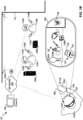
- the artificial reality system 10 may render one or more virtual content items in response to a determination that at least a portion of the location of virtual content items is in the field of view 130 of user 110. For example, artificial reality system 10 may render virtual user interface 137 only if peripheral device 136 is within field of view 130 of user 110.
- Artificial reality system 10 may trigger generation and rendering of virtual content items based on a current field of view 130 of user 110, as may be determined by real-time gaze tracking of the user, or other conditions. More specifically, image capture devices 138 of HMD 112 capture image data representative of objects in the real world, physical environment that are within a field of view 130 of image capture devices 138. Field of view 130 typically corresponds with the viewing perspective of HMD 112. In some examples, the artificial reality application presents artificial reality content 122 comprising mixed reality and/or augmented reality. As illustrated in FIG.
- the artificial reality application may render images of real-world objects, such as the portions of peripheral device 136, hand 132, and/or arm 134 of user 110, that are within field of view 130 along with virtual objects, such as within artificial reality content 122.
- the artificial reality application may render virtual representations of the portions of peripheral device 136, hand 132, and/or arm 134 of user 110 that are within field of view 130 (e.g., render real-world objects as virtual objects) within artificial reality content 122.
- user 110 is able to view the portions of their hand 132, arm 134, peripheral device 136 and/or any other real-world objects that are within field of view 130 within artificial reality content 122.
- the artificial reality application may not render representations of the hand 132 or arm 134 of the user.
- artificial reality system 10 performs object recognition within image data captured by image capture devices 138 of HMD 112 to identify peripheral device 136, hand 132, including optionally identifying individual fingers or the thumb, and/or all or portions of arm 134 of user 110. Further, artificial reality system 10 tracks the position, orientation, and configuration of peripheral device 136, hand 132 (optionally including particular digits of the hand), and/or portions of arm 134 over a sliding window of time.
- peripheral device 136 includes one or more sensors (e.g., accelerometers) for tracking motion or orientation of the peripheral device 136.
- peripheral device 136 may be a smartphone, tablet computer, personal data assistant (PDA), or other hand-held device. In some examples, peripheral device 136 may be a smartwatch, smartring, or other wearable device. Peripheral device 136 may also be part of kiosk or other stationary or mobile system. Peripheral device 136 may or may not include a display device for outputting content to a screen. Peripheral device 136 may be in communication with HMD 112 and/or console 106 using one or more wired or wireless communications links (e.g., Wi-Fi, near-field communication of short-range wireless communication such as Bluetooth).
- wired or wireless communications links e.g., Wi-Fi, near-field communication of short-range wireless communication such as Bluetooth
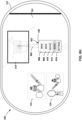
- Virtual user interface 137 includes one or more virtual user interface elements.
- Virtual user interface elements may include, for instance, a virtual drawing interface 142, a selectable menu 144 (e.g., a drop-down menu), virtual buttons 146, a directional pad 148, a keyboard, or other user-selectable user interface elements, glyphs, display elements, content, user interface controls, and so forth.
- the particular virtual user interface elements for virtual user interface 137 may be context-driven based on the current AR applications engaged by the user.
- the AR system 10 detects the user interface and performs an action. For example, the user may press their finger at a physical location on the peripheral device 136 corresponding to a position in the virtual environment at which the AR system 10 renders a virtual user interface button 146 on virtual user interface 137. In this example, the AR system 10 detects this virtual button press gesture and performs an action corresponding to the detected press of a virtual user interface button 146. The AR system 10 may also, for instance, animate a press of the virtual user interface button along with the button press gesture.
- AR system 10 may detect user interface gestures and other gestures using an inside-out or outside-in tracking system of image capture devices 138 and or external cameras. AR system 10 may alternatively, or in addition, detect user interface gestures and other gestures using a presence-sensitive surface. That is, a presence-sensitive interface of peripheral device 136 may receive user inputs that make up a user interface gesture.
- AR systems as described herein can enable the user to provide fine-grained user inputs with respect to virtual user interface elements rendered virtually on a peripheral device 136 that provides haptic feedback, in contrast to free-floating virtual user interfaces in the artificial reality environment.
- This can simplify and improve the precision of gesture detection.
- peripheral device 136 may not display the user interface elements at its own display and may not even include a display.
- the techniques may therefore additionally reduce power consumption and simplify AR applications by eliminating a separate interface that would otherwise need to be generated and displayed, at a presence-sensitive display of a smartphone or tablet for instance, for receiving precision inputs from a user.
- receiving user inputs with a presence-sensitive surface may provide more precise gesture detection than image-based gesture detection techniques.
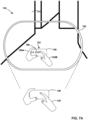
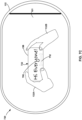
- FIG. 1B is an illustration depicting another example artificial reality system 20 in accordance with techniques of the disclosure. Similar to artificial reality system 10 of FIG. 1A , artificial reality system 20 of FIG. 1B may present and control virtual user interface 137 locked to a position of peripheral device 136 in the artificial reality environment.
- the artificial reality application constructs artificial content by tracking and computing pose information for a frame of reference for each of HMDs 112.
- Artificial reality system 20 uses data received from cameras 102, HMDs 112, and controllers 114 to capture 3D information within the real world environment, such as motion by users 110 and/or tracking information with respect to users 110 and objects 108, for use in computing updated pose information for a corresponding frame of reference of HMDs 112.
- the artificial reality application may render, based on a current viewing perspective determined for HMD 112C, artificial reality content 122 having virtual objects 128A-128B (collectively, "virtual objects 128") as spatially overlaid upon real world objects 108A-108B (collectively, "real world objects 108").
- virtual reality system 20 renders avatars 120A, 120B based upon the estimated positions for users 110A, 110B, respectively.
- Image capture devices 102 and 138 may capture images in the visible light spectrum, the infrared spectrum, or other spectrum.
- Image processing described herein for identifying objects, object poses, and gestures, for example, may include processing infrared images, visible light spectrum images, and so forth.
- Virtual user interface 137 is mapped to a surface of peripheral device 136.
- AR system 10 renders, at a user interface position that is locked relative to a position of peripheral device 136 in the artificial reality environment, virtual user interface 137 for display at HMD 112C as part of artificial reality content 122.
- FIG. 1B shows that virtual user interface 137 appears on peripheral device 136 only within artificial reality content 122, illustrating that this virtual content does not exist in the real world, physical environment.
- HMD 112 further includes one or more motion sensors 206, such as one or more accelerometers (also referred to as inertial measurement units or "IMUs") that output data indicative of current acceleration of HMD 112, GPS sensors that output data indicative of a location of HMD 112, radar or sonar that output data indicative of distances of HMD 112 from various objects, or other sensors that provide indications of a location or orientation of HMD 112 or other objects within a physical environment.
- accelerometers also referred to as inertial measurement units or "IMUs”
- GPS sensors that output data indicative of a location of HMD 112
- radar or sonar that output data indicative of distances of HMD 112 from various objects, or other sensors that provide indications of a location or orientation of HMD 112 or other objects within a physical environment.
- HMD 112 may include integrated image capture devices 138A and 138B (collectively, "image capture devices 138"), such as video cameras, laser scanners, Doppler radar scanners, depth scanners, or the like, configured to output image data representative of the physical environment. More specifically, image capture devices 138 capture image data representative of objects (including peripheral device 136 and/or hand 132) in the physical environment that are within a field of view 130A, 130B of image capture devices 138, which typically corresponds with the viewing perspective of HMD 112.
- image capture devices 138 capture image data representative of objects (including peripheral device 136 and/or hand 132) in the physical environment that are within a field of view 130A, 130B of image capture devices 138, which typically corresponds with the viewing perspective of HMD 112.
- HMD 112 includes an internal control unit 210, which may include an internal power source and one or more printed-circuit boards having one or more processors, memory, and hardware to provide an operating environment for executing programmable operations to process sensed data and present artificial reality content on display 203.
- an internal control unit 210 may include an internal power source and one or more printed-circuit boards having one or more processors, memory, and hardware to provide an operating environment for executing programmable operations to process sensed data and present artificial reality content on display 203.
- control unit 210 is configured to, based on the sensed data (e.g., image data captured by image capture devices 138, position information from GPS sensors), generate and render for display on display 203 a virtual surface comprising one or more virtual content items (e.g., virtual content items 124, 126 of FIG. 1A ) associated with a position contained within field of view 130A, 130B of image capture devices 138.
- sensed data e.g., image data captured by image capture devices 138, position information from GPS sensors
- virtual content items e.g., virtual content items 124, 126 of FIG. 1A
- a virtual content item may be associated with a position within a virtual surface that is associated with a physical surface within a real-world environment, and control unit 210 can be configured to render the virtual content item (or portion thereof) for display on display 203 in response to a determination that the position associated with the virtual content (or portion therefore) is within the current field of view 130A, 130B.
- a virtual surface is associated with a position on a planar or other surface (e.g., a wall), and control unit 210 will generate and render the portions of any virtual content items contained within that virtual surface when those portions are within field of view 130A, 130B.
- control unit 210 is configured to, based on the sensed data, identify a specific gesture or combination of gestures performed by the user and, in response, perform an action. For example, in response to one identified gesture, control unit 210 may generate and render a specific user interface for display on electronic display 203 at a position locked relative to peripheral device 136. For example, control unit 210 can generate and render a user interface including one or more user interface elements (e.g., virtual buttons) on surface 220 of peripheral device 136.
- user interface elements e.g., virtual buttons
- control unit 210 In response to identifying a pre-defined gesture, control unit 210 takes some action, such as selecting an option from an option set associated with a user interface (e.g., selecting an option from a user interface menu), translating the gesture into input (e.g., characters), launching an application, manipulating virtual content (e.g., moving, rotating a virtual content item), generating and rendering virtual markings, generating and rending a laser pointer, or otherwise displaying content, and the like.
- control unit 210 can dynamically generate and present a user interface, such as a menu, in response to detecting a pre-defined gesture specified as a "trigger" for revealing a user interface (e.g., turning peripheral device to a landscape or horizontal orientation (not shown)).
- control unit 210 detects user input, based on the sensed data, with respect to a rendered user interface (e.g., a tapping gesture performed on a virtual user interface element). In some examples, control unit 210 performs such functions in response to direction from an external device, such as console 106, which may perform, object recognition, motion tracking and gesture detection, or any part thereof.
- a rendered user interface e.g., a tapping gesture performed on a virtual user interface element.
- control unit 210 performs such functions in response to direction from an external device, such as console 106, which may perform, object recognition, motion tracking and gesture detection, or any part thereof.
- control unit 210 can utilize image capture devices 138A and 138B to analyze configurations, positions, movements, and/or orientations of peripheral device 136, hand 132 and/or arm 134 to identify a user interface gesture, selection gesture, stamping gesture, translation gesture, rotation gesture, drawing gesture, pointing gesture, etc., that may be performed by users with respect to peripheral device 136.
- the control unit 210 can render a virtual user interface (including virtual user interface elements) and/or a virtual surface (including any virtual content items) and enable the user to interface with the virtual user interface and/or virtual surface based on detection of a user interface gesture, selection gesture, stamping gesture, translation gesture, rotation gesture, and drawing gesture performed by the user with respect to the peripheral device, as described in further detail below.
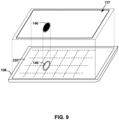
- surface 220 of peripheral device 136 is a presence-sensitive surface, such as a surface that uses capacitive, conductive, resistive, acoustic, or other technology to detect touch and/or hover input.
- surface 220 of peripheral device 136 is a touchscreen (e.g., a capacitive touchscreen, resistive touchscreen, surface acoustic wave (SAW) touchscreen, infrared touchscreen, optical imaging touchscreen, acoustic pulse recognition touchscreen, or any other touchscreen).
- SAW surface acoustic wave
- peripheral device 136 can detect user input (e.g., touch or hover input) on surface 220.
- surface 220 does not include a display and peripheral device 136 does not include a display.
- peripheral device 136 may communicate detected user input to HMD 112 (and/or console 106 of FIG. 1A ) using wireless communications links (e.g., Wi-Fi, near-field communication of short-range wireless communication such as Bluetooth), using wired communication links (not shown), or using other types of communication links.
- peripheral device 136 can include one or more input devices 222 (e.g., buttons, trackball, scroll wheel) for interacting with virtual content (e.g., to select a virtual user interface element, scroll through virtual user interface elements).
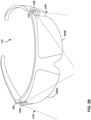
- FIG. 2B is an illustration depicting an example HMD 112, in accordance with techniques of the disclosure.
- HMD 112 may take the form of glasses.
- HMD 112 of FIG. 2A may be an example of any of HMDs 112 of FIGS. 1A and 1B .
- HMD 112 may be part of an artificial reality system, such as artificial reality systems 10, 20 of FIGS. 1A , 1B , or may operate as a stand-alone, mobile artificial realty system configured to implement techniques described herein.
- Electronic displays 203 may be any suitable display technology, such as liquid crystal displays (LCD), quantum dot display, dot matrix displays, light emitting diode (LED) displays, organic light-emitting diode (OLED) displays, cathode ray tube (CRT) displays, e-ink, or monochrome, color, or any other type of display capable of generating visual output.
- LCD liquid crystal displays
- LED light emitting diode
- OLED organic light-emitting diode
- CRT cathode ray tube
- e-ink e-ink
- monochrome color
- HMD 112 further includes one or more motion sensors 206, such as one or more accelerometers (also referred to as inertial measurement units or "IMUs") that output data indicative of current acceleration of HMD 112, GPS sensors that output data indicative of a location of HMD 112, radar or sonar that output data indicative of distances of HMD 112 from various objects, or other sensors that provide indications of a location or orientation of HMD 112 or other objects within a physical environment.
- accelerometers also referred to as inertial measurement units or "IMUs”
- GPS sensors that output data indicative of a location of HMD 112
- radar or sonar that output data indicative of distances of HMD 112 from various objects, or other sensors that provide indications of a location or orientation of HMD 112 or other objects within a physical environment.
- FIG. 3 is a block diagram showing example implementations of console 106, HMD 112, and peripheral device 136 of artificial reality system 10, 20 of FIGS 1A , 1B .
- console 106 performs pose tracking, gesture detection, and virtual user interface generation and rendering for HMD 112 in accordance with techniques described herein based at least on sensed data, such as motion data and image data received from HMD 112 and/or external sensors, and in some cases on indications of user input received by peripheral device 136.
- HMD 112 includes one or more processors 302 and memory 304 that, in some examples, provide a computer platform for executing an operating system 305, which may be an embedded, real-time multitasking operating system, for instance, or other type of operating system.
- operating system 305 provides a multitasking operating environment for executing one or more software components 307, including application engine 340.
- processors 302 are coupled to electronic display 203, motion sensors 206 and image capture devices 138.
- processors 302 and memory 304 may be separate, discrete components.
- memory 304 may be on-chip memory collocated with processors 302 within a single integrated circuit.
- console 106 is a computing device that processes image and tracking information received from cameras 102 ( FIG. 1B ) and/or image capture devices 138 of HMD 112 ( FIGS. 1A , 2A , 2B ) to perform gesture detection and user interface and/or virtual content generation for HMD 112.
- console 106 is a single computing device, such as a workstation, a desktop computer, a laptop, or gaming system.
- console 106 includes one or more processors 312 and memory 314 that, in some examples, provide a computer platform for executing an operating system 316, which may be a multitasking operating system, for instance, or other type of operating system.
- operating system 316 provides a multitasking operating environment for executing one or more software components 317.
- Processors 312 are coupled to one or more I/O interfaces 315, which provides one or more I/O interfaces for communicating with external devices, such as a keyboard, game controllers, display devices, image capture devices, HMDs, and the like.
- the one or more I/O interfaces 315 may include one or more wired or wireless network interface controllers (NICs) for communicating with a network, such as network 104.
- NICs network interface controllers
- Application engine 320 and rendering engine 322 construct the artificial content for display to user 110 in accordance with current pose information for a frame of reference, typically a viewing perspective of HMD 112, as determined by pose tracker 326. Based on the current viewing perspective, rendering engine 322 constructs the 3D, artificial reality content which may in some cases be overlaid, at least in part, upon the real-world 3D environment of user 110.
- pose tracker 326 operates on sensed data received from HMD 112, such as movement information and user commands, and, in some examples, data from any external sensors 90 ( FIGS. 1A , 1B ), such as external cameras, to capture 3D information within the real world environment, such as motion by user 110 and/or feature tracking information with respect to user 110.
- pose tracker 326 determines a current pose for the frame of reference of HMD 112 and, in accordance with the current pose, constructs the artificial reality content for communication, via the one or more I/O interfaces 315, to HMD 112 for display to user 110.
- gesture detector 324 may track movement, including changes to position and orientation, of the peripheral device 136, hand, digits, and/or arm based on the captured image data, and compare motion vectors of the objects to one or more entries in gesture library 330 to detect a gesture or combination of gestures performed by user 110. In some examples, gesture detector 324 may receive user inputs detected by presence-sensitive surface(s) of peripheral device and process the user inputs to detect one or more gestures performed by user 110 with respect to peripheral device 136.
- Gesture detector 324 and gesture library 330 may be distributed, in whole or in part, to peripheral device 136 to process user inputs on peripheral device 136 to detect gestures. In such cases, presence-sensitive surface(s) 220 detects user inputs at locations of the surface. Peripheral device 136 executing gesture detector 324 can process the user inputs to detect one or more gestures of gesture library 330. Peripheral device 136 may send indications of the detected gestures to console 106 and/or HMD 112 to cause the console 106 and/or HMD 112 to responsively perform one or more actions. Peripheral device 136 may alternatively, or additionally, send indications of the user inputs at locations of the surface to console 106, and gesture detector 324 may process the user inputs to detect one or more gestures of gesture library 330.
- Some entries in gesture library 330 may each define a gesture as a series or pattern of motion, such as a relative path or spatial translations and rotations of peripheral device 136, a user's hand, specific fingers, thumbs, wrists and/or arms. Some entries in gesture library 330 may each define a gesture as a configuration, position, and/or orientation of the peripheral device, user's hand and/or arms (or portions thereof) at a particular time, or over a period of time. Some entries in gesture library 330 may each define a gesture as one or more user inputs, over time, detected by presence-sensitive surface(s) 220 of peripheral device 136. Other examples of type of gestures are possible.
- certain gestures may be associated with other actions, such as providing input, selecting virtual objects (including virtual content items and/or user interface elements), translating (e.g., moving, rotating) virtual objects, altering (e.g., scaling, annotating) virtual objects, making virtual markings, launching applications, and other actions.
- actions such as providing input, selecting virtual objects (including virtual content items and/or user interface elements), translating (e.g., moving, rotating) virtual objects, altering (e.g., scaling, annotating) virtual objects, making virtual markings, launching applications, and other actions.
- Gesture detector 324 may process image data from image capture devices 138 to analyze configurations, positions, motions, and/or orientations of peripheral device 136 and/or a user's hand to identify a user interface gesture, selection gesture, stamping gesture, translation gesture, rotation gesture, drawing gesture, pointing gesture, etc. that may be performed by users with respect to peripheral device 136.
- Gesture detector 324 may detect a user interface gesture performed by a user at a position corresponding to one of the virtual user interface elements of a virtual user interface generated by user interface engine 328.
- rendering engine 322 may render the virtual user interface at a position in the artificial reality environment that corresponds to a position of peripheral device 136 in the physical environment.
- Rendering engine 322 renders user interface elements at positions within the virtual user interface that also correspond to positions of locations on the peripheral device 136.
- a gesture performed by a user at one of the positions of the virtual user interface elements is an indication of a gesture performed with respect to the virtual user interface element.
- a user may perform a button press user interface gesture at a location on the peripheral device 136 that is encompassed by and overlaid by a virtual button in the artificial reality environment.
- the artificial reality system may perform one or more actions associated with the virtual user interface element.
- Actions may include, for example, launching an application or performing some action within an application, modifying the virtual user interface, animating artificial reality content such as one of the user interface elements, closing an application, outputting artificial reality for display, configuring an application, modifying an application, or other action by console 106, HMD 112, or peripheral device 136.
- the position corresponding to the virtual user interface element and at which the detected gesture was performed may be a location on a presence-sensitive surface 220.
- User interface engine 328 may store a mapping of locations on the presence-sensitive surface 220 to virtual user interface elements of a virtual user interface.
- user interface engine 328 may map the location to the virtual user interface element.
- the artificial reality system may then perform one or more actions associated with the virtual user interface element.
- the position corresponding to the virtual user interface element and at which the detected gesture was performed may be a location on the peripheral device 136 that is not a presence-sensitive surface.
- User interface engine 328 may store a mapping of locations on peripheral device to virtual user interface elements of a virtual user interface. In response to receiving an indication of a detected gesture at a location of peripheral device 136, user interface engine 328 may map the location to the virtual user interface element. The artificial reality system may then perform one or more actions associated with the virtual user interface element.
- user interface engine 328 may modify the virtual user interface.
- User interface engine 328 may drop down a selection list in response to a detected selection gesture, animate a button press in response to a button press gesture, generate markings at locations in the virtual user interface, and other user interface-type animations or modifications associated with user interfaces.
- Rendering engine 322 renders the modified virtual user interface at the appropriate user interface position, locked to peripheral device 136.
- peripheral device 136 includes one or more processors 346 and memory 344 that, in some examples, provide a computer platform for executing an operating system 342, which may be an embedded, real-time multitasking operating system, for instance, or other type of operating system.
- operating system 346 provides a multitasking operating environment for executing one or more software components.
- peripheral device 136 includes one or more presence-sensitive surfaces 220 (e.g., one or more surfaces that use capacitive, conductive, resistive, acoustic, and/or other technology to detect touch and/or hover input).
- peripheral device 136 can be configured to detect touch and/or hover input at presence-sensitive surface 220, process that input (e.g., at processors 346) and communicate the touch and/or hover input and communicate information about that input (including location information about that input) to console 106 and/or HMD 112.
- presence-sensitive surface(s) 220 can comprise a touchscreen (e.g., a capacitive touchscreen, resistive touchscreen, surface acoustic wave (SAW) touchscreen, infrared touchscreen, optical imaging touchscreen, acoustic pulse recognition touchscreen, or any other touchscreen).
- a touchscreen e.g., a capacitive touchscreen, resistive touchscreen, surface acoustic wave (SAW) touchscreen, infrared touchscreen, optical imaging touchscreen, acoustic pulse recognition touchscreen, or any other touchscreen.
- SAW surface acoustic wave
- peripheral device 136 further includes one or more motion sensors 348, such as one or more accelerometers (also referred to as IMUs) that output data indicative of current acceleration of peripheral device 136, GPS sensors that output data indicative of a location or position of peripheral device, radar or sonar that output data indicative of distances of peripheral device 136 from various objects (e.g., from a wall or other surface), or other sensors that provide indications of a location, position, and/or orientation of peripheral device or other objects within a physical environment.
- processors 346 are coupled to presence-sensitive surface(s) 220 and motion sensors 246.
- processors 346 and memory 344 may be separate, discrete components.
- peripheral device 136 can coexist with the HMD and, in some example, operate as an auxiliary input /output device for the HMD in the virtual environment. In some examples, the peripheral device 136 may operate as an artificial reality co-processing device to which some of the functions of the HMD 112 and/or console 106 are offloaded. In one or more aspects, peripheral device 136 can be a smartphone, tablet, or any other hand-held device.
- each of processors 302, 312, 346 may comprise any one or more of a multi-core processor, a controller, a digital signal processor (DSP), an application specific integrated circuit (ASIC), a field-programmable gate array (FPGA), or equivalent discrete or integrated logic circuitry.
- Memory 304, 314, 344 may comprise any form of memory for storing data and executable software instructions, such as random-access memory (RAM), read only memory (ROM), programmable read only memory (PROM), erasable programmable read only memory (EPROM), electronically erasable programmable read only memory (EEPROM), and flash memory.
- RAM random-access memory
- ROM read only memory
- PROM programmable read only memory
- EPROM erasable programmable read only memory
- EEPROM electronically erasable programmable read only memory
- peripheral device 136 includes an output display, such as a presence-sensitive surface 220 that is a touchscreen
- console 106 may send a communication to peripheral device 136 directing it to deactivate (i.e., turn off) the output display.
- Rendering engine 322 only renders virtual user interface 137 when the output display for the peripheral device 136 is deactivated.
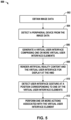
- FIG. 5 is flowchart illustrating an example mode of operation for an artificial reality system, in accordance with one or more aspects of techniques of this disclosure.
- Operations of mode of operation 500 is described in this example with respect to artificial reality system 10 but may be performed by one or more components of any artificial reality system described herein, such as artificial reality systems 10, 20 of FIGS. 1A , 1B .
- some or all of the operations may be performed by one or more of pose tracker (326, 426 of FIGS. 3 and 4 ), gesture detector (324, 424 of FIGS. 3 and 4 ), a user interface engine (328, 428 of FIGS. 3 and 4 ), and a rendering engine (322, 422 of FIGS. 3 and 4 ).
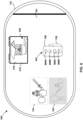
- FIG. 8G is an example HMD display 870 illustrating a transformation gesture in accordance with aspects of the disclosure.
- the user rotates peripheral device 136 counterclockwise while artificial reality content item 816 is active and while the user is selecting rotate element 810.
- the artificial reality system rotates artificial reality content item 816 in accordance with the translation gesture performed with respect to peripheral device 136 (e.g., rotates artificial reality content item 816 as shown in FIG. 8G ).
- a user may press and hold the rotate element 810, rotate the peripheral device 136 or virtual pointer 804 to rotate the artificial reality content 816, and release the rotate element 810 to stop rotating the artificial reality content 816.
- a user may use the virtual pointer 804 to select the artificial reality content, e.g., artificial reality content 816, for which to annotate.
- a user may perform an interface gesture at a position corresponding to one or more of the virtual elements 894 rendered on the peripheral device 136.
- an annotation gesture comprises hand 132 (or one or more fingers of hand 132) selecting (e.g., touching) one of elements 894A-894D.
- a user can annotate active virtual content item 616 by selecting an "emoji" (e.g., any of elements 894A, 894B) that indicates a user's reaction to the virtual content item.
Landscapes
- Engineering & Computer Science (AREA)
- Theoretical Computer Science (AREA)
- General Engineering & Computer Science (AREA)
- Physics & Mathematics (AREA)
- General Physics & Mathematics (AREA)
- Human Computer Interaction (AREA)
- Computer Hardware Design (AREA)
- Software Systems (AREA)
- Optics & Photonics (AREA)
- Computer Graphics (AREA)
- Multimedia (AREA)
- User Interface Of Digital Computer (AREA)
Claims (12)
- Ein System (10) künstlicher Realität, das Folgendes beinhaltet:eine Bilderfassungsvorrichtung (138), die konfiguriert ist, um Bilddaten zu erfassen;eine am Kopf befestigte Anzeige (HMD) (112), die konfiguriert ist, um Inhalte (122) der künstlichen Realität auszugeben;ein Peripheriegerät (136), das eine Anzeige umfasst;eine Benutzerschnittstellenengine (328, 428), die konfiguriert ist, um das Peripheriegerät (136) anhand der Bilddaten zu erkennen,dadurch gekennzeichnet, dass die Benutzerschnittstellenengine (328, 428) ferner für Folgendes konfiguriert ist:Senden einer Nachrichtenübermittlung an das Peripheriegerät (136), um zu bewirken,dass das Peripheriegerät die Anzeige deaktiviert,Empfangen einer Angabe, dass die Anzeige deaktiviert ist,Erzeugen, als Antwort auf das Bestimmen, basierend auf der Angabe, dass die Anzeige deaktiviert ist, einer virtuellen Benutzerschnittstelle (137), die als eine Oberfläche des Peripheriegeräts (136) erscheint und eines oder mehrere virtuelle Benutzerschnittstellenelemente beinhaltet;wobei das System (10) künstlicher Realität ferner Folgendes beinhaltet:
eine Renderingengine (322, 422), die konfiguriert ist, um den Inhalt der künstlichen Realität zu rendern und an einer Benutzerschnittstellenposition, die relativ zu einer Position des Peripheriegeräts (136) in dem Inhalt (122) der künstlichen Realität fixiert ist, die virtuelle Benutzerschnittstelle (137) zur Anzeige an der HMD (112) zu rendern. - System künstlicher Realität gemäß Anspruch 1, das ferner Folgendes beinhaltet:einen Gestenerkenner (324), der konfiguriert ist, um eine Benutzerschnittstellengeste zu erkennen, die von einem Benutzer an einer Position durchgeführt wird, die einem der virtuellen Benutzerschnittstellenelemente entspricht,wobei das System (10) künstlicher Realität konfiguriert ist, um als Antwort auf die Benutzerschnittstellengeste eine oder mehrere Aktionen durchzuführen, die mit dem einen der virtuellen Benutzerschnittstellenelemente assoziiert sind.
- System künstlicher Realität gemäß Anspruch 2,
wobei das Peripheriegerät (136) eine präsenzempfindliche Schnittstelle beinhaltet, die konfiguriert ist, um eine oder mehrere Eingaben durch einen Benutzer zu empfangen, wobei der Gestenerkenner konfiguriert ist, um die Benutzerschnittstellengeste basierend auf der einen oder den mehreren Eingaben zu erkennen. - System künstlicher Realität gemäß Anspruch 2,wobei die Benutzerschnittstellenengine (328, 428) zum Durchführen der einen oder der mehreren Aktionen konfiguriert ist, um die virtuelle Benutzerschnittstelle (137) zu modifizieren, um eine modifizierte virtuelle Benutzerschnittstelle zu erzeugen, die ein oder mehrere modifizierte virtuelle Benutzerschnittstellenelemente beinhaltet, undwobei die Renderingengine (322, 422) konfiguriert ist, um an der Benutzerschnittstellenposition die modifizierte virtuelle Benutzerschnittstelle (137) zur Anzeige an der HMD (112) zu rendern.
- System künstlicher Realität gemäß Anspruch 1,wobei die Renderingengine (322, 422) zum Rendern der virtuellen Benutzerschnittstelle konfiguriert ist, um die virtuelle Benutzerschnittstelle (137) überlagert auf einer Oberfläche des Peripheriegeräts (136) zu rendern, undwobei die Oberfläche des Peripheriegeräts (136) optional eine präsenzempfindliche Schnittstelle beinhaltet.
- System künstlicher Realität gemäß Anspruch 1, das ferner Folgendes beinhaltet:das Peripheriegerät (136),wobei das Peripheriegerät einen Gestenerkenner beinhaltet, der konfiguriert ist, um eine Benutzerschnittstellengeste zu erkennen, die von einem Benutzer an einer Position durchgeführt wird, die einem der virtuellen Benutzerschnittstellenelemente entspricht, undwobei die HMD (112) konfiguriert ist, um als Antwort auf die Benutzerschnittstellengeste eine oder mehrere Aktionen durchzuführen, die mit dem einen der virtuellen Benutzerschnittstellenelemente assoziiert sind.
- System künstlicher Realität gemäß Anspruch 1, das ferner Folgendes beinhaltet:einen Gestenerkenner, der konfiguriert ist, um eine Malgeste zu erkennen, die von einem Benutzer an Positionen durchgeführt wird, die Positionen auf der virtuellen Benutzerschnittstelle (137) entsprechen,wobei die Benutzerschnittstellenengine (328, 428) konfiguriert ist, um als Antwort auf die Malgeste eine modifizierte virtuelle Benutzerschnittstelle zu erzeugen, die virtuelle Markierungen an den Positionen auf der virtuellen Benutzerschnittstelle beinhaltet,wobei die Renderingengine (322, 422) konfiguriert ist, um an der Benutzerschnittstellenposition die modifizierte virtuelle Benutzerschnittstelle zur Anzeige an der HMD (112) zu rendern.
- System künstlicher Realität gemäß Anspruch 1, wobei das Peripheriegerät (136) eines von einem Smartphone, einer Smartwatch oder einem Tablet-Computer beinhaltet.
- Ein Verfahren, das Folgendes beinhaltet:Erhalten, durch ein System (10) künstlicher Realität, das eine am Kopf befestigte Anzeige (HMD) (112) umfasst, von Bilddaten über eine Bilderfassungsvorrichtung (138), wobei die HMD (112) konfiguriert ist, um Inhalt (122) der künstlichen Realität auszugeben;Erkennen, anhand der Bilddaten, durch das System (10) künstlicher Realität, eines Peripheriegeräts (136), das eine Anzeige umfasst;gekennzeichnet durch:Senden, durch das System (10) künstlicher Realität, einer Nachrichtenübermittlung an das Peripheriegerät (136), um zu bewirken, dass das Peripheriegerät die Anzeige deaktiviert,Empfangen, durch das System (10) künstlicher Realität, einer Angabe, dass die Anzeige deaktiviert ist;Erzeugen, durch das System (10) künstlicher Realität, als Antwort auf das Bestimmen, basierend auf der Angabe, dass die Anzeige deaktiviert ist, einer virtuellen Benutzerschnittstelle, die als eine Oberfläche des Peripheriegeräts (136) erscheint und ein oder mehrere virtuelle Benutzerschnittstellenelemente beinhaltet; undRendern, durch das System (10) künstlicher Realität, des Inhalts der künstlichen Realität und an einer Benutzerschnittstellenposition, die relativ zu einer Position des Peripheriegeräts (136) in dem Inhalt (122) der künstlichen Realität fixiert ist, der virtuellen Benutzerschnittstelle zur Anzeige an der HMD (112).
- Verfahren gemäß Anspruch 9, das ferner Folgendes beinhaltet:Erkennen, durch das System (10) künstlicher Realität, einer Benutzerschnittstellengeste, die von einem Benutzer an einer Position durchgeführt wird, die einem der virtuellen Benutzerschnittstellenelemente entspricht;Durchführen, durch das System (10) künstlicher Realität als Antwort auf die Benutzerschnittstellengeste, einer oder mehrerer Aktionen, die mit dem einen der virtuellen Benutzerschnittstellenelemente assoziiert sind.
- Verfahren gemäß Anspruch 10,wobei das Verfahren ferner das Empfangen, an einer präsenzempfindlichen Schnittstelle des Peripheriegeräts (136), einer oder mehrerer Eingaben durch einen Benutzer beinhaltet, wobei das Erkennen das Erkennen, basierend auf der einen oder den mehreren Eingaben, der Benutzerschnittstellengeste beinhaltet, oderwobei das Durchführen der einen oder der mehreren Aktionen das Modifizieren der virtuellen Benutzerschnittstelle beinhaltet, um eine modifizierte virtuelle Benutzerschnittstelle zu erzeugen, die ein oder mehrere modifizierte virtuelle Benutzerschnittstellenelemente beinhaltet, und wobei das Verfahren ferner das Rendern, an der Benutzerschnittstellenposition, der modifizierten virtuellen Benutzerschnittstelle zur Anzeige an der HMD (112) beinhaltet.
- Ein nichttransitorisches, computerlesbares Medium, das Anweisungen beinhaltet, die, wenn sie ausgeführt werden, bewirken, dass ein oder mehrere Prozessoren eines Systems (10) künstlicher Realität, das eine am Kopf befestigte Anzeige (HMD) (112) umfasst, die konfiguriert ist, um Inhalt (122) der künstlichen Realität auszugeben, das Verfahren gemäß einem der Ansprüche 9 bis 11 durchführen.
Applications Claiming Priority (2)
| Application Number | Priority Date | Filing Date | Title |
|---|---|---|---|
| US16/506,618 US20210011556A1 (en) | 2019-07-09 | 2019-07-09 | Virtual user interface using a peripheral device in artificial reality environments |
| PCT/US2020/041028 WO2021007221A1 (en) | 2019-07-09 | 2020-07-07 | Virtual user interface using a peripheral device in artificial reality environments |
Publications (2)
| Publication Number | Publication Date |
|---|---|
| EP3997552A1 EP3997552A1 (de) | 2022-05-18 |
| EP3997552B1 true EP3997552B1 (de) | 2024-07-03 |
Family
ID=71833468
Family Applications (1)
| Application Number | Title | Priority Date | Filing Date |
|---|---|---|---|
| EP20746809.1A Active EP3997552B1 (de) | 2019-07-09 | 2020-07-07 | Virtuelle benutzerschnittstelle mit verwendung einer peripheren vorrichtung in umgebungen der künstlichen realität |
Country Status (7)
| Country | Link |
|---|---|
| US (1) | US20210011556A1 (de) |
| EP (1) | EP3997552B1 (de) |
| JP (1) | JP2022540315A (de) |
| KR (1) | KR20220030294A (de) |
| CN (1) | CN114080585A (de) |
| TW (1) | TW202105133A (de) |
| WO (1) | WO2021007221A1 (de) |
Families Citing this family (74)
| Publication number | Priority date | Publication date | Assignee | Title |
|---|---|---|---|---|
| US11323495B2 (en) * | 2015-07-27 | 2022-05-03 | Autodesk, Inc. | Sharing computer application activities |
| US11184574B2 (en) | 2017-07-17 | 2021-11-23 | Facebook, Inc. | Representing real-world objects with a virtual reality environment |
| US11861136B1 (en) * | 2017-09-29 | 2024-01-02 | Apple Inc. | Systems, methods, and graphical user interfaces for interacting with virtual reality environments |
| US11409671B2 (en) | 2019-09-19 | 2022-08-09 | Facebook Technologies, Llc | Artificial reality system having multi-bank, multi-port distributed shared memory |
| US11487594B1 (en) | 2019-09-24 | 2022-11-01 | Meta Platforms Technologies, Llc | Artificial reality system with inter-processor communication (IPC) |
| US11474970B2 (en) | 2019-09-24 | 2022-10-18 | Meta Platforms Technologies, Llc | Artificial reality system with inter-processor communication (IPC) |
| US11086476B2 (en) * | 2019-10-23 | 2021-08-10 | Facebook Technologies, Llc | 3D interactions with web content |
| US11196846B2 (en) | 2019-11-15 | 2021-12-07 | Facebook Technologies, Llc | Inline encryption of packet data in a wireless communication system |
| US11520707B2 (en) | 2019-11-15 | 2022-12-06 | Meta Platforms Technologies, Llc | System on a chip (SoC) communications to prevent direct memory access (DMA) attacks |
| US11368283B2 (en) | 2019-11-15 | 2022-06-21 | Facebook Technologies, Llc | Encryption and decryption engines with selective key expansion skipping |
| US11475639B2 (en) | 2020-01-03 | 2022-10-18 | Meta Platforms Technologies, Llc | Self presence in artificial reality |
| US12299340B2 (en) * | 2020-04-17 | 2025-05-13 | Apple Inc. | Multi-device continuity for use with extended reality systems |
| WO2021236170A1 (en) * | 2020-05-18 | 2021-11-25 | Google Llc | Low-power semi-passive relative six-degree-of-freedom tracking |
| US11954268B2 (en) * | 2020-06-30 | 2024-04-09 | Snap Inc. | Augmented reality eyewear 3D painting |
| WO2022067342A2 (en) | 2020-09-25 | 2022-03-31 | Apple Inc. | Methods for interacting with virtual controls and/or an affordance for moving virtual objects in virtual environments |
| US11694376B2 (en) * | 2020-10-19 | 2023-07-04 | Adobe Inc. | Intuitive 3D transformations for 2D graphics |
| US12223104B2 (en) | 2020-12-22 | 2025-02-11 | Meta Platforms Technologies, Llc | Partial passthrough in virtual reality |
| US11449606B1 (en) | 2020-12-23 | 2022-09-20 | Facebook Technologies, Llc | Monitoring circuit including cascaded s-boxes for fault injection attack protection |
| US12200130B1 (en) | 2020-12-30 | 2025-01-14 | Meta Platforms Technologies, Llc | ROM instruction authentication and integrity verification for artificial reality security controller |
| US12045921B2 (en) * | 2020-12-30 | 2024-07-23 | Snap Inc. | Automated content curation for generating composite augmented reality content |
| US12299183B1 (en) | 2020-12-31 | 2025-05-13 | Meta Platforms Technologies, Llc | Tamper detection and prevention in computer systems having one-time programmable memory |
| TWI821878B (zh) * | 2021-02-02 | 2023-11-11 | 仁寶電腦工業股份有限公司 | 虛實互動方法及虛實互動系統 |
| JP7642389B2 (ja) * | 2021-02-10 | 2025-03-10 | キヤノン株式会社 | 撮像システム、表示装置、撮像装置、および撮像システムの制御方法 |
| US11995230B2 (en) | 2021-02-11 | 2024-05-28 | Apple Inc. | Methods for presenting and sharing content in an environment |
| US12183035B1 (en) | 2021-03-08 | 2024-12-31 | Meta Platforms, Inc. | System and method for positioning a 3D eyeglasses model |
| US11972505B2 (en) * | 2021-06-15 | 2024-04-30 | Lenovo (Singapore) Pte. Ltd. | Augmented image overlay on external panel |
| US11295503B1 (en) | 2021-06-28 | 2022-04-05 | Facebook Technologies, Llc | Interactive avatars in artificial reality |
| TWI784645B (zh) * | 2021-07-29 | 2022-11-21 | 宏碁股份有限公司 | 擴增實境系統及其操作方法 |
| JP7767760B2 (ja) * | 2021-07-30 | 2025-11-12 | 富士フイルムビジネスイノベーション株式会社 | 装置およびプログラム |
| WO2023028571A1 (en) * | 2021-08-27 | 2023-03-02 | Chinook Labs Llc | System and method of augmented representation of an electronic device |
| US11644972B2 (en) | 2021-09-24 | 2023-05-09 | Htc Corporation | Virtual image display device and setting method for input interface thereof |
| TWI803134B (zh) * | 2021-09-24 | 2023-05-21 | 宏達國際電子股份有限公司 | 虛擬影像顯示裝置及其輸入介面的設定方法 |
| JP7779062B2 (ja) | 2021-09-27 | 2025-12-03 | 富士フイルムビジネスイノベーション株式会社 | 情報処理装置、情報処理システム、およびプログラム |
| WO2023080958A1 (en) * | 2021-11-04 | 2023-05-11 | Microsoft Technology Licensing, Llc. | Intelligent keyboard attachment for mixed reality input |
| US11797175B2 (en) * | 2021-11-04 | 2023-10-24 | Microsoft Technology Licensing, Llc | Intelligent keyboard attachment for mixed reality input |
| US12456271B1 (en) | 2021-11-19 | 2025-10-28 | Apple Inc. | System and method of three-dimensional object cleanup and text annotation |
| US12147613B2 (en) * | 2021-12-06 | 2024-11-19 | Htc Corporation | Control method, virtual reality system, and non-transitory computer readable storage medium with map of head-mounted device |
| TWI854368B (zh) * | 2021-12-06 | 2024-09-01 | 宏達國際電子股份有限公司 | 控制方法、虛擬實境系統及非暫態電腦可讀取儲存媒體 |
| US12229899B2 (en) | 2021-12-06 | 2025-02-18 | Htc Corporation | Tracking device, head-mounted display device, and virtual reality system |
| EP4453695A1 (de) | 2021-12-23 | 2024-10-30 | Apple Inc. | Verfahren zur gemeinsamen nutzung von inhalten und zur interaktion mit physikalischen vorrichtungen in einer dreidimensionalen umgebung |
| EP4463754A1 (de) | 2022-01-12 | 2024-11-20 | Apple Inc. | Verfahren zur anzeige, auswahl und bewegung von objekten und behältern in einer umgebung |
| JP7843357B2 (ja) | 2022-01-19 | 2026-04-09 | アップル インコーポレイテッド | 環境内にオブジェクトを表示及び再位置決めするための方法 |
| US12541280B2 (en) | 2022-02-28 | 2026-02-03 | Apple Inc. | System and method of three-dimensional placement and refinement in multi-user communication sessions |
| US12045385B2 (en) * | 2022-03-23 | 2024-07-23 | Htc Corporation | Wearable tracking system and wearable tracking method |
| US12242666B2 (en) | 2022-04-08 | 2025-03-04 | Meta Platforms Technologies, Llc | Artificial reality input using multiple modalities |
| US12093462B2 (en) | 2022-04-11 | 2024-09-17 | Meta Platforms Technologies, Llc | Virtual keyboard selections using multiple input modalities |
| US11836205B2 (en) | 2022-04-20 | 2023-12-05 | Meta Platforms Technologies, Llc | Artificial reality browser configured to trigger an immersive experience |
| CN119404170A (zh) | 2022-04-20 | 2025-02-07 | 苹果公司 | 三维环境中的被遮蔽对象 |
| US11847267B2 (en) * | 2022-05-11 | 2023-12-19 | Hewlett-Packard Development Company, L.P. | Input device tracking systems |
| US12299252B2 (en) * | 2022-06-10 | 2025-05-13 | Meta Platforms Technologies, Llc | Systems and methods for coordinating operation of a head-wearable device and an electronic device to assist a user in interacting with the electronic device |
| CN117289850A (zh) * | 2022-06-16 | 2023-12-26 | 北京字跳网络技术有限公司 | 显示控制方法、装置、电子设备、介质及程序产品 |
| US20230419617A1 (en) | 2022-06-22 | 2023-12-28 | Meta Platforms Technologies, Llc | Virtual Personal Interface for Control and Travel Between Virtual Worlds |
| US12353673B2 (en) * | 2022-07-15 | 2025-07-08 | Samsung Electronics Co., Ltd. | Control-deck graphical user interface in XR |
| US12277301B2 (en) | 2022-08-18 | 2025-04-15 | Meta Platforms Technologies, Llc | URL access to assets within an artificial reality universe on both 2D and artificial reality interfaces |
| US12097427B1 (en) | 2022-08-26 | 2024-09-24 | Meta Platforms Technologies, Llc | Alternate avatar controls |
| US12112011B2 (en) | 2022-09-16 | 2024-10-08 | Apple Inc. | System and method of application-based three-dimensional refinement in multi-user communication sessions |
| KR20250057045A (ko) | 2022-09-23 | 2025-04-28 | 애플 인크. | 3차원 환경에서의 깊이 충돌 완화를 위한 방법들 |
| US20240103704A1 (en) | 2022-09-24 | 2024-03-28 | Apple Inc. | Methods for interacting with user interfaces based on attention |
| US20240233288A1 (en) | 2022-09-24 | 2024-07-11 | Apple Inc. | Methods for controlling and interacting with a three-dimensional environment |
| WO2024064950A1 (en) | 2022-09-24 | 2024-03-28 | Apple Inc. | Methods for time of day adjustments for environments and environment presentation during communication sessions |
| US12175603B2 (en) | 2022-09-29 | 2024-12-24 | Meta Platforms Technologies, Llc | Doors for artificial reality universe traversal |
| US12218944B1 (en) | 2022-10-10 | 2025-02-04 | Meta Platform Technologies, LLC | Group travel between artificial reality destinations |
| US12547237B1 (en) | 2022-10-24 | 2026-02-10 | Meta Platforms Technologies, Llc | Artificial reality input for two-dimensional virtual objects |
| US12399571B2 (en) * | 2022-12-19 | 2025-08-26 | T-Mobile Usa, Inc. | Hand-movement based interaction with augmented reality objects |
| US12547432B1 (en) | 2022-12-27 | 2026-02-10 | Apple Inc. | Systems and methods of transferring user interaction between two computer systems |
| CN120813918A (zh) | 2023-01-30 | 2025-10-17 | 苹果公司 | 用于响应于注视和/或手势输入来显示多组控件的设备、方法和图形用户界面 |
| US12483805B2 (en) | 2023-02-13 | 2025-11-25 | Meta Platforms Technologies, Llc | Automatic termination of image sensor for analog histogram depth sensing |
| US12182325B2 (en) | 2023-04-25 | 2024-12-31 | Apple Inc. | System and method of representations of user interfaces of an electronic device |
| US12321515B2 (en) * | 2023-04-25 | 2025-06-03 | Apple Inc. | System and method of representations of user interfaces of an electronic device |
| WO2024254096A1 (en) | 2023-06-04 | 2024-12-12 | Apple Inc. | Methods for managing overlapping windows and applying visual effects |
| US20250068297A1 (en) * | 2023-08-23 | 2025-02-27 | Meta Platforms Technologies, Llc | Gesture-Engaged Virtual Menu for Controlling Actions on an Artificial Reality Device |
| US12561924B2 (en) | 2023-09-29 | 2026-02-24 | Apple Inc. | Displaying extended reality media feed using media links |
| US20250377719A1 (en) | 2024-06-09 | 2025-12-11 | Apple Inc. | Methods of interacting with content in a virtual environment |
| US20260086758A1 (en) * | 2024-09-26 | 2026-03-26 | Apple Inc. | Systems and methods of transferring presentation of content between a first electronic device and a second electronic device |
Family Cites Families (8)
| Publication number | Priority date | Publication date | Assignee | Title |
|---|---|---|---|---|
| US9001153B2 (en) * | 2012-03-21 | 2015-04-07 | GM Global Technology Operations LLC | System and apparatus for augmented reality display and controls |
| US20160054791A1 (en) * | 2014-08-25 | 2016-02-25 | Daqri, Llc | Navigating augmented reality content with a watch |
| CN107615214B (zh) * | 2015-05-21 | 2021-07-13 | 日本电气株式会社 | 界面控制系统、界面控制装置、界面控制方法及程序 |
| US10754416B2 (en) * | 2016-11-14 | 2020-08-25 | Logitech Europe S.A. | Systems and methods for a peripheral-centric augmented/virtual reality environment |
| US10147243B2 (en) * | 2016-12-05 | 2018-12-04 | Google Llc | Generating virtual notation surfaces with gestures in an augmented and/or virtual reality environment |
| US10754496B2 (en) * | 2017-08-24 | 2020-08-25 | Microsoft Technology Licensing, Llc | Virtual reality input |
| US10591730B2 (en) * | 2017-08-25 | 2020-03-17 | II Jonathan M. Rodriguez | Wristwatch based interface for augmented reality eyewear |
| JP7005753B2 (ja) * | 2017-09-29 | 2022-02-10 | アップル インコーポレイテッド | プライバシースクリーン |
-
2019
- 2019-07-09 US US16/506,618 patent/US20210011556A1/en not_active Abandoned
-
2020
- 2020-07-07 WO PCT/US2020/041028 patent/WO2021007221A1/en not_active Ceased
- 2020-07-07 KR KR1020227004212A patent/KR20220030294A/ko not_active Ceased
- 2020-07-07 EP EP20746809.1A patent/EP3997552B1/de active Active
- 2020-07-07 CN CN202080049039.6A patent/CN114080585A/zh active Pending
- 2020-07-07 JP JP2021572856A patent/JP2022540315A/ja active Pending
- 2020-07-08 TW TW109123051A patent/TW202105133A/zh unknown
Also Published As
| Publication number | Publication date |
|---|---|
| TW202105133A (zh) | 2021-02-01 |
| WO2021007221A1 (en) | 2021-01-14 |
| JP2022540315A (ja) | 2022-09-15 |
| US20210011556A1 (en) | 2021-01-14 |
| EP3997552A1 (de) | 2022-05-18 |
| CN114080585A (zh) | 2022-02-22 |
| KR20220030294A (ko) | 2022-03-10 |
Similar Documents
| Publication | Publication Date | Title |
|---|---|---|
| EP3997552B1 (de) | Virtuelle benutzerschnittstelle mit verwendung einer peripheren vorrichtung in umgebungen der künstlichen realität | |
| US11023035B1 (en) | Virtual pinboard interaction using a peripheral device in artificial reality environments | |
| USRE50598E1 (en) | Artificial reality system having a sliding menu | |
| US12099693B2 (en) | Detecting input in artificial reality systems based on a pinch and pull gesture | |
| US10976804B1 (en) | Pointer-based interaction with a virtual surface using a peripheral device in artificial reality environments | |
| US11003307B1 (en) | Artificial reality systems with drawer simulation gesture for gating user interface elements | |
| US11043192B2 (en) | Corner-identifiying gesture-driven user interface element gating for artificial reality systems | |
| US10921879B2 (en) | Artificial reality systems with personal assistant element for gating user interface elements | |
| US11422669B1 (en) | Detecting input using a stylus in artificial reality systems based on a stylus movement after a stylus selection action | |
| US20200387286A1 (en) | Arm gaze-driven user interface element gating for artificial reality systems | |
| US11086475B1 (en) | Artificial reality systems with hand gesture-contained content window | |
| US10990240B1 (en) | Artificial reality system having movable application content items in containers | |
| US20200387214A1 (en) | Artificial reality system having a self-haptic virtual keyboard | |
| US10955929B2 (en) | Artificial reality system having a digit-mapped self-haptic input method | |
| US11023036B1 (en) | Virtual drawing surface interaction using a peripheral device in artificial reality environments | |
| US10852839B1 (en) | Artificial reality systems with detachable personal assistant for gating user interface elements | |
| US11816757B1 (en) | Device-side capture of data representative of an artificial reality environment |
Legal Events
| Date | Code | Title | Description |
|---|---|---|---|
| STAA | Information on the status of an ep patent application or granted ep patent |
Free format text: STATUS: UNKNOWN |
|
| STAA | Information on the status of an ep patent application or granted ep patent |
Free format text: STATUS: THE INTERNATIONAL PUBLICATION HAS BEEN MADE |
|
| PUAI | Public reference made under article 153(3) epc to a published international application that has entered the european phase |
Free format text: ORIGINAL CODE: 0009012 |
|
| STAA | Information on the status of an ep patent application or granted ep patent |
Free format text: STATUS: REQUEST FOR EXAMINATION WAS MADE |
|
| 17P | Request for examination filed |
Effective date: 20220110 |
|
| AK | Designated contracting states |
Kind code of ref document: A1 Designated state(s): AL AT BE BG CH CY CZ DE DK EE ES FI FR GB GR HR HU IE IS IT LI LT LU LV MC MK MT NL NO PL PT RO RS SE SI SK SM TR |
|
| DAV | Request for validation of the european patent (deleted) | ||
| DAX | Request for extension of the european patent (deleted) | ||
| GRAP | Despatch of communication of intention to grant a patent |
Free format text: ORIGINAL CODE: EPIDOSNIGR1 |
|
| STAA | Information on the status of an ep patent application or granted ep patent |
Free format text: STATUS: GRANT OF PATENT IS INTENDED |
|
| INTG | Intention to grant announced |
Effective date: 20230810 |
|
| RAP3 | Party data changed (applicant data changed or rights of an application transferred) |
Owner name: META PLATFORMS TECHNOLOGIES, LLC |
|
| GRAJ | Information related to disapproval of communication of intention to grant by the applicant or resumption of examination proceedings by the epo deleted |
Free format text: ORIGINAL CODE: EPIDOSDIGR1 |
|
| STAA | Information on the status of an ep patent application or granted ep patent |
Free format text: STATUS: REQUEST FOR EXAMINATION WAS MADE |
|
| INTC | Intention to grant announced (deleted) | ||
| GRAP | Despatch of communication of intention to grant a patent |
Free format text: ORIGINAL CODE: EPIDOSNIGR1 |
|
| STAA | Information on the status of an ep patent application or granted ep patent |
Free format text: STATUS: GRANT OF PATENT IS INTENDED |
|
| INTG | Intention to grant announced |
Effective date: 20240125 |
|
| GRAS | Grant fee paid |
Free format text: ORIGINAL CODE: EPIDOSNIGR3 |
|
| GRAA | (expected) grant |
Free format text: ORIGINAL CODE: 0009210 |
|
| STAA | Information on the status of an ep patent application or granted ep patent |
Free format text: STATUS: THE PATENT HAS BEEN GRANTED |
|
| AK | Designated contracting states |
Kind code of ref document: B1 Designated state(s): AL AT BE BG CH CY CZ DE DK EE ES FI FR GB GR HR HU IE IS IT LI LT LU LV MC MK MT NL NO PL PT RO RS SE SI SK SM TR |
|
| P01 | Opt-out of the competence of the unified patent court (upc) registered |
Effective date: 20240528 |
|
| REG | Reference to a national code |
Ref country code: CH Ref legal event code: EP |
|
| REG | Reference to a national code |
Ref country code: DE Ref legal event code: R096 Ref document number: 602020033365 Country of ref document: DE |
|
| REG | Reference to a national code |
Ref country code: LT Ref legal event code: MG9D |
|
| REG | Reference to a national code |
Ref country code: NL Ref legal event code: MP Effective date: 20240703 |
|
| PG25 | Lapsed in a contracting state [announced via postgrant information from national office to epo] |
Ref country code: PT Free format text: LAPSE BECAUSE OF FAILURE TO SUBMIT A TRANSLATION OF THE DESCRIPTION OR TO PAY THE FEE WITHIN THE PRESCRIBED TIME-LIMIT Effective date: 20241104 |
|
| REG | Reference to a national code |
Ref country code: AT Ref legal event code: MK05 Ref document number: 1700504 Country of ref document: AT Kind code of ref document: T Effective date: 20240703 |
|
| PG25 | Lapsed in a contracting state [announced via postgrant information from national office to epo] |
Ref country code: NL Free format text: LAPSE BECAUSE OF FAILURE TO SUBMIT A TRANSLATION OF THE DESCRIPTION OR TO PAY THE FEE WITHIN THE PRESCRIBED TIME-LIMIT Effective date: 20240703 |
|
| PG25 | Lapsed in a contracting state [announced via postgrant information from national office to epo] |
Ref country code: PT Free format text: LAPSE BECAUSE OF FAILURE TO SUBMIT A TRANSLATION OF THE DESCRIPTION OR TO PAY THE FEE WITHIN THE PRESCRIBED TIME-LIMIT Effective date: 20241104 Ref country code: NL Free format text: LAPSE BECAUSE OF FAILURE TO SUBMIT A TRANSLATION OF THE DESCRIPTION OR TO PAY THE FEE WITHIN THE PRESCRIBED TIME-LIMIT Effective date: 20240703 |
|
| PG25 | Lapsed in a contracting state [announced via postgrant information from national office to epo] |
Ref country code: NO Free format text: LAPSE BECAUSE OF FAILURE TO SUBMIT A TRANSLATION OF THE DESCRIPTION OR TO PAY THE FEE WITHIN THE PRESCRIBED TIME-LIMIT Effective date: 20241003 |
|
| PG25 | Lapsed in a contracting state [announced via postgrant information from national office to epo] |
Ref country code: GR Free format text: LAPSE BECAUSE OF FAILURE TO SUBMIT A TRANSLATION OF THE DESCRIPTION OR TO PAY THE FEE WITHIN THE PRESCRIBED TIME-LIMIT Effective date: 20241004 Ref country code: PL Free format text: LAPSE BECAUSE OF FAILURE TO SUBMIT A TRANSLATION OF THE DESCRIPTION OR TO PAY THE FEE WITHIN THE PRESCRIBED TIME-LIMIT Effective date: 20240703 Ref country code: FI Free format text: LAPSE BECAUSE OF FAILURE TO SUBMIT A TRANSLATION OF THE DESCRIPTION OR TO PAY THE FEE WITHIN THE PRESCRIBED TIME-LIMIT Effective date: 20240703 |
|
| PG25 | Lapsed in a contracting state [announced via postgrant information from national office to epo] |
Ref country code: BG Free format text: LAPSE BECAUSE OF FAILURE TO SUBMIT A TRANSLATION OF THE DESCRIPTION OR TO PAY THE FEE WITHIN THE PRESCRIBED TIME-LIMIT Effective date: 20240703 |
|
| PG25 | Lapsed in a contracting state [announced via postgrant information from national office to epo] |
Ref country code: LV Free format text: LAPSE BECAUSE OF FAILURE TO SUBMIT A TRANSLATION OF THE DESCRIPTION OR TO PAY THE FEE WITHIN THE PRESCRIBED TIME-LIMIT Effective date: 20240703 |
|
| PG25 | Lapsed in a contracting state [announced via postgrant information from national office to epo] |
Ref country code: AT Free format text: LAPSE BECAUSE OF FAILURE TO SUBMIT A TRANSLATION OF THE DESCRIPTION OR TO PAY THE FEE WITHIN THE PRESCRIBED TIME-LIMIT Effective date: 20240703 Ref country code: IS Free format text: LAPSE BECAUSE OF FAILURE TO SUBMIT A TRANSLATION OF THE DESCRIPTION OR TO PAY THE FEE WITHIN THE PRESCRIBED TIME-LIMIT Effective date: 20241103 |
|
| PG25 | Lapsed in a contracting state [announced via postgrant information from national office to epo] |
Ref country code: HR Free format text: LAPSE BECAUSE OF FAILURE TO SUBMIT A TRANSLATION OF THE DESCRIPTION OR TO PAY THE FEE WITHIN THE PRESCRIBED TIME-LIMIT Effective date: 20240703 Ref country code: CZ Free format text: LAPSE BECAUSE OF FAILURE TO SUBMIT A TRANSLATION OF THE DESCRIPTION OR TO PAY THE FEE WITHIN THE PRESCRIBED TIME-LIMIT Effective date: 20240703 |
|
| PG25 | Lapsed in a contracting state [announced via postgrant information from national office to epo] |
Ref country code: RS Free format text: LAPSE BECAUSE OF FAILURE TO SUBMIT A TRANSLATION OF THE DESCRIPTION OR TO PAY THE FEE WITHIN THE PRESCRIBED TIME-LIMIT Effective date: 20241003 Ref country code: ES Free format text: LAPSE BECAUSE OF FAILURE TO SUBMIT A TRANSLATION OF THE DESCRIPTION OR TO PAY THE FEE WITHIN THE PRESCRIBED TIME-LIMIT Effective date: 20240703 |
|
| PG25 | Lapsed in a contracting state [announced via postgrant information from national office to epo] |
Ref country code: RS Free format text: LAPSE BECAUSE OF FAILURE TO SUBMIT A TRANSLATION OF THE DESCRIPTION OR TO PAY THE FEE WITHIN THE PRESCRIBED TIME-LIMIT Effective date: 20241003 Ref country code: PL Free format text: LAPSE BECAUSE OF FAILURE TO SUBMIT A TRANSLATION OF THE DESCRIPTION OR TO PAY THE FEE WITHIN THE PRESCRIBED TIME-LIMIT Effective date: 20240703 Ref country code: NO Free format text: LAPSE BECAUSE OF FAILURE TO SUBMIT A TRANSLATION OF THE DESCRIPTION OR TO PAY THE FEE WITHIN THE PRESCRIBED TIME-LIMIT Effective date: 20241003 Ref country code: LV Free format text: LAPSE BECAUSE OF FAILURE TO SUBMIT A TRANSLATION OF THE DESCRIPTION OR TO PAY THE FEE WITHIN THE PRESCRIBED TIME-LIMIT Effective date: 20240703 Ref country code: IS Free format text: LAPSE BECAUSE OF FAILURE TO SUBMIT A TRANSLATION OF THE DESCRIPTION OR TO PAY THE FEE WITHIN THE PRESCRIBED TIME-LIMIT Effective date: 20241103 Ref country code: HR Free format text: LAPSE BECAUSE OF FAILURE TO SUBMIT A TRANSLATION OF THE DESCRIPTION OR TO PAY THE FEE WITHIN THE PRESCRIBED TIME-LIMIT Effective date: 20240703 Ref country code: GR Free format text: LAPSE BECAUSE OF FAILURE TO SUBMIT A TRANSLATION OF THE DESCRIPTION OR TO PAY THE FEE WITHIN THE PRESCRIBED TIME-LIMIT Effective date: 20241004 Ref country code: FI Free format text: LAPSE BECAUSE OF FAILURE TO SUBMIT A TRANSLATION OF THE DESCRIPTION OR TO PAY THE FEE WITHIN THE PRESCRIBED TIME-LIMIT Effective date: 20240703 Ref country code: ES Free format text: LAPSE BECAUSE OF FAILURE TO SUBMIT A TRANSLATION OF THE DESCRIPTION OR TO PAY THE FEE WITHIN THE PRESCRIBED TIME-LIMIT Effective date: 20240703 Ref country code: CZ Free format text: LAPSE BECAUSE OF FAILURE TO SUBMIT A TRANSLATION OF THE DESCRIPTION OR TO PAY THE FEE WITHIN THE PRESCRIBED TIME-LIMIT Effective date: 20240703 Ref country code: BG Free format text: LAPSE BECAUSE OF FAILURE TO SUBMIT A TRANSLATION OF THE DESCRIPTION OR TO PAY THE FEE WITHIN THE PRESCRIBED TIME-LIMIT Effective date: 20240703 Ref country code: AT Free format text: LAPSE BECAUSE OF FAILURE TO SUBMIT A TRANSLATION OF THE DESCRIPTION OR TO PAY THE FEE WITHIN THE PRESCRIBED TIME-LIMIT Effective date: 20240703 |
|
| REG | Reference to a national code |
Ref country code: CH Ref legal event code: PL |
|
| PG25 | Lapsed in a contracting state [announced via postgrant information from national office to epo] |
Ref country code: LU Free format text: LAPSE BECAUSE OF NON-PAYMENT OF DUE FEES Effective date: 20240707 |
|
| PG25 | Lapsed in a contracting state [announced via postgrant information from national office to epo] |
Ref country code: LU Free format text: LAPSE BECAUSE OF NON-PAYMENT OF DUE FEES Effective date: 20240707 |
|
| REG | Reference to a national code |
Ref country code: DE Ref legal event code: R097 Ref document number: 602020033365 Country of ref document: DE |
|
| PG25 | Lapsed in a contracting state [announced via postgrant information from national office to epo] |
Ref country code: DK Free format text: LAPSE BECAUSE OF FAILURE TO SUBMIT A TRANSLATION OF THE DESCRIPTION OR TO PAY THE FEE WITHIN THE PRESCRIBED TIME-LIMIT Effective date: 20240703 Ref country code: RO Free format text: LAPSE BECAUSE OF FAILURE TO SUBMIT A TRANSLATION OF THE DESCRIPTION OR TO PAY THE FEE WITHIN THE PRESCRIBED TIME-LIMIT Effective date: 20240703 Ref country code: SM Free format text: LAPSE BECAUSE OF FAILURE TO SUBMIT A TRANSLATION OF THE DESCRIPTION OR TO PAY THE FEE WITHIN THE PRESCRIBED TIME-LIMIT Effective date: 20240703 |
|
| PG25 | Lapsed in a contracting state [announced via postgrant information from national office to epo] |
Ref country code: MC Free format text: LAPSE BECAUSE OF FAILURE TO SUBMIT A TRANSLATION OF THE DESCRIPTION OR TO PAY THE FEE WITHIN THE PRESCRIBED TIME-LIMIT Effective date: 20240703 Ref country code: BE Free format text: LAPSE BECAUSE OF NON-PAYMENT OF DUE FEES Effective date: 20240731 Ref country code: CH Free format text: LAPSE BECAUSE OF NON-PAYMENT OF DUE FEES Effective date: 20240731 Ref country code: EE Free format text: LAPSE BECAUSE OF FAILURE TO SUBMIT A TRANSLATION OF THE DESCRIPTION OR TO PAY THE FEE WITHIN THE PRESCRIBED TIME-LIMIT Effective date: 20240703 |
|
| PG25 | Lapsed in a contracting state [announced via postgrant information from national office to epo] |
Ref country code: SK Free format text: LAPSE BECAUSE OF FAILURE TO SUBMIT A TRANSLATION OF THE DESCRIPTION OR TO PAY THE FEE WITHIN THE PRESCRIBED TIME-LIMIT Effective date: 20240703 Ref country code: IT Free format text: LAPSE BECAUSE OF FAILURE TO SUBMIT A TRANSLATION OF THE DESCRIPTION OR TO PAY THE FEE WITHIN THE PRESCRIBED TIME-LIMIT Effective date: 20240703 |
|
| PLBE | No opposition filed within time limit |
Free format text: ORIGINAL CODE: 0009261 |
|
| STAA | Information on the status of an ep patent application or granted ep patent |
Free format text: STATUS: NO OPPOSITION FILED WITHIN TIME LIMIT |
|
| REG | Reference to a national code |
Ref country code: BE Ref legal event code: MM Effective date: 20240731 |
|
| 26N | No opposition filed |
Effective date: 20250404 |
|
| PG25 | Lapsed in a contracting state [announced via postgrant information from national office to epo] |
Ref country code: FR Free format text: LAPSE BECAUSE OF NON-PAYMENT OF DUE FEES Effective date: 20240903 |
|
| PG25 | Lapsed in a contracting state [announced via postgrant information from national office to epo] |
Ref country code: IE Free format text: LAPSE BECAUSE OF NON-PAYMENT OF DUE FEES Effective date: 20240707 |
|
| PG25 | Lapsed in a contracting state [announced via postgrant information from national office to epo] |
Ref country code: SE Free format text: LAPSE BECAUSE OF FAILURE TO SUBMIT A TRANSLATION OF THE DESCRIPTION OR TO PAY THE FEE WITHIN THE PRESCRIBED TIME-LIMIT Effective date: 20240703 |
|
| PGFP | Annual fee paid to national office [announced via postgrant information from national office to epo] |
Ref country code: DE Payment date: 20250730 Year of fee payment: 6 |
|
| PGFP | Annual fee paid to national office [announced via postgrant information from national office to epo] |
Ref country code: GB Payment date: 20250730 Year of fee payment: 6 |
|
| PG25 | Lapsed in a contracting state [announced via postgrant information from national office to epo] |
Ref country code: CY Free format text: LAPSE BECAUSE OF FAILURE TO SUBMIT A TRANSLATION OF THE DESCRIPTION OR TO PAY THE FEE WITHIN THE PRESCRIBED TIME-LIMIT; INVALID AB INITIO Effective date: 20200707 |
|
| PG25 | Lapsed in a contracting state [announced via postgrant information from national office to epo] |
Ref country code: HU Free format text: LAPSE BECAUSE OF FAILURE TO SUBMIT A TRANSLATION OF THE DESCRIPTION OR TO PAY THE FEE WITHIN THE PRESCRIBED TIME-LIMIT; INVALID AB INITIO Effective date: 20200707 |