EP3998663B1 - Membrane électrolytique polymère, son procédé de fabrication et dispositif électrochimique la comprenant - Google Patents
Membrane électrolytique polymère, son procédé de fabrication et dispositif électrochimique la comprenant Download PDFInfo
- Publication number
- EP3998663B1 EP3998663B1 EP20836550.2A EP20836550A EP3998663B1 EP 3998663 B1 EP3998663 B1 EP 3998663B1 EP 20836550 A EP20836550 A EP 20836550A EP 3998663 B1 EP3998663 B1 EP 3998663B1
- Authority
- EP
- European Patent Office
- Prior art keywords
- group
- polymer electrolyte
- electrolyte membrane
- ion conductor
- repeating unit
- Prior art date
- Legal status (The legal status is an assumption and is not a legal conclusion. Google has not performed a legal analysis and makes no representation as to the accuracy of the status listed.)
- Active
Links
Classifications
-
- H—ELECTRICITY
- H01—ELECTRIC ELEMENTS
- H01M—PROCESSES OR MEANS, e.g. BATTERIES, FOR THE DIRECT CONVERSION OF CHEMICAL ENERGY INTO ELECTRICAL ENERGY
- H01M8/00—Fuel cells; Manufacture thereof
- H01M8/10—Fuel cells with solid electrolytes
- H01M8/1009—Fuel cells with solid electrolytes with one of the reactants being liquid, solid or liquid-charged
- H01M8/1011—Direct alcohol fuel cells [DAFC], e.g. direct methanol fuel cells [DMFC]
-
- H—ELECTRICITY
- H01—ELECTRIC ELEMENTS
- H01M—PROCESSES OR MEANS, e.g. BATTERIES, FOR THE DIRECT CONVERSION OF CHEMICAL ENERGY INTO ELECTRICAL ENERGY
- H01M8/00—Fuel cells; Manufacture thereof
- H01M8/10—Fuel cells with solid electrolytes
- H01M8/1016—Fuel cells with solid electrolytes characterised by the electrolyte material
- H01M8/1018—Polymeric electrolyte materials
- H01M8/102—Polymeric electrolyte materials characterised by the chemical structure of the main chain of the ion-conducting polymer
- H01M8/1025—Polymeric electrolyte materials characterised by the chemical structure of the main chain of the ion-conducting polymer having only carbon and oxygen, e.g. polyethers, sulfonated polyetheretherketones [S-PEEK], sulfonated polysaccharides, sulfonated celluloses or sulfonated polyesters
-
- H—ELECTRICITY
- H01—ELECTRIC ELEMENTS
- H01M—PROCESSES OR MEANS, e.g. BATTERIES, FOR THE DIRECT CONVERSION OF CHEMICAL ENERGY INTO ELECTRICAL ENERGY
- H01M8/00—Fuel cells; Manufacture thereof
- H01M8/10—Fuel cells with solid electrolytes
- H01M8/1016—Fuel cells with solid electrolytes characterised by the electrolyte material
- H01M8/1018—Polymeric electrolyte materials
- H01M8/1058—Polymeric electrolyte materials characterised by a porous support having no ion-conducting properties
- H01M8/1062—Polymeric electrolyte materials characterised by a porous support having no ion-conducting properties characterised by the physical properties of the porous support, e.g. its porosity or thickness
-
- H—ELECTRICITY
- H01—ELECTRIC ELEMENTS
- H01M—PROCESSES OR MEANS, e.g. BATTERIES, FOR THE DIRECT CONVERSION OF CHEMICAL ENERGY INTO ELECTRICAL ENERGY
- H01M8/00—Fuel cells; Manufacture thereof
- H01M8/10—Fuel cells with solid electrolytes
- H01M8/1016—Fuel cells with solid electrolytes characterised by the electrolyte material
- H01M8/1018—Polymeric electrolyte materials
- H01M8/1069—Polymeric electrolyte materials characterised by the manufacturing processes
- H01M8/1072—Polymeric electrolyte materials characterised by the manufacturing processes by chemical reactions, e.g. in situ polymerisation or in situ crosslinking
-
- H—ELECTRICITY
- H01—ELECTRIC ELEMENTS
- H01M—PROCESSES OR MEANS, e.g. BATTERIES, FOR THE DIRECT CONVERSION OF CHEMICAL ENERGY INTO ELECTRICAL ENERGY
- H01M8/00—Fuel cells; Manufacture thereof
- H01M8/18—Regenerative fuel cells, e.g. redox flow batteries or secondary fuel cells
- H01M8/184—Regeneration by electrochemical means
- H01M8/188—Regeneration by electrochemical means by recharging of redox couples containing fluids; Redox flow type batteries
-
- H—ELECTRICITY
- H01—ELECTRIC ELEMENTS
- H01M—PROCESSES OR MEANS, e.g. BATTERIES, FOR THE DIRECT CONVERSION OF CHEMICAL ENERGY INTO ELECTRICAL ENERGY
- H01M8/00—Fuel cells; Manufacture thereof
- H01M8/10—Fuel cells with solid electrolytes
- H01M2008/1095—Fuel cells with polymeric electrolytes
-
- H—ELECTRICITY
- H01—ELECTRIC ELEMENTS
- H01M—PROCESSES OR MEANS, e.g. BATTERIES, FOR THE DIRECT CONVERSION OF CHEMICAL ENERGY INTO ELECTRICAL ENERGY
- H01M8/00—Fuel cells; Manufacture thereof
- H01M8/02—Details
- H01M8/0202—Collectors; Separators, e.g. bipolar separators; Interconnectors
-
- H—ELECTRICITY
- H01—ELECTRIC ELEMENTS
- H01M—PROCESSES OR MEANS, e.g. BATTERIES, FOR THE DIRECT CONVERSION OF CHEMICAL ENERGY INTO ELECTRICAL ENERGY
- H01M8/00—Fuel cells; Manufacture thereof
- H01M8/10—Fuel cells with solid electrolytes
- H01M8/1004—Fuel cells with solid electrolytes characterised by membrane-electrode assemblies [MEA]
-
- H—ELECTRICITY
- H01—ELECTRIC ELEMENTS
- H01M—PROCESSES OR MEANS, e.g. BATTERIES, FOR THE DIRECT CONVERSION OF CHEMICAL ENERGY INTO ELECTRICAL ENERGY
- H01M8/00—Fuel cells; Manufacture thereof
- H01M8/10—Fuel cells with solid electrolytes
- H01M8/1016—Fuel cells with solid electrolytes characterised by the electrolyte material
- H01M8/1018—Polymeric electrolyte materials
-
- H—ELECTRICITY
- H01—ELECTRIC ELEMENTS
- H01M—PROCESSES OR MEANS, e.g. BATTERIES, FOR THE DIRECT CONVERSION OF CHEMICAL ENERGY INTO ELECTRICAL ENERGY
- H01M8/00—Fuel cells; Manufacture thereof
- H01M8/10—Fuel cells with solid electrolytes
- H01M8/1016—Fuel cells with solid electrolytes characterised by the electrolyte material
- H01M8/1018—Polymeric electrolyte materials
- H01M8/102—Polymeric electrolyte materials characterised by the chemical structure of the main chain of the ion-conducting polymer
- H01M8/1023—Polymeric electrolyte materials characterised by the chemical structure of the main chain of the ion-conducting polymer having only carbon, e.g. polyarylenes, polystyrenes or polybutadiene-styrenes
-
- H—ELECTRICITY
- H01—ELECTRIC ELEMENTS
- H01M—PROCESSES OR MEANS, e.g. BATTERIES, FOR THE DIRECT CONVERSION OF CHEMICAL ENERGY INTO ELECTRICAL ENERGY
- H01M8/00—Fuel cells; Manufacture thereof
- H01M8/10—Fuel cells with solid electrolytes
- H01M8/1016—Fuel cells with solid electrolytes characterised by the electrolyte material
- H01M8/1018—Polymeric electrolyte materials
- H01M8/102—Polymeric electrolyte materials characterised by the chemical structure of the main chain of the ion-conducting polymer
- H01M8/1027—Polymeric electrolyte materials characterised by the chemical structure of the main chain of the ion-conducting polymer having carbon, oxygen and other atoms, e.g. sulfonated polyethersulfones [S-PES]
-
- H—ELECTRICITY
- H01—ELECTRIC ELEMENTS
- H01M—PROCESSES OR MEANS, e.g. BATTERIES, FOR THE DIRECT CONVERSION OF CHEMICAL ENERGY INTO ELECTRICAL ENERGY
- H01M8/00—Fuel cells; Manufacture thereof
- H01M8/10—Fuel cells with solid electrolytes
- H01M8/1016—Fuel cells with solid electrolytes characterised by the electrolyte material
- H01M8/1018—Polymeric electrolyte materials
- H01M8/102—Polymeric electrolyte materials characterised by the chemical structure of the main chain of the ion-conducting polymer
- H01M8/1032—Polymeric electrolyte materials characterised by the chemical structure of the main chain of the ion-conducting polymer having sulfur, e.g. sulfonated-polyethersulfones [S-PES]
-
- H—ELECTRICITY
- H01—ELECTRIC ELEMENTS
- H01M—PROCESSES OR MEANS, e.g. BATTERIES, FOR THE DIRECT CONVERSION OF CHEMICAL ENERGY INTO ELECTRICAL ENERGY
- H01M8/00—Fuel cells; Manufacture thereof
- H01M8/10—Fuel cells with solid electrolytes
- H01M8/1016—Fuel cells with solid electrolytes characterised by the electrolyte material
- H01M8/1018—Polymeric electrolyte materials
- H01M8/1039—Polymeric electrolyte materials halogenated, e.g. sulfonated polyvinylidene fluorides
-
- H—ELECTRICITY
- H01—ELECTRIC ELEMENTS
- H01M—PROCESSES OR MEANS, e.g. BATTERIES, FOR THE DIRECT CONVERSION OF CHEMICAL ENERGY INTO ELECTRICAL ENERGY
- H01M8/00—Fuel cells; Manufacture thereof
- H01M8/10—Fuel cells with solid electrolytes
- H01M8/1016—Fuel cells with solid electrolytes characterised by the electrolyte material
- H01M8/1018—Polymeric electrolyte materials
- H01M8/1041—Polymer electrolyte composites, mixtures or blends
- H01M8/1044—Mixtures of polymers, of which at least one is ionically conductive
-
- H—ELECTRICITY
- H01—ELECTRIC ELEMENTS
- H01M—PROCESSES OR MEANS, e.g. BATTERIES, FOR THE DIRECT CONVERSION OF CHEMICAL ENERGY INTO ELECTRICAL ENERGY
- H01M8/00—Fuel cells; Manufacture thereof
- H01M8/10—Fuel cells with solid electrolytes
- H01M8/1016—Fuel cells with solid electrolytes characterised by the electrolyte material
- H01M8/1018—Polymeric electrolyte materials
- H01M8/1058—Polymeric electrolyte materials characterised by a porous support having no ion-conducting properties
- H01M8/106—Polymeric electrolyte materials characterised by a porous support having no ion-conducting properties characterised by the chemical composition of the porous support
-
- H—ELECTRICITY
- H01—ELECTRIC ELEMENTS
- H01M—PROCESSES OR MEANS, e.g. BATTERIES, FOR THE DIRECT CONVERSION OF CHEMICAL ENERGY INTO ELECTRICAL ENERGY
- H01M8/00—Fuel cells; Manufacture thereof
- H01M8/10—Fuel cells with solid electrolytes
- H01M8/1016—Fuel cells with solid electrolytes characterised by the electrolyte material
- H01M8/1018—Polymeric electrolyte materials
- H01M8/1069—Polymeric electrolyte materials characterised by the manufacturing processes
-
- H—ELECTRICITY
- H01—ELECTRIC ELEMENTS
- H01M—PROCESSES OR MEANS, e.g. BATTERIES, FOR THE DIRECT CONVERSION OF CHEMICAL ENERGY INTO ELECTRICAL ENERGY
- H01M8/00—Fuel cells; Manufacture thereof
- H01M8/10—Fuel cells with solid electrolytes
- H01M8/1016—Fuel cells with solid electrolytes characterised by the electrolyte material
- H01M8/1018—Polymeric electrolyte materials
- H01M8/1069—Polymeric electrolyte materials characterised by the manufacturing processes
- H01M8/1081—Polymeric electrolyte materials characterised by the manufacturing processes starting from solutions, dispersions or slurries exclusively of polymers
-
- Y—GENERAL TAGGING OF NEW TECHNOLOGICAL DEVELOPMENTS; GENERAL TAGGING OF CROSS-SECTIONAL TECHNOLOGIES SPANNING OVER SEVERAL SECTIONS OF THE IPC; TECHNICAL SUBJECTS COVERED BY FORMER USPC CROSS-REFERENCE ART COLLECTIONS [XRACs] AND DIGESTS
- Y02—TECHNOLOGIES OR APPLICATIONS FOR MITIGATION OR ADAPTATION AGAINST CLIMATE CHANGE
- Y02E—REDUCTION OF GREENHOUSE GAS [GHG] EMISSIONS, RELATED TO ENERGY GENERATION, TRANSMISSION OR DISTRIBUTION
- Y02E60/00—Enabling technologies; Technologies with a potential or indirect contribution to GHG emissions mitigation
- Y02E60/30—Hydrogen technology
- Y02E60/50—Fuel cells
Definitions
- electrochemical device encompasses a power-generating device (e.g., a fuel cell) and an energy-saving device (e.g., a redox flow battery: RFB).
- a power-generating device e.g., a fuel cell
- an energy-saving device e.g., a redox flow battery: RFB
- a fuel cell that generates electricity through bonding between hydrogen and oxygen has advantages of continuously generating electricity as long as hydrogen and oxygen are supplied and having efficiency about twice as high as that of an internal combustion engine because no heat is lost.
- the fuel cell emits fewer pollutants because it directly converts the chemical energy generated by bonding between hydrogen and oxygen into electrical energy. Accordingly, the fuel cell has advantages of being environmentally friendly and alleviating concern over resource depletion caused by increased energy consumption.
- a stack that actually generates electricity in the fuel cell has a stacked structure of several to dozens of unit cells, each including a membrane-electrode assembly (MEA) and a separator (also referred to as a "bipolar plate”).
- MEA membrane-electrode assembly
- the membrane-electrode assembly generally includes an anode (also referred to as a "fuel electrode”), a cathode (also referred to as an "air electrode”), and an electrolyte membrane interposed therebetween.
- the fuel cell may be classified into an alkaline electrolyte fuel cell, a polymer electrolyte fuel cell (PEMFC) and the like, depending on the state and type of the electrolyte.
- PEMFC polymer electrolyte fuel cell
- the polymer electrolyte fuel cell is receiving attention as a portable power supply for vehicular and domestic use due to the advantages of a low operating temperature of less than 100°C, quick start-up, rapid response, and excellent durability.
- a polymer electrolyte membrane for fuel cells requires high ion conductivity, excellent chemical durability, high mechanical strength, high heat resistance, low hydrogen gas permeability, excellent dimensional stability and the like.
- a redox flow battery is a secondary battery that can be used for a long time by being repeatedly charged and discharged through a reversible electrochemical reaction involving an electrolyte.
- the redox flow battery generally includes two types of liquid electrolytes that are isolated from each other via a polymer electrolyte membrane (also referred to as an "ion exchange membrane").
- a first liquid electrolyte reaction at an anode is different from a second liquid electrolyte reaction at a cathode, causing a difference in pressure.
- the polymer electrolyte membrane requires high ionic conductivity and excellent physical and chemical stability.
- the present disclosure has been made in view of the above problems, and is directed to a polymer electrolyte membrane, a method for manufacturing the same, and a membrane electrode assembly including the same.
- the polymer has of at least one crosslinking functional group selected from the group consisting of a hydroxyl group (-OH), a carboxyl group (-COOH), and an amine group (-NH 2 ).
- the polymer is a polyphenylene sulfide (PPS) copolymer.
- the polyphenylene sulfide (PPS) copolymer includes a first repeating unit having the crosslinking functional group and a second repeating unit not having the crosslinking functional group, and the ratio of the number of the first repeating unit to the number of second repeating unit (the number of first repeating unit : the number of second repeating unit) may be 1:99 to 50:50.
- the ratio of the apparent volume of the nonwoven web to the total volume of the polymer electrolyte membrane may be 5 to 90%.
- the ratio of the apparent volume of the nonwoven web to the total volume of the polymer electrolyte membrane may be 30 to 60%.
- a method for manufacturing a polymer electrolyte membrane including preparing a polymer having at least one crosslinking functional group selected from the group consisting of a hydroxyl group (-OH), a carboxyl group (-COOH), and an amine group (-NH 2 ), forming a porous support using the polymer, and filling pores of the porous support with a non-crosslinked ion conductor.
- the polymer is prepared using a first monomer having the crosslinking functional group and a second monomer not having the crosslinking functional group.
- the first monomer may be a diiodine or dichloro monomer represented by the following Formula 1
- the second monomer may be para-diiodobenzene (pDIB) or para-dichlorobenzeneyl (pDCB)
- the polymer may be prepared by polymerizing sulfur or sodium sulfide with the first and second monomers:
- R 1 , R 2 , R 3 and R 4 are each independently a hydrogen atom, a hydroxyl group (-OH), a carboxyl group (-COOH), or an amine group (-NH 2 )
- at least one of R 1 , R 2 , R 3 , and R 4 is not a hydrogen atom
- X is I or Cl
- the first monomer may be diiodophenol, diiodobenzoic acid, diiodoaniline, or a mixture of two or more thereof.
- the first monomer may be dichlorophenol, dichlorobenzoic acid, dichloroaniline, or a mixture of two or more thereof.
- the porous support may be a nonwoven web.
- the nonwoven web may be formed using a wet-laying process or an electrospinning process.
- leakage of the degraded ion conductor from the polymer electrolyte membrane can be prevented by introducing into the porous support a crosslinking functional group that is capable of crosslinking the degraded ion conductor by being bonded to radical end groups and/or ionic end groups produced by degradation of the ion conductor.
- the chemical durability of the polymer electrolyte membrane can be remarkably improved without using a crosslinked ion conductor, which increases costs, decreases productivity, and hinders impregnation into a porous support. That is, according to the present disclosure, the chemical durability of the polymer electrolyte membrane can be remarkably improved without increasing costs, decreasing productivity, or deteriorating impregnation into a porous support.
- the polymer electrolyte membrane according to the present disclosure is a reinforced composite membrane-type polymer electrolyte membrane including a non-crosslinked ion conductor and a porous support having a plurality of pores filled with the ion conductor.
- the ion conductor may be a cation conductor having at least one cation exchange group selected from the group consisting of a sulfonic group, a carboxyl group, a boronic group, a phosphoric group, an imide group, a sulfonimide group, a sulfonamide group, and a sulfonyl fluoride group.
- the ion conductor may be a cation conductor having a sulfonic group and/or a carboxyl group as the cation exchange group.
- the ion conductor is a fluorine-based ion conductor, a hydrocarbon-based ion conductor, or a mixture thereof.
- Radical end groups e.g., -COO ⁇ , -CO ⁇ , etc.
- ionic end groups e.g., -COO - , -O - , -CO 2- , etc.
- the crosslinking reaction of the fluorine-based or hydrocarbon-based ion conductor used in the polymer electrolyte membrane for fuel cells is difficult to induce.
- the radical end groups and/or ionic end groups produced by degradation of the ion conductor react immediately with the crosslinking functional groups of the present disclosure, so cross-linking of the ion conductor can be forcibly performed without a separate temperature increase process for crosslinking.
- the ion conductor used in the preparation of the polymer electrolyte membrane of the present disclosure is a non-crosslinked ion conductor having fluidity superior to that of a crosslinked ion conductor, so the pores in the porous support can be easily filled with the ionic conductor. Therefore, a water channel through which hydrogen ions can move is well formed in the thickness direction (through plane) of the porous support, thereby imparting excellent ionic conductivity to the polymer electrolyte membrane, while a channel through which hydrogen gas can move is complicated, thereby imparting relatively low hydrogen gas permeability to the polymer electrolyte membrane.
- the polymer of the porous support has at least one crosslinking functional group selected from the group consisting of a hydroxyl group (-OH), a carboxyl group (-COOH), and an amine group (-NH 2 ).
- the polymer is a polyphenylene sulfide (PPS) copolymer substituted with the crosslinking functional group, and is represented by Formula 2 below.
- R 1 , R 2 , R 3 and R 4 are each independently a hydrogen atom, a hydroxyl group (-OH), a carboxyl group (-COOH), or an amine group (-NH 2 ), at least one of R 1 , R 2 , R 3 and R 4 is not a hydrogen atom, and X is I or Cl.
- PPS is a kind of super engineering plastic, exhibits superior mechanical strength, excellent heat resistance, chemical resistance, flame resistance, electrical insulation and the like, and can satisfy high chemical durability, superior mechanical strength, high heat resistance and excellent dimensional stability and the like required for polymer electrolyte membranes for electrochemical devices.
- the PPS copolymer substituted with the crosslinking functional group includes a first repeating unit having the crosslinking functional group and a second repeating unit not having the crosslinking functional group.
- the ratio (m:n) of the number (m) of first repeating unit to the number (n) of second repeating unit may be 1:99 to 50:50.
- the PPS copolymer substituted with a crosslinking functional group has a weight average molecular weight (Mw) of 5,000 to 500,000.
- Mw weight average molecular weight
- the polymer may be (i) polyparaphenylene substituted with the cross-linkable functional group, (ii) polyphenylene oxide substituted with the cross-linkable functional group, (iii) polyaniline substituted with the cross-linkable functional group, or (iv) polyether ether ketone (PEEK) substituted with the crosslinking functional group, but is not limited thereto.
- PEEK polyether ether ketone
- the polymers described above as specific examples may each independently be used in the preparation of the porous support. Also, a mixture of two or more thereof may be used for preparation of the porous support.
- the porous support may be an expanded film or a nonwoven web.
- some substances e.g., PPS or a copolymer thereof
- nonwoven webs may be preferable than expanded films when producing porous supports from such materials.
- the ratio of the apparent volume of the porous support (non-woven web) to the total volume of the polymer electrolyte membrane may be 5 to 90%.
- the ratio of the apparent volume of the porous support to the total volume of the polymer electrolyte membrane is more preferably 30 to 60%.
- the ratio of the thickness of the porous support (non-woven web) to the total thickness of the polymer electrolyte membrane is preferably 5 to 90%, and more preferably 30 to 60%.
- the porous support may have a thickness of 1 to 50 ⁇ m.
- the porous support When the thickness of the porous support (non-woven web) is less than 1 ⁇ m, the mechanical strength of the polymer electrolyte membrane may be lowered. On the other hand, when the thickness of the porous support exceeds 50 ⁇ m, resistance loss may increase, and weight reduction and integration may be reduced.
- the porous support preferably has a thickness of 2 to 40 ⁇ m, more preferably 3 to 30 ⁇ m, and still more preferably 3 to 20 ⁇ m.
- porous support refers to the ratio of the volume of air in the porous support to the total volume of the porous support.
- the total volume of the porous support can be obtained by measuring the width, length, and thickness of a cuboid sample and multiplying these values, and the volume of air in the support can be obtained by subtracting the volume of the material, obtained by dividing the mass of the sample by the density of the porous support material, from the total volume of the porous support.
- the method for manufacturing a polymer electrolyte membrane includes preparing a polymer having at least one crosslinking functional group selected from the group consisting of a hydroxyl group (-OH), a carboxyl group (-COOH), and an amine group (-NH 2 ), forming a porous support using the polymer, and filling the pores in the porous support with a non-crosslinked ion conductor.
- the polymer may be prepared using a first monomer having the crosslinking functional group and a second monomer not having the crosslinking functional group.
- the polymer according to an embodiment of the present disclosure may be a PPS copolymer substituted with a crosslinking functional group.
- the polymer according to another embodiment of the present disclosure may be (i) polyparaphenylene substituted with a cross-linkable functional group, (ii) polyphenylene oxide substituted with a cross-linkable functional group, (iii) polyaniline substituted with a cross-linkable functional group, or (iv) polyether ether ketone (PEEK) substituted with a cross-linkable functional group which may be prepared by the following method.
- PEEK polyether ether ketone
- Polyparaphenylene may, for example, be prepared by adding aluminum chloride (AlCl 3 ) and copper chloride (CuCl 2 ) to benzene and then performing radical polymerization.
- AlCl 3 aluminum chloride
- CuCl 2 copper chloride
- Polyphenylene oxide (PPO) may be prepared, for example, by oxidation-coupling polymerization of 2,6-dimethylphenol in the presence of a Cu/amine complex catalyst.
- Polyether ether ketone can be obtained, for example, by melt polymerization of 1,4-benzenediol and 4,4'-difluorobenzophenone with sodium carbonate at 300°C or higher.
- the polymer substituted with a crosslinking functional group of the present disclosure is prepared by using at least part of a monomer substituted with a crosslinking functional group as a corresponding monomer when polymerizing each of the polymers described above (e.g., PPO, PANI, or PEEK).
- a monomer substituted with a crosslinking functional group as a corresponding monomer when polymerizing each of the polymers described above (e.g., PPO, PANI, or PEEK).
- a polymer e.g., PPP, PPO, PANI, or PEEK
- a polymer substituted with a cross-linkable functional group may be obtained through post-treatment.
- PPO including an amine group as a crosslinking functional group can be obtained by brominating the PPO using bromine water and then substituting the bromine with an amine again.
- the porous support may preferably be an expanded film or a nonwoven web, and more preferably a nonwoven web.
- the expanded film may be manufactured by extruding the support-forming liquid into a film and expanding the obtained film to form a plurality of pores in the film.
- the pores of the prepared porous support are filled with an ion conductor.
- the ion conductor may be a fluorine-based ion conductor, a hydrocarbon-based ion conductor, or a mixture thereof, and specific examples thereof have been described above, and thus a description thereof will be omitted.
- an ion-conductor-containing liquid is prepared.
- the ion-conductor-containing liquid may be a solution in which the ion conductor is dissolved in a solvent or a dispersion in which the ion conductor is dispersed in a dispersion medium.
- Each of the solvent and the dispersion medium may be selected from the group consisting of water, a hydrophilic solvent, an organic solvent, and a mixture thereof.
- the hydrophilic solvent may contain a linear or branched saturated or unsaturated hydrocarbon having 1 to 12 carbon atoms in a main chain, may have one or more functional groups selected from the group consisting of alcohol, isopropyl alcohol, ketone, aldehyde, carbonate, carboxylate, carboxylic acid, ether, and amide, and may contain an alicyclic or aromatic cyclic compound in at least a part of the main chain.
- the ion-conductor-containing liquid may further contain a radical scavenger as an additive.
- the radical scavenger is an additive that rapidly decomposes peroxides (especially hydrogen peroxide) and/or radicals (especially hydroxyl radicals) that are produced during the operation of the fuel cell and are the major cause of degradation of the ion conductor contained in the polymer electrolyte membrane or the catalyst layer of the anode/cathode.
- the radical scavenger is (i) at least one transition metal selected from the group consisting of cerium (Ce), nickel (Ni), tungsten (W), cobalt (Co), chromium (Cr), zirconium (Zr), yttrium (Y), manganese (Mn), iron (Fe), titanium (Ti), vanadium (V), molybdenum (Mo), lanthanum (La) and neodymium (Nd), (ii) at least one noble metal selected from the group consisting of silver (Au), platinum (Pt), ruthenium (Ru), palladium (Pd) and rhodium (Rh), (iii) an ion of the transition metal or noble metal, (iv) a salt of the transition metal or noble metal, and/or (iv) an oxide of the transition metal or noble metal.
- transition metal selected from the group consisting of cerium (Ce), nickel (Ni), tungsten (W), cobalt (Co),
- the porous support wetted with the mixed solution is dried. It should be noted that the drying is performed at a temperature that is not lower than 60°C but is lower than the melting point of the porous support for 10 minutes to 24 hours depending on the thickness of the electrolyte membrane.
- the temperature for the primary drying is less than 60°C or the primary drying time is less than 15 minutes, the solvent/dispersion medium cannot primarily escape, so a dense film cannot be formed, and when the temperature for secondary drying exceeds 190°C or the secondary drying time exceeds 1 hour, the cation exchanger (e.g., sulfonic acid group) of the ion conductor may be decomposed, and the ionic conductivity of the polymer electrolyte membrane may be reduced.
- the drying temperature should be lower than the melting point of the porous support.
- the anode and the cathode of the membrane electrode assembly of the present disclosure are not particularly limited, and the anode and the cathode of a conventional membrane electrode assembly for fuel cells may be used herein.
- a polymer electrolyte membrane was prepared in the same manner as in Example 1, except that 2,5-diiodoaniline was used instead of the 2,5-diiodophenol.
- a polymer electrolyte membrane was prepared in the same manner as in Example 1, except that the nonwoven fabric was wetted with a sulfonated polyarylethersulfone (S-PAES) solution (10 wt%, solvent:DMAC) instead of the PFSA resin dispersion.
- S-PAES sulfonated polyarylethersulfone
- a polymer electrolyte membrane was prepared in the same manner as in Example 1, except that a mixture of pDIB and sulfur was used instead of the mixture of Example 1.
- the polymer electrolyte membranes according to Examples of the present disclosure had much higher chemical durability than the polymer electrolyte membranes of Comparative Examples.
Landscapes
- Chemical & Material Sciences (AREA)
- Engineering & Computer Science (AREA)
- Manufacturing & Machinery (AREA)
- General Chemical & Material Sciences (AREA)
- Electrochemistry (AREA)
- Sustainable Development (AREA)
- Sustainable Energy (AREA)
- Chemical Kinetics & Catalysis (AREA)
- Life Sciences & Earth Sciences (AREA)
- Crystallography & Structural Chemistry (AREA)
- Dispersion Chemistry (AREA)
- Conductive Materials (AREA)
- Fuel Cell (AREA)
- Manufacture Of Macromolecular Shaped Articles (AREA)
- Compositions Of Macromolecular Compounds (AREA)
- Polymers With Sulfur, Phosphorus Or Metals In The Main Chain (AREA)
Claims (13)
- Membrane d'électrolyte polymère comportant :un conducteur ionique non réticulé ; etun support poreux ayant une pluralité de pores remplis du conducteur ionique,dans laquelle le support poreux comporte un polymère possédant au moins un groupe fonctionnel de réticulation,le conducteur ionique est un conducteur ionique à base de fluor, un conducteur ionique à base d'hydrocarbure ou un mélange de ceux-ci et le groupe fonctionnel de réticulation est choisi parmi le groupe constitué d'un groupe hydroxyle (-OH), d'un groupe carboxyle (-COOH) et d'un groupe amine (-NH2) de telle sorte que le groupe fonctionnel de réticulation est capable de se lier au conducteur ionique lors de l'occurrence d'une dégradation du conducteur ionique pour ainsi entraîner une réticulation du conducteur ionique dégradé, etle polymère est un copolymère de sulfure de polyphénylène substitué par le groupe fonctionnel de réticulation, qui inclut un premier motif répété possédant le groupe fonctionnel de réticulation et un second motif répété ne possédant pas le groupe fonctionnel de réticulation, et est représenté par la Formule 2 ci-dessous :dans laquelle (i) R1, R2, R3 et R4 sont chacun, indépendamment les uns des autres, un atome d'hydrogène, un groupe hydroxyle (-OH), un groupe carboxyle (-COOH) ou un groupe amine (-NH2), (ii) au moins un élément parmi R1, R2, R3 et R4 n'est pas un atome d'hydrogène, (iii) m est le nombre des premiers motifs répétés, (iv) n est le nombre des seconds motifs répétés, et (v) un rapport du nombre des premiers motifs répétés sur le nombre des seconds motifs répétés (m:n) est de 1:99 à 50:50.

- Membrane d'électrolyte polymère selon la revendication 1, dans laquelle le rapport du nombre des premiers motifs répétés sur le nombre des seconds motifs répétés est de 5:95 à 40:60.
- Membrane d'électrolyte polymère selon la revendication 1, dans laquelle le support poreux est un voile non tissé.
- Membrane d'électrolyte polymère selon la revendication 3, dans laquelle un rapport d'un volume apparent du voile non tissé sur un volume total de la membrane d'électrolyte polymère est de 5 à 90 %.
- Membrane d'électrolyte polymère selon la revendication 3, dans laquelle un rapport d'un volume apparent du voile non tissé sur un volume total de la membrane d'électrolyte polymère est de 30 à 60 %.
- Procédé de fabrication d'une membrane d'électrolyte polymère, le procédé comportant les étapes consistant à :préparer un polymère possédant au moins un groupe fonctionnel de réticulation choisi parmi le groupe constitué d'un groupe hydroxyle (-OH), d'un groupe carboxyle (-COOH) et d'un groupe amine (-NH2) ;former un support poreux en utilisant le polymère ; etremplir des pores du support poreux avec un conducteur ionique non réticulé,dans lequel le polymère est un copolymère de sulfure de polyphénylène substitué par le groupe fonctionnel de réticulation, qui inclut un premier motif répété possédant le groupe fonctionnel de réticulation et un second motif répété ne possédant pas le groupe fonctionnel de réticulation, et est représenté par la Formule 2 ci-dessous :dans laquelle (i) R1, R2, R3 et R4 sont chacun, indépendamment les uns des autres, un atome d'hydrogène, un groupe hydroxyle (-OH), un groupe carboxyle (-COOH) ou un groupe amine (-NH2), (ii) au moins un élément parmi R1, R2, R3 et R4 n'est pas un atome d'hydrogène, (iii) m est le nombre des premiers motifs répétés, (iv) n est le nombre des seconds motifs répétés, et (v) un rapport du nombre des premiers motifs répétés sur le nombre des seconds motifs répétés (m:n) est de 1:99 à 50:50.

- Procédé selon la revendication 6, dans lequel le polymère est préparé en utilisant un premier monomère possédant le groupe fonctionnel de réticulation et un second monomère ne possédant pas le groupe fonctionnel de réticulation.
- Procédé selon la revendication 7, dans lequel le premier monomère est un monomère représenté par la Formule 1 suivante :
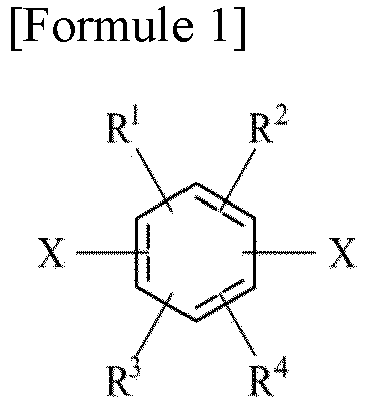 [dans laquelle R1, R2, R3 et R4 sont chacun, indépendamment les uns des autres, un atome d'hydrogène, un groupe hydroxyle (-OH), un groupe carboxyle (-COOH) ou un groupe amine (-NH2), au moins un élément parmi R1, R2, R3 et R4 n'est pas un atome d'hydrogène, et X est 1 ou Cl],le second monomère est le para-diiodobenzène ou le para-dichlorobenzène, etle polymère est préparé en polymérisant du soufre solide ou du sulfure de sodium avec les premier et second monomères.
 - Procédé selon la revendication 8, dans lequel le premier monomère est le diiodophénol, l'acide diiodobenzoïque, la diiodoaniline ou un mélange de deux éléments ou plus parmi ceux-ci.
- Procédé selon la revendication 8, dans lequel le premier monomère est le dichlorophénol, l'acide dichlorobenzoïque, la dichloroaniline ou un mélange de deux éléments ou plus parmi ceux-ci.
- Procédé selon la revendication 6, dans lequel le support poreux est un voile non tissé.
- Procédé selon la revendication 11, dans lequel le tissu non tissé est formé en utilisant un processus de formation par voie humide ou un processus d'électrofilage.
- Dispositif électrochimique comportant :une anode ;une cathode ; etla membrane d'électrolyte polymère selon la revendication 1, intercalée entre l'anode et la cathode.
Applications Claiming Priority (2)
| Application Number | Priority Date | Filing Date | Title |
|---|---|---|---|
| KR20190082178 | 2019-07-08 | ||
| PCT/KR2020/008705 WO2021006551A1 (fr) | 2019-07-08 | 2020-07-03 | Membrane électrolytique polymère, son procédé de fabrication et dispositif électrochimique la comprenant |
Publications (3)
| Publication Number | Publication Date |
|---|---|
| EP3998663A1 EP3998663A1 (fr) | 2022-05-18 |
| EP3998663A4 EP3998663A4 (fr) | 2024-04-10 |
| EP3998663B1 true EP3998663B1 (fr) | 2025-04-16 |
Family
ID=74114634
Family Applications (1)
| Application Number | Title | Priority Date | Filing Date |
|---|---|---|---|
| EP20836550.2A Active EP3998663B1 (fr) | 2019-07-08 | 2020-07-03 | Membrane électrolytique polymère, son procédé de fabrication et dispositif électrochimique la comprenant |
Country Status (6)
| Country | Link |
|---|---|
| US (1) | US12218391B2 (fr) |
| EP (1) | EP3998663B1 (fr) |
| JP (1) | JP7311644B2 (fr) |
| KR (1) | KR102424779B1 (fr) |
| CN (1) | CN114930587B (fr) |
| WO (1) | WO2021006551A1 (fr) |
Families Citing this family (3)
| Publication number | Priority date | Publication date | Assignee | Title |
|---|---|---|---|---|
| WO2021006496A1 (fr) | 2019-07-08 | 2021-01-14 | 코오롱인더스트리 주식회사 | Membrane électrolytique polymère, son procédé de fabrication et dispositif électrochimique la comprenant |
| KR102919135B1 (ko) * | 2021-11-30 | 2026-01-27 | 코오롱인더스트리 주식회사 | 연료전지용 고분자 전해질막 및 이를 포함하는 연료전지 |
| KR102905680B1 (ko) * | 2022-04-19 | 2025-12-29 | 코오롱인더스트리 주식회사 | 연료전지용 강화복합막, 이의 제조방법 및 이를 포함하는 연료전지용 막-전극 어셈블리 |
Family Cites Families (14)
| Publication number | Priority date | Publication date | Assignee | Title |
|---|---|---|---|---|
| WO2001070858A2 (fr) | 2000-03-22 | 2001-09-27 | Victrex Manufacturing Limited | Materiau d'echange d'ions composite |
| EP1284518A1 (fr) | 2001-08-16 | 2003-02-19 | Samsung Electronics Co., Ltd. | Membrane polymère conductrice ionique composite renforcée et cellule à combustible l'utilisant |
| KR20070019837A (ko) * | 2005-08-11 | 2007-02-15 | 삼성에스디아이 주식회사 | 연료전지용 고분자 전해질막, 이의 제조방법, 및 이를포함하는 연료전지 시스템 |
| KR100634551B1 (ko) * | 2005-10-12 | 2006-10-16 | 삼성에스디아이 주식회사 | 이온전도성 가교 공중합체 및 이를 포함하는 연료전지 |
| KR101279352B1 (ko) | 2009-12-23 | 2013-07-04 | 한국화학연구원 | 강도가 개선된 다공성 지지체, 그를 이용한 강화 복합전해질 막, 그 막을 구비한 막-전극 어셈블리 및 연료전지 |
| KR101666887B1 (ko) * | 2012-03-29 | 2016-10-18 | 코오롱인더스트리 주식회사 | 가교 고분자, 이를 포함하는 고분자 전해질 막, 및 이를 포함하는 고분자 전해질 막의 제조 방법 |
| KR101995527B1 (ko) | 2012-12-28 | 2019-07-02 | 코오롱인더스트리 주식회사 | 연료전지용 강화복합막 및 이를 포함하는 연료전지용 막-전극 어셈블리 |
| KR101805230B1 (ko) * | 2013-03-13 | 2017-12-05 | 롯데첨단소재(주) | 난연성 폴리아미드 수지 조성물 및 이를 이용한 성형품 |
| KR102098639B1 (ko) | 2013-09-30 | 2020-04-08 | 코오롱인더스트리 주식회사 | 고분자 전해질막, 이의 제조 방법 및 이를 포함하는 막-전극 어셈블리 |
| KR20160038851A (ko) * | 2014-09-30 | 2016-04-07 | 코오롱인더스트리 주식회사 | 이온 전도체, 및 이를 포함하는 이온 교환막, 막-전극 어셈블리 및 연료전지 |
| KR20180003295A (ko) | 2016-06-30 | 2018-01-09 | (주)센트롤 | 3차원 프린터 |
| KR102140121B1 (ko) * | 2016-07-01 | 2020-07-31 | 주식회사 엘지화학 | 다공성 기재를 포함하는 강화-복합 전해질막 및 이의 제조방법 |
| KR102563567B1 (ko) * | 2016-12-28 | 2023-08-03 | 현대자동차주식회사 | 연료전지용 고분자 전해질막 및 그 제조방법 |
| US10396385B2 (en) | 2017-03-31 | 2019-08-27 | Kolon Industries, Inc. | Ion exchanging membrane, method for manufacturing the same, and energy storage device comprising the same |
-
2020
- 2020-07-03 EP EP20836550.2A patent/EP3998663B1/fr active Active
- 2020-07-03 US US17/620,199 patent/US12218391B2/en active Active
- 2020-07-03 KR KR1020200081862A patent/KR102424779B1/ko not_active Expired - Fee Related
- 2020-07-03 JP JP2021576505A patent/JP7311644B2/ja active Active
- 2020-07-03 CN CN202080050016.7A patent/CN114930587B/zh active Active
- 2020-07-03 WO PCT/KR2020/008705 patent/WO2021006551A1/fr not_active Ceased
Also Published As
| Publication number | Publication date |
|---|---|
| KR102424779B1 (ko) | 2022-07-25 |
| JP2022539331A (ja) | 2022-09-08 |
| US20220238901A1 (en) | 2022-07-28 |
| CN114930587A (zh) | 2022-08-19 |
| KR102424779B9 (ko) | 2022-12-27 |
| EP3998663A1 (fr) | 2022-05-18 |
| EP3998663A4 (fr) | 2024-04-10 |
| US12218391B2 (en) | 2025-02-04 |
| CN114930587B (zh) | 2024-09-10 |
| JP7311644B2 (ja) | 2023-07-19 |
| KR20210006288A (ko) | 2021-01-18 |
| WO2021006551A1 (fr) | 2021-01-14 |
Similar Documents
| Publication | Publication Date | Title |
|---|---|---|
| KR20100024972A (ko) | 막전극 접합체, 및 이것을 구비하는 막전극 가스 확산층 접합체, 고체 고분자형 연료 전지, 그리고 막전극 접합체의 제조 방법 | |
| US11817608B2 (en) | Polymer electrolyte membrane, manufacturing method therefor, and electrochemical device comprising same | |
| KR102098639B1 (ko) | 고분자 전해질막, 이의 제조 방법 및 이를 포함하는 막-전극 어셈블리 | |
| JPWO2018207325A1 (ja) | 高分子電解質膜、膜電極接合体、及び固体高分子型燃料電池 | |
| EP3998663B1 (fr) | Membrane électrolytique polymère, son procédé de fabrication et dispositif électrochimique la comprenant | |
| EP4040549B1 (fr) | Dispersion d'ionomères ayant une stabilité de dispersion élevée, son procédé de production, et membrane échangeuse de protons produite au moyen de celui-ci | |
| JP7450707B2 (ja) | 高分子電解質膜、その製造方法、及びそれを含む電気化学装置 | |
| EP2161771A1 (fr) | Ensemble membrane-électrode, procédé de fabrication et pile à combustible à polymère semi-conducteur | |
| JP2009021236A (ja) | 膜電極接合体、並びにこれを備える膜−電極−ガス拡散層接合体及び固体高分子形燃料電池 | |
| CN101507033B (zh) | 燃料电池用膜-电极组件及燃料电池 | |
| KR102701793B1 (ko) | 고분자 전해질막, 그 제조방법, 및 그것을 포함하는 전기화학 장치 | |
| KR102154101B1 (ko) | Pan 부직포 지지체에 탄화수소계 전해질을 함침시켜 제조한 복합막 및 이의 용도 | |
| JP2019102330A (ja) | 高分子電解質膜、膜電極接合体、及び固体高分子型燃料電池 | |
| Choudhury et al. | Studies on the Preparation and Characterization of Poly (vinyl alcohol-co-styrenesulfonicacid)-Based Proton Exchange Membranes for Direct Methanol Fuel Cell | |
| Lee et al. | Development and Modification of a PEMFC Electrode by Using a Hydrocarbon Ionomer for High Utilization of Catalyst |
Legal Events
| Date | Code | Title | Description |
|---|---|---|---|
| STAA | Information on the status of an ep patent application or granted ep patent |
Free format text: STATUS: THE INTERNATIONAL PUBLICATION HAS BEEN MADE |
|
| PUAI | Public reference made under article 153(3) epc to a published international application that has entered the european phase |
Free format text: ORIGINAL CODE: 0009012 |
|
| STAA | Information on the status of an ep patent application or granted ep patent |
Free format text: STATUS: REQUEST FOR EXAMINATION WAS MADE |
|
| 17P | Request for examination filed |
Effective date: 20220202 |
|
| AK | Designated contracting states |
Kind code of ref document: A1 Designated state(s): AL AT BE BG CH CY CZ DE DK EE ES FI FR GB GR HR HU IE IS IT LI LT LU LV MC MK MT NL NO PL PT RO RS SE SI SK SM TR |
|
| DAV | Request for validation of the european patent (deleted) | ||
| DAX | Request for extension of the european patent (deleted) | ||
| A4 | Supplementary search report drawn up and despatched |
Effective date: 20240311 |
|
| RIC1 | Information provided on ipc code assigned before grant |
Ipc: H01M 8/1069 20160101ALI20240304BHEP Ipc: H01M 8/1044 20160101ALI20240304BHEP Ipc: H01M 8/1032 20160101ALI20240304BHEP Ipc: H01M 8/1027 20160101ALI20240304BHEP Ipc: H01M 8/1004 20160101ALI20240304BHEP Ipc: H01M 8/0202 20160101ALI20240304BHEP Ipc: H01M 8/1072 20160101ALI20240304BHEP Ipc: H01M 8/1039 20160101ALI20240304BHEP Ipc: H01M 8/1023 20160101ALI20240304BHEP Ipc: H01M 8/1018 20160101ALI20240304BHEP Ipc: H01M 8/18 20060101ALI20240304BHEP Ipc: H01M 8/1011 20160101ALI20240304BHEP Ipc: H01M 8/1081 20160101ALI20240304BHEP Ipc: H01M 8/1062 20160101ALI20240304BHEP Ipc: H01M 8/106 20160101AFI20240304BHEP |
|
| GRAP | Despatch of communication of intention to grant a patent |
Free format text: ORIGINAL CODE: EPIDOSNIGR1 |
|
| STAA | Information on the status of an ep patent application or granted ep patent |
Free format text: STATUS: GRANT OF PATENT IS INTENDED |
|
| RIC1 | Information provided on ipc code assigned before grant |
Ipc: H01M 8/1025 20160101ALI20241118BHEP Ipc: H01M 8/10 20160101ALI20241118BHEP Ipc: H01M 8/1069 20160101ALI20241118BHEP Ipc: H01M 8/1044 20160101ALI20241118BHEP Ipc: H01M 8/1032 20160101ALI20241118BHEP Ipc: H01M 8/1027 20160101ALI20241118BHEP Ipc: H01M 8/1004 20160101ALI20241118BHEP Ipc: H01M 8/0202 20160101ALI20241118BHEP Ipc: H01M 8/1072 20160101ALI20241118BHEP Ipc: H01M 8/1039 20160101ALI20241118BHEP Ipc: H01M 8/1023 20160101ALI20241118BHEP Ipc: H01M 8/1018 20160101ALI20241118BHEP Ipc: H01M 8/18 20060101ALI20241118BHEP Ipc: H01M 8/1011 20160101ALI20241118BHEP Ipc: H01M 8/1081 20160101ALI20241118BHEP Ipc: H01M 8/1062 20160101ALI20241118BHEP Ipc: H01M 8/106 20160101AFI20241118BHEP |
|
| INTG | Intention to grant announced |
Effective date: 20241212 |
|
| GRAJ | Information related to disapproval of communication of intention to grant by the applicant or resumption of examination proceedings by the epo deleted |
Free format text: ORIGINAL CODE: EPIDOSDIGR1 |
|
| STAA | Information on the status of an ep patent application or granted ep patent |
Free format text: STATUS: REQUEST FOR EXAMINATION WAS MADE |
|
| P01 | Opt-out of the competence of the unified patent court (upc) registered |
Free format text: CASE NUMBER: APP_68528/2024 Effective date: 20241230 |
|
| GRAP | Despatch of communication of intention to grant a patent |
Free format text: ORIGINAL CODE: EPIDOSNIGR1 |
|
| STAA | Information on the status of an ep patent application or granted ep patent |
Free format text: STATUS: GRANT OF PATENT IS INTENDED |
|
| INTC | Intention to grant announced (deleted) | ||
| GRAS | Grant fee paid |
Free format text: ORIGINAL CODE: EPIDOSNIGR3 |
|
| GRAA | (expected) grant |
Free format text: ORIGINAL CODE: 0009210 |
|
| STAA | Information on the status of an ep patent application or granted ep patent |
Free format text: STATUS: THE PATENT HAS BEEN GRANTED |
|
| INTG | Intention to grant announced |
Effective date: 20250212 |
|
| AK | Designated contracting states |
Kind code of ref document: B1 Designated state(s): AL AT BE BG CH CY CZ DE DK EE ES FI FR GB GR HR HU IE IS IT LI LT LU LV MC MK MT NL NO PL PT RO RS SE SI SK SM TR |
|
| REG | Reference to a national code |
Ref country code: GB Ref legal event code: FG4D |
|
| REG | Reference to a national code |
Ref country code: CH Ref legal event code: EP Ref country code: DE Ref legal event code: R096 Ref document number: 602020049665 Country of ref document: DE |
|
| REG | Reference to a national code |
Ref country code: IE Ref legal event code: FG4D |
|
| REG | Reference to a national code |
Ref country code: NL Ref legal event code: MP Effective date: 20250416 |
|
| PG25 | Lapsed in a contracting state [announced via postgrant information from national office to epo] |
Ref country code: NL Free format text: LAPSE BECAUSE OF FAILURE TO SUBMIT A TRANSLATION OF THE DESCRIPTION OR TO PAY THE FEE WITHIN THE PRESCRIBED TIME-LIMIT Effective date: 20250416 |
|
| REG | Reference to a national code |
Ref country code: AT Ref legal event code: MK05 Ref document number: 1786414 Country of ref document: AT Kind code of ref document: T Effective date: 20250416 |
|
| PG25 | Lapsed in a contracting state [announced via postgrant information from national office to epo] |
Ref country code: ES Free format text: LAPSE BECAUSE OF FAILURE TO SUBMIT A TRANSLATION OF THE DESCRIPTION OR TO PAY THE FEE WITHIN THE PRESCRIBED TIME-LIMIT Effective date: 20250416 Ref country code: PT Free format text: LAPSE BECAUSE OF FAILURE TO SUBMIT A TRANSLATION OF THE DESCRIPTION OR TO PAY THE FEE WITHIN THE PRESCRIBED TIME-LIMIT Effective date: 20250818 Ref country code: FI Free format text: LAPSE BECAUSE OF FAILURE TO SUBMIT A TRANSLATION OF THE DESCRIPTION OR TO PAY THE FEE WITHIN THE PRESCRIBED TIME-LIMIT Effective date: 20250416 |
|
| PGFP | Annual fee paid to national office [announced via postgrant information from national office to epo] |
Ref country code: DE Payment date: 20250730 Year of fee payment: 6 |
|
| REG | Reference to a national code |
Ref country code: LT Ref legal event code: MG9D |
|
| PG25 | Lapsed in a contracting state [announced via postgrant information from national office to epo] |
Ref country code: NO Free format text: LAPSE BECAUSE OF FAILURE TO SUBMIT A TRANSLATION OF THE DESCRIPTION OR TO PAY THE FEE WITHIN THE PRESCRIBED TIME-LIMIT Effective date: 20250716 Ref country code: GR Free format text: LAPSE BECAUSE OF FAILURE TO SUBMIT A TRANSLATION OF THE DESCRIPTION OR TO PAY THE FEE WITHIN THE PRESCRIBED TIME-LIMIT Effective date: 20250717 |
|
| PG25 | Lapsed in a contracting state [announced via postgrant information from national office to epo] |
Ref country code: PL Free format text: LAPSE BECAUSE OF FAILURE TO SUBMIT A TRANSLATION OF THE DESCRIPTION OR TO PAY THE FEE WITHIN THE PRESCRIBED TIME-LIMIT Effective date: 20250416 |
|
| PG25 | Lapsed in a contracting state [announced via postgrant information from national office to epo] |
Ref country code: BG Free format text: LAPSE BECAUSE OF FAILURE TO SUBMIT A TRANSLATION OF THE DESCRIPTION OR TO PAY THE FEE WITHIN THE PRESCRIBED TIME-LIMIT Effective date: 20250416 |
|
| PGFP | Annual fee paid to national office [announced via postgrant information from national office to epo] |
Ref country code: GB Payment date: 20250724 Year of fee payment: 6 |
|
| PG25 | Lapsed in a contracting state [announced via postgrant information from national office to epo] |
Ref country code: HR Free format text: LAPSE BECAUSE OF FAILURE TO SUBMIT A TRANSLATION OF THE DESCRIPTION OR TO PAY THE FEE WITHIN THE PRESCRIBED TIME-LIMIT Effective date: 20250416 |
|
| PG25 | Lapsed in a contracting state [announced via postgrant information from national office to epo] |
Ref country code: AT Free format text: LAPSE BECAUSE OF FAILURE TO SUBMIT A TRANSLATION OF THE DESCRIPTION OR TO PAY THE FEE WITHIN THE PRESCRIBED TIME-LIMIT Effective date: 20250416 |
|
| PG25 | Lapsed in a contracting state [announced via postgrant information from national office to epo] |
Ref country code: RS Free format text: LAPSE BECAUSE OF FAILURE TO SUBMIT A TRANSLATION OF THE DESCRIPTION OR TO PAY THE FEE WITHIN THE PRESCRIBED TIME-LIMIT Effective date: 20250716 |
|
| PG25 | Lapsed in a contracting state [announced via postgrant information from national office to epo] |
Ref country code: IS Free format text: LAPSE BECAUSE OF FAILURE TO SUBMIT A TRANSLATION OF THE DESCRIPTION OR TO PAY THE FEE WITHIN THE PRESCRIBED TIME-LIMIT Effective date: 20250816 |
|
| PG25 | Lapsed in a contracting state [announced via postgrant information from national office to epo] |
Ref country code: LV Free format text: LAPSE BECAUSE OF FAILURE TO SUBMIT A TRANSLATION OF THE DESCRIPTION OR TO PAY THE FEE WITHIN THE PRESCRIBED TIME-LIMIT Effective date: 20250416 |
|
| PG25 | Lapsed in a contracting state [announced via postgrant information from national office to epo] |
Ref country code: DK Free format text: LAPSE BECAUSE OF FAILURE TO SUBMIT A TRANSLATION OF THE DESCRIPTION OR TO PAY THE FEE WITHIN THE PRESCRIBED TIME-LIMIT Effective date: 20250416 Ref country code: SM Free format text: LAPSE BECAUSE OF FAILURE TO SUBMIT A TRANSLATION OF THE DESCRIPTION OR TO PAY THE FEE WITHIN THE PRESCRIBED TIME-LIMIT Effective date: 20250416 |
|
| REG | Reference to a national code |
Ref country code: DE Ref legal event code: R097 Ref document number: 602020049665 Country of ref document: DE |
|
| PG25 | Lapsed in a contracting state [announced via postgrant information from national office to epo] |
Ref country code: CZ Free format text: LAPSE BECAUSE OF FAILURE TO SUBMIT A TRANSLATION OF THE DESCRIPTION OR TO PAY THE FEE WITHIN THE PRESCRIBED TIME-LIMIT Effective date: 20250416 |
|
| PG25 | Lapsed in a contracting state [announced via postgrant information from national office to epo] |
Ref country code: EE Free format text: LAPSE BECAUSE OF FAILURE TO SUBMIT A TRANSLATION OF THE DESCRIPTION OR TO PAY THE FEE WITHIN THE PRESCRIBED TIME-LIMIT Effective date: 20250416 |
|
| PG25 | Lapsed in a contracting state [announced via postgrant information from national office to epo] |
Ref country code: SK Free format text: LAPSE BECAUSE OF FAILURE TO SUBMIT A TRANSLATION OF THE DESCRIPTION OR TO PAY THE FEE WITHIN THE PRESCRIBED TIME-LIMIT Effective date: 20250416 Ref country code: RO Free format text: LAPSE BECAUSE OF FAILURE TO SUBMIT A TRANSLATION OF THE DESCRIPTION OR TO PAY THE FEE WITHIN THE PRESCRIBED TIME-LIMIT Effective date: 20250416 |
|
| PG25 | Lapsed in a contracting state [announced via postgrant information from national office to epo] |
Ref country code: IT Free format text: LAPSE BECAUSE OF FAILURE TO SUBMIT A TRANSLATION OF THE DESCRIPTION OR TO PAY THE FEE WITHIN THE PRESCRIBED TIME-LIMIT Effective date: 20250416 |
|
| PLBE | No opposition filed within time limit |
Free format text: ORIGINAL CODE: 0009261 |
|
| STAA | Information on the status of an ep patent application or granted ep patent |
Free format text: STATUS: NO OPPOSITION FILED WITHIN TIME LIMIT |
|
| REG | Reference to a national code |
Ref country code: CH Ref legal event code: H13 Free format text: ST27 STATUS EVENT CODE: U-0-0-H10-H13 (AS PROVIDED BY THE NATIONAL OFFICE) Effective date: 20260224 |
|
| REG | Reference to a national code |
Ref country code: CH Ref legal event code: L10 Free format text: ST27 STATUS EVENT CODE: U-0-0-L10-L00 (AS PROVIDED BY THE NATIONAL OFFICE) Effective date: 20260225 |
|
| PG25 | Lapsed in a contracting state [announced via postgrant information from national office to epo] |
Ref country code: LU Free format text: LAPSE BECAUSE OF NON-PAYMENT OF DUE FEES Effective date: 20250703 |
|
| 26N | No opposition filed |
Effective date: 20260119 |
|
| REG | Reference to a national code |
Ref country code: BE Ref legal event code: MM Effective date: 20250731 |
|
| PG25 | Lapsed in a contracting state [announced via postgrant information from national office to epo] |
Ref country code: BE Free format text: LAPSE BECAUSE OF NON-PAYMENT OF DUE FEES Effective date: 20250731 |
|
| PG25 | Lapsed in a contracting state [announced via postgrant information from national office to epo] |
Ref country code: FR Free format text: LAPSE BECAUSE OF NON-PAYMENT OF DUE FEES Effective date: 20250731 |
|
| PG25 | Lapsed in a contracting state [announced via postgrant information from national office to epo] |
Ref country code: CH Free format text: LAPSE BECAUSE OF NON-PAYMENT OF DUE FEES Effective date: 20250731 |