EP4001147B1 - Emballage pour produits de l'industrie du tabac et son procédé de fabrication - Google Patents
Emballage pour produits de l'industrie du tabac et son procédé de fabrication Download PDFInfo
- Publication number
- EP4001147B1 EP4001147B1 EP21208904.9A EP21208904A EP4001147B1 EP 4001147 B1 EP4001147 B1 EP 4001147B1 EP 21208904 A EP21208904 A EP 21208904A EP 4001147 B1 EP4001147 B1 EP 4001147B1
- Authority
- EP
- European Patent Office
- Prior art keywords
- pouch
- tray
- lateral walls
- retaining elements
- corners
- Prior art date
- Legal status (The legal status is an assumption and is not a legal conclusion. Google has not performed a legal analysis and makes no representation as to the accuracy of the status listed.)
- Active
Links
Images



Classifications
-
- B—PERFORMING OPERATIONS; TRANSPORTING
- B65—CONVEYING; PACKING; STORING; HANDLING THIN OR FILAMENTARY MATERIAL
- B65D—CONTAINERS FOR STORAGE OR TRANSPORT OF ARTICLES OR MATERIALS, e.g. BAGS, BARRELS, BOTTLES, BOXES, CANS, CARTONS, CRATES, DRUMS, JARS, TANKS, HOPPERS, FORWARDING CONTAINERS; ACCESSORIES, CLOSURES, OR FITTINGS THEREFOR; PACKAGING ELEMENTS; PACKAGES
- B65D5/00—Rigid or semi-rigid containers of polygonal cross-section, e.g. boxes, cartons or trays, formed by folding or erecting one or more blanks made of paper
- B65D5/42—Details of containers or of foldable or erectable container blanks
- B65D5/56—Linings or internal coatings, e.g. pre-formed trays provided with a blow- or thermoformed layer
- B65D5/60—Loose, or loosely attached, linings
- B65D5/603—Flexible linings loosely glued to the wall of the container
- B65D5/606—Bags or bag-like tubes loosely glued to the wall of a "tubular" container
-
- A—HUMAN NECESSITIES
- A24—TOBACCO; CIGARS; CIGARETTES; SIMULATED SMOKING DEVICES; SMOKERS' REQUISITES
- A24F—SMOKERS' REQUISITES; MATCH BOXES; SIMULATED SMOKING DEVICES
- A24F23/00—Cases for tobacco, snuff, or chewing tobacco
- A24F23/02—Tobacco pouches
-
- B—PERFORMING OPERATIONS; TRANSPORTING
- B65—CONVEYING; PACKING; STORING; HANDLING THIN OR FILAMENTARY MATERIAL
- B65D—CONTAINERS FOR STORAGE OR TRANSPORT OF ARTICLES OR MATERIALS, e.g. BAGS, BARRELS, BOTTLES, BOXES, CANS, CARTONS, CRATES, DRUMS, JARS, TANKS, HOPPERS, FORWARDING CONTAINERS; ACCESSORIES, CLOSURES, OR FITTINGS THEREFOR; PACKAGING ELEMENTS; PACKAGES
- B65D33/00—Details of, or accessories for, sacks or bags
- B65D33/16—End- or aperture-closing arrangements or devices
- B65D33/25—Riveting; Dovetailing; Screwing; using press buttons or slide fasteners
- B65D33/2508—Riveting; Dovetailing; Screwing; using press buttons or slide fasteners using slide fasteners with interlocking members having a substantially uniform section throughout the length of the fastener; Sliders therefor
-
- B—PERFORMING OPERATIONS; TRANSPORTING
- B65—CONVEYING; PACKING; STORING; HANDLING THIN OR FILAMENTARY MATERIAL
- B65D—CONTAINERS FOR STORAGE OR TRANSPORT OF ARTICLES OR MATERIALS, e.g. BAGS, BARRELS, BOTTLES, BOXES, CANS, CARTONS, CRATES, DRUMS, JARS, TANKS, HOPPERS, FORWARDING CONTAINERS; ACCESSORIES, CLOSURES, OR FITTINGS THEREFOR; PACKAGING ELEMENTS; PACKAGES
- B65D5/00—Rigid or semi-rigid containers of polygonal cross-section, e.g. boxes, cartons or trays, formed by folding or erecting one or more blanks made of paper
- B65D5/42—Details of containers or of foldable or erectable container blanks
- B65D5/54—Lines of weakness to facilitate opening of container or dividing it into separate parts by cutting or tearing
- B65D5/5405—Lines of weakness to facilitate opening of container or dividing it into separate parts by cutting or tearing for opening containers formed by erecting a blank in tubular form
- B65D5/542—Lines of weakness to facilitate opening of container or dividing it into separate parts by cutting or tearing for opening containers formed by erecting a blank in tubular form the lines of weakness being provided in the container body
-
- B—PERFORMING OPERATIONS; TRANSPORTING
- B65—CONVEYING; PACKING; STORING; HANDLING THIN OR FILAMENTARY MATERIAL
- B65D—CONTAINERS FOR STORAGE OR TRANSPORT OF ARTICLES OR MATERIALS, e.g. BAGS, BARRELS, BOTTLES, BOXES, CANS, CARTONS, CRATES, DRUMS, JARS, TANKS, HOPPERS, FORWARDING CONTAINERS; ACCESSORIES, CLOSURES, OR FITTINGS THEREFOR; PACKAGING ELEMENTS; PACKAGES
- B65D77/00—Packages formed by enclosing articles or materials in preformed containers, e.g. boxes, cartons, sacks or bags
- B65D77/04—Articles or materials enclosed in two or more containers disposed one within another
- B65D77/06—Liquids or semi-liquids or other materials or articles enclosed in flexible containers disposed within rigid containers
- B65D77/062—Flexible containers disposed within polygonal containers formed by folding a carton blank
Definitions
- the invention relates to a package for products of the tobacco industry, with an inner package for receiving the contents of the package and an outer package for receiving the inner package, wherein the inner package is designed as a (tobacco) bag which has a resealable opening, and wherein the opening can be reclosed by a resealable, strip-shaped closure means, and wherein the inner package has bag corners in the region of lateral ends of the closure means, according to the preamble of claim 1.
- the invention relates to packages for bulk goods, e.g. fine-cut tobacco.
- Such goods are currently packaged in the tobacco and cigarette industry in large stand-up pouches or in cans.
- the cans are usually made of plastic, metal or coated cardboard and/or combinations of the above materials with a resealable lid.
- the stand-up pouches are much softer and more flexible than cans, but are correspondingly less stable. It is usual to close the opening of the bag with a type of ziplock.
- the disadvantages of the solutions described are, on the one hand, the need for improvement in terms of environmental compatibility in view of the packaging materials used, and, on the other hand, the low stability.
- 127 A pack of the type mentioned above is known in which a tobacco pouch is arranged in a cardboard box. An upper end of the pouch is closed by a double fold 13, whereupon lateral ends of the double fold are folded over. Side walls of the cardboard box then prevent the pouch corners from unfolding ( Fig. 7 ).
- Similar solutions are available from US 2012/187182 A1 and US 2016/244243 A1 known. Based on this, the invention is based on the object of further developing packages of the type mentioned at the beginning, in particular with regard to improving the disadvantages described.
- a pack according to the invention has the features of claim 1. It is therefore provided that the first retaining elements can be deactivated, namely can be transferred from a configuration in which they secure the bag corners in the folded position to a configuration in which they do not secure the bag corners in the folded position, in order to transfer the bag corners from the folded position to an open position in which the closure means can be opened to remove the pack contents, such that the first retaining elements can be separated from the respective side walls or folded out of the plane of the respective side walls.
- first retaining elements are formed by regions of side walls of the tray which are designed to press the bag corners against side walls of the bag.
- the first retaining elements are limited by material weakenings in the material of the side walls of the tray and can be deactivated after at least partially separating the material weakenings.
- the retaining elements extend to the upper edge of the side walls, i.e. to the opening of the tray.
- At least one tear-open opening is formed on the edge in the region of the first retaining elements in order to facilitate access to the retaining elements for deactivating them.
- the tear-open opening can be arranged below the retaining element, i.e. on the side facing the bottom wall of the tray.
- a special feature may be that second retaining elements are formed on the side walls of the tray, which after deactivation of the first retaining elements designed to fix the bag corners in the folded position, preferably after the bag has been opened for the first time and then resealed.
- the second retaining elements are formed by retaining tabs or fixing tabs which are formed by the material of the side walls of the tray.
- the retaining tabs protrude from adjacent areas of the material weakenings, so that the bag corners can each be fixed by clamping the material of the bag between a retaining tab and the side wall of the bag, in particular in the area of a folding edge of the bag.
- the fixing tabs are formed by incisions in the material of the side walls, which are designed to fix the bag corners by clamping the material of the bag between the fixing tab and the side wall of the bag, in particular in the region of a folding edge of the bag.
- first retaining elements are designed as fixing tabs with the features of claim 8, and that the side walls of the tray in the area of the bag corners are otherwise essentially closed, in particular do not have any deactivatable retaining elements according to one of the preceding claims, and that the bag corners are each folded over an upper edge of a side wall of the tray and rest against it on the outside and can be fixed there by means of a fixing tab.
- first retaining elements are pivotably mounted on side walls of the tray, and that the first retaining elements can be pivoted out of the plane of the side walls to expose the bag corners, and that the first retaining elements can be pivoted back into the plane of the side walls, so that the bag corners can each be folded over an upper edge of a side wall of the tray and rest against this on the outside and can be fixed there by means of a fixing tab.
- the retaining elements are arranged on two opposite, preferably upright, side walls of the tray, wherein it is preferably provided that the tray has a (lower) bottom wall and four has upright side walls and is open in the area of an upper side opposite the bottom wall.
- the outer packaging has a lid for closing the open top of the tray, and that the lid preferably has four side walls corresponding to the side walls of the tray, which substantially conceal the side walls of the tray.
- the bag and tray are connected to one another by adhesive, in particular by adhesive surfaces.
- the corners of the bag are connected to the side walls of the bag by adhesive surfaces.
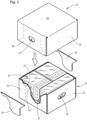
- the first embodiment of a pack 10 for products of the tobacco industry has a tray 11 and a lid 12, which belong to an outer pack 13.
- the outer packaging 13 there is a bag 14 as inner packaging 15.
- the bag contains the contents of the package 16.
- the contents of the pack 16 are bulk goods, namely fine-cut tobacco. It goes without saying that the pack 10 can also be used for other products of the tobacco or cigarette industry.
- the tray 11 and the lid 12 are preferably made from corresponding blanks 17, 18 made of a rigid packaging material, in particular by folding and gluing.
- Cardboard is preferably used for this purpose. Thicker paper or other common materials are also conceivable.
- the bag 14 is preferably made of a film material which can be provided, for example, as a continuous material web and from which individual blanks can be separated and closed by forming (welded) seams.
- the bag 14 usually has an opening 19 which is used to remove the contents 16 of the package.
- the opening 19 can be closed by a closure means 20.
- the closure means 20 is a strip-shaped, multi-actuable element which is located near an upper edge of the bag 14.
- a ziplock is preferably used here. This usually consists of two profile pieces made of plastic which extend in the area of the opening and engage with one another in the closed position with projections and recesses.
- the tray 11 serves to hold the bag 14.
- the bag 14 is folded so that in the first embodiment it is essentially completely held in the bag 14.
- Two bag corners 21 which are located in the area of the lateral, free ends of the closure means 20 are problematic. Due to the material-related restoring forces of the strip-shaped closure means 20, the bag corners 21 tend to spring open, so special measures are provided here to secure the bag corners 21 in a folded position.
- the two bag corners 21 are folded against (upright) side walls 22 of the bag 14. Accordingly, the two bag corners 21 rest on the inside against corresponding side walls 23 of the tray 11. Sections or areas of the side walls 23 against which the bag corners 21 rest serve as retaining elements 24 for the bag corners 21.
- a special feature is that in the first embodiment the two retaining elements 24 can be separated from the tray 11.
- the retaining elements 24 are limited by material weakenings, for example by a corresponding tear perforation 25.
- a tear opening 26 is provided, which is positioned at the edge of the tear perforation 25 or the retaining element 24. With the help of the tear opening 26, the consumer can reach behind the retaining element and separate it.
- Fig. 2 shows that the retaining elements 24 are arranged in such a way that after removal of the same, the respective bag corner 21 is exposed and can be swung up (in Fig. 4 The upper end of the bag 14 can then be pulled slightly upwards out of the tray 11 and the closure means 20 and thus the opening 19 can be opened so that the contents of the package 16 can be partially removed.
- the procedure is reversed.
- the opening 19 is closed with the closure means 20 and then the bag corners 21 are folded sideways into the folded position.
- the retaining elements 24 have been removed, they can no longer be used to fix the bag corners 21.
- This function is therefore taken over by second retaining elements in the form of retaining tabs 27.
- the retaining tabs 27 are material projections of the side walls 23 of the tray 11, which protrude beyond an imaginary plane along which the tear perforation 25 extends on both sides of the retaining tabs 27. Accordingly, the bag corners 21 can be held behind the retaining tabs 27. Finally, the lid 12 can be placed on the tray 11 without any protruding bag corners 21 causing interference.
- the pack 10 is cuboid-shaped and rectangular in plan, in particular square.
- the tray 11 has a (lower) bottom wall 28 and four (upright) side walls 23.
- the lid 12 is designed as a slip lid with a lid wall 29 and four (upright) side walls 30.
- the tray 11 with the bag 14 is essentially completely accommodated in the lid 12.
- the two bag corners 21 are located on two opposite side walls 23 of the tray 11 and are each fixed by a retaining element 24 or a retaining tab 27 located there. It is understood that within the scope of the invention, this specific solution can be deviated from if other bag shapes make this seem appropriate.
- the figures also show optional gripping holes 31 (lid) or 32 (tray), which can make handling easier.
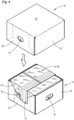
- Fig. 6 shows a second embodiment of such a pack 10.
- the difference from the first embodiment is that no retaining elements 24 are provided. Instead, the bag corners 21 are folded over the upper edge of the side walls 23 and placed against them from the outside. In order to be held in this folded position, retaining elements in the form of fixing tabs 33 are formed on the side walls 23. For example, a punching in the material of the side walls that forms such a tab is conceivable. As with the retaining tabs 27, the bag corners 21 are threaded with a folding edge 49 behind the fixing tabs 33 and thus in the folded position ( Fig. 6 ) was held.
- FIG. 7 and 8 A third embodiment is shown in Fig. 7 and 8 shown.
- the difference to the two previous embodiments is, on the one hand, that both retaining elements 24 and fixing tabs 33 are present.
- the retaining elements 24 are partly detachable and partly pivotable. This enables the following functionality:
- the retaining elements 24 can on the one hand be separated from the side walls 23 along a tear perforation 25 and on the other hand can be swung out along a folding edge in continuation of the tear perforation 25. In this way, access to the bag corners 21 can be granted as in the first embodiment. Then, with the bag corners 21 erected, the retaining elements 24 can be folded back into the plane of the side walls 30 and the bag corners 21 can be folded from the outside against the retaining elements 24, where they are again held in the folded position by the fixing tabs 33 as in the second embodiment.
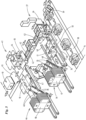
- a device or a method for producing, for example, the packages 10 according to the first embodiment are described in Fig. 5 shown.
- blanks 17 are removed from a first blank magazine 34 by blank extractors 35 and placed unfolded on blank guides 48 and transported by a transport belt 36 in the direction of a first folding station 37.
- Filled bags 14 are transported on a conveyor belt 38 in the direction of the folding station 37 and are pushed by sliders 39 onto a blank 17 in the folding station 37. The blank 17 is then folded around the bag 14 by means of a tray folder 40.
- the trays 11 with bags 14 are then transported towards a second folding station 41.
- the trays 11 are conveyed by a carrier belt 43 while resting on support strips 42.
- the feeding of the blanks 18 to the second folding station 41 is carried out analogously to the feeding of the blanks 17 to the first folding station 37, starting with the removal from a blank magazine 46.
- a lateral suction unit 47 is used to transport the blanks 17.
- the blanks 17, 18 can be provided with adhesive surfaces in respective gluing stations 50 on the way to the first or second folding station 37, 41 in order to connect folding flaps of the tray 11 or lid 12 to one another.
- pre-glued blanks can also be used.
Landscapes
- Engineering & Computer Science (AREA)
- Mechanical Engineering (AREA)
- Packages (AREA)
Claims (13)
- Emballage destiné à des produits de l'industrie du tabac, ledit emballage comprenant un emballage intérieur (15) destiné à recevoir le contenu d'emballage (16) et un emballage extérieur (13) destiné à recevoir l'emballage intérieur (15), l'emballage intérieur (15) étant conçu comme un sachet (de tabac) (14) qui comporte une ouverture refermable (19), et l'ouverture (19) pouvant être refermée par un moyen de fermeture refermable (20) en forme de bande, et l'emballage intérieur (15) comportant des coins de sachet (21) dans la zone d'extrémités latérales du moyen de fermeture (20), et l'emballage extérieur (13) comportant un plateau (11) destiné à recevoir au moins partiellement l'emballage intérieur (15), et le plateau (11) comportant des éléments de retenue (24) qui sont destinés aux coins de sachet (21) et qui sont conçus pour immobiliser les coins de sachet (21) dans une position pliée dans laquelle les coins de sachet (21) viennent en appui sur des parois latérales (23) du plateau (11), caractérisé en ce que les premiers éléments de retenue (24) peuvent être désactivés, à savoir peuvent passer d'une configuration, dans laquelle ils immobilisent les coins de sachet (21) dans la position pliée, à une configuration dans laquelle ils n'immobilisent pas les coins de sachet (21) dans la position pliée, afin de faire passer les coins de sachet (21) de la position pliée à une position ouverte, dans laquelle le moyen de fermeture (20) peut être ouvert afin de retirer le contenu d'emballage (16), de manière à ce que les premiers éléments de retenue (24) puissent être séparés des parois latérales respectives (23) ou dépliés hors du plan des parois latérales respectives (23).
- Emballage selon la revendication 1, caractérisé en ce que des premiers éléments de retenue (24) sont formés par des zones de parois latérales (23) du plateau (11), qui sont conçues pour presser les coins de sachet (21) contre des parois latérales (23) du sachet (14).
- Emballage selon la revendication 1 ou 2, caractérisé en ce que les premiers éléments de retenue (24) sont délimités par des zones de matière de moindre résistance (25) dans la matière des parois latérales (23) du plateau (11) et peuvent être désactivés après séparation au moins partielle des affaiblissements de matière (25), les éléments de retenue (24) étant de préférence prévus pour s'étendre jusqu'au bord supérieur des parois latérales (23).
- Emballage selon la revendication 1 ou l'une des autres revendications précédentes, caractérisé en ce qu'une ouverture déchirable (26) est formée dans chacune des parois latérales (23) du plateau (11) du côté bord dans la zone des premiers éléments de retenue (24) afin de faciliter l'accès aux éléments de retenue (24) pour désactiver ceux-ci, l'ouverture déchirable (26) étant de préférence prévue pour être disposée au-dessous de l'élément de retenue (24).
- Emballage selon la revendication 2 ou l'une des autres revendications précédentes, caractérisé en ce que des deuxièmes éléments de retenue (27, 33) sont formés sur des parois latérales (23) du plateau (11), lesquels sont conçus après désactivation des premiers éléments de retenue (24) pour fixer les coins de sachet (21) dans la position pliée, de préférence après que le sachet (14) a été ouvert pour la première fois (19) puis refermé.
- Emballage selon la revendication 5 ou l'une des autres revendications précédentes, caractérisé en ce que les deuxièmes éléments de retenue sont formés par des pattes de retenue (27) ou des pattes de fixation (33) qui sont formées par la matière des parois latérales (23) du plateau (11).
- Emballage selon la revendication 6 ou l'une des autres revendications précédentes, caractérisé en ce que les pattes de retenue (27) font saillie des zones adjacentes des zones de matière de moindre résistance (25), de façon à pouvoir fixer les coins de sachet (21) par serrage de la matière du sachet (14) entre une patte de retenue (27) et la paroi latérale (23) du sachet (14), notamment dans la zone d'un bord de pliage (49) du sachet (14).
- Emballage selon la revendication 6 ou l'une des autres revendications précédentes, caractérisé en ce que les pattes de fixation (33) sont formées par des incisions dans la matière des parois latérales (23), qui sont destinées à fixer les coins de sachet (21) par serrage de la matière du sachet (14) entre la patte de fixation (33) et la paroi latérale (23) du sachet (14), notamment dans la zone d'un bord de plage (49) du sachet (14).
- Emballage selon la revendication 1 ou l'une des autres revendications précédentes, caractérisé en ce que des premiers éléments de retenue sont conçus comme des pattes de fixation (33) dotées des caractéristiques de la revendication 8, et en ce que les parois latérales (23) du plateau (11) dans la zone des coins de sachet (21) sont par ailleurs sensiblement fermées, en particulier ne comportent aucun élément de retenue (24) désactivable selon l'une des revendications précédentes, et en ce que les coins de sachet (21) sont chacun pliés sur un bord supérieur d'une paroi latérale (23) du plateau (11) et viennent en appui du côté extérieur sur ledit bord supérieur et peuvent y être fixés au moyen d'une patte de fixation (33).
- Emballage selon la revendication 1 ou l'une des autres revendications précédentes, caractérisé en ce que des premiers éléments de retenue (24) sont montés de manière pivotante sur des parois latérales du plateau (11), et en ce que les premiers éléments de retenue (24) peuvent être pivotés hors du plan des parois latérales (23) afin de libérer les coins de sachet (21) et en ce que les premiers éléments de retenue (24) peuvent être ramenés par pivotement dans le plan des parois latérales (23), de sorte que les coins de sachet (21) puissent être repliés chacun sur un bord supérieur d'une paroi latérale (23) du plateau (11) et viennent en appui du côté extérieur sur ledit bord supérieur et puissent y être fixés au moyen d'une patte de fixation (27).
- Emballage selon la revendication 1 ou l'une des autres revendications précédentes, caractérisé en ce que les éléments de retenue (24) sont disposés sur deux parois latérales opposées, de préférence verticales (23), du plateau (11), le plateau (11) étant prévu de préférence pour comporter une paroi de fond (inférieure) (28) et quatre parois latérales verticales (23) et être ouvert à l'opposé de la paroi de fond (28) dans la zone d'un côté supérieur.
- Emballage selon la revendication 1 ou l'une des autres revendications précédentes, caractérisé en ce que l'emballage extérieur (13) comporte un couvercle (12), de préférence séparé du plateau (11), permettant de fermer le côté supérieur ouvert du plateau (11) et en ce que le couvercle (12) dispose de préférence de quatre parois latérales (30) qui correspondent aux parois latérales du plateau (11) et qui recouvrent sensiblement les parois latérales (23) du plateau (11).
- Emballage selon la revendication 1 ou l'une des autres revendications précédentes, caractérisé en ce que le sachet (14) et le plateau (11) sont reliés l'un à l'autre par collage, notamment par des surfaces adhésives, notamment de manière à ce que, avant que le sachet (14) ne soit utilisé pour la première fois, les coins de sachet (21) soient reliés aux parois latérales (23) du sachet (14) par des surfaces adhésives.
Applications Claiming Priority (1)
| Application Number | Priority Date | Filing Date | Title |
|---|---|---|---|
| DE102020130709.8A DE102020130709A1 (de) | 2020-11-20 | 2020-11-20 | Packung für Produkte der Tabakindustrie und Verfahren zur Herstellung derselben |
Publications (2)
| Publication Number | Publication Date |
|---|---|
| EP4001147A1 EP4001147A1 (fr) | 2022-05-25 |
| EP4001147B1 true EP4001147B1 (fr) | 2025-01-08 |
Family
ID=78695531
Family Applications (1)
| Application Number | Title | Priority Date | Filing Date |
|---|---|---|---|
| EP21208904.9A Active EP4001147B1 (fr) | 2020-11-20 | 2021-11-18 | Emballage pour produits de l'industrie du tabac et son procédé de fabrication |
Country Status (2)
| Country | Link |
|---|---|
| EP (1) | EP4001147B1 (fr) |
| DE (1) | DE102020130709A1 (fr) |
Family Cites Families (10)
| Publication number | Priority date | Publication date | Assignee | Title |
|---|---|---|---|---|
| US2077046A (en) | 1935-07-23 | 1937-04-13 | Nat Sugar Refining Co | Carton |
| US2421141A (en) | 1943-10-06 | 1947-05-27 | Carr Trem | Dispensing package |
| GB759127A (en) | 1954-03-01 | 1956-10-10 | Bartelt Engineering Co | Package for tobacco or the like |
| DE4018024A1 (de) | 1990-06-05 | 1991-12-12 | Rovema Gmbh | Verfahren und vorrichtung zum verpacken von beuteln |
| MX9602780A (es) * | 1994-11-16 | 1997-06-28 | Legend Inc Ltd | Envases de fluido y metodos de fabricacion de los mismos. |
| JP3026044U (ja) | 1995-12-19 | 1996-07-02 | 勝治 辻村 | 流動物収容容器 |
| DE10212584A1 (de) | 2002-03-15 | 2003-10-09 | Felix Schlosser | Verpackung für Zigarettentabak |
| EP2485955B1 (fr) * | 2009-10-08 | 2018-03-28 | Illinois Tool Works Inc. | Partie de conteneur pour un carton pourvu d'une étiquette fermoir refermable en plastique |
| DE102010019867A1 (de) | 2010-03-10 | 2011-09-15 | Focke & Co.(Gmbh & Co. Kg) | Packung für Zigaretten sowie Verfahren und Vorrichtung zur Herstellung derselben |
| US20160244243A1 (en) * | 2015-02-20 | 2016-08-25 | Orchard View Farms, Inc. | Fruit packaging containers |
-
2020
- 2020-11-20 DE DE102020130709.8A patent/DE102020130709A1/de active Pending
-
2021
- 2021-11-18 EP EP21208904.9A patent/EP4001147B1/fr active Active
Also Published As
| Publication number | Publication date |
|---|---|
| EP4001147A1 (fr) | 2022-05-25 |
| DE102020130709A1 (de) | 2022-05-25 |
Similar Documents
| Publication | Publication Date | Title |
|---|---|---|
| EP0401621B1 (fr) | Emballage flexible, en particulier pour mouchoirs en papier | |
| EP0392224B1 (fr) | Emballage formé à partir d'un flanc pour mouchoir en papier | |
| DE69213354T2 (de) | Zigarettenpackung | |
| EP1637460B1 (fr) | Conditionnement | |
| EP1373097B1 (fr) | Paquet de cigarettes | |
| EP3526139B1 (fr) | Paquet de cigarettes, procédé et dispositif de fabrication | |
| EP4069605B1 (fr) | Emballage pour produits de l'industrie du tabac | |
| EP0147447B1 (fr) | Piece decoupee pour emballages parallelepipedes ou elements d'emballage | |
| DE69219103T2 (de) | Wiederverschliessbare Schachtel zur Abgabe von Blattmaterial | |
| DE1586542B2 (de) | Aufreisspackung fuer nahrungs- und genussmittel | |
| DE69313847T2 (de) | Verpackungseinheit für blattförmige gegenstände. | |
| DE102023122018A1 (de) | Gebindepackung mit wenigstens einer Gruppe von mehreren Produkten | |
| DE3940872C2 (fr) | ||
| EP0374663B1 (fr) | Récipient d'emballage | |
| DE69211219T2 (de) | Öffnungskonstruktion für keilförmige Torteschachtel | |
| DE3624345C2 (fr) | ||
| EP0218186B1 (fr) | Boîte en carton, carton ondulé ou similaire | |
| DE29611809U1 (de) | Transport- und Verkaufsverpackung | |
| EP4001147B1 (fr) | Emballage pour produits de l'industrie du tabac et son procédé de fabrication | |
| EP2082969A1 (fr) | Emballage divisible | |
| DE4042103C2 (de) | Schuber | |
| DE69614120T2 (de) | Verfahren zum Verpacken eines Stapels von blattförmigen Gegenständen | |
| EP0575689B1 (fr) | Carton d'emballage pour piles de papier | |
| DE19842262A1 (de) | Packung bzw. Zuschnitt hierfür | |
| DE2705162A1 (de) | Trage-verpackung aus einem folienmaterial |
Legal Events
| Date | Code | Title | Description |
|---|---|---|---|
| PUAI | Public reference made under article 153(3) epc to a published international application that has entered the european phase |
Free format text: ORIGINAL CODE: 0009012 |
|
| STAA | Information on the status of an ep patent application or granted ep patent |
Free format text: STATUS: THE APPLICATION HAS BEEN PUBLISHED |
|
| AK | Designated contracting states |
Kind code of ref document: A1 Designated state(s): AL AT BE BG CH CY CZ DE DK EE ES FI FR GB GR HR HU IE IS IT LI LT LU LV MC MK MT NL NO PL PT RO RS SE SI SK SM TR |
|
| STAA | Information on the status of an ep patent application or granted ep patent |
Free format text: STATUS: REQUEST FOR EXAMINATION WAS MADE |
|
| 17P | Request for examination filed |
Effective date: 20221121 |
|
| RBV | Designated contracting states (corrected) |
Designated state(s): AL AT BE BG CH CY CZ DE DK EE ES FI FR GB GR HR HU IE IS IT LI LT LU LV MC MK MT NL NO PL PT RO RS SE SI SK SM TR |
|
| RIC1 | Information provided on ipc code assigned before grant |
Ipc: B65D 77/06 20060101ALI20240626BHEP Ipc: B65D 33/25 20060101ALI20240626BHEP Ipc: B65D 5/60 20060101ALI20240626BHEP Ipc: A24F 23/02 20060101ALI20240626BHEP Ipc: B65D 5/54 20060101AFI20240626BHEP |
|
| GRAP | Despatch of communication of intention to grant a patent |
Free format text: ORIGINAL CODE: EPIDOSNIGR1 |
|
| STAA | Information on the status of an ep patent application or granted ep patent |
Free format text: STATUS: GRANT OF PATENT IS INTENDED |
|
| INTG | Intention to grant announced |
Effective date: 20240828 |
|
| GRAS | Grant fee paid |
Free format text: ORIGINAL CODE: EPIDOSNIGR3 |
|
| GRAA | (expected) grant |
Free format text: ORIGINAL CODE: 0009210 |
|
| STAA | Information on the status of an ep patent application or granted ep patent |
Free format text: STATUS: THE PATENT HAS BEEN GRANTED |
|
| AK | Designated contracting states |
Kind code of ref document: B1 Designated state(s): AL AT BE BG CH CY CZ DE DK EE ES FI FR GB GR HR HU IE IS IT LI LT LU LV MC MK MT NL NO PL PT RO RS SE SI SK SM TR |
|
| REG | Reference to a national code |
Ref country code: GB Ref legal event code: FG4D Free format text: NOT ENGLISH |
|
| REG | Reference to a national code |
Ref country code: CH Ref legal event code: EP |
|
| REG | Reference to a national code |
Ref country code: DE Ref legal event code: R096 Ref document number: 502021006350 Country of ref document: DE |
|
| REG | Reference to a national code |
Ref country code: IE Ref legal event code: FG4D Free format text: LANGUAGE OF EP DOCUMENT: GERMAN |
|
| P01 | Opt-out of the competence of the unified patent court (upc) registered |
Free format text: CASE NUMBER: APP_68113/2024 Effective date: 20241226 |
|
| REG | Reference to a national code |
Ref country code: LT Ref legal event code: MG9D |
|
| REG | Reference to a national code |
Ref country code: NL Ref legal event code: MP Effective date: 20250108 |
|
| PG25 | Lapsed in a contracting state [announced via postgrant information from national office to epo] |
Ref country code: NL Free format text: LAPSE BECAUSE OF FAILURE TO SUBMIT A TRANSLATION OF THE DESCRIPTION OR TO PAY THE FEE WITHIN THE PRESCRIBED TIME-LIMIT Effective date: 20250108 |
|
| PG25 | Lapsed in a contracting state [announced via postgrant information from national office to epo] |
Ref country code: RS Free format text: LAPSE BECAUSE OF FAILURE TO SUBMIT A TRANSLATION OF THE DESCRIPTION OR TO PAY THE FEE WITHIN THE PRESCRIBED TIME-LIMIT Effective date: 20250408 |
|
| PG25 | Lapsed in a contracting state [announced via postgrant information from national office to epo] |
Ref country code: FI Free format text: LAPSE BECAUSE OF FAILURE TO SUBMIT A TRANSLATION OF THE DESCRIPTION OR TO PAY THE FEE WITHIN THE PRESCRIBED TIME-LIMIT Effective date: 20250108 |
|
| PG25 | Lapsed in a contracting state [announced via postgrant information from national office to epo] |
Ref country code: PL Free format text: LAPSE BECAUSE OF FAILURE TO SUBMIT A TRANSLATION OF THE DESCRIPTION OR TO PAY THE FEE WITHIN THE PRESCRIBED TIME-LIMIT Effective date: 20250108 |
|
| PG25 | Lapsed in a contracting state [announced via postgrant information from national office to epo] |
Ref country code: ES Free format text: LAPSE BECAUSE OF FAILURE TO SUBMIT A TRANSLATION OF THE DESCRIPTION OR TO PAY THE FEE WITHIN THE PRESCRIBED TIME-LIMIT Effective date: 20250108 |
|
| PG25 | Lapsed in a contracting state [announced via postgrant information from national office to epo] |
Ref country code: NO Free format text: LAPSE BECAUSE OF FAILURE TO SUBMIT A TRANSLATION OF THE DESCRIPTION OR TO PAY THE FEE WITHIN THE PRESCRIBED TIME-LIMIT Effective date: 20250408 Ref country code: IS Free format text: LAPSE BECAUSE OF FAILURE TO SUBMIT A TRANSLATION OF THE DESCRIPTION OR TO PAY THE FEE WITHIN THE PRESCRIBED TIME-LIMIT Effective date: 20250508 |
|
| PG25 | Lapsed in a contracting state [announced via postgrant information from national office to epo] |
Ref country code: HR Free format text: LAPSE BECAUSE OF FAILURE TO SUBMIT A TRANSLATION OF THE DESCRIPTION OR TO PAY THE FEE WITHIN THE PRESCRIBED TIME-LIMIT Effective date: 20250108 |
|
| PG25 | Lapsed in a contracting state [announced via postgrant information from national office to epo] |
Ref country code: LV Free format text: LAPSE BECAUSE OF FAILURE TO SUBMIT A TRANSLATION OF THE DESCRIPTION OR TO PAY THE FEE WITHIN THE PRESCRIBED TIME-LIMIT Effective date: 20250108 Ref country code: PT Free format text: LAPSE BECAUSE OF FAILURE TO SUBMIT A TRANSLATION OF THE DESCRIPTION OR TO PAY THE FEE WITHIN THE PRESCRIBED TIME-LIMIT Effective date: 20250508 |
|
| PG25 | Lapsed in a contracting state [announced via postgrant information from national office to epo] |
Ref country code: BG Free format text: LAPSE BECAUSE OF FAILURE TO SUBMIT A TRANSLATION OF THE DESCRIPTION OR TO PAY THE FEE WITHIN THE PRESCRIBED TIME-LIMIT Effective date: 20250108 Ref country code: GR Free format text: LAPSE BECAUSE OF FAILURE TO SUBMIT A TRANSLATION OF THE DESCRIPTION OR TO PAY THE FEE WITHIN THE PRESCRIBED TIME-LIMIT Effective date: 20250409 |
|
| PG25 | Lapsed in a contracting state [announced via postgrant information from national office to epo] |
Ref country code: SE Free format text: LAPSE BECAUSE OF FAILURE TO SUBMIT A TRANSLATION OF THE DESCRIPTION OR TO PAY THE FEE WITHIN THE PRESCRIBED TIME-LIMIT Effective date: 20250108 |
|
| PG25 | Lapsed in a contracting state [announced via postgrant information from national office to epo] |
Ref country code: SM Free format text: LAPSE BECAUSE OF FAILURE TO SUBMIT A TRANSLATION OF THE DESCRIPTION OR TO PAY THE FEE WITHIN THE PRESCRIBED TIME-LIMIT Effective date: 20250108 |
|
| REG | Reference to a national code |
Ref country code: DE Ref legal event code: R097 Ref document number: 502021006350 Country of ref document: DE |
|
| PG25 | Lapsed in a contracting state [announced via postgrant information from national office to epo] |
Ref country code: DK Free format text: LAPSE BECAUSE OF FAILURE TO SUBMIT A TRANSLATION OF THE DESCRIPTION OR TO PAY THE FEE WITHIN THE PRESCRIBED TIME-LIMIT Effective date: 20250108 |
|
| PG25 | Lapsed in a contracting state [announced via postgrant information from national office to epo] |
Ref country code: CZ Free format text: LAPSE BECAUSE OF FAILURE TO SUBMIT A TRANSLATION OF THE DESCRIPTION OR TO PAY THE FEE WITHIN THE PRESCRIBED TIME-LIMIT Effective date: 20250108 Ref country code: EE Free format text: LAPSE BECAUSE OF FAILURE TO SUBMIT A TRANSLATION OF THE DESCRIPTION OR TO PAY THE FEE WITHIN THE PRESCRIBED TIME-LIMIT Effective date: 20250108 |
|
| PG25 | Lapsed in a contracting state [announced via postgrant information from national office to epo] |
Ref country code: RO Free format text: LAPSE BECAUSE OF FAILURE TO SUBMIT A TRANSLATION OF THE DESCRIPTION OR TO PAY THE FEE WITHIN THE PRESCRIBED TIME-LIMIT Effective date: 20250108 |
|
| PG25 | Lapsed in a contracting state [announced via postgrant information from national office to epo] |
Ref country code: SK Free format text: LAPSE BECAUSE OF FAILURE TO SUBMIT A TRANSLATION OF THE DESCRIPTION OR TO PAY THE FEE WITHIN THE PRESCRIBED TIME-LIMIT Effective date: 20250108 |
|
| PLBE | No opposition filed within time limit |
Free format text: ORIGINAL CODE: 0009261 |
|
| STAA | Information on the status of an ep patent application or granted ep patent |
Free format text: STATUS: NO OPPOSITION FILED WITHIN TIME LIMIT |
|
| 26N | No opposition filed |
Effective date: 20251009 |
|
| PGFP | Annual fee paid to national office [announced via postgrant information from national office to epo] |
Ref country code: AT Payment date: 20260113 Year of fee payment: 5 |
|
| PGFP | Annual fee paid to national office [announced via postgrant information from national office to epo] |
Ref country code: IT Payment date: 20251128 Year of fee payment: 5 |