EP4001226A1 - Verfahren zur aufbereitung einer glasscherbe durch kolorimetrische analyse - Google Patents
Verfahren zur aufbereitung einer glasscherbe durch kolorimetrische analyse Download PDFInfo
- Publication number
- EP4001226A1 EP4001226A1 EP21208637.5A EP21208637A EP4001226A1 EP 4001226 A1 EP4001226 A1 EP 4001226A1 EP 21208637 A EP21208637 A EP 21208637A EP 4001226 A1 EP4001226 A1 EP 4001226A1
- Authority
- EP
- European Patent Office
- Prior art keywords
- cullet
- glass
- types
- oxide
- redox potential
- Prior art date
- Legal status (The legal status is an assumption and is not a legal conclusion. Google has not performed a legal analysis and makes no representation as to the accuracy of the status listed.)
- Pending
Links
Images

Classifications
-
- G—PHYSICS
- G01—MEASURING; TESTING
- G01N—INVESTIGATING OR ANALYSING MATERIALS BY DETERMINING THEIR CHEMICAL OR PHYSICAL PROPERTIES
- G01N21/00—Investigating or analysing materials by the use of optical means, i.e. using sub-millimetre waves, infrared, visible or ultraviolet light
- G01N21/17—Systems in which incident light is modified in accordance with the properties of the material investigated
- G01N21/25—Colour; Spectral properties, i.e. comparison of effect of material on the light at two or more different wavelengths or wavelength bands
-
- C—CHEMISTRY; METALLURGY
- C03—GLASS; MINERAL OR SLAG WOOL
- C03B—MANUFACTURE, SHAPING, OR SUPPLEMENTARY PROCESSES
- C03B1/00—Preparing the batches
-
- C—CHEMISTRY; METALLURGY
- C03—GLASS; MINERAL OR SLAG WOOL
- C03B—MANUFACTURE, SHAPING, OR SUPPLEMENTARY PROCESSES
- C03B5/00—Melting in furnaces; Furnaces so far as specially adapted for glass manufacture
- C03B5/005—Melting in furnaces; Furnaces so far as specially adapted for glass manufacture of glass-forming waste materials
-
- C—CHEMISTRY; METALLURGY
- C03—GLASS; MINERAL OR SLAG WOOL
- C03C—CHEMICAL COMPOSITION OF GLASSES, GLAZES OR VITREOUS ENAMELS; SURFACE TREATMENT OF GLASS; SURFACE TREATMENT OF FIBRES OR FILAMENTS MADE FROM GLASS, MINERALS OR SLAGS; JOINING GLASS TO GLASS OR OTHER MATERIALS
- C03C1/00—Ingredients generally applicable to manufacture of glasses, glazes, or vitreous enamels
- C03C1/002—Use of waste materials, e.g. slags
-
- G—PHYSICS
- G01—MEASURING; TESTING
- G01N—INVESTIGATING OR ANALYSING MATERIALS BY DETERMINING THEIR CHEMICAL OR PHYSICAL PROPERTIES
- G01N21/00—Investigating or analysing materials by the use of optical means, i.e. using sub-millimetre waves, infrared, visible or ultraviolet light
- G01N21/84—Systems specially adapted for particular applications
- G01N21/88—Investigating the presence of flaws or contamination
- G01N21/8851—Scan or image signal processing specially adapted therefor, e.g. for scan signal adjustment, for detecting different kinds of defects, for compensating for structures, markings, edges
-
- G—PHYSICS
- G06—COMPUTING OR CALCULATING; COUNTING
- G06T—IMAGE DATA PROCESSING OR GENERATION, IN GENERAL
- G06T7/00—Image analysis
- G06T7/0002—Inspection of images, e.g. flaw detection
- G06T7/0004—Industrial image inspection
-
- G—PHYSICS
- G06—COMPUTING OR CALCULATING; COUNTING
- G06T—IMAGE DATA PROCESSING OR GENERATION, IN GENERAL
- G06T7/00—Image analysis
- G06T7/90—Determination of colour characteristics
-
- C—CHEMISTRY; METALLURGY
- C03—GLASS; MINERAL OR SLAG WOOL
- C03C—CHEMICAL COMPOSITION OF GLASSES, GLAZES OR VITREOUS ENAMELS; SURFACE TREATMENT OF GLASS; SURFACE TREATMENT OF FIBRES OR FILAMENTS MADE FROM GLASS, MINERALS OR SLAGS; JOINING GLASS TO GLASS OR OTHER MATERIALS
- C03C2203/00—Production processes
- C03C2203/20—Wet processes, e.g. sol-gel process
- C03C2203/30—Additives
-
- G—PHYSICS
- G06—COMPUTING OR CALCULATING; COUNTING
- G06T—IMAGE DATA PROCESSING OR GENERATION, IN GENERAL
- G06T2207/00—Indexing scheme for image analysis or image enhancement
- G06T2207/10—Image acquisition modality
- G06T2207/10024—Color image
-
- Y—GENERAL TAGGING OF NEW TECHNOLOGICAL DEVELOPMENTS; GENERAL TAGGING OF CROSS-SECTIONAL TECHNOLOGIES SPANNING OVER SEVERAL SECTIONS OF THE IPC; TECHNICAL SUBJECTS COVERED BY FORMER USPC CROSS-REFERENCE ART COLLECTIONS [XRACs] AND DIGESTS
- Y02—TECHNOLOGIES OR APPLICATIONS FOR MITIGATION OR ADAPTATION AGAINST CLIMATE CHANGE
- Y02P—CLIMATE CHANGE MITIGATION TECHNOLOGIES IN THE PRODUCTION OR PROCESSING OF GOODS
- Y02P40/00—Technologies relating to the processing of minerals
- Y02P40/50—Glass production, e.g. reusing waste heat during processing or shaping
Definitions
- the present invention relates to the field of the manufacture of mineral fibers from recycled glass, and relates more particularly to a process for treating a cullet, said process preceding the melting of the glass.
- Samples of glass fragments, or cullet are used in the manufacture of various glass-based products.
- mineral fibers are commonly used, obtained largely from cullet.
- Cullet can also be used in the manufacture of bottles and other glass containers.
- the manufacture of the mineral fiber takes place according to a process consisting first of all in heating the cullet in a glass furnace, at a temperature sufficient to melt the glass, that is to say approximately 1500°C.
- the molten glass is then led into a spinning plate type centrifugation device, resulting in the creation of fibers which are glued on their way to a conveyor on which they are then dried, fired and shaped.
- Furnace temperature is not the only factor influencing optimum cullet melting. Indeed, the furnace is also parameterized according to a redox balance, or oxidation-reduction balance, precise and adapted to the cullet, in order to melt the latter in a stable manner and without the appearance of impurities.
- the ideal redox balance to be applied to the furnace parameters is however dependent on the composition of the cullet, ie what types of glass it contains and in what quantities.
- the composition of the cullet is automatically determined, and its chemical composition deduced. Knowing this, it is then possible to configure the furnace so that it is adapted for the optimal melting of the cullet. It is thus possible to fully automate this process, and therefore to limit the risk of error.
- the detection step makes it possible to determine which types of glass are present in the cullet. Detection by colorimetry is a method for precisely analyzing the color of each cullet fragment and deducing the type of glass relating to each of the colors detected.
- the cullet can be placed facing an image acquisition device and be illuminated by a light source, so that the cullet is placed between the light source and the image acquisition device.
- the light source and the image acquisition device can be placed on the same side of the cullet.
- the cullet is placed on a reverberating background so that the image acquisition device can pick up the light rays emitted by the light source.
- the light rays produced by the light source pass at least partially through each of the cullet fragments, and the transmitted light is then picked up by the acquisition device. Thanks to the infrared capture of the image acquisition device, the different types of clear glass can be detected, and not only the types of colored glass, for example of green or amber color.
- the different types of glass are identified.
- An image of the cullet is then acquired and is subsequently used to determine the amount of different types of glass in the cullet.
- the method then continues with the calculation of these said quantities. In other words, this calculation step makes it possible to determine the relative distribution of each type of glass within the cullet. This calculation is done using a measurement of the surface of the different types of glass thanks to the acquired image of the cullet.
- all the areas measured are sorted by type of glass in order to obtain a total area for each of the types of glass and thus determine the quantity of each of them.
- the method finally performs the step of determining the quantity of oxide present in the cullet.
- An oxide is a compound combining a chemical element with oxygen. Within cullet, there are preponderant oxides such as silica.
- a cullet also includes metal oxides, such as iron oxide, copper oxide or chromium oxide for example. More particularly, the presence of such and such an oxide and its quantity in the various types of glass is a parameter which influences the redox potential of the cullet and therefore on the operation of firing the cullet in the glass furnace. Determining the quantity of such and such an oxide in the cullet therefore offers the possibility of adjusting the parameters of the glass furnace in order to carry out an optimal melting of the latter.
- the objective of this step is thus to determine the quantity of at least least one type of oxide contained in the total cullet.
- the quantity of this iron oxide depends on the quantity of each of the types of glass present in the cullet and determined during the calculation step, said types of glass each having a mass percentage of such or such oxide which is own.
- the determination step of the method makes it possible to determine a quantity of iron oxide associated with the cullet according to the quantity of the different types of glass detected in the cullet.
- the amount of iron oxide is a constant relating to each of the different types of glass.
- the detection step consists of a first phase of acquisition of the acquired image of the cullet, then in a second phase of colorimetric processing of said acquired image of the cullet.
- the first phase of acquisition makes it possible to capture the image acquired from the cullet via an acquisition device.
- the acquisition device can be a camera.
- the detection step can be preceded by a cullet distribution step.
- the cullet glass fragments must be advantageously distributed so as not to overlap.
- the cullet is distributed, or spread out, in such a way as to avoid overlapping of several fragments of glass between them in order to obtain a qualitative image of the cullet.
- the acquisition device has no infrared filter, and the acquisition is preferably carried out in a dark environment.
- the acquisition device in particular by capturing the infrared rays, performs a more precise image capture. According to such an arrangement, the clear glasses and the smallest fragments are thus detected more easily.
- the second phase of colorimetric processing takes place after the first phase of acquisition, insofar as it requires the acquired image of the cullet to be carried out. It is during the second phase of colorimetric processing that the color of each cullet fragment is detected.
- the second phase of colorimetric processing can be performed via an image processing module.
- colorimetric processing is meant the use of all types of image processing module making it possible to obtain a correspondence of the shades of color appearing on an image acquired in encrypted or lettered data.
- the image processing module can be included in the acquisition device or else be independent of the latter.
- the image processing module is configured to receive the acquired cullet image in order to analyze the latter.
- the second phase of colorimetric processing of the acquired cullet image is carried out according to an HSV model and/or according to an RGB model. Either model can be used. If only one of the models is used, the HSV model is the most efficient. However, preferably, it is advantageous to use the HSV model, then the RGB model to obtain optimal image processing.
- the HSV color space in French TSV, is an acronym meaning Hue Saturation Value. Each datum of these three terms makes it possible to define any shade of color in the visible range.
- Hue is a term that can be represented by a circle and is defined by a data range extending from 0 to 360°. Each degree represents a shade, according to the following table: Degree Tint 0° Red 60° Yellow 120° Green 180° Cyan 240° Blue 300° Magenta 360° Red
- Saturation is a term between 0 and 1, reflecting the notion of quantity of color. A saturation approaching 0 will tend to be more bland while a saturation approaching 1 will be more saturated.
- the value is also a term between 0 and 1, reflecting the notion of brilliance or luminosity. Any data with a value equal to 0 is associated with a black color. The closer the value is to 1, the lighter the associated color will be.
- All of the different HSV data can be represented by a cone of revolution, within which all the shades of color of the visible can be converted into HSV terms and all correspond to a point in the area of this cone of revolution.
- the Hue corresponds to the circumference of the cone
- the Saturation corresponds to the radius of the cone
- the Value corresponds to the height of the cone.
- the image processing module processes the images obtained by the image acquisition device by considering only a datum of the HSV model, and more particularly only the datum H of this HSV model.
- the V data of the HSV model can also be useful to distinguish between two different types of glass but having a similar color, such a distinction can be difficult to make with only the H data of the HSV model.
- the RGB model is based on the value of three data to define each of the shades of color in the visible range. Each color is defined based on the value of each of the three primary colors used to define that color, namely red R, green G, and blue B. Each of the RGB values ranges from 0 to 255.
- the RGB model can be used to carry out the colorimetric processing on the image acquired from the cullet during the processing process, although this entails a longer processing than processing by the HSV model since the three data of the model RGB must be calculated to determine the color of each fragment of the cullet from the acquired image of the cullet.
- the RGB model can also be used following the HSV model in order to confirm or invalidate the color of each cullet fragment determined during the colorimetric processing via the HSV model.
- the quantity of the different types of glass corresponds to a total volume specific to each of the types of glass in the cullet and calculated as a function of said surface area.
- Volume calculation is an example of a unit of measurement calculated by measuring the surface area of different types of glass in cullet.
- To calculate the volume of each fragment of the cullet it is necessary to take into account a thickness of each of them.
- the image acquisition device implemented by the invention does not allow the acquisition of three-dimensional images, it is therefore not possible to directly determine the volume of each fragment of the cullet at from the acquired image thereof.
- the inventors have determined that the volume of each fragment is substantially relative to its surface.
- the thicker, and therefore heavier, parts of a glass bottle break less easily than the thinner, and therefore lighter, parts of the glass bottle. glass.
- the fragments of the thicker parts thus tend to be fragments having a higher surface area than that of the fragments of the thinner parts.
- the colored glasses found in a cullet tend to come from bottles, while the clear glasses tend to come from flat glass fragments, the latter having on average a greater thickness than the glasses of bottles.
- the area covered by each color specific to each type of cullet glass is calculated as a function of a pixel size of an image acquisition device used for the first phase of acquisition and the number of pixels of a pattern corresponding to each of the colors.
- the calculation of the area therefore depends on the characteristics of the image acquisition device used.
- Each pixel of the acquired cullet image can be colored with a color relative to a glass fragment. If this is not the case, this means that there is no glass fragment at said pixel. The latter is therefore not taken into account for the calculation of the surface area of cullet fragments.
- the area calculation can be done by the image processing module, which will therefore detect the colors of the cullet fragments and also calculate over how many pixels of the acquired image each of the detected colors extends.
- the image processing module By taking the product of the number of pixels relating to each color of the cullet fragments by the size of the pixels determined by the type of acquisition device used, it is therefore possible to find the surface area of each color of the cullet fragments. This being done, the relative distribution of the volume of each type of cullet glass is deduced therefrom.
- the quantity of oxide in the cullet is determined as a function of the total quantities of each of the types of glass in the cullet.
- oxides are present in significant quantities in cullet and influence the redox potential of cullet. Knowing the quantity of oxide, for example the quantity of iron oxide in the cullet, is therefore essential to operate an optimal melting of the cullet thereafter.
- the quantity of oxide for each type of glass is a known constant, hence the interest in establishing the relative volume of each type of glass within the cullet.
- By multiplying the volume of each type of cullet glass by its mass percentage of this specific oxide, for example iron oxide a quantity of this specific oxide is found in the cullet specific to each type of glass. By summing up each of these quantities and multiplying the total by the density of the glass, we find the total quantity of this specific oxide present in the cullet.
- the quantity of specific oxide, and for example of iron oxide, obtained corresponds to a relative volume within the set of glass intended to be melted, and it is therefore possible to estimate the quantity of specific oxide, and for example iron oxide, present in the glass assembly via an appropriate calculation.
- the total quantity of specific oxide, and for example of iron oxide thus makes it possible to adapt the parameters of the glass furnace accordingly, in order to carry out an optimal melting of the glass and to subsequently obtain a product quality finish.
- the redox potential of the cullet is determined as a function of a redox potential of each of the types of glass present in the cullet and of the quantity of each of the types of glass in the cullet.
- the redox potential of each of the types of glass can correspond to the result of a ratio between the quantity of iron II ions and the total quantity of iron included within each of the types of glass.
- the redox potential of each type of glass is a constant specific to each type of glass.
- iron oxide can be the element mainly responsible for the variation of the redox potential of cullet, there are other metallic elements that can be taken into account to determine the redox potential of cullet, such as copper oxide or chromium oxide for example.
- Calculating the redox potential of the cullet in addition, for example, to the amount of iron oxide can be useful since two types of glass can be of a similar color and have a similar mass percentage of iron oxide as well, but show a significant difference in terms of their respective redox potential.
- the treatment method may comprise a step of setting up a glass furnace intended to melt the cullet, the step of setting up being subsequent to the step of determining the quantity of oxide and/or or the redox potential, said parameterization being carried out according to the determined quantity of oxide and/or the redox potential associated with the cullet.
- this parameterization step consists in adapting the furnace, for example in terms of temperature or redox balance, in order to melt the cullet in an optimal manner.
- a redox balance of the glass furnace is modified by adding additives, the quantity of said additives being a function of the quantity of oxide and/or of the redox potential of the cullet .
- the redox balance of the furnace In order to carry out an optimal melting of the cullet, the redox balance of the furnace must be correctly adapted to the composition of the cullet intended to be melted.
- additives can be added in order to modify the redox balance of the furnace, said redox balance preferably having to be maintained at a value which can for example be between two threshold values.
- the additives added are compounds capable of increasing or decreasing the redox potential of the cullet, for example oxidizing agents.
- the invention also covers an installation for manufacturing mineral fibers comprising at least one glass furnace and forming stations, in which cullet is poured into the glass furnace to obtain molten glass intended to supply the forming stations, said installation implementing a process for treating a cullet as described previously.
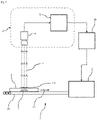
- the figure 1 is an arrangement of an installation 1 for manufacturing mineral fibers.
- the installation 1 makes it possible to melt at least one cullet 6 within a glass furnace 3. Once the melting has been carried out, the molten glass can for example circulate to a forming station, not shown here, which ensures the formation of mineral fibers. This is a non-exhaustive example, the molten glass being able to be used to manufacture any other finished product resulting from the melting of the cullet 6, such as for example bottles or flat glass.
- the cullet 6 Before being melted by the glass furnace 3, the cullet 6 can be moved for example via a conveyor 10 operating in a direction of movement 11.
- the direction of movement 11 is oriented towards the glass furnace 3.
- the cullet 6 may correspond to a set of glass fragments that can be recycled or else to a sample of such a set raised and intended to be melted.
- said sample has a distribution of different types of glass similar to the distribution of the different types of glass within the set of fragments of glass.
- the composition of the cullet 6 is an important factor in order to ensure optimal melting thereof by the glass furnace 3. Indeed, depending on the types of glass present in the cullet 6 as well as the quantities of each of said types of glass in the cullet 6, it is possible to configure the glass furnace 3 in order to improve the melting of the glass fragments of the cullet 6. A bad parameter setting of the glass furnace 3 can lead to an imperfect melting of the cullet 6, and subsequently to the manufacture of a non-compliant or low-quality finished product.
- the cullet 6, before being melted within the glass furnace 3, is subjected to a processing method implemented by a processing system 2.
- the processing system 2 comprises in particular an acquisition device image 4 and an image processing module 5. These two elements allow the implementation of at least a first step of the processing method which is a detection step. Such a detection step is divided into a first phase of acquisition and a second phase of colorimetric processing.
- the image acquisition device 4 can for example be a camera whose function is to capture an image of the cullet 6 scrolling on the conveyor 10 in order to implement the first acquisition phase.
- the cullet 6 In order to obtain an acquired image of the cullet 6 in such a way that it can be correctly processed afterwards, the cullet 6 must be correctly illuminated so that the image acquisition device 4 can capture a clear image.
- the support 8 comprises a light source 7 which illuminates the cullet 6.
- the support 8 comprises a light source 7 which illuminates the cullet 6.
- the support 8 In order to allow the light rays to pass through the support 8, the latter has a transparent bottom on which the cullet 6 rests. This results in a plurality of transmitted light rays 9 which, after passing through the cullet 6, are picked up by the image acquisition device 4.
- the acquisition of the image of the cullet 6 can be done outside the conveyor 10, with a fixed support 8 on which the cullet 6 rests. Once the treatment has been carried out, the cullet 6 is then placed on the conveyor 10.
- the image acquisition by the image acquisition device 4 can be done in a darkened environment, in order to obtain a clear acquired image of the cullet 6 and subsequently making it possible to correctly distinguish the all the different types of glass, as well as all the fragments, including the smallest ones.
- the image acquisition device here does not have an infrared filter in order to correctly distinguish the clear glass fragments from the zones without fragments.
- the cullet 6 is placed on the support 8, itself containing the light source 7. It is however possible for example to set up a transparent conveyor 10 comprising the light source 7, the cullet 6 being placed directly on the conveyor 10
- the light source 7 is thus arranged opposite the conveyor 10 by relative to the cullet 6 and to the image acquisition device 4.
- the transparency of the conveyor 10 thus guarantees that the light rays pass through the latter as well as the cullet 6 until they reach the image acquisition device 4.
- the glass fragments of the cullet 6 are, prior to their passage in front of the light source 7, distributed over the whole of the support 8 so as to avoid or at least limit their overlapping, so that the acquisition image can be done correctly for the whole of the cullet 6.
- the support 8 and the cullet 6 which is placed there can pass over a station where a comb can ensure a correct distribution of the cullet 6 on the entire support 8.
- the acquired image of the cullet 6 is transmitted to the image processing module 5.
- the latter has the particular function of detecting the color of each of the glass fragments of the cullet 6, in order to determine what type of glass these fragments correspond to.
- the image processing module 5 can in particular detect several different types of glass, despite the fact that said types of glass have a similar color with respect to each other. This is the second colorimetric processing phase of the detection step.
- the colors detected can for example be compared with a database of the image processing module 5 in order to deduce therefrom the type of glass associated with each of the colors detected.
- the image processing module 5 can associate the glass fragment with a type of glass whose color is the most close to the color detected, or alternatively classifying the fragment of glass in a separate category, said category grouping together the fragments of glass whose color has not been identified as being clearly specific to a particular type of glass.
- the database can be refined over time.
- the image processing module 5 can detect the different types of glass via an HSV or RGB model, or else a combination of the two models.
- the HSV model is advantageous in the sense that only the H value can be calculated in order to detect the different types of glass, while the RGB model requires the calculation of the three data of the model. Used in combination, the HSV model and the RGB model make it possible to carry out a double detection.
- Each of the fragments of cullet 6 is thus detected as corresponding to a specific type of glass.
- the most common glass colors are clear glass, green glass and amber glass.
- the image processing module 5 can also be capable of determining the quantity of the different types of glass present in the cullet 6, for example the total relative volume of each of the types of glass within the cullet 6.
- the volume of a specific type of glass in particular in the case of an image acquired in two dimensions, is determined by referring to the total surface area of the glass fragments whose detected color corresponds to that of this type of glass, said surface area being calculated according to the number of pixels in the acquired image that are associated with this color. Taking the surface into account makes it possible to deduce therefrom an estimated datum of the thickness of each type of glass detected and to determine on this basis a volume associated with this specific type of glass.
- the volume of a type of glass depends on the number of pixels participating in forming a pattern of a color corresponding to this type of glass.
- the total relative volume of each of the types of glass is also dependent on a resolution of the image acquisition device 4. Indeed, depending on said resolution, the number of pixels and the size of the pixels differ from one model from image acquisition device 4 to another. Such data is provided in a technical description of the image acquisition device 4.
- the number of pixels which are identified as being associated with the color associated with the glass is determined via the image processing module 5 of type A, then we multiply this number of pixels by the size of a pixel. An area corresponding to a spot on the image of said color is thus calculated. Then a volume corresponding to this type A glass is determined, on the basis of a method of calculation defined by the inventors which will be detailed subsequently.
- the volume of each of the types of glass constitutes an example of a quantitative value for calculating the quantity of the different types of glass in the cullet 6.
- Other measurements can be made in order to determine the quantity of each of the types of glass in the cullet 6 to from the measurement of the surface area of the cullet fragments 6.
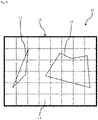
- the figure 2 allows to show an example of determination of the surface area of the cullet glass fragments.
- the picture 2 schematically represents part of the acquired image 16 of the cullet, after the image acquisition device has captured the cullet.
- a grid 15 makes it possible to virtually represent a set of pixels 14.
- the objective is to determine the surface area of all the fragments of the cullet in order to deduce their volume.
- the image processing module therefore analyzes each of the fragments by determining over how many pixels 14 they extend. Depending on the resolution of the image capture device, a particular fragment may span more or less than 14 pixels, hence the importance of considering the resolution of the image capture device in the calculation.
- the second fragment 13 has a larger area than the first fragment 12.
- the volume of each of the glass fragments is determined based on a correlation between the area of the fragment and its thickness.
- the thickness of each of the fragments is deduced according to its respective area.
- Such a correlation is deduced from the fact that the more a glass fragment has a large surface area, the more said fragment tends to have a high thickness.
- This correlation can be established so that when a fragment has a given area, the analysis of the value of this area makes it possible to classify the fragment in a class with which a given thickness is associated.
- a multiplier can be applied to the area to derive a thickness.
- the determination of the thickness of the fragment combined with the value of the area determined by the image processing makes it possible to subsequently deduce the volume of said fragment.
- the image processing module After the image processing module has analyzed that the second fragment 13 has a greater surface area than that of the first fragment, a thickness corresponding to each fragment is determined, with a thickness value of the first fragment less than the thickness value of the second fragment by referring to the predictive model provided by the inventors. Finally, the volumes are calculated and the second fragment 13 has a larger volume than the first fragment 12.
- the volumes of each of the fragments appearing on the acquired image 16 are calculated, said volumes are added up by type of glass detected. For example, if the first fragment 12 and the second fragment 13 have been detected by colorimetry as being of the same type of glass, their respective volumes are added together, as well as with the volume of all the fragments of said type of glass detected on the acquired image 16. If the first fragment 12 and the second fragment 13 correspond to two types of glass distinct from each other, the volume of the first fragment 12 is added with the volume of the fragments corresponding to the type of glass of the first fragment 12 and the volume of the second fragment 13 is added with the volume of the fragments of the same type of glass.
- the following step is a step for determining an amount of oxide and/or a redox potential associated with the cullet as a function of an amount of the different types of glass detected in the cullet.
- Such a step can only be carried out once the different types of glass have been detected as well as their respective volumes. For example, the amount of iron oxide and the redox potential of each type of glass is given for information in the picture 3 .
- Iron oxide is a chemical element that influences the redox potential of cullet, and therefore on the melting of the latter by the glass furnace. It is therefore important to control the amount of iron oxide in the cullet in order to configure the furnace accordingly and thus perform optimal melting of the cullet. Generally speaking, the amount of all types of oxides present in the cullet can be determined. Each quantity in oxide, and according to the example of the picture 3 in iron oxide, is determined by a constant mass percentage within each type of glass.
- FeO early ⁇ glass ⁇ ⁇ volume I ⁇ FeO % I ⁇ glass being the density of the glass
- volume i being the volume of each of the types of glass calculated during the detection step
- FeO [%] i being the mass concentration of iron oxide of each of the types of glass that l 'we find in the table of the picture 3 .
- Such a calculation can also be made alternatively or additionally via the redox potential of each type of glass, in order to obtain the redox potential associated with the cullet.
- the redox potential of each type of glass is not proportional to the mass concentration of iron oxide. This is in particular due to the fact that there are other elements capable of varying the redox potential of each of the types of glass within the latter, such as for example copper oxide or chromium oxide.
- the redox potential of glass C and of glass D differ enormously from each other, this difference being able to be explained by the presence of reducer in greater number for glass D, or else by the presence of a greater quantity of total iron for glass D, the redox potential being able to be calculated by calculating the ratio between the quantity of Fe2+ ions and the quantity of total iron for each type of glass.
- the choice of the calculation of the total quantity of oxide or of the redox potential associated with the cullet can for example depend on the composition of the cullet.
- the step of determining the quantity of oxide and/or the redox potential associated with the cullet as a function of the quantity of the various types of glass detected in the cullet is completed.
- the image processing module 5 can communicate with a control module 30, in order to transmit the quantity of oxide present in the cullet 6 or the redox potential of the latter.
- the control module 30 is able to receive the information generated and to modify the parameters of the glass furnace 3 accordingly.
- the parameters of the glass furnace 3 can be modified according to the composition of the cullet 6, and this in order to bring about an optimal melting of the latter.
- a redox balance of the glass furnace 3 can in particular be modified in order to be adapted to the redox potential or to the quantity of oxide of the cullet 6.
- the modification of the redox balance of the glass furnace 3 can for example be carried out by adding additives, for example oxidizing agents, in order to reduce the oxidation of the cullet 6. This is a step for setting up the glass furnace 3.
- this additional step can be fully automated so that the control module 30 can automatically modify the parameters of the glass furnace 3 according to the results provided by the processing module 5.
- the instructions Parameterization of the glass furnace 3 can also be carried out directly by the processing module 5.
- the parameterization of the glass furnace 3 can also be done manually by an operator.
- the processing module 5 can for example comprise a results display screen read by the operator who can then modify or not the parameters of the glass furnace 3 accordingly.
- the parameters of the glass furnace 3 can be modified absolutely, that is to say individually with respect to each new cullet 6 intended to be melted.
- the parameters of the glass furnace 3 can also be modified in a relative manner, that is to say they are modified according to a difference in results between a cullet 6 and a cullet previously melted by the same glass furnace 3. If the difference in quantity of oxide or in redox potential between the two cullets 6 is too significant, the parameters of the glass furnace 3 are modified accordingly, the parameters of the glass furnace 3 are kept as is.
- the invention achieves the object it had set itself, and makes it possible to propose a process for treating a cullet ensuring its melting in an optimal manner.
- Variants not described here could be implemented without departing from the context of the invention, provided that, in accordance with the invention, they comprise a processing method in accordance with the invention.
Landscapes
- Engineering & Computer Science (AREA)
- Chemical & Material Sciences (AREA)
- Physics & Mathematics (AREA)
- General Physics & Mathematics (AREA)
- Organic Chemistry (AREA)
- Materials Engineering (AREA)
- Computer Vision & Pattern Recognition (AREA)
- Life Sciences & Earth Sciences (AREA)
- Theoretical Computer Science (AREA)
- Immunology (AREA)
- Pathology (AREA)
- Health & Medical Sciences (AREA)
- Analytical Chemistry (AREA)
- Biochemistry (AREA)
- General Health & Medical Sciences (AREA)
- General Chemical & Material Sciences (AREA)
- Geochemistry & Mineralogy (AREA)
- Chemical Kinetics & Catalysis (AREA)
- Quality & Reliability (AREA)
- Spectroscopy & Molecular Physics (AREA)
- Signal Processing (AREA)
- Spectrometry And Color Measurement (AREA)
- Investigating Or Analysing Materials By Optical Means (AREA)
- Glass Melting And Manufacturing (AREA)
Applications Claiming Priority (1)
| Application Number | Priority Date | Filing Date | Title |
|---|---|---|---|
| FR2011757A FR3116272B1 (fr) | 2020-11-17 | 2020-11-17 | Procédé de traitement d’un calcin par analyse colorimétrique |
Publications (1)
| Publication Number | Publication Date |
|---|---|
| EP4001226A1 true EP4001226A1 (de) | 2022-05-25 |
Family
ID=74592116
Family Applications (1)
| Application Number | Title | Priority Date | Filing Date |
|---|---|---|---|
| EP21208637.5A Pending EP4001226A1 (de) | 2020-11-17 | 2021-11-16 | Verfahren zur aufbereitung einer glasscherbe durch kolorimetrische analyse |
Country Status (7)
| Country | Link |
|---|---|
| US (1) | US20240011895A1 (de) |
| EP (1) | EP4001226A1 (de) |
| JP (1) | JP2023549268A (de) |
| AR (1) | AR124073A1 (de) |
| CA (1) | CA3197523A1 (de) |
| FR (1) | FR3116272B1 (de) |
| WO (1) | WO2022106771A1 (de) |
Citations (4)
| Publication number | Priority date | Publication date | Assignee | Title |
|---|---|---|---|---|
| US20060101856A1 (en) * | 2004-11-12 | 2006-05-18 | Lehman Richard L | Method of analyzing mixed-color cullet to facilitate its use in glass manufacture |
| US20060101857A1 (en) * | 2004-11-12 | 2006-05-18 | Lehman Richard L | System for and method of batch analysis and optimization for glass manufacturing |
| EP2298705A2 (de) * | 1998-04-09 | 2011-03-23 | Culchrome, LLC | Verfahren zum Recyclen von gemischten gefärbten Glasscheiben in braunes, grünes oder weißes Glas mit ausgewählten Eigenschaften |
| US20140130553A1 (en) * | 2004-11-12 | 2014-05-15 | Re Community Holdings Ii, Inc. | System for and method of mixed-color cullet characterization and certification, and providing contaminant-free, uniformly colored mixed-color cullet |
Family Cites Families (6)
| Publication number | Priority date | Publication date | Assignee | Title |
|---|---|---|---|---|
| US20050170944A1 (en) * | 2004-01-29 | 2005-08-04 | Mehran Arbab | High performance blue glass |
| JP4664223B2 (ja) * | 2006-03-29 | 2011-04-06 | Jx日鉱日石エネルギー株式会社 | 画像センサーによる多孔質金属−金属酸化物複合体の評価方法 |
| US9675091B1 (en) * | 2016-02-05 | 2017-06-13 | Horst Eger | Automated monitoring in cutting up slaughtered animals |
| WO2019164814A1 (en) * | 2018-02-20 | 2019-08-29 | Purdue Research Foundation | System and method of detecting contaminants |
| FR3095273B1 (fr) * | 2019-04-19 | 2021-05-07 | Saint Gobain Isover | Système de détection automatisé de matériaux de type vitrocéramique |
| FR3095275B1 (fr) * | 2019-04-19 | 2021-09-03 | Saint Gobain Isover | Procédé de détection de vitrocéramique |
-
2020
- 2020-11-17 FR FR2011757A patent/FR3116272B1/fr active Active
-
2021
- 2021-11-10 CA CA3197523A patent/CA3197523A1/fr active Pending
- 2021-11-10 JP JP2023528668A patent/JP2023549268A/ja active Pending
- 2021-11-10 WO PCT/FR2021/051989 patent/WO2022106771A1/fr not_active Ceased
- 2021-11-10 US US18/252,463 patent/US20240011895A1/en active Pending
- 2021-11-16 EP EP21208637.5A patent/EP4001226A1/de active Pending
- 2021-11-16 AR ARP210103164A patent/AR124073A1/es unknown
Patent Citations (4)
| Publication number | Priority date | Publication date | Assignee | Title |
|---|---|---|---|---|
| EP2298705A2 (de) * | 1998-04-09 | 2011-03-23 | Culchrome, LLC | Verfahren zum Recyclen von gemischten gefärbten Glasscheiben in braunes, grünes oder weißes Glas mit ausgewählten Eigenschaften |
| US20060101856A1 (en) * | 2004-11-12 | 2006-05-18 | Lehman Richard L | Method of analyzing mixed-color cullet to facilitate its use in glass manufacture |
| US20060101857A1 (en) * | 2004-11-12 | 2006-05-18 | Lehman Richard L | System for and method of batch analysis and optimization for glass manufacturing |
| US20140130553A1 (en) * | 2004-11-12 | 2014-05-15 | Re Community Holdings Ii, Inc. | System for and method of mixed-color cullet characterization and certification, and providing contaminant-free, uniformly colored mixed-color cullet |
Also Published As
| Publication number | Publication date |
|---|---|
| US20240011895A1 (en) | 2024-01-11 |
| FR3116272B1 (fr) | 2024-01-19 |
| WO2022106771A1 (fr) | 2022-05-27 |
| FR3116272A1 (fr) | 2022-05-20 |
| JP2023549268A (ja) | 2023-11-22 |
| CA3197523A1 (fr) | 2022-05-27 |
| AR124073A1 (es) | 2023-02-08 |
Similar Documents
| Publication | Publication Date | Title |
|---|---|---|
| EP4107515B1 (de) | Bildgebungsunterstützte abtastspektroskopie zur identifizierung von edelsteinen | |
| US7446864B2 (en) | Defect inspection method and defect inspection system using the method | |
| EP0214172B1 (de) | Verfahren und vorrichtung zur abmusterung einer farbe ausgehend aus einer sammlung von basisfarbtönen | |
| US11408819B2 (en) | Process and system for identifying the gram type of a bacterium | |
| JP2021510226A (ja) | 金属粉末の状態を判定するための方法及び装置 | |
| EP1232385A1 (de) | Verfahren zur bestimmung des kalzinierungsgrades und der homogenität von aluminium | |
| CN102300100A (zh) | 一种白平衡控制装置及方法 | |
| EP3728624A1 (de) | Verfahren zur identifizierung von hefe oder bakterien | |
| CA3140502A1 (en) | Method and apparatus for analysing metal powder | |
| EP3728623A1 (de) | Verfahren und system zur identifizierung des gramtyps eines bakteriums | |
| US20190256885A1 (en) | Cell measurement method | |
| EP3771903B1 (de) | Verfahren und system zur messung der diamantklarheit | |
| EP4457507A1 (de) | Verfahren und vorrichtung zur inspektion von heissen glasbehältern zur erkennung von defekten | |
| US20220260479A1 (en) | Particle quantitative measurement device | |
| EP4001226A1 (de) | Verfahren zur aufbereitung einer glasscherbe durch kolorimetrische analyse | |
| Sáenz Gamasa et al. | Measurement of the colour of white and rosé wines in visual tasting conditions | |
| CN112697681B (zh) | 一种基于机器视觉检测家具耐光色牢度等级的方法 | |
| FR2905007A1 (fr) | Evaluation quantitave d'un filtre colore | |
| KR101646040B1 (ko) | 반사도를 이용한 컬러합금의 색분석 방법 | |
| EP3956859A1 (de) | Verfahren zur detektion von glaskeramikmaterialien | |
| CA3140550A1 (en) | Method and apparatus for analysing metal powder | |
| EP0414783A1 (de) | Vorrichtung und verfahren zur automatischen bestimmung physikalisch chemischer parameter in einem los von getreide | |
| HK40037871A (en) | A process and system for diamond clarity measurement | |
| CN121837252A (zh) | 基于视觉与知识图谱的工业表面缺陷方法及系统 | |
| FR2870337A1 (fr) | Procede permettant d'evaluer les proprietes colorimetriques d'une surface, notamment un parement de beton |
Legal Events
| Date | Code | Title | Description |
|---|---|---|---|
| PUAI | Public reference made under article 153(3) epc to a published international application that has entered the european phase |
Free format text: ORIGINAL CODE: 0009012 |
|
| STAA | Information on the status of an ep patent application or granted ep patent |
Free format text: STATUS: THE APPLICATION HAS BEEN PUBLISHED |
|
| AK | Designated contracting states |
Kind code of ref document: A1 Designated state(s): AL AT BE BG CH CY CZ DE DK EE ES FI FR GB GR HR HU IE IS IT LI LT LU LV MC MK MT NL NO PL PT RO RS SE SI SK SM TR |
|
| RBV | Designated contracting states (corrected) |
Designated state(s): AL AT BE BG CH CY CZ DE DK EE ES FI FR GB GR HR HU IE IS IT LI LT LU LV MC MK MT NL NO PL PT RO RS SE SI SK SM TR |