EP4001347B1 - Film soluble dans l'eau et emballage - Google Patents
Film soluble dans l'eau et emballage Download PDFInfo
- Publication number
- EP4001347B1 EP4001347B1 EP20839845.3A EP20839845A EP4001347B1 EP 4001347 B1 EP4001347 B1 EP 4001347B1 EP 20839845 A EP20839845 A EP 20839845A EP 4001347 B1 EP4001347 B1 EP 4001347B1
- Authority
- EP
- European Patent Office
- Prior art keywords
- water
- soluble film
- film
- less
- average
- Prior art date
- Legal status (The legal status is an assumption and is not a legal conclusion. Google has not performed a legal analysis and makes no representation as to the accuracy of the status listed.)
- Active
Links
Images
Classifications
-
- B—PERFORMING OPERATIONS; TRANSPORTING
- B29—WORKING OF PLASTICS; WORKING OF SUBSTANCES IN A PLASTIC STATE IN GENERAL
- B29C—SHAPING OR JOINING OF PLASTICS; SHAPING OF MATERIAL IN A PLASTIC STATE, NOT OTHERWISE PROVIDED FOR; AFTER-TREATMENT OF THE SHAPED PRODUCTS, e.g. REPAIRING
- B29C41/00—Shaping by coating a mould, core or other substrate, i.e. by depositing material and stripping-off the shaped article; Apparatus therefor
- B29C41/003—Shaping by coating a mould, core or other substrate, i.e. by depositing material and stripping-off the shaped article; Apparatus therefor characterised by the choice of material
-
- B—PERFORMING OPERATIONS; TRANSPORTING
- B29—WORKING OF PLASTICS; WORKING OF SUBSTANCES IN A PLASTIC STATE IN GENERAL
- B29C—SHAPING OR JOINING OF PLASTICS; SHAPING OF MATERIAL IN A PLASTIC STATE, NOT OTHERWISE PROVIDED FOR; AFTER-TREATMENT OF THE SHAPED PRODUCTS, e.g. REPAIRING
- B29C41/00—Shaping by coating a mould, core or other substrate, i.e. by depositing material and stripping-off the shaped article; Apparatus therefor
- B29C41/34—Component parts, details or accessories; Auxiliary operations
- B29C41/46—Heating or cooling
-
- B—PERFORMING OPERATIONS; TRANSPORTING
- B65—CONVEYING; PACKING; STORING; HANDLING THIN OR FILAMENTARY MATERIAL
- B65D—CONTAINERS FOR STORAGE OR TRANSPORT OF ARTICLES OR MATERIALS, e.g. BAGS, BARRELS, BOTTLES, BOXES, CANS, CARTONS, CRATES, DRUMS, JARS, TANKS, HOPPERS, FORWARDING CONTAINERS; ACCESSORIES, CLOSURES, OR FITTINGS THEREFOR; PACKAGING ELEMENTS; PACKAGES
- B65D65/00—Wrappers or flexible covers; Packaging materials of special type or form
- B65D65/38—Packaging materials of special type or form
-
- C—CHEMISTRY; METALLURGY
- C08—ORGANIC MACROMOLECULAR COMPOUNDS; THEIR PREPARATION OR CHEMICAL WORKING-UP; COMPOSITIONS BASED THEREON
- C08J—WORKING-UP; GENERAL PROCESSES OF COMPOUNDING; AFTER-TREATMENT NOT COVERED BY SUBCLASSES C08B, C08C, C08F, C08G or C08H
- C08J5/00—Manufacture of articles or shaped materials containing macromolecular substances
- C08J5/18—Manufacture of films or sheets
-
- C—CHEMISTRY; METALLURGY
- C08—ORGANIC MACROMOLECULAR COMPOUNDS; THEIR PREPARATION OR CHEMICAL WORKING-UP; COMPOSITIONS BASED THEREON
- C08K—Use of inorganic or non-macromolecular organic substances as compounding ingredients
- C08K5/00—Use of organic ingredients
- C08K5/04—Oxygen-containing compounds
- C08K5/05—Alcohols; Metal alcoholates
- C08K5/053—Polyhydroxylic alcohols
-
- B—PERFORMING OPERATIONS; TRANSPORTING
- B29—WORKING OF PLASTICS; WORKING OF SUBSTANCES IN A PLASTIC STATE IN GENERAL
- B29C—SHAPING OR JOINING OF PLASTICS; SHAPING OF MATERIAL IN A PLASTIC STATE, NOT OTHERWISE PROVIDED FOR; AFTER-TREATMENT OF THE SHAPED PRODUCTS, e.g. REPAIRING
- B29C59/00—Surface shaping of articles, e.g. embossing; Apparatus therefor
- B29C59/02—Surface shaping of articles, e.g. embossing; Apparatus therefor by mechanical means, e.g. pressing
- B29C59/022—Surface shaping of articles, e.g. embossing; Apparatus therefor by mechanical means, e.g. pressing characterised by the disposition or the configuration, e.g. dimensions, of the embossments or the shaping tools therefor
- B29C2059/023—Microembossing
-
- B—PERFORMING OPERATIONS; TRANSPORTING
- B29—WORKING OF PLASTICS; WORKING OF SUBSTANCES IN A PLASTIC STATE IN GENERAL
- B29K—INDEXING SCHEME ASSOCIATED WITH SUBCLASSES B29B, B29C OR B29D, RELATING TO MOULDING MATERIALS OR TO MATERIALS FOR MOULDS, REINFORCEMENTS, FILLERS OR PREFORMED PARTS, e.g. INSERTS
- B29K2029/00—Use of polyvinylalcohols, polyvinylethers, polyvinylaldehydes, polyvinylketones or polyvinylketals or derivatives thereof as moulding material
- B29K2029/04—PVOH, i.e. polyvinyl alcohol
-
- B—PERFORMING OPERATIONS; TRANSPORTING
- B29—WORKING OF PLASTICS; WORKING OF SUBSTANCES IN A PLASTIC STATE IN GENERAL
- B29K—INDEXING SCHEME ASSOCIATED WITH SUBCLASSES B29B, B29C OR B29D, RELATING TO MOULDING MATERIALS OR TO MATERIALS FOR MOULDS, REINFORCEMENTS, FILLERS OR PREFORMED PARTS, e.g. INSERTS
- B29K2031/00—Use of polyvinylesters or derivatives thereof as moulding material
- B29K2031/04—Polymers of vinyl acetate, e.g. PVAc, i.e. polyvinyl acetate
-
- B—PERFORMING OPERATIONS; TRANSPORTING
- B29—WORKING OF PLASTICS; WORKING OF SUBSTANCES IN A PLASTIC STATE IN GENERAL
- B29K—INDEXING SCHEME ASSOCIATED WITH SUBCLASSES B29B, B29C OR B29D, RELATING TO MOULDING MATERIALS OR TO MATERIALS FOR MOULDS, REINFORCEMENTS, FILLERS OR PREFORMED PARTS, e.g. INSERTS
- B29K2995/00—Properties of moulding materials, reinforcements, fillers, preformed parts or moulds
- B29K2995/0037—Other properties
- B29K2995/0059—Degradable
- B29K2995/0062—Degradable water-soluble
-
- B—PERFORMING OPERATIONS; TRANSPORTING
- B29—WORKING OF PLASTICS; WORKING OF SUBSTANCES IN A PLASTIC STATE IN GENERAL
- B29L—INDEXING SCHEME ASSOCIATED WITH SUBCLASS B29C, RELATING TO PARTICULAR ARTICLES
- B29L2007/00—Flat articles, e.g. films or sheets
- B29L2007/008—Wide strips, e.g. films, webs
-
- B—PERFORMING OPERATIONS; TRANSPORTING
- B29—WORKING OF PLASTICS; WORKING OF SUBSTANCES IN A PLASTIC STATE IN GENERAL
- B29L—INDEXING SCHEME ASSOCIATED WITH SUBCLASS B29C, RELATING TO PARTICULAR ARTICLES
- B29L2031/00—Other particular articles
- B29L2031/712—Containers; Packaging elements or accessories, Packages
-
- B—PERFORMING OPERATIONS; TRANSPORTING
- B65—CONVEYING; PACKING; STORING; HANDLING THIN OR FILAMENTARY MATERIAL
- B65D—CONTAINERS FOR STORAGE OR TRANSPORT OF ARTICLES OR MATERIALS, e.g. BAGS, BARRELS, BOTTLES, BOXES, CANS, CARTONS, CRATES, DRUMS, JARS, TANKS, HOPPERS, FORWARDING CONTAINERS; ACCESSORIES, CLOSURES, OR FITTINGS THEREFOR; PACKAGING ELEMENTS; PACKAGES
- B65D65/00—Wrappers or flexible covers; Packaging materials of special type or form
- B65D65/38—Packaging materials of special type or form
- B65D65/46—Applications of disintegrable, dissolvable or edible materials
-
- C—CHEMISTRY; METALLURGY
- C08—ORGANIC MACROMOLECULAR COMPOUNDS; THEIR PREPARATION OR CHEMICAL WORKING-UP; COMPOSITIONS BASED THEREON
- C08J—WORKING-UP; GENERAL PROCESSES OF COMPOUNDING; AFTER-TREATMENT NOT COVERED BY SUBCLASSES C08B, C08C, C08F, C08G or C08H
- C08J2329/00—Characterised by the use of homopolymers or copolymers of compounds having one or more unsaturated aliphatic radicals, each having only one carbon-to-carbon double bond, and at least one being terminated by an alcohol, ether, aldehydo, ketonic, acetal, or ketal radical; Hydrolysed polymers of esters of unsaturated alcohols with saturated carboxylic acids; Derivatives of such polymer
- C08J2329/02—Homopolymers or copolymers of unsaturated alcohols
- C08J2329/04—Polyvinyl alcohol; Partially hydrolysed homopolymers or copolymers of esters of unsaturated alcohols with saturated carboxylic acids
Definitions
- the present invention relates to a water-soluble film containing polyvinyl alcohol resin suitably used for packaging various chemicals etc., and a package using the film.
- water-soluble films have been used in a wide variety of fields such as packaging for various chemicals, such as liquid cleaners, pesticides, and disinfectants, and seed tape including seeds, utilizing its excellent solubility in water.
- Polyvinyl alcohol resin (may be abbreviated as PVA hereafter) is primarily used for such applied water-soluble films. Unevenness is provided to the film surface for improving matting and slipperiness between films. Method of providing unevenness may be a method of forming a film from a film forming solution, which results from adding a filler to a PVA aqueous solution, or method of embossing a formed film (Patent Document 1, for example).
- Patent Document 2 discloses a chemical packaging body manufacturing method of providing a chemical packaging body having excellent appearance characteristics through bonding together embossed surfaces or non-embossed surfaces when bonding together water-soluble films.
- Patent Document JP-H07290567 A discloses the production of water-soluble films as packaging for pesticides,
- packaging bodies having a high-quality appearance and glossiness have been in high demand from the perspective of design.
- a packaging body is manufactured such that surfaces having large unevenness such as embossed surfaces are bonded together, and that the surface with small unevenness is on the front surface side.
- sealing may be carried out at a high speed.
- water to be coated as a paste may be coated unevenly, and air may not be sufficiently discharged out from the packaging body, remaining in the seal portion as a seal defect, thereby easily making seal strength be uneven.
- the packaging bag may tear from the portion with a weak seal strength, and leaking content therefrom.
- the present invention aims to provide a water-soluble film that can be suitably used for manufacturing a packaging body with excellent uniformity of seal strength, even for manufacturing a packaging body with excellent uniformity of seal strength during high-speed sealing, and a packaging body using the film.
- the present invention relates to:
- the present invention relates to:
- the present invention relates to:
- a water-soluble film that can be suitably used for manufacturing a package with excellent uniformity of seal strength, even for manufacturing a package with excellent uniformity of seal strength during high-speed sealing, and a package using the film are provided.
- the water-soluble film of the present invention contains polyvinyl alcohol resin (PVA).
- PVA polyvinyl alcohol resin
- the water-soluble film of the present invention is a water-soluble film having the ratio RSm (LD) / RSm (TD) (may be referred to as RSm (LD/TD) hereafter) of 1.2 or greater and 2.5 or less, wherein RSm (LD) denotes the average length of roughness curve elements in the longitudinal direction of at least one surface of the film and RSm (TD) denotes the average length of the roughness curve elements in the transverse direction of the same.
- the longitudinal direction of the film surface denotes the main orientation direction of PVA molecules of the film.
- the transverse direction denotes the vertical direction to the longitudinal direction and is parallel to the film surface.
- the average length of roughness curve elements RSm which is obtained by measuring film surface roughness using a confocal laser microscope (e.g., 'OLS3100' manufactured by Olympus Corporation), is used as an index for film surface roughness.
- the confocal laser microscope is different from typical optical microscopes, and uses a laser beam having a specific wavelength and excellent linearity, detecting only light having a focal point on the sample surface through an objective lens. With this optical system, most of the reflective light not from the focal point is cut out, whereby only information of focal point position is obtained. Since the confocal laser microscope has resolution along the optical axis (along the sample thickness), 3-dimensional measurement of surface unevenness is possible.
- the average length of roughness curve elements RSm is a parameter for line roughness, which is found through measurement of roughness of a solid body surface and is specified in JIS B 0601-2001.
- the RSm (LD/TD) of at least one of the film surfaces of the water-soluble film according to the present invention falls within the range of 1.2 or greater and 2.5 or less.
- the RSm (LD / TD) being within the range given above results in a film with excellent uniformity of seal strength. This means that the average length of the tops or bottoms constituting the contour elements in the longitudinal direction is greater than that of the same constituting the contour elements in the transverse direction, namely, that the tops or bottoms of the film surface are longer in the longitudinal direction.
- the RSm (LD / TD) is preferably 1.4 or greater.
- the RSm (LD/TD) is preferably 2.0 or less from the perspective of productivity.
- the average length of roughness curve elements in the longitudinal direction: RSm (LD) is preferably 10 ⁇ m or greater and 30 ⁇ m or less from the perspective of uniformity of seal strength.
- the average length of roughness curve elements in the transverse direction: RSm (TD) is preferably 5 ⁇ m or greater and 20 ⁇ m or less, further preferably 5 ⁇ m or greater and 15 ⁇ m or less from the perspective of seal strength.
- the ratio of arithmetic average roughness Ra of both surfaces that is, front/back ratio (may be referred to as Ra (M/G) hereafter) of arithmetic average roughness Ra is preferably 2 or greater and 10 or less.
- the Ra (M/G) being within the region given above results in easily having both uniformity of seal strength when sealing at a high speed, and a favorable outer appearance of the resulting packaging bag.
- Ra (M/G) is preferably 3 or greater and 7 or less.
- the front/back ratio Ra (M/G) of Ra is found by measuring the arithmetic average roughness Ra of each film surface and dividing the Ra (Ra(M)) of a matte surface by the Ra (Ra(G)) of a glossy surface, where the glossy surface denotes the surface with the smaller Ra and the matte surface denotes the surface with the larger Ra.
- the arithmetic average roughness Ra of each film surface namely the matte surface and the glossy surface, results from measuring the arithmetic average roughness Ra in the longitudinal direction and the transverse direction of the water-soluble film and taking the average value thereof.
- the Ra(G) is preferably 0.5 ⁇ m or less, more preferably 0.4 ⁇ m or less. If the Ra(G) is within the region given above, the obtained packaging bag has excellent glossiness.
- the RSm (LD / TD) of the matte surface is preferably within the range given above.
- the water-soluble film according to the present invention preferably has multiple convex shapes, which have long sides in the longitudinal direction, on at least one of the film surfaces. Since the film surface having convex shapes arranged in the longitudinal direction makes it easy for a paste to flow in the longitudinal direction when coating the film surface with the paste, the paste is applied uniformly, and a result of the present invention of improving uniformity of seal strength is easily achieved.
- the convex shapes may be approximately rectangular or approximately elliptical.
- the surface form of the film may be observed using the confocal laser microscope in the same manner as observing surface roughness.
- the long side is set as length and the short side is set as width in the case where the convex shapes are approximately rectangular.
- the average of the lengths and average of the widths of 100 arbitrary convex shapes are taken as average length and average width, respectively.
- distance from the flat part surrounding a convex shape to the highest position of the convex shape is taken as height
- the average of the heights of the 100 arbitrary convex shapes is taken as an average height.
- distance between two adjacent convex shapes in the transverse direction is called interval, and the average of the intervals between 100 arbitrary paired adjacent convex shapes is taken as an average interval.
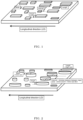
- FIG. 1 illustrates the case where the convex shapes are approximately rectangular
- the major axis is taken as length
- the minor axis is taken as width
- average length and average width are defined in the same manner as when the convex shapes are approximately rectangular.
- distance from the flat part surrounding a convex shape to the maximum height position of the convex shape is taken as height
- the average of the heights of the 100 arbitrary convex shapes is taken as an average height.
- the value resulting from subtracting half of the sum of the lengths along respective minor axes (minor axis A and minor axis B in FIG. 2 ) from the shortest distance between two adjacent convex shapes in the respective transverse directions of the respective major axes is take as an interval, and the average of intervals between 100 arbitrary paired adjacent convex shapes is taken as an average interval.
- the average aspect ratio of the convex shapes is preferably 2 or greater and 10 or less.
- the average aspect ratio here is a value resulting from dividing the average length of the convex shapes by the average width. If the average aspect ratio is within this range, uniformity of seal strength is easily secured by controlling the paste from escaping sideways when sealing in the longitudinal direction. Moreover, uniformity of seal strength is easily secured by securing an escape route for air when sealing so as to reduce seal defects.
- the average height of the convex shapes is preferably 0.5 ⁇ m or greater and 5 ⁇ m or less. If the average height is too small, an effect as a projection cannot be sufficiently achieved. On the other hand, if the average height is too large, difference in film thickness in the film may be a cause for uneven water solubility.
- the average height is preferably 1 ⁇ m or greater and 4 ⁇ m or less.
- PVA polymerization degree, saponification degree, and/or modification degree
- Content of the water-soluble polymer other than PVA in the water-soluble film is preferably 15 parts mass or less, more preferably 10 parts mass or less to 100 parts mass PVA.
- content of the water-soluble polymer other than PVA is within the region given above, unevenness of the film surface is easily adjusted, and water solubility of the water-soluble film may be heightened sufficiently.
- Surfactant content in the water-soluble film is preferably 0.01 parts mass or greater, more preferably 0.02 parts mass or greater, even more preferably 0.05 parts mass or greater to 100 parts mass PVA.
- the surfactant content is preferably 10 parts mass or less, more preferably 1 part mass or less, even more preferably 0.5 parts mass or less, and most preferably 0.3 parts mass or less to 100 parts mass PVA.
- the water-soluble film may contain, within a range not inhibiting the results of the present invention, components such as plasticizer, starch, water-soluble polymers other than PVA, and surfactants, and may also contain moisture, oxidation inhibitor, ultraviolet light absorber, lubricant, crosslinking agent, colorant, filler, preservative, anti-mold agent, and other polymer compounds, etc.
- the complete dissolution time of the water-soluble film when immersed in 10°C deionized water may be measured in the following manner.
- Thickness of the water-soluble film is not particularly limited; however, the range given below is preferred. That is, the thickness is preferably 200 ⁇ m or less, more preferably 150 ⁇ m or less, even more preferably 100 ⁇ m or less. On the other hand, the thickness is preferably 5 ⁇ m or greater, more preferably 10 ⁇ m or greater, even more preferably 15 ⁇ m or greater, and most preferably 20 ⁇ m or greater. While decrease in secondary workability of the water-soluble film may be suitably prevented since the thickness within the range given above is not too large, sufficient mechanical strength of the water-soluble film may be secured since the thickness is not too small either.
- the thickness of the water-soluble film may be found by measuring thickness at ten arbitrary places (for example, ten arbitrary places along a straight line drawn in the longitudinal direction of the water-soluble film) and taking the average value thereof.
- the manufacturing method of the water-soluble film according to the present invention is not particularly limited, and the following methods may be used, for example.
- Examples of the manufacturing method using a film forming solution made uniform by adding a solvent, an additive etc. to the PVA are a flow-casting film forming method, a wet film forming method (discharge into a poor solvent), a dry film forming method, a gel film forming method (method of temporarily cooling and gelling the film forming solution, and then extracting and removing the solvent), a method of forming a film by a combination of these methods, a melt extrusion film forming method of obtaining the film forming solution using an extruder or the like and extruding it from a T-die etc., thereby forming a film, and an inflation film forming method.
- the flow-casting film forming method and the melt extrusion film forming method are preferred as the manufacturing method of the water-soluble film. Use of these methods allows formation of a homogeneous film with good productivity.
- the film forming solution is flow-cast (supplied) in film form onto a support.
- the support may be made of a polymer (e.g., polyethylene terephthalate (PET), polyethylene naphthalate (PEN), acetyl cellulose, polycarbonate, paper, resin laminated paper etc.) or a metal (e.g., iron, copper, aluminum, etc.).
- the liquid coating is dried on the support, eliminating the solvent, and thereby being solidified and made into a film. This drying may be sped up by adding heat.
- the solidified film may be either detached from the support, or further dried as needed using a drying roller, drying furnace etc., and heat treated as needed. Film formation is carried out through a batch method, a semi-batch method, or a continuous method. While storing method of the film is not particularly limited, it may be either wound into a roll form, or (precut and) stacked.
- the method of preparing the film forming solution is not particularly limited, it may be a method of dissolving PVA and an additive, such as a plasticizer or a surfactant, in a solution tank, or method of melting and mixing an additive, such as a plasticizer or a surfactant, when melting and mixing PVA that has retained water using a single or twin-screw extruder.
- an additive such as a plasticizer or a surfactant
- the surface temperature of the support on which the film forming solution is flow casted is preferably 50 to 110°C, more preferably 60 to 100°C, even more preferably 65 to 95°C.
- the surface temperature is within the ranges given above, drying of the liquid coating progresses at an efficient speed, and thus neither is time required for drying the liquid coating too long, nor is productivity of the water-soluble film decreased.
- abnormalities of the water-soluble film surface, such as foaming do not occur easily due to drying of the liquid coating progressing at such a speed.
- hot air may be blown uniformly onto the entire area on a noncontact surface side of the PVA film at a speed of 1 to 10 m per second. This allows adjustment of the drying speed of the liquid coating.
- the temperature of the hot air blown on the noncontact surface side is preferably 50 to 150°C, more preferably 70 to 120°C. When the temperature of the hot air is within the ranges given above, drying efficiency and drying uniformity of the liquid coating may be further improved.
- the water-soluble film is dried (solvent removed) on the support until reaching the volatile component rate of 5 to 50 mass%, it is detached from the support, and is further dried as needed.
- the film may be stored while on the support and may be subjected to a subsequent step.
- the drying method is not particularly limited, and may be a method of passing through a drying furnace, or a method of making physical contact with a drying roller.
- drying the water-soluble film using multiple drying rollers making either one surface of the film or the other surface thereof have physical contact with the drying rollers alternately is preferred. This allows making the degree of crystallization of PVA on both surfaces of the water-soluble film uniform. In this case, use of 3 or more drying rollers is preferred, 4 or more is further preferred, and 5 to 30 is even further preferred.
- Temperature of the drying furnace and drying rollers is preferably 40 to 110°C.
- the upper limit of the temperature of the drying furnace and drying rollers is preferably 100°C or lower, more preferably 90°C or less, even more preferably 85°C or lower.
- the lower limit of the temperature of the drying furnace and drying rollers is preferably 45°C or higher, more preferably 50°C or higher.
- Heat treatment may be further carried out on the water-soluble film after drying as needed. Carrying out heat treatment allows adjustment of characteristics such as mechanical strength, water solubility, birefringence etc. of the water-soluble film.
- Heat treatment temperature is preferably 60 to 135°C. The upper limit of the heat treatment temperature is more preferably 130°C or less.
- a method of providing unevenness to the support surface so as to obtain a water-soluble film having unevenness through transfer at the time of film formation, or a method of providing unevenness to the water-soluble film through embossing may be employed.
- formation of concave parts having an RSm (LD/TD) of 1.2 or greater and 2.5 or less allows provision of a water-soluble film having the target surface roughness.
- formation of concave parts with long sides in the longitudinal direction of the support surface allows provision of a water-soluble film having convex shapes with long sides in the longitudinal direction.
- the method of providing unevenness to the support surface so as to obtain a water-soluble film having unevenness at the time of film formation may easily provide a water-soluble film constituted by a matte surface having a suitable RSm (LD/TD) and a glossy surface having a suitable Ra, and provide both uniformity of seal strength at the time of high-speed sealing and good outer appearance, and is thus preferred.
- a water-soluble film constituted by a matte surface having a suitable RSm (LD/TD) and a glossy surface having a suitable Ra may easily provide a water-soluble film constituted by a matte surface having a suitable RSm (LD/TD) and a glossy surface having a suitable Ra, and provide both uniformity of seal strength at the time of high-speed sealing and good outer appearance, and is thus preferred.
- the drying temperature of the film is preferably 50 to 170°C, more preferably 60 to 140°C.
- the drying time on the support is preferably 0.5 to 20 minutes, more preferably 1 to 15 minutes.
- processing temperature is preferably 60 to 150°C, more preferably 80 to 140°C.
- Processing pressure is preferably 0.1 to 15 MPa, more preferably 0.3 to 8 MPa.
- Film transport speed for embossing is preferably 5m per minute or more, more preferably 10 to 30 m per minute.
- the water-soluble film formed in this manner further undergoes humidity conditioning and has either film end part (ear) cut off etc. as needed, and is then wound in a roll form on a cylindrical core, and wrapped in moisture-proof packaging, resulting in a product.
- the film is cut etc. into uniform-sized pieces, stacked with a release film inserted as needed, and wrapped in moisture-proof packaging, resulting in a product.
- the water-soluble film according to the present invention may be suitably used for various water-soluble film applications to which typical water-soluble films are applied.
- the film applications may be chemical package films, base films for hydraulic pressure transfer, base films for embroidery, release films for artificial marble molding, seed package films, and films for waste storage bags, for example.
- the water-soluble film of the present invention is preferably applied to a chemical package film.
- While physical properties of the chemicals are not particularly limited, they may be acidic, neutral, or alkaline.
- the chemicals may include boron-containing compounds or halogen-containing compounds.
- the packaging form is also not particularly limited; however, unit packages for packaging (preferably sealed packaging) a unit quantity of chemical per package are preferred from the perspective of handleability.
- Manufacturing a packaging body by bonding together surfaces having a predetermined surface roughness, or otherwise bonding a surface having a desired surface roughness and another surface of the water-soluble film according to the present invention allows provision of a packaging body with excellent uniformity of seal strength.
- Oblong samples of a water-soluble film each having dimensions of approximately 30 cm in the longitudinal direction (LD) and approximately 10 cm in the transverse direction (TD), are cut out, and kept for 16 hours or longer in an environment of 23°C and 35% RH (Relative Humidity) so as to be humidity conditioned.
- One of the humidity conditioned samples is placed on a stand in the same environment, and the four corners of the film are fixed using adhesive tape.
- One more sample is stacked thereupon, both ends of respective 10 cm sides are fixed using adhesive tape, and the unfixed ends are passed through an ESIPROOF proofing roller using a 140/10 anilox roller.
- test pieces are bonded and left for ten minutes, they are set in a tension tester, peeled at a tension rate of 254 mm per minute in conformity to a T-peel test based on JIS K6854-3: 1999, and the average value of detaching force of the three obtained test pieces is taken as the adhesive force.
- the average value of detaching force of the nine obtained test pieces is taken as the seal strength, where the coefficient of variation (value resulting from dividing the standard deviation by the average value) is an index of uniformity of seal strength.
- the obtained water-soluble film is 76 ⁇ m thick.
- the complete dissolution time of the obtained water-soluble film when immersed in 10°C deionized water is 195 seconds when measured through the method described above.
- a water-soluble film is obtained in the same manner as in Working Example 1. Surface roughness, surface form, glossiness and seal strength of the obtained water-soluble film are measured. The results are given in Table 1. Note that the complete dissolution time of the obtained water-soluble film when immersed in 10°C deionized water is 97 seconds, which is found using the method described above.
- MMM monomethyl maleate
Landscapes
- Engineering & Computer Science (AREA)
- Chemical & Material Sciences (AREA)
- Mechanical Engineering (AREA)
- Manufacturing & Machinery (AREA)
- Medicinal Chemistry (AREA)
- Chemical Kinetics & Catalysis (AREA)
- Health & Medical Sciences (AREA)
- Polymers & Plastics (AREA)
- Organic Chemistry (AREA)
- Materials Engineering (AREA)
- Manufacture Of Macromolecular Shaped Articles (AREA)
- Wrappers (AREA)
- Shaping Of Tube Ends By Bending Or Straightening (AREA)
Claims (12)
- Film hydrosoluble contenant une résine d'alcool polyvinylique, dans lequel un rapport RSm (LD/TD) est de 1,2 ou plus et 2,5 ou moins, où le RSm (LD/TD) est le rapport entre une longueur moyenne RSm (LD) d'éléments de courbe de rugosité sur au moins une surface de film dans la direction longitudinale et une longueur moyenne RSm (TD) d'éléments de courbe de rugosité sur la même surface de film dans la direction transversale, qui a été déterminé au moyen d'un microscope laser confocal et comme stipulé dans JIS B0601-2001.
- Film hydrosoluble selon la revendication 1, dans lequel la surface de film comprend une pluralité de formes convexes ayant des côtés longs dans la direction longitudinale.
- Film hydrosoluble selon la revendication 2, dans lequel un rapport de forme moyen des formes convexes est de 2 ou plus et 10 ou moins.
- Film hydrosoluble selon la revendication 2 ou la revendication 3, dans lequel la hauteur moyenne des formes convexes est de 0,5 µm ou plus et 5 um ou moins.
- Film hydrosoluble selon l'une quelconque des revendications 2 à 4, dans lequel la largeur moyenne des formes convexes est de 10 µm ou plus et 50 um ou moins, et la longueur moyenne est de 30 µm ou plus et 100 um ou moins.
- Film hydrosoluble selon l'une quelconque des revendications 2 à 5, dans lequel les formes convexes sont obtenues par transfert pendant la formation du film.
- Film hydrosoluble selon l'une quelconque des revendications 2 à 6, dans lequel les formes convexes sont obtenues par gaufrage.
- Film hydrosoluble selon l'une quelconque des revendications 1 à 7, dans lequel un rapport avant/arrière Ra (M/G) de rugosité moyenne arithmétique Ra de la surface de film est de 2 ou plus et 10 ou moins.
- Film hydrosoluble selon l'une quelconque des revendications 1 à 8, dans lequel la surface de film ayant le RSm (LD/TD) de 1,2 ou plus et 2,5 ou moins est une surface mate.
- Emballage dans lequel le film hydrosoluble selon l'une quelconque des revendications 1 à 9 est utilisé pour stocker des produits chimiques.
- Emballage selon la revendication 10, dans lequel une surface brillante est une surface externe.
- Emballage selon la revendication 10 ou la revendication 11, dans lequel les produits chimiques incluent les pesticides, les nettoyants, ou les désinfectants.
Applications Claiming Priority (2)
| Application Number | Priority Date | Filing Date | Title |
|---|---|---|---|
| JP2019131681 | 2019-07-17 | ||
| PCT/JP2020/027450 WO2021010412A1 (fr) | 2019-07-17 | 2020-07-15 | Film soluble dans l'eau et emballage |
Publications (3)
| Publication Number | Publication Date |
|---|---|
| EP4001347A1 EP4001347A1 (fr) | 2022-05-25 |
| EP4001347A4 EP4001347A4 (fr) | 2023-08-09 |
| EP4001347B1 true EP4001347B1 (fr) | 2024-07-03 |
Family
ID=74210845
Family Applications (1)
| Application Number | Title | Priority Date | Filing Date |
|---|---|---|---|
| EP20839845.3A Active EP4001347B1 (fr) | 2019-07-17 | 2020-07-15 | Film soluble dans l'eau et emballage |
Country Status (5)
| Country | Link |
|---|---|
| US (1) | US12325569B2 (fr) |
| EP (1) | EP4001347B1 (fr) |
| JP (1) | JP7493507B2 (fr) |
| CN (1) | CN114008114B (fr) |
| WO (1) | WO2021010412A1 (fr) |
Families Citing this family (2)
| Publication number | Priority date | Publication date | Assignee | Title |
|---|---|---|---|---|
| GB2616656A (en) * | 2022-03-17 | 2023-09-20 | Reckitt Benckiser Finish Bv | Process for manufacturing a water-soluble sheet |
| WO2024024940A1 (fr) * | 2022-07-28 | 2024-02-01 | 三菱ケミカル株式会社 | Film soluble dans l'eau, emballage de produit chimique et procédé de production d'emballage de produit chimique |
Family Cites Families (9)
| Publication number | Priority date | Publication date | Assignee | Title |
|---|---|---|---|---|
| JPH07290567A (ja) * | 1994-04-27 | 1995-11-07 | Dainippon Ink & Chem Inc | 水溶性フィルムおよび袋状成形品 |
| JPH10298311A (ja) * | 1997-04-22 | 1998-11-10 | Kawakami Sangyo Kk | 分解性エンボスフィルム |
| US20080113173A1 (en) * | 2004-11-02 | 2008-05-15 | The Nippon Synthetic Chemical Industry Co., Ltd. | Polyvinyl Alcohol Film and Process for Producing the Same |
| WO2008050517A1 (fr) * | 2006-10-23 | 2008-05-02 | Denki Kagaku Kogyo Kabushiki Kaisha | Feuille d'acetal de polyvinyle et son procede de production |
| JP4332204B2 (ja) * | 2007-09-21 | 2009-09-16 | 積水化学工業株式会社 | 離型フィルム |
| SG10201602911UA (en) * | 2015-04-14 | 2016-11-29 | Univ Singapore | Bioactive modification of poly(vinyl alcohol) with surface topography and biochemical cues for vascular graft |
| JP2017110213A (ja) | 2015-12-14 | 2017-06-22 | 日本合成化学工業株式会社 | 薬剤包装体及び薬剤包装体の製造方法 |
| JP6859696B2 (ja) * | 2015-12-24 | 2021-04-14 | 三菱ケミカル株式会社 | 水溶性フィルム、薬剤包装体及び水溶性フィルムの製造方法 |
| JP2017119434A (ja) | 2015-12-25 | 2017-07-06 | 日本合成化学工業株式会社 | 水溶性フィルム、薬剤包装体及び水溶性フィルムの製造方法 |
-
2020
- 2020-07-15 WO PCT/JP2020/027450 patent/WO2021010412A1/fr not_active Ceased
- 2020-07-15 JP JP2021533085A patent/JP7493507B2/ja active Active
- 2020-07-15 CN CN202080044802.6A patent/CN114008114B/zh active Active
- 2020-07-15 EP EP20839845.3A patent/EP4001347B1/fr active Active
-
2022
- 2022-01-13 US US17/574,792 patent/US12325569B2/en active Active
Also Published As
| Publication number | Publication date |
|---|---|
| JPWO2021010412A1 (fr) | 2021-01-21 |
| EP4001347A1 (fr) | 2022-05-25 |
| JP7493507B2 (ja) | 2024-05-31 |
| US12325569B2 (en) | 2025-06-10 |
| WO2021010412A1 (fr) | 2021-01-21 |
| EP4001347A4 (fr) | 2023-08-09 |
| CN114008114A (zh) | 2022-02-01 |
| CN114008114B (zh) | 2025-03-28 |
| US20220135301A1 (en) | 2022-05-05 |
Similar Documents
| Publication | Publication Date | Title |
|---|---|---|
| JP7546030B2 (ja) | 水溶性フィルム、その製造方法および包装体 | |
| EP3904231A1 (fr) | Film hydrosoluble et emballage | |
| US12325569B2 (en) | Water-soluble film and package | |
| US12319798B2 (en) | Water-soluble film and packaging | |
| US12234333B2 (en) | Water-soluble film and package | |
| US20250353982A1 (en) | Polyvinyl alcohol resin film, optical film, water-soluble film, and polyvinyl alcohol resin composition | |
| US20250353940A1 (en) | Polyvinyl alcohol resin film, optical film, water-soluble film, and polyvinyl alcohol resin composition | |
| US20250353981A1 (en) | Polyvinyl alcohol resin film, optical film, water-soluble film, and polyvinyl alcohol resin composition | |
| KR20170095181A (ko) | 폴리비닐알코올 필름 | |
| KR20260022294A (ko) | 폴리비닐 알코올계 수지 필름, 광학 필름, 수용성 필름, 및 폴리비닐 알코올계 수지 조성물 | |
| EP3848174B1 (fr) | Film de démoulage en alcool polyvinylique destiné à être utilisé en moulage de marbre artificiel et procédé pour la production de marbre artificiel utilisant celui-ci | |
| EP4173989A1 (fr) | Film hydrosoluble, et emballage | |
| WO2023127874A1 (fr) | Film de poly(alcool vinylique) et procédé de production d'un film de poly(alcool vinylique) | |
| JP7512205B2 (ja) | ポリビニルアルコールフィルム及びそれを用いた偏光フィルムの製造方法 | |
| EP4173990A1 (fr) | Film soluble dans l'eau et emballage | |
| EP4174116A1 (fr) | Film hydrosoluble, et emballage | |
| EP4174118A1 (fr) | Film hydrosoluble, et emballage |
Legal Events
| Date | Code | Title | Description |
|---|---|---|---|
| STAA | Information on the status of an ep patent application or granted ep patent |
Free format text: STATUS: THE INTERNATIONAL PUBLICATION HAS BEEN MADE |
|
| PUAI | Public reference made under article 153(3) epc to a published international application that has entered the european phase |
Free format text: ORIGINAL CODE: 0009012 |
|
| STAA | Information on the status of an ep patent application or granted ep patent |
Free format text: STATUS: REQUEST FOR EXAMINATION WAS MADE |
|
| 17P | Request for examination filed |
Effective date: 20220203 |
|
| AK | Designated contracting states |
Kind code of ref document: A1 Designated state(s): AL AT BE BG CH CY CZ DE DK EE ES FI FR GB GR HR HU IE IS IT LI LT LU LV MC MK MT NL NO PL PT RO RS SE SI SK SM TR |
|
| DAV | Request for validation of the european patent (deleted) | ||
| DAX | Request for extension of the european patent (deleted) | ||
| P01 | Opt-out of the competence of the unified patent court (upc) registered |
Effective date: 20230524 |
|
| A4 | Supplementary search report drawn up and despatched |
Effective date: 20230711 |
|
| RIC1 | Information provided on ipc code assigned before grant |
Ipc: B29K 29/00 20060101ALI20230705BHEP Ipc: B65D 65/46 20060101ALI20230705BHEP Ipc: B29C 59/02 20060101ALI20230705BHEP Ipc: B29C 41/38 20060101ALI20230705BHEP Ipc: B29C 41/24 20060101ALI20230705BHEP Ipc: C08J 5/18 20060101AFI20230705BHEP |
|
| GRAP | Despatch of communication of intention to grant a patent |
Free format text: ORIGINAL CODE: EPIDOSNIGR1 |
|
| STAA | Information on the status of an ep patent application or granted ep patent |
Free format text: STATUS: GRANT OF PATENT IS INTENDED |
|
| INTG | Intention to grant announced |
Effective date: 20240208 |
|
| GRAS | Grant fee paid |
Free format text: ORIGINAL CODE: EPIDOSNIGR3 |
|
| GRAA | (expected) grant |
Free format text: ORIGINAL CODE: 0009210 |
|
| STAA | Information on the status of an ep patent application or granted ep patent |
Free format text: STATUS: THE PATENT HAS BEEN GRANTED |
|
| AK | Designated contracting states |
Kind code of ref document: B1 Designated state(s): AL AT BE BG CH CY CZ DE DK EE ES FI FR GB GR HR HU IE IS IT LI LT LU LV MC MK MT NL NO PL PT RO RS SE SI SK SM TR |
|
| REG | Reference to a national code |
Ref country code: CH Ref legal event code: EP |
|
| REG | Reference to a national code |
Ref country code: DE Ref legal event code: R096 Ref document number: 602020033504 Country of ref document: DE |
|
| REG | Reference to a national code |
Ref country code: LT Ref legal event code: MG9D |
|
| REG | Reference to a national code |
Ref country code: NL Ref legal event code: MP Effective date: 20240703 |
|
| PG25 | Lapsed in a contracting state [announced via postgrant information from national office to epo] |
Ref country code: PT Free format text: LAPSE BECAUSE OF FAILURE TO SUBMIT A TRANSLATION OF THE DESCRIPTION OR TO PAY THE FEE WITHIN THE PRESCRIBED TIME-LIMIT Effective date: 20241104 |
|
| REG | Reference to a national code |
Ref country code: AT Ref legal event code: MK05 Ref document number: 1699780 Country of ref document: AT Kind code of ref document: T Effective date: 20240703 |
|
| PG25 | Lapsed in a contracting state [announced via postgrant information from national office to epo] |
Ref country code: NL Free format text: LAPSE BECAUSE OF FAILURE TO SUBMIT A TRANSLATION OF THE DESCRIPTION OR TO PAY THE FEE WITHIN THE PRESCRIBED TIME-LIMIT Effective date: 20240703 |
|
| PG25 | Lapsed in a contracting state [announced via postgrant information from national office to epo] |
Ref country code: PT Free format text: LAPSE BECAUSE OF FAILURE TO SUBMIT A TRANSLATION OF THE DESCRIPTION OR TO PAY THE FEE WITHIN THE PRESCRIBED TIME-LIMIT Effective date: 20241104 Ref country code: NL Free format text: LAPSE BECAUSE OF FAILURE TO SUBMIT A TRANSLATION OF THE DESCRIPTION OR TO PAY THE FEE WITHIN THE PRESCRIBED TIME-LIMIT Effective date: 20240703 |
|
| PG25 | Lapsed in a contracting state [announced via postgrant information from national office to epo] |
Ref country code: NO Free format text: LAPSE BECAUSE OF FAILURE TO SUBMIT A TRANSLATION OF THE DESCRIPTION OR TO PAY THE FEE WITHIN THE PRESCRIBED TIME-LIMIT Effective date: 20241003 |
|
| PG25 | Lapsed in a contracting state [announced via postgrant information from national office to epo] |
Ref country code: GR Free format text: LAPSE BECAUSE OF FAILURE TO SUBMIT A TRANSLATION OF THE DESCRIPTION OR TO PAY THE FEE WITHIN THE PRESCRIBED TIME-LIMIT Effective date: 20241004 Ref country code: FI Free format text: LAPSE BECAUSE OF FAILURE TO SUBMIT A TRANSLATION OF THE DESCRIPTION OR TO PAY THE FEE WITHIN THE PRESCRIBED TIME-LIMIT Effective date: 20240703 Ref country code: PL Free format text: LAPSE BECAUSE OF FAILURE TO SUBMIT A TRANSLATION OF THE DESCRIPTION OR TO PAY THE FEE WITHIN THE PRESCRIBED TIME-LIMIT Effective date: 20240703 |
|
| PG25 | Lapsed in a contracting state [announced via postgrant information from national office to epo] |
Ref country code: BG Free format text: LAPSE BECAUSE OF FAILURE TO SUBMIT A TRANSLATION OF THE DESCRIPTION OR TO PAY THE FEE WITHIN THE PRESCRIBED TIME-LIMIT Effective date: 20240703 |
|
| PG25 | Lapsed in a contracting state [announced via postgrant information from national office to epo] |
Ref country code: LV Free format text: LAPSE BECAUSE OF FAILURE TO SUBMIT A TRANSLATION OF THE DESCRIPTION OR TO PAY THE FEE WITHIN THE PRESCRIBED TIME-LIMIT Effective date: 20240703 |
|
| PG25 | Lapsed in a contracting state [announced via postgrant information from national office to epo] |
Ref country code: IS Free format text: LAPSE BECAUSE OF FAILURE TO SUBMIT A TRANSLATION OF THE DESCRIPTION OR TO PAY THE FEE WITHIN THE PRESCRIBED TIME-LIMIT Effective date: 20241103 Ref country code: AT Free format text: LAPSE BECAUSE OF FAILURE TO SUBMIT A TRANSLATION OF THE DESCRIPTION OR TO PAY THE FEE WITHIN THE PRESCRIBED TIME-LIMIT Effective date: 20240703 |
|
| PG25 | Lapsed in a contracting state [announced via postgrant information from national office to epo] |
Ref country code: HR Free format text: LAPSE BECAUSE OF FAILURE TO SUBMIT A TRANSLATION OF THE DESCRIPTION OR TO PAY THE FEE WITHIN THE PRESCRIBED TIME-LIMIT Effective date: 20240703 Ref country code: CZ Free format text: LAPSE BECAUSE OF FAILURE TO SUBMIT A TRANSLATION OF THE DESCRIPTION OR TO PAY THE FEE WITHIN THE PRESCRIBED TIME-LIMIT Effective date: 20240703 |
|
| PG25 | Lapsed in a contracting state [announced via postgrant information from national office to epo] |
Ref country code: RS Free format text: LAPSE BECAUSE OF FAILURE TO SUBMIT A TRANSLATION OF THE DESCRIPTION OR TO PAY THE FEE WITHIN THE PRESCRIBED TIME-LIMIT Effective date: 20241003 Ref country code: ES Free format text: LAPSE BECAUSE OF FAILURE TO SUBMIT A TRANSLATION OF THE DESCRIPTION OR TO PAY THE FEE WITHIN THE PRESCRIBED TIME-LIMIT Effective date: 20240703 |
|
| PG25 | Lapsed in a contracting state [announced via postgrant information from national office to epo] |
Ref country code: RS Free format text: LAPSE BECAUSE OF FAILURE TO SUBMIT A TRANSLATION OF THE DESCRIPTION OR TO PAY THE FEE WITHIN THE PRESCRIBED TIME-LIMIT Effective date: 20241003 Ref country code: PL Free format text: LAPSE BECAUSE OF FAILURE TO SUBMIT A TRANSLATION OF THE DESCRIPTION OR TO PAY THE FEE WITHIN THE PRESCRIBED TIME-LIMIT Effective date: 20240703 Ref country code: NO Free format text: LAPSE BECAUSE OF FAILURE TO SUBMIT A TRANSLATION OF THE DESCRIPTION OR TO PAY THE FEE WITHIN THE PRESCRIBED TIME-LIMIT Effective date: 20241003 Ref country code: LV Free format text: LAPSE BECAUSE OF FAILURE TO SUBMIT A TRANSLATION OF THE DESCRIPTION OR TO PAY THE FEE WITHIN THE PRESCRIBED TIME-LIMIT Effective date: 20240703 Ref country code: IS Free format text: LAPSE BECAUSE OF FAILURE TO SUBMIT A TRANSLATION OF THE DESCRIPTION OR TO PAY THE FEE WITHIN THE PRESCRIBED TIME-LIMIT Effective date: 20241103 Ref country code: HR Free format text: LAPSE BECAUSE OF FAILURE TO SUBMIT A TRANSLATION OF THE DESCRIPTION OR TO PAY THE FEE WITHIN THE PRESCRIBED TIME-LIMIT Effective date: 20240703 Ref country code: GR Free format text: LAPSE BECAUSE OF FAILURE TO SUBMIT A TRANSLATION OF THE DESCRIPTION OR TO PAY THE FEE WITHIN THE PRESCRIBED TIME-LIMIT Effective date: 20241004 Ref country code: FI Free format text: LAPSE BECAUSE OF FAILURE TO SUBMIT A TRANSLATION OF THE DESCRIPTION OR TO PAY THE FEE WITHIN THE PRESCRIBED TIME-LIMIT Effective date: 20240703 Ref country code: ES Free format text: LAPSE BECAUSE OF FAILURE TO SUBMIT A TRANSLATION OF THE DESCRIPTION OR TO PAY THE FEE WITHIN THE PRESCRIBED TIME-LIMIT Effective date: 20240703 Ref country code: CZ Free format text: LAPSE BECAUSE OF FAILURE TO SUBMIT A TRANSLATION OF THE DESCRIPTION OR TO PAY THE FEE WITHIN THE PRESCRIBED TIME-LIMIT Effective date: 20240703 Ref country code: BG Free format text: LAPSE BECAUSE OF FAILURE TO SUBMIT A TRANSLATION OF THE DESCRIPTION OR TO PAY THE FEE WITHIN THE PRESCRIBED TIME-LIMIT Effective date: 20240703 Ref country code: AT Free format text: LAPSE BECAUSE OF FAILURE TO SUBMIT A TRANSLATION OF THE DESCRIPTION OR TO PAY THE FEE WITHIN THE PRESCRIBED TIME-LIMIT Effective date: 20240703 |
|
| REG | Reference to a national code |
Ref country code: CH Ref legal event code: PL |
|
| PG25 | Lapsed in a contracting state [announced via postgrant information from national office to epo] |
Ref country code: LU Free format text: LAPSE BECAUSE OF NON-PAYMENT OF DUE FEES Effective date: 20240715 |
|
| PG25 | Lapsed in a contracting state [announced via postgrant information from national office to epo] |
Ref country code: LU Free format text: LAPSE BECAUSE OF NON-PAYMENT OF DUE FEES Effective date: 20240715 |
|
| REG | Reference to a national code |
Ref country code: DE Ref legal event code: R097 Ref document number: 602020033504 Country of ref document: DE |
|
| PG25 | Lapsed in a contracting state [announced via postgrant information from national office to epo] |
Ref country code: RO Free format text: LAPSE BECAUSE OF FAILURE TO SUBMIT A TRANSLATION OF THE DESCRIPTION OR TO PAY THE FEE WITHIN THE PRESCRIBED TIME-LIMIT Effective date: 20240703 Ref country code: SM Free format text: LAPSE BECAUSE OF FAILURE TO SUBMIT A TRANSLATION OF THE DESCRIPTION OR TO PAY THE FEE WITHIN THE PRESCRIBED TIME-LIMIT Effective date: 20240703 Ref country code: DK Free format text: LAPSE BECAUSE OF FAILURE TO SUBMIT A TRANSLATION OF THE DESCRIPTION OR TO PAY THE FEE WITHIN THE PRESCRIBED TIME-LIMIT Effective date: 20240703 |
|
| PG25 | Lapsed in a contracting state [announced via postgrant information from national office to epo] |
Ref country code: CH Free format text: LAPSE BECAUSE OF NON-PAYMENT OF DUE FEES Effective date: 20240731 Ref country code: MC Free format text: LAPSE BECAUSE OF FAILURE TO SUBMIT A TRANSLATION OF THE DESCRIPTION OR TO PAY THE FEE WITHIN THE PRESCRIBED TIME-LIMIT Effective date: 20240703 Ref country code: EE Free format text: LAPSE BECAUSE OF FAILURE TO SUBMIT A TRANSLATION OF THE DESCRIPTION OR TO PAY THE FEE WITHIN THE PRESCRIBED TIME-LIMIT Effective date: 20240703 Ref country code: BE Free format text: LAPSE BECAUSE OF NON-PAYMENT OF DUE FEES Effective date: 20240731 |
|
| PG25 | Lapsed in a contracting state [announced via postgrant information from national office to epo] |
Ref country code: SK Free format text: LAPSE BECAUSE OF FAILURE TO SUBMIT A TRANSLATION OF THE DESCRIPTION OR TO PAY THE FEE WITHIN THE PRESCRIBED TIME-LIMIT Effective date: 20240703 Ref country code: IT Free format text: LAPSE BECAUSE OF FAILURE TO SUBMIT A TRANSLATION OF THE DESCRIPTION OR TO PAY THE FEE WITHIN THE PRESCRIBED TIME-LIMIT Effective date: 20240703 |
|
| PLBE | No opposition filed within time limit |
Free format text: ORIGINAL CODE: 0009261 |
|
| STAA | Information on the status of an ep patent application or granted ep patent |
Free format text: STATUS: NO OPPOSITION FILED WITHIN TIME LIMIT |
|
| REG | Reference to a national code |
Ref country code: BE Ref legal event code: MM Effective date: 20240731 |
|
| 26N | No opposition filed |
Effective date: 20250404 |
|
| PGFP | Annual fee paid to national office [announced via postgrant information from national office to epo] |
Ref country code: GB Payment date: 20250529 Year of fee payment: 6 |
|
| PGFP | Annual fee paid to national office [announced via postgrant information from national office to epo] |
Ref country code: FR Payment date: 20250610 Year of fee payment: 6 |
|
| PG25 | Lapsed in a contracting state [announced via postgrant information from national office to epo] |
Ref country code: IE Free format text: LAPSE BECAUSE OF NON-PAYMENT OF DUE FEES Effective date: 20240715 |
|
| PG25 | Lapsed in a contracting state [announced via postgrant information from national office to epo] |
Ref country code: SE Free format text: LAPSE BECAUSE OF FAILURE TO SUBMIT A TRANSLATION OF THE DESCRIPTION OR TO PAY THE FEE WITHIN THE PRESCRIBED TIME-LIMIT Effective date: 20240703 |
|
| PGFP | Annual fee paid to national office [announced via postgrant information from national office to epo] |
Ref country code: DE Payment date: 20250604 Year of fee payment: 6 |
|
| PG25 | Lapsed in a contracting state [announced via postgrant information from national office to epo] |
Ref country code: CY Free format text: LAPSE BECAUSE OF FAILURE TO SUBMIT A TRANSLATION OF THE DESCRIPTION OR TO PAY THE FEE WITHIN THE PRESCRIBED TIME-LIMIT; INVALID AB INITIO Effective date: 20200715 |
|
| PG25 | Lapsed in a contracting state [announced via postgrant information from national office to epo] |
Ref country code: HU Free format text: LAPSE BECAUSE OF FAILURE TO SUBMIT A TRANSLATION OF THE DESCRIPTION OR TO PAY THE FEE WITHIN THE PRESCRIBED TIME-LIMIT; INVALID AB INITIO Effective date: 20200715 |