EP4001692A1 - Palier - Google Patents
Palier Download PDFInfo
- Publication number
- EP4001692A1 EP4001692A1 EP21206181.6A EP21206181A EP4001692A1 EP 4001692 A1 EP4001692 A1 EP 4001692A1 EP 21206181 A EP21206181 A EP 21206181A EP 4001692 A1 EP4001692 A1 EP 4001692A1
- Authority
- EP
- European Patent Office
- Prior art keywords
- bearing
- housing
- core
- additional body
- hydraulic fluid
- Prior art date
- Legal status (The legal status is an assumption and is not a legal conclusion. Google has not performed a legal analysis and makes no representation as to the accuracy of the status listed.)
- Pending
Links
Images

Classifications
-
- F—MECHANICAL ENGINEERING; LIGHTING; HEATING; WEAPONS; BLASTING
- F16—ENGINEERING ELEMENTS AND UNITS; GENERAL MEASURES FOR PRODUCING AND MAINTAINING EFFECTIVE FUNCTIONING OF MACHINES OR INSTALLATIONS; THERMAL INSULATION IN GENERAL
- F16F—SPRINGS; SHOCK-ABSORBERS; MEANS FOR DAMPING VIBRATION
- F16F13/00—Units comprising springs of the non-fluid type as well as vibration-dampers, shock-absorbers, or fluid springs
- F16F13/04—Units comprising springs of the non-fluid type as well as vibration-dampers, shock-absorbers, or fluid springs comprising both a plastics spring and a damper, e.g. a friction damper
- F16F13/06—Units comprising springs of the non-fluid type as well as vibration-dampers, shock-absorbers, or fluid springs comprising both a plastics spring and a damper, e.g. a friction damper the damper being a fluid damper, e.g. the plastics spring not forming a part of the wall of the fluid chamber of the damper
- F16F13/08—Units comprising springs of the non-fluid type as well as vibration-dampers, shock-absorbers, or fluid springs comprising both a plastics spring and a damper, e.g. a friction damper the damper being a fluid damper, e.g. the plastics spring not forming a part of the wall of the fluid chamber of the damper the plastics spring forming at least a part of the wall of the fluid chamber of the damper
- F16F13/14—Units of the bushing type, i.e. loaded predominantly radially
- F16F13/1436—Units of the bushing type, i.e. loaded predominantly radially with free- or virtually free-floating members
-
- F—MECHANICAL ENGINEERING; LIGHTING; HEATING; WEAPONS; BLASTING
- F16—ENGINEERING ELEMENTS AND UNITS; GENERAL MEASURES FOR PRODUCING AND MAINTAINING EFFECTIVE FUNCTIONING OF MACHINES OR INSTALLATIONS; THERMAL INSULATION IN GENERAL
- F16F—SPRINGS; SHOCK-ABSORBERS; MEANS FOR DAMPING VIBRATION
- F16F13/00—Units comprising springs of the non-fluid type as well as vibration-dampers, shock-absorbers, or fluid springs
- F16F13/04—Units comprising springs of the non-fluid type as well as vibration-dampers, shock-absorbers, or fluid springs comprising both a plastics spring and a damper, e.g. a friction damper
- F16F13/06—Units comprising springs of the non-fluid type as well as vibration-dampers, shock-absorbers, or fluid springs comprising both a plastics spring and a damper, e.g. a friction damper the damper being a fluid damper, e.g. the plastics spring not forming a part of the wall of the fluid chamber of the damper
- F16F13/08—Units comprising springs of the non-fluid type as well as vibration-dampers, shock-absorbers, or fluid springs comprising both a plastics spring and a damper, e.g. a friction damper the damper being a fluid damper, e.g. the plastics spring not forming a part of the wall of the fluid chamber of the damper the plastics spring forming at least a part of the wall of the fluid chamber of the damper
- F16F13/14—Units of the bushing type, i.e. loaded predominantly radially
- F16F13/1409—Units of the bushing type, i.e. loaded predominantly radially characterised by buffering features or stoppers
Definitions
- the invention relates to a bearing comprising a core and a housing, at least one elastomer body being arranged between the core and the housing, the core, the housing and the elastomer body enclosing a working space filled with hydraulic fluid.
- such bearings are used in the area of the bogie.
- such bearings are used between the wheel set and the bogie of a rail vehicle, the bearing forming a vibration control system together with the primary suspension arranged between the wheel set and the bogie.
- the bearing which is filled with hydraulic fluid, makes it possible to isolate or dampen the vibrations introduced into the bogie by the wheelset.
- Hydraulic axle guide bearings represent a special application in this context. Hydraulic axle guide bearings guide the wheel set and thereby enable an adjustment movement of the wheel set when cornering.
- the axle guide bearing is designed in such a way that a frequency-dependent rigidity is established, with the bearing being hard for higher-frequency excitations and soft for low-frequency excitations, with higher-frequency excitations being understood to mean frequencies of more than 2 hertz.
- the higher rigidity with higher-frequency excitations ensures that the vehicle runs stably, while the low rigidity enables a radial deflection movement of the wheelset, which is associated with low-wear and low-noise cornering of the vehicle.
- the bearings used for rail vehicles relatively bulky.
- the working space of the bearing has a large volume, into which a correspondingly large amount of hydraulic fluid is filled.
- the desired vibration-damping or vibration-isolating properties of the bearing arise when the working space is completely filled with hydraulic fluid and the working space contains no or not significant proportions of compressible gases.
- the camp of the type mentioned has components made of different materials.
- the core and the housing are usually made of metal and the elastomer body is made of a rubber-elastic material.
- a hydraulic oil for example based on polyglycol, is often used as the hydraulic fluid.
- such hydraulic oils have a significantly larger coefficient of volume expansion than that of the elastomer material or that of the metallic material. Compared to the elastomer material, the volume expansion coefficient of hydraulic oil is, for example, about twice as large and compared to a steel material even twenty times as large.
- the hydraulic fluid is usually filled into the hydraulic mount without pressure.
- the volume of the hydraulic fluid is significantly reduced and that the volume released is taken up by the expansion of gas bubbles present in the working chamber or by evaporated hydraulic fluid.
- the hydraulic fluid can lose about 2% of its volume, for example, with this space being occupied by a corresponding volume of compressible gas.
- the stiffness of the bearing can change as a function of the excitation amplitudes. For example, it is conceivable that the bearing has an undesired free travel before it responds.
- the object of the invention is to provide a bearing which has largely constant bearing properties over a large temperature range.
- the bearing according to the invention comprises a core and a housing, with at least one elastomeric body being arranged between the core and the housing, with the core, the housing and the elastomeric body enclosing a working space filled with hydraulic fluid, with at least one additional body being arranged in the working space.
- the additional body is a solid body which is incompressible in terms of vibration technology.
- the additional body reduces the volume of the working space available for the hydraulic fluid.
- the hydraulic fluid continues to experience quite strong changes in volume depending on the ambient temperature. Due to the smaller volume, however, there is only a small volume, which is occupied by compressible gases, even with very strong temperature fluctuations. Therefore, the bearing has the predetermined vibration properties even with very strong temperature fluctuations.
- the housing can be designed as a sleeve which surrounds the core at a distance.
- the bearing is designed as a hydraulic bush.
- the housing is usually tubular and the core extends coaxially through the housing.
- Such hydraulic bushings have a relatively large-volume working space due to their construction, which is achieved by the inventive Additional body can be advantageously reduced without having to make adjustments to the housing or the core.
- Two chambers are preferably formed from the working space, which are connected to one another in a flow-conducting manner via a device.
- the working space is divided into two chambers, with both chambers being filled with hydraulic fluid and with the hydraulic fluid being able to flow from one chamber into the other chamber via the device.
- the device can be designed as a throttle, for example.
- An additional body is preferably assigned to each chamber. More preferably, both additional bodies have the same volume, so that both chambers are filled with a comparable quantity of hydraulic fluid in the unloaded state.
- An annular section can be formed from the elastomer body on each end face of the housing, which section extends in each case from the core to the housing.
- the section can be designed to run radially or obliquely. It is also conceivable that each section is designed separately, so that the bearing has two elastomer bodies. It is also conceivable that both sections are formed from a one-piece elastomer body formed from the same material. In this context, it is particularly conceivable that the elastomer body is arranged on the inner wall of the housing and on the outer circumference of the core. In this configuration, the working space is delimited by the elastomeric body, with the elastomeric body forming a lining.
- the additional body can be made of plastic.
- a plastic compatible with the hydraulic fluid is selected as the plastic.
- a hydraulic oil from the group of polyglycols it is particularly conceivable to form the additional body from polyetheretherketone (PEEK) or from polyoxymethylene (POM).
- PEEK polyetheretherketone
- POM polyoxymethylene
- the additional body can be made of metallic material. In this context, it is particularly conceivable to form the additional body from the same material as the core or the housing.
- the auxiliary body is preferably attached to the core or to the housing.
- the influence of the additional body on the dynamic behavior of the bearing can be minimized.
- the additional body can be prevented from clogging hydrodynamic components, such as nozzles, valves or the like, if such are provided on the bearing.
- the additional body can be fixed in a non-positive or positive manner on the core or on the housing. It is also conceivable, for example, that the additional body is coated with the material of the elastomer body and is thereby fixed to the core or to the housing.
- the additional body can be at least partially ring-shaped.
- the additional body then extends over part of the circumference of the bearing.
- the working space has two chambers, each of which is provided with an additional body.
- each additional body preferably extends over the peripheral region of the chamber in which the additional body is arranged.
- the additional body can be made of the same material and in one piece from the core and/or the housing.
- the core or the housing has a section that protrudes into the working space and thereby forms the additional body. This refinement can be produced in a particularly simple and cost-effective manner.
- the additional body can reduce the volume of the working space available for the hydraulic fluid by at least 50%. If two chambers and two additional bodies are provided, one additional body reduces the space available in a chamber for the hydraulic fluid, preferably by at least 50%. Preferably, the two additional bodies reduce the space of respective chamber by a consistent amount. This configuration can prevent a significant volume of compressible gases from accumulating in the interior of the working space in the event of very large temperature differences.
- a bogie of a rail vehicle according to the invention comprises at least one wheel set and at least one spring arrangement, the at least one spring arrangement being equipped with at least one bearing as described above.
- Rail vehicles for example, have components that are large in comparison to passenger cars due to their weight. This applies in particular to the bogie and the bearings used in it. Accordingly, a relatively large working space, which is filled with hydraulic fluid, is created between the housing and the core of the bearing used in a bogie. Depending on the country in which they are used, rail vehicles are exposed to very large temperature fluctuations. As a result, the volume of the hydraulic fluid filled into the large-volume working chamber fluctuates greatly. At low temperatures, this means that, in addition to the hydraulic fluid, a significant volume of compressible gases is taken up. At high temperatures, on the other hand, the hydraulic fluid expands, which leads to a sharp increase in pressure in the working area. As a result, at low outside temperatures, the bearing may have free travel before responding, and at high outside temperatures, the bearing may exhibit an undesirably hard characteristic.
- the bearing Due to the fact that the volume available for the hydraulic fluid in the bearing according to the invention is reduced by the additional body, the fluctuation in volume of the hydraulic fluid when the temperature changes is also reduced. As a result, the bearing has consistent bearing properties over a wide temperature range.
- the bearing can function as a guide bush.
- Guide bushes are used in the primary suspension of the bogie.
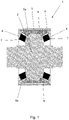
- FIG 1 shows a bearing 1 comprising a core 2 and a housing 3, with an elastomer body 4 being arranged between the core 2 and the housing 3.
- the housing 3 is designed as a sleeve which surrounds the core 2 at a distance.
- Ring-shaped sections 7 are formed from the elastomer body 4 on each end face of the housing 3 and each extend from the core 2 to the housing 3 . Accordingly, the bearing 1 forms a hydraulic bush.
- the core 2, the housing 3 and the elastomer body 4 enclose a working space 5 filled with hydraulic fluid.
- the elastomer body 4 is designed in such a way that the working space 5 is delimited by the elastomer body 4 .
- the elastomer body 4 extends over the inner wall of the housing 3 and around the core 2 on the outer circumference.
- the two chambers 5a, 5b are fluidly connected to one another via a device (a throttle, not shown here).
- an additional body 6, 6' is arranged in each chamber 5a, 5b of the working space 5.
- the additional bodies 6, 6' are made of a metallic material.
- the additional bodies 6, 6' may be made of plastic, with PEEK or POM being particularly suitable in this case.
- the additional bodies 6, 6' are fastened to the core 2 in the present embodiment.
- the additional bodies 6, 6′ are in the form of a ring in sections over the extent of the chambers 5a, 5b in the circumferential direction.
- the attachment of the additional body 6, 6 'on the core 2 is done by means of a screw connection. Alternatively, however, the fastening can also take place in a materially bonded manner by gluing or welding.
- the additional bodies 6, 6' are designed in such a way that the volume of each chamber 5a, 5b of the working space 5 available for the hydraulic fluid is reduced by 40%.
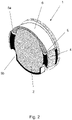
- figure 2 shows the camp 1 according to figure 1 in partial section in three-dimensional representation.
- the housing 3 is not shown and only the additional body 6 provided in the chamber 5a.
- the additional body 6′ provided in the chamber 5b, however, is not shown.
- FIG figure 3 shows a bogie 8 of a rail vehicle with a wheel set 9 and a spring arrangement 10.
- the spring arrangement 10 is provided with a bearing 1 according to FIG figure 1 equipped.
- Bearing 1 acts as a hydraulic axle guide bearing.
- the bearing 1 is mounted in the axle swing arm 11 of the bogie 8 and supports the wheelset 9 against the bogie frame 12 .
Landscapes
- Engineering & Computer Science (AREA)
- General Engineering & Computer Science (AREA)
- Mechanical Engineering (AREA)
- Combined Devices Of Dampers And Springs (AREA)
Applications Claiming Priority (1)
| Application Number | Priority Date | Filing Date | Title |
|---|---|---|---|
| DE102020130271.1A DE102020130271A1 (de) | 2020-11-17 | 2020-11-17 | Lager |
Publications (1)
| Publication Number | Publication Date |
|---|---|
| EP4001692A1 true EP4001692A1 (fr) | 2022-05-25 |
Family
ID=78516609
Family Applications (1)
| Application Number | Title | Priority Date | Filing Date |
|---|---|---|---|
| EP21206181.6A Pending EP4001692A1 (fr) | 2020-11-17 | 2021-11-03 | Palier |
Country Status (2)
| Country | Link |
|---|---|
| EP (1) | EP4001692A1 (fr) |
| DE (1) | DE102020130271A1 (fr) |
Citations (5)
| Publication number | Priority date | Publication date | Assignee | Title |
|---|---|---|---|---|
| JPH11141595A (ja) * | 1997-11-10 | 1999-05-25 | Bridgestone Corp | 防振装置 |
| EP1457706A1 (fr) * | 2003-03-10 | 2004-09-15 | Carl Freudenberg KG | Palier pour guide d'essieu |
| EP2978993B1 (fr) | 2013-03-25 | 2018-03-07 | Carl Freudenberg KG | Palier |
| DE102017120321B3 (de) * | 2017-09-04 | 2018-12-06 | Vibracoustic Gmbh | Hydraulisch dämpfendes Lager |
| US20190186586A1 (en) * | 2016-08-23 | 2019-06-20 | ContiTech Vibration Control GbmH | Bushing |
Family Cites Families (1)
| Publication number | Priority date | Publication date | Assignee | Title |
|---|---|---|---|---|
| DE102018200346A1 (de) | 2018-01-11 | 2019-07-11 | Contitech Luftfedersysteme Gmbh | Hydraulische Lagerbuchse |
-
2020
- 2020-11-17 DE DE102020130271.1A patent/DE102020130271A1/de active Pending
-
2021
- 2021-11-03 EP EP21206181.6A patent/EP4001692A1/fr active Pending
Patent Citations (5)
| Publication number | Priority date | Publication date | Assignee | Title |
|---|---|---|---|---|
| JPH11141595A (ja) * | 1997-11-10 | 1999-05-25 | Bridgestone Corp | 防振装置 |
| EP1457706A1 (fr) * | 2003-03-10 | 2004-09-15 | Carl Freudenberg KG | Palier pour guide d'essieu |
| EP2978993B1 (fr) | 2013-03-25 | 2018-03-07 | Carl Freudenberg KG | Palier |
| US20190186586A1 (en) * | 2016-08-23 | 2019-06-20 | ContiTech Vibration Control GbmH | Bushing |
| DE102017120321B3 (de) * | 2017-09-04 | 2018-12-06 | Vibracoustic Gmbh | Hydraulisch dämpfendes Lager |
Also Published As
| Publication number | Publication date |
|---|---|
| DE102020130271A1 (de) | 2022-05-19 |
Similar Documents
| Publication | Publication Date | Title |
|---|---|---|
| DE2736188C3 (de) | Gummilager mit hydraulischer Dämpfung | |
| EP1464866B1 (fr) | Ensemble ressort pneumatique | |
| DE112005000363B4 (de) | Stangenführung und Dichtungssystem für Stoßdämpfer mit Gasfüllung | |
| DE112010000707B4 (de) | Dreirohr-Stoßdämpfer mit verkürztem Mittelrohr | |
| DE102011102076B3 (de) | Hydrolager | |
| DE112011101883B4 (de) | Zweistufen-Ventil und hydraulisch gedämpftes Ventil | |
| DE3125907A1 (de) | Daempfungselement fuer die aufhaengung eines schwingenden koerpers an einer tragkonstruktion | |
| EP1831582B1 (fr) | Unite d'amortissement a ressort pneumatique | |
| DE102018201297A1 (de) | Schwingungsdämpfer für ein Fahrzeug | |
| DE102008001097A1 (de) | Elastisches Verbindungselement mit veränderlicher Steifigkeit | |
| EP1693233A1 (fr) | Jambe de ressort pneumatique avec amortisseur positionné centralement | |
| DE102019214905A1 (de) | Luftfederbein mit speziell ausgebildeter Befestigung eines Abrollkolbens am Stoßdämpfer | |
| DE3440681A1 (de) | Schwingungsabsorbierende befestigung | |
| EP1055839B1 (fr) | Support amorti hydrauliquement | |
| DE19629959A1 (de) | Schwingungsdämpfer mit einem Hydrolager | |
| EP3158217A1 (fr) | Palier hydraulique et véhicule à moteur équipé d'un tel palier hydraulique | |
| WO2006061119A1 (fr) | Unite ressort et amortisseur pneumatique de guidage de roue | |
| DE3720140C2 (fr) | ||
| EP0351737A2 (fr) | Support de moteur à amortissement hydraulique | |
| EP0528253B1 (fr) | Palier de support à amortissement hydraulique pour parties de châssis de voiture | |
| EP4001692A1 (fr) | Palier | |
| DE102018217373A1 (de) | Dämpfervorrichtung sowie Fahrzeug mit der Dämpfervorrichtung | |
| DE102021204441A1 (de) | Ventilanordnung für eine Dämpfervorrichtung sowie Dämpfervorrichtung mit der Ventilanordnung | |
| EP1923301B1 (fr) | Amortisseur d'oscillations doté d'une butée | |
| EP1069338B1 (fr) | Support à amortissement hydraulique |
Legal Events
| Date | Code | Title | Description |
|---|---|---|---|
| PUAI | Public reference made under article 153(3) epc to a published international application that has entered the european phase |
Free format text: ORIGINAL CODE: 0009012 |
|
| STAA | Information on the status of an ep patent application or granted ep patent |
Free format text: STATUS: THE APPLICATION HAS BEEN PUBLISHED |
|
| AK | Designated contracting states |
Kind code of ref document: A1 Designated state(s): AL AT BE BG CH CY CZ DE DK EE ES FI FR GB GR HR HU IE IS IT LI LT LU LV MC MK MT NL NO PL PT RO RS SE SI SK SM TR |
|
| STAA | Information on the status of an ep patent application or granted ep patent |
Free format text: STATUS: REQUEST FOR EXAMINATION WAS MADE |
|
| 17P | Request for examination filed |
Effective date: 20221117 |
|
| RBV | Designated contracting states (corrected) |
Designated state(s): AL AT BE BG CH CY CZ DE DK EE ES FI FR GB GR HR HU IE IS IT LI LT LU LV MC MK MT NL NO PL PT RO RS SE SI SK SM TR |
|
| P01 | Opt-out of the competence of the unified patent court (upc) registered |
Effective date: 20230516 |
|
| STAA | Information on the status of an ep patent application or granted ep patent |
Free format text: STATUS: EXAMINATION IS IN PROGRESS |
|
| 17Q | First examination report despatched |
Effective date: 20250416 |