EP4001730A1 - Matériau d'encapsulation externe pour matériau d'isolation thermique sous vide, matériau d'isolation thermique sous vide, et article doté de matériau d'isolation thermique sous vide - Google Patents
Matériau d'encapsulation externe pour matériau d'isolation thermique sous vide, matériau d'isolation thermique sous vide, et article doté de matériau d'isolation thermique sous vide Download PDFInfo
- Publication number
- EP4001730A1 EP4001730A1 EP20832793.2A EP20832793A EP4001730A1 EP 4001730 A1 EP4001730 A1 EP 4001730A1 EP 20832793 A EP20832793 A EP 20832793A EP 4001730 A1 EP4001730 A1 EP 4001730A1
- Authority
- EP
- European Patent Office
- Prior art keywords
- film
- vacuum insulation
- gas barrier
- outer packing
- insulation material
- Prior art date
- Legal status (The legal status is an assumption and is not a legal conclusion. Google has not performed a legal analysis and makes no representation as to the accuracy of the status listed.)
- Pending
Links
- 239000011810 insulating material Substances 0.000 title 3
- 239000005022 packaging material Substances 0.000 title 1
- 230000004888 barrier function Effects 0.000 claims abstract description 407
- 239000000463 material Substances 0.000 claims abstract description 320
- 239000012774 insulation material Substances 0.000 claims abstract description 277
- 229920005989 resin Polymers 0.000 claims abstract description 236
- 239000011347 resin Substances 0.000 claims abstract description 236
- 238000012856 packing Methods 0.000 claims abstract description 216
- 229910052751 metal Inorganic materials 0.000 claims abstract description 54
- 239000002184 metal Substances 0.000 claims abstract description 54
- 229920000219 Ethylene vinyl alcohol Polymers 0.000 claims abstract description 42
- 239000004372 Polyvinyl alcohol Substances 0.000 claims abstract description 39
- 229920002451 polyvinyl alcohol Polymers 0.000 claims abstract description 39
- XLYOFNOQVPJJNP-UHFFFAOYSA-N water Chemical compound O XLYOFNOQVPJJNP-UHFFFAOYSA-N 0.000 claims abstract description 34
- 230000035699 permeability Effects 0.000 claims abstract description 30
- VYPSYNLAJGMNEJ-UHFFFAOYSA-N Silicium dioxide Chemical compound O=[Si]=O VYPSYNLAJGMNEJ-UHFFFAOYSA-N 0.000 claims description 41
- 239000011162 core material Substances 0.000 claims description 40
- PNEYBMLMFCGWSK-UHFFFAOYSA-N aluminium oxide Inorganic materials [O-2].[O-2].[O-2].[Al+3].[Al+3] PNEYBMLMFCGWSK-UHFFFAOYSA-N 0.000 claims description 33
- 238000009413 insulation Methods 0.000 claims description 24
- 239000000377 silicon dioxide Substances 0.000 claims description 19
- 239000000203 mixture Substances 0.000 claims description 17
- 239000010408 film Substances 0.000 description 531
- 239000010410 layer Substances 0.000 description 310
- 239000007789 gas Substances 0.000 description 244
- QVGXLLKOCUKJST-UHFFFAOYSA-N atomic oxygen Chemical compound [O] QVGXLLKOCUKJST-UHFFFAOYSA-N 0.000 description 119
- 229910052760 oxygen Inorganic materials 0.000 description 119
- 239000001301 oxygen Substances 0.000 description 119
- 239000002585 base Substances 0.000 description 69
- 239000000853 adhesive Substances 0.000 description 39
- 230000001070 adhesive effect Effects 0.000 description 39
- 238000007740 vapor deposition Methods 0.000 description 38
- 150000001875 compounds Chemical class 0.000 description 34
- 239000004715 ethylene vinyl alcohol Substances 0.000 description 27
- 239000000945 filler Substances 0.000 description 23
- 239000011256 inorganic filler Substances 0.000 description 23
- 229910003475 inorganic filler Inorganic materials 0.000 description 23
- 238000000034 method Methods 0.000 description 23
- 229920002799 BoPET Polymers 0.000 description 21
- 239000012790 adhesive layer Substances 0.000 description 16
- 239000003795 chemical substances by application Substances 0.000 description 16
- 229910010272 inorganic material Inorganic materials 0.000 description 16
- 239000011248 coating agent Substances 0.000 description 14
- 238000005259 measurement Methods 0.000 description 13
- KFZMGEQAYNKOFK-UHFFFAOYSA-N Isopropanol Chemical group CC(C)O KFZMGEQAYNKOFK-UHFFFAOYSA-N 0.000 description 12
- 239000002734 clay mineral Substances 0.000 description 12
- 238000002834 transmittance Methods 0.000 description 12
- 238000000576 coating method Methods 0.000 description 11
- 150000002484 inorganic compounds Chemical class 0.000 description 11
- -1 polyethylene Polymers 0.000 description 11
- 230000000052 comparative effect Effects 0.000 description 10
- 239000000243 solution Substances 0.000 description 10
- BOTDANWDWHJENH-UHFFFAOYSA-N Tetraethyl orthosilicate Chemical compound CCO[Si](OCC)(OCC)OCC BOTDANWDWHJENH-UHFFFAOYSA-N 0.000 description 9
- 230000006866 deterioration Effects 0.000 description 9
- XUIMIQQOPSSXEZ-UHFFFAOYSA-N Silicon Chemical compound [Si] XUIMIQQOPSSXEZ-UHFFFAOYSA-N 0.000 description 8
- 239000000835 fiber Substances 0.000 description 8
- 229920000092 linear low density polyethylene Polymers 0.000 description 8
- 239000004707 linear low-density polyethylene Substances 0.000 description 8
- 239000007788 liquid Substances 0.000 description 8
- 239000002245 particle Substances 0.000 description 8
- 239000000523 sample Substances 0.000 description 8
- 229910052710 silicon Inorganic materials 0.000 description 8
- 239000010703 silicon Substances 0.000 description 8
- 229910052782 aluminium Inorganic materials 0.000 description 7
- XAGFODPZIPBFFR-UHFFFAOYSA-N aluminium Chemical compound [Al] XAGFODPZIPBFFR-UHFFFAOYSA-N 0.000 description 7
- 239000006260 foam Substances 0.000 description 7
- 239000000843 powder Substances 0.000 description 7
- 239000000047 product Substances 0.000 description 7
- 239000011888 foil Substances 0.000 description 6
- 238000011282 treatment Methods 0.000 description 6
- XEEYBQQBJWHFJM-UHFFFAOYSA-N Iron Chemical compound [Fe] XEEYBQQBJWHFJM-UHFFFAOYSA-N 0.000 description 5
- 125000004429 atom Chemical group 0.000 description 5
- 230000000694 effects Effects 0.000 description 5
- 239000011147 inorganic material Substances 0.000 description 5
- 229910044991 metal oxide Inorganic materials 0.000 description 5
- 150000004706 metal oxides Chemical class 0.000 description 5
- 229910052618 mica group Inorganic materials 0.000 description 5
- 238000002156 mixing Methods 0.000 description 5
- 229920001707 polybutylene terephthalate Polymers 0.000 description 5
- 229920000139 polyethylene terephthalate Polymers 0.000 description 5
- 239000005020 polyethylene terephthalate Substances 0.000 description 5
- 238000012360 testing method Methods 0.000 description 5
- VTYYLEPIZMXCLO-UHFFFAOYSA-L Calcium carbonate Chemical compound [Ca+2].[O-]C([O-])=O VTYYLEPIZMXCLO-UHFFFAOYSA-L 0.000 description 4
- VEXZGXHMUGYJMC-UHFFFAOYSA-N Hydrochloric acid Chemical group Cl VEXZGXHMUGYJMC-UHFFFAOYSA-N 0.000 description 4
- NBIIXXVUZAFLBC-UHFFFAOYSA-N Phosphoric acid Chemical compound OP(O)(O)=O NBIIXXVUZAFLBC-UHFFFAOYSA-N 0.000 description 4
- RTAQQCXQSZGOHL-UHFFFAOYSA-N Titanium Chemical compound [Ti] RTAQQCXQSZGOHL-UHFFFAOYSA-N 0.000 description 4
- 150000004703 alkoxides Chemical class 0.000 description 4
- 230000007547 defect Effects 0.000 description 4
- 238000010438 heat treatment Methods 0.000 description 4
- 239000012784 inorganic fiber Substances 0.000 description 4
- 238000004519 manufacturing process Methods 0.000 description 4
- 239000010445 mica Substances 0.000 description 4
- TWNQGVIAIRXVLR-UHFFFAOYSA-N oxo(oxoalumanyloxy)alumane Chemical compound O=[Al]O[Al]=O TWNQGVIAIRXVLR-UHFFFAOYSA-N 0.000 description 4
- 230000000737 periodic effect Effects 0.000 description 4
- 239000002904 solvent Substances 0.000 description 4
- 239000010936 titanium Substances 0.000 description 4
- 229910052719 titanium Inorganic materials 0.000 description 4
- IJGRMHOSHXDMSA-UHFFFAOYSA-N Atomic nitrogen Chemical compound N#N IJGRMHOSHXDMSA-UHFFFAOYSA-N 0.000 description 3
- MYMOFIZGZYHOMD-UHFFFAOYSA-N Dioxygen Chemical compound O=O MYMOFIZGZYHOMD-UHFFFAOYSA-N 0.000 description 3
- XEKOWRVHYACXOJ-UHFFFAOYSA-N Ethyl acetate Chemical compound CCOC(C)=O XEKOWRVHYACXOJ-UHFFFAOYSA-N 0.000 description 3
- 239000004677 Nylon Substances 0.000 description 3
- 239000004698 Polyethylene Substances 0.000 description 3
- 229920002125 Sokalan® Polymers 0.000 description 3
- 238000004833 X-ray photoelectron spectroscopy Methods 0.000 description 3
- QCWXUUIWCKQGHC-UHFFFAOYSA-N Zirconium Chemical compound [Zr] QCWXUUIWCKQGHC-UHFFFAOYSA-N 0.000 description 3
- 238000010521 absorption reaction Methods 0.000 description 3
- 238000000862 absorption spectrum Methods 0.000 description 3
- 239000000654 additive Substances 0.000 description 3
- 239000011575 calcium Substances 0.000 description 3
- 229910052791 calcium Inorganic materials 0.000 description 3
- 239000012159 carrier gas Substances 0.000 description 3
- 239000007795 chemical reaction product Substances 0.000 description 3
- 229910001882 dioxygen Inorganic materials 0.000 description 3
- 238000001035 drying Methods 0.000 description 3
- 150000002148 esters Chemical class 0.000 description 3
- 239000011491 glass wool Substances 0.000 description 3
- 229910052742 iron Inorganic materials 0.000 description 3
- 239000011777 magnesium Substances 0.000 description 3
- 229910052749 magnesium Inorganic materials 0.000 description 3
- 150000004767 nitrides Chemical class 0.000 description 3
- 229920001778 nylon Polymers 0.000 description 3
- 150000003018 phosphorus compounds Chemical class 0.000 description 3
- 239000004584 polyacrylic acid Substances 0.000 description 3
- 238000006068 polycondensation reaction Methods 0.000 description 3
- 229920000573 polyethylene Polymers 0.000 description 3
- 229920005672 polyolefin resin Polymers 0.000 description 3
- 229920002635 polyurethane Polymers 0.000 description 3
- 239000004814 polyurethane Substances 0.000 description 3
- 239000007787 solid Substances 0.000 description 3
- 229910052726 zirconium Inorganic materials 0.000 description 3
- 239000004925 Acrylic resin Substances 0.000 description 2
- OYPRJOBELJOOCE-UHFFFAOYSA-N Calcium Chemical compound [Ca] OYPRJOBELJOOCE-UHFFFAOYSA-N 0.000 description 2
- OKTJSMMVPCPJKN-UHFFFAOYSA-N Carbon Chemical compound [C] OKTJSMMVPCPJKN-UHFFFAOYSA-N 0.000 description 2
- FYYHWMGAXLPEAU-UHFFFAOYSA-N Magnesium Chemical compound [Mg] FYYHWMGAXLPEAU-UHFFFAOYSA-N 0.000 description 2
- 238000005481 NMR spectroscopy Methods 0.000 description 2
- PXHVJJICTQNCMI-UHFFFAOYSA-N Nickel Chemical compound [Ni] PXHVJJICTQNCMI-UHFFFAOYSA-N 0.000 description 2
- 239000004743 Polypropylene Substances 0.000 description 2
- PPBRXRYQALVLMV-UHFFFAOYSA-N Styrene Chemical compound C=CC1=CC=CC=C1 PPBRXRYQALVLMV-UHFFFAOYSA-N 0.000 description 2
- GWEVSGVZZGPLCZ-UHFFFAOYSA-N Titan oxide Chemical compound O=[Ti]=O GWEVSGVZZGPLCZ-UHFFFAOYSA-N 0.000 description 2
- HCHKCACWOHOZIP-UHFFFAOYSA-N Zinc Chemical compound [Zn] HCHKCACWOHOZIP-UHFFFAOYSA-N 0.000 description 2
- 239000002253 acid Substances 0.000 description 2
- 229920000122 acrylonitrile butadiene styrene Polymers 0.000 description 2
- 230000000996 additive effect Effects 0.000 description 2
- 229910000147 aluminium phosphate Inorganic materials 0.000 description 2
- 229910052898 antigorite Inorganic materials 0.000 description 2
- 239000003963 antioxidant agent Substances 0.000 description 2
- 230000003078 antioxidant effect Effects 0.000 description 2
- 239000002216 antistatic agent Substances 0.000 description 2
- 239000012298 atmosphere Substances 0.000 description 2
- TZCXTZWJZNENPQ-UHFFFAOYSA-L barium sulfate Chemical compound [Ba+2].[O-]S([O-])(=O)=O TZCXTZWJZNENPQ-UHFFFAOYSA-L 0.000 description 2
- 229910000019 calcium carbonate Inorganic materials 0.000 description 2
- 229910052799 carbon Inorganic materials 0.000 description 2
- 239000001913 cellulose Substances 0.000 description 2
- 229920002678 cellulose Polymers 0.000 description 2
- 235000010980 cellulose Nutrition 0.000 description 2
- 238000001816 cooling Methods 0.000 description 2
- GUJOJGAPFQRJSV-UHFFFAOYSA-N dialuminum;dioxosilane;oxygen(2-);hydrate Chemical compound O.[O-2].[O-2].[O-2].[Al+3].[Al+3].O=[Si]=O.O=[Si]=O.O=[Si]=O.O=[Si]=O GUJOJGAPFQRJSV-UHFFFAOYSA-N 0.000 description 2
- 238000004134 energy conservation Methods 0.000 description 2
- 230000001747 exhibiting effect Effects 0.000 description 2
- 239000003365 glass fiber Substances 0.000 description 2
- 150000004676 glycans Chemical class 0.000 description 2
- 150000002500 ions Chemical group 0.000 description 2
- NLYAJNPCOHFWQQ-UHFFFAOYSA-N kaolin Chemical group O.O.O=[Al]O[Si](=O)O[Si](=O)O[Al]=O NLYAJNPCOHFWQQ-UHFFFAOYSA-N 0.000 description 2
- 239000004611 light stabiliser Substances 0.000 description 2
- 239000000314 lubricant Substances 0.000 description 2
- 229910052901 montmorillonite Inorganic materials 0.000 description 2
- 239000011368 organic material Substances 0.000 description 2
- 125000004430 oxygen atom Chemical group O* 0.000 description 2
- 125000004437 phosphorous atom Chemical group 0.000 description 2
- 239000002985 plastic film Substances 0.000 description 2
- 229920002239 polyacrylonitrile Polymers 0.000 description 2
- 229920002647 polyamide Polymers 0.000 description 2
- 229920000728 polyester Polymers 0.000 description 2
- 229920001225 polyester resin Polymers 0.000 description 2
- 239000011112 polyethylene naphthalate Substances 0.000 description 2
- 229920001721 polyimide Polymers 0.000 description 2
- 229920001155 polypropylene Polymers 0.000 description 2
- 229920001282 polysaccharide Polymers 0.000 description 2
- 239000005017 polysaccharide Substances 0.000 description 2
- 239000011118 polyvinyl acetate Substances 0.000 description 2
- 229920002689 polyvinyl acetate Polymers 0.000 description 2
- 238000010926 purge Methods 0.000 description 2
- 239000002994 raw material Substances 0.000 description 2
- 239000011435 rock Substances 0.000 description 2
- 238000007789 sealing Methods 0.000 description 2
- 229910052814 silicon oxide Inorganic materials 0.000 description 2
- LGERWORIZMAZTA-UHFFFAOYSA-N silicon zinc Chemical compound [Si].[Zn] LGERWORIZMAZTA-UHFFFAOYSA-N 0.000 description 2
- 229910052708 sodium Inorganic materials 0.000 description 2
- 239000011734 sodium Substances 0.000 description 2
- 238000003980 solgel method Methods 0.000 description 2
- 239000000126 substance Substances 0.000 description 2
- 239000002344 surface layer Substances 0.000 description 2
- 238000004381 surface treatment Methods 0.000 description 2
- 239000000454 talc Substances 0.000 description 2
- 229910052623 talc Inorganic materials 0.000 description 2
- XOLBLPGZBRYERU-UHFFFAOYSA-N tin dioxide Chemical compound O=[Sn]=O XOLBLPGZBRYERU-UHFFFAOYSA-N 0.000 description 2
- 229910001887 tin oxide Inorganic materials 0.000 description 2
- OGIDPMRJRNCKJF-UHFFFAOYSA-N titanium oxide Inorganic materials [Ti]=O OGIDPMRJRNCKJF-UHFFFAOYSA-N 0.000 description 2
- 239000006097 ultraviolet radiation absorber Substances 0.000 description 2
- 229910052902 vermiculite Inorganic materials 0.000 description 2
- 239000010455 vermiculite Substances 0.000 description 2
- 235000019354 vermiculite Nutrition 0.000 description 2
- 229920003169 water-soluble polymer Polymers 0.000 description 2
- 229910052725 zinc Inorganic materials 0.000 description 2
- 239000011701 zinc Substances 0.000 description 2
- DHKHKXVYLBGOIT-UHFFFAOYSA-N 1,1-Diethoxyethane Chemical compound CCOC(C)OCC DHKHKXVYLBGOIT-UHFFFAOYSA-N 0.000 description 1
- RNFJDJUURJAICM-UHFFFAOYSA-N 2,2,4,4,6,6-hexaphenoxy-1,3,5-triaza-2$l^{5},4$l^{5},6$l^{5}-triphosphacyclohexa-1,3,5-triene Chemical compound N=1P(OC=2C=CC=CC=2)(OC=2C=CC=CC=2)=NP(OC=2C=CC=CC=2)(OC=2C=CC=CC=2)=NP=1(OC=1C=CC=CC=1)OC1=CC=CC=C1 RNFJDJUURJAICM-UHFFFAOYSA-N 0.000 description 1
- SMZOUWXMTYCWNB-UHFFFAOYSA-N 2-(2-methoxy-5-methylphenyl)ethanamine Chemical compound COC1=CC=C(C)C=C1CCN SMZOUWXMTYCWNB-UHFFFAOYSA-N 0.000 description 1
- NIXOWILDQLNWCW-UHFFFAOYSA-N 2-Propenoic acid Natural products OC(=O)C=C NIXOWILDQLNWCW-UHFFFAOYSA-N 0.000 description 1
- 229920000178 Acrylic resin Polymers 0.000 description 1
- ZOXJGFHDIHLPTG-UHFFFAOYSA-N Boron Chemical compound [B] ZOXJGFHDIHLPTG-UHFFFAOYSA-N 0.000 description 1
- 229920002134 Carboxymethyl cellulose Polymers 0.000 description 1
- 229910052684 Cerium Inorganic materials 0.000 description 1
- KZBUYRJDOAKODT-UHFFFAOYSA-N Chlorine Chemical compound ClCl KZBUYRJDOAKODT-UHFFFAOYSA-N 0.000 description 1
- RYGMFSIKBFXOCR-UHFFFAOYSA-N Copper Chemical compound [Cu] RYGMFSIKBFXOCR-UHFFFAOYSA-N 0.000 description 1
- 229920001651 Cyanoacrylate Polymers 0.000 description 1
- 239000004593 Epoxy Substances 0.000 description 1
- JOYRKODLDBILNP-UHFFFAOYSA-N Ethyl urethane Chemical compound CCOC(N)=O JOYRKODLDBILNP-UHFFFAOYSA-N 0.000 description 1
- UFHFLCQGNIYNRP-UHFFFAOYSA-N Hydrogen Chemical compound [H][H] UFHFLCQGNIYNRP-UHFFFAOYSA-N 0.000 description 1
- 238000004566 IR spectroscopy Methods 0.000 description 1
- DGAQECJNVWCQMB-PUAWFVPOSA-M Ilexoside XXIX Chemical compound C[C@@H]1CC[C@@]2(CC[C@@]3(C(=CC[C@H]4[C@]3(CC[C@@H]5[C@@]4(CC[C@@H](C5(C)C)OS(=O)(=O)[O-])C)C)[C@@H]2[C@]1(C)O)C)C(=O)O[C@H]6[C@@H]([C@H]([C@@H]([C@H](O6)CO)O)O)O.[Na+] DGAQECJNVWCQMB-PUAWFVPOSA-M 0.000 description 1
- 229910000846 In alloy Inorganic materials 0.000 description 1
- 241001595840 Margarites Species 0.000 description 1
- MWCLLHOVUTZFKS-UHFFFAOYSA-N Methyl cyanoacrylate Chemical compound COC(=O)C(=C)C#N MWCLLHOVUTZFKS-UHFFFAOYSA-N 0.000 description 1
- BPQQTUXANYXVAA-UHFFFAOYSA-N Orthosilicate Chemical compound [O-][Si]([O-])([O-])[O-] BPQQTUXANYXVAA-UHFFFAOYSA-N 0.000 description 1
- ISWSIDIOOBJBQZ-UHFFFAOYSA-N Phenol Chemical compound OC1=CC=CC=C1 ISWSIDIOOBJBQZ-UHFFFAOYSA-N 0.000 description 1
- ABLZXFCXXLZCGV-UHFFFAOYSA-N Phosphorous acid Chemical compound OP(O)=O ABLZXFCXXLZCGV-UHFFFAOYSA-N 0.000 description 1
- 229920002845 Poly(methacrylic acid) Polymers 0.000 description 1
- 239000004952 Polyamide Substances 0.000 description 1
- 239000004642 Polyimide Substances 0.000 description 1
- ZLMJMSJWJFRBEC-UHFFFAOYSA-N Potassium Chemical compound [K] ZLMJMSJWJFRBEC-UHFFFAOYSA-N 0.000 description 1
- 239000004820 Pressure-sensitive adhesive Substances 0.000 description 1
- 229910052581 Si3N4 Inorganic materials 0.000 description 1
- ATJFFYVFTNAWJD-UHFFFAOYSA-N Tin Chemical compound [Sn] ATJFFYVFTNAWJD-UHFFFAOYSA-N 0.000 description 1
- NRTOMJZYCJJWKI-UHFFFAOYSA-N Titanium nitride Chemical compound [Ti]#N NRTOMJZYCJJWKI-UHFFFAOYSA-N 0.000 description 1
- 229910001297 Zn alloy Inorganic materials 0.000 description 1
- 239000011354 acetal resin Substances 0.000 description 1
- XECAHXYUAAWDEL-UHFFFAOYSA-N acrylonitrile butadiene styrene Chemical compound C=CC=C.C=CC#N.C=CC1=CC=CC=C1 XECAHXYUAAWDEL-UHFFFAOYSA-N 0.000 description 1
- 239000004676 acrylonitrile butadiene styrene Substances 0.000 description 1
- 229920001893 acrylonitrile styrene Polymers 0.000 description 1
- 125000001931 aliphatic group Chemical group 0.000 description 1
- 229910052910 alkali metal silicate Inorganic materials 0.000 description 1
- AJGDITRVXRPLBY-UHFFFAOYSA-N aluminum indium Chemical compound [Al].[In] AJGDITRVXRPLBY-UHFFFAOYSA-N 0.000 description 1
- HPTYUNKZVDYXLP-UHFFFAOYSA-N aluminum;trihydroxy(trihydroxysilyloxy)silane;hydrate Chemical compound O.[Al].[Al].O[Si](O)(O)O[Si](O)(O)O HPTYUNKZVDYXLP-UHFFFAOYSA-N 0.000 description 1
- 229920003180 amino resin Polymers 0.000 description 1
- 239000007864 aqueous solution Substances 0.000 description 1
- 238000005102 attenuated total reflection Methods 0.000 description 1
- 230000005540 biological transmission Effects 0.000 description 1
- 230000015572 biosynthetic process Effects 0.000 description 1
- 239000002981 blocking agent Substances 0.000 description 1
- 229910052796 boron Inorganic materials 0.000 description 1
- BRPQOXSCLDDYGP-UHFFFAOYSA-N calcium oxide Chemical compound [O-2].[Ca+2] BRPQOXSCLDDYGP-UHFFFAOYSA-N 0.000 description 1
- 239000000292 calcium oxide Substances 0.000 description 1
- ODINCKMPIJJUCX-UHFFFAOYSA-N calcium oxide Inorganic materials [Ca]=O ODINCKMPIJJUCX-UHFFFAOYSA-N 0.000 description 1
- VNSBYDPZHCQWNB-UHFFFAOYSA-N calcium;aluminum;dioxido(oxo)silane;sodium;hydrate Chemical compound O.[Na].[Al].[Ca+2].[O-][Si]([O-])=O VNSBYDPZHCQWNB-UHFFFAOYSA-N 0.000 description 1
- 239000001768 carboxy methyl cellulose Substances 0.000 description 1
- 235000010948 carboxy methyl cellulose Nutrition 0.000 description 1
- 239000008112 carboxymethyl-cellulose Substances 0.000 description 1
- 229940105329 carboxymethylcellulose Drugs 0.000 description 1
- 239000003054 catalyst Substances 0.000 description 1
- 239000012461 cellulose resin Substances 0.000 description 1
- 239000000919 ceramic Substances 0.000 description 1
- ZMIGMASIKSOYAM-UHFFFAOYSA-N cerium Chemical compound [Ce][Ce][Ce][Ce][Ce][Ce][Ce][Ce][Ce][Ce][Ce][Ce][Ce][Ce][Ce][Ce][Ce][Ce][Ce][Ce][Ce][Ce][Ce][Ce][Ce][Ce][Ce][Ce][Ce][Ce][Ce][Ce][Ce][Ce][Ce][Ce][Ce][Ce] ZMIGMASIKSOYAM-UHFFFAOYSA-N 0.000 description 1
- 229910052619 chlorite group Inorganic materials 0.000 description 1
- QBWCMBCROVPCKQ-UHFFFAOYSA-N chlorous acid Chemical group OCl=O QBWCMBCROVPCKQ-UHFFFAOYSA-N 0.000 description 1
- 229910052620 chrysotile Inorganic materials 0.000 description 1
- 229920006026 co-polymeric resin Polymers 0.000 description 1
- 229910052681 coesite Inorganic materials 0.000 description 1
- 238000004891 communication Methods 0.000 description 1
- 239000002131 composite material Substances 0.000 description 1
- 238000013329 compounding Methods 0.000 description 1
- 239000004035 construction material Substances 0.000 description 1
- 229910052802 copper Inorganic materials 0.000 description 1
- 239000010949 copper Substances 0.000 description 1
- PMHQVHHXPFUNSP-UHFFFAOYSA-M copper(1+);methylsulfanylmethane;bromide Chemical compound Br[Cu].CSC PMHQVHHXPFUNSP-UHFFFAOYSA-M 0.000 description 1
- 229910052593 corundum Inorganic materials 0.000 description 1
- 229910052906 cristobalite Inorganic materials 0.000 description 1
- 239000003431 cross linking reagent Substances 0.000 description 1
- 239000013078 crystal Substances 0.000 description 1
- 125000004122 cyclic group Chemical group 0.000 description 1
- 239000002274 desiccant Substances 0.000 description 1
- 229910001649 dickite Inorganic materials 0.000 description 1
- 229910001873 dinitrogen Inorganic materials 0.000 description 1
- YGANSGVIUGARFR-UHFFFAOYSA-N dipotassium dioxosilane oxo(oxoalumanyloxy)alumane oxygen(2-) Chemical compound [O--].[K+].[K+].O=[Si]=O.O=[Al]O[Al]=O YGANSGVIUGARFR-UHFFFAOYSA-N 0.000 description 1
- 239000006185 dispersion Substances 0.000 description 1
- 239000002612 dispersion medium Substances 0.000 description 1
- 229920001971 elastomer Polymers 0.000 description 1
- 229920001038 ethylene copolymer Polymers 0.000 description 1
- 239000003063 flame retardant Substances 0.000 description 1
- 229910021485 fumed silica Inorganic materials 0.000 description 1
- 125000000524 functional group Chemical group 0.000 description 1
- 238000007429 general method Methods 0.000 description 1
- 239000011521 glass Substances 0.000 description 1
- 238000007756 gravure coating Methods 0.000 description 1
- 229910052621 halloysite Inorganic materials 0.000 description 1
- 229910000271 hectorite Inorganic materials 0.000 description 1
- KWLMIXQRALPRBC-UHFFFAOYSA-L hectorite Chemical compound [Li+].[OH-].[OH-].[Na+].[Mg+2].O1[Si]2([O-])O[Si]1([O-])O[Si]([O-])(O1)O[Si]1([O-])O2 KWLMIXQRALPRBC-UHFFFAOYSA-L 0.000 description 1
- 229910052739 hydrogen Inorganic materials 0.000 description 1
- 239000001257 hydrogen Substances 0.000 description 1
- 239000012535 impurity Substances 0.000 description 1
- 239000003112 inhibitor Substances 0.000 description 1
- 229910052500 inorganic mineral Inorganic materials 0.000 description 1
- 229910052809 inorganic oxide Inorganic materials 0.000 description 1
- 238000011835 investigation Methods 0.000 description 1
- 239000012948 isocyanate Substances 0.000 description 1
- IQPQWNKOIGAROB-UHFFFAOYSA-N isocyanate group Chemical group [N-]=C=O IQPQWNKOIGAROB-UHFFFAOYSA-N 0.000 description 1
- 150000002513 isocyanates Chemical class 0.000 description 1
- 229910052622 kaolinite Inorganic materials 0.000 description 1
- 229920001684 low density polyethylene Polymers 0.000 description 1
- 239000004702 low-density polyethylene Substances 0.000 description 1
- ZLNQQNXFFQJAID-UHFFFAOYSA-L magnesium carbonate Chemical compound [Mg+2].[O-]C([O-])=O ZLNQQNXFFQJAID-UHFFFAOYSA-L 0.000 description 1
- 239000001095 magnesium carbonate Substances 0.000 description 1
- 229910000021 magnesium carbonate Inorganic materials 0.000 description 1
- 239000000395 magnesium oxide Substances 0.000 description 1
- CPLXHLVBOLITMK-UHFFFAOYSA-N magnesium oxide Inorganic materials [Mg]=O CPLXHLVBOLITMK-UHFFFAOYSA-N 0.000 description 1
- AXZKOIWUVFPNLO-UHFFFAOYSA-N magnesium;oxygen(2-) Chemical compound [O-2].[Mg+2] AXZKOIWUVFPNLO-UHFFFAOYSA-N 0.000 description 1
- 229910052630 margarite Inorganic materials 0.000 description 1
- 238000000691 measurement method Methods 0.000 description 1
- 238000002844 melting Methods 0.000 description 1
- 230000008018 melting Effects 0.000 description 1
- 229920000609 methyl cellulose Polymers 0.000 description 1
- 239000001923 methylcellulose Substances 0.000 description 1
- 235000010981 methylcellulose Nutrition 0.000 description 1
- 239000011707 mineral Substances 0.000 description 1
- 239000011490 mineral wool Substances 0.000 description 1
- 239000003607 modifier Substances 0.000 description 1
- 229910052627 muscovite Inorganic materials 0.000 description 1
- 239000002121 nanofiber Substances 0.000 description 1
- 229920005615 natural polymer Polymers 0.000 description 1
- 229910052759 nickel Inorganic materials 0.000 description 1
- 229910052757 nitrogen Inorganic materials 0.000 description 1
- 229910052755 nonmetal Inorganic materials 0.000 description 1
- 229910000273 nontronite Inorganic materials 0.000 description 1
- 125000000962 organic group Chemical group 0.000 description 1
- 238000007254 oxidation reaction Methods 0.000 description 1
- 238000005192 partition Methods 0.000 description 1
- 230000000149 penetrating effect Effects 0.000 description 1
- 230000035515 penetration Effects 0.000 description 1
- 239000010451 perlite Substances 0.000 description 1
- 235000019362 perlite Nutrition 0.000 description 1
- 239000005011 phenolic resin Substances 0.000 description 1
- 229910052628 phlogopite Inorganic materials 0.000 description 1
- 229910052615 phyllosilicate Inorganic materials 0.000 description 1
- 239000000049 pigment Substances 0.000 description 1
- 238000009832 plasma treatment Methods 0.000 description 1
- 229920003023 plastic Polymers 0.000 description 1
- 239000004033 plastic Substances 0.000 description 1
- 229920006255 plastic film Polymers 0.000 description 1
- 229920006122 polyamide resin Polymers 0.000 description 1
- 229920005668 polycarbonate resin Polymers 0.000 description 1
- 239000004431 polycarbonate resin Substances 0.000 description 1
- 229920005906 polyester polyol Polymers 0.000 description 1
- 239000004645 polyester resin Substances 0.000 description 1
- 239000009719 polyimide resin Substances 0.000 description 1
- 229920000642 polymer Polymers 0.000 description 1
- 229920006324 polyoxymethylene Polymers 0.000 description 1
- 229920000137 polyphosphoric acid Polymers 0.000 description 1
- 229920001296 polysiloxane Polymers 0.000 description 1
- 229920005990 polystyrene resin Polymers 0.000 description 1
- 229920005749 polyurethane resin Polymers 0.000 description 1
- 239000004800 polyvinyl chloride Substances 0.000 description 1
- 229920000915 polyvinyl chloride Polymers 0.000 description 1
- 239000005033 polyvinylidene chloride Substances 0.000 description 1
- 239000011148 porous material Substances 0.000 description 1
- 229910052700 potassium Inorganic materials 0.000 description 1
- 239000011591 potassium Substances 0.000 description 1
- SCUZVMOVTVSBLE-UHFFFAOYSA-N prop-2-enenitrile;styrene Chemical compound C=CC#N.C=CC1=CC=CC=C1 SCUZVMOVTVSBLE-UHFFFAOYSA-N 0.000 description 1
- 230000005855 radiation Effects 0.000 description 1
- 239000012744 reinforcing agent Substances 0.000 description 1
- 239000005060 rubber Substances 0.000 description 1
- 150000003839 salts Chemical class 0.000 description 1
- 229910000275 saponite Inorganic materials 0.000 description 1
- 229910000276 sauconite Inorganic materials 0.000 description 1
- 238000001878 scanning electron micrograph Methods 0.000 description 1
- HQVNEWCFYHHQES-UHFFFAOYSA-N silicon nitride Chemical compound N12[Si]34N5[Si]62N3[Si]51N64 HQVNEWCFYHHQES-UHFFFAOYSA-N 0.000 description 1
- 239000002356 single layer Substances 0.000 description 1
- 229910000269 smectite group Inorganic materials 0.000 description 1
- 239000003381 stabilizer Substances 0.000 description 1
- 239000010935 stainless steel Substances 0.000 description 1
- 229910001220 stainless steel Inorganic materials 0.000 description 1
- 229910052682 stishovite Inorganic materials 0.000 description 1
- 238000006467 substitution reaction Methods 0.000 description 1
- 239000013077 target material Substances 0.000 description 1
- ISIJQEHRDSCQIU-UHFFFAOYSA-N tert-butyl 2,7-diazaspiro[4.5]decane-7-carboxylate Chemical compound C1N(C(=O)OC(C)(C)C)CCCC11CNCC1 ISIJQEHRDSCQIU-UHFFFAOYSA-N 0.000 description 1
- 238000010998 test method Methods 0.000 description 1
- 229920001169 thermoplastic Polymers 0.000 description 1
- 229920002803 thermoplastic polyurethane Polymers 0.000 description 1
- 239000004416 thermosoftening plastic Substances 0.000 description 1
- 239000010409 thin film Substances 0.000 description 1
- 229910052718 tin Inorganic materials 0.000 description 1
- 239000011135 tin Substances 0.000 description 1
- 229910052723 transition metal Inorganic materials 0.000 description 1
- 150000003624 transition metals Chemical class 0.000 description 1
- 229910052905 tridymite Inorganic materials 0.000 description 1
- CWBIFDGMOSWLRQ-UHFFFAOYSA-N trimagnesium;hydroxy(trioxido)silane;hydrate Chemical compound O.[Mg+2].[Mg+2].[Mg+2].O[Si]([O-])([O-])[O-].O[Si]([O-])([O-])[O-] CWBIFDGMOSWLRQ-UHFFFAOYSA-N 0.000 description 1
- 229920001567 vinyl ester resin Polymers 0.000 description 1
- 239000011800 void material Substances 0.000 description 1
- 229910001845 yogo sapphire Inorganic materials 0.000 description 1
- 229910052727 yttrium Inorganic materials 0.000 description 1
- VWQVUPCCIRVNHF-UHFFFAOYSA-N yttrium atom Chemical compound [Y] VWQVUPCCIRVNHF-UHFFFAOYSA-N 0.000 description 1
Images

Classifications
-
- F—MECHANICAL ENGINEERING; LIGHTING; HEATING; WEAPONS; BLASTING
- F16—ENGINEERING ELEMENTS AND UNITS; GENERAL MEASURES FOR PRODUCING AND MAINTAINING EFFECTIVE FUNCTIONING OF MACHINES OR INSTALLATIONS; THERMAL INSULATION IN GENERAL
- F16L—PIPES; JOINTS OR FITTINGS FOR PIPES; SUPPORTS FOR PIPES, CABLES OR PROTECTIVE TUBING; MEANS FOR THERMAL INSULATION IN GENERAL
- F16L59/00—Thermal insulation in general
- F16L59/06—Arrangements using an air layer or vacuum
- F16L59/065—Arrangements using an air layer or vacuum using vacuum
-
- B—PERFORMING OPERATIONS; TRANSPORTING
- B32—LAYERED PRODUCTS
- B32B—LAYERED PRODUCTS, i.e. PRODUCTS BUILT-UP OF STRATA OF FLAT OR NON-FLAT, e.g. CELLULAR OR HONEYCOMB, FORM
- B32B27/00—Layered products comprising a layer of synthetic resin
- B32B27/16—Layered products comprising a layer of synthetic resin specially treated, e.g. irradiated
-
- B—PERFORMING OPERATIONS; TRANSPORTING
- B32—LAYERED PRODUCTS
- B32B—LAYERED PRODUCTS, i.e. PRODUCTS BUILT-UP OF STRATA OF FLAT OR NON-FLAT, e.g. CELLULAR OR HONEYCOMB, FORM
- B32B27/00—Layered products comprising a layer of synthetic resin
- B32B27/06—Layered products comprising a layer of synthetic resin as the main or only constituent of a layer, which is next to another layer of the same or of a different material
- B32B27/065—Layered products comprising a layer of synthetic resin as the main or only constituent of a layer, which is next to another layer of the same or of a different material of foam
-
- B—PERFORMING OPERATIONS; TRANSPORTING
- B32—LAYERED PRODUCTS
- B32B—LAYERED PRODUCTS, i.e. PRODUCTS BUILT-UP OF STRATA OF FLAT OR NON-FLAT, e.g. CELLULAR OR HONEYCOMB, FORM
- B32B27/00—Layered products comprising a layer of synthetic resin
- B32B27/06—Layered products comprising a layer of synthetic resin as the main or only constituent of a layer, which is next to another layer of the same or of a different material
- B32B27/08—Layered products comprising a layer of synthetic resin as the main or only constituent of a layer, which is next to another layer of the same or of a different material of synthetic resin
-
- B—PERFORMING OPERATIONS; TRANSPORTING
- B32—LAYERED PRODUCTS
- B32B—LAYERED PRODUCTS, i.e. PRODUCTS BUILT-UP OF STRATA OF FLAT OR NON-FLAT, e.g. CELLULAR OR HONEYCOMB, FORM
- B32B27/00—Layered products comprising a layer of synthetic resin
- B32B27/12—Layered products comprising a layer of synthetic resin next to a fibrous or filamentary layer
-
- B—PERFORMING OPERATIONS; TRANSPORTING
- B32—LAYERED PRODUCTS
- B32B—LAYERED PRODUCTS, i.e. PRODUCTS BUILT-UP OF STRATA OF FLAT OR NON-FLAT, e.g. CELLULAR OR HONEYCOMB, FORM
- B32B27/00—Layered products comprising a layer of synthetic resin
- B32B27/14—Layered products comprising a layer of synthetic resin next to a particulate layer
-
- B—PERFORMING OPERATIONS; TRANSPORTING
- B32—LAYERED PRODUCTS
- B32B—LAYERED PRODUCTS, i.e. PRODUCTS BUILT-UP OF STRATA OF FLAT OR NON-FLAT, e.g. CELLULAR OR HONEYCOMB, FORM
- B32B27/00—Layered products comprising a layer of synthetic resin
- B32B27/30—Layered products comprising a layer of synthetic resin comprising vinyl (co)polymers; comprising acrylic (co)polymers
- B32B27/306—Layered products comprising a layer of synthetic resin comprising vinyl (co)polymers; comprising acrylic (co)polymers comprising vinyl acetate or vinyl alcohol (co)polymers
-
- B—PERFORMING OPERATIONS; TRANSPORTING
- B32—LAYERED PRODUCTS
- B32B—LAYERED PRODUCTS, i.e. PRODUCTS BUILT-UP OF STRATA OF FLAT OR NON-FLAT, e.g. CELLULAR OR HONEYCOMB, FORM
- B32B27/00—Layered products comprising a layer of synthetic resin
- B32B27/32—Layered products comprising a layer of synthetic resin comprising polyolefins
-
- B—PERFORMING OPERATIONS; TRANSPORTING
- B32—LAYERED PRODUCTS
- B32B—LAYERED PRODUCTS, i.e. PRODUCTS BUILT-UP OF STRATA OF FLAT OR NON-FLAT, e.g. CELLULAR OR HONEYCOMB, FORM
- B32B27/00—Layered products comprising a layer of synthetic resin
- B32B27/36—Layered products comprising a layer of synthetic resin comprising polyesters
-
- B—PERFORMING OPERATIONS; TRANSPORTING
- B32—LAYERED PRODUCTS
- B32B—LAYERED PRODUCTS, i.e. PRODUCTS BUILT-UP OF STRATA OF FLAT OR NON-FLAT, e.g. CELLULAR OR HONEYCOMB, FORM
- B32B3/00—Layered products comprising a layer with external or internal discontinuities or unevennesses, or a layer of non-planar shape; Layered products comprising a layer having particular features of form
- B32B3/02—Layered products comprising a layer with external or internal discontinuities or unevennesses, or a layer of non-planar shape; Layered products comprising a layer having particular features of form characterised by features of form at particular places, e.g. in edge regions
- B32B3/04—Layered products comprising a layer with external or internal discontinuities or unevennesses, or a layer of non-planar shape; Layered products comprising a layer having particular features of form characterised by features of form at particular places, e.g. in edge regions characterised by at least one layer folded at the edge, e.g. over another layer ; characterised by at least one layer enveloping or enclosing a material
-
- B—PERFORMING OPERATIONS; TRANSPORTING
- B32—LAYERED PRODUCTS
- B32B—LAYERED PRODUCTS, i.e. PRODUCTS BUILT-UP OF STRATA OF FLAT OR NON-FLAT, e.g. CELLULAR OR HONEYCOMB, FORM
- B32B5/00—Layered products characterised by the non- homogeneity or physical structure, i.e. comprising a fibrous, filamentary, particulate or foam layer; Layered products characterised by having a layer differing constitutionally or physically in different parts
- B32B5/02—Layered products characterised by the non- homogeneity or physical structure, i.e. comprising a fibrous, filamentary, particulate or foam layer; Layered products characterised by having a layer differing constitutionally or physically in different parts characterised by structural features of a fibrous or filamentary layer
-
- B—PERFORMING OPERATIONS; TRANSPORTING
- B32—LAYERED PRODUCTS
- B32B—LAYERED PRODUCTS, i.e. PRODUCTS BUILT-UP OF STRATA OF FLAT OR NON-FLAT, e.g. CELLULAR OR HONEYCOMB, FORM
- B32B5/00—Layered products characterised by the non- homogeneity or physical structure, i.e. comprising a fibrous, filamentary, particulate or foam layer; Layered products characterised by having a layer differing constitutionally or physically in different parts
- B32B5/16—Layered products characterised by the non- homogeneity or physical structure, i.e. comprising a fibrous, filamentary, particulate or foam layer; Layered products characterised by having a layer differing constitutionally or physically in different parts characterised by features of a layer formed of particles, e.g. chips, powder or granules
-
- B—PERFORMING OPERATIONS; TRANSPORTING
- B32—LAYERED PRODUCTS
- B32B—LAYERED PRODUCTS, i.e. PRODUCTS BUILT-UP OF STRATA OF FLAT OR NON-FLAT, e.g. CELLULAR OR HONEYCOMB, FORM
- B32B5/00—Layered products characterised by the non- homogeneity or physical structure, i.e. comprising a fibrous, filamentary, particulate or foam layer; Layered products characterised by having a layer differing constitutionally or physically in different parts
- B32B5/18—Layered products characterised by the non- homogeneity or physical structure, i.e. comprising a fibrous, filamentary, particulate or foam layer; Layered products characterised by having a layer differing constitutionally or physically in different parts characterised by features of a layer of foamed material
-
- B—PERFORMING OPERATIONS; TRANSPORTING
- B32—LAYERED PRODUCTS
- B32B—LAYERED PRODUCTS, i.e. PRODUCTS BUILT-UP OF STRATA OF FLAT OR NON-FLAT, e.g. CELLULAR OR HONEYCOMB, FORM
- B32B7/00—Layered products characterised by the relation between layers; Layered products characterised by the relative orientation of features between layers, or by the relative values of a measurable parameter between layers, i.e. products comprising layers having different physical, chemical or physicochemical properties; Layered products characterised by the interconnection of layers
- B32B7/02—Physical, chemical or physicochemical properties
-
- B—PERFORMING OPERATIONS; TRANSPORTING
- B32—LAYERED PRODUCTS
- B32B—LAYERED PRODUCTS, i.e. PRODUCTS BUILT-UP OF STRATA OF FLAT OR NON-FLAT, e.g. CELLULAR OR HONEYCOMB, FORM
- B32B7/00—Layered products characterised by the relation between layers; Layered products characterised by the relative orientation of features between layers, or by the relative values of a measurable parameter between layers, i.e. products comprising layers having different physical, chemical or physicochemical properties; Layered products characterised by the interconnection of layers
- B32B7/02—Physical, chemical or physicochemical properties
- B32B7/027—Thermal properties
-
- B—PERFORMING OPERATIONS; TRANSPORTING
- B32—LAYERED PRODUCTS
- B32B—LAYERED PRODUCTS, i.e. PRODUCTS BUILT-UP OF STRATA OF FLAT OR NON-FLAT, e.g. CELLULAR OR HONEYCOMB, FORM
- B32B7/00—Layered products characterised by the relation between layers; Layered products characterised by the relative orientation of features between layers, or by the relative values of a measurable parameter between layers, i.e. products comprising layers having different physical, chemical or physicochemical properties; Layered products characterised by the interconnection of layers
- B32B7/04—Interconnection of layers
- B32B7/12—Interconnection of layers using interposed adhesives or interposed materials with bonding properties
-
- B—PERFORMING OPERATIONS; TRANSPORTING
- B32—LAYERED PRODUCTS
- B32B—LAYERED PRODUCTS, i.e. PRODUCTS BUILT-UP OF STRATA OF FLAT OR NON-FLAT, e.g. CELLULAR OR HONEYCOMB, FORM
- B32B9/00—Layered products comprising a layer of a particular substance not covered by groups B32B11/00 - B32B29/00
- B32B9/005—Layered products comprising a layer of a particular substance not covered by groups B32B11/00 - B32B29/00 comprising one layer of ceramic material, e.g. porcelain, ceramic tile
-
- B—PERFORMING OPERATIONS; TRANSPORTING
- B32—LAYERED PRODUCTS
- B32B—LAYERED PRODUCTS, i.e. PRODUCTS BUILT-UP OF STRATA OF FLAT OR NON-FLAT, e.g. CELLULAR OR HONEYCOMB, FORM
- B32B9/00—Layered products comprising a layer of a particular substance not covered by groups B32B11/00 - B32B29/00
- B32B9/04—Layered products comprising a layer of a particular substance not covered by groups B32B11/00 - B32B29/00 comprising such particular substance as the main or only constituent of a layer, which is next to another layer of the same or of a different material
- B32B9/045—Layered products comprising a layer of a particular substance not covered by groups B32B11/00 - B32B29/00 comprising such particular substance as the main or only constituent of a layer, which is next to another layer of the same or of a different material of synthetic resin
-
- B—PERFORMING OPERATIONS; TRANSPORTING
- B65—CONVEYING; PACKING; STORING; HANDLING THIN OR FILAMENTARY MATERIAL
- B65D—CONTAINERS FOR STORAGE OR TRANSPORT OF ARTICLES OR MATERIALS, e.g. BAGS, BARRELS, BOTTLES, BOXES, CANS, CARTONS, CRATES, DRUMS, JARS, TANKS, HOPPERS, FORWARDING CONTAINERS; ACCESSORIES, CLOSURES, OR FITTINGS THEREFOR; PACKAGING ELEMENTS; PACKAGES
- B65D65/00—Wrappers or flexible covers; Packaging materials of special type or form
- B65D65/38—Packaging materials of special type or form
- B65D65/40—Applications of laminates for particular packaging purposes
-
- B—PERFORMING OPERATIONS; TRANSPORTING
- B32—LAYERED PRODUCTS
- B32B—LAYERED PRODUCTS, i.e. PRODUCTS BUILT-UP OF STRATA OF FLAT OR NON-FLAT, e.g. CELLULAR OR HONEYCOMB, FORM
- B32B2250/00—Layers arrangement
- B32B2250/02—2 layers
-
- B—PERFORMING OPERATIONS; TRANSPORTING
- B32—LAYERED PRODUCTS
- B32B—LAYERED PRODUCTS, i.e. PRODUCTS BUILT-UP OF STRATA OF FLAT OR NON-FLAT, e.g. CELLULAR OR HONEYCOMB, FORM
- B32B2250/00—Layers arrangement
- B32B2250/03—3 layers
-
- B—PERFORMING OPERATIONS; TRANSPORTING
- B32—LAYERED PRODUCTS
- B32B—LAYERED PRODUCTS, i.e. PRODUCTS BUILT-UP OF STRATA OF FLAT OR NON-FLAT, e.g. CELLULAR OR HONEYCOMB, FORM
- B32B2250/00—Layers arrangement
- B32B2250/04—4 layers
-
- B—PERFORMING OPERATIONS; TRANSPORTING
- B32—LAYERED PRODUCTS
- B32B—LAYERED PRODUCTS, i.e. PRODUCTS BUILT-UP OF STRATA OF FLAT OR NON-FLAT, e.g. CELLULAR OR HONEYCOMB, FORM
- B32B2250/00—Layers arrangement
- B32B2250/24—All layers being polymeric
-
- B—PERFORMING OPERATIONS; TRANSPORTING
- B32—LAYERED PRODUCTS
- B32B—LAYERED PRODUCTS, i.e. PRODUCTS BUILT-UP OF STRATA OF FLAT OR NON-FLAT, e.g. CELLULAR OR HONEYCOMB, FORM
- B32B2250/00—Layers arrangement
- B32B2250/44—Number of layers variable across the laminate
-
- B—PERFORMING OPERATIONS; TRANSPORTING
- B32—LAYERED PRODUCTS
- B32B—LAYERED PRODUCTS, i.e. PRODUCTS BUILT-UP OF STRATA OF FLAT OR NON-FLAT, e.g. CELLULAR OR HONEYCOMB, FORM
- B32B2255/00—Coating on the layer surface
- B32B2255/10—Coating on the layer surface on synthetic resin layer or on natural or synthetic rubber layer
-
- B—PERFORMING OPERATIONS; TRANSPORTING
- B32—LAYERED PRODUCTS
- B32B—LAYERED PRODUCTS, i.e. PRODUCTS BUILT-UP OF STRATA OF FLAT OR NON-FLAT, e.g. CELLULAR OR HONEYCOMB, FORM
- B32B2255/00—Coating on the layer surface
- B32B2255/20—Inorganic coating
-
- B—PERFORMING OPERATIONS; TRANSPORTING
- B32—LAYERED PRODUCTS
- B32B—LAYERED PRODUCTS, i.e. PRODUCTS BUILT-UP OF STRATA OF FLAT OR NON-FLAT, e.g. CELLULAR OR HONEYCOMB, FORM
- B32B2255/00—Coating on the layer surface
- B32B2255/24—Organic non-macromolecular coating
-
- B—PERFORMING OPERATIONS; TRANSPORTING
- B32—LAYERED PRODUCTS
- B32B—LAYERED PRODUCTS, i.e. PRODUCTS BUILT-UP OF STRATA OF FLAT OR NON-FLAT, e.g. CELLULAR OR HONEYCOMB, FORM
- B32B2255/00—Coating on the layer surface
- B32B2255/26—Polymeric coating
-
- B—PERFORMING OPERATIONS; TRANSPORTING
- B32—LAYERED PRODUCTS
- B32B—LAYERED PRODUCTS, i.e. PRODUCTS BUILT-UP OF STRATA OF FLAT OR NON-FLAT, e.g. CELLULAR OR HONEYCOMB, FORM
- B32B2255/00—Coating on the layer surface
- B32B2255/28—Multiple coating on one surface
-
- B—PERFORMING OPERATIONS; TRANSPORTING
- B32—LAYERED PRODUCTS
- B32B—LAYERED PRODUCTS, i.e. PRODUCTS BUILT-UP OF STRATA OF FLAT OR NON-FLAT, e.g. CELLULAR OR HONEYCOMB, FORM
- B32B2270/00—Resin or rubber layer containing a blend of at least two different polymers
-
- B—PERFORMING OPERATIONS; TRANSPORTING
- B32—LAYERED PRODUCTS
- B32B—LAYERED PRODUCTS, i.e. PRODUCTS BUILT-UP OF STRATA OF FLAT OR NON-FLAT, e.g. CELLULAR OR HONEYCOMB, FORM
- B32B2307/00—Properties of the layers or laminate
- B32B2307/30—Properties of the layers or laminate having particular thermal properties
- B32B2307/304—Insulating
-
- B—PERFORMING OPERATIONS; TRANSPORTING
- B32—LAYERED PRODUCTS
- B32B—LAYERED PRODUCTS, i.e. PRODUCTS BUILT-UP OF STRATA OF FLAT OR NON-FLAT, e.g. CELLULAR OR HONEYCOMB, FORM
- B32B2307/00—Properties of the layers or laminate
- B32B2307/30—Properties of the layers or laminate having particular thermal properties
- B32B2307/31—Heat sealable
-
- B—PERFORMING OPERATIONS; TRANSPORTING
- B32—LAYERED PRODUCTS
- B32B—LAYERED PRODUCTS, i.e. PRODUCTS BUILT-UP OF STRATA OF FLAT OR NON-FLAT, e.g. CELLULAR OR HONEYCOMB, FORM
- B32B2307/00—Properties of the layers or laminate
- B32B2307/70—Other properties
- B32B2307/724—Permeability to gases, adsorption
- B32B2307/7242—Non-permeable
- B32B2307/7244—Oxygen barrier
-
- B—PERFORMING OPERATIONS; TRANSPORTING
- B32—LAYERED PRODUCTS
- B32B—LAYERED PRODUCTS, i.e. PRODUCTS BUILT-UP OF STRATA OF FLAT OR NON-FLAT, e.g. CELLULAR OR HONEYCOMB, FORM
- B32B2307/00—Properties of the layers or laminate
- B32B2307/70—Other properties
- B32B2307/724—Permeability to gases, adsorption
- B32B2307/7242—Non-permeable
- B32B2307/7246—Water vapor barrier
-
- B—PERFORMING OPERATIONS; TRANSPORTING
- B32—LAYERED PRODUCTS
- B32B—LAYERED PRODUCTS, i.e. PRODUCTS BUILT-UP OF STRATA OF FLAT OR NON-FLAT, e.g. CELLULAR OR HONEYCOMB, FORM
- B32B2307/00—Properties of the layers or laminate
- B32B2307/70—Other properties
- B32B2307/732—Dimensional properties
-
- B—PERFORMING OPERATIONS; TRANSPORTING
- B32—LAYERED PRODUCTS
- B32B—LAYERED PRODUCTS, i.e. PRODUCTS BUILT-UP OF STRATA OF FLAT OR NON-FLAT, e.g. CELLULAR OR HONEYCOMB, FORM
- B32B2553/00—Packaging equipment or accessories not otherwise provided for
-
- B—PERFORMING OPERATIONS; TRANSPORTING
- B65—CONVEYING; PACKING; STORING; HANDLING THIN OR FILAMENTARY MATERIAL
- B65D—CONTAINERS FOR STORAGE OR TRANSPORT OF ARTICLES OR MATERIALS, e.g. BAGS, BARRELS, BOTTLES, BOXES, CANS, CARTONS, CRATES, DRUMS, JARS, TANKS, HOPPERS, FORWARDING CONTAINERS; ACCESSORIES, CLOSURES, OR FITTINGS THEREFOR; PACKAGING ELEMENTS; PACKAGES
- B65D2565/00—Wrappers or flexible covers; Packaging materials of special type or form
- B65D2565/38—Packaging materials of special type or form
- B65D2565/381—Details of packaging materials of special type or form
- B65D2565/387—Materials used as gas barriers
-
- B—PERFORMING OPERATIONS; TRANSPORTING
- B65—CONVEYING; PACKING; STORING; HANDLING THIN OR FILAMENTARY MATERIAL
- B65D—CONTAINERS FOR STORAGE OR TRANSPORT OF ARTICLES OR MATERIALS, e.g. BAGS, BARRELS, BOTTLES, BOXES, CANS, CARTONS, CRATES, DRUMS, JARS, TANKS, HOPPERS, FORWARDING CONTAINERS; ACCESSORIES, CLOSURES, OR FITTINGS THEREFOR; PACKAGING ELEMENTS; PACKAGES
- B65D2565/00—Wrappers or flexible covers; Packaging materials of special type or form
- B65D2565/38—Packaging materials of special type or form
- B65D2565/381—Details of packaging materials of special type or form
- B65D2565/388—Materials used for their gas-permeability
Definitions
- the present disclosure relates to anouterpackingmaterial for vacuum insulation material capable of forming a vacuum insulationmaterial, a vacuum insulation material, andanarticle provided with a vacuum insulation material.
- a vacuum insulation material is a material in which a core is arranged inside the bag body of an outer packing material, and inside the bag body is kept in a vacuum state of which pressure is lower than the atmospheric pressure; thus, heat convection inside is suppressed to exhibit excellent thermal insulation property.
- the outer packing material used for the vacuum insulation material is referred to as an outer packing material for vacuum insulation material, or simply an outer packing material while explained.
- Outer packing materials for vacuum insulation material require properties such as gas barrier property for preventing gas such as oxygen and water vapor from permeating; and thermal weldability for enclosing and sealing a core material by bonding the end part when the core material is enclosed, in order to keep the vacuum state inside the vacuum insulation material for a long period of time.
- gas barrier property for preventing gas such as oxygen and water vapor from permeating
- thermal weldability for enclosing and sealing a core material by bonding the end part when the core material is enclosed, in order to keep the vacuum state inside the vacuum insulation material for a long period of time.
- a structure including a gas barrier film and a thermally weldable film as constituting members is generally used.
- Patent Document 1 discloses an outer packing material for vacuum insulation material using an aluminum foil.
- Patent Document 1 Japanese Patent Application Laid-Open ( JP-A) No. 2003-262296
- a vacuum insulation material capable of transmitting radiowave is required for the purpose of discrimination and traceability of contents.
- glass wool, fumed silica, and organic fiber, for example, used for the core material of the vacuum insulation material have radiowave transmittance
- the outer packing material for vacuum insulation material used for a conventional vacuum insulation material generally include a metal foil or a metal vapor deposition film, the radiowave is blocked so that it is not suitable for a use application requiring radio communication between inside and outside of a space.
- the present disclosure has been made in view of the above circumstances, and a main object of the present disclosure is to provide an outer packing material for vacuum insulation material capable of transmitting radiowave and also capable of producing a vacuum insulation material capable of maintaining good thermal insulation property; and a vacuum insulation material, and an article provided with the vacuum insulation material using the same.
- the present disclosure provides an n outer packing material for vacuum insulation material comprising a thermally weldable film; a resin layer including at least one of an ethylene-vinyl alcohol copolymer and polyvinyl alcohol; and a gas barrier film including a resin base material, and an inorganic film placed on at least one main surface of the resin base material, wherein the resin layer is placed between the thermally weldable film and the gas barrier film, a water vapor permeability of the outer packing material for vacuum insulation material is 0.03 g/(m 2 ⁇ day) or less, and a metal layer is not placed in the outer packing material for vacuum insulation material.
- the present disclosure also provides an outer packing material for vacuum insulation material comprising a thermally weldable film; a resin layer including at least one of an ethylene-vinyl alcohol copolymer and polyvinyl alcohol; and a gas barrier film including a resin base material, and an inorganic film placed on at least one main surface of the resin base material, wherein the resin layer is placed between the thermally weldable film and the gas barrier film, the inorganic film of the gas barrier film placed on the resin layer, on an opposite side to the thermally weldable film, includes alumina, silica, or a mixture these, and a metal layer is not placed in the outer packing material for vacuum insulation material.
- the present disclosure also provides an outer packing material for vacuum insulation material comprising a thermally weldable film; a resin layer including at least one of an ethylene-vinyl alcohol copolymer and polyvinyl alcohol; and a gas barrier film including a resin base material, and an inorganic film placed on at least one main surface of the resin base material, wherein the resin layer is placed between the thermally weldable film and two or more of the gas barrier films, and a metal layer is not placed in the outer packing material for vacuum insulation material.
- the present disclosure also provides an outer packing material for vacuum insulation material comprising a thermally weldable film; a resin layer including at least one of an ethylene-vinyl alcohol copolymer and polyvinyl alcohol; and a gas barrier film including a resin base material, and an inorganic film placed on at least one main surface of the resin base material, wherein the resin layer is placed between the thermally weldable film and the gas barrier film, the gas barrier film placed on the resin layer, on an opposite side to the thermally weldable film, includes an overcoating layer placed on the inorganic film, on a main surface opposite to the resin base material, and a metal layer is not placed in the outer packing material for vacuum insulation material.
- the present disclosure also provides a vacuum insulation material comprising a core material, and an outer packing material enclosing the core material; wherein the outer packing material is the outer packing material for vacuum insulation material described above.
- the present disclosure also provides an article provided with vacuum insulation material comprising an article including a thermal insulation region, and a vacuum insulation material; wherein the vacuum insulation material includes a core material, and an outer packing material enclosing the core material; and the outer packing material is the outer packing material for vacuum insulation material described above.
- an outer packing material for vacuum insulation material capable of transmitting radiowave and capable of producing a vacuum insulation material capable of maintaining good thermal insulation property may be provided.
- the present disclosure includes an outer packing material for vacuum insulation material, a vacuum insulation material, and an article provided with a vacuum insulation material as its embodiments.
- Embodiments of the present disclosure are hereinafter explained with reference to, for example, drawings.
- the present disclosure is enforceable in a variety of different forms, and thus should not be taken as is limited to the contents described in the embodiments exemplified as below.
- the drawings may show the features of the invention such as width, thickness, and shape of each part schematically comparing to the actual form in order to explain the invention more clearly in some cases; however, it is merely an example, and thus does not limit the interpretation of the present disclosure.
- the present inventors In order to impart radiowave transmittance to the outer packing material for vacuum insulation material, the present inventors have considered a configuration wherein a metal layer is not placed in the gas barrier film. However, they have found out that the oxygen permeability is increased and the gas barrier property is not sufficient.
- Examples of the film wherein the barrier property is improved in a configuration not including the metal layer may include a film including a metal oxide layer, and a barrier coating such as polyvinyl alcohol (PVA).
- PVA polyvinyl alcohol
- an ethylene-vinyl alcohol copolymer (EVOH) layer and a polyvinyl alcohol (PVA) layer having high barrier property against nitrogen and oxygen, those are abundant in the atmosphere, are useful.
- EVOH ethylene-vinyl alcohol copolymer
- PVA polyvinyl alcohol
- the present inventors have found out that, instead of placing a metal layer in the outer packing material for vacuum insulation material, by placing a resin layer including an ethylene-vinyl alcohol copolymer (hereinafter, sometimes referred to as EVOH) or polyvinyl alcohol (hereinafter, sometimes referred to as PVA), and further, by placing a gas barrier film including an inorganic film on such the resin layer, on the opposite side to the side wherein a thermally weldable film is placed (in the direction opposite to the side of the core material, when the vacuum insulation material is formed), water vapor may be suppressed from penetrating into the resin layer and the deterioration of the oxygen barrier property may be suppressed.
- EVOH ethylene-vinyl alcohol copolymer
- PVA polyvinyl alcohol
- an outer packing material for vacuum insulation material capable of transmitting radiowave and capable of producing a vacuum insulation material capable of maintaining good thermal insulation property. Further, such an outer packing material for vacuum insulation material is cheaper than an outer packing material for vacuum insulation material using a film including a conventional metal oxide layer and a barrier coating such as PVA.
- Examples of the outer packing material for vacuum insulation material in the present disclosure may include the first embodiment, the second embodiment, the third embodiment, and the fourth embodiment of the outer packing material for vacuum insulation material to be described below.
- the outer packing material for vacuum insulation material, the vacuum insulation material, and the article provided with a vacuum insulation material in the present disclosure are hereinafter explained respectively.
- the outer packing material for vacuum insulation material in the present embodiment is characterized by comprising a thermally weldable film; a resin layer (hereinafter, may be referred to as an oxygen barrier resin layer) including at least one of EVOH and PVA; and a gas barrier film including a resin base material, and an inorganic film placed on at least one main surface of the resin base material, wherein the oxygen barrier resin layer is placed between the thermally weldable film and the gas barrier film, a water vapor permeability of the outer packing material for vacuum insulation material is 0.03 g/(m 2 ⁇ day) or less, and a metal layer is not placed in the outer packing material for vacuum insulation material.
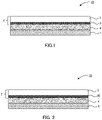
- FIG. 1 is a schematic cross-sectional view illustrating an example of the outer packing material for vacuum insulation material in the present embodiment.
- Outer packing material for vacuum insulation material 10 in the present embodiment comprises thermally weldable film 1, gas barrier film 2 including inorganic film 3, and oxygen barrier resin layer 4; and the gas barrier film 2 including inorganic film 3 is placed on the oxygen barrier resin layer 4, on the opposite side to the side wherein the thermally weldable film 1 is placed. That is, the oxygen barrier resin layer 4 is placed between the thermally weldable film 1 and the gas barrier film 2 including inorganic film 3.
- the gas barrier film 2 includes the inorganic film 3 and resin base material 5 supporting the inorganic film 3.
- a metal layer is not placed in the outer packing material for vacuum insulation material in the present embodiment.
- the metal layer in the present specification refers to a layer of metal having radiowave shielding property wherein the metal atoms constituting thereof are metallic bonded with each other.
- Examples of the metal layer may include a metal foil and a metal film of aluminum, nickel, stainless steel, iron, copper, and titanium.
- the outer packing material for vacuum insulation material in the present embodiment is capable of transmitting radiowave.
- the oxygen barrier property may be secured by including the oxygen barrier resin layer, and by placing the gas barrier film including an inorganic film, on the oxygen barrier resin layer, on an opposite side to the side wherein the thermally weldable film is placed, the deterioration of the oxygen barrier property of the oxygen barrier resin layer may be suppressed. Therefore, an outer packing material for vacuum insulation material is capable of transmitting radiowave, and capable of producing a vacuum insulation material capable of maintaining good thermal insulation property, may be provided.
- one or more, preferably two or more gas barrier film including a resin base material, and an inorganic film placed on at least one main surface of the resin base material is placed on the oxygen barrier resin layer, on an opposite side to a side wherein the thermally weldable film is placed. That is, the oxygen barrier resin layer is placed between one or more, preferably two or more gas barrier film including an inorganic film, and the thermally weldable film.
- the gas barrier film placed on the opposite side to the side wherein the thermally weldable film is placed, with respect to the oxygen barrier resin layer may be referred to as an outer gas barrier film.
- the gas barrier film may be placed between the thermally weldable film and the oxygen barrier resin layer, the gas barrier film is preferably not placed.
- the gas barrier film placed between the oxygen barrier resin layer and the thermally weldable film may be referred to as an inner gas barrier film.
- the inorganic film included in the gas barrier film is a layer other than a metal layer such as a metal foil and a metal thin film, and examples thereof may include an inorganic compound film and a film including a M-O-P bond (here, M represents a metal atom, O represents an oxygen atom, and P represents a phosphorous atom), a film including a multivalent metal salt a polycarboxylic acid based polymer.
- M-O-P bond here, M represents a metal atom, O represents an oxygen atom, and P represents a phosphorous atom
- Examples of the inorganic compound constituting the inorganic compound film may include an oxide, an oxidized nitride, a nitride, an oxidized carbide, and an oxidized carbonized nitride of a non-metal element or a metal element such as silicon, aluminum, magnesium, calcium, potassium, tin, sodium, titanium, boron, yttrium, zirconium, cerium, and zinc.
- Specific examples thereof may include the following inorganic oxides: a silicon oxide such as SiO 2 ; an aluminum oxide such as Al 2 O 3 ; a magnesium oxide; a titanium oxide; a tin oxide; a silicon zinc alloy oxide; an indium alloy oxide; a silicon nitride; an aluminum nitride; a titanium nitride; an oxidized nitridized silicon; and an oxidized silicon zinc.
- a silicon oxide such as SiO 2
- an aluminum oxide such as Al 2 O 3
- a magnesium oxide such as TiO 3
- titanium oxide such as Al 2 O 3
- a magnesium oxide such as a titanium oxide
- a tin oxide such as Al 2 O 3
- silicon zinc alloy oxide an indium alloy oxide
- a silicon nitride an aluminum nitride; a titanium nitride; an oxidized nitridized silicon
- an aluminum oxide (alumina) and a silicon oxide (silica) are preferable.
- the inorganic film is preferably the high barrier compound film described in the second embodiment described later, because of the high water vapor barrier property.
- the inorganic compound film may be a vapor deposition film formed by a vapor deposition method, and may be a coating film formed by an applying method such as coating.
- the inorganic compound film is the vapor deposition film
- the film may be formed by a single time vapor deposition, and may be formed by a multiple times of vapor depositions.
- the inorganic compound film may be formed in a shape of film using conventionally known methods such as a coat method, a vapor deposition method, and a pressure joint method.
- One inorganic compound film may be a single film formed by one time vapor deposition, and may have a stacked structure formed by a multiple times of vapor depositions.
- Examples of the film including a M-O-P bond may include a film including a reaction product of a metal oxide and a phosphorous compound.
- the metal oxide may include an oxide of a metal of valence number of two or more; specifically, may include an oxide of a metal such as a metal belonging to the group 2 of the periodic table such as magnesium and calcium; a metal belonging to the group 12 of the periodic table such as zinc; a metal belonging to the group 13 of the periodic table such as aluminum; a metal belonging to the group 14 of the periodic table such as silicon; a transition metal such as titanium and zirconium.
- aluminum oxide (alumina) is preferable.
- examples of the phosphorous compound may include a phosphoric acid, a polyphosphoric acid, a phosphorous acid, a phosphonic acid, and the derivatives of these.
- the phosphoric acid is preferable.
- Specific examples of the reaction product of the metal oxide and the phosphorous compound may include those similar to the reaction products disclosed in JP-A No. 2011-226644 .
- the presence of the M-O-P bond may be confirmed by the presence of the maximum infrared ray absorption peak within the range of 1080 cm -1 or more and 1130 cm -1 or less in the infrared ray absorption spectrum (measured wavenumber range within 800 cm -1 or more and 1400 cm -1 or less). There are no particular limitations on the method for measuring the infrared ray absorption spectrum.
- the following methods may be used: the measurement method using an attenuated total reflectance method (ATR method); a method wherein a sample is scraped from the inorganic film in the outer packing material for vacuum insulation material and the infrared ray absorption spectrum of the sample is measured by a KBr method; and a method wherein a collected sample is measured by a microscopic infrared spectroscopy.
- ATR method attenuated total reflectance method
- a method wherein a sample is scraped from the inorganic film in the outer packing material for vacuum insulation material and the infrared ray absorption spectrum of the sample is measured by a KBr method
- a collected sample is measured by a microscopic infrared spectroscopy.
- the thickness of the inorganic film is preferably within the range of 10 nm to 300 nm (in the present specification, the notation of A to B denotes a range including A and B). Making the thickness of the inorganic film within the above range, barrier property may be secured, and plasticity may also be sufficiently maintained so that a barrier breakage is not likely to occur.
- a resin base material configured to support the inorganic film is placed on one main surface of the inorganic film.
- the resin base material for example, a film made of resin is preferably used.
- the resin base material is a resin film
- the resin film may be unstretched, and may be uniaxial stretched or biaxial stretched.
- the resin base material may or may not have transparency.
- a resin used for the resin base material there are no particular limitations on a resin used for the resin base material.
- resins such as a polyolefin resin such as polyethylene and polypropylene; a polyester resin such as polyethylene terephthalate (PET), polyethylene naphthalate (PEN), and polybutylene terephthalate (PBT); a cyclic polyolefin resin; a polystyrene resin; an acrylonitrile-styrene copolymer (AS resin); an acrylonitrile-butadiene-styrene copolymer (ABS resin) ; a poly (meth) acrylic acid resin; a polycarbonate resin; an ethylene-vinylester copolymer resin and saponified product thereof; a polyamide resin such as a variety of nylon; a polyimide resin; a polyurethane resin; an acetal resin; and a cellulose resin.
- PET, PBT, and nylon for example, may be used
- various plastic compounding agent and additives may be included.
- the additive may include a lubricant, a crosslinking agent, an antioxidant, an ultraviolet absorber, a light stabilizer, a filler, a reinforcing agent, an anti-static agent, a pigment, and a modifier resin.
- the resin base material may be subjected to a surface treatment.
- the reason therefore is to improve the adhesion with the inorganic film.
- the surface treatment may include a plasma treatment, an oxidization treatment disclosed in JP-ANo. 2014-180837 , a convexo-concaving treatment (surface roughing treatment), and an easily adhesive coating treatment.
- the thickness of the resin base material is in a range of 6 ⁇ m to 200 ⁇ m, and more preferably in a range of 9 ⁇ m to 100 ⁇ m.
- the resin base material may be a single layer, and may be a layered body including a plurality of stacked resin layers . Respective resin layers of the layered body may be formed of different resins, and may be formed of the same resin.
- the gas barrier film in the outer packing material for vacuum insulation material in the present embodiment particularly the outer gas barrier film preferably further includes an overcoating layer formed on one main surface of the inorganic film.
- the overcoating layer may include those similar to ones described in "A. Outer packing material for vacuum insulation material, IV. Fourth embodiment, 1. Gas barrier film, (b) Overcoating layer" below.
- the resin base material, the inorganic film, and the overcoating layer are included in the gas barrier film, they are usually included in the gas barrier film in this order.
- the outer packing material for vacuum insulation material includes a plurality of gas barrier films, the inorganic film, the resin base material, and overcoating layer may be respectively the same, and may be different.
- the outer gas barrier film includes the resin base material and the inorganic film
- the outer gas barrier film is preferably placed in the direction so that the inorganic film is on the oxygen barrier resin layer side described later, than the resin base material.
- the inorganic film in the outer gas barrier film closest to the oxygen barrier resin layer is preferably placed to face the resin layer, not via the resin base material. Thereby, the influence, of moisture included inside the resin base material, on the resin layer may be reduced.
- the outer packing material for vacuum insulation material in the present embodiment includes an oxygen barrier resin layer, that is, a resin layer including at least one of EVOH and PVA.
- EVOH and PVA are hydrophilic resins including a hydrophilic group, and exhibit high barrier property to oxygen.
- the oxygen barrier resin layer in the present embodiment includes at least one of EVOH and PVA, and is preferably mainly composed of at least one of EVOH and PVA.
- "mainly composed of at least one of EVOH and PVA” means that at least one of EVOH and PVA is included to such an extent as to be able to exhibit the oxygen barrier property required for the oxygen barrier resin layer.
- the content of at least one of EVOH and PVA in the oxygen barrier resin layer is preferably 50 mass% or more; above all, the content is preferably 90 mass% or more.
- a nuclear magnetic resonance (NMR) method may be used as a measuring method.
- the gas barrier property of EVOH or PVA is likely to be lowered by water vapor.
- the gas barrier film including the inorganic film is placed on the opposite direction (outer side) to the core material side direction (inner side) in the thickness direction when formed in to a vacuum insulation material, than the oxygen barrier resin layer, the deterioration of EVOH or PVA included in the oxygen barrier resin layer maybe suppressed so that the barrier property, to oxygen, of the oxygen barrier resin layer may be maintained at high level. Therefore, the oxygen barrier resin layer in the present embodiment is able to maintain the function as a gas barrier film.
- the thickness of the oxygen barrier resin layer in the present embodiment may be 8 ⁇ m to 50 ⁇ m, preferably 10 ⁇ m to 30 ⁇ m, particularly preferably 12 ⁇ m to 15 ⁇ m.
- the oxygen barrier resin layer alone has the function a gas barrier film
- the inorganic film and the overcoating layer may be placed on the surface of the oxygen barrier resin layer.
- the inorganic film and the overcoating layer placed on the surface of the oxygen barrier resin layer is a film other than a metal layer such as a metal foil and a metal film; and examples thereof may include those similar to ones described in "1.
- thermally weldable layer is placed on one main surface side.
- thermally weldable film is a film that may be welded by heating thereof.
- the thermally weldable film is a member working as one surface in the thickness direction of the outer packing material for vacuum insulation material.
- the thermally weldable film contacts with a core material when a vacuum insulation material is produced using the outer packing material for vacuum insulation material in the present embodiment, and it is a member for bonding the edges of the outer packing materials for vacuum insulation material facing to each other when the core material is enclosed therein.
- a resin film able to be melted and fused by heating may be used.
- examples thereof may include a polyolefin based resin film such as a polyethylene such as straight chain-short chain branched polyethylene (LLDPE), and unstretched polypropylene (CPP); a polyester based resin film such as polyethylene terephthalate (PET), polyethylene naphthalate (PEN), and polybutylene terephthalate (PBT), a polyvinyl acetate based resin film; a polyvinyl chloride based resin film; a poly (meth) acrylic resin film; and an urethane resin film.
- EVOH or PVA may be used as the thermally weldable film.
- the thermally weldable film has the function as the oxygen barrier resin layer.
- the thermally weldable film may include an additional material such as an anti-blocking agent, a lubricant, a flame retardant, and a filler material.
- the thickness of the thermally weldable film may be in the thickness with which desired adhesiveness may be obtained when the outer packing materials for vacuum insulation material are bonded to each other; for example, it is within the range of 15 ⁇ m or more and 100 ⁇ m or less, preferably within the range of 25 ⁇ m or more and 90 ⁇ m or less, and more preferably within the range of 30 ⁇ m or more and 80 ⁇ m or less.
- the water vapor permeability of the outer packing material for vacuum insulation material in the present embodiment is preferably 0.03 g/(m 2 ⁇ day) or less, and above all, preferably 0.01 (m 2 ⁇ day) or less.
- the outer packing material for vacuum insulation material in the present embodiment has excellent water vapor gas barrier property.
- the water vapor permeability may be a value measured under the conditions of at a temperature of 40°C and relative humidity difference of 90%RH in accordance with ISO 15106-5:2015 (differential pressure method).
- the measurement of the water vapor permeability measurement may be carried out in the following steps: first, the outer packing material for vacuum insulation material cut out in a desired sample size is installed between an upper room and a lower room of the device so as the outermost surface layer positioned on the opposite to the thermally weldable film which is one of the outermost surface layers, among the facing outermost surfaces in the thickness direction (stacked direction), comes to high humidity side (water vapor supplying side), and the measurement is carried out to the permeation area of approximately 50 cm 2 (permeation region: circle having the diameter of 8 cm) under the conditions of temperature at 40°C and relative humidity difference of 90%RH.
- the water vapor permeability measurement device for example, "DELTAPERM" from U.K. Technolox Ltd. may be used.
- the oxygen permeability may be, for example, 0.1 cc/(m 2 ⁇ day ⁇ atm) or less, and above all, preferably 0.05 cc/(m 2 ⁇ day ⁇ atm) or less, due to the oxygen barrier property of the oxygen barrier resin layer.
- the oxygen permeability may be measured using an oxygen gas permeability measurement device with reference to JIS K7126-2:2006 (Plastic - film and sheet - gas permeability test method- Section 2: Isopiestic method, Annex A: Test method of oxygen gas permeability with electrolytic sensor method) under the conditions of temperature at 23°C and humidity of 60%RH.
- the oxygen permeability measurement device for example, "OXTARAN” from U.S. MOCON may be used.
- the measurement may be carried out in the manner such that the outer packing material for vacuum insulation material cut out in a desired sample size is installed to the device so as the surface of the outermost layer on the opposite side to the thermally weldable film which is one of the outermost layers, among the layers working as two facing outermost surfaces in the thickness direction, comes to contact with oxygen gas, and the measurement is carried out to the permeation area of approximately 50 cm 2 (permeation region: circle having the diameter of 8 cm) under the conditions of carrier gas and test gas adjusted to temperature of 23°C and humidity of 60%RH.
- the carrier gas is supplied to the device at a flow rate of 10 cc/min for 60 minutes or more to purge.
- nitrogen gas including approximately 5% of hydrogen may be used.
- the measurement is carried out after securing 12 hours as the time, from letting the test gas flow to the device until reaching to the equilibrium state.
- the dry oxygen of at least 99.5% is used.
- the measurement of the oxygen permeability is carried out for at least 3 pieces of the sample, for one condition, and the average of these measured values is regarded as the value of oxygen permeability under that condition.
- the outer packing material for vacuum insulation material in the present embodiment may include an adhesive layer, for example, between the gas barrier film and the gas barrier film, between the gas barrier film and the oxygen barrier resin layer, or between the oxygen barrier resin layer and the thermally weldable film.
- an adhesive layer for example, between the gas barrier film and the gas barrier film, between the gas barrier film and the oxygen barrier resin layer, or between the oxygen barrier resin layer and the thermally weldable film.
- a conventionally known pressure-sensitive adhesive, a thermoplastic adhesive, a curable adhesive, for example may be used as a material of the adhesive layer.
- the adhesive constituting the adhesive layer is usually, but is not limited to, a two-liquid curable type adhesive including a main agent and a curing agent.
- a two-liquid curable type adhesive including a main agent and a curing agent.
- it may be a one-liquid curable type adhesive obtained by mixing a main agent and a latent curing agent blocked by a known method so that it does not react with the main agent when they are mixed; and may be a one-liquid curable type adhesive obtained by mixing a curing agent and a latent main agent blocked by a known method so it does not to react with the curing agent when they are mixed.
- an inorganic based adhesive including the followings, for example, may be used: epoxy based adhesives, polyvinyl acetate based adhesives, polyacrylic acid ester based adhesives, cyanoacrylate based adhesives, ethylene copolymer based adhesives, cellulose based adhesives, polyester based adhesives, polyamide based adhesives, polyimide based adhesives, amino resin based adhesives, phenol resin based adhesives, polyurethane based adhesives, reactive (meta) acrylic acid based adhesives, inorganic rubber based adhesives, silicone based adhesives, alkali metal silicate, and low melting point glass.
- the adhesive polyacrylic acid ester based adhesives, and polyurethane based adhesives are preferable, and in particular, the adhesive is preferably a compound including an isocyanate group as a functional group, and specifically, polyurethane based adhesives is preferable.
- the adhesive constituting the adhesive layer may include arbitrary material such as a curing accelerator, a catalyst, an antioxidant, a stabilizer, an ultraviolet absorber, a light stabilizer, and an antistatic agent.
- the thickness of adhesive layer may be the thickness capable of exhibiting a desired adhesive force, and may be appropriately set according to the composition of the adhesive layer. Usually, it is preferable that the thickness is approximately 0.1 g/m 2 to 10 g/m 2 in a dry condition.
- the adhesive layer may or may not have transparency, and it is preferable to have transparency, when transparency is required as an outer packing material for vacuum insulation material.
- a sheet or a film formed with the adhesive described above may be used for the adhesive layer, and the adhesive layer may be formed by preparing a coating liquid obtained by mixing the adhesive described above into a desired solvent, directly applying the coating liquid onto one surface of the thermally weldable film or the gas barrier film, and drying and curing the coating liquid.
- the outer packing material for vacuum insulation material in the present embodiment is characterized by comprising a thermally weldable film; an oxygen barrier resin layer; and a gas barrier film including a resin base material, and an inorganic film placed on at least one main surface of the resin base material, wherein the oxygen barrier resin layer is placed between the thermally weldable film and the gas barrier film, the inorganic film of the gas barrier film placed on the resin layer, on an opposite side to the thermally weldable film, includes alumina, silica, or a mixture of these, and a metal layer is not placed in the outer packing material for vacuum insulation material.
- an inorganic film including alumina, silica, or a mixture of these may be referred to as a high barrier compound film, hereinafter.
- FIG. 2 is a schematic cross-sectional view illustrating an example of the outer packing material for vacuum insulation material in the present embodiment.
- Outer packing material for vacuum insulation material 10 in the present embodiment comprises thermally weldable film 1, gas barrier film 2 including high barrier compound film 30, and oxygen barrier resin layer 4.
- the gas barrier film 2 including high barrier compound film 30 is placed on the oxygen barrier resin layer 4, on the opposite side to the side wherein the thermally weldable film 1 is placed. That is, the oxygen barrier resin layer 4 is placed between the thermally weldable film 1 and the gas barrier film 2 including high barrier compound film 30.
- the gas barrier film 2 includes the high barrier compound film 30 and resin base material 5 supporting the high barrier compound film 30.
- the outer packing material for vacuum insulation material in the present embodiment is capable of transmitting radiowave.
- the high barrier compound film effectively suppresses the penetration of water vapor into the oxygen barrier resin layer, and the deterioration of the oxygen barrier property may be suppressed. Therefore, an outer packing material for vacuum insulation material capable of transmitting radiowave and capable of producing a vacuum insulation material capable of maintaining good thermal insulation property, may be provided.
- the inorganic film included in at least one outer gas barrier film is a high barrier compound film, that is, an inorganic compound film including alumina, silica, or a mixture of these.
- the high barrier compound film is not particularly limited as long as it includes the inorganic compound described above; the atomic number ratio of impurity other than aluminum, silicon, oxygen, and carbon is preferably 5 at% or less.
- the atomic number ratio may be measured by X-ray photoelectron spectroscopy (XPS).
- XPS X-ray photoelectron spectroscopy
- Theta-Probe from Thermo Fisher Scientific K.K. may be used.
- the outer packing material for vacuum insulation material in the present embodiment may include at least one gas barrier film including the high barrier compound film. Also, as the outer gas barrier film, it may include a gas barrier film including other inorganic film. Examples of the other inorganic film may include those similar to ones described in "A. Outer packing material for vacuum insulation material, I. First embodiment, 1. Gas barrier film, (a) Inorganic film" above, other than the high barrier compound film.
- the outer packing material for vacuum insulation material in the present embodiment preferably includes two or more gas barrier films including the high barrier compound film on the opposite side to a side wherein the thermally weldable film is placed, with respect to the oxygen barrier resin layer.
- the gas barrier film in the present embodiment may include the resin base material, and the overcoating layer.
- the outer gas barrier film preferably further includes the overcoating layer. Examples thereof may include those similar to ones described in "A. Outer packing material for vacuum insulation material, I. First embodiment, 1. Gas barrier film, (b) Resin base material" above, and “A. Outer packing material for vacuum insulation material, IV. Fourth embodiment, 1. Gas barrier film, (b) Overcoating layer" below.
- the resin base material, the inorganic film, and the overcoating layer are included in the gas barrier film, they are usually included in the gas barrier film in this order.
- the outer packing material for vacuum insulation material includes a plurality of gas barrier films, the inorganic film, the resin base material, and overcoating layer may be respectively the same, and may be different.
- the outer gas barrier film includes the resin base material and the high barrier compound film
- the outer gas barrier film is prefer ablyplaced in the direction so that the high barrier compound film is on the oxygen barrier resin layer side described later, than the resin base material.
- the high barrier compound film in the outer gas barrier film closest to the oxygen barrier resin layer is preferably placed to face the oxygen barrier resin layer, not via the resin base material. Thereby, the influence, of moisture included inside the resin base material, on the oxygen barrier resin layer may be reduced.
- the outer packing material for vacuum insulation material in the present embodiment includes an oxygen barrier resin layer.
- the EVOH and PVA included in the oxygen barrier resin layer are hydrophilic resins including a hydrophilic group, and exhibit high barrier property to oxygen.
- oxygen barrier resin layer examples include those similar to ones described in "A. Outer packing material for vacuum insulation material, I. First embodiment, 2. Oxygen barrier resin layer" above.
- the outer packing material for vacuum insulation material in the present embodiment includes the thermally weldable layer on one main surface side.
- Examples of the thermally weldable film may include those similar to ones described in "A. Outer packing material for vacuum insulation material, I. First embodiment, 3. Thermally weldable film".
- the outer packing material for vacuum insulation material in the present embodiment may include an adhesive layer. Examples of these may include those similar to ones described in "A. Outer packing material for vacuum insulation material, I. First embodiment, 5. Arbitrary constitutions".
- the outer packing material for vacuum insulation material in the present embodiment has an excellent gas barrier property.
- the gas barrier property means an oxygen barrier property specified by an oxygen permeability, and a water vapor barrier property specified by a water vapor permeability.
- the water vapor permeability may be 0.03 g/(m 2 ⁇ day) or less, and above all, may be 0.01 (m 2 ⁇ day) or less.
- the outer packing material for vacuum insulation material in the present embodiment is characterized by comprising a thermally weldable film, an oxygen barrier resin layer, and a gas barrier film including a resin base material, and an inorganic film placed on at least one main surface of the resin base material, wherein the oxygen barrier resin layer is placed between the thermally weldable film and two or more of the gas barrier films, and a metal layer is not placed in the outer packing material for vacuum insulation material.
- FIG. 3 is a schematic cross-sectional view illustrating an example of the outer packing material for vacuum insulation material in the present embodiment.
- Outer packing material for vacuum insulation material 10 in the present embodiment comprises thermally weldable film 1, and two or more gas barrier films 2a, 2b including inorganic film 3. It further comprises oxygen barrier resin layer 4, and the two gas barrier films 2a, 2b are placed on the oxygen barrier resin layer 4, on the opposite side to the side wherein the thermally weldable film 1 is placed.
- the gas barrier films 2a and 2b respectively include the inorganic film 3 and the resin base material 5 supporting the inorganic film 3.
- the outer packing material for vacuum insulation material in the present embodiment is capable of transmitting radiowave. Further, the deterioration of the oxygen barrier property may be suppressed by securing the oxygen barrier property by including the oxygen barrier resin layer, as well as placing two or more gas barrier films including the inorganic film on the oxygen barrier resin layer, on an opposite surface side to the thermally weldable film. Therefore, an outer packing material for vacuum insulation material capable of transmitting radiowave and capable of producing a vacuum insulation material capable of maintaining good thermal insulation property, may be provided.
- the outer packing material for vacuum insulation material in the present embodiment includes two or more gas barrier films including the inorganic film, and the oxygen barrier resin layer is placed between two or more gas barrier films including the inorganic film, and the thermally weldable film.
- gas barrier film including the inorganic film may be placed between the thermally weldable film and the oxygen barrier resin layer, the gas barrier film including the inorganic film is preferably not placed.
- Examples of the inorganic film may include those similar to ones described in "A. Outer packing material for vacuum insulation material, I. First embodiment, 1. Gas barrier film, (a) Inorganic film" above.
- the inorganic film in the two or more outer gas barrier film is preferably the high barrier compound film described above.
- the gas barrier film in the present embodiment may include the resin base material and the overcoating layer.
- the outer gas barrier film preferably further includes the overcoating layer. Examples of these may include those similar to ones described in "A. Outer packing material for vacuum insulation material, I. First embodiment, 1. Gas barrier film, (b) Resin base material" above and “A. Outer packing material for vacuum insulation material, IV. Fourth embodiment, 1. Gas barrier film, (b) Overcoating layer" below.
- the inorganic film, the resin base material, and overcoating layer may be respectively the same, and may be different.
- the resin base material, the inorganic film, and the overcoating layer are included in the gas barrier film, they are usually included in the gas barrier film in this order.
- the outer gas barrier film includes the resin base material and the inorganic film
- the outer gas barrier film is preferably placed in the direction so that the inorganic film is on the oxygen barrier resin layer side described later, than the resin base material.
- the inorganic film in the outer gas barrier film closest to the oxygen barrier resin layer is preferablyplaced to face the oxygen barrier resin layer, not via the resin base material.
- the outer packing material for vacuum insulation material in the present embodiment includes an oxygen barrier resin layer.
- the EVOH and PVA included in the oxygen barrier resin layer are hydrophilic resins including a hydrophilic group, and exhibit high barrier property to oxygen.
- oxygen barrier resin layer in the present embodiment may include those similar to ones described in "A. Outer packing material for vacuum insulation material, I. First embodiment, 2. Oxygen barrier resin layer" above.
- the outer packing material for vacuum insulation material in the present embodiment includes the thermally weldable layer on one main surface side.
- Examples of the thermally weldable film may include those similar to ones described in "A. Outer packing material for vacuum insulation material, I. First embodiment, 3. Thermally weldable film".
- the outer packing material for vacuum insulation material in the present embodiment may include an adhesive layer. Examples of these may include those similar to ones described in "A. Outer packing material for vacuum insulation material, I. First embodiment, 5. Arbitrary constitutions".
- the outer packing material for vacuum insulation material in the present embodiment has an excellent gas barrier property.
- the gas barrier property means an oxygen barrier property specified by an oxygen permeability, and a water vapor barrier property specified by a water vapor permeability.
- the water vapor permeability may be 0.03 g/(m 2 ⁇ day) or less, and above all, may be 0.01 (m 2 ⁇ day) or less.
- the outer packing material for vacuum insulation material in the present embodiment is characterized by comprising a thermally weldable film; an oxygen barrier resin layer; and a gas barrier film including a resin base material, and an inorganic film placed on at least one main surface of the resin base material, wherein the oxygen barrier resin layer is placed between the thermally weldable film and the gas barrier film, the gas barrier film placed on the oxygen barrier resin layer, on an opposite side to the thermally weldable film, includes an overcoating layer placed on the inorganic film, on a main surface opposite to the resin base material, and a metal layer is not placed in the outer packing material for vacuum insulation material.
- FIG. 4 is a schematic cross-sectional view illustrating an example of the outer packing material for vacuum insulation material in the present embodiment.
- Outer packing material for vacuum insulation material 10 in the present embodiment comprises thermally weldable film 1, and gas barrier film 2 including inorganic film 3. Further, it comprises oxygen barrier resin layer 4, and the gas barrier film 2 is placed on the oxygen barrier resin layer 4, on the opposite side to a side wherein the thermally weldable film 1 is placed.
- the gas barrier film 2 is characterized by the configuration wherein resin base material 5, the inorganic film 3, and the overcoating layer 6 are stacked in this order. Also, in the example illustrated in FIG. 4 , the gas barrier film 2 is placed in a direction so that the overcoating layer 6 faces the oxygen barrier resin layer 4.
- the outer packing material for vacuum insulation material in the present embodiment is capable of transmitting radiowave. Further, the deterioration of the oxygen barrier property may be suppressed by securing the oxygen barrier property by including the oxygen barrier resin layer, as well as placing the gas barrier film including an inorganic film and an overcoating layer, on the oxygen barrier resin layer, on an opposite surface side to the thermally weldable film. Therefore, an outer packing material for vacuum insulation material is capable of transmitting radiowave and capable of producing a vacuum insulation material capable of maintaining good thermal insulation property, may be provided.
- the oxygen barrier resin layer is placed between one or more gas barrier film including the inorganic film and the overcoating layer, and the thermally weldable film.
- the outer packing material for vacuum insulation material in the present embodiment may include one or more, preferably two or more gas barrier film including the inorganic film and the overcoating layer. Also, as the outer gas barrier film, it may include a gas barrier film not including the overcoating layer.
- gas barrier film including the inorganic film may be placed between the thermally weldable film and the oxygen barrier resin layer, the gas barrier film including the inorganic film is preferably not placed.
- Examples of the inorganic film may include those similar to ones described in "A. Outer packing material for vacuum insulation material, I. First embodiment, 1. Gas barrier film, (a) Inorganic film" above.
- the inorganic film in the outer gas barrier film is preferably the high barrier compound described above.
- an outer gas barrier film further includes an overcoating layer formed on one main surface of the inorganic film.
- the overcoating layer is formed on the inorganic film, on a surface opposite to the resin base material, and material generally used as a barrier coating agent or an over coating agent may be used.
- the over coating may be one including an organic material only and not including an inorganic material, in particular, the over coating preferably includes a mixture of an inorganic material and an organic material. This is because the water vapor barrier property is high, compared to one not including an inorganic material.
- the inorganic material may include an inorganic filler, and an alkoxide component included in a sol-gel compound.
- the overcoating layer is hereinafter explained, separating thereof into a non-filler-containing overcoating layer including no filler, and a filler-containing overcoating layer including the filler.
- Non-filler-containing overcoating layer is not particularly limited as long as it does not include an inorganic filler, and material generally used as a barrier coating agent or an overcoating agent may be used.
- the material may include a sol-gel compound.
- the sol-gel compound is high in an adhesive strength at an interface, and treatments in the film formation may be carried out at relatively low temperature, so that the deterioration by heat of the resin base material, for example, may be suppressed.
- the overcoating layer including the sol-gel compound may be formed, for example, by a raw material liquid containing at least one kind or more of alkoxide represented by a general formula R 1 n M(OR 2 ) m (provided that in the formula, R 1 and R 2 each represents an organic group having carbon number of 1 or more and 8 or less, "M” represents a metal atom, "n” represents an integer of 0 or more, “m” represents an integer of 1 or more, and "n + m” represents the valence of "M”) and a water-soluble polymer, and obtained by further polycondensation thereof by a sol-gel method.
- R 1 n M(OR 2 ) m each represents an organic group having carbon number of 1 or more and 8 or less
- M represents a metal atom
- n represents an integer of 0 or more
- m represents an integer of 1 or more
- n + m represents the valence of "M”
- a water-soluble polymer and obtained by further polycon
- Examples of the metal atom "M" of the alkoxide represented by the general formula above may include silicon, zirconium, titanium, and aluminum. Among the above, silicon is preferable. As an alkoxide including silicon, tetraethyl orthosilicate (TEOS) is preferable.
- examples of the water-soluble polymer may include a polyvinyl alcohol-based resin, an ethylene-vinyl alcohol copolymer, an acryl acid based resin, natural polymer based methyl cellulose, carboxy methyl cellulose, cellulose nanofiber, and polysaccharide. Among the above, the polyvinyl alcohol based resin is preferable.
- the sol-gel compound is preferably a polycondensation product of the tetraethyl orthosilicate (TEOS) and the polyvinyl alcohol based resin.
- the polycondensation product of the tetraethyl orthosilicate (TEOS) and the polyvinyl alcohol based resin may be similar to those disclosed in, for example, Japanese Patent No. 5568897 .
- the filler-containing overcoating layer includes an inorganic filler, and the thickness is in a range of 50 nm or more and 500 nmor less.
- the filler-containing overcoating layer is provided in directly contact with the surface opposite to the resin base material of the inorganic film.
- the filler-containing overcoating layer may be placed on at least one inorganic film, and may be placed respectively on the both inorganic films.
- the thickness of the filler-containing overcoating layer is in a range of 50 nm or more and 500 nm or less.
- the thickness of the filler-containing overcoating layer may be 50 nm or more, among the above, may be 100 nm or more, further, may be 130 nm or more, and particularly, may be 150 nm or more.
- the thickness of the filler-containing overcoating layer may be 500 nm or less, among the above, may be 480 nm or less, and particularly, maybe 450 nm or less.
- the thickness of the filler-containing overcoating layer may be measured by a cross-sectional SEM observation, and the average value may be the average value obtained by measuring five points including uneven parts (thickest part and thinnest part) in the SEM image for each filler-containing overcoating layer.
- the inorganic filler may have a shape capable of filling defects such as cracks generated in the inorganic film.
- Examples of the shape of the inorganic filler may include the form of a layer, a plate, a scale, a polyhedral, a needle, a column, a sphere, a spindle, and a mass.
- a plurality of kinds of inorganic fillers having the above shapes maybe used in combination. Among these, it is preferably in the form of a layer, a plate, or a needle.
- the average particle size of the inorganic filler may be a size capable of filling defects such as cracks generated in the inorganic film, and may be, for example, 5 nm or more, preferably 10 nm or more, and further preferably 50 nm or more. Also, the average particle size of the inorganic filler may be, for example, 500 nmor less, preferably 450 nmor less, and further preferably 400 nm or less. This is because, by setting the average particle size of the inorganic filler within the above range, defects generated in the inorganic film may be filled, and a maze effect maybe exhibited. Incidentally, the maze effect refers to a condition wherein water vapor or oxygen is inhibited by the inorganic filler and hardly passes, due to dispersion of the inorganic filler.
- the average particle size of the inorganic filler is a value measured by surface SEM observation, and may be an average value of particle size of five particles randomly selected.
- the maximum length of five inorganic fillers randomly selected is defined as the particle size of the inorganic filler.
- the inorganic filler may include silica, talc, alumina, mica, calcium carbonate, magnesium carbonate, barium sulfate, and an inorganic layered compound.
- the inorganic filler may be an inorganic layered compound.
- the inorganic layered compound refers to an inorganic compound wherein unit crystal layers are stacked to form one layered particle.
- the inorganic layered compound may include a clay mineral, and specifically, may include following clay minerals, substitution products or derivatives of these: phyllosilicate minerals such as hydrous silicate; kaolinite group clay minerals such as halloysite, kaolinite, endellite, dickite, and nacrite; antigorite group clay minerals such as antigorite, and chrysotile; smectite group clay minerals such as montmorillonite, iron montmorillonite, beidellite, nontronite, saponite, hectorite, sauconite, and stevensite; vermiculite group clay minerals such as vermiculite; mica such as muscovite and phlogopite; mica or mica group clay minerals such as margarite, tetrasilicic mica, and taeniolite; chlorite group such as cook
- the inorganic layered compound may be a clay mineral including at least one selected from the group consisting of Na, Mg, Fe, and Ca.
- the filler-containing overcoating layer includes a resin, in addition to the inorganic filler.
- the resin may include resins generally used for the overcoating layer, and examples thereof may include water-soluble resins. Among them, a water-soluble resin having high gas barrier property may be used.
- Specific examples of the resin may include polyvinyl alcohol (PVA), polyvinylidene chloride (PVDC), ethylene-vinyl alcohol copolymer (EVOH), polyacrylonitrile (PAN), nylon, polyester, polyamide, polysaccharide, polyacrylic acid and esters thereof. These may be used alone, or two or more kinds of them may be used in combination.
- the filler-containing overcoating layer may include a known additive, according to the needs.
- the ratio of the solid mass of the inorganic filler with respect to the solid mass of the resin in the filler-containing overcoating layer may be 50 mass% or less, and among them, 45 mass% or less, particularly preferably 40 mass% or less, and the ratio may be 5 mass% or more, and is preferably 10 mass% or more. This is because, by setting the ratio of the solid mass of the inorganic filler in the filler-containing overcoating layer within the above range, sufficient gas barrier property may be exhibited, and the surface of the filler-containing overcoating layer may be made uniform.
- the filler-containing overcoating layer may be formed, for example, by coating the surface of the inorganic film of the gas barrier film with an aqueous solution of a composition wherein an inorganic filler and a resin are dissolved and dispersed in a solvent, and drying.
- an inorganic layered compound When the inorganic layered compound is used as the inorganic filler, it may be swollen in a dispersion medium of, for example, water in advance, if necessary.
- the gas barrier film in the present embodiment may include a resin base material.
- the resin base material may include those similar to ones described in "A. Outer packing material for vacuum insulation material, I. First embodiment, 1. Gas barrier film, (b) Resin base material" above.
- the gas barrier film usually includes the resin base material, the inorganic film, and the overcoating layer in this order.
- One or more of the outer gas barrier film is preferably placed in a direction so that the overcoating layer is on the oxygen barrier resin layer side than the resin base material.
- the inorganic film of the outer gas barrier film closest to the resin layer is preferably placed facing to the resin layer, via the overcoating layer (not via the resin base material).
- the outer packing material for vacuum insulation material includes a plurality of gas barrier films
- the inorganic film, the resin base material, and overcoating layer may be respectively the same, and may be different.
- the outer packing material for vacuum insulation material in the present embodiment includes an oxygen barrier resin layer.
- the EVOH and PVA included in the oxygen barrier resin layer are hydrophilic resins including a hydrophilic group, and exhibit high barrier property to oxygen.
- oxygen barrier resin layer may include those similar to ones described in "A. Outer packing material for vacuum insulation material, I. First embodiment, 2. Oxygen barrier resin layer" above.
- the outer packing material for vacuum insulation material in the present embodiment includes the thermally weldable layer on one main surface side.
- Examples of the thermally weldable film may include those similar to ones described in "A. Outer packing material for vacuum insulation material, I. First embodiment, 3. Thermally weldable film".
- the outer packing material for vacuum insulation material in the present embodiment may include an adhesive layer. Examples of these may include those similar to ones described in "A. Outer packing material for vacuum insulation material, I. First embodiment, 5. Arbitrary constitutions".
- the outer packing material for vacuum insulation material in the present embodiment has an excellent gas barrier property.
- the gas barrier property means an oxygen barrier property specified by an oxygen permeability, and a water vapor barrier property specified by a water vapor permeability.
- the water vapor permeability may be 0.03 g/(m 2 ⁇ day) or less, and above all, may be 0.01 (m 2 ⁇ day) or less.
- radiowave transmittance is not particularly limited as long as it has radiowave transmittance to an extent that a device in a compartment surrounded by the vacuum insulation material is able to be in contact via radiowave, with outside thereof; and the electromagnetic wave shielding property within a range of 300 MHz to 30 GHz is preferably, for example, 10 dB or less.
- the radiowave transparency may be measured by a far-field measurement. Specifically, the radiowave transparency may be evaluated by placing a transmission antenna in one radiowave darkroom and a reception antenna in another radiowave darkroom, and placing a shielding material on the partition wall separating these two darkrooms.
- the outer packing material for vacuum insulation material in the present disclosure may and may not have transparency, and may be appropriately set according to the use application of the vacuum insulation material wherein the outer packing material for vacuum insulation material in the present disclosure is used.
- the transparency of the outer packing material for vacuum insulation material is not specified with a strict transmittance, and may be appropriately determined according to the use application.
- the outer packing material for vacuum insulation material in the present disclosure is transparent, inside of the vacuum insulation material using the outer packing material for vacuum insulation material is visible . Therefore, by installing a detecting agent inside the vacuum insulation material, together with the core material, the vacuum condition of the inside may be confirmed visibly, from the change in the detecting agent.
- Examples of the method for producing the outer packing material for vacuum insulation material in the present disclosure may include a method wherein each film produced in advance is pasted via an adhesive layer described above. Also, the outer packing material for vacuum insulation material in the present disclosure may be produced by extruding the thermally melted raw material of each film, by a tool such as a T-die sequentially to stack thereof.
- the outer packing material for vacuum insulation material in the present disclosure may be used for a vacuum insulation material.
- the outer packing material for vacuum insulation material in the present disclosure may be used in the manner placed in a vacuum insulation material so as the thermally weldable films come to the core material side and to face each other interposing the core material.
- the vacuum insulation material in the present disclosure is a vacuum insulation material characterized by comprising: a core material, and an outer packing material enclosing the core material; wherein the outer packing material is the one explained in the section "A. Outer packing material for vacuum insulation material" above.
- FIG. 5A is a schematic perspective view illustrating an example of the vacuum insulation material in the present disclosure
- FIG. 5B is an X-X cross-sectional view of FIG. 5A
- Vacuum insulation material 20 illustrated in FIGS. 5A and 5B comprises core material 11, and outer packing material 10 enclosing the core material 11, and outer packing material 10 is the outer packing material for vacuum insulation material explained in FIG. 1 .
- the vacuum insulation material 20 is formed by two pieces of the outer packing material 10 in the manner that the two pieces of the outer packing material 10 are brought into a form wherein each of the thermally weldable film faces to each other, edges 12 are thermally welded to prepare a bag body wherein the core material 11 is enclosed inside the bag body, and the pressure inside the bag body is decompressed.
- the outer packing material enclosing the core material is the outer packing material for vacuum insulation material explained in the section "A. Outer packing material for vacuum insulation material" above, the vacuum insulation material having radiowave transmittance is able to maintain good thermal insulation property.
- the outer packing material for vacuum insulation material in the present disclosure is a member enclosing the core material, and is similar to the outer packing material for vacuum insulation material explained in the section "A. Outer packing material for vacuum insulation material" above; thus, the explanation herein is omitted.
- the core material in the present disclosure is a member that is enclosed by the outer packing material for vacuum insulation material.
- to be enclosed means to be sealed inside the bag body formed of the outer packing materials for vacuum insulation material.
- the core material preferably has low heat conductivity.
- the core material may be a porous material of which void ratio is 50% or more, and particularly 90% or more.
- a material such as a powder body, a foam body, and a fiber body may be used.
- the powder body may be inorganic and may be organic; for example, a material such as dry silica, wet silica, condensed silica powder, a conductive powder body, a calcium carbonate powder, perlite, cray, and talc may be used.
- a material such as dry silica, wet silica, condensed silica powder, a conductive powder body, a calcium carbonate powder, perlite, cray, and talc may be used.
- the mixture of dry silica and a conductive powder body is advantageous on the occasion of using thereof in the temperature range where inner pressure rise is caused, since the degrade of the thermal insulation property along with the inner pressure rise of the vacuum insulation material is small.
- a material having small infrared ray absorption rate such as a titanium oxide, an aluminum oxide, and indium-doped tin oxide
- a radiation inhibitor may reduce the infrared ray absorption rate of the core material.
- the foam body a material such as urethane foam, styrene foam, and phenol foam may be used. Above all, a foam body forming continuous foam is preferable.
- the fiber body may be inorganic fiber and may be organic fiber, and inorganic fiber is preferably used from the viewpoint of thermal insulation property.
- the inorganic fiber may include glass fiber such as glass wool and glass fiber, alumina fiber, silica alumina fiber, silica fiber, ceramic fiber, and rock wool. These inorganic fibers are preferable on the point that they have low heat conductivity and are more easily handled compared to powder bodies.
- the above described material may be used singly, and two kinds or more of the materials may be mixed to form a composite material.
- the core material is enclosed inside the outer packing material for vacuum insulation material, and the inside is decompressed to be a vacuum state.
- the vacuum degree inside the vacuum insulation material is, for example, preferably 5 Pa or less. The reason therefor is to lower the heat conduction due to the convection of air remained inside so as to achieve excellent thermal insulation property.
- the heat conductivity (initial heat conductivity) is, for example, preferably 5 mW/ (mK) or less.
- the reason therefor is that the vacuum insulation material would not easily conduct heat to outside, and thus high heat insulation effect may be achieved.
- the initial heat conductivity is more preferably 4 mW/(mK) or less.
- the heat conductivity may be a value measured in accordance with JIS A1412-2:1999 in the conditions of high temperature side at 30°C, low temperature side at 10°C, and average temperature at 20°C.
- the outer packing material for vacuum insulation material described above is used for the vacuum insulation material in the present disclosure, the deterioration of thermal insulation property is suppressed.
- a general method may be used. For example, two pieces of the outer packing material for vacuum insulation material described in the section "A. Outer packing material for vacuum insulation material" above are prepared and overlapped so that each thermally weldable film faces to each other, and three sides of the outer periphery are thermally welded to obtain a bag body of with one opening side. After inserting a core material to the bag body from the opening, the air is sucked from the opening and the opening is sealed with inside of the bag body in a decompressed state; thereby, a vacuum insulation material may be obtained.
- the vacuum insulation material in the present disclosure may be used in, for example, an article that requires thermal insulation and radiowave transmittance.
- the article is described later.
- the article provided with vacuum insulation material in the present disclosure is an article provided with vacuum insulation material characterized by comprising: an article including a thermal insulation region, and a vacuum insulation material; wherein the vacuum insulation material includes a core material, and an outer packing material enclosing the core material; and the outer packing material is the outer packing material for vacuum insulation material explained in the section "A. Outer packing material for vacuum insulation material" above .
- the vacuum insulation material used in the article is configured with the outer packing material explained in the section "A. Outer packing material for vacuum insulation material"
- the vacuum insulation material is capable of exhibiting excellent thermal insulation property for a long period of time; thus, energy conservation of an article and of a target material wherein the article is used, in high temperature and high humidity environment may be achieved by the article including such vacuum insulation material.
- the vacuum insulation material is capable of transmitting radiowave, discrimination of the contents of the article is possible, and the contents of the article will be traceable.
- the article in the present disclosure includes a thermal insulation region.
- the thermal insulation region is a region thermally insulated by the vacuum insulation material, which is, for example, a region warmed or cooled, a region surrounding a heating source and a cooling source, and a region isolated from the heating source and the cooling source. These regions may be a space and may be a substance .
- the article is preferably an article requiring radiowave transmittance.
- Examples of the article may include electronic devices such as a refrigerator, a freezer, a heat-keeping device, and a cool-keeping device; containers such as a heat-keeping container, a cool-keeping container, a container for transportation, a container, and a storing container; conveyance for transporting such as a vehicle, an airplane, and a vessel; buildings such as a house and a storehouse; and construction materials such as a wall material and a floor material.
- electronic devices such as a refrigerator, a freezer, a heat-keeping device, and a cool-keeping device
- containers such as a heat-keeping container, a cool-keeping container, a container for transportation, a container, and a storing container
- conveyance for transporting such as a vehicle, an airplane, and a vessel
- buildings such as a house and a storehouse
- construction materials such as a wall material and a floor material.
- Solution B (a hydrolyzed solution comprising tetraethoxy silane (TEOS), isopropyl alcohol, hydrochloric acid, and ion exchanged water) prepared in advanced in accordance with the composition shown below was added to solution A (a mixture solution comprising polyvinyl alcohol, isopropyl alcohol, and water) prepared in accordance with the composition shown below, and stirred to obtain a colorless and transparent composition for overcoating layer by a sol-gel method.
- TEOS tetraethoxy silane
- solution A a mixture solution comprising polyvinyl alcohol, isopropyl alcohol, and water
- the composition for overcoating layer was coated on the gas barrier film which is an object to be coated, using a gravure coating method, and then, the product was heat-treated respectively at 120°C, 140°C, and 150°C for 20 seconds each to form a overcoating layer having the required thickness, and aged at 55°C for one week to obtain an overcoating layer A that was a mixture compound layer containing a silicon element, an oxygen element, and a polyvinyl alcohol resin.
- Tetraethoxysilane 21.49 mass%
- Isopropyl alcohol 5.03 mass%
- 0.5N hydrochloric acid solution 0.69 mass%
- Ion exchanged water 29.10 mass% (* Solution A and solution B were added to be 100 mass%)
- Thermally weldable film A straight chain low-density polyethylene film (trade name: TUX HC-E from Mitsui Chemicals Tohcello, Inc., thickness of 50 ⁇ m)
- a main agent mainly composed of polyester polyol product name : RU-77T, from ROCK PAINT CO., LTD
- a curing agent including aliphatic based isocyanate product name: H-7 from ROCK PAINT CO., LTD
- a solvent of ethyl acetate 10 : 1 : 14.
- An outer packing material for vacuum insulation material including the gas barrier film A as the first layer, the gas barrier film A as the second layer, the gas barrier film G as the third layer, and the thermally weldable film A as the fourth layer in this order, was obtained.
- the gas barrier film A of the first layer was placed so that the overcoating layer was on the side of the gas barrier film A of the second layer.
- the gas barrier film A of the second layer was placed so that the overcoating layer was on the side of the gas barrier film G of the third layer.
- the adhesive A was pasted on the adherend surface of one member in the pasting amount of 3 g/m 2 to form an adhesive layer, another member was placed on the adhesive layer, and pressurized to adhere.
- Example 1 an outer packing material for vacuum insulation material having a layered structure wherein the gas barrier film A (PET film/alumina vapor deposition film/overcoating layer) /the gas barrier filmA (PET film/alumina vapor deposition film/overcoating layer)/the gas barrier film G (EVOH film) /the thermally weldable film (LLDPE film) stacked in this order, was obtained.
- the gas barrier film A PET film/alumina vapor deposition film/overcoating layer
- the gas barrier filmA PET film/alumina vapor deposition film/overcoating layer
- the gas barrier film G EVOH film
- LLDPE film thermally weldable film
- An outer packing material for vacuum insulation material including the gas barrier film C as the first layer, the gas barrier film C as the second layer, the gas barrier film G as the third layer, and the thermally weldable film A as the fourth layer in this order, was obtained.
- the gas barrier film C of the first layer was placed so that the overcoating layer was on the side of the gas barrier film C of the second layer.
- the gas barrier film C of the second layer was placed so that the overcoating layer was on the side of the gas barrier film G of the third layer.
- Example 2 an outer packing material for vacuum insulation material having a layered structure wherein the gas barrier film C (PET film/silica vapor deposition film/overcoating layer) /the gas barrier film C (PET film/silica vapor deposition film/overcoating layer)/the gas barrier film G (EVOH film) /the thermally weldable film (LLDPE film) stacked in this order, was obtained.
- An outer packing material for vacuum insulation material including the gas barrier film D as the first layer, the gas barrier film D as the second layer, the gas barrier film G as the third layer, and the thermally weldable film A as the fourth layer in this order, was obtained.
- the gas barrier film D of the first layer was placed so that the overcoating layer was on the side of the gas barrier film D of the second layer.
- the gas barrier film D of the second layer was placed so that the overcoating layer was on the side of the gas barrier film G of the third layer.
- Example 3 an outer packing material for vacuum insulation material having a layered structure wherein the gas barrier film D (PET film/alumina vapor deposition film/overcoating layer) /the gas barrier filmD (PET film/alumina vapor deposition film/overcoating layer)/the gas barrier film G (EVOH film) /the thermally weldable film (LLDPE film) stacked in this order, was obtained.
- the gas barrier film D PET film/alumina vapor deposition film/overcoating layer
- the gas barrier filmD PET film/alumina vapor deposition film/overcoating layer
- the gas barrier film G EVOH film
- the thermally weldable film LLC
- An outer packing material for vacuum insulation material including the gas barrier film A as the first layer, the gas barrier film B as the second layer, the gas barrier film G as the third layer, and the thermally weldable film A as the fourth layer in this order, was obtained.
- the gas barrier film A of the first layer was placed so that the overcoating layer was on the side of the gas barrier film B of the second layer.
- the gas barrier film B of the second layer was placed so that the overcoating layer was on the side of the gas barrier film G of the third layer.
- Example 4 an outer packing material for vacuum insulation material having a layered structure wherein the gas barrier film A (PET film/alumina vapor deposition film/overcoating layer) /the gas barrier film B (PET film/silica vapor deposition film/overcoating layer)/the gas barrier film G (EVOH film) /the thermally weldable film (LLDPE film) stacked in this order, was obtained.
- the gas barrier film A PET film/alumina vapor deposition film/overcoating layer
- the gas barrier film B PET film/silica vapor deposition film/overcoating layer
- the gas barrier film G EVOH film
- LLDPE film thermally weldable film
- An outer packing material for vacuum insulation material including the gas barrier film E as the first layer, the gas barrier film E as the second layer, the gas barrier film G as the third layer, and the thermally weldable film A as the fourth layer in this order, was obtained.
- the gas barrier film E of the first layer was placed so that the alumina vapor deposition film was on the side of the gas barrier film E of the second layer.
- the gas barrier film E of the second layer was placed so that the alumina vapor deposition film was on the side of the gas barrier film G of the third layer. Between respective layers were adhered in the same manner as in Example 1.
- Example 5 an outer packing material for vacuum insulation material having a layered structure wherein the gas barrier film E (PET film/alumina vapor deposition film) /the gas barrier film E (PET film/alumina vapor deposition film) /the gas barrier film G (EVOH film)/the thermally weldable film (LLDPE film) stacked in this order, was obtained.
- An outer packing material for vacuum insulation material including the gas barrier film F as the first layer, the gas barrier film F as the second layer, the gas barrier film H as the third layer, and the thermally weldable film A as the fourth layer in this order, was obtained.
- the gas barrier film F of the first layer was placed so that the alumina vapor deposition film was on the side of the gas barrier film F of the second layer.
- the gas barrier film F of the second layer was placed so that the alumina vapor deposition film was on the side of the gas barrier film H of the third layer.
- the gas barrier film H of the third layer was placed so that the alumina vapor deposition film was on the side of the gas barrier film F of the second layer .
- Between respective layers were adhered in the same manner as in Example 1.
- an outer packing material for vacuum insulation material having a layered structure wherein the gas barrier film F (PET film/alumina vapor deposition film) /the gas barrier film F (PET film/alumina vapor deposition film) /the gas barrier film H (alumina vapor deposition film/EVOH film)/the thermally weldable film (LLDPE film) stacked in this order, was obtained.
- the gas barrier film A of the first layer was placed so that the overcoating layer was on the side of the gas barrier film A of the second layer.
- the gas barrier film A of the second layer was placed so that the overcoating layer was on the side of the gas barrier film A of the third layer.
- the gas barrier film A of the third layer was placed so that the overcoating layer was on the side of the gas barrier film A of the second layer.
- an outer packing material for vacuum insulation material having a layered structure wherein the gas barrier filmA (PET film/alumina vapor deposition film/overcoating layer) /the gas barrier film A (PET film/alumina vapor deposition film/overcoating layer)/the gas barrier filmA (overcoating layer/alumina vapor deposition film/ PET film)/the thermally weldable film (LLDPE film) stacked in this order, was obtained.
- [Table 1] 1 st layer 2nd layer 3rd layer 4th layer Resin layer Metal layer Overcoating layer Gas barrier film Thermally weldable film Ex. 1 Gas barrier film A Gas barrier film A Gas barrier film G Thermally weldable film A Yes No Yes Ex.
- the vacuum insulation materials (Examples 1 to 5) including the outer packing material for vacuum insulation material in the present disclosure had radiowave transmittance, and were able to maintain thermal insulation property for a long period of time. Meanwhile, the outer packing material for vacuum insulation material in Comparative Example 1 did not have radiowave transmittance since a metal layer was included, and the outer packing material for vacuum insulation material in Comparative Example 2 was inferior in gas barrier property since EVOH layer was not included, and the vacuum insulation material using this was not able to maintain good thermal insulation property.
Landscapes
- Engineering & Computer Science (AREA)
- Ceramic Engineering (AREA)
- Mechanical Engineering (AREA)
- General Engineering & Computer Science (AREA)
- Chemical & Material Sciences (AREA)
- Physics & Mathematics (AREA)
- Thermal Sciences (AREA)
- Life Sciences & Earth Sciences (AREA)
- Wood Science & Technology (AREA)
- Thermal Insulation (AREA)
- Laminated Bodies (AREA)
- Silicon Compounds (AREA)
Applications Claiming Priority (2)
| Application Number | Priority Date | Filing Date | Title |
|---|---|---|---|
| JP2019120493A JP6897720B2 (ja) | 2019-06-27 | 2019-06-27 | 真空断熱材用外包材、真空断熱材、および真空断熱材付き物品 |
| PCT/JP2020/025372 WO2020262665A1 (fr) | 2019-06-27 | 2020-06-26 | Matériau d'encapsulation externe pour matériau d'isolation thermique sous vide, matériau d'isolation thermique sous vide, et article doté de matériau d'isolation thermique sous vide |
Publications (2)
| Publication Number | Publication Date |
|---|---|
| EP4001730A1 true EP4001730A1 (fr) | 2022-05-25 |
| EP4001730A4 EP4001730A4 (fr) | 2023-09-20 |
Family
ID=74061732
Family Applications (1)
| Application Number | Title | Priority Date | Filing Date |
|---|---|---|---|
| EP20832793.2A Pending EP4001730A4 (fr) | 2019-06-27 | 2020-06-26 | Matériau d'encapsulation externe pour matériau d'isolation thermique sous vide, matériau d'isolation thermique sous vide, et article doté de matériau d'isolation thermique sous vide |
Country Status (5)
| Country | Link |
|---|---|
| US (1) | US12337578B2 (fr) |
| EP (1) | EP4001730A4 (fr) |
| JP (2) | JP6897720B2 (fr) |
| CN (1) | CN114269559A (fr) |
| WO (1) | WO2020262665A1 (fr) |
Families Citing this family (2)
| Publication number | Priority date | Publication date | Assignee | Title |
|---|---|---|---|---|
| JP7279348B2 (ja) * | 2018-11-29 | 2023-05-23 | 大日本印刷株式会社 | 断熱容器、内容物入り断熱容器及び断熱容器の組合体 |
| JP2022128849A (ja) * | 2021-02-24 | 2022-09-05 | 凸版印刷株式会社 | ガスバリア性積層体およびそれを用いた包装体 |
Family Cites Families (21)
| Publication number | Priority date | Publication date | Assignee | Title |
|---|---|---|---|---|
| DE19915311A1 (de) | 1999-04-03 | 2000-10-05 | Bayer Ag | Vakuum Isolier Paneele |
| JP2002225170A (ja) * | 2001-01-30 | 2002-08-14 | Matsushita Electric Ind Co Ltd | 気体遮蔽性フィルム、その製造方法およびそれを用いた真空断熱体 |
| JP3482408B2 (ja) | 2002-03-11 | 2003-12-22 | 松下冷機株式会社 | 真空断熱材、および真空断熱材を使用した冷蔵庫 |
| JP2008195447A (ja) * | 2007-02-16 | 2008-08-28 | Reiko Co Ltd | ガスバリア性に優れた包装用フイルム |
| JP5568897B2 (ja) | 2009-06-11 | 2014-08-13 | 大日本印刷株式会社 | 真空断熱材用ガスバリア性積層フィルム、真空断熱材、家電および家屋 |
| EP2554367B1 (fr) | 2010-03-30 | 2016-06-29 | Kuraray Co., Ltd. | Structure composite, matériau d'emballage et article moulé produits chacun à partir de celle-ci, et procédé pour la production de la structure composite |
| JP5761950B2 (ja) * | 2010-10-01 | 2015-08-12 | 富士フイルム株式会社 | 輸液バックおよび外装用フィルム |
| TWI405666B (zh) * | 2010-12-09 | 2013-08-21 | Ind Tech Res Inst | 阻氣熱封複合膜及包含此複合膜之真空絕熱板 |
| JP2012180904A (ja) * | 2011-03-01 | 2012-09-20 | Honko Mfg Co Ltd | 断熱センサ類 |
| KR20150034319A (ko) * | 2013-09-26 | 2015-04-03 | (주)엘지하우시스 | 진공단열재 및 그 제조방법 |
| JP2015068484A (ja) * | 2013-09-30 | 2015-04-13 | 旭有機材工業株式会社 | 真空断熱材用ラミネートシート及び真空断熱材 |
| BR112018000028B1 (pt) * | 2015-07-03 | 2021-12-14 | Amcor Flexibles Kreuzlingen Ag | Película flexível de embalagem multicamadas, método para produzir uma película flexível de embalagem multicamadas e embalagem |
| JP6123927B1 (ja) | 2016-02-24 | 2017-05-10 | 大日本印刷株式会社 | 真空断熱材用外包材、真空断熱材、および真空断熱材付き機器 |
| JP6471769B2 (ja) * | 2016-05-24 | 2019-02-20 | 大日本印刷株式会社 | 真空断熱材用外包材、真空断熱材、および真空断熱材付き物品 |
| JP2017211001A (ja) * | 2016-05-24 | 2017-11-30 | 大日本印刷株式会社 | 真空断熱材用外包材、真空断熱材、および真空断熱材付き機器 |
| JP2018059524A (ja) * | 2016-09-30 | 2018-04-12 | 大日本印刷株式会社 | 真空断熱材用外包材、真空断熱材、および真空断熱材付き物品 |
| JP2018189163A (ja) * | 2017-05-08 | 2018-11-29 | 大日本印刷株式会社 | 真空断熱材用外包材、真空断熱材、および真空断熱材付き物品 |
| JP6187718B1 (ja) * | 2017-05-09 | 2017-08-30 | 大日本印刷株式会社 | 真空断熱材用外包材、真空断熱材、および真空断熱材付き物品 |
| JP2019002442A (ja) * | 2017-06-13 | 2019-01-10 | 大日本印刷株式会社 | 真空断熱材用外包材、真空断熱材、および真空断熱材付き物品 |
| JP7068617B2 (ja) * | 2017-09-29 | 2022-05-17 | 東洋紡株式会社 | ガスバリア性積層フィルム |
| CN108909130A (zh) * | 2018-07-20 | 2018-11-30 | 成都新柯力化工科技有限公司 | 一种喷镀石墨烯的高阻隔食品包装塑料片材及制备方法 |
-
2019
- 2019-06-27 JP JP2019120493A patent/JP6897720B2/ja active Active
-
2020
- 2020-06-26 CN CN202080059155.6A patent/CN114269559A/zh active Pending
- 2020-06-26 EP EP20832793.2A patent/EP4001730A4/fr active Pending
- 2020-06-26 WO PCT/JP2020/025372 patent/WO2020262665A1/fr not_active Ceased
- 2020-06-26 US US17/622,282 patent/US12337578B2/en active Active
-
2021
- 2021-06-03 JP JP2021093487A patent/JP2021156437A/ja active Pending
Also Published As
| Publication number | Publication date |
|---|---|
| US12337578B2 (en) | 2025-06-24 |
| JP2021156437A (ja) | 2021-10-07 |
| WO2020262665A1 (fr) | 2020-12-30 |
| JP2021006722A (ja) | 2021-01-21 |
| CN114269559A (zh) | 2022-04-01 |
| US20220339917A1 (en) | 2022-10-27 |
| EP4001730A4 (fr) | 2023-09-20 |
| JP6897720B2 (ja) | 2021-07-07 |
Similar Documents
| Publication | Publication Date | Title |
|---|---|---|
| EP3636978B1 (fr) | Matériau de revêtement externe pour matériaux d'isolation thermique sous vide, matériau d'isolation thermique sous vide et article doté dudit matériau d'isolation thermique sous vide | |
| EP2764994B1 (fr) | Structure composite, produit l'utilisant et procédé pour production de structure composite | |
| EP3421860B1 (fr) | Matériau d'emballage externe de matériau d'isolation sous vide, matériau d'isolation sous vide, et article doté d'un matériau d'isolation sous vide | |
| EP2687371B1 (fr) | Stratifié, son procédé de fabrication et récipient moulé | |
| EP4001730A1 (fr) | Matériau d'encapsulation externe pour matériau d'isolation thermique sous vide, matériau d'isolation thermique sous vide, et article doté de matériau d'isolation thermique sous vide | |
| KR101209293B1 (ko) | 기체 차단성 투명 고분자 필름 | |
| EP3521681B1 (fr) | Matériau d'emballage externe pour matériau d'isolation sous vide, matériau d'isolation sous vide, et article pourvu d'un matériau d'isolation sous vide | |
| JP2019002442A (ja) | 真空断熱材用外包材、真空断熱材、および真空断熱材付き物品 | |
| JP2020037187A (ja) | 包装材料用積層体及び包装材料 | |
| JP2018189163A (ja) | 真空断熱材用外包材、真空断熱材、および真空断熱材付き物品 | |
| WO2023157762A1 (fr) | Matériau d'emballage externe pour matériau d'isolation thermique sous vide, matériau d'isolation thermique sous vide et article avec matériau d'isolation thermique sous vide | |
| JP7238566B2 (ja) | 真空断熱材用外包材、真空断熱材、および真空断熱材付き物品 | |
| JP7247235B2 (ja) | 真空断熱材用外包材、真空断熱材、および真空断熱材付き物品 | |
| JP7852795B1 (ja) | 真空断熱材用外包材、真空断熱材、真空断熱材付き物品、およびバリアフィルム | |
| EP3763988B1 (fr) | Matériau d'emballage pour matériaux d'isolation thermique sous vide, matériau d'isolation thermique sous vide et article doté d'un matériau d'isolation thermique sous vide | |
| JP2016138638A (ja) | 真空断熱材用積層体及びそれを用いた真空断熱材 | |
| JP2018189240A (ja) | 真空断熱材用外包材、真空断熱材、および真空断熱材付き物品 | |
| JP7478353B2 (ja) | 積層体及び包装体 | |
| WO2026023538A1 (fr) | Matériau d'emballage externe pour matériau d'isolation thermique sous vide, matériau d'isolation thermique sous vide, article avec matériau d'isolation thermique sous vide, et procédé de production de matériau d'emballage externe pour matériau d'isolation thermique sous vide | |
| JP6662408B2 (ja) | 真空断熱材用外包材、真空断熱材、および真空断熱材付き物品 | |
| JP6369597B1 (ja) | 真空断熱材用外包材、真空断熱材、および真空断熱材付き物品 | |
| EP4733065A1 (fr) | Film multicouche pour isolant thermique sous vide, film multicouche déposé en phase vapeur pour isolant thermique sous vide, structure multicouche pour isolant thermique sous vide, sac d'emballage sous vide et isolant thermique sous vide | |
| JP2022061738A (ja) | 蒸着フィルム及びそれを用いたガスバリアフィルムの製造方法 | |
| JP2025090188A (ja) | 真空断熱材用外包材、真空断熱材、および真空断熱材付き物品 | |
| WO2021010416A1 (fr) | Matériau d'enveloppe externe pour matériau d'isolation thermique sous vide, matériau d'isolation thermique sous vide et article doté d'un matériau d'isolation thermique sous vide |
Legal Events
| Date | Code | Title | Description |
|---|---|---|---|
| STAA | Information on the status of an ep patent application or granted ep patent |
Free format text: STATUS: THE INTERNATIONAL PUBLICATION HAS BEEN MADE |
|
| PUAI | Public reference made under article 153(3) epc to a published international application that has entered the european phase |
Free format text: ORIGINAL CODE: 0009012 |
|
| STAA | Information on the status of an ep patent application or granted ep patent |
Free format text: STATUS: REQUEST FOR EXAMINATION WAS MADE |
|
| 17P | Request for examination filed |
Effective date: 20220113 |
|
| AK | Designated contracting states |
Kind code of ref document: A1 Designated state(s): AL AT BE BG CH CY CZ DE DK EE ES FI FR GB GR HR HU IE IS IT LI LT LU LV MC MK MT NL NO PL PT RO RS SE SI SK SM TR |
|
| DAV | Request for validation of the european patent (deleted) | ||
| DAX | Request for extension of the european patent (deleted) | ||
| REG | Reference to a national code |
Ref country code: DE Ref legal event code: R079 Free format text: PREVIOUS MAIN CLASS: F16L0059065000 Ipc: B32B0027080000 |
|
| A4 | Supplementary search report drawn up and despatched |
Effective date: 20230821 |
|
| RIC1 | Information provided on ipc code assigned before grant |
Ipc: F16L 59/065 20060101ALI20230814BHEP Ipc: B32B 27/30 20060101ALI20230814BHEP Ipc: B32B 27/16 20060101ALI20230814BHEP Ipc: B32B 7/02 20190101ALI20230814BHEP Ipc: B32B 3/04 20060101ALI20230814BHEP Ipc: B32B 27/08 20060101AFI20230814BHEP |