EP4001911B1 - Procédé d'analyse d'acide isoaspartique et spectromètre de masse - Google Patents
Procédé d'analyse d'acide isoaspartique et spectromètre de masse Download PDFInfo
- Publication number
- EP4001911B1 EP4001911B1 EP20841023.3A EP20841023A EP4001911B1 EP 4001911 B1 EP4001911 B1 EP 4001911B1 EP 20841023 A EP20841023 A EP 20841023A EP 4001911 B1 EP4001911 B1 EP 4001911B1
- Authority
- EP
- European Patent Office
- Prior art keywords
- ion
- ions
- product
- isoaspartic acid
- radical
- Prior art date
- Legal status (The legal status is an assumption and is not a legal conclusion. Google has not performed a legal analysis and makes no representation as to the accuracy of the status listed.)
- Active
Links
Images

Classifications
-
- G—PHYSICS
- G01—MEASURING; TESTING
- G01N—INVESTIGATING OR ANALYSING MATERIALS BY DETERMINING THEIR CHEMICAL OR PHYSICAL PROPERTIES
- G01N27/00—Investigating or analysing materials by the use of electric, electrochemical, or magnetic means
- G01N27/62—Investigating or analysing materials by the use of electric, electrochemical, or magnetic means by investigating the ionisation of gases, e.g. aerosols; by investigating electric discharges, e.g. emission of cathode
-
- G—PHYSICS
- G01—MEASURING; TESTING
- G01N—INVESTIGATING OR ANALYSING MATERIALS BY DETERMINING THEIR CHEMICAL OR PHYSICAL PROPERTIES
- G01N33/00—Investigating or analysing materials by specific methods not covered by groups G01N1/00 - G01N31/00
- G01N33/48—Biological material, e.g. blood, urine; Haemocytometers
- G01N33/50—Chemical analysis of biological material, e.g. blood, urine; Testing involving biospecific ligand binding methods; Immunological testing
- G01N33/68—Chemical analysis of biological material, e.g. blood, urine; Testing involving biospecific ligand binding methods; Immunological testing involving proteins, peptides or amino acids
- G01N33/6803—General methods of protein analysis not limited to specific proteins or families of proteins
- G01N33/6848—Methods of protein analysis involving mass spectrometry
-
- H—ELECTRICITY
- H01—ELECTRIC ELEMENTS
- H01J—ELECTRIC DISCHARGE TUBES OR DISCHARGE LAMPS
- H01J49/00—Particle spectrometers or separator tubes
- H01J49/02—Details
- H01J49/10—Ion sources; Ion guns
- H01J49/14—Ion sources; Ion guns using particle bombardment, e.g. ionisation chambers
-
- G—PHYSICS
- G01—MEASURING; TESTING
- G01N—INVESTIGATING OR ANALYSING MATERIALS BY DETERMINING THEIR CHEMICAL OR PHYSICAL PROPERTIES
- G01N27/00—Investigating or analysing materials by the use of electric, electrochemical, or magnetic means
- G01N27/62—Investigating or analysing materials by the use of electric, electrochemical, or magnetic means by investigating the ionisation of gases, e.g. aerosols; by investigating electric discharges, e.g. emission of cathode
- G01N27/64—Investigating or analysing materials by the use of electric, electrochemical, or magnetic means by investigating the ionisation of gases, e.g. aerosols; by investigating electric discharges, e.g. emission of cathode using wave or particle radiation to ionise a gas, e.g. in an ionisation chamber
-
- G—PHYSICS
- G01—MEASURING; TESTING
- G01N—INVESTIGATING OR ANALYSING MATERIALS BY DETERMINING THEIR CHEMICAL OR PHYSICAL PROPERTIES
- G01N33/00—Investigating or analysing materials by specific methods not covered by groups G01N1/00 - G01N31/00
- G01N33/48—Biological material, e.g. blood, urine; Haemocytometers
- G01N33/50—Chemical analysis of biological material, e.g. blood, urine; Testing involving biospecific ligand binding methods; Immunological testing
- G01N33/68—Chemical analysis of biological material, e.g. blood, urine; Testing involving biospecific ligand binding methods; Immunological testing involving proteins, peptides or amino acids
- G01N33/6803—General methods of protein analysis not limited to specific proteins or families of proteins
- G01N33/6806—Determination of free amino acids
- G01N33/6812—Assays for specific amino acids
-
- H—ELECTRICITY
- H01—ELECTRIC ELEMENTS
- H01J—ELECTRIC DISCHARGE TUBES OR DISCHARGE LAMPS
- H01J49/00—Particle spectrometers or separator tubes
- H01J49/0027—Methods for using particle spectrometers
- H01J49/0031—Step by step routines describing the use of the apparatus
-
- H—ELECTRICITY
- H01—ELECTRIC ELEMENTS
- H01J—ELECTRIC DISCHARGE TUBES OR DISCHARGE LAMPS
- H01J49/00—Particle spectrometers or separator tubes
- H01J49/004—Combinations of spectrometers, tandem spectrometers, e.g. MS/MS, MSn
- H01J49/0045—Combinations of spectrometers, tandem spectrometers, e.g. MS/MS, MSn characterised by the fragmentation or other specific reaction
-
- H—ELECTRICITY
- H01—ELECTRIC ELEMENTS
- H01J—ELECTRIC DISCHARGE TUBES OR DISCHARGE LAMPS
- H01J49/00—Particle spectrometers or separator tubes
- H01J49/26—Mass spectrometers or separator tubes
- H01J49/34—Dynamic spectrometers
- H01J49/40—Time-of-flight spectrometers
-
- G—PHYSICS
- G01—MEASURING; TESTING
- G01N—INVESTIGATING OR ANALYSING MATERIALS BY DETERMINING THEIR CHEMICAL OR PHYSICAL PROPERTIES
- G01N2800/00—Detection or diagnosis of diseases
- G01N2800/16—Ophthalmology
- G01N2800/166—Cataract
Definitions
- the present invention relates to a method for analyzing isoaspartic acid, and a mass spectrometer for performing the analysis method.
- ions derived from a high polymer compound are dissociated one or more times to generate product ions (also referred to as fragment ions), and the product ions are separated according to mass-to-charge ratio and detected.
- precursor ions ions derived from a high polymer compound
- product ions also referred to as fragment ions
- CID collision-induced dissociation
- Non Patent Literature 1 describes that when a negative ion is collided with a positive precursor ion derived from a peptide containing an isoaspartic acid residue to cause electron transfer dissociation (ETD), product ions that are characteristic of isoaspartic acid, such as c+57 ions and z-57 ions, are generated.
- the c+57 ion is an ion having a mass larger by 57 Da than the ion (c ion) on the N-terminal side generated by cleaving the N-C ⁇ bond of the peptide main chain of aspartic acid.
- the z-57 ion is an ion having a mass smaller by 57 Da than the ion (z ion) on the C-terminal side generated by cleaving the N-C ⁇ bond.
- the product ion generated from the precursor ion derived from the peptide containing the isoaspartic acid residue is expressed based on the c ion and the z ion of the peptide containing the aspartic acid residue because the bond of the peptide main chain is different between the isoaspartic acid residue and the aspartic acid residue, so that the definition of the c ion and the z ion may be unclear.
- An object of the present invention is to provide a technique capable of easily discriminating isoaspartic acid and aspartic acid contained in a sample.
- One aspect of the present invention developed for solving the above-mentioned problems is a method for analyzing isoaspartic acid by dissociating precursor ions derived from a peptide component and generating and analyzing product ions, the method including:
- a mass spectrometer for analyzing isoaspartic acid by generating product ions from precursor ions derived from a sample component and analyzing the product ions
- the mass spectrometer including:
- precursor ions derived from the sample component are irradiated with hydrogen radicals or radicals having oxidizing ability to generate product ions.
- the radical having oxidizing ability is, for example, an oxygen radical or a hydroxy radical.
- the ion dissociation method for irradiating precursor ions with these radicals is a hydrogen-attachment dissociation (HAD) method and an oxygen-attachment dissociation (OAD) method proposed by the present inventor in Patent Literature 1.
- the present inventor has found that when the precursor ions derived from isoaspartic acid are dissociated by the HAD method, c+57 ions and z-57 ions which characterize isoaspartic acid (and are not generated from aspartic acid) are generated as in the ETD method.
- the present inventor has found that when precursor ions derived from isoaspartic acid are dissociated by the OAD method, a+16 ions and/or x ions are generated.
- the a+16 ion is an ion having a mass larger by 16 Da than that of the ion (a ion) on the N-terminal side which is generated by cleaving the C ⁇ -C bond of the peptide main chain of aspartic acid. Since both the a+16 ion and the x ion generated from the isoaspartic acid residue have different masses from that derived from the aspartic acid residue, it is possible to discriminate these residues according to the present invention.
- isoaspartic acid can be discriminated from aspartic acid and analyzed by separating and detecting product ions generated by dissociating precursor ions derived from a sample component according to a mass-to-charge ratio and specifying c+57 ions, z-57 ions, a+16 ions, or x ions from the product ions.
- the HAD method and the OAD method are methods of dissociating precursor ions by radical addition, and can be used regardless of the polarity or valence of ions to be dissociated. Therefore, precursor ions derived from a sample component can be efficiently dissociated, and the isoaspartic acid and the aspartic acid, which is an isomer of the isoaspartic acid, can be easily discriminated.
- the mass spectrometer of the embodiment is an ion trap-time-of-flight (IT-TOF) mass spectrometer.
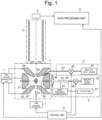
- Fig. 1 illustrates a schematic configuration of the ion trap-time-of-flight mass spectrometer (hereinafter, also simply referred to as "mass spectrometer") of the embodiment.
- the mass spectrometer of the present embodiment includes, inside a vacuum chamber (not illustrated) maintained in a vacuum atmosphere, an ion source 1 which ionizes components in a sample, an ion trap 2 which captures ions generated by the ion source 1 by operation of a radio-frequency electric field, a time-of-flight mass separation unit 3 which separates ions ejected from the ion trap 2 according to a mass-to-charge ratio, and an ion detector 4 which detects separated ions.
- the ion trap mass spectrometer of the present embodiment further includes a radical irradiation unit 5 for irradiating precursor ions captured in the ion trap 2 with radicals in order to dissociate the ions captured in the ion trap 2, an inert gas supply unit 6 which supplies a predetermined inert gas into the ion trap 2, a trap voltage generation unit 7, a control unit 8, and a data processing unit 9.
- the ion source 1 of the mass spectrometer of the present embodiment is a MALDI ion source.
- a material matrix material that easily absorbs laser light and easily ionizes is applied to the surface of the sample. Thereafter, the matrix material incorporating the sample molecules are microcrystallized, and the sample molecules are ionized by application of laser light on the matrix material.
- the ion trap 2 is a three-dimensional ion trap including an annular ring electrode 21 and a pair of end cap electrodes (an inlet-side end cap electrode 22 and an outlet-side end cap electrode 24) disposed to oppose each other with the ring electrode 21 between them.
- a radical particle introduction port 26 and a radical particle releasing port 27 are formed in the ring electrode 21, an ion introduction hole 23 is formed in the inlet-side end cap electrode 22, and an ion ejection hole 25 is formed in the outlet-side end cap electrode 24.
- the trap voltage generation unit 7 applies one of a radio-frequency voltage and a direct-current voltage or a combined voltage of these voltages to each of the ring electrode 21, the inlet-side end cap electrode 22, and the outlet-side end cap electrode 24 at a predetermined timing.
- the radical irradiation unit 5 includes a nozzle 54 having a radical generation chamber 51 formed inside the nozzle 54, a raw gas supply unit (raw gas supply source) 52 for introducing raw gas into the radical generation chamber 51, a vacuum pump (evacuating unit) 57 for evacuating the radical generation chamber 51, an inductively coupled radio-frequency plasma source 53 for supplying a microwave for generating a vacuum electrical discharge in the radical generation chamber 51, a skimmer 55 which has an opening on a central axis of the jet flow from the nozzle 54 and separates diffused raw gas molecules and the like to extract a radical flow having a small diameter, and a valve 56 provided on the flow path from the raw gas supply source 52 to the radical generation chamber 51.
- a raw gas supply unit raw gas supply source
- vacuum pump evacuating unit
- the raw gas for example, hydrogen gas, oxygen gas, water vapor (water), air or the like can be used.
- hydrogen gas hydrogen radicals are generated
- oxygen gas oxygen radicals are generated
- water vapor used as the raw gas
- hydroxyl radicals, oxygen radicals, and hydrogen radicals are generated
- air mainly oxygen radicals and nitrogen radicals are generated.
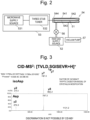
- Non Patent Literature 3 A schematic configuration of the radical irradiation unit 5 is illustrated in Fig. 2 .
- Main components of the radical irradiation unit 5 are the raw gas supply source 52, the radio-frequency plasma source 53, the nozzle 54, and the vacuum pump 57.
- the radio-frequency plasma source 53 includes a microwave supply source 531 and a three stub tuner 532.
- the nozzle 54 includes a ground electrode 541 constituting an outer peripheral portion and a torch 542 made of Pyrex (registered trademark) glass located inside the ground electrode 541, and the inside of the torch 542 serves as the radical generation chamber 51.
- the inert gas supply unit 6 includes a gas supply source 61 storing helium, argon or the like used as buffer gas or cooling gas and a gas introduction tube 63.
- the gas introduction tube 63 is provided with a valve 62 for adjusting the flow rate of the gas supplied from the gas supply source 61 to the ion trap 2.
- the analysis in the mass spectrometer of the present embodiment will be described.
- the inside of the vacuum chamber accommodating the ion trap 2 and the like is evacuated to a predetermined degree of vacuum by a vacuum pump (not illustrated).
- the inside of the radical generation chamber 51 is evacuated to a predetermined degree of vacuum by the vacuum pump 57.
- the raw gas is supplied from the raw gas supply source 52 to the radical generation chamber 51 of the radical irradiation unit 5 and the microwave is supplied from the radio-frequency plasma source 53, and thereby radicals are generated in the radical generation chamber 51.
- hydrogen gas, oxygen gas, water vapor, or the like is used as the raw gas to generate hydrogen radicals, or oxygen radicals and/or hydroxy radicals.
- ions generated from the sample in the ion source 1 (mainly monovalent ions) are ejected from the ion source 1 in the form of a packet, and the ions pass through the ion introduction holes 23 formed in the inlet-side end cap electrode 22 and introduced inside of the ion trap 2.
- the ions introduced into the ion trap 2 are captured by a radio-frequency electric field formed in the ion trap 2 by a voltage applied from the trap voltage generation unit 7 to the ring electrode 21. Then, a predetermined voltage is applied from the trap voltage generation unit 7 to the ring electrode 21 and the like, whereby ions having a mass-to-charge ratio other than targeted ions having a specific mass-to-charge ratio are excited and discharged from the ion trap 2. In this way, only precursor ions having a specific mass-to-charge ratio are trapped in the ion trap 2.
- the valve 62 of the inert gas supply unit 6 is opened, and an inert gas such as helium gas is introduced into the ion trap 2 to cool the precursor ions.
- an inert gas such as helium gas is introduced into the ion trap 2 to cool the precursor ions.
- the precursor ions are converged near a center of the ion trap 2.
- the valve 56 of the radical irradiation unit 5 is opened, and the gas containing the radicals generated in the radical generation chamber 51 is jetted from the nozzle 54.
- the gas containing radicals is formed in a beam shape having a small diameter by the skimmer 55 to be jetted into the ion trap 2 from the radical particle introduction port 26 bored in the ring electrode 21, and the precursor ions captured in the ion trap 2 are irradiated with the gas.
- the opening degree and the opening time of the valve 56 are adjusted so that the amount of radicals irradiated to the precursor ions becomes a predetermined amount or more. These may be determined in advance based on the results of preliminary experiments and the like.
- the precursor ions in the ion trap 2 are irradiated with the radicals, dissociation induced by unpaired electrons occurs in the precursor ions to generate product ions derived from a peptide.
- Various product ions generated are captured in the ion trap 2 and cooled by helium gas or the like from the inert gas supply unit 6. Then, a high DC voltage is applied from the trap voltage generation unit 7 to the inlet-side end cap electrode 22 and the outlet-side end cap electrode 24 at a predetermined timing, whereby the ions captured in the ion trap 2 receive acceleration energy and are ejected through the ion ejection holes 25 at once.
- the product ions produced here can include both fragment ions and adduct ions.
- the ions having a constant acceleration energy are introduced into a flight space of the time-of-flight mass separation unit 3, and are separated according to mass-to-charge ratio while flying in the flight space.
- the ion detector 4 sequentially detects separated ions, and the data processing unit 9 having received a detection signal of the ion detector 4 creates a time-of-flight spectrum in which a time point of ejection of the ions from the ion trap 2 is a time zero, for example. Then, the time-of-flight is converted into a mass-to-charge ratio using mass calibration information which is previously obtained, whereby a product ion spectrum is created.
- the data processing unit 9 searches for a mass peak of a predetermined type of product ion to specify a product ion derived from isoaspartic acid, thereby discriminating isoaspartic acid and aspartic acid. That is, the data processing unit 9 of the present embodiment has a function as a product ion specifying unit of the mass spectrometer according to the present invention.
- isoaspartic acid and aspartic acid are discriminated by dissociating precursor ions by the HAD method or the OAD method.
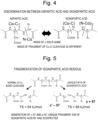
- Fig. 3 illustrates a mass spectrum (product ion spectrum) of product ions generated by dissociating precursor ions derived from a peptide obtained by digesting crystallin (containing an aspartic acid residue) and a crystallin-modified product (containing an isoaspartic acid residue obtained by isomerizing aspartic acid), which are proteins constituting the lens of the eye, with trypsin so as to be fragmented, by the CID method.
- the upper part illustrates a mass spectrum of a product ion derived from a peptide containing an isoaspartic acid residue
- the lower part illustrates a mass spectrum of a product ion derived from a peptide containing an aspartic acid residue.
- both mass peaks appear at the same position. That is, when the peptide containing an aspartic acid residue and the peptide containing an isoaspartic acid residue are dissociated by the CID method, there is no difference in product ions to be generated, and the peptide containing an aspartic acid residue and the peptide containing an isoaspartic acid residue, which is an isomer of the aspartic acid residue, cannot be discriminated by dissociation of precursor ions by the CID method.
- Fig. 5 illustrates the results of quantum chemical calculation performed by the present inventors for the dissociation of the isoaspartic acid residue by the HAD method.
- the hydrogen radical is attached to the carbon atom of the carboxyl group contained in an amide bond, and then the precursor ions are dissociated in two modes.
- the first mode is a mode in which dissociation occurs at the position of the N-C ⁇ bond as in the CID method (a mode described as "normal N-C ⁇ bond cleavage" in Fig.
- the second mode is a mode in which dissociation occurs at the position of the C ⁇ -C bond (a mode described as "route specific to isoaspartic acid” in Fig. 5 ).
- the activation energies from attachment to dissociation of hydrogen radicals are 64 kJ/mol and 66 kJ/mol, respectively, and there is almost no difference. Therefore, when precursor ions derived from a peptide containing an isoaspartic acid residue are dissociated by the HAD method, the product ions dissociated by the C ⁇ -C bond are generated from about half of the precursor ions.
- aspartic acid is only dissociated at the position of the N-C ⁇ bond. Therefore, isoaspartic acid and aspartic acid can be discriminated by searching for product ions generated by dissociation at the position of the C ⁇ -C bond.
- Fig. 6 the results of measuring product ions generated by actually dissociating peptides containing an isoaspartic acid residue and an aspartic acid residue by the HAD method are illustrated in Fig. 6 .
- hydrogen gas was used as a raw gas.
- the upper part of Fig. 6 illustrates the product ion spectrum of the peptide having an isoaspartic acid residue
- the lower part of Fig. 6 illustrates the product ion spectrum of the peptide having an aspartic acid residue.
- the upper part of Fig. 6 illustrates the product ion spectrum of the peptide having an isoaspartic acid residue.
- z7+57 ions are detected in the product ion spectrum of the peptide having an isoaspartic acid residue, while z7+57 ions are not detected in the product ion spectrum of the peptide having an aspartic acid residue illustrated in the lower part of Fig. 6 .
- z7 refers to an ion (z ion) on the C-terminal side generated by dissociation at the position of the N-C ⁇ bond of an aspartic acid residue, and has seven amino acids on the C-terminal side of the binding site.
- z7+57 is an ion having a mass larger by 57 Da than that of the z7 ion.
- Fig. 7 the results of measuring product ions generated by dissociating peptides containing an isoaspartic acid residue and an aspartic acid residue by the HAD method in the same manner as described above for other peptides are illustrated in Fig. 7 .
- the upper part of Fig. 7 illustrates the product ion spectrum of the peptide having an isoaspartic acid residue
- the lower part of Fig. 7 illustrates the product ion spectrum of the peptide having an aspartic acid residue.
- c7-57 ions are detected in the product ion spectrum of the peptide having an isoaspartic acid residue, while c7-57 ions are not detected in the product ion spectrum of the peptide having an aspartic acid residue illustrated in the lower part of Fig. 7 .
- c7 refers to an ion (c ion) on the N-terminal side generated by dissociation at the position of the N-C ⁇ bond of an aspartic acid residue, and has seven amino acids on the N-terminal side of the binding site.
- c7-57 is an ion having a mass smaller by 57 Da than that of the c7 ion.
- isoaspartic acid and aspartic acid can be discriminated by searching for the z+57 ion or the c-57 ion.
- z7+57 ions are detected in Fig. 6
- c-57 ions are detected in Fig. 7
- which of z ion and c ion is detected depends on the configuration and position of the amino acid contained in the peptide.
- a z ion is generated on the C-terminal side of aspartic acid
- a c ion is generated on the N-terminal side of aspartic acid.
- Non Patent Literature 4 when the precursor ions are irradiated with oxygen radicals, the precursor ions derived from a peptide are cleaved at the position of the C ⁇ -C bond of the peptide bond, and a+16 ions are generated.
- the a+16 ion is an ion in which an oxygen atom is attached to an a ion, which is an ion on the N-terminal side generated by dissociation of a peptide bond at the position of the C ⁇ -C bond, and the mass is increased by 16 Da.
- an x ion can also be generated on the C-terminal side.
- product ions a+16 ions and/or x ions
- isoaspartic acid and aspartic acid can be discriminated from each other also by using water vapor or oxygen gas as a raw gas in place of the hydrogen gas used in the above measurement examples and irradiating the precursor ions with oxygen radicals or hydroxy radicals.
- oxygen radicals and hydroxy radicals it is also possible to use not only oxygen radicals and hydroxy radicals but also radicals having oxidizing ability similarly to these radicals.
- the structure of the peptide can be estimated by causing the data processing unit 9 to store the names and masses of various materials predicted to be contained in the peptide as a sample component, such as amino acids, and searching for a material in which a difference in mass-to-charge ratio between mass peaks of a product ion spectrum matches the mass of any of the amino acids.
- the mass spectrometer having the configuration of three-dimensional ion trap-time-of-flight mass separation unit has been described, but a mass spectrometer having another configuration can also be used.
- An example of such a mass spectrometer is a triple quadrupole mass spectrometer. In this case, radicals may be injected from the nozzle into the collision cell to irradiate precursor ions passing through the collision cell.
- a first aspect of the present invention is a method for analyzing isoaspartic acid by dissociating precursor ions derived from a sample component and generating and analyzing product ions, the method including:
- a fourth aspect of the present invention is a mass spectrometer for analyzing isoaspartic acid by dissociating precursor ions derived from a sample component and generating and analyzing product ions, the mass spectrometer including:
- precursor ions derived from the sample component are irradiated with hydrogen radicals or radicals having oxidizing ability to generate the product ions.
- the radical having oxidizing ability is, for example, an oxygen radical or a hydroxy radical.
- the ion dissociation method for irradiating precursor ions with these radicals is a hydrogen-attachment dissociation (HAD) method and an oxygen-attachment dissociation (OAD) method proposed by the present inventor in Patent Literature 1.
- the present inventor has found that when the precursor ions derived from isoaspartic acid are dissociated by the HAD method, c+57 ions and z-57 ions which characterize isoaspartic acid (and not generated from aspartic acid) are generated as in the ETD method.
- the present inventor has found that when the precursor ions derived from isoaspartic acid are dissociated by the OAD method, in which oxygen radicals or hydroxy radicals are attached to precursor ions to dissociate the precursor ions, an a+16 ion which characterizes isoaspartic acid (not generated from aspartic acid) is generated.
- the a+16 ion is an ion having a mass larger by 57 than that of the ion (c ion) on the N-terminal side which is generated by cleaving the C ⁇ -C bond of the peptide main chain of aspartic acid.
- isoaspartic acid can be discriminated from aspartic acid and analyzed by separating and detecting product ions generated by dissociating precursor ions derived from a sample component according to a mass-to-charge ratio and specifying ions corresponding to these detected ions.
- the HAD method and the OAD method are methods of dissociating precursor ions by radical addition, and can be used regardless of the polarity or valence of ions to be dissociated. Therefore, the precursor ions derived from a sample component can be efficiently dissociated, and the isoaspartic acid and the aspartic acid, which is an isomer of the isoaspartic acid can be easily discriminated and analyzed.
- a method for analyzing isoaspartic acid according to a second aspect of the present invention is the method for analyzing isoaspartic acid according to the first aspect, wherein the product ions derived from isoaspartic acid are specified by searching for an a+16 ion and wherein the precursor ions are irradiated with oxygen radicals and/or hydroxy radicals.
- a mass spectrometer according to a fifth aspect of the present invention is the mass spectrometer of the fourth aspect, in which
- the mass spectrometer of the fourth aspect it is possible to infer the ratio of the component having a cis type unsaturated bond and the component having a trans type unsaturated bond contained in the sample component without bothering the user.
Landscapes
- Life Sciences & Earth Sciences (AREA)
- Health & Medical Sciences (AREA)
- Chemical & Material Sciences (AREA)
- Engineering & Computer Science (AREA)
- Analytical Chemistry (AREA)
- Physics & Mathematics (AREA)
- Molecular Biology (AREA)
- Immunology (AREA)
- Pathology (AREA)
- General Health & Medical Sciences (AREA)
- General Physics & Mathematics (AREA)
- Biochemistry (AREA)
- Hematology (AREA)
- Urology & Nephrology (AREA)
- Biomedical Technology (AREA)
- Chemical Kinetics & Catalysis (AREA)
- Bioinformatics & Cheminformatics (AREA)
- Bioinformatics & Computational Biology (AREA)
- Electrochemistry (AREA)
- Microbiology (AREA)
- Biotechnology (AREA)
- Cell Biology (AREA)
- Proteomics, Peptides & Aminoacids (AREA)
- Biophysics (AREA)
- Food Science & Technology (AREA)
- Medicinal Chemistry (AREA)
- Toxicology (AREA)
- Plasma & Fusion (AREA)
- Spectroscopy & Molecular Physics (AREA)
- Other Investigation Or Analysis Of Materials By Electrical Means (AREA)
Claims (6)
- Procédé pour analyser de l'acide isoaspartique par dissociation d'ions précurseurs dérivés d'un composant d'échantillon et par génération et par analyse d'ions de produit, le procédé comprenant les étapes consistant à :générer des ions de produit par irradiation des ions précurseurs avec des radicaux hydrogène ou des radicaux présentant une capacité d'oxydation pour dissocier les ions précurseurs ;séparer et détecter les ions de produit selon un rapport de charge massique ; etspécifier les ions de produit dérivés de l'acide isoaspartique sur la base d'un rapport de charge massique des ions de produit,dans lequel les ions précurseurs sont irradiés avec des radicaux hydrogène et les ions de produit dérivés de l'acide isoaspartique sont spécifiés en recherchant un ion c+57 ou un ion z-57,ou dans lequel les ions de produit dérivés de l'acide isoaspartique sont spécifiés en recherchant un ion a+16.
- Procédé pour analyser de l'acide isoaspartique selon la revendication 1, dans lequel les ions de produit dérivés de l'acide isoaspartique sont spécifiés en recherchant un ion a+16 et dans lequel les ions précurseurs sont irradiés avec des radicaux oxygène et/ou des radicaux hydroxy.
- Procédé pour analyser de l'acide isoaspartique selon la revendication 1, dans lequel les ions précurseurs sont des ions monovalents.
- Spectromètre de masse pour analyser l'acide isoaspartique par dissociation d'ions précurseurs dérivés d'un composant d'échantillon et par génération et par analyse d'ions de produit, le spectromètre de masse comprenant :une chambre de réaction dans laquelle les ions précurseurs sont introduits ;une unité de génération de radicaux configurée pour générer un radical hydrogène ou un radical présentant une capacité d'oxydation ;une unité d'irradiation radicalaire configurée pour irradier un intérieur de la chambre de réaction avec des radicaux générés par l'unité de génération de radicaux ;une unité de séparation et de détection configurée pour séparer et détecter les ions de produit générés par une dissociation des ions précurseurs par réaction avec les radicaux selon un rapport de charge massique ; etune unité de spécification d'ions de produit configurée pour spécifier des ions de produit dérivés de l'acide isoaspartique sur la base d'un rapport de charge massique des ions de produit,dans lequell'unité de génération de radicaux est configurée pour générer un radical hydrogène et l'unité de spécification d'ion de produit est configurée pour rechercher un ion c+57 ou un ion z-57,
oul'unité de spécification d'ion de produit est configurée pour rechercher un ion a+16. - Spectromètre de masse selon la revendication 4, dans lequel l'unité de génération de radicaux est configurée pour générer un radical oxygène et/ou un radical hydroxy, et
l'unité de spécification d'ion de produit est configurée pour rechercher un ion a+16. - Spectromètre de masse selon l'une des revendications 4 à 5, dans lequel les ions précurseurs sont des ions monovalents.
Applications Claiming Priority (2)
| Application Number | Priority Date | Filing Date | Title |
|---|---|---|---|
| JP2019132268 | 2019-07-17 | ||
| PCT/JP2020/027388 WO2021010401A1 (fr) | 2019-07-17 | 2020-07-14 | Procédé d'analyse d'acide isoaspartique et spectromètre de masse |
Publications (3)
| Publication Number | Publication Date |
|---|---|
| EP4001911A1 EP4001911A1 (fr) | 2022-05-25 |
| EP4001911A4 EP4001911A4 (fr) | 2022-08-31 |
| EP4001911B1 true EP4001911B1 (fr) | 2024-08-21 |
Family
ID=74210854
Family Applications (1)
| Application Number | Title | Priority Date | Filing Date |
|---|---|---|---|
| EP20841023.3A Active EP4001911B1 (fr) | 2019-07-17 | 2020-07-14 | Procédé d'analyse d'acide isoaspartique et spectromètre de masse |
Country Status (5)
| Country | Link |
|---|---|
| US (1) | US12020919B2 (fr) |
| EP (1) | EP4001911B1 (fr) |
| JP (1) | JP7403774B2 (fr) |
| CN (1) | CN114144668B (fr) |
| WO (1) | WO2021010401A1 (fr) |
Family Cites Families (9)
| Publication number | Priority date | Publication date | Assignee | Title |
|---|---|---|---|---|
| EP3114476A4 (fr) * | 2013-10-03 | 2017-11-01 | Bioanalytix, Inc. | Procédé fondé sur la spectrométrie de masse permettant d'identifier et de conserver constants des facteurs de contrôle qualité durant la mise au point et la fabrication d'un médicament biologique |
| CN106104747B (zh) | 2014-03-04 | 2018-01-30 | 株式会社岛津制作所 | 离子分析装置 |
| US20190073452A1 (en) * | 2015-09-25 | 2019-03-07 | Bioanalytix, Inc. | Method for determining the in vivo comparability of a biologic drug and a reference drug |
| JP6593243B2 (ja) * | 2016-04-14 | 2019-10-23 | 株式会社島津製作所 | イオントラップ質量分析装置 |
| JP6665740B2 (ja) | 2016-09-13 | 2020-03-13 | 株式会社島津製作所 | ペプチド解析方法、ペプチド解析装置、及びペプチド解析用プログラム |
| JP6713646B2 (ja) * | 2017-04-04 | 2020-06-24 | 株式会社島津製作所 | イオン分析装置 |
| US10908165B2 (en) | 2017-06-07 | 2021-02-02 | Purdue Research Foundation | Method for determining whether a peptide comprises aspartate or isoaspartate |
| JP2019056598A (ja) * | 2017-09-20 | 2019-04-11 | 株式会社島津製作所 | 分析方法および分析装置 |
| TWI907533B (zh) * | 2020-10-01 | 2025-12-11 | 美商安進公司 | 異天冬胺酸之檢測方法 |
-
2020
- 2020-07-14 CN CN202080051664.4A patent/CN114144668B/zh active Active
- 2020-07-14 US US17/597,350 patent/US12020919B2/en active Active
- 2020-07-14 WO PCT/JP2020/027388 patent/WO2021010401A1/fr not_active Ceased
- 2020-07-14 JP JP2021533081A patent/JP7403774B2/ja active Active
- 2020-07-14 EP EP20841023.3A patent/EP4001911B1/fr active Active
Also Published As
| Publication number | Publication date |
|---|---|
| WO2021010401A1 (fr) | 2021-01-21 |
| EP4001911A4 (fr) | 2022-08-31 |
| JPWO2021010401A1 (fr) | 2021-01-21 |
| EP4001911A1 (fr) | 2022-05-25 |
| CN114144668B (zh) | 2025-02-11 |
| US12020919B2 (en) | 2024-06-25 |
| US20220254621A1 (en) | 2022-08-11 |
| CN114144668A (zh) | 2022-03-04 |
| JP7403774B2 (ja) | 2023-12-25 |
Similar Documents
| Publication | Publication Date | Title |
|---|---|---|
| US10998177B2 (en) | Ion analyzer | |
| CN110494955B (zh) | 离子分析装置及离子裂解方法 | |
| US7170051B2 (en) | Method and apparatus for ion fragmentation in mass spectrometry | |
| JP7142867B2 (ja) | イオン分析装置 | |
| WO2010044370A1 (fr) | Spectromètre de masse et procédé de spectrométrie de masse | |
| JP2020177784A (ja) | イオン分析装置 | |
| US20220344140A1 (en) | Ion analyzer | |
| JP7435812B2 (ja) | 質量分析方法及び質量分析装置 | |
| WO2017041361A1 (fr) | Dispositif de spectrométrie de masse dans lequel la lumière ultraviolette ionise des molécules neutres perdues, et son procédé de fonctionnement | |
| US7397029B2 (en) | Method and apparatus for ion fragmentation in mass spectrometry | |
| JP5831347B2 (ja) | 質量分析装置及び質量分析方法 | |
| US10317412B1 (en) | Method and device for analyzing protein or peptide | |
| EP4001911B1 (fr) | Procédé d'analyse d'acide isoaspartique et spectromètre de masse | |
| CN113678229B (zh) | 离子分析装置 | |
| US12009197B2 (en) | Method and apparatus | |
| GB2606024A (en) | Apparatus and method |
Legal Events
| Date | Code | Title | Description |
|---|---|---|---|
| STAA | Information on the status of an ep patent application or granted ep patent |
Free format text: STATUS: THE INTERNATIONAL PUBLICATION HAS BEEN MADE |
|
| PUAI | Public reference made under article 153(3) epc to a published international application that has entered the european phase |
Free format text: ORIGINAL CODE: 0009012 |
|
| STAA | Information on the status of an ep patent application or granted ep patent |
Free format text: STATUS: REQUEST FOR EXAMINATION WAS MADE |
|
| 17P | Request for examination filed |
Effective date: 20220215 |
|
| AK | Designated contracting states |
Kind code of ref document: A1 Designated state(s): AL AT BE BG CH CY CZ DE DK EE ES FI FR GB GR HR HU IE IS IT LI LT LU LV MC MK MT NL NO PL PT RO RS SE SI SK SM TR |
|
| REG | Reference to a national code |
Ref legal event code: R079 Ipc: H01J0049260000 Ref country code: DE Ref legal event code: R079 Ref document number: 602020036385 Country of ref document: DE Free format text: PREVIOUS MAIN CLASS: G01N0027620000 Ipc: H01J0049260000 |
|
| A4 | Supplementary search report drawn up and despatched |
Effective date: 20220801 |
|
| RIC1 | Information provided on ipc code assigned before grant |
Ipc: G01N 33/68 20060101ALI20220726BHEP Ipc: H01J 49/26 20060101AFI20220726BHEP |
|
| DAV | Request for validation of the european patent (deleted) | ||
| DAX | Request for extension of the european patent (deleted) | ||
| STAA | Information on the status of an ep patent application or granted ep patent |
Free format text: STATUS: EXAMINATION IS IN PROGRESS |
|
| 17Q | First examination report despatched |
Effective date: 20230822 |
|
| REG | Reference to a national code |
Ref country code: DE Ref legal event code: R079 Free format text: PREVIOUS MAIN CLASS: H01J0049260000 Ipc: G01N0033680000 Ref country code: DE Ref legal event code: R079 Ref document number: 602020036385 Country of ref document: DE Free format text: PREVIOUS MAIN CLASS: H01J0049260000 Ipc: G01N0033680000 |
|
| GRAP | Despatch of communication of intention to grant a patent |
Free format text: ORIGINAL CODE: EPIDOSNIGR1 |
|
| STAA | Information on the status of an ep patent application or granted ep patent |
Free format text: STATUS: GRANT OF PATENT IS INTENDED |
|
| RIC1 | Information provided on ipc code assigned before grant |
Ipc: H01J 49/00 20060101ALI20240117BHEP Ipc: G01N 33/68 20060101AFI20240117BHEP |
|
| INTG | Intention to grant announced |
Effective date: 20240215 |
|
| GRAS | Grant fee paid |
Free format text: ORIGINAL CODE: EPIDOSNIGR3 |
|
| GRAA | (expected) grant |
Free format text: ORIGINAL CODE: 0009210 |
|
| STAA | Information on the status of an ep patent application or granted ep patent |
Free format text: STATUS: THE PATENT HAS BEEN GRANTED |
|
| AK | Designated contracting states |
Kind code of ref document: B1 Designated state(s): AL AT BE BG CH CY CZ DE DK EE ES FI FR GB GR HR HU IE IS IT LI LT LU LV MC MK MT NL NO PL PT RO RS SE SI SK SM TR |
|
| REG | Reference to a national code |
Ref country code: GB Ref legal event code: FG4D |
|
| REG | Reference to a national code |
Ref country code: CH Ref legal event code: EP |
|
| REG | Reference to a national code |
Ref country code: IE Ref legal event code: FG4D |
|
| REG | Reference to a national code |
Ref country code: DE Ref legal event code: R096 Ref document number: 602020036385 Country of ref document: DE |
|
| REG | Reference to a national code |
Ref country code: LT Ref legal event code: MG9D |
|
| REG | Reference to a national code |
Ref country code: NL Ref legal event code: MP Effective date: 20240821 |
|
| PG25 | Lapsed in a contracting state [announced via postgrant information from national office to epo] |
Ref country code: NO Free format text: LAPSE BECAUSE OF FAILURE TO SUBMIT A TRANSLATION OF THE DESCRIPTION OR TO PAY THE FEE WITHIN THE PRESCRIBED TIME-LIMIT Effective date: 20241121 |
|
| REG | Reference to a national code |
Ref country code: AT Ref legal event code: MK05 Ref document number: 1715972 Country of ref document: AT Kind code of ref document: T Effective date: 20240821 |
|
| PG25 | Lapsed in a contracting state [announced via postgrant information from national office to epo] |
Ref country code: NL Free format text: LAPSE BECAUSE OF FAILURE TO SUBMIT A TRANSLATION OF THE DESCRIPTION OR TO PAY THE FEE WITHIN THE PRESCRIBED TIME-LIMIT Effective date: 20240821 Ref country code: GR Free format text: LAPSE BECAUSE OF FAILURE TO SUBMIT A TRANSLATION OF THE DESCRIPTION OR TO PAY THE FEE WITHIN THE PRESCRIBED TIME-LIMIT Effective date: 20241122 Ref country code: PT Free format text: LAPSE BECAUSE OF FAILURE TO SUBMIT A TRANSLATION OF THE DESCRIPTION OR TO PAY THE FEE WITHIN THE PRESCRIBED TIME-LIMIT Effective date: 20241223 Ref country code: PL Free format text: LAPSE BECAUSE OF FAILURE TO SUBMIT A TRANSLATION OF THE DESCRIPTION OR TO PAY THE FEE WITHIN THE PRESCRIBED TIME-LIMIT Effective date: 20240821 Ref country code: FI Free format text: LAPSE BECAUSE OF FAILURE TO SUBMIT A TRANSLATION OF THE DESCRIPTION OR TO PAY THE FEE WITHIN THE PRESCRIBED TIME-LIMIT Effective date: 20240821 |
|
| PG25 | Lapsed in a contracting state [announced via postgrant information from national office to epo] |
Ref country code: BG Free format text: LAPSE BECAUSE OF FAILURE TO SUBMIT A TRANSLATION OF THE DESCRIPTION OR TO PAY THE FEE WITHIN THE PRESCRIBED TIME-LIMIT Effective date: 20240821 |
|
| PG25 | Lapsed in a contracting state [announced via postgrant information from national office to epo] |
Ref country code: LV Free format text: LAPSE BECAUSE OF FAILURE TO SUBMIT A TRANSLATION OF THE DESCRIPTION OR TO PAY THE FEE WITHIN THE PRESCRIBED TIME-LIMIT Effective date: 20240821 |
|
| PG25 | Lapsed in a contracting state [announced via postgrant information from national office to epo] |
Ref country code: AT Free format text: LAPSE BECAUSE OF FAILURE TO SUBMIT A TRANSLATION OF THE DESCRIPTION OR TO PAY THE FEE WITHIN THE PRESCRIBED TIME-LIMIT Effective date: 20240821 Ref country code: IS Free format text: LAPSE BECAUSE OF FAILURE TO SUBMIT A TRANSLATION OF THE DESCRIPTION OR TO PAY THE FEE WITHIN THE PRESCRIBED TIME-LIMIT Effective date: 20241221 |
|
| PG25 | Lapsed in a contracting state [announced via postgrant information from national office to epo] |
Ref country code: HR Free format text: LAPSE BECAUSE OF FAILURE TO SUBMIT A TRANSLATION OF THE DESCRIPTION OR TO PAY THE FEE WITHIN THE PRESCRIBED TIME-LIMIT Effective date: 20240821 |
|
| PG25 | Lapsed in a contracting state [announced via postgrant information from national office to epo] |
Ref country code: ES Free format text: LAPSE BECAUSE OF FAILURE TO SUBMIT A TRANSLATION OF THE DESCRIPTION OR TO PAY THE FEE WITHIN THE PRESCRIBED TIME-LIMIT Effective date: 20240821 Ref country code: RS Free format text: LAPSE BECAUSE OF FAILURE TO SUBMIT A TRANSLATION OF THE DESCRIPTION OR TO PAY THE FEE WITHIN THE PRESCRIBED TIME-LIMIT Effective date: 20241121 |
|
| PG25 | Lapsed in a contracting state [announced via postgrant information from national office to epo] |
Ref country code: RS Free format text: LAPSE BECAUSE OF FAILURE TO SUBMIT A TRANSLATION OF THE DESCRIPTION OR TO PAY THE FEE WITHIN THE PRESCRIBED TIME-LIMIT Effective date: 20241121 Ref country code: PT Free format text: LAPSE BECAUSE OF FAILURE TO SUBMIT A TRANSLATION OF THE DESCRIPTION OR TO PAY THE FEE WITHIN THE PRESCRIBED TIME-LIMIT Effective date: 20241223 Ref country code: PL Free format text: LAPSE BECAUSE OF FAILURE TO SUBMIT A TRANSLATION OF THE DESCRIPTION OR TO PAY THE FEE WITHIN THE PRESCRIBED TIME-LIMIT Effective date: 20240821 Ref country code: NO Free format text: LAPSE BECAUSE OF FAILURE TO SUBMIT A TRANSLATION OF THE DESCRIPTION OR TO PAY THE FEE WITHIN THE PRESCRIBED TIME-LIMIT Effective date: 20241121 Ref country code: NL Free format text: LAPSE BECAUSE OF FAILURE TO SUBMIT A TRANSLATION OF THE DESCRIPTION OR TO PAY THE FEE WITHIN THE PRESCRIBED TIME-LIMIT Effective date: 20240821 Ref country code: LV Free format text: LAPSE BECAUSE OF FAILURE TO SUBMIT A TRANSLATION OF THE DESCRIPTION OR TO PAY THE FEE WITHIN THE PRESCRIBED TIME-LIMIT Effective date: 20240821 Ref country code: IS Free format text: LAPSE BECAUSE OF FAILURE TO SUBMIT A TRANSLATION OF THE DESCRIPTION OR TO PAY THE FEE WITHIN THE PRESCRIBED TIME-LIMIT Effective date: 20241221 Ref country code: HR Free format text: LAPSE BECAUSE OF FAILURE TO SUBMIT A TRANSLATION OF THE DESCRIPTION OR TO PAY THE FEE WITHIN THE PRESCRIBED TIME-LIMIT Effective date: 20240821 Ref country code: GR Free format text: LAPSE BECAUSE OF FAILURE TO SUBMIT A TRANSLATION OF THE DESCRIPTION OR TO PAY THE FEE WITHIN THE PRESCRIBED TIME-LIMIT Effective date: 20241122 Ref country code: FI Free format text: LAPSE BECAUSE OF FAILURE TO SUBMIT A TRANSLATION OF THE DESCRIPTION OR TO PAY THE FEE WITHIN THE PRESCRIBED TIME-LIMIT Effective date: 20240821 Ref country code: ES Free format text: LAPSE BECAUSE OF FAILURE TO SUBMIT A TRANSLATION OF THE DESCRIPTION OR TO PAY THE FEE WITHIN THE PRESCRIBED TIME-LIMIT Effective date: 20240821 Ref country code: BG Free format text: LAPSE BECAUSE OF FAILURE TO SUBMIT A TRANSLATION OF THE DESCRIPTION OR TO PAY THE FEE WITHIN THE PRESCRIBED TIME-LIMIT Effective date: 20240821 Ref country code: AT Free format text: LAPSE BECAUSE OF FAILURE TO SUBMIT A TRANSLATION OF THE DESCRIPTION OR TO PAY THE FEE WITHIN THE PRESCRIBED TIME-LIMIT Effective date: 20240821 |
|
| PG25 | Lapsed in a contracting state [announced via postgrant information from national office to epo] |
Ref country code: RO Free format text: LAPSE BECAUSE OF FAILURE TO SUBMIT A TRANSLATION OF THE DESCRIPTION OR TO PAY THE FEE WITHIN THE PRESCRIBED TIME-LIMIT Effective date: 20240821 Ref country code: SM Free format text: LAPSE BECAUSE OF FAILURE TO SUBMIT A TRANSLATION OF THE DESCRIPTION OR TO PAY THE FEE WITHIN THE PRESCRIBED TIME-LIMIT Effective date: 20240821 Ref country code: DK Free format text: LAPSE BECAUSE OF FAILURE TO SUBMIT A TRANSLATION OF THE DESCRIPTION OR TO PAY THE FEE WITHIN THE PRESCRIBED TIME-LIMIT Effective date: 20240821 |
|
| PG25 | Lapsed in a contracting state [announced via postgrant information from national office to epo] |
Ref country code: EE Free format text: LAPSE BECAUSE OF FAILURE TO SUBMIT A TRANSLATION OF THE DESCRIPTION OR TO PAY THE FEE WITHIN THE PRESCRIBED TIME-LIMIT Effective date: 20240821 |
|
| PG25 | Lapsed in a contracting state [announced via postgrant information from national office to epo] |
Ref country code: CZ Free format text: LAPSE BECAUSE OF FAILURE TO SUBMIT A TRANSLATION OF THE DESCRIPTION OR TO PAY THE FEE WITHIN THE PRESCRIBED TIME-LIMIT Effective date: 20240821 |
|
| PG25 | Lapsed in a contracting state [announced via postgrant information from national office to epo] |
Ref country code: SK Free format text: LAPSE BECAUSE OF FAILURE TO SUBMIT A TRANSLATION OF THE DESCRIPTION OR TO PAY THE FEE WITHIN THE PRESCRIBED TIME-LIMIT Effective date: 20240821 Ref country code: IT Free format text: LAPSE BECAUSE OF FAILURE TO SUBMIT A TRANSLATION OF THE DESCRIPTION OR TO PAY THE FEE WITHIN THE PRESCRIBED TIME-LIMIT Effective date: 20240821 |
|
| REG | Reference to a national code |
Ref country code: DE Ref legal event code: R097 Ref document number: 602020036385 Country of ref document: DE |
|
| PLBE | No opposition filed within time limit |
Free format text: ORIGINAL CODE: 0009261 |
|
| STAA | Information on the status of an ep patent application or granted ep patent |
Free format text: STATUS: NO OPPOSITION FILED WITHIN TIME LIMIT |
|
| PGFP | Annual fee paid to national office [announced via postgrant information from national office to epo] |
Ref country code: GB Payment date: 20250529 Year of fee payment: 6 |
|
| 26N | No opposition filed |
Effective date: 20250522 |
|
| PG25 | Lapsed in a contracting state [announced via postgrant information from national office to epo] |
Ref country code: SE Free format text: LAPSE BECAUSE OF FAILURE TO SUBMIT A TRANSLATION OF THE DESCRIPTION OR TO PAY THE FEE WITHIN THE PRESCRIBED TIME-LIMIT Effective date: 20240821 |
|
| PGFP | Annual fee paid to national office [announced via postgrant information from national office to epo] |
Ref country code: DE Payment date: 20250528 Year of fee payment: 6 |
|
| REG | Reference to a national code |
Ref country code: CH Ref legal event code: H13 Free format text: ST27 STATUS EVENT CODE: U-0-0-H10-H13 (AS PROVIDED BY THE NATIONAL OFFICE) Effective date: 20260224 |
|
| PG25 | Lapsed in a contracting state [announced via postgrant information from national office to epo] |
Ref country code: LU Free format text: LAPSE BECAUSE OF NON-PAYMENT OF DUE FEES Effective date: 20250714 |
|
| REG | Reference to a national code |
Ref country code: BE Ref legal event code: MM Effective date: 20250731 |
|
| PG25 | Lapsed in a contracting state [announced via postgrant information from national office to epo] |
Ref country code: BE Free format text: LAPSE BECAUSE OF NON-PAYMENT OF DUE FEES Effective date: 20250731 |
|
| PG25 | Lapsed in a contracting state [announced via postgrant information from national office to epo] |
Ref country code: FR Free format text: LAPSE BECAUSE OF NON-PAYMENT OF DUE FEES Effective date: 20250731 |
|
| PG25 | Lapsed in a contracting state [announced via postgrant information from national office to epo] |
Ref country code: CH Free format text: LAPSE BECAUSE OF NON-PAYMENT OF DUE FEES Effective date: 20250731 |