EP4001972A1 - Procédé de détermination d'une grandeur météorologique - Google Patents
Procédé de détermination d'une grandeur météorologique Download PDFInfo
- Publication number
- EP4001972A1 EP4001972A1 EP21209600.2A EP21209600A EP4001972A1 EP 4001972 A1 EP4001972 A1 EP 4001972A1 EP 21209600 A EP21209600 A EP 21209600A EP 4001972 A1 EP4001972 A1 EP 4001972A1
- Authority
- EP
- European Patent Office
- Prior art keywords
- meteorological
- parameter
- parameters
- situation
- determined
- Prior art date
- Legal status (The legal status is an assumption and is not a legal conclusion. Google has not performed a legal analysis and makes no representation as to the accuracy of the status listed.)
- Pending
Links
Images


Classifications
-
- G—PHYSICS
- G01—MEASURING; TESTING
- G01W—METEOROLOGY
- G01W1/00—Meteorology
- G01W1/10—Devices for predicting weather conditions
-
- G—PHYSICS
- G01—MEASURING; TESTING
- G01W—METEOROLOGY
- G01W1/00—Meteorology
- G01W1/02—Instruments for indicating weather conditions by measuring two or more variables, e.g. humidity, pressure, temperature, cloud cover or wind speed
- G01W1/06—Instruments for indicating weather conditions by measuring two or more variables, e.g. humidity, pressure, temperature, cloud cover or wind speed giving a combined indication of weather conditions
-
- G—PHYSICS
- G06—COMPUTING OR CALCULATING; COUNTING
- G06N—COMPUTING ARRANGEMENTS BASED ON SPECIFIC COMPUTATIONAL MODELS
- G06N20/00—Machine learning
-
- G—PHYSICS
- G06—COMPUTING OR CALCULATING; COUNTING
- G06N—COMPUTING ARRANGEMENTS BASED ON SPECIFIC COMPUTATIONAL MODELS
- G06N3/00—Computing arrangements based on biological models
- G06N3/02—Neural networks
- G06N3/08—Learning methods
-
- G—PHYSICS
- G01—MEASURING; TESTING
- G01W—METEOROLOGY
- G01W2203/00—Real-time site-specific personalized weather information, e.g. nowcasting
-
- Y—GENERAL TAGGING OF NEW TECHNOLOGICAL DEVELOPMENTS; GENERAL TAGGING OF CROSS-SECTIONAL TECHNOLOGIES SPANNING OVER SEVERAL SECTIONS OF THE IPC; TECHNICAL SUBJECTS COVERED BY FORMER USPC CROSS-REFERENCE ART COLLECTIONS [XRACs] AND DIGESTS
- Y02—TECHNOLOGIES OR APPLICATIONS FOR MITIGATION OR ADAPTATION AGAINST CLIMATE CHANGE
- Y02A—TECHNOLOGIES FOR ADAPTATION TO CLIMATE CHANGE
- Y02A90/00—Technologies having an indirect contribution to adaptation to climate change
- Y02A90/10—Information and communication technologies [ICT] supporting adaptation to climate change, e.g. for weather forecasting or climate simulation
Definitions
- the invention relates to a method for determining, in particular predicting, at least one meteorological variable for describing a current and/or past and/or future weather situation according to the preamble of claim 1.
- the object of the present invention was to overcome the disadvantages of the prior art and to provide a method by means of which an existing data set of meteorological data with parameters distributed over grid points can be used flexibly for various purposes.
- a user of the system should be able to make statements or forecasts that are accurate in terms of time and location regarding a past, current or future weather situation.
- the method should be characterized by configurability, so that meteorological variables or values or information derived therefrom and/or the method steps of the method itself can be adapted individually or to a concrete—local, temporal or subjective—situation.
- the user can determine, depending on the situation, which information is determined or calculated from the first meteorological parameters—obtained from first measurements—which are each associated with grid points of a first grid.
- the first meteorological parameters are preferably also available for different points in time in the past, so that, for example, the weather situation at a specific location (i.e. at a point) can be determined with pinpoint accuracy at a point in time in the past. This could be relevant, for example, in claims settlement after an accident (possibly caused by fog, rain, snow, ice, wind, etc.) or destructive natural phenomena.
- meteorological quantities can also be calculated for any points that lie between the individual grid points and any points in time.
- the present invention can also be referred to as a virtual weather station.
- the method on which the virtual weather station is based is based on real, first measurements and the first meteorological parameters obtained from them, but the further method steps take place depending on a default parameter which serves as a default for determining the meteorological variable.
- the specification can be a location or time coordinate or a meteorological comparison parameter.
- the default parameter is linked to the first parameters by the first algorithm.
- the first (and second) grid is a spatial (i.e. two- or three-dimensional) grid, i.e. the grid points correspond to different spatial coordinates of the area covered by the grid.
- a preferred embodiment is characterized in that the at least one default parameter includes a time coordinate, preferably a point in time, and that in step (c) the at least one meteorological variable is determined for this time coordinate preferably the time coordinate is in the past.
- a meteorological variable is determined for a specific time coordinate by such a default parameter. The determination can be limited to a specific region or a location coordinate, or the entire region covered by the first grid can be performed. If no meteorological parameters are available for the specified time coordinate, then the meteorological variable can be determined or estimated by interpolation, averaging and/or taking into account the parameters that are closest in time.
- the method is particularly advantageous if steps (b) and (c) from the first meteorological parameters for the first time since their generation (from the first measurements) a meteorological variable for a point in time in the past or for a point (spatial coordinate) , for which no data are available and which also does not correspond to any grid point, is calculated.
- a preferred embodiment is characterized in that the at least one default parameter includes a location coordinate, preferably a point, and that in step (c) the at least one meteorological variable is determined for this location coordinate, with the location coordinate preferably lying between the grid points of the first grid .
- a meteorological variable can be determined using the first algorithm, even if the location coordinate does not coincide with a grid point. The weather can thus be calculated virtually for a specific point, although neither measurement data nor grid data (first meteorological parameters) are available for this specific point. This is preferably done by interpolating and/or averaging the first parameters and/or taking into account the parameters of the spatially closest grid points.
- a preferred embodiment is characterized in that the at least one default parameter characterizes at least one local condition, preferably relating to the vegetation and/or the buildings and/or an object that shades the wind and/or the sun and/or the sea level and/or the landform.
- the additionally specified local conditions mean that the meteorological variable for this specific location can be determined even more precisely and in a more targeted manner.
- a default parameter that takes a in The west-east extending wall includes or describes that a wind force of south or north winds directly behind the wall will be lower than would be the case without the wall - given as a meteorological variable.
- the situation is similar with a temperature (particularly at midday) - output as a meteorological variable - if a group of trees casting a shadow is entered as a default parameter, for example south of the relevant location coordinates.
- a virtual weather station is created through the possibility of individual default parameters, ie the meteorological variable is modeled using an algorithm or a model and adjusted accordingly.
- the at least one default parameter includes at least one meteorological comparison parameter which—independently of the first measurements—is obtained through observation and/or from at least one second measurement, with the comparison parameter preferably describing the current weather situation.
- a comparison can be used to determine or improve the informative value of the determined meteorological variable for a specific location at which the observations or second measurements are carried out.
- the algorithm and/or the meteorological variable can be adjusted.
- the situation parameter can serve as feedback for the system and ensure that the determination of the meteorological variable or situations caused by the weather can be determined and/or predicted more precisely.
- a preferred embodiment is characterized in that the meteorological variable is determined for different points in time and situation parameters are received for corresponding points in time. This enables a direct comparison or a direct link.
- the at least one situation parameter includes a meteorological parameter which—independently of the first measurements—is obtained through observation and/or from at least one second measurement.
- the situation parameters serve as feedback for the system and a virtual weather station can be "set up” for a specific location.
- the situation parameters in the form of meteorological parameters ensure that the "bare" first meteorological parameters gain “locality” in that the actual parameters are determined by observation and/or a second measurement at the specific location. Due to the resulting relationship or dependency between the first meteorological parameters and the situation parameters, the algorithm can also be better adapted in order to be able to make location-specific statements or predictions, so to speak.
- a preferred embodiment is characterized in that the at least one situation parameter includes a parameter that describes a physiological state and/or a subjective sensation of at least one person.
- subjective perceptions dependent on the weather sensitivity to the weather, for example with a foehn, weather change, etc.
- Subjective sensations can be processed particularly advantageously when the associated values are comparable and/or when subjective sensations are reported by the same person and/or when subjective sensations are subject to the same external conditions (e.g. environmental parameters) and/or internal conditions (e.g. activity status of a person) are recorded and fed into the system.
- a preferred embodiment is characterized in that a situation parameter, which is preferably a meteorological parameter and/or describes a physiological state and/or a subjective perception of at least one person, is a function of the determined meteorological variable, preferably by means of an algorithm or an assignment table. is determined or estimated, with the situation parameter preferably being output at a user interface and/or being sent by means of an electronic message dispatch device.
- a situation parameter can not only be entered into the system, but also determined or estimated by the system and optionally output/sent.
- a preferred embodiment is characterized in that a meteorological variable is determined independently of the at least one default parameter by using an algorithm from the first meteorological parameters.
- a preferred embodiment is characterized in that the meteorological variable determined independently of the at least one default parameter and the meteorological variable determined - according to step (c) - as a function of the at least one default parameter are compared with one another, with the deviation preferably being determined independently of the meteorological variable determined as a function of the at least one default parameter, the algorithm is changed or adapted to the meteorological variable determined as a function of the at least one default parameter and/or a value derived from both variables is determined and preferably output on a user interface and/or preferably sent by means of an electronic message dispatch device .
- the dependency of the algorithm on the default parameter and thus the "bare" first meteorological parameters can be compared or related to the ascertained meteorological variable.
- a preferred embodiment is characterized in that the first meteorological parameters are values of temperature and/or air pressure and/or humidity and/or wind speed and/or wind direction and/or precipitation and/or cloudiness and/or include solar radiation.
- a preferred embodiment is characterized in that the at least one meteorological variable is a value for temperature and/or air pressure and/or air humidity and/or wind speed and/or wind direction and/or precipitation and/or cloud cover and/or or exposure to sunlight.
- a preferred embodiment is characterized in that the first meteorological parameters include current values and/or values lying in the past and/or values to be expected in the future.
- a preferred embodiment is characterized in that the algorithm is a configurable and/or self-learning algorithm.
- the algorithm can be configured, for example, using the default parameters.
- Self-learning algorithms are particularly preferred because, based on default parameters and/or situation parameters that are entered, for example, over a period of time at different points in time (at an interface), it recognizes how it has to change in order to determine the meteorological variable in the best possible and most accurate way.
- a preferred embodiment is characterized in that the data processing device is a portable device, preferably a smartphone or a tablet.
- the data processing can also be designed in the form of a device having a housing, e.g. in the form of a weather station.
- a preferred embodiment is characterized in that the data processing device includes a measuring device for measuring at least one meteorological parameter.
- the second measurements mentioned above can be carried out by this measuring device and preferably fed directly to the method—via an interface.
- the goal is also achieved with an algorithm for determining, in particular predicting, at least one meteorological variable for describing a current and/or past and/or future weather situation, the algorithm having the steps of a method according to the invention.
- the aim is also achieved with a data processing device and/or a computer program product stored on a data carrier for determining, in particular predicting, at least one meteorological variable for describing a current and/or past and/or future weather situation, with the data processing device and/or or an algorithm according to the invention is stored in the computer program product.
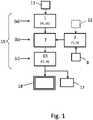
- FIG. 1 shows an embodiment of the method according to the invention for determining, in particular predicting, at least one meteorological variable 10 for describing a current and/or past and/or future weather situation.
- the method is carried out using a data processing device 9 (see figure 5 ) carried out.
- first measurements 11 are made, for example, by a large number of weather measuring stations set up at different locations and/or by means of weather balloons and/or from satellite images and/or by means of radio signals that are more or less strongly transmitted through the atmosphere (through clouds, fog, etc.). , precipitation, etc.) can be weakened.
- the first meteorological parameters 1 can include values for temperature and/or air pressure and/or air humidity and/or wind strength and/or wind direction and/or precipitation and/or cloudiness and/or solar radiation.
- the first meteorological parameters 1 can include current values and/or values lying in the past and/or values to be expected in the future.
- the invention is directed both to a method and to a (superordinate) algorithm 15—see figures—for determining, in particular predicting, at least one meteorological variable 10 for describing a current and/or past and/or future weather situation.
- step (a) first meteorological parameters 1 obtained from the first measurements 11 are provided, the first meteorological parameters 1 being assigned to grid points P1 of a first grid G1.
- Each grid point P1 of the grid G1 is preferably assigned at least one, preferably several, first parameters (e.g. temperature, air pressure, humidity, etc.).
- step (b) at least one default parameter 2, which can be entered via an interface 8, in particular a user interface, is received.
- the default parameter can be entered, for example, by a user of the "virtual weather station".
- step (c) the at least one meteorological variable 10 is determined from the first meteorological parameters 1 as a function of the at least one default parameter 2 by using a first algorithm 7 .
- the first algorithm 7 is preferably a configurable (through the default parameters 2) and/or self-learning algorithm.
- the at least one meteorological variable 10 can—like the first meteorological parameters—values of temperature and/or air pressure and/or air humidity and/or wind speed and/or wind direction and/or precipitation and/or cloud cover and/or or exposure to sunlight.
- the meteorological variable 10 determined in this way is preferably output on a user interface 18, in particular on a screen, and/or sent by means of an electronic message sending device 17 (e-mail, short message, SMS, etc.).
- an electronic message sending device 17 e-mail, short message, SMS, etc.
- the at least one default parameter 2 can include a time coordinate T, preferably a point in time, with the at least one meteorological variable 10 for this time coordinate T then being determined in step (c).
- the time coordinate T can be in the past, in the present or in the future.
- the at least one default parameter can include a location coordinate X, preferably a point, with the at least one meteorological variable 10 for this location coordinate X then being determined in step (c).
- the location coordinate X can also lie between the grid points P1 of the first grid G1. This is preferably done by interpolating and/or averaging the first parameters 1 and/or taking into account the parameters 1 of the spatially closest grid points P1.
- the at least one default parameter 2 can also characterize at least one local condition, preferably relating to the vegetation and/or the buildings and/or an object that shades the wind and/or the sun and/or the sea level and/or the shape of the landscape. include.
- the local conditions have a significant influence on the local weather situation and can thus improve the forecast.
- the at least one default parameter 2 can include at least one meteorological comparison parameter which—independently of the first measurements 11—is obtained through observation and/or from at least one second measurement 12, with the comparison parameter preferably describing the current weather situation.
- the situation parameter 3 describes a current situation, in particular the weather situation or a procedure caused by the weather situation, in particular a de-icing operation (airport) or a road-clearing operation.
- the meteorological variable 10 can be determined for different points in time and situation parameters 3 can be received for corresponding points in time.
- the at least one situation parameter 3 can include a meteorological parameter which—independently of the first measurements 11—can be obtained by observation and/or from at least one second measurement 12.
- the at least one situation parameter 3 can also include a parameter that describes a physiological state and/or a subjective sensation of at least one person.
- situation parameter 13 which is preferably a meteorological parameter and/or a physiological state and/or or describes, ascertains or estimates a subjective sensation of at least one person.
- the situation parameter 13 can also be output at a user interface 18 and/or sent using an electronic message sending device 17 .
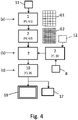
- a meteorological variable 5 is determined independently of the at least one default parameter 2 by using a second algorithm 6 from the first meteorological parameters 1.
- the meteorological variable 5 determined independently of the at least one default parameter (2) and the meteorological variable 10 determined - according to step (c) - as a function of the at least one default parameter 2 can be compared with one another, with preferably depending on the deviation of the independently of the at least a default parameter 2 determined meteorological variable 5 from the meteorological variable 10 determined as a function of the at least one default parameter 2, the first algorithm 7 is changed or adapted and/or a value 19 derived from both variables 5, 10 is determined and preferably output at a user interface 18 and /or is preferably sent by means of an electronic message dispatch device 17.
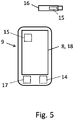
- FIG. 12 shows a data processing device 9 in the form of a portable device, preferably a smartphone or tablet. It is preferred if the data processing device 9 includes a measuring device 14 for measuring at least one meteorological parameter.
- the invention also relates to a data processing device 9 and/or on a data carrier 16 (in figure 5 shown as a data stick) stored computer program product for determining, in particular predicting, at least one meteorological variable 10 for describing a current and/or past and/or future weather situation, with algorithm 15 being stored in data processing device 9 and/or in the computer program product is.
Landscapes
- Engineering & Computer Science (AREA)
- Environmental & Geological Engineering (AREA)
- Life Sciences & Earth Sciences (AREA)
- Theoretical Computer Science (AREA)
- Physics & Mathematics (AREA)
- Environmental Sciences (AREA)
- Ecology (AREA)
- Biodiversity & Conservation Biology (AREA)
- Atmospheric Sciences (AREA)
- Software Systems (AREA)
- Data Mining & Analysis (AREA)
- Evolutionary Computation (AREA)
- General Engineering & Computer Science (AREA)
- Artificial Intelligence (AREA)
- Computing Systems (AREA)
- General Physics & Mathematics (AREA)
- Mathematical Physics (AREA)
- Molecular Biology (AREA)
- General Health & Medical Sciences (AREA)
- Computational Linguistics (AREA)
- Biophysics (AREA)
- Biomedical Technology (AREA)
- Health & Medical Sciences (AREA)
- Medical Informatics (AREA)
- Computer Vision & Pattern Recognition (AREA)
- Management, Administration, Business Operations System, And Electronic Commerce (AREA)
Applications Claiming Priority (1)
| Application Number | Priority Date | Filing Date | Title |
|---|---|---|---|
| ATA51020/2020A AT524210B1 (de) | 2020-11-24 | 2020-11-24 | Verfahren zur Ermittlung einer meteorologischen Größe |
Publications (1)
| Publication Number | Publication Date |
|---|---|
| EP4001972A1 true EP4001972A1 (fr) | 2022-05-25 |
Family
ID=78725344
Family Applications (1)
| Application Number | Title | Priority Date | Filing Date |
|---|---|---|---|
| EP21209600.2A Pending EP4001972A1 (fr) | 2020-11-24 | 2021-11-22 | Procédé de détermination d'une grandeur météorologique |
Country Status (3)
| Country | Link |
|---|---|
| US (1) | US20220163693A1 (fr) |
| EP (1) | EP4001972A1 (fr) |
| AT (1) | AT524210B1 (fr) |
Families Citing this family (2)
| Publication number | Priority date | Publication date | Assignee | Title |
|---|---|---|---|---|
| CN114997547B (zh) * | 2022-08-05 | 2022-10-11 | 国能日新科技股份有限公司 | 气象采集终端布点方法和装置 |
| US20250271593A1 (en) * | 2024-02-28 | 2025-08-28 | Disney Enterprises, Inc. | Method of predicting microclimate conditions based on global weather |
Citations (5)
| Publication number | Priority date | Publication date | Assignee | Title |
|---|---|---|---|---|
| US20170276834A1 (en) * | 2016-03-22 | 2017-09-28 | Here Global B.V. | Selecting a weather estimation algorithm and providing a weather estimate |
| US20170371074A1 (en) * | 2016-06-24 | 2017-12-28 | Climacell Inc. | Real-Time Precipitation Forecasting System |
| US20180188417A1 (en) * | 2017-01-03 | 2018-07-05 | UBIMET GmbH | Method for increasing the spatial resolution of a weather forecast |
| WO2019219664A1 (fr) * | 2018-05-16 | 2019-11-21 | Basf Agro Trademarks Gmbh | Détermination d'informations météorologiques spécifiques à des lieux et permettant une aide à la décision en matière d'agronomie |
| US10725205B2 (en) * | 2015-10-07 | 2020-07-28 | Forensic Weather Consultants, Llc | Forensic weather system |
Family Cites Families (4)
| Publication number | Priority date | Publication date | Assignee | Title |
|---|---|---|---|---|
| DE102006060206A1 (de) * | 2006-12-18 | 2008-06-19 | Hkw-Elektronik Gmbh | Verfahren und Einrichtung zum Erstellen einer Wetterprognose für einen bestimmten Ort |
| US20160356922A1 (en) * | 2013-12-22 | 2016-12-08 | Telvent Dtn Llc | Dynamic storm environment engine apparatuses, methods and systems |
| CN108375807A (zh) * | 2017-12-01 | 2018-08-07 | 国网北京市电力公司 | 气象数据的获取方法及装置 |
| BR112020023825A2 (pt) * | 2018-05-25 | 2021-04-13 | Basf Agro Trademarks Gmbh | Métodos para treinar um algoritmo e para prever um valor, meio legível por computador não transitório e sistema de processamento de dados |
-
2020
- 2020-11-24 AT ATA51020/2020A patent/AT524210B1/de active
-
2021
- 2021-11-22 EP EP21209600.2A patent/EP4001972A1/fr active Pending
- 2021-11-22 US US17/532,050 patent/US20220163693A1/en not_active Abandoned
Patent Citations (5)
| Publication number | Priority date | Publication date | Assignee | Title |
|---|---|---|---|---|
| US10725205B2 (en) * | 2015-10-07 | 2020-07-28 | Forensic Weather Consultants, Llc | Forensic weather system |
| US20170276834A1 (en) * | 2016-03-22 | 2017-09-28 | Here Global B.V. | Selecting a weather estimation algorithm and providing a weather estimate |
| US20170371074A1 (en) * | 2016-06-24 | 2017-12-28 | Climacell Inc. | Real-Time Precipitation Forecasting System |
| US20180188417A1 (en) * | 2017-01-03 | 2018-07-05 | UBIMET GmbH | Method for increasing the spatial resolution of a weather forecast |
| WO2019219664A1 (fr) * | 2018-05-16 | 2019-11-21 | Basf Agro Trademarks Gmbh | Détermination d'informations météorologiques spécifiques à des lieux et permettant une aide à la décision en matière d'agronomie |
Also Published As
| Publication number | Publication date |
|---|---|
| AT524210A4 (de) | 2022-04-15 |
| AT524210B1 (de) | 2022-04-15 |
| US20220163693A1 (en) | 2022-05-26 |
Similar Documents
| Publication | Publication Date | Title |
|---|---|---|
| DE69226422T2 (de) | Verbessertes niedrighöhe-windscherungswarnsystem | |
| AT520436B1 (de) | Verfahren zur Ermittlung zumindest einer meteorologischen Größe zur Beschreibung einer Zustandsform atmosphärischen Wassers | |
| EP1631938B1 (fr) | Procede de production d'un modele topographique tridimensionnel | |
| EP4001972A1 (fr) | Procédé de détermination d'une grandeur météorologique | |
| EP2798382B1 (fr) | Réseau de mesure adaptatif auto-activable et procédé d'enregistrement de signaux électromagnétiques faibles | |
| DE102018219773B4 (de) | Verfahren zum Kartographieren einer örtlichen Verteilung von Ereignissen eines vorbestimmten Ereignistyps in einem vorbestimmten Umgebungsbereich eines Kraftfahrzeugs sowie dazu ausgelegtes Steuergerät und Kraftfahrzeug | |
| DE102018217190A1 (de) | Verfahren und System zum Bereitstellen einer Reibwertinformation für einen Verkehrsflächenabschnitt | |
| DE102008034923A1 (de) | Verfahren und Einrichtung zum Steuern der klimatischen Bedingungen eines eine Klimaanlage enthaltenden Gebäudes | |
| EP3106901B1 (fr) | Mesures environnementales a l'aide de capteurs mobiles repartis geographiquement | |
| DE102023200930B4 (de) | Objektposition-erkennungsvorrichtung | |
| DE602004013047T2 (de) | Verfahren und system zur funkversorgungsplanung unter verwendung eines mehrfachauflösungsprofils | |
| EP3642651A1 (fr) | Dispositif et procédé servant à détecter de manière mobile des informations météorologiques | |
| WO2003018401A1 (fr) | Systemes de guidage de trajectoire pour parachute ou parapente, dispositifs de planification de vol pour la planification de l'utilisation d'au moins un parachute ou un parapente, et procede de mise en oeuvre dudit guidage de trajectoire et de ladite planification | |
| DE102017207138A1 (de) | Verfahren und Vorrichtung zum rechnergestützten Erzeugen einer virtuellen Zugumgebung | |
| EP3244279A1 (fr) | Procédé de fonctionnement d'un indicateur d'erreurs | |
| DE10313653A1 (de) | Verfahren und System zur regionalen Niederschlagsvorhersage für drahtlose Endgeräte | |
| EP4102179B1 (fr) | Procédé et dispositif pour localiser une image d'un objet prise à distance | |
| WO2023232202A1 (fr) | Procédé de détermination d'une trajectoire, dispositif de commande et véhicule automobile | |
| DE102022109018A1 (de) | System und Verfahren zur Wettererfassung von vernetzten Fahrzeugen | |
| LU509707B1 (de) | Ein System und Verfahren zur Planung und Überwachung von Erdrutschen mit mehreren Feldern zur Datenfusion | |
| Sieg | Reliability of Flood damage estimations across spatial scales | |
| DE102022110116A1 (de) | Verfahren zum Erzeugen von Daten zum Steuern einer autonomen landwirtschaftlichen Arbeitsmaschine | |
| EP4109194A1 (fr) | Génération des données de capteur permettant de commander un véhicule autonome | |
| DE102016224290B4 (de) | Verfahren zur rechnergestützten Verkehrsüberwachung von Fahrstreckenabschnitten eines Straßennetzes | |
| DE102019203808A1 (de) | Verfahren und Datenverarbeitungsvorrichtung zum Analysieren einer Sensorverbundkonfiguration und zumindest teilautonomer Roboter |
Legal Events
| Date | Code | Title | Description |
|---|---|---|---|
| PUAI | Public reference made under article 153(3) epc to a published international application that has entered the european phase |
Free format text: ORIGINAL CODE: 0009012 |
|
| STAA | Information on the status of an ep patent application or granted ep patent |
Free format text: STATUS: THE APPLICATION HAS BEEN PUBLISHED |
|
| AK | Designated contracting states |
Kind code of ref document: A1 Designated state(s): AL AT BE BG CH CY CZ DE DK EE ES FI FR GB GR HR HU IE IS IT LI LT LU LV MC MK MT NL NO PL PT RO RS SE SI SK SM TR |
|
| RIN1 | Information on inventor provided before grant (corrected) |
Inventor name: FASSNAUER, MICHAEL Inventor name: SPATZIERER, MANFRED |
|
| STAA | Information on the status of an ep patent application or granted ep patent |
Free format text: STATUS: REQUEST FOR EXAMINATION WAS MADE |
|
| 17P | Request for examination filed |
Effective date: 20221124 |
|
| RBV | Designated contracting states (corrected) |
Designated state(s): AL AT BE BG CH CY CZ DE DK EE ES FI FR GB GR HR HU IE IS IT LI LT LU LV MC MK MT NL NO PL PT RO RS SE SI SK SM TR |
|
| P01 | Opt-out of the competence of the unified patent court (upc) registered |
Effective date: 20230621 |
|
| STAA | Information on the status of an ep patent application or granted ep patent |
Free format text: STATUS: EXAMINATION IS IN PROGRESS |
|
| 17Q | First examination report despatched |
Effective date: 20240423 |