EP4002112A1 - Datenverarbeitungsverfahren und -vorrichtung sowie elektronische vorrichtung - Google Patents
Datenverarbeitungsverfahren und -vorrichtung sowie elektronische vorrichtung Download PDFInfo
- Publication number
- EP4002112A1 EP4002112A1 EP20844411.7A EP20844411A EP4002112A1 EP 4002112 A1 EP4002112 A1 EP 4002112A1 EP 20844411 A EP20844411 A EP 20844411A EP 4002112 A1 EP4002112 A1 EP 4002112A1
- Authority
- EP
- European Patent Office
- Prior art keywords
- period
- thread
- time sequence
- task
- main thread
- Prior art date
- Legal status (The legal status is an assumption and is not a legal conclusion. Google has not performed a legal analysis and makes no representation as to the accuracy of the status listed.)
- Granted
Links
Images



Classifications
-
- G—PHYSICS
- G06—COMPUTING OR CALCULATING; COUNTING
- G06F—ELECTRIC DIGITAL DATA PROCESSING
- G06F9/00—Arrangements for program control, e.g. control units
- G06F9/06—Arrangements for program control, e.g. control units using stored programs, i.e. using an internal store of processing equipment to receive or retain programs
- G06F9/46—Multiprogramming arrangements
- G06F9/48—Program initiating; Program switching, e.g. by interrupt
- G06F9/4806—Task transfer initiation or dispatching
- G06F9/4843—Task transfer initiation or dispatching by program, e.g. task dispatcher, supervisor, operating system
- G06F9/4881—Scheduling strategies for dispatcher, e.g. round robin, multi-level priority queues
- G06F9/4887—Scheduling strategies for dispatcher, e.g. round robin, multi-level priority queues involving deadlines, e.g. rate based, periodic
-
- G—PHYSICS
- G06—COMPUTING OR CALCULATING; COUNTING
- G06F—ELECTRIC DIGITAL DATA PROCESSING
- G06F9/00—Arrangements for program control, e.g. control units
- G06F9/06—Arrangements for program control, e.g. control units using stored programs, i.e. using an internal store of processing equipment to receive or retain programs
- G06F9/44—Arrangements for executing specific programs
- G06F9/451—Execution arrangements for user interfaces
-
- G—PHYSICS
- G06—COMPUTING OR CALCULATING; COUNTING
- G06F—ELECTRIC DIGITAL DATA PROCESSING
- G06F9/00—Arrangements for program control, e.g. control units
- G06F9/06—Arrangements for program control, e.g. control units using stored programs, i.e. using an internal store of processing equipment to receive or retain programs
- G06F9/46—Multiprogramming arrangements
- G06F9/50—Allocation of resources, e.g. of the central processing unit [CPU]
- G06F9/5005—Allocation of resources, e.g. of the central processing unit [CPU] to service a request
- G06F9/5027—Allocation of resources, e.g. of the central processing unit [CPU] to service a request the resource being a machine, e.g. CPUs, Servers, Terminals
- G06F9/5038—Allocation of resources, e.g. of the central processing unit [CPU] to service a request the resource being a machine, e.g. CPUs, Servers, Terminals considering the execution order of a plurality of tasks, e.g. taking priority or time dependency constraints into consideration
Definitions
- This application relates to the field of electronic technologies, and in particular, to a data processing method and apparatus, and an electronic device.
- a mainstream intelligent terminal operating system is an Android (Android) system.
- Android Android
- a typical problem is that the interfaces are changed unstably, and system smoothness is poor.
- FPS drops and jank sometimes occur, and therefore user experience is poor.
- a main reason for this is that a plurality of threads including high-load tasks need to run in the background, resulting in relatively high power consumption, and a foreground task cannot obtain a required central processing unit (central processing unit, CPU) resource in a timely manner. This increases time consumed for running a single frame and causes jank.
- CPU central processing unit
- This application provides a data processing method and apparatus, and an electronic device, to reduce load of a UI thread in some scenarios, shorten running time of the UI thread, and reduce jank, so as to improve system smoothness and improve user experience.
- a data processing method includes: In response to a received trigger signal, a main thread in a first period starts to process a time sequence-dependent task in one or more tasks in the first period; the main thread obtains a preprocessing result of a time sequence-independent task in the one or more tasks, where the preprocessing result is a result obtained by processing the time sequence-independent task in a second period, and the second period is a period before the first period; the main thread determines a processing result of the main thread based on a result of the time sequence-dependent task processed in the first period and the obtained preprocessing result of the time sequence-independent task; and the main thread sends the processing result of the main thread to a render thread.
- a time sequence-independent task in a UI thread is recognized offline, where the time sequence-independent task may be a function of the time sequence-independent task, an Android API interface of the time sequence-independent task, or the like, and idle time of one frame of the UI thread or whether the UI thread is in an idle state is recognized.
- the time sequence-independent task is preprocessed by using the idle time of one frame, that is, the time sequence-independent task in the UI thread is "moved" to the idle time of one frame of the UI thread for processing, and a processing result is buffered.
- the time sequence-independent task is preprocessed by using the idle state, that is, the time sequence-independent task in the UI thread is "moved" to an idle state time period of the UI thread for processing, and a processing result is buffered.
- This method can reduce task load of the UI thread in some scenarios, and reduce jank, to improve system smoothness and improve user experience.
- a time sequence-independent task FunC is preprocessed.
- UI thread + render thread 18 ms
- running time of the UI thread is 10 ms
- running time of the time sequence-independent task FunC is 3 ms
- running time of the render thread is 8 ms
- FunC may be processed in advance by using time after the running time 10 ms of the UI thread.
- UI thread + render thread 15 ms. In this way, an FPS drop does not occur, and a user experiences smooth display without jank.
- the method before the main thread in the first period starts to process the time sequence-dependent task, the method further includes: processing the time sequence-independent task in the second period, to obtain the preprocessing result of the time sequence-independent task; and buffering the preprocessing result of the time sequence-independent task.
- duration of the second period when the main thread in the second period is in a running state, duration of the second period includes running duration of the main thread and idle duration of the main thread, and the method further includes: determining that running duration of the time sequence-independent task is less than or equal to the idle duration of the main thread.
- the time sequence-independent task is preprocessed, to reduce UI running time of a current frame, and reduce running load of the main thread, so as to reduce total time consumed by the UI thread and the render thread.
- a processing procedure of the time sequence-independent task in the first period is moved to the idle time of one frame of the UI thread in the second period for preprocessing, and the processing result of the time sequence-independent task is buffered.
- the buffered result of the time sequence-independent task may be directly obtained. In this way, time for the UI thread in the current first period to run the time sequence-independent task is reduced, so that total time consumed by the UI thread and the render thread that are in the current period is reduced.
- the main thread in the second period is in an idle state.
- idle time of one frame of the UI thread cannot be used, because running time of such type of time sequence-independent task may be longer than duration of one period. Time required for processing such type of function is long. Therefore, the preprocessing procedure cannot be performed by using the idle time of one frame of the UI thread. In this case, the idle state of the UI thread may be used for processing and the processing result of the time sequence-independent task of the UI thread is buffered. When the function that consumes a long time is executed, a running result in the idle state is directly obtained, to reduce the running time of the function.
- the method further includes: determining idle duration of the main thread in a third period, where the main thread in the third period is in a running state, and duration of the third period includes running duration of the main thread and the idle duration of the main thread; and when running duration of the time sequence-independent task is greater than the idle duration of the main thread in the third period, processing the time sequence-independent task in the second period, to obtain the preprocessing result of the time sequence-independent task.
- a system may determine whether a preprocessing procedure for processing the time sequence-independent task is moved to idle duration or an idle state of the UI thread. For example, the system may preferentially determine whether the running duration of the time sequence-independent task is less than or equal to the idle duration of the main thread. When the running duration of the time sequence-independent task is less than or equal to the idle duration of the UI thread, a time sequence-independent task in one or more subsequent periods is moved to the idle duration of the UI thread in the current period for processing. When the running duration of the time sequence-independent task is greater than the idle duration of the UI thread, a time sequence-independent task in one or more subsequent periods is moved to the idle state of the current UI thread for processing. Alternatively, when determining that there is currently an idle state of the UI thread, the system may move a time sequence-independent task in one or more subsequent periods to the idle state of the current UI thread for processing. This is not limited in this application.
- that the main thread in the first period starts to process the time sequence-dependent task in the one or more tasks in the first period in response to the received trigger signal includes: in response to the received trigger signal, stopping a preprocessing procedure of the main thread in the first period, and starting to process the time sequence-dependent task in the one or more tasks in the first period.
- a data processing apparatus configured to start, in a first period in response to a received trigger signal, to process a time sequence-dependent task in one or more tasks in the first period; an obtaining unit, configured to obtain a preprocessing result of a time sequence-independent task in the one or more tasks, where the preprocessing result is a result obtained by processing the time sequence-independent task in a second period, and the second period is a period before the first period, where the processing unit is further configured to determine a processing result of the main thread based on a result of the time sequence-dependent task processed in the first period and the obtained preprocessing result of the time sequence-independent task; and a sending unit, configured to send the processing result of the main thread to a render thread.
- the processing unit before the processing unit starts to process the time sequence-dependent task, the processing unit is further configured to process the time sequence-independent task in the second period, to obtain the preprocessing result of the time sequence-independent task.
- the apparatus further includes: a buffering unit, configured to buffer the preprocessing result of the time sequence-independent task.
- duration of the second period includes running duration of the main thread and idle duration of the main thread
- the processing unit is further configured to determine that running duration of the time sequence-independent task is less than or equal to the idle duration of the main thread.
- the main thread in the second period is in an idle state.
- the processing unit is further configured to: determine idle duration of the main thread in a third period, where the main thread in the third period is in a running state, and duration of the third period includes running duration of the main thread and idle duration of the main thread; and when running duration of the time sequence-independent task is greater than the idle duration of the main thread in the third period, process the time sequence-independent task in the second period, to obtain the preprocessing result of the time sequence-independent task.
- the processing unit is specifically configured to: in response to the received trigger signal, stop a preprocessing procedure in the first period, and start to process the time sequence-dependent task in the one or more tasks in the first period.
- this application provides an apparatus.
- the apparatus is included in an electronic apparatus, and the apparatus has a function of implementing behavior of the electronic apparatus in the foregoing aspects and the possible implementations of the foregoing aspects.
- the function may be implemented by hardware, or may be implemented by hardware executing corresponding software.
- the hardware or the software includes one or more modules or units corresponding to the foregoing function, for example, a display module or unit, a detection module or unit, or a processing module or unit.
- this application provides an electronic apparatus, including a touchscreen, where the touchscreen includes a touch-sensitive surface and a display; a camera; one or more processors; a memory; a plurality of applications; and one or more computer programs.
- the one or more computer programs are stored in the memory, and the one or more computer programs include instructions.
- the electronic apparatus is enabled to perform the data processing method according to any possible implementation of any one of the foregoing aspects.
- this application provides an electronic apparatus, including one or more processors and one or more memories.
- the one or more memories are coupled to the one or more processors.
- the one or more memories are configured to store computer program code, and the computer program code includes computer instructions.
- the electronic apparatus is enabled to perform the data processing method according to any possible implementation of any one of the foregoing aspects.
- this application provides a computer storage medium, including computer instructions.
- the computer instructions When the computer instructions are run on an electronic apparatus, the electronic apparatus is enabled to perform the data processing method according to any possible implementation of any one of the foregoing aspects.
- this application provides a computer program product.
- the computer program product runs on an electronic apparatus, the electronic apparatus is enabled to perform the data processing method according to any possible implementation of any one of the foregoing aspects.
- an electronic apparatus includes an apparatus for performing the data processing method according to any possible implementation of any one of the foregoing aspects.
- A/B may represent A or B.
- and/or describes only an association relationship for describing associated objects and represents that three relationships may exist.
- a and/or B may represent the following three cases: Only A exists, both A and B exist, and only B exists.
- a plurality of means two or more.
- first and second are merely intended for a purpose of description, and shall not be understood as an indication or implication of relative importance or implicit indication of a quantity of indicated technical features. Therefore, a feature limited by “first” or “second” may explicitly or implicitly include one or more features, for example, “first period”, “second period”, and “third period” in this application.
- a plurality of means two or more. For example, a plurality of tasks may refer to two or more tasks.
- the electronic apparatus may be, for example, a portable electronic apparatus further including another function, such as a mobile phone, a tablet computer, or a wearable electronic apparatus (such as a smartwatch) with a wireless communication function.
- An example embodiment of the portable electronic apparatus includes but is not limited to a portable electronic apparatus using iOS ® , Android ® , Microsoft ® , or another operating system.
- the portable electronic apparatus may alternatively be another portable electronic apparatus, such as a laptop (laptop). It should be further understood that, in some other embodiments, the foregoing electronic apparatus may alternatively be not a portable electronic apparatus but a desktop computer.
- the electronic apparatus may be a smart home appliance, such as a smart speaker or a smart home device. A specific type of the electronic apparatus is not limited in the embodiments of this application.
- a plurality of third-party applications may be installed on an existing electronic apparatus, for example, a plurality of applications such as Alipay, Album, WeChat, Cards, Settings, and Camera on a mobile phone.
- Each application may present a different graphical user interface (graphical user interface, GUI) on the electronic apparatus according to a user operation.
- GUI graphical user interface
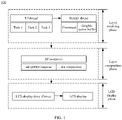
- FIG. 1 is a schematic diagram of a display procedure of a graphical user interface according to this application
- FIG. 2 is a diagram of another display procedure of a graphical user interface according to this application.
- An electronic apparatus based on an Android (Android) system is used as an example.
- the electronic apparatus creates a thread of an Android user interface (Android user interface, UI).
- UI Android user interface
- Phase 1 layer rendering phase
- the UI may be drawn into a graphic queue buffer (Queue buffer).
- the layer rendering phase may include a main thread (main thread) and a render thread (renderer thread), where the main thread is also referred to as a UI thread (UI thread).
- the main thread and the render thread are dependent threads. It should be understood that the system does not create a separate thread for each component, all UI components in a same process are instantiated in the UI thread, and calling made by the system to each component is distributed from the UI thread.
- the UI thread may include a plurality of processing tasks, for example, member functions such as Measure, Draw, and Layout.
- a DrawFrame command is sent to the render thread.
- the render thread contains a task queue (Task Queue) inside.
- the DrawFrame command sent from the UI thread is stored in the task queue of the render thread and waits to be processed by the render thread. Function types, tasks, and the like included in the UI thread and the render thread are not described herein.
- a task processing result of the UI thread needs to be sent to the render thread.
- the DrawFrame command sent by the UI thread to the render thread may be generated based on the task processing result of the UI thread.
- the task processing result of the UI thread may be sent to the render thread by using the DrawFrame command. This is not limited in this application.
- the system may periodically generate a trigger signal, for example, a VSYNC signal shown in FIG. 2 .
- the VSYNC signal is a trigger signal of each phase.
- the VSYNC signal may be equivalently understood as a timer function. Duration between two adjacent VSYNC signals is a frame length of one frame of a procedure of displaying a graphical user interface.
- the UI thread and the render (renderer) thread are sequentially executed.
- a 60 Hz display system is used as an example in this application.
- a VSYNC signal period is 16.67 ms.
- FIG. 2 shows a display procedure of three consecutive periods. Generally, if response time of each phase is within 16.67 ms, the system is considered smooth without an FPS drop or jank.
- Phase 2 layer composition phase
- the layer composition phase is mainly performed in a SurfaceFlinger (SurfaceFlinger, SF), and layers in a previous phase are composed based on a result of the graphic queue buffer in the layer rendering phase.
- SurfaceFlinger SurfaceFlinger
- a running result is drawn into the graphic queue buffer (Queue buffer), and the second VSYNC signal triggers the system to enter the second period.
- the layers in the previous phase are directly composed based on the result of the graphic queue buffer in the previous phase.
- Phase 3 display phase
- a liquid crystal display (liquid crystal display, LCD) displays composed data.
- LCD liquid crystal display
- each period includes a layer rendering phase, a layer composition phase, and a display phase, and the three phases are run in parallel.
- the layer composition phase a result of a graphic queue buffer in a previous period is composed, and in the display phase, data composed in a layer composition phase in a previous period is displayed. Therefore, the three different processing phases in the three periods shown in FIG. 2 are for a task processing procedure started by a same application.
- System smoothness means that processing time of each frame does not exceed frequency time specified by the system. With reference to the 60 Hz display system listed above, in the procedure of displaying the graphical user interface, system smoothness may mean that single-frame processing time does not exceed 16.67 ms. For a layer rendering phase that includes a UI thread and a render thread, if single-frame processing time exceeds specified time, for example, 16.67 ms, the system experiences an FPS drop or jank, affecting system smoothness. Consequently, user experience is poor.
- a scheduling priority of a central processing unit central processing unit, CPU
- a graphics processing unit graphics processing units, GPU
- CPU central processing unit
- GPU graphics processing unit
- a plurality of threads need to be run by the CPU
- the UI thread is one of the plurality of threads.
- Running of the plurality of threads occupies a CPU resource.
- the CPU resource may include a big core and a little core of the CPU that are used to run a thread, a CPU frequency of a core in which the thread is located, and the like.
- the big core of the CPU has a high processing capability and high power consumption.
- the little core has a weak processing capability and low power consumption.
- different scheduling priorities are set for different UI threads. For example, the UI thread (main thread) is run on the big core of the CPU. This can alleviate jank to some extent, but increases power consumption of the CPU.
- single-frame running efficiency is improved by increasing a frequency.
- a processing speed of the CPU is improved.
- a running speed of the CPU is increased from 300M to 800M.
- the frequency does not need to be increased for all user operations. For a light-load thread, increasing the frequency causes extra power consumption of the CPU.
- a processing speed of the system is further improved by adding an asynchronous thread, that is, by adding an extra thread (such as a V thread), so that the system can process a plurality of threads in parallel.
- an asynchronous thread that is, by adding an extra thread (such as a V thread)
- this method cannot work in a thread detection procedure and even causes a system crash.
- the Android system it is specified that some tasks can be processed by only the main thread. If it is detected, in the thread detection procedure, that these tasks are not processed by the main thread, the application crashes.
- the above solutions require that the UI thread and the render thread finish task processing within the single-frame processing time (for example, the single-frame processing time is 16.67 ms), to avoid an FPS drop. If the processing time of the UI thread and the render thread exceeds the single-frame processing time, an FPS drop occurs. Therefore, a method is required to improve system smoothness, reduce jank, and improve user experience.
- the UI thread described in FIG. 1 and FIG. 2 may include a plurality of processing tasks and functions, such as a load function. If a quantity of load functions is too large, or the tasks are too heavy, the system may fail to finish task processing within specified time, causing jank.
- this application provides a data processing method, to improve system smoothness by reducing processing time of a UI thread, so as to avoid jank and improve user experience.
- a UI thread includes a plurality of processing tasks, and the tasks include a time sequence-independent task and a time sequence-dependent task.
- the time sequence-independent task may be understood as a task that does not depend on a previous task and whose running result does not affect processing of a subsequent task.
- a UI thread includes a plurality of tasks: a task A, a task B, a task C, a task D, and a task E, that are executed in sequence, where the task C is defined as a time sequence-independent task, and the task A, the task B, the task D, and the task E are defined as time sequence-dependent tasks.
- the task C may not depend on finishing of running of the task A and the task B, but the other tasks need to depend on finishing of running of a previous task.
- the task B can be run only after running of the task A is finished
- the task D can be run only after running of the task C is finished.
- the task C is the time sequence-independent task and is a necessary processing task of the current UI thread.
- a main thread in a period may include a plurality of time sequence-independent tasks.
- the following describes a data processing method provided in this application by using a single time sequence-independent task as an example.
- a processing principle of a plurality of time sequence-independent tasks is the same as that of the single time sequence-independent task, and details are not described in this application.
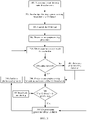
- FIG. 3 is a flowchart of a data processing method according to an embodiment of this application.
- An electronic apparatus based on a 60 Hz Android system is used as an example. As shown in FIG. 3 , the method may include the following content.
- An external event triggers a UI thread to work. It should be understood that the external event herein may be a user operation event, or may be an event that is set in advance. This is not limited in this application.
- the UI thread processes a non-preprocessing task based on an original system procedure.
- the UI thread may include a preprocessing procedure and a non-preprocessing procedure.
- the preprocessing procedure may be understood as a processing procedure of a time sequence-independent task
- the non-preprocessing procedure may be understood as a necessary time sequence-dependent task processing procedure of the current UI thread.
- the UI thread includes the task A, the task B, the task C, the task D, and the task E.
- a processing procedure of the task C is referred to as a preprocessing procedure
- processing procedures of the task A, the task B, the task D, and the task E are referred to as non-preprocessing procedures.
- the external event may trigger a system to send a VSYNC signal
- the VSYNC signal triggers the UI thread in a period to start task processing, which is referred to as a UI thread in a first period.
- the UI thread in the first period in this application may be understood as "a currently running UI thread”.
- a preprocessing result of a current time sequence-independent task may be obtained, where the preprocessing result is a result obtained by processing the time sequence-independent task in a second period, and the second period is a period before the first period.
- the task C may be a time sequence-independent task in the current first period, the task C is processed in the second period, and a processing result is buffered, where the second period is a period before the first period.
- the task C is preprocessed in the second period before the current first period, and the preprocessing result of the task C is buffered.
- the system may process, in the current first period, the time sequence-independent task in the one or more periods after the first period, and buffer a processing result of the time sequence-independent task.
- the first period and the one or more periods after the first period may be a plurality of periods formed by using consecutive VSYNC signals.
- a quantity of time sequence-independent tasks preprocessed in the first period is not limited in this application.
- the UI thread obtains a preprocessing result from a buffer in a processing procedure.
- the processing procedure of the task C is a preprocessing procedure
- processing procedures of the task A, the task B, the task D, and the task E of the current UI thread are non-preprocessing procedures.
- the processing result of the task C has been buffered through processing in a previous period (for example, the second period).
- the system may directly obtain the processing result of the preprocessed task C from the buffer; or after running of the task A, the task B, the task D, and the task E is finished, the system may directly obtain the processing result of the preprocessed task C from the buffer. This is not limited in this application.
- the system directly obtains the processing result of the preprocessed task C from the buffer after finishing running the task A and the task B, and continues to run the task D and the task E after finishing obtaining the processing result of the task C, until the task of the UI thread ends.
- the system directly obtains the processing result of the preprocessed task C from the buffer after finishing running the task A, the task B, the task D, and the task E, and the task of the UI thread ends after the processing result of the task C is obtained.
- step 306 running of the UI thread ends, and a render thread may be entered.
- the idle state of the UI thread may be understood as that the UI thread has sufficient or abundant idle time of one frame. To be specific, there is remaining time after running of the UI thread ends in a period.
- the idle state of the UI thread may be understood as that the UI thread enters the idle state.
- the system continues to run the UI thread, does not perform a preprocessing procedure, and enters the render thread after finishing running the UI thread. This is not limited in this application.
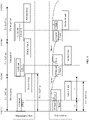
- FIG. 4 is a schematic diagram of a processing procedure of a UI thread according to an embodiment of this application.
- a UI thread procedure and a render thread procedure in a layer rendering phase are shown in each of three different periods.
- each period may include a UI thread and a render thread.
- Duration T of each period between two adjacent VSYNC signals is equal to 16.67 ms, and one period is a one-frame processing process.
- the UI thread plus the render thread is a one-frame processing process.
- the current frame experiences an FPS drop, causing jank to a user.
- a system may determine, through offline analysis, a time sequence-independent task that is independent of a time sequence and that is in the UI thread, for example, a function FunA shown in FIG. 4 .
- the time sequence-independent task may be a function, an API interface, or the like.
- a time sequence-independent task is used as an example herein. Processing of a time sequence-independent API interface is the same as that of the time sequence-independent task. Details are not described again.
- the function FunA is equivalent to the time sequence-independent task C listed above.
- a processing procedure of the function FunA is used as a preprocessing procedure of the UI thread, so that the function FunA can be processed in another time period without affecting processing of another task of the current UI thread.
- the time sequence-independent task is preprocessed, to reduce UI running time of a current frame, and reduce running load of a main thread, so as to reduce total time consumed by the UI thread and the render thread.
- a time sequence-independent task of a UI thread in a first period is moved to idle time of one frame of a UI thread in a second period for processing, and a processing result of the time sequence-independent task of the UI thread is buffered.
- the second period is a period or several periods before the first period. This is not limited in this application.
- a processing procedure of the time sequence-independent task FunA in the first period is moved to the idle time of one frame of the UI thread in the second period for preprocessing, and a processing result of FunA is buffered.
- the buffered result of FunA may be directly obtained. In this way, time for the UI thread in the current first period to run FunA is reduced, so that total time consumed by the UI thread and a render thread that are in the current period is reduced.
- total time consumed by the UI thread and the render thread is T0, and T0 is greater than 16.67 ms.
- time for the UI thread to run FunA is reduced, and running time of the UI thread is shortened to t1 (including time for processing a non-preprocessing procedure and time for calculation based on the obtained preprocessing result).
- Total time T1 is equal to t1 plus running time of the render thread, and T1 is less than 16.67 ms.
- idle time t2 of one frame of the UI thread is equal to T - t1
- the system may move the time sequence-independent task FunA in the first period to the second period for processing, and buffer a running result of FunA.
- the system may move the time sequence-independent task FunA in the first period to the second period for processing, and buffer a running result of FunA. It should be understood that a manner of determining the idle time of one frame of the UI thread is not limited in this application.
- the running time of the UI thread can be shortened, and the total time consumed by the UI thread and the render thread can be further reduced, so that system smoothness can be improved.
- the procedure does not affect interface display of an electronic apparatus.
- the time sequence-independent task FunA may be processed in parallel with the render thread.
- the electronic apparatus may simultaneously run a time sequence-independent task FunA of a subsequent period in a render thread time period.
- the time sequence-independent task FunA in the subsequent first period is run. This is not limited in this application.
- the system moves both the time sequence-independent task FunA in the first period and the time sequence-independent task FunA in the fourth period to the second period for processing, and buffers running results of FunA.
- a quantity of time sequence-independent tasks FunA that are processed in a current frame or a quantity of time sequence-independent tasks in a plurality of periods is not limited in this application.
- duration of the second period includes running duration of the main thread and idle duration of the main thread.
- the system may move a time sequence-independent task in one or more periods after the second period to the second period for processing.
- the main thread in the second period that preprocesses the time sequence-independent task may be in an idle state.
- a time sequence-independent task in one or more periods after the second period may be moved to a time period in which the UI thread is in an idle state for processing, and a processing result of the time sequence-independent task of the UI thread is buffered.
- a time sequence-independent task in a period consumes quite a long time, idle time of one frame of the UI thread cannot be used, because running time of such type of time sequence-independent task may be longer than duration of one period.
- Such type of function whose processing duration is longer than duration of one period is referred to as FunB.
- FunB may include a function obtaniview, a function inflate, or the like. Processing of such type of function requires a long time, and the preprocessing procedure cannot be performed by using the idle time of one frame of the UI thread. In this case, the idle state of the UI thread may be used to perform processing, and a processing result of a time sequence-independent task of the UI thread is buffered.
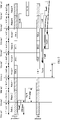
- FIG. 5 is a schematic diagram of another processing procedure of a UI thread according to an embodiment of this application.
- a shaded part is a period in which a system has a processing process, each period includes the foregoing described UI thread, render thread, and the like, and the UI thread is in a running state.
- a blank part shows an idle (IDLE) state in which the system does not have a processing process. That is, the UI thread is in an idle state.
- Duration T of each period between two adjacent VSYNC signals is equal to 16.67 ms, and one period is a one-frame processing process.
- time-consuming functions FunB after a period 8 are moved to an idle state in blank periods from a period 4 to a period 7, the functions FunB are preprocessed in sequence, and a running result is buffered. It should be understood that the system may determine, based on total duration of the idle state, a specific quantity of periods including functions FunB that can be run for processing. This is not limited in this application.
- the system may determine whether a preprocessing procedure for processing the time sequence-independent task is moved to idle duration or an idle state of the UI thread. For example, the system may preferentially determine whether the running duration of the time sequence-independent task is less than or equal to the idle duration of the main thread. When the running duration of the time sequence-independent task is less than or equal to the idle duration of the UI thread, a time sequence-independent task in one or more subsequent periods is moved to the idle duration of the UI thread in the current period for processing. When the running duration of the time sequence-independent task is greater than the idle duration of the UI thread, a time sequence-independent task in one or more subsequent periods is moved to the idle state of the current UI thread for processing. Alternatively, when determining that there is currently an idle state of the UI thread, the system may move a time sequence-independent task in one or more subsequent periods to the idle state of the current UI thread for processing. This is not limited in this application.
- the foregoing describes two procedures of shortening total time consumed by the UI thread and the render thread to improve system smoothness.
- the system monitors a state of the UI thread, recognizes a time sequence-independent task, estimates running time consumption of the time sequence-independent task, and then determines a processing principle of the time sequence-independent task, for example, determines the processing procedure in FIG. 4 or FIG. 5 , to process the time sequence-independent task.
- the following procedure may be included (processing of a time sequence-independent API interface is the same as that of the time sequence-independent task, and details are not described herein).
- a system monitors the state of the UI thread. Specifically, two pieces of information are mainly monitored: idle time of one frame of the UI thread or whether the UI thread is in an idle state.
- the idle time of one frame of the UI thread may be obtained by obtaining running time of the UI thread.
- the system further monitors whether the UI thread is in the idle state. Specifically, whether the UI thread is in the idle state may be determined by monitoring the state of the thread. Specifically, a manner in which the system obtains and determines a state of the UI thread is not limited in this application.
- step 309 in FIG. 3 because a current frame needs to be used to preprocess a time sequence-independent task of a next frame, time for executing the time sequence-independent task in the current frame needs to be estimated, so as to estimate whether the time sequence-independent task can be processed in the idle time t2 of one frame of the UI thread.
- the system estimates that running time consumption is t3.
- the data processing method described in FIG. 4 may be used to perform a preprocessing procedure by using the idle time of one frame of the UI thread.
- the system estimates that running time consumption is t4.
- t4 is greater than the idle time t2 of one frame, the data processing method described in FIG. 5 may be used to perform a preprocessing procedure by using the idle state.
- t3 and t4 may be preset in the system, or may be obtained from another device/a network side.
- the system may further determine t3 and t4 with reference to time consumption of a similar function based on a parameter of the function, such as a type and calculation complexity.
- the system may estimate time for processing the time sequence-independent task.
- running time of the time sequence-independent task in a period of time may be collected, and average running time and actual fluctuation of the time sequence-independent task are recorded.
- a 3 ⁇ principle may be used, so that estimated average running time of the time sequence-independent task can meet 99.98% cases, and then estimation accuracy is improved.
- the foregoing 1 and 2 may occur sequentially, or may be performed simultaneously.
- the state of the UI thread may be continuously monitored, and estimated time for processing the time sequence-independent task is obtained only once.
- the system determines, by monitoring the state of the UI thread, the idle time t2 of one frame of the current frame, or whether the UI thread is in the idle state. In addition, the system obtains the running time of the time sequence-independent task and determines, based on the above information, the policy for processing the time sequence-independent task.
- the time sequence-independent task is preprocessed by using the idle time t2 of one frame.
- a time sequence-independent task in a subsequent period is moved to a current frame for processing based on the processing procedure of this solution in FIG. 4 , and a processing result is buffered.
- the system determines whether the UI thread in the current frame is in the idle state, and preprocesses the time sequence-independent task by using the idle state. To be specific, a time sequence-independent task is moved to the idle state for preprocessing based on the processing procedure of this solution in FIG. 5 , and a processing result is buffered.
- the time sequence-independent task starts to be processed.
- Start to be processed herein means that the time sequence-independent task is directly processed in parallel with a render thread after running of the current UI thread is finished. Alternatively, the time sequence-independent task starts to be processed after the idle state is entered.
- the foregoing is a procedure that the system recognizes and processes the time sequence-independent task. After the time sequence-independent task is processed, the system can enter the render thread; or the time sequence-independent task and the render thread are processed simultaneously, and a preprocessing result is buffered. This is not limited in this application.
- the preprocessing procedure is started and the preprocessing result is buffered.
- the buffering is finished, or a signal interrupts the preprocessing procedure, running ends, and a new UI thread is started.
- the system determines, through UI thread state monitoring, that the UI thread is not in the idle state, the system does not run the preprocessing procedure of the UI thread.
- step 305 to step 311 may be cyclically performed in a next-frame running procedure, and a preprocessing function result is obtained from the buffer.
- a render thread is entered when running of a UI thread ends.
- the time sequence-independent task in the UI thread is recognized offline, where the time sequence-independent task may be a function of the time sequence-independent task, an Android API interface of the time sequence-independent task, or the like, and the idle time of one frame of the UI thread or whether the UI thread is in the idle state is recognized.
- the time sequence-independent task is preprocessed by using the idle time of one frame, that is, the time sequence-independent task in the UI thread is "moved" to the idle time of one frame of the UI thread for processing, and a processing result is buffered.
- the time sequence-independent task is preprocessed by using the idle state, that is, the time sequence-independent task in the UI thread is "moved" to an idle state time period of the UI thread for processing, and a processing result is buffered.
- This method can reduce task load of the UI thread in some scenarios, and reduce jank, to improve system smoothness and improve user experience. For example, when total duration of a UI thread and a render thread exceeds 16.67 ms, jank occurs in an existing system.
- a time sequence-independent task FunC is preprocessed.
- UI thread + render thread 18 ms
- running time of the UI thread 10 ms
- running time of the time sequence-independent task FunC 3 ms
- running time of the render thread 8 ms
- FunC may be processed in advance by using time after the running time 10 ms of the UI thread.
- UI thread + render thread 15 ms. In this way, an FPS drop does not occur, and a user experiences smooth display without jank.
- FIG. 6 is a schematic diagram of a smoothness test result according to an embodiment of this application.
- a user slides in WeChat is used as a test scenario, and it is assumed that a physical speed at which the user slides is 600 millimeters per second (mm/s).
- the abscissa indicates a frame length in a unit of ms.
- the abscissa in the dashed line indicates that a time length of one period is 16.67 ms, indicating a time length for running one frame.
- the ordinate indicates a percentage.
- an operation of sliding in WeChat is used as an example.
- Running time of layer rendering phases (UI threads and render threads) of a system in 200,000 frames is collected.
- a curve before optimization indicates percentages of the layer rendering phases of the system in the 200,000 frames at different frame lengths. For example, before optimization, it can be ensured that frame lengths of layer rendering phases in 94.70% of the 200,000 frames are within 16.67 ms. After optimization, it can be ensured that frame lengths of layer rendering phases in 98.72% of the 200,000 frames are within 16.67 ms. It is clear that, through optimization according to the method provided in this application, a percentage of frames whose running time is controlled to be within 16.67 ms is increased by approximately four percentage points. Running duration of the system is significantly shortened, so that system smoothness is improved.
- FIG. 7 is a schematic diagram of a data processing apparatus 700 according to an embodiment of this application. It may be understood that the data processing apparatus 700 may be the foregoing electronic apparatus, or a chip or a component applied to the electronic apparatus. Modules or units in the apparatus 700 are separately configured to perform the actions or the processing procedures described in the foregoing method 300.
- the apparatus 700 includes corresponding hardware and/or software modules for performing each function. As shown in FIG. 7 , the apparatus 700 may include the following parts.
- a UI thread processing unit 710 is configured to run a UI thread and process a plurality of processing tasks, for example, a member function Draw, load Layout, and the like, included in the UI thread.
- the UI thread processing unit 710 may receive a VSYNC signal to trigger the UI thread to start execution.
- the UI thread processing unit 710 may include a receiving module 712, an interface module 714, and a processing module 717.
- the receiving module 712 is configured to receive a trigger signal and to-be-processed data.
- the interface module 714 is configured to obtain a preprocessing result of a time sequence-independent task from an optimization unit.
- the processing module 717 is configured to process a time sequence-dependent task in the to-be-processed data, determine a UI thread processing result based on the obtained preprocessing result of the time sequence-independent task, and send the UI thread processing result to a render thread processing unit 720.
- the render thread processing unit 720 receives a DrawFrame command sent by the UI thread processing unit 710, and performs rendering processing on received data.
- the render thread processing unit 720 includes a task queue (Task Queue), and the DrawFrame command sent from the UI thread is stored in the task queue of the render thread processing unit 720, and waits for processing by the render thread.
- An SF composer 730 is configured to compose layers in a previous phase based on a result of a graphic queue buffer of the render thread processing unit 720.
- the SurfaceFlinger starts to compose the layers. If a previously submitted GPU rendering task is not finished, composition is not performed until the GPU rendering is finished.
- a composition phase depends on a GPU.
- a display unit 740 is configured to display data composed by the SF composer 730.
- an LCD display module may perform display.
- the layer composition phase and the LCD display phase shown in FIG. 1 are not changed. That is, the corresponding render thread processing unit 720, SF composer 730, and display unit 740 are the same as those existing, and details are not described herein again.
- An optimization unit 750 is included.
- the optimization unit 750 is configured to implement the data processing methods described in FIG. 3 to FIG. 5 .
- the optimization unit 750 may include a UI thread state monitoring module 752, a processing module 758, a time sequence-independent task running time obtaining module 754, and a queue buffering module 756.
- the state monitoring module 752 is configured to collect related information of the UI thread.
- the time sequence-independent task running time obtaining module 754 is configured to obtain running time of a time sequence-independent task.
- the processing module 758 is configured to determine, based on UI thread state information from the UI thread state monitoring module 752 and the obtained running time of the time sequence-independent task, whether to move the time sequence-independent task to idle time of one frame of the UI thread or an idle state of the UI thread.
- the obtained data is parsed to collect statistics on time consumed by a main thread of a foreground application in a specific time period, a state of the main thread, and time consumed by the time sequence-independent task, so as to determine whether a current frame (for example, a second period) can be used to process the time sequence-independent task.
- the time sequence-independent task is preprocessed by using the idle time of one frame, that is, the time sequence-independent task in the UI thread is "moved" to the idle time of one frame of the UI thread for processing.
- the time sequence-independent task is preprocessed by using the idle state, that is, the time sequence-independent task in the UI thread is "moved" to an idle state time period of the UI thread for processing.
- the queue buffering module 756 is configured to buffer a processing result of the time sequence-independent task in the UI thread preprocessing procedure, and when the UI thread runs the time sequence-independent task again, directly obtain the result from the queue buffering module 756.
- Coordination and cooperation of the modules of the newly added optimization unit 750 can reduce task load of the UI thread in some scenarios, and reduce jank, to improve system smoothness and improve user experience.
- An embodiment of the present invention further provides an electronic apparatus or an electronic terminal.
- the electronic apparatus or the electronic terminal may further include a baseband processor, a transceiver, a display, an input/output apparatus, and the like, for example, an external memory interface, an internal memory, a universal serial bus (universal serial bus, USB) interface, a charging management module, a power management module, a battery, an antenna, a mobile communications module, a wireless communications module, an audio module, a speaker, a receiver, a microphone, a headset jack, a sensor module, a button, a motor, an indicator, a camera, a display, and a subscriber identification module (subscriber identification module, SIM) card interface.
- a baseband processor for example, an external memory interface, an internal memory, a universal serial bus (universal serial bus, USB) interface, a charging management module, a power management module, a battery, an antenna, a mobile communications module, a wireless communications module, an audio module, a speaker, a
- the sensor module may include a pressure sensor, a gyroscope sensor, a barometric pressure sensor, a magnetic sensor, an acceleration sensor, a distance sensor, an optical proximity sensor, a fingerprint sensor, a temperature sensor, a touch sensor, an ambient light sensor, a bone conduction sensor, and the like.
- the structure shown in some embodiments of this application does not constitute a specific limitation on the electronic apparatus or the electronic terminal.
- the electronic apparatus or the electronic terminal may include more or fewer components than those shown in the figure or listed above, or some components may be combined, or some components may be split, or the components may be disposed differently.
- the components shown in the figure may be implemented by hardware, software, or a combination of software and hardware.
- the electronic terminal may be an electronic device such as a mobile phone, a tablet computer, a wearable device, a vehicle-mounted device, an augmented reality (augmented reality, AR)/virtual reality (virtual reality, VR) device, a notebook computer, an ultra-mobile personal computer (ultra-mobile personal computer, UMPC), a netbook, or a personal digital assistant (personal digital assistant, PDA).
- a specific type of the electronic terminal is not limited in some embodiments of this application.
- An embodiment of the present invention further provides an electronic apparatus.
- the electronic apparatus may be a chip or a circuit, and includes only the UI thread processing unit 710, the optimization unit 750, and the render thread processing unit 720 that are shown in FIG. 7 . This is not limited in this application.
- the electronic apparatus includes corresponding hardware and/or software modules for performing the functions.
- this application may be implemented in a form of hardware or a combination of hardware and computer software. Whether a function is performed by hardware or hardware driven by computer software depends on particular applications and design constraints of the technical solutions. A person skilled in the art may use different methods to implement the described functions for each particular application with reference to the embodiments, but it should not be considered that the implementation goes beyond the scope of this application.
- the electronic apparatus may be divided into function modules based on the foregoing method examples.
- each function module corresponding to each function may be obtained through division, or two or more functions may be integrated into one processing module.
- the integrated module may be implemented in a form of hardware. It should be noted that division into the modules in the embodiments is an example, and is merely logical function division. In an actual implementation, another division manner may be used.
- FIG. 8 is a schematic diagram of possible composition of an electronic apparatus 800 in the foregoing embodiment.
- the electronic apparatus 800 may include a display unit 801, a detection unit 802, and a processing unit 803.
- the display unit 801, the detection unit 802, and the processing unit 803 may be configured to support the electronic apparatus 800 in performing the data processing methods and the like described in FIG. 3 to FIG. 5 , and/or another procedure of the technology described in this specification.
- the electronic apparatus provided in some embodiments is configured to perform the data processing method, and therefore, can achieve a same effect as the foregoing implementation method.
- the electronic apparatus may include a processing module, a storage module, and a communications module.
- the processing module may be configured to control and manage actions of the electronic apparatus, for example, may be configured to support the electronic apparatus in performing the steps performed by the display unit 801, the detection unit 802, and the processing unit 803.
- the storage module may be configured to support the electronic apparatus to store program code, data, and the like.
- the communications module may be configured to support communication between the electronic apparatus and another device.
- the processing module may be a processor or a controller.
- the processing module may implement or execute various example logical blocks, modules, and circuits described with reference to content disclosed in this application.
- the processor may be a combination of processors implementing a computing function, for example, a combination of one or more microprocessors, a combination of a digital signal processor (digital signal processing, DSP) and a microprocessor, or the like.
- the storage module may be a memory.
- the communications module may be specifically a device that interacts with another electronic apparatus, such as a radio frequency circuit, a Bluetooth chip, or a Wi-Fi chip.
- the electronic apparatus in some embodiments may be a device having the structure shown in FIG. 1 .
- An embodiment further provides a computer storage medium.
- the computer storage medium stores computer instructions.
- the electronic apparatus is enabled to perform the related method steps, to implement the data processing method in the foregoing embodiments.
- An embodiment further provides a computer program product.
- the computer program product runs on a computer, the computer is enabled to perform the related steps, to implement the data processing method in the foregoing embodiments.
- an embodiment of this application further provides an apparatus.
- the apparatus may be specifically a chip, a component, or a module.
- the apparatus may include a processor and a memory that are connected.
- the memory is configured to store computer executable instructions.
- the processor may execute the computer executable instructions stored in the memory, so that the chip performs the data processing method in the foregoing method embodiments.
- the electronic apparatus, the computer storage medium, the computer program product, or the chip provided in the embodiments is configured to perform a corresponding method provided above. Therefore, for beneficial effects that can be achieved by the electronic apparatus, the computer storage medium, the computer program product, or the chip, refer to beneficial effects of the corresponding method provided above. Details are not described herein again.
- the disclosed apparatuses and methods may be implemented in other manners.
- the described apparatus embodiment is merely an example.
- division into the modules or units is merely logical function division and may be other division in actual implementation.
- a plurality of units or components may be combined or integrated into another apparatus, or some features may be ignored or not performed.
- the displayed or discussed mutual couplings or direct couplings or communication connections may be implemented through some interfaces.
- the indirect couplings or communication connections between the apparatuses or units may be implemented in electronic, mechanical, or another form.
- the units described as separate parts may or may not be physically separate, and parts displayed as units may be one or more physical units, may be located in one place, or may be distributed on different places. Some or all of the units may be selected depending on actual requirements to achieve the objectives of the solutions in the embodiments.
- function units in the embodiments of this application may be integrated into one processing unit, each of the units may exist alone physically, or two or more units may be integrated into one unit.
- the integrated unit may be implemented in a form of hardware, or may be implemented in a form of a software function unit.
- the integrated unit When the integrated unit is implemented in a form of a software function unit and sold or used as an independent product, the integrated unit may be stored in a readable storage medium. Based on such an understanding, the technical solutions of the embodiments of this application essentially, or the part contributing to the current technology, or all or some of the technical solutions may be implemented in a form of a software product.
- the software product is stored in a storage medium and includes several instructions for instructing a device (which may be a singlechip microcomputer, a chip, or the like) or a processor (processor) to perform all or some of the steps of the methods described in the embodiments of this application.
- the foregoing storage medium includes any medium that can store program code, such as a USB flash drive, a removable hard disk, a read-only memory (read-only memory, ROM), a random access memory (random access memory, RAM), a magnetic disk, or an optical disc.
- program code such as a USB flash drive, a removable hard disk, a read-only memory (read-only memory, ROM), a random access memory (random access memory, RAM), a magnetic disk, or an optical disc.
Landscapes
- Engineering & Computer Science (AREA)
- Software Systems (AREA)
- Theoretical Computer Science (AREA)
- Physics & Mathematics (AREA)
- General Engineering & Computer Science (AREA)
- General Physics & Mathematics (AREA)
- Human Computer Interaction (AREA)
- Debugging And Monitoring (AREA)
- User Interface Of Digital Computer (AREA)
- Controls And Circuits For Display Device (AREA)
Applications Claiming Priority (2)
| Application Number | Priority Date | Filing Date | Title |
|---|---|---|---|
| CN201910657906.3A CN110502294B (zh) | 2019-07-20 | 2019-07-20 | 数据处理的方法、装置及电子设备 |
| PCT/CN2020/102534 WO2021013055A1 (zh) | 2019-07-20 | 2020-07-17 | 数据处理的方法、装置及电子设备 |
Publications (3)
| Publication Number | Publication Date |
|---|---|
| EP4002112A1 true EP4002112A1 (de) | 2022-05-25 |
| EP4002112A4 EP4002112A4 (de) | 2022-10-05 |
| EP4002112B1 EP4002112B1 (de) | 2024-09-25 |
Family
ID=68586749
Family Applications (1)
| Application Number | Title | Priority Date | Filing Date |
|---|---|---|---|
| EP20844411.7A Active EP4002112B1 (de) | 2019-07-20 | 2020-07-17 | Datenverarbeitungsverfahren und -vorrichtung sowie elektronische vorrichtung |
Country Status (3)
| Country | Link |
|---|---|
| EP (1) | EP4002112B1 (de) |
| CN (1) | CN110502294B (de) |
| WO (1) | WO2021013055A1 (de) |
Cited By (1)
| Publication number | Priority date | Publication date | Assignee | Title |
|---|---|---|---|---|
| EP4210316A4 (de) * | 2020-09-30 | 2024-03-20 | Huawei Technologies Co., Ltd. | Bildverarbeitungsverfahren auf der basis eines vertikalen synchronisierungssignals und elektronische vorrichtung |
Families Citing this family (15)
| Publication number | Priority date | Publication date | Assignee | Title |
|---|---|---|---|---|
| CN110502294B (zh) * | 2019-07-20 | 2021-08-20 | 华为技术有限公司 | 数据处理的方法、装置及电子设备 |
| CN111880944B (zh) * | 2020-06-15 | 2024-11-26 | 视联动力信息技术股份有限公司 | 数据处理方法、装置、会议管理调度系统及计算机介质 |
| CN115631258B (zh) * | 2020-07-31 | 2023-10-20 | 荣耀终端有限公司 | 一种图像处理方法及电子设备 |
| CN115086756B (zh) * | 2021-03-10 | 2024-02-23 | 北京字跳网络技术有限公司 | 视频处理方法、装置及存储介质 |
| CN113238842A (zh) * | 2021-05-11 | 2021-08-10 | 中国第一汽车股份有限公司 | 任务执行方法、装置及存储介质 |
| CN115549811B (zh) * | 2021-06-30 | 2024-10-08 | 深圳市瑞图生物技术有限公司 | 时序控制方法、装置、干化学扫描设备和存储介质 |
| CN114003177B (zh) * | 2021-11-05 | 2024-02-06 | 青岛海信日立空调系统有限公司 | 一种空调器、控制系统和控制方法 |
| CN114035926B (zh) * | 2021-11-19 | 2025-11-21 | 深圳Tcl新技术有限公司 | 应用线程调度方法、装置、存储介质及电子设备 |
| CN114202608B (zh) * | 2021-12-14 | 2025-07-22 | 建信金融科技有限责任公司 | 图像渲染的方法、装置、设备、介质和程序产品 |
| CN116723265B (zh) * | 2022-09-14 | 2024-07-16 | 荣耀终端有限公司 | 图像处理方法、可读存储介质、程序产品和电子设备 |
| CN116010047B (zh) * | 2022-12-12 | 2023-12-15 | 爱芯元智半导体(宁波)有限公司 | 线程调度方法、硬件电路及电子设备 |
| CN116225691A (zh) * | 2022-12-21 | 2023-06-06 | 小米科技(武汉)有限公司 | 基于容器的图形处理器虚拟化资源调度方法及其装置 |
| CN115982020A (zh) * | 2022-12-22 | 2023-04-18 | 北京蔚领时代科技有限公司 | 安卓调试桥命令获取帧率的方法、装置和计算机可读存储介质 |
| CN115981822A (zh) * | 2023-01-05 | 2023-04-18 | 杭州网易云音乐科技有限公司 | 任务处理方法、介质、装置和计算设备 |
| CN121444068A (zh) * | 2024-05-30 | 2026-01-30 | 荣耀终端股份有限公司 | 图像处理方法、可读存储介质、电子设备和程序产品 |
Family Cites Families (16)
| Publication number | Priority date | Publication date | Assignee | Title |
|---|---|---|---|---|
| US6894693B1 (en) * | 2001-02-09 | 2005-05-17 | Vicarious Visions Inc. | Management of limited resources in a graphics system |
| US8924976B2 (en) * | 2011-08-26 | 2014-12-30 | Knu-Industry Cooperation Foundation | Task scheduling method and apparatus |
| US9207986B2 (en) * | 2013-04-11 | 2015-12-08 | Facebook, Inc. | Identifying a next window of idle time to perform pre-generation tasks of content portions outside of the displayable region stored in a message queue |
| CN104574265B (zh) * | 2014-12-30 | 2018-04-17 | 中科九度(北京)空间信息技术有限责任公司 | 卫星遥感图像数据的处理方法及装置 |
| CN107491346B (zh) * | 2016-06-12 | 2021-03-12 | 阿里巴巴集团控股有限公司 | 一种应用的任务处理方法、装置及系统 |
| CN106354512A (zh) * | 2016-09-08 | 2017-01-25 | 广州华多网络科技有限公司 | 用户界面渲染方法及装置 |
| CN107015871A (zh) * | 2016-12-07 | 2017-08-04 | 阿里巴巴集团控股有限公司 | 一种数据处理方法和装置 |
| CN107193551B (zh) * | 2017-04-19 | 2021-02-02 | 北京永航科技有限公司 | 一种生成图像帧的方法和装置 |
| CN107491931A (zh) * | 2017-07-12 | 2017-12-19 | 浙江大学 | 一种基于众创设计的设计任务数据分解方法 |
| CN107729094B (zh) * | 2017-08-29 | 2020-12-29 | 口碑(上海)信息技术有限公司 | 一种用户界面渲染的方法及装置 |
| US10424041B2 (en) * | 2017-12-11 | 2019-09-24 | Microsoft Technology Licensing, Llc | Thread independent scalable vector graphics operations |
| CN109669752A (zh) * | 2018-12-19 | 2019-04-23 | 北京达佳互联信息技术有限公司 | 一种界面绘制方法、装置及移动终端 |
| CN109901926A (zh) * | 2019-01-25 | 2019-06-18 | 平安科技(深圳)有限公司 | 基于大数据行为调度应用任务的方法、服务器及存储介质 |
| CN109992347B (zh) * | 2019-04-10 | 2022-03-25 | Oppo广东移动通信有限公司 | 界面显示方法、装置、终端及存储介质 |
| CN109996104A (zh) * | 2019-04-22 | 2019-07-09 | 北京奇艺世纪科技有限公司 | 一种视频播放方法、装置及电子设备 |
| CN110502294B (zh) * | 2019-07-20 | 2021-08-20 | 华为技术有限公司 | 数据处理的方法、装置及电子设备 |
-
2019
- 2019-07-20 CN CN201910657906.3A patent/CN110502294B/zh active Active
-
2020
- 2020-07-17 EP EP20844411.7A patent/EP4002112B1/de active Active
- 2020-07-17 WO PCT/CN2020/102534 patent/WO2021013055A1/zh not_active Ceased
Cited By (1)
| Publication number | Priority date | Publication date | Assignee | Title |
|---|---|---|---|---|
| EP4210316A4 (de) * | 2020-09-30 | 2024-03-20 | Huawei Technologies Co., Ltd. | Bildverarbeitungsverfahren auf der basis eines vertikalen synchronisierungssignals und elektronische vorrichtung |
Also Published As
| Publication number | Publication date |
|---|---|
| WO2021013055A1 (zh) | 2021-01-28 |
| EP4002112A4 (de) | 2022-10-05 |
| CN110502294B (zh) | 2021-08-20 |
| EP4002112B1 (de) | 2024-09-25 |
| CN110502294A (zh) | 2019-11-26 |
Similar Documents
| Publication | Publication Date | Title |
|---|---|---|
| EP4002112B1 (de) | Datenverarbeitungsverfahren und -vorrichtung sowie elektronische vorrichtung | |
| CN110489228B (zh) | 一种资源调度的方法和电子设备 | |
| US10628216B2 (en) | I/O request scheduling method and apparatus by adjusting queue depth associated with storage device based on hige or low priority status | |
| EP4083792B1 (de) | Bildverarbeitungsverfahren und elektronische vorrichtung | |
| JP6412162B2 (ja) | グラフィックスフレーム処理において電力消費を低減させるためのcpu/gpu dcvs相互最適化 | |
| CN110300328B (zh) | 一种视频播放控制方法、装置及可读存储介质 | |
| EP2530592B1 (de) | Mobiles Endgerät und Schedulingverfahren dafür | |
| EP2823373B1 (de) | Batterievirtualisierung in einer gruppe von personalisierten mobilen vorrichtungen | |
| EP3428801B1 (de) | Planungsverfahren und elektronische vorrichtung | |
| KR20200091962A (ko) | 디스플레이 성능 제어 | |
| CN104076903A (zh) | 推迟挂起 | |
| CN116578422B (zh) | 资源分配方法和电子设备 | |
| EP3535655A1 (de) | Auf thread-bedeutung basierendes prozessorkernparken und frequenzauswahl | |
| WO2016195778A1 (en) | Opportunistic waking of an application processor | |
| CN113032152A (zh) | 用于深度学习框架的调度方法、调度装置、电子设备、存储介质和程序产品 | |
| CN119960944B (zh) | 任务调度方法及电子设备 | |
| WO2022222721A1 (zh) | 计算资源调度方法及装置 | |
| CN112799805B (zh) | 基于终端设备的调度方法、装置、存储介质及终端设备 | |
| US8954774B2 (en) | Preventing starting of the current user operation to save power based on combined most recent operation time | |
| EP4664285A1 (de) | Ressourcenplanungsverfahren und elektronische vorrichtung | |
| CN114003367A (zh) | 风险监控方法、装置、设备及存储介质 | |
| CN109669528A (zh) | 终端的处理组件控制方法、装置、计算机设备及存储介质 | |
| CN119847715A (zh) | 一种处理器的频率调节方法及电子设备 | |
| CN116893893B (zh) | 一种虚拟机调度方法、装置、电子设备及存储介质 | |
| EP4738119A1 (de) | Frequenzmodulationsverfahren und elektronische vorrichtung |
Legal Events
| Date | Code | Title | Description |
|---|---|---|---|
| STAA | Information on the status of an ep patent application or granted ep patent |
Free format text: STATUS: THE INTERNATIONAL PUBLICATION HAS BEEN MADE |
|
| PUAI | Public reference made under article 153(3) epc to a published international application that has entered the european phase |
Free format text: ORIGINAL CODE: 0009012 |
|
| STAA | Information on the status of an ep patent application or granted ep patent |
Free format text: STATUS: REQUEST FOR EXAMINATION WAS MADE |
|
| 17P | Request for examination filed |
Effective date: 20220131 |
|
| AK | Designated contracting states |
Kind code of ref document: A1 Designated state(s): AL AT BE BG CH CY CZ DE DK EE ES FI FR GB GR HR HU IE IS IT LI LT LU LV MC MK MT NL NO PL PT RO RS SE SI SK SM TR |
|
| REG | Reference to a national code |
Ref legal event code: R079 Free format text: PREVIOUS MAIN CLASS: G06F0009451000 Ipc: G06F0009480000 Ref country code: DE Ref document number: 602020038458 Country of ref document: DE |
|
| A4 | Supplementary search report drawn up and despatched |
Effective date: 20220906 |
|
| RIC1 | Information provided on ipc code assigned before grant |
Ipc: G06F 9/451 20180101ALI20220831BHEP Ipc: G06F 9/48 20060101AFI20220831BHEP |
|
| DAV | Request for validation of the european patent (deleted) | ||
| DAX | Request for extension of the european patent (deleted) | ||
| GRAP | Despatch of communication of intention to grant a patent |
Free format text: ORIGINAL CODE: EPIDOSNIGR1 |
|
| STAA | Information on the status of an ep patent application or granted ep patent |
Free format text: STATUS: GRANT OF PATENT IS INTENDED |
|
| INTG | Intention to grant announced |
Effective date: 20240517 |
|
| GRAS | Grant fee paid |
Free format text: ORIGINAL CODE: EPIDOSNIGR3 |
|
| GRAA | (expected) grant |
Free format text: ORIGINAL CODE: 0009210 |
|
| STAA | Information on the status of an ep patent application or granted ep patent |
Free format text: STATUS: THE PATENT HAS BEEN GRANTED |
|
| AK | Designated contracting states |
Kind code of ref document: B1 Designated state(s): AL AT BE BG CH CY CZ DE DK EE ES FI FR GB GR HR HU IE IS IT LI LT LU LV MC MK MT NL NO PL PT RO RS SE SI SK SM TR |
|
| REG | Reference to a national code |
Ref country code: GB Ref legal event code: FG4D |
|
| REG | Reference to a national code |
Ref country code: CH Ref legal event code: EP |
|
| REG | Reference to a national code |
Ref country code: DE Ref legal event code: R096 Ref document number: 602020038458 Country of ref document: DE |
|
| REG | Reference to a national code |
Ref country code: IE Ref legal event code: FG4D |
|
| REG | Reference to a national code |
Ref country code: LT Ref legal event code: MG9D |
|
| PG25 | Lapsed in a contracting state [announced via postgrant information from national office to epo] |
Ref country code: NO Free format text: LAPSE BECAUSE OF FAILURE TO SUBMIT A TRANSLATION OF THE DESCRIPTION OR TO PAY THE FEE WITHIN THE PRESCRIBED TIME-LIMIT Effective date: 20241225 |
|
| PG25 | Lapsed in a contracting state [announced via postgrant information from national office to epo] |
Ref country code: GR Free format text: LAPSE BECAUSE OF FAILURE TO SUBMIT A TRANSLATION OF THE DESCRIPTION OR TO PAY THE FEE WITHIN THE PRESCRIBED TIME-LIMIT Effective date: 20241226 Ref country code: FI Free format text: LAPSE BECAUSE OF FAILURE TO SUBMIT A TRANSLATION OF THE DESCRIPTION OR TO PAY THE FEE WITHIN THE PRESCRIBED TIME-LIMIT Effective date: 20240925 |
|
| PG25 | Lapsed in a contracting state [announced via postgrant information from national office to epo] |
Ref country code: BG Free format text: LAPSE BECAUSE OF FAILURE TO SUBMIT A TRANSLATION OF THE DESCRIPTION OR TO PAY THE FEE WITHIN THE PRESCRIBED TIME-LIMIT Effective date: 20240925 |
|
| PG25 | Lapsed in a contracting state [announced via postgrant information from national office to epo] |
Ref country code: LV Free format text: LAPSE BECAUSE OF FAILURE TO SUBMIT A TRANSLATION OF THE DESCRIPTION OR TO PAY THE FEE WITHIN THE PRESCRIBED TIME-LIMIT Effective date: 20240925 |
|
| PG25 | Lapsed in a contracting state [announced via postgrant information from national office to epo] |
Ref country code: RS Free format text: LAPSE BECAUSE OF FAILURE TO SUBMIT A TRANSLATION OF THE DESCRIPTION OR TO PAY THE FEE WITHIN THE PRESCRIBED TIME-LIMIT Effective date: 20241225 |
|
| REG | Reference to a national code |
Ref country code: NL Ref legal event code: MP Effective date: 20240925 |
|
| PG25 | Lapsed in a contracting state [announced via postgrant information from national office to epo] |
Ref country code: RS Free format text: LAPSE BECAUSE OF FAILURE TO SUBMIT A TRANSLATION OF THE DESCRIPTION OR TO PAY THE FEE WITHIN THE PRESCRIBED TIME-LIMIT Effective date: 20241225 Ref country code: NO Free format text: LAPSE BECAUSE OF FAILURE TO SUBMIT A TRANSLATION OF THE DESCRIPTION OR TO PAY THE FEE WITHIN THE PRESCRIBED TIME-LIMIT Effective date: 20241225 Ref country code: LV Free format text: LAPSE BECAUSE OF FAILURE TO SUBMIT A TRANSLATION OF THE DESCRIPTION OR TO PAY THE FEE WITHIN THE PRESCRIBED TIME-LIMIT Effective date: 20240925 Ref country code: GR Free format text: LAPSE BECAUSE OF FAILURE TO SUBMIT A TRANSLATION OF THE DESCRIPTION OR TO PAY THE FEE WITHIN THE PRESCRIBED TIME-LIMIT Effective date: 20241226 Ref country code: FI Free format text: LAPSE BECAUSE OF FAILURE TO SUBMIT A TRANSLATION OF THE DESCRIPTION OR TO PAY THE FEE WITHIN THE PRESCRIBED TIME-LIMIT Effective date: 20240925 Ref country code: BG Free format text: LAPSE BECAUSE OF FAILURE TO SUBMIT A TRANSLATION OF THE DESCRIPTION OR TO PAY THE FEE WITHIN THE PRESCRIBED TIME-LIMIT Effective date: 20240925 |
|
| REG | Reference to a national code |
Ref country code: AT Ref legal event code: MK05 Ref document number: 1727224 Country of ref document: AT Kind code of ref document: T Effective date: 20240925 |
|
| PG25 | Lapsed in a contracting state [announced via postgrant information from national office to epo] |
Ref country code: NL Free format text: LAPSE BECAUSE OF FAILURE TO SUBMIT A TRANSLATION OF THE DESCRIPTION OR TO PAY THE FEE WITHIN THE PRESCRIBED TIME-LIMIT Effective date: 20240925 |
|
| PG25 | Lapsed in a contracting state [announced via postgrant information from national office to epo] |
Ref country code: PT Free format text: LAPSE BECAUSE OF FAILURE TO SUBMIT A TRANSLATION OF THE DESCRIPTION OR TO PAY THE FEE WITHIN THE PRESCRIBED TIME-LIMIT Effective date: 20250127 Ref country code: IS Free format text: LAPSE BECAUSE OF FAILURE TO SUBMIT A TRANSLATION OF THE DESCRIPTION OR TO PAY THE FEE WITHIN THE PRESCRIBED TIME-LIMIT Effective date: 20250125 |
|
| PG25 | Lapsed in a contracting state [announced via postgrant information from national office to epo] |
Ref country code: RO Free format text: LAPSE BECAUSE OF FAILURE TO SUBMIT A TRANSLATION OF THE DESCRIPTION OR TO PAY THE FEE WITHIN THE PRESCRIBED TIME-LIMIT Effective date: 20240925 Ref country code: SM Free format text: LAPSE BECAUSE OF FAILURE TO SUBMIT A TRANSLATION OF THE DESCRIPTION OR TO PAY THE FEE WITHIN THE PRESCRIBED TIME-LIMIT Effective date: 20240925 |
|
| PG25 | Lapsed in a contracting state [announced via postgrant information from national office to epo] |
Ref country code: ES Free format text: LAPSE BECAUSE OF FAILURE TO SUBMIT A TRANSLATION OF THE DESCRIPTION OR TO PAY THE FEE WITHIN THE PRESCRIBED TIME-LIMIT Effective date: 20240925 |
|
| PG25 | Lapsed in a contracting state [announced via postgrant information from national office to epo] |
Ref country code: EE Free format text: LAPSE BECAUSE OF FAILURE TO SUBMIT A TRANSLATION OF THE DESCRIPTION OR TO PAY THE FEE WITHIN THE PRESCRIBED TIME-LIMIT Effective date: 20240925 Ref country code: AT Free format text: LAPSE BECAUSE OF FAILURE TO SUBMIT A TRANSLATION OF THE DESCRIPTION OR TO PAY THE FEE WITHIN THE PRESCRIBED TIME-LIMIT Effective date: 20240925 |
|
| PG25 | Lapsed in a contracting state [announced via postgrant information from national office to epo] |
Ref country code: PL Free format text: LAPSE BECAUSE OF FAILURE TO SUBMIT A TRANSLATION OF THE DESCRIPTION OR TO PAY THE FEE WITHIN THE PRESCRIBED TIME-LIMIT Effective date: 20240925 Ref country code: CZ Free format text: LAPSE BECAUSE OF FAILURE TO SUBMIT A TRANSLATION OF THE DESCRIPTION OR TO PAY THE FEE WITHIN THE PRESCRIBED TIME-LIMIT Effective date: 20240925 |
|
| PG25 | Lapsed in a contracting state [announced via postgrant information from national office to epo] |
Ref country code: IT Free format text: LAPSE BECAUSE OF FAILURE TO SUBMIT A TRANSLATION OF THE DESCRIPTION OR TO PAY THE FEE WITHIN THE PRESCRIBED TIME-LIMIT Effective date: 20240925 Ref country code: SK Free format text: LAPSE BECAUSE OF FAILURE TO SUBMIT A TRANSLATION OF THE DESCRIPTION OR TO PAY THE FEE WITHIN THE PRESCRIBED TIME-LIMIT Effective date: 20240925 |
|
| REG | Reference to a national code |
Ref country code: DE Ref legal event code: R097 Ref document number: 602020038458 Country of ref document: DE |
|
| PG25 | Lapsed in a contracting state [announced via postgrant information from national office to epo] |
Ref country code: DK Free format text: LAPSE BECAUSE OF FAILURE TO SUBMIT A TRANSLATION OF THE DESCRIPTION OR TO PAY THE FEE WITHIN THE PRESCRIBED TIME-LIMIT Effective date: 20240925 |
|
| PGFP | Annual fee paid to national office [announced via postgrant information from national office to epo] |
Ref country code: GB Payment date: 20250529 Year of fee payment: 6 |
|
| PLBE | No opposition filed within time limit |
Free format text: ORIGINAL CODE: 0009261 |
|
| STAA | Information on the status of an ep patent application or granted ep patent |
Free format text: STATUS: NO OPPOSITION FILED WITHIN TIME LIMIT |
|
| 26N | No opposition filed |
Effective date: 20250626 |
|
| PG25 | Lapsed in a contracting state [announced via postgrant information from national office to epo] |
Ref country code: SE Free format text: LAPSE BECAUSE OF FAILURE TO SUBMIT A TRANSLATION OF THE DESCRIPTION OR TO PAY THE FEE WITHIN THE PRESCRIBED TIME-LIMIT Effective date: 20240925 |
|
| PGFP | Annual fee paid to national office [announced via postgrant information from national office to epo] |
Ref country code: DE Payment date: 20250604 Year of fee payment: 6 |
|
| PG25 | Lapsed in a contracting state [announced via postgrant information from national office to epo] |
Ref country code: HR Free format text: LAPSE BECAUSE OF FAILURE TO SUBMIT A TRANSLATION OF THE DESCRIPTION OR TO PAY THE FEE WITHIN THE PRESCRIBED TIME-LIMIT Effective date: 20240925 |
|
| REG | Reference to a national code |
Ref country code: CH Ref legal event code: H13 Free format text: ST27 STATUS EVENT CODE: U-0-0-H10-H13 (AS PROVIDED BY THE NATIONAL OFFICE) Effective date: 20260224 |
|
| PG25 | Lapsed in a contracting state [announced via postgrant information from national office to epo] |
Ref country code: LU Free format text: LAPSE BECAUSE OF NON-PAYMENT OF DUE FEES Effective date: 20250717 |
|
| REG | Reference to a national code |
Ref country code: BE Ref legal event code: MM Effective date: 20250731 |
|
| PG25 | Lapsed in a contracting state [announced via postgrant information from national office to epo] |
Ref country code: BE Free format text: LAPSE BECAUSE OF NON-PAYMENT OF DUE FEES Effective date: 20250731 |
|
| PG25 | Lapsed in a contracting state [announced via postgrant information from national office to epo] |
Ref country code: FR Free format text: LAPSE BECAUSE OF NON-PAYMENT OF DUE FEES Effective date: 20250731 |
|
| PG25 | Lapsed in a contracting state [announced via postgrant information from national office to epo] |
Ref country code: CH Free format text: LAPSE BECAUSE OF NON-PAYMENT OF DUE FEES Effective date: 20250731 |