EP4002145A1 - Enregistrement de données basé sur des listes destiné à la recherche de données - Google Patents
Enregistrement de données basé sur des listes destiné à la recherche de données Download PDFInfo
- Publication number
- EP4002145A1 EP4002145A1 EP20206967.0A EP20206967A EP4002145A1 EP 4002145 A1 EP4002145 A1 EP 4002145A1 EP 20206967 A EP20206967 A EP 20206967A EP 4002145 A1 EP4002145 A1 EP 4002145A1
- Authority
- EP
- European Patent Office
- Prior art keywords
- data
- concept
- lists
- list
- search
- Prior art date
- Legal status (The legal status is an assumption and is not a legal conclusion. Google has not performed a legal analysis and makes no representation as to the accuracy of the status listed.)
- Granted
Links
Images

Classifications
-
- G—PHYSICS
- G06—COMPUTING OR CALCULATING; COUNTING
- G06F—ELECTRIC DIGITAL DATA PROCESSING
- G06F16/00—Information retrieval; Database structures therefor; File system structures therefor
- G06F16/20—Information retrieval; Database structures therefor; File system structures therefor of structured data, e.g. relational data
- G06F16/21—Design, administration or maintenance of databases
- G06F16/215—Improving data quality; Data cleansing, e.g. de-duplication, removing invalid entries or correcting typographical errors
-
- G—PHYSICS
- G06—COMPUTING OR CALCULATING; COUNTING
- G06F—ELECTRIC DIGITAL DATA PROCESSING
- G06F16/00—Information retrieval; Database structures therefor; File system structures therefor
- G06F16/20—Information retrieval; Database structures therefor; File system structures therefor of structured data, e.g. relational data
- G06F16/25—Integrating or interfacing systems involving database management systems
- G06F16/258—Data format conversion from or to a database
-
- G—PHYSICS
- G06—COMPUTING OR CALCULATING; COUNTING
- G06F—ELECTRIC DIGITAL DATA PROCESSING
- G06F16/00—Information retrieval; Database structures therefor; File system structures therefor
- G06F16/20—Information retrieval; Database structures therefor; File system structures therefor of structured data, e.g. relational data
- G06F16/21—Design, administration or maintenance of databases
- G06F16/211—Schema design and management
-
- G—PHYSICS
- G06—COMPUTING OR CALCULATING; COUNTING
- G06F—ELECTRIC DIGITAL DATA PROCESSING
- G06F16/00—Information retrieval; Database structures therefor; File system structures therefor
- G06F16/20—Information retrieval; Database structures therefor; File system structures therefor of structured data, e.g. relational data
- G06F16/22—Indexing; Data structures therefor; Storage structures
- G06F16/2228—Indexing structures
-
- G—PHYSICS
- G06—COMPUTING OR CALCULATING; COUNTING
- G06F—ELECTRIC DIGITAL DATA PROCESSING
- G06F16/00—Information retrieval; Database structures therefor; File system structures therefor
- G06F16/20—Information retrieval; Database structures therefor; File system structures therefor of structured data, e.g. relational data
- G06F16/23—Updating
- G06F16/2365—Ensuring data consistency and integrity
Definitions
- the invention relates to a method and system for processing and storing data for searching the data.
- DBMS database management systems
- the main task of DBMSs is to store large amounts of data efficiently, consistently and permanently and to provide required subsets in different, needs-based forms of representation for users and application programs.
- the basis for structuring the data and their relationships to one another in a database managed by a conventional DBMS is the database model, which is created by the DBMS manufacturer is determined.
- the database schema must be adapted to certain structuring options.
- the well-known database models used today include hierarchical models, network-like models, relational models (organized in tables), object-oriented models, document-oriented models and mixed forms of these models.
- OLTP efficiently answering many small queries
- OLAP lengthy evaluations
- existing DBMS are often characterized by structural inflexibility, poor expandability and/or poor performance, particularly when processing complex queries relating to a large number of data objects with a large number of different attributes (keys) and corresponding values. If additional and differently structured data has to be stored in the database at a later date, it is often not possible to query and analyze existing and newly added data in a meaningful, high-performance and resource-saving manner. This is a problem in particular, but not only, in the context of the "Internet of Things", since various objects and sensors record very heterogeneous data in terms of content and structure, the composition and nature of which often changes over time.
- the object of the invention is to propose an improved method and system for storing data in such a way that they can be efficiently searched.
- the object IDs may each represent a data set (e.g., protein sequence ID, raw data file URL, natural language text or sentence, line in an Excel file, etc.) and the data value is a value occurring in that data set (e.g., word, bit string, numerical value, etc.).
- the DVS system thus stores the imported data values depending on the semantic concept that is assigned to them (if this could be determined during parsing or was otherwise specified) in redundancy-free data value lists, with the storage and distribution of the data values in the Listing is independent of the original affiliation of the data value to the data objects.
- embodiments of the invention have the advantage of enormous flexibility, which allows the integration of large amounts of heterogeneous structures and content As far as data is concerned, and this with very high performance of data analyzes and search processes, since the original assignment of data values to data objects is resolved from a structural point of view when importing into the data memory: the assignment of the data values to the objects is found exclusively in the object IDs, otherwise has no effect on the structure of the data managed by the DMS system: regardless of whether the raw data is provided hierarchically, in tabular form or as an XML file, regardless of whether the data values have already been largely specified in the raw data (e.g. by key-value fields ) or were obtained dynamically by one of the parsers in an analysis process (e.g.
- the data values are always stored within non-redundant lists linked to the object IDs containing the data values.
- the semantic concept that a data value represents is taken into account by selectively storing the data value in that concept list that precisely represents this concept. If the data value already exists in this list, only the set of object IDs is supplemented accordingly. If the semantic concept behind a data value could not be determined at the time the raw data was parsed, this data value is saved in the "concept-free" list or, if the data value already exists there, only the corresponding entry is extended by an object ID.
- the import process can thus be understood as a process of dissolving all data object structures, in which all data values extracted from all data objects of the raw data are stored in non-redundant data value lists on the basis of the semantic concepts assigned to them.
- data sources as diverse as JSON files, XML files, database tables, media files or user inputs can be made available to the DMS system via a user interface, for example a graphical user interface.
- the provision can take place, for example, in such a way that the DMS system receives the raw data (in the original or as a copy), for example via a network or from a local data storage facility or another source, and first saves a copy in its own document store.
- This can have the advantage that the original is still available and possibly for the purpose of display of the search or analysis result or for parsing processes and analyzes that are only added later.
- the raw data is not saved as a copy in a document store of the DVS system, but that the DVS system only has (permanent or temporary) read access to the raw data in order to be able to process and parse it. In this case it is sufficient if the DVS system receives the access addresses of the raw data.
- Embodiments of the invention can have the advantage that data objects that are described by a large number of properties (values) with regard to a wide variety of semantic concepts (keys) (even thousands per object) can be queried for any combination of a wide variety of key values with a very short query time, without having to follow a specification that depends on the original structure of the data objects (as is the case, for example, with search queries in relational, index-based DBMS with regard to the table and index structures in the database).
- index-based systems indices of all possible combinations of all keys would have to be available.
- the set of indices in conventional index-based DBMS thus grows with the factorial of the keys!.
- a non-redundant concept list corresponds to each semantic concept, in which each data value of this concept—in contrast to the data record-based tables of a relational DBMS, for example—occurs only once.
- a search and/or analysis can be carried out without having to create suitable index structures for the search queries to be expected. Rather, the search can be carried out directly in the redundancy-free lists, with preferably only those concept lists (and possibly also the concept-free list and/or a global list being used) which correspond to the semantic concepts to which the search criteria relate.
- the data store is a volatile or non-volatile data store.
- the data storage can be, for example, a hard disk (HDD) or mass storage - Solid State Drive (SSD) or main memory (in memory storage and management of lists).
- HDD hard disk
- SSD Solid State Drive
- main memory main memory (in memory storage and management of lists).
- Streaming data is data that is continuously generated by source systems and sent in packets and/or within queues (according to the FiFo principle). Typically, this data is processed by a streaming framework in "real time". A streaming framework receives this stream of data and processes the information in the main memory before it is then written to a data storage medium (e.g. hard disk (HDD) or mass storage - solid state drive (SSD)). According to embodiments, the DVS system can also be designed for real-time processing of streaming raw data.
- Streaming data can be, for example, log data from an ERP system, e-commerce events (views, orders, baskets), tracking events on mobile apps, geolocations from web applications, or usage data from certain products.
- At least some (typically most) of the non-redundant lists contain data values that were contained in two or more of the different data structures with the raw data.
- the question of which data structure contains a data value in the raw data therefore has no influence on the structure of the lists managed by the DMS system. This can be advantageous as it makes the system independent of the structure of the files and databases that contain the raw data.
- the raw data can be data with a wide variety of content and structure. This can be beneficial as the use of the DVS system allows the integration of a large amount of heterogeneous data from many independent sources into a common data structure (non-redundant data value lists). This not only makes it possible to compress the data set enormously, but also to integrate it semantically, at least when the raw data from two or more different sources have at least one type of data value that represents the same semantic concept and this during the parsing process is also recognized. In this case, the data values of this concept are stored linked to references to the respective data objects in the same concept list.
- the raw data are protein sequences or gene sequences and, in the course of a parsing process of this data, certain peptide sequences or genomic markers that represent the concept "predictors for diagnosis X" are also found in the raw data from other data sources, it is harmless if the used parser cannot recognize and extract all of the semantic concepts that may be present in the raw data from a data source. It is therefore not necessary to have a complete "understanding” or a complete “data model” in order to integrate data from different heterogeneous sources. However, if at least one or some data values of certain semantic concepts are found when parsing the raw data from different data sources, these can be classified in the corresponding list and thus integrated.
- Embodiments of the invention therefore also have the advantage of being very flexibly expandable: Since neither the structure of the data objects in the raw data nor the type and number of attributes of the data objects have an influence on the structure of the data managed by the DVS system (these are stored in the form of non-redundant lists in any case), further raw data can be imported and integrated in new structures at any time. If the structure of the raw data was not previously known, it is only necessary to develop a corresponding parser that processes the raw data, if possible assigns the data values contained therein to semantic concepts and, depending on the existence and type of the assigned semantic concept, the data value together To store the object ID of the data object in question, or at least the object ID, in the concept-free list or one of the concept lists.
- the method includes the execution of the search query and/or the analysis by the DVS system or another DVS system.
- the search query and/or the data analysis is carried out in particular without access to the raw data.
- the DVS system is configured to carry out the analysis and/or search exclusively on the basis of the redundancy-free lists or on data derived from these lists by the DVS system, the Analysis and/or search is in particular not carried out on the raw data or the data objects contained in them or data records representing these data objects.
- the list element "silver" is selectively assigned the object IDs of this list in the list that represents the concept "metal types”. Data objects additionally assigned. If, when parsing certain raw data, the parser is not able to recognize whether the data value "silver” represents a color, a metal, a surname or even another semantic concept not previously represented as a list, this data value "silver” is written in saved to the concept-free list. It is therefore possible that the data value "silver” occurs several thousand times in the raw data, but only once or a few times in the lists on which the DVS system is working.
- the object IDs are preferably stored in the form of numerical values, which consume little storage space and on which fast set operations can be performed.
- complex search queries for example for all data objects that contain the product type "conductor material” and “silver” as “metal type”
- the data analysis therefore no longer requires the structure of the data objects contained in the raw data.
- the data store managed by the DMS system is free of the data objects (which can also be described as data sets).
- the DMS system also manages a document memory in which all or at least some of the data structures containing the raw data are stored. But again, this raw data is not used for the purpose of processing search queries or for data analysis, but for other purposes. For example, it may be advantageous to save a copy of the raw data in the document storage of the DMS system in order to carry out the parsing process again on the raw data at a later point in time, when additional and/or better parsers are available, for further data values and/or these recognize and extract assigned semantic concepts that could not be recognized or parsed by the previously used parsers. This can reduce network traffic because the raw data stored in networked systems does not need to be retransmitted when a new or better parser is available.
- the redundancy-free lists further include a global list.
- the global list is a redundancy-free list of all imported data values, with each data value in the global list being assigned one or more pointers, each of the pointers pointing to an element of one of the concept lists or an element of the concept-free list which has a data value identical to this data value contains.
- the DVS system is configured to carry out the analysis or the requested search at least also on the global list, with the global list being used to identify and/or process specific data values that represent different semantic concepts in different data objects.
- no object IDs are assigned to the data values in the global list.
- the global list would contain the data value "silver” only once. While this data value in the global list does not have object IDs directly associated with it, it does have associated pointers to one or more concept lists representing semantic concepts that are assigned the data value "silver” in at least one of the data objects. So in this example, the data value "silver” in the global list would be the concept lists "Last Name”, “Metal Type” and "Color” assigned. If the silver data value is also stored in the concept-free list, the "silver" data value would also be assigned the concept-free list.
- the use of the global list can therefore have the advantage that it can be determined immediately for each data value whether it represents different semantic concepts, depending on the context, and if so, how many and which ones. Since the object IDs are preferably only assigned directly to the data values of the individual concept lists or the concept-free list, the data objects that contain the data value "silver" according to a specific concept can be easily selected and distinguished from the data objects that contain the word " silver” according to another concept.
- the DVS system is designed to provide a GUI for entering a search term.
- the DMS system searches the global list to determine if the term you entered matches a data value in the global list.
- the DVS system suggests one or more determined data values to the user, which are at least partially identical or similar to the search term already entered.
- the DVS system can show the determined data values to the user in a context menu or an auto-complete list and make them available for selection.
- the DVS system determines the number and type of semantic concepts (and corresponding concept lists) that this data value of the global list references.
- the semantic concepts determined in this way are also displayed on the GUI and the user is able to select one or more of these semantic concepts via the GUI.
- the user learns that several concepts (surname, type of metal, color) are known for this search term.
- the user is able to select these concepts, for example by means of so-called “checkboxes”, “dropdown lists”, "radio buttons” GUI elements or the like, and thereby limit the search query to a specific semantic concept.
- selecting the concept "metal type” restricts the search to those data objects that have the data value "silver” as an identifier contain a metal.
- the object IDs of these data objects are all stored in the "Metal Type" concept list and associated with the "Silver” list item.
- the data values are extracted from arrays of data structures containing the raw data.
- the fields are defined by the data structures.
- the fields include one or more concept-related fields and/or one or more concept-agnostic fields.
- a field can be a cell in an Excel file, an element in a database table, a specific XML element within an XML object tree, or the like. It corresponds to a predefined container within a data structure that is used to store one or more data values.
- a concept-related field is a field that is assigned a field identifier, where the field identifier represents a semantic concept.
- a concept-agnostic field is a field devoid of semantic meaning attribution.
- at least some of the data values of the raw data are stored in concept-related fields and/or some other data values of the raw data are stored in concept-agnostic fields.
- Parsing and importing data values stored in concept-related fields can be beneficial because it allows new semantic concepts to be automatically "learned” and incorporated into the DVS system.
- An immense learning effect can also be achieved with a few parser types: by defining a parser that interprets the data values in cells in the first row of the table as semantic concepts to which the data values below these cells in the same column are to be assigned, this parser can be used to import both new semantic concepts and new data values from any Excel spreadsheet that follows the scheme that the semantic concepts of the respective column are in the first (title) row are included.
- the DMS system stores those of the data values extracted from the concept-related fields in that of the concept lists which represents the semantic concept of the field identifier of these concept-related fields. According to embodiments, the DVS system stores those data values that were extracted from the concept-agnostic fields exclusively in the concept-free list if the parser used does not recognize a semantic concept of the data value.
- the data values are imported by semantic parsers, which recognize the imported data values and the semantic concept assigned to them on the basis of a data analysis, the data analysis including in particular an image analysis, an audio signal analysis, a statistical analysis, a classification method, a machine Learning method, and / or a pattern recognition method.
- the plurality of parsers used includes a parser that classifies and converts audio data into text, which is then broken down into words used as data values. Additionally or alternatively, the parser can evaluate the audio data in order to recognize a music style and to treat the audio data in its entirety as a data value to which the automatically determined music style (e.g. rock, techno, classical) is assigned as a semantic concept.
- the raw data can be digital images and the parser can be image analysis software that can recognize certain objects (people, animals, plants, etc.).
- the images or image segments in which a specific object was detected receive an object ID and the image (or the pixel data of the corresponding image segment or just the name of the detected object ("Human", “dog”, “cat” etc.) are stored as a parsed "data value” in a corresponding concept list ("Human” or "dog” etc.).
- Whether a data value can be recognized and extracted from the raw data and whether a semantic concept can be assigned to this data value can depend on the field identifiers and/or the parsers used.
- the DMS system preferably automatically creates a new concept list for this semantic concept.
- the data values of each of the lists are sorted, i.e. ordered according to an ordering relation (e.g. alphabetical order for data values consisting of alphanumeric character strings).
- an ordering relation e.g. alphabetical order for data values consisting of alphanumeric character strings.
- using the redundancy-free list(s) to perform the requested search and/or data analysis comprises performing a set operation on sets of object IDs assigned to data values in two or more of the redundancy-free lists, the set operation in particular a calculation of an intersection , a union, a difference, or a symmetric difference.
- a data value (“match value”) or multiple match values can be identified in multiple concept lists and/or the concept-free list, which is or are identical to or most similar to a search term of a search query.
- a union set formation operation to the sets of object IDs that are respectively assigned to these match values of a single one of these concept lists, the united total of those data objects that contain all match values of this one concept list is determined.
- an intersection operation to the sets of object IDs obtained in the union step for the various concept lists, the intersection of those data objects is determined that contain at least one match value for each of the concept lists to which a search criterion of the query referred. This intersection can be returned as a result of the search query and/or used for further analysis.
- the data values of the concept-free list and/or the one or more concept lists are each linked to one or more time specifications, with the time specifications each containing a transaction time for the initial generation of a data value or a time when a data value was imported by the DVS system .
- the method also includes taking the time information into account by the DVS system in order to answer the search request and/or carry out the data analysis.
- the data value "Frankfurt” of the concept list "Company Headquarters” can be assigned the time “from 03/13/1978" in connection with the object ID on a commercial register excerpt no. 238 of the company "Gelb AG”, from which this time information is taken.
- the data value "Berlin” of the concept list "company headquarters” can be assigned the time “from 07/16/2012” in connection with an object ID on a commercial register excerpt no. 46474, from which this time information is taken, of the same company "Gelb AG”.
- a chronological course of the company headquarters relocation can also be reconstructed, since the data object and its object ID, from which a data value was extracted, are linked to this time specification.
- At least some of the data objects are related to other data objects.
- These relations can be, for example, relations such as “is part of”, “contains”, “belongs to class”, “activated”, “inhibited”, “is_buildable_in” or the like.
- the relations can already be included explicitly or implicitly in the raw data and can be extracted in the course of the parsing process. However, it is also possible for the DVS system to only extract the relations in the course of a data processing operation carried out later on the raw data and/or on the data values of the redundancy-free lists already stored.
- Each extracted relation of one of the data objects (“first data object”) to another of the data objects (“second data object”) is in the form of a combination (in particular a concatenation) of a relation type (i.e. the identifier of the relation such as "is_verbaubar_in” and the object -ID of the second data object is extracted.
- a relation type i.e. the identifier of the relation such as "is_verbaubar_in” and the object -ID of the second data object is extracted.
- Each of the extracted combinations is used as one of the Data values are stored in the concept-free list and/or in the at least one concept list, wherein in the concept-free list and/or the at least one concept list each of the extracted combinations is assigned the object IDs of those of the first data objects to which the relation designated in the combination consists.
- object relations can be used to formulate "open" search queries that extract the context of a particular object, including the set of objects that refer to that search object and the nature of the relations.
- the object IDs of the data objects determined during parsing are also treated as data values and stored, for example, in the "Object IDs" concept list (and optionally also in the global list).
- the object ID of the data objects can be extracted as a data value and stored in an "object identifiers" concept list.
- the object identifier concept list can be searched for a particular object ID (search object ID) to find a data value in this list that is identical to the search object ID. Thereafter, the IDs of all data objects that are assigned to this determined data value in the object identifier concept list are determined. In addition to the data object that is identical to the search object, this also includes all data objects that have a relation to the search object, because these also contain the object ID of the search object.
- the global list could contain many data values that represent relations, such as "is_installable_in_Motor_XL-3000", “is_performance_equivalent_to_Motor_XL-3000”, “is_activated_by_p53_Gen” etc., with the components “Motor_XL-3000” and "p53_Gen” representing object IDs .
- all data values that have the search object ID as part of the data value can first be determined in the global list included, i.e. also all relation types that refer to the search object.
- the data values of the global list determined in this way refer to corresponding context lists, ie, for example, to the context lists for the semantic concepts "is_verbaubar_in” and "is_ antiquesequivalent_zu".
- the concept list "is_verbaubar_in” can have a data value. "ist_verbaubar_in_Motor_XL-3000" to which a first set of object IDs is assigned.
- the "is_performance_equivalent_to” concept list may include the data value "is_performance_equivalent_to_Motor_XL-3000" that is assigned a second set of object IDs. The union of the first and second set of object IDs thus results in the entirety of data objects that are either “can be installed in” or “performance equivalent to” the search object “Motor_XL_3000”.
- mapping table and the obfuscated list copies can be provided on different computer systems and/or stored and used in separate IT security environments. If an unauthorized third party gains access to the obfuscated lists, they cannot see the content of the lists without the mapping table. Access to the mapping table itself is harmless, since it does not contain any object IDs that would allow the assignment of data values to objects to be reconstructed. The unauthorized third party would therefore have to penetrate two separate computer systems or two separate security systems in order to obtain the original lists to be able to reconstruct. A particularly secure data management and search method is thus provided.
- the identifiers are values, the length and/or type of which depends on the processor architecture of the computer system used for the search and/or analysis, ie were chosen depending on these factors.
- the length and/or type of identifiers are chosen so that they can be processed very quickly by the processor architecture.
- the length of the identifiers can correspond to the processing width of the processor architecture (e.g. 32 bits for 32 bit architectures, 64 bits for 64 bit architectures). If the processor architecture can process numeric values particularly efficiently, the identifiers can consist of numeric values. If the processor architecture can process other types of values (e.g. symbols) particularly efficiently, the identifiers can consist of symbols.
- a search value identifier is determined during the search or analysis using the mapping table, wherein the search value identifier is an identifier that is assigned to the search value in the mapping table.
- all identifiers have a fixed length, in particular an identical length, which is preferably selected such that each identifier fits completely into the working register of the ALU of the at least one processor that performs the method according to embodiments of the invention.
- the identifiers are compared with one another and/or with a search value identifier in a single operating cycle of the ALU.
- the lists generated and managed by the DVS system are primarily unreadable because they are encrypted.
- the cryptographic keys required for decryption are preferably stored securely, e.g. on an HSM or in a comparable secure environment. This means that an unauthorized third party who obtains the lists or a copy of the lists cannot read the data contained therein. Only in response to a search query or an analysis command are some of the lists that have to be read to answer the query temporarily decrypted.
- a flexibly expandable, resource-saving and at the same time secure method for managing and searching through data can thus be provided.
- the DVS system uses a different encryption key for encrypting each of the lists. This can further increase security.
- At least one of the concept lists represent genomic markers of multiple individuals of a species or subspecies, wherein at least one other of the concept lists represent metabolic or phenotypic characteristics of these individuals.
- the DMS system carries out the data analysis using quantity operations on the lists.
- the data analysis includes a correlation analysis of genomic markers on the one hand and the metabolic or phenotypic traits on the other hand.
- At least some of the data values of the global list and/or the at least one concept list specify an "is-part-of" relation to other objects, including an object ID of that other object, with at least one other of the concept lists having metabolic or phenotypic characteristics of these represent individuals.
- the DVS system carries out the requested search, with the search criterion containing a combination of the relation type "is-part-of" and an object ID, with the object ID of the search criterion being a machine or a vehicle or a multi-component part of this machine or the vehicle represents.
- At least some of the data values of the global list and/or the at least one concept list are natural language words.
- the DMS system carries out the data analysis using quantity operations on the lists.
- the data analysis involves a correlation analysis of words to create a predictive model of this natural language.
- the invention relates to a volatile or non-volatile storage medium on which computer-readable instructions are stored, the instructions being designed to cause a processor to carry out a method for storing data in a data memory according to one of the preceding claims .
- the data memory in which the redundancy-free data value lists are stored is a working memory.
- the main memory can be the main memory of a processor, in particular a processor of a single-board computer such as a Raspberry Pi computer.
- the invention relates to several redundancy-free data value lists.
- the data value lists include several concept lists and one concept-free list.
- the redundancy-free data value lists can also include a global list.
- the redundancy-free lists contain data values and object IDs of data objects, each containing one or more of these data values.
- Each of the concept lists each represents a semantic concept and a non-redundant list selectively includes those data values to which the semantic concept of this concept list is assigned, with each of the data values in the concept list being assigned all object IDs of those data objects that contain this data value, where the included data value is a representation of the semantic concept of that concept list.
- the concept-free list includes selectively those data values to which no semantic concept is assigned, with each of the data values in the concept-free list being assigned all the object IDs of those data objects that contain this data value, with the included data value of this data object not being assigned a semantic concept.
- the invention relates to using the redundancy-free data value lists for searching and/or analyzing the data values contained in these lists.
- the search and/or analysis is performed by the same DVS system that created the lists.
- the search is carried out by another system, e.g. another DMS system, than the one that generated the lists.
- the at least one processor contains an arithmetic logic unit - ALU, which is designed to perform a set operation on sets of object IDs that are assigned to data values in two or more of the redundancy-free lists, the set operation in particular a calculation of a Intersection, a union, a difference or a symmetric difference.
- the set operations can be performed by the ALU such that a comparison of two object IDs is performed within a single work cycle (compare operation) of the ALU.
- a "processor” is understood here as a (usually greatly reduced and mostly freely) programmable arithmetic unit, i.e. a machine or an electronic circuit, which controls other machines or electrical circuits according to the commands given and thereby drives an algorithm (process) forward, which usually involves data processing.
- the processor can, for example, be designed as a main processor, a central processing unit or (more generally) a central processing unit (CPU) for computers or computer-like devices in which they execute instructions.
- the processor can also be designed as a microcontroller in embedded systems (e.g. in household appliances, ticket machines, smartphones, etc.).
- At least one of the steps of the method is executed directly by a subunit of a processor.
- the set operations on the object IDs can be executed directly by the arithmetic logic unit (often abbreviated as ALU) of the at least one processor.
- An ALU can combine two binary values with the same number of digits (n).
- n Typical values for n are 8, 16, 32 and 64.
- all object IDs have a fixed length, in particular an identical length, which is preferably chosen such that each object ID fits completely in the working register of the ALU, and can be compared with each other in the course of set operations in the ALU.
- all object IDs of one set can be checked for identity with all object IDs of the other set to compare.
- Raw data is understood here to mean any data that is available in electronic form and is not yet available in a form that has been parsed by a parser of the DVS system.
- the raw data includes in particular data that is obtained directly during an observation, a measurement or a data collection and that is not yet processed.
- the "raw data” in the sense of this invention also includes data from the primarily collected data were derived, although the derivation was not performed by a parser used to import data into the DMS system.
- Raw data is therefore to be understood as data whose extraction and storage was typically generated and stored completely independently of the existence or the involvement of a DMS system.
- Access addresses are understood here to mean information that enables a data processing system to at least read data that has been made available under these access addresses.
- An access address can be, for example, a URL to a file available over a network, a local file system-based address of the file, an indication of the name of a database and the database table therein with a specific data record, or the like.
- a "data processing and search system - DVS system” is understood here as a software and/or hardware-based system for storing, managing and processing electronic data.
- the DVS system is designed to store large amounts of data efficiently, consistently and permanently.
- the data processing system can include several components, which can be designed as modules: an import component for receiving and parsing raw data and for storing the parsed data in non-redundant lists.
- the import component can use existing lists and, if necessary, create new lists automatically.
- the DVS system can also include a search and analysis component that is used to search through and/or analyze the lists.
- the DVS system can include a GUI that allows users to enter the raw data to be parsed and/or concept-data-value pairs (key-value pairs) to be imported and/or search terms and/or analysis commands.
- the DVS system has read and write access to a data store managed by it.
- the DVS system includes the data store and the lists stored in it.
- the DMS system can also include a document storage for storing at least some of the raw data.
- a "data object” or “data record” is used here to describe a group of data values that are related in terms of content (belonging to an object), e.g. B. Article number and article name and date of manufacture understood. Records correspond to a logical structure of data values that is specified when the data of a data object is stored or that is only recognized when data is parsed. If the parsed raw data are images, for example, the individual recognized objects depicted in the image can be “data objects” within the meaning of the invention. However, it is also possible that the matrix of pixel information of an image in its entirety makes up the "image" data object. In this case the digital image is the data object and an identifier of the image can be used as the object ID.
- the data objects contained in the raw data thus include data records explicitly identified as separate objects in the raw data (e.g. individual rows of an Excel table with row-by-row oriented data records) as well as data objects dynamically recognized and extracted in the course of the parsing process.
- the latter represent data objects "implicitly" contained in the raw data.
- a "data value” is understood here as the smallest unit of a data set that can be evaluated. What is regarded as the smallest analyzable unit depends on the application context, e.g. on the parser, which should recognize and extract the data values and optionally also their semantic meaning in the raw data.
- an image analysis parser could be configured to recognize patterns of a digital image at the bit plane. In this case the data values would be binary values concatenated with pixel position data.
- the parser could recognize the pattern recognition based on intensity values of individual pixels. Then a data value could be an intensity value at a certain pixel position.
- the data value can be a sequence of alphanumeric characters (e.g. a word, a peptide sequence, a nucleotide sequence), a number (e.g. weight or size information) or a binary object (image, audio or video file).
- a “parser” is understood here to mean a computer program or program module that is responsible for breaking down and converting an input into a format that is more suitable for further processing.
- a parser can serve to recognize the meaning (the semantics, the semantic concept) of the data values contained explicitly or implicitly in the input and the recognized semantic concept of an extracted data value linked to this data value for further processing.
- a parser outputs the raw data it has processed in a desired form, which contains additional semantic information.
- the parsers used to import data into a DVS system can output the parsed data values and their semantic concepts in the form of key-value pairs, which are then stored in existing lists or serve as the basis for automatically creating new concept lists.
- a parser can also be a purely syntactic parser that processes a data structure with raw data according to a specific decomposition and/or extraction scheme in order to extract one or more data values from the raw data.
- a “redundancy-free” data value list is understood here as a list of data values that contains each data value only once.
- data storage is a storage medium or storage area on a storage medium, or combination of multiple storage media or storage areas, used to store data. If the data store comprises a plurality of storage media or storage media areas, these can be connected to one another to form a logical data store. In this case, the storage media or storage media areas can be operatively connected to one another, for example via a network or via a bus of a computer system.
- a data store that is managed by the DVS system can be a data store whose data the DVS system only has access to.
- a "concept list” is understood here as a non-redundant and preferably sorted list of data values, with each concept list representing a specific semantic concept and containing only data values to which this very semantic concept was assigned during the import.
- the object IDs that are assigned to a specific data value or list element in a concept list only include object IDs of data objects that contained this data value or list element and to which this semantic concept was assigned during import.
- a "concept-free list” is understood here as a non-redundant and preferably sorted list of data values that does not represent a semantic concept and contains data values to which no semantic concept was assigned during the import.
- the object IDs that are assigned to a specific data value or list element in the concept-free list only include object IDs of data objects that contained this data value or list element and to which no semantic concept could be assigned during the import.
- a "global list” is understood here as a non-redundant and preferably sorted list of data values in which each data value in the global list is assigned one or more pointers, each of the pointers pointing to an element of one of the concept lists or an element of the concept-free list , which contains a data value identical to this data value of the global list.
- semantic concept is understood here to mean content that can be realized in various concrete embodiments.
- a semantic concept can denote a class of objects or processes that includes multiple elements.
- a variety of different concepts can be assigned to the parsed and imported data values.
- a semantic concept can be a diagnosis, for example, which includes various concrete embodiments (data values) such as “diabetes”, “Parkinson” or “skin cancer”.
- Another semantic concept could be "symptom” and includes representations or data values such as "fever”, “chills", “toothache”.
- the "import" of parsing results by the DVS system is understood here as the process of receiving parsing results from one or more DVS system-external parsers by the DVS system. If one or more of the parsers are internal components of the DMS system, the import is the transfer of the parsing results from this or these parsers to the modules of the DMS system responsible for storing the results in the form of redundancy-free lists.
- a "computer system” is understood here to mean a monolithic or distributed data processing system, in particular a digital data processing system.
- the data processing system can therefore consist, for example, of a standalone computer system or a computer network, in particular a cloud system.
- the computer system can, for example, also be in the form of a mobile data processing system, for example a notebook, tablet computer or portable telecommunications device, for example a smartphone.
- a “system” here means a set of one or more elements capable of processing data.
- the system components exchange data and/or control commands.
- a system can include a computer with a DVS system.
- the system may include further components, e.g. one or more client computer systems that send search requests and/or analysis requests to the DVS system, and/or source systems, each containing some of the raw data that the DVS system and the parsers in the non-redundant data value lists is transformed.
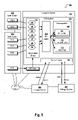
- figure 1 10 shows a block diagram of a system 100 including a DVS system 102 according to an embodiment of the invention.
- the system and method can be used to integrate a large amount of heterogeneously structured raw data 112 and make it searchable and analyzable in an efficient and flexibly expandable manner.
- the raw data can be XML files with different content and structure, JSON files, text files in different formats (e.g. Microsoft Word, OpenOffice, Adobe Acrobat PDF files, TXT files etc.), different tables from one or more different relational databases, media data or hierarchically organized data, for example object trees.
- the raw data can also be entered via a user interface of the DVS system.
- the raw data comes from several independent data sources, for example from different organizations, in particular companies, institutes and authorities.
- data objects, their data values and optionally also their semantic meaning can be more or less explicitly identified, for example in database tables, Excel files and other comparatively heavily structured data with corresponding fields.
- data objects and their data values cannot be present explicitly but implicitly. This means that the data objects and their data values are only recognized and extracted as such in the course of the parsing process.
- the parsers can be part of an integration module 110 of the DVS system 102 . It is also possible that the parsers are external components whose execution is initiated and controlled by the DVS system. In order to be able to parse the raw data, the parsers 118-130 used require at least read access to the respective raw data. During parsing, the parsers are preferably in exchange with the DMS system or other components of the DMS system, e.g. when dynamically creating an object ID for a data object, to be able to determine whether this ID is really unique or already has an object ID that is used as a reference in one of the data value lists.
- the DMS system 102 and/or the parsers controlled by it receive the raw data 112 or at least access addresses to this raw data.
- the access addresses allow at least read access to the raw data.
- the raw data may have been generated or acquired in one or more source systems connected via a network and transmitted to the computer system 100 via a network, for example the Internet.
- the raw data is stored in copy by the DMS system, for example for later re-processing by additional and/or improved versions of existing parsers. However, the raw data is not processed directly to answer search queries.
- the parsing and the import of the various raw data can take place in parallel, but it is also possible for the various raw data to be processed one after the other and even at a large time interval, depending on the availability of the raw data and/or the parser used for parsing.
- the raw data is processed by a plurality of parsers 118-130 to extract data objects, their object IDs and one or more data values contained in each of the data objects.
- the object IDs can be identifiers of data objects that are already known from the raw data are specified, and which are accepted by the DMS system as object IDs.
- the object IDs can also be generated during parsing. For example, multiple data sets can be stored line by line in an Excel spreadsheet.
- a parser of this Excel spreadsheet can be configured to interpret each row of the Excel file as a data object and to use the combination of file name and row number of the row in which the data record/data object is contained. If the extracted data values have already been explicitly assigned correct semantic concepts in the raw data (e.g. by corresponding field or column identifiers), the responsible parser assigns the extracted data values to the semantic concept that the extracted data value embodies. Because the parser uses certain field identifiers as a semantic concept and the DMS system automatically creates corresponding concept lists if the concept is not yet available in the form of a concept list in the data storage, the DMS system automatically learns new semantic concepts.
- the data values extracted from the raw data during parsing are stored in the concept lists according to the semantic concept assigned to them by the field labels.
- a parser only recognizes data objects and data values that are not explicitly contained in the raw data in a complex parsing process. It is also possible that a parser does not recognize which semantic concept an extracted data value belongs to.
- the results can be in the form of (initially possibly redundancies) data value lists whose elements are each linked to an object ID and to which a semantic concept is optionally also assigned.
- step 206 the DVS system imports the results of the parsing process, for example via an integration module 110, and stores the results in the form of non-redundant data value lists 114, 115, 116 in a data memory or data memory area 104 managed by the DVS system.
- These lists include one or more concept lists 116, typically a concept-free list and optionally also a global list 115.
- the data values within a list are preferably sorted according to a specific ordering relationship, that is, for example, sorted alphabetically. Function and structure of the lists are with reference to figure 4 described in more detail.
- the object structure i.e. the question of which data values or semantic concepts are present in a specific data object, is resolved to a certain extent.
- the amount of data can be compressed to a great extent and expanded at any time with further data values and/or concepts, which were provided in the form of additional raw data and/or additional parsers, without structural changes.
- the DMS system provides the redundancy-free lists 114, 115, 116 in order to answer a search query on the basis of these lists and/or to carry out analyzes on the data values contained in the lists.
- the DVS system that created the lists can contain a module 106 for receiving and processing search queries and/or a module for carrying out the analyses.
- the module 106 may be configured to receive search queries from one or more client computers via a network interface or directly from a local user via a GUI.
- the module 106 can also contain a large number of complex analysis functions which are based on set operations on a number of concept lists and optionally also on the concept-free list and the global list.
- the DVS system that created the lists 114, 115, 116 can transmit the original or a copy of the lists 114, 115, 116 to a search and analysis system.
- the search or analysis system can be another instance of a DVS system, or another hardware and/or software-based data processing system with an interface for receiving and processing search queries and/or analysis commands.
- This other search and analysis system can optionally also include a parser and an interface for importing parsing results, but does not have to include these components.
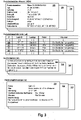
- figure 3 shows data structures with raw data, the data structures having a different structure and different content.
- data structures 302, 304, and 306 are motor product data sheets from a manufacturer in JSON format (represented here as tab-delimited text file).
- JSON format represented here as tab-delimited text file.
- the parsing process can take place in such a way that each of the three JSON files 302, 304 and 306 is interpreted as a separate data object, each with an object ID.
- Each data object contains several key-value fields, such as a concrete data value for the "power" semantic concept, a concrete data value for the "torque” semantic concept, and so on.
- the data structure shown below is an Excel table with a specification of various properties of paints from a paint dealer. Exactly one data object (data record) is contained in each line 308-313. During the parsing process, each recognized data object can be assigned, for example, the line number in combination with an identifier of this Excel spreadsheet as the object ID.
- Some of the raw data may be in the form of text data, e.g. text files 314-318.
- a purely syntactical parser could be used to break this text down into individual words (each acting as a data value).
- the syntactic parser can be a tokenizer that breaks natural language text into words to use as data values (apart from some stop words, if any).
- the words/data values are initially not assigned a semantic concept during the import and the words and the object ID of the respective source object are saved in the concept-free list, with each word only appearing once in this list.
- Another part of the raw data can be provided, for example, in the form of extracts from the commercial register 320-324. These can contain a mix of key-value fields and free text.
- the raw data come from different sources, but sometimes have overlapping content ("Yellow AG”) and sometimes ambiguous data values ("Silver”). Nevertheless, embodiments allow efficient integration and processing of all this data while resolving semantic ambiguities.
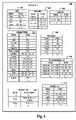
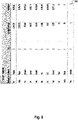
- figure 4 shows a block diagram of a selection of some of the DVS system based on the in figure 3 represented raw data generated data structures.
- the in the The data values shown in the redundancy-free lists 114, 115, 116 are also only a selection; the lists are typically considerably longer.
- All data value lists 114, 115, 116 generated and managed by the DVS system are redundancy-free, i. that is, they contain each data value only once.
- the data values are also preferably sorted, so that a sequential search in the lists can be aborted if, based on the sorting of the search term in the order and the data values of the list already searched through, it is impossible that a further search in the list will yield a hit.
- semantic concepts were determined by the parsers when processing the raw data: color, manufacturer, paint ID, cash on delivery, relation types and metal types. These semantic concepts are represented by concept lists 402, 4, 404, 406, 408, 410, and 412, respectively.
- the concept-free list 115 contains data values to which no semantic concept could be assigned during parsing. For example, if the message text parser 314 is a pure tokenizer of text into words that does not recognize the meaning of the words, then the words determined by that parser are "concept-free" and are stored in the concept list in a non-redundant form. So if a "yellow AG" is mentioned in the text 314 without the parser used recognizing the semantic meaning of this term, then this data value is stored in the concept-free list, with the data object 314 being referenced. It is possible that the same data value "Yellow-AG" is also contained in other raw data, it being possible when parsing this other raw data to assign a semantic concept to this data value.
- the data value "Yellow-AG” is also contained in the extract from the commercial register 320 under the field identifier "company".
- the commercial register parser and / or the DVS system can be configured to consider the semantic concepts "company” and "manufacturer” as synonyms of the same semantic concept, so that the data value "yellow AG” in the concept list 404 for the concept "Manufacturer” associated with the object ID is stored on data object 302. If a data value already exists in the list, only the set of object IDs assigned to this data value is supplemented accordingly.
- position data of data values within the respective data object can also be stored with the object IDs in the lists 115-116, so that the position of the data values within the data objects can also be reconstructed in the raw data.
- the non-redundant data value lists preferably also include a global list 114. This does not contain any object IDs and is used to associate data values with one or more semantic concepts and the corresponding concept lists. For example, the data value "silver" in the global list is assigned to the "color", "last name” and “metal type” concept lists, whereas the data value "pride” is only assigned to the "last name” concept list.
- the global list can be used to represent various semantic Dynamically display concepts that contain a specific search term when entering the search term and/or serve to limit the data values evaluated during a database search or data analysis to those data values that represent a specific semantic concept.
- the lists also include one or more concept lists 410 representing relations of data objects.
- the data value consists of a concatenation of the relation type (e.g. "can be installed in") and an object ID (e.g. identifiers of motor types MF-3000, ..., MF6000).
- the relation specifies in which motor type a certain component (which is specified in a data object from which this relation was extracted during parsing) can be installed.
- a search query with the search value "Verbaubar_in_MF_3100" now quickly returns all object IDs of data objects that represent engine components that are in the engine of type MF_3100 can be installed.
- a highly efficient search option is thus provided for all possible relation types of objects, which can also be used by data processing devices with little main memory and/or computing capacity.
- figure 5 shows a distributed computer system 500 with DVS system clients 506, 508, which send search requests and/or analysis requests to an interface 106 of the DVS system 102 via a network and receive a response in response, for example a list of objects whose Data values meet the submitted search criteria.
- the raw data are also provided by a number of source systems 502, 504 via a network, for example the Internet.
- system architecture 500 shown is only one of many possible. Many alternative architectures are possible, for example storing the raw data in copy on the same computer system 100 as the DMS system and/or using one or more local client request applications also instantiated on the computer system 100, in addition or as an alternative to the client systems 506, 508 connected via the network.
- the parsers 118-130 can be an integral part of the DVS system or external software programs controlled by the DVS system.
- KV lists can be received via a GUI of the data processing system, so that in this case the parsing process merely consists of accepting the specified key-value pairs and using the object IDs of the data objects to which the key Value pairs are taken to connect.
- the GUI may allow a doctor to enter a diagnosis based on multiple symptoms.
- New medical findings can thus be gained by means of efficient correlation analyzes on the redundancy-free lists, which are carried out, for example, by means of intersection formation of the object IDs of data values from a number of concept lists.
- All key-value pairs 503 generated by the parsers 118-130 are preferably automatically, standardized and always processed in the same way and transferred to the redundancy-free data value lists 114, 115, 116. Changes to the list structure or any indices (both usually have to be adjusted in conventional DBMS when integrating further data or new data sets with a previously unknown structure) are not required.
- the entirety of the data value lists thus represents a multidimensional model in which no data sets exist as a separate unit that is also structurally separated from other data sets.
- the affiliation of data values to specific data objects is calculated solely by searching in the redundancy-free lists and/or using set operations on the object IDs of elements in these lists.
- the search query therefore contains two regular expressions as search criteria that allow "fuzzy matches” and a data value "14" that must be fulfilled exactly.
- the DVS system is configured to identify those concept lists to which the search criteria of the query are to be applied (here first name, street and house number) and then, depending on the type of criterion, a fuzzy search or a search for identical values in the data values of the respective concept lists.
- Such a search is not only very fast, but also has the advantage that typos or misspellings in the name do not result in the phone book entry (data object) that meets the search criteria being overlooked, provided the typo is still included in the regular expressions.
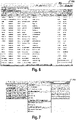
- FIG. 6 shows a screenshot of a GUI 600 of a DVS system with search results for a regular expression according to an embodiment.
- a raw data set with a size of 8.9 gigabytes was parsed and converted into non-redundant lists with a size of 4.42 gigabytes.
- the raw data set consisted of a set of comma-separated files, each containing a large number of telephone data sets, with the columns each containing different semantic concepts such as surname, first name, street, house number, zip code, city, area code and telephone number.
- this data was converted into a global list and the following concept lists, each of which contains only non-redundant data values: first name, last name, zip code, city, street, area code and telephone.
- data sets (data objects) relations to other data objects (data sets) were defined, in this case "mother” and "father” relations.
- the GUI allows a user to formulate different search queries, which can include search criteria related to one or more of the lists and which can be used in different search modes (identity or regular expression matching), where the search mode can be chosen individually for each of the concept indices can.
- a regular expression is entered into the search field 602, with which the redundancy-free concept list "Name” is searched for a regular expression. All data values that are contained in the "Name" concept list and "match” with the regular expression and the object IDs assigned to these match data values in this concept list are determined in a first step. This first step only takes 0.7 seconds, because instead of 89 gigabytes of raw data, only a sorted list of names with 3.2 million different data values has to be searched through. In a second step, all of the object IDs determined in the first step used to return the data objects (records) representing a person with a "matching" surname. In the example shown here, the output of these data records takes around 11 seconds.
- non-redundant data value lists has the advantage that not only an identity search, but also searches with regular expressions can be carried out very efficiently.
- specific data organization in the form of non-redundant data value lists supports a large number of other search queries, some of which are in figure 7 are shown.
- FIG 7 shows a screenshot of a GUI 700 of a DVS system with various search options.
- the user has the option of carrying out a “global search”, referred to here as a “universal search”.
- a search term is entered for an identity search or a search term in the form of a regular expression. This is then searched for in the global list, which contains all of the imported data values.
- the global list will contain the search term "Berlin” once, with this data value referring to several concept lists "Name”, “City”, “Street” and "First name” in the global list, in which this data value appears 1327 times or 1112234 times or 89412 times or 81 times.
- the 81 hits for the first name “Berlin” can be an indication of errors in the raw data, eg missing or incorrect separators, which means that the field assignment was not recognized during parsing.
- a combination search allows the user to enter, for each semantic concept to be considered in the search (here, for example, name, initials and telephone or street). Enter search criterion, preferably each entry of another letter in any of the search criteria already triggers a search for all already (in whole or in part) entered search criteria.
- the effective memory consumption of a conventional relational DBMS which supports the same large number of search queries, is many times higher than the 4.42 GB that the DMS system according to the embodiment described here consumes, in order to put every combinatorially possible search query on the global list and/or allow the concept list and/or the concept-free list.
- a 550 GB raw data set containing 1.4 billion taxi journey data sets (including time and location information for start and end point, number of guests and amount paid) was transferred to a set of non-redundant lists with a total size of 396GB had.
- the data sets (data objects) of the raw data each referenced a taxi zone that served as the starting zone and another that served as the destination zone.
- the running time for determining the total number of all taxi journeys that have a specific zone as a starting zone or as a destination zone was only 0.01 seconds despite the immense size of the database thanks to the list organization described.
- FIG. 8 shows a screenshot of a GUI 800 of a DVS system, the GUI summarizing the content of the concept lists.
- the "Field name” column contains the name of the concept lists that are managed by the DVS system and used for the search. This name is identical to the semantic concept represented by this concept list. The number of distinct data values in each concept list is shown in the "Field Index Entries” column.
- the "telephone” concept list there are 6,941,134 different ones Telephone numbers (without area code) before.
- the raw data includes 34795673 data objects (records) having a data value in the "Phone” field, with a total of 6941134 different phone numbers contained and extracted in the totality of these "Phone fields".
Landscapes
- Engineering & Computer Science (AREA)
- Theoretical Computer Science (AREA)
- Databases & Information Systems (AREA)
- Data Mining & Analysis (AREA)
- Physics & Mathematics (AREA)
- General Engineering & Computer Science (AREA)
- General Physics & Mathematics (AREA)
- Software Systems (AREA)
- Computer Security & Cryptography (AREA)
- Quality & Reliability (AREA)
- Information Retrieval, Db Structures And Fs Structures Therefor (AREA)
Priority Applications (5)
| Application Number | Priority Date | Filing Date | Title |
|---|---|---|---|
| EP20206967.0A EP4002145B1 (fr) | 2020-11-11 | 2020-11-11 | Enregistrement de données basé sur des listes destiné à la recherche de données |
| US18/249,639 US12314238B2 (en) | 2020-11-11 | 2021-11-09 | List-based data storage for data search |
| JP2023528107A JP7878801B2 (ja) | 2020-11-11 | 2021-11-09 | データ検索のためのリストベースのデータ保存 |
| CN202180080614.3A CN116783587B (zh) | 2020-11-11 | 2021-11-09 | 基于列表的数据搜索用数据存储 |
| PCT/EP2021/081011 WO2022101156A1 (fr) | 2020-11-11 | 2021-11-09 | Stockage de données fondé sur des listes pour la recherche de données |
Applications Claiming Priority (1)
| Application Number | Priority Date | Filing Date | Title |
|---|---|---|---|
| EP20206967.0A EP4002145B1 (fr) | 2020-11-11 | 2020-11-11 | Enregistrement de données basé sur des listes destiné à la recherche de données |
Publications (3)
| Publication Number | Publication Date |
|---|---|
| EP4002145A1 true EP4002145A1 (fr) | 2022-05-25 |
| EP4002145C0 EP4002145C0 (fr) | 2024-06-19 |
| EP4002145B1 EP4002145B1 (fr) | 2024-06-19 |
Family
ID=73343938
Family Applications (1)
| Application Number | Title | Priority Date | Filing Date |
|---|---|---|---|
| EP20206967.0A Active EP4002145B1 (fr) | 2020-11-11 | 2020-11-11 | Enregistrement de données basé sur des listes destiné à la recherche de données |
Country Status (5)
| Country | Link |
|---|---|
| US (1) | US12314238B2 (fr) |
| EP (1) | EP4002145B1 (fr) |
| JP (1) | JP7878801B2 (fr) |
| CN (1) | CN116783587B (fr) |
| WO (1) | WO2022101156A1 (fr) |
Families Citing this family (3)
| Publication number | Priority date | Publication date | Assignee | Title |
|---|---|---|---|---|
| CN114722014B (zh) * | 2022-06-09 | 2022-09-02 | 杭银消费金融股份有限公司 | 基于数据库日志文件的批量数据时间序列传输方法及系统 |
| CN120470023B (zh) * | 2025-07-17 | 2025-10-28 | 中国人寿保险股份有限公司江苏省分公司 | 一种使用sql语句对多个列表集合进行数据处理的方法 |
| JP7831889B1 (ja) * | 2025-08-15 | 2026-03-17 | 株式会社E-リテイリングシステムズ | 多段式構造変換によるデータインポートシステム、データインポート方法 |
Citations (3)
| Publication number | Priority date | Publication date | Assignee | Title |
|---|---|---|---|---|
| US6542896B1 (en) * | 1999-07-20 | 2003-04-01 | Primentia, Inc. | System and method for organizing data |
| US20040015783A1 (en) * | 2002-06-20 | 2004-01-22 | Canon Kabushiki Kaisha | Methods for interactively defining transforms and for generating queries by manipulating existing query data |
| EP2365448A1 (fr) * | 2010-03-11 | 2011-09-14 | British Telecommunications PLC | Système d'intégration de données |
Family Cites Families (7)
| Publication number | Priority date | Publication date | Assignee | Title |
|---|---|---|---|---|
| US6480843B2 (en) * | 1998-11-03 | 2002-11-12 | Nec Usa, Inc. | Supporting web-query expansion efficiently using multi-granularity indexing and query processing |
| CN101771570B (zh) * | 2010-02-08 | 2012-05-23 | 杭州华三通信技术有限公司 | 一种状态切换方法及装置 |
| US20110302149A1 (en) * | 2010-06-07 | 2011-12-08 | Microsoft Corporation | Identifying dominant concepts across multiple sources |
| US20140279864A1 (en) * | 2013-03-14 | 2014-09-18 | Google Inc. | Generating data records based on parsing |
| JP2016176407A (ja) * | 2015-03-20 | 2016-10-06 | 株式会社Ihi | 液圧回転装置 |
| US10248720B1 (en) * | 2015-07-16 | 2019-04-02 | Tableau Software, Inc. | Systems and methods for preparing raw data for use in data visualizations |
| ES2765415T3 (es) * | 2016-10-21 | 2020-06-09 | Fujitsu Ltd | Aparato, método y programa de procesamiento de datos basado en microservicios |
-
2020
- 2020-11-11 EP EP20206967.0A patent/EP4002145B1/fr active Active
-
2021
- 2021-11-09 US US18/249,639 patent/US12314238B2/en active Active
- 2021-11-09 JP JP2023528107A patent/JP7878801B2/ja active Active
- 2021-11-09 CN CN202180080614.3A patent/CN116783587B/zh active Active
- 2021-11-09 WO PCT/EP2021/081011 patent/WO2022101156A1/fr not_active Ceased
Patent Citations (3)
| Publication number | Priority date | Publication date | Assignee | Title |
|---|---|---|---|---|
| US6542896B1 (en) * | 1999-07-20 | 2003-04-01 | Primentia, Inc. | System and method for organizing data |
| US20040015783A1 (en) * | 2002-06-20 | 2004-01-22 | Canon Kabushiki Kaisha | Methods for interactively defining transforms and for generating queries by manipulating existing query data |
| EP2365448A1 (fr) * | 2010-03-11 | 2011-09-14 | British Telecommunications PLC | Système d'intégration de données |
Also Published As
| Publication number | Publication date |
|---|---|
| JP2023551641A (ja) | 2023-12-12 |
| US20230394015A1 (en) | 2023-12-07 |
| EP4002145C0 (fr) | 2024-06-19 |
| EP4002145B1 (fr) | 2024-06-19 |
| US12314238B2 (en) | 2025-05-27 |
| JP7878801B2 (ja) | 2026-06-23 |
| WO2022101156A1 (fr) | 2022-05-19 |
| CN116783587A (zh) | 2023-09-19 |
| CN116783587B (zh) | 2026-07-31 |
Similar Documents
| Publication | Publication Date | Title |
|---|---|---|
| CN108509547B (zh) | 一种信息管理方法、信息管理系统及电子设备 | |
| DE102013209868B4 (de) | Abfragen und Integrieren strukturierter und unstrukturierter Daten | |
| Bonaque et al. | Mixed-instance querying: a lightweight integration architecture for data journalism | |
| DE69910219T2 (de) | Transformation der perspektive auf tabellen von relationalen datenbanken | |
| CN114218218A (zh) | 基于数据仓库的数据处理方法、装置、设备及存储介质 | |
| CN103593418B (zh) | 一种面向大数据的分布式主题发现方法及系统 | |
| US8108411B2 (en) | Methods and systems for merging data sets | |
| WO2022101156A1 (fr) | Stockage de données fondé sur des listes pour la recherche de données | |
| US20140040306A1 (en) | Business intelligence performance analysis system | |
| EP3948577B1 (fr) | Apprentissage automatisé par machine sur la base de données stockées | |
| DE102013205737A1 (de) | System und Verfahren zum automatischen Erkennen und interaktiven Anzeigen von Informationen über Entitäten, Aktivitäten und Ereignisse aus multimodalen natürlichen Sprachquellen | |
| DE112017006106T5 (de) | Erzeugen von, Zugreifen auf und Anzeigen von Abstammungsmetadaten | |
| DE112013000987T5 (de) | Erzeugen von Visualisierungen einer Anzeigegruppe von Tags, die Inhaltsinstanzen in Suchkriterien erfüllenden Objekten darstellen | |
| DE69710309T2 (de) | System für betriebliche veröffentlichung und speicherung | |
| EP4080376B1 (fr) | Recherche de données basée sur une liste à structure de données append-only | |
| DE102013200355A1 (de) | Zusammenfügen von Dokumenten aud der Grundlage der Kenntnis eines Dokumentenschemas | |
| DE112011101200T5 (de) | Spaltenorientierte Speicher-Darstellungen von Datensätzen | |
| DE202013012490U1 (de) | Effiziente hierarchisch geprägte Top-Down Verbindung geclusterter Datenstrom | |
| EP3563261B1 (fr) | Système de classification de données à base de séquence de bits | |
| CN110109870A (zh) | 一种基于Solr的海量数据快速检索系统 | |
| DE102021117711A1 (de) | Integration verteilter Machine-Learning Modelle | |
| EP3996017A1 (fr) | Méthode, système, produit de programme informatique et système de traitement de données pour fournir et enrichir sélectivement des données | |
| CN117520112A (zh) | 计算任务的提效分析处理方法、装置、设备和存储介质 | |
| DE112021007304T5 (de) | Informationsverarbeitungsvorrichtung, informationsverarbeitungsverfahren und informationsverarbeitungsprogramm | |
| KR20130036886A (ko) | 와일드카드 매칭을 이용한 검색 방법 |
Legal Events
| Date | Code | Title | Description |
|---|---|---|---|
| PUAI | Public reference made under article 153(3) epc to a published international application that has entered the european phase |
Free format text: ORIGINAL CODE: 0009012 |
|
| STAA | Information on the status of an ep patent application or granted ep patent |
Free format text: STATUS: THE APPLICATION HAS BEEN PUBLISHED |
|
| AK | Designated contracting states |
Kind code of ref document: A1 Designated state(s): AL AT BE BG CH CY CZ DE DK EE ES FI FR GB GR HR HU IE IS IT LI LT LU LV MC MK MT NL NO PL PT RO RS SE SI SK SM TR |
|
| RAP3 | Party data changed (applicant data changed or rights of an application transferred) |
Owner name: CORTEX INNOVATIONS GMBH |
|
| STAA | Information on the status of an ep patent application or granted ep patent |
Free format text: STATUS: REQUEST FOR EXAMINATION WAS MADE |
|
| 17P | Request for examination filed |
Effective date: 20221125 |
|
| RBV | Designated contracting states (corrected) |
Designated state(s): AL AT BE BG CH CY CZ DE DK EE ES FI FR GB GR HR HU IE IS IT LI LT LU LV MC MK MT NL NO PL PT RO RS SE SI SK SM TR |
|
| GRAP | Despatch of communication of intention to grant a patent |
Free format text: ORIGINAL CODE: EPIDOSNIGR1 |
|
| STAA | Information on the status of an ep patent application or granted ep patent |
Free format text: STATUS: GRANT OF PATENT IS INTENDED |
|
| INTG | Intention to grant announced |
Effective date: 20240115 |
|
| GRAS | Grant fee paid |
Free format text: ORIGINAL CODE: EPIDOSNIGR3 |
|
| GRAA | (expected) grant |
Free format text: ORIGINAL CODE: 0009210 |
|
| STAA | Information on the status of an ep patent application or granted ep patent |
Free format text: STATUS: THE PATENT HAS BEEN GRANTED |
|
| AK | Designated contracting states |
Kind code of ref document: B1 Designated state(s): AL AT BE BG CH CY CZ DE DK EE ES FI FR GB GR HR HU IE IS IT LI LT LU LV MC MK MT NL NO PL PT RO RS SE SI SK SM TR |
|
| REG | Reference to a national code |
Ref country code: GB Ref legal event code: FG4D Free format text: NOT ENGLISH |
|
| REG | Reference to a national code |
Ref country code: CH Ref legal event code: EP |
|
| REG | Reference to a national code |
Ref country code: DE Ref legal event code: R081 Ref document number: 502020008306 Country of ref document: DE Owner name: CORTEX INNOVATIONS GMBH, DE Free format text: FORMER OWNER: ANMELDERANGABEN UNKLAR / UNVOLLSTAENDIG, 80297 MUENCHEN, DE |
|
| REG | Reference to a national code |
Ref country code: DE Ref legal event code: R096 Ref document number: 502020008306 Country of ref document: DE |
|
| RAP4 | Party data changed (patent owner data changed or rights of a patent transferred) |
Owner name: CORTEX INNOVATIONS GMBH |
|
| U01 | Request for unitary effect filed |
Effective date: 20240718 |
|
| U07 | Unitary effect registered |
Designated state(s): AT BE BG DE DK EE FI FR IT LT LU LV MT NL PT SE SI Effective date: 20240729 |
|
| PG25 | Lapsed in a contracting state [announced via postgrant information from national office to epo] |
Ref country code: HR Free format text: LAPSE BECAUSE OF FAILURE TO SUBMIT A TRANSLATION OF THE DESCRIPTION OR TO PAY THE FEE WITHIN THE PRESCRIBED TIME-LIMIT Effective date: 20240619 |
|
| PG25 | Lapsed in a contracting state [announced via postgrant information from national office to epo] |
Ref country code: GR Free format text: LAPSE BECAUSE OF FAILURE TO SUBMIT A TRANSLATION OF THE DESCRIPTION OR TO PAY THE FEE WITHIN THE PRESCRIBED TIME-LIMIT Effective date: 20240920 |
|
| PG25 | Lapsed in a contracting state [announced via postgrant information from national office to epo] |
Ref country code: NO Free format text: LAPSE BECAUSE OF FAILURE TO SUBMIT A TRANSLATION OF THE DESCRIPTION OR TO PAY THE FEE WITHIN THE PRESCRIBED TIME-LIMIT Effective date: 20240919 Ref country code: HR Free format text: LAPSE BECAUSE OF FAILURE TO SUBMIT A TRANSLATION OF THE DESCRIPTION OR TO PAY THE FEE WITHIN THE PRESCRIBED TIME-LIMIT Effective date: 20240619 Ref country code: GR Free format text: LAPSE BECAUSE OF FAILURE TO SUBMIT A TRANSLATION OF THE DESCRIPTION OR TO PAY THE FEE WITHIN THE PRESCRIBED TIME-LIMIT Effective date: 20240920 Ref country code: RS Free format text: LAPSE BECAUSE OF FAILURE TO SUBMIT A TRANSLATION OF THE DESCRIPTION OR TO PAY THE FEE WITHIN THE PRESCRIBED TIME-LIMIT Effective date: 20240919 |
|
| U20 | Renewal fee for the european patent with unitary effect paid |
Year of fee payment: 5 Effective date: 20241126 |
|
| PG25 | Lapsed in a contracting state [announced via postgrant information from national office to epo] |
Ref country code: PL Free format text: LAPSE BECAUSE OF FAILURE TO SUBMIT A TRANSLATION OF THE DESCRIPTION OR TO PAY THE FEE WITHIN THE PRESCRIBED TIME-LIMIT Effective date: 20240619 |
|
| PG25 | Lapsed in a contracting state [announced via postgrant information from national office to epo] |
Ref country code: IS Free format text: LAPSE BECAUSE OF FAILURE TO SUBMIT A TRANSLATION OF THE DESCRIPTION OR TO PAY THE FEE WITHIN THE PRESCRIBED TIME-LIMIT Effective date: 20241019 |
|
| PG25 | Lapsed in a contracting state [announced via postgrant information from national office to epo] |
Ref country code: CZ Free format text: LAPSE BECAUSE OF FAILURE TO SUBMIT A TRANSLATION OF THE DESCRIPTION OR TO PAY THE FEE WITHIN THE PRESCRIBED TIME-LIMIT Effective date: 20240619 |
|
| PG25 | Lapsed in a contracting state [announced via postgrant information from national office to epo] |
Ref country code: RO Free format text: LAPSE BECAUSE OF FAILURE TO SUBMIT A TRANSLATION OF THE DESCRIPTION OR TO PAY THE FEE WITHIN THE PRESCRIBED TIME-LIMIT Effective date: 20240619 Ref country code: SK Free format text: LAPSE BECAUSE OF FAILURE TO SUBMIT A TRANSLATION OF THE DESCRIPTION OR TO PAY THE FEE WITHIN THE PRESCRIBED TIME-LIMIT Effective date: 20240619 |
|
| PG25 | Lapsed in a contracting state [announced via postgrant information from national office to epo] |
Ref country code: ES Free format text: LAPSE BECAUSE OF FAILURE TO SUBMIT A TRANSLATION OF THE DESCRIPTION OR TO PAY THE FEE WITHIN THE PRESCRIBED TIME-LIMIT Effective date: 20240619 Ref country code: SM Free format text: LAPSE BECAUSE OF FAILURE TO SUBMIT A TRANSLATION OF THE DESCRIPTION OR TO PAY THE FEE WITHIN THE PRESCRIBED TIME-LIMIT Effective date: 20240619 |
|
| PG25 | Lapsed in a contracting state [announced via postgrant information from national office to epo] |
Ref country code: SM Free format text: LAPSE BECAUSE OF FAILURE TO SUBMIT A TRANSLATION OF THE DESCRIPTION OR TO PAY THE FEE WITHIN THE PRESCRIBED TIME-LIMIT Effective date: 20240619 Ref country code: SK Free format text: LAPSE BECAUSE OF FAILURE TO SUBMIT A TRANSLATION OF THE DESCRIPTION OR TO PAY THE FEE WITHIN THE PRESCRIBED TIME-LIMIT Effective date: 20240619 Ref country code: RO Free format text: LAPSE BECAUSE OF FAILURE TO SUBMIT A TRANSLATION OF THE DESCRIPTION OR TO PAY THE FEE WITHIN THE PRESCRIBED TIME-LIMIT Effective date: 20240619 Ref country code: PL Free format text: LAPSE BECAUSE OF FAILURE TO SUBMIT A TRANSLATION OF THE DESCRIPTION OR TO PAY THE FEE WITHIN THE PRESCRIBED TIME-LIMIT Effective date: 20240619 Ref country code: IS Free format text: LAPSE BECAUSE OF FAILURE TO SUBMIT A TRANSLATION OF THE DESCRIPTION OR TO PAY THE FEE WITHIN THE PRESCRIBED TIME-LIMIT Effective date: 20241019 Ref country code: ES Free format text: LAPSE BECAUSE OF FAILURE TO SUBMIT A TRANSLATION OF THE DESCRIPTION OR TO PAY THE FEE WITHIN THE PRESCRIBED TIME-LIMIT Effective date: 20240619 Ref country code: CZ Free format text: LAPSE BECAUSE OF FAILURE TO SUBMIT A TRANSLATION OF THE DESCRIPTION OR TO PAY THE FEE WITHIN THE PRESCRIBED TIME-LIMIT Effective date: 20240619 |
|
| PLBE | No opposition filed within time limit |
Free format text: ORIGINAL CODE: 0009261 |
|
| STAA | Information on the status of an ep patent application or granted ep patent |
Free format text: STATUS: NO OPPOSITION FILED WITHIN TIME LIMIT |
|
| 26N | No opposition filed |
Effective date: 20250320 |
|
| REG | Reference to a national code |
Ref country code: CH Ref legal event code: PL |
|
| PG25 | Lapsed in a contracting state [announced via postgrant information from national office to epo] |
Ref country code: MC Free format text: LAPSE BECAUSE OF FAILURE TO SUBMIT A TRANSLATION OF THE DESCRIPTION OR TO PAY THE FEE WITHIN THE PRESCRIBED TIME-LIMIT Effective date: 20240619 |
|
| REG | Reference to a national code |
Ref country code: CH Ref legal event code: PL |
|
| PG25 | Lapsed in a contracting state [announced via postgrant information from national office to epo] |
Ref country code: CH Free format text: LAPSE BECAUSE OF NON-PAYMENT OF DUE FEES Effective date: 20241130 |
|
| PG25 | Lapsed in a contracting state [announced via postgrant information from national office to epo] |
Ref country code: IE Free format text: LAPSE BECAUSE OF NON-PAYMENT OF DUE FEES Effective date: 20241111 |
|
| U20 | Renewal fee for the european patent with unitary effect paid |
Year of fee payment: 6 Effective date: 20251127 |
|
| PGFP | Annual fee paid to national office [announced via postgrant information from national office to epo] |
Ref country code: GB Payment date: 20251121 Year of fee payment: 6 |
|
| PG25 | Lapsed in a contracting state [announced via postgrant information from national office to epo] |
Ref country code: HU Free format text: LAPSE BECAUSE OF FAILURE TO SUBMIT A TRANSLATION OF THE DESCRIPTION OR TO PAY THE FEE WITHIN THE PRESCRIBED TIME-LIMIT; INVALID AB INITIO Effective date: 20201111 |
|
| PG25 | Lapsed in a contracting state [announced via postgrant information from national office to epo] |
Ref country code: CY Free format text: LAPSE BECAUSE OF FAILURE TO SUBMIT A TRANSLATION OF THE DESCRIPTION OR TO PAY THE FEE WITHIN THE PRESCRIBED TIME-LIMIT; INVALID AB INITIO Effective date: 20201111 |
|
| PG25 | Lapsed in a contracting state [announced via postgrant information from national office to epo] |
Ref country code: TR Free format text: LAPSE BECAUSE OF FAILURE TO SUBMIT A TRANSLATION OF THE DESCRIPTION OR TO PAY THE FEE WITHIN THE PRESCRIBED TIME-LIMIT Effective date: 20240619 |