EP4002264A1 - Hilfslösung zur visualisierung der simulation eines automatischen belichtungsprozesses - Google Patents
Hilfslösung zur visualisierung der simulation eines automatischen belichtungsprozesses Download PDFInfo
- Publication number
- EP4002264A1 EP4002264A1 EP21207181.5A EP21207181A EP4002264A1 EP 4002264 A1 EP4002264 A1 EP 4002264A1 EP 21207181 A EP21207181 A EP 21207181A EP 4002264 A1 EP4002264 A1 EP 4002264A1
- Authority
- EP
- European Patent Office
- Prior art keywords
- image
- images
- exposure
- sensor
- display
- Prior art date
- Legal status (The legal status is an assumption and is not a legal conclusion. Google has not performed a legal analysis and makes no representation as to the accuracy of the status listed.)
- Withdrawn
Links
Images

Classifications
-
- G—PHYSICS
- G06—COMPUTING OR CALCULATING; COUNTING
- G06T—IMAGE DATA PROCESSING OR GENERATION, IN GENERAL
- G06T5/00—Image enhancement or restoration
- G06T5/50—Image enhancement or restoration using two or more images, e.g. averaging or subtraction
-
- G—PHYSICS
- G06—COMPUTING OR CALCULATING; COUNTING
- G06T—IMAGE DATA PROCESSING OR GENERATION, IN GENERAL
- G06T5/00—Image enhancement or restoration
- G06T5/60—Image enhancement or restoration using machine learning, e.g. neural networks
-
- G—PHYSICS
- G06—COMPUTING OR CALCULATING; COUNTING
- G06T—IMAGE DATA PROCESSING OR GENERATION, IN GENERAL
- G06T5/00—Image enhancement or restoration
- G06T5/90—Dynamic range modification of images or parts thereof
-
- H—ELECTRICITY
- H04—ELECTRIC COMMUNICATION TECHNIQUE
- H04N—PICTORIAL COMMUNICATION, e.g. TELEVISION
- H04N23/00—Cameras or camera modules comprising electronic image sensors; Control thereof
- H04N23/60—Control of cameras or camera modules
- H04N23/617—Upgrading or updating of programs or applications for camera control
-
- H—ELECTRICITY
- H04—ELECTRIC COMMUNICATION TECHNIQUE
- H04N—PICTORIAL COMMUNICATION, e.g. TELEVISION
- H04N23/00—Cameras or camera modules comprising electronic image sensors; Control thereof
- H04N23/70—Circuitry for compensating brightness variation in the scene
- H04N23/741—Circuitry for compensating brightness variation in the scene by increasing the dynamic range of the image compared to the dynamic range of the electronic image sensors
-
- G—PHYSICS
- G06—COMPUTING OR CALCULATING; COUNTING
- G06T—IMAGE DATA PROCESSING OR GENERATION, IN GENERAL
- G06T2207/00—Indexing scheme for image analysis or image enhancement
- G06T2207/20—Special algorithmic details
- G06T2207/20081—Training; Learning
-
- G—PHYSICS
- G06—COMPUTING OR CALCULATING; COUNTING
- G06T—IMAGE DATA PROCESSING OR GENERATION, IN GENERAL
- G06T2207/00—Indexing scheme for image analysis or image enhancement
- G06T2207/20—Special algorithmic details
- G06T2207/20084—Artificial neural networks [ANN]
-
- G—PHYSICS
- G06—COMPUTING OR CALCULATING; COUNTING
- G06T—IMAGE DATA PROCESSING OR GENERATION, IN GENERAL
- G06T2207/00—Indexing scheme for image analysis or image enhancement
- G06T2207/20—Special algorithmic details
- G06T2207/20172—Image enhancement details
- G06T2207/20208—High dynamic range [HDR] image processing
-
- G—PHYSICS
- G06—COMPUTING OR CALCULATING; COUNTING
- G06T—IMAGE DATA PROCESSING OR GENERATION, IN GENERAL
- G06T2207/00—Indexing scheme for image analysis or image enhancement
- G06T2207/20—Special algorithmic details
- G06T2207/20212—Image combination
- G06T2207/20221—Image fusion; Image merging
Definitions
- the present invention relates to the field of image processing, and more specifically to a method for displaying a set of image(s) comprising at least one image.
- the object of the invention is therefore to propose a visualization aid solution for faithfully simulating the self-exposure process implemented by an image(s) sensor distinct from the image(s) sensor having provided this set of image(s), while limiting the complexity of post-processing.
- the present invention proposes to simulate a change of auto-exposure algorithm respectively associated with a change of image sensor(s), including in particular the human eye, by "playing" on the display duration of each image of the set of image(s) initially provided by the first image(s) sensor, the display duration being able to vary for at least two distinct images of said set of image(s).
- the invention is therefore at least partly an invention of a problem corresponding to the detection of such a need for augmented reality associated with a change of image sensor(s).
- the solution proposed according to the present invention based on an optimization of the duration of display of each image of the set of image(s) to faithfully restore the effect of any image sensor(s) allows a significant reduction of the number of parameters that would conventionally be used according to deep learning techniques, since the correspondence between the self-exposure algorithms of two distinct image(s) sensors is obtained by means of a single parameter, namely the duration of display of each image previously supplied by a first sensor.
- the adjustment and learning of self-exposure algorithm proposed according to the present invention to go from (i.e. to match) the restitution of image(s) (i.e. the visual rendering) of a first sensor of image(s) supplying a set of image(s) to the restitution of image(s) associated with another image(s) sensor, for example used virtually, is one-dimensional.
- the invention also relates to a computer program comprising software instructions which, when they are executed by a computer, implement such a display method.
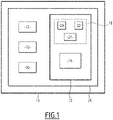
- an electronic device 10 for displaying a set of image(s) is according to the present invention configured to display a set of image(s) provided by a first image sensor(s), not shown, “ as if” in terms of exposure this set of images had been obtained, instead, from a second image sensor (s) distinct from the first image sensor (s).
- a second image sensor could potentially correspond to the human eye or to an electronic device distinct from that comprising the first image sensor(s).
- first image(s) sensor an image(s) sensor known per se, namely for example an image(s) sensor configured to take one or more images of a scene by applying to each image a first exposure by means of an auto-exposure algorithm specific to this first image sensor(s), and transmit them to the electronic display device 10.
- the display device 10 comprises a reception module 12 configured to receive the set of image(s) obtained from the first image sensor(s), an association module 14 configured to associate with each image of said set of image(s) a display duration representative of a second exposure, distinct from the first exposure for at least one image of said set of image(s), a display module 16 configured to display said set of image(s) by applying for each image of said set of image(s), its associated display duration.
- the display device 10 further comprises a module 18 for completing the set of image(s) capable of generating at least one additional image, said at least one additional image and said set of image(s) received and obtained from the first image sensor(s) forming a completed set of images capable of then being processed by the aforementioned association module.
- the set of image(s) received and obtained from the first image sensor(s) corresponds to (i.e. comprises): a sequence of images, each image being associated with a distinct instant of capture, or two images of the same scene comprising a low dynamic range image and a high dynamic range image, these two images being substantially acquired at the same instant of capture by the first image sensor(s), or even at a single image suitable for use in generating at least said two low dynamic range and high dynamic range images respectively.
- the completion module 18 comprises at least one artificial neural network 20.
- Such an at least one artificial neural network 20 is in particular suitable for use when the set of image(s) received and obtained from the first image sensor(s) corresponds to a single image.
- the artificial neural network 20 is used to generate a second additional image from this single image received from the first image sensor in order to obtain a low dynamic range image and a high dynamic range image, these two images being substantially associated with the same instant of capture.
- said at least one artificial neural network corresponds to a set of generative adversarial networks GANs (from the English Generative Adversarial Networks ) such as in particular introduced in the article by G. Eilertsen et al. entitled “HDR image reconstruction from a single exposure using deep CNNs”. published in ACM Transactions on Graphics (Proc. of SIGGRAPH Asia 2017), 36(6), Article 178, (2017 ), or in the article of D. Marnerides et al., entitled “A Deep Convolutional Neural Network for High Dynamic Range Expansion from Low Dynamic Range Content” published in EUROGRAPHICS 2018, Volume 37 (2016), Number 2 , or in the article of L. Siyeong et al.
- GANs from the English Generative Adversarial Networks
- the completion module 18 comprises an inter-image distance measurement tool 22 applicable directly to said set of image(s) received and obtained from the first image sensor(s) when it comprises at least two images, or applicable to the completed set of images provided by said at least one artificial neural network 20.
- Such a Euclidean distance corresponding to a real number such as: 0 ⁇ I you I , I you v ⁇ 1 .
- the completion module 18 comprises a temporal interpolation tool 24, in particular a slow motion interpolation (English Slow motion interpolation ) as notably introduced in the article by H. Jiang et al., titled “Super SloMo: High Quality Estimation of Multiple Intermediate Frames for Video Interpolation” CVPR, 2018, arXiv:1712.00080 [csCV] .
- a temporal interpolation tool 24 is in particular configured to complete the set of image(s) to then be supplied to the association module 14 until reaching a predetermined filling criterion ⁇ corresponding to a predetermined inter-image distance.
- two consecutive images can present a more or less large deviation from one pair of consecutive images to another, and the predetermined filling criterion ⁇ aims to regularize this deviation so that the self-exposure effect is smoothed. on the set of image(s).
- the electronic display device 10 comprises an information processing unit 26 formed for example of a memory 28 and a processor 30 associated with the memory 28.
- the association module 14, as well as, as an optional addition, the completion module 18, are each produced in the form of software, or a software brick, executable by the processor 30.
- the memory 28 of the electronic device d the display 10 is then able to store software for associating each image of said set of image(s) with a display duration representative of a second exposure, distinct from the first exposure for at least one image of said set image(s).
- the memory 28 of the electronic display device 10 is capable of storing completion software capable of generating at least one additional image, said at least one additional image and said set of image(s) received and obtained at from the first image sensor(s) forming a completed set of images to which said association step is then applied.
- the processor 30 is then capable of executing each of the software programs among the association software as well as, optionally, the completion software.
- association module 14 and, as an optional addition, the completion module 18, are each made in the form of a programmable logic component, such as an FPGA ( Field Programmable Gate Array ), or else in the form of a dedicated integrated circuit, such as an ASIC (from the English Application Specific Integrated Circuit ).
- a programmable logic component such as an FPGA ( Field Programmable Gate Array )
- ASIC Application Specific Integrated Circuit
- the electronic display device 10 When the electronic display device 10 is produced in the form of one or more software, that is to say in the form of a computer program, it is also capable of being recorded on a medium, not shown. , computer readable.
- the computer-readable medium is, for example, a medium capable of storing electronic instructions and of being coupled to a bus of a computer system.
- the readable medium is an optical disc, a magneto-optical disc, a ROM memory, a RAM memory, any type of non-volatile memory (for example EPROM, EEPROM, FLASH, NVRAM), a magnetic card or an optical card.
- On the readable medium is then stored a computer program comprising software instructions.
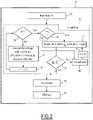
- the electronic display device 10 receives, via its reception module 12, the set of image(s) EI comprising n image(s).
- the electronic display device 10 optionally completes (as shown in dotted lines), via its completion module 18, the set of image(s) EI.
- the electronic display device 10 via its completion module 18, increments the value of n and returns to the sub-step 38 of testing the value n previously described which arrives at the conclusion that n is no longer equal to one.
- the electronic display device 10 via the temporal interpolation tool 24 of its completion module 18, generates an additional image associated with a capture instant distinct from the instant of capture associated with each of the two images of the same scene comprising a low dynamic range image and a high dynamic range image of said set of image(s).
- the electronic display device 10 via its completion module 18 increments the value of n.
- step 54 is implemented by the electronic display device 10, via its association module 14.
- the association module 14 of the electronic display device 10 associates with each image of said set of completed image(s) a display duration representative of a second exposure, distinct of the first exposure for at least one image of said set of completed E-I image(s).
- each image sensor (s) adjusts the same parameters along trajectories almost or even substantially identical in the parametric space, but with a different speed from one image sensor(s) to another.
- the present invention proposes, in a non-trivial manner in view of current deep learning techniques based on complex learning of numerous parameters, to materialize these differences associated with a pair of image sensors, comprising a first sensor of image(s) and a second image(s) sensor, by a one-dimensional function associating a display duration with each image of an initial set of image(s) provided by the first image sensor, for create a different image restitution (i.e. a display), by applying its associated display duration to each image, in order to simulate the display that would be obtained from an image sequence of the same scene obtained in the same conditions, but by the second image sensor(s) of said pair of image sensors(s), the second image sensor(s) being separate from the first image sensor.
- said association 54 is implemented by using a predetermined function associating with a moment of capture of each image of said set of image(s) completed (or not in the event of absence of implementation of the step of completion 36) a value, predetermined for the display duration, capable of varying from one image to another of said set of image(s) considered.
- a predetermined function associating with a moment of capture of each image of said set of image(s) completed (or not in the event of absence of implementation of the step of completion 36) a value, predetermined for the display duration, capable of varying from one image to another of said set of image(s) considered.
- the display module 16 of the electronic display device 10 displays the set of image(s) E-I, if necessary supplemented, by applying for each image of this set of image(s) E-I, its display duration associated with the previous step 54.
- the picture 3 illustrates a possible choice of predetermined function 58 ⁇ ( t ) associating with an instant of capture of each image of said set of image(s) completed (or not in the absence of implementation of the completion step 36) a predetermined value of the display duration.
- the predetermined function 58 ⁇ ( t ) is non-linear and has been chosen according to the user's image restitution needs in order in particular to increase the display duration of the first images associated with the instant t k of the set of image(s) EI, if necessary supplemented, with respect to the lower display duration associated with the last image associated with the instant t N of the set of image(s) EI, the if necessary completed.
- a second predetermined function ⁇ ( t ), not shown, is suitable for use.
- the present invention as described previously proposes a reconfigurable solution according to the change of image sensor(s) or the desired effect, by means of a single parameter, namely the display duration in accordance with the second reconfigurable predetermined function ⁇ ( t ) of each image previously supplied by a first sensor.
- two first sets of image(s) E_I A_1 and E_I B_1 of the same scene provided respectively by the cameras are considered.
- a and B If necessary, after implementation of the completion step 36 with application of a slow motion interpolation to the set E_I B_1 provided by the camera B to reach the predetermined filling criterion ⁇ , the set d 'image(s) E_I B_1 , supplemented where appropriate, comprises n B-1 images while the set E_I A_1 comprises n A images.
- the distance d i is measured, in particular in accordance with calculation equation (1) of aforementioned distance, between this image I b-1 (t i ) and the images of the set of image(s) E_I A_1 starting from the first image, in terms of temporal capture, of the set of images (s) E_I A_1 and for all the following images of E_I A_1 as long as d i remains less than a predetermined distance threshold d*.
- each value ⁇ ( t i ) is interrupted after using all the images of the set of image(s) E_I A_1 even if I ⁇ not I f .
- Such a second predetermined function ⁇ ( t ) is then suitable for use when one has, for example, a second set of image(s) EI B_2 of a scene, distinct from the scene associated with the first set of image(s) EI B_1 , provided by camera B, and that one seeks to display a set of corresponding image(s) such as it would have been obtained by a camera A.
- a second set of image(s) EI A _ 2 here one does not have the corresponding set of image(s) EI A _ 2 but according to the present invention it is possible to obtain it virtually by applying to each image I b-2 (t i ) the display duration ⁇ ( t i ) corresponding.
- the predetermined function ⁇ ( t ) is then suitable for being obtained empirically, for example in a showroom, a factory, a workshop, etc., to then be used on the images of a scene captured outside this showroom, factory , workshop, etc., which makes it possible to simulate the effect of glazing in any place without actually changing the window.
- the display device 10 makes it possible, by means of several distinct predetermined functions ⁇ ( t ), to simulate and display, from a single set of image(s) provided by a single first image sensor, the capture of image(s) of the same scene with other sensors distinct from the first sensor and each associated with a predetermined function ⁇ ( t ) which is specific to it.
- Such flexibility is suitable for making it possible to approach (ie simulate) the behavior of the human eye during its adaptation to the light intensity by determining, in particular empirically, a suitable predetermined function ⁇ ( t ).
- the solution proposed here offers a drastic reduction in parameters, because instead of teaching many parameters to a large neural network, by training it on different sets of images, the person skilled in the art must only determine/choose beforehand the predetermined function ⁇ ( t ) associated with a pair comprising a first image sensor(s) and a second image sensor(s), for the then apply as soon as it is sought to display a set of image(s) representative of a scene obtained with the first sensor, as it would have been obtained by the separate second sensor.
- the flexibility offered by the solution according to the present invention allows various applications such as in the field of autonomous vehicles in order to prepare training videos or in the field of advertising to simulate the effect of new lighting or the high performance glazing effect for living spaces.
Landscapes
- Engineering & Computer Science (AREA)
- Physics & Mathematics (AREA)
- General Physics & Mathematics (AREA)
- Theoretical Computer Science (AREA)
- Multimedia (AREA)
- Signal Processing (AREA)
- Software Systems (AREA)
- Image Processing (AREA)
- Controls And Circuits For Display Device (AREA)
- Testing, Inspecting, Measuring Of Stereoscopic Televisions And Televisions (AREA)
Applications Claiming Priority (1)
| Application Number | Priority Date | Filing Date | Title |
|---|---|---|---|
| FR2011659A FR3116364B1 (fr) | 2020-11-13 | 2020-11-13 | Solution d’aide à la visualisation pour simuler un processus d’auto-exposition |
Publications (1)
| Publication Number | Publication Date |
|---|---|
| EP4002264A1 true EP4002264A1 (de) | 2022-05-25 |
Family
ID=74553976
Family Applications (1)
| Application Number | Title | Priority Date | Filing Date |
|---|---|---|---|
| EP21207181.5A Withdrawn EP4002264A1 (de) | 2020-11-13 | 2021-11-09 | Hilfslösung zur visualisierung der simulation eines automatischen belichtungsprozesses |
Country Status (2)
| Country | Link |
|---|---|
| EP (1) | EP4002264A1 (de) |
| FR (1) | FR3116364B1 (de) |
Citations (1)
| Publication number | Priority date | Publication date | Assignee | Title |
|---|---|---|---|---|
| US20170332009A1 (en) * | 2016-05-11 | 2017-11-16 | Canon Canada Inc. | Devices, systems, and methods for a virtual reality camera simulator |
-
2020
- 2020-11-13 FR FR2011659A patent/FR3116364B1/fr active Active
-
2021
- 2021-11-09 EP EP21207181.5A patent/EP4002264A1/de not_active Withdrawn
Patent Citations (1)
| Publication number | Priority date | Publication date | Assignee | Title |
|---|---|---|---|---|
| US20170332009A1 (en) * | 2016-05-11 | 2017-11-16 | Canon Canada Inc. | Devices, systems, and methods for a virtual reality camera simulator |
Non-Patent Citations (7)
| Title |
|---|
| D. MARNERIDES ET AL.: "A Deep Convolutional Neural Network for High Dynamic Range Expansion from Low Dynamic Range Content", EUROGRAPHICS, vol. 37, no. 2, 2018, XP055569673, DOI: 10.1111/cgf.13340 |
| EILERTSEN ET AL.: "HDR image reconstruction from a single exposure using deep CNNs", ACM TRANSACTIONS ON GRAPHICS, vol. 36, no. 6, 2017, XP055569626, DOI: 10.1145/3130800.3130816 |
| H. JIANG ET AL.: "Super SloMo: High Quality Estimation of Multiple Intermediate Frames for Video Interpolation", CVPR, 2018 |
| K. MORIWAKI ET AL.: "Hybrid Loss for Learning Single-Image-based HDR Reconstruction", ARXIV |
| L. SIYEONG ET AL.: "Deep Chain HDRI: Reconstructing a High Dynamic Range Image from a Single Low Dynamic Range Image", ARXIV |
| LOSCOS C�LINE: "R�-�clairage et remod�lisation interactifs des sc�nes r�elles pour la r�alit� augment�e", 18 February 2004 (2004-02-18), pages 1 - 192, XP055819053, Retrieved from the Internet <URL:https://tel.archives-ouvertes.fr/tel-00004842/document> [retrieved on 20210629] * |
| Y. LECUN ET AL.: "Deep learning", NATURE, vol. 521, no. 7553, 2015, pages 436 - 444, XP055574086, DOI: 10.1038/nature14539 |
Also Published As
| Publication number | Publication date |
|---|---|
| FR3116364B1 (fr) | 2024-01-05 |
| FR3116364A1 (fr) | 2022-05-20 |
Similar Documents
| Publication | Publication Date | Title |
|---|---|---|
| EP1410331B1 (de) | Verfahren und vorrichtung zur änderung eines numerischen bildes unter berücksichtigung des geräusches | |
| US11605156B2 (en) | Iterative image inpainting with confidence feedback | |
| Galdran | Image dehazing by artificial multiple-exposure image fusion | |
| Stumpfel et al. | Direct HDR capture of the sun and sky | |
| US20200167612A1 (en) | Image processing method and apparatus | |
| US9639945B2 (en) | Depth-based application of image effects | |
| US11196939B2 (en) | Generating light painting images from a sequence of short exposure images | |
| Hasinoff et al. | A layer-based restoration framework for variable-aperture photography | |
| Gupta et al. | HDR-like image from pseudo-exposure image fusion: A genetic algorithm approach | |
| CN107370910B (zh) | 基于最优曝光的最小包围曝光集合获取方法 | |
| WO2009120830A1 (en) | Methods and apparatus for visual sub-band decomposition of signals | |
| Bemana et al. | Bracket diffusion: Hdr image generation by consistent ldr denoising | |
| EP4020978A1 (de) | Verfahren zur eichung einer matrix von photodetektoren, entsprechende eichungsvorrichtung und entsprechendes bildgebungssystem | |
| EP4002264A1 (de) | Hilfslösung zur visualisierung der simulation eines automatischen belichtungsprozesses | |
| Wen et al. | Reconstructing fisheye luminance maps with a two-step network from a single low dynamic range image | |
| FR2979986B1 (fr) | Procede et dispositif de reglage de la representation cartographique d'un systeme d'informations de vehicule | |
| CN117710273A (zh) | 图像增强模型的构建方法、图像增强方法、设备及介质 | |
| CA3105372C (fr) | Traitement d'un bruit impulsionnel dans une sequence video | |
| Safranek | A comparison of techniques used for the removal of lens flare found in high dynamic range luminance measurements | |
| EP4189636A1 (de) | Verfahren und system zur abbildung einer szene im raum | |
| FR3092423A1 (fr) | Cartographie de saillance d'images pendant une classification d'images par intelligence artificielle | |
| FR3105861A1 (fr) | Système et procédé pour réduire les altérations dans des données de capteurs | |
| FR2910673A1 (fr) | Procede de traitement d'image et dispositif implementant ledit procede | |
| WO2024115373A1 (fr) | Système et méthode d'acquisition synchrone d'une image hyperspectrale, d'images numériques et de spectres radiométriques d'un bâtiment vitré | |
| US20230156342A1 (en) | System and method for synthesizing low-light images |
Legal Events
| Date | Code | Title | Description |
|---|---|---|---|
| PUAI | Public reference made under article 153(3) epc to a published international application that has entered the european phase |
Free format text: ORIGINAL CODE: 0009012 |
|
| STAA | Information on the status of an ep patent application or granted ep patent |
Free format text: STATUS: REQUEST FOR EXAMINATION WAS MADE |
|
| 17P | Request for examination filed |
Effective date: 20211109 |
|
| AK | Designated contracting states |
Kind code of ref document: A1 Designated state(s): AL AT BE BG CH CY CZ DE DK EE ES FI FR GB GR HR HU IE IS IT LI LT LU LV MC MK MT NL NO PL PT RO RS SE SI SK SM TR |
|
| STAA | Information on the status of an ep patent application or granted ep patent |
Free format text: STATUS: EXAMINATION IS IN PROGRESS |
|
| 17Q | First examination report despatched |
Effective date: 20230413 |
|
| RAP3 | Party data changed (applicant data changed or rights of an application transferred) |
Owner name: COMMISSARIAT A L'ENERGIE ATOMIQUE ET AUX ENERGIESALTERNATIVES |
|
| STAA | Information on the status of an ep patent application or granted ep patent |
Free format text: STATUS: THE APPLICATION IS DEEMED TO BE WITHDRAWN |
|
| 18D | Application deemed to be withdrawn |
Effective date: 20251007 |