EP4002346B1 - Video-pipeline-system und verfahren zur verbesserten farbwahrnehmung - Google Patents
Video-pipeline-system und verfahren zur verbesserten farbwahrnehmung Download PDFInfo
- Publication number
- EP4002346B1 EP4002346B1 EP20207126.2A EP20207126A EP4002346B1 EP 4002346 B1 EP4002346 B1 EP 4002346B1 EP 20207126 A EP20207126 A EP 20207126A EP 4002346 B1 EP4002346 B1 EP 4002346B1
- Authority
- EP
- European Patent Office
- Prior art keywords
- video stream
- computing device
- color
- source
- further configured
- Prior art date
- Legal status (The legal status is an assumption and is not a legal conclusion. Google has not performed a legal analysis and makes no representation as to the accuracy of the status listed.)
- Active
Links
Images



Classifications
-
- G—PHYSICS
- G09—EDUCATION; CRYPTOGRAPHY; DISPLAY; ADVERTISING; SEALS
- G09G—ARRANGEMENTS OR CIRCUITS FOR CONTROL OF INDICATING DEVICES USING STATIC MEANS TO PRESENT VARIABLE INFORMATION
- G09G5/00—Control arrangements or circuits for visual indicators common to cathode-ray tube indicators and other visual indicators
- G09G5/02—Control arrangements or circuits for visual indicators common to cathode-ray tube indicators and other visual indicators characterised by the way in which colour is displayed
- G09G5/026—Control of mixing and/or overlay of colours in general
-
- H—ELECTRICITY
- H04—ELECTRIC COMMUNICATION TECHNIQUE
- H04N—PICTORIAL COMMUNICATION, e.g. TELEVISION
- H04N13/00—Stereoscopic video systems; Multi-view video systems; Details thereof
- H04N13/30—Image reproducers
- H04N13/324—Colour aspects
-
- H—ELECTRICITY
- H04—ELECTRIC COMMUNICATION TECHNIQUE
- H04N—PICTORIAL COMMUNICATION, e.g. TELEVISION
- H04N9/00—Details of colour television systems
- H04N9/12—Picture reproducers
- H04N9/31—Projection devices for colour picture display, e.g. using electronic spatial light modulators [ESLM]
- H04N9/3179—Video signal processing therefor
- H04N9/3182—Colour adjustment, e.g. white balance, shading or gamut
-
- G—PHYSICS
- G02—OPTICS
- G02B—OPTICAL ELEMENTS, SYSTEMS OR APPARATUS
- G02B27/00—Optical systems or apparatus not provided for by any of the groups G02B1/00 - G02B26/00, G02B30/00
- G02B27/01—Head-up displays
- G02B27/017—Head mounted
-
- G—PHYSICS
- G09—EDUCATION; CRYPTOGRAPHY; DISPLAY; ADVERTISING; SEALS
- G09G—ARRANGEMENTS OR CIRCUITS FOR CONTROL OF INDICATING DEVICES USING STATIC MEANS TO PRESENT VARIABLE INFORMATION
- G09G3/00—Control arrangements or circuits, of interest only in connection with visual indicators other than cathode-ray tubes
- G09G3/001—Control arrangements or circuits, of interest only in connection with visual indicators other than cathode-ray tubes using specific devices not provided for in groups G09G3/02 - G09G3/36, e.g. using an intermediate record carrier such as a film slide; Projection systems; Display of non-alphanumerical information, solely or in combination with alphanumerical information, e.g. digital display on projected diapositive as background
- G09G3/003—Control arrangements or circuits, of interest only in connection with visual indicators other than cathode-ray tubes using specific devices not provided for in groups G09G3/02 - G09G3/36, e.g. using an intermediate record carrier such as a film slide; Projection systems; Display of non-alphanumerical information, solely or in combination with alphanumerical information, e.g. digital display on projected diapositive as background to produce spatial visual effects
-
- G—PHYSICS
- G09—EDUCATION; CRYPTOGRAPHY; DISPLAY; ADVERTISING; SEALS
- G09G—ARRANGEMENTS OR CIRCUITS FOR CONTROL OF INDICATING DEVICES USING STATIC MEANS TO PRESENT VARIABLE INFORMATION
- G09G5/00—Control arrangements or circuits for visual indicators common to cathode-ray tube indicators and other visual indicators
- G09G5/02—Control arrangements or circuits for visual indicators common to cathode-ray tube indicators and other visual indicators characterised by the way in which colour is displayed
- G09G5/06—Control arrangements or circuits for visual indicators common to cathode-ray tube indicators and other visual indicators characterised by the way in which colour is displayed using colour palettes, e.g. look-up tables
-
- G—PHYSICS
- G09—EDUCATION; CRYPTOGRAPHY; DISPLAY; ADVERTISING; SEALS
- G09G—ARRANGEMENTS OR CIRCUITS FOR CONTROL OF INDICATING DEVICES USING STATIC MEANS TO PRESENT VARIABLE INFORMATION
- G09G5/00—Control arrangements or circuits for visual indicators common to cathode-ray tube indicators and other visual indicators
- G09G5/36—Control arrangements or circuits for visual indicators common to cathode-ray tube indicators and other visual indicators characterised by the display of a graphic pattern, e.g. using an all-points-addressable [APA] memory
- G09G5/37—Details of the operation on graphic patterns
- G09G5/377—Details of the operation on graphic patterns for mixing or overlaying two or more graphic patterns
-
- H—ELECTRICITY
- H04—ELECTRIC COMMUNICATION TECHNIQUE
- H04N—PICTORIAL COMMUNICATION, e.g. TELEVISION
- H04N13/00—Stereoscopic video systems; Multi-view video systems; Details thereof
- H04N13/10—Processing, recording or transmission of stereoscopic or multi-view image signals
- H04N13/106—Processing image signals
- H04N13/15—Processing image signals for colour aspects of image signals
-
- H—ELECTRICITY
- H04—ELECTRIC COMMUNICATION TECHNIQUE
- H04N—PICTORIAL COMMUNICATION, e.g. TELEVISION
- H04N13/00—Stereoscopic video systems; Multi-view video systems; Details thereof
- H04N13/30—Image reproducers
- H04N13/327—Calibration thereof
-
- H—ELECTRICITY
- H04—ELECTRIC COMMUNICATION TECHNIQUE
- H04N—PICTORIAL COMMUNICATION, e.g. TELEVISION
- H04N13/00—Stereoscopic video systems; Multi-view video systems; Details thereof
- H04N13/30—Image reproducers
- H04N13/332—Displays for viewing with the aid of special glasses or head-mounted displays [HMD]
-
- H—ELECTRICITY
- H04—ELECTRIC COMMUNICATION TECHNIQUE
- H04N—PICTORIAL COMMUNICATION, e.g. TELEVISION
- H04N13/00—Stereoscopic video systems; Multi-view video systems; Details thereof
- H04N13/30—Image reproducers
- H04N13/363—Image reproducers using image projection screens
-
- H—ELECTRICITY
- H04—ELECTRIC COMMUNICATION TECHNIQUE
- H04N—PICTORIAL COMMUNICATION, e.g. TELEVISION
- H04N5/00—Details of television systems
- H04N5/76—Television signal recording
-
- H—ELECTRICITY
- H04—ELECTRIC COMMUNICATION TECHNIQUE
- H04N—PICTORIAL COMMUNICATION, e.g. TELEVISION
- H04N9/00—Details of colour television systems
- H04N9/12—Picture reproducers
- H04N9/31—Projection devices for colour picture display, e.g. using electronic spatial light modulators [ESLM]
- H04N9/3141—Constructional details thereof
- H04N9/317—Convergence or focusing systems
-
- H—ELECTRICITY
- H04—ELECTRIC COMMUNICATION TECHNIQUE
- H04N—PICTORIAL COMMUNICATION, e.g. TELEVISION
- H04N9/00—Details of colour television systems
- H04N9/12—Picture reproducers
- H04N9/31—Projection devices for colour picture display, e.g. using electronic spatial light modulators [ESLM]
- H04N9/3179—Video signal processing therefor
- H04N9/3185—Geometric adjustment, e.g. keystone or convergence
-
- H—ELECTRICITY
- H04—ELECTRIC COMMUNICATION TECHNIQUE
- H04N—PICTORIAL COMMUNICATION, e.g. TELEVISION
- H04N9/00—Details of colour television systems
- H04N9/64—Circuits for processing colour signals
- H04N9/67—Circuits for processing colour signals for matrixing
-
- H—ELECTRICITY
- H04—ELECTRIC COMMUNICATION TECHNIQUE
- H04N—PICTORIAL COMMUNICATION, e.g. TELEVISION
- H04N9/00—Details of colour television systems
- H04N9/77—Circuits for processing the brightness signal and the chrominance signal relative to each other, e.g. adjusting the phase of the brightness signal relative to the colour signal, correcting differential gain or differential phase
-
- G—PHYSICS
- G02—OPTICS
- G02B—OPTICAL ELEMENTS, SYSTEMS OR APPARATUS
- G02B27/00—Optical systems or apparatus not provided for by any of the groups G02B1/00 - G02B26/00, G02B30/00
- G02B27/01—Head-up displays
- G02B27/0101—Head-up displays characterised by optical features
- G02B2027/0118—Head-up displays characterised by optical features comprising devices for improving the contrast of the display / brillance control visibility
-
- G—PHYSICS
- G02—OPTICS
- G02B—OPTICAL ELEMENTS, SYSTEMS OR APPARATUS
- G02B27/00—Optical systems or apparatus not provided for by any of the groups G02B1/00 - G02B26/00, G02B30/00
- G02B27/01—Head-up displays
- G02B27/0101—Head-up displays characterised by optical features
- G02B2027/014—Head-up displays characterised by optical features comprising information/image processing systems
-
- G—PHYSICS
- G09—EDUCATION; CRYPTOGRAPHY; DISPLAY; ADVERTISING; SEALS
- G09G—ARRANGEMENTS OR CIRCUITS FOR CONTROL OF INDICATING DEVICES USING STATIC MEANS TO PRESENT VARIABLE INFORMATION
- G09G2300/00—Aspects of the constitution of display devices
- G09G2300/02—Composition of display devices
- G09G2300/023—Display panel composed of stacked panels
-
- G—PHYSICS
- G09—EDUCATION; CRYPTOGRAPHY; DISPLAY; ADVERTISING; SEALS
- G09G—ARRANGEMENTS OR CIRCUITS FOR CONTROL OF INDICATING DEVICES USING STATIC MEANS TO PRESENT VARIABLE INFORMATION
- G09G2320/00—Control of display operating conditions
- G09G2320/06—Adjustment of display parameters
- G09G2320/0673—Adjustment of display parameters for control of gamma adjustment, e.g. selecting another gamma curve
-
- G—PHYSICS
- G09—EDUCATION; CRYPTOGRAPHY; DISPLAY; ADVERTISING; SEALS
- G09G—ARRANGEMENTS OR CIRCUITS FOR CONTROL OF INDICATING DEVICES USING STATIC MEANS TO PRESENT VARIABLE INFORMATION
- G09G2340/00—Aspects of display data processing
- G09G2340/04—Changes in size, position or resolution of an image
- G09G2340/0407—Resolution change, inclusive of the use of different resolutions for different screen areas
- G09G2340/0435—Change or adaptation of the frame rate of the video stream
-
- G—PHYSICS
- G09—EDUCATION; CRYPTOGRAPHY; DISPLAY; ADVERTISING; SEALS
- G09G—ARRANGEMENTS OR CIRCUITS FOR CONTROL OF INDICATING DEVICES USING STATIC MEANS TO PRESENT VARIABLE INFORMATION
- G09G2340/00—Aspects of display data processing
- G09G2340/06—Colour space transformation
-
- G—PHYSICS
- G09—EDUCATION; CRYPTOGRAPHY; DISPLAY; ADVERTISING; SEALS
- G09G—ARRANGEMENTS OR CIRCUITS FOR CONTROL OF INDICATING DEVICES USING STATIC MEANS TO PRESENT VARIABLE INFORMATION
- G09G2340/00—Aspects of display data processing
- G09G2340/10—Mixing of images, i.e. displayed pixel being the result of an operation, e.g. adding, on the corresponding input pixels
-
- G—PHYSICS
- G09—EDUCATION; CRYPTOGRAPHY; DISPLAY; ADVERTISING; SEALS
- G09G—ARRANGEMENTS OR CIRCUITS FOR CONTROL OF INDICATING DEVICES USING STATIC MEANS TO PRESENT VARIABLE INFORMATION
- G09G2340/00—Aspects of display data processing
- G09G2340/12—Overlay of images, i.e. displayed pixel being the result of switching between the corresponding input pixels
- G09G2340/125—Overlay of images, i.e. displayed pixel being the result of switching between the corresponding input pixels wherein one of the images is motion video
-
- G—PHYSICS
- G09—EDUCATION; CRYPTOGRAPHY; DISPLAY; ADVERTISING; SEALS
- G09G—ARRANGEMENTS OR CIRCUITS FOR CONTROL OF INDICATING DEVICES USING STATIC MEANS TO PRESENT VARIABLE INFORMATION
- G09G2360/00—Aspects of the architecture of display systems
- G09G2360/16—Calculation or use of calculated indices related to luminance levels in display data
-
- G—PHYSICS
- G09—EDUCATION; CRYPTOGRAPHY; DISPLAY; ADVERTISING; SEALS
- G09G—ARRANGEMENTS OR CIRCUITS FOR CONTROL OF INDICATING DEVICES USING STATIC MEANS TO PRESENT VARIABLE INFORMATION
- G09G2370/00—Aspects of data communication
- G09G2370/20—Details of the management of multiple sources of image data
-
- G—PHYSICS
- G09—EDUCATION; CRYPTOGRAPHY; DISPLAY; ADVERTISING; SEALS
- G09G—ARRANGEMENTS OR CIRCUITS FOR CONTROL OF INDICATING DEVICES USING STATIC MEANS TO PRESENT VARIABLE INFORMATION
- G09G5/00—Control arrangements or circuits for visual indicators common to cathode-ray tube indicators and other visual indicators
- G09G5/36—Control arrangements or circuits for visual indicators common to cathode-ray tube indicators and other visual indicators characterised by the display of a graphic pattern, e.g. using an all-points-addressable [APA] memory
- G09G5/39—Control of the bit-mapped memory
- G09G5/395—Arrangements specially adapted for transferring the contents of the bit-mapped memory to the screen
- G09G5/397—Arrangements specially adapted for transferring the contents of two or more bit-mapped memories to the screen simultaneously, e.g. for mixing or overlay
Definitions
- the invention relates to an image and/or real-time video processing system comprising two video sources whereby information of the respective video sources is adapted for improved visual perception.
- Color calibration for light-emitting displays is known in the art wherein the colors of light-emitting elements such as LEDs can be dynamically adapted, depending on the content of the video or image to be shown or displayed. This can additionally take into account any non-uniformity of the display, temperature effects and lifetime degradation of said display and the content itself.
- the color calibration methods known in the art generally define the color points and calibration matrices, and the latter are weighted based on so-called matrix factor defined as a real number between 0 and 1. As a result, the impression is given that much deeper saturated colors can be seen or virtually deeper colors are taken into account for the calibration calculations.
- the document WO 2019/215219 A1 shows wireless control and drive of an LED display that can be battery powered, which further includes content dependent calibration. Said calibration is adequate if the image is seen directly (e.g. Television) or projected on a uniform white background (e.g. Cinema). However, if the image is projected or overlaid on a background that is not uniform, the resulting color and brightness perception is not correct anymore, thereby affecting the image quality severely.
- the document US 2016/365065 A1 discloses a system and a method to generate blended video and graphics using a blending domain.
- the document US 2017/229099 A1 discloses a display apparatus for setting display luminance and a method for controlling the display apparatus.
- the document US 2014/253579 A1 discloses a head-up display including a detection portion detecting a background color and a display method for the head-up display.
- the document US 2018/018793 A1 discloses an image display device and a method for performing gamut mapping.
- an object of the invention is to provide a system and a method for facilitating enhanced video pipeline for improved color perception, especially by using a secondary video source, in order to address the aforementioned limitations.
- a system for facilitating an enhanced video pipeline in order to improve color perception.
- the system comprises a first source configured to generate a first video stream, a second source configured to generate a second video stream, and a computing device.
- the computing device is configured to superpose the first video stream onto the second video stream, thereby generating an output video stream.
- the computing device is further configured to calculate weighting factors for individual pixels or discrete pixel sets of adjacent individual pixels of the output video stream by analyzing the first video stream and/or the second video stream.
- the system further comprises a memory configured to store pre-calculated color manipulation matrices.
- the computing device is further configured to utilize the weighting factors in order to determine the percentage of the pre-calculated color manipulation matrices so as to obtain a final color matrix for the output video stream and to obtain an altered color accordingly.
- the proposed solution presents an enhanced video pipeline that corrects a video stream based on the background parameters, e.g., chromaticity, brightness, reflection, diffusion and so on.
- the video pipeline may overlay and may correct the video stream from the first source to be projected or overlaid on a surface or background with a second video stream from the second source to take into account the surface or background parameters.
- the pre-calculated color manipulation matrices correspond to XYZ color spaces according to the International Commission on Illumination (CIE).
- CIE International Commission on Illumination
- the color manipulation matrices or color correction matrices are preferably derived from measurement data that is stored in a non-volatile memory. This measurement data can be multiple sets based on factory measurements using, for example, different viewing angles, current settings or any other parameter that has its influence on the color and brightness perception of a particular display. By means of the weighting factors, the color manipulation matrices are altered in real-time in order to reflect the actual color and brightness perception for each pixel or a cluster of neighboring pixels.
- the computing device is further configured to estimate influence factors for individual pixels or discrete pixel sets of adjacent individual pixels of the second video stream and further configured to realize the weighting factors as a function of the influence factors.
- said influence factors address the total influence of the background compared to the foreground, which may vary, for instance, scene by scene or frame by frame.
- the computing device is further configured to calculate the weighting factors in real-time.
- the proposed solution provides a real-time computing engine for analyzing the first and/or second video stream, or part of the first and/or second video stream, based on individual pixels or cluster of pixels, thereby yielding said weighting factors.
- the computing device is further configured to perform Gamma correction on the first video stream and/or the second video stream.
- the computing device is further configured to perform in-plane translational and rotational corrections on the first video stream and/or the second video stream.
- the computing device is further configured to perform temperature compensation on individual pixels or discrete pixel sets of adjacent individual pixels of the output video stream.
- any offset between the first video stream and the second video stream is corrected as well as are gamma corrected in order to achieve improved eye perception.
- the computing device is further configured to perform windowing on the first video stream and/or the second video stream.
- Said windowing can be implemented on each frame of the video stream to, for instance, reduce the current resolution of a particular frame or stream based on a target resolution. Additionally or alternatively, said windowing can be implemented on a part of a frame such that the resolution of said part is maintained while the resolution in the remaining part is reduced.
- the system further comprises a surface onto which the output video stream is projected, and wherein optionally the output video stream is transmitted through an optical waveguide whereby the surface is perceived through the waveguide, preferably a holographic waveguide.
- the proposed solution facilitates an enhanced video pipeline system that performs real-time positional and content dependent calibration, which can be applied onto any transparent pixel addressed devices.
- a method for controlling a system facilitating an enhanced video pipeline in order to improve color perception.
- the system comprises a first source, a second source, a memory and a computing device.
- the method comprises a step of generating, by the first source, a first video stream.
- the method comprises the step of generating, by the second source, a second video stream.
- the method further comprises the step of superposing, by the computing device, the first video stream onto the second video stream in order to generate an output video stream.
- the method comprises the step of calculating, by the computing device, weighting factors for individual pixels or discrete pixel sets of adjacent individual pixels of the output video stream by analyzing the first video stream and/or the second video stream.
- the method further comprises the steps of storing pre-calculated color manipulation matrices in the memory, and utilizing, by the computing device, the weighting factors in order to determine the percentage of the pre-calculated color manipulation matrices so as to obtain a final color matrix for the output video stream and to obtain an altered color accordingly.
- the proposed solution presents an enhanced video pipeline that corrects a video stream by taking into account the background parameters, for instance, chromaticity, brightness, reflection, diffusion and so on.
- the method further comprises the step of calculating the weighting factors in real-time.
- the color manipulation matrices are altered in real-time in order to reflect the actual color and brightness perception for each pixel or a cluster of neighboring pixels.
- the method further comprises the step of storing the output video stream in an on-chip memory in order to access the output video stream at a frame rate different from the first source. Further preferably, the method comprises the step of performing a late stage re-projection function depending on an input of an external data source tracking a viewer position and/or movement and/or eye viewing angle.
- the final data stream is stored in an on-chip memory, e.g. SRAM, so that, for instance, the display driver can access the video data at a frame rate different from the first video source.
- the late stage re-projection further allows image and pixel adjustments depending on the input of an external data source that tracks the viewer position, movement or viewing angle.
- the system 100 comprises a first source or a first video source 101 that generates a first video stream 113 in a defined or particular format.
- the input can be sent from a local or an external source 111, for instance.
- the system 100 further comprises a second source or a second video source 102 that generates a second video stream 114 in a defined or particular format.
- the second source 102 can be a camera, where the video stream can be originated from the camera via RGB input.
- the system 100 comprises a computing device 103 that superposes the first video stream 113 onto the second video source 114, or vice versa, in order to generate an output video stream 115.
- the computing device 103 analyzes the first video stream 113 and/or the second video stream 114, or a part of first video stream 113 and/or a part of the second video stream 114, based upon individual pixels or clusters of pixels in case of data reduction, herewith yielding weighting factors.
- weighting factors can be, for example weighting for brightness of colors to be emitted or perceived.
- the computing device 103 can be implemented with custom electronics, FPGA, microcontroller, processor, and the like, so as to facilitate a real-time computation engine.
- the system 100 further comprises a memory 104 that primarily stores the pre-calculated manipulation or calibration matrices.
- the memory 104 can be further configured to act as a local source and/or storage of the video data 117 for the first source 101 and to act as a local source and/or storage of the video data 118 for the second source 102.
- the memory 104 can be further configured to store the output video stream 115.
- the memory 104 may further comprises processing commands and/or instructions to execute within the computing device 103 and is able to communicate with the computing device 103 by exchanging control signals 116.
- the system 100 may further comprise additional memory dedicated to, for instance the first video stream 113 and/or the second video stream 114 and/or the output video stream 115. Said additional memory is preferably an on-chip memory, for instance a static random access memory.
- a second exemplary embodiment of the system 200 according to the first aspect of the invention is illustrated.
- the system 200 differs from the system 100 of Fig. 1 in that the system 200 additionally comprises a surface 205, where the computing device 103 may project a video stream 215 to be displayed onto the surface 215.
- Said video stream 215 comprises the superposed first video stream 113 onto the second video stream 114 forming the output video stream 115.
- the superposed first video stream 113 onto the second video stream 114, i.e. the output video stream 115 may be transmitted through an optical waveguide (not shown), e.g. a holographic optical waveguide, where the surface 205 can be perceived through the waveguide.
- the system 200 resembles an augmented reality system or goggle, where the surface 205 can be interpreted as the glasses of the goggle.
- the second source 102 can be interpreted as a camera that is mounted onto the goggle, which acts as the secondary or auxiliary information channel.
- the first source 101 acts as the primary information channel that contains the information to be shown of displayed onto the glasses of the goggle itself.
- the information is originated from a local or an external data source.
- the system 200 describes a generic real-time video processing system capable of performing real-time pixel color adjustment based upon criteria that are related to primary information to display from the first video stream 113 and/or the auxiliary information from the second video stream 114.
- the second video stream 114 does not necessarily need to be linked to the channel of primary information to be displayed.
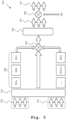
- the RGB input 301 represents the RGB input of the primary information channel and the RGB input 302 represents the RGB input of the secondary or auxiliary information channel.
- the primary information channel may correspond to the first source 101 and the auxiliary information channel may correspond to the second source 102. Alternately, the primary information channel may correspond to the second source 102 and the auxiliary information channel may correspond to the first source 101.
- the execution of the first source 101 and the second source 102 as the primary channel or the secondary channel depends on the application onto which the video pipeline 300 to be executed.
- the primary RGB input 301 and/or the auxiliary RGB input 302 is geometrically corrected, i.e., X-Y translation and rotational offset corrections. It is further preferable that the primary RGB input 301 and/or the auxiliary RGB input 302 is Gamma corrected.
- the primary RGB input 301 and the auxiliary RGB input are fed to a factor engine 303 that determines weighting factors A,B,C,...,N, based upon individual pixels or a cluster of neighboring pixels, in order to determine the amount of percentage of the pre-calculated color correction or manipulation matrices M1a,M1b,M1c,...,M1n.
- the matrices M1a,M1b,M1c,...,M1n are basically to be used for the calibration with a,b,c,...,n being an integer number.
- the matrices M1a,M1b,M1c,...,M1n can reside in the memory 104 or the computing device 103 may derive the matrices M1a,M1b,M1c,...,M1n in real-time from their original format.
- Mfinal denotes the final matrix, i.e., the output RGB stream to be displayed.
- generic pixel level corrections 309 for instance temperature compensation, are implemented onto the output RGB stream.
- the secondary video stream does not necessarily need to have the same resolution, nor the same frame rate in relation to the primary video stream.
- the readout is adapted by the computing device 103 (e.g. windowing by using an interpolation filter) to reflect the position of the particular pixel to be processed in the primary video stream.
- data from previous or current frame can be used.
- frame rate conversion, (scan conversion) and resolution scaling, rotation or any geometric correction on either primary or secondary channel are performed by the computing device 103 as well such that both video streams have the same prior to be used in the enhanced video pipeline 300.
- the system 100 or 200 may comprise an additional memory dedicated to the primary channel and/or the auxiliary channel.
- the computing device 103 may perform a comparison between the individual pixels in said images. If for a certain pixel in the image both secondary channel as well as primary channel have the same data, then the computing device 103 refrains from any further computation and utilizes the previous result from the previous frame calculation. This technique significantly reduces the overall computation time.
- the video pipeline 300 comprises an extra multiplier 308 at the end to compensate for these variations, whereby the multiplication factor is updated in certain relevant intervals.
- the temperature variation compensation can also be included by modifying the individual matrix elements, e.g. by the factor engine 303, in the proposed video pipeline 300 instead of multiplying it afterwards.
- the matrices M1a,M1b,M1c,...,M1n are ideally derived from measurement data, which can be multiple sets based on factory measurements using different viewing angles, current settings or any other parameter that has its influence on the color and brightness perception of a particular display. Given the current information on these parameters, the computing device 103 is configured to compute and alter the correction or calibration matrices M1a,M1b,M1c,...,M1n in real-time in order to reflect the changes based on the measurement sets.
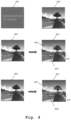
- a first exemplary implementation of the enhanced video pipeline 300 according to the first aspect of the invention is illustrated.
- the image 401 represents the information from the primary channel and the image 402 represents the information from the auxiliary channel, where the image 401 is to be superposed onto the image 402.
- the image 402 can be interpreted as the background seen by the camera and the image 401 can be interpreted as the foreground image or information to be shown on the goggle.
- the image 403 represents the superposed output of the images 401 and 402.
- the computing device 103 performs more or less emphasis toward more or less saturation.
- the computing device 103 may define, for instance, three matrices, one each respectively for red, green and blue as standard matrices to be used when the background color is white.
- the computing device 103 may use a fourth matrix for white on top of those three. In case background color is blue, another set of matrices is to be defined and the same is valid when background is red or green.
- the computing device 103 preferably performs background extraction wherein the brightness to show (being the matrix numbers) for a particular pixel is derived from subtraction of the background from the desired (foreground) pixel.
- the finally displayed pixel is then the residual value as the background already contains part of the (color brightness) information that is to be shown. Therefore, the correction factor in this case simple becomes a measure of the difference between background and foreground images.
- the computing device may use the auxiliary channel, e.g. camera, to see both foreground and background and can then perform analysis.
- the camera not only views the background, but also shows the image that is to be displayed, whereas the camera is now mounted in front of the goggle glasses (from the perspective of someone wearing such goggles).
- the matrices need to be build and precomputed, but outcome can be exactly the same as when the camera is mounted behind of or next to the goggle glasses (again from the perspective of someone wearing such goggles).
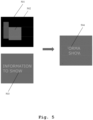
- a second exemplary implementation of the enhanced video pipeline 300 according to the first aspect of the invention is illustrated.
- the background 501 is used as color key, for instance as a green screen keying known in the art.
- the information to be shown 503 will only be shown if the background 501 has certain values of green 502.
- the resulting image is shown in the right 504.
- the illustrated color keying can be implemented for all kinds of colors, ranges and even discontinuous color ranges.
- the green screen background 502 is here the only location where primary information 503 from e.g. a data source channel is to be shown or with which it can be combined.
- FIG. 6A a third exemplary implementation of the enhanced video pipeline 300 according to the first aspect of the invention is illustrated.
- the image 601 represents the inputted image, either from a local or from an external data source, and the image 602 represents the manipulated image.
- This example particularly refers to visual aid for visibly impaired people.
- only the secondary information channel is used for real-time image processing. For example, in case one cannot see blue very well, these colors can be real-time adapted to for example more reddish and yellow shades.
- a fourth exemplary implementation of the enhanced video pipeline 300 according to the first aspect of the invention is illustrated.
- the image 603 represents the inputted image, either from a local or from an external data source, and the image 604 represents the manipulated image.
- the example generally illustrates a rudimentary edge detection scheme.
- it is needed to make use of clusters of pixels (rather than just individual pixels) in order to perform rudimentary edge detection, while using only the secondary information channel.
- the weighing factors A,B,C,...,N for a particular cluster are remembered for the next cluster and thus a limited set of factors is added or recalculated.
- the LEDs are now calibrated to target colors to be displayed, which are defined by specific standards, for example, NTSC, Adobe RGB, PAL, and so on.
- RonR means how much contribution of Red from the native LED needs to use in the desired (target) color of red.
- GonR mean how much green of the original LED color needs to be added to this red and so on.
- RinX GinX BinX RinY GinY BinY RinZ GinZ BinZ ⁇ RonR GonR BonR RtargX RtargY RtargZ
- RonR RonG RonB GonR GonG GonB BonR BonG BonB RinX GinX BinX RinY GinY BinY RinZ GinZ BinZ ⁇ 1 ⁇ RtargX GtargX BtargX RtargY GtargY BtargY RtargZ GtargZ BtargZ
- the brightness Y is normalized for all the targets to 1. Due to this, additional information can be added to not only set the LED calibrated colors to a target color, but to use the brightness of each individual target color to set the display to a fixed white point when all RGB colors are on.
- RX GX BX RY GY BY RZ GZ BZ ⁇ R G B WX WY WZ where, WX, WY, WZ is the white point.
- the RX,GX,... is in this case the target color matrix as these target colors and the brightness of the targets are required to get to the right white point. Therefore, the equation (5) needs to be solved for RGB.
- R G B RX GX BX RY GY BY RZ GZ BZ ⁇ 1 ⁇ WX WY WZ
- color perception of the human eye is most sensitive in x direction and less in y direction.
- luminance of colors is varied, it is proven that the human eye color perception changes.
- the least sensitive is the blue component. Best example to show this is to read a blue text in a black background. This is much more difficult compared to reading a red text on a black background.
- the human eye is also not sensitive to gradual luminance variations. Best example is e.g. a projector or beamer.
- the measured brightness in the corners is only 25% compared to the brightness in the center (100%). Humans will perceive this as uniform. Immediate differences in brightness will be perceived much faster (within tolerance limits) .
- the matrices are different for every individual RGB LED. The example below is explained using one LED.
- one matrix can be defined that is to be used when only blue needs to be shown (MBonly) and one matrix when blue is used whilst also showing green and red (MBmix).
- MBonly blue needs to be shown
- MBmix green and red
- Mfinal Factor ⁇ MBmix + 1 ⁇ Factor MBonly
- the following example relates to the scenario when only the information of the auxiliary channel is used.
- the factors A, B and C are NOT derived from the primary channel, but instead derived from the auxiliary channel.
- brightness emitted from the LEDs is compensated with the background information to get as close as possible to the intended color.
- RGBback Rn Bn Gn where, Rn,Bn,Gn numbers are normalized to values between 0 and 1.
- This natural background can be chosen arbitrary and is meant to set a reference. At this reference, colors to be displayed are not needed to be changed. Hence, by assuming the background equals Rn,Gn,Bn; the color to be displayed must remain untouched.
- This background influence factor sets the total influence of the background compared to the foreground.
- the background influence factor can be set as a percentage, e.g. 10%, which physically means that the foreground (i.e. the real picture to show) is 10 times brighter compared to the background. It is to be noted that the background influence factor may vary scene by scene or even frame by frame due to, for instance the presence of an Automatic gain control in cameras.
- ⁇ r Rprimary ⁇ Rauxiliary ⁇ Bif ⁇ Rauxiliary
- ref ⁇ g Gprimary ⁇ Gauxiliary ⁇ Bif ⁇ Gauxiliary
- ref ⁇ b Bprimary ⁇ Bauxiliary ⁇ Bif ⁇ Bauxiliary
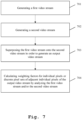
- a first video stream is generated.
- a second video stream is generated.
- the first video stream is superposed onto the second video stream in order to generate an output video stream.
- weighting factors for individual pixels or discrete pixel sets of adjacent individual pixels of the output video stream are calculated by analyzing the first video stream and/or the second video stream.
- the embodiments of the present invention can be implemented by hardware, software, or any combination thereof.
- Various embodiments of the present invention may be implemented by one or more application specific integrated circuits (ASICs), digital signal processors (DSPs), digital signal processing devices (DSPDs), programmable logic devices (PLDs), field programmable gate arrays (FPGAs), processors, controllers, microcontrollers, microprocessors, or the like.
- ASICs application specific integrated circuits
- DSPs digital signal processors
- DSPDs digital signal processing devices
- PLDs programmable logic devices
- FPGAs field programmable gate arrays
- processors controllers, microcontrollers, microprocessors, or the like.
Landscapes
- Engineering & Computer Science (AREA)
- Multimedia (AREA)
- Signal Processing (AREA)
- Physics & Mathematics (AREA)
- General Physics & Mathematics (AREA)
- Computer Hardware Design (AREA)
- Theoretical Computer Science (AREA)
- Geometry (AREA)
- Optics & Photonics (AREA)
- Image Processing (AREA)
- Control Of Indicators Other Than Cathode Ray Tubes (AREA)
Claims (11)
- Ein System (100) zur Vereinfachung einer verbesserten VideoPipeline, um die Farbwahrnehmung zu verbessern, wobei das System aufweist:eine erste Quelle (101), die zum Erzeugen eines ersten Videostroms (113) ausgebildet ist,eine zweite Quelle (102), die zum Erzeugen eines zweiten Videostroms (114) ausgebildet ist, undeine Rechenvorrichtung (103),wobei die Rechenvorrichtung (103) so ausgebildet ist, dass sie den ersten Videostrom (113) dem zweiten Videostrom (114) überlagert, wodurch sie einen Ausgabevideostrom (115) erzeugt, undwobei die Rechenvorrichtung (103) ferner so ausgebildet ist, dass sie für einzelne Pixel oder diskrete Pixelsätze benachbarter einzelner Pixel des Ausgabevideostroms (115) durch Analysieren des ersten Videostroms (113) und/oder des zweiten Videostroms (114) Gewichtungsfaktoren berechnet,dadurch gekennzeichnet, dassdas System ferner einen Speicher (104) aufweist, der so ausgebildet ist, dass er im Voraus berechnete Farbmanipulationsmatrizen (304) speichert, wobei die Rechenvorrichtung (103) ferner so ausgebildet ist, dass sie die Gewichtungsfaktoren verwendet, um den Prozentsatz der im Voraus berechneten Farbmanipulationsmatrizen (304) zu verwenden, um für den Ausgabevideostrom (115) eine endgültige Farbmatrix zu erhalten und um eine entsprechend geänderte Farbe zu erhalten.
- Das System nach Anspruch 1,
wobei die im Voraus berechneten Farbmanipulationsmatrizen (304) den XYZ-Farbräumen gemäß der Internationalen Beleuchtungskommission "CIE" entsprechen. - Das System nach Anspruch 1 oder 2,
wobei die Rechenvorrichtung (103) ferner so ausgebildet ist, dass sie für einzelne Pixel oder diskrete Pixelsätze benachbarter einzelner Pixel des zweiten Videostroms (114) Einflussfaktoren schätzt, und ferner so ausgebildet ist, dass sie die Gewichtungsfaktoren als eine Funktion der Einflussfaktoren realisiert. - Das System nach einem der Ansprüche 1 bis 3,
wobei die Rechenvorrichtung (103) ferner so ausgebildet ist, dass sie die Gewichtungsfaktoren in Echtzeit berechnet. - Das System nach einem der Ansprüche 1 bis 4,
wobei die Rechenvorrichtung (103) ferner so ausgebildet ist, dass sie an dem ersten Videostrom (113) und/oder dem zweiten Videostrom (114) eine Gammakorrektur durchführt. - Das System nach einem der Ansprüche 1 bis 5,
wobei die Rechenvorrichtung (103) ferner so ausgebildet ist, dass sie an dem ersten Videostrom (113) und/oder dem zweiten Videostrom (114) in der Ebene liegende Translations- und Rotationskorrekturen durchführt. - Das System nach einem der Ansprüche 1 bis 6,
wobei die Rechenvorrichtung (103) ferner so ausgebildet ist, dass sie an dem ersten Videostrom (113) und/oder dem zweiten Videostrom (114) eine Fensterung durchführt. - Das System nach einem der Ansprüche 1 bis 7,
wobei das System ferner eine Oberfläche (205) aufweist, auf die der Ausgabevideostrom (115) projiziert wird, und wobei optional der Ausgabevideostrom (115) über einen optischen Wellenleiter übertragen wird, wobei die Oberfläche (205) durch den Wellenleiter, vorzugsweise den holografischen Wellenleiter, wahrgenommen wird. - Ein Verfahren zum Steuern eines Systems, welches die Vereinfachung einer verbesserten Videopipeline ermöglicht, um die Farbwahrnehmung zu verbessern, wobei das System eine erste Quelle, eine zweite Quelle, einen Speicher und eine Rechenvorrichtung umfasst, wobei das Verfahren die folgenden Schritte aufweist:Erzeugen (701) eines ersten Videostroms (113) durch die erste Quelle (101),Erzeugen (702) eines zweiten Videostroms (114) durch die zweite Quelle (102),Überlagern (703) des ersten Videostroms (113) mit dem zweiten Videostrom (114) durch die Rechenvorrichtung (103), um einen Ausgabevideostrom (115) zu erzeugen, undBerechnen (704), durch Analysieren des ersten Videostroms (113) und/oder des zweiten Videostroms (114) durch die Rechenvorrichtung (103), von Gewichtungsfaktoren für einzelne Pixel oder diskrete Pixelsätze von benachbarten einzelnen Pixeln des Ausgabevideostroms (115),dadurch gekennzeichnet, dass das Verfahren ferner die folgenden Schritte aufweist:Speichern von im Voraus berechneten Farbmanipulationsmatrizen (304) in dem Speicher (104), undVerwenden, durch die Rechenvorrichtung, der Gewichtungsfaktoren, um den Prozentsatz der im Voraus berechneten Farbmanipulationsmatrizen (304) zu bestimmen, um für den Ausgabevideostrom (115) eine abschließende Farbmatrix zu erhalten und um eine entsprechend veränderte Farbe zu erhalten.
- Das Verfahren nach Anspruch 9,
wobei das Verfahren ferner den Schritt der Berechnung der Gewichtungsfaktoren in Echtzeit aufweist. - Das Verfahren nach Anspruch 9 oder 10,
wobei das Verfahren ferner die folgenden Schritte aufweist:Speichern des Ausgabevideostroms (115) in einem On-Chip-Speicher, um auf den Ausgabevideostrom (115) mit einer von der ersten Quelle (101) abweichenden Bildrate zuzugreifen, undDurchführen einer Spätphasen-Reprojektions-Funktion in Abhängigkeit von einer Eingabe einer externen Datenquelle, die eine Betrachterposition und/oder -bewegung und/oder einen Blickwinkel der Augen verfolgt.
Priority Applications (3)
| Application Number | Priority Date | Filing Date | Title |
|---|---|---|---|
| EP20207126.2A EP4002346B1 (de) | 2020-11-12 | 2020-11-12 | Video-pipeline-system und verfahren zur verbesserten farbwahrnehmung |
| US17/507,429 US11695907B2 (en) | 2020-11-12 | 2021-10-21 | Video pipeline system and method for improved color perception |
| CN202111331367.8A CN114500972A (zh) | 2020-11-12 | 2021-11-11 | 用于改善颜色感知的视频流水线系统和方法 |
Applications Claiming Priority (1)
| Application Number | Priority Date | Filing Date | Title |
|---|---|---|---|
| EP20207126.2A EP4002346B1 (de) | 2020-11-12 | 2020-11-12 | Video-pipeline-system und verfahren zur verbesserten farbwahrnehmung |
Publications (3)
| Publication Number | Publication Date |
|---|---|
| EP4002346A1 EP4002346A1 (de) | 2022-05-25 |
| EP4002346C0 EP4002346C0 (de) | 2025-03-05 |
| EP4002346B1 true EP4002346B1 (de) | 2025-03-05 |
Family
ID=73448785
Family Applications (1)
| Application Number | Title | Priority Date | Filing Date |
|---|---|---|---|
| EP20207126.2A Active EP4002346B1 (de) | 2020-11-12 | 2020-11-12 | Video-pipeline-system und verfahren zur verbesserten farbwahrnehmung |
Country Status (3)
| Country | Link |
|---|---|
| US (1) | US11695907B2 (de) |
| EP (1) | EP4002346B1 (de) |
| CN (1) | CN114500972A (de) |
Families Citing this family (14)
| Publication number | Priority date | Publication date | Assignee | Title |
|---|---|---|---|---|
| EP3705989A1 (de) | 2019-03-07 | 2020-09-09 | Stereyo BVBA | Echtzeitverformbare und transparente anzeige |
| EP4679407A3 (de) | 2019-06-07 | 2026-04-29 | Stereyo BV | Verfahren zur optimierung des dynamikbereichs eines led-bildschirms |
| KR102809085B1 (ko) * | 2021-04-13 | 2025-05-20 | 삼성디스플레이 주식회사 | 표시 장치 및 이를 이용한 표시 패널의 구동 방법 |
| US12425538B2 (en) | 2022-07-15 | 2025-09-23 | Stereyo Bv | Focused sound and infotainment system and method |
| US12455056B2 (en) | 2022-08-08 | 2025-10-28 | Stereyo Bv | Photovoltaic sunshade and display system |
| US12119330B2 (en) | 2022-12-19 | 2024-10-15 | Stereyo Bv | Configurations, methods, and devices for improved visual performance of a light-emitting element display and/or a camera recording an image from the display |
| US12112695B2 (en) | 2022-12-19 | 2024-10-08 | Stereyo Bv | Display systems and methods with multiple and/or adaptive primary colors |
| US12443384B2 (en) | 2022-12-19 | 2025-10-14 | Stereyo Bv | Display system and method for mapping of images |
| US12499820B2 (en) | 2022-12-19 | 2025-12-16 | Stereyo Bv | Systems and methods for altering light output and white point of a light source or light source display |
| US12080224B2 (en) | 2022-12-19 | 2024-09-03 | Stereyo Bv | Configurations, methods, and devices for improved visual performance of a light-emitting element display and/or a camera recording an image from the display |
| US12506923B2 (en) | 2022-12-19 | 2025-12-23 | Stereyo Bv | Video processing in modular display system and method |
| US12199079B2 (en) | 2022-12-19 | 2025-01-14 | Stereyo Bv | Configurations, methods, and devices for improved visual performance of a light-emitting element display and/or a camera recording an image from the display |
| US12185585B2 (en) | 2022-12-19 | 2024-12-31 | Stereyo Bv | Active matrix display, system, and method having an additional transistor that discharges a storage capacitor within pixel circuits, at least one pixel circuit driven by a drive circuit resides physical within another drive circuit, and/or off-to-on time of scan signals are set in relation to an operation of a camera recording the display |
| US12100363B2 (en) | 2022-12-19 | 2024-09-24 | Stereyo Bv | Configurations, methods, and devices for improved visual performance of a light-emitting element display and/or a camera recording an image from the display |
Citations (1)
| Publication number | Priority date | Publication date | Assignee | Title |
|---|---|---|---|---|
| US20180018793A1 (en) * | 2016-07-18 | 2018-01-18 | Samsung Electronics Co., Ltd. | Image display device and image display method |
Family Cites Families (20)
| Publication number | Priority date | Publication date | Assignee | Title |
|---|---|---|---|---|
| US6317128B1 (en) * | 1996-04-18 | 2001-11-13 | Silicon Graphics, Inc. | Graphical user interface with anti-interference outlines for enhanced variably-transparent applications |
| US5721792A (en) * | 1996-08-29 | 1998-02-24 | Sensormatic Electronics Corporation | Control of brightness of text/graphics overlay |
| JP4215038B2 (ja) * | 2005-09-16 | 2009-01-28 | セイコーエプソン株式会社 | 画像処理装置、画像処理方法、およびプログラム |
| US7720283B2 (en) | 2005-12-09 | 2010-05-18 | Microsoft Corporation | Background removal in a live video |
| US20120127198A1 (en) * | 2010-11-22 | 2012-05-24 | Microsoft Corporation | Selection of foreground characteristics based on background |
| JP2014172406A (ja) * | 2013-03-05 | 2014-09-22 | Funai Electric Co Ltd | ヘッドアップディスプレイ装置、ヘッドアップディスプレイ装置の表示方法およびヘッドアップディスプレイ装置のプログラム |
| US9946361B2 (en) * | 2014-08-14 | 2018-04-17 | Qualcomm Incorporated | Management for wearable display |
| US10043298B2 (en) * | 2014-09-30 | 2018-08-07 | Konica Minolta Laboratory U.S.A., Inc. | Enhanced document readability on devices |
| KR102262566B1 (ko) * | 2014-10-10 | 2021-06-07 | 엘지디스플레이 주식회사 | 투명 디스플레이 장치 |
| GB2532953A (en) * | 2014-12-02 | 2016-06-08 | Ibm | Overlay display |
| EP3029943B1 (de) * | 2014-12-04 | 2018-01-31 | Axis AB | Verfahren und Vorrichtung zur Bestimmung der Eigenschaften einer grafischen Überlagerung für einen Video-Stream |
| US10909949B2 (en) * | 2015-06-12 | 2021-02-02 | Avago Technologies International Sales Pte. Limited | System and method to provide high-quality blending of video and graphics |
| WO2017079329A1 (en) | 2015-11-04 | 2017-05-11 | Magic Leap, Inc. | Dynamic display calibration based on eye-tracking |
| JP2017142343A (ja) * | 2016-02-09 | 2017-08-17 | キヤノン株式会社 | 表示装置及び表示装置の制御方法 |
| ITUA20162920A1 (it) * | 2016-04-27 | 2017-10-27 | Consiglio Nazionale Ricerche | Metodo per correggere e/o attenuare difetti visivi dovuti ad una patologia degenerativa della retina e relativo sistema. |
| US10290110B2 (en) * | 2016-07-05 | 2019-05-14 | Intel Corporation | Video overlay modification for enhanced readability |
| EP3567469A1 (de) | 2018-05-08 | 2019-11-13 | Stereyo BVBA | Eigenständige modulare lichtemittierende elemente anzeige und verfahren dafür |
| CN112567736B (zh) * | 2018-08-03 | 2023-06-02 | 奇跃公司 | 用于显示设备的次网格校准的方法和系统 |
| EP3705989A1 (de) | 2019-03-07 | 2020-09-09 | Stereyo BVBA | Echtzeitverformbare und transparente anzeige |
| US11295497B2 (en) * | 2019-11-25 | 2022-04-05 | International Business Machines Corporation | Dynamic subtitle enhancement |
-
2020
- 2020-11-12 EP EP20207126.2A patent/EP4002346B1/de active Active
-
2021
- 2021-10-21 US US17/507,429 patent/US11695907B2/en active Active
- 2021-11-11 CN CN202111331367.8A patent/CN114500972A/zh active Pending
Patent Citations (1)
| Publication number | Priority date | Publication date | Assignee | Title |
|---|---|---|---|---|
| US20180018793A1 (en) * | 2016-07-18 | 2018-01-18 | Samsung Electronics Co., Ltd. | Image display device and image display method |
Also Published As
| Publication number | Publication date |
|---|---|
| CN114500972A (zh) | 2022-05-13 |
| EP4002346C0 (de) | 2025-03-05 |
| US20220150456A1 (en) | 2022-05-12 |
| EP4002346A1 (de) | 2022-05-25 |
| US11695907B2 (en) | 2023-07-04 |
Similar Documents
| Publication | Publication Date | Title |
|---|---|---|
| EP4002346B1 (de) | Video-pipeline-system und verfahren zur verbesserten farbwahrnehmung | |
| JP5273671B2 (ja) | 表示信号変換装置 | |
| US8681148B2 (en) | Method for correcting stereoscopic image, stereoscopic display device, and stereoscopic image generating device | |
| US7986291B2 (en) | Method of driving displays comprising a conversion from the RGB colour space to the RGBW colour space | |
| US20140267470A1 (en) | Color adjustment device, method for adjusting color, and display | |
| WO2018092465A1 (ja) | 表示装置 | |
| US20080198180A1 (en) | Method and Apparatus of Converting Signals for Driving Display and a Display Using the Same | |
| US11302288B2 (en) | Ambient saturation adaptation | |
| JP2002140038A (ja) | 透過型画像表示装置 | |
| EP2347571A2 (de) | Konstrastverstärkung von bildern | |
| CN113658559B (zh) | 显示器驱动装置及驱动方法 | |
| HK1198344A1 (zh) | 两种不同的多色显示之间感知的色彩匹配方法 | |
| Bodrogi et al. | Illumination, color and imaging: evaluation and optimization of visual displays | |
| TWI802628B (zh) | 圖像處理裝置、顯示裝置、圖像處理方法 | |
| US7907135B2 (en) | Image display and image displaying method for gradation correction | |
| US11605358B2 (en) | Liquid crystal display including two overlapping display panels that differ from each other in terms of the size of their respective display pixels | |
| CN117746808A (zh) | 显示校准方法、显示面板的校准系统和显示装置 | |
| JP5145658B2 (ja) | 画像信号処理装置及び画像表示装置 | |
| CN103986852A (zh) | 一种人眼视觉估计液晶显示器灰阶曲线的方法 | |
| EP1315142A1 (de) | An die umgebung angepasstes bildanzeigesystem, bildverarbeitungssystem und informationsträger | |
| JP2005172799A (ja) | ディスプレイ装置の光漏れ補償方法 | |
| JP4924009B2 (ja) | 画像処理装置 | |
| KR20120054458A (ko) | 색역 확장 방법 및 유닛과, 그를 이용한 광색역 표시 장치 | |
| JP2007324665A (ja) | 画像補正装置及び映像表示装置 | |
| EP4243006A1 (de) | Verfahren zur nichtlinearen kompensation bei anzeigeanwendungen |
Legal Events
| Date | Code | Title | Description |
|---|---|---|---|
| PUAI | Public reference made under article 153(3) epc to a published international application that has entered the european phase |
Free format text: ORIGINAL CODE: 0009012 |
|
| STAA | Information on the status of an ep patent application or granted ep patent |
Free format text: STATUS: THE APPLICATION HAS BEEN PUBLISHED |
|
| AK | Designated contracting states |
Kind code of ref document: A1 Designated state(s): AL AT BE BG CH CY CZ DE DK EE ES FI FR GB GR HR HU IE IS IT LI LT LU LV MC MK MT NL NO PL PT RO RS SE SI SK SM TR |
|
| STAA | Information on the status of an ep patent application or granted ep patent |
Free format text: STATUS: REQUEST FOR EXAMINATION WAS MADE |
|
| 17P | Request for examination filed |
Effective date: 20220727 |
|
| RBV | Designated contracting states (corrected) |
Designated state(s): AL AT BE BG CH CY CZ DE DK EE ES FI FR GB GR HR HU IE IS IT LI LT LU LV MC MK MT NL NO PL PT RO RS SE SI SK SM TR |
|
| STAA | Information on the status of an ep patent application or granted ep patent |
Free format text: STATUS: EXAMINATION IS IN PROGRESS |
|
| 17Q | First examination report despatched |
Effective date: 20230824 |
|
| GRAP | Despatch of communication of intention to grant a patent |
Free format text: ORIGINAL CODE: EPIDOSNIGR1 |
|
| STAA | Information on the status of an ep patent application or granted ep patent |
Free format text: STATUS: GRANT OF PATENT IS INTENDED |
|
| INTG | Intention to grant announced |
Effective date: 20241008 |
|
| GRAS | Grant fee paid |
Free format text: ORIGINAL CODE: EPIDOSNIGR3 |
|
| GRAA | (expected) grant |
Free format text: ORIGINAL CODE: 0009210 |
|
| STAA | Information on the status of an ep patent application or granted ep patent |
Free format text: STATUS: THE PATENT HAS BEEN GRANTED |
|
| AK | Designated contracting states |
Kind code of ref document: B1 Designated state(s): AL AT BE BG CH CY CZ DE DK EE ES FI FR GB GR HR HU IE IS IT LI LT LU LV MC MK MT NL NO PL PT RO RS SE SI SK SM TR |
|
| REG | Reference to a national code |
Ref country code: GB Ref legal event code: FG4D |
|
| REG | Reference to a national code |
Ref country code: CH Ref legal event code: EP |
|
| REG | Reference to a national code |
Ref country code: DE Ref legal event code: R096 Ref document number: 602020047117 Country of ref document: DE |
|
| REG | Reference to a national code |
Ref country code: IE Ref legal event code: FG4D |
|
| U01 | Request for unitary effect filed |
Effective date: 20250312 |
|
| U07 | Unitary effect registered |
Designated state(s): AT BE BG DE DK EE FI FR IT LT LU LV MT NL PT RO SE SI Effective date: 20250320 |
|
| PG25 | Lapsed in a contracting state [announced via postgrant information from national office to epo] |
Ref country code: RS Free format text: LAPSE BECAUSE OF FAILURE TO SUBMIT A TRANSLATION OF THE DESCRIPTION OR TO PAY THE FEE WITHIN THE PRESCRIBED TIME-LIMIT Effective date: 20250605 |
|
| PG25 | Lapsed in a contracting state [announced via postgrant information from national office to epo] |
Ref country code: ES Free format text: LAPSE BECAUSE OF FAILURE TO SUBMIT A TRANSLATION OF THE DESCRIPTION OR TO PAY THE FEE WITHIN THE PRESCRIBED TIME-LIMIT Effective date: 20250305 |
|
| PG25 | Lapsed in a contracting state [announced via postgrant information from national office to epo] |
Ref country code: NO Free format text: LAPSE BECAUSE OF FAILURE TO SUBMIT A TRANSLATION OF THE DESCRIPTION OR TO PAY THE FEE WITHIN THE PRESCRIBED TIME-LIMIT Effective date: 20250605 |
|
| PG25 | Lapsed in a contracting state [announced via postgrant information from national office to epo] |
Ref country code: HR Free format text: LAPSE BECAUSE OF FAILURE TO SUBMIT A TRANSLATION OF THE DESCRIPTION OR TO PAY THE FEE WITHIN THE PRESCRIBED TIME-LIMIT Effective date: 20250305 |
|
| PG25 | Lapsed in a contracting state [announced via postgrant information from national office to epo] |
Ref country code: GR Free format text: LAPSE BECAUSE OF FAILURE TO SUBMIT A TRANSLATION OF THE DESCRIPTION OR TO PAY THE FEE WITHIN THE PRESCRIBED TIME-LIMIT Effective date: 20250606 |
|
| PG25 | Lapsed in a contracting state [announced via postgrant information from national office to epo] |
Ref country code: SM Free format text: LAPSE BECAUSE OF FAILURE TO SUBMIT A TRANSLATION OF THE DESCRIPTION OR TO PAY THE FEE WITHIN THE PRESCRIBED TIME-LIMIT Effective date: 20250305 |
|
| PG25 | Lapsed in a contracting state [announced via postgrant information from national office to epo] |
Ref country code: PL Free format text: LAPSE BECAUSE OF FAILURE TO SUBMIT A TRANSLATION OF THE DESCRIPTION OR TO PAY THE FEE WITHIN THE PRESCRIBED TIME-LIMIT Effective date: 20250305 |
|
| PG25 | Lapsed in a contracting state [announced via postgrant information from national office to epo] |
Ref country code: CZ Free format text: LAPSE BECAUSE OF FAILURE TO SUBMIT A TRANSLATION OF THE DESCRIPTION OR TO PAY THE FEE WITHIN THE PRESCRIBED TIME-LIMIT Effective date: 20250305 |
|
| PG25 | Lapsed in a contracting state [announced via postgrant information from national office to epo] |
Ref country code: SK Free format text: LAPSE BECAUSE OF FAILURE TO SUBMIT A TRANSLATION OF THE DESCRIPTION OR TO PAY THE FEE WITHIN THE PRESCRIBED TIME-LIMIT Effective date: 20250305 |
|
| PG25 | Lapsed in a contracting state [announced via postgrant information from national office to epo] |
Ref country code: IS Free format text: LAPSE BECAUSE OF FAILURE TO SUBMIT A TRANSLATION OF THE DESCRIPTION OR TO PAY THE FEE WITHIN THE PRESCRIBED TIME-LIMIT Effective date: 20250705 |
|
| U20 | Renewal fee for the european patent with unitary effect paid |
Year of fee payment: 6 Effective date: 20251125 |
|
| PLBE | No opposition filed within time limit |
Free format text: ORIGINAL CODE: 0009261 |
|
| STAA | Information on the status of an ep patent application or granted ep patent |
Free format text: STATUS: NO OPPOSITION FILED WITHIN TIME LIMIT |
|
| REG | Reference to a national code |
Ref country code: CH Ref legal event code: L10 Free format text: ST27 STATUS EVENT CODE: U-0-0-L10-L00 (AS PROVIDED BY THE NATIONAL OFFICE) Effective date: 20260114 |
|
| 26N | No opposition filed |
Effective date: 20251208 |