EP4002368A1 - Speicherdatenauffrischungsverfahren und steuerung dafür sowie speicher - Google Patents
Speicherdatenauffrischungsverfahren und steuerung dafür sowie speicher Download PDFInfo
- Publication number
- EP4002368A1 EP4002368A1 EP21769324.1A EP21769324A EP4002368A1 EP 4002368 A1 EP4002368 A1 EP 4002368A1 EP 21769324 A EP21769324 A EP 21769324A EP 4002368 A1 EP4002368 A1 EP 4002368A1
- Authority
- EP
- European Patent Office
- Prior art keywords
- refreshing
- row
- data
- memory
- reserved
- Prior art date
- Legal status (The legal status is an assumption and is not a legal conclusion. Google has not performed a legal analysis and makes no representation as to the accuracy of the status listed.)
- Ceased
Links
Images




Classifications
-
- G—PHYSICS
- G11—INFORMATION STORAGE
- G11C—STATIC STORES
- G11C11/00—Digital stores characterised by the use of particular electric or magnetic storage elements; Storage elements therefor
- G11C11/21—Digital stores characterised by the use of particular electric or magnetic storage elements; Storage elements therefor using electric elements
- G11C11/34—Digital stores characterised by the use of particular electric or magnetic storage elements; Storage elements therefor using electric elements using semiconductor devices
- G11C11/40—Digital stores characterised by the use of particular electric or magnetic storage elements; Storage elements therefor using electric elements using semiconductor devices using transistors
- G11C11/401—Digital stores characterised by the use of particular electric or magnetic storage elements; Storage elements therefor using electric elements using semiconductor devices using transistors forming cells needing refreshing or charge regeneration, i.e. dynamic cells
- G11C11/406—Management or control of the refreshing or charge-regeneration cycles
- G11C11/40603—Arbitration, priority and concurrent access to memory cells for read/write or refresh operations
-
- G—PHYSICS
- G11—INFORMATION STORAGE
- G11C—STATIC STORES
- G11C11/00—Digital stores characterised by the use of particular electric or magnetic storage elements; Storage elements therefor
- G11C11/21—Digital stores characterised by the use of particular electric or magnetic storage elements; Storage elements therefor using electric elements
- G11C11/34—Digital stores characterised by the use of particular electric or magnetic storage elements; Storage elements therefor using electric elements using semiconductor devices
- G11C11/40—Digital stores characterised by the use of particular electric or magnetic storage elements; Storage elements therefor using electric elements using semiconductor devices using transistors
- G11C11/401—Digital stores characterised by the use of particular electric or magnetic storage elements; Storage elements therefor using electric elements using semiconductor devices using transistors forming cells needing refreshing or charge regeneration, i.e. dynamic cells
- G11C11/406—Management or control of the refreshing or charge-regeneration cycles
- G11C11/40611—External triggering or timing of internal or partially internal refresh operations, e.g. auto-refresh or CAS-before-RAS triggered refresh
-
- G—PHYSICS
- G11—INFORMATION STORAGE
- G11C—STATIC STORES
- G11C11/00—Digital stores characterised by the use of particular electric or magnetic storage elements; Storage elements therefor
- G11C11/21—Digital stores characterised by the use of particular electric or magnetic storage elements; Storage elements therefor using electric elements
- G11C11/34—Digital stores characterised by the use of particular electric or magnetic storage elements; Storage elements therefor using electric elements using semiconductor devices
- G11C11/40—Digital stores characterised by the use of particular electric or magnetic storage elements; Storage elements therefor using electric elements using semiconductor devices using transistors
- G11C11/401—Digital stores characterised by the use of particular electric or magnetic storage elements; Storage elements therefor using electric elements using semiconductor devices using transistors forming cells needing refreshing or charge regeneration, i.e. dynamic cells
- G11C11/406—Management or control of the refreshing or charge-regeneration cycles
- G11C11/40618—Refresh operations over multiple banks or interleaving
-
- G—PHYSICS
- G11—INFORMATION STORAGE
- G11C—STATIC STORES
- G11C11/00—Digital stores characterised by the use of particular electric or magnetic storage elements; Storage elements therefor
- G11C11/21—Digital stores characterised by the use of particular electric or magnetic storage elements; Storage elements therefor using electric elements
- G11C11/34—Digital stores characterised by the use of particular electric or magnetic storage elements; Storage elements therefor using electric elements using semiconductor devices
- G11C11/40—Digital stores characterised by the use of particular electric or magnetic storage elements; Storage elements therefor using electric elements using semiconductor devices using transistors
- G11C11/401—Digital stores characterised by the use of particular electric or magnetic storage elements; Storage elements therefor using electric elements using semiconductor devices using transistors forming cells needing refreshing or charge regeneration, i.e. dynamic cells
- G11C11/406—Management or control of the refreshing or charge-regeneration cycles
- G11C11/40622—Partial refresh of memory arrays
-
- G—PHYSICS
- G11—INFORMATION STORAGE
- G11C—STATIC STORES
- G11C2211/00—Indexing scheme relating to digital stores characterized by the use of particular electric or magnetic storage elements; Storage elements therefor
- G11C2211/401—Indexing scheme relating to cells needing refreshing or charge regeneration, i.e. dynamic cells
- G11C2211/406—Refreshing of dynamic cells
- G11C2211/4065—Low level details of refresh operations
Definitions
- a dynamic random access memory As a semiconductor memory, a dynamic random access memory (DRAM for short) is widely used in various electronic products because of its high efficiency and low cost.
- the DRAM is composed of a transistor and a capacitor, and a basic storage unit of each DRAM stores data depending on the electric quantity of the capacitor.
- the data stored in the DRAM is identified by sensing the electric quantity of the capacitor in the DRAM. Since the capacitor may leak electricity through the transistor, the electric quantity of the capacitor may be gradually reduced, and if the capacitor is not charged in time, a storage error of the data in the DRAM may be caused. Therefore, in order to ensure the accuracy of the data in the DRAM, the basic storage unit of the DRAM needs to be periodically charged, which is called DRAM refreshing.
- the DRAM refreshing may maintain the correctness of the data in the DRAM.
- the method may further include: a fine granularity refreshing mode is acquired.
- the fine granularity refreshing mode may be a mode of grouping the data row and sequentially refreshing groups.
- the operation that the first reserved row in the target refreshing row is refreshed may include: the target refreshing row is grouped based on the fine granularity refreshing mode to acquire a plurality of refreshing groups; the plurality of refreshing groups are sequentially refreshed.
- the target refreshing row is grouped based on the fine granularity refreshing mode to acquire the plurality of refreshing groups, and then the plurality of refreshing groups are sequentially refreshed.
- the refreshing group which does not include the first reserved row will not be refreshed, and therefore refreshing consumption of the memory will not be caused.
- the data row of the refreshing group including the first reserved row will be refreshed according to the method of refreshing the first reserved row, so that the refreshing consumption of the memory also will not be caused.
- the data refreshing of the memory is performed by adopting the method of the operation S202 based on the fine granularity refreshing mode, since the refreshing is performed in groups, the data access to the memory may still be executed, and the problem of data access delay in the data refreshing process of the memory is avoided.
- the operation that the target refreshing row in the data row of the memory is determined according to the running state of a controller may include: in response to determining that the running state of the controller is running, a data row with arrived refreshing time in part of the data rows of the memory is determined to be the target refreshing row.
- the operation that the first reserved row in the target refreshing row is refreshed may include: the target refreshing row is grouped based on the intermittent refreshing mode to acquire a plurality of refreshing groups; the plurality of refreshing groups are refreshed according to the period of time; the refreshing according to the period of time may perform the data access to the memory when the refreshing group is not refreshed or when the refreshing group is refreshed, so that the data access delay will not be caused.
- the method may further include: in response to determining that a second refreshing interval expires, a second reserved row is refreshed; the second reserved row may be a data row with the data storage duration greater than or equal to the preset duration in the memory; and the second refreshing interval may be a refreshing interval of the second reserved row.
- the method may further include: in response to determining that the target refreshing row does not include the first reserved row and a second refreshing interval expires, a second reserved row is refreshed.
- the second reserved row may be a data row with the data storage duration greater than or equal to the preset duration in the memory.
- the second refreshing interval may be a refreshing interval of the second reserved row.
- the determining module may specifically be configured to determine a data row with arrived corresponding refreshing time in all the data rows of the memory to be the target refreshing row in response to determining that the running state of the controller is non-running.
- the controller may further include an acquiring module.
- the acquiring module may be configured to acquire a fine granularity refreshing mode.
- the fine granularity refreshing mode may be a mode of grouping the data row and sequentially refreshing groups.
- the refreshing module may specifically be configured to group the target refreshing row based on the fine granularity refreshing mode to acquire a plurality of refreshing groups, and sequentially refresh the plurality of refreshing groups.
- the determining module may specifically be configured to determine a data row with arrived refreshing time in part of the data rows of the memory to be the target refreshing row in response to determining that the running state of the controller is running.
- the refreshing module may further be configured to refresh the first reserved row and a second reserved row at same time in response to determining that the first refreshing interval and a second refreshing interval expire at the same time.
- the second reserved row may be a data row with the data storage duration greater than or equal to the preset duration in the memory.
- the second refreshing interval may be a refreshing interval of the second reserved row.
- the refreshing module may further be configured to refresh a second reserved row in response to determining that the target refreshing row does not include the first reserved row and a second refreshing interval expires.
- the second reserved row may be a data row with the data storage duration greater than or equal to the preset duration in the memory.
- the second refreshing interval may be a refreshing interval of the second reserved row.
- the memory may include a refreshing timer.
- the refreshing timer may be configured to identify whether each data row has been processed.
- the disclosure discloses a memory, which includes a controller and a plurality of storage units.
- the storage unit includes a plurality of data rows.
- the storage unit is configured to store data.
- the controller is configured to execute the method in the first aspect.
- the data refreshing method of a memory disclosed by the disclosure includes that a target refreshing row in a data row of the memory is determined according to a running state of the controller; and if a first refreshing interval expires and the target refreshing row includes a first reserved row, the first reserved row in the target refreshing row is refreshed.
- the first reserved row is a data row with data storage duration smaller than preset duration in the memory.
- the first refreshing interval is a refreshing interval of the first reserved row.
- the data row with the data storage duration smaller than the preset duration in the target refreshing row will be preferentially refreshed, while the data row of the data storage duration is greater than the preset duration may still be accessed, so that the problem of access delay in a DRAM refreshing process is avoided.
- the data refreshing of the memory is executed separately, that is, the data of the memory is controlled to be refreshed in stages through setting of different refreshing intervals, compared with the conventional solution that all basic storage units are refreshed and stored with the lowest refreshing period each time when the DRAM is refreshed, the method provided by the disclosure may also solve the problem of serious energy consumption in the DRAM refreshing process.
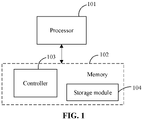
- FIG. 1 is a structural schematic diagram of a computer apparatus.
- the computer apparatus includes a processor 101 and a memory 102.
- the processor 101 is connected/coupled to a controller 103 and may access the memory 102 through the controller 103.
- the processor 101 may be a multi-core processor.
- the processor 101 executes programs of system software (such as an operating system and/or system firmware, for example, a basic input/output system, extensible firmware, or the like), a utility tool, an application program, and the like.
- the programs and data required in an execution process of the processor 101 are stored in the memory 102.
- the memory 102 includes the controller 103 and a storage module 104.
- the controller 103 is configured to control read and write of the data.
- the storage module 104 is configured to store the data.
- the storage module 104 may include one or more storage units.
- a dynamic random access memory is a common semiconductor memory and is widely used in various electronic products due to its high efficiency and low cost.
- the DRAM includes a transistor and a capacitor, and a basic storage unit of each DRAM stores data depending on the electric quantity of the capacitor.
- the data stored in the DRAM is identified by sensing the electric quantity of the capacitor in the DRAM. Since the capacitor may leak electricity through the transistor, the electric quantity of the capacitor may be gradually reduced, and if the capacitor is not charged in time, a storage error of the data in the DRAM may be caused. Therefore, in order to ensure the accuracy of the data stored in the DRAM, the basic storage unit of the DRAM needs to be periodically charged, which is called DRAM refreshing.
- the DRAM refreshing may maintain the correctness of the data in the DRAM.
- DRAM refreshing is executed before data access. That is, when the DRAM refreshing is performed, the data access cannot be performed until the DRAM refreshing is completed. This causes certain delay in the data access to the DRAM. In particular, when it is urgent to store data into or read data from the DRAM, it is necessary to wait until the DRAM is refreshed before data access may be performed, which brings great inconvenience to data access.
- the data storing time of most of the basic storage units in the DRAM is greater than 64ms, and only the data storing time of a very small part of the basic storage units is relatively short.
- all the basic storage units are refreshed and stored with the lowest refreshing period, that is, the basic storage unit with data storing time smaller than or equal to 64ms, the basic storage unit with the data storing time greater than 64ms and smaller than or equal to 128ms, and the basic storage unit with the data storing time greater than 128ms and smaller than or equal to 256ms are refreshed and stored with the lowest refreshing period, for example, 64ms.
- the disclosure provides a data refreshing method of a memory, a controller of a memory, and a memory.
- the data refreshing method of a memory is applied to the controller.
- the controller is configured to control the memory to perform data refreshing and data access.
- to-be-refreshed data in a to-be-refreshed data row is divided into a first reserved row, and the first reserved row refers to a data row with data storage duration smaller than preset duration in the memory.
- the first reserved row is refreshed preferentially without refreshing the whole data row, so that unnecessary refreshing is avoided, and the problem of serious energy consumption upon data refreshing in the memory is solved.
- data which is not refreshed may still be accessed, and the problem of data access delay upon the data refreshing in the memory is solved.
- the disclosure provides a data refreshing method of a memory, applied to a controller.
- the controller is configured to control the memory to perform data refreshing and data access.
- the method includes as follows.
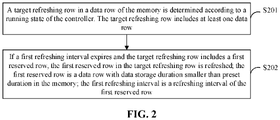
- a target refreshing row in a data row of the memory is determined according to a running state of the controller.
- the target refreshing row includes at least one data row.
- the controller is set in the memory.
- the running state of the controller may include running or non-running.
- the target refreshing row is a to-be-refreshed data row. Being to-be-refreshed refers to arrival of refreshing time of the data row.
- the target refreshing row includes at least one data row.
- a refreshing mode of the target refreshing row needs to be determined according to the running state of the controller.
- the refreshing mode may include sequential refreshing of all the data rows in the memory or synchronous refreshing of data rows which need to be refreshed in all the data rows in the memory.
- the refreshing mode may also include, for example, grouping all the data rows in the memory and refreshing all the data rows based on the grouping.
- the target refreshing row includes a first reserved row
- the first reserved row in the target refreshing row is refreshed.
- the first reserved row is a data row with data storage duration smaller/less than preset duration in the memory.
- the first refreshing interval is a refreshing interval of the first reserved row.
- the refreshing interval of each data row in the memory is set by a refreshing countdown timer.
- the refreshing countdown timer sets a first refreshing interval on each data row.
- the first refreshing interval is the refreshing interval of the first reserved row. That is, after the first refreshing interval expires, if the target refreshing row includes the first reserved row, the first reserved row in the target refreshing row is refreshed. At this time, the data with the storage duration smaller than the preset duration in the target refreshing row is refreshed, and the rest of the data is not refreshed and may still be read.
- Whether the target refreshing row includes the first reserved row is specifically determined as follows: before a refreshing program of the memory is formally run, a worker tests and acquires the data storage duration of the data in the storage unit, and records an address row/data row of the data in the storage unit with the data storage duration smaller than the preset duration to the controller.
- the address row/data row with the data storage duration smaller than the preset duration belongs to the first reserved row or may be marked as the first reserved row. For example, when the preset duration is 256ms, the address row/data row of the data in the storage unit with the data storage duration smaller than 256ms is recorded to the controller.
- the address row/data row with the data storage duration smaller than 256ms may be marked as the first reserved row.
- the controller controls the memory to perform data refreshing
- matching needs to be performed according to the first reserved row stored in the controller and the target refreshing row in the memory. If the matching is successful, it is determined that the target refreshing row includes the first reserved row.
- the matching means that the controller determines whether the data row belonging to the first reserved row exists in the target refreshing row.
- the data refreshing method of a memory provided by the embodiment, after the target refreshing row is determined, if a first refreshing interval of the target refreshing row expires and the target refreshing row includes the first reserved row, the first reserved row in the target refreshing row is refreshed. At this time, since only the data with the data storage duration smaller than the preset duration in the target refreshing row is refreshed, while the data with the data storage duration greater than or equal to the preset duration is not refreshed. The data with the data storage duration greater than or equal to the preset duration may still be read, and the problem of data access delay in a DRAM refreshing process in the related art is solved.
- operation S201 includes as follows.
- a data row with arrived corresponding refreshing time in all the data rows of the memory is determined to be the target refreshing row.
- the non-running means that the controller does not need to access the data in the memory.
- all the data rows in the memory need to be processed.
- the one data row is locked as the target refreshing row.
- the corresponding refreshing time of a plurality of data rows in all the data rows may arrive at the same time, if the corresponding refreshing time of at least two data rows in all the data rows arrives, the at least two data rows are locked as the target refreshing row.
- all the data rows of the memory may include four data rows in total.
- the four data rows are named here as a first data row, a second data row, a third data row, and a fourth data row, respectively. If the refreshing time of the first data row arrives and the refreshing time of the second data row, the third data row and the fourth data row does not arrive, the first data row is the target refreshing row. If the refreshing time of the first data row and the third data row arrives and the refreshing time of the second data row and the fourth data row does not arrive, the first data row and the third data row are the target refreshing row.
- the data refreshing method of a memory further includes as follows.
- the fine granularity refreshing mode is a mode of grouping the data row and sequentially refreshing groups.
- the fine granularity refreshing mode is acquired.
- the memory may, in response to a single refreshing command, refresh the data in the memory in 1x mode, 2x mode, and 4x mode, respectively.
- the controller may respond to the refreshing command.
- the controller may control the memory to perform data refreshing in the 1x mode, the data refreshing in the 2x mode, or the data refreshing in the 4x mode upon the data refreshing.
- the operation that the first reserved row in the target refreshing row is refreshed includes as follows.
- the target refreshing row is grouped based on the fine granularity refreshing mode to acquire a plurality of refreshing groups.
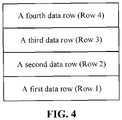
- the target data row includes four rows in total.
- the four data rows are refreshed as one refreshing group, that is, the first data row, the second data row, the third data row and the fourth data row are refreshed as one refreshing group.
- the four data rows are refreshed in the 2x mode, the four data rows are divided into two groups, each group includes two data rows, and then the four data rows are sequentially refreshed in groups, that is, the first data row and the second data row are refreshed as one refreshing group, and the third data row and the fourth data row are refreshed as one refreshing group.
- the four data rows are divided into four groups, each group includes one data row, and then the four data rows are sequentially refreshed in groups, that is, the first data row is refreshed as one refreshing group, the second data row is refreshed as one refreshing group, the third data row is refreshed as one refreshing group, and the fourth data row is refreshed as one refreshing group.
- the plurality of refreshing groups are sequentially refreshed.
- Each refreshing group may include the first reserved row and may also include no first reserved row. If one refreshing group includes the first reserved row, the one refreshing group needs to be refreshed. If another refreshing group does not include the first reserved row, the another refreshing group does not need to be refreshed. After the another refreshing group is marked as processed, the next refreshing group is processed. For example, in FIG. 4 , when the four data rows are refreshed in the 4x mode, if the first data row includes the first reserved row, the first data row is refreshed. If the second data row does not include the first reserved row, the second data row does not need to be refreshed, and the third data row is processed. As further shown in FIG.
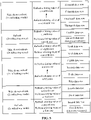
- the target data row includes 16 rows: a first data row, a second data row, a third data row, a fourth data row, a fifth data row, ... a fifteenth data row, and a sixteenth data row in sequence.
- the 16 rows of data may be sequentially refreshed in the 1x mode and the 2x mode, respectively.
- the first data row, the second data row, the third data row, and the fourth data row are refreshed in the 2x mode. If the first data row includes the first reserved row, the first data row and the second data row are refreshed.
- the refreshing group including the third data row and the fourth data row is not refreshed, that is, the refreshing group is skipped and is not refreshed.
- the fifth data row, the sixth data row, the seventh data row, and the eighth data row are taken as one refreshing group and are refreshed in the 1x mode.
- the refreshing group including the fifth data row, the sixth data row, the seventh data row and the eighth data row is not refreshed.
- the ninth data row and the tenth data row are processed next, the ninth data row and the tenth data row are taken as one refreshing group and are refreshed in the 2x mode.
- the ninth data row and the tenth data row do not include the first reserved row, the ninth data row and the tenth data row are not refreshed.
- the eleventh data row and the twelfth data row are processed next, the eleventh data row, and the twelfth data row are taken as one refreshing group and are refreshed in the 2x mode. If the eleventh data row and the twelfth data row include the first reserved row, and the one refreshing group including the eleventh data row and the twelfth data row is refreshed.
- the thirteenth data row, the fourteenth data row, the fifteenth data row, and the sixteenth data row are taken as one refreshing group and are refreshed in the 1x mode. If the fourteenth data row and the sixteenth data row include the first reserved row, the one refreshing group including the thirteenth data row, the fourteenth data row, the fifteenth data row and the sixteenth data row is refreshed.
- Each refreshing group is provided with the first refreshing interval, after the first refreshing interval expires, whether the refreshing group includes the first reserved row needs to be determined, and if so, the data row in the refreshing group is refreshed.
- the target data row is grouped based on the fine granularity refreshing mode to acquire the plurality of refreshing groups, and then the plurality of refreshing groups are sequentially refreshed.
- the refreshing group which does not include the first reserved row will not be refreshed, and therefore refreshing consumption of the memory will not be caused.
- the data row of the refreshing group including the first reserved row will be refreshed according to the method of refreshing the first reserved row, so that the refreshing consumption of the memory also will not be caused.
- the data refreshing of the memory is performed by adopting the method at S202 based on the fine granularity refreshing mode, since the refreshing is performed in groups, the data access to the memory may still be executed, and the problem of data access delay in the data refreshing process of the memory is avoided.
- the method provided by the embodiment can solve the problem of excessive loss of the memory in data refresh.
- operation S201 includes as follows.
- a data row with arrived refreshing time in part of the data rows of the memory is determined to be the target refreshing row.
- the running means that the controller needs to access the data in the memory.
- the part of the data rows are randomly selected data rows.
- the controller When the controller is running, the part of the data rows in the memory need to be processed. If the corresponding refreshing time of one data row in the part of the data rows arrives, the one data row is locked as the target refreshing row.
- the corresponding refreshing time of a plurality of data rows in the part of the data rows may arrive at the same time, if the corresponding refreshing time of at least two data rows in the part of the data rows arrives, the at least two data rows are locked as the target refreshing row.
- the data refreshing method of a memory further includes as follows.
- an intermittent refreshing mode is acquired.
- the intermittent refreshing mode is a mode of grouping part of the data rows and refreshing each group according to a period of time.
- part of the data rows in the memory are divided into eight refreshing groups: a first refreshing group, a second refreshing group, a third refreshing group, a fourth refreshing group, a fifth refreshing group, a sixth refreshing group, a seventh refreshing group and an eighth refreshing group in sequence.
- the eight refreshing groups are refreshed, those groups do not need to be refreshed sequentially.
- the first refreshing group, the second refreshing group, and the seventh refreshing group are randomly selected as the target refreshing rows, and the first refreshing group, the second refreshing group, and the seventh refreshing group are refreshed according to the period of time.
- the operation that the first reserved row in the target refreshing row is refreshed includes as follows.
- the target data row is grouped based on the intermittent refreshing mode to acquire a plurality of refreshing groups.
- part of the data rows in the memory are divided into the eight refreshing groups: the first refreshing group, the second refreshing group, the third refreshing group, the fourth refreshing group, the fifth refreshing group, the sixth refreshing group, the seventh refreshing group and the eighth refreshing group in sequence.
- the plurality of refreshing groups are refreshed according to the period of time.
- the refreshing according to the period of time may perform the data access to the memory when the refreshing group is not refreshed or when the refreshing group is refreshed, so that the data access delay will not be caused.
- the refreshing is performed according to the period of time based on operation S202, energy consumption of the memory upon the data refreshing will be reduced.
- the data refreshing method of a memory further includes as follows.
- a second reserved row is refreshed.
- the second reserved row is a data row with data storage duration greater than or equal to preset duration in the memory.
- the second refreshing interval is a refreshing interval of the second reserved row.
- the preset duration may be set according to an actual requirement of the memory, for example, the preset duration may be set as 64ms, or 128ms, or 256ms. For example, if the preset duration is 64ms, the data row with the data storage duration greater than or equal to 64ms in the memory is the second reserved row. If the preset duration is 256ms, the data row with the data storage duration greater than or equal to 256ms in the memory is the second reserved row. When the first reserved row and the second reserved row exist at the same time, if the first refreshing interval expires, the first reserved row is refreshed first; and when the second refreshing interval expires, the second reserved row is refreshed.
- the first reserved row in the refreshing group is refreshed first when the first refreshing interval in the refreshing group expires, and after the second refreshing interval in the refreshing group expires, the second reserved row in the refreshing group is refreshed, thereby finishing refreshing the refreshing group.
- the data refreshing method of a memory further includes as follows.
- the second reserved row is the data row with the data storage duration greater than or equal to the preset duration in the memory.
- the second refreshing interval is the refreshing interval of the second reserved row.
- the first reserved row and the second reserved row are refreshed at the same time.
- the embodiment is suitable for the case that the first refreshing interval and the second refreshing interval expire at the same time; and if the first refreshing interval and the second refreshing interval do not expire at the same time, the first reserved row is preferentially refreshed when the first refreshing interval expires.
- the data refreshing method of a memory further includes as follows.
- the second reserved row is the data row with the data storage duration greater than or equal to the preset duration in the memory.
- the second refreshing interval is the refreshing interval of the second reserved row.
- the target refreshing row does not include the first reserved row
- the second reserved row is refreshed after the second refreshing interval expires.
- the target data row including the first reserved row is refreshed first.
- the refreshing group which does not include the first reserved row is refreshed.
- the second reserved row is refreshed on the basis that the second refreshing interval expires, that is, the refreshing group itself which does not include the first reserved row is refreshed. For example, as illustrated in FIG.
- the refreshing group including the first data row and the second data row includes the first reserved row
- the refreshing group in which the first data row and the second data row are located is refreshed according to operation S202.
- the refreshing group which does not include the first reserved row and only includes the second reserved row is refreshed.
- the second reserved row is refreshed according to expiration time of the second refreshing interval.
- the memory includes a refreshing timer.
- the refreshing timer is configured to identify whether each data row has been processed.
- the refreshing timer is set on the memory.
- the refreshing timer may mark a timing value on each data row. If the data row has been processed, no matter the data row is refreshed, the timing value on the data row will be increased to identify that the data row has been processed.
- the processing means whether the data row includes the first reserved row is determined first, and if so, the data row is refreshed after the first refreshing interval expires. If the data row does not include the first reserved row and only includes the second reserved row, the processing means whether the data row includes the first reserved row is determined, but the data row is not refreshed. At this time, the timing value of the data row is increased to identify that the data row has been processed.
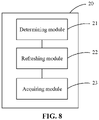
- the disclosure further provides a controller 20 of a memory 10.
- the controller 20 is configured to control the memory to perform data refreshing and data access.
- the method includes a determining module 21 and a refreshing module 22.
- the determining module 21 is configured to determine a target refreshing row in a data row of the memory according to a running state of the controller.
- the target refreshing row includes at least one data row.
- the refreshing module 22 is configured to refresh a first reserved row in the target refreshing row if a first refreshing interval expires and the target refreshing row includes the first reserved row.
- the first reserved row is a data row with data storage duration smaller than preset duration in the memory.
- the first refreshing interval is a refreshing interval of the first reserved row.
- the determining module 21 is specifically configured to determine a data row with arrived corresponding refreshing time in all the data rows of the memory to be the target refreshing row if the running state of the controller is non-running.
- the controller 20 further includes an acquiring module 23.
- the acquiring module 23 is configured to acquire a fine granularity refreshing mode.
- the fine granularity refreshing mode is a mode of grouping the data row and sequentially refreshing groups.
- the refreshing module 22 is specifically configured to group the target data row based on the fine granularity refreshing mode to acquire a plurality of refreshing groups and sequentially refresh the plurality of refreshing groups.
- the determining module 21 is specifically configured to determine a data row with arrived refreshing time in part of the data rows of the memory to be the target refreshing row if the running state of the controller is running.
- the acquiring module 23 is further configured to acquire an intermittent refreshing mode.
- the intermittent refreshing mode is a mode of grouping part of the data rows and refreshing each group according to a period of time.
- the refreshing module 22 is specifically configured to group the target data row based on the intermittent refreshing mode to acquire a plurality of refreshing groups and refresh the plurality of refreshing groups according to the period of time.
- the refreshing module 22 is further configured to refresh a second reserved row if a second refreshing interval expires.
- the second reserved row is a data row with the data storage duration greater than or equal to the preset duration in the memory.
- the second refreshing interval is a refreshing interval of the second reserved row.
- the refreshing module 22 is further configured to refresh the first reserved row and a second reserved row at the same time if the first refreshing interval and a second refreshing interval expire at the same time.
- the second reserved row is a data row with the data storage duration greater than or equal to the preset duration in the memory.
- the second refreshing interval is a refreshing interval of the second reserved row.
- the refreshing module 22 is further configured to refresh a second reserved row if the target refreshing row does not include the first reserved row and a second refreshing interval expires.
- the second reserved row is a data row with the data storage duration greater than or equal to the preset duration in the memory.
- the second refreshing interval is a refreshing interval of the second reserved row.
- the memory 10 includes a refreshing timer.
- the refreshing timer is configured to identify whether each data row has been processed.
- the disclosure further provides a memory 10, including a controller 20 and a plurality of storage units 30.
- the storage unit 30 includes a plurality of data rows.
- the storage unit 30 is configured to store data.
- the controller 20 is configured to execute the above data refreshing method of a memory.
Landscapes
- Engineering & Computer Science (AREA)
- Microelectronics & Electronic Packaging (AREA)
- Computer Hardware Design (AREA)
- Dram (AREA)
Applications Claiming Priority (2)
| Application Number | Priority Date | Filing Date | Title |
|---|---|---|---|
| CN202011002960.3A CN114255799B (zh) | 2020-09-22 | 2020-09-22 | 存储器数据刷新方法及其控制器、存储器 |
| PCT/CN2021/098836 WO2022062477A1 (zh) | 2020-09-22 | 2021-06-08 | 存储器数据刷新方法及其控制器、存储器 |
Publications (2)
| Publication Number | Publication Date |
|---|---|
| EP4002368A1 true EP4002368A1 (de) | 2022-05-25 |
| EP4002368A4 EP4002368A4 (de) | 2022-05-25 |
Family
ID=80740784
Family Applications (1)
| Application Number | Title | Priority Date | Filing Date |
|---|---|---|---|
| EP21769324.1A Ceased EP4002368A4 (de) | 2020-09-22 | 2021-06-08 | Speicherdatenauffrischungsverfahren und steuerung dafür sowie speicher |
Country Status (2)
| Country | Link |
|---|---|
| US (1) | US11798612B2 (de) |
| EP (1) | EP4002368A4 (de) |
Family Cites Families (9)
| Publication number | Priority date | Publication date | Assignee | Title |
|---|---|---|---|---|
| DE10057275C1 (de) * | 2000-11-18 | 2002-06-06 | Infineon Technologies Ag | Schaltung und Verfahren zum Auffrischen von Speicherzellen in einem DRAM |
| US7095669B2 (en) | 2003-11-07 | 2006-08-22 | Infineon Technologies Ag | Refresh for dynamic cells with weak retention |
| US9159396B2 (en) | 2011-06-30 | 2015-10-13 | Lattice Semiconductor Corporation | Mechanism for facilitating fine-grained self-refresh control for dynamic memory devices |
| KR101977665B1 (ko) * | 2012-07-12 | 2019-08-28 | 삼성전자주식회사 | 리프레쉬 주기를 조절하는 반도체 메모리 장치, 메모리 시스템 및 그 동작방법 |
| KR102089665B1 (ko) * | 2012-12-28 | 2020-04-14 | 삼성전자주식회사 | 메모리 모듈 및 메모리 시스템 |
| CN103810126B (zh) | 2014-01-27 | 2017-06-13 | 上海新储集成电路有限公司 | 混合dram存储器及降低该dram存储器刷新时功耗的方法 |
| CN103811048B (zh) | 2014-02-26 | 2017-01-11 | 上海新储集成电路有限公司 | 一种混合存储器结构的低功耗刷新方法 |
| US10332582B2 (en) | 2017-08-02 | 2019-06-25 | Qualcomm Incorporated | Partial refresh technique to save memory refresh power |
| KR102434343B1 (ko) * | 2018-04-23 | 2022-08-22 | 에스케이하이닉스 주식회사 | 메모리 컨트롤러 및 이를 포함하는 메모리 시스템 |
-
2021
- 2021-06-08 EP EP21769324.1A patent/EP4002368A4/de not_active Ceased
- 2021-08-06 US US17/395,613 patent/US11798612B2/en active Active
Also Published As
| Publication number | Publication date |
|---|---|
| US20220093167A1 (en) | 2022-03-24 |
| US11798612B2 (en) | 2023-10-24 |
| EP4002368A4 (de) | 2022-05-25 |
Similar Documents
| Publication | Publication Date | Title |
|---|---|---|
| US8606991B2 (en) | Method and system for refreshing dynamic random access memory | |
| EP3279899B1 (de) | Verfahren, vorrichtung und system zur dram-auffrischung | |
| EP2619674B1 (de) | Schnelle beendigung einer dram-selbstaktualisierung | |
| US11922061B2 (en) | Adaptive memory refresh control | |
| KR20170035150A (ko) | 트레이닝 동작을 제어하는 메모리 컨트롤러, 메모리 시스템 및 그의 동작방법 | |
| US6285616B1 (en) | Memory refreshing control apparatus comprising a unique refreshing counter | |
| US5379400A (en) | Method and system for determining memory refresh rate | |
| WO2017092282A1 (zh) | 一种用于DRAM或eDRAM刷新的装置及其方法 | |
| US9685220B2 (en) | DDR controller, method for implementing the same, and chip | |
| TWI641995B (zh) | 動態隨機存取記憶體控制器以及動態隨機存取記憶體控制方法 | |
| US20070011397A1 (en) | Dram with hidden refresh | |
| EP4002368A1 (de) | Speicherdatenauffrischungsverfahren und steuerung dafür sowie speicher | |
| US10365829B2 (en) | Memory transaction-level modeling method and system | |
| CN101000798A (zh) | 存储器刷新方法 | |
| CN114255799B (zh) | 存储器数据刷新方法及其控制器、存储器 | |
| US10852956B1 (en) | Structure of a high-bandwidth-memory command queue of a memory controller with external per-bank refresh and burst reordering | |
| US8218389B2 (en) | Semiconductor storage device and control method of the same | |
| KR100809960B1 (ko) | 반도체 메모리 장치의 리프레시 회로 및 리프레시 방법 | |
| US20230290423A1 (en) | Method and apparatus for testing memory chip, storage medium, and electronic device | |
| JP6059360B2 (ja) | バッファ処理方法及び装置 | |
| US20070053235A1 (en) | Semiconductor memory device | |
| US20200320021A1 (en) | Access management apparatus and access management method | |
| US20030043675A1 (en) | Memory system | |
| JPS63247996A (ja) | メモリアクセス方法 | |
| CN120705109A (zh) | 多核处理器的状态同步方法、装置、芯片及设备 |
Legal Events
| Date | Code | Title | Description |
|---|---|---|---|
| STAA | Information on the status of an ep patent application or granted ep patent |
Free format text: STATUS: UNKNOWN |
|
| STAA | Information on the status of an ep patent application or granted ep patent |
Free format text: STATUS: THE INTERNATIONAL PUBLICATION HAS BEEN MADE |
|
| PUAI | Public reference made under article 153(3) epc to a published international application that has entered the european phase |
Free format text: ORIGINAL CODE: 0009012 |
|
| STAA | Information on the status of an ep patent application or granted ep patent |
Free format text: STATUS: REQUEST FOR EXAMINATION WAS MADE |
|
| 17P | Request for examination filed |
Effective date: 20210921 |
|
| A4 | Supplementary search report drawn up and despatched |
Effective date: 20220428 |
|
| AK | Designated contracting states |
Kind code of ref document: A1 Designated state(s): AL AT BE BG CH CY CZ DE DK EE ES FI FR GB GR HR HU IE IS IT LI LT LU LV MC MK MT NL NO PL PT RO RS SE SI SK SM TR |
|
| RIN1 | Information on inventor provided before grant (corrected) |
Inventor name: ZOU, WU |
|
| STAA | Information on the status of an ep patent application or granted ep patent |
Free format text: STATUS: EXAMINATION IS IN PROGRESS |
|
| 17Q | First examination report despatched |
Effective date: 20230124 |
|
| DAV | Request for validation of the european patent (deleted) | ||
| DAX | Request for extension of the european patent (deleted) | ||
| REG | Reference to a national code |
Ref country code: DE Ref legal event code: R003 |
|
| STAA | Information on the status of an ep patent application or granted ep patent |
Free format text: STATUS: THE APPLICATION HAS BEEN REFUSED |
|
| 18R | Application refused |
Effective date: 20240122 |