EP4002718A1 - Système de communication d'un engin spatial - Google Patents
Système de communication d'un engin spatial Download PDFInfo
- Publication number
- EP4002718A1 EP4002718A1 EP20207548.7A EP20207548A EP4002718A1 EP 4002718 A1 EP4002718 A1 EP 4002718A1 EP 20207548 A EP20207548 A EP 20207548A EP 4002718 A1 EP4002718 A1 EP 4002718A1
- Authority
- EP
- European Patent Office
- Prior art keywords
- subsystems
- link system
- external entity
- spacecraft
- anomaly
- Prior art date
- Legal status (The legal status is an assumption and is not a legal conclusion. Google has not performed a legal analysis and makes no representation as to the accuracy of the status listed.)
- Withdrawn
Links
- 238000000034 method Methods 0.000 claims abstract description 38
- 238000011084 recovery Methods 0.000 claims abstract description 30
- 238000004590 computer program Methods 0.000 claims description 8
- 230000000977 initiatory effect Effects 0.000 claims description 4
- 230000003287 optical effect Effects 0.000 claims description 4
- 230000006870 function Effects 0.000 description 6
- XUIMIQQOPSSXEZ-UHFFFAOYSA-N Silicon Chemical compound [Si] XUIMIQQOPSSXEZ-UHFFFAOYSA-N 0.000 description 2
- 230000006399 behavior Effects 0.000 description 2
- 230000000694 effects Effects 0.000 description 2
- 230000007257 malfunction Effects 0.000 description 2
- 239000002245 particle Substances 0.000 description 2
- 230000001105 regulatory effect Effects 0.000 description 2
- 229910052710 silicon Inorganic materials 0.000 description 2
- 239000010703 silicon Substances 0.000 description 2
- 238000003491 array Methods 0.000 description 1
- 230000005540 biological transmission Effects 0.000 description 1
- 239000000969 carrier Substances 0.000 description 1
- 230000005855 radiation Effects 0.000 description 1
- 238000001228 spectrum Methods 0.000 description 1
Images


Classifications
-
- H—ELECTRICITY
- H04—ELECTRIC COMMUNICATION TECHNIQUE
- H04B—TRANSMISSION
- H04B7/00—Radio transmission systems, i.e. using radiation field
- H04B7/14—Relay systems
- H04B7/15—Active relay systems
- H04B7/185—Space-based or airborne stations; Stations for satellite systems
- H04B7/1851—Systems using a satellite or space-based relay
- H04B7/18519—Operations control, administration or maintenance
-
- H—ELECTRICITY
- H04—ELECTRIC COMMUNICATION TECHNIQUE
- H04B—TRANSMISSION
- H04B7/00—Radio transmission systems, i.e. using radiation field
- H04B7/14—Relay systems
- H04B7/15—Active relay systems
- H04B7/185—Space-based or airborne stations; Stations for satellite systems
- H04B7/1851—Systems using a satellite or space-based relay
- H04B7/18515—Transmission equipment in satellites or space-based relays
-
- H—ELECTRICITY
- H04—ELECTRIC COMMUNICATION TECHNIQUE
- H04B—TRANSMISSION
- H04B7/00—Radio transmission systems, i.e. using radiation field
- H04B7/14—Relay systems
- H04B7/15—Active relay systems
- H04B7/185—Space-based or airborne stations; Stations for satellite systems
- H04B7/18578—Satellite systems for providing broadband data service to individual earth stations
- H04B7/18582—Arrangements for data linking, i.e. for data framing, for error recovery, for multiple access
-
- B—PERFORMING OPERATIONS; TRANSPORTING
- B64—AIRCRAFT; AVIATION; COSMONAUTICS
- B64G—COSMONAUTICS; VEHICLES OR EQUIPMENT THEREFOR
- B64G1/00—Cosmonautic vehicles
- B64G1/10—Artificial satellites; Systems of such satellites; Interplanetary vehicles
Definitions
- Embodiments herein relate to a link system for a spacecraft, corresponding methods as well as computer programs and carriers of such computer programs.
- an object of the present disclosure is to overcome drawbacks related to handling function anomalies and fault conditions in spacecraft hardware components.
- a link system for a spacecraft comprising a plurality of subsystems interconnected with each other, an on-board computer configured to communicate with the subsystems and to at least convey data between the subsystems and the link system.
- a wireless communication system is configured to communicate data between the spacecraft and at least one external entity such as a ground station and/or another spacecraft.
- the link system comprises control and communication circuitry and the link system is configured to communicate with the subsystems independent of the on-board computer and configured to manage communication between the subsystems and the external entity via the wireless communication system.
- the link system is further configured to determine that an anomaly has occurred in functionality of the on-board computer and/or at least one subsystem among the plurality of subsystems. As a consequence of the determination that an anomaly has occurred, the link system initiates a recovery procedure that comprises enabling the external entity to perform recovery actions in relation to the on-board computer and/or at least one subsystem among the plurality of subsystems.
- such a link system connects directly to the spacecraft subsystems.
- fault conditions can be overcome in that the link system allows an external entity direct communication with any of the subsystems on the spacecraft.
- the connectivity intelligence is no longer integrated only in the on-board-computer, thereby providing an additional advantage of redundancy without the need of configuring the spacecraft with a backup on-board computer as such.
- the functional conditions programmed in the on-board-computer are based on predicted performance of the system. As such, if/when unpredicted conditions occur, it is not always possible to be managed by the on-board-computer without external intervention.
- the link system described herein overcomes drawbacks associated with reduced performance and/or complete loss of functionality that may follow from such unpredicted conditions.
- the determination that an anomaly has occurred may vary.
- it may comprise any of the following, alone or in combination:
- anomalies may be determined in various ways, for example by the external entity.
- the link system may be configured to communicate and operate independently of the on-board computer so that if an error occurs in the on-board computer, it is still possible for the external entity to manually manage the spacecraft by communicating directly with the subsystems. In some cases, it is possible to use the link system to trigger a recovery procedure designed to bring the spacecraft back to nominal functionality. However, if recovery is not possible, and depending on the nature of the failure, the external entity may still be able to continue operating the spacecraft remotely and manage the system.
- the anomaly may be in the on-board computer or in any of the subsystems.
- the anomaly may not have been detected by the on-board computer but detected by the link system.
- parameters in the subsystems may have been tweaked, e.g. as a consequence of operator actions in order to optimise functional performance or even just to extend the life of the spacecraft, which in turn may lead to an anomaly at a later point in time.
- such embodiments may overcome drawbacks associated with a scenario wherein the on-board computer is unable to detect a malfunction or non-optimum behaviour of a subsystem that may be due to inherent logic limitations in the on-board computer rather than an outright malfunction.
- the recovery procedure initiated by the link system may comprise receiving, from the external entity, at least one command to execute a restart procedure of the on-board computer and then executing a restart procedure of the on-board computer according to the received at least one command.
- Such a recovery procedure is simple and in may be a preferred first and easiest alternative to recover after an anomaly has been determined.
- the recovery procedure initiated by the link system may also or alternatively comprise enabling direct communication between the external entity and at least one subsystem.
- Such enabling of direct communication between the external entity and at least one subsystem may comprise establishing a communication channel between the link system and the at least one subsystem and then transmitting, to the external entity, information configured to enable the external entity to obtain access to the established channel.
- the external entity is thereby enabled to communicate with the at least one subsystem via the channel.
- the link system may in such embodiments be considered as performing a router function in relation to the external entity when communicating with one or more subsystems.
- Such embodiments are advantageous in that they enable a direct communication channel for use by the external entity, bypassing the on-board computer and thereby also avoiding any problems related to the determined anomaly.
- the recovery procedure initiated by the link system may in some embodiments comprise receiving, from the external entity, a request for telemetry data from at least one subsystem. Telemetry data may then be obtained from the at least one subsystem, and the obtained telemetry data may then be transmitted to the external entity.
- Such embodiments are advantageous in that they facilitate diagnostics of the determined anomaly.
- the external entity it is possible for the external entity to modify operational parameters of the misbehaving subsystem in order to achieve more optimum performance.
- a link system for a spacecraft.
- the spacecraft comprises a plurality of subsystems interconnected with each other, an on-board computer configured to communicate with the subsystems and to at least convey data between the subsystems and the link system, and a wireless communication system configured to communicate data between the spacecraft and at least one external entity.
- the link system comprises control and communication circuitry that performs the steps of:
- a computer program comprising instructions which, when executed on at least one processor in a computer system, cause the computer system to carry out a method as summarized above.
- a carrier comprising the computer program as summarized above, wherein the carrier is one of an electronic signal, an optical signal, a radio signal and a computer readable storage medium.
- a spacecraft communication system comprises a plurality of entities that are configured to communicate with each other in a wireless manner.
- a spacecraft 10 is configured to communicate with entities that are external to the spacecraft 10.
- the external entities are exemplified in figure 1 by a plurality of terrestrial entities including ground stations 150 and by one or more other spacecraft 160. Communication between the spacecraft 10 and the ground stations 150 may take place via a wireless communication interface 151 of a first type and communication between the spacecraft 10 and the spacecraft 160 may take place via a wireless communication interface 161 of a second type.
- a terrestrial network 153 interconnect the ground stations 150 and other communicating entities as exemplified by operator systems 152.
- the spacecraft comprises a a plurality of subsystems 12 interconnected with each other, an on-board computer 102 configured to communicate with the subsystems 12 and to at least convey data between the subsystems 12 and a link system 100, which will be described in some detail below.
- a wireless communication system 116 is configured to communicate data between the spacecraft 10 and at least one external entity 150, 160.
- the wireless communication system 116 may be a radio communication system.
- the wireless communication system 116 may be configured to communicate with at least one external entity in the form of a ground station 150 in a fixed-satellite service system (FSS).
- FSS fixed-satellite service system
- the wireless communication system 116 may be configured to communicate with at least one external entity in the form of another spacecraft 160 in an inter-satellite service system, ISS.
- the International Telecommunication Union defines such communication systems in so-called radio regulations (RR).
- RR radio regulations
- FSS is regulated in RR 1.21
- ISS is regulated in RR 1.22.
- the wireless communication system 116 may also or alternatively be configured to communicate by means of optical means, e.g. laser communication circuitry.
- subsystems 12 include payloads (scientific instruments etc.) 104, 106, solar arrays 108, a battery system 110, an attitude and orbital control system (AOCS) 112 and a power distribution unit 114.
- a telemetry, tracking and command (TT&C) subsystem may also be present as a separate subsystem (not illustrated in figure 1 ).
- the subsystems 12 are interconnected via a communications bus 101 and the on-board computer 102 is configured to manage operations of the spacecraft 10.
- the on-board computer 102 is responsible for managing operations of the spacecraft 10 and to communicate with the link system 100.
- communications bus 101 is one example of communication means suitable in the present context.
- bus configurations include SpaceWire and Controller Area Network (CAN) bus.
- CAN Controller Area Network
- other non-bus configurations may be utilized, such as mesh or star network topologies.
- the link system 100 is configured to communicate with the subsystems 12 independent of the on-board computer 102 and configured to manage communication between the subsystems 12 and one or more of the external entities 150, 160 via the wireless communication system 116.
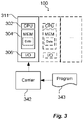
- the link system 100 may comprise at least one computer system 311 as exemplified in figure 3 that comprises control and communication circuitry in the form of a processor 302, memory 304 and input/output circuitry 306.
- the fact that the link system 100 is configured to communicate with the subsystems 12 independent of the on-board computer 102 is characterized by an ability to implement routing functions for establishing a direct communications channel between an external entity and any of the spacecraft subsystems, or the initiation of communications with the earth station when it determines that the satellite passes over a ground antenna.
- control and communication circuitry of the link system 100 may be configured to perform a number of actions as follows:
- the determination in action 210 that an anomaly has occurred may comprise receiving, from the external entity 150, 160, information that the anomaly has occurred.
- the determination in action 210 that an anomaly has occurred may comprise detecting that the anomaly has occurred.
- the anomaly may be detected by the external entity 150, 160 and then the external entity 150, 160 informs the link system 100 in the spacecraft 10 that the anomaly has occurred; or the anomaly is determined in that the link system 100 itself detects the anomaly.
- the determination that an anomaly has occurred comprises determining that a limitation of the on-board computer 102 to communicate with at least one subsystem among the plurality of subsystems 12 has occurred. In some embodiments, the determination that an anomaly has occurred comprises determining that a limitation of the on-board computer 102 to execute a scheduled management task associated with at least one subsystem among the plurality of subsystems 12 has occurred. In some embodiments, the determination that an anomaly has occurred comprises determining a limitation of the on-board computer 102 to determine non optimum operational parameters for any of the subsystems 12. In some embodiments, the determination that an anomaly has occurred comprises determining a limitation of the on-board computer 102 to recognise any unpredicted condition in the system behaviour.
- a recovery procedure is initiated that comprises enabling the external entity 150, 160 to perform recovery actions in relation to the on-board computer 102 and/or in relation to at least one subsystem among the plurality of subsystems 12.
- the recovery procedure depends on the nature of the anomaly.
- the most common anomaly is related to the radiation environment of the spacecraft, especially during periods of solar flares, when a high energy particle hits an active silicon component, i.e. a field-programmable gate array (FPGA) or a processor and causes a latch up event or a single event effect/single event upset (SEE/SEU).
- FPGA field-programmable gate array
- SEE/SEU single event effect/single event upset
- the recovery procedure may be realized through the power system of the spacecraft by limiting the amount of current supplied to individual subsystems (or the on-board computer) and gradually returning the spacecraft in nominal operations. Restarting the processor without removing the power altogether does not clear a latch up condition.
- the damage from an event where a high energy particle hits an active silicon component is so extensive that recovery is no longer possible. In those cases, the only option is to completely shut down the malfunctioning system and manually recover functionality in the areas that are not damaged.
- the link system 100 is configured such that the recovery procedure initiated by the link system 100 comprises the following actions, as illustrated in figure 2b :
- Anomaly information pertaining to the anomaly in functionality of the on-board computer 102 is stored, for example stored in a memory 304 as exemplified in figure 3 .
- the anomaly information is then transmitted to the external entity 150, 160.
- the link system 100 is configured such that the recovery procedure initiated by the link system 100 comprises the following actions, as illustrated in figure 2c :
- the link system 100 receives, from the external entity 150, 160, at least one command to execute a restart procedure of the on-board computer 102.
- a restart procedure of the on-board computer 102 is executed according to the received at least one command.
- the recovery procedure may be realized through the power system of the spacecraft by limiting the amount of current supplied to the on-board computer (or individual subsystems) and gradually returning the spacecraft in nominal operations. Restarting the processor without removing the power altogether does not clear a latch up condition.
- the link system 100 is configured such that the recovery procedure initiated by the link system 100 comprises the following action, as illustrated in figure 2d :
- Direct communication is enabled between the external entity 150, 160 and at least one subsystem among the plurality of subsystems 12.
- the link system 100 is configured such that the enabling in action 263 of direct communication between the external entity 150, 160 and at least one subsystem among the plurality of subsystems 12 comprises the following actions:
- a communication channel 120 is established between the link system 100 and the at least one subsystem among the plurality of subsystems 12.
- Transmission is made, to the external entity 150, 160, of information configured to enable the external entity 150, 160 to obtain access to the established channel 120 and thereby enabling the external entity 150, 160 to communicate with the at least one subsystem among the plurality of subsystems 12 via the channel 120.
- the link system may in such embodiments be considered as performing a router function in relation to the external entity when communicating with one or more subsystems.
- the link system 100 is configured such that the recovery procedure initiated in action 212 comprises the following actions:
- the link system 100 receives, from the external entity 150, 160, a request for telemetry data from at least one subsystem among the plurality of subsystems 12.
- Telemetry data is obtained from the at least one subsystem among the plurality of subsystems 12.
- the obtained telemetry data is transmitted, to the external entity 150, 160.
- a computer program 343 may comprise instructions which, when executed on at least one processor 302 in the spacecraft link system 100, cause the link system 100 to carry out a method as exemplified by the actions described above.
- a carrier 342, comprising such a computer program 343, may be one of an electronic signal, an optical signal, a radio signal and a computer readable storage medium.
- the link system 100 may be in the form of a computer apparatus installed in the spacecraft 10 and a purpose is to manage all forms of communications between the spacecraft 10 and any of the nodes of the network (i.e. the external entities 150, 160). Although several functions of the link system 100 has been exemplified above, it may further be configured to fulfil similar and other functions as follows, e.g. in combination with the features described above in connection with figures 1 to 3 :
- the link system 100 connects directly to the spacecraft communication bus(es) and, in doing so, it allows direct communication with any of the subsystems 12 in the spacecraft 10.
- connectivity intelligence is no longer integrated only in the on-board-computer 102 but also in the link system 100. This allows the network (i.e. external entities 150, 160) to adapt and modernise by programming new communication protocols in the link system 100.
- the connectivity intelligence integrated in the link system 100 also allows it to serve each of the spacecraft subsystems 12 as if they were separate entities, by directly addressing them from any node (i.e. external entities 150, 160).
- the arrangements and methods described herein removes some of the intelligence from the on-board-computer 102 and moves it to the link system 100. This helps make the spacecraft a lot more resilient in terms of communicating with the ground or with other spacecraft (i.e. external entities 150, 160).
Landscapes
- Engineering & Computer Science (AREA)
- Physics & Mathematics (AREA)
- Astronomy & Astrophysics (AREA)
- Aviation & Aerospace Engineering (AREA)
- General Physics & Mathematics (AREA)
- Computer Networks & Wireless Communication (AREA)
- Signal Processing (AREA)
- Radio Relay Systems (AREA)
- Mobile Radio Communication Systems (AREA)
Priority Applications (4)
| Application Number | Priority Date | Filing Date | Title |
|---|---|---|---|
| EP20207548.7A EP4002718A1 (fr) | 2020-11-13 | 2020-11-13 | Système de communication d'un engin spatial |
| PCT/EP2021/081239 WO2022101266A1 (fr) | 2020-11-13 | 2021-11-10 | Système de communication d'astronef |
| EP21810010.5A EP4244995A1 (fr) | 2020-11-13 | 2021-11-10 | Système de communication d?astronef |
| US18/035,632 US20230403070A1 (en) | 2020-11-13 | 2021-11-10 | Spacecraft communication system |
Applications Claiming Priority (1)
| Application Number | Priority Date | Filing Date | Title |
|---|---|---|---|
| EP20207548.7A EP4002718A1 (fr) | 2020-11-13 | 2020-11-13 | Système de communication d'un engin spatial |
Publications (1)
| Publication Number | Publication Date |
|---|---|
| EP4002718A1 true EP4002718A1 (fr) | 2022-05-25 |
Family
ID=73448932
Family Applications (2)
| Application Number | Title | Priority Date | Filing Date |
|---|---|---|---|
| EP20207548.7A Withdrawn EP4002718A1 (fr) | 2020-11-13 | 2020-11-13 | Système de communication d'un engin spatial |
| EP21810010.5A Withdrawn EP4244995A1 (fr) | 2020-11-13 | 2021-11-10 | Système de communication d?astronef |
Family Applications After (1)
| Application Number | Title | Priority Date | Filing Date |
|---|---|---|---|
| EP21810010.5A Withdrawn EP4244995A1 (fr) | 2020-11-13 | 2021-11-10 | Système de communication d?astronef |
Country Status (3)
| Country | Link |
|---|---|
| US (1) | US20230403070A1 (fr) |
| EP (2) | EP4002718A1 (fr) |
| WO (1) | WO2022101266A1 (fr) |
Families Citing this family (2)
| Publication number | Priority date | Publication date | Assignee | Title |
|---|---|---|---|---|
| DE112023001297T5 (de) | 2022-03-09 | 2025-01-02 | Microchip Technology Incorporated | Versorgungsspannungsbasierte oder temperaturbasierte feinsteuerung eines abstimmbaren oszillators einer pll |
| CN115396292B (zh) * | 2022-07-12 | 2023-11-10 | 重庆金康赛力斯新能源汽车设计院有限公司 | 车载网络恢复方法、系统、电子设备及存储介质 |
Citations (4)
| Publication number | Priority date | Publication date | Assignee | Title |
|---|---|---|---|---|
| DE102005016209A1 (de) * | 2005-04-07 | 2006-10-12 | Deutsches Zentrum für Luft- und Raumfahrt e.V. | Verfahren zur Erzeugung eines Notsignals an Bord eines Satelliten sowie dessen Übertragung |
| US20160344685A1 (en) * | 2015-05-08 | 2016-11-24 | Rishabh Y. Maharaja | Ip-based satellite command, control, and data transfer |
| EP3493428A1 (fr) * | 2017-11-30 | 2019-06-05 | Telespazio S.p.A. | Télémétrie par satellite automatique, système de suivi et de commande |
| US10368251B1 (en) * | 2016-07-25 | 2019-07-30 | SpaceWorks Enterprises, Inc. | Satellites and satellite-based systems for ground-to-space short-burst data communications |
Family Cites Families (3)
| Publication number | Priority date | Publication date | Assignee | Title |
|---|---|---|---|---|
| US5779195A (en) * | 1996-05-03 | 1998-07-14 | Motorola, Inc. | Satellite assembly having modular common bus components |
| FR2986879B1 (fr) * | 2012-02-15 | 2014-10-17 | Airbus Operations Sas | Procede et systeme de detection d'anomalies a solutionner dans un aeronef |
| US11228361B2 (en) * | 2019-10-25 | 2022-01-18 | Atlas Space Operations, Inc. | System and method for configuring a communications device for space-terrestrial communications |
-
2020
- 2020-11-13 EP EP20207548.7A patent/EP4002718A1/fr not_active Withdrawn
-
2021
- 2021-11-10 EP EP21810010.5A patent/EP4244995A1/fr not_active Withdrawn
- 2021-11-10 US US18/035,632 patent/US20230403070A1/en active Pending
- 2021-11-10 WO PCT/EP2021/081239 patent/WO2022101266A1/fr not_active Ceased
Patent Citations (4)
| Publication number | Priority date | Publication date | Assignee | Title |
|---|---|---|---|---|
| DE102005016209A1 (de) * | 2005-04-07 | 2006-10-12 | Deutsches Zentrum für Luft- und Raumfahrt e.V. | Verfahren zur Erzeugung eines Notsignals an Bord eines Satelliten sowie dessen Übertragung |
| US20160344685A1 (en) * | 2015-05-08 | 2016-11-24 | Rishabh Y. Maharaja | Ip-based satellite command, control, and data transfer |
| US10368251B1 (en) * | 2016-07-25 | 2019-07-30 | SpaceWorks Enterprises, Inc. | Satellites and satellite-based systems for ground-to-space short-burst data communications |
| EP3493428A1 (fr) * | 2017-11-30 | 2019-06-05 | Telespazio S.p.A. | Télémétrie par satellite automatique, système de suivi et de commande |
Also Published As
| Publication number | Publication date |
|---|---|
| US20230403070A1 (en) | 2023-12-14 |
| EP4244995A1 (fr) | 2023-09-20 |
| WO2022101266A1 (fr) | 2022-05-19 |
Similar Documents
| Publication | Publication Date | Title |
|---|---|---|
| US20210184763A1 (en) | Application Deployment To Satellite-Linked Communication Nodes | |
| US20180359670A1 (en) | Satellite network switching | |
| US20230403070A1 (en) | Spacecraft communication system | |
| SalarKaleji et al. | A survey on Fault Detection, Isolation and Recovery (FDIR) module in satellite onboard software | |
| CN110002005A (zh) | 一种可重构的微纳卫星系统架构及卫星系统重构方法 | |
| Ahmed et al. | Satellite Gateway Diversity in SDN/NFV-enabled satellite ground segment systems | |
| JP7842919B2 (ja) | 高空域長期滞空航空機の分散制御コンピューティングシステムおよび方法 | |
| CN113778060B (zh) | 卫星遥控接收终端在轨异常监测与故障恢复方法及系统 | |
| Challa et al. | CubeSat Torrent: Torrent like distributed communications for CubeSat satellite clusters | |
| CN120621717A (zh) | 适应全自主飞行航天器的全生命周期时间管理和维护方法 | |
| US11240116B2 (en) | Spacecraft network management system and method | |
| Jalilian et al. | Fault detection, isolation and recovery (FDIR) in satellite onboard software | |
| CN113794507B (zh) | 基于在轨路由切换的自主故障处理方法和系统 | |
| LU508278B1 (en) | Arrangement and methods for safe and efficient management of processing loads in space-based computing cluster | |
| Abraham et al. | NASA deep space communications: future mission trends and their implications | |
| Muri et al. | Gateway Avionics Concept of Operations for Command and Data Handling Architecture | |
| EP4434170A1 (fr) | Techniques de routage de données entre satellites et serveurs terrestres | |
| Wojtkowiak et al. | ASAP: Autonomy through on-board planning | |
| US12587269B1 (en) | System for modem array fault tolerance | |
| US12431961B2 (en) | Modular architecture avionics | |
| Clerigo | Avoiding Cluster Safe Modes | |
| Einafshar et al. | Integrated reconfiguration of multi-satellite network communication using colored petri nets | |
| Rodriguez | Optimizing Communications for Cubesats to Commercial Constellations | |
| LaBonde et al. | Ground Autonomy for an Aging Spacecraft | |
| Dechant | The advanced onboard signal processor (AOSP) |
Legal Events
| Date | Code | Title | Description |
|---|---|---|---|
| PUAI | Public reference made under article 153(3) epc to a published international application that has entered the european phase |
Free format text: ORIGINAL CODE: 0009012 |
|
| STAA | Information on the status of an ep patent application or granted ep patent |
Free format text: STATUS: THE APPLICATION HAS BEEN PUBLISHED |
|
| AK | Designated contracting states |
Kind code of ref document: A1 Designated state(s): AL AT BE BG CH CY CZ DE DK EE ES FI FR GB GR HR HU IE IS IT LI LT LU LV MC MK MT NL NO PL PT RO RS SE SI SK SM TR |
|
| STAA | Information on the status of an ep patent application or granted ep patent |
Free format text: STATUS: THE APPLICATION IS DEEMED TO BE WITHDRAWN |
|
| 18D | Application deemed to be withdrawn |
Effective date: 20221126 |