EP4002748B1 - Appareil - Google Patents
Appareil Download PDFInfo
- Publication number
- EP4002748B1 EP4002748B1 EP20306395.3A EP20306395A EP4002748B1 EP 4002748 B1 EP4002748 B1 EP 4002748B1 EP 20306395 A EP20306395 A EP 20306395A EP 4002748 B1 EP4002748 B1 EP 4002748B1
- Authority
- EP
- European Patent Office
- Prior art keywords
- cryptographic
- digital
- involutional
- backward
- signal
- Prior art date
- Legal status (The legal status is an assumption and is not a legal conclusion. Google has not performed a legal analysis and makes no representation as to the accuracy of the status listed.)
- Active
Links
Images


Classifications
-
- H—ELECTRICITY
- H04—ELECTRIC COMMUNICATION TECHNIQUE
- H04L—TRANSMISSION OF DIGITAL INFORMATION, e.g. TELEGRAPHIC COMMUNICATION
- H04L9/00—Cryptographic mechanisms or cryptographic arrangements for secret or secure communications; Network security protocols
- H04L9/06—Cryptographic mechanisms or cryptographic arrangements for secret or secure communications; Network security protocols the encryption apparatus using shift registers or memories for block-wise or stream coding, e.g. DES systems or RC4; Hash functions; Pseudorandom sequence generators
- H04L9/0618—Block ciphers, i.e. encrypting groups of characters of a plain text message using fixed encryption transformation
- H04L9/0631—Substitution permutation network [SPN], i.e. cipher composed of a number of stages or rounds each involving linear and nonlinear transformations, e.g. AES algorithms
-
- H—ELECTRICITY
- H04—ELECTRIC COMMUNICATION TECHNIQUE
- H04L—TRANSMISSION OF DIGITAL INFORMATION, e.g. TELEGRAPHIC COMMUNICATION
- H04L9/00—Cryptographic mechanisms or cryptographic arrangements for secret or secure communications; Network security protocols
- H04L9/002—Countermeasures against attacks on cryptographic mechanisms
- H04L9/003—Countermeasures against attacks on cryptographic mechanisms for power analysis, e.g. differential power analysis [DPA] or simple power analysis [SPA]
-
- G—PHYSICS
- G06—COMPUTING OR CALCULATING; COUNTING
- G06F—ELECTRIC DIGITAL DATA PROCESSING
- G06F21/00—Security arrangements for protecting computers, components thereof, programs or data against unauthorised activity
- G06F21/30—Authentication, i.e. establishing the identity or authorisation of security principals
- G06F21/45—Structures or tools for the administration of authentication
- G06F21/46—Structures or tools for the administration of authentication by designing passwords or checking the strength of passwords
-
- H—ELECTRICITY
- H04—ELECTRIC COMMUNICATION TECHNIQUE
- H04L—TRANSMISSION OF DIGITAL INFORMATION, e.g. TELEGRAPHIC COMMUNICATION
- H04L2209/00—Additional information or applications relating to cryptographic mechanisms or cryptographic arrangements for secret or secure communication H04L9/00
- H04L2209/08—Randomization, e.g. dummy operations or using noise
-
- H—ELECTRICITY
- H04—ELECTRIC COMMUNICATION TECHNIQUE
- H04L—TRANSMISSION OF DIGITAL INFORMATION, e.g. TELEGRAPHIC COMMUNICATION
- H04L2209/00—Additional information or applications relating to cryptographic mechanisms or cryptographic arrangements for secret or secure communication H04L9/00
- H04L2209/16—Obfuscation or hiding, e.g. involving white box
Definitions
- the present disclosure relates to an apparatus that uses cryptography to provide a digital output signal that represents a response to a challenge, associated systems and methods.
- such an apparatus can provide effective obfuscation of the side-channel signals.
- the digital input signal represents a challenge
- the digital output signal represents a response to the challenge
- the processor is configured to:
- the apparatus is configured to set the value of the processing-direction-signal according to the output of a random number generator.
- the apparatus also comprises the random number generator.
- the random number generator is a true random number generator.
- the random number generator is configured to set the processing-direction-signal such that it is more likely to have one of the forward-value or the backward-value than the other of the forward-value and the backward-value.
- the apparatus further comprises a program counter configured to count the absolute number of operations taken for calculating the digital output signal.
- the processor may be configured to implement calculations in a single direction for any further operations until the difference between the number of forward calculations and backward calculations performed by the processor is the predetermined value and the digital output signal has been calculated.
- the apparatus comprises an S-box.
- the system may be configured to apply a plurality of involutional cryptographic functions to the digital input signal in order to provide the digital system output signal.
- Each of the plurality of involutional cryptographic functions may be performed by any apparatus disclosed herein.
- the plurality of involutional cryptographic functions may comprise a first involutional cryptographic function, a last involutional cryptographic function, and one or more intermediate involutional cryptographic functions.
- the one or more involutional cryptographic functions can be performed in either:
- the system may be configured to: perform a first apparatus-operation, wherein the first apparatus-operation comprises:
- the system may be configured to: perform a plurality of apparatus-operations, wherein each apparatus-operation comprises:
- the system may be configured to provide the digital apparatus output signal as the digital system output signal when the difference between the number of forward cryptographic calculations and backward cryptographic calculations is a predetermined value.
- system comprises a single one of any of the apparatuses disclosed herein, that is configured to sequentially perform each of the plurality of involutional cryptographic functions.
- the apparatus that is not in the first data flow path does not contribute to calculating the digital system output signal.
- system further comprises one or more multiplexers configured to selectively include either the first-apparatus or the second-apparatus in the first data flow path based on the apparatus-direction-signal.
- Smartcards and other ICs for secure authentication provide hard cryptography but are threatened by various types of side-channel attacks. Due to cost requirements, often only a few means against side-channel attacks are applied. Moreover, unknown attack mechanisms may appear.
- Involutional Substitution-Permutation-Network block ciphers One class of these involutional cryptographic functions is Involutional Substitution-Permutation-Network block ciphers.
- Figure 1 shows schematically the calculation of a response ( R ) to a challenge ( C ) in the forward direction, and also the calculation of a response ( R ) to a challenge ( C ) in the backward direction.
- the calculation / conversion requires 10 processing steps over 10 command cycles (through 10 successive processing states), as illustrated by the program counter. Each command cycle may be executed over one or more clock cycles. Also, it some examples it may be possible to execute a plurality of command cycles in one clock cycle.
- Figure 2 shows schematically the calculation of a response ( R ) to a challenge ( C ) in the forward direction during which one step is performed in the backward direction before processing then continues in the forward direction until the response is calculated.
- Figure 2 also shows the calculation of a response ( R ) from a challenge ( C ) in the backward direction, during which one step is performed in the forward direction before processing is continued in the backward direction until the response is calculated.
- the complete calculation / conversion from response ( R ) to challenge ( C ) requires processing steps over 12 command cycles. This is because the processing when the program counter has the value of 5 and 6, when the processing direction is reversed, is performed more than once. For example the two command cycles can be performed twice, or a single command cycle can be performed three times - once in the forward direction, once in the backward direction, and then again in the forward direction.
- This procedure can advantageously provide effective obfuscation of the side-channel signals, especially if the forward and backward steps are performed in random order. In this way, the order and number of the processing steps that are preformed to calculate the response R can be different from one calculation to the next.
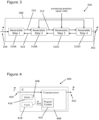
- Figure 3 shows an example embodiment of an apparatus 300 for applying an involutional cryptographic function to a challenge C in order to calculate a response R .
- the apparatus 300 may be implemented as an S-box (substitution-box).
- the apparatus 300 receives a digital input signal 304 that represents the challenge, and provides a digital output signal 302 that represents the response to the challenge.
- a digital input signal 304 that represents the challenge
- a digital output signal 302 that represents the response to the challenge.
- the terms “challenge” and “response” can relate to signals in an authentication process. Examples disclosed herein, including the apparatus 300 of Figure 3 , are not restricted to authentication processes. For instance, examples disclosed herein can be used for encryption/decryption purposes, depending upon the nature of the underlying involutional cryptographic function. Therefore the digital input and output signals disclosed herein may comprise plaintext / ciphertext.
- the apparatus 300 also receives a processing-direction-signal 306 that can have a forward-value or a backward-value.
- the processing-direction-signal 306 is used to control the direction in which a plurality of processing steps 310A, 310B, 310C, 310D are performed when applying the involutional cryptographic function.
- the apparatus 300 includes a processor 308 that can apply the involutional cryptographic function to the digital input signal 304.
- the processor 308 can also be referred to as a cryptoprocessor.
- the involutional cryptographic function comprises a sequence of processing steps. In the example of Figure 2 there are 10 steps. In the example of Figure 3 there are four processing steps 310A-D consisting of: a first step 310A, a last step 310D and a plurality (in this example two) intermediate steps 310B, 310C. All of the steps 310A-310D are reversible such that they can be performed in either a forward direction or a backward direction.
- a processing step 310A-310D implements a forward calculation to move to the next step in the sequence.
- An example of moving from the first step 310A to the second step 310B is labelled with reference 316 in Figure 3 .
- a processing step 310A-310D implements a backward calculation to move to the preceding step in the sequence.
- An example of moving from the second step 310B to the first step 310A is labelled with reference 314 in Figure 3 .
- the application of the involutional cryptographic function involves performing a plurality of operations as the plurality of processing steps are applied to calculate the response R .
- the number of operations required to apply the involutional cryptographic function can be varied by changing the direction of the reversible functions that are applied, as shown in Figure 2 .
- the processor 308 applies the first step 310A of the involutional cryptographic function to the digital input signal 304 in order to implement a forward calculation to move to the next step in the sequence.
- the first processing step 310A is always performed in a forward direction because there is no preceding / earlier step to go back to.
- the processing that is performed by the processor 308 for the further operations will depend upon the value of the processing-direction-signal 306.
- the value of the processing-direction-signal 306 can be set randomly such that the number of operations required to calculate the response R is also random.
- this can make it more difficult for an attacker to intercept the response R .
- the processor 308 For each further operation: if the processing-direction-signal 306 has a forward-value, then the processor 308 performs the forward calculation for the current step to move to the next step in the sequence. Taking the first of the plurality of further operations as an example (which is the processing performed at second processing step 310B, in the second operation in calculating the overall response R for a given challenge C ), if the processing-direction-signal 306 has a forward-value then the second processing step 310B performs the forward calculation to move to the third processing step 310C in the sequence (this transition is illustrated with reference 312 in the drawing).
- the processor 308 performs a backward calculation for the current step to move to the preceding step in the sequence.
- the second processing step 310A performs the backward calculation to move back to the first processing step 310A in the sequence (this transition is illustrated with reference 314 in the drawing).
- performing the forward calculation for the second processing step 310B may involve performing a reversible calculation that is associated with the second processing step 310B (i.e. the current processing step) in a forward direction.
- Performing the backward calculation for the second processing step 310B may involve performing a reversible calculation that is associated with the first processing step 310BA (i.e. the preceding processing step) in a backward / reverse direction.
- the processor 308 can then provide the output of the forward calculation of the last step 310D as the digital output signal R 302. In this way, when the difference between the number of forward calculations and backward calculations performed by the processor 308 is a predetermined value, the output of the last step 310D is the digital output signal R 302. In the example of Figure 3 the output of the last step 310D is the digital output signal R 302 when the difference between the number of forward calculations and backward calculations is 4. In the example of Figure 2 , the output of the last step is the digital output signal R when the difference between the number of forward calculations and backward calculations is 10.
- the processor 308 can maintain a count of the number of forward calculations minus backward calculations during the plurality of operations, and then recognise that the involutional cryptographic function has been completed when the count reaches the predetermined value. Such a count may be available as the program counter shown in Figure 4 is incremented or decremented.
- FIG. 4 shows an apparatus 400 according to an embodiment of the present disclosure.
- the apparatus 400 in this example is implemented as a smartcard integrated circuit (IC) with a true random number generator (TRNG) 416, a clock generator 418 and a cryptoprocessor 408 with a program counter 420.
- IC smartcard integrated circuit
- TRNG true random number generator
- the apparatus 400 receives a digital input signal 404 that represents a challenge, and provides a digital output signal 402 that represents a response to the challenge.
- the digital input signal 404 is provided as an input to the cryptoprocessor 408.
- the cryptoprocessor 408 applies one of a sequence of processing steps in accordance with the value of the program counter 420. That is: when the program counter 420 has a value of 1, it performs the first processing step in the sequence; when the program counter 420 has a value of 2, it performs the second processing step in the sequence, etc.
- the clock generator 418 providers a clock signal that has a value that periodically changes between a high and low value, thereby providing periodic rising and falling edges in the clock signal.
- This clock signal is provided to either: an up-input-terminal of the program counter 420; or a down-input-terminal of the program counter 420.
- the program counter can be configured to respond to either the rising or falling edges of the clock signal such that: in response to a rising or falling edge of the clock signal at the up-input-terminal, the count of the program counter 420 is incremented; and in response to a rising or falling edge of the clock signal at the down-input-terminal, the count of the program counter 420 is decremented. In this way: a forward calculation is performed in response to the clock signal being provided to the up-input-terminal; and a backward calculation is performed in response to the clock signal being provided to the down-input-terminal.
- the TRNG 416 provides a randomly generated output signal that controls whether the clock generator 418 is connected to the up-input-terminal or the down-input-terminal of the program counter 420.
- the randomly generated output signal can be considered as a processing-direction-signal that can have either: i) a forward-value (when it connects the clock generator 418 to the up-input terminal of the program counter 420); or a backward-value (when it connects the clock generator 418 to the down-input terminal of the program counter 420).
- the TRNG 416 can be considered as providing a flag to reverse the incrementing / decrementing of the program counter 420.
- the TRNG 416 can be based on a physical entropy source like a noise generator. This is in contrast to a Pseudo-Random Number Generator that uses e.g. a linear feedback shift register (LFSR) with a certain seed, to provide a bitstream that has a random statistics, but is deterministic with respect to the seed.
- LFSR linear feedback shift register
- the TRNG 416 can provide a biased randomly generated output signal such that the processing-direction-signal is more likely to have one of the forward-value than the backward-value.
- the TRNG 416 can be configured such that overall the processing-direction-signal is 80% more likely to have a forward-value than a backward-value when performing the involutional cryptographic function in a forward direction.
- the TRNG 416 can be configured such that overall the processing-direction-signal is 80% more likely to have a backward-value than a forward-value when performing the involutional cryptographic function in a backward direction. In this way, the apparatus 400 is likely to calculate the response to the challenge in a reasonable number of operations for a given application.
- the program counter 420 can count the absolute number of operations taken for calculating the response to the challenge (irrespective of whether they are forward or backward), and in response to the absolute number of steps reaching an operation-threshold value (e.g. 20), then the apparatus 400 implements calculations in a single direction for any further operations until the difference between the number of forward calculations and backward calculations performed by the processor is a predetermined value and the response has been calculated. In this way, if the involutional cryptographic function is being performed in a forward direction, the apparatus 400 can perform calculations in only a forward direction for any further operations. Similarly, if the involutional cryptographic function is being performed in a backward direction, the apparatus 400 can implement calculations in only a backward direction for any further operations.
- an operation-threshold value e.g. 20
- the processing that is described with reference to Figures 2 to 4 can reinforce the obfuscation of the calculation of the response to a challenge, and can especially defy side-channel attacks. This is because randomly processing steps in either the forward way or the backward way can result in substantially different side-channel signals.
- this module / apparatus can be implemented as a "Substitution Box" ("S-Box"). I.e. one module implemented on an IC or in a cryptoprocessor.
- S-Box Substitution Box
- the calculation of the cryptographic function is performed with a mixture of steps in the forward and in the backward direction; hence this can already be expected to deliver a high extent of obfuscation: the side channel signals do not only depend on key and message, but also to a large extent on the (forward / backward) path through the algorithm as chosen by a Random Generator.
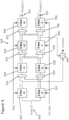
- Figure 5 shows an example embodiment of a system 518 that implements the processing of a plurality of the apparatuses of Figure 3 .
- the system 518 receives a digital system input signal 520 that represents a challenge, and provides a digital system output signal 522 that represents a response to the challenge.
- the system 518 sequentially applies a plurality of involutional cryptographic functions to the digital system input signal 520 in order to determine the digital system output signal 522.
- the digital system output signal 522 in Figure 5 is required to be the result of the involutional cryptographic function being applied sequentially to the digital system input signal 520 twice in a forward direction.
- FIG 5 the processing of eight apparatuses of Figure 4 is shown, with the processing of each apparatus illustrated as a box that is labelled as either "S-box +1" or "S-box -1". However, not all of these apparatuses / S-boxes are used in calculating the digital system output signal 522.
- An apparatus labelled as "S-box +1" represents an involutional cryptographic function being performed in a forward cryptographic direction in order to implement a forward cryptographic calculation.
- a forward cryptographic calculation is shown schematically in the top half of Figure 2 as a "Forward-direction”.
- An apparatus labelled as “S-box -1” represents an involutional cryptographic function being performed in a backward cryptographic direction in order to implement an inverse of the forward cryptographic calculation.
- the inverse of the forward cryptographic calculation is shown schematically in the bottom half of Figure 2 as a "Backward-direction".
- each S-box involves a plurality of operations to perform a sequence of processing steps and apply an involutional cryptographic function.
- the processing of Figure 5 involves the application of a plurality of apparatus-operations, wherein for each apparatus-operations the apparatus of Figures 3 and 4 applies an involutional cryptographic function in either a forward cryptographic direction or a backward cryptographic direction. Once the required number of apparatus-iterations have been applied, the output from the last iteration is the digital system output signal.
- the system 518 can apply a plurality of involutional cryptographic functions to the digital system input signal 520 in order to provide the digital system output signal 522.
- Each of the plurality of involutional cryptographic functions is performed by the apparatus of Figure 3 or Figure 4 .
- the application of an involutional cryptographic function is illustrated graphically in Figure 5 as an S-box 523-530.
- the S-boxes 523-530 are provided in pairs, with each pair including: (i) an S-box (labelled as S-box +1) 523-526 for performing the involutional cryptographic function in a forward cryptographic direction in order to implement a forward cryptographic calculation; and (ii) an S-box (labelled as S-box -1) 527-530 for performing the involutional cryptographic function in a backward cryptographic direction in order to implement an inverse of the forward cryptographic calculation.
- an S-box pair can be considered as having a first-S-box (which is an example of a first-apparatus) and a second-S-box (which is an example of a second-apparatus). Irrespective of whether an S-box 523-530 performs a forward or backward cryptographic function, the output of the S-box 523-530 will be referred to as a digital apparatus output signal.
- Figure 5 can further increase the degree of obfuscation.
- the functionality of Figure 5 is based on the involutional nature of the cryptographic function. Assuming e.g. that traversing the S-box twice is intended such that the digital system output signal 522 represents the involutional cryptographic function being performed sequentially on the digital system input signal 520 twice then this can be achieved in a number of ways, including one of the following three paths through a plurality of S-boxes:
- FIG. 5 there are four pairs of S-boxes 523-530, arranged sequentially such that there is a first S-box pair 523, 527, a last S-box pair 526, 530, and one or more intermediate S-box pairs 524, 528, 525, 529.
- Each S-box pair provides two digital apparatus output signals.
- the two digital apparatus output signals are provided as input signals to the next S-box pair.
- the last S-box pair one of the two digital apparatus output signals is provided as the digital system output signal 522.
- the first S-box pair 523, 527 receives the digital system input signal 520 as their input signals.
- the system 518 includes a plurality of multiplexers 531-536. For each of the S-boxes in the intermediate and last S-box pairs, a multiplexer 531-536 can selectively couple the digital apparatus output signal from one of the two S-boxes in a preceding S-box pair to the input of the S-box.
- the multiplexers 531-536 can be set such that they control the flow of data through the S-boxes such that the digital system input signal 520 (that is provided to the first S-box pair 523, 527) is processed in such a way that a digital apparatus output signal of one the S-boxes of the last S-box pair 526, 530 has, on balance, been processed by the required number of involutional cryptographic functions and therefore correctly represents the required digital system output signal 522. That is, the required digital system output signal 522 is achieved when the difference between the number of inverse calculations and the number of forward cryptographic calculations matches a target value.
- each of the multiplexers is controlled based on an apparatus-direction-signal.
- Such an apparatus-direction-signal can have an apparatus-forward-value or an apparatus-backward-value.
- An apparatus-direction-signal having an apparatus-forward-value will cause the digital apparatus output signal from the preceding S-box pair to be connected to the input of an S-box that implements a forward cryptographic calculation (S-box +1).
- An apparatus-direction-signal having an apparatus-backward-value will cause the digital apparatus output signal from the preceding S-box pair to be connected to the input of an S-box that implements the inverse of the forward cryptographic calculation (S-box -1).
- each of the multiplexers 531-536 can be set such that the digital input signal 520 follows an appropriate data path through a plurality of S-boxes in order to provide the required digital system output signal 522.
- the multiplexers 531-536 have been set to define: a first data flow path through the S-boxes and also a second data flow path through the S-boxes.
- the components that are included in the first data flow path are shown unfilled.
- the components that are included in the second data flow path are shown with a dotted pattern.
- one or more multiplexers 531-536 can selectively include either a first-S-box of an S-box pair or a second-S-box of the S-box pair in the first data flow path based on the apparatus-direction-signal.
- the first data flow path has the digital input signal 520 as an input, and provides the digital system output signal 522.
- the first data flow path includes one of the S-boxes in each S-box pair (in Figure 5 , the S-boxes with references 523, 524, 529, 526) and also three of the multiplexers (in Figure 5 , the multiplexers with references 531, 535, 533).
- the digital apparatus output signal of each S-box in the first data flow path is labelled as D(n), where n is incremented if the S-box performs a forward cryptographic calculation. Similarly, n is decremented if the S-box performs the inverse of the forward cryptographic calculation.
- the value of n at the end of the processing represents the difference between the number of forward cryptographic calculations and backward cryptographic calculations. This difference may be required to be a predetermined / target value in order for the system 518 to perform the required processing for any particular application.
- the second data flow path has the digital input signal 520 as an input, and provides a secondary digital system output signal 537.
- the digital system output signal 537 is not directly required for determining the response to a challenge, although as will be discussed below its generation can be useful for verifying the correctness of the digital system output signal 537.
- the second data flow path includes the other of the S-boxes in each S-box pair (in Figure 5 , the S-boxes with references 527, 528, 525, 530) and also the other three multiplexers (in Figure 5 , the multiplexers with references 534, 532, 536).
- the system of Figure 5 can be considered as performing a plurality of apparatus-operations to calculate the digital system output signal 522. As it is shown in Figure 5 , each of these apparatus-operations is sequentially performed by one of the S-box pairs. More specifically, each apparatus-operation can be sequentially performed by one of the S-boxes of one of the S-box pairs.
- the digital apparatus output signal can be considered as an intermediate output signal that is part of the overall calculation of the digital system output signal 522.
- the value of the apparatus-direction-signal will define which of these two digital apparatus output signals (provided by either S-box 523 or S-box 527) will be processed in the next apparatus-iteration. If the apparatus-direction-signal has an apparatus-forward-value, then the digital apparatus output signal that is calculated as a forward cryptographic calculation by S-box 523 will be used in the next apparatus-iteration as part of the process in calculating the digital system output signal 522. If the apparatus-direction-signal has an apparatus-backward-value, then the digital apparatus output signal that is calculated as an inverse of the forward cryptographic calculation by S-box 527 will be used in the next apparatus-operation on the way to calculating the digital system output signal 522.
- the apparatus-direction-signal has an apparatus-forward-value for the first apparatus-iteration such that the settings of the multiplexers incorporate S-box 523 into the first data flow path that culminates with providing the digital system output signal 522). That is, a digital apparatus output signal that is the result of the involutional cryptographic function on the digital system input signal in the forward cryptographic direction will be used as an input signal for the next apparatus-iteration on the way to calculating the digital system output signal 522.
- the configurable S-box may be configured to perform the processing of only one of a) and b) based on the value of the apparatus-direction-signal.
- the processing of the second apparatus-iteration is performed by one of the S-boxes of the second S-box pair 524, 528.
- Two multiplexers 531, 534 are included such that they can selectively connect the digital apparatus output signal from either of the S-boxes 523, 527 of the first S-box pair to the input of either of the S-boxes 524, 528 of the second S-box pair.
- the apparatus-direction-signal has an apparatus-forward-value for the second apparatus-iteration such that multiplexer 531 incorporates S-box 524 into the first data flow path.
- the processing of the third apparatus-operation is performed by one of the S-boxes of the third S-box pair 525, 529.
- Two multiplexers 532, 535 are included such that they can selectively connect the digital apparatus output signal from either of the S-boxes 524, 528 of the second S-box pair to the input of either of the S-boxes 525, 529 of the third S-box pair.
- the apparatus-direction-signal has an apparatus-backward-value for the third apparatus-operation such that multiplexer 535 incorporates S-box 529 into the first data flow path.
- the processing of the last / fourth apparatus-iteration is performed by one of the S-boxes of the last / fourth S-box pair 526, 530.
- Two multiplexers 533, 536 are included such that they can selectively connect the digital apparatus output signal from either of the S-boxes 525, 529 of the third S-box pair to the input of either of the S-boxes 526, 530 of the last / fourth S-box pair.
- the apparatus-direction-signal has an apparatus-forward-value for the last / fourth apparatus-iteration such that multiplexer 533 incorporates S-box 526 into the first data flow path. Therefore, the digital apparatus output signal of S-box 526 is provided as the digital system output signal 522.
- the digital apparatus output signal is then provided as the digital system output signal 522 when the difference between the number of forward cryptographic calculations and backward cryptographic calculations is a predetermined value.
- the states of the multiplexers 531-536 may be hard-coded for the number of involutional cryptographic functions that are to be applied sequentially to the digital system input signal 520 to calculate the digital system output signal 522.
- the system 518 may be configured to randomly select one of a plurality of predetermined multiplexer-configurations that will correctly calculate the digital system output signal 522.
- the system 518 may have access to memory that stores a plurality multiplexer-configurations (which each define the state of the plurality of multiplexers), and the system can select one of these multiplexer-configurations that is associated with a target-output-signal.
- the target-output-signal can represent the "predetermined value" that is required to be the difference between the number of forward cryptographic calculations and backward cryptographic calculations for the required response to the challenge.
- a single configurable S-box can be used instead of an S-box pair.
- Such a configurable S-box can be configured to implement: (i) a forward cryptographic calculation; or (ii) an inverse of the forward cryptographic calculation; based on the apparatus-direction-signal.
- the system can be considered as applying a plurality of involutional cryptographic functions to the digital input signal, wherein the plurality of involutional cryptographic functions comprises a first involutional cryptographic function (provided by a single S-box that replaces the first S-box pair 523, 527 that is shown in Figure 5 ), a last involutional cryptographic function (provided by a single S-box that replaces the last S-box pair 526, 530 that is shown in Figure 5 ), and one or more involutional cryptographic functions (provided by two sequentially connected S-boxes that replace the two sequentially connected intermediate S-box pair 524, 528, 525, 529 that are shown in Figure 5 ).
- the plurality of involutional cryptographic functions comprises a first involutional cryptographic function (provided by a single S-box that replaces the first S-box pair 523, 527 that is shown in Figure 5 ), a last involutional cryptographic function (provided by a single S-box that replaces the last S-box
- a single configurable S-box can be used instead of all of the individual S-boxes 523-530 of Figure 5 .
- the output of the S-box is connected to its input such that it can sequentially apply the involutional cryptographic function in either the forward or backward cryptographic direction, depending upon the state of the apparatus-direction-signal, until the difference between the number of forward cryptographic calculations and backward cryptographic calculations is the predetermined value.
- the state of the apparatus-direction-signal can be set by a random number generator in the same as described above for the processing-direction-signal.
- An additional feature of the configuration shown in Figure 5 is that it can enable online verification for correctness of the calculation of the digital system output signal 522. This is indicated in Figure 5 by the error checking function 538, and its "Correct" output signal. This verification is possible, because the same digital apparatus output signals (outputs of individual S-boxes) can be obtained by two different paths through the S-boxes.
- the digital apparatus output signal of one of the S-boxes of the first S-box pair (the S-box labelled as 523) should be the same as the digital apparatus output signal of one of the S-boxes of the third S-box pair (the S-box labelled as 529).
- each of these two S-boxes 523, 529 should have a digital apparatus output signal that represents a single forward cryptographic calculation (D(1)). If the error checking function 538 determines that the digital apparatus output signals that should eb the same are not the same, then it can set the "Correct" output signal to an error value. In response, the system 518 can recalculate the digital system output signal 522.
- the system 518 can compare the two digital apparatus output signals from different operations, wherein each of these two digital apparatus output signals are the result of, on balance the same number of forward cryptographic calculations or backward cryptographic calculations. By “on balance”, it will be appreciated that this means that the difference between the number of forward and backward cryptographic calculations is the same for each of the two digital apparatus output signals. If the two digital apparatus output signals are not equal, then the system 518 can reapply the plurality of involutional cryptographic functions to the digital input signal 520 in order to recalculate the digital system output signal 522.
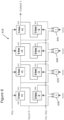
- Figure 6 shows an alternative implementation of a system 618 with two complementary S-box paths.
- This implementation is based on S-boxes which each can be run in either a forward or a backward direction (in the same way as shown in Figure 4 ).
- the system 618 can include a plurality of error checking functions 638-640 for helping to identify whether or not there has been an error in calculating a result of any of the involutional cryptographic functions, and if there has been then instructing the response to be recalculated.
- This online error checking can enable sub-threshold computing to be used because the higher risk of errors can be mitigated by the ability to identify those errors and take remedial action of recalculating the response until no error is identified.
- Figure 7 shows an example embodiment of a computer implemented method of the present disclosure.
- the method can be performed by an apparatus such as an S-box.
- the method involves receiving a digital input signal that represents a challenge.
- the method receives a processing-direction-signal that can have a forward-value or a backward-value;
- the method involves, for a first iteration, applying a first step of an involutional cryptographic function to the digital input signal in order to implement a forward calculation to move to the next step in the sequence. Then, at step 756, the method performs a plurality of further operations until a forward calculation of the last step is performed. Further details of these operations are provided above, especially with reference to Figures 2 to 4 .
- the method provides a digital output signal that represents a response to the challenge.
- Examples described herein can involve apparatuses and systems that provide obfuscation of side-channel signals, especially to defy differential side-channel attacks, by using
- Such mechanisms can be used stand-alone, or in combination with other security mechanisms.
- the set of instructions/method steps described above are implemented as functional and software instructions embodied as a set of executable instructions which are effected on a computer or machine which is programmed with and controlled by said executable instructions. Such instructions are loaded for execution on a processor (such as one or more CPUs).
- processor includes microprocessors, microcontrollers, processor modules or subsystems (including one or more microprocessors or microcontrollers), or other control or computing devices.
- a processor can refer to a single component or to plural components.
- the set of instructions/methods illustrated herein and data and instructions associated therewith are stored in respective storage devices, which are implemented as one or more non-transient machine or computer-readable or computer-usable storage media or mediums.
- Such computer-readable or computer usable storage medium or media is (are) considered to be part of an article (or article of manufacture).
- An article or article of manufacture can refer to any manufactured single component or multiple components.
- the non-transient machine or computer usable media or mediums as defined herein excludes signals, but such media or mediums may be capable of receiving and processing information from signals and/or other transient mediums.
- Example embodiments of the material discussed in this specification can be implemented in whole or in part through network, computer, or data based devices and/or services. These may include cloud, internet, intranet, mobile, desktop, processor, look-up table, microcontroller, consumer equipment, infrastructure, or other enabling devices and services. As may be used herein and in the claims, the following non-exclusive definitions are provided.
- one or more instructions or steps discussed herein are automated.
- the terms automated or automatically mean controlled operation of an apparatus, system, and/or process using computers and/or mechanical/electrical devices without the necessity of human intervention, observation, effort and/or decision.
- any components said to be coupled may be coupled or connected either directly or indirectly.
- additional components may be located between the two components that are said to be coupled.
Landscapes
- Engineering & Computer Science (AREA)
- Computer Security & Cryptography (AREA)
- Signal Processing (AREA)
- Computer Networks & Wireless Communication (AREA)
- Theoretical Computer Science (AREA)
- Software Systems (AREA)
- General Physics & Mathematics (AREA)
- General Engineering & Computer Science (AREA)
- Physics & Mathematics (AREA)
- Computer Hardware Design (AREA)
- Lock And Its Accessories (AREA)
- Storage Device Security (AREA)
- Mobile Radio Communication Systems (AREA)
Claims (13)
- Appareil (300, 400) configuré pour :recevoir un signal d'entrée numérique (304, 404) ;recevoir, pour chacune d'une pluralité d'opérations supplémentaires, un signal de direction de traitement (306) qui peut avoir une valeur avant ou une valeur arrière, la valeur du signal de direction de traitement (306) étant définie en fonction de la sortie d'un générateur de nombres aléatoires (416) ; etproduire un signal de sortie numérique (302, 402) ;l'appareil comprenant :
un processeur (308, 408) configuré pour appliquer une fonction cryptographique involutive au signal d'entrée numérique, où :la fonction cryptographique involutive comprend une séquence d'étapes de traitement (310),la séquence d'étapes de traitement comprenant une première étape (310A), une dernière étape (310D) et une ou plusieurs étapes intermédiaires (310B-310C), etles étapes étant réversibles de sorte qu'elles peuvent être exécutées :en direction avant afin de mettre en œuvre un calcul vers l'avant pour passer à l'étape suivante de la séquence ; ou bienen direction arrière afin de mettre en œuvre un calcul vers l'arrière pour passer à l'étape précédente de la séquence ;le processeur étant configuré pour :pour une première opération : appliquer la première étape de la fonction cryptographique involutive au signal d'entrée numérique afin de mettre en œuvre un calcul vers l'avant pour passer à l'étape suivante de la séquence ; etexécuter la pluralité d'opérations supplémentaires jusqu'à ce que le calcul vers l'avant de la dernière étape soit exécuté, chaque opération supplémentaire comprenant :si le signal de direction de traitement à une valeur avant : alors exécution du calcul vers l'avant pour l'étape en cours pour passer à l'étape suivante de la séquence par exécution d'un calcul réversible associé à l'étape de traitement en cours en direction avant (312, 316) ; ousi le signal de direction de traitement à une valeur arrière : alors exécution du calcul vers l'arrière pour l'étape en cours pour passer à l'étape précédente de la séquence par exécution d'un calcul réversible associé à l'étape de traitement précédente en direction inverse (314) ; etproduire la sortie du calcul vers l'avant de la dernière étape en tant que signal de sortie numérique lorsque la différence entre le nombre de calculs vers l'avant et de calculs vers l'arrière exécutés par le processeur est égale à une valeur prédéterminée, la valeur prédéterminée étant la différence requise entre le nombre de calculs vers l'avant et de calculs vers l'arrière pour achever la fonction cryptographique involutive. - Appareil (400) selon la revendication 1, dans lequel l'appareil comprend également le générateur de nombres aléatoires (416).
- Appareil (300, 400) selon l'une quelconque des revendications précédentes, dans lequel :le signal d'entrée numérique (304, 404) représente un défi ; etle signal de sortie numérique (302, 402) représente une réponse au défi.
- Appareil (300, 400) selon l'une quelconque des revendications précédentes, dans lequel le générateur de nombres aléatoires (416) est configuré pour définir le signal de direction de traitement (306) de telle sorte qu'il soit plus susceptible d'avoir l'une de la valeur avant ou la valeur arrière que l'autre de la valeur avant et la valeur arrière.
- Appareil (300, 400) selon l'une quelconque des revendications précédentes, comprenant en outre :
un compteur de programme (420) configuré pour compter le nombre absolu d'opérations prises pour calculer le signal de sortie numérique (302, 402), et en réponse au fait que le nombre absolu d'opérations atteint une valeur seuil d'opérations : le processeur (308, 408) est configuré pour mettre en œuvre des calculs dans une seule direction pour toute opération supplémentaire jusqu'à ce que la différence entre le nombre de calculs vers l'avant et de calculs vers l'arrière effectués par le processeur soit égale à la valeur prédéterminée et que le signal de sortie numérique (302, 402) ait été calculé. - Appareil (300, 400) selon l'une quelconque des revendications précédentes, dans lequel l'appareil comprend une boîte-S (523-530).
- Système (518) configuré pour :recevoir un signal d'entrée numérique système (520) ;recevoir un signal de direction d'appareil qui peut avoir une valeur avant appareil ou une valeur arrière appareil, la valeur du signal de direction d'appareil étant définie en fonction de la sortie d'un générateur de nombres aléatoires ; etproduire un signal de sortie numérique système (522, 537) ;dans lequel :le système est configuré pour appliquer une pluralité de fonctions cryptographiques involutives au signal d'entrée numérique afin de produire le signal de sortie numérique système, et dans lequel chacune de la pluralité de fonctions cryptographiques involutives est exécutée par l'appareil (300, 400) selon l'une quelconque des revendications précédentes ;la pluralité de fonctions cryptographiques involutives comprenant une première fonction cryptographique involutive, une dernière fonction cryptographique involutive, et une ou plusieurs fonctions cryptographiques involutives ;chacune des fonctions cryptographiques involutives pouvant être exécuter :dans une direction cryptographique avant afin de mettre en œuvre un calcul cryptographique vers l'avant ; ou biendans une direction cryptographique arrière afin de mettre en œuvre un calcul inverse du calcul cryptographique vers l'avant ;le système étant configuré pour :exécuter une première opération appareil, la première opération appareil comprenant :si le signal de direction d'appareil a une valeur avant appareil : alors exécution de la première fonction cryptographique involutive sur le signal d'entrée numérique système (520) dans la direction cryptographique avant afin de produire le signal de sortie numérique appareil ; ousi le signal de direction d'appareil a une valeur arrière appareil : alors exécution de la première fonction cryptographique involutive sur le signal d'entrée numérique système dans la direction cryptographique arrière afin de produire un signal de sortie numérique appareil ; etexécuter une pluralité d'opérations appareil supplémentaires jusqu'à ce que la dernière fonction cryptographique involutive soit exécutée,chaque opération appareil comprenant :si le signal de direction d'appareil a une valeur avant appareil : alors exécution d'une fonction cryptographique involutive en cours sur le signal de sortie numérique appareil provenant de l'opération appareil précédente dans la direction cryptographique avant afin de fournir un nouveau signal de sortie numérique appareil à une fonction cryptographique involutive suivante ; ousi le signal de direction d'appareil a une valeur arrière appareil : alors exécution de la fonction cryptographique involutive en cours sur le signal de sortie numérique appareil provenant de l'opération appareil précédente dans la direction cryptographique arrière afin de fournir un nouveau signal de sortie numérique appareil à la fonction cryptographique involutive suivante ; etproduire le signal de sortie numérique appareil de la dernière fonction cryptographique involutive en tant que signal de sortie numérique système (522, 537) lorsque la différence entre le nombre de calculs cryptographiques vers l'avant et de calculs cryptographiques vers l'arrière est égale à une valeur prédéterminée,la valeur prédéterminée étant la différence requise entre le nombre de calculs cryptographiques vers l'avant et de calculs cryptographiques vers l'arrière pour achever la pluralité de fonctions cryptographiques involutives.
- Système (518) selon la revendication 8, dans lequel le système comprend un seul appareil (300, 400) selon la revendication 1, qui est configuré pour exécuter de manière séquentielle chacune de la pluralité de fonctions cryptographiques involutives.
- Système (518) selon la revendication 8 ou la revendication 9, configuré pour :comparer les deux signaux de sortie numériques appareil des différentes opérations appareil, chacun de ces deux signaux de sortie numériques appareil étant le résultat, à l'équilibre, du même nombre de calculs cryptographiques vers l'avant ou de calculs cryptographiques vers l'arrière ; etsi les deux signaux de sortie numériques appareil ne sont pas égaux, alors le système est configuré réappliquer la pluralité de fonctions cryptographiques involutives au signal d'entrée numérique système (520) afin de recalculer le signal de sortie numérique système (522, 537).
- Système (518) selon la revendication 8, lequel système comprend :un premier appareil (523-526) comprenant l'appareil (300, 400) selon la revendication 1, le premier appareil étant configuré pour exécuter la fonction cryptographique involutive dans la direction cryptographique avant afin d'exécuter le calcul cryptographique vers l'avant ;un deuxième appareil (527-530) comprenant l'appareil (300, 400) selon la revendication 1, le deuxième appareil étant configuré pour exécuter la fonction cryptographique involutive dans la direction cryptographique arrière afin d'exécuter le calcul inverse du calcul cryptographique vers l'avant ;le signal de direction d'appareil étant configuré pour définir un premier trajet de flux de données à travers l'un du premier appareil et du deuxième appareil de telle sorte que l'appareil qui se trouve sur le premier trajet de flux de données contribue au calcul du signal de sortie numérique système (522, 537).
- Système (518) selon la revendication 11, dans lequel l'appareil qui ne se trouve pas sur le premier trajet de flux de données ne contribue pas au calcul du signal de sortie numérique système (522, 537).
- Système (518) selon la revendication 11 ou la revendication 12, comprenant en outre un ou plusieurs multiplexeurs (531-536) configurés pour inclure de manière sélective le premier appareil (523-526) ou bien le deuxième appareil (527-530) sur le premier trajet de flux de données en fonction du signal de direction d'appareil.
- Procédé mis en œuvre par ordinateur comprenant :la réception (750) d'un signal d'entrée numérique ;la réception (752), pour chacune d'une pluralité d'opérations supplémentaires, d'un signal de direction de traitement qui peut avoir une valeur avant ou une valeur arrière, la valeur du signal de direction de traitement (306) étant définie en fonction de la sortie d'un générateur de nombres aléatoires (416) ;pour une première opération : l'application (754) d'une première étape d'une fonction cryptographique involutive au signal d'entrée numérique afin de mettre en œuvre un calcul vers l'avant pour passer à une étape suivante d'une séquence d'étapes de traitement de la fonction cryptographique involutive ; etl'exécution (756) de la pluralité d'opérations supplémentaires jusqu'à ce que le calcul vers l'avant d'une dernière étape de la séquence soit exécuté, chaque opération supplémentaire comprenant :si le signal de direction de traitement à une valeur avant : alors l'exécution du calcul vers l'avant pour l'étape en cours pour passer à l'étape suivante de la séquence par exécution d'un calcul réversible associé à l'étape de traitement en cours en direction avant (312, 316) ; ousi le signal de direction de traitement à une valeur arrière : alors l'exécution d'un calcul vers l'arrière pour l'étape en cours pour passer à l'étape précédente de la séquence par exécution d'un calcul réversible associé à l'étape de traitement précédente en direction inverse (314) ; etla production (758) de la sortie du calcul vers l'avant de la dernière étape en tant que signal de sortie numérique lorsque la différence entre le nombre de calculs vers l'avant et de calculs vers l'arrière est égale à une valeur prédéterminée, la valeur prédéterminée étant la différence requise entre le nombre de calculs vers l'avant et de calculs vers l'arrière pour achever la fonction cryptographique involutive.
Priority Applications (3)
| Application Number | Priority Date | Filing Date | Title |
|---|---|---|---|
| EP20306395.3A EP4002748B1 (fr) | 2020-11-17 | 2020-11-17 | Appareil |
| US17/451,198 US12047489B2 (en) | 2020-11-17 | 2021-10-18 | Apparatus to cryptographically provide a digital output signal as a response to a challenge |
| CN202111291236.1A CN114510705A (zh) | 2020-11-17 | 2021-11-02 | 一种使用密码术来提供数字输出信号的设备 |
Applications Claiming Priority (1)
| Application Number | Priority Date | Filing Date | Title |
|---|---|---|---|
| EP20306395.3A EP4002748B1 (fr) | 2020-11-17 | 2020-11-17 | Appareil |
Publications (2)
| Publication Number | Publication Date |
|---|---|
| EP4002748A1 EP4002748A1 (fr) | 2022-05-25 |
| EP4002748B1 true EP4002748B1 (fr) | 2023-08-16 |
Family
ID=74661217
Family Applications (1)
| Application Number | Title | Priority Date | Filing Date |
|---|---|---|---|
| EP20306395.3A Active EP4002748B1 (fr) | 2020-11-17 | 2020-11-17 | Appareil |
Country Status (3)
| Country | Link |
|---|---|
| US (1) | US12047489B2 (fr) |
| EP (1) | EP4002748B1 (fr) |
| CN (1) | CN114510705A (fr) |
Citations (1)
| Publication number | Priority date | Publication date | Assignee | Title |
|---|---|---|---|---|
| DE10149191A1 (de) * | 2001-10-05 | 2003-04-24 | Infineon Technologies Ag | Verfahren und Vorrichtung zum Ermitteln von Ursprungsausgangsdaten aus Ursprungseingangsdaten auf der Basis einer kryptographischen Operation |
Family Cites Families (2)
| Publication number | Priority date | Publication date | Assignee | Title |
|---|---|---|---|---|
| JP3512939B2 (ja) * | 1996-03-12 | 2004-03-31 | 株式会社ルネサステクノロジ | 疑似乱数発生回路及び双方向シフトレジスタ |
| US9891888B2 (en) * | 2015-06-17 | 2018-02-13 | Nxp B.V. | Digital true random number generator based on S-boxes |
-
2020
- 2020-11-17 EP EP20306395.3A patent/EP4002748B1/fr active Active
-
2021
- 2021-10-18 US US17/451,198 patent/US12047489B2/en active Active
- 2021-11-02 CN CN202111291236.1A patent/CN114510705A/zh active Pending
Patent Citations (1)
| Publication number | Priority date | Publication date | Assignee | Title |
|---|---|---|---|---|
| DE10149191A1 (de) * | 2001-10-05 | 2003-04-24 | Infineon Technologies Ag | Verfahren und Vorrichtung zum Ermitteln von Ursprungsausgangsdaten aus Ursprungseingangsdaten auf der Basis einer kryptographischen Operation |
Also Published As
| Publication number | Publication date |
|---|---|
| CN114510705A (zh) | 2022-05-17 |
| US12047489B2 (en) | 2024-07-23 |
| EP4002748A1 (fr) | 2022-05-25 |
| US20220158820A1 (en) | 2022-05-19 |
Similar Documents
| Publication | Publication Date | Title |
|---|---|---|
| Bernstein | Curve25519: new Diffie-Hellman speed records | |
| EP2962185B1 (fr) | Générateur de nombres aléatoires et chiffrement de flux | |
| KR102628466B1 (ko) | 메시지 부호화 및 복호화를 위한 블록 암호화 방법 및 이 방법을 구현하기 위한 암호화 장치 | |
| US9596080B2 (en) | Method of generating prime numbers proven suitable for chip cards | |
| Nara et al. | Scan-based attack against elliptic curve cryptosystems | |
| US20120207298A1 (en) | Apparatus and method for calculating a result in a scalar multiplication | |
| Coron et al. | Side-channel masking with pseudo-random generator | |
| US10567155B2 (en) | Securing a cryptographic device | |
| EP3503459B1 (fr) | Dispositif et procédé pour protéger l'exécution d'une opération cryptographique | |
| CN101772915B (zh) | 使用有限域运算的密码随机数生成器 | |
| EP3891925B1 (fr) | Dispositif de calcul à l'aide d'actions partagées | |
| EP1557740A2 (fr) | Procédé, circuit et progiciel pour traiter des données masquées dans le standard de chiffrement avancé (AES) | |
| US10133554B2 (en) | Non-modular multiplier, method for non-modular multiplication and computational device | |
| Mouris et al. | Privacy-preserving IP verification | |
| EP4002748B1 (fr) | Appareil | |
| US11157612B2 (en) | Secret tampering detection system, secret tampering detection apparatus, secret tampering detection method, and program | |
| Telle et al. | Customising hardware designs for elliptic curve cryptography | |
| US11029922B2 (en) | Method for determining a modular inverse and associated cryptographic processing device | |
| Oku et al. | A robust scan-based side-channel attack method against HMAC-SHA-256 circuits | |
| US7916860B2 (en) | Scalar multiplication apparatus and method | |
| Papachristodoulou et al. | Recent developments in side-channel analysis on elliptic curve cryptography implementations | |
| Sakamoto et al. | Fault sensitivity analysis against elliptic curve cryptosystems | |
| US7502814B2 (en) | Device and method for generating a pseudorandom sequence of numbers | |
| JP2005529365A (ja) | Aesミックスカラム変換 | |
| JP2010232709A (ja) | 暗号演算回路装置 |
Legal Events
| Date | Code | Title | Description |
|---|---|---|---|
| PUAI | Public reference made under article 153(3) epc to a published international application that has entered the european phase |
Free format text: ORIGINAL CODE: 0009012 |
|
| STAA | Information on the status of an ep patent application or granted ep patent |
Free format text: STATUS: THE APPLICATION HAS BEEN PUBLISHED |
|
| AK | Designated contracting states |
Kind code of ref document: A1 Designated state(s): AL AT BE BG CH CY CZ DE DK EE ES FI FR GB GR HR HU IE IS IT LI LT LU LV MC MK MT NL NO PL PT RO RS SE SI SK SM TR |
|
| STAA | Information on the status of an ep patent application or granted ep patent |
Free format text: STATUS: REQUEST FOR EXAMINATION WAS MADE |
|
| 17P | Request for examination filed |
Effective date: 20221125 |
|
| RBV | Designated contracting states (corrected) |
Designated state(s): AL AT BE BG CH CY CZ DE DK EE ES FI FR GB GR HR HU IE IS IT LI LT LU LV MC MK MT NL NO PL PT RO RS SE SI SK SM TR |
|
| GRAP | Despatch of communication of intention to grant a patent |
Free format text: ORIGINAL CODE: EPIDOSNIGR1 |
|
| STAA | Information on the status of an ep patent application or granted ep patent |
Free format text: STATUS: GRANT OF PATENT IS INTENDED |
|
| INTG | Intention to grant announced |
Effective date: 20230522 |
|
| GRAS | Grant fee paid |
Free format text: ORIGINAL CODE: EPIDOSNIGR3 |
|
| GRAA | (expected) grant |
Free format text: ORIGINAL CODE: 0009210 |
|
| STAA | Information on the status of an ep patent application or granted ep patent |
Free format text: STATUS: THE PATENT HAS BEEN GRANTED |
|
| AK | Designated contracting states |
Kind code of ref document: B1 Designated state(s): AL AT BE BG CH CY CZ DE DK EE ES FI FR GB GR HR HU IE IS IT LI LT LU LV MC MK MT NL NO PL PT RO RS SE SI SK SM TR |
|
| REG | Reference to a national code |
Ref country code: CH Ref legal event code: EP Ref country code: DE Ref legal event code: R096 Ref document number: 602020015802 Country of ref document: DE |
|
| REG | Reference to a national code |
Ref country code: IE Ref legal event code: FG4D |
|
| P01 | Opt-out of the competence of the unified patent court (upc) registered |
Effective date: 20230907 |
|
| REG | Reference to a national code |
Ref country code: LT Ref legal event code: MG9D |
|
| REG | Reference to a national code |
Ref country code: NL Ref legal event code: MP Effective date: 20230816 |
|
| REG | Reference to a national code |
Ref country code: AT Ref legal event code: MK05 Ref document number: 1601124 Country of ref document: AT Kind code of ref document: T Effective date: 20230816 |
|
| PG25 | Lapsed in a contracting state [announced via postgrant information from national office to epo] |
Ref country code: GR Free format text: LAPSE BECAUSE OF FAILURE TO SUBMIT A TRANSLATION OF THE DESCRIPTION OR TO PAY THE FEE WITHIN THE PRESCRIBED TIME-LIMIT Effective date: 20231117 |
|
| PG25 | Lapsed in a contracting state [announced via postgrant information from national office to epo] |
Ref country code: IS Free format text: LAPSE BECAUSE OF FAILURE TO SUBMIT A TRANSLATION OF THE DESCRIPTION OR TO PAY THE FEE WITHIN THE PRESCRIBED TIME-LIMIT Effective date: 20231216 |
|
| PG25 | Lapsed in a contracting state [announced via postgrant information from national office to epo] |
Ref country code: SE Free format text: LAPSE BECAUSE OF FAILURE TO SUBMIT A TRANSLATION OF THE DESCRIPTION OR TO PAY THE FEE WITHIN THE PRESCRIBED TIME-LIMIT Effective date: 20230816 Ref country code: RS Free format text: LAPSE BECAUSE OF FAILURE TO SUBMIT A TRANSLATION OF THE DESCRIPTION OR TO PAY THE FEE WITHIN THE PRESCRIBED TIME-LIMIT Effective date: 20230816 Ref country code: PT Free format text: LAPSE BECAUSE OF FAILURE TO SUBMIT A TRANSLATION OF THE DESCRIPTION OR TO PAY THE FEE WITHIN THE PRESCRIBED TIME-LIMIT Effective date: 20231218 Ref country code: NO Free format text: LAPSE BECAUSE OF FAILURE TO SUBMIT A TRANSLATION OF THE DESCRIPTION OR TO PAY THE FEE WITHIN THE PRESCRIBED TIME-LIMIT Effective date: 20231116 Ref country code: NL Free format text: LAPSE BECAUSE OF FAILURE TO SUBMIT A TRANSLATION OF THE DESCRIPTION OR TO PAY THE FEE WITHIN THE PRESCRIBED TIME-LIMIT Effective date: 20230816 Ref country code: LV Free format text: LAPSE BECAUSE OF FAILURE TO SUBMIT A TRANSLATION OF THE DESCRIPTION OR TO PAY THE FEE WITHIN THE PRESCRIBED TIME-LIMIT Effective date: 20230816 Ref country code: LT Free format text: LAPSE BECAUSE OF FAILURE TO SUBMIT A TRANSLATION OF THE DESCRIPTION OR TO PAY THE FEE WITHIN THE PRESCRIBED TIME-LIMIT Effective date: 20230816 Ref country code: IS Free format text: LAPSE BECAUSE OF FAILURE TO SUBMIT A TRANSLATION OF THE DESCRIPTION OR TO PAY THE FEE WITHIN THE PRESCRIBED TIME-LIMIT Effective date: 20231216 Ref country code: HR Free format text: LAPSE BECAUSE OF FAILURE TO SUBMIT A TRANSLATION OF THE DESCRIPTION OR TO PAY THE FEE WITHIN THE PRESCRIBED TIME-LIMIT Effective date: 20230816 Ref country code: GR Free format text: LAPSE BECAUSE OF FAILURE TO SUBMIT A TRANSLATION OF THE DESCRIPTION OR TO PAY THE FEE WITHIN THE PRESCRIBED TIME-LIMIT Effective date: 20231117 Ref country code: FI Free format text: LAPSE BECAUSE OF FAILURE TO SUBMIT A TRANSLATION OF THE DESCRIPTION OR TO PAY THE FEE WITHIN THE PRESCRIBED TIME-LIMIT Effective date: 20230816 Ref country code: AT Free format text: LAPSE BECAUSE OF FAILURE TO SUBMIT A TRANSLATION OF THE DESCRIPTION OR TO PAY THE FEE WITHIN THE PRESCRIBED TIME-LIMIT Effective date: 20230816 |
|
| PG25 | Lapsed in a contracting state [announced via postgrant information from national office to epo] |
Ref country code: PL Free format text: LAPSE BECAUSE OF FAILURE TO SUBMIT A TRANSLATION OF THE DESCRIPTION OR TO PAY THE FEE WITHIN THE PRESCRIBED TIME-LIMIT Effective date: 20230816 |
|
| PG25 | Lapsed in a contracting state [announced via postgrant information from national office to epo] |
Ref country code: ES Free format text: LAPSE BECAUSE OF FAILURE TO SUBMIT A TRANSLATION OF THE DESCRIPTION OR TO PAY THE FEE WITHIN THE PRESCRIBED TIME-LIMIT Effective date: 20230816 |
|
| PG25 | Lapsed in a contracting state [announced via postgrant information from national office to epo] |
Ref country code: SM Free format text: LAPSE BECAUSE OF FAILURE TO SUBMIT A TRANSLATION OF THE DESCRIPTION OR TO PAY THE FEE WITHIN THE PRESCRIBED TIME-LIMIT Effective date: 20230816 Ref country code: RO Free format text: LAPSE BECAUSE OF FAILURE TO SUBMIT A TRANSLATION OF THE DESCRIPTION OR TO PAY THE FEE WITHIN THE PRESCRIBED TIME-LIMIT Effective date: 20230816 Ref country code: ES Free format text: LAPSE BECAUSE OF FAILURE TO SUBMIT A TRANSLATION OF THE DESCRIPTION OR TO PAY THE FEE WITHIN THE PRESCRIBED TIME-LIMIT Effective date: 20230816 Ref country code: EE Free format text: LAPSE BECAUSE OF FAILURE TO SUBMIT A TRANSLATION OF THE DESCRIPTION OR TO PAY THE FEE WITHIN THE PRESCRIBED TIME-LIMIT Effective date: 20230816 Ref country code: DK Free format text: LAPSE BECAUSE OF FAILURE TO SUBMIT A TRANSLATION OF THE DESCRIPTION OR TO PAY THE FEE WITHIN THE PRESCRIBED TIME-LIMIT Effective date: 20230816 Ref country code: CZ Free format text: LAPSE BECAUSE OF FAILURE TO SUBMIT A TRANSLATION OF THE DESCRIPTION OR TO PAY THE FEE WITHIN THE PRESCRIBED TIME-LIMIT Effective date: 20230816 Ref country code: SK Free format text: LAPSE BECAUSE OF FAILURE TO SUBMIT A TRANSLATION OF THE DESCRIPTION OR TO PAY THE FEE WITHIN THE PRESCRIBED TIME-LIMIT Effective date: 20230816 |
|
| REG | Reference to a national code |
Ref country code: DE Ref legal event code: R097 Ref document number: 602020015802 Country of ref document: DE |
|
| PLBE | No opposition filed within time limit |
Free format text: ORIGINAL CODE: 0009261 |
|
| STAA | Information on the status of an ep patent application or granted ep patent |
Free format text: STATUS: NO OPPOSITION FILED WITHIN TIME LIMIT |
|
| REG | Reference to a national code |
Ref country code: CH Ref legal event code: PL |
|
| PG25 | Lapsed in a contracting state [announced via postgrant information from national office to epo] |
Ref country code: MC Free format text: LAPSE BECAUSE OF FAILURE TO SUBMIT A TRANSLATION OF THE DESCRIPTION OR TO PAY THE FEE WITHIN THE PRESCRIBED TIME-LIMIT Effective date: 20230816 |
|
| PG25 | Lapsed in a contracting state [announced via postgrant information from national office to epo] |
Ref country code: LU Free format text: LAPSE BECAUSE OF NON-PAYMENT OF DUE FEES Effective date: 20231117 |
|
| PG25 | Lapsed in a contracting state [announced via postgrant information from national office to epo] |
Ref country code: CH Free format text: LAPSE BECAUSE OF NON-PAYMENT OF DUE FEES Effective date: 20231130 |
|
| 26N | No opposition filed |
Effective date: 20240517 |
|
| PG25 | Lapsed in a contracting state [announced via postgrant information from national office to epo] |
Ref country code: MC Free format text: LAPSE BECAUSE OF FAILURE TO SUBMIT A TRANSLATION OF THE DESCRIPTION OR TO PAY THE FEE WITHIN THE PRESCRIBED TIME-LIMIT Effective date: 20230816 Ref country code: LU Free format text: LAPSE BECAUSE OF NON-PAYMENT OF DUE FEES Effective date: 20231117 Ref country code: IT Free format text: LAPSE BECAUSE OF FAILURE TO SUBMIT A TRANSLATION OF THE DESCRIPTION OR TO PAY THE FEE WITHIN THE PRESCRIBED TIME-LIMIT Effective date: 20230816 Ref country code: CH Free format text: LAPSE BECAUSE OF NON-PAYMENT OF DUE FEES Effective date: 20231130 Ref country code: SI Free format text: LAPSE BECAUSE OF FAILURE TO SUBMIT A TRANSLATION OF THE DESCRIPTION OR TO PAY THE FEE WITHIN THE PRESCRIBED TIME-LIMIT Effective date: 20230816 |
|
| REG | Reference to a national code |
Ref country code: BE Ref legal event code: MM Effective date: 20231130 |
|
| REG | Reference to a national code |
Ref country code: IE Ref legal event code: MM4A |
|
| PG25 | Lapsed in a contracting state [announced via postgrant information from national office to epo] |
Ref country code: IE Free format text: LAPSE BECAUSE OF NON-PAYMENT OF DUE FEES Effective date: 20231117 |
|
| PG25 | Lapsed in a contracting state [announced via postgrant information from national office to epo] |
Ref country code: BE Free format text: LAPSE BECAUSE OF NON-PAYMENT OF DUE FEES Effective date: 20231130 |
|
| PG25 | Lapsed in a contracting state [announced via postgrant information from national office to epo] |
Ref country code: IE Free format text: LAPSE BECAUSE OF NON-PAYMENT OF DUE FEES Effective date: 20231117 Ref country code: BE Free format text: LAPSE BECAUSE OF NON-PAYMENT OF DUE FEES Effective date: 20231130 |
|
| PG25 | Lapsed in a contracting state [announced via postgrant information from national office to epo] |
Ref country code: BG Free format text: LAPSE BECAUSE OF FAILURE TO SUBMIT A TRANSLATION OF THE DESCRIPTION OR TO PAY THE FEE WITHIN THE PRESCRIBED TIME-LIMIT Effective date: 20230816 |
|
| PG25 | Lapsed in a contracting state [announced via postgrant information from national office to epo] |
Ref country code: BG Free format text: LAPSE BECAUSE OF FAILURE TO SUBMIT A TRANSLATION OF THE DESCRIPTION OR TO PAY THE FEE WITHIN THE PRESCRIBED TIME-LIMIT Effective date: 20230816 |
|
| GBPC | Gb: european patent ceased through non-payment of renewal fee |
Effective date: 20241117 |
|
| PG25 | Lapsed in a contracting state [announced via postgrant information from national office to epo] |
Ref country code: CY Free format text: LAPSE BECAUSE OF FAILURE TO SUBMIT A TRANSLATION OF THE DESCRIPTION OR TO PAY THE FEE WITHIN THE PRESCRIBED TIME-LIMIT; INVALID AB INITIO Effective date: 20201117 |
|
| PG25 | Lapsed in a contracting state [announced via postgrant information from national office to epo] |
Ref country code: HU Free format text: LAPSE BECAUSE OF FAILURE TO SUBMIT A TRANSLATION OF THE DESCRIPTION OR TO PAY THE FEE WITHIN THE PRESCRIBED TIME-LIMIT; INVALID AB INITIO Effective date: 20201117 |
|
| PG25 | Lapsed in a contracting state [announced via postgrant information from national office to epo] |
Ref country code: GB Free format text: LAPSE BECAUSE OF NON-PAYMENT OF DUE FEES Effective date: 20241117 |
|
| PG25 | Lapsed in a contracting state [announced via postgrant information from national office to epo] |
Ref country code: TR Free format text: LAPSE BECAUSE OF FAILURE TO SUBMIT A TRANSLATION OF THE DESCRIPTION OR TO PAY THE FEE WITHIN THE PRESCRIBED TIME-LIMIT Effective date: 20230816 |
|
| PGFP | Annual fee paid to national office [announced via postgrant information from national office to epo] |
Ref country code: DE Payment date: 20251022 Year of fee payment: 6 |
|
| PGFP | Annual fee paid to national office [announced via postgrant information from national office to epo] |
Ref country code: FR Payment date: 20251022 Year of fee payment: 6 |