EP4002875A1 - Procédé d'adaptation des casques anc - Google Patents
Procédé d'adaptation des casques anc Download PDFInfo
- Publication number
- EP4002875A1 EP4002875A1 EP21207962.8A EP21207962A EP4002875A1 EP 4002875 A1 EP4002875 A1 EP 4002875A1 EP 21207962 A EP21207962 A EP 21207962A EP 4002875 A1 EP4002875 A1 EP 4002875A1
- Authority
- EP
- European Patent Office
- Prior art keywords
- anc
- filter
- feedback
- feedforward
- headphones
- Prior art date
- Legal status (The legal status is an assumption and is not a legal conclusion. Google has not performed a legal analysis and makes no representation as to the accuracy of the status listed.)
- Pending
Links
Images


Classifications
-
- G—PHYSICS
- G10—MUSICAL INSTRUMENTS; ACOUSTICS
- G10K—SOUND-PRODUCING DEVICES; METHODS OR DEVICES FOR PROTECTING AGAINST, OR FOR DAMPING, NOISE OR OTHER ACOUSTIC WAVES IN GENERAL; ACOUSTICS NOT OTHERWISE PROVIDED FOR
- G10K11/00—Methods or devices for transmitting, conducting or directing sound in general; Methods or devices for protecting against, or for damping, noise or other acoustic waves in general
- G10K11/16—Methods or devices for protecting against, or for damping, noise or other acoustic waves in general
- G10K11/175—Methods or devices for protecting against, or for damping, noise or other acoustic waves in general using interference effects; Masking sound
- G10K11/178—Methods or devices for protecting against, or for damping, noise or other acoustic waves in general using interference effects; Masking sound by electro-acoustically regenerating the original acoustic waves in anti-phase
- G10K11/1785—Methods, e.g. algorithms; Devices
- G10K11/17853—Methods, e.g. algorithms; Devices of the filter
-
- G—PHYSICS
- G10—MUSICAL INSTRUMENTS; ACOUSTICS
- G10K—SOUND-PRODUCING DEVICES; METHODS OR DEVICES FOR PROTECTING AGAINST, OR FOR DAMPING, NOISE OR OTHER ACOUSTIC WAVES IN GENERAL; ACOUSTICS NOT OTHERWISE PROVIDED FOR
- G10K11/00—Methods or devices for transmitting, conducting or directing sound in general; Methods or devices for protecting against, or for damping, noise or other acoustic waves in general
- G10K11/16—Methods or devices for protecting against, or for damping, noise or other acoustic waves in general
- G10K11/175—Methods or devices for protecting against, or for damping, noise or other acoustic waves in general using interference effects; Masking sound
- G10K11/178—Methods or devices for protecting against, or for damping, noise or other acoustic waves in general using interference effects; Masking sound by electro-acoustically regenerating the original acoustic waves in anti-phase
- G10K11/1781—Methods or devices for protecting against, or for damping, noise or other acoustic waves in general using interference effects; Masking sound by electro-acoustically regenerating the original acoustic waves in anti-phase characterised by the analysis of input or output signals, e.g. frequency range, modes, transfer functions
- G10K11/17813—Methods or devices for protecting against, or for damping, noise or other acoustic waves in general using interference effects; Masking sound by electro-acoustically regenerating the original acoustic waves in anti-phase characterised by the analysis of input or output signals, e.g. frequency range, modes, transfer functions characterised by the analysis of the acoustic paths, e.g. estimating, calibrating or testing of transfer functions or cross-terms
- G10K11/17815—Methods or devices for protecting against, or for damping, noise or other acoustic waves in general using interference effects; Masking sound by electro-acoustically regenerating the original acoustic waves in anti-phase characterised by the analysis of input or output signals, e.g. frequency range, modes, transfer functions characterised by the analysis of the acoustic paths, e.g. estimating, calibrating or testing of transfer functions or cross-terms between the reference signals and the error signals, i.e. primary path
-
- G—PHYSICS
- G10—MUSICAL INSTRUMENTS; ACOUSTICS
- G10K—SOUND-PRODUCING DEVICES; METHODS OR DEVICES FOR PROTECTING AGAINST, OR FOR DAMPING, NOISE OR OTHER ACOUSTIC WAVES IN GENERAL; ACOUSTICS NOT OTHERWISE PROVIDED FOR
- G10K11/00—Methods or devices for transmitting, conducting or directing sound in general; Methods or devices for protecting against, or for damping, noise or other acoustic waves in general
- G10K11/16—Methods or devices for protecting against, or for damping, noise or other acoustic waves in general
- G10K11/175—Methods or devices for protecting against, or for damping, noise or other acoustic waves in general using interference effects; Masking sound
- G10K11/178—Methods or devices for protecting against, or for damping, noise or other acoustic waves in general using interference effects; Masking sound by electro-acoustically regenerating the original acoustic waves in anti-phase
- G10K11/1781—Methods or devices for protecting against, or for damping, noise or other acoustic waves in general using interference effects; Masking sound by electro-acoustically regenerating the original acoustic waves in anti-phase characterised by the analysis of input or output signals, e.g. frequency range, modes, transfer functions
- G10K11/17813—Methods or devices for protecting against, or for damping, noise or other acoustic waves in general using interference effects; Masking sound by electro-acoustically regenerating the original acoustic waves in anti-phase characterised by the analysis of input or output signals, e.g. frequency range, modes, transfer functions characterised by the analysis of the acoustic paths, e.g. estimating, calibrating or testing of transfer functions or cross-terms
- G10K11/17817—Methods or devices for protecting against, or for damping, noise or other acoustic waves in general using interference effects; Masking sound by electro-acoustically regenerating the original acoustic waves in anti-phase characterised by the analysis of input or output signals, e.g. frequency range, modes, transfer functions characterised by the analysis of the acoustic paths, e.g. estimating, calibrating or testing of transfer functions or cross-terms between the output signals and the error signals, i.e. secondary path
-
- G—PHYSICS
- G10—MUSICAL INSTRUMENTS; ACOUSTICS
- G10K—SOUND-PRODUCING DEVICES; METHODS OR DEVICES FOR PROTECTING AGAINST, OR FOR DAMPING, NOISE OR OTHER ACOUSTIC WAVES IN GENERAL; ACOUSTICS NOT OTHERWISE PROVIDED FOR
- G10K11/00—Methods or devices for transmitting, conducting or directing sound in general; Methods or devices for protecting against, or for damping, noise or other acoustic waves in general
- G10K11/16—Methods or devices for protecting against, or for damping, noise or other acoustic waves in general
- G10K11/175—Methods or devices for protecting against, or for damping, noise or other acoustic waves in general using interference effects; Masking sound
- G10K11/178—Methods or devices for protecting against, or for damping, noise or other acoustic waves in general using interference effects; Masking sound by electro-acoustically regenerating the original acoustic waves in anti-phase
- G10K11/1785—Methods, e.g. algorithms; Devices
- G10K11/17853—Methods, e.g. algorithms; Devices of the filter
- G10K11/17854—Methods, e.g. algorithms; Devices of the filter the filter being an adaptive filter
-
- H—ELECTRICITY
- H04—ELECTRIC COMMUNICATION TECHNIQUE
- H04R—LOUDSPEAKERS, MICROPHONES, GRAMOPHONE PICK-UPS OR LIKE ACOUSTIC ELECTROMECHANICAL TRANSDUCERS; ELECTRIC HEARING AIDS; PUBLIC ADDRESS SYSTEMS
- H04R1/00—Details of transducers, loudspeakers or microphones
- H04R1/10—Earpieces; Attachments therefor ; Earphones; Monophonic headphones
- H04R1/1083—Reduction of ambient noise
-
- H—ELECTRICITY
- H04—ELECTRIC COMMUNICATION TECHNIQUE
- H04R—LOUDSPEAKERS, MICROPHONES, GRAMOPHONE PICK-UPS OR LIKE ACOUSTIC ELECTROMECHANICAL TRANSDUCERS; ELECTRIC HEARING AIDS; PUBLIC ADDRESS SYSTEMS
- H04R29/00—Monitoring arrangements; Testing arrangements
-
- G—PHYSICS
- G10—MUSICAL INSTRUMENTS; ACOUSTICS
- G10K—SOUND-PRODUCING DEVICES; METHODS OR DEVICES FOR PROTECTING AGAINST, OR FOR DAMPING, NOISE OR OTHER ACOUSTIC WAVES IN GENERAL; ACOUSTICS NOT OTHERWISE PROVIDED FOR
- G10K2210/00—Details of active noise control [ANC] covered by G10K11/178 but not provided for in any of its subgroups
- G10K2210/10—Applications
- G10K2210/108—Communication systems, e.g. where useful sound is kept and noise is cancelled
- G10K2210/1081—Earphones, e.g. for telephones, ear protectors or headsets
-
- G—PHYSICS
- G10—MUSICAL INSTRUMENTS; ACOUSTICS
- G10K—SOUND-PRODUCING DEVICES; METHODS OR DEVICES FOR PROTECTING AGAINST, OR FOR DAMPING, NOISE OR OTHER ACOUSTIC WAVES IN GENERAL; ACOUSTICS NOT OTHERWISE PROVIDED FOR
- G10K2210/00—Details of active noise control [ANC] covered by G10K11/178 but not provided for in any of its subgroups
- G10K2210/30—Means
- G10K2210/301—Computational
- G10K2210/3055—Transfer function of the acoustic system
-
- G—PHYSICS
- G10—MUSICAL INSTRUMENTS; ACOUSTICS
- G10K—SOUND-PRODUCING DEVICES; METHODS OR DEVICES FOR PROTECTING AGAINST, OR FOR DAMPING, NOISE OR OTHER ACOUSTIC WAVES IN GENERAL; ACOUSTICS NOT OTHERWISE PROVIDED FOR
- G10K2210/00—Details of active noise control [ANC] covered by G10K11/178 but not provided for in any of its subgroups
- G10K2210/50—Miscellaneous
- G10K2210/504—Calibration
-
- H—ELECTRICITY
- H04—ELECTRIC COMMUNICATION TECHNIQUE
- H04R—LOUDSPEAKERS, MICROPHONES, GRAMOPHONE PICK-UPS OR LIKE ACOUSTIC ELECTROMECHANICAL TRANSDUCERS; ELECTRIC HEARING AIDS; PUBLIC ADDRESS SYSTEMS
- H04R2410/00—Microphones
- H04R2410/05—Noise reduction with a separate noise microphone
-
- H—ELECTRICITY
- H04—ELECTRIC COMMUNICATION TECHNIQUE
- H04R—LOUDSPEAKERS, MICROPHONES, GRAMOPHONE PICK-UPS OR LIKE ACOUSTIC ELECTROMECHANICAL TRANSDUCERS; ELECTRIC HEARING AIDS; PUBLIC ADDRESS SYSTEMS
- H04R2460/00—Details of hearing devices, i.e. of ear- or headphones covered by H04R1/10 or H04R5/033 but not provided for in any of their subgroups, or of hearing aids covered by H04R25/00 but not provided for in any of its subgroups
- H04R2460/01—Hearing devices using active noise cancellation
Definitions
- the invention relates to a method for adjusting or calibrating ANC headphones, according to the preamble of claim 1 and WO 2010/049241 A1 .
- the final setting of the level can also change the changes that occur over the course of the life of a headphone, be it the quality of the shielding by the headphone shells or their cushions, be it electronic drift in the amplifiers or loudspeakers or in the microphone due to aging processes necessary moving membranes etc. are taken into account.
- the CN 111 800 694 A shows a method for adjusting ANC headphones, in which the headphones to be adjusted are placed on a measuring device and the ANC circuit is stimulated. A filter function calculation is then carried out in the frequency range. Also the US2011/222696 shows a similar method for adjusting ANC headphones in the frequency domain. The disadvantage of this method is that this type of signal processing is not suitable for all applications and then leads to an increased computing effort.
- the U.S. 2019/080682 A1 represents a more distant state of the art. It is not dedicated to the filter calculation or the determination of the parameters for Configuration of the ANC headphones after the measurement, but the focus is on the measurement itself.
- ANC headphones are tuned by measuring the impulse responses of prototypes and determining "mean" (optimized) filter characteristics, which are programmed accordingly on the signal processors (usually ANC ICs). These filter characteristics are used in all headphones in this series.
- the real impulse response is measured piece by piece and the gain of the ANC microphone is adjusted as best as possible to the difference between the measurement results and the desired end result.
- ANC headphones are also understood to mean earphones, so-called in-ear, earbud, on-ear and circumaural-ear headphones and also hearing aids of all kinds.
- a desired transmission path is determined in the course of the development of the headphones, the transmission paths of the produced ANC headphones are measured, complementary filter functions are calculated from the measurements and using the Prony method (recursive) filters for the signal processor are determined in such a way that the headphones achieve the desired (Ideal) transmission path, the filter coefficients and/or amplification factors determined in this way are stored or activated on the signal processor.
- the method according to the invention includes that in the course of the measurement of the finished product, the filter characteristics are individually changed and adapted to the respective individual product, which is made possible by the structure of the signal processor because they have Bluetooth or other wireless connection options, or via one galvanic interface such as USB or similar are accessible. Since the measurement results are available in digital form and are usually processed digitally (without this being absolutely necessary), it is easy to adapt the digital filter coefficients of the signal processor as desired using these data transmission options.
- the transfer functions determined in this way are broken down into second-order polynomials, which makes it possible to use the biquadratic cascades that are frequently used in signal processors.
- the EDP with data transmission is an integral part of the measuring equipment. Accordingly, the measuring arrangement consists not only of the coupler, but also of an EDP that can further process the signal.
- the method according to the invention uses IIR filters since these require significantly less computing power and memory than FIR filters with the same result. In addition, some ICs only allow IIR filters, so this method can be used universally.
- This can be a feedforward, feedback or hybrid system.
- a measuring system determines the impulse responses of the transmission paths (feedforward and feedback). This can be done using all the usual methods, such as excitation using chirps or noise, but is not limited to these.
- the known characteristics of the microphones and the driver, which are already available, must be added (by means of convolution) to the determined impulse responses of the passive sections.
- x(n) is the transmission path from the loudspeaker of the ANC headphones to the extinction point of the feedforward ANC system (coupler microphone, artificial head microphone, real head with probe microphone, or similar) and m(n) is the transmission path between the external loudspeaker (noise source) and the feedforward microphone correspond to.
- the objective function p ( n ) corresponds to the passive transmission path to the extinction point. From the present three For distances x ( n ), m ( n ) and p ( n ), the desired complementary function f ( n ) can be calculated analogously to the feedback system by deconvolution and then approximated using the method according to the invention.
- the cancellation point describes the point at which the counter wave generated by the ANC system cancels out the sound wave penetrating the headphones from the outside.
- the feedback path is determined by achieving a target impulse response t(n) through deconvolution.
- H n ⁇ i n t n
- the measured real impulse response h(n) also known as the secondary path (corresponding to the transmission path between ANC headphones, loudspeaker and feedback microphone), convolved with the calculated impulse response i ( n ) results in the target function t ( n ).
- the impulse responses for feedforward and feedback are given.
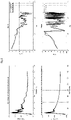
- the individual functions and the resulting already approximated complementary filter impulse response are in Fig.4 shown.
- a given impulse response can be viewed as an FIR filter of the length of the impulse response, with the values of each sample acting as the filter coefficients.
- a given integrated circuit does not necessarily have the ability to use an FIR filter for ANC due to hardware limitations (such filters require too many taps). With an IIR filter, however, it is already possible, since the feedback structure requires fewer taps. It is therefore advantageous to approximate the given impulse response using an IIR polynomial.
- the Prony method in 1 shown, used, which approximates the given impulse response by exponentially damped cosine oscillations.
- the advantage of the Prony method is that, in contrast to filter approximation in the frequency domain, where the result is FIR filters which then require further methods to generate IIR polynomials, the result is an IIR polynomial.
- the Prony method approximates impulse responses; that means it has to be worked in the time domain. Impulse responses are already given as transmission routes via the measurement, which also makes it obvious not to leave the time range.
- the approximation of the ANC filter in point e) of the procedure corresponds to the conversion of the ideal FIR impulse response of the filter into an IIR filter function using the Prony method.
- the determined transfer function has more coefficients than required: ANC filters are usually defined up to 2kHz, since good passive damping can be expected above this. Optionally, the order of the transfer function can be reduced.
- Impulse responses are typically recorded at a lower sample rate than used in the ANC system. 44.1 or 48kHz are common, while an ANC system is more likely to be clocked at 192 or 384kHz.
- the determined IIR filter must therefore be scaled from e.g. 48kHz to 384kHz, whereby the frequency response in absolute terms (in Hz) should remain the same (in a relevant range).
- the DC component (0Hz) can be found at the (Cartesian) coordinate 1 + 0j, while half the sampling frequency can be found at -1 + 0j (Nyquist frequency).
- the Nyquist frequency is 24kHz. In radians it is ⁇ , which is half the unit circle.
- ⁇ is half the unit circle.
- ⁇ equals 192kHz. That means there is more bandwidth (in Hz) in the same range in radians.
- the angle through which the poles and zeros must be rotated to scale the transfer function for the higher sampling rate is known.
- the damping factors must be adjusted.
- the lines of constant damping of the s-plane become spiral-shaped root locus curves on the z-plane by appropriate mapping (bilinear transformation, impulse invariance, or similar). From the original point of a pole or a zero, the position root function to the DC point must be found. The new position of a pole/zero is at the intersection of the square root function and the new angle for the higher sampling rate. The result of this adjustment is in Fig.2 (right above and below).
- poles/zeros which are at the Nyquist frequency for the low sampling rate: Since this moves for the higher sampling rate (from ⁇ to ⁇ ⁇ ), these poles/zeros must also move and be mirrored along the abscissa by a real value get filters. This process can result in more zeros than poles, resulting in an ill-defined transfer function. Add poles close to the origin point so that their influence is small but the transfer function becomes well defined. It is known that a polynomial with more coefficients in the numerator than in the denominator is not well defined since it would be anti-causal.
- the scaling can be done after the decomposition into biquadratic filters.
- the decomposition can be done using partial fractions.
- the feedback filter is programmed in the signal processor of a feedback ANC system with the coefficients of the calculated complementary function approximated according to the above description.
- This programming is usually accomplished via the development environment of the respective signal processors (ANC Ics) or by importing firmware provided with the coefficients using the methods already explained.
- the invention can be modified and changed in various ways, so the measuring device can have or consist of any other arrangement of microphones in addition to the possibilities mentioned of an artificial head, etc., as long as only the required data are recorded that are familiar to the person skilled in the art with knowledge of the invention.
- Adjustments to headphones that have been in use for a long time are also possible without any problems.
- Embodiments of the invention provide, for example, that in step b) the transmission links are measured digitally at the sampling rate of the measuring system, that the ANC headphones have a clock rate given by the digital signal processor, that the clock rate is higher than the sampling rate and that the /the approximated ANC filter(s) are scaled in the ratio of the sampling rate to the clock rate, whereby the frequency response of the approximated complementary filter(s) remains the same in absolute terms, in Hertz.
- the scaling of already approximated ANC filters according to the ratio between the clock rate of the working signal processor in the ANC listener and the sampling rate of the measuring system means that the coefficients of the IIR filter function are changed numerically in order to be identical with the higher clock rate of the signal processor generate frequency response.
- a further embodiment provides that in step e) the order of the approximated complementary filter(s) is/are higher than the signal processor(s) can process and that the order of the approximated complementary filter(s) is reduced appropriately for the performance of the signal processor(s).
- DSP Digital signal processors
- the need to reduce the order results from the fact that the signal processes in the headphones must be processed in real time during operation, since ANC only makes sense for real-time applications.
- Digital signal processors have hardware-related properties known to those skilled in the art that represent restrictions that must be taken into account when they are used (e.g. arithmetic operations/cycle, clock rates inherent in the processor, energy requirements, etc.). This results in countless reasons or limitations why signal processing processes (e.g. filters) could not be carried out in real time. The list is therefore not to be regarded as conclusive.
- the utilization of the signal processors can of course depend not only on the pure generation of an ANC signal but also on other factors, such as the processing of the audio signal to be emitted (e.g. music) or Bluetooth streaming.
- the IIR polynomial or the 2nd order IIR cascade is already a filter implementation.
- the order is reduced if the signal processor does not have enough power to execute a cascade of 16 second-order filters, for example.
- 8 filters of the 2nd order are to be reduced. This reduction must be done in such a way that ANC performance is not significantly affected. This is neither trivial nor obvious given that there are already the slightest deviations from the ideal leads to strong negative effects on the sound suppression. This in turn is familiar to anyone skilled in the field and is assumed.
- pole/zero positions of the IIR filter polynomials which are calculated based on the transmission paths sampled at 48 kHz, for example, must not shift in their position with respect to the natural frequency of the filter during upsampling, otherwise the filter characteristics no longer match the required complementary function.
- the poles and zeros on the z-plane must be modified to match the higher sampling rate of the ANC system; so that the characteristic of the filter cascade with regard to its natural frequency is retained.
- the determination described as to whether a reduction in complexity is required is made by the operating specialist or a corresponding algorithm after the measurement according to the method. This decision does not have to be made in real time since the storage of the polynomial is not time sensitive since the adjustment is done before the headphone is sold. In this way it can be ensured that the ANC system can later act in real time.
Landscapes
- Physics & Mathematics (AREA)
- Engineering & Computer Science (AREA)
- Acoustics & Sound (AREA)
- Multimedia (AREA)
- Signal Processing (AREA)
- Health & Medical Sciences (AREA)
- General Health & Medical Sciences (AREA)
- Otolaryngology (AREA)
- Soundproofing, Sound Blocking, And Sound Damping (AREA)
- Headphones And Earphones (AREA)
Applications Claiming Priority (1)
| Application Number | Priority Date | Filing Date | Title |
|---|---|---|---|
| EP20207549.5A EP4002871A1 (fr) | 2020-11-13 | 2020-11-13 | Procédé d'adaptation des casques anc |
Publications (1)
| Publication Number | Publication Date |
|---|---|
| EP4002875A1 true EP4002875A1 (fr) | 2022-05-25 |
Family
ID=73448933
Family Applications (2)
| Application Number | Title | Priority Date | Filing Date |
|---|---|---|---|
| EP20207549.5A Withdrawn EP4002871A1 (fr) | 2020-11-13 | 2020-11-13 | Procédé d'adaptation des casques anc |
| EP21207962.8A Pending EP4002875A1 (fr) | 2020-11-13 | 2021-11-12 | Procédé d'adaptation des casques anc |
Family Applications Before (1)
| Application Number | Title | Priority Date | Filing Date |
|---|---|---|---|
| EP20207549.5A Withdrawn EP4002871A1 (fr) | 2020-11-13 | 2020-11-13 | Procédé d'adaptation des casques anc |
Country Status (2)
| Country | Link |
|---|---|
| US (1) | US11587543B2 (fr) |
| EP (2) | EP4002871A1 (fr) |
Citations (4)
| Publication number | Priority date | Publication date | Assignee | Title |
|---|---|---|---|---|
| WO2010049241A1 (fr) | 2008-10-31 | 2010-05-06 | Austriamicrosystems Ag | Agencement de commande active du bruit, casque écouteur à commande active du bruit et procédé de calibrage |
| US20110222696A1 (en) | 2010-03-15 | 2011-09-15 | Nikhil Balachandran | Configurable electronic device reprogrammable to modify the device frequency response |
| US20190080682A1 (en) | 2016-03-17 | 2019-03-14 | Paul Darlington | Earphone Test System |
| CN111800694A (zh) | 2020-06-30 | 2020-10-20 | 深圳市豪恩声学股份有限公司 | 一种主动降噪耳机的滤波器设计方法、装置及测试设备 |
Family Cites Families (1)
| Publication number | Priority date | Publication date | Assignee | Title |
|---|---|---|---|---|
| US10034092B1 (en) * | 2016-09-22 | 2018-07-24 | Apple Inc. | Spatial headphone transparency |
-
2020
- 2020-11-13 EP EP20207549.5A patent/EP4002871A1/fr not_active Withdrawn
-
2021
- 2021-11-12 US US17/454,782 patent/US11587543B2/en active Active
- 2021-11-12 EP EP21207962.8A patent/EP4002875A1/fr active Pending
Patent Citations (5)
| Publication number | Priority date | Publication date | Assignee | Title |
|---|---|---|---|---|
| WO2010049241A1 (fr) | 2008-10-31 | 2010-05-06 | Austriamicrosystems Ag | Agencement de commande active du bruit, casque écouteur à commande active du bruit et procédé de calibrage |
| US9779714B2 (en) | 2008-10-31 | 2017-10-03 | Ams Ag | Active noise control arrangement, active noise control headphone and calibration method |
| US20110222696A1 (en) | 2010-03-15 | 2011-09-15 | Nikhil Balachandran | Configurable electronic device reprogrammable to modify the device frequency response |
| US20190080682A1 (en) | 2016-03-17 | 2019-03-14 | Paul Darlington | Earphone Test System |
| CN111800694A (zh) | 2020-06-30 | 2020-10-20 | 深圳市豪恩声学股份有限公司 | 一种主动降噪耳机的滤波器设计方法、装置及测试设备 |
Non-Patent Citations (1)
| Title |
|---|
| SMITH JULIUS O.: "Filter Design by Minimizing the L2 Equation-Error Norm", INTRODUCTION TO DIGITAL FILTERS: WITH AUDIO APPLICATIONS, 2007, XP055901502, Retrieved from the Internet <URL:https://www.dsprelated.com/freebooks/filters/Filter_Design_Minimizing_L2.html> [retrieved on 20220315] * |
Also Published As
| Publication number | Publication date |
|---|---|
| US20220157289A1 (en) | 2022-05-19 |
| US11587543B2 (en) | 2023-02-21 |
| EP4002871A1 (fr) | 2022-05-25 |
Similar Documents
| Publication | Publication Date | Title |
|---|---|---|
| DE102015101729B4 (de) | Echoauslöschungsverfahren und echoauslöschungsanordnung für elektroakustische kommunikationsvorrichtungen | |
| DE69132085T2 (de) | Kompensationsfilter | |
| DE3856269T2 (de) | Digitales Entzerrungsgerät mit Möglichkeit zur getrennten Modifikation der Phasen- und Amplitudencharakteristik | |
| DE3689035T2 (de) | Rauschminderungssystem. | |
| DE112012006458B4 (de) | Signalverarbeitungsvorrichtung | |
| DE102015120997B4 (de) | Verzögerungsloser Subband-Algorithmus mit variabler Bandbreite für ein breitbandiges aktives Geräuschunterdrückungs-System, Fahrzeug und Verfahren | |
| DE102010026884B4 (de) | Verfahren zum Betreiben einer Hörvorrichtung mit zweistufiger Transformation | |
| DE112009005469T5 (de) | Lautsprecherschutzvorrichtung und Verfahren dafür | |
| DE10018666A1 (de) | Vorrichtung und Verfahren zum geräuschabhängigen Anpassen eines akustischen Nutzsignals | |
| DE102019123971B4 (de) | Aktives lärmkompensationssystem und verfahren | |
| DE102009018812A1 (de) | Verfahren zum Betrieb einer Hörvorrichtung und Hörvorrichtung mit einer Frequenzweiche | |
| EP4133476B1 (fr) | Procédé, dispositif, casque d'écoute et programme informatique pour supprimer activement un bruit d'interférence | |
| DE102020200553B3 (de) | Verfahren zur Abstimmung der jeweiligen Phasengänge eines ersten Mikrofones und eines zweiten Mikrofons | |
| EP2981099B1 (fr) | Procede et dispositif de suppression de l'effet larsen | |
| DE102008024534A1 (de) | Hörvorrichtung mit einem Entzerrungsfilter im Filterbank-System | |
| DE102015110938B4 (de) | Verfahren zur Modifizierung einer Impulsantwort eines Klangwandlers | |
| EP4002871A1 (fr) | Procédé d'adaptation des casques anc | |
| DE102022111300A1 (de) | Vorrichtung zur Reduzierung des Rauschens bei der Wiedergabe eines Audiosignals mit einem Kopfhörer oder Hörgerät und entsprechendes Verfahren | |
| EP1309225B1 (fr) | Procédé pour déterminer le seuil de couplage dans une prothèse auditive | |
| WO2005093950A1 (fr) | Systeme de circuit et dispositif de traitement de signaux | |
| DE102024108243B4 (de) | Verfahren zur Verarbeitung von Audiosignalen | |
| DE10035673C1 (de) | Verfahren zum adaptiven digitalen Filtern, adaptives digitales Filter und Verwendung eines solchen adaptiven digitalen Filters | |
| DE102012008557B4 (de) | Verfahren zur Rückkopplungsunterdrückung in elektroakustischen Systemen | |
| WO2007036443A1 (fr) | Procede de reduction active du bruit et dispositif pour la mise en oeuvre dudit procede | |
| DE112017007239T5 (de) | Audiosignal-verarbeitungsvorrichtung |
Legal Events
| Date | Code | Title | Description |
|---|---|---|---|
| PUAI | Public reference made under article 153(3) epc to a published international application that has entered the european phase |
Free format text: ORIGINAL CODE: 0009012 |
|
| STAA | Information on the status of an ep patent application or granted ep patent |
Free format text: STATUS: THE APPLICATION HAS BEEN PUBLISHED |
|
| AK | Designated contracting states |
Kind code of ref document: A1 Designated state(s): AL AT BE BG CH CY CZ DE DK EE ES FI FR GB GR HR HU IE IS IT LI LT LU LV MC MK MT NL NO PL PT RO RS SE SI SK SM TR |
|
| STAA | Information on the status of an ep patent application or granted ep patent |
Free format text: STATUS: REQUEST FOR EXAMINATION WAS MADE |
|
| 17P | Request for examination filed |
Effective date: 20221117 |
|
| RBV | Designated contracting states (corrected) |
Designated state(s): AL AT BE BG CH CY CZ DE DK EE ES FI FR GB GR HR HU IE IS IT LI LT LU LV MC MK MT NL NO PL PT RO RS SE SI SK SM TR |
|
| STAA | Information on the status of an ep patent application or granted ep patent |
Free format text: STATUS: EXAMINATION IS IN PROGRESS |
|
| 17Q | First examination report despatched |
Effective date: 20240821 |