EP4002890A1 - Système et procédé de personnalisation audio - Google Patents
Système et procédé de personnalisation audio Download PDFInfo
- Publication number
- EP4002890A1 EP4002890A1 EP21207292.0A EP21207292A EP4002890A1 EP 4002890 A1 EP4002890 A1 EP 4002890A1 EP 21207292 A EP21207292 A EP 21207292A EP 4002890 A1 EP4002890 A1 EP 4002890A1
- Authority
- EP
- European Patent Office
- Prior art keywords
- hrtf
- sound source
- audio
- user
- personalisation
- Prior art date
- Legal status (The legal status is an assumption and is not a legal conclusion. Google has not performed a legal analysis and makes no representation as to the accuracy of the status listed.)
- Granted
Links
Images


Classifications
-
- H—ELECTRICITY
- H04—ELECTRIC COMMUNICATION TECHNIQUE
- H04S—STEREOPHONIC SYSTEMS
- H04S7/00—Indicating arrangements; Control arrangements, e.g. balance control
- H04S7/30—Control circuits for electronic adaptation of the sound field
- H04S7/302—Electronic adaptation of stereophonic sound system to listener position or orientation
- H04S7/303—Tracking of listener position or orientation
-
- H—ELECTRICITY
- H04—ELECTRIC COMMUNICATION TECHNIQUE
- H04S—STEREOPHONIC SYSTEMS
- H04S7/00—Indicating arrangements; Control arrangements, e.g. balance control
- H04S7/30—Control circuits for electronic adaptation of the sound field
- H04S7/302—Electronic adaptation of stereophonic sound system to listener position or orientation
- H04S7/303—Tracking of listener position or orientation
- H04S7/304—For headphones
-
- H—ELECTRICITY
- H04—ELECTRIC COMMUNICATION TECHNIQUE
- H04S—STEREOPHONIC SYSTEMS
- H04S3/00—Systems employing more than two channels, e.g. quadraphonic
- H04S3/002—Non-adaptive circuits, e.g. manually adjustable or static, for enhancing the sound image or the spatial distribution
-
- H—ELECTRICITY
- H04—ELECTRIC COMMUNICATION TECHNIQUE
- H04S—STEREOPHONIC SYSTEMS
- H04S3/00—Systems employing more than two channels, e.g. quadraphonic
- H04S3/008—Systems employing more than two channels, e.g. quadraphonic in which the audio signals are in digital form, i.e. employing more than two discrete digital channels
-
- H—ELECTRICITY
- H04—ELECTRIC COMMUNICATION TECHNIQUE
- H04S—STEREOPHONIC SYSTEMS
- H04S7/00—Indicating arrangements; Control arrangements, e.g. balance control
- H04S7/30—Control circuits for electronic adaptation of the sound field
- H04S7/307—Frequency adjustment, e.g. tone control
-
- H—ELECTRICITY
- H04—ELECTRIC COMMUNICATION TECHNIQUE
- H04S—STEREOPHONIC SYSTEMS
- H04S2400/00—Details of stereophonic systems covered by H04S but not provided for in its groups
- H04S2400/01—Multi-channel, i.e. more than two input channels, sound reproduction with two speakers wherein the multi-channel information is substantially preserved
-
- H—ELECTRICITY
- H04—ELECTRIC COMMUNICATION TECHNIQUE
- H04S—STEREOPHONIC SYSTEMS
- H04S2400/00—Details of stereophonic systems covered by H04S but not provided for in its groups
- H04S2400/11—Positioning of individual sound objects, e.g. moving airplane, within a sound field
-
- H—ELECTRICITY
- H04—ELECTRIC COMMUNICATION TECHNIQUE
- H04S—STEREOPHONIC SYSTEMS
- H04S2400/00—Details of stereophonic systems covered by H04S but not provided for in its groups
- H04S2400/13—Aspects of volume control, not necessarily automatic, in stereophonic sound systems
-
- H—ELECTRICITY
- H04—ELECTRIC COMMUNICATION TECHNIQUE
- H04S—STEREOPHONIC SYSTEMS
- H04S2420/00—Techniques used stereophonic systems covered by H04S but not provided for in its groups
- H04S2420/01—Enhancing the perception of the sound image or of the spatial distribution using head related transfer functions [HRTF's] or equivalents thereof, e.g. interaural time difference [ITD] or interaural level difference [ILD]
-
- H—ELECTRICITY
- H04—ELECTRIC COMMUNICATION TECHNIQUE
- H04S—STEREOPHONIC SYSTEMS
- H04S2420/00—Techniques used stereophonic systems covered by H04S but not provided for in its groups
- H04S2420/07—Synergistic effects of band splitting and sub-band processing
-
- H—ELECTRICITY
- H04—ELECTRIC COMMUNICATION TECHNIQUE
- H04S—STEREOPHONIC SYSTEMS
- H04S2420/00—Techniques used stereophonic systems covered by H04S but not provided for in its groups
- H04S2420/11—Application of ambisonics in stereophonic audio systems
Definitions
- the present invention relates to an audio personalisation method and system.
- the present invention seeks to mitigate or alleviate this problem.
- a suitable system and/or platform for implementing the methods and techniques herein may be an entertainment device such as the Sony PlayStation 4 ® or PlayStation 5 ® videogame consoles.
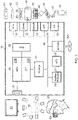
- Figure 1 schematically illustrates the overall system architecture of a Sony ® PlayStation 4 ® entertainment device.
- a system unit 10 is provided, with various peripheral devices connectable to the system unit.
- the system unit 10 comprises an accelerated processing unit (APU) 20 being a single chip that in turn comprises a central processing unit (CPU) 20A and a graphics processing unit (GPU) 20B.
- the APU 20 has access to a random access memory (RAM) unit 22.
- RAM random access memory
- the APU 20 communicates with a bus 40, optionally via an I/O bridge 24, which may be a discreet component or part of the APU 20.
- bus 40 Connected to the bus 40 are data storage components such as a hard disk drive 37, and a Blu-ray ® drive 36 operable to access data on compatible optical discs 36A. Additionally the RAM unit 22 may communicate with the bus 40.
- auxiliary processor 38 is also connected to the bus 40.
- the auxiliary processor 38 may be provided to run or support the operating system.
- the system unit 10 communicates with peripheral devices as appropriate via an audio/visual input port 31, an Ethernet ® port 32, a Bluetooth ® wireless link 33, a Wi-Fi ® wireless link 34, or one or more universal serial bus (USB) ports 35. Audio and video may be output via an AV output 39, such as an HDMI ® port.
- the peripheral devices may include a monoscopic or stereoscopic video camera 41 such as the PlayStation ® Eye; wand-style videogame controllers 42 such as the PlayStation ® Move and conventional handheld videogame controllers 43 such as the DualShock ® 4; portable entertainment devices 44 such as the PlayStation ® Portable and PlayStation ® Vita; a keyboard 45 and/or a mouse 46; a media controller 47, for example in the form of a remote control; and a headset 48.
- Other peripheral devices may similarly be considered such as a printer, or a 3D printer (not shown), or a mobile phone 49 connected for example via Bluetooth ® or Wifi Direct ® .
- the GPU 20B optionally in conjunction with the CPU 20A, generates video images and audio for output via the AV output 39.
- the audio may be generated in conjunction with or instead by an audio processor (not shown).
- the video and optionally the audio may be presented to a television 51. Where supported by the television, the video may be stereoscopic.
- the audio may be presented to a home cinema system 52 in one of a number of formats such as stereo, 5.1 surround sound or 7.1 surround sound.
- Video and audio may likewise be presented to a head mounted display unit 53 worn by a user 60.
- the entertainment device defaults to an operating system such as a variant of FreeBSD ® 9.0.
- the operating system may run on the CPU 20A, the auxiliary processor 38, or a mixture of the two.
- the operating system provides the user with a graphical user interface such as the PlayStation ® Dynamic Menu. The menu allows the user to access operating system features and to select games and optionally other content.
- the user When playing such games, or optionally other content, the user will typically be receiving audio from a stereo or surround sound system 52, or headphones, when viewing the content on a static display 51, or similarly receiving audio from a stereo surround sound system 52 or headphones, when viewing content on a head mounted display ('HMD') 53.
- a stereo or surround sound system 52 or headphones
- 'HMD' head mounted display
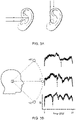
- an example physical interaction is the interaural delay or time difference (ITD), which is indicative of the degree to which a sound is positioned to the left or right of the user (resulting in relative changes in arrival time at the left and right ears), which is a function of the listener's head size and face shape.
- ITD interaural delay or time difference
- interaural level difference relates to different loudness for left and right ears and is indicative of the degree to which a sound is positioned to the left or right of the user (resulting in different degrees of attenuation due to the relative obscuring of the ear from the sound source), and again is a function of head size and face shape.
- the outer ear comprises asymmetric features that vary between individuals and provide additional vertical discrimination for incoming sound; referring to Figure 3B , the small difference in path lengths between direct and reflected sounds from these features cause so-called spectral notches that change in frequency as a function of sound source elevation.
- the result is a complex two-dimensional response for each ear that is a function of monaural cues such as spectral notches, and binaural or inter-aural cues such as ITD and ILD.
- An individual's brain learns to correlate this response with the physical source of objects, enabling them to distinguish between left and right, up and down, and indeed forward and back, to estimate an object's location in 3D with respect to the user's head.
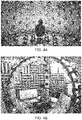
- figure 4A shows a fixed speaker arrangement for this purpose
- figure 4B shows a simplified system where, for example, the speaker rig or the user can rotate by fixed increments so that the speakers successively fill in the remaining sample points in the sphere.
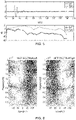
- a recorded impulse response within the ear (for example using a microphone positioned at the entrance to the ear canal) is obtained, as shown in the upper graph.
- a Fourier transform of such an impulse response is referred to as a frequency response, as shown in the lower graph of Figure 5 .
- HRTF head-related transfer function
- a full HRTF can be computed, as partially illustrated in figure 6 for both left and right ears (showing frequency on the y-axis versus azimuth on the x-axis).
- Brightness is a function of the Fourier transform values, with dark regions corresponding to spectral notches.
- An HRTF typically comprises a time or frequency filter (e.g. based on an impulse or frequency response) for a series of positions on a sphere or partial sphere surrounding the user's head (e.g. for both azimuth and elevation), so that a sound, when played through a respective one of these filters, appears to come from the corresponding positon/direction.
- a time or frequency filter e.g. based on an impulse or frequency response
- a series of positions on a sphere or partial sphere surrounding the user's head e.g. for both azimuth and elevation
- an audio personalisation method for a user may comprise the steps of capturing at least a first image of a user comprising a view of their head, wherein at least one of the captured images comprises a reference feature of known absolute size in a predetermined relationship to the user's head; analysing the or each captured image to generate data characteristic of the morphology of the user's head, responsive to the known absolute size of the reference feature; for a corpus of reference individuals for whom respective head related transfer functions 'HRTF's have been generated, comparing some or all of the generated data from the user with corresponding data of some or all respective reference individuals in the corpus; identifying a reference individual whose generated data best matches the generated data from the user; and using the HRTF of the identified reference individual for the user.
- an audio personalisation method for a first user may comprises the steps of testing a first user on a calibration test, the calibration test comprising: requiring a user to match a test sound to a test location, either by controlling the position of the presented sound or controlling the position of the presented location, for a sequence of test matches, each test sound being presented at a position using a default HRTF, receiving an estimate of each matching location from the first user, and calculating a respective error for each estimate, to generate a sequence of location estimate errors for the first user; and then comparing at least some of the location estimate errors for the first user with estimate errors of the same locations previously generated for at least a subset of a corpus of reference individuals; identifying a reference individual with the closest match of compared location estimation errors to those of the first user; and using an HRTF, previously obtained for the identified reference individual, for the first user.
- the aim is to match a user to a reference individual, this time based on the extent to which both the user and the reference individual (who undergoes a similar test) make mistakes localising sounds that are played using a common default HRTF; the mistakes are a proxy for the differences between the default HRTF and the user's HRTF, and hence finding a matching set of errors among the reference individuals will also find a similar corresponding HRTF.
- an audio personalisation method for a user may comprise the steps of testing the user with an audio test, the audio test comprising: moving a portable device, comprising a position tracking mechanism and a speaker, to a plurality of test positions relative to the user's head; playing a test sound through the speaker of the portable device; and detecting the test sound using a microphone at least proximate to each of the user's ears, and associating resulting measurement data with the corresponding test position, wherein the resulting measurement data derived from the detected test sounds is characteristic of the user's head morphology; for a corpus of reference individuals for whom respective head-related transfer functions 'HRTF's have been generated, comparing the measurement data from the user's audio test or an HRTF derived from this measurement data with corresponding measurement data of some or all respective reference individuals in the corpus or HRTFs of some or all respective reference individuals in the corpus; identifying a reference individual whose measurement data or HRTF best matches the measurement data or HR
- an approximate HRTF (or precursor audio measurements) are collected for the end user, and compared with corresponding data for the reference individuals to find a match; the full HRTF for that reference individual can then be used for the end user.
- the end user may obtain an HRTF, which enable the reproduction of 3D audio directional sources by combining the raw sound source with the HRTF for a given position, the HRTF providing the relevant inter-aural time delay, inter-aural level delay, and spectral response expected by the ears of the user for that position.
- the HRTF spatialise a physically small source such as a person speaking or a bird tweeting, for example within a videogame or other immersive content.
- an HRTF to spatialize (i.e. appear to position in space) physically large or volumetric sources, such as rivers or busy roads, that typically form part of the wider environment in such videogames.
- phase and position information is primarily obtained through spectral peaks and notches in the HRTF's spectral response (plus ITD for basic left/right localisation).
- the smoothing can be achieved using any suitable signal processing technique, such as applying a moving average filter, or a spatial smoothing filter when treating the HRTF values as a 2D or 3D array, such as dilation.
- the smoothing serves to simulate the chaotic or random superposition of phases and source positions likely to be experienced by a person when listening to a large or distributed source such as a river.
- the degree of smoothing can be made proportional to the notional size of the source compared to a notional size of a point source or position. It will be appreciated that a typical HRTF is itself a discrete approximation of the continuous variations in filter parameters with direction created by the user's ear, typically by sampling the space around a person at (as a non-limiting example) every 10 degrees of arc.
- the effective spatial sampling granularity may be any value but can serve as the default size of the notional point source when using the unsmoothed HRTF.
- the HRTF for the direction or directions corresponding the object may be smoothed to be 50% as accurate as before. If the object spans 15 degree, then the HRTF for that area may be smoothed to be 33% as accurate as before.
- the HRTF can be smoothed using a suitable filter, and/or the values for the HRTF directions that the object occupies (or optionally is also proximate to) may be averaged, or superposed and normalised, to create a blended HRTF filter for the object. Either approach can be referred to herein as 'smoothed'.
- the object is then represented by the source sound(s) and one smoothed HRTF filter corresponding to the object's average or perceived positon. It will be appreciated that multiple sounds can be filtered with this one filter to simulate variability in the source.
- HRTFs allow localisation as a function of direction (and thus smoothing the HRTF expands the localisation from a point to an area), they do not necessarily allow localisation as a function of distance (although the human brain can also infer this from corresponding visual cues, for example); therefore to enhance the effect for a volumetric source, multiple versions of the sound may be filtered using the smoothed HRTF filter but at different global delays (and optionally global attenuations) corresponding to increasing distances within the volume.
- a river for example, that is at an angle with respect to the user may have an overall size of, say 60 degrees of arc, spanning 12 HRTF filter positions at 5 degree separations, but this can be divided into four sets of large objects each with 15 degrees of arc, and use different global delays, and optionally attenuation, to capture the change of distance for each segment of the river as it recedes.
- smoothed HRTF can be used in conjunction with an unsmoothed or 'full resolution' HRTF; hence for example the smoothed HRTF could be used for general river sounds, whilst nearby fish splashing in the river could use the full resolution HRTF.
- the technique can comprise dividing the space around the user into a grid or array of directions each corresponding to an HRTF sampling point, and then for a given direction smoothing the corresponding HRTF filter, or equivalently averaging or blending it with neighbouring filters, depending on how many of the grid or array of directions the large object occupies.
- the volume of the object can be represented further by the use of the sound with different global delays, and similarly such global delays can be used where a long sound source such as a river or road recedes at an angle from the user.
- 'Ambisonics' is a spatial audio format that in effect parcels the audio environment up into a series of different size grids.
- Ambisonics an entire directional sound field can be stored as a finite number of distinct 'channels' (as opposed to an object format where individual sources are stored separately along with positional meta-data). Each channel represents a specific spatial portion of the soundfield, with higher numbered channels representing more precise directions. Audio sources can be encoded into Ambisonics by weighting the source onto each channel with a gain value equivalent to the value of a spherical harmonic component at the desired angle of the source.
- Ambisonics is a soundfield reconstruction technique, similar to Wave Field Synthesis, where loudspeaker signals are generated such that the harmonic mode excitations within the centre of a playback array are matched with those of the original soundfield.
- Ambisonics can be stored at different 'orders' with higher orders including more channels. Higher order Ambisonics can therefore represent a higher resolution soundfield to the limit that an infinitely high order Ambisonic mix (which includes an infinite number of channels) is equivalent to perfect object based audio rendering. Lower order Ambisonics meanwhile results in blurred/spread out sources, similar to a 2D or 3D version of low-pass filtering or muffling the sound.
- Sources can be manually blurred in higher order Ambisonics by increasing the gain of the specific source on the W Channel.
- the W channel is the first channel and is omnidirectional. Doing this therefore increases the omnidirectional reproduction of the source in the rendering stages, making the apparent direction of the source harder to discern.
- non-linear filtering may be considered; e.g. frequencies can arrive at each ear with different and/or multiple time delays. This can be achieved by applying a random/chaotic phase delay on to multiple copies of the smoothed HRTF and summing the results.
- HRTFs can be applied independently of using Ambisonics, but that optionally where Ambisonics is used, then for respective Ambisonic channels, corresponding HRTF coefficients appropriately smoothed for the spatial area represented by the channel may be used to deliver an apparently diffuse or volumetric sound source.
- the approach of smoothing HRTFs may also be used to assist with any one of the three approaches described above relating to finding an HRTF for a user from a library of existing HRTFs created for reference individuals.
- using smoothed HRTFs allows for filtration/sifting of the candidate HRTFs. Comparing HRTFs for a specific user on large scale sounds allows a faster HRTF selection, as differences between HRTFs are smoothed out for a large scale source, allowing many candidate HRTFs that have similar large-scale characteristics to be ruled in or out at once. Then increasingly smaller scale sources could be used until only a few HRTFs are being evaluated at a full resolution for 'point' sources.
- smoothed HRTFs could be used instead of full resolution HRTFs for example where no HRTF can be found for the user (for example to within a predetermined tolerance) based on the comparisons with the data for the reference individuals as described in the above techniques.
- the smoothed HRTF could be a blend of the two or three closest matching HRTFs.
- an audio personalisation method for a user to reproduce an area-based or volumetric sound source, comprises the following steps.
- a first step s710 comprises smoothing HRTF coefficients relating to peaks and notches in the HRTF's spectral response, responsive to the size of the area or volume of the sound source, as described elsewhere herein.
- a second step s720 then comprises filtering the sound source using the smoothed HRTF for the notional position of the sound source, as described elsewhere herein.
- a third step s730 then comprises outputting the filtered sound source signal for playback to the user, as described elsewhere herein.
- a conventional equivalent device may be implemented in the form of a computer program product comprising processor implementable instructions stored on a non-transitory machine-readable medium such as a floppy disk, optical disk, hard disk, solid state disk, PROM, RAM, flash memory or any combination of these or other storage media, or realised in hardware as an ASIC (application specific integrated circuit) or an FPGA (field programmable gate array) or other configurable circuit suitable to use in adapting the conventional equivalent device.
- a computer program may be transmitted via data signals on a network such as an Ethernet, a wireless network, the Internet, or any combination of these or other networks.
- an example conventional device may be a PlayStation 4 (as shown) or a PlayStation 5.
- an audio personalisation system to reproduce an area-based or volumetric sound source for a user may comprise the following.
- a smoothing processor for example CPU 20A configured (for example by suitable software instruction) to smooth HRTF coefficients relating to peaks and notches in the HRTF's spectral response, responsive to the size of the area or volume of the sound source.
- a filtering processor for example CPU 20A configured (for example by suitable software instruction) to filter the sound source using the smoothed HRTF for the notional position of the sound source.
- a playback processor for example CPU 20A configured (for example by suitable software instruction) to output audio signals corresponding to the filtered sound source for the user.
- audio personalisation system may be further configured (for example by suitable software instruction) to implement any of the methods and techniques described herein, including but not limited to:
Landscapes
- Engineering & Computer Science (AREA)
- Physics & Mathematics (AREA)
- Acoustics & Sound (AREA)
- Signal Processing (AREA)
- Multimedia (AREA)
- Stereophonic System (AREA)
Applications Claiming Priority (1)
| Application Number | Priority Date | Filing Date | Title |
|---|---|---|---|
| GB2017814.1A GB2600943A (en) | 2020-11-11 | 2020-11-11 | Audio personalisation method and system |
Publications (2)
| Publication Number | Publication Date |
|---|---|
| EP4002890A1 true EP4002890A1 (fr) | 2022-05-25 |
| EP4002890B1 EP4002890B1 (fr) | 2024-09-18 |
Family
ID=74046264
Family Applications (1)
| Application Number | Title | Priority Date | Filing Date |
|---|---|---|---|
| EP21207292.0A Active EP4002890B1 (fr) | 2020-11-11 | 2021-11-09 | Système et procédé de personnalisation audio |
Country Status (3)
| Country | Link |
|---|---|
| US (1) | US11765539B2 (fr) |
| EP (1) | EP4002890B1 (fr) |
| GB (1) | GB2600943A (fr) |
Citations (3)
| Publication number | Priority date | Publication date | Assignee | Title |
|---|---|---|---|---|
| US20070092085A1 (en) * | 2005-10-11 | 2007-04-26 | Yamaha Corporation | Signal processing device and sound image orientation apparatus |
| US9848273B1 (en) * | 2016-10-21 | 2017-12-19 | Starkey Laboratories, Inc. | Head related transfer function individualization for hearing device |
| US20200336858A1 (en) * | 2019-04-18 | 2020-10-22 | Facebook Technologies, Llc | Individualization of head related transfer function templates for presentation of audio content |
Family Cites Families (5)
| Publication number | Priority date | Publication date | Assignee | Title |
|---|---|---|---|---|
| JP6454027B2 (ja) * | 2014-12-04 | 2019-01-16 | ガウディ オーディオ ラボラトリー,インコーポレイティド | バイノーラルレンダリングのためのオーディオ信号処理装置及びその方法 |
| US9918177B2 (en) * | 2015-12-29 | 2018-03-13 | Harman International Industries, Incorporated | Binaural headphone rendering with head tracking |
| WO2017126895A1 (fr) * | 2016-01-19 | 2017-07-27 | 지오디오랩 인코포레이티드 | Dispositif et procédé pour traiter un signal audio |
| US10764704B2 (en) * | 2018-03-22 | 2020-09-01 | Boomcloud 360, Inc. | Multi-channel subband spatial processing for loudspeakers |
| US10425762B1 (en) * | 2018-10-19 | 2019-09-24 | Facebook Technologies, Llc | Head-related impulse responses for area sound sources located in the near field |
-
2020
- 2020-11-11 GB GB2017814.1A patent/GB2600943A/en not_active Withdrawn
-
2021
- 2021-11-09 EP EP21207292.0A patent/EP4002890B1/fr active Active
- 2021-11-09 US US17/522,052 patent/US11765539B2/en active Active
Patent Citations (3)
| Publication number | Priority date | Publication date | Assignee | Title |
|---|---|---|---|---|
| US20070092085A1 (en) * | 2005-10-11 | 2007-04-26 | Yamaha Corporation | Signal processing device and sound image orientation apparatus |
| US9848273B1 (en) * | 2016-10-21 | 2017-12-19 | Starkey Laboratories, Inc. | Head related transfer function individualization for hearing device |
| US20200336858A1 (en) * | 2019-04-18 | 2020-10-22 | Facebook Technologies, Llc | Individualization of head related transfer function templates for presentation of audio content |
Also Published As
| Publication number | Publication date |
|---|---|
| GB2600943A (en) | 2022-05-18 |
| US11765539B2 (en) | 2023-09-19 |
| EP4002890B1 (fr) | 2024-09-18 |
| US20220150658A1 (en) | 2022-05-12 |
| GB202017814D0 (en) | 2020-12-23 |
Similar Documents
| Publication | Publication Date | Title |
|---|---|---|
| EP3644628B1 (fr) | Systèmes et procédés de modification des caractéristiques de salle pour rendu audio spatial sur écouteurs | |
| US11589184B1 (en) | Differential spatial rendering of audio sources | |
| TWI517028B (zh) | 音訊空間定位和環境模擬 | |
| US11122384B2 (en) | Devices and methods for binaural spatial processing and projection of audio signals | |
| US11418903B2 (en) | Spatial repositioning of multiple audio streams | |
| CN113950845B (zh) | 凹式音频渲染 | |
| EP3375207B1 (fr) | Appareil et procédé de traitement de signal audio | |
| US11770669B2 (en) | Audio personalisation method and system | |
| EP3750334A1 (fr) | Procédé d'amélioration de la localisation d'un son surround | |
| EP4205412B1 (fr) | Méthode pour trouver la meilleure hrtf dans une base de données de hrtf | |
| KR20200070110A (ko) | 복수 오디오 스트림의 공간 위치 변경 | |
| EP3595337A1 (fr) | Appareil audio et procédé de traitement audio | |
| US10999694B2 (en) | Transfer function dataset generation system and method | |
| EP3700233A1 (fr) | Système et procédé de génération d'une fonction de transfert | |
| WO2006067893A1 (fr) | Dispositif de localisation d’image acoustique | |
| EP3225039B1 (fr) | Système et procédé pour produire un audio tridimensionnel (3d) externalisé sur la tête par l'intermédiaire de casques d'écoute | |
| EP4002890B1 (fr) | Système et procédé de personnalisation audio | |
| Nowak et al. | 3D virtual audio with headphones: A literature review of the last ten years | |
| Xu et al. | An improved free-field cross-talk cancellation method based on the spherical head model | |
| Hacıhabiboğlu et al. | Perceptual simplification for model-based binaural room auralisation | |
| Privitera et al. | Preliminary evaluation of the auralization of a real indoor environment for augmented reality research | |
| Daugintis et al. | Perceptual evaluation of an auditory model–based similarity metric for head-related transfer functions | |
| KR20260043123A (ko) | 오디오 데이터 신호의 생성 | |
| CN119497030A (zh) | 音频处理方法及电子设备 | |
| Pierleoni et al. | Audio Rendering System For Multimedia Applications |
Legal Events
| Date | Code | Title | Description |
|---|---|---|---|
| PUAI | Public reference made under article 153(3) epc to a published international application that has entered the european phase |
Free format text: ORIGINAL CODE: 0009012 |
|
| STAA | Information on the status of an ep patent application or granted ep patent |
Free format text: STATUS: REQUEST FOR EXAMINATION WAS MADE |
|
| 17P | Request for examination filed |
Effective date: 20211125 |
|
| AK | Designated contracting states |
Kind code of ref document: A1 Designated state(s): AL AT BE BG CH CY CZ DE DK EE ES FI FR GB GR HR HU IE IS IT LI LT LU LV MC MK MT NL NO PL PT RO RS SE SI SK SM TR |
|
| RIN1 | Information on inventor provided before grant (corrected) |
Inventor name: CAPPELLO, FABIO Inventor name: JONES, MICHAEL LEE Inventor name: SMITH, ALEXEI ASHTON DEREK Inventor name: BARREIRO, MARINA VILLANUEVA Inventor name: ARMSTRONG, CALUM |
|
| GRAP | Despatch of communication of intention to grant a patent |
Free format text: ORIGINAL CODE: EPIDOSNIGR1 |
|
| STAA | Information on the status of an ep patent application or granted ep patent |
Free format text: STATUS: GRANT OF PATENT IS INTENDED |
|
| INTG | Intention to grant announced |
Effective date: 20240424 |
|
| RAP3 | Party data changed (applicant data changed or rights of an application transferred) |
Owner name: SONY INTERACTIVE ENTERTAINMENT INC. |
|
| GRAS | Grant fee paid |
Free format text: ORIGINAL CODE: EPIDOSNIGR3 |
|
| GRAA | (expected) grant |
Free format text: ORIGINAL CODE: 0009210 |
|
| STAA | Information on the status of an ep patent application or granted ep patent |
Free format text: STATUS: THE PATENT HAS BEEN GRANTED |
|
| P01 | Opt-out of the competence of the unified patent court (upc) registered |
Free format text: CASE NUMBER: APP_45427/2024 Effective date: 20240806 |
|
| AK | Designated contracting states |
Kind code of ref document: B1 Designated state(s): AL AT BE BG CH CY CZ DE DK EE ES FI FR GB GR HR HU IE IS IT LI LT LU LV MC MK MT NL NO PL PT RO RS SE SI SK SM TR |
|
| REG | Reference to a national code |
Ref country code: GB Ref legal event code: FG4D |
|
| REG | Reference to a national code |
Ref country code: CH Ref legal event code: EP |
|
| REG | Reference to a national code |
Ref country code: IE Ref legal event code: FG4D |
|
| REG | Reference to a national code |
Ref country code: DE Ref legal event code: R096 Ref document number: 602021018910 Country of ref document: DE |
|
| REG | Reference to a national code |
Ref country code: NL Ref legal event code: FP |
|
| REG | Reference to a national code |
Ref country code: LT Ref legal event code: MG9D |
|
| PG25 | Lapsed in a contracting state [announced via postgrant information from national office to epo] |
Ref country code: NO Free format text: LAPSE BECAUSE OF FAILURE TO SUBMIT A TRANSLATION OF THE DESCRIPTION OR TO PAY THE FEE WITHIN THE PRESCRIBED TIME-LIMIT Effective date: 20241218 |
|
| PG25 | Lapsed in a contracting state [announced via postgrant information from national office to epo] |
Ref country code: GR Free format text: LAPSE BECAUSE OF FAILURE TO SUBMIT A TRANSLATION OF THE DESCRIPTION OR TO PAY THE FEE WITHIN THE PRESCRIBED TIME-LIMIT Effective date: 20241219 Ref country code: FI Free format text: LAPSE BECAUSE OF FAILURE TO SUBMIT A TRANSLATION OF THE DESCRIPTION OR TO PAY THE FEE WITHIN THE PRESCRIBED TIME-LIMIT Effective date: 20240918 |
|
| PG25 | Lapsed in a contracting state [announced via postgrant information from national office to epo] |
Ref country code: BG Free format text: LAPSE BECAUSE OF FAILURE TO SUBMIT A TRANSLATION OF THE DESCRIPTION OR TO PAY THE FEE WITHIN THE PRESCRIBED TIME-LIMIT Effective date: 20240918 |
|
| PG25 | Lapsed in a contracting state [announced via postgrant information from national office to epo] |
Ref country code: LV Free format text: LAPSE BECAUSE OF FAILURE TO SUBMIT A TRANSLATION OF THE DESCRIPTION OR TO PAY THE FEE WITHIN THE PRESCRIBED TIME-LIMIT Effective date: 20240918 |
|
| PG25 | Lapsed in a contracting state [announced via postgrant information from national office to epo] |
Ref country code: HR Free format text: LAPSE BECAUSE OF FAILURE TO SUBMIT A TRANSLATION OF THE DESCRIPTION OR TO PAY THE FEE WITHIN THE PRESCRIBED TIME-LIMIT Effective date: 20240918 |
|
| PG25 | Lapsed in a contracting state [announced via postgrant information from national office to epo] |
Ref country code: RS Free format text: LAPSE BECAUSE OF FAILURE TO SUBMIT A TRANSLATION OF THE DESCRIPTION OR TO PAY THE FEE WITHIN THE PRESCRIBED TIME-LIMIT Effective date: 20241218 |
|
| PG25 | Lapsed in a contracting state [announced via postgrant information from national office to epo] |
Ref country code: RS Free format text: LAPSE BECAUSE OF FAILURE TO SUBMIT A TRANSLATION OF THE DESCRIPTION OR TO PAY THE FEE WITHIN THE PRESCRIBED TIME-LIMIT Effective date: 20241218 Ref country code: NO Free format text: LAPSE BECAUSE OF FAILURE TO SUBMIT A TRANSLATION OF THE DESCRIPTION OR TO PAY THE FEE WITHIN THE PRESCRIBED TIME-LIMIT Effective date: 20241218 Ref country code: LV Free format text: LAPSE BECAUSE OF FAILURE TO SUBMIT A TRANSLATION OF THE DESCRIPTION OR TO PAY THE FEE WITHIN THE PRESCRIBED TIME-LIMIT Effective date: 20240918 Ref country code: HR Free format text: LAPSE BECAUSE OF FAILURE TO SUBMIT A TRANSLATION OF THE DESCRIPTION OR TO PAY THE FEE WITHIN THE PRESCRIBED TIME-LIMIT Effective date: 20240918 Ref country code: GR Free format text: LAPSE BECAUSE OF FAILURE TO SUBMIT A TRANSLATION OF THE DESCRIPTION OR TO PAY THE FEE WITHIN THE PRESCRIBED TIME-LIMIT Effective date: 20241219 Ref country code: FI Free format text: LAPSE BECAUSE OF FAILURE TO SUBMIT A TRANSLATION OF THE DESCRIPTION OR TO PAY THE FEE WITHIN THE PRESCRIBED TIME-LIMIT Effective date: 20240918 Ref country code: BG Free format text: LAPSE BECAUSE OF FAILURE TO SUBMIT A TRANSLATION OF THE DESCRIPTION OR TO PAY THE FEE WITHIN THE PRESCRIBED TIME-LIMIT Effective date: 20240918 |
|
| REG | Reference to a national code |
Ref country code: AT Ref legal event code: MK05 Ref document number: 1725711 Country of ref document: AT Kind code of ref document: T Effective date: 20240918 |
|
| PG25 | Lapsed in a contracting state [announced via postgrant information from national office to epo] |
Ref country code: PT Free format text: LAPSE BECAUSE OF FAILURE TO SUBMIT A TRANSLATION OF THE DESCRIPTION OR TO PAY THE FEE WITHIN THE PRESCRIBED TIME-LIMIT Effective date: 20250120 Ref country code: IS Free format text: LAPSE BECAUSE OF FAILURE TO SUBMIT A TRANSLATION OF THE DESCRIPTION OR TO PAY THE FEE WITHIN THE PRESCRIBED TIME-LIMIT Effective date: 20250118 |
|
| PG25 | Lapsed in a contracting state [announced via postgrant information from national office to epo] |
Ref country code: RO Free format text: LAPSE BECAUSE OF FAILURE TO SUBMIT A TRANSLATION OF THE DESCRIPTION OR TO PAY THE FEE WITHIN THE PRESCRIBED TIME-LIMIT Effective date: 20240918 Ref country code: SM Free format text: LAPSE BECAUSE OF FAILURE TO SUBMIT A TRANSLATION OF THE DESCRIPTION OR TO PAY THE FEE WITHIN THE PRESCRIBED TIME-LIMIT Effective date: 20240918 |
|
| PG25 | Lapsed in a contracting state [announced via postgrant information from national office to epo] |
Ref country code: ES Free format text: LAPSE BECAUSE OF FAILURE TO SUBMIT A TRANSLATION OF THE DESCRIPTION OR TO PAY THE FEE WITHIN THE PRESCRIBED TIME-LIMIT Effective date: 20240918 |
|
| PG25 | Lapsed in a contracting state [announced via postgrant information from national office to epo] |
Ref country code: AT Free format text: LAPSE BECAUSE OF FAILURE TO SUBMIT A TRANSLATION OF THE DESCRIPTION OR TO PAY THE FEE WITHIN THE PRESCRIBED TIME-LIMIT Effective date: 20240918 Ref country code: EE Free format text: LAPSE BECAUSE OF FAILURE TO SUBMIT A TRANSLATION OF THE DESCRIPTION OR TO PAY THE FEE WITHIN THE PRESCRIBED TIME-LIMIT Effective date: 20240918 |
|
| PG25 | Lapsed in a contracting state [announced via postgrant information from national office to epo] |
Ref country code: CZ Free format text: LAPSE BECAUSE OF FAILURE TO SUBMIT A TRANSLATION OF THE DESCRIPTION OR TO PAY THE FEE WITHIN THE PRESCRIBED TIME-LIMIT Effective date: 20240918 Ref country code: PL Free format text: LAPSE BECAUSE OF FAILURE TO SUBMIT A TRANSLATION OF THE DESCRIPTION OR TO PAY THE FEE WITHIN THE PRESCRIBED TIME-LIMIT Effective date: 20240918 |
|
| PG25 | Lapsed in a contracting state [announced via postgrant information from national office to epo] |
Ref country code: IT Free format text: LAPSE BECAUSE OF FAILURE TO SUBMIT A TRANSLATION OF THE DESCRIPTION OR TO PAY THE FEE WITHIN THE PRESCRIBED TIME-LIMIT Effective date: 20240918 Ref country code: SK Free format text: LAPSE BECAUSE OF FAILURE TO SUBMIT A TRANSLATION OF THE DESCRIPTION OR TO PAY THE FEE WITHIN THE PRESCRIBED TIME-LIMIT Effective date: 20240918 |
|
| REG | Reference to a national code |
Ref country code: DE Ref legal event code: R097 Ref document number: 602021018910 Country of ref document: DE |
|
| REG | Reference to a national code |
Ref country code: CH Ref legal event code: PL |
|
| PG25 | Lapsed in a contracting state [announced via postgrant information from national office to epo] |
Ref country code: MC Free format text: LAPSE BECAUSE OF FAILURE TO SUBMIT A TRANSLATION OF THE DESCRIPTION OR TO PAY THE FEE WITHIN THE PRESCRIBED TIME-LIMIT Effective date: 20240918 |
|
| PG25 | Lapsed in a contracting state [announced via postgrant information from national office to epo] |
Ref country code: DK Free format text: LAPSE BECAUSE OF FAILURE TO SUBMIT A TRANSLATION OF THE DESCRIPTION OR TO PAY THE FEE WITHIN THE PRESCRIBED TIME-LIMIT Effective date: 20240918 |
|
| PG25 | Lapsed in a contracting state [announced via postgrant information from national office to epo] |
Ref country code: LU Free format text: LAPSE BECAUSE OF NON-PAYMENT OF DUE FEES Effective date: 20241109 |
|
| REG | Reference to a national code |
Ref country code: CH Ref legal event code: PL |
|
| PG25 | Lapsed in a contracting state [announced via postgrant information from national office to epo] |
Ref country code: CH Free format text: LAPSE BECAUSE OF NON-PAYMENT OF DUE FEES Effective date: 20241130 |
|
| PLBE | No opposition filed within time limit |
Free format text: ORIGINAL CODE: 0009261 |
|
| STAA | Information on the status of an ep patent application or granted ep patent |
Free format text: STATUS: NO OPPOSITION FILED WITHIN TIME LIMIT |
|
| 26N | No opposition filed |
Effective date: 20250619 |
|
| REG | Reference to a national code |
Ref country code: BE Ref legal event code: MM Effective date: 20241130 |
|
| PG25 | Lapsed in a contracting state [announced via postgrant information from national office to epo] |
Ref country code: SE Free format text: LAPSE BECAUSE OF FAILURE TO SUBMIT A TRANSLATION OF THE DESCRIPTION OR TO PAY THE FEE WITHIN THE PRESCRIBED TIME-LIMIT Effective date: 20240918 |
|
| PG25 | Lapsed in a contracting state [announced via postgrant information from national office to epo] |
Ref country code: BE Free format text: LAPSE BECAUSE OF NON-PAYMENT OF DUE FEES Effective date: 20241130 |
|
| PG25 | Lapsed in a contracting state [announced via postgrant information from national office to epo] |
Ref country code: IE Free format text: LAPSE BECAUSE OF NON-PAYMENT OF DUE FEES Effective date: 20241109 |
|
| PGFP | Annual fee paid to national office [announced via postgrant information from national office to epo] |
Ref country code: NL Payment date: 20251022 Year of fee payment: 5 |
|
| PGFP | Annual fee paid to national office [announced via postgrant information from national office to epo] |
Ref country code: DE Payment date: 20251022 Year of fee payment: 5 |
|
| PGFP | Annual fee paid to national office [announced via postgrant information from national office to epo] |
Ref country code: GB Payment date: 20251022 Year of fee payment: 5 |
|
| PGFP | Annual fee paid to national office [announced via postgrant information from national office to epo] |
Ref country code: FR Payment date: 20251022 Year of fee payment: 5 |
|
| PG25 | Lapsed in a contracting state [announced via postgrant information from national office to epo] |
Ref country code: HU Free format text: LAPSE BECAUSE OF FAILURE TO SUBMIT A TRANSLATION OF THE DESCRIPTION OR TO PAY THE FEE WITHIN THE PRESCRIBED TIME-LIMIT; INVALID AB INITIO Effective date: 20211109 |
|
| PG25 | Lapsed in a contracting state [announced via postgrant information from national office to epo] |
Ref country code: CY Free format text: LAPSE BECAUSE OF FAILURE TO SUBMIT A TRANSLATION OF THE DESCRIPTION OR TO PAY THE FEE WITHIN THE PRESCRIBED TIME-LIMIT; INVALID AB INITIO Effective date: 20211109 |