EP4003159B1 - Herzüberwachungssystem und -verfahren - Google Patents
Herzüberwachungssystem und -verfahren Download PDFInfo
- Publication number
- EP4003159B1 EP4003159B1 EP20746309.2A EP20746309A EP4003159B1 EP 4003159 B1 EP4003159 B1 EP 4003159B1 EP 20746309 A EP20746309 A EP 20746309A EP 4003159 B1 EP4003159 B1 EP 4003159B1
- Authority
- EP
- European Patent Office
- Prior art keywords
- force
- sensitive resistors
- piezoelectric transducers
- sensitive
- sensor surface
- Prior art date
- Legal status (The legal status is an assumption and is not a legal conclusion. Google has not performed a legal analysis and makes no representation as to the accuracy of the status listed.)
- Active
Links
Images


Classifications
-
- A—HUMAN NECESSITIES
- A61—MEDICAL OR VETERINARY SCIENCE; HYGIENE
- A61B—DIAGNOSIS; SURGERY; IDENTIFICATION
- A61B5/00—Measuring for diagnostic purposes; Identification of persons
- A61B5/02—Detecting, measuring or recording for evaluating the cardiovascular system, e.g. pulse, heart rate, blood pressure or blood flow
- A61B5/024—Measuring pulse rate or heart rate
- A61B5/0255—Recording instruments specially adapted therefor
-
- A—HUMAN NECESSITIES
- A61—MEDICAL OR VETERINARY SCIENCE; HYGIENE
- A61B—DIAGNOSIS; SURGERY; IDENTIFICATION
- A61B5/00—Measuring for diagnostic purposes; Identification of persons
- A61B5/02—Detecting, measuring or recording for evaluating the cardiovascular system, e.g. pulse, heart rate, blood pressure or blood flow
- A61B5/0205—Simultaneously evaluating both cardiovascular conditions and different types of body conditions, e.g. heart and respiratory condition
-
- A—HUMAN NECESSITIES
- A61—MEDICAL OR VETERINARY SCIENCE; HYGIENE
- A61B—DIAGNOSIS; SURGERY; IDENTIFICATION
- A61B5/00—Measuring for diagnostic purposes; Identification of persons
- A61B5/02—Detecting, measuring or recording for evaluating the cardiovascular system, e.g. pulse, heart rate, blood pressure or blood flow
- A61B5/021—Measuring pressure in heart or blood vessels
- A61B5/02141—Details of apparatus construction, e.g. pump units or housings therefor, cuff pressurising systems, arrangements of fluid conduits or circuits
-
- A—HUMAN NECESSITIES
- A61—MEDICAL OR VETERINARY SCIENCE; HYGIENE
- A61B—DIAGNOSIS; SURGERY; IDENTIFICATION
- A61B5/00—Measuring for diagnostic purposes; Identification of persons
- A61B5/02—Detecting, measuring or recording for evaluating the cardiovascular system, e.g. pulse, heart rate, blood pressure or blood flow
- A61B5/024—Measuring pulse rate or heart rate
- A61B5/02444—Details of sensor
-
- A—HUMAN NECESSITIES
- A61—MEDICAL OR VETERINARY SCIENCE; HYGIENE
- A61B—DIAGNOSIS; SURGERY; IDENTIFICATION
- A61B5/00—Measuring for diagnostic purposes; Identification of persons
- A61B5/08—Measuring devices for evaluating the respiratory organs
- A61B5/0816—Measuring devices for examining respiratory frequency
-
- A—HUMAN NECESSITIES
- A61—MEDICAL OR VETERINARY SCIENCE; HYGIENE
- A61B—DIAGNOSIS; SURGERY; IDENTIFICATION
- A61B5/00—Measuring for diagnostic purposes; Identification of persons
- A61B5/103—Measuring devices for testing the shape, pattern, colour, size or movement of the body or parts thereof, for diagnostic purposes
- A61B5/1036—Measuring load distribution, e.g. podologic studies
-
- A—HUMAN NECESSITIES
- A61—MEDICAL OR VETERINARY SCIENCE; HYGIENE
- A61B—DIAGNOSIS; SURGERY; IDENTIFICATION
- A61B5/00—Measuring for diagnostic purposes; Identification of persons
- A61B5/103—Measuring devices for testing the shape, pattern, colour, size or movement of the body or parts thereof, for diagnostic purposes
- A61B5/11—Measuring movement of the entire body or parts thereof, e.g. head or hand tremor or mobility of a limb
- A61B5/1102—Ballistocardiography
-
- A—HUMAN NECESSITIES
- A61—MEDICAL OR VETERINARY SCIENCE; HYGIENE
- A61B—DIAGNOSIS; SURGERY; IDENTIFICATION
- A61B5/00—Measuring for diagnostic purposes; Identification of persons
- A61B5/68—Arrangements of detecting, measuring or recording means, e.g. sensors, in relation to patient
- A61B5/6887—Arrangements of detecting, measuring or recording means, e.g. sensors, in relation to patient mounted on external non-worn devices, e.g. non-medical devices
- A61B5/6891—Furniture
-
- A—HUMAN NECESSITIES
- A61—MEDICAL OR VETERINARY SCIENCE; HYGIENE
- A61B—DIAGNOSIS; SURGERY; IDENTIFICATION
- A61B5/00—Measuring for diagnostic purposes; Identification of persons
- A61B5/68—Arrangements of detecting, measuring or recording means, e.g. sensors, in relation to patient
- A61B5/6887—Arrangements of detecting, measuring or recording means, e.g. sensors, in relation to patient mounted on external non-worn devices, e.g. non-medical devices
- A61B5/6892—Mats
-
- A—HUMAN NECESSITIES
- A61—MEDICAL OR VETERINARY SCIENCE; HYGIENE
- A61B—DIAGNOSIS; SURGERY; IDENTIFICATION
- A61B5/00—Measuring for diagnostic purposes; Identification of persons
- A61B5/72—Signal processing specially adapted for physiological signals or for diagnostic purposes
- A61B5/7203—Signal processing specially adapted for physiological signals or for diagnostic purposes for noise prevention, reduction or removal
- A61B5/7207—Signal processing specially adapted for physiological signals or for diagnostic purposes for noise prevention, reduction or removal of noise induced by motion artifacts
- A61B5/721—Signal processing specially adapted for physiological signals or for diagnostic purposes for noise prevention, reduction or removal of noise induced by motion artifacts using a separate sensor to detect motion or using motion information derived from signals other than the physiological signal to be measured
-
- A—HUMAN NECESSITIES
- A61—MEDICAL OR VETERINARY SCIENCE; HYGIENE
- A61B—DIAGNOSIS; SURGERY; IDENTIFICATION
- A61B5/00—Measuring for diagnostic purposes; Identification of persons
- A61B5/72—Signal processing specially adapted for physiological signals or for diagnostic purposes
- A61B5/7235—Details of waveform analysis
- A61B5/7264—Classification of physiological signals or data, e.g. using neural networks, statistical classifiers, expert systems or fuzzy systems
-
- A—HUMAN NECESSITIES
- A61—MEDICAL OR VETERINARY SCIENCE; HYGIENE
- A61B—DIAGNOSIS; SURGERY; IDENTIFICATION
- A61B5/00—Measuring for diagnostic purposes; Identification of persons
- A61B5/72—Signal processing specially adapted for physiological signals or for diagnostic purposes
- A61B5/7235—Details of waveform analysis
- A61B5/7264—Classification of physiological signals or data, e.g. using neural networks, statistical classifiers, expert systems or fuzzy systems
- A61B5/7267—Classification of physiological signals or data, e.g. using neural networks, statistical classifiers, expert systems or fuzzy systems involving training the classification device
-
- A—HUMAN NECESSITIES
- A61—MEDICAL OR VETERINARY SCIENCE; HYGIENE
- A61B—DIAGNOSIS; SURGERY; IDENTIFICATION
- A61B2562/00—Details of sensors; Constructional details of sensor housings or probes; Accessories for sensors
- A61B2562/02—Details of sensors specially adapted for in-vivo measurements
- A61B2562/0247—Pressure sensors
-
- A—HUMAN NECESSITIES
- A61—MEDICAL OR VETERINARY SCIENCE; HYGIENE
- A61B—DIAGNOSIS; SURGERY; IDENTIFICATION
- A61B2562/00—Details of sensors; Constructional details of sensor housings or probes; Accessories for sensors
- A61B2562/06—Arrangements of multiple sensors of different types
- A61B2562/066—Arrangements of multiple sensors of different types in a matrix array
Definitions
- the present disclosure relates to systems and methods for measuring heart rate.
- piezoelectric sensors can be used for performing ballistocardiography (BCG) to measure the heart rate, breathing rate and even pulse wave velocity in a semi-contact manner through clothing or bedding/matrass (e.g. chair/bed).
- BCG ballistocardiography
- the sensors need to be in proximity to relevant parts of the body to transfer the vibrations.
- this contact information is difficult to extract from the sensor signal.
- artefacts are quite common and this is worse when the position of the subject is undefined.
- US 2018/0337325A1 describes a multi-element piezo sensor for in-bed physiological measurements.
- the monitoring system can perform a first scan of all of the piezo sensors.
- the first scan can be, for example, a high-level scan to determine roughly where the user is located along the mat.
- the monitoring system can perform a second scan of one or more piezo sensors, such as piezo sensors potentially located in the immediate periphery of the user's body.
- the piezo sensors that are potentially located in the immediate periphery of the user's body can be, for example, those piezo sensors measuring a force, while also located adjacent to piezo sensors that do not measure force.
- CN 206792383 U and JP H10-14883 A disclose similar systems comprising an array of force-sensitive resistors and an array of piezoelectric transducers for determining a heart rate of a subject.
- piezoelectric sensors typically produce time-dependent signals which may need individual and continuous monitoring. It can also be difficult to balance the accuracy for different time scales and pressure ranges. There remains a need for further improvements in accuracy heart rate monitoring.
- the heart monitoring system preferably uses a sensor surface with a combination of (membrane based) force-sensitive resistors and piezoelectric transducers.
- the force sensitive resistors can be configured to measure a respective amount of pressure exerted on the sensor surface by a subject.
- the force sensitive resistors may change a respective resistance value dependent on the pressure.
- the piezoelectric transducers can be interspersed among, e.g. between, the force-sensitive resistors and configured to measure respective vibrations exerted on the sensor surface at a respective location of the transducer by the subject.
- the piezoelectric transducers can produce time-dependent electrical signals dependent on the vibrations.
- the heart rate of the subject can be determined based on a combination of the respective signals from the different types of sensors, e.g. the measured resistance values of the force-sensitive resistors and the time-dependent electrical signals of the piezoelectric transducers.
- the (static) pressure profile of a subject can be more accurately determined, than using piezo-electric sensors.
- the force sensitive resistors can be arranged in a (relatively) high density grid, e.g. with shared scan lines in a passive matrix configuration.
- the force sensitive resistors may be better suited to measure a range of different pressure signals and in a high density grid can be used to accurately determine a pressure profile.
- a better selection can be made which of the piezoelectric transducers will likely produce the best signals.
- the pressure profile can be used to determine regions of the body where the heart rate vibrations are most prominent.
- the piezoelectric transducers can be arranged in a (relatively) low density grid, e.g. to allow dedicated circuit lines between the relatively few transducers and the controller. In this way rapidly changing signals such as heart beat can be unambiguously and accurately measured from specific locations. This can improve reliability and data integrity.
- the data from the pressure sensor may also be used for a number of other applications such as breathing, posture detection, et cetera. This can further enhance the applications of the sensors.
- aspects of the present disclosure relate to performing data fusion to improve the reliability of piezo sensors for the detection of heart beat or other physiological parameters such as respiration rate.
- a combination of piezo sensors and membrane based pressure sensors is used. For example, based on the pressure sensor distribution, the piezoelectric sensors with the highest likelihood of good signal integrity can be selected.
- quasi-static pressure distributions onto an object is first detected using pressure sensor technology, e.g. based on Thermoplastic Polyurethane (TPU) technology.
- pressure sensor technology e.g. based on Thermoplastic Polyurethane (TPU) technology.
- TPU Thermoplastic Polyurethane
- piezo sensors with the highest likeliness of providing the accurate data can be used to extract a heart rate and/or breathing rate measurement.
- the piezo sensors are printed.
- the pressure sensors are used to reconstruct how someone is laying onto the sensors. This can help the piezo sensor readout, e.g. because the pressure sensors can provide a low power solution to detect if there is a person or an object present on the sensor system. Accordingly, the obtained pressures distribution can be used to reconstruct a model of the person on the pressure sensor.
- the piezo sensors are exclusively readout when a human body is detected. This may save computationally heavy analysis in other circumstances when it is not needed.
- the sensors located on the best body parts for detecting the BCG are extracted and within this group of piezo sensors, the piezo sensors within the optimal pressure range are selected.
- piezo sensors having a high likeliness not to be in contact with the body are used for noise cancellations, e.g. to remove unrelated (e.g. parasitic) vibrations.
- sensors which are located on parts of the body where no BCG signal should be present are used to remove other vibrations, e.g. related to breathing and not heart rate, or vice versa (in case the breathing rate is measured).
- the breathing rate of a subject is extracted simultaneously from the pressure sensor signal and the piezo sensors providing a redundancy on the obtained signal.
- motion artefacts can be actively suppressed since motions of a subject are detected using the pressure sensor.
- the motion artefacts can be removed spatially and/or temporally.
- Using a piezo resistive sensor array data which is directly relevant to improving signal quality can be provided by defining the most accurate place to measure and measuring real-time spatial and temporal low frequency motions, e.g. below 1 Hz. It will be appreciated that using an absolute pressure distribution provides much more relevant data for improving the measurements, compared to for example using only piezo sensors.
- the static pressure sensor information can be used to better filter the piezo date and to complement (in the case of breathing rate) the piezo sensor data.
- stretchable inks and TPU technology are used for the manufacturing of the sensors. Accordingly, the sensors may be located closer to the persons body, which improves the reliability of the signals. In other or further embodiments, the measurements may be complemented by incorporating (printed) temperature sensors in the sensor surface to, for example, measure a temperature in a bed or chair.
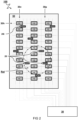
- FIG 1A illustrates an exemplary embodiment of a heart monitoring system 100.
- the heart monitoring system 100 comprises an array of force-sensitive resistors 10 spanning a sensor surface 50, e.g. substrate.
- each resistor 10 is configured to change a respective resistance value "R" in accordance with an amount of (quasi) static pressure "P" exerted on the sensor surface 50 at a respective location of the force-sensitive resistor 10 by a subject 200.
- the system comprises an array of piezoelectric transducers 20 interspersed among the array of force-sensitive resistors 10, e.g. on the same or another (overlapping) substrate.
- each transducer 20 is configured to generate a respective time-dependent electrical signal S in accordance with respective vibrations "F" exerted on the sensor surface 50 at a respective location of the transducer 20 by the subject 200.
- a controller 30 is configured to determine a heart rate "H1" of the subject 200 based on a combination of the measured resistance values "R” of the force-sensitive resistors 10 and the time-dependent electrical signals "S" of the piezoelectric transducers 20.
- the heart monitoring system 100 as described herein may find application in various settings and situations.
- a bed 300 comprising the heart monitoring system 100 as described herein.
- a mattress of a bed 300 comprises a heart monitoring system 100 for a subject 200 to lie on.
- the sensor surface 50 is embedded in the mattress.
- the sensor surface 50 may be disposed on top of the mattress.
- the sensor surface 50 may be disposed between one or more sheets or other bedding.
- the subject 200 may be a patient who needs continuous monitoring lying in a hospital bed.
- the heart monitoring system can also be incorporated in other types of furniture, e.g.
- the system can be incorporated in the bottom and/or back section of the chair, e.g. regular chair or car seat.
- the sensor surface 50 including the force-sensitive resistors 10 and piezoelectric transducers 20 may be clamped onto the seat back and disposed on top of the seat bottom.
- the sensor surface 50 may be embedded in an internal layer of the seat, e.g. inside a seat cushion.
- the controller 30 receives the measured resistance values "R" of the force-sensitive resistors 10 and the time-dependent electrical signals "S" of the piezoelectric transducers 20 as an input, and produces a heart rate "H1" as an output. Accordingly, the heart monitoring system 100 may provide a continuous, real-time measurement and analysis of the subject's 200 heart rate, even when the subject (200) is in non-direct contact with the sensor surface 50.
- the controller 30 may be provided as an external device to the bed 300.
- the controller 30 is connected with an electrical connection to the bed 300.
- the controller 30 may be provided as part of the bed 300.
- a display device is connected to the controller 30.
- the heart rate can also be output in other ways, e.g. as a an electrical data signal for further processing, or an audible or haptic signal.
- a secondary heart monitoring device 40 may be temporarily or permanently provided and coupled to the controller 30.
- the secondary heart monitoring device 40 is attached to the subject's 200, e.g. wrist or chest, for a period of time to produce a secondary heart rate measurement H2 which can be used as a reference value.
- the secondary heart controller 30 can compare the secondary heart rate measurement H2 to the primary measurement of the heart rate "H1".
- the secondary heart rate measurement H2 is measured using a separate instrument, e.g. a dedicated secondary heart monitoring device 40 based on electrical signals from the heart region (electrocardiogram).
- the secondary heart monitoring device 40 may be provided temporarily, as check and/or to correct the primary heart monitoring system 100.
- the secondary heart monitoring device e.g. electrodes on the chest, can be removed once the network has been trained, as will be explained later in FIGs 3A and 3B .
- the subject's weight, position or movement may cause a static or quasi-static pressure "P" onto the sensor surface 50.
- the pressure "P" may be relatively high in specific areas, e.g. higher at the subject's chest area compared to the subject's legs.
- the pressure profile is used to determine where the heart rate is measured.
- Static pressure can be distinguished from dynamic vibrations "F" such as heart rate, e.g. based on time scale.
- a force sensitive resistor is typically capable of measuring static pressures, i.e. even if the pressure is constant in time.
- the pressure may change, e.g. by the subject moving, which will result in a new (static) pressure being measured. This may be contrasted with the measurements using piezo-electric sensors, which are typically more sensitive to vibrations or pressure changes.
- FIG 1B illustrates a cross-section view of a heart monitoring system 100 with a force-sensitive resistor 10 and a piezoelectric transducer 20.
- the force-sensitive resistors 10 are arranged on or spanning the sensor surface 50. Most preferably, the force-sensitive resistors 10 are distributed with equally spacing over the sensor surface 50. This may allow easy correspondence between respective signals and location of the sensors. In another or further embodiment, the force-sensitive resistors 10 may vary in distribution, orientation, number and/or shape. This may allow, e.g. a higher concentration of sensors at relevant locations.
- each of the force-sensitive resistors 10 comprises a force-sensitive material 14, e.g. a conductive composite material or other material which changes its resistance when a force is applied in a membrane configuration.
- a force-sensitive material 14 e.g. a conductive composite material or other material which changes its resistance when a force is applied in a membrane configuration.
- the force-sensitive material 14 disposed on a first flexible substrate 17, e.g. a thermoplastic polyurethane (TPU) substrate, wherein the force-sensitive material 14 is facing a set of electrodes 12,13 disposed on an opposing second substrate 11, e.g. a TPU substrate.
- the force-sensitive material 14 is held apart from the electrodes 12,13 by a spacer material 15 disposed between the substrates 17,11 and surrounding the force-sensitive material 14.
- the first 17 and/or second substrate 11 is configured to flex towards the opposing substrate under the influence of static pressure "P" applied to the force-sensitive resistors 10. Accordingly, the force-sensitive material 14 contacts the electrodes 12,13 and changes the resistance value "R".
- the sensor acts like an infinite resistor, i.e. an open circuit.
- the more pressure is applied to the surface of the sensor the more the electrodes 12,13 touch the force-sensitive material 14, and the lower the resistance becomes.
- the force-sensitive resistors have a diameter D10 on the order of a few millimeters. For example, between one millimeter and fifty millimeters, preferably between five millimeters and twenty millimeters, for example ten millimeters.
- piezoelectric transducers 20 are interspersed among the force-sensitive resistors 10.
- each of the piezoelectric transducers 20 comprises a layer of piezoelectric material 24.
- the piezoelectric material 24 is made of a polymer, e.g. PVDF-TrFE, which has a piezoelectric effect.
- the piezoelectric effect can be understood as a phenomenon whereby electric charges and corresponding fields may accumulate in certain materials in response to applied mechanical stress.
- a piezoelectric transducer 20 may detect small changes in pressure, acceleration, temperature, strain, or force and convert them into an electrical signal.
- the piezoelectric material 24 is sandwiched between a bottom electrode 22 and top electrode 23.
- the bottom electrode 22 is disposed on a substrate 21, e.g. a TPU substrate.
- the piezoelectric transducers 20 are configured to generate a respective time-dependent electrical signal S in response to a time dependent mechanical stress being applied to the piezoelectric material 24.
- the piezoelectric transducers have a diameter D20 on the order of a few millimeters. For example, between one millimeter and fifty millimeters, preferably between five millimeters and twenty millimeters, for example ten millimeters.
- each of the force-sensitive resistors 10 is coupled to a pair of shared circuit lines 30h,30v.
- each shared circuit line connects a plurality of the force-sensitive resistors 10 to the controller 30.
- a resistance value "R" of a respective force-sensitive resistors 10 can be determined e.g. by scanning a respective pair of the shared circuit lines 30h,30v connected to said force-sensitive resistors 10.
- the first row of force-sensitive resistors 10 are horizontally coupled to a shared circuit line 30h, and the first column of force-sensitive resistors 10 are also coupled to a shared circuit line 30v.
- the multiple shared circuit lines 30v,30h are coupled to the controller 30 from one side, and to a ground on the other side.
- other configurations are possible.
- each of the piezoelectric transducers 20 is separately coupled with a dedicated circuit line 30p to the controller 30.
- Piezoelectric transducers 20 may typically use a dedicated circuit line 30p, e.g. because they produce single time-dependent electrical signals which is preferably detected individually.
- the first piezoelectric transducer 20 on the first column of the array is individually coupled with a dedicated circuit line 30p to the controller 30 from one side and to a ground from the other side.
- any other suitable means for coupling the force-sensitive resistors 10 and piezoelectric transducers 20 to the controller 30 is contemplated.
- the sensor surface 50 comprises more force-sensitive resistors 10 than piezoelectric transducers 20.
- the force-sensitive resistors are arranged in a relatively high density grid while the piezoelectric transducers are arranged in a relatively low density grid.
- the number of force-sensitive resistors 10 can be higher than the number of piezoelectric transducers 20 by at least a factor of two, three, four or five. It will be appreciated that it may be easier to connect many force-sensitive resistors 10 than piezoelectric transducers 20, e.g. owing to the differing signals and/or connections. This can be used to advantage in providing a better measurement of the pressure profile using the force-sensitive resistors 10 while using the few interspersed piezoelectric transducers 20 to measure heart rate at specific locations, e.g. based on the profile.
- the multiple shared circuit lines 30v,30h and dedicated circuit lines 30p form a matrix readout system.
- the controller 30 is configured to determine a pressure profile based on the measured resistance values (R) of the force-sensitive resistors 10.
- the pressure profile is used to determine a region of interest (RoI) based on locations of corresponding force-sensitive resistors 10 on the surface 50.
- the region of interest is the region of the sensor surface 50 that the subject 200 is contacting.
- the controller 30 is configured to analyze a shape and/or magnitude of the pressure profile to overlay a shape of the subject's body.
- the region of interest is determined at one or more specific locations in the pressure profile corresponding to respective location on the subject's body.
- the controller 30 is configured to exclusively or predominantly select the piezoelectric transducers 20 located in the region of interest, for measuring the respective time-dependent electrical signals "S". Accordingly, the heart rate "H1" is determined by measuring vibrations "F” using a subset of the piezoelectric transducers 20 located on the surface 50 in the region of interest.
- the region of interest is the region of the sensor surface 50 wherein the BCG signal of the subject 200 is optimal.
- only the piezoelectric transducers 20 located in the region of interest are active. It will be appreciated that this way, the controller does not have to continuously monitor all the piezoelectric transducers 20 on the sensor surface 50.
- At least one of the piezoelectric transducers 20 outside a region of interest based on the force-sensitive resistors 10, is used for noise cancellation.
- one or more piezoelectric transducers 20i outside the region of interest may be used to cancel noise by cancelling any vibrations "F” detected by the inactive piezoelectric transducers 20i. It will be appreciated that this way vibrations "F” that are not induced by the contact of the subject 200 with the sensor surface 50, and any background noise will be cancelled and not taken into consideration while measuring the heart rate "H1".
- FIGs 3A and 3B illustrate examples of machine learning to improve determination of a heart rate "H1" using a neural network 30n.
- the controller 30 comprises a neural network 30n configured to receive at least the resistance values "R” to determine a region of interest.
- the resistance values "R” are fed as input into the neural network 30n and the neural network is trained to output a region of interest.
- a selection is made from one or more of the time-dependent electrical signals "S(t)" for determining a primary measurement of the heart rate "H1".
- the network is trained for each individual subject to provide optimal accuracy taking into account specific characteristics of the subject. In other or further embodiments, the network is generally trained to be used also for other subjects.
- the network starts with a basic training which can be improved for a specific individual.
- the trained network may comprise a set of weights (w), offsets or other parameters which determine the network to output a region of interest and/or heart rate based on the respective input signals.
- the time-dependent electrical signals "S(t)" can be input into the same or another neural network for determining a respective heart rate measurement.
- the resistance values "R” and time-dependent electrical signals "S” are fed as input into a neural network 30n.
- the neural network 30n is configured to output a value indicative of a primary measurement of the heart rate "H1".
- the primary measurement of the heart rate "H1" is compared to a secondary measurement of heart rate "H2", obtained by an independent heart monitoring device 40, for training the neural network 30n.
- the neural network 30n may be trained by comparing a direct or indirect output from the neural network 30n with the secondary heart rates of the secondary heart monitoring device 40.
- the difference between the primary and secondary heart rate measurements is fed back as an error "Err" into the network, which may result in changes to the weights "w” or other parameters of the neuron connections.
- a recurrent neural network is used.
- This is a class of artificial neural networks where connections between nodes form a directed graph along a temporal sequence. This allows it to exhibit temporal dynamic behavior, e.g. a time dependent heart rate signal.
- other or similar artificial networks can be used.
- other or further values H' can be output from the neural network 30n, or the controller 30 in general.
- the neural network 30n may output physiological parameters such a breathing rate, blood pressure, weight, posture detection, body position, body temperature, et cetera.
- Some aspects of the present disclosure relate to a non-transitory computer-readable medium storing instructions.
- the non-transitory computer-readable when executed by a controller in a heart monitoring system causes the system to determine the heart rate of a subject directly or indirectly contacting the sensor surface.
- Other aspects of the present disclosure relate to a method for heart monitoring. In some embodiments, the method comprises providing an array of force-sensitive resistors spanning a sensor surface.
- each resistor is configured to change a respective resistance value in accordance with an amount of quasi static pressure exerted on the sensor surface at a respective location of the force-sensitive resistor by a subject.
- the method comprises providing an array of piezoelectric transducers interspersed among the array of force-sensitive resistors.
- each transducer is configured to generate a respective time-dependent electrical signal in accordance with respective vibrations exerted on the sensor surface at a respective location of the transducer by the subject.
- the method comprises determining a heart rate of the subject based on a combination of the measured resistance values of the force-sensitive resistors and the time-dependent electrical signals of the piezoelectric transducers.
Landscapes
- Health & Medical Sciences (AREA)
- Life Sciences & Earth Sciences (AREA)
- Engineering & Computer Science (AREA)
- Physics & Mathematics (AREA)
- Public Health (AREA)
- Medical Informatics (AREA)
- Veterinary Medicine (AREA)
- General Health & Medical Sciences (AREA)
- Animal Behavior & Ethology (AREA)
- Surgery (AREA)
- Molecular Biology (AREA)
- Biophysics (AREA)
- Pathology (AREA)
- Biomedical Technology (AREA)
- Heart & Thoracic Surgery (AREA)
- Physiology (AREA)
- Cardiology (AREA)
- Artificial Intelligence (AREA)
- Signal Processing (AREA)
- Psychiatry (AREA)
- Computer Vision & Pattern Recognition (AREA)
- Mathematical Physics (AREA)
- Fuzzy Systems (AREA)
- Evolutionary Computation (AREA)
- Pulmonology (AREA)
- Dentistry (AREA)
- Oral & Maxillofacial Surgery (AREA)
- Vascular Medicine (AREA)
- Measuring Pulse, Heart Rate, Blood Pressure Or Blood Flow (AREA)
- Measuring And Recording Apparatus For Diagnosis (AREA)
- Measurement Of The Respiration, Hearing Ability, Form, And Blood Characteristics Of Living Organisms (AREA)
Claims (15)
- Herzüberwachungssystem (100), umfassendeine Anordnung von kraftempfindlichen Widerständen (10), die sich über eine Sensorfläche (50) erstrecken, wobei jeder Widerstand (10) konfiguriert ist, um einen jeweiligen Widerstandswert (R) in Übereinstimmung mit einem Betrag eines statischen Drucks (P) zu ändern, der auf die Sensorfläche (50) an einer jeweiligen Stelle des kraftempfindlichen Widerstands (10) durch eine Person (200) ausgeübt wird;eine Anordnung von piezoelektrischen Wandlern (20), die zwischen den kraftempfindlichen Widerständen (10) verteilt sind, wobei jeder Wandler (20) konfiguriert ist, um ein jeweiliges zeitabhängiges elektrisches Signal (S) in Übereinstimmung mit jeweiligen Schwingungen (F) zu erzeugen, die auf die Sensorfläche (50) an einer jeweiligen Stelle des Wandlers (20) durch die Person (200) ausgeübt werden; wobei die Sensorfläche (50) mehr kraftempfindliche Widerstände (10) als piezoelektrische Wandler (20) aufweist; undeine Steuerung (30), die konfiguriert ist, um eine Herzfrequenz (H1) der Person (200) basierend auf einer Kombination der gemessenen Widerstandswerte (R) der kraftempfindlichen Widerstände (10) und der zeitabhängigen elektrischen Signale (S) der piezoelektrischen Wandler (20) zu bestimmen,dadurch gekennzeichnet, dass die Steuerung (30) konfiguriert ist, um ein Druckprofil unter Verwendung der kraftempfindlichen Widerstände (10) zu messen und auf der Grundlage des gemessenen Druckprofils eine Teilmenge der piezoelektrischen Wandler (20) zwischen den kraftempfindlichen Widerständen (10) zu verwenden, um die Herzfrequenz an einer oder mehreren spezifischen Stellen der Sensorfläche (50) zu messen.
- System nach Anspruch 1, wobei die Steuerung (30) konfiguriert ist, um das Druckprofil basierend auf den gemessenen Widerstandswerten (R) der kraftempfindlichen Widerstände (10) zu bestimmen, wobei das Druckprofil verwendet wird, um einen interessierenden Bereich (region of interest - RoI) basierend auf Positionen entsprechender kraftempfindlicher Widerstände (10) auf der Fläche (50) zu bestimmen, wobei die Herzfrequenz (H1) durch Messen von Schwingungen (F) unter Verwendung einer Teilmenge der piezoelektrischen Wandler (20) bestimmt wird, die sich auf der Fläche (50) in dem interessierenden Bereich (RoI) befinden.
- System nach einem der vorstehenden Ansprüche, wobei die Steuerung (30) konfiguriert ist, um eine Form und/oder Größe des Druckprofils zu analysieren, um eine Form des Körpers der Person zu überlagern, wobei der interessierende Bereich (RoI) an einer oder mehreren spezifischen Stellen im Druckprofil bestimmt wird, die einer jeweiligen Stelle am Körper der Person entsprechen.
- System nach einem der vorstehenden Ansprüche, wobei mindestens einer der piezoelektrischen Wandler (20) außerhalb eines auf den kraftempfindlichen Widerständen (10) basierenden Bereichs von Interesse (RoI) zur Rauschunterdrückung verwendet wird.
- System nach einem der vorstehenden Ansprüche, wobei die Widerstandswerte (R) als Eingabe in ein neuronales Netz (30n) eingespeist werden, wobei das neuronale Netz so trainiert wird, dass es einen interessierenden Bereich (RoI) ausgibt, wobei auf der Grundlage des interessierenden Bereichs (RoI) eine Auswahl aus einem oder mehreren der zeitabhängigen elektrischen Signale (S) zur Bestimmung einer primären Messung der Herzfrequenz (H1) getroffen wird.
- System nach einem der vorstehenden Ansprüche, wobei die Widerstandswerte (R) und die zeitabhängigen elektrischen Signale (S) als Eingabe in ein neuronales Netz (30n) eingespeist werden, wobei das neuronale Netz (30n) konfiguriert ist, um einen Wert auszugeben, der eine primäre Messung der Herzfrequenz (H1) anzeigt.
- System nach Anspruch 5 oder 6, wobei die primäre Messung der Herzfrequenz (H1) mit einer sekundären Messung der Herzfrequenz (H2) verglichen wird, die von einem unabhängigen Herzüberwachungsgerät (40) erhalten wird, um das neuronale Netz (30n) zu trainieren.
- System nach einem der vorstehenden Ansprüche, wobei jeder der kraftempfindlichen Widerstände (10) ein kraftempfindliches Material (14) umfasst, das auf einem ersten Substrat (17) angeordnet ist, das einem Satz von Elektroden (12, 13) gegenüberliegt, die auf einem gegenüberliegenden zweiten Substrat (11) angeordnet sind, wobei das kraftempfindliche Material (14) von den Elektroden (12, 13) durch ein Abstandsmaterial (15) getrennt gehalten wird, das zwischen den Substraten (17, 11) angeordnet ist und das kraftempfindliche Material (14) umgibt, wobei das erste und/oder zweite Substrat (17) konfiguriert ist, um sich unter dem Einfluss von statischem Druck (P), der auf die kraftempfindlichen Widerstände (10) ausgeübt wird, in Richtung des gegenüberliegenden Substrats zu biegen, wodurch das kraftempfindliche Material (14) mit den Elektroden (12, 13) in Kontakt gebracht wird und der Widerstandswert (R) verändert wird.
- System nach einem der vorstehenden Ansprüche, wobei jeder der piezoelektrischen Wandler (20) eine Schicht aus piezoelektrischem Material (24) umfasst, die zwischen einer unteren Elektrode (22) und einer oberen Elektrode (23) angeordnet ist, wobei die piezoelektrischen Wandler (20) konfiguriert sind, um ein jeweiliges zeitabhängiges elektrisches Signal (S) als Reaktion auf eine zeitabhängige mechanische Belastung zu erzeugen, die auf das piezoelektrische Material (24) ausgeübt wird.
- System nach einem der vorstehenden Ansprüche, wobei jeder der kraftempfindlichen Widerstände (10) mit einem Paar gemeinsam genutzter Schaltungsleitungen (30h, 30v) gekoppelt ist, wobei jede gemeinsam genutzte Schaltungsleitung eine Vielzahl der kraftempfindlichen Widerstände (10) mit der Steuerung (30) verbindet, wobei ein Widerstandswert (R) eines jeweiligen kraftempfindlichen Widerstands (10) durch Abtasten eines jeweiligen Paares der gemeinsam genutzten Schaltungsleitungen (30h, 30v), die mit den kraftempfindlichen Widerständen (10) verbunden sind, bestimmt wird.
- System nach einem der vorstehenden Ansprüche, wobei jeder der piezoelektrischen Wandler (20) separat mit einer eigenen Schaltungsleitung (30p) an die Steuerung (30) gekoppelt ist.
- System nach einem der vorstehenden Ansprüche, wobei die Sensorfläche (50) mindestens doppelt so viele kraftempfindliche Widerstände (10) wie piezoelektrische Wandler (20) umfasst.
- Bett oder Stuhl, umfassend das Herzüberwachungssystem (100) nach einem der vorstehenden Ansprüche.
- Nicht-transitorisches computerlesbares Medium, das Befehle speichert, die bei Ausführung durch eine Steuerung (30) in einem Herzüberwachungssystem (100) nach einem der vorstehenden Ansprüche das System veranlassen, die Herzfrequenz (H1) einer Person (200) zu bestimmen, welche direkt oder indirekt mit der Sensorfläche (50) in Kontakt kommt.
- Verfahren zur Herzüberwachung (100), wobei das Verfahren Folgendes umfasst:Bereitstellen einer Anordnung von kraftempfindlichen Widerständen (10), die sich über eine Sensorfläche (50) erstrecken, wobei jeder Widerstand (10) konfiguriert ist, um einen jeweiligen Widerstandswert (R) in Übereinstimmung mit einem Betrag des statischen Drucks (P) zu ändern, der an einer jeweiligen Stelle des kraftempfindlichen Widerstands (10) durch eine Person (200) auf die Sensorfläche (50) ausgeübt wird;Bereitstellen einer Anordnung von piezoelektrischen Wandlern (20), die zwischen den kraftempfindlichen Widerständen (10) verteilt sind, wobei jeder Wandler (20) konfiguriert ist, um ein jeweiliges zeitabhängiges elektrisches Signal (S) in Übereinstimmung mit jeweiligen Schwingungen (F) zu erzeugen, die auf die Sensorfläche (50) an einer jeweiligen Stelle des Wandlers (20) durch die Person (200) ausgeübt werden; wobei die Sensorfläche (50) mehr kraftempfindliche Widerstände (10) als piezoelektrische Wandler (20) aufweist;Bestimmen einer Herzfrequenz (H1) der Person (200) basierend auf einer Kombination der gemessenen Widerstandswerte (R) der kraftempfindlichen Widerstände (10) und der zeitabhängigen elektrischen Signale (S) der piezoelektrischen Wandler (20),wobei das Verfahren dadurch gekennzeichnet ist, dass die kraftempfindlichen Widerstände (10) verwendet werden, um ein Druckprofil zu messen, und eine Teilmenge der piezoelektrischen Wandler (20) zwischen den kraftempfindlichen Widerständen (10) verwendet wird, um die Herzfrequenz an einer oder mehreren spezifischen Stellen der Sensorfläche (50) basierend auf dem gemessenen Druckprofil zu messen.
Applications Claiming Priority (2)
| Application Number | Priority Date | Filing Date | Title |
|---|---|---|---|
| EP19187908.9A EP3769674A1 (de) | 2019-07-23 | 2019-07-23 | Herzüberwachungssystem und -verfahren |
| PCT/NL2020/050480 WO2021015617A1 (en) | 2019-07-23 | 2020-07-22 | Heart monitoring system and method |
Publications (3)
| Publication Number | Publication Date |
|---|---|
| EP4003159A1 EP4003159A1 (de) | 2022-06-01 |
| EP4003159B1 true EP4003159B1 (de) | 2025-03-12 |
| EP4003159C0 EP4003159C0 (de) | 2025-03-12 |
Family
ID=67438584
Family Applications (2)
| Application Number | Title | Priority Date | Filing Date |
|---|---|---|---|
| EP19187908.9A Withdrawn EP3769674A1 (de) | 2019-07-23 | 2019-07-23 | Herzüberwachungssystem und -verfahren |
| EP20746309.2A Active EP4003159B1 (de) | 2019-07-23 | 2020-07-22 | Herzüberwachungssystem und -verfahren |
Family Applications Before (1)
| Application Number | Title | Priority Date | Filing Date |
|---|---|---|---|
| EP19187908.9A Withdrawn EP3769674A1 (de) | 2019-07-23 | 2019-07-23 | Herzüberwachungssystem und -verfahren |
Country Status (5)
| Country | Link |
|---|---|
| US (1) | US12121338B2 (de) |
| EP (2) | EP3769674A1 (de) |
| JP (1) | JP7628999B2 (de) |
| CN (1) | CN114173646B (de) |
| WO (1) | WO2021015617A1 (de) |
Families Citing this family (7)
| Publication number | Priority date | Publication date | Assignee | Title |
|---|---|---|---|---|
| WO2018217585A1 (en) * | 2017-05-22 | 2018-11-29 | Apple Inc. | Multi-element piezo sensors for physiological measurements |
| EP4052644A1 (de) * | 2021-03-03 | 2022-09-07 | Koninklijke Philips N.V. | Messung eines vitalzeichens eines subjekts |
| FR3123195A1 (fr) * | 2021-05-26 | 2022-12-02 | Nanomade Lab | Dispositif et procédé pour la mesure de paramètres physiologiques par contact temporaire avec une surface réceptrice |
| WO2022248639A1 (fr) * | 2021-05-26 | 2022-12-01 | Nanomade Lab | Dispositif et procédé pour la mesure de paramètres physiologiques par contact temporaire avec une surface réceptrice |
| CN114680860A (zh) * | 2022-03-31 | 2022-07-01 | 慕思健康睡眠股份有限公司 | 一种生理体征监测系统及方法 |
| WO2023220252A1 (en) * | 2022-05-11 | 2023-11-16 | Brisby, Inc. | Pet bed with vital sign monitoring |
| JP2024158292A (ja) * | 2023-04-27 | 2024-11-08 | 住友理工株式会社 | 心拍測定装置 |
Family Cites Families (12)
| Publication number | Priority date | Publication date | Assignee | Title |
|---|---|---|---|---|
| JP3564878B2 (ja) * | 1996-07-04 | 2004-09-15 | 松下電器産業株式会社 | 生体信号検出装置 |
| US7396331B2 (en) | 2003-10-27 | 2008-07-08 | Home Guardian, Llc | System and process for non-invasive collection and analysis of physiological signals |
| JP2014515628A (ja) * | 2011-03-04 | 2014-07-03 | ストライカー コーポレイション | 患者支持装置のためのセンシングシステム |
| CN105264350B (zh) * | 2013-06-04 | 2017-07-18 | 日本写真印刷株式会社 | 压电传感器和压力检测装置 |
| JP6297385B2 (ja) | 2014-03-28 | 2018-03-20 | 住友理工株式会社 | 就寝者の心拍測定方法および心拍測定装置 |
| US10299735B2 (en) * | 2014-08-22 | 2019-05-28 | Pulse Tectonics Llc | Automated diagnosis based at least in part on pulse waveforms |
| CN107205650A (zh) * | 2015-01-27 | 2017-09-26 | 苹果公司 | 用于确定睡眠质量的系统 |
| CN104825144B (zh) * | 2015-05-08 | 2017-08-15 | 马立新 | 移动式无创连续血压监测传感装置 |
| CN205879411U (zh) * | 2016-07-01 | 2017-01-11 | 南昌欧菲光科技有限公司 | 压阻传感器和用于压阻传感器的压敏元件 |
| CN107631818A (zh) * | 2016-07-19 | 2018-01-26 | 中国科学院沈阳自动化研究所 | 基于压阻效应的柔性阵列压力测量传感器及其测量方法 |
| CN206792383U (zh) | 2016-12-21 | 2017-12-26 | 复旦大学 | 非侵入式睡眠监测床垫 |
| WO2018217585A1 (en) | 2017-05-22 | 2018-11-29 | Apple Inc. | Multi-element piezo sensors for physiological measurements |
-
2019
- 2019-07-23 EP EP19187908.9A patent/EP3769674A1/de not_active Withdrawn
-
2020
- 2020-07-22 US US17/624,006 patent/US12121338B2/en active Active
- 2020-07-22 JP JP2022500494A patent/JP7628999B2/ja active Active
- 2020-07-22 WO PCT/NL2020/050480 patent/WO2021015617A1/en not_active Ceased
- 2020-07-22 EP EP20746309.2A patent/EP4003159B1/de active Active
- 2020-07-22 CN CN202080052959.3A patent/CN114173646B/zh active Active
Also Published As
| Publication number | Publication date |
|---|---|
| US20220346656A1 (en) | 2022-11-03 |
| EP3769674A1 (de) | 2021-01-27 |
| JP7628999B2 (ja) | 2025-02-12 |
| JP2022541737A (ja) | 2022-09-27 |
| US12121338B2 (en) | 2024-10-22 |
| CN114173646B (zh) | 2025-05-16 |
| WO2021015617A1 (en) | 2021-01-28 |
| CN114173646A (zh) | 2022-03-11 |
| EP4003159A1 (de) | 2022-06-01 |
| EP4003159C0 (de) | 2025-03-12 |
Similar Documents
| Publication | Publication Date | Title |
|---|---|---|
| EP4003159B1 (de) | Herzüberwachungssystem und -verfahren | |
| US7610820B2 (en) | Biological information pressure sensor and biological information pressure detector | |
| US8400302B2 (en) | Electric field sensing device | |
| CN1980602B (zh) | 生物信息测量板以及生物信息测量设备 | |
| US7641618B2 (en) | Capacitance-type pressure sensor and heart beat / respiration measuring device using the same | |
| EP2124747B1 (de) | Ballistokardiographisches sensorsystem mit einer sensorenanordnung und verfahren zur ballistokardiographischen erkennung von körperbewegungen | |
| TWI700059B (zh) | 信號採集傳感器陣列、具有該信號採集傳感器陣列的電子設備及床墊 | |
| KR101764174B1 (ko) | 사용자 상태 모니터링 방법 및 이를 수행하는 시스템 | |
| JP2010069021A (ja) | 生体情報検出体及びベッド装置 | |
| Xu et al. | A low-cost non-invasive continuous cardiovascular monitoring system based on oil-filled rubber tubing | |
| KR20170040985A (ko) | 압력 감지 의자 | |
| JP7706970B2 (ja) | 推定装置、推定方法、推定プログラム、及び学習モデル生成装置 | |
| US20250082228A1 (en) | Ballistocardiogram detection device for noise reduction and sensing system | |
| HK40020048A (en) | Signal acquisition sensor array, electronic equipment and mattress | |
| KR20170120879A (ko) | 압력 감지 센서 |
Legal Events
| Date | Code | Title | Description |
|---|---|---|---|
| STAA | Information on the status of an ep patent application or granted ep patent |
Free format text: STATUS: UNKNOWN |
|
| STAA | Information on the status of an ep patent application or granted ep patent |
Free format text: STATUS: THE INTERNATIONAL PUBLICATION HAS BEEN MADE |
|
| PUAI | Public reference made under article 153(3) epc to a published international application that has entered the european phase |
Free format text: ORIGINAL CODE: 0009012 |
|
| STAA | Information on the status of an ep patent application or granted ep patent |
Free format text: STATUS: REQUEST FOR EXAMINATION WAS MADE |
|
| 17P | Request for examination filed |
Effective date: 20220126 |
|
| AK | Designated contracting states |
Kind code of ref document: A1 Designated state(s): AL AT BE BG CH CY CZ DE DK EE ES FI FR GB GR HR HU IE IS IT LI LT LU LV MC MK MT NL NO PL PT RO RS SE SI SK SM TR |
|
| DAV | Request for validation of the european patent (deleted) | ||
| DAX | Request for extension of the european patent (deleted) | ||
| P01 | Opt-out of the competence of the unified patent court (upc) registered |
Effective date: 20230522 |
|
| GRAP | Despatch of communication of intention to grant a patent |
Free format text: ORIGINAL CODE: EPIDOSNIGR1 |
|
| STAA | Information on the status of an ep patent application or granted ep patent |
Free format text: STATUS: GRANT OF PATENT IS INTENDED |
|
| INTG | Intention to grant announced |
Effective date: 20241017 |
|
| GRAS | Grant fee paid |
Free format text: ORIGINAL CODE: EPIDOSNIGR3 |
|
| GRAA | (expected) grant |
Free format text: ORIGINAL CODE: 0009210 |
|
| STAA | Information on the status of an ep patent application or granted ep patent |
Free format text: STATUS: THE PATENT HAS BEEN GRANTED |
|
| AK | Designated contracting states |
Kind code of ref document: B1 Designated state(s): AL AT BE BG CH CY CZ DE DK EE ES FI FR GB GR HR HU IE IS IT LI LT LU LV MC MK MT NL NO PL PT RO RS SE SI SK SM TR |
|
| REG | Reference to a national code |
Ref country code: GB Ref legal event code: FG4D |
|
| REG | Reference to a national code |
Ref country code: CH Ref legal event code: EP |
|
| REG | Reference to a national code |
Ref country code: DE Ref legal event code: R096 Ref document number: 602020047600 Country of ref document: DE |
|
| REG | Reference to a national code |
Ref country code: IE Ref legal event code: FG4D |
|
| P04 | Withdrawal of opt-out of the competence of the unified patent court (upc) registered |
Free format text: CASE NUMBER: APP_15706/2025 Effective date: 20250401 |
|
| U01 | Request for unitary effect filed |
Effective date: 20250328 |
|
| U07 | Unitary effect registered |
Designated state(s): AT BE BG DE DK EE FI FR IT LT LU LV MT NL PT RO SE SI Effective date: 20250403 |
|
| PG25 | Lapsed in a contracting state [announced via postgrant information from national office to epo] |
Ref country code: RS Free format text: LAPSE BECAUSE OF FAILURE TO SUBMIT A TRANSLATION OF THE DESCRIPTION OR TO PAY THE FEE WITHIN THE PRESCRIBED TIME-LIMIT Effective date: 20250612 |
|
| PG25 | Lapsed in a contracting state [announced via postgrant information from national office to epo] |
Ref country code: ES Free format text: LAPSE BECAUSE OF FAILURE TO SUBMIT A TRANSLATION OF THE DESCRIPTION OR TO PAY THE FEE WITHIN THE PRESCRIBED TIME-LIMIT Effective date: 20250312 |
|
| PG25 | Lapsed in a contracting state [announced via postgrant information from national office to epo] |
Ref country code: NO Free format text: LAPSE BECAUSE OF FAILURE TO SUBMIT A TRANSLATION OF THE DESCRIPTION OR TO PAY THE FEE WITHIN THE PRESCRIBED TIME-LIMIT Effective date: 20250612 |
|
| PG25 | Lapsed in a contracting state [announced via postgrant information from national office to epo] |
Ref country code: HR Free format text: LAPSE BECAUSE OF FAILURE TO SUBMIT A TRANSLATION OF THE DESCRIPTION OR TO PAY THE FEE WITHIN THE PRESCRIBED TIME-LIMIT Effective date: 20250312 |
|
| PG25 | Lapsed in a contracting state [announced via postgrant information from national office to epo] |
Ref country code: GR Free format text: LAPSE BECAUSE OF FAILURE TO SUBMIT A TRANSLATION OF THE DESCRIPTION OR TO PAY THE FEE WITHIN THE PRESCRIBED TIME-LIMIT Effective date: 20250613 |
|
| U20 | Renewal fee for the european patent with unitary effect paid |
Year of fee payment: 6 Effective date: 20250728 |
|
| PG25 | Lapsed in a contracting state [announced via postgrant information from national office to epo] |
Ref country code: SM Free format text: LAPSE BECAUSE OF FAILURE TO SUBMIT A TRANSLATION OF THE DESCRIPTION OR TO PAY THE FEE WITHIN THE PRESCRIBED TIME-LIMIT Effective date: 20250312 |
|
| PG25 | Lapsed in a contracting state [announced via postgrant information from national office to epo] |
Ref country code: PL Free format text: LAPSE BECAUSE OF FAILURE TO SUBMIT A TRANSLATION OF THE DESCRIPTION OR TO PAY THE FEE WITHIN THE PRESCRIBED TIME-LIMIT Effective date: 20250312 |
|
| PGFP | Annual fee paid to national office [announced via postgrant information from national office to epo] |
Ref country code: GB Payment date: 20250722 Year of fee payment: 6 |
|
| PG25 | Lapsed in a contracting state [announced via postgrant information from national office to epo] |
Ref country code: CZ Free format text: LAPSE BECAUSE OF FAILURE TO SUBMIT A TRANSLATION OF THE DESCRIPTION OR TO PAY THE FEE WITHIN THE PRESCRIBED TIME-LIMIT Effective date: 20250312 |
|
| PG25 | Lapsed in a contracting state [announced via postgrant information from national office to epo] |
Ref country code: SK Free format text: LAPSE BECAUSE OF FAILURE TO SUBMIT A TRANSLATION OF THE DESCRIPTION OR TO PAY THE FEE WITHIN THE PRESCRIBED TIME-LIMIT Effective date: 20250312 |
|
| PG25 | Lapsed in a contracting state [announced via postgrant information from national office to epo] |
Ref country code: IS Free format text: LAPSE BECAUSE OF FAILURE TO SUBMIT A TRANSLATION OF THE DESCRIPTION OR TO PAY THE FEE WITHIN THE PRESCRIBED TIME-LIMIT Effective date: 20250712 |
|
| PLBE | No opposition filed within time limit |
Free format text: ORIGINAL CODE: 0009261 |
|
| STAA | Information on the status of an ep patent application or granted ep patent |
Free format text: STATUS: NO OPPOSITION FILED WITHIN TIME LIMIT |
|
| REG | Reference to a national code |
Ref country code: CH Ref legal event code: L10 Free format text: ST27 STATUS EVENT CODE: U-0-0-L10-L00 (AS PROVIDED BY THE NATIONAL OFFICE) Effective date: 20260121 |
|
| 26N | No opposition filed |
Effective date: 20251215 |
|
| REG | Reference to a national code |
Ref country code: CH Ref legal event code: H13 Free format text: ST27 STATUS EVENT CODE: U-0-0-H10-H13 (AS PROVIDED BY THE NATIONAL OFFICE) Effective date: 20260224 |
|
| PG25 | Lapsed in a contracting state [announced via postgrant information from national office to epo] |
Ref country code: CH Free format text: LAPSE BECAUSE OF NON-PAYMENT OF DUE FEES Effective date: 20250731 |