EP4003253B1 - Produit de nettoyage de plaie - Google Patents
Produit de nettoyage de plaie Download PDFInfo
- Publication number
- EP4003253B1 EP4003253B1 EP20740573.9A EP20740573A EP4003253B1 EP 4003253 B1 EP4003253 B1 EP 4003253B1 EP 20740573 A EP20740573 A EP 20740573A EP 4003253 B1 EP4003253 B1 EP 4003253B1
- Authority
- EP
- European Patent Office
- Prior art keywords
- layer
- foam layer
- wound
- foam
- fibres
- Prior art date
- Legal status (The legal status is an assumption and is not a legal conclusion. Google has not performed a legal analysis and makes no representation as to the accuracy of the status listed.)
- Active
Links
Images
Classifications
-
- A—HUMAN NECESSITIES
- A61—MEDICAL OR VETERINARY SCIENCE; HYGIENE
- A61F—FILTERS IMPLANTABLE INTO BLOOD VESSELS; PROSTHESES; DEVICES PROVIDING PATENCY TO, OR PREVENTING COLLAPSING OF, TUBULAR STRUCTURES OF THE BODY, e.g. STENTS; ORTHOPAEDIC, NURSING OR CONTRACEPTIVE DEVICES; FOMENTATION; TREATMENT OR PROTECTION OF EYES OR EARS; BANDAGES, DRESSINGS OR ABSORBENT PADS; FIRST-AID KITS
- A61F13/00—Bandages or dressings; Absorbent pads
- A61F13/01—Non-adhesive bandages or dressings
- A61F13/01008—Non-adhesive bandages or dressings characterised by the material
-
- A—HUMAN NECESSITIES
- A61—MEDICAL OR VETERINARY SCIENCE; HYGIENE
- A61B—DIAGNOSIS; SURGERY; IDENTIFICATION
- A61B17/00—Surgical instruments, devices or methods
- A61B17/32—Surgical cutting instruments
-
- A—HUMAN NECESSITIES
- A61—MEDICAL OR VETERINARY SCIENCE; HYGIENE
- A61B—DIAGNOSIS; SURGERY; IDENTIFICATION
- A61B90/00—Instruments, implements or accessories specially adapted for surgery or diagnosis and not covered by any of the groups A61B1/00 - A61B50/00, e.g. for luxation treatment or for protecting wound edges
- A61B90/80—Implements for cleaning or washing the skin of surgeons or patients
-
- A—HUMAN NECESSITIES
- A61—MEDICAL OR VETERINARY SCIENCE; HYGIENE
- A61F—FILTERS IMPLANTABLE INTO BLOOD VESSELS; PROSTHESES; DEVICES PROVIDING PATENCY TO, OR PREVENTING COLLAPSING OF, TUBULAR STRUCTURES OF THE BODY, e.g. STENTS; ORTHOPAEDIC, NURSING OR CONTRACEPTIVE DEVICES; FOMENTATION; TREATMENT OR PROTECTION OF EYES OR EARS; BANDAGES, DRESSINGS OR ABSORBENT PADS; FIRST-AID KITS
- A61F13/00—Bandages or dressings; Absorbent pads
- A61F13/01—Non-adhesive bandages or dressings
- A61F13/01021—Non-adhesive bandages or dressings characterised by the structure of the dressing
-
- A—HUMAN NECESSITIES
- A61—MEDICAL OR VETERINARY SCIENCE; HYGIENE
- A61F—FILTERS IMPLANTABLE INTO BLOOD VESSELS; PROSTHESES; DEVICES PROVIDING PATENCY TO, OR PREVENTING COLLAPSING OF, TUBULAR STRUCTURES OF THE BODY, e.g. STENTS; ORTHOPAEDIC, NURSING OR CONTRACEPTIVE DEVICES; FOMENTATION; TREATMENT OR PROTECTION OF EYES OR EARS; BANDAGES, DRESSINGS OR ABSORBENT PADS; FIRST-AID KITS
- A61F13/00—Bandages or dressings; Absorbent pads
- A61F13/01—Non-adhesive bandages or dressings
- A61F13/01021—Non-adhesive bandages or dressings characterised by the structure of the dressing
- A61F13/01029—Non-adhesive bandages or dressings characterised by the structure of the dressing made of multiple layers
-
- B—PERFORMING OPERATIONS; TRANSPORTING
- B32—LAYERED PRODUCTS
- B32B—LAYERED PRODUCTS, i.e. PRODUCTS BUILT-UP OF STRATA OF FLAT OR NON-FLAT, e.g. CELLULAR OR HONEYCOMB, FORM
- B32B5/00—Layered products characterised by the non- homogeneity or physical structure, i.e. comprising a fibrous, filamentary, particulate or foam layer; Layered products characterised by having a layer differing constitutionally or physically in different parts
- B32B5/02—Layered products characterised by the non- homogeneity or physical structure, i.e. comprising a fibrous, filamentary, particulate or foam layer; Layered products characterised by having a layer differing constitutionally or physically in different parts characterised by structural features of a fibrous or filamentary layer
- B32B5/022—Non-woven fabric
-
- B—PERFORMING OPERATIONS; TRANSPORTING
- B32—LAYERED PRODUCTS
- B32B—LAYERED PRODUCTS, i.e. PRODUCTS BUILT-UP OF STRATA OF FLAT OR NON-FLAT, e.g. CELLULAR OR HONEYCOMB, FORM
- B32B5/00—Layered products characterised by the non- homogeneity or physical structure, i.e. comprising a fibrous, filamentary, particulate or foam layer; Layered products characterised by having a layer differing constitutionally or physically in different parts
- B32B5/02—Layered products characterised by the non- homogeneity or physical structure, i.e. comprising a fibrous, filamentary, particulate or foam layer; Layered products characterised by having a layer differing constitutionally or physically in different parts characterised by structural features of a fibrous or filamentary layer
- B32B5/06—Layered products characterised by the non- homogeneity or physical structure, i.e. comprising a fibrous, filamentary, particulate or foam layer; Layered products characterised by having a layer differing constitutionally or physically in different parts characterised by structural features of a fibrous or filamentary layer characterised by a fibrous or filamentary layer mechanically connected, e.g. by needling to another layer, e.g. of fibres, of paper
-
- B—PERFORMING OPERATIONS; TRANSPORTING
- B32—LAYERED PRODUCTS
- B32B—LAYERED PRODUCTS, i.e. PRODUCTS BUILT-UP OF STRATA OF FLAT OR NON-FLAT, e.g. CELLULAR OR HONEYCOMB, FORM
- B32B5/00—Layered products characterised by the non- homogeneity or physical structure, i.e. comprising a fibrous, filamentary, particulate or foam layer; Layered products characterised by having a layer differing constitutionally or physically in different parts
- B32B5/02—Layered products characterised by the non- homogeneity or physical structure, i.e. comprising a fibrous, filamentary, particulate or foam layer; Layered products characterised by having a layer differing constitutionally or physically in different parts characterised by structural features of a fibrous or filamentary layer
- B32B5/08—Layered products characterised by the non- homogeneity or physical structure, i.e. comprising a fibrous, filamentary, particulate or foam layer; Layered products characterised by having a layer differing constitutionally or physically in different parts characterised by structural features of a fibrous or filamentary layer the fibres or filaments of a layer being of different substances, e.g. conjugate fibres, mixture of different fibres
-
- B—PERFORMING OPERATIONS; TRANSPORTING
- B32—LAYERED PRODUCTS
- B32B—LAYERED PRODUCTS, i.e. PRODUCTS BUILT-UP OF STRATA OF FLAT OR NON-FLAT, e.g. CELLULAR OR HONEYCOMB, FORM
- B32B5/00—Layered products characterised by the non- homogeneity or physical structure, i.e. comprising a fibrous, filamentary, particulate or foam layer; Layered products characterised by having a layer differing constitutionally or physically in different parts
- B32B5/18—Layered products characterised by the non- homogeneity or physical structure, i.e. comprising a fibrous, filamentary, particulate or foam layer; Layered products characterised by having a layer differing constitutionally or physically in different parts characterised by features of a layer of foamed material
-
- B—PERFORMING OPERATIONS; TRANSPORTING
- B32—LAYERED PRODUCTS
- B32B—LAYERED PRODUCTS, i.e. PRODUCTS BUILT-UP OF STRATA OF FLAT OR NON-FLAT, e.g. CELLULAR OR HONEYCOMB, FORM
- B32B5/00—Layered products characterised by the non- homogeneity or physical structure, i.e. comprising a fibrous, filamentary, particulate or foam layer; Layered products characterised by having a layer differing constitutionally or physically in different parts
- B32B5/22—Layered products characterised by the non- homogeneity or physical structure, i.e. comprising a fibrous, filamentary, particulate or foam layer; Layered products characterised by having a layer differing constitutionally or physically in different parts characterised by the presence of two or more layers which are next to each other and are fibrous, filamentary, formed of particles or foamed
- B32B5/24—Layered products characterised by the non- homogeneity or physical structure, i.e. comprising a fibrous, filamentary, particulate or foam layer; Layered products characterised by having a layer differing constitutionally or physically in different parts characterised by the presence of two or more layers which are next to each other and are fibrous, filamentary, formed of particles or foamed one layer being a fibrous or filamentary layer
- B32B5/245—Layered products characterised by the non- homogeneity or physical structure, i.e. comprising a fibrous, filamentary, particulate or foam layer; Layered products characterised by having a layer differing constitutionally or physically in different parts characterised by the presence of two or more layers which are next to each other and are fibrous, filamentary, formed of particles or foamed one layer being a fibrous or filamentary layer another layer next to it being a foam layer
-
- D—TEXTILES; PAPER
- D04—BRAIDING; LACE-MAKING; KNITTING; TRIMMINGS; NON-WOVEN FABRICS
- D04H—MAKING TEXTILE FABRICS, e.g. FROM FIBRES OR FILAMENTARY MATERIAL; FABRICS MADE BY SUCH PROCESSES OR APPARATUS, e.g. FELTS, NON-WOVEN FABRICS; COTTON-WOOL; WADDING ; NON-WOVEN FABRICS FROM STAPLE FIBRES, FILAMENTS OR YARNS, BONDED WITH AT LEAST ONE WEB-LIKE MATERIAL DURING THEIR CONSOLIDATION
- D04H1/00—Non-woven fabrics formed wholly or mainly of staple fibres or like relatively short fibres
- D04H1/40—Non-woven fabrics formed wholly or mainly of staple fibres or like relatively short fibres from fleeces or layers composed of fibres without existing or potential cohesive properties
- D04H1/44—Non-woven fabrics formed wholly or mainly of staple fibres or like relatively short fibres from fleeces or layers composed of fibres without existing or potential cohesive properties the fleeces or layers being consolidated by mechanical means, e.g. by rolling
- D04H1/46—Non-woven fabrics formed wholly or mainly of staple fibres or like relatively short fibres from fleeces or layers composed of fibres without existing or potential cohesive properties the fleeces or layers being consolidated by mechanical means, e.g. by rolling by needling or like operations to cause entanglement of fibres
- D04H1/48—Non-woven fabrics formed wholly or mainly of staple fibres or like relatively short fibres from fleeces or layers composed of fibres without existing or potential cohesive properties the fleeces or layers being consolidated by mechanical means, e.g. by rolling by needling or like operations to cause entanglement of fibres in combination with at least one other method of consolidation
- D04H1/485—Non-woven fabrics formed wholly or mainly of staple fibres or like relatively short fibres from fleeces or layers composed of fibres without existing or potential cohesive properties the fleeces or layers being consolidated by mechanical means, e.g. by rolling by needling or like operations to cause entanglement of fibres in combination with at least one other method of consolidation in combination with weld-bonding
-
- D—TEXTILES; PAPER
- D04—BRAIDING; LACE-MAKING; KNITTING; TRIMMINGS; NON-WOVEN FABRICS
- D04H—MAKING TEXTILE FABRICS, e.g. FROM FIBRES OR FILAMENTARY MATERIAL; FABRICS MADE BY SUCH PROCESSES OR APPARATUS, e.g. FELTS, NON-WOVEN FABRICS; COTTON-WOOL; WADDING ; NON-WOVEN FABRICS FROM STAPLE FIBRES, FILAMENTS OR YARNS, BONDED WITH AT LEAST ONE WEB-LIKE MATERIAL DURING THEIR CONSOLIDATION
- D04H1/00—Non-woven fabrics formed wholly or mainly of staple fibres or like relatively short fibres
- D04H1/40—Non-woven fabrics formed wholly or mainly of staple fibres or like relatively short fibres from fleeces or layers composed of fibres without existing or potential cohesive properties
- D04H1/44—Non-woven fabrics formed wholly or mainly of staple fibres or like relatively short fibres from fleeces or layers composed of fibres without existing or potential cohesive properties the fleeces or layers being consolidated by mechanical means, e.g. by rolling
- D04H1/46—Non-woven fabrics formed wholly or mainly of staple fibres or like relatively short fibres from fleeces or layers composed of fibres without existing or potential cohesive properties the fleeces or layers being consolidated by mechanical means, e.g. by rolling by needling or like operations to cause entanglement of fibres
- D04H1/498—Non-woven fabrics formed wholly or mainly of staple fibres or like relatively short fibres from fleeces or layers composed of fibres without existing or potential cohesive properties the fleeces or layers being consolidated by mechanical means, e.g. by rolling by needling or like operations to cause entanglement of fibres entanglement of layered webs
-
- D—TEXTILES; PAPER
- D04—BRAIDING; LACE-MAKING; KNITTING; TRIMMINGS; NON-WOVEN FABRICS
- D04H—MAKING TEXTILE FABRICS, e.g. FROM FIBRES OR FILAMENTARY MATERIAL; FABRICS MADE BY SUCH PROCESSES OR APPARATUS, e.g. FELTS, NON-WOVEN FABRICS; COTTON-WOOL; WADDING ; NON-WOVEN FABRICS FROM STAPLE FIBRES, FILAMENTS OR YARNS, BONDED WITH AT LEAST ONE WEB-LIKE MATERIAL DURING THEIR CONSOLIDATION
- D04H1/00—Non-woven fabrics formed wholly or mainly of staple fibres or like relatively short fibres
- D04H1/40—Non-woven fabrics formed wholly or mainly of staple fibres or like relatively short fibres from fleeces or layers composed of fibres without existing or potential cohesive properties
- D04H1/54—Non-woven fabrics formed wholly or mainly of staple fibres or like relatively short fibres from fleeces or layers composed of fibres without existing or potential cohesive properties by welding together the fibres, e.g. by partially melting or dissolving
- D04H1/542—Adhesive fibres
-
- D—TEXTILES; PAPER
- D04—BRAIDING; LACE-MAKING; KNITTING; TRIMMINGS; NON-WOVEN FABRICS
- D04H—MAKING TEXTILE FABRICS, e.g. FROM FIBRES OR FILAMENTARY MATERIAL; FABRICS MADE BY SUCH PROCESSES OR APPARATUS, e.g. FELTS, NON-WOVEN FABRICS; COTTON-WOOL; WADDING ; NON-WOVEN FABRICS FROM STAPLE FIBRES, FILAMENTS OR YARNS, BONDED WITH AT LEAST ONE WEB-LIKE MATERIAL DURING THEIR CONSOLIDATION
- D04H1/00—Non-woven fabrics formed wholly or mainly of staple fibres or like relatively short fibres
- D04H1/40—Non-woven fabrics formed wholly or mainly of staple fibres or like relatively short fibres from fleeces or layers composed of fibres without existing or potential cohesive properties
- D04H1/54—Non-woven fabrics formed wholly or mainly of staple fibres or like relatively short fibres from fleeces or layers composed of fibres without existing or potential cohesive properties by welding together the fibres, e.g. by partially melting or dissolving
- D04H1/542—Adhesive fibres
- D04H1/544—Olefin series
-
- D—TEXTILES; PAPER
- D04—BRAIDING; LACE-MAKING; KNITTING; TRIMMINGS; NON-WOVEN FABRICS
- D04H—MAKING TEXTILE FABRICS, e.g. FROM FIBRES OR FILAMENTARY MATERIAL; FABRICS MADE BY SUCH PROCESSES OR APPARATUS, e.g. FELTS, NON-WOVEN FABRICS; COTTON-WOOL; WADDING ; NON-WOVEN FABRICS FROM STAPLE FIBRES, FILAMENTS OR YARNS, BONDED WITH AT LEAST ONE WEB-LIKE MATERIAL DURING THEIR CONSOLIDATION
- D04H1/00—Non-woven fabrics formed wholly or mainly of staple fibres or like relatively short fibres
- D04H1/40—Non-woven fabrics formed wholly or mainly of staple fibres or like relatively short fibres from fleeces or layers composed of fibres without existing or potential cohesive properties
- D04H1/54—Non-woven fabrics formed wholly or mainly of staple fibres or like relatively short fibres from fleeces or layers composed of fibres without existing or potential cohesive properties by welding together the fibres, e.g. by partially melting or dissolving
- D04H1/542—Adhesive fibres
- D04H1/55—Polyesters
-
- D—TEXTILES; PAPER
- D04—BRAIDING; LACE-MAKING; KNITTING; TRIMMINGS; NON-WOVEN FABRICS
- D04H—MAKING TEXTILE FABRICS, e.g. FROM FIBRES OR FILAMENTARY MATERIAL; FABRICS MADE BY SUCH PROCESSES OR APPARATUS, e.g. FELTS, NON-WOVEN FABRICS; COTTON-WOOL; WADDING ; NON-WOVEN FABRICS FROM STAPLE FIBRES, FILAMENTS OR YARNS, BONDED WITH AT LEAST ONE WEB-LIKE MATERIAL DURING THEIR CONSOLIDATION
- D04H1/00—Non-woven fabrics formed wholly or mainly of staple fibres or like relatively short fibres
- D04H1/40—Non-woven fabrics formed wholly or mainly of staple fibres or like relatively short fibres from fleeces or layers composed of fibres without existing or potential cohesive properties
- D04H1/58—Non-woven fabrics formed wholly or mainly of staple fibres or like relatively short fibres from fleeces or layers composed of fibres without existing or potential cohesive properties by applying, incorporating or activating chemical or thermoplastic bonding agents, e.g. adhesives
-
- D—TEXTILES; PAPER
- D04—BRAIDING; LACE-MAKING; KNITTING; TRIMMINGS; NON-WOVEN FABRICS
- D04H—MAKING TEXTILE FABRICS, e.g. FROM FIBRES OR FILAMENTARY MATERIAL; FABRICS MADE BY SUCH PROCESSES OR APPARATUS, e.g. FELTS, NON-WOVEN FABRICS; COTTON-WOOL; WADDING ; NON-WOVEN FABRICS FROM STAPLE FIBRES, FILAMENTS OR YARNS, BONDED WITH AT LEAST ONE WEB-LIKE MATERIAL DURING THEIR CONSOLIDATION
- D04H3/00—Non-woven fabrics formed wholly or mainly of yarns or like filamentary material of substantial length
- D04H3/08—Non-woven fabrics formed wholly or mainly of yarns or like filamentary material of substantial length characterised by the method of strengthening or consolidating
- D04H3/10—Non-woven fabrics formed wholly or mainly of yarns or like filamentary material of substantial length characterised by the method of strengthening or consolidating with bonds between yarns or filaments made mechanically
- D04H3/105—Non-woven fabrics formed wholly or mainly of yarns or like filamentary material of substantial length characterised by the method of strengthening or consolidating with bonds between yarns or filaments made mechanically by needling
-
- A—HUMAN NECESSITIES
- A61—MEDICAL OR VETERINARY SCIENCE; HYGIENE
- A61B—DIAGNOSIS; SURGERY; IDENTIFICATION
- A61B17/00—Surgical instruments, devices or methods
- A61B17/32—Surgical cutting instruments
- A61B2017/320004—Surgical cutting instruments abrasive
- A61B2017/320008—Scrapers
-
- A—HUMAN NECESSITIES
- A61—MEDICAL OR VETERINARY SCIENCE; HYGIENE
- A61F—FILTERS IMPLANTABLE INTO BLOOD VESSELS; PROSTHESES; DEVICES PROVIDING PATENCY TO, OR PREVENTING COLLAPSING OF, TUBULAR STRUCTURES OF THE BODY, e.g. STENTS; ORTHOPAEDIC, NURSING OR CONTRACEPTIVE DEVICES; FOMENTATION; TREATMENT OR PROTECTION OF EYES OR EARS; BANDAGES, DRESSINGS OR ABSORBENT PADS; FIRST-AID KITS
- A61F13/00—Bandages or dressings; Absorbent pads
- A61F2013/00361—Plasters
- A61F2013/00365—Plasters use
- A61F2013/00531—Plasters use for exfoliation
-
- B—PERFORMING OPERATIONS; TRANSPORTING
- B32—LAYERED PRODUCTS
- B32B—LAYERED PRODUCTS, i.e. PRODUCTS BUILT-UP OF STRATA OF FLAT OR NON-FLAT, e.g. CELLULAR OR HONEYCOMB, FORM
- B32B2250/00—Layers arrangement
- B32B2250/02—2 layers
-
- B—PERFORMING OPERATIONS; TRANSPORTING
- B32—LAYERED PRODUCTS
- B32B—LAYERED PRODUCTS, i.e. PRODUCTS BUILT-UP OF STRATA OF FLAT OR NON-FLAT, e.g. CELLULAR OR HONEYCOMB, FORM
- B32B2260/00—Layered product comprising an impregnated, embedded, or bonded layer wherein the layer comprises an impregnation, embedding, or binder material
- B32B2260/02—Composition of the impregnated, bonded or embedded layer
- B32B2260/021—Fibrous or filamentary layer
-
- B—PERFORMING OPERATIONS; TRANSPORTING
- B32—LAYERED PRODUCTS
- B32B—LAYERED PRODUCTS, i.e. PRODUCTS BUILT-UP OF STRATA OF FLAT OR NON-FLAT, e.g. CELLULAR OR HONEYCOMB, FORM
- B32B2260/00—Layered product comprising an impregnated, embedded, or bonded layer wherein the layer comprises an impregnation, embedding, or binder material
- B32B2260/04—Impregnation, embedding, or binder material
- B32B2260/046—Synthetic resin
-
- B—PERFORMING OPERATIONS; TRANSPORTING
- B32—LAYERED PRODUCTS
- B32B—LAYERED PRODUCTS, i.e. PRODUCTS BUILT-UP OF STRATA OF FLAT OR NON-FLAT, e.g. CELLULAR OR HONEYCOMB, FORM
- B32B2262/00—Composition or structural features of fibres which form a fibrous or filamentary layer or are present as additives
- B32B2262/02—Synthetic macromolecular fibres
- B32B2262/0246—Acrylic resin fibres
-
- B—PERFORMING OPERATIONS; TRANSPORTING
- B32—LAYERED PRODUCTS
- B32B—LAYERED PRODUCTS, i.e. PRODUCTS BUILT-UP OF STRATA OF FLAT OR NON-FLAT, e.g. CELLULAR OR HONEYCOMB, FORM
- B32B2262/00—Composition or structural features of fibres which form a fibrous or filamentary layer or are present as additives
- B32B2262/02—Synthetic macromolecular fibres
- B32B2262/0253—Polyolefin fibres
-
- B—PERFORMING OPERATIONS; TRANSPORTING
- B32—LAYERED PRODUCTS
- B32B—LAYERED PRODUCTS, i.e. PRODUCTS BUILT-UP OF STRATA OF FLAT OR NON-FLAT, e.g. CELLULAR OR HONEYCOMB, FORM
- B32B2262/00—Composition or structural features of fibres which form a fibrous or filamentary layer or are present as additives
- B32B2262/02—Synthetic macromolecular fibres
- B32B2262/0261—Polyamide fibres
-
- B—PERFORMING OPERATIONS; TRANSPORTING
- B32—LAYERED PRODUCTS
- B32B—LAYERED PRODUCTS, i.e. PRODUCTS BUILT-UP OF STRATA OF FLAT OR NON-FLAT, e.g. CELLULAR OR HONEYCOMB, FORM
- B32B2262/00—Composition or structural features of fibres which form a fibrous or filamentary layer or are present as additives
- B32B2262/02—Synthetic macromolecular fibres
- B32B2262/0276—Polyester fibres
-
- B—PERFORMING OPERATIONS; TRANSPORTING
- B32—LAYERED PRODUCTS
- B32B—LAYERED PRODUCTS, i.e. PRODUCTS BUILT-UP OF STRATA OF FLAT OR NON-FLAT, e.g. CELLULAR OR HONEYCOMB, FORM
- B32B2262/00—Composition or structural features of fibres which form a fibrous or filamentary layer or are present as additives
- B32B2262/06—Vegetal fibres
- B32B2262/062—Cellulose fibres, e.g. cotton
-
- B—PERFORMING OPERATIONS; TRANSPORTING
- B32—LAYERED PRODUCTS
- B32B—LAYERED PRODUCTS, i.e. PRODUCTS BUILT-UP OF STRATA OF FLAT OR NON-FLAT, e.g. CELLULAR OR HONEYCOMB, FORM
- B32B2262/00—Composition or structural features of fibres which form a fibrous or filamentary layer or are present as additives
- B32B2262/12—Conjugate fibres, e.g. core/sheath or side-by-side
-
- B—PERFORMING OPERATIONS; TRANSPORTING
- B32—LAYERED PRODUCTS
- B32B—LAYERED PRODUCTS, i.e. PRODUCTS BUILT-UP OF STRATA OF FLAT OR NON-FLAT, e.g. CELLULAR OR HONEYCOMB, FORM
- B32B2266/00—Composition of foam
- B32B2266/02—Organic
- B32B2266/0214—Materials belonging to B32B27/00
- B32B2266/0221—Vinyl resin
-
- B—PERFORMING OPERATIONS; TRANSPORTING
- B32—LAYERED PRODUCTS
- B32B—LAYERED PRODUCTS, i.e. PRODUCTS BUILT-UP OF STRATA OF FLAT OR NON-FLAT, e.g. CELLULAR OR HONEYCOMB, FORM
- B32B2266/00—Composition of foam
- B32B2266/02—Organic
- B32B2266/0214—Materials belonging to B32B27/00
- B32B2266/0264—Polyester
-
- B—PERFORMING OPERATIONS; TRANSPORTING
- B32—LAYERED PRODUCTS
- B32B—LAYERED PRODUCTS, i.e. PRODUCTS BUILT-UP OF STRATA OF FLAT OR NON-FLAT, e.g. CELLULAR OR HONEYCOMB, FORM
- B32B2266/00—Composition of foam
- B32B2266/02—Organic
- B32B2266/0214—Materials belonging to B32B27/00
- B32B2266/0278—Polyurethane
-
- B—PERFORMING OPERATIONS; TRANSPORTING
- B32—LAYERED PRODUCTS
- B32B—LAYERED PRODUCTS, i.e. PRODUCTS BUILT-UP OF STRATA OF FLAT OR NON-FLAT, e.g. CELLULAR OR HONEYCOMB, FORM
- B32B2266/00—Composition of foam
- B32B2266/06—Open cell foam
-
- B—PERFORMING OPERATIONS; TRANSPORTING
- B32—LAYERED PRODUCTS
- B32B—LAYERED PRODUCTS, i.e. PRODUCTS BUILT-UP OF STRATA OF FLAT OR NON-FLAT, e.g. CELLULAR OR HONEYCOMB, FORM
- B32B2307/00—Properties of the layers or laminate
- B32B2307/50—Properties of the layers or laminate having particular mechanical properties
- B32B2307/54—Yield strength; Tensile strength
-
- B—PERFORMING OPERATIONS; TRANSPORTING
- B32—LAYERED PRODUCTS
- B32B—LAYERED PRODUCTS, i.e. PRODUCTS BUILT-UP OF STRATA OF FLAT OR NON-FLAT, e.g. CELLULAR OR HONEYCOMB, FORM
- B32B2307/00—Properties of the layers or laminate
- B32B2307/70—Other properties
- B32B2307/718—Weight, e.g. weight per square meter
-
- B—PERFORMING OPERATIONS; TRANSPORTING
- B32—LAYERED PRODUCTS
- B32B—LAYERED PRODUCTS, i.e. PRODUCTS BUILT-UP OF STRATA OF FLAT OR NON-FLAT, e.g. CELLULAR OR HONEYCOMB, FORM
- B32B2307/00—Properties of the layers or laminate
- B32B2307/70—Other properties
- B32B2307/72—Density
-
- B—PERFORMING OPERATIONS; TRANSPORTING
- B32—LAYERED PRODUCTS
- B32B—LAYERED PRODUCTS, i.e. PRODUCTS BUILT-UP OF STRATA OF FLAT OR NON-FLAT, e.g. CELLULAR OR HONEYCOMB, FORM
- B32B2307/00—Properties of the layers or laminate
- B32B2307/70—Other properties
- B32B2307/728—Hydrophilic
-
- B—PERFORMING OPERATIONS; TRANSPORTING
- B32—LAYERED PRODUCTS
- B32B—LAYERED PRODUCTS, i.e. PRODUCTS BUILT-UP OF STRATA OF FLAT OR NON-FLAT, e.g. CELLULAR OR HONEYCOMB, FORM
- B32B2307/00—Properties of the layers or laminate
- B32B2307/70—Other properties
- B32B2307/73—Hydrophobic
-
- B—PERFORMING OPERATIONS; TRANSPORTING
- B32—LAYERED PRODUCTS
- B32B—LAYERED PRODUCTS, i.e. PRODUCTS BUILT-UP OF STRATA OF FLAT OR NON-FLAT, e.g. CELLULAR OR HONEYCOMB, FORM
- B32B2535/00—Medical equipment, e.g. bandage, prostheses or catheter
Definitions
- the invention relates to a wound cleansing article comprising a composite material having a foam layer and a fiber layer arranged on and in the foam layer, and to a method for its production.
- Wound cleansing i.e. cleaning the wound of necrotic (dead), infected or damaged tissue, fibrin deposits, wound exudate and other contaminants, plays an integral role in wound treatment.
- necrotic (dead) i.e. cleaning the wound of necrotic (dead), infected or damaged tissue, fibrin deposits, wound exudate and other contaminants.
- necrotic (dead) i.e. cleaning the wound of necrotic (dead), infected or damaged tissue, fibrin deposits, wound exudate and other contaminants
- wound cleansing i.e. cleaning the wound of necrotic (dead), infected or damaged tissue, fibrin deposits, wound exudate and other contaminants.
- mechanical wound cleansing Various surface structures, such as textiles or sponges, are used to clean the wound.
- mechanical wound cleansing is that it is easy to perform and can also be used by nursing staff in home care.
- the requirements for surface structures for mechanical wound cleaning are diverse. On the one hand, they must have an abrasive character tailored to the application, which enables the gentle, pain-free removal of necrotic tissue and deposits, and on the other hand, they must have good absorption capacity, which enables the dissolved wound deposits to be quickly absorbed and thus prevents recontamination of the wound.
- the surface structure should also be suitable for cleaning the surrounding skin, for which a less abrasive surface is suitable.
- the structure should be flexible so that a wide variety of wound geometries can be cleaned, i.e. both large wounds and tunnels.
- the WO 2019/028057 A1 describes a hydrophilic foam with a moisture content between 20% and 60% by weight with a structure that allows debridement of the wound.
- the disadvantage here is that the abrasiveness is determined by the moisture content. In practice, this is not practical because it is very time-consuming for the nursing staff to dose the wound irrigation solution.
- Another disadvantage is that no surfaces with different abrasivities are available for cleaning.
- a commercially available foam for mechanical debridement is the Wundputzer ® from Ligasano ® .
- the reticulated hydrophobic foam has good cleaning performance due to its highly abrasive structure. However, this structure can also lead to severe pain in the patient during application.
- the reticulated foam has a high degree of open porosity in order to remove solid and highly viscous wound components. However, this leads to a reduced absorption capacity.
- the EP 2 365 794 B1 describes a wound cleaning device which has or is a cloth which has a carrier layer with protruding or arranged threads made of synthetic fibers, which preferably have cut ends or end surfaces.
- the disadvantage is that the cleaning effect is achieved by the protruding fibers. This quickly leads to the fiber ends sticking together, especially in wounds with viscous exudate, which results in the cloth's capacity being quickly exhausted.
- the hollow spaces provided between the fibers are not so well suited to receiving and containing the wound components due to their elongated geometry.
- a commercially available product of the aforementioned design is the wound cleansing product Debrisoft ® .
- the product has hard, cleaned edges that can cause severe pain when they come into contact with the wound bed.
- edges are necessary to hold the textile structure together, as cutting the product releases fibers that can lead to contamination of the wound.
- it is very rigid, so it is only suitable for use on flat wounds.
- exudate is only bound to the surface and not absorbed into the structure of the cloth. Finally, it can only be used on one side.
- the EP 2777662 B1 describes a velour nonwoven fabric for use in wound cleaning, characterized by the fact that the fibers are in loops.
- the advantage of this is that the loop structure allows necrosis and wound secretions to be easily removed and absorbed into the structure.
- the disadvantage of the invention described is that abrasion and absorption are carried out by the same layer and therefore cannot be varied independently of one another as desired.
- US 20030079324 A1 describes a process for producing a structured, permeable nonwoven fabric that is solidified using a water jet and has high absorption capacity and good abrasion, particularly when wet.
- the disadvantage here is the low thickness of the material caused by the manufacturing process, which means that there is little space available for absorbing and containing the wound components.
- a commercially available and widely used fiber-based mechanical wound cleaning product is cotton gauze. This is an open fabric made of cotton yarns and is characterized by its low price and high versatility. The disadvantage of this product is that it can be painful for the patient to use due to the coarse yarn structure. There is also a risk of contamination of the wound by fiber components coming loose from the yarn, especially when cutting the gauze.
- the WO 2013/113906 A1 describes a wound care article, having at least one surface with abrasive properties, which is designed in such a way that the wound care article is suitable for breaking up biofilms arranged in the wound and/or stimulating wound exudation when it moves relative to a wound.
- the surface with abrasive properties can be a foam or fibers.
- a product is also described that contains both a polyurethane foam and a textile material laminated onto it. The disadvantage of this composite material is its high rigidity and tendency to delaminate. In addition, the transport of wound exudate through the structure is made more difficult by the lamination.
- a commercially available product of the aforementioned design is the wound cleansing product Cutimed ® DebriClean.
- the product has the disadvantage of having hard edges and a high degree of rigidity, which means it is only suitable for large wounds. Furthermore, it can only be used on one side.
- the invention is based on the object of providing a wound cleaning article with which the aforementioned disadvantages can be at least partially eliminated.
- the wound cleaning article should enable good and gentle wound cleaning. Necrotic Tissue and deposits can be removed without the use of excessive force, so that the risk of damaging young granulation tissue is minimized.
- it should have at least two areas of different abrasiveness so that these can be optimized independently of one another for cleaning the wound and the surrounding skin. This means that both the wound and the surrounding skin can be optimally cared for with one article.
- the article should be usable for different wound geometries, for example large or tunnel-shaped wounds.
- the article should be able to be cut and used without significant loss of fibres.
- a wound cleaning article comprising a composite material which has a foam layer and a fiber layer arranged on and in the foam layer, wherein the fiber layer is at least partially thermally solidified and wherein the foam layer and fiber layer are connected to one another by needling, wherein fibers of the fiber layer have penetrated into the foam layer and form capillary channels which extend from the fiber layer into the foam layer.
- the wound cleansing article according to the invention is characterized in that it has a foam layer and a fiber layer that are connected to one another by needling. Through this mechanical connection, fibers of the fiber layer penetrate into the foam layer and form capillary channels.
- capillary channels are understood to be the elongated cavities that arise between the fibers aligned by needling. The capillary channels extend from the fiber layer into the foam layer and thus enable good and rapid transport of exudate across layers and its inclusion in the entire wound cleansing article.
- the composite material can have a maximum tensile force/elongation measured according to EN 29073-03 (wet) of more than 40%, for example from 40% to 180%, preferably more than 50%, for example from 50% to 180%, even more preferably more than 60%, for example from 60% to 180%, even more preferably more than 70%, for example from 70% to 180%, even more preferably more than 80%, for example from 80% to 180%, even more preferably more than 90%, for example from 90% to 180%, and in particular more than 100%, for example from 100% to 180%.
- a maximum tensile force/elongation measured according to EN 29073-03 (wet) of more than 40%, for example from 40% to 180%, preferably more than 50%, for example from 50% to 180%, even more preferably more than 60%, for example from 60% to 180%, even more preferably more than 70%, for example from 70% to 180%, even more preferably more than 80%, for example from 80% to 180%, even more preferably more than 90%, for example from 90%
- the needling of the fiber layer and foam layer enables liquid transport between the layers, which enables wound exudate to be transported away quickly and securely enclosed inside the structure.
- the fibers of the fiber layer penetrate the foam layer and protrude at least partially from the side of the foam layer facing away from the fiber layer. This is advantageous because it makes the foam side particularly pleasant to the touch.
- the protruding fiber ends can further increase the cleaning effect of the foam layer due to their high specific surface area.
- the use of the fiber layer as the cleaning side is advantageous compared to the foam layer, as fibers are generally less abrasive than foams, allowing gentle cleaning of the surrounding skin.
- the fibers offer a higher specific surface area than the foam for cleaning and adsorption of small dissolved wound components and bacteria.
- the wound cleaning article according to the invention enables gentle wound cleaning.
- viscous and encrusted components can be removed even with low pressure.
- the wound cleaning article according to the invention enables different surface structures in a single material, so that different cleaning needs can be addressed with a single product.
- the fiber layer is thermally solidified.
- the thermal solidification allows the fibers to be fixed well, so that the risk of fiber loss and thus contamination of the wound can be reduced.
- the degree of thermal solidification can be used to specifically adjust the abrasiveness.
- Thermal bonding is preferably achieved by thermally bonding the fiber layer before applying it to the foam layer. This prevents the foam layer from being damaged by heating.
- the fiber layer is a fiber layer that has been thermally consolidated without compression.
- This has the advantage that the pore volume is still available to absorb wound components to a large extent even after consolidation. Furthermore, this makes it possible to obtain a fiber layer with a rough surface, which enables difficult-to-dissolve deposits in the wound to be dissolved. In addition, this allows the flexibility of the fiber layer to be maintained.
- Thermal consolidation without compression can be achieved, for example, by treating the fiber layer with hot air, for example in a through-air oven.
- the fiber layer is a fiber layer that is thermally bonded over the entire surface. This is advantageous over fiber layers that are not thermally bonded over the entire surface, such as point-calendered fiber layers, because it can prevent individual fibers from becoming detached from the fiber layer and contaminating the wound.
- the fiber layer is a nonwoven fabric, in particular a nonwoven fabric according to DIN EN ISO 9092:2019-08, a woven fabric, a knitted fabric and/or a knitted fabric, wherein the aforementioned fiber layers are each at least partially thermally bonded.
- the fiber layer is particularly preferably an at least partially thermally bonded nonwoven fabric, since this allows the fibers to penetrate particularly well into the foam layer due to its open structure.
- the fiber layer can comprise a wide variety of fibers. Synthetic fibers are preferred because they can be easily sterilized. Hydrophobic fibers are also preferred, i.e. fibers that are made at least on their surface from polymers whose surface energy is less than 50 mJ/m 2 . Particularly suitable hydrophobic fibers are polyester and/or polyolefin fibers. The advantage of hydrophobic fibers is that they allow bacteria to bind and thus be removed. The binding of bacteria to hydrophobic fibers is described, for example, in N. Edwards et al. Role of surface energy and nanoroughness in the removal efficiency of bacterial contamination by nonwoven wipes from frequently touched surfaces, Science and Technology of advanced materials, 2017, Vol. 18, No. 1 197 -209 .
- the fiber layer preferably has matrix fibers.
- Matrix fibers are understood according to the invention to be fibers that are not thermally fused or are only thermally fused to a small extent.
- Thermoplastic matrix fibers are preferred, which have a melting point of the lowest melting fiber component of over 170 °C, for example from 170 °C to 250 °C, more preferably over 200 °C.
- the matrix fibers consist of one fiber component.
- the matrix fibers consist of several fiber components. Particularly preferred are solid profile fibers, multilobal solid profile fibers, hollow fibers and/or solid profile bicomponent fibers (e.g. core/sheath, side-by-side).
- the melting point of the fiber component with the lowest melting point contained in the matrix fiber is above the melting point of the fiber component with the highest melting point contained in the binding fiber.
- the melting point of the fiber component with the lowest melting point in the matrix fiber is at least 10 °C, particularly preferably at least 30 °C, above the melting point of the fiber component with the highest melting point in the binding fiber.
- Suitable polymer classes for producing the matrix fibers may include polyesters, polyamides, polyolefins, polyacrylonitrile, cellulose and/or polyvinyl alcohols.
- Particularly suitable matrix fibers are hydrophobic matrix fibers.
- the proportion of matrix fibers in the fiber layer is preferably at least 20 wt.%, for example from 20 wt.% to 90 wt.% and/or from 20 wt.% to 80 wt.%, and/or from 20 wt.% to 70 wt.%, more preferably at least 25 wt.%, for example from 25 wt.% to 80 wt.% and/or from 25 wt.% to 70 wt.%, more preferably at least 30 wt.%, for example from 30 wt.% to 70 wt.%, in each case based on the total weight of the fiber layer.
- the fiber layer comprises a binder, for example thermoplastic binders and/or binding fibers.
- Binding fibers are fibers that are at least partially fused and thereby Create bonding points between the fibers. This enables thermal consolidation and targeted adjustment of the abrasiveness of the fiber layer.
- at least one fusible fiber component of the binding fiber in particular an externally arranged fusible fiber component, has a melting point that is lower than the melting point of other fiber components contained in the fiber layer, in particular lower than the melting point of the lowest melting fiber component of the matrix fibers.
- the melting point of the highest melting fiber component of the binding fiber is preferably more than 10 °C, particularly preferably more than 30 °C below the melting point of the lowest melting fiber component of the matrix fibers.
- Suitable binding fibers have a melting point of the highest melting fiber component of less than 250 °C, for example from 100 °C to 200 °C, even more preferably less than 180 °C, for example from 100 °C to 180 °C, in particular less than 175 °C, for example from 100 °C to 175 °C.
- binding fibers are polyolefin, polyester, polyamide and/or mixtures thereof and copolymers such as ethylene-vinyl acetate copolymers.
- binding fibers are bicomponent fibers, in particular bicomponent fibers that contain polyolefin, polyester, ethylene-vinyl acetate copolymers, polybutylene terephthalate and/or mixtures thereof as externally arranged fiber components.
- the binding fibers can have different cross-sectional geometries such as full-profile fiber, multilobal full-profile fiber, hollow fiber, full-profile bicomponent fiber (e.g. core/sheath, side-by-side) geometries. Melt binding fibers in the form of full-profile fibers are preferred.
- Particularly suitable binders are hydrophobic binding fibers, in particular polyester and/or polyolefin fibers.
- the proportion of binding fibers in the fiber layer is preferably at least 10 wt.%, for example from 10 wt.% to 80 wt.% and/or from 10 wt.% to 70 wt.%, and/or from 10 wt.% to 60 wt.%, more preferably at least 25 wt.%, for example from 25 wt.% to 80 wt.% and/or from 25 wt.% to 70 wt.%, and/or from 25 wt.% to 60 wt.%, more preferably at least 30 wt.%, for example from 30 wt.% to 80 wt.% and/or from 30 wt.% to 70 wt.%, and/or from 30 wt.% to 60 wt.%, in each case based on the total weight of the fiber layer.
- Thermoplastic binders can be copolyamide, copolyester, polyolefins, polyvinyl alcohol (PVA), ethylene-vinyl acetate (EVA), thermoplastic polyurethane (TPU), polycaprolactone, terpolymers and/or mixtures thereof.
- the thermoplastic binder preferably contains the aforementioned polymers in an amount of more than 50% by weight, particularly preferably more than 70% by weight, in particular more than 90% by weight, in each case based on the total weight of the binder.
- Preferred thermoplastic binders have a melting point of 90 °C to 200 °C.
- Particularly suitable thermoplastic binders are hydrophobic, i.e. made from polymers whose surface energy is less than 50 mJ/m2.
- the fibers contained in the fiber layer are staple fibers, preferably with a staple length between 20 mm and 150 mm, more preferably between 30 mm and 90 mm and in particular between 40 mm and 70 mm.
- the fiber titer of the fibers contained in the fiber layer is preferably in the range from 0.9 dtex to 100 dtex (g/10,000 m). Even more preferably, the fiber titer is between 1.5 dtex and 30 dtex, in particular between 3 dtex and 11 dtex.
- the fiber layer has an average thickness, determined microscopically, of at least 1.5 mm, for example from 1.5 mm to 10 mm, more preferably of at least 2 mm, for example from 2 mm to 10 mm, and/or from 4 mm to 10 mm and/or from 2 mm to 5 mm and/or from 5 mm to 8 mm.
- the basis weight of the fiber layer is preferably 50 g/m 2 to 400 g/m 2 , more preferably 50 g/m 2 to 350 g/m 2 , even more preferably 50 g/m 2 to 300 g/m 2 , even more preferably 50 g/m 2 to 250 g/m 2 , in particular 50 g/m 2 to 200 g/m 2 .
- foams in particular polymer foams
- the foam layer is preferably based on polyurethane foam, for example polyether polyurethane or polyester polyurethane foam, polyether ester polyurethane foam, polyvinyl acetate foam, polyvinyl alcohol foam or mixtures of these foams.
- the term "based on” means more than 50% by weight, more preferably more than 70% by weight, in particular more than 90% by weight, based on the polymer content of the foam layer.
- the foam layer particularly preferably contains a hydrophilic polymer foam, i.e. a foam with an absorption capacity of at least 4 g/g, for example from 4 g/g to 50 g/g, preferably from 4 g/g to 30 g/g and even more preferably from 4 g/g to 25 g/g in a proportion of more than 50 wt.%, even more preferably more than 70 wt.%, in particular more than 90 wt.%, based on the polymer content of the foam layer.
- a polymer foam which consists of hydrophilic polymers, preferably hydrophilic polyurethanes, especially hydrophilic polyurethanes as in the WO2018/007093 described.
- a hydrophilic polymer foam allows for rapid absorption of viscous wound components. It also allows for soaking of necroses if it is previously soaked with wound irrigation solution and applied to the wound.
- Polyurethane foam is particularly preferred as it combines high hydrophilicity with good elasticity and retention. The advantage of good retention is the secure containment of removed wound components, so that re-contamination of the wound or the wound area can be prevented.
- the foam layer is open-celled.
- open-celled is to be understood according to the invention as meaning that the majority of the pores are connected to one another by pore openings. The advantage of this is that absorbed wound components can be easily absorbed into the structure and distributed homogeneously.
- the foam layer has at least one open-cell surface.
- open-cell surface is to be understood according to the invention as meaning that the percentage of the area of open pores to the total surface of the foam layer is at least 50%, for example 50% to 98%, even more preferably at least 60%, for example 60% to 98%, in particular at least 70%, for example 70% to 98%.
- the advantage of such an open-cell foam layer is that it has a slightly abrasive character, which enables deposits to be gently removed and at the same time can retain dissolved wound components well in the structure, so that contamination of the wound is prevented.
- the foam layer comprises a reticulated foam.
- the open cell structure is achieved by Rupture of the pore walls by means of a gas explosion in the foam pores.
- the basis weight of the foam layer is preferably 50 g/m 2 to 600 g/m 2 , more preferably 80 g/m 2 to 500 g/m 2 , more preferably 100 g/m 2 to 400 g/m 2 , even more preferably 120 g/m 2 to 350 g/m 2 , in particular 120 g/m 2 to 250 g/m 2 .
- the average thickness of the foam layer is preferably 1 mm to 15 mm, particularly preferably 2 mm to 10 mm and particularly preferably 3 mm to 8 mm.
- the average pore size of the foam layer is at least 0.2 mm, for example 0.2 mm to 3 mm, more preferably at least 0.25 mm, for example 0.25 mm to 2.5 mm, in particular at least 0.3 mm, for example 0.3 mm to 2.2 mm.
- the average density of the foam layer is at least 50 kg/m 3 , preferably from 70 kg/m 3 to 150 kg/m 3 and in particular from 90 kg/m 3 to 150 kg/m 3 .
- the composite material has an absorption capacity of at least 4 g/g, for example from 4 g/g to 50 g/g, preferably from 4 g/g to 30 g/g and more preferably from 6 g/g to 25 g/g.
- the basis weight of the composite material is preferably 100 g/m 2 to 1000 g/m 2 , more preferably 200 g/m 2 to 900 g/m 2 , more preferably 200 g/m 2 to 600 g/m 2 , even more preferably 200 g/m 2 to 500 g/m 2 , in particular 250 g/m 2 to 450 g/m 2 .
- the composite material comprises a hydrophilic foam layer in combination with a hydrophobic fiber layer.
- a hydrophilic foam layer is understood to mean a foam layer with an absorption capacity of at least 4 g/g, for example from 4 g/g to 50 g/g, preferably from 4 g/g to 30 g/g and even more preferably from 4 g/g to 25 g/g.
- a foam layer which consists of a polymer foam which contains hydrophilic polymers, preferably hydrophilic polyurethanes, in particular hydrophilic polyurethanes as in the WO2018/007093 described, preferably in a proportion of at least 50 wt.%, more preferably at least 70 wt.%, in particular at least 90 wt.% based on the total weight of the foam layer.
- hydrophilic polymers preferably hydrophilic polyurethanes, in particular hydrophilic polyurethanes as in the WO2018/007093 described, preferably in a proportion of at least 50 wt.%, more preferably at least 70 wt.%, in particular at least 90 wt.% based on the total weight of the foam layer.
- the composite material has a hydrophilic foam layer in combination with a hydrophobic fiber layer, wherein hydrophobic fibers of the fiber layer penetrate the hydrophilic foam layer and protrude at least partially from the side of the foam layer facing away from the fiber layer.
- a hydrophobic fibre layer is understood to mean a fibre layer which contains hydrophobic fibres, ie fibres made of polymers whose surface energy is lower than 50 mJ/m 2 , preferably in a proportion of at least 50% by weight, more preferably at least 70 % by weight, in particular at least 90 % by weight, based on the total weight of the fiber layer.
- Particularly suitable hydrophobic fibers are polyester and/or polyolefin fibers.
- the wound cleansing article is preferably sterile.
- Determination of open-cell surface The open-cell nature of the surface is determined by taking a light microscopic image (interference microscope, green light source) of the surface of the foam layer on an area of 1 cm x 1 cm and by subsequent optical evaluation. The percentage of the area of open pores to the total surface of the foam layer is determined.
- Pore diameter of the pores in the foam layer is determined by optical evaluation of light microscopy images by creating an outer circle.
- the pore diameter corresponds to the diameter of the outer circle.
- the average is calculated from the evaluation of at least 10 pores.
- Absorption capacity For absorption measurements, a test solution as described in BS EN 13726-1:2002 is used. A 100 cm2 sample is first weighed (W1), then placed in the test solution and left there for at least ten minutes. The sample is then carefully grasped by one corner without squeezing the sample and allowed to drain for two minutes. The weight is then determined again (W2). The absorption capacity is now calculated by dividing the difference in magnitude of W2 and W1 by the initial weight W1 as absorption [g] per [g]. Density of the foam layer: The density is determined by cutting out a sample, weighing it and determining the thickness. The volume is then calculated by multiplying the thickness by the area of the sample and finally dividing the weight by the volume.
- Thickness of the foam layer The thickness of the foam layer is determined microscopically before needling with the fiber layer.
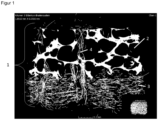
- Fig. 1 shows the average of a CT image of a composite material 1 according to the invention, which has a foam layer 2 and a fiber layer 3 arranged on it.
- Foam layer 2 and fiber layer 3 are connected to one another by needling, so that fibers of the fiber layer 3 are inserted into the foam layer 2 and form capillary channels 4 in it. It can be seen that the capillary channels 4 extend from the fiber layer 3 into the foam layer 2.
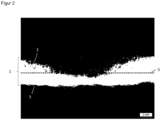
- Fig. 2 shows the cross-section of a light microscopy image of a composite material 1 according to the invention after wound cleaning with the foam side.
- the interface between the foam layer 2 and the fiber layer 3 is illustrated as a boundary line 5. It can be clearly seen how wound components are absorbed deep in the foam layer 2 and cross the boundary line 5, i.e. have penetrated into the fiber layer 3.
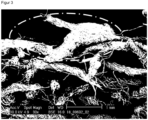
- Fig. 3 shows the cross-section of a scanning electron microscopy image of a cotton gauze after wound cleaning. It is clearly visible how the wound components are only retained on the surface of the cotton gauze (area within the dot-dash line).
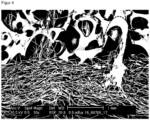
- Fig. 4 shows the cross-section of a scanning electron microscopy image of a wound cleansing material according to the invention after wound cleansing. It can be clearly seen how wound exudate is guided along the capillary channels formed by fibers from the foam layer into the fiber layer (marked within a dotted line).
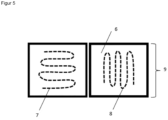
- Fig. 5 shows the defined movement of a wiping cycle for cleaning a test wound on pig skin.
- the wound surface 6 is cleaned with low pressure (to simulate gentle cleaning) and in a defined horizontal 7 and vertical 8 movement, which result in a wiping cycle 9.
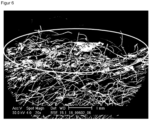
- Fig. 6 shows the cross-section of a scanning electron microscopy image of the product Debrisoft ® after wound cleansing. One can clearly see how the Wound components are only retained on the surface (area within oval).
- Example 1 Making a foam layer
- a water phase is prepared for foam production by dissolving/dispersing the surfactant Pluronic F87 at a concentration of 0.5 wt.%.
- a Teflon mold with a sufficient depth to produce a foam of 7 mm thickness is lined with casting paper.
- the prepolymer Hypol 2001 is added to the water phase at a concentration of 40 wt.% and mixed at room temperature with a dispersing disk (1600 rpm). The resulting mixture is immediately poured into the mold. It is foamed against air and cured for 10 minutes. The casting paper is then removed and dried at a temperature of 150 °C for 3 hours.
- Example 2 Production of a thermally bonded fiber layer
- Staple fibers are used to produce the thermally bonded fiber layer: 70% by weight of polyester fibers (Grisuten ® from Märkische Faser GmbH) with a fiber titer of 1.7 dtex and a fiber length of 60 mm and 30% by weight of a polyethylene terephthalate/polyethylene core-sheath binding fiber (Trevira ® 256 from Trevira GmbH) with a fiber titer of 3 dtex and a fiber length of 50 mm.
- These staple fibers are laid into a fiber layer using a carding machine according to a process known to those skilled in the art.
- the basis weight of the fiber layer is 150 g/m 2 .
- the fiber layer is then thermally bonded in a hot air oven at 150 °C and a speed of 2 m/min.
- Example 3 Manufacturing a wound cleansing article by mechanical needling of fiber layer and foam layer
- an open-pore foam layer from example 1 and a thermally consolidated fiber layer from example 2 are provided.
- the fleece layer is needled against the foam layer with a puncture density of 100/cm 2 and a puncture depth of 10 mm.
- the surface of the fleece layer that was facing away from the belt side in the oven is on the side facing away from the foam layer surface.
- the needling process connects the foam layer and fiber layer to one another. In this way, both a mechanically stable composite and a slightly fibrous surface on the foam are created.
- the fibers of the fiber layer penetrate the foam layer, form capillary channels in the foam layer and protrude at least partially from the side of the foam layer facing away from the fiber layer.
- the composite material obtained has a higher abrasiveness on the foam layer than on the fiber layer. Due to the fibers protruding from the foam layer, the foam layer has a more pleasant feel than the pure foam layer. To produce a wound cleansing article, the composite material is assembled. No significant loss of fibers occurs.
- Example 4 Determination of the mechanical stability of the composite material from Example 3
- the mechanical stability is tested as the tensile strength of the composite material according to the invention using a tensile test according to EN 29073-03 (deviations: no conditioning and pull-off speed 200 mm/min) in the longitudinal direction with a sample size of 300 x 50 mm.
- the dry and wet tear strength was determined, since wound cleansing materials are usually used wet.
- the test specimens were placed in tap water for approximately 30 minutes and then gently squeezed and hung up to drain for 5 - 10 minutes.
- Table 1 shows a comparison of the maximum tensile strength and maximum tensile elongation for an open-cell foam, the composite material according to the invention and the standard cotton gauze.
- the composite material according to the invention has a significantly higher maximum tensile strength in the wet and dry state compared to a pure open-cell foam. The penetration of the foam layer through the fiber layer mechanically strengthens the foam layer and increases the tensile strength. In the dry state, this achieves the strength of a standard cotton compress. In the wet state, the composite material according to the invention has a lower but sufficient maximum tensile strength than the standard cotton gauze. The maximum tensile elongation, however, is significantly higher than the cotton gauze.
- Example 5 Determination of the cleaning performance of the wound cleansing article in an ex-vivo wound model
- the composite material produced in Example 3 was made into a wound cleansing article according to the invention by punching it to a size of 10 cm x 10 cm.
- the cleansing performance of the wound cleansing article according to the invention was evaluated using an ex-vivo wound model on pig skin.
- the wound to be cleaned was prepared as follows: First, the pig skin was fixed in a frame (wound area 10 cm x 10 cm) with the inside of the skin facing upwards and scratched with a scalpel in the form of a grid pattern. The skin was then lightly burned with a flame beer burner (20 seconds, medium flame, distance approx. 20 cm) so that an uneven wound base was created by gaping the cuts. Any fat that leaked out was carefully removed by dabbing with a paper towel.
- protein solution 100 g/L protein powder (e.g. Body&Fit Egg White Powder in phosphate buffered saline solution (8.0 g/L sodium chloride (NaCl), 0.2 g/L potassium chloride (KCI), 1.42 g/L Disodium hydrogen phosphate (Na2HPO4) or 1.78 g/L disodium hydrogen phosphate dihydrate (Na2HPO4• 2 H2O), 0.27 g/L potassium dihydrogen phosphate (KH2PO4)) dissolved
- the protein solution is suitable for simulating fibrin deposits in the wound.
- 2 g of artificial exudate solution (5% Blanose, 40 g/L protein powder, 1 g/L sugar, artificial blood (150 drops per 300 mL, 2 g/L sunflower oil, 3.7 g/L sodium carbonate, 3 g/L quartz sand, all dissolved in PBS) are applied to the wound using a wooden spatula and burned again until a black crust (partially) forms (30 seconds, medium flame, distance approx. 20 cm).
- the simulated wound is left to rest for 2 hours at room temperature so that previously applied exudate cannot be easily removed.
- the wound cleansing article was moistened with water on the foam side (10 cm x 10 cm) with 5 sprays and placed on the wound for one minute with the foam side facing the wound surface.
- the wound surface was then cleaned with low pressure (to simulate gentle cleaning) and in a defined horizontal and vertical movement, which results in a wiping cycle (see Figure 5 ). Cleaning takes place for 3 minutes with 11 wiping cycles.
- the cleaning performance was evaluated by image analysis of the burned (black) areas before and after wound cleaning.
- the prepared pig skins were photographed with a SLR camera (Canon D70) with a fixed focal length lens (60 mm) using a copying tripod. Care was taken to ensure that the lighting and the distance (resulting magnification) between the object and the lens were the same for all images.
- a metal frame was placed on top to smooth the pig skins. By setting a threshold value and using a 15 x 15 pixel median filter, the black areas in the image were identified and marked green. An upper limit of 80 was chosen in the histogram for all images. This, and the consistent recording setup, ensure that the results of all samples are comparable.
- Example 6 Determination of the absorption of wound components by the wound cleansing article according to the invention from Example 5
- the wound cleansing article according to the invention is tested for its absorbency in comparison to cotton gauze and the product Debrisoft ® according to BS EN 13726-1:2002. It was found to show increased absorption of the aqueous test solution in comparison to standard cotton gauze and to the product Debrisoft ® (see Table 3).
- the advantage of this is that more wound components and liquids such as rinsing solutions used to support wound cleansing and/or wound exudate can be absorbed within one wound cleansing application.
- Table 3 Comparison of the absorption of cotton gauze, Debrisoft ⁇ sup>® ⁇ /sup> and a wound cleansing article according to the invention Absorption [g/g] cotton gauze 5.2 Debrisoft ® 5.9 Wound cleansing article according to the invention 6.5
Landscapes
- Engineering & Computer Science (AREA)
- Health & Medical Sciences (AREA)
- Textile Engineering (AREA)
- Life Sciences & Earth Sciences (AREA)
- Public Health (AREA)
- Animal Behavior & Ethology (AREA)
- Veterinary Medicine (AREA)
- Biomedical Technology (AREA)
- Heart & Thoracic Surgery (AREA)
- General Health & Medical Sciences (AREA)
- Mechanical Engineering (AREA)
- Surgery (AREA)
- Vascular Medicine (AREA)
- Nuclear Medicine, Radiotherapy & Molecular Imaging (AREA)
- Molecular Biology (AREA)
- Medical Informatics (AREA)
- Oral & Maxillofacial Surgery (AREA)
- Pathology (AREA)
- Materials For Medical Uses (AREA)
- Nonwoven Fabrics (AREA)
Claims (14)
- Article de nettoyage de plaies, comprenant un matériau composite (1) qui présente une couche de mousse (2) et une couche de fibres (3) agencée sur et dans la couche de mousse (2), la couche de fibres (3) étant au moins partiellement consolidée thermiquement et la couche de mousse (2) et la couche de fibres (3) étant reliées entre elles par aiguilletage, des fibres de la couche de fibres (3) ayant pénétré dans la couche de mousse (2) et formant des canaux capillaires (4) qui s'étendent de la couche de fibres (3) dans la couche de mousse (2), caractérisé en ce que les fibres de la couche de fibres (3) traversent la couche de mousse (2) et dépassent au moins partiellement du côté de la couche de mousse (2) détourné de la couche de fibres (3).
- Article de nettoyage de plaies selon la revendication 1, caractérisé en ce que la couche de fibres (3) présente des fibres synthétiques.
- Article de nettoyage de plaies selon la revendication 1 ou 2, caractérisé en ce que la couche de fibres (3) présente des fibres de matrice et un liant, notamment des fibres de liaison.
- Article de nettoyage de plaies selon une ou plusieurs des revendications précédentes, caractérisé en ce que la couche de fibres (3) présente des fibres hydrophobes, notamment des fibres de polyester et/ou de polyoléfine.
- Article de nettoyage de plaies selon une ou plusieurs des revendications précédentes, caractérisé en ce que les fibres contenues dans la couche de fibres (3), notamment les fibres de matrice et/ou les fibres de liaison, sont des fibres discontinues, de préférence avec une longueur comprise entre 20 mm et 150 mm.
- Article de nettoyage de plaies selon une ou plusieurs des revendications précédentes, caractérisé en ce que la couche de mousse (2) présente une mousse polymère hydrophile, en une proportion de plus de 50 % en poids, de préférence encore de plus de 70 % en poids, notamment de plus de 90 % en poids par rapport à la proportion de polymère de la couche de mousse (2).
- Article de nettoyage de plaies selon une ou plusieurs des revendications précédentes, caractérisé en ce que la couche de mousse (2) est à cellules ouvertes.
- Article de nettoyage de plaies selon une ou plusieurs des revendications précédentes, caractérisé en ce que la couche de mousse (2) présente au moins une surface à cellules ouvertes.
- Article de nettoyage de plaies selon une ou plusieurs des revendications précédentes, caractérisé par une force de traction maximale/un allongement mesuré(e) selon EN 29073-03 (humide) de plus de 40 %.
- Article de nettoyage de plaies selon une ou plusieurs des revendications précédentes, caractérisé en ce que le matériau composite (1) présente une couche de mousse hydrophile (2) en combinaison avec une couche de fibres hydrophobe (3).
- Article de nettoyage de plaies selon la revendication 10, caractérisé en ce que les fibres hydrophobes de la couche de fibres (3) pénètrent dans la couche de mousse hydrophile (2) et dépassent au moins partiellement du côté de la couche de mousse (2) détourné de la couche de fibres (3).
- Article de nettoyage de plaies selon une ou plusieurs des revendications précédentes, caractérisé en ce qu'il est stérile.
- Procédé de fabrication d'un article de nettoyage de plaies selon l'invention, comprenant les étapes suivantes :A l'agencement d'une couche de fibres (3) au moins partiellement consolidée thermiquement sur une couche de mousse (2) ;B l'aiguilletage de la couche de mousse (2) et de la couche de fibres (3) de telle sorte qu'un matériau composite (1) se forme, dans lequel des fibres de la couche de fibres (3) ont pénétré dans la couche de mousse (2) et forment des canaux capillaires (4) qui s'étendent de la couche de fibres (3) dans la couche de mousse (2).
- Procédé de fabrication d'un article de nettoyage de plaie selon l'invention, comprenant les étapes suivantes :A l'agencement d'une couche de fibres (3) sur une couche de mousse (2) ;B l'aiguilletage de la couche de mousse (2) et de la couche de fibres (3) de telle sorte qu'un matériau composite (1) se forme, dans lequel des fibres de la couche de fibres (3) ont pénétré dans la couche de mousse (2) et forment des canaux capillaires (4) qui s'étendent de la couche de fibres (3) dans la couche de mousse (2) ;C la consolidation thermique du matériau composite (1).
Applications Claiming Priority (2)
| Application Number | Priority Date | Filing Date | Title |
|---|---|---|---|
| DE102019120712.6A DE102019120712A1 (de) | 2019-07-31 | 2019-07-31 | Wundreinigungsartikel |
| PCT/EP2020/069478 WO2021018544A1 (fr) | 2019-07-31 | 2020-07-10 | Produit de nettoyage de plaie |
Publications (3)
| Publication Number | Publication Date |
|---|---|
| EP4003253A1 EP4003253A1 (fr) | 2022-06-01 |
| EP4003253B1 true EP4003253B1 (fr) | 2025-02-12 |
| EP4003253C0 EP4003253C0 (fr) | 2025-02-12 |
Family
ID=71620421
Family Applications (1)
| Application Number | Title | Priority Date | Filing Date |
|---|---|---|---|
| EP20740573.9A Active EP4003253B1 (fr) | 2019-07-31 | 2020-07-10 | Produit de nettoyage de plaie |
Country Status (5)
| Country | Link |
|---|---|
| US (1) | US12275224B2 (fr) |
| EP (1) | EP4003253B1 (fr) |
| CN (1) | CN114144304A (fr) |
| DE (1) | DE102019120712A1 (fr) |
| WO (1) | WO2021018544A1 (fr) |
Families Citing this family (2)
| Publication number | Priority date | Publication date | Assignee | Title |
|---|---|---|---|---|
| EP4326213A2 (fr) | 2021-04-23 | 2024-02-28 | Glatfelter Gernsbach GmbH | Combinaison déposée de mousse-air et procédés d'utilisation |
| DE102022119882A1 (de) * | 2022-08-08 | 2024-02-22 | Carl Freudenberg Kg | Wundkontaktschicht und Wundauflage umfassend einen sterilen Vliesstoff |
Family Cites Families (18)
| Publication number | Priority date | Publication date | Assignee | Title |
|---|---|---|---|---|
| CA734221A (en) * | 1966-05-17 | George A. Crowe, Jr. | Flexible absorbent sheet | |
| US3156242A (en) * | 1962-03-29 | 1964-11-10 | Johnson & Johnson | Flexible absorbent sheet |
| US3122141A (en) * | 1962-03-29 | 1964-02-25 | Johnson & Johnson | Flexible absorbent sheet |
| US3301257A (en) * | 1963-07-15 | 1967-01-31 | Johnson & Johnson | Absorbent surgical dressing |
| US4360015A (en) * | 1981-05-14 | 1982-11-23 | Hartford Corporation | Multilayer absorbent structure |
| DE3528524A1 (de) | 1985-08-08 | 1987-02-12 | Freudenberg Carl Fa | Nichtgewebter, textiler saugkoerper fuer medizin und hygiene sowie verfahren zu seiner herstellung |
| US6701591B2 (en) * | 2001-09-21 | 2004-03-09 | Polymer Group, Inc. | Diaphanous nonwoven fabrics with improved abrasive performance |
| US20060135026A1 (en) * | 2004-12-22 | 2006-06-22 | Kimberly-Clark Worldwide, Inc. | Composite cleaning products having shape resilient layer |
| GB2464970A (en) * | 2008-11-01 | 2010-05-05 | Christian Stephenson | Wound dressing comprising fibrous plugs |
| CN102395339B (zh) | 2009-01-28 | 2016-10-05 | 劳-贝投资股份有限公司 | 伤口清洁装置 |
| WO2013113906A1 (fr) * | 2012-02-01 | 2013-08-08 | Birgit Riesinger | Article pour le soin des plaies comprenant au moins une surface présentant des propriétés abrasives |
| PL2777662T3 (pl) * | 2013-03-11 | 2015-11-30 | Freudenberg Carl Kg | Zastosowanie welurowej włókniny igłowanej |
| US10709807B2 (en) * | 2014-10-01 | 2020-07-14 | 3M Innovative Properties Company | Porous devices, kits, and methods for debridement |
| DE202015103600U1 (de) | 2015-07-08 | 2016-10-11 | Mascot GmbH | Reinigungstextilie |
| DE102015010966A1 (de) * | 2015-08-26 | 2017-03-02 | Carl Freudenberg Kg | Reinigungstextil |
| DE102016008257A1 (de) * | 2016-07-08 | 2018-01-11 | Carl Freudenberg Kg | Hautauflage |
| US20200246195A1 (en) * | 2017-08-02 | 2020-08-06 | Kci Licensing, Inc. | Systems and methods for wound debridement |
| US11452639B2 (en) * | 2017-09-20 | 2022-09-27 | Coloplast A/S | Wound care device for debriding wounds |
-
2019
- 2019-07-31 DE DE102019120712.6A patent/DE102019120712A1/de active Pending
-
2020
- 2020-07-10 US US17/630,938 patent/US12275224B2/en active Active
- 2020-07-10 EP EP20740573.9A patent/EP4003253B1/fr active Active
- 2020-07-10 WO PCT/EP2020/069478 patent/WO2021018544A1/fr not_active Ceased
- 2020-07-10 CN CN202080042876.6A patent/CN114144304A/zh active Pending
Also Published As
| Publication number | Publication date |
|---|---|
| CN114144304A (zh) | 2022-03-04 |
| US20220203650A1 (en) | 2022-06-30 |
| EP4003253A1 (fr) | 2022-06-01 |
| US12275224B2 (en) | 2025-04-15 |
| DE102019120712A1 (de) | 2021-02-04 |
| EP4003253C0 (fr) | 2025-02-12 |
| WO2021018544A1 (fr) | 2021-02-04 |
Similar Documents
| Publication | Publication Date | Title |
|---|---|---|
| EP0296279B1 (fr) | Article absorbant en étoffe non tissée, et procédé pour le fabriquer | |
| DE69327674T2 (de) | VERFAHREN ZUM HERSTELLEN EINER ABSORBIERENDEN STRUKTUR SOWIE ABSORBIERENDER ARTIKEL MIT EINER GEMäSS DIESEM VERFAHREN HERGESTELLTEN STRUKTUR | |
| DE69327854T2 (de) | VERFAHREN ZUM HERSTELLEN EINER ABSORBIERENDEN STRUKTUR SOWIE ARTIKEL MIT EINER GEMäSS DIESEM VERFAHREN HERGESTELLTEN STRUKTUR | |
| EP3033116B1 (fr) | Article pour le soin de plaies, présentant des fibres super-absorbantes et des particules super-absorbantes | |
| DE69902584T2 (de) | Absorbierende struktur in einem absorbierenden artikel | |
| DE19604601B4 (de) | Absorptionsprodukt | |
| DE69812917T2 (de) | Verbände | |
| DE69329674T3 (de) | Mehrschichtiger saugfähiger verbundstoff | |
| DE69520869T2 (de) | Absorbierende Schicht und Verfahren zu seiner Herstellung | |
| DE2657684C2 (fr) | ||
| EP2528567B1 (fr) | Matériau souple et fortement absorbant | |
| EP0049319B1 (fr) | Compresse pour blessure | |
| EP2692321B1 (fr) | Matelas d'accumulateur intermédiaire | |
| EP2320844A1 (fr) | Article pour le soin des plaies contenant une proportion de fibres naturelles modifiées ou de fibres synthétiques | |
| WO2009019227A2 (fr) | Article pour le soin des plaies, présentant des polymères super-absorbants sous forme de fibres et/ou de fils | |
| EP2532326B1 (fr) | Pansement comprenant une étoffe nappée et une base de pommade destinées au traitement par dépressurisation | |
| EP4003253B1 (fr) | Produit de nettoyage de plaie | |
| DE60018772T2 (de) | Absorbierende struktur in einem absorbierenden artikel | |
| DE69504326T2 (de) | Verfahren zur herstellung einer absorbierenden struktur und ein absorbierender wundverband mit einer absorbierenden struktur, hergestellt durch dieses verfahren | |
| WO2013053410A1 (fr) | Non-tissé à pouvoir gonflant élevé | |
| DE69713406T2 (de) | Verfahren zur herstellung einer absorbierenden struktur mit erhöhter festigkeit | |
| DE3122954C2 (de) | Aus offenzelligem Kunststoffschaum bestehender Tampon für hygienische oder medizinische Zwecke | |
| EP4069320B1 (fr) | Article pour débridement mécanique | |
| DE102010006228A1 (de) | Flexibles, stark absorbierendes Material | |
| DE2525210C3 (de) | Saugstoff zur Verwendung in hygienischen Einwegartikeln |
Legal Events
| Date | Code | Title | Description |
|---|---|---|---|
| STAA | Information on the status of an ep patent application or granted ep patent |
Free format text: STATUS: UNKNOWN |
|
| STAA | Information on the status of an ep patent application or granted ep patent |
Free format text: STATUS: THE INTERNATIONAL PUBLICATION HAS BEEN MADE |
|
| PUAI | Public reference made under article 153(3) epc to a published international application that has entered the european phase |
Free format text: ORIGINAL CODE: 0009012 |
|
| STAA | Information on the status of an ep patent application or granted ep patent |
Free format text: STATUS: REQUEST FOR EXAMINATION WAS MADE |
|
| 17P | Request for examination filed |
Effective date: 20211215 |
|
| AK | Designated contracting states |
Kind code of ref document: A1 Designated state(s): AL AT BE BG CH CY CZ DE DK EE ES FI FR GB GR HR HU IE IS IT LI LT LU LV MC MK MT NL NO PL PT RO RS SE SI SK SM TR |
|
| DAV | Request for validation of the european patent (deleted) | ||
| DAX | Request for extension of the european patent (deleted) | ||
| REG | Reference to a national code |
Ref country code: DE Ref legal event code: R079 Free format text: PREVIOUS MAIN CLASS: A61F0013000000 Ipc: A61F0013010000 Ref country code: DE Ref legal event code: R079 Ref document number: 502020010383 Country of ref document: DE Free format text: PREVIOUS MAIN CLASS: A61F0013000000 Ipc: A61F0013010000 |
|
| GRAP | Despatch of communication of intention to grant a patent |
Free format text: ORIGINAL CODE: EPIDOSNIGR1 |
|
| STAA | Information on the status of an ep patent application or granted ep patent |
Free format text: STATUS: GRANT OF PATENT IS INTENDED |
|
| RIC1 | Information provided on ipc code assigned before grant |
Ipc: B32B 5/08 20060101ALI20240812BHEP Ipc: B32B 5/18 20060101ALI20240812BHEP Ipc: B32B 5/06 20060101ALI20240812BHEP Ipc: D04H 3/105 20120101ALI20240812BHEP Ipc: D04H 1/498 20120101ALI20240812BHEP Ipc: D04H 1/485 20120101ALI20240812BHEP Ipc: A61F 13/00 20060101ALI20240812BHEP Ipc: B32B 5/24 20060101ALI20240812BHEP Ipc: A61F 13/01 20240101AFI20240812BHEP |
|
| INTG | Intention to grant announced |
Effective date: 20240903 |
|
| GRAS | Grant fee paid |
Free format text: ORIGINAL CODE: EPIDOSNIGR3 |
|
| GRAA | (expected) grant |
Free format text: ORIGINAL CODE: 0009210 |
|
| STAA | Information on the status of an ep patent application or granted ep patent |
Free format text: STATUS: THE PATENT HAS BEEN GRANTED |
|
| AK | Designated contracting states |
Kind code of ref document: B1 Designated state(s): AL AT BE BG CH CY CZ DE DK EE ES FI FR GB GR HR HU IE IS IT LI LT LU LV MC MK MT NL NO PL PT RO RS SE SI SK SM TR |
|
| REG | Reference to a national code |
Ref country code: GB Ref legal event code: FG4D Free format text: NOT ENGLISH |
|
| REG | Reference to a national code |
Ref country code: CH Ref legal event code: EP |
|
| REG | Reference to a national code |
Ref country code: DE Ref legal event code: R096 Ref document number: 502020010383 Country of ref document: DE |
|
| REG | Reference to a national code |
Ref country code: IE Ref legal event code: FG4D Free format text: LANGUAGE OF EP DOCUMENT: GERMAN |
|
| U01 | Request for unitary effect filed |
Effective date: 20250306 |
|
| U07 | Unitary effect registered |
Designated state(s): AT BE BG DE DK EE FI FR IT LT LU LV MT NL PT RO SE SI Effective date: 20250313 |
|
| PG25 | Lapsed in a contracting state [announced via postgrant information from national office to epo] |
Ref country code: RS Free format text: LAPSE BECAUSE OF FAILURE TO SUBMIT A TRANSLATION OF THE DESCRIPTION OR TO PAY THE FEE WITHIN THE PRESCRIBED TIME-LIMIT Effective date: 20250512 |
|
| PG25 | Lapsed in a contracting state [announced via postgrant information from national office to epo] |
Ref country code: PL Free format text: LAPSE BECAUSE OF FAILURE TO SUBMIT A TRANSLATION OF THE DESCRIPTION OR TO PAY THE FEE WITHIN THE PRESCRIBED TIME-LIMIT Effective date: 20250212 |
|
| PG25 | Lapsed in a contracting state [announced via postgrant information from national office to epo] |
Ref country code: ES Free format text: LAPSE BECAUSE OF FAILURE TO SUBMIT A TRANSLATION OF THE DESCRIPTION OR TO PAY THE FEE WITHIN THE PRESCRIBED TIME-LIMIT Effective date: 20250212 |
|
| PG25 | Lapsed in a contracting state [announced via postgrant information from national office to epo] |
Ref country code: NO Free format text: LAPSE BECAUSE OF FAILURE TO SUBMIT A TRANSLATION OF THE DESCRIPTION OR TO PAY THE FEE WITHIN THE PRESCRIBED TIME-LIMIT Effective date: 20250512 Ref country code: IS Free format text: LAPSE BECAUSE OF FAILURE TO SUBMIT A TRANSLATION OF THE DESCRIPTION OR TO PAY THE FEE WITHIN THE PRESCRIBED TIME-LIMIT Effective date: 20250612 |
|
| PG25 | Lapsed in a contracting state [announced via postgrant information from national office to epo] |
Ref country code: HR Free format text: LAPSE BECAUSE OF FAILURE TO SUBMIT A TRANSLATION OF THE DESCRIPTION OR TO PAY THE FEE WITHIN THE PRESCRIBED TIME-LIMIT Effective date: 20250212 |
|
| PG25 | Lapsed in a contracting state [announced via postgrant information from national office to epo] |
Ref country code: GR Free format text: LAPSE BECAUSE OF FAILURE TO SUBMIT A TRANSLATION OF THE DESCRIPTION OR TO PAY THE FEE WITHIN THE PRESCRIBED TIME-LIMIT Effective date: 20250513 |
|
| U20 | Renewal fee for the european patent with unitary effect paid |
Year of fee payment: 6 Effective date: 20250725 |
|
| PG25 | Lapsed in a contracting state [announced via postgrant information from national office to epo] |
Ref country code: SM Free format text: LAPSE BECAUSE OF FAILURE TO SUBMIT A TRANSLATION OF THE DESCRIPTION OR TO PAY THE FEE WITHIN THE PRESCRIBED TIME-LIMIT Effective date: 20250212 |
|
| PGFP | Annual fee paid to national office [announced via postgrant information from national office to epo] |
Ref country code: GB Payment date: 20250722 Year of fee payment: 6 |
|
| PG25 | Lapsed in a contracting state [announced via postgrant information from national office to epo] |
Ref country code: CZ Free format text: LAPSE BECAUSE OF FAILURE TO SUBMIT A TRANSLATION OF THE DESCRIPTION OR TO PAY THE FEE WITHIN THE PRESCRIBED TIME-LIMIT Effective date: 20250212 |
|
| PG25 | Lapsed in a contracting state [announced via postgrant information from national office to epo] |
Ref country code: SK Free format text: LAPSE BECAUSE OF FAILURE TO SUBMIT A TRANSLATION OF THE DESCRIPTION OR TO PAY THE FEE WITHIN THE PRESCRIBED TIME-LIMIT Effective date: 20250212 |
|
| PLBE | No opposition filed within time limit |
Free format text: ORIGINAL CODE: 0009261 |
|
| STAA | Information on the status of an ep patent application or granted ep patent |
Free format text: STATUS: NO OPPOSITION FILED WITHIN TIME LIMIT |
|
| REG | Reference to a national code |
Ref country code: CH Ref legal event code: L10 Free format text: ST27 STATUS EVENT CODE: U-0-0-L10-L00 (AS PROVIDED BY THE NATIONAL OFFICE) Effective date: 20251224 |
|
| 26N | No opposition filed |
Effective date: 20251113 |
|
| REG | Reference to a national code |
Ref country code: CH Ref legal event code: H13 Free format text: ST27 STATUS EVENT CODE: U-0-0-H10-H13 (AS PROVIDED BY THE NATIONAL OFFICE) Effective date: 20260224 |
|
| PG25 | Lapsed in a contracting state [announced via postgrant information from national office to epo] |
Ref country code: CH Free format text: LAPSE BECAUSE OF NON-PAYMENT OF DUE FEES Effective date: 20250731 |