EP4003621B1 - Substrat métallique pourvu d'une texture de surface et procédé d'application de ces textures sur des substrats métalliques - Google Patents
Substrat métallique pourvu d'une texture de surface et procédé d'application de ces textures sur des substrats métalliques Download PDFInfo
- Publication number
- EP4003621B1 EP4003621B1 EP20745186.5A EP20745186A EP4003621B1 EP 4003621 B1 EP4003621 B1 EP 4003621B1 EP 20745186 A EP20745186 A EP 20745186A EP 4003621 B1 EP4003621 B1 EP 4003621B1
- Authority
- EP
- European Patent Office
- Prior art keywords
- metal substrate
- depressions
- surface texture
- previous
- substrate according
- Prior art date
- Legal status (The legal status is an assumption and is not a legal conclusion. Google has not performed a legal analysis and makes no representation as to the accuracy of the status listed.)
- Active
Links
Images
Classifications
-
- B—PERFORMING OPERATIONS; TRANSPORTING
- B21—MECHANICAL METAL-WORKING WITHOUT ESSENTIALLY REMOVING MATERIAL; PUNCHING METAL
- B21H—MAKING PARTICULAR METAL OBJECTS BY ROLLING, e.g. SCREWS, WHEELS, RINGS, BARRELS, BALLS
- B21H8/00—Rolling metal of indefinite length in repetitive shapes specially designed for the manufacture of particular objects, e.g. checkered sheets
-
- B—PERFORMING OPERATIONS; TRANSPORTING
- B21—MECHANICAL METAL-WORKING WITHOUT ESSENTIALLY REMOVING MATERIAL; PUNCHING METAL
- B21H—MAKING PARTICULAR METAL OBJECTS BY ROLLING, e.g. SCREWS, WHEELS, RINGS, BARRELS, BALLS
- B21H8/00—Rolling metal of indefinite length in repetitive shapes specially designed for the manufacture of particular objects, e.g. checkered sheets
- B21H8/005—Embossing sheets or rolls
-
- B—PERFORMING OPERATIONS; TRANSPORTING
- B21—MECHANICAL METAL-WORKING WITHOUT ESSENTIALLY REMOVING MATERIAL; PUNCHING METAL
- B21B—ROLLING OF METAL
- B21B1/00—Metal-rolling methods or mills for making semi-finished products of solid or profiled cross-section; Sequence of operations in milling trains; Layout of rolling-mill plant, e.g. grouping of stands; Succession of passes or of sectional pass alternations
- B21B1/22—Metal-rolling methods or mills for making semi-finished products of solid or profiled cross-section; Sequence of operations in milling trains; Layout of rolling-mill plant, e.g. grouping of stands; Succession of passes or of sectional pass alternations for rolling plates, strips, bands or sheets of indefinite length
- B21B1/227—Surface roughening or texturing
-
- B—PERFORMING OPERATIONS; TRANSPORTING
- B21—MECHANICAL METAL-WORKING WITHOUT ESSENTIALLY REMOVING MATERIAL; PUNCHING METAL
- B21B—ROLLING OF METAL
- B21B27/00—Rolls, roll alloys or roll fabrication; Lubricating, cooling or heating rolls while in use
- B21B27/005—Rolls with a roughened or textured surface; Methods for making same
-
- B—PERFORMING OPERATIONS; TRANSPORTING
- B23—MACHINE TOOLS; METAL-WORKING NOT OTHERWISE PROVIDED FOR
- B23K—SOLDERING OR UNSOLDERING; WELDING; CLADDING OR PLATING BY SOLDERING OR WELDING; CUTTING BY APPLYING HEAT LOCALLY, e.g. FLAME CUTTING; WORKING BY LASER BEAM
- B23K26/00—Working by laser beam, e.g. welding, cutting or boring
- B23K26/352—Working by laser beam, e.g. welding, cutting or boring for surface treatment
- B23K26/355—Texturing
-
- B—PERFORMING OPERATIONS; TRANSPORTING
- B21—MECHANICAL METAL-WORKING WITHOUT ESSENTIALLY REMOVING MATERIAL; PUNCHING METAL
- B21B—ROLLING OF METAL
- B21B2265/00—Forming parameters
- B21B2265/10—Compression, e.g. longitudinal compression
Definitions
- the invention relates to a metal substrate provided with surface texture, wherein the surface texture comprises a plurality of depressions for simultaneously providing good press performance and waviness, as well as a method to apply such surface textures on a metal substrate.
- a metal strip is subjected to levelling and/or temper rolling.
- levelling the shape and form of the strip are controlled and with temper rolling the mechanical properties of the metal strip are improved by lengthening of the strip.
- surface quality of the strip is improved as far as it concerns appearance, surface texture and surface function(ality).
- temper rolling step a texture may be transferred to the surface of the strip from the work rolls to get a certain function.
- the texturing of the metal strip is done to the requirements of the end user, for instance end users in the automotive industry.
- An important functional aspect of the surface of the metal substrate is related to press performance.
- transfer of material from (metallic coated) metal sheet onto press tools and subsequent material accumulation of the material on the press tools can initiate galling in the (metallic coated) metal sheet during forming. This disrupts a good visual appearance of the final part, and may lead to rejection of the part as well as expensive cleaning of press tools.
- the surface of the substrate slides along the press tools where high contact friction and poor lubrication may result in surface damage such as galling of the substrate and in case of an applied zinc coating, zinc pollution of the press tools.
- the current solution is to use extremely smooth tool surfaces and rather rough strip surfaces as well as applying oil for lubrication.
- a metal substrate according to the preamble of claim 1 is e.g. known from US 5 358 794 A .
- a metal substrate with a surface texture wherein the surface texture comprises a plurality of depressions, wherein each triplet of closest neighbouring depressions is spaced apart by a circle with a radius r, measured from the edge of the depressions, and wherein the arithmetic mean radius r mean is at most 20 ⁇ m and wherein the material area fraction is at least 30%.
- r mean By limiting the r mean of each triplet of closest neighbouring depressions, it was observed that the press performance of the metal substrate increased and galling was reduced while the waviness still indicated a good paint appearance. If the r mean exceeds 20 ⁇ m, the press performance deteriorates, and significant higher amount of tool pollution and galling is observed.
- the lower limit of r mean is not particularly limited and is determined by the preparation of the surface texture. If the depressions in the surface texture are obtained by laser ablation, a r mean of 1 ⁇ m would be a suitable lower limit, whereas if the depression are obtained by imprinting, for example via a textured work roll, a r mean of 3 ⁇ m would be feasible.
- the material area fraction is at least 30%.
- the material area fraction is representative for the contact area during forming. A higher material area fraction will result in a lower local contact pressure.
- the load can be carried by the high height area's or peaks of the surface texture and by a hydrostatic pressure generated in the lubricant in the depressions of the surface texture. A material area fraction below 30% will likely generate high local contact pressures and therefore result in surface defects.
- the material area fraction is at least 40%, more preferably at least 60%, most preferably at least 80%.
- the material area fraction can be calculated from a height profile, for example obtained by confocal microscopy.
- the metal substrate may have a deterministic, pseudo-deterministic or stochastic surface.
- the r mean can be set to be at most 20 ⁇ m, in particular for deterministic and pseudo-deterministic surface textures. It should be noted that the surface texture also can be analysed afterwards.
- the circles can be mathematically fitted between the depressions and the circles are not part of the surface texture itself. The sum of the radius of all fitted circles is then divided by the amount of fitted circles to obtain the arithmetic mean radius r a .
- the circles can be fitted on an image of the surface, preferably a 3D measured height map, using image processing software such as matlab.
- the arithmetic mean radius r mean provides an indication of the average size of the land areas.
- arithmetic mean radius r mean of the circular space between each triplet of closest neighbouring depressions will on average result in smaller land areas. As these land areas will be under high load during press conditions, they are most prone to be damaged. Without wishing to be bound to theory, it is believed that limiting the arithmetic mean radius r mean to 20 ⁇ m ensures that the damaged land areas will generate small wear particles, resulting in less tool pollution and galling, and hence, a better press performance.
- depression, recesses or dimples are used interchangeably and comprise depressions, recesses or dimples of any shape.
- the surface texture which has the objective to reduce galling may be present over the full width and length of the metal substrate.
- only specific parts of the metal substrate such as a blank or strip, comprises the surface texture while the remainder of the surface has another surface texture with another objective, depending on the final specifications of the product.
- the metal substrate may comprise the surface texture only on these corresponding areas.
- the arithmetic mean radius r mean is most 15 ⁇ m, more preferably at most 10 ⁇ m or even more preferably 5 ⁇ m. By limiting the arithmetic mean radius, the average size of the wear particles will likely become smaller and the press performance is even further increased.
- At least 90% of the fitted circles between a triplet of closest neighbouring depressions have a radius r of at most 30 ⁇ m.
- the distribution of depression may vary.
- a stochastic or pseudo-deterministic structure will have a larger statistical dispersion for the radius r between each triplet of closest neighbouring depressions than a deterministic structure. It was observed that at least 90% of the circles between a triplet of closest neighbouring depressions should have a radius r of at most 30 ⁇ m, in order to reduce unwanted tool pollution and subsequent galling.
- the percentage of fitted circles between a triplet of closest neighbouring depressions with a radius of at most 30 ⁇ m, preferably at most 25 ⁇ m, more preferably at most 20 ⁇ m is at least 90%, preferably at least 95%, more preferably at least 97%, even more preferably at least 98%, most preferably at least 99.5%.
- the surface texture is deterministic or pseudo deterministic.
- a deterministic or pseudo deterministic surface texture will result in a more defined surface texture, thereby decreasing the chance of large land areas and galling.
- a (pseudo) deterministic surface texture will have a lower waviness, thereby giving a better paint appearance in comparison to typical stochastic surface textures.
- the texture patterns can be applied in a fully deterministic manner resulting in perfect arrays of depressions, that is with the dimples in lines at an angle to each other, for instance in a cubic or hexagonal array. Such texture will have excellent waviness and good press performance. However, this may result in very visible patterns in a painted product when viewed at specific angles, for example a Moiré pattern.
- the depressions may also be provided in a pseudo deterministic manner which prevents that these kind of unwanted interference patterns are seen when viewed at specific angles.
- Pseudo deterministic includes, but is not limited to, a spatial distribution which is based on a hexagonal array but with a controlled displacement of each surface feature in the hexagonal array such that autocorrelation is reduced. That means that a certain spatial distribution of surface features in an evaluation window is unique and no equal spatial distribution of surface features is found when moving the evaluation window with a certain distance or angle. Also apparently random generation of surfaces but with certain boundary conditions taken into account, like not allowing surface featured to overlap, is included as a so called pseudo deterministic spatial distribution.
- the depressions have a diameter in a range of 25 - 120 ⁇ m, preferably in a range of 25 -70 ⁇ m, most preferably in a range of 30 - 45 ⁇ m.
- a surface texture with the diameter of the depressions in this range will be beneficial for oiling and capturing the wear particles to further reduce tool pollution and to avoid waviness increase by texturing.
- the paint appearance will be good in this range.
- Below 25 ⁇ m the preparation of the depressions will become challenging. In the case of making surface texture with a rolling process, the roughness transfer becomes less robust. In the case of making the surface with a laser, the process will be less efficient and robust due to high focussing of the laser beam. In addition, the depression will likely be too small to efficiently capture wear particles. Above 120 ⁇ m the length scale of the surface texture becomes too course and the waviness increases such that the paint appearance will likely be worse.
- the depressions have a depth in a range of 2 -12 ⁇ m, preferably in a range of 2 - 5 ⁇ m.
- a surface texture with the depth of the depressions in this range will be beneficial for oiling and capturing the wear particles to further reduce tool pollution and to avoid waviness increase due to the applied surface texture.
- Below 2 ⁇ m the roughness of the surface texture will become insufficient, negatively impacting the lubrication storage effect.
- the depressions may pierce the upper layer completely. This could lead for example to corrosion issues in case the metal substrate is zinc coated steel.
- the depressions have a density in a range of between 100 to 10000 per square millimetre.
- the metal substrate will already have a texture pattern with a respective waviness and roughness obtained from production, for example from the work rolls in the temper mill, the applied texture pattern will typically result in an alteration of the pattern and an increase in waviness.
- This additional waviness should preferably be minimized for paint performance.
- the additional waviness is defined as the additional waviness introduced by the surface texture of the invention in comparison to the waviness which would have been realized with a smooth roll which had a ground surface with a roughness Ra ⁇ 1.5 ⁇ m.
- the additional waviness is below 0.1 ⁇ m, more preferably below 0.05 ⁇ m in order to obtain a good paint performance.
- the dimple density is at least 100 dimples per square millimetre, more preferably at least 150 dimples per square millimetre, most preferably at least 180 dimples per square millimetre.
- the higher density is limited by the method of texturing, for example a density of 10000 dimples per square millimetre is feasible with ultrafine laser texturing, whereas imprinting may be limited to a density of 600 dimples per square millimetre.
- the texture pattern has a high closed void volume.
- the closed void volume should preferably be at least 600 mm 3 /m 2 , more preferably at least 800 mm 3 /m 2 and most preferably at least 1000 mm 3 /m 2 .
- the load can be carried by the high height area's or peaks and by a hydrostatic pressure generated in the lubricant in the closed dimples. Dimples which are interconnected to dimples outside the loading area will likely generate a limited hydrostatic pressure and therefore do not contribute to the load carrying capacity as much.
- This integrated volume of the dimples is referred to as the closed void volume which is a known parameter by the expert in the field.
- the texture pattern has a waviness (Wsa) of at most 0.3 ⁇ m to obtain optimal paint performance.
- Wsa waviness
- the Wsa is at most 0.25 ⁇ m, more preferably 0.20 ⁇ m. Wsa is measured according to SEP1941
- the texture pattern has a roughness (Ra) in a range of 0.2 ⁇ m to 3 ⁇ m, more preferably in the range of 0.5 ⁇ m to 2 ⁇ m.
- Ra roughness
- a metal substrate according to the invention with a roughness in this range will result in good press performance and good paint adherence while maintaining a good visual appearance.
- a roughness below 0.2 ⁇ m will result in bad press performance, as the grip will be too low and the oil typically used during press will not be distributed properly.
- the roughness exceeds 3 ⁇ m a low waviness cannot be obtained and the paint appearance gets worse.
- Roughness Ra is measured according to ISO 4287 or EN10091. It should be noted that although Ra is a commonly used parameter to characterize steel strip surfaces it provides no detail about the actual surface nor detailed surface properties.
- the texture pattern has a peak count (RPc) in a range of 30 - 190 per centimetre to obtain a better paint adherence and smoother paint surfaces with better reflection of images.
- RPc peak count
- the peak count is in a range of 75- 160 per centimetre, more preferably 75 - 110 per centimetre.
- RPc is a measure for the spacing of peaks (EN10094)
- the metal substrate is a blank or a strip.
- the metal substrate is preferably a blank or a strip from which blanks can be cut wherein each blank may have its own reference points. In the latter case the reference points are used to trigger a cutting device to cut the strip into blanks of predefined sizes.
- the metal could in principle be any metal, but in most cases will be steel, which for automotive purposes comprises high strength steels for instance for parts such as A, B, C, (D) pillars, and also softer better formable steels for outer panels.
- the metal substrate comprises a metallic coating layer.
- the material will typically be provided with a metallic coating to prevent corrosion of the substrate.
- a metallic coating is provided on the metal substrate before applying a texture pattern.
- the texture patterns may be applied before applying the coating.
- Metallic coatings comprise Zn coatings and Zn alloy coatings such as ZnAI, ZnMg, ZnAlMg coatings, Cr and Cr alloy coatings, Sn and Sn alloy coatings.
- the metal substrate is provided.
- the metal substrate can be either coated, or uncoated, and may be provided as a strip or sheet, for example a coiled steel strip.
- the metal substrate may be temper rolled in a second step to obtain an initial low roughness of the strip.
- the metal substrate is temper rolled to a roughness to an arithmetic mean height Ra ⁇ 1.2 ⁇ m, more preferably to Ra ⁇ 0.9 ⁇ m. Such roughness will make the metal substrate especially suitable for automotive purposes.
- a surface texture will be provided to the metal substrate by a texturing means wherein the surface texture comprises a plurality of depressions, wherein each triplet of closest neighbouring depressions is spaced apart by a circle with a radius r, measured from the edge of the depressions, and wherein the arithmetic mean radius r mean is at most 20 ⁇ m. It is also possible to temper roll the metal substrate during the same step the surface texture is applied, for example if the surface texture is provided by a texturing means such as a temper mill.
- the texturing means may be laser ablation which results in a pattern of depressions in the metal substrate or by a textured work roll, which imprints the surface texture on the metal substrate.
- a product either has one side or both sides that have to meet high appearance standards, but in most cases as for instance with products for the automotive industry there is only one side that has to fulfil the highest appearance standards.
- the opposite side is covered and will normally not be visible in which case appearance is far less important.
- the tribological properties and press performance are equally important on both sides. Accordingly it is provided that only one side of the metal substrate is provided with texture patterns or wherein different texture patterns and/or different areas are provided with texture patterns on opposite sides of the metal substrate. With a texture pattern applied according the method on only one side, for example using laser ablation, the other side will still have a texture resulting from the temper rolling of the metal substrate.
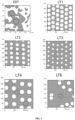
- FIG. 1 shows a top view of metal substrates comprising typical texture patterns according to the prior art (EDT), according to the invention (LT1) and according to comparative samples (LT2 - LT4).
- EDT electronic texture
- LT1 typical texture patterns according to the prior art
- LT2 comparative samples
- a circle with a diameter of 50 ⁇ m is plotted on top as an indication of the size of the land areas.
- LT1-LT4 are pseudo-deterministic as the columns in the initial square array are all shifted in vertical direction.
- LT6, which is another comparative example is generated by randomly applying depressions. From FIG 1 , it can be observed that a surface texture with a smaller r mean such as LT1 results in smaller land areas, which in turn results in better press performance.
- the samples shown in FIG. 1 were prepared as follows: a standard steel sheet was produced and finished with hot rolling and cold rolling as known to a person skilled in the art, after cold rolling the sheet was annealed and hot dip galvanized with a zinc alloy and finished by temper rolling.
- the steel sheet was smooth skin passed to a roughness Ra ⁇ 0.5 ⁇ m and a texture pattern was applied by laser as described in WO20217125497 .
- Pseudo-deterministic textures were prepared with laser texturing.
- An additional sample with a stochastic surface (EDT) texture was prepared with a conventional rolling process using EDT textured work rolls.
- NSP non-skin passed steel sheet directly obtained from the zinc bath before temper rolling was included
- All samples were characterized by confocal microscopy resulting in a 3-dimensional height map to determine r mean , % of r above 30 ⁇ m and MAF.
- the measurement area had a dimension of 2x2 mm 2 to ensure a representative evaluation of the stochastic and pseudo-deterministic surface textures.
- the measured height profile was filtered according to ISO 16610-61 with a cut-off of 2.5 ⁇ 2.5 ⁇ m 2 to remove measurement noise. Subsequently a cross section in the horizontal plane is selected at a height where the material volume above the cross section is 0.7 ⁇ m 3 / ⁇ m 2 .
- the cross section is referred to as projected area, indicating at which locations contact between the sample material and tool is to be expected, called high area and indicating locations where no contact between the sample and tool is to be expected, called depressions.
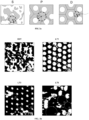
- High areas, corresponding to the material area fraction (MAF) are shown in black and depressions in white in FIG. 2 .
- Further analysis was done by fitting circles in the projected area; where a circle is defined by the three nearest edges of a local high area, corresponding to the edge of the depression.
- the radius r of the largest circle in a local high area is shown in FIG.2 as a characteristic measure for the dimension of the local high area. It was found that for conventional surfaces, such as comparative example EDT, the average characteristic radius r mean is above 30 ⁇ m.
- the inventive surfaces have been designed such that the r mean ⁇ 20 ⁇ m, which was confirmed by the analysis of the confocal microscopy.
- the samples according to the invention have significantly less galling and tool pollution in comparison with the comparative samples, while maintaining a good to excellent waviness.
- the inspection of the metal substrate surface and tool showed significant less galling and tool pollution for the inventive samples.
- the inventive samples showed a lower friction build-up (COF).
- LT1 having the lowest r mean ( ⁇ 20 ⁇ m) gave the best results and showed no galling in any of the 6 passes.
- LT4 not according to the invention provided satisfiable results whereas NSP, EDT and LT6, having a r mean outside the scope of the invention, already showed galling after three passes and significantly polluted the tool.
- depression dimensions Surface characteristics Press Performance type diameter [ ⁇ m] depth [ ⁇ m] density [mm -2 ] centre distance Ra [ ⁇ m] RPc [cm -1 ] Wsa [ ⁇ m] r mean [ ⁇ m] %r> 30 ⁇ m MAF [%] n* Tool Pollution NSP S n.a. n.a. n.a. 0.49 13 0.46 > 30 >10 - 1 -- EDT S n.a. n.a. n.a. n.a.
Landscapes
- Engineering & Computer Science (AREA)
- Mechanical Engineering (AREA)
- Physics & Mathematics (AREA)
- Optics & Photonics (AREA)
- Plasma & Fusion (AREA)
- Metal Rolling (AREA)
Claims (14)
- Substrat métallique avec une texture de surface, dans lequel la texture de surface comprend une pluralité de creux, caractérisé en ce que chaque triplet de creux voisins les plus proches est espacé par un cercle avec un rayon r, mesuré à partir du bord des creux, et dans lequel le rayon moyen arithmétique rmoyen est inférieur ou égal à 20 µm et dans lequel la fraction de surface de matériau est supérieur ou égal à 30 %.
- Substrat métallique selon la revendication 1, dans lequel au moins 90 % des cercles entre un triplet de creux voisins les plus proches comportent un rayon r inférieur ou égal à 30 µm.
- Substrat métallique selon la revendication 1 ou 2, dans lequel la texture de surface est déterministe ou pseudo-déterministe.
- Substrat métallique selon l'une quelconque des revendications précédentes, dans lequel les creux comportent un diamètre compris dans une plage de 25-120 µm.
- Substrat métallique selon l'une quelconque des revendications précédentes, dans lequel les creux comportent une profondeur comprise dans une plage de 2-12 µm, de préférence dans une plage de 2-5 µm.
- Substrat métallique selon l'une quelconque des revendications précédentes, dans lequel les creux comportent une densité comprise dans une plage entre 100 et 10000 par millimètre carré, de préférence entre 180 et 600 par millimètre carré.
- Substrat métallique selon l'une quelconque des revendications précédentes, dans lequel le Wsa est ≤ 0,3 µm mesuré selon SEP1941.
- Substrat métallique selon l'une quelconque des revendications précédentes, dans lequel la hauteur moyenne arithmétique Ra est comprise dans une plage de 0,5 µm à 2 µm mesurée selon la norme ISO 4287 ou EN10091.
- Substrat métallique selon l'une quelconque des revendications précédentes, dans lequel la fraction de surface de matériau est supérieure ou égale à 40 %.
- Substrat métallique selon l'une quelconque des revendications précédentes, dans lequel le substrat métallique est une ébauche ou une bande.
- Substrat métallique selon l'une quelconque des revendications précédentes, dans lequel le substrat métallique comprend un revêtement métallique.
- Procédé pour obtenir un substrat métallique selon la revendication 1-11, comprenant les étapes dea. fourniture d'un substrat métalliqueb. éventuellement, dressage par laminage à froid du substrat métalliquec. fourniture d'une texture de surface telle que définie dans les revendications 1-11 par un moyen de texturation.
- Procédé selon la revendication 12, dans lequel le substrat métallique comprend un revêtement métallique.
- Procédé selon la revendication 12 ou 13, dans lequel le moyen de texturation est un cylindre de travail texturé ou un laser.
Applications Claiming Priority (2)
| Application Number | Priority Date | Filing Date | Title |
|---|---|---|---|
| EP19188400 | 2019-07-25 | ||
| PCT/EP2020/070819 WO2021013938A1 (fr) | 2019-07-25 | 2020-07-23 | Substrat métallique doté d'une texture de surface et procédé d'application de ces textures sur des substrats métalliques |
Publications (2)
| Publication Number | Publication Date |
|---|---|
| EP4003621A1 EP4003621A1 (fr) | 2022-06-01 |
| EP4003621B1 true EP4003621B1 (fr) | 2024-12-04 |
Family
ID=67438924
Family Applications (1)
| Application Number | Title | Priority Date | Filing Date |
|---|---|---|---|
| EP20745186.5A Active EP4003621B1 (fr) | 2019-07-25 | 2020-07-23 | Substrat métallique pourvu d'une texture de surface et procédé d'application de ces textures sur des substrats métalliques |
Country Status (5)
| Country | Link |
|---|---|
| EP (1) | EP4003621B1 (fr) |
| KR (1) | KR102896246B1 (fr) |
| ES (1) | ES3003358T3 (fr) |
| PT (1) | PT4003621T (fr) |
| WO (1) | WO2021013938A1 (fr) |
Families Citing this family (2)
| Publication number | Priority date | Publication date | Assignee | Title |
|---|---|---|---|---|
| DE102022113809A1 (de) | 2022-06-01 | 2023-12-07 | Thyssenkrupp Steel Europe Ag | Metallflachprodukt und Bauteil daraus |
| DE102024107448A1 (de) * | 2024-03-15 | 2025-09-18 | Thyssenkrupp Steel Europe Ag | Verfahren zum Herstellen eines schmelztauchbeschichteten Kaltbands |
Citations (5)
| Publication number | Priority date | Publication date | Assignee | Title |
|---|---|---|---|---|
| US5358794A (en) | 1991-09-03 | 1994-10-25 | Nippon Steel Corporation | Steel strip and method for producing rolling dull roll |
| WO2014037545A1 (fr) | 2012-09-07 | 2014-03-13 | Daetwyler Graphics Ag | Produit plat constitué d'un matériau métallique, en particulier d'un matériau acier, utilisation dudit produit plat, ainsi que cylindre et procédé de fabrication dudit produit plat |
| WO2014104459A1 (fr) | 2012-12-31 | 2014-07-03 | 선문대학교 산학협력단 | Matière à frottement faible pour moteur de voiture et procédé de sa fabrication à l'aide de modélisation laser |
| WO2017125497A1 (fr) | 2016-01-22 | 2017-07-27 | Tata Steel Nederland Technology B.V. | Texturation au laser de bande d'acier |
| WO2019175370A1 (fr) | 2018-03-16 | 2019-09-19 | Tata Steel Nederland Technology B.V. | Substrat métallique pourvu de textures de surface personnalisées et procédé d'application de telles textures sur des substrats métalliques |
-
2020
- 2020-07-23 EP EP20745186.5A patent/EP4003621B1/fr active Active
- 2020-07-23 ES ES20745186T patent/ES3003358T3/es active Active
- 2020-07-23 PT PT207451865T patent/PT4003621T/pt unknown
- 2020-07-23 KR KR1020227006297A patent/KR102896246B1/ko active Active
- 2020-07-23 WO PCT/EP2020/070819 patent/WO2021013938A1/fr not_active Ceased
Patent Citations (5)
| Publication number | Priority date | Publication date | Assignee | Title |
|---|---|---|---|---|
| US5358794A (en) | 1991-09-03 | 1994-10-25 | Nippon Steel Corporation | Steel strip and method for producing rolling dull roll |
| WO2014037545A1 (fr) | 2012-09-07 | 2014-03-13 | Daetwyler Graphics Ag | Produit plat constitué d'un matériau métallique, en particulier d'un matériau acier, utilisation dudit produit plat, ainsi que cylindre et procédé de fabrication dudit produit plat |
| WO2014104459A1 (fr) | 2012-12-31 | 2014-07-03 | 선문대학교 산학협력단 | Matière à frottement faible pour moteur de voiture et procédé de sa fabrication à l'aide de modélisation laser |
| WO2017125497A1 (fr) | 2016-01-22 | 2017-07-27 | Tata Steel Nederland Technology B.V. | Texturation au laser de bande d'acier |
| WO2019175370A1 (fr) | 2018-03-16 | 2019-09-19 | Tata Steel Nederland Technology B.V. | Substrat métallique pourvu de textures de surface personnalisées et procédé d'application de telles textures sur des substrats métalliques |
Also Published As
| Publication number | Publication date |
|---|---|
| PT4003621T (pt) | 2024-12-19 |
| KR102896246B1 (ko) | 2025-12-04 |
| ES3003358T3 (en) | 2025-03-10 |
| EP4003621A1 (fr) | 2022-06-01 |
| KR20220038469A (ko) | 2022-03-28 |
| WO2021013938A1 (fr) | 2021-01-28 |
Similar Documents
| Publication | Publication Date | Title |
|---|---|---|
| EP4031303B1 (fr) | Substrat métallique avec une texture de surface | |
| KR20180113533A (ko) | 플래니싱롤, 이를 이용하여 평판 제품을 플래니싱하기 위한 방법 및 이로부터 생산된 평판 제품 | |
| EP4003621B1 (fr) | Substrat métallique pourvu d'une texture de surface et procédé d'application de ces textures sur des substrats métalliques | |
| KR102692723B1 (ko) | 맞춤형 표면 질감이 제공된 금속 기판 및 이러한 질감을 금속 기판에 적용하는 방법 | |
| KR20190092496A (ko) | 강판의 표면 지형을 압연하기 위한 롤 및 이를 제조하기 위한 방법 | |
| WO2017144407A1 (fr) | Cylindre, en particulier cylindre de travail de dressage et produit plat dressé | |
| US20230081814A1 (en) | Sheet Metal Packaging Product with Textured Surface And Method of Producing Such a Sheet Metal Packaging Product | |
| EP3677352B1 (fr) | Feuille métallique ayant un faible coefficient de frottement et une faible ondulation | |
| CN119365623A (zh) | 用于平整轧制经热浸镀涂层的钢板的方法及相应的经平整轧制、热浸镀涂层的钢板 | |
| JP3476495B2 (ja) | プレス加工用薄鋼板 | |
| JP2519809B2 (ja) | 塗装用鋼板およびその評価方法 | |
| JP2530908B2 (ja) | 塗装鮮映性の優れた鋼板 | |
| JP2514693B2 (ja) | 塗装鮮映性の優れた鋼板 | |
| JP2004130352A (ja) | 星目を発生しにくいプレス加工用薄板鋼板 | |
| DE102020102382A1 (de) | Stahlblech mit einem Oberflächenprofil mit periodisch wiederkehrenden Strukturelementen und Verfahren zur Herstellung eines solchen Stahlblechs | |
| KR102281203B1 (ko) | 프레스 성형성 및 도장 선영성이 우수한 도금강판용 조질압연 롤 및 이를 이용한 도금강판의 제조방법 | |
| JP2514692B2 (ja) | 塗装鮮映性の優れた鋼板及びその製造方法 | |
| CA2022235A1 (fr) | Tole d'acier lamine et enduit d'un revetement metallique | |
| JPH04200902A (ja) | 塗膜鮮映性とプレス成形性に優れた金属板およびその製造方法 | |
| JP2517689B2 (ja) | 塗装用鋼板およびその評価方法 | |
| CN119301291A (zh) | 扁平金属产品及其制成的构件 | |
| JPH066354B2 (ja) | 曲げ加工性に優れた複合型金属板 | |
| JPH01107903A (ja) | 塗装鮮映性の優れた鋼板 | |
| JPH0237902A (ja) | 部分的に表面粗度の異なる鋼板 | |
| JPH0448523B2 (fr) |
Legal Events
| Date | Code | Title | Description |
|---|---|---|---|
| STAA | Information on the status of an ep patent application or granted ep patent |
Free format text: STATUS: UNKNOWN |
|
| STAA | Information on the status of an ep patent application or granted ep patent |
Free format text: STATUS: THE INTERNATIONAL PUBLICATION HAS BEEN MADE |
|
| PUAI | Public reference made under article 153(3) epc to a published international application that has entered the european phase |
Free format text: ORIGINAL CODE: 0009012 |
|
| STAA | Information on the status of an ep patent application or granted ep patent |
Free format text: STATUS: REQUEST FOR EXAMINATION WAS MADE |
|
| 17P | Request for examination filed |
Effective date: 20220225 |
|
| AK | Designated contracting states |
Kind code of ref document: A1 Designated state(s): AL AT BE BG CH CY CZ DE DK EE ES FI FR GB GR HR HU IE IS IT LI LT LU LV MC MK MT NL NO PL PT RO RS SE SI SK SM TR |
|
| RIN1 | Information on inventor provided before grant (corrected) |
Inventor name: TEN HORN, CAREL, HENDRIK, LAURENS, JAN Inventor name: VAN BEECK, JEROEN Inventor name: BAART, PIETER |
|
| DAV | Request for validation of the european patent (deleted) | ||
| DAX | Request for extension of the european patent (deleted) | ||
| GRAP | Despatch of communication of intention to grant a patent |
Free format text: ORIGINAL CODE: EPIDOSNIGR1 |
|
| STAA | Information on the status of an ep patent application or granted ep patent |
Free format text: STATUS: GRANT OF PATENT IS INTENDED |
|
| INTG | Intention to grant announced |
Effective date: 20240325 |
|
| RIN1 | Information on inventor provided before grant (corrected) |
Inventor name: TEN HORN, CAREL HENDRIK LAURENS JAN Inventor name: VAN BEECK, JEROEN Inventor name: BAART, PIETER |
|
| GRAJ | Information related to disapproval of communication of intention to grant by the applicant or resumption of examination proceedings by the epo deleted |
Free format text: ORIGINAL CODE: EPIDOSDIGR1 |
|
| STAA | Information on the status of an ep patent application or granted ep patent |
Free format text: STATUS: REQUEST FOR EXAMINATION WAS MADE |
|
| INTC | Intention to grant announced (deleted) | ||
| GRAP | Despatch of communication of intention to grant a patent |
Free format text: ORIGINAL CODE: EPIDOSNIGR1 |
|
| STAA | Information on the status of an ep patent application or granted ep patent |
Free format text: STATUS: GRANT OF PATENT IS INTENDED |
|
| INTG | Intention to grant announced |
Effective date: 20240731 |
|
| GRAS | Grant fee paid |
Free format text: ORIGINAL CODE: EPIDOSNIGR3 |
|
| GRAA | (expected) grant |
Free format text: ORIGINAL CODE: 0009210 |
|
| STAA | Information on the status of an ep patent application or granted ep patent |
Free format text: STATUS: THE PATENT HAS BEEN GRANTED |
|
| AK | Designated contracting states |
Kind code of ref document: B1 Designated state(s): AL AT BE BG CH CY CZ DE DK EE ES FI FR GB GR HR HU IE IS IT LI LT LU LV MC MK MT NL NO PL PT RO RS SE SI SK SM TR |
|
| REG | Reference to a national code |
Ref country code: CH Ref legal event code: EP |
|
| P01 | Opt-out of the competence of the unified patent court (upc) registered |
Free format text: CASE NUMBER: APP_60660/2024 Effective date: 20241111 |
|
| REG | Reference to a national code |
Ref country code: PT Ref legal event code: SC4A Ref document number: 4003621 Country of ref document: PT Date of ref document: 20241219 Kind code of ref document: T Free format text: AVAILABILITY OF NATIONAL TRANSLATION Effective date: 20241216 Ref country code: DE Ref legal event code: R096 Ref document number: 602020042500 Country of ref document: DE |
|
| REG | Reference to a national code |
Ref country code: IE Ref legal event code: FG4D |
|
| REG | Reference to a national code |
Ref country code: NL Ref legal event code: FP |
|
| REG | Reference to a national code |
Ref country code: SK Ref legal event code: T3 Ref document number: E 45566 Country of ref document: SK |
|
| REG | Reference to a national code |
Ref country code: ES Ref legal event code: FG2A Ref document number: 3003358 Country of ref document: ES Kind code of ref document: T3 Effective date: 20250310 |
|
| REG | Reference to a national code |
Ref country code: LT Ref legal event code: MG9D |
|
| PG25 | Lapsed in a contracting state [announced via postgrant information from national office to epo] |
Ref country code: HR Free format text: LAPSE BECAUSE OF FAILURE TO SUBMIT A TRANSLATION OF THE DESCRIPTION OR TO PAY THE FEE WITHIN THE PRESCRIBED TIME-LIMIT Effective date: 20241204 |
|
| PG25 | Lapsed in a contracting state [announced via postgrant information from national office to epo] |
Ref country code: FI Free format text: LAPSE BECAUSE OF FAILURE TO SUBMIT A TRANSLATION OF THE DESCRIPTION OR TO PAY THE FEE WITHIN THE PRESCRIBED TIME-LIMIT Effective date: 20241204 |
|
| PG25 | Lapsed in a contracting state [announced via postgrant information from national office to epo] |
Ref country code: BG Free format text: LAPSE BECAUSE OF FAILURE TO SUBMIT A TRANSLATION OF THE DESCRIPTION OR TO PAY THE FEE WITHIN THE PRESCRIBED TIME-LIMIT Effective date: 20241204 |
|
| PG25 | Lapsed in a contracting state [announced via postgrant information from national office to epo] |
Ref country code: NO Free format text: LAPSE BECAUSE OF FAILURE TO SUBMIT A TRANSLATION OF THE DESCRIPTION OR TO PAY THE FEE WITHIN THE PRESCRIBED TIME-LIMIT Effective date: 20250304 |
|
| PG25 | Lapsed in a contracting state [announced via postgrant information from national office to epo] |
Ref country code: LV Free format text: LAPSE BECAUSE OF FAILURE TO SUBMIT A TRANSLATION OF THE DESCRIPTION OR TO PAY THE FEE WITHIN THE PRESCRIBED TIME-LIMIT Effective date: 20241204 Ref country code: GR Free format text: LAPSE BECAUSE OF FAILURE TO SUBMIT A TRANSLATION OF THE DESCRIPTION OR TO PAY THE FEE WITHIN THE PRESCRIBED TIME-LIMIT Effective date: 20250305 |
|
| PG25 | Lapsed in a contracting state [announced via postgrant information from national office to epo] |
Ref country code: RS Free format text: LAPSE BECAUSE OF FAILURE TO SUBMIT A TRANSLATION OF THE DESCRIPTION OR TO PAY THE FEE WITHIN THE PRESCRIBED TIME-LIMIT Effective date: 20250304 |
|
| REG | Reference to a national code |
Ref country code: AT Ref legal event code: MK05 Ref document number: 1747625 Country of ref document: AT Kind code of ref document: T Effective date: 20241204 |
|
| PG25 | Lapsed in a contracting state [announced via postgrant information from national office to epo] |
Ref country code: SM Free format text: LAPSE BECAUSE OF FAILURE TO SUBMIT A TRANSLATION OF THE DESCRIPTION OR TO PAY THE FEE WITHIN THE PRESCRIBED TIME-LIMIT Effective date: 20241204 |
|
| PG25 | Lapsed in a contracting state [announced via postgrant information from national office to epo] |
Ref country code: PL Free format text: LAPSE BECAUSE OF FAILURE TO SUBMIT A TRANSLATION OF THE DESCRIPTION OR TO PAY THE FEE WITHIN THE PRESCRIBED TIME-LIMIT Effective date: 20241204 |
|
| PG25 | Lapsed in a contracting state [announced via postgrant information from national office to epo] |
Ref country code: IS Free format text: LAPSE BECAUSE OF FAILURE TO SUBMIT A TRANSLATION OF THE DESCRIPTION OR TO PAY THE FEE WITHIN THE PRESCRIBED TIME-LIMIT Effective date: 20250404 |
|
| PG25 | Lapsed in a contracting state [announced via postgrant information from national office to epo] |
Ref country code: EE Free format text: LAPSE BECAUSE OF FAILURE TO SUBMIT A TRANSLATION OF THE DESCRIPTION OR TO PAY THE FEE WITHIN THE PRESCRIBED TIME-LIMIT Effective date: 20241204 |
|
| PG25 | Lapsed in a contracting state [announced via postgrant information from national office to epo] |
Ref country code: AT Free format text: LAPSE BECAUSE OF FAILURE TO SUBMIT A TRANSLATION OF THE DESCRIPTION OR TO PAY THE FEE WITHIN THE PRESCRIBED TIME-LIMIT Effective date: 20241204 Ref country code: RO Free format text: LAPSE BECAUSE OF FAILURE TO SUBMIT A TRANSLATION OF THE DESCRIPTION OR TO PAY THE FEE WITHIN THE PRESCRIBED TIME-LIMIT Effective date: 20241204 |
|
| PGFP | Annual fee paid to national office [announced via postgrant information from national office to epo] |
Ref country code: SK Payment date: 20250630 Year of fee payment: 6 |
|
| PG25 | Lapsed in a contracting state [announced via postgrant information from national office to epo] |
Ref country code: CZ Free format text: LAPSE BECAUSE OF FAILURE TO SUBMIT A TRANSLATION OF THE DESCRIPTION OR TO PAY THE FEE WITHIN THE PRESCRIBED TIME-LIMIT Effective date: 20241204 |
|
| REG | Reference to a national code |
Ref country code: DE Ref legal event code: R026 Ref document number: 602020042500 Country of ref document: DE |
|
| PLBI | Opposition filed |
Free format text: ORIGINAL CODE: 0009260 |
|
| PGFP | Annual fee paid to national office [announced via postgrant information from national office to epo] |
Ref country code: NL Payment date: 20250726 Year of fee payment: 6 |
|
| PLAB | Opposition data, opponent's data or that of the opponent's representative modified |
Free format text: ORIGINAL CODE: 0009299OPPO |
|
| PG25 | Lapsed in a contracting state [announced via postgrant information from national office to epo] |
Ref country code: SE Free format text: LAPSE BECAUSE OF FAILURE TO SUBMIT A TRANSLATION OF THE DESCRIPTION OR TO PAY THE FEE WITHIN THE PRESCRIBED TIME-LIMIT Effective date: 20241204 |
|
| PLAX | Notice of opposition and request to file observation + time limit sent |
Free format text: ORIGINAL CODE: EPIDOSNOBS2 |
|
| 26 | Opposition filed |
Opponent name: THYSSENKRUPP STEEL EUROPE AG Effective date: 20250808 |
|
| R26 | Opposition filed (corrected) |
Opponent name: THYSSENKRUPP STEEL EUROPE AG Effective date: 20250808 |
|
| PGFP | Annual fee paid to national office [announced via postgrant information from national office to epo] |
Ref country code: ES Payment date: 20250801 Year of fee payment: 6 Ref country code: PT Payment date: 20250702 Year of fee payment: 6 |
|
| PG25 | Lapsed in a contracting state [announced via postgrant information from national office to epo] |
Ref country code: DK Free format text: LAPSE BECAUSE OF FAILURE TO SUBMIT A TRANSLATION OF THE DESCRIPTION OR TO PAY THE FEE WITHIN THE PRESCRIBED TIME-LIMIT Effective date: 20241204 |
|
| PGFP | Annual fee paid to national office [announced via postgrant information from national office to epo] |
Ref country code: DE Payment date: 20250729 Year of fee payment: 6 |
|
| PGFP | Annual fee paid to national office [announced via postgrant information from national office to epo] |
Ref country code: IT Payment date: 20250721 Year of fee payment: 6 |
|
| PGFP | Annual fee paid to national office [announced via postgrant information from national office to epo] |
Ref country code: GB Payment date: 20250728 Year of fee payment: 6 Ref country code: BE Payment date: 20250728 Year of fee payment: 6 |
|
| PGFP | Annual fee paid to national office [announced via postgrant information from national office to epo] |
Ref country code: FR Payment date: 20250725 Year of fee payment: 6 |
|
| PLBB | Reply of patent proprietor to notice(s) of opposition received |
Free format text: ORIGINAL CODE: EPIDOSNOBS3 |
|
| REG | Reference to a national code |
Ref country code: CH Ref legal event code: H13 Free format text: ST27 STATUS EVENT CODE: U-0-0-H10-H13 (AS PROVIDED BY THE NATIONAL OFFICE) Effective date: 20260224 |
|
| PG25 | Lapsed in a contracting state [announced via postgrant information from national office to epo] |
Ref country code: LU Free format text: LAPSE BECAUSE OF NON-PAYMENT OF DUE FEES Effective date: 20250723 |
|
| PG25 | Lapsed in a contracting state [announced via postgrant information from national office to epo] |
Ref country code: CH Free format text: LAPSE BECAUSE OF NON-PAYMENT OF DUE FEES Effective date: 20250731 |