EP4004101B1 - Pneu pour roues de véhicule - Google Patents
Pneu pour roues de véhicule Download PDFInfo
- Publication number
- EP4004101B1 EP4004101B1 EP20747141.8A EP20747141A EP4004101B1 EP 4004101 B1 EP4004101 B1 EP 4004101B1 EP 20747141 A EP20747141 A EP 20747141A EP 4004101 B1 EP4004101 B1 EP 4004101B1
- Authority
- EP
- European Patent Office
- Prior art keywords
- silane
- aminopropyl
- phr
- mixture
- triethoxysilane
- Prior art date
- Legal status (The legal status is an assumption and is not a legal conclusion. Google has not performed a legal analysis and makes no representation as to the accuracy of the status listed.)
- Active
Links
Images


Classifications
-
- C—CHEMISTRY; METALLURGY
- C08—ORGANIC MACROMOLECULAR COMPOUNDS; THEIR PREPARATION OR CHEMICAL WORKING-UP; COMPOSITIONS BASED THEREON
- C08L—COMPOSITIONS OF MACROMOLECULAR COMPOUNDS
- C08L9/00—Compositions of homopolymers or copolymers of conjugated diene hydrocarbons
- C08L9/06—Copolymers with styrene
-
- B—PERFORMING OPERATIONS; TRANSPORTING
- B60—VEHICLES IN GENERAL
- B60C—VEHICLE TYRES; TYRE INFLATION; TYRE CHANGING; CONNECTING VALVES TO INFLATABLE ELASTIC BODIES IN GENERAL; DEVICES OR ARRANGEMENTS RELATED TO TYRES
- B60C1/00—Tyres characterised by the chemical composition or the physical arrangement or mixture of the composition
- B60C1/0016—Compositions of the tread
-
- B—PERFORMING OPERATIONS; TRANSPORTING
- B60—VEHICLES IN GENERAL
- B60C—VEHICLE TYRES; TYRE INFLATION; TYRE CHANGING; CONNECTING VALVES TO INFLATABLE ELASTIC BODIES IN GENERAL; DEVICES OR ARRANGEMENTS RELATED TO TYRES
- B60C1/00—Tyres characterised by the chemical composition or the physical arrangement or mixture of the composition
- B60C1/0025—Compositions of the sidewalls
-
- C—CHEMISTRY; METALLURGY
- C08—ORGANIC MACROMOLECULAR COMPOUNDS; THEIR PREPARATION OR CHEMICAL WORKING-UP; COMPOSITIONS BASED THEREON
- C08K—Use of inorganic or non-macromolecular organic substances as compounding ingredients
- C08K3/00—Use of inorganic substances as compounding ingredients
- C08K3/34—Silicon-containing compounds
- C08K3/36—Silica
-
- C—CHEMISTRY; METALLURGY
- C08—ORGANIC MACROMOLECULAR COMPOUNDS; THEIR PREPARATION OR CHEMICAL WORKING-UP; COMPOSITIONS BASED THEREON
- C08K—Use of inorganic or non-macromolecular organic substances as compounding ingredients
- C08K5/00—Use of organic ingredients
- C08K5/54—Silicon-containing compounds
- C08K5/544—Silicon-containing compounds containing nitrogen
-
- C—CHEMISTRY; METALLURGY
- C08—ORGANIC MACROMOLECULAR COMPOUNDS; THEIR PREPARATION OR CHEMICAL WORKING-UP; COMPOSITIONS BASED THEREON
- C08K—Use of inorganic or non-macromolecular organic substances as compounding ingredients
- C08K5/00—Use of organic ingredients
- C08K5/54—Silicon-containing compounds
- C08K5/548—Silicon-containing compounds containing sulfur
-
- C—CHEMISTRY; METALLURGY
- C08—ORGANIC MACROMOLECULAR COMPOUNDS; THEIR PREPARATION OR CHEMICAL WORKING-UP; COMPOSITIONS BASED THEREON
- C08L—COMPOSITIONS OF MACROMOLECULAR COMPOUNDS
- C08L15/00—Compositions of rubber derivatives
-
- C—CHEMISTRY; METALLURGY
- C08—ORGANIC MACROMOLECULAR COMPOUNDS; THEIR PREPARATION OR CHEMICAL WORKING-UP; COMPOSITIONS BASED THEREON
- C08L—COMPOSITIONS OF MACROMOLECULAR COMPOUNDS
- C08L7/00—Compositions of natural rubber
-
- B—PERFORMING OPERATIONS; TRANSPORTING
- B60—VEHICLES IN GENERAL
- B60C—VEHICLE TYRES; TYRE INFLATION; TYRE CHANGING; CONNECTING VALVES TO INFLATABLE ELASTIC BODIES IN GENERAL; DEVICES OR ARRANGEMENTS RELATED TO TYRES
- B60C1/00—Tyres characterised by the chemical composition or the physical arrangement or mixture of the composition
-
- C—CHEMISTRY; METALLURGY
- C08—ORGANIC MACROMOLECULAR COMPOUNDS; THEIR PREPARATION OR CHEMICAL WORKING-UP; COMPOSITIONS BASED THEREON
- C08K—Use of inorganic or non-macromolecular organic substances as compounding ingredients
- C08K3/00—Use of inorganic substances as compounding ingredients
- C08K3/18—Oxygen-containing compounds, e.g. metal carbonyls
- C08K3/20—Oxides; Hydroxides
- C08K3/22—Oxides; Hydroxides of metals
- C08K2003/2296—Oxides; Hydroxides of metals of zinc
-
- C—CHEMISTRY; METALLURGY
- C08—ORGANIC MACROMOLECULAR COMPOUNDS; THEIR PREPARATION OR CHEMICAL WORKING-UP; COMPOSITIONS BASED THEREON
- C08K—Use of inorganic or non-macromolecular organic substances as compounding ingredients
- C08K2201/00—Specific properties of additives
- C08K2201/014—Additives containing two or more different additives of the same subgroup in C08K
Definitions
- the present invention relates to a tyre for vehicle wheels comprising a cross-linked elastomeric material obtained by vulcanisation of a vulcanisable elastomeric composition comprising at least one functionalised polymer and at least one non-functionalised polymer, and silica as a reinforcing filler, characterised by the incorporation of special silane mixtures able to improve the performance of the tyre, in particular the balance between rolling resistance and mechanical properties.
- vulcanisation is a process commonly used to give the elastomeric compositions of tyre components the necessary mechanical properties. Such a process influences the static and dynamic modules as well as the hysteresis of the elastomeric compositions at different temperatures and, consequently, the behaviour of the tyre on dry or wet surfaces as well as its rolling resistance and its resistance to tearing and abrasion during use.
- the vulcanization process typically uses sulfur to promote cross-linking of the elastomeric composition reinforced for example with carbon black to improve the mechanical properties of the finished product.
- silica dispersion in elastomeric polymers, it is necessary to subject the elastomeric compositions to a prolonged thermomechanical mixing action ("silicification” process), and to increase the affinity of silica with elastomeric polymers, it is necessary to use suitable coupling agents, such as, for example, organosilane products containing sulfur (“silanisation” process).
- WO2011106765 discloses a rubber composition comprising natural rubber, a functionalised rubber, silica and a mixture of silanes comprising one sulfur-silane and one amino-silane.
- the Applicant has undertaken studies to further improve the effectiveness of coupling agents in the production of tyre compounds, with the aim of obtaining a better balance of the vulcanisation curve by obtaining good hysteresis values without affecting the mechanical properties of the vulcanisation product, i.e. the cross-linked elastomeric material.
- the Applicant has found that through the use of a mixture comprising two different types of silanes, in particular at least one sulfur-silane and at least one amino-silane, in an elastomeric composition comprising at least one functionalized polymer and at least one non-functionalized polymer, it is possible to modulate the final properties of the cross-linked elastomeric material according to the required performance.
- the Applicant has observed that the employed silane mixture was capable of simultaneously improving static mechanical properties, in particular elongation modulus and tear resistance, and dynamic mechanical properties, in particular tan ⁇ values at medium and high temperatures with a significant reduction in hysteresis and rolling resistance.
- the Applicant has observed a higher value of silanisation yield during the first mixing phase, which may allow a reduction in the amount of coupling agent and ensure the absence of free silane, in particular sulfur-silane, and consequently a more stable system, as sulfur-silane could act as a sulfur donor and trigger the vulcanization.
- the Applicant has observed that by increasing the percentage of amino-silane the vulcanisation curve varies from the typical form with incremental modulus to a form comprising modulus values reaching a constant maximum and again to a form comprising a regression of the modulus value.
- the vulcanisation kinetics is faster allowing shorter vulcanisation cycles during industrial production.
- a first aspect of the present invention is a tyre comprising at least one structural element including a cross-linked elastomeric material obtained by cross-linking a cross-linkable elastomeric composition comprising per 100 phr of vulcanisable polymer:
- the tyre of the present invention comprises:
- said silane mixture comprises from 50% to 99% by weight, with respect to the total quantity of mixture, of at least one sulfur-silane and from 50% to 1% by weight, with respect to the total quantity of mixture, of at least one amino-silane.
- 'phr' parts per hundreds of rubber means the parts by weight of a given component of the elastomeric composition per 100 parts by weight of the dienic elastomeric polymer (vulcanisable polymer). Unless otherwise stated, all percentages are expressed as percentages by weight.
- elastomeric polymer or "rubber” or “elastomer” represents a natural or synthetic vulcanisable polymer which, after vulcanization, at room temperature can be repeatedly stretched to at least twice its original length and which after removal of tensile stress returns substantially immediately and forcefully to its approximately original length (as defined in ASTM D1566-11 Standard terminology relating to Rubber).
- the term "functional group' means any functional group comprising one or more specifically linked atoms, where at least one of said atoms is different from C and H, which provides chemical and/or reactive properties to the elastomeric polymer to which it is linked, such as for example, halides, carboxyl groups, carboxylate groups, anhydride groups, ester groups, epoxy groups, aldehyde groups, alcoholic groups, ketone groups, amine groups, and so on.
- the term 'elastomeric composition' means the product obtained by mixing and, optionally, heating at least one elastomeric polymer with at least one of the additives commonly used in the preparation of elastomeric compositions for tyres.
- the elastomeric composition is made 'vulcanisable' by the presence of vulcanising agents in the composition itself.
- cross-linked elastomeric material means the material obtained by vulcanisation of a vulcanisable elastomeric composition.
- green is generally used to refer to an material, compound, component or tyre not yet vulcanised.
- reinforcing filler refers to a reinforcing material typically used in the industry to improve the mechanical properties of pneumatic tyres.
- the present invention in at least one of the aspects mentioned above, may exhibit one or more of the preferred features described below.
- said at least one non-functionalized elastomeric polymer (a) can be selected, for example, from (a 1 ) dienic elastomeric polymers that are commonly used in sulfur cross-linkable elastomeric compositions, which are particularly suitable for producing tyres, i.e. between elastomeric polymers or elastomeric copolymers with an unsaturated chain having a glass transition temperature (Tg) generally below about 20°C, preferably in the range from about 0°C to about -110°C.
- Tg glass transition temperature
- the diene elastomeric polymer has a weight average molecular weight above 80,000 g/mol.
- polymers or copolymers may be of natural origin or may be obtained by solution polymerisation, emulsion polymerisation or gas phase polymerisation of one or more conjugated diolefins, possibly mixed with at least one comonomer selected from monovinylarenes and/or polar comonomers in a quantity not exceeding 60% by weight.
- Conjugated diolefins generally contain 4 to 12, preferably 4 to 8 carbon atoms and can be selected from, for example, the group comprising: 1,3-butadiene, isoprene, 2,3-dimethyl-1,3-butadiene, 1,3-pentadiene, 1,3-hexadiene, 3- butyl-1,3-octadiene, 2-phenyl-1,3-butadiene and mixtures thereof. 1,3-butadiene and isoprene are particularly preferred.
- Monovinylarenes which may possibly be used as comonomers, generally contain 8 to 20, preferably 8 to 12 carbon atoms and may be selected, for example, from: styrene; 1-vinylnaphthalene; 2-vinylnaphthalene; various alkyl, cycloalkyl, aryl, alkylaryl or arylalkyl derivatives of styrene such as, for example, ⁇ -methylstyrene, 3-methylstyrene, 4-propylstyrene, 4-cyclohexystyrene, 4-dodecylstyrene, 2-ethyl-4-benzylstyrene, 4-(4-phenylbutyl)styrene, and mixtures thereof.
- Styrene is particularly preferred.
- Polar comonomers which may possibly be used, may be selected, for example, from: vinylpyridine, vinylquinoline, acrylic acid and alkylacrylic acid esters, nitriles, or mixtures thereof, such as, for example, methyl acrylate, ethyl acrylate, methyl methacrylate, acrylonitrile and mixtures thereof.
- the non-functionalized dienic elastomeric polymer that can be used in the present invention can be selected, for example, from: cis-1,4-polyisoprene (natural or synthetic, preferably natural rubber), 3,4-polyisoprene, polybutadiene (especially polybutadiene with a high content of 1,4-cis), isoprene/isobutene copolymers, 1,3-butadiene/acrylonitrile copolymers, styrene/1,3-butadiene copolymers, styrene/isoprene/1,3-butadiene copolymers, styrene/1,3-butadiene/acrylonitrile copolymers, and mixtures thereof.
- cis-1,4-polyisoprene natural or synthetic, preferably natural rubber
- 3,4-polyisoprene polybutadiene (especially polybutadiene with a high content of 1,4-c
- said at least one elastomeric polymer (a) may be selected, for example, from (a 2 ) elastomeric polymers of one or more monoolefins with an olefinic comonomer or derivatives thereof.
- Monoolefins may be selected from: ethylene and ⁇ -olefins generally containing 3 to 12 carbon atoms, such as, for example, propylene, 1-butene, 1-pentene, 1-hexene, 1-octene and mixtures thereof. The following are preferred: copolymers between ethylene and an ⁇ -olefin, possibly with a diene; isobutene homopolymers or copolymers thereof with small amounts of a diene.
- the diene if present, generally contains between 4 and 20 carbon atoms and is preferably selected from: 1,3-butadiene, isoprene, 1,4-hexadiene, 1,4-cyclohexadiene, 5-ethylene-2-norbornene, 5-methylene-2-norbornene, vinylnorbornene and mixtures thereof.
- the following are particularly preferred: ethylene/propylene copolymers (EPR) or ethylene/propylene/diene copolymers (EPDM); polyisobutene; butyl rubbers; or mixtures thereof.
- said at least one functionalised elastomeric polymer (b) may be selected from the elastomeric polymers (a) listed above which include at least one functional group selected from the group consisting of carboxylic groups, carboxylate groups, anhydride groups, ester groups, epoxy groups, or mixtures thereof.
- the functional group may be introduced into the elastomeric polymer by processes known in the art, such as, for example, during production of the elastomeric polymer by copolymerisation with at least one corresponding functionalised monomer containing at least one ethylene unsaturation; or by subsequent modification of the elastomeric polymer by grafting of at least one functionalised monomer in the presence of a free radical initiator (e.g. an organic peroxide).
- a free radical initiator e.g. an organic peroxide
- elastomeric diene polymers (a 1 ) obtained by anionic polymerization in the presence of an organometallic initiator may be functionalized by reacting the residual organometallic groups derived from the initiator with suitable terminating agents or coupling agents such as, for example, imines, carbodiimides, tin alkyl halides, substituted benzophenones, alkoxysilanes or aryloxysilanes.
- said at least one functionalised elastomeric polymer (b) shall comprise a quantity of functional groups between 0.05% by weight and 10% by weight, preferably 0.1% by weight to 5% by weight with respect to the total weight of the functionalised elastomeric polymer (b).
- the amount used of the mixture of at least one non-functionalised elastomeric polymer and at least one functionalised elastomeric polymer as defined above shall be 100 phr in total.
- the white reinforcing filler (c) can be any conventional white reinforcing filler.
- the white reinforcing filler is preferably selected between silica and conventional silicates, in the form of fibres, flakes or granules, such as bentonite, nontronite, beidellite, volkonskoite, hectorite, saponite, sauconite, vermiculite, sericite, sepiolite, paligorskite also known as attapulgite, montmorillonite, alloysite and the like, possibly modified by acid treatment and/or derivatized, and mixtures thereof, more preferably silica.
- silica are pyrogenic silica, precipitated amorphous silica, wet silica (hydrated silicic acid), or mixtures thereof.
- the white reinforcing filler has a specific surface area (BET) of at least 30 m 2 /g, more preferably at least 50 m 2 /g, and even more preferably at least 80 m 2 /g.
- BET specific surface area
- the white reinforcing filler has a specific surface area (BET) of from about 50 m 2 /g to about 350 m 2 /g, more preferably from about 70 m 2 /g to about 240 m 2 /g, even more preferably from about 90 m 2 /g to about 190 m 2 /g.
- BET specific surface area
- Suitable commercial silica are products sold under the Hi-Sil ® brand of PPG Industries (Pittsburgh, Pa.), Ultrasil ® by Degussa, or Zeosil ® by Rhodia, such as precipitated silica Rhodia Zeosil MP1165 (BET specific surface area 160 m 2 /g), Ultrasil VN3 GR (BET specific surface area 180 m 2 /g) and Zeosil 1115 MP (BET specific surface area 95-120 m 2 /g).
- carbon black Commercial examples are N375 or N234 marketed by Birla Group (India) or Cabot Corporation.
- the cross-linkable elastomeric composition may comprise one or more reinforcing fillers as defined above in the mixture.
- the elastomeric composition comprises from about 5% to about 15% by weight, preferably from about 7% to about 12% by weight, with respect to the amount of white reinforcing filler of the silane mixture (b) comprising at least one sulfur-silane and at least one amino-silane.
- the silane mixture (d) shall preferably comprise from 60% to 90% by weight with respect to the total quantity of mixture of at least one sulfur-silane, and 40% to 10% by weight with respect to the total quantity of mixture of at least one amino-silane.
- the silane mixture comprises from 70% to 90% by weight with respect to the total quantity of mixture of at least one sulfur-silane, and from 30% to 10% by weight with respect to the total quantity of mixture of at least one amino-silane.
- the silane mixture comprises from 80% to 90% by weight with respect to the total quantity of mixture of at least one sulfur-silane, and from 20% to 10% by weight with respect to the total quantity of mixture of at least one amino-silane.
- the silane mixture comprises at least one amino-silane represented by the following formula (I): (R) 3 Si-C n H 2n -[X-C m H 2m ] p -Y (I) where
- the silane mixture comprises at least one sulfur-silane represented by the following formula (II): (R) 3 Si-C n H 2n -X (II) where
- Amino-silanes useful in the present invention represented by the formula (I) are 2-aminoethyl-trimethoxysilane, 2-aminoethyl-triethoxysilane, 2-aminoethyl-tripropoxysilane, 2-aminoethyl-tributoxysilane, 3-aminopropyl-trimethoxysilane, 3-aminopropyl-triethoxysilane (APTES), 3-aminopropyl-methyldiethoxysilane, 3-aminopropyl-methyldimethoxysilane, 3-aminopropyl-diisopropylethoxysilane, 3-aminopropyltris-(methoxyethoxyethoxy)silane, 3-aminopropyl-diisopropyletoxy silane, 3-(2-aminomethylamino)propyl-triethoxysilane, 3-(2-aminoethyla)
- Sulphosilanes useful in the present invention represented by the formula (II) are bis[3-(trimethoxysilyl)propyl]-tetrasulphane (TESPT), bis[3-(triethoxysilyl)propyl]-disulphane (TESPD), bis[2-(trimethoxysilyl)ethyl]-tetrasulphane, bis[2-(triethoxysilyl)ethyl]-trisulphane, bis[3-(trimethoxysilyl)propyl]-disulphane, (1-mercaptomethyl)triethoxysilane, (2-mercaptoethyl)triethoxysilane, (3-mercaptopropyltriethoxysilane, (3-mercaptopropyl)methyldiethoxysilane, (3-mercaptopropyl)methyldimethoxysilane, (3-mercaptopropyl)trimethoxysilane, 3-o
- Preferred compounds represented by the formula (I) and (II) are (i) amino-silanes selected from the group consisting of (3-aminopropyl)triethoxysilane (APTES), (3-aminopropyl)trimethoxysilane, N-(2-aminoethyl)-3-aminopropyl trimethoxysilane (also known as N-[3-(trimethoxysilyl)propyl]ethylenediamine (EDTMS)), and N-(2-amino-ethyl)-3-aminopropyl triethoxysilane, and (ii) sulfo-silanes selected from the group consisting of bis[3-(trimethoxysilyl)propyl]-tetrasulphane (TESPT), bis[3-(triethoxysilyl)propyl]-disulphane (TESPD), and (3-mercaptopropyl)trimethoxy silane.
- the cross-linkable elastomeric composition shown above can be vulcanised according to known techniques, in particular with sulfur-based vulcanisation systems commonly used for elastomeric polymers.
- a sulfur-based vulcanization agent is incorporated together with vulcanization accelerators.
- the temperature is generally kept below 120°C and preferably below 100°C, in order to avoid any undesired pre-curing phenomenon.
- the vulcanising agent is preferably selected from sulfur, or alternatively, sulfur-containing molecules (sulfur donors) such as, for example, caprolactam disulphide (CLD), bis[(trialkoxysilyl)propyl]polysulphides, dithiophosphates, phosphoryl polysulphide (SDT) and mixtures thereof.
- sulfur donors such as, for example, caprolactam disulphide (CLD), bis[(trialkoxysilyl)propyl]polysulphides, dithiophosphates, phosphoryl polysulphide (SDT) and mixtures thereof.
- the vulcanizing agent is sulfur, preferably selected between soluble sulfur (crystalline sulfur), insoluble sulfur (polymeric sulfur) and sulfur dispersed in oil and mixtures thereof.
- Suitable curing agents are 65% sulfur known under the trade name of Rhenogran from Lanxess, 67% sulfur known under the trade name of Crystex OT33 from Eastman, 95% sulfur known under the trade name of SchwefelKC from Solvay, rhombic crystalline sulfur known under the trade name of Sulphur (1% oil and 0.3% silica) from Zolfindustria,
- the vulcanizing agent can be present in the vulcanizing elastomeric composition in a total quantity generally from 0.1 to 15 phr, preferably from 0.5 to 10 phr, even more preferably from 1 to 7 phr.
- the cross-linkable elastomeric composition may comprise one or more vulcanising agents as defined above in a mixture.
- the vulcanising agent is preferably used in combination with adjuvants such as activators, vulcanization accelerators and/or retardants known to men skilled in the art.
- Activators that are particularly effective are zinc compounds, and in particular ZnO, ZnCO 3 , zinc salts of saturated or unsaturated fatty acids containing 8 to 18 carbon atoms such as zinc stearate, which are preferably formed in situ in the elastomeric composition from ZnO and fatty acid, and also BiO, PbO, Pb 3 O 4 , PbO 2 or mixtures thereof.
- the accelerating agent for vulcanization is preferably selected from dithiocarbamates, guanidines, thioureas, thiazoles, sulphenamides, sulphenimides, thiurams, amines, xanthates and mixtures thereof.
- the accelerating agent is selected from N-cyclohexyl-2-benzothiazol-sulfenamide (CBS), N-tert-butyl-2-benothiazol-sulfenamide (TBBS) and mixtures thereof.
- CBS N-cyclohexyl-2-benzothiazol-sulfenamide
- TBBS N-tert-butyl-2-benothiazol-sulfenamide
- a commercial example of a suitable accelerating agent is N-cyclohexyl-2-benzothiazyl-sulfenamide Vulkacit ® (CBS or CZ) marketed by Lanxess.
- the accelerating agent may be present in the cross-linkable elastomeric composition in a total quantity generally ranging from 0.05 phr to 10 phr, preferably from 0.1 phr to 5 phr.
- the cross-linkable elastomeric composition may comprise one or more accelerating agents as defined above in a mixture.
- the vulcanisation retarding agent can be selected for example from urea, phthalic anhydride, N-nitrosodiphenylamine N-cyclohexyethylthiophthalimide (CTP or PVI), and mixtures thereof.
- a commercial example of a suitable retardant agent is N-cyclohexyethylthiophthalimide VULKALENT G from Lanxess.
- the retardant agent may be present in the cross-linkable elastomeric composition in a quantity generally ranging from 0.05 phr to 2 phr.
- the cross-linkable elastomeric composition may comprise one or more retardant agents as defined above in a mixture.
- the cross-linkable elastomeric composition may comprise other commonly used additives selected on the basis of the specific application for which the elastomeric composition is designed.
- the following may be added to said cross-linkable elastomeric composition: antioxidants, anti-aging agents, plasticizers, adhesives, anti-ozonants (in particular p-phenylenediamine), waxes, modified resins, fibres (e.g. Kevlar ® paste), or mixtures thereof.
- the antioxidant agent is preferably selected from N-isopropyl-N'-phenyl-p-phenylenediamine (IPPD), N-(1,3-dimethyl-butyl)-N'-phenyl-p-phenylenediamine (6PPD), N,N'-bis-(1,4-dimethyl-pentyl)-p-phenylenediamine (77PD), N,N'-bis-(1-ethyl-3-methylpentyl)-p-phenylenediamine (DOPD), N,N'-Bis-(1,4-dimethyl-pentyl)-p-phenylenediamine, N,N'-diphenyl-p-phenylenediamine (DPPD), N,N'-ditolyl-p-phenylenediamine (DTPD), N,N'-di-beta-naphthyl-p-phenylenediamine (DNPD), N,N'-Bis(1
- a commercial example of a suitable antioxidant agent is 6PPD from Solutia / Eastman's.
- the antioxidant agent may be present in the cross-linkable elastomeric composition in a total quantity generally ranging from 0 phr to 20 phr, preferably from 0.5 phr to 10 phr.
- the wax can for example be an oil wax or a paraffin mixture.
- suitable waxes are Repsol N-paraffins blend and Rhein Chemie's Antilux ® 654 microcrystalline wax.
- Wax may be present in the cross-linkable elastomeric composition in a total quantity generally ranging from 0 phr to 20 phr, preferably from 0.5 phr to 5 phr.
- At least one plasticising agent generally selected from mineral oils, vegetable oils, synthetic oils, low molecular weight polymers and mixtures thereof, such as aromatic oil, naphthenic oil, phthalates, soya oil and mixtures thereof, may be added to the cross-linkable elastomeric composition.
- the amount of plasticiser is generally ranging from 0 phr to 70 phr, preferably from 5 phr to 30 phr.
- the cross-linkable elastomeric composition referred to above may be prepared by mixing together (a) at least one non-functionalised elastomeric polymer, (b) at least one functionalised elastomeric polymer, (c) at least one white reinforcing filler and (d) the mixture comprising at least one sulphosilane and at least one amino-silane, with the other optionally present additives, in accordance with techniques known in the art.
- the tyre according to the present invention can be manufactured according to a process that comprises:
- the present description refers by way of example to a vehicle wheel tyre.
- the Applicant considers that the present invention may also apply to tyres for different vehicles such as heavy vehicles, motorcycles, bicycles.
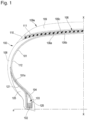
- tyre 100 for vehicle wheels comprises at least one carcass structure of elastomeric blend, comprising at least one carcass layer 101 with opposite end flaps engaged with their respective annular anchoring structures 102, referred to as bead core, possibly associated with an bead filler 104 of elastomeric blend.
- the area of the tyre comprising the bead 102 and the 104 filler forms an annular reinforcing structure 103, the so-called bead, intended to anchor the tyre on a corresponding mounting rim, not shown.
- the carcass structure is usually of radial type, i.e. the reinforcing elements of at least one carcass layer 101 are located on planes comprising the rotational axis of the tyre and substantially perpendicular to the equatorial plane of the tyre.
- Said reinforcing elements generally consist of textile cords, e.g. rayon, nylon, polyester (e.g. polyethylene naphthalate (PEN)).
- PEN polyethylene naphthalate
- Each annular reinforcing structure is associated with the carcass structure by folding back the opposite side edges of at least one carcass layer 101 around the annular anchorage structure 102 to form so-called carcass flaps 101a as shown in Figure 1 .
- the coupling between carcass structure and annular reinforcing structure can be provided by means of a second carcass layer (not shown in Figure 1 ) applied in an axially outer positon relative to the first carcass layer.
- An anti-abrasive strip 105 made of elastomeric blend is placed in an outer position of each annular reinforcing structure 103.
- each anti-abrasive strip 105 is placed at least in axially outer position relative to the annular reinforcing structure 103 and extends at least between side-wall 108 and the radially lower portion of the annular reinforcing structure 103.
- the anti-abrasive strip 105 is arranged so as to wrap around the annular reinforcing structure 103 along the inner and outer axially and radially lower areas of the annular reinforcing structure 103 so as to interpose itself between the latter and the wheel rim when the tyre 100 is mounted on the rim.
- the carcass structure is associated with an belt structure 106 of elastomeric blend comprising one or more belt layers 106a, 106b placed in radial overlap with respect to each other and relative to the carcass layer, having typically metal reinforcing cords.
- Such reinforcing cords may have a cross orientation relative to a direction of circumferential development of the tyre 100.
- circumferential direction it is meant a direction generally facing in the direction of rotation of the tyre.
- At least one zero degrees reinforcing layer 106c can be applied, which generally incorporates a plurality of reinforcing cords, typically textile cords, oriented in a substantially circumferential direction, thus forming an angle of a few degrees (for example an angle between approximately 0° and 6°) relative to the equatorial plane of the tyre, and coated with an elastomeric blend.
- a tread band 109 of elastomeric blend is applied in a radially outer position relative to the belt structure 106.
- respective sidewalls 108 of elastomeric blend are also applied in an axially outer position.
- the tread band 109 In a radially outer position, the tread band 109 has a rolling surface 109a that is intended to come in contact with the ground.
- Circumferential grooves which are connected by transverse notches (not shown in Figure 1 ) so as to define a plurality of blocks of various shapes and sizes distributed over the rolling surface109a, are generally made in this surface109a, which for simplicity is represented smoothly in Figure 1 .
- An underlayer 111 of elastomeric blend is placed between the belt structure 106 and the tread band 109.
- a strip made of elastomeric material 110 may be present in the connection area between the 108 sidewalls and the 109 tread band, this mini-sidewall being generally obtained by co-extrusion with the tread band 109 and allowing an improvement in the mechanical interaction between the tread band 109 and the sidewalls 108.
- the end portion of the sidewall 108 directly covers the lateral edge of the tread band 109.
- a layer of elastomeric material 112, generally known as "liner”, which provides the necessary air-tightness to the inflation air of the tyre, may also be provided in a radially internal position relative to the carcass layer 101.
- the stiffness of the tyre sidewall 108 can be improved by providing the bead structure 103 with a reinforcing layer 120 generally known as "flipper" or additional list-shaped insert.
- Flipper 120 typically comprises a plurality of textile cords embedded within a layer of elastomeric material.
- Flipper 120 is a reinforcing layer which is wrapped around the respective bead 102 and the bead filler 104 in such a way as to surround them at least partially, this reinforcing layer being placed between the at least one carcass layer 101 and the bead structure 103. Usually, the flipper is in contact with said at least one layer of carcass 101 and the bead structure 103.
- the tyre bead structure 103 may comprise an additional protective layer which is generally known as "chafer” 121 or protective strip and which has the function of increasing stiffness and integrity of the tyre bead structure 103.
- the elastomeric composition according to the present invention can be advantageously used to make the elastomeric material incorporated in one or more of the components of the tyre selected from tread band, tread underlayer, sidewall, and in general any structural element in which silica is used as a reinforcing element, preferably in the tread, even when made of two radially overlapping layers (known as "cap and base” tread) with a radially outer portion (“cap”) and a radially inner portion ("base”) comprising different amounts of silica.
- the use of the elastomeric composition to make the elastomeric material of the above mentioned components allows to obtain a tyre with a lower rolling resistance, and consequently a lower heat development and fuel consumption, at the same time realizing a good resistance to tearing of the tyre surface, and a good manoeuvrability during its use.
- the building of tyres 100 as described above may be carried out by assembly of the respective semi-finished products on a forming drum, not illustrated, by at least one assembly device.
- At least part of the components intended to form the carcass structure of the tyre may be constructed and/or assembled on the forming drum. More particularly, the forming drum is suitable for first receiving the liner, if any, and then the carcass structure and the anti-abrasive strip. Subsequently, devices not shown shall coaxially engage one of the annular anchoring structures around each of the end flaps, place an outer sleeve comprising the belt structure and tread band in a coaxially centred position around the cylindrical carcass sleeve and conform the carcass sleeve to a substantially toroidal configuration by radial expansion of the carcass structure, so as to determine its application against a radially internal surface of the outer sleeve.
- a moulding and vulcanization treatment is carried out in order to determine the structural stabilization of the tyre by cross-linking the elastomeric compositions as well as to impress on the tread band a desired tread pattern and to imprint any distinctive graphic marks on the sidewalls.
- the tyre can be a tyre for wheels of heavy transport vehicles, such as trucks, buses, trailers, vans, and in general for vehicles where the tyre is subjected to a high load.
- a tyre is suitable for mounting on rims with a diameter of 17,5 inches or more for directional or trailer wheels.
- the tyre can be a motorcycle wheel tyre which is typically a tyre with a straight cross-section characterised by a high transverse curvature.
- the tyre can be a tyre for bicycle wheel.
- the scorch time represents the time needed to increase the Mooney viscosity by 5 points.
- the value in minutes was measured at 127°C according to ISO 289/2 (1994).
- Mooney ML(1+4) viscosity at 100°C was measured according to ISO 289-1:1994 on non-crosslinked elastomeric compositions.
- IRHD hardness was measured at 23°C on cross-linked elastomeric compositions according to ISO 48:2007.
- compositions A1 and A2 of the invention are better or equivalent to those of the composition R1, with a marked improvement in the results of detachment tests both on the fresh product and after ageing, predicting greater resistance to tearing.
- the vulcanization curve of the composition A4 of the invention shows a further reduction in the values of T30, T60 and T90 with a trend tending towards reversion, i.e. a decrease from the maximum modulus values (MH).
- This behaviour can generate an external portion with a lower cross-linking density, resulting in lower stiffness and higher hysteresis, useful to improve tread grip on the road.
- the elastomeric compositions thus prepared were evaluated for their vulcanisation behaviour (170°C, 30 min.) and subsequently, in terms of static and dynamic mechanical properties and wear resistance according to the methods described above.
- the following table 6 shows the rheometric, mechanical, dynamic and static properties of the compositions in table 5.
Landscapes
- Chemical & Material Sciences (AREA)
- Health & Medical Sciences (AREA)
- Chemical Kinetics & Catalysis (AREA)
- Medicinal Chemistry (AREA)
- Polymers & Plastics (AREA)
- Organic Chemistry (AREA)
- Engineering & Computer Science (AREA)
- Mechanical Engineering (AREA)
- Compositions Of Macromolecular Compounds (AREA)
Claims (14)
- Pneu comprenant au moins un élément structurel qui inclut une matière élastomère réticulée obtenue par vulcanisation d'une composition élastomère réticulable comprenant, pour 100 pce de polymère vulcanisable :(a) de 90 à 10 pce d'au moins un polymère élastomère non fonctionnalisé ;(b) de 10 à 90 pce d'au moins un polymère élastomère fonctionnalisé ;(c) d'environ 10 pce à environ 120 pce, de préférence d'environ 20 pce à environ 90 pce d'au moins une charge de renforcement blanche ;(d) d'environ 5 % à environ 15 % en poids par rapport à la quantité de charge de renforcement blanche d'un mélange de silanes, ledit mélange comprenant au moins un soufre-silane et au moins un amino-silane,dans lequel ledit polymère élastomère fonctionnalisé inclut au moins un groupe fonctionnel choisi dans le groupe consistant en des groupes carboxyliques, des groupes carboxylates, des groupes anhydrides, des groupes esters, des groupes époxy ou des mélanges de ceux-ci.
- Pneu selon la revendication 1, dans lequel ledit polymère élastomère fonctionnalisé est obtenu à partir d'un polymère élastomère choisi dans le groupe consistant en le polybutadiène, les copolymères styrène/1,3-butadiène, les copolymères styrène/isoprène/1,3-butadiène, les copolymères styrène/1,3-butadiène/acrylonitrile, et des mélanges de ceux-ci.
- Pneu selon la revendication 1, dans lequel ledit polymère élastomère fonctionnalisé est obtenu à partir de copolymères styrène/1,3-butadiène.
- Pneu selon la revendication 1, dans lequel ledit pneu comprend :- une structure de carcasse, présentant des bords latéraux opposés associés à des structures de talon gauche et droite respectives ;- une bande de roulement appliquée dans une position radialement externe par rapport à ladite structure de carcasse ;- une paire de parois latérales appliquées latéralement sur les côtés opposés de ladite structure de carcasse,dans lequel ledit élément structurel est au moins l'une de ladite bande de roulement ou de ladite paire de parois latérales.
- Pneu selon la revendication 1, dans lequel ladite composition élastomère comprend d'environ 7 % à environ 12 % en poids, par rapport à la quantité de charge de renforcement blanche, dudit mélange de silanes.
- Pneu selon la revendication 1, dans lequel ledit mélange de silanes comprend de 50 % à 99 % en poids, par rapport à la quantité totale dudit mélange, d'au moins un soufre-silane, et de 50 % à 1 % en poids, par rapport à la quantité totale dudit mélange, d'au moins un amino-silane.
- Pneu selon la revendication 1, dans lequel ledit mélange de silanes comprend de 60 % à 90 % en poids, par rapport à la quantité totale dudit mélange, d'au moins un soufre-silane, et de 40 % à 10 % en poids, par rapport à la quantité totale dudit mélange, d'au moins un amino-silane.
- Pneu selon la revendication 1, dans lequel ledit mélange de silanes comprend de 70 % à 90 % en poids, par rapport à la quantité totale de mélange, d'au moins un soufre-silane, et de 30 % à 10 % en poids, par rapport à la quantité totale de mélange, d'au moins un amino-silane.
- Pneu selon la revendication 1, dans lequel ledit mélange de silanes comprend au moins un amino-silane représenté par la formule (I) suivante :
(R)3Si-CnH2n-[X-CmH2m]p-Y (I)
dans lequelles groupes R, égaux ou différents les uns des autres, sont choisis parmi les groupes alkyle ou alcoxy présentant 1 à 4 atomes de carbone, à condition qu'au moins l'un des groupes R soit un groupe alcoxy ;n et m, égaux ou différents l'un de l'autre, sont un entier compris entre 1 et 6 inclus ;p est un entier compris entre 0 et 5 inclus ;X est un groupe -NH-, etY est un groupe -NH2 ou NHR', dans lequel R' est un groupe alkyle ou cycloalkyle présentant de 1 à 6 atomes de carbone. - Pneu selon la revendication 1, dans lequel ledit mélange de silanes comprend au moins un soufre-silane représenté par la formule (II) suivante :
(R)3Si-CnH2n-X (II)
dans lequelX est un groupe mercapto (-SH), ou -(S)mCnH2n-Si-(R)3les groupes R, égaux ou différents les uns des autres, sont choisis parmi les groupes alkyle ou alcoxy présentant de 1 à 4 atomes de carbone, à condition qu'au moins l'un des groupes R soit un groupe alcoxy ; etn et m, égaux ou différents l'un de l'autre, sont un entier compris entre 1 et 6 inclus. - Pneu selon la revendication 1, dans lequel ledit amino-silane est choisi dans le
groupe consistant en 2-aminoéthyl-triméthoxysilane, 2-aminoéthyl-triéthoxysilane, 2-aminoéthyl-tripropoxysilane, 2-aminoéthyl-tributoxysilane, 3-aminopropyl-triméthoxysilane, 3-aminopropyl-triéthoxysilane (APTES), 3-aminopropyl-méthyldiéthoxysilane, 3-aminopropyl-méthyldiméthoxysilane, 3-aminopropyl-diisopropyléthoxysilane, 3-aminopropyltris-(méthoxyéthoxyéthoxy)silane, 3-aminopropyl-diisopropylétoxy silane, 3-(2-aminométhylamino)propyl-triéthoxysilane, 3-(2-(2-aminoéthylamino)éthylamino)propyl-triméthoxysilane, 4-aminobutyl-triéthoxysilane, 4-aminobutyldiméthylméthoxysilane, 4-aminobutyl-triéthoxysilane, N-(2-aminoéthyl)aminométhyl-triéthoxysilane, N-(2-aminoéthyl)-3-aminopropyl-triméthoxysilane (également connu sous le nom de N-[3-(triméthoxysilyl)propyl]éthylènediamine (EDTMS)), N-(2-aminoéthyl)-3-aminopropyl-triéthoxysilane, N-(2-aminoéthyl)-3-aminopropyl-tris(2-éthylhoxy) silane, N-(2-aminoéthyl)-3-aminopropyl-méthyldiméthoxysilane, N-(2-aminoéthyl)-3-aminopropyl-méthyldiéthoxysilane, N-(2-aminoéthyl)-3-aminoisobutyl-méthyldiméthoxysilane, N-(6-aminohexyl)-3-aminopropyl-triméthoxysilane, N-(6-aminohexyl)-3-aminopropyl-triéthoxysilane, N-2-(vinylbenzylamino)-éthyl-3-aminopropyl-triméthoxysilane, N-cyclohexyl(aminométhyl)méthyldiéthoxysilane, N-cyclohexyl(aminométhyl)triéthoxysilane, N-cyclohexyl(aminométhyl)triméthoxy silane, N-cyclohexyl-3-aminopropyl-triméthoxysilane, N-(n-butyl)-3-aminopropyl-triméthoxysilane, N-(n-butyl)-3-aminopropyl-triéthoxysilane, N-(n-butyl)-aminométhyl-triéthoxysilane, N,N-diéthylaminopropyltriméthoxysilane, N,N-diméthylaminopropyltriméthoxysilane, N,N-diéthylaminométhyltriéthoxysilane. - Pneu selon la revendication 1, dans lequel ledit soufre-silane est choisi dans le groupe consistant en bis[3-(triméthoxysilyl)propyl]-tétrasulfane (TESPT), bis[3-(triéthoxysilyl)propyl]-disulfane (TESPD), bis[2-(triméthoxysilyl)éthyl]-tétrasulfane, bis[2-(triéthoxysilyl)éthyl]-trisulfane, bis[3-(triméthoxysilyl)propyl]-disulfane, (1-mercaptométhyl)triéthoxysilane, (2-mercaptoéthyl)triéthoxysilane, (3-mercaptopropyl)triéthoxysilane, (3-mercaptopropyl)méthyldiéthoxysilane, (3-mercaptopropyl)méthyldiméthoxysilane, (3-mercaptopropyl)triméthoxysilane, 3-octanoylthio-1-propyltriethoxysilane et (2-mercaptoethyl)tripropoxysilane.
- Pneu selon la revendication 1, dans lequel ledit mélange de silanes comprend (i) au moins un amino-silane choisi dans le groupe consistant en (3-aminopropyl)triéthoxysilane (APTES), (3-aminopropyl)triméthoxysilane, N-(2-aminoéthyl)-3-aminopropyltriméthoxysilane (également connu sous le nom de N-[3-(triméthoxysilyl)propyl]éthylènediamine (EDTMS)), et N-(2-aminoéthyl)-3-aminopropyltriéthoxysilane, et (ii) au moins un soufre-silane choisi dans le groupe consistant en bis[3-(triméthoxysilyl)propyl]-tétrasulfane (TESPT), bis[3-(triéthoxysilyl)propyl]-disulfane (TESPD), et (3-mercaptopropyl)triméthoxy silane.
- Composition élastomère réticulable comprenant, pour 100 pce de polymère vulcanisable :(a) de 90 à 10 pce d'au moins un polymère élastomère non fonctionnalisé ;(b) de 10 à 90 pce d'au moins un polymère élastomère fonctionnalisé ;(c) d'environ 10 pce à environ 120 pce, de préférence d'environ 20 pce à environ 90 pce d'au moins une charge de renforcement blanche ;(d) d'environ 5 % à environ 15 % en poids par rapport à la quantité de charge de renforcement blanche d'un mélange de silanes, ledit mélange comprenant au moins un soufre-silane et au moins un amino-silane,dans lequel ledit polymère élastomère fonctionnalisé inclut au moins un groupe fonctionnel choisi dans le groupe consistant en des groupes carboxyliques, des groupes carboxylates, des groupes anhydrides, des groupes esters, des groupes époxy ou des mélanges de ceux-ci.
Applications Claiming Priority (2)
| Application Number | Priority Date | Filing Date | Title |
|---|---|---|---|
| IT201900012780 | 2019-07-24 | ||
| PCT/IB2020/056936 WO2021014394A1 (fr) | 2019-07-24 | 2020-07-23 | Pneumatique pour roues de véhicule |
Publications (3)
| Publication Number | Publication Date |
|---|---|
| EP4004101A1 EP4004101A1 (fr) | 2022-06-01 |
| EP4004101C0 EP4004101C0 (fr) | 2025-06-25 |
| EP4004101B1 true EP4004101B1 (fr) | 2025-06-25 |
Family
ID=68733481
Family Applications (1)
| Application Number | Title | Priority Date | Filing Date |
|---|---|---|---|
| EP20747141.8A Active EP4004101B1 (fr) | 2019-07-24 | 2020-07-23 | Pneu pour roues de véhicule |
Country Status (5)
| Country | Link |
|---|---|
| US (1) | US12559612B2 (fr) |
| EP (1) | EP4004101B1 (fr) |
| CN (2) | CN118006011A (fr) |
| MX (1) | MX2022000323A (fr) |
| WO (1) | WO2021014394A1 (fr) |
Families Citing this family (5)
| Publication number | Priority date | Publication date | Assignee | Title |
|---|---|---|---|---|
| WO2023013781A1 (fr) * | 2021-08-06 | 2023-02-09 | 株式会社ブリヂストン | Composition de caoutchouc pour pneumatique et pneumatique |
| DE102022204644A1 (de) * | 2022-05-12 | 2023-11-16 | Continental Reifen Deutschland Gmbh | Fahrradreifen und Verfahren zum Recycling von Fahrradreifen |
| IT202200010532A1 (it) | 2022-05-20 | 2023-11-20 | Pirelli | Pneumatico per ruote di veicoli |
| CN117801386A (zh) * | 2023-12-19 | 2024-04-02 | 山东玲珑轮胎股份有限公司 | 一种防滑全钢载重汽车轮胎胎面橡胶组合物 |
| WO2025147697A1 (fr) * | 2024-01-05 | 2025-07-10 | Sumitomo Chemical Advanced Technologies, Llc, D.B.A. Sumika Electronic Materials | Compositions de caoutchouc contenant de l'acétate ou du butyrate de phloroglucinol destinées à être utilisées dans des bandes de roulement de pneus de véhicules lourds |
Family Cites Families (12)
| Publication number | Priority date | Publication date | Assignee | Title |
|---|---|---|---|---|
| DE10015308A1 (de) * | 2000-03-28 | 2001-10-11 | Degussa | Kautschukmischungen |
| CN1140570C (zh) * | 2000-05-26 | 2004-03-03 | 米其林技术公司 | 可用作轮胎胎面的橡胶组合物 |
| CA2339056A1 (fr) | 2001-03-02 | 2002-09-02 | Bayer Inc. | Elastomeres contenant une charge |
| ATE425020T1 (de) | 2004-12-23 | 2009-03-15 | Pirelli | Luftreifen |
| JP2007031581A (ja) * | 2005-07-27 | 2007-02-08 | Yokohama Rubber Co Ltd:The | ゴム組成物 |
| CN101835631B (zh) | 2007-09-28 | 2013-03-13 | 倍耐力轮胎股份公司 | 轮胎和包含玻璃薄片的可交联弹性体组合物 |
| EP2231759B1 (fr) | 2007-12-19 | 2017-11-22 | Pirelli Tyre S.p.A. | Pneu et composition élastomère réticulable comprenant des particules de diatomite |
| US20110105669A1 (en) * | 2009-10-30 | 2011-05-05 | Flexsys America L.P. | Process of forming vulcanizable elastomeric compositions using ultra accelerators and products formed therefrom |
| WO2011106765A2 (fr) * | 2010-02-28 | 2011-09-01 | Bridgestone Corporation | Compositions de caoutchouc comprenant des charges siliceuses |
| WO2012092062A1 (fr) * | 2010-12-30 | 2012-07-05 | Bridgestone Corporation | Composition de caoutchouc avec renfort bis-silane amélioré |
| CN105542267A (zh) | 2011-02-23 | 2016-05-04 | 株式会社普利司通 | 橡胶组合物的制造方法 |
| CN102875840B (zh) * | 2012-10-19 | 2014-08-06 | 厦门大学 | 一种白炭黑橡胶补强剂及其制备方法 |
-
2020
- 2020-07-23 EP EP20747141.8A patent/EP4004101B1/fr active Active
- 2020-07-23 MX MX2022000323A patent/MX2022000323A/es unknown
- 2020-07-23 CN CN202410166207.XA patent/CN118006011A/zh active Pending
- 2020-07-23 CN CN202080053586.1A patent/CN114174406A/zh active Pending
- 2020-07-23 US US17/627,501 patent/US12559612B2/en active Active
- 2020-07-23 WO PCT/IB2020/056936 patent/WO2021014394A1/fr not_active Ceased
Also Published As
| Publication number | Publication date |
|---|---|
| EP4004101C0 (fr) | 2025-06-25 |
| MX2022000323A (es) | 2022-03-29 |
| WO2021014394A1 (fr) | 2021-01-28 |
| US20220259414A1 (en) | 2022-08-18 |
| EP4004101A1 (fr) | 2022-06-01 |
| BR112022000970A2 (pt) | 2022-04-05 |
| US12559612B2 (en) | 2026-02-24 |
| CN114174406A (zh) | 2022-03-11 |
| CN118006011A (zh) | 2024-05-10 |
Similar Documents
| Publication | Publication Date | Title |
|---|---|---|
| US12559612B2 (en) | Tyre for vehicle wheels | |
| EP1559586B1 (fr) | Pneumatique comportant un élément ayant une composition caoutchouteuse comprenant un élastomère styrène/butadiène fonctionalisé, de la silice et une résine styrène/alpha méthyle styrène | |
| EP2165855B1 (fr) | Pneu | |
| JP3986821B2 (ja) | タイヤ用ゴム組成物および当該ゴム組成物を用いたタイヤ | |
| EP3532303B1 (fr) | Nouveaux matériaux de renforcement, compositions élastomères et pneumatiques pour roues de véhicule les comprenant | |
| CN101802078B (zh) | 胎侧用橡胶组合物及具有使用该组合物的胎侧的轮胎、以及胎搭接部用橡胶组合物及具有使用胎搭接部用橡胶组合物的胎搭接部的轮胎 | |
| JP7587343B2 (ja) | トレッド用ゴム組成物およびタイヤ | |
| EP2042544B1 (fr) | Procédé de fabrication d'une composition de caoutchouc et pneu | |
| EP2629987B1 (fr) | Pneumatique pour roues de véhicule | |
| EP3288778A1 (fr) | Matériaux élastomères vulcanisables pour composants de pneus comportant des fibres de silicate modifié, et pneus associés | |
| WO2008145155A1 (fr) | Pneu et composition élastomère réticulable | |
| EP1497363A1 (fr) | Pneumatique a grande resistance a l'usure, bande de roulement et composition utilisee | |
| WO2014203666A1 (fr) | Composition de caoutchouc pour pneus, et pneu | |
| CN101415764B (zh) | 具有包含行驶面胎面及基部胎面的胎面结构的轮胎 | |
| EP2102017B1 (fr) | Pneumatique et composition élastomère réticulable | |
| US20180057665A1 (en) | Rubber composition | |
| JP7587342B2 (ja) | トレッド用ゴム組成物およびタイヤ | |
| JP7375536B2 (ja) | トレッド用ゴム組成物およびタイヤ | |
| CN116472306A (zh) | 弹性体组合物的制备方法和包含其的轮胎 | |
| WO2009071122A1 (fr) | Pneumatique et composition élastomère réticulable comprenant des agents de réticulation diazides | |
| JP3384793B2 (ja) | タイヤトレッド用ゴム組成物およびそれを用いた空気入りタイヤ | |
| JP4805556B2 (ja) | タイヤ用ゴム組成物 | |
| US20250333584A1 (en) | Tyre for vehicle wheels | |
| JP5236138B2 (ja) | タイヤトレッド用ゴム組成物およびそれを用いた空気入りタイヤ | |
| BR112022000970B1 (pt) | Pneu, e, composição elastomérica reticulável |
Legal Events
| Date | Code | Title | Description |
|---|---|---|---|
| STAA | Information on the status of an ep patent application or granted ep patent |
Free format text: STATUS: UNKNOWN |
|
| STAA | Information on the status of an ep patent application or granted ep patent |
Free format text: STATUS: THE INTERNATIONAL PUBLICATION HAS BEEN MADE |
|
| PUAI | Public reference made under article 153(3) epc to a published international application that has entered the european phase |
Free format text: ORIGINAL CODE: 0009012 |
|
| STAA | Information on the status of an ep patent application or granted ep patent |
Free format text: STATUS: REQUEST FOR EXAMINATION WAS MADE |
|
| 17P | Request for examination filed |
Effective date: 20220128 |
|
| AK | Designated contracting states |
Kind code of ref document: A1 Designated state(s): AL AT BE BG CH CY CZ DE DK EE ES FI FR GB GR HR HU IE IS IT LI LT LU LV MC MK MT NL NO PL PT RO RS SE SI SK SM TR |
|
| DAV | Request for validation of the european patent (deleted) | ||
| DAX | Request for extension of the european patent (deleted) | ||
| GRAP | Despatch of communication of intention to grant a patent |
Free format text: ORIGINAL CODE: EPIDOSNIGR1 |
|
| STAA | Information on the status of an ep patent application or granted ep patent |
Free format text: STATUS: GRANT OF PATENT IS INTENDED |
|
| INTG | Intention to grant announced |
Effective date: 20250321 |
|
| GRAS | Grant fee paid |
Free format text: ORIGINAL CODE: EPIDOSNIGR3 |
|
| GRAA | (expected) grant |
Free format text: ORIGINAL CODE: 0009210 |
|
| STAA | Information on the status of an ep patent application or granted ep patent |
Free format text: STATUS: THE PATENT HAS BEEN GRANTED |
|
| AK | Designated contracting states |
Kind code of ref document: B1 Designated state(s): AL AT BE BG CH CY CZ DE DK EE ES FI FR GB GR HR HU IE IS IT LI LT LU LV MC MK MT NL NO PL PT RO RS SE SI SK SM TR |
|
| REG | Reference to a national code |
Ref country code: GB Ref legal event code: FG4D |
|
| REG | Reference to a national code |
Ref country code: CH Ref legal event code: EP |
|
| REG | Reference to a national code |
Ref country code: DE Ref legal event code: R096 Ref document number: 602020053327 Country of ref document: DE |
|
| REG | Reference to a national code |
Ref country code: CH Ref legal event code: EP |
|
| REG | Reference to a national code |
Ref country code: IE Ref legal event code: FG4D |
|
| U01 | Request for unitary effect filed |
Effective date: 20250702 |
|
| U07 | Unitary effect registered |
Designated state(s): AT BE BG DE DK EE FI FR IT LT LU LV MT NL PT RO SE SI Effective date: 20250711 |
|
| U20 | Renewal fee for the european patent with unitary effect paid |
Year of fee payment: 6 Effective date: 20250728 |
|
| PG25 | Lapsed in a contracting state [announced via postgrant information from national office to epo] |
Ref country code: NO Free format text: LAPSE BECAUSE OF FAILURE TO SUBMIT A TRANSLATION OF THE DESCRIPTION OR TO PAY THE FEE WITHIN THE PRESCRIBED TIME-LIMIT Effective date: 20250925 Ref country code: GR Free format text: LAPSE BECAUSE OF FAILURE TO SUBMIT A TRANSLATION OF THE DESCRIPTION OR TO PAY THE FEE WITHIN THE PRESCRIBED TIME-LIMIT Effective date: 20250926 |
|
| PGFP | Annual fee paid to national office [announced via postgrant information from national office to epo] |
Ref country code: GB Payment date: 20250728 Year of fee payment: 6 |
|
| PG25 | Lapsed in a contracting state [announced via postgrant information from national office to epo] |
Ref country code: HR Free format text: LAPSE BECAUSE OF FAILURE TO SUBMIT A TRANSLATION OF THE DESCRIPTION OR TO PAY THE FEE WITHIN THE PRESCRIBED TIME-LIMIT Effective date: 20250625 |
|
| PG25 | Lapsed in a contracting state [announced via postgrant information from national office to epo] |
Ref country code: RS Free format text: LAPSE BECAUSE OF FAILURE TO SUBMIT A TRANSLATION OF THE DESCRIPTION OR TO PAY THE FEE WITHIN THE PRESCRIBED TIME-LIMIT Effective date: 20250925 |
|
| PG25 | Lapsed in a contracting state [announced via postgrant information from national office to epo] |
Ref country code: IS Free format text: LAPSE BECAUSE OF FAILURE TO SUBMIT A TRANSLATION OF THE DESCRIPTION OR TO PAY THE FEE WITHIN THE PRESCRIBED TIME-LIMIT Effective date: 20251025 |
|
| PG25 | Lapsed in a contracting state [announced via postgrant information from national office to epo] |
Ref country code: SM Free format text: LAPSE BECAUSE OF FAILURE TO SUBMIT A TRANSLATION OF THE DESCRIPTION OR TO PAY THE FEE WITHIN THE PRESCRIBED TIME-LIMIT Effective date: 20250625 |
|
| PG25 | Lapsed in a contracting state [announced via postgrant information from national office to epo] |
Ref country code: CZ Free format text: LAPSE BECAUSE OF FAILURE TO SUBMIT A TRANSLATION OF THE DESCRIPTION OR TO PAY THE FEE WITHIN THE PRESCRIBED TIME-LIMIT Effective date: 20250625 |
|
| PG25 | Lapsed in a contracting state [announced via postgrant information from national office to epo] |
Ref country code: PL Free format text: LAPSE BECAUSE OF FAILURE TO SUBMIT A TRANSLATION OF THE DESCRIPTION OR TO PAY THE FEE WITHIN THE PRESCRIBED TIME-LIMIT Effective date: 20250625 |
|
| PG25 | Lapsed in a contracting state [announced via postgrant information from national office to epo] |
Ref country code: SK Free format text: LAPSE BECAUSE OF FAILURE TO SUBMIT A TRANSLATION OF THE DESCRIPTION OR TO PAY THE FEE WITHIN THE PRESCRIBED TIME-LIMIT Effective date: 20250625 |
|
| PG25 | Lapsed in a contracting state [announced via postgrant information from national office to epo] |
Ref country code: ES Free format text: LAPSE BECAUSE OF FAILURE TO SUBMIT A TRANSLATION OF THE DESCRIPTION OR TO PAY THE FEE WITHIN THE PRESCRIBED TIME-LIMIT Effective date: 20250625 |
|
| REG | Reference to a national code |
Ref country code: CH Ref legal event code: H13 Free format text: ST27 STATUS EVENT CODE: U-0-0-H10-H13 (AS PROVIDED BY THE NATIONAL OFFICE) Effective date: 20260224 |
|
| PG25 | Lapsed in a contracting state [announced via postgrant information from national office to epo] |
Ref country code: MC Free format text: LAPSE BECAUSE OF FAILURE TO SUBMIT A TRANSLATION OF THE DESCRIPTION OR TO PAY THE FEE WITHIN THE PRESCRIBED TIME-LIMIT Effective date: 20250625 |
|
| PG25 | Lapsed in a contracting state [announced via postgrant information from national office to epo] |
Ref country code: CH Free format text: LAPSE BECAUSE OF NON-PAYMENT OF DUE FEES Effective date: 20250731 |
|
| PLBE | No opposition filed within time limit |
Free format text: ORIGINAL CODE: 0009261 |
|
| STAA | Information on the status of an ep patent application or granted ep patent |
Free format text: STATUS: NO OPPOSITION FILED WITHIN TIME LIMIT |
|
| REG | Reference to a national code |
Ref country code: CH Ref legal event code: L10 Free format text: ST27 STATUS EVENT CODE: U-0-0-L10-L00 (AS PROVIDED BY THE NATIONAL OFFICE) Effective date: 20260507 |
|
| 26N | No opposition filed |
Effective date: 20260326 |
|
| PG25 | Lapsed in a contracting state [announced via postgrant information from national office to epo] |
Ref country code: IE Free format text: LAPSE BECAUSE OF NON-PAYMENT OF DUE FEES Effective date: 20250723 |
|
| PG25 | Lapsed in a contracting state [announced via postgrant information from national office to epo] |
Ref country code: CY Free format text: LAPSE BECAUSE OF FAILURE TO SUBMIT A TRANSLATION OF THE DESCRIPTION OR TO PAY THE FEE WITHIN THE PRESCRIBED TIME-LIMIT Effective date: 20250625 |