EP4004144B1 - Schmale grünlichtemittierende leuchtstoffe - Google Patents
Schmale grünlichtemittierende leuchtstoffe Download PDFInfo
- Publication number
- EP4004144B1 EP4004144B1 EP20753639.2A EP20753639A EP4004144B1 EP 4004144 B1 EP4004144 B1 EP 4004144B1 EP 20753639 A EP20753639 A EP 20753639A EP 4004144 B1 EP4004144 B1 EP 4004144B1
- Authority
- EP
- European Patent Office
- Prior art keywords
- phosphor
- reaction mixture
- heating
- source
- light
- Prior art date
- Legal status (The legal status is an assumption and is not a legal conclusion. Google has not performed a legal analysis and makes no representation as to the accuracy of the status listed.)
- Active
Links
Images




Classifications
-
- C—CHEMISTRY; METALLURGY
- C09—DYES; PAINTS; POLISHES; NATURAL RESINS; ADHESIVES; COMPOSITIONS NOT OTHERWISE PROVIDED FOR; APPLICATIONS OF MATERIALS NOT OTHERWISE PROVIDED FOR
- C09K—MATERIALS FOR MISCELLANEOUS APPLICATIONS, NOT PROVIDED FOR ELSEWHERE
- C09K11/00—Luminescent materials, e.g. electroluminescent or chemiluminescent
- C09K11/08—Luminescent materials, e.g. electroluminescent or chemiluminescent containing inorganic luminescent materials
- C09K11/77—Luminescent materials, e.g. electroluminescent or chemiluminescent containing inorganic luminescent materials containing rare earth metals
- C09K11/7728—Luminescent materials, e.g. electroluminescent or chemiluminescent containing inorganic luminescent materials containing rare earth metals containing europium
- C09K11/774—Borates
-
- H—ELECTRICITY
- H10—SEMICONDUCTOR DEVICES; ELECTRIC SOLID-STATE DEVICES NOT OTHERWISE PROVIDED FOR
- H10H—INORGANIC LIGHT-EMITTING SEMICONDUCTOR DEVICES HAVING POTENTIAL BARRIERS
- H10H20/00—Individual inorganic light-emitting semiconductor devices having potential barriers, e.g. light-emitting diodes [LED]
- H10H20/80—Constructional details
- H10H20/85—Packages
- H10H20/851—Wavelength conversion means
- H10H20/8511—Wavelength conversion means characterised by their material, e.g. binder
- H10H20/8512—Wavelength conversion materials
- H10H20/8513—Wavelength conversion materials having two or more wavelength conversion materials
-
- H—ELECTRICITY
- H10—SEMICONDUCTOR DEVICES; ELECTRIC SOLID-STATE DEVICES NOT OTHERWISE PROVIDED FOR
- H10H—INORGANIC LIGHT-EMITTING SEMICONDUCTOR DEVICES HAVING POTENTIAL BARRIERS
- H10H20/00—Individual inorganic light-emitting semiconductor devices having potential barriers, e.g. light-emitting diodes [LED]
- H10H20/01—Manufacture or treatment
- H10H20/036—Manufacture or treatment of packages
- H10H20/0361—Manufacture or treatment of packages of wavelength conversion means
-
- H—ELECTRICITY
- H10—SEMICONDUCTOR DEVICES; ELECTRIC SOLID-STATE DEVICES NOT OTHERWISE PROVIDED FOR
- H10H—INORGANIC LIGHT-EMITTING SEMICONDUCTOR DEVICES HAVING POTENTIAL BARRIERS
- H10H20/00—Individual inorganic light-emitting semiconductor devices having potential barriers, e.g. light-emitting diodes [LED]
- H10H20/80—Constructional details
- H10H20/85—Packages
- H10H20/851—Wavelength conversion means
- H10H20/8511—Wavelength conversion means characterised by their material, e.g. binder
- H10H20/8512—Wavelength conversion materials
-
- Y—GENERAL TAGGING OF NEW TECHNOLOGICAL DEVELOPMENTS; GENERAL TAGGING OF CROSS-SECTIONAL TECHNOLOGIES SPANNING OVER SEVERAL SECTIONS OF THE IPC; TECHNICAL SUBJECTS COVERED BY FORMER USPC CROSS-REFERENCE ART COLLECTIONS [XRACs] AND DIGESTS
- Y02—TECHNOLOGIES OR APPLICATIONS FOR MITIGATION OR ADAPTATION AGAINST CLIMATE CHANGE
- Y02B—CLIMATE CHANGE MITIGATION TECHNOLOGIES RELATED TO BUILDINGS, e.g. HOUSING, HOUSE APPLIANCES OR RELATED END-USER APPLICATIONS
- Y02B20/00—Energy efficient lighting technologies, e.g. halogen lamps or gas discharge lamps
Definitions
- the present invention relates generally to the fields of chemistry and physics. More particularly, it concerns phosphors that emit a narrow band of light as well as methods of making and light-emitting devices comprising said phosphors.
- the white emitting LED combines a near-UV emitting LED chip with ⁇ -SiAlON:Eu 2+ as the green source, BaMgAl 10 O 17 :Eu 2+ as the blue source, and K 2 SiF 6 :Mn 4+ as the red source.
- a blue emitting LED chip along with a similar green source and similar red source.
- Phosphors having a composition similar to those of the present invention, but with shorter wavelength excitation and emission maxima are known from Y. Zhuo et al., Nature Comm., 2018, 9, 4377 . Specifically, Zhuo et al disclose a phosphor having the composition NaBa 0.97 Eu 0.03 B 9 O 15 .
- the present disclosure provides phosphors that efficiently and narrowly emit green light, methods for their manufacture, and light-emitting devices comprising said phosphors.
- the phosphors provided herein emit green light in a narrower band than other phosphors in the art.
- the methods of producing the phosphors provided herein may be performed at atmospheric pressure and may be performed in air.
- the phosphors provided herein may possess emission coordinates that provide a color gamut more suitable to lighting applications than phosphors in the art. In some embodiments, the phosphors may be used in lighting applications.
- the phosphors may be used for converting UV light to green light for use with a light-emitting diode (LED), laser diode (LD), or liquid crystal display (LCD), and a lighting or display apparatus employing the same.
- LED light-emitting diode
- LD laser diode
- LCD liquid crystal display
- the present disclosure provides phosphors of the general molecular formula: (A 1-x Eu x )(Ba 1-y Sr y )B 9 O 15 , wherein: A is one or more alkali metal; 0 ⁇ x ⁇ 0.25 ; and and 0 ⁇ y ⁇ 1 .
- A is a single alkali metal. In some embodiments, A is sodium. In some embodiments, A is sodium (I). In some embodiments, 0 ⁇ y ⁇ 0.75. In further embodiments, 0 ⁇ y ⁇ 0.50. In still further embodiments, 0 ⁇ y ⁇ 0.25. In some embodiments, y is 0. In some embodiments, 0 ⁇ x ⁇ 0.15. In some embodiments, 0 ⁇ x ⁇ 0.10. In some embodiments, 0 ⁇ x ⁇ 0.05. In some embodiments, x is 0.03. In some embodiments, the phosphor is further defined as Na 0.97 Eu 0.03 BaB 9 O 15 .
- a crystalline sample of the phosphor has a space group of R3c.
- the phosphor has a decay time ( ⁇ ) of from about 0.500 ⁇ s to about 1.500 ⁇ s.
- ⁇ is from about 1.000 ⁇ s to about 1.200 ⁇ s.
- ⁇ is about 1.103 ⁇ s.
- the phosphor has an excitation spectrum peak at an excitation wavelength from about 350 nm to about 450 nm.
- the excitation wavelength is from about 370 nm to about 435 nm.
- the excitation wavelength is from about 390 nm to about 425 nm.
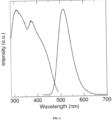
- the excitation wavelength is from about 385 nm to about 405 nm. In some embodiments, the excitation wavelength is about 395 nm. In some embodiments, the excitation wavelength is from about 420 nm to about 440 nm. In some embodiments, the excitation wavelength is about 430 nm. In some embodiments, the phosphor has an emission spectrum peak at an emission wavelength from about 400 nm to about 650 nm. In some embodiments, the emission wavelength is from about 450 nm to about 550 nm. In some embodiments, the emission wavelength is from about 500 nm to about 525 nm. In some embodiments, the emission wavelength is about 515 nm.
- the emission spectrum peak has a full width at half-maximum (FWHM) of from about 50 nm to about 90 nm. In some embodiments, the FWHM is from about 55 nm to about 75 nm. In some embodiments, the FWHM is from about 60 nm to about 70 nm. In some embodiments, the FWHM is about 64 nm.
- the phosphor has a photoluminescence quantum yield (PLQY) greater than about 50%. In some embodiments, the phosphor has a PLQY is about 58%. In some embodiments, the phosphor has a PLQY greater than about 60%. In some embodiments, the phosphor has a PLQY greater than about 70%. In some embodiments, the PLQY is greater than about 80%. In some embodiments, the PLQY is about 87%.
- PLQY photoluminescence quantum yield
- the present disclosure provides methods for producing a phosphor of the present disclosure, wherein the method comprises:
- heating the first reaction mixture comprises irradiating with microwave radiation.
- the frequency of the microwave radiation is from about 500 MHz to about 4400 MHz. In some embodiments, the frequency of the microwave radiation is from about 1000 MHz to about 3900 MHz. In some embodiments, the frequency of the microwave radiation is from about 2000 MHz to about 2900 MHz, such as about 2450 MHz.
- the power of the microwave radiation is from about 120 W to about 1200 W. In some embodiments, the power of the microwave radiation is from about 240 W to about 900 W. In some embodiments, the power of the microwave radiation is from about 360 W to about 600 W, such as about 480 W.
- the present disclosure provides methods for producing a phosphor of the present disclosure, wherein the method comprises:
- the starting materials of the phosphor comprise one or more alkali metal sources, a barium source, a boron source, and a europium source.
- the starting materials of the phosphor comprise a single alkali metal source.
- the alkali metal source is a sodium source.
- the sodium source is a sodium salt, such as NaHCO 3 .
- the barium source is a barium salt, such as BaCO 3 .
- the boron source is H 3 BO 3 .
- the europium source is a europium oxide, such as europium (III) oxide.
- heating the first reaction mixture comprises heating in a furnace.
- the first temperature is from about 400 °C to 800 °C. In some embodiments, the first temperature is from about 500 °C to about 700 °C. In some embodiments, the first temperature is from about 550 °C to about 650 °C. In some embodiments, the first temperature is about 600 °C. In some embodiments, heating the second reaction mixture comprises heating in a furnace. In some embodiments, the second temperature is from about 525 °C to 925 °C. In some embodiments, the second temperature is from about 625 °C to about 825 °C. In some embodiments, the second temperature is from about 675 °C to about 775 °C. In some embodiments, the second temperature is about 725 °C.
- mixing is performed in air.
- heating the first reaction mixture is performed in air.
- heating the first reaction mixture is performed in a reducing atmosphere.
- the heating the second reaction mixture is performed in a reducing atmosphere.
- the reducing atmosphere comprises H 2 , CO, or NH 3 .
- the reducing atmosphere comprises CO.
- the reducing atmosphere comprises H 2 .
- the reducing atmosphere further comprises a diluent gas.
- the diluent gas is N 2 , helium, neon, argon, krypton, xenon, or any combination thereof.
- the reducing atmosphere comprises argon.
- the reducing atmosphere comprises N 2 . In some embodiments, the reducing atmosphere comprises H 2 and argon. In some embodiments, the reducing atmosphere comprises H 2 and N 2 . In some embodiments, the reducing atmosphere comprises from about 0.1% to about 25% H 2 . In some embodiments, the reducing atmosphere comprises from about 1% to about 10% H 2 . In some embodiments, the reducing atmosphere comprises about 5% H 2 . In some embodiments, the reducing atmosphere comprises from about 75% to about 99.9% N 2 . In some embodiments, the reducing atmosphere comprises from about 90% to about 99% N 2 . In some embodiments, the reducing atmosphere comprises about 95% N 2 .
- the method further comprises resting the first reaction mixture for at least about 12 hours before heating. In some embodiments, heating the first reaction mixture comprises the method further comprises resting the first reaction mixture for at least about 1 day before heating. In some embodiments, the method further comprises resting the first reaction mixture for at least about 3 days before heating. In some embodiments, the method further comprises resting the first reaction mixture for at least about 4 days before heating. In some embodiments, the method further comprises resting the first reaction mixture for at least about 7 days before heating. In some embodiments, the method further comprises resting the first reaction mixture for about 7 days before heating. In some embodiments, resting is performed in an accelerated aging chamber. In some embodiments, the accelerated aging chamber produces elevated temperature and/or humidity relative to the ambient temperature and/or humidity. In some embodiments, the methods may be performed at atmospheric pressure.
- the present disclosure provides light-emitting devices comprising:
- the phosphor is a green-emitting phosphor.
- the excitation light source is a semiconductor light source, such as a light-emitting diode (LED) or a laser diode (LD).
- the primary light has a wavelength from about 380 nm to about 500 nm. In some embodiments, the primary light has a wavelength from about 390 nm to about 425 nm. In some embodiments, the primary light has a wavelength of about 395 nm. In some embodiments, the primary light has a wavelength from about 390 nm to about 435 nm. In some embodiments, the primary light has a wavelength of about 430 nm.
- the light-emitting device further comprises a blue-emitting phosphor. In some embodiments, the light-emitting device further comprises a red-emitting phosphor. In some embodiments, the light-emitting device further comprises a blue-emitting phosphor and a red-emitting phosphor.
- the phosphor emits in the green region of the electromagnetic spectrum when excited with n-UV or blue light. In some embodiments, the phosphors exhibit a narrower emission band than other green phosphors in art. In some embodiments, the phosphors may be synthesized by a simple multi-step high temperature solid-state furnace reaction under normal atmospheric pressure. In other embodiments the phosphors may be synthesized using a rapid microwave-based reaction under normal atmospheric pressure. In some embodiments, the phosphors have a high photoluminescence quantum yield and are thermally robust at elevated temperature.
- the phosphors exhibit optical properties suitable for general white illumination. In some embodiments, the phosphor has optical properties suitable for LED backlighting or similar display applications. In some embodiments, the phosphor is Na 0.97 Eu 0.03 BaB 9 O 15 .
- the compounds of the present invention are shown, for example, above, in the summary of the invention section, in the Examples below, and in the claims below. They may be made using the synthetic methods outlined in the Examples section. These methods can be further modified and optimized using the principles and techniques of inorganic chemistry as applied by a person skilled in the art. Such principles and techniques are taught, for example, in Cotton and Wilkinson, Advanced Inorganic Chemistry, (1998). In addition, the synthetic methods may be further modified and optimized for preparative, pilot- or large-scale production, either batch or continuous, using the principles and techniques of process chemistry as applied by a person skilled in the art.
- the compounds of the present invention have the advantage that they may be more efficacious than, more efficient than, more easily manufactured than, more thermally stable than, and/or have a better photophysical properties (e.g ., narrower emission band and/or higher optical yield) than, and/or have other useful physical or chemical properties over, compounds known in the prior art, whether for use in the applications stated herein or otherwise.
- a better photophysical properties e.g ., narrower emission band and/or higher optical yield
- Atoms making up the compounds of the present invention are intended to include all isotopic forms of such atoms.
- Isotopes include those atoms having the same atomic number but different mass numbers.
- isotopes of hydrogen include tritium and deuterium
- isotopes of carbon include 13 C and 14 C.
- the present disclosure provides methods for producing phosphors of the present disclosure. Such methods comprise mixing starting materials of the phosphor to produce a first reaction mixture; heating the first reaction mixture to a first temperature to produce a second reaction mixture; heating the second reaction mixture to a second temperature to produce the phosphor.
- the starting materials of the phosphor comprise one or more sources of inorganic elements, such as alkali metal sources, alkaline earth metal sources, boron sources, and lathanide sources.
- alkali metal sources include lithium, sodium, potassium, and rubidium sources, such as sodium salts ( e.g., NaHCO 3 ).
- the starting materials comprise one or more alkali metal sources.
- the one or more alkali metal sources comprise the same alkali metal element (e.g., NaHCO 3 and Na 2 CO 3 ). In some embodiments, the one or more alkali metal sources comprise different alkali metal elements (e.g., NaHCO 3 and KHCO 3 ).
- alkaline earth metal sources include strontium and barium sources, such as barium salts ( e.g., BaCO 3 ).
- barium salts e.g., BaCO 3
- boron sources include boric acid ( i.e., H 3 BO 3 ) and borate salts, including but not limited to monoborates, diborates, triborates, and tetraborates.
- Non-limiting examples of lanthanide sources include europium, cerium, yttrium, terbium, and gadolinium sources, such as europium oxides ( e.g., EU 2 O 3 ).
- the phosphors of the present disclosure may be prepared at atmospheric pressure and exhibit a narrow green emission band (see FIG. 6 ) and exhibit emission coordinates that are desirable in many applications, such as display lighting (see FIG. 7 ).
- the phosphors of the present disclosure exhibit an emission spectrum peak with a full width at half-maximum (FWHM) of from about 50 nm to about 90 nm, from about 55 nm to about 75 nm, from about 50 to about 70 nm, from about 60 nm to about 70 nm, or from about 50 nm, 55 nm, 60 nm, 65 nm, 70 nm, 75 nm, 80 nm, or 85 nm to about 90 nm, or any range derivable therein.
- the FWHM is about 64 nm.
- the first reaction mixture is prepared by combining the starting materials in the appropriate stoichiometric ratios.
- the starting materials are mixed and ground by hand using a mortar and pestle.
- the starting materials are mixed and ground using mechanical methods including, stirring or blending in a high-speed blender or a ribbon blender, or using a ball mill, a shaker mill, or a jar mill.
- mixing further comprises mixing media.
- Non-limiting examples of mixing media include solvents, such as ethanol.
- the first reaction mixture is rested in air before heating. In some embodiments, the first reaction mixture is rested in air for at least 12 hours. In some embodiments, the first reaction mixture is rested in air for at least about 7 days.
- the first reaction mixture is rested in air for from about 1 day to about 14 days, from about 3 days to about 12 days, from about 5 days to about 9 days, or for about 7 days before heating. In some embodiments, the first reaction mixture is rested in air for from about 1, 2, 3, 4, 5, 6, 7, 8, 9, 10, 11, 12, 13, 14, 15, 16, 17, 18, 19, 20, 21, 22, 23, 24, 25, 26, 27, 28, 29, 30, 31, 32, 33, 34, 35, 36, 37, 38, 39, 40, 41, 42, 43, 44, 45, 46, 47, 48, 49, 50, 51, 52, 53, 54, 55, 56, 57, 58, 59, to about 60 days or any range derivable therein.
- the first reaction mixture is heated at a temperature from about 400 °C to 800 °C, from about 500 °C to about 700 °C, from about 550 °C to about 650 °C, or from about 400 °C, 420 °C, 440 °C, 460 °C, 480 °C, 500 °C, 520 °C, 540 °C, 560 °C, 580 °C, 600 °C, 620 °C, 640 °C, 660 °C, 680 °C, 700 °C, 720 °C, 720 °C, 740 °C, 760 °C, or 780 °C to about 800 °C or any range derivable therein.
- the first reaction temperature is about 600 °C.
- the second reaction temperature is from about 525 °C to 925 °C, from about 625 °C to about 825 °C, from about 675 °C to about 775 °C, or from about 525 °C, 550 °C, 575 °C, 600 °C, 625 °C, 650 °C, 675 °C, 700 °C, 725 °C, 750 °C, 775 °C, 800 °C, 825 °C, 850 °C, 875 °C, or 900 °C, to about 925 °C or any range derivable therein.
- the second reaction temperature is about 725 °C.
- the first reaction mixture is heated with microwave radiation with a frequency from about 500 MHz to about 4400 MHz, from about 1000 MHz to about 3900 MHz, from about 2000 MHz to about 2900 MHz, or from about 500 MHz, 1000 MHz, 1500 MHz, 2000 MHz, 2500 MHz, 3000 MHz, 3500 MHz, or 4000 MHz to about 4400 MHz, or any range derivable therein.
- the power of the microwave radiation is from about 120 W to 1200 W, from about 240 W to about 900 W, from about 360 W to 600 W, or from about 120 W, 240 W, 360 W, 480 W, 600 W, 720 W, 840 W, 960 W, or 1080 W to about 1200 W or any range derivable therein.
- heating the first reaction mixture is performed under an atmosphere of air.
- heating the second reaction mixture is performed under a reducing atmosphere.
- the reducing atmosphere comprises a reducing gas such as hydrogen, carbon monoxide, ammonia, or any combination thereof.
- the reducing atmosphere further comprises a diluent gas, such as nitrogen, helium, neon, argon, krypton, xenon, or any combination thereof.
- the reducing atmosphere is produced by heating high-purity carbon particles in air so that the carbon particles react with the oxygen present in air, thereby, generating the reducing gas, carbon monoxide.
- the reducing atmosphere comprises H 2 and N 2 .
- the reducing atmosphere comprises from about 0.1% to about 25% H 2 , from about 1% to about 10% H 2 , or from about 0.1%, 0.2%, 0.3%, 0.4%, 0.5%, 0.6%, 0.7, 0.8%, 0.9%, 1%, 2%, 3%, 4%, 5%, 6%, 7%, 8%, 9%, 10%, 12%, 14%, 16%, 18%, or 20% to about 25% H 2 or any range derivable therein. In some embodiments, the reducing atmosphere comprises about 5% H 2 .
- the reducing atmosphere comprises from about 75% to about 99.9% N 2 , from about 90% to about 99% N 2 , or from about 75%, 80%, 85%, 90%, 91%, 92%, 93%, 94%, 95%, 96%, 97%, 98%, 99%, 99.1%, 99.2%, 99.3%, 99.4%, 99.5%, 99.6%, 99.7%, 99.8%, to about 99.9% N 2 or any range derivable therein. In some embodiments, the reducing atmosphere comprises about 95% N 2 .
- White light is a mixture of different wavelengths of light, and thus it is possible to characterize white light based on the component colors used to generate it. Different colors may be combined to generate white light, including but not limited to: 1) red, green, and blue, 2) light blue, amber, and lavender, and 3) cyan, magenta, and yellow. Further, a combination of only two colors may be combined to generate light that still appears white to the eye if these two chosen colors are so-called complementary, and an example of this is narrow band sources (LEDs, or in the extreme case, lasers) emitting around 635 nm and 493 nanometers. These artificial whites may appear white to the human eye, but in other ways inferior to full spectrum light and/or natural sunlight in that they will appear artificial when shown on a colored surface.
- LEDs narrow band sources
- CIE Color Rendering Index
- the method involves the spectroradiometric measurement of the light source being tested. This data is multiplied by the reflectance spectrums of eight color sample. The resulting spectrums are then converted to tristimulus values based on the CIE 1931 standard observer. The shift of these values with respect to a reference light are determined for the uniform color space (UCS) recommended in 1960 by the CIE. The average of the eight color shifts is calculated to generate the General Color Rendering Index, known as the CRI. Within these calculations the CRI is scaled so that a perfect score equals 100, where "perfect" means using a source spectrally equal to a reference source (often sunlight and/or full spectrum light).
- Machine lighting generally uses the standard CRI to determine the quality of white light. If a white light yields a high CRI compared to sunlight and/or a full spectrum light, then it is considered to have a better quality in that it is more "natural,” and more likely to enable a colored surface to be rendered better. In addition to providing better quality white light, it may also be desirable to produce specific colors of light, because, for example, as natural light tends to be more orange to red in the morning, and bluer in the night or evening, the ability to change, fine-tune, or control a specific color or range of colors within the full spectrum is also important.
- the phosphors of the present disclosure may be used in the manufacture of photoluminescence wavelength conversion materials for solid-state light-emitting devices, including but not limited to LEDs. In some embodiments, the phosphors may be deposited directly onto the LED chips to produce photoluminescence wavelength converted solid-state light emitting devices. In some embodiments, the phosphors of the present disclosure may be used in conjunction with one or more additional phosphors to produce white light and/or to increase the CRI.
- the additional one or more phosphors may include but are not limited to silicate-based phosphors, aluminate-based phosphors, nitride-based phosphors, sulfate-based phosphors, YAG phosphors or mixtures thereof.
- the light-emitting devices of the present disclosure further comprise a red-emitting phosphor and a blue-emitting phosphor.
- red light-emitting phosphors include K 2 SiF 6 :Mn 4+ and nitride-based phosphors, such as those taught in U.S. Pat. No. 8,597,545 or 8,663,502 .
- Non-limiting examples of blue light-emitting phosphors include aluminate-based phosphors, such as BaMgAl 10 O 17 :Eu 2+ .
- the present disclosure provides inorganic compounds comprising atoms of one or more elements.
- reference to an element is intended to refer to atoms of that element in any oxidation state.
- a non-limiting example is the term "sodium" (i.e ., Na) which refers to both sodium metal ( i.e., Na 0 ) and sodium(I) ( i.e ., Na + ).
- a “repeat unit” is the simplest structural entity of certain materials, for example, frameworks and/or polymers, whether organic, inorganic or metal-organic.
- repeat units are linked together successively along the chain, like the beads of a necklace.
- the repeat unit is -CH 2 CH 2 -.
- the subscript "n” denotes the degree of polymerization, that is, the number of repeat units linked together. When the value for "n” is left undefined or where "n” is absent, it simply designates repetition of the formula within the brackets as well as the polymeric nature of the material.
- the concept of a repeat unit applies equally to where the connectivity between the repeat units extends three dimensionally, such as crystalline inorganic materials, metal organic frameworks, modified polymers, thermosetting polymers, etc.
- the term "about” is used to indicate that a value includes the inherent variation of error for the device, the method being employed to determine the value, or the variation that exists among the study subjects or patients.
- the term “about” is used in the context of X-ray diffraction peaks, the term is used to express variation in the peak of ⁇ 0.2 °2 ⁇ .
- An "isomer" of a first compound is a separate compound in which each molecule contains the same constituent atoms as the first compound, but where the configuration of those atoms in three dimensions differs.
- LED light-emitting diode
- pc -LED phosphor-converted while light emitting diode
- n-UV near ultraviolet
- FWHM full width at half-maximum
- PLQY or ⁇ photoluminescence quantum yield
- h hour
- rt room temperature
- the absolute internal quantum yield was determined by placing the sample inside a Spectralon-coated integrating sphere (150 mm diameter, Labsphere) and exciting by n-UV through blue light of different wavelengths.
- the photoluminescence quantum yield (PLQY) was calculated on the basis of disclosed methods (see de Mello et al., 1997; and Leyre et al., 2014).
- Phase purity was confirmed by X-ray powder diffraction on a PanAnalytical X'Pert powder diffractometer using Cu K ⁇ radiation (1.54183 ⁇ ).
- Na 0.97 Eu 0.03 BaB 9 O 15 was prepared via solid-state reactions starting from NaHCO 3 , BaCO 3 , H 3 BO 3 , and Eu 2 O 3 .
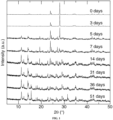
- the starting materials were loaded in the requisite stoichiometric ratios, thoroughly ground using an agate mortar and pestle, and allowed to rest in air for various amounts of time. In some experiments, the starting materials were allowed to rest for 7 days after mixing. Without wishing to be bound by any particular theory, the resting period may facilitate a pre-reaction, evidence for which is visible in FIG 1 . The pre-reaction is visible 5 days after mixing, as noted by the significant increase in new peaks in the diffractogram.
- Na 0.97 Eu 0.03 BaB 9 O 15 may be prepared via a microwave-assisted solid-state reaction. After resting the mixture of the initial starting materials for approximately 7 days, the resulting pre-reaction mixture was loaded into a graphite crucible that was centered in a larger alumina crucible with activated carbon packed into the annular space and covered by a graphite cap to maintain a reducing atmosphere comprising carbon monoxide produced by the hot carbon. The whole apparatus was then loaded into a microwave oven and reacted at ⁇ 480 W and -2450 Hz for 8 min.
- NaBaB 9 O 15 :Eu 2+ used a high-temperature ceramic route starting from the oxide powders.
- NBBO:Eu 2+ used a high-temperature ceramic route starting from the oxide powders.
- the X-ray powder diffractograms shown in FIG. 2 , most of the peaks can be indexed to calculated NaBaB 9 O 15 pattern.
- NaBaB 9 O 15 adopts the non-centrosymmetric trigonal space group R3c (no. 161). As illustrated in FIG.
- the crystal structure contains a three-dimensional framework of [B 3 O 7 ] 5- subunits in which two [BO 3 ] 3- trigonal planar units and one [BO 4 ] 5- tetrahedron are linked by the vertices.
- the arrangement of the [B 3 O 7 ] 5- units generates large tunnels along the [001] direction that are occupied by Ba 2+ and Na + alternatively.
- the Ba 2+ ions are coordinated in a nine-vertex distorted tri-capped trigonal prism, whereas six oxygen atoms form a highly distorted trigonal antiprism surrounding the Na + ions.
- the Eu 2+ substitutes for a small amount of Na + in this case.
- Na 0.97 Eu 0.03 BaB 9 O 15 has the largest unit cell volume among NaBaB 9 O 15 and NaBa 0.97 Eu 0.03 B 9 O 15 , because smaller Na + is substituted by larger Eu 2+ . Owing to the larger size of Ba 2+ than Eu 2+ , NaBa 0.97 Eu 0.03 B 9 O 15 possesses the smallest unit cell.
- Table 1 Refined crystallographic data of Na 0.97 Eu 0.03 BaB 9 O 15 , NaBaB 9 O 15 , and NaBa 0.97 Eu 0.03 B 9 O 15 .
- the single Eu 2+ site can also be supported by measuring the photoluminescence lifetime, as shown in FIG 5 .
- ⁇ -SiAlON:Eu 2+ emits an almost monochromatic light but contains some yellow component in it. Moreover, its harsh synthetic condition determines the high price of this phosphor in market. Both ⁇ -SiAlON:Eu 2+ and Ba 2 SiO 4 :Eu 2+ lie outside the National Television System Committee (NTSC) color triangle, which makes them off the standard and decreases the color quality in real application.
- NTSC National Television System Committee
- NBBO:Eu 2+ is clearly located in between Ba 2 SiO 4 :Eu 2+ and ⁇ -SiAlON:Eu 2+ in the color space, which moves this new phosphor's emission color closer to the green corner of the NTSC triangle, as shown, providing the potential to use this material in display applications.
- the CIE coordinates of blue-emitting BaMgAl 10 O 17 :Eu 2+ (BAM:Eu 2+ ) and red-emitting K 2 SiF 6 :Mn 4+ were also plotted.
- the triangle formed using NBBO:Eu 2+ as the green phosphor has an area that overlaps 78% of the NTSC area. This is a broader area than a device using ⁇ -SiAlON:Eu 2+ (69% of NTSC area) and Ba 2 SiO 4 :Eu 2+ (68% of NTSC area) by permitting more color in the green wavelength region.
Landscapes
- Chemical & Material Sciences (AREA)
- Inorganic Chemistry (AREA)
- Engineering & Computer Science (AREA)
- Materials Engineering (AREA)
- Organic Chemistry (AREA)
- Luminescent Compositions (AREA)
Claims (15)
- Leuchtstoff (Phosphor) der allgemeinen Summenformel:
(A1-xEux)(Ba1-ySry)B9O15,
wobei:
A ein oder mehrere Alkalimetall(e) ist;

- Leuchtstoff nach Anspruch 1, wobei A Natrium (I) ist.
- Leuchtstoff nach Anspruch 1 oder Anspruch 2, wobei 0 ≤ y ≤ 0,75, so wie 0.
- Leuchtstoff nach einem der Ansprüche 1-3, wobei 0 < x ≤ 0,15, so wie 0,03.
- Leuchtstoff nach einem der Ansprüche 1-4, weiter definiert als Na0,97Eu0,03BaB9O15.
- Leuchtstoff nach einem der Ansprüche 1-5, wobei der Leuchtstoff einen Anregungsspektrums-Peak bei einer Anregungswellenlänge von etwa 350 nm bis etwa 450 nm, wie etwa 395 nm oder 430 nm, aufweist, der Leuchtstoff einen Emissionsspektrums-Peak bei einer Emissionswellenlänge von etwa 450 nm bis etwa 550 nm, wie etwa 515 nm aufweist und/oder Emissionsspektrums-Peak eine Halbwertsbreite (FWHM) von etwa 50 nm bis etwa 90 nm, wie etwa 64 Nanometer aufweist.
- Verfahren zur Herstellung eines Leuchtstoffs nach einem der Ansprüche 1-6, wobei das Verfahren umfasst:a) Mischen von Ausgangsmaterialien des Leuchtstoffs zur Herstellung einer ersten Reaktionsmischung, wobei die Ausgangsmaterialien des Leuchtstoffs eine oder mehrere Alkalimetallquellen, eine Bariumquelle, eine Borquelle und eine Europiumquelle umfassen;b) Erhitzen der ersten Reaktionsmischung zur Herstellung des Leuchtstoffs.
- Verfahren nach Anspruch 7, wobei das Erhitzen des ersten Reaktionsgemisches das Bestrahlen des ersten Reaktionsgemisches mit Mikrowellenstrahlung umfasst, wobei optional die Frequenz der Mikrowellenstrahlung etwa 500 MHz bis etwa 4400 MHz beträgt, wie beispielsweise etwa 2450 MHz, und/oder die Leistung der Mikrowelle etwa 120 W bis etwa 1200 W, wie etwa 480 W, beträgt.
- Verfahren zur Herstellung eines Leuchtstoffs nach einem der Ansprüche 1-6, wobei das Verfahren umfasst:a) Mischen von Ausgangsmaterialien des Leuchtstoffs zur Herstellung einer ersten Reaktionsmischung, wobei die Ausgangsmaterialien des Leuchtstoffs eine oder mehrere Alkalimetallquellen, eine Bariumquelle, eine Borquelle und eine Europiumquelle umfassen;b) Erhitzen der ersten Reaktionsmischung auf eine erste Temperatur, um eine zweite Reaktionsmischung herzustellen; undc) Erhitzen der zweiten Reaktionsmischung auf eine zweite Temperatur, um den Leuchtstoff herzustellen.
- Verfahren nach einem der Ansprüche 7-9, wobei die Alkalimetallquelle eine Natriumquelle, ein Natriumsalz, wie NaHCO3, ist, die Bariumquelle ein Bariumsalz, wie BaCO3, ist, die Borquelle H3BO3 ist, und/oder die Europiumquelle ein Europiumsalz, wie Europium(III)-oxid, ist.
- The method according to any one of claims 7-10, wherein the first temperature is from about 400 °C to 800 °C, such as about 600 °C, optionally wherein heating the first reaction mixture comprises irradiating with microwave radiation or comprises heating in a furnace; and/or Verfahren nach einem der Ansprüche 7-10, wobei die erste Temperatur etwa 400°C bis 800°C beträgt, wie beispielsweise etwa 600°C, wobei optional das Erhitzen der ersten Reaktionsmischung das Bestrahlen mit Mikrowellenstrahlung umfasst oder das Erhitzen in einem Ofen umfasst; und/oder
wobei das Mischen in Luft durchgeführt wird und das Erhitzen der ersten Reaktionsmischung in Luft oder in einer reduzierenden Atmosphäre durchgeführt wird. - Verfahren nach einem der Ansprüche 9-11, wobei die zweite Temperatur etwa 525°C bis 925°C beträgt, wie etwa 725°C, wobei optional das Erhitzen der zweiten Reaktionsmischung das Erhitzen in einem Ofen umfasst; und/oder
wobei das Erhitzen der zweiten Reaktionsmischung in einer reduzierenden Atmosphäre durchgeführt wird. - Verfahren nach einem der Ansprüche 7-12, wobei die reduzierende Atmosphäre H2, CO oder NH 3 umfasst und gegebenenfalls ferner ein Verdünnungsgas wie N2 , Helium, Neon, Argon, Krypton, Xenon oder eine beliebige Kombination davon umfasst und/oder das Verfahren ferner das Ruhen lassen der ersten Reaktionsmischung für mindestens etwa 12 Stunden vor dem Erhitzen, wie etwa 3, 4, 5, 6 oder 7 Tage, umfasst.
- Licht emittierende Vorrichtung, umfassend:a) eine Anregungslichtquelle, die Primärlicht emittiert; undb) einen Leuchtstoff nach einem der Ansprüche 1-6, wobei der Leuchtstoff ein grün emittierender Leuchtstoff ist.
- Lichtemittierende Vorrichtung nach Anspruch 14, wobei die Anregungslichtquelle eine Halbleiterlichtquell, beispielsweise eine Leuchtdiode (LED) oder Laserdiode (LD), ist, deren Primärlicht eine Wellenlänge von etwa 380 nm bis etwa 500 nm, wie etwa 395 nm oder etwa 430 nm, hat, und/oder die lichtemittierende Vorrichtung ferner einen blau emittierenden Leuchtstoff, einen rot emittierenden Leuchtstoff oder eine Kombination davon umfasst.
Applications Claiming Priority (2)
| Application Number | Priority Date | Filing Date | Title |
|---|---|---|---|
| US201962877603P | 2019-07-23 | 2019-07-23 | |
| PCT/US2020/043167 WO2021016411A1 (en) | 2019-07-23 | 2020-07-23 | Narrow green-emitting phosphors |
Publications (2)
| Publication Number | Publication Date |
|---|---|
| EP4004144A1 EP4004144A1 (de) | 2022-06-01 |
| EP4004144B1 true EP4004144B1 (de) | 2023-05-24 |
Family
ID=71995176
Family Applications (1)
| Application Number | Title | Priority Date | Filing Date |
|---|---|---|---|
| EP20753639.2A Active EP4004144B1 (de) | 2019-07-23 | 2020-07-23 | Schmale grünlichtemittierende leuchtstoffe |
Country Status (5)
| Country | Link |
|---|---|
| US (1) | US12297384B2 (de) |
| EP (1) | EP4004144B1 (de) |
| CN (1) | CN114341313A (de) |
| CA (1) | CA3145214A1 (de) |
| WO (1) | WO2021016411A1 (de) |
Families Citing this family (3)
| Publication number | Priority date | Publication date | Assignee | Title |
|---|---|---|---|---|
| CN114479858B (zh) * | 2022-02-16 | 2023-08-08 | 西安建筑科技大学 | 一种适于近紫外光激发的硼酸盐蓝色发光荧光粉及其制备方法和白光led装置 |
| CN117903788A (zh) * | 2023-11-17 | 2024-04-19 | 上海应用技术大学 | 一种紫光高响应绿光荧光材料及其制备方法与应用 |
| CN118667538B (zh) * | 2024-06-05 | 2025-08-22 | 中山大学南昌研究院 | 一种稀土掺杂绿色荧光粉的制备方法 |
Family Cites Families (10)
| Publication number | Priority date | Publication date | Assignee | Title |
|---|---|---|---|---|
| US7014336B1 (en) | 1999-11-18 | 2006-03-21 | Color Kinetics Incorporated | Systems and methods for generating and modulating illumination conditions |
| US6273589B1 (en) | 1999-01-29 | 2001-08-14 | Agilent Technologies, Inc. | Solid state illumination source utilizing dichroic reflectors |
| US6555958B1 (en) | 2000-05-15 | 2003-04-29 | General Electric Company | Phosphor for down converting ultraviolet light of LEDs to blue-green light |
| US7088038B2 (en) | 2003-07-02 | 2006-08-08 | Gelcore Llc | Green phosphor for general illumination applications |
| US7489073B2 (en) | 2005-04-15 | 2009-02-10 | Patent-Treuhand-Gesellschaft für elektrische Glühlampen mbH | Blue to yellow-orange emitting phosphor, and light source having such a phosphor |
| CN102199426B (zh) | 2011-04-02 | 2013-08-21 | 北京工商大学 | 稳定红色荧光材料及其制备方法、增强发光效率的方法 |
| US8663502B2 (en) | 2011-12-30 | 2014-03-04 | Intematix Corporation | Red-emitting nitride-based phosphors |
| US8597545B1 (en) | 2012-07-18 | 2013-12-03 | Intematix Corporation | Red-emitting nitride-based calcium-stabilized phosphors |
| CN106190119A (zh) | 2016-07-20 | 2016-12-07 | 上海应用技术学院 | 一种白光LED用Eu3+掺杂钼酸盐红粉的制备方法 |
| US10177287B1 (en) | 2017-09-19 | 2019-01-08 | Eie Materials, Inc. | Gamut broadened displays with narrow band green phosphors |
-
2020
- 2020-07-23 EP EP20753639.2A patent/EP4004144B1/de active Active
- 2020-07-23 CA CA3145214A patent/CA3145214A1/en active Pending
- 2020-07-23 WO PCT/US2020/043167 patent/WO2021016411A1/en not_active Ceased
- 2020-07-23 US US17/629,194 patent/US12297384B2/en active Active
- 2020-07-23 CN CN202080058748.0A patent/CN114341313A/zh active Pending
Also Published As
| Publication number | Publication date |
|---|---|
| EP4004144A1 (de) | 2022-06-01 |
| WO2021016411A1 (en) | 2021-01-28 |
| CN114341313A (zh) | 2022-04-12 |
| CA3145214A1 (en) | 2021-01-28 |
| US20220290045A1 (en) | 2022-09-15 |
| US12297384B2 (en) | 2025-05-13 |
Similar Documents
| Publication | Publication Date | Title |
|---|---|---|
| Guzik et al. | Eu 3+ luminescence from different sites in a scheelite-type cadmium molybdate red phosphor with vacancies | |
| Zhang et al. | A zero-thermal-quenching and color-tunable phosphor LuVO4: Bi3+, Eu3+ for NUV LEDs | |
| Zhang et al. | An efficient, broad-band red-emitting Li2MgTi3O8: Mn4+ phosphor for blue-converted white LEDs | |
| US9550939B2 (en) | Red emitting nitride fluorescent material and white light emitting device using the same | |
| Guo et al. | A Eu 2+ and Mn 2+-coactivated fluoro-apatite-structure Ca 6 Y 2 Na 2 (PO 4) 6 F 2 as a standard white-emitting phosphor via energy transfer | |
| Han et al. | Photoluminescence properties of a double perovskite tungstate based red-emitting phosphor NaLaMgWO6: Sm3+ | |
| JP5643424B2 (ja) | 炭窒化物系蛍光体およびこれを使用する発光素子 | |
| Cui et al. | The synthesis of narrow-band red-emitting SrLiAl 3 N 4: Eu 2+ phosphor and improvement of its luminescence properties | |
| JP5770192B2 (ja) | 青色発光蛍光体及び該青色発光蛍光体を用いた発光装置 | |
| Yang et al. | An investigation of Eu2+-doped CaAlSiN3 fabricated by an alloy-nitridation method | |
| EP4004144B1 (de) | Schmale grünlichtemittierende leuchtstoffe | |
| Lu et al. | Ce3+ and Dy3+ doped Ca3 (P1-xBxO4) 2 phosphors for white light-emitting applications | |
| Yang et al. | Cyan-emitting Ba0. 45Ca2. 5La6 (SiO4) 6: 0.05 Eu2+ and Ba1. 45Ca1. 5La6 (SiO4) 6: 0.05 Eu2+ solid-solution phosphors for white light-emitting diodes | |
| Zhao et al. | Effect of oxygen vacancy on photoluminescence properties of Dy3+ doped K2BaCa (PO4) 2 phosphor and remote luminescence multi-layer for white light | |
| Kumar et al. | Structural, optical and photoluminescence characteristics of apatite type lanthanide silicates | |
| Liu et al. | Mn4+-doped organometallic hafnium hexafluoride phosphors: Achieving near-unity quantum yield to elevate LED performance | |
| Derbel et al. | Novel reddish-orange emitting ultraphosphate CaP4O11: Eu3+ phosphor: Synthesis and photoluminescence properties | |
| Tian et al. | High color purity aluminate phosphor SryCa1-x-yAl12O19: xEu2+ for lighting and backlight display applications | |
| JP5353638B2 (ja) | 蛍光体及びその製造方法と、その蛍光体を用いた蛍光体含有組成物及び発光装置、並びに、その発光装置を用いた画像表示装置及び照明装置 | |
| Llanos et al. | Preparation, characterization and luminescence of a new green-emitting phosphor: Gd2TeO6 doped with Tb3+ | |
| Abdel-Hameed et al. | Employing one crystalline phase to gain different phosphor emissions for distinctive applications: Preparation, crystallization and luminescence of SrAl2B2O7 with different additions via glass ceramic technique | |
| Reddy et al. | Sol–gel synthesis, structural and optical properties of rare earth ions (Sm3+ or Dy3+) activated Ca3Ga2Si3O12 powder phosphors | |
| Zhuo et al. | Controlling Eu2+ substitution towards a narrow-band green-emitting borate phosphor NaBaB9O15: Eu2+ | |
| Geetha et al. | Synthesis and Optical Characterization of Ce3+-Doped CaMgPO4F Phosphor for LED Applications | |
| WO2023028516A1 (en) | Violet light exciteable blue-emitting oxynitride phosphors and uses thereof |
Legal Events
| Date | Code | Title | Description |
|---|---|---|---|
| STAA | Information on the status of an ep patent application or granted ep patent |
Free format text: STATUS: UNKNOWN |
|
| STAA | Information on the status of an ep patent application or granted ep patent |
Free format text: STATUS: THE INTERNATIONAL PUBLICATION HAS BEEN MADE |
|
| PUAI | Public reference made under article 153(3) epc to a published international application that has entered the european phase |
Free format text: ORIGINAL CODE: 0009012 |
|
| STAA | Information on the status of an ep patent application or granted ep patent |
Free format text: STATUS: REQUEST FOR EXAMINATION WAS MADE |
|
| 17P | Request for examination filed |
Effective date: 20220210 |
|
| AK | Designated contracting states |
Kind code of ref document: A1 Designated state(s): AL AT BE BG CH CY CZ DE DK EE ES FI FR GB GR HR HU IE IS IT LI LT LU LV MC MK MT NL NO PL PT RO RS SE SI SK SM TR |
|
| DAV | Request for validation of the european patent (deleted) | ||
| DAX | Request for extension of the european patent (deleted) | ||
| GRAP | Despatch of communication of intention to grant a patent |
Free format text: ORIGINAL CODE: EPIDOSNIGR1 |
|
| STAA | Information on the status of an ep patent application or granted ep patent |
Free format text: STATUS: GRANT OF PATENT IS INTENDED |
|
| INTG | Intention to grant announced |
Effective date: 20221129 |
|
| GRAS | Grant fee paid |
Free format text: ORIGINAL CODE: EPIDOSNIGR3 |
|
| GRAA | (expected) grant |
Free format text: ORIGINAL CODE: 0009210 |
|
| STAA | Information on the status of an ep patent application or granted ep patent |
Free format text: STATUS: THE PATENT HAS BEEN GRANTED |
|
| AK | Designated contracting states |
Kind code of ref document: B1 Designated state(s): AL AT BE BG CH CY CZ DE DK EE ES FI FR GB GR HR HU IE IS IT LI LT LU LV MC MK MT NL NO PL PT RO RS SE SI SK SM TR |
|
| REG | Reference to a national code |
Ref country code: GB Ref legal event code: FG4D |
|
| REG | Reference to a national code |
Ref country code: CH Ref legal event code: EP |
|
| REG | Reference to a national code |
Ref country code: DE Ref legal event code: R096 Ref document number: 602020011154 Country of ref document: DE |
|
| REG | Reference to a national code |
Ref country code: AT Ref legal event code: REF Ref document number: 1569503 Country of ref document: AT Kind code of ref document: T Effective date: 20230615 |
|
| REG | Reference to a national code |
Ref country code: IE Ref legal event code: FG4D |
|
| REG | Reference to a national code |
Ref country code: LT Ref legal event code: MG9D |
|
| REG | Reference to a national code |
Ref country code: NL Ref legal event code: MP Effective date: 20230524 |
|
| REG | Reference to a national code |
Ref country code: AT Ref legal event code: MK05 Ref document number: 1569503 Country of ref document: AT Kind code of ref document: T Effective date: 20230524 |
|
| PG25 | Lapsed in a contracting state [announced via postgrant information from national office to epo] |
Ref country code: SE Free format text: LAPSE BECAUSE OF FAILURE TO SUBMIT A TRANSLATION OF THE DESCRIPTION OR TO PAY THE FEE WITHIN THE PRESCRIBED TIME-LIMIT Effective date: 20230524 Ref country code: PT Free format text: LAPSE BECAUSE OF FAILURE TO SUBMIT A TRANSLATION OF THE DESCRIPTION OR TO PAY THE FEE WITHIN THE PRESCRIBED TIME-LIMIT Effective date: 20230925 Ref country code: NO Free format text: LAPSE BECAUSE OF FAILURE TO SUBMIT A TRANSLATION OF THE DESCRIPTION OR TO PAY THE FEE WITHIN THE PRESCRIBED TIME-LIMIT Effective date: 20230824 Ref country code: NL Free format text: LAPSE BECAUSE OF FAILURE TO SUBMIT A TRANSLATION OF THE DESCRIPTION OR TO PAY THE FEE WITHIN THE PRESCRIBED TIME-LIMIT Effective date: 20230524 Ref country code: ES Free format text: LAPSE BECAUSE OF FAILURE TO SUBMIT A TRANSLATION OF THE DESCRIPTION OR TO PAY THE FEE WITHIN THE PRESCRIBED TIME-LIMIT Effective date: 20230524 Ref country code: AT Free format text: LAPSE BECAUSE OF FAILURE TO SUBMIT A TRANSLATION OF THE DESCRIPTION OR TO PAY THE FEE WITHIN THE PRESCRIBED TIME-LIMIT Effective date: 20230524 |
|
| PG25 | Lapsed in a contracting state [announced via postgrant information from national office to epo] |
Ref country code: RS Free format text: LAPSE BECAUSE OF FAILURE TO SUBMIT A TRANSLATION OF THE DESCRIPTION OR TO PAY THE FEE WITHIN THE PRESCRIBED TIME-LIMIT Effective date: 20230524 Ref country code: PL Free format text: LAPSE BECAUSE OF FAILURE TO SUBMIT A TRANSLATION OF THE DESCRIPTION OR TO PAY THE FEE WITHIN THE PRESCRIBED TIME-LIMIT Effective date: 20230524 Ref country code: LV Free format text: LAPSE BECAUSE OF FAILURE TO SUBMIT A TRANSLATION OF THE DESCRIPTION OR TO PAY THE FEE WITHIN THE PRESCRIBED TIME-LIMIT Effective date: 20230524 Ref country code: LT Free format text: LAPSE BECAUSE OF FAILURE TO SUBMIT A TRANSLATION OF THE DESCRIPTION OR TO PAY THE FEE WITHIN THE PRESCRIBED TIME-LIMIT Effective date: 20230524 Ref country code: IS Free format text: LAPSE BECAUSE OF FAILURE TO SUBMIT A TRANSLATION OF THE DESCRIPTION OR TO PAY THE FEE WITHIN THE PRESCRIBED TIME-LIMIT Effective date: 20230924 Ref country code: HR Free format text: LAPSE BECAUSE OF FAILURE TO SUBMIT A TRANSLATION OF THE DESCRIPTION OR TO PAY THE FEE WITHIN THE PRESCRIBED TIME-LIMIT Effective date: 20230524 Ref country code: GR Free format text: LAPSE BECAUSE OF FAILURE TO SUBMIT A TRANSLATION OF THE DESCRIPTION OR TO PAY THE FEE WITHIN THE PRESCRIBED TIME-LIMIT Effective date: 20230825 |
|
| PG25 | Lapsed in a contracting state [announced via postgrant information from national office to epo] |
Ref country code: FI Free format text: LAPSE BECAUSE OF FAILURE TO SUBMIT A TRANSLATION OF THE DESCRIPTION OR TO PAY THE FEE WITHIN THE PRESCRIBED TIME-LIMIT Effective date: 20230524 |
|
| PG25 | Lapsed in a contracting state [announced via postgrant information from national office to epo] |
Ref country code: SK Free format text: LAPSE BECAUSE OF FAILURE TO SUBMIT A TRANSLATION OF THE DESCRIPTION OR TO PAY THE FEE WITHIN THE PRESCRIBED TIME-LIMIT Effective date: 20230524 |
|
| PG25 | Lapsed in a contracting state [announced via postgrant information from national office to epo] |
Ref country code: SM Free format text: LAPSE BECAUSE OF FAILURE TO SUBMIT A TRANSLATION OF THE DESCRIPTION OR TO PAY THE FEE WITHIN THE PRESCRIBED TIME-LIMIT Effective date: 20230524 Ref country code: SK Free format text: LAPSE BECAUSE OF FAILURE TO SUBMIT A TRANSLATION OF THE DESCRIPTION OR TO PAY THE FEE WITHIN THE PRESCRIBED TIME-LIMIT Effective date: 20230524 Ref country code: RO Free format text: LAPSE BECAUSE OF FAILURE TO SUBMIT A TRANSLATION OF THE DESCRIPTION OR TO PAY THE FEE WITHIN THE PRESCRIBED TIME-LIMIT Effective date: 20230524 Ref country code: EE Free format text: LAPSE BECAUSE OF FAILURE TO SUBMIT A TRANSLATION OF THE DESCRIPTION OR TO PAY THE FEE WITHIN THE PRESCRIBED TIME-LIMIT Effective date: 20230524 Ref country code: DK Free format text: LAPSE BECAUSE OF FAILURE TO SUBMIT A TRANSLATION OF THE DESCRIPTION OR TO PAY THE FEE WITHIN THE PRESCRIBED TIME-LIMIT Effective date: 20230524 Ref country code: CZ Free format text: LAPSE BECAUSE OF FAILURE TO SUBMIT A TRANSLATION OF THE DESCRIPTION OR TO PAY THE FEE WITHIN THE PRESCRIBED TIME-LIMIT Effective date: 20230524 |
|
| REG | Reference to a national code |
Ref country code: DE Ref legal event code: R119 Ref document number: 602020011154 Country of ref document: DE |
|
| PG25 | Lapsed in a contracting state [announced via postgrant information from national office to epo] |
Ref country code: MC Free format text: LAPSE BECAUSE OF FAILURE TO SUBMIT A TRANSLATION OF THE DESCRIPTION OR TO PAY THE FEE WITHIN THE PRESCRIBED TIME-LIMIT Effective date: 20230524 |
|
| PG25 | Lapsed in a contracting state [announced via postgrant information from national office to epo] |
Ref country code: MC Free format text: LAPSE BECAUSE OF FAILURE TO SUBMIT A TRANSLATION OF THE DESCRIPTION OR TO PAY THE FEE WITHIN THE PRESCRIBED TIME-LIMIT Effective date: 20230524 |
|
| REG | Reference to a national code |
Ref country code: CH Ref legal event code: PL |
|
| REG | Reference to a national code |
Ref country code: BE Ref legal event code: MM Effective date: 20230731 |
|
| PG25 | Lapsed in a contracting state [announced via postgrant information from national office to epo] |
Ref country code: LU Free format text: LAPSE BECAUSE OF NON-PAYMENT OF DUE FEES Effective date: 20230723 |
|
| PG25 | Lapsed in a contracting state [announced via postgrant information from national office to epo] |
Ref country code: LU Free format text: LAPSE BECAUSE OF NON-PAYMENT OF DUE FEES Effective date: 20230723 |
|
| PLBE | No opposition filed within time limit |
Free format text: ORIGINAL CODE: 0009261 |
|
| STAA | Information on the status of an ep patent application or granted ep patent |
Free format text: STATUS: NO OPPOSITION FILED WITHIN TIME LIMIT |
|
| REG | Reference to a national code |
Ref country code: IE Ref legal event code: MM4A |
|
| PG25 | Lapsed in a contracting state [announced via postgrant information from national office to epo] |
Ref country code: DE Free format text: LAPSE BECAUSE OF NON-PAYMENT OF DUE FEES Effective date: 20240201 Ref country code: CH Free format text: LAPSE BECAUSE OF NON-PAYMENT OF DUE FEES Effective date: 20230731 |
|
| 26N | No opposition filed |
Effective date: 20240227 |
|
| PG25 | Lapsed in a contracting state [announced via postgrant information from national office to epo] |
Ref country code: SI Free format text: LAPSE BECAUSE OF FAILURE TO SUBMIT A TRANSLATION OF THE DESCRIPTION OR TO PAY THE FEE WITHIN THE PRESCRIBED TIME-LIMIT Effective date: 20230524 |
|
| PG25 | Lapsed in a contracting state [announced via postgrant information from national office to epo] |
Ref country code: SI Free format text: LAPSE BECAUSE OF FAILURE TO SUBMIT A TRANSLATION OF THE DESCRIPTION OR TO PAY THE FEE WITHIN THE PRESCRIBED TIME-LIMIT Effective date: 20230524 Ref country code: IT Free format text: LAPSE BECAUSE OF FAILURE TO SUBMIT A TRANSLATION OF THE DESCRIPTION OR TO PAY THE FEE WITHIN THE PRESCRIBED TIME-LIMIT Effective date: 20230524 Ref country code: FR Free format text: LAPSE BECAUSE OF NON-PAYMENT OF DUE FEES Effective date: 20230724 Ref country code: BE Free format text: LAPSE BECAUSE OF NON-PAYMENT OF DUE FEES Effective date: 20230731 |
|
| PG25 | Lapsed in a contracting state [announced via postgrant information from national office to epo] |
Ref country code: IE Free format text: LAPSE BECAUSE OF NON-PAYMENT OF DUE FEES Effective date: 20230723 |
|
| PG25 | Lapsed in a contracting state [announced via postgrant information from national office to epo] |
Ref country code: IE Free format text: LAPSE BECAUSE OF NON-PAYMENT OF DUE FEES Effective date: 20230723 |
|
| PG25 | Lapsed in a contracting state [announced via postgrant information from national office to epo] |
Ref country code: BG Free format text: LAPSE BECAUSE OF FAILURE TO SUBMIT A TRANSLATION OF THE DESCRIPTION OR TO PAY THE FEE WITHIN THE PRESCRIBED TIME-LIMIT Effective date: 20230524 |
|
| PG25 | Lapsed in a contracting state [announced via postgrant information from national office to epo] |
Ref country code: BG Free format text: LAPSE BECAUSE OF FAILURE TO SUBMIT A TRANSLATION OF THE DESCRIPTION OR TO PAY THE FEE WITHIN THE PRESCRIBED TIME-LIMIT Effective date: 20230524 |
|
| GBPC | Gb: european patent ceased through non-payment of renewal fee |
Effective date: 20240723 |
|
| PG25 | Lapsed in a contracting state [announced via postgrant information from national office to epo] |
Ref country code: GB Free format text: LAPSE BECAUSE OF NON-PAYMENT OF DUE FEES Effective date: 20240723 |
|
| REG | Reference to a national code |
Ref country code: GB Ref legal event code: S28 Free format text: APPLICATION FILED |
|
| PG25 | Lapsed in a contracting state [announced via postgrant information from national office to epo] |
Ref country code: CY Free format text: LAPSE BECAUSE OF FAILURE TO SUBMIT A TRANSLATION OF THE DESCRIPTION OR TO PAY THE FEE WITHIN THE PRESCRIBED TIME-LIMIT; INVALID AB INITIO Effective date: 20200723 |
|
| PG25 | Lapsed in a contracting state [announced via postgrant information from national office to epo] |
Ref country code: HU Free format text: LAPSE BECAUSE OF FAILURE TO SUBMIT A TRANSLATION OF THE DESCRIPTION OR TO PAY THE FEE WITHIN THE PRESCRIBED TIME-LIMIT; INVALID AB INITIO Effective date: 20200723 |
|
| REG | Reference to a national code |
Ref country code: GB Ref legal event code: S28 Free format text: RESTORATION ALLOWED Effective date: 20250902 |
|
| PG25 | Lapsed in a contracting state [announced via postgrant information from national office to epo] |
Ref country code: GB Free format text: LAPSE BECAUSE OF NON-PAYMENT OF DUE FEES Effective date: 20240723 |
|
| PGFP | Annual fee paid to national office [announced via postgrant information from national office to epo] |
Ref country code: GB Payment date: 20250813 Year of fee payment: 6 |
|
| PGRI | Patent reinstated in contracting state [announced from national office to epo] |
Ref country code: GB Effective date: 20250902 |
|
| PG25 | Lapsed in a contracting state [announced via postgrant information from national office to epo] |
Ref country code: TR Free format text: LAPSE BECAUSE OF FAILURE TO SUBMIT A TRANSLATION OF THE DESCRIPTION OR TO PAY THE FEE WITHIN THE PRESCRIBED TIME-LIMIT Effective date: 20230524 |