EP4004335B1 - Perforierpistole und system und verfahren zu ihrer verwendung - Google Patents
Perforierpistole und system und verfahren zu ihrer verwendung Download PDFInfo
- Publication number
- EP4004335B1 EP4004335B1 EP20757446.8A EP20757446A EP4004335B1 EP 4004335 B1 EP4004335 B1 EP 4004335B1 EP 20757446 A EP20757446 A EP 20757446A EP 4004335 B1 EP4004335 B1 EP 4004335B1
- Authority
- EP
- European Patent Office
- Prior art keywords
- perforating gun
- gun section
- section
- sections
- actuation
- Prior art date
- Legal status (The legal status is an assumption and is not a legal conclusion. Google has not performed a legal analysis and makes no representation as to the accuracy of the status listed.)
- Active
Links
Images




Classifications
-
- E—FIXED CONSTRUCTIONS
- E21—EARTH OR ROCK DRILLING; MINING
- E21B—EARTH OR ROCK DRILLING; OBTAINING OIL, GAS, WATER, SOLUBLE OR MELTABLE MATERIALS OR A SLURRY OF MINERALS FROM WELLS
- E21B43/00—Methods or apparatus for obtaining oil, gas, water, soluble or meltable materials or a slurry of minerals from wells
- E21B43/11—Perforators; Permeators
- E21B43/116—Gun or shaped-charge perforators
- E21B43/117—Shaped-charge perforators
-
- E—FIXED CONSTRUCTIONS
- E21—EARTH OR ROCK DRILLING; MINING
- E21B—EARTH OR ROCK DRILLING; OBTAINING OIL, GAS, WATER, SOLUBLE OR MELTABLE MATERIALS OR A SLURRY OF MINERALS FROM WELLS
- E21B43/00—Methods or apparatus for obtaining oil, gas, water, soluble or meltable materials or a slurry of minerals from wells
- E21B43/11—Perforators; Permeators
- E21B43/119—Details, e.g. for locating perforating place or direction
-
- E—FIXED CONSTRUCTIONS
- E21—EARTH OR ROCK DRILLING; MINING
- E21B—EARTH OR ROCK DRILLING; OBTAINING OIL, GAS, WATER, SOLUBLE OR MELTABLE MATERIALS OR A SLURRY OF MINERALS FROM WELLS
- E21B43/00—Methods or apparatus for obtaining oil, gas, water, soluble or meltable materials or a slurry of minerals from wells
- E21B43/11—Perforators; Permeators
- E21B43/116—Gun or shaped-charge perforators
- E21B43/1185—Ignition systems
-
- E—FIXED CONSTRUCTIONS
- E21—EARTH OR ROCK DRILLING; MINING
- E21B—EARTH OR ROCK DRILLING; OBTAINING OIL, GAS, WATER, SOLUBLE OR MELTABLE MATERIALS OR A SLURRY OF MINERALS FROM WELLS
- E21B47/00—Survey of boreholes or wells
- E21B47/12—Means for transmitting measuring-signals or control signals from the well to the surface, or from the surface to the well, e.g. for logging while drilling
- E21B47/138—Devices entrained in the flow of well-bore fluid for transmitting data, control or actuation signals
Definitions
- the present disclosure relates to perforating guns, and apparatus and method for operating perforating guns within a subterranean well.
- Subterranean wells are typically created by drilling a hole into the earth with a drilling rig. After the hole is drilled, well casing sections are inserted into the hole to provide structural integrity to the newly drilled wellbore. This process may be repeated several times at increasingly smaller bore diameters to create a well at a desired depth. Hydrocarbons, such as oil and gas, are produced from the well casing that intersects with one or more hydrocarbon reservoirs in a formation. The hydrocarbons flow into the well casing through perforations in the well casing.
- a perforating gun loaded with shaped charges may be used to create perforations in a well casing.
- the gun may be lowered into the wellbore on electric wireline, slickline, tubing, coiled tubing, or other conveyance device until it is adjacent the hydrocarbon producing formation.
- prior art systems may employ a signal from the well head to actuate a firing head associated with the perforating gun, which then causes actuation of the shaped charges. Projectiles or jets formed by the explosion of the shaped charges penetrate the well casing to thereby allow formation fluids to flow through the perforations and into the well casing.
- a plurality of well casing sections may be separately perforated by inserting a perforating gun into the well multiple times; e.g., by running a work string in and out of the well for each zone to be perforated.
- This approach often increases rig and personnel time and can be costly.
- a perforating gun assembly that includes a plurality of independent perforating guns may be inserted into the well casing.
- the perforating gun assembly is a continuous system configured with the perforating guns separated from one another by blank guns.
- the blank guns typically contain explosive boosters and explosive detonating cord configured to propagate an explosive train from one perforating gun to the next. Blank guns are not operable to perforate well casing.
- the perforating gun spacing within the assembly is chosen so that each perforating gun is aligned with a production zone.
- US2010000789A1 describes a perforating gun train for perforating two or more zones of interest.
- WO2018055339A1 describes downhole firing tools.
- WO0220939A1 describes a method for performing operations and for purportedly improving production in a well.
- CN106837265A describes a method for downhole sleeve perforating.
- the present disclosure relates to devices and methods for actuating one or more downhole tools, such as but not limited to perforating guns.
- the present disclosure is susceptible to embodiments of different forms. There are shown in the drawings, and herein will be described in detail, specific embodiments of the present disclosure with the understanding that the present disclosure is to be considered an exemplification of the principles of the disclosure, and is not intended to limit the disclosure to that illustrated and described herein.
- a subterranean well having a wellbore 10 that extends into a subterranean formation 12.
- the subterranean formation 12 includes one or more production zones 13.
- the subterranean well is shown as a land-based well, but the present disclosure is not limited thereto.
- the wellbore 10 includes a well casing 14 and a wellhead 16.
- a work string 18 may be used to suspend tooling within the well casing 14, and to convey the tooling into and out of the well casing 14.
- the work string 18 may include tubing, drill pipe, wire line, slick line, or any other known conveyance means.
- the work string tooling includes a plurality of perforating gun sections 20 (i.e., an initial perforating gun section 20A and at least one secondary perforating gun section 20B), typically spaced apart from one another within the work string 18.
- the sections of the work string 18 disposed between perforating gun sections 20 are free of explosive material and/or detonator cord.
- Each perforating gun section 20 includes at least one activator 22 and at least one perforating shaped charge 24.
- the present disclosure is not limited to any particular perforating gun section 20 configuration other than as indicated herein; i.e., the present disclosure may be used with a variety of different perforating gun section 20 configurations.
- the initial perforating gun section 20A may be actuable via an external impetus.
- external impetus refers to a signal or condition external to the initial perforating gun section 20A or not associated with the actuation of the initial perforating gun section 20A.
- Non-limiting examples of a signal or condition external to or not associated with the actuation of an initial perforating gun section 20A include a surface transmitted signal, a "drop bar,” wellbore conditions such as pressure and/or temperature, timer-based actuation, etc.
- the present disclosure is not limited to any particular initial perforating gun section 20A configuration other than as specified herein.
- Each secondary perforating gun section 20B includes an activator 22, at least one perforating shaped charge 24, and at least one sensor 26 (e.g., see FIG. 2 ) configured to sense a signal directly produced by the actuation of a perforating gun section 20 (e.g., a "condition" of a perforating gun section actuation).
- the signal directly produced by the actuation of a perforating gun section 20 may take a variety of different forms; e.g., a shock wave, a pressure pulse, a pressure wave, an electromagnetic wave (an "EM wave”), an acoustic signal, etc., and in some instances one or more combinations of the same.
- the present invention is limited by sensing as claimed.
- the at least one sensor 26 and the activator 22 are components within the respective secondary perforating gun section 20B and are independent of any other perforating gun section 20 or work string 18 component disposed between perforating gun sections 20.
- the activator 22 may be configured to initiate a firing sequence for the respective secondary perforating gun section 20B upon receipt of a signal from the sensor 26.
- initial perforating gun sections 20A and secondary perforating gun sections 20B may be configured the same.
- a perforating gun section may include an activator 22, at least one perforating shaped charge 24, at least one sensor 26, and is actuable via an external impetus.
- the ability to be actuable via an external impetus can be selectively switched on or off or enabled or disabled.
- Such a perforating gun section may be utilized as either an initial perforating gun section or a secondary perforating gun section.
- one or more of the secondary perforating gun sections 20B may include a time delay mechanism (not shown).
- the time delay mechanism may, for example, be configured to be within a signal path between the sensor 26 and the activator 22 for the respective secondary perforating gun section 20B.
- the time delay mechanism may be configured to create a predetermined time interval between receipt of the sensor signal and providing a signal to the activator 22, thereby delaying the actuation of the secondary perforating gun section 20B by the predetermined time interval.
- the at least one sensor 26 configured to sense a signal directly produced by the actuation of a perforating gun section 20 may assume a variety of different configurations; e.g., configured to sense a signal that is directly produced by the actuation of a perforating gun section 20 such as a shock wave, a pressure pulse, a pressure wave, an EM wave, an acoustic signal, etc., and any combination thereof. Sensing for a signal that is directly produced by the actuation of a perforating gun section 20 greatly simplifies the device and eliminates elements that could potentially lead to a malfunction (e.g., a "stop-fire").
- the sensor 26 may be configured to sense the presence and magnitude of a respective signal type and to produce an output signal representative of the sensed signal.
- the sensor output signal may be provided to a logic device (i.e., any type of computing device, computational circuit, process or processing circuit, etc.) capable of evaluating the sensor output signal relative to one or more predetermined parameters; e.g., logic that determines if a predetermined condition is met such as whether the magnitude or the frequency of the wave/signal meets the predetermined condition.
- the sensor 26 may be configured to sense the presence, magnitude and/or frequency of a respective signal type within the well environment and to only produce an output signal when the sensed signal meets a predetermined condition.
- the present invention is limited by the sensor as claimed.
- the following examples illustrate how differently configured sensors 26 may operate within a secondary perforated gun section 20B.
- a perforating gun section 20 e.g., the initial perforating gun section 20A
- high shock forces are produced within the wellbore 10 and are transmitted to fluid disposed within the wellbore 10.
- the shock forces produce shock waves.
- the sensor 26 of a secondary perforating gun 20B is configured to sense for shock waves.
- the predetermined condition is based on a shock wave that can only be produced by actuation of a perforating gun section 20.
- the activator 22 when the sensed shock wave meets the predetermined condition, a signal is provided to the activator 22.
- the activator 22 will, in turn, produce an output that causes the respective secondary perforating gun section 20B to actuate.
- the activator 22 output may immediately cause the secondary perforating gun section 20B to actuate, or may cause the secondary perforating gun section 20B to actuate after a predetermined time interval if the gun section 20B includes a time delay mechanism.
- the sensor 26 of a secondary perforating gun section may be configured to sense for pressure pulses.
- the pressure pulse sensor 26 may produce an output signal that is representative of the presence, magnitude, and/or frequency of the sensed pressure pulse, or may produce an output signal only when the sensed pressure pulse signal meets a predetermined condition, etc.
- the predetermined condition is based on a pressure pulse that can only be produced by actuation of a perforating gun section 20.
- a signal is provided to the activator 22.
- the activator 22 will, in turn, produce an output that causes the respective secondary perforating gun section 20B to actuate immediately or after a time interval as described above.
- the senor 26 of a secondary perforating gun 20B is configured to sense for EM waves.
- the EM wave sensor 26 may produce an output signal that is representative of the presence, magnitude, and/or the frequency of the sensed EM wave, or may produce an output signal only when the sensed EM wave signal meets a predetermined condition, etc.
- the predetermined condition is based on an EM wave that can only be produced by actuation of a perforating gun section 20.
- a signal is provided to the activator 22.
- the activator 22 will, in turn, produce an output that causes the respective secondary perforating gun section 20B to actuate immediately or after a time interval as described above.
- the senor 26 of a secondary perforating gun section 20B is configured to sense for acoustic waves.
- the acoustic wave sensor 26 may produce an output signal that is representative of the presence, magnitude, and/or frequency of the sensed acoustic wave, or may produce an output signal only when the sensed acoustic wave signal meets a predetermined condition, etc.
- the predetermined condition is based on an acoustic wave that can only be produced by actuation of a perforating gun section 20.
- a signal is provided to the activator 22.
- the activator 22 will, in turn, produce an output that causes the respective secondary perforating gun section 20B to actuate immediately or after a time interval as described above.
- perforating gun sections within a work string may be configured to facilitate a predetermined sequential operating order.
- the following description is a non-limiting example of a device configured for a predetermined sequential operating order.
- the actuation of an initial perforating gun section 20A as described above produces a signal as described above (e.g., a shock wave). That signal is either unique to the initial perforating gun section 20A or is accompanied by an identifier (e.g., a secondary signal that is unique to the initial perforating gun section).
- a first secondary perforating gun section is configured to determine the source of the signal(s); e.g., the initial perforating gun section unique identifier.
- the first secondary perforating gun section Upon receipt and recognition of the unique identifier, the first secondary perforating gun section is actuated.
- Each secondary perforating gun section within the work string may be configured to actuate upon receipt of a predetermined unique identifier.
- only the first secondary perforating gun section may be configured to accept the unique identifier from the initial perforating gun section and thereby be actuated.
- the first secondary perforating gun section when actuated, it produces a signal as described above (e.g., a shock wave), and that signal is either unique to the first secondary perforating gun section or is accompanied by an identifier unique to the first secondary perforating gun section.
- a second secondary perforating gun section is configured to determine the source of the signal(s) produced upon actuation of the first secondary perforating gun section. Upon receipt and recognition of the unique identifier from the first secondary perforating gun section, the second secondary perforating gun section is actuated. This exemplary process can be repeated a plurality of times depending on the number of perforating gun sections within the work string. The present disclosure is not limited to the above example.
- all secondary perforating gun sections could be configured to sense signals directly produced by actuation of a perforating gun section as described above.
- each secondary perforating gun section could be configured to "count" the number perforating gun section actuations.
- the first secondary perforating gun section could be configured to actuate after sensing a single perforating gun section actuation (i.e., that of the initial perforating gun section)
- the second secondary perforating gun section could be configured to actuate when the counted number of perforating gun section actuations equals a predetermined number of perforating gun section actuations (e.g., one actuation or greater than one actuation).
- the second secondary perforating gun section could be configured to actuate.
- the predetermined number of perforating gun section actuations required to actuate a particular perforating gun section of the plurality of perforating gun sections may be unique to that particular perforating gun section.
- FIG. 3 diagrammatically illustrates a wellbore 10 wherein the perforating gun sections 20A, 20B have been actuated, and the well casing includes perforations that permit fluid travel between respective production zones 13 of the subterranean formation 12 and the interior of the well casing 14.
- Work strings 18 may assume a variety of different configurations.
- the perforating gun sections 20 within a work string 18 may have a "top-down" firing sequence, wherein the initial perforating gun section 20A is positioned within the work string 18 so as to be closest to the top of the well casing 14 entry, and the secondary perforating gun sections 20B disposed below the initial perforating gun section 20A. Actuation of the initial perforating gun section 20A causes the secondary perforating gun section 20B closest to the initial perforating gun section 20A to actuate. In turn, actuation of that secondary perforating gun section 20B causes the next in line secondary perforating gun section 20B to actuate, etc.
- the perforating gun sections 20 within a work string 18 may have a "bottom-up" firing sequence, wherein the initial perforating gun section 20A is positioned within the work string 18 so as to be farthest from the top of the well casing 14 entry, and the secondary perforating gun sections 10B are disposed above the initial perforating gun section 20A.
- actuation of the initial perforating gun section 20A causes the secondary perforating gun section 20B closest to the initial perforating gun section 20A to actuate
- actuation of that secondary perforating gun section 20B causes the next in line secondary perforating gun section 20B to actuate, etc.
- the perforating gun sections 20 within a work string 18 may have a predetermined non-sequential firing order. The present disclosure is not limited to any particular perforated gun section 20 firing sequence within a work string 18.
- a work string 18 may include a plurality of perforating gun sections 20 with non-explosive blank gun sections (i.e., work string 18 sections free of explosive material and/or detonator cord) disposed there between.
- One or more of the perforating gun sections 20 may be configured with a mechanism for releasing at least one releasable member 28 (a "pig 28") having a radiofrequency identification (“RFID”) tag.
- One or more of the perforating gun sections 20 is configured with at least one RFID reader 30 configured for reading an RFID pig 28. In various embodiments, the RFID reader 30 may be part of the sensor 26.
- the RFID information available from the RFID tag affixed to the pig 28 is read by the RFID reader 30.
- the RFID reader 30 may be a "smart device" configured to interpret the information or may be configured to pass the information to a logic device having the capability to interpret the information.
- the perforating gun section 20 with the RFID reader 30 is positioned adjacent the perforating gun section 20 configured with at least one RFID tagged pig 28.
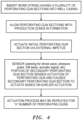
- the RFID pig 28 may be configured to sink (e.g., see FIG. 4 ).
- the perforating gun section 20 with the RFID reader 30 is positioned adjacent and gravitationally below the perforating gun section 20 configured with at least one RFID pig 28.
- the RFID pig 28 may be configured to float.
- the perforating gun section 20 with the RFID reader 30 is positioned adjacent and gravitationally above the perforating gun section 20 configured with at least one RFID tagged pig 28.
- some perforating gun sections 20 may include a mechanism for dispensing an RFID pig 28 and other perforating gun sections 20 may include an RFID reader 30.
- perforating gun sections 20 may be configured with both a mechanism for dispensing an RFID pig 28 and an RFID reader 30.
- actuation of the perforating gun section 20 with at least one RFID pig 28 causes the release of the RFID pig 28 (e.g., a "condition" of a perforating gun section actuation).
- the released RFID pig 28 passes (e.g., sinks down or floats up) through the work string 18 to a perforating gun section 20 with the RFID reader 30.
- the perforating gun section 20 with the RFID reader 30 reads the information stored within the RFID tag affixed to the RFID pig 28.
- the RFID reader (or a logic device receiving the information from the RFID reader) produces a signal to actuate the perforating gun section 20 with the RFID reader 30.
- the process of actuation, RFID pig 28 release, RFID reading, and subsequent actuation, can be repeated for a plurality of perforating gun sections 20.
- actuation of a perforating gun section 20 (other than perhaps an initial perforating gun section 20) can only occur upon actuation of a perforating gun section 20.
- the perforating gun section 20 may include a sensor 26 (as described above) configured to sense the actuation of a perforating gun section 20.
- the perforating gun section 20 with at least one RFID pig 28 operates to release the at least one RFID pig 28.
- the released RFID pig 28 passes (e.g., sinks down or floats up) through the work string 18 to the perforating gun section 20 with the RFID reader 30.
- the perforating gun section 20 with the RFID reader 30 Upon receipt of the RFID pig 28, the perforating gun section 20 with the RFID reader 30 reads the RFID pig 28 (as described above) and produces a signal to actuate the perforating gun section 20 with the RFID reader 30.
- the process of sensing, RFID pig 28 release, RFID reading, and subsequent actuation can be repeated for a plurality of perforating gun sections 20.
- actuation of a perforating gun section 20 can only occur upon actuation of a perforating gun section 20.
- prior art perforating gun assemblies that utilize blank gun sections configured with explosive boosters at both ends and explosive detonating cord there between, potentially have operational issues; e.g., stop-fires, substantial costs, etc.
- Other prior art perforating gun assemblies that utilize standard API tubing or drill pipe between loaded intervals, instead of blank guns, require each perforating gun section to have discreet firing heads. Depending on the type of firing head, these can be more expensive than utilizing blank gun sections and each has its own risk profile.
- the present disclosure overcomes these issues and provides a substantial improvement over the known prior art.
Landscapes
- Engineering & Computer Science (AREA)
- Life Sciences & Earth Sciences (AREA)
- Geology (AREA)
- Mining & Mineral Resources (AREA)
- Physics & Mathematics (AREA)
- Environmental & Geological Engineering (AREA)
- Fluid Mechanics (AREA)
- General Life Sciences & Earth Sciences (AREA)
- Geochemistry & Mineralogy (AREA)
- Remote Sensing (AREA)
- Geophysics (AREA)
- Application Of Or Painting With Fluid Materials (AREA)
Claims (18)
- Perforierkanonensystem zur Verwendung in einer Bohrlochverrohrung (14), die in einem unterirdischen Bohrloch angeordnet ist, wobei das Perforierkanonensystem Folgendes umfasst:
eine Vielzahl von Perforierkanonenabschnitten (20), die jeweils mindestens eine Hohlladung (24) aufweisen, wobei die Vielzahl von Perforierkanonenabschnitten (20) Folgendes einschließt:einen anfänglichen Perforierkanonenabschnitt (20A); undmindestens einen sekundären Perforierkanonenabschnitt (20B) mit einem Aktivator (22) und einem Sensor (26), der konfiguriert ist, um eine Betätigung eines anderen der Vielzahl von Perforierkanonenabschnitten (20) zu erfassen, wobei der Sensor (26) ferner konfiguriert ist, um mit dem Aktivator (22) zusammenzuarbeiten, um den mindestens einen sekundären Perforierkanonenabschnitt (20B) beim Erfassen der Betätigung des anderen der Vielzahl von Perforierkanonenabschnitten (20) zu betätigen,wobei der Sensor (26), der konfiguriert ist, um die Betätigung des anderen der Vielzahl von Perforierkanonenabschnitten (20) zu erfassen, ferner konfiguriert ist, um mindestens eines von einer Stoßwelle, einem Druckimpuls, einer EM-Welle oder einem akustischen Signal zu erfassen, das direkt durch die Betätigung des anderen der Vielzahl von Perforierkanonenabschnitten (20) erzeugt wird. - System nach Anspruch 1, wobei der anfängliche Perforierkanonenabschnitt (20A) konfiguriert ist, um durch einen externen Impuls betätigt zu werden.
- System nach Anspruch 1, wobei der mindestens eine sekundäre Perforierkanonenabschnitt (20B) einen Zeitverzögerungsmechanismus innerhalb eines Signalpfads zwischen dem Sensor und dem Aktivator (22) einschließt und konfiguriert ist, um die Betätigung des mindestens einen sekundären Perforierkanonenabschnitts (20B) zu verzögern.
- System nach Anspruch 1, wobei der anfängliche Perforierkanonenabschnitt (20A) konfiguriert ist, um bei Betätigung eine Kennung zu erzeugen, die für den anfänglichen Perforierkanonenabschnitt (20A) eindeutig ist.
- System nach Anspruch 4, wobei der mindestens eine sekundäre Perforierkanonenabschnitt (20B) einen ersten sekundären Perforierkanonenabschnitt umfasst und der erste sekundäre Perforierkanonenabschnitt konfiguriert ist, um sich bei Empfang der eindeutigen Kennung des anfänglichen Perforierkanonenabschnitts (20A) zu betätigen.
- System nach Anspruch 5, wobei der erste sekundäre Perforierkanonenabschnitt konfiguriert ist, um bei Betätigung eine zweite Kennung zu erzeugen, die für den ersten sekundären Perforierkanonenabschnitt eindeutig ist und sich von der eindeutigen Kennung des anfänglichen Perforierkanonenabschnitts (20A) unterscheidet, und wobei der mindestens eine sekundäre Perforierkanonenabschnitt (20B) ferner einen zweiten sekundären Perforierkanonenabschnitt umfasst und der zweite sekundäre Perforierkanonenabschnitt konfiguriert ist, um sich bei Empfang der eindeutigen zweiten Kennung des ersten sekundären Perforierkanonenabschnitts zu betätigen.
- System nach Anspruch 1, wobei der mindestens eine sekundäre Perforierkanonenabschnitt (20B) konfiguriert ist, um eine Anzahl von Perforierkanonenabschnittsbetätigungen zu zählen und sich zu betätigen, wenn die gezählte Anzahl von Perforierkanonenabschnittsbetätigungen gleich einer vorbestimmten Anzahl von Perforierkanonenabschnittsbetätigungen ist.
- Perforierkanonensystem nach Anspruch 1, wobei die Vielzahl von Perforierkanonenabschnitten (20) ferner Folgendes einschließt:einen ersten Perforierkanonenabschnitt mit mindestens einem RFID-Molch (28) und einem RFID-Molch-Freigabemechanismus, wobei der RFID-Molch-Freigabemechanismus konfiguriert ist, um den mindestens einen RFID-Molch (28) bei Betätigung des ersten Perforierkanonenabschnitts freizugeben,wobei der mindestens eine sekundäre Perforierkanonenabschnitt (20B) einen RFID-Leser (30) aufweist, wobei der RFID-Leser (30) konfiguriert ist, um Informationen von dem mindestens einen RFID-Molch (28) zu lesen, wobei der RFID-Leser (30) ferner konfiguriert ist, um mit dem Aktivator (22) zusammenzuarbeiten, um den sekundären Perforierkanonenabschnitt (20B) beim Lesen der Informationen von dem mindestens einen RFID-Molch (28) zu betätigen.
- System nach Anspruch 8, wobei die Vielzahl von Perforierkanonenabschnitten (20) so konfiguriert ist, dass sich der mindestens eine sekundäre Perforierkanonenabschnitt (20B) schwerkraftbedingt angrenzend an den ersten Perforierkanonenabschnitt befindet.
- System nach Anspruch 9, wobei der mindestens eine RFID-Molch (28) konfiguriert ist, um in einer Flüssigkeit des unterirdischen Bohrlochs zu schwimmen.
- System nach Anspruch 9, wobei der der mindestens eine RFID-Molch (28) konfiguriert ist, um in einer Flüssigkeit des unterirdischen Bohrlochs zu sinken.
- System nach Anspruch 8, wobei der mindestens eine sekundäre Perforierkanonenabschnitt (20B) mindestens einen sekundären RFID-Molch und einen sekundären RFID-Molch-Freigabemechanismus umfasst, der konfiguriert ist, um den mindestens einen sekundären RFID-Molch freizugeben.
- System nach Anspruch 12, wobei der sekundäre RFID-Molchfreigabemechanismus konfiguriert ist, um den mindestens einen sekundären RFID-Molch bei Betätigung des mindestens einen sekundären Perforierkanonenabschnitts (20B) freizugeben.
- System nach Anspruch 8, wobei der erste Perforierkanonenabschnitt ferner einen Sensor (26) umfasst, der konfiguriert ist, um eine Betätigung eines anderen der Vielzahl von Perforierkanonenabschnitten (20) zu erfassen, wobei der Sensor (26) ferner konfiguriert ist, um mit dem RFID-Molchfreigabemechanismus zusammenzuarbeiten, um den RFID-Molchfreigabemechanismus zu veranlassen, den mindestens einen RFID-Molch (28) bei Betätigung des anderen der Vielzahl von Perforierkanonenabschnitten (20) freizugeben.
- Verfahren zum Betätigen einer Vielzahl von Perforierkanonenabschnitten (20) eines Perforierkanonensystems für ein unterirdisches Bohrloch, wobei das Verfahren Folgendes umfasst:Einlegen eines Arbeitsstrangs (18), der eine Vielzahl von Perforierkanonenabschnitten (20) aufweist, von denen jeder mindestens eine Hohlladung (24) aufweist, in eine innerhalb des unterirdischen Bohrlochs angeordnete Bohrlochverrohrung (14), wobei die Vielzahl von Perforierkanonenabschnitten (20) einen ersten Perforierkanonenabschnitt und mindestens einen sekundären Perforierkanonenabschnitt (20B) mit einem Aktivator (22) und einem Sensor (26) umfasst;Ausrichten der Vielzahl von Perforierkanonenabschnitten (20) mit einer entsprechenden jeweiligen Vielzahl von Produktionsbereichen (13) innerhalb des unterirdischen Bohrlochs; undBetätigen der Vielzahl von Perforierkanonenabschnitten (20) durch Betätigen des ersten Perforierkanonenabschnitts über einen externen Impuls, sodass ein durch die Betätigung des ersten Perforierkanonenabschnitts verursachter Zustand durch den Sensor (26) erfasst wird, was den Aktivator (22) veranlasst, den mindestens einen sekundären Perforierkanonenabschnitt (20B) zu betätigen,wobei der Sensor (26) konfiguriert ist, um mindestens eines von einer Stoßwelle, einem Druckimpuls, einer EM-Welle oder einem akustisches Signal zu erfassen, das direkt durch die Betätigung des anderen der Vielzahl von Perforierkanonenabschnitten (20) erzeugt wird.
- Verfahren nach Anspruch 15, wobei das Betätigen der Vielzahl von Perforierkanonenabschnitten (20) das Erfassen einer Betätigung eines anderen der Vielzahl von Perforierkanonenabschnitten (20) mit dem Sensor (26) und das Betätigen des mindestens einen sekundären Perforierkanonenabschnitts (20B) beim Erfassen der Betätigung des anderen der Vielzahl von Perforierkanonenabschnitten (20) einschließt.
- Verfahren nach Anspruch 15, wobei das Betätigen des anfänglichen Perforierkanonenabschnitts (20A) Folgendes einschließt:Freigeben mindestens eines RFID-Molchs (28) mit einem RFID-Molch-Freigabemechanismus des ersten Perforierkanonenabschnitts bei Betätigung des ersten Perforierkanonenabschnitts; undLesen von Informationen von dem mindestens einen RFID-Molch (28) mit einem RFID-Leser (30) des mindestens einen sekundären Perforierkanonenabschnitts (20B) und Betätigen des mindestens einen sekundären Perforierkanonenabschnitts (20B) beim Lesen der Informationen von dem mindestens einen RFID-Molch (28), wobei der Sensor des mindestens einen sekundären Perforierkanonenabschnitts (20B) den RFID-Leser (30) umfasst.
- Verfahren nach Anspruch 15, wobei die Vielzahl von Perforierkanonenabschnitten (20) des Arbeitsstrangs (18) entweder eine Top-Down-Abfeuerungsfolge oder eine Bottom-Up-Abfeuerungsfolge aufweist.
Applications Claiming Priority (2)
| Application Number | Priority Date | Filing Date | Title |
|---|---|---|---|
| US201962880747P | 2019-07-31 | 2019-07-31 | |
| PCT/US2020/044227 WO2021022025A1 (en) | 2019-07-31 | 2020-07-30 | Perforating gun and system and method for using the same |
Publications (2)
| Publication Number | Publication Date |
|---|---|
| EP4004335A1 EP4004335A1 (de) | 2022-06-01 |
| EP4004335B1 true EP4004335B1 (de) | 2023-05-24 |
Family
ID=72088377
Family Applications (1)
| Application Number | Title | Priority Date | Filing Date |
|---|---|---|---|
| EP20757446.8A Active EP4004335B1 (de) | 2019-07-31 | 2020-07-30 | Perforierpistole und system und verfahren zu ihrer verwendung |
Country Status (4)
| Country | Link |
|---|---|
| US (1) | US11280167B2 (de) |
| EP (1) | EP4004335B1 (de) |
| CA (1) | CA3144643A1 (de) |
| WO (1) | WO2021022025A1 (de) |
Families Citing this family (1)
| Publication number | Priority date | Publication date | Assignee | Title |
|---|---|---|---|---|
| CA3144643A1 (en) * | 2019-07-31 | 2021-02-04 | Kerry G. DALY | Perforating gun and system and method for using the same |
Family Cites Families (12)
| Publication number | Priority date | Publication date | Assignee | Title |
|---|---|---|---|---|
| US5287924A (en) | 1992-08-28 | 1994-02-22 | Halliburton Company | Tubing conveyed selective fired perforating systems |
| US6536524B1 (en) * | 1999-04-27 | 2003-03-25 | Marathon Oil Company | Method and system for performing a casing conveyed perforating process and other operations in wells |
| US8079296B2 (en) * | 2005-03-01 | 2011-12-20 | Owen Oil Tools Lp | Device and methods for firing perforating guns |
| US8540027B2 (en) * | 2006-08-31 | 2013-09-24 | Geodynamics, Inc. | Method and apparatus for selective down hole fluid communication |
| US9500071B2 (en) * | 2012-12-03 | 2016-11-22 | Halliburton Energy Services, Inc. | Extendable orienting tool for use in wells |
| US20150075770A1 (en) * | 2013-05-31 | 2015-03-19 | Michael Linley Fripp | Wireless activation of wellbore tools |
| US9896920B2 (en) * | 2014-03-26 | 2018-02-20 | Superior Energy Services, Llc | Stimulation methods and apparatuses utilizing downhole tools |
| GB2544247B (en) * | 2016-09-26 | 2018-01-31 | Guardian Global Tech Limited | Downhole firing tool |
| CN106837265B (zh) * | 2017-01-17 | 2023-12-29 | 成都众智诚成石油科技有限公司 | 一种新的井下套管射孔方法 |
| US10443361B2 (en) * | 2017-03-27 | 2019-10-15 | IdeasCo LLC | Multi-shot charge for perforating gun |
| US11346168B2 (en) * | 2018-12-20 | 2022-05-31 | Schlumberger Technology Corporation | Self-propelling perforating gun system |
| CA3144643A1 (en) * | 2019-07-31 | 2021-02-04 | Kerry G. DALY | Perforating gun and system and method for using the same |
-
2020
- 2020-07-30 CA CA3144643A patent/CA3144643A1/en active Pending
- 2020-07-30 US US16/943,503 patent/US11280167B2/en not_active Expired - Fee Related
- 2020-07-30 EP EP20757446.8A patent/EP4004335B1/de active Active
- 2020-07-30 WO PCT/US2020/044227 patent/WO2021022025A1/en not_active Ceased
Also Published As
| Publication number | Publication date |
|---|---|
| EP4004335A1 (de) | 2022-06-01 |
| CA3144643A1 (en) | 2021-02-04 |
| WO2021022025A1 (en) | 2021-02-04 |
| US20210032962A1 (en) | 2021-02-04 |
| US11280167B2 (en) | 2022-03-22 |
Similar Documents
| Publication | Publication Date | Title |
|---|---|---|
| US8672031B2 (en) | Perforating with wired drill pipe | |
| US8540021B2 (en) | Release assembly for a downhole tool string and method for use thereof | |
| EP1853792B1 (de) | Vorrichtung und verfahren zum abschiessen von perforationskanonen | |
| EP0974066B1 (de) | Kommunikations- und steurungssystem mit verwendung von impulsen hoher intensität | |
| RU2493358C2 (ru) | Беспроводное инициирование скважинного перфоратора | |
| CA2451231C (en) | Method and apparatus for detonating an explosive charge | |
| US20170314372A1 (en) | System and Method for Autonomous Tools | |
| US20170167233A1 (en) | System and Method for Perforating a Wellbore | |
| EP2434092A2 (de) | Vorrichtung und Verfahren zum Aufbrechen von Teilen einer Erdformation | |
| US11319772B2 (en) | Elimination of perofration process in plug and perf with downhole electronic sleeves | |
| EA030072B1 (ru) | Способ автоматического управления и позиционирования автономных скважинных инструментов | |
| SG190376A1 (en) | Autonomous downhole conveyance system | |
| US8496065B2 (en) | Release assembly for a downhole tool string | |
| US20220065080A1 (en) | Behind casing well perforating and isolation system and related methods | |
| US20040144539A1 (en) | Apparatus and method to mechanically orient perforating systems in a well | |
| EP4004335B1 (de) | Perforierpistole und system und verfahren zu ihrer verwendung | |
| US11105188B2 (en) | Perforation tool and methods of use | |
| US11268356B2 (en) | Casing conveyed, externally mounted perforation concept | |
| US11136867B2 (en) | Perforating gun | |
| King | Perforating the horizontal well | |
| US20200003024A1 (en) | Casing conveyed, externally mounted perforation concept | |
| Shumakov et al. | Acoustic firing for intelligent reservoir perforation | |
| Taylor et al. | A New Electronic Firing Head for Slickline Explosive Services | |
| US11384627B2 (en) | System and method for firing a charge in a well tool | |
| WO2017173374A1 (en) | Method and apparatus for hydraulic fracturing |
Legal Events
| Date | Code | Title | Description |
|---|---|---|---|
| STAA | Information on the status of an ep patent application or granted ep patent |
Free format text: STATUS: UNKNOWN |
|
| STAA | Information on the status of an ep patent application or granted ep patent |
Free format text: STATUS: THE INTERNATIONAL PUBLICATION HAS BEEN MADE |
|
| PUAI | Public reference made under article 153(3) epc to a published international application that has entered the european phase |
Free format text: ORIGINAL CODE: 0009012 |
|
| STAA | Information on the status of an ep patent application or granted ep patent |
Free format text: STATUS: REQUEST FOR EXAMINATION WAS MADE |
|
| 17P | Request for examination filed |
Effective date: 20220125 |
|
| AK | Designated contracting states |
Kind code of ref document: A1 Designated state(s): AL AT BE BG CH CY CZ DE DK EE ES FI FR GB GR HR HU IE IS IT LI LT LU LV MC MK MT NL NO PL PT RO RS SE SI SK SM TR |
|
| DAV | Request for validation of the european patent (deleted) | ||
| DAX | Request for extension of the european patent (deleted) | ||
| GRAP | Despatch of communication of intention to grant a patent |
Free format text: ORIGINAL CODE: EPIDOSNIGR1 |
|
| STAA | Information on the status of an ep patent application or granted ep patent |
Free format text: STATUS: GRANT OF PATENT IS INTENDED |
|
| INTG | Intention to grant announced |
Effective date: 20221214 |
|
| GRAS | Grant fee paid |
Free format text: ORIGINAL CODE: EPIDOSNIGR3 |
|
| GRAA | (expected) grant |
Free format text: ORIGINAL CODE: 0009210 |
|
| STAA | Information on the status of an ep patent application or granted ep patent |
Free format text: STATUS: THE PATENT HAS BEEN GRANTED |
|
| AK | Designated contracting states |
Kind code of ref document: B1 Designated state(s): AL AT BE BG CH CY CZ DE DK EE ES FI FR GB GR HR HU IE IS IT LI LT LU LV MC MK MT NL NO PL PT RO RS SE SI SK SM TR |
|
| RAP3 | Party data changed (applicant data changed or rights of an application transferred) |
Owner name: EXPRO AMERICAS LLC |
|
| REG | Reference to a national code |
Ref country code: GB Ref legal event code: FG4D |
|
| REG | Reference to a national code |
Ref country code: CH Ref legal event code: EP |
|
| REG | Reference to a national code |
Ref country code: DE Ref legal event code: R096 Ref document number: 602020011160 Country of ref document: DE |
|
| REG | Reference to a national code |
Ref country code: AT Ref legal event code: REF Ref document number: 1569588 Country of ref document: AT Kind code of ref document: T Effective date: 20230615 |
|
| P01 | Opt-out of the competence of the unified patent court (upc) registered |
Effective date: 20230512 |
|
| REG | Reference to a national code |
Ref country code: IE Ref legal event code: FG4D |
|
| REG | Reference to a national code |
Ref country code: NO Ref legal event code: T2 Effective date: 20230524 |
|
| REG | Reference to a national code |
Ref country code: LT Ref legal event code: MG9D |
|
| REG | Reference to a national code |
Ref country code: NL Ref legal event code: MP Effective date: 20230524 |
|
| REG | Reference to a national code |
Ref country code: AT Ref legal event code: MK05 Ref document number: 1569588 Country of ref document: AT Kind code of ref document: T Effective date: 20230524 |
|
| PG25 | Lapsed in a contracting state [announced via postgrant information from national office to epo] |
Ref country code: SE Free format text: LAPSE BECAUSE OF FAILURE TO SUBMIT A TRANSLATION OF THE DESCRIPTION OR TO PAY THE FEE WITHIN THE PRESCRIBED TIME-LIMIT Effective date: 20230524 Ref country code: PT Free format text: LAPSE BECAUSE OF FAILURE TO SUBMIT A TRANSLATION OF THE DESCRIPTION OR TO PAY THE FEE WITHIN THE PRESCRIBED TIME-LIMIT Effective date: 20230925 Ref country code: NL Free format text: LAPSE BECAUSE OF FAILURE TO SUBMIT A TRANSLATION OF THE DESCRIPTION OR TO PAY THE FEE WITHIN THE PRESCRIBED TIME-LIMIT Effective date: 20230524 Ref country code: ES Free format text: LAPSE BECAUSE OF FAILURE TO SUBMIT A TRANSLATION OF THE DESCRIPTION OR TO PAY THE FEE WITHIN THE PRESCRIBED TIME-LIMIT Effective date: 20230524 Ref country code: AT Free format text: LAPSE BECAUSE OF FAILURE TO SUBMIT A TRANSLATION OF THE DESCRIPTION OR TO PAY THE FEE WITHIN THE PRESCRIBED TIME-LIMIT Effective date: 20230524 |
|
| PG25 | Lapsed in a contracting state [announced via postgrant information from national office to epo] |
Ref country code: RS Free format text: LAPSE BECAUSE OF FAILURE TO SUBMIT A TRANSLATION OF THE DESCRIPTION OR TO PAY THE FEE WITHIN THE PRESCRIBED TIME-LIMIT Effective date: 20230524 Ref country code: PL Free format text: LAPSE BECAUSE OF FAILURE TO SUBMIT A TRANSLATION OF THE DESCRIPTION OR TO PAY THE FEE WITHIN THE PRESCRIBED TIME-LIMIT Effective date: 20230524 Ref country code: LV Free format text: LAPSE BECAUSE OF FAILURE TO SUBMIT A TRANSLATION OF THE DESCRIPTION OR TO PAY THE FEE WITHIN THE PRESCRIBED TIME-LIMIT Effective date: 20230524 Ref country code: LT Free format text: LAPSE BECAUSE OF FAILURE TO SUBMIT A TRANSLATION OF THE DESCRIPTION OR TO PAY THE FEE WITHIN THE PRESCRIBED TIME-LIMIT Effective date: 20230524 Ref country code: IS Free format text: LAPSE BECAUSE OF FAILURE TO SUBMIT A TRANSLATION OF THE DESCRIPTION OR TO PAY THE FEE WITHIN THE PRESCRIBED TIME-LIMIT Effective date: 20230924 Ref country code: HR Free format text: LAPSE BECAUSE OF FAILURE TO SUBMIT A TRANSLATION OF THE DESCRIPTION OR TO PAY THE FEE WITHIN THE PRESCRIBED TIME-LIMIT Effective date: 20230524 Ref country code: GR Free format text: LAPSE BECAUSE OF FAILURE TO SUBMIT A TRANSLATION OF THE DESCRIPTION OR TO PAY THE FEE WITHIN THE PRESCRIBED TIME-LIMIT Effective date: 20230825 |
|
| PG25 | Lapsed in a contracting state [announced via postgrant information from national office to epo] |
Ref country code: FI Free format text: LAPSE BECAUSE OF FAILURE TO SUBMIT A TRANSLATION OF THE DESCRIPTION OR TO PAY THE FEE WITHIN THE PRESCRIBED TIME-LIMIT Effective date: 20230524 |
|
| PG25 | Lapsed in a contracting state [announced via postgrant information from national office to epo] |
Ref country code: SK Free format text: LAPSE BECAUSE OF FAILURE TO SUBMIT A TRANSLATION OF THE DESCRIPTION OR TO PAY THE FEE WITHIN THE PRESCRIBED TIME-LIMIT Effective date: 20230524 |
|
| PG25 | Lapsed in a contracting state [announced via postgrant information from national office to epo] |
Ref country code: SM Free format text: LAPSE BECAUSE OF FAILURE TO SUBMIT A TRANSLATION OF THE DESCRIPTION OR TO PAY THE FEE WITHIN THE PRESCRIBED TIME-LIMIT Effective date: 20230524 Ref country code: SK Free format text: LAPSE BECAUSE OF FAILURE TO SUBMIT A TRANSLATION OF THE DESCRIPTION OR TO PAY THE FEE WITHIN THE PRESCRIBED TIME-LIMIT Effective date: 20230524 Ref country code: RO Free format text: LAPSE BECAUSE OF FAILURE TO SUBMIT A TRANSLATION OF THE DESCRIPTION OR TO PAY THE FEE WITHIN THE PRESCRIBED TIME-LIMIT Effective date: 20230524 Ref country code: EE Free format text: LAPSE BECAUSE OF FAILURE TO SUBMIT A TRANSLATION OF THE DESCRIPTION OR TO PAY THE FEE WITHIN THE PRESCRIBED TIME-LIMIT Effective date: 20230524 Ref country code: DK Free format text: LAPSE BECAUSE OF FAILURE TO SUBMIT A TRANSLATION OF THE DESCRIPTION OR TO PAY THE FEE WITHIN THE PRESCRIBED TIME-LIMIT Effective date: 20230524 Ref country code: CZ Free format text: LAPSE BECAUSE OF FAILURE TO SUBMIT A TRANSLATION OF THE DESCRIPTION OR TO PAY THE FEE WITHIN THE PRESCRIBED TIME-LIMIT Effective date: 20230524 |
|
| REG | Reference to a national code |
Ref country code: DE Ref legal event code: R119 Ref document number: 602020011160 Country of ref document: DE |
|
| PG25 | Lapsed in a contracting state [announced via postgrant information from national office to epo] |
Ref country code: MC Free format text: LAPSE BECAUSE OF FAILURE TO SUBMIT A TRANSLATION OF THE DESCRIPTION OR TO PAY THE FEE WITHIN THE PRESCRIBED TIME-LIMIT Effective date: 20230524 |
|
| PG25 | Lapsed in a contracting state [announced via postgrant information from national office to epo] |
Ref country code: MC Free format text: LAPSE BECAUSE OF FAILURE TO SUBMIT A TRANSLATION OF THE DESCRIPTION OR TO PAY THE FEE WITHIN THE PRESCRIBED TIME-LIMIT Effective date: 20230524 |
|
| REG | Reference to a national code |
Ref country code: CH Ref legal event code: PL |
|
| REG | Reference to a national code |
Ref country code: BE Ref legal event code: MM Effective date: 20230731 |
|
| PG25 | Lapsed in a contracting state [announced via postgrant information from national office to epo] |
Ref country code: LU Free format text: LAPSE BECAUSE OF NON-PAYMENT OF DUE FEES Effective date: 20230730 |
|
| PG25 | Lapsed in a contracting state [announced via postgrant information from national office to epo] |
Ref country code: LU Free format text: LAPSE BECAUSE OF NON-PAYMENT OF DUE FEES Effective date: 20230730 |
|
| PLBE | No opposition filed within time limit |
Free format text: ORIGINAL CODE: 0009261 |
|
| STAA | Information on the status of an ep patent application or granted ep patent |
Free format text: STATUS: NO OPPOSITION FILED WITHIN TIME LIMIT |
|
| REG | Reference to a national code |
Ref country code: IE Ref legal event code: MM4A |
|
| PG25 | Lapsed in a contracting state [announced via postgrant information from national office to epo] |
Ref country code: DE Free format text: LAPSE BECAUSE OF NON-PAYMENT OF DUE FEES Effective date: 20240201 Ref country code: CH Free format text: LAPSE BECAUSE OF NON-PAYMENT OF DUE FEES Effective date: 20230731 |
|
| 26N | No opposition filed |
Effective date: 20240227 |
|
| PG25 | Lapsed in a contracting state [announced via postgrant information from national office to epo] |
Ref country code: SI Free format text: LAPSE BECAUSE OF FAILURE TO SUBMIT A TRANSLATION OF THE DESCRIPTION OR TO PAY THE FEE WITHIN THE PRESCRIBED TIME-LIMIT Effective date: 20230524 |
|
| PG25 | Lapsed in a contracting state [announced via postgrant information from national office to epo] |
Ref country code: SI Free format text: LAPSE BECAUSE OF FAILURE TO SUBMIT A TRANSLATION OF THE DESCRIPTION OR TO PAY THE FEE WITHIN THE PRESCRIBED TIME-LIMIT Effective date: 20230524 Ref country code: IT Free format text: LAPSE BECAUSE OF FAILURE TO SUBMIT A TRANSLATION OF THE DESCRIPTION OR TO PAY THE FEE WITHIN THE PRESCRIBED TIME-LIMIT Effective date: 20230524 Ref country code: FR Free format text: LAPSE BECAUSE OF NON-PAYMENT OF DUE FEES Effective date: 20230731 Ref country code: BE Free format text: LAPSE BECAUSE OF NON-PAYMENT OF DUE FEES Effective date: 20230731 |
|
| PG25 | Lapsed in a contracting state [announced via postgrant information from national office to epo] |
Ref country code: IE Free format text: LAPSE BECAUSE OF NON-PAYMENT OF DUE FEES Effective date: 20230730 |
|
| PG25 | Lapsed in a contracting state [announced via postgrant information from national office to epo] |
Ref country code: IE Free format text: LAPSE BECAUSE OF NON-PAYMENT OF DUE FEES Effective date: 20230730 |
|
| PG25 | Lapsed in a contracting state [announced via postgrant information from national office to epo] |
Ref country code: BG Free format text: LAPSE BECAUSE OF FAILURE TO SUBMIT A TRANSLATION OF THE DESCRIPTION OR TO PAY THE FEE WITHIN THE PRESCRIBED TIME-LIMIT Effective date: 20230524 |
|
| PG25 | Lapsed in a contracting state [announced via postgrant information from national office to epo] |
Ref country code: BG Free format text: LAPSE BECAUSE OF FAILURE TO SUBMIT A TRANSLATION OF THE DESCRIPTION OR TO PAY THE FEE WITHIN THE PRESCRIBED TIME-LIMIT Effective date: 20230524 |
|
| PGFP | Annual fee paid to national office [announced via postgrant information from national office to epo] |
Ref country code: GB Payment date: 20250605 Year of fee payment: 6 |
|
| PG25 | Lapsed in a contracting state [announced via postgrant information from national office to epo] |
Ref country code: CY Free format text: LAPSE BECAUSE OF FAILURE TO SUBMIT A TRANSLATION OF THE DESCRIPTION OR TO PAY THE FEE WITHIN THE PRESCRIBED TIME-LIMIT; INVALID AB INITIO Effective date: 20200730 |
|
| PG25 | Lapsed in a contracting state [announced via postgrant information from national office to epo] |
Ref country code: HU Free format text: LAPSE BECAUSE OF FAILURE TO SUBMIT A TRANSLATION OF THE DESCRIPTION OR TO PAY THE FEE WITHIN THE PRESCRIBED TIME-LIMIT; INVALID AB INITIO Effective date: 20200730 |
|
| PGFP | Annual fee paid to national office [announced via postgrant information from national office to epo] |
Ref country code: NO Payment date: 20250709 Year of fee payment: 6 |
|
| PG25 | Lapsed in a contracting state [announced via postgrant information from national office to epo] |
Ref country code: TR Free format text: LAPSE BECAUSE OF FAILURE TO SUBMIT A TRANSLATION OF THE DESCRIPTION OR TO PAY THE FEE WITHIN THE PRESCRIBED TIME-LIMIT Effective date: 20230524 |