EP4004579B1 - System und verfahren zur wifi-basierten lokalisierung in innenräumen über unüberwachte domänenanpassung - Google Patents
System und verfahren zur wifi-basierten lokalisierung in innenräumen über unüberwachte domänenanpassung Download PDFInfo
- Publication number
- EP4004579B1 EP4004579B1 EP20871681.1A EP20871681A EP4004579B1 EP 4004579 B1 EP4004579 B1 EP 4004579B1 EP 20871681 A EP20871681 A EP 20871681A EP 4004579 B1 EP4004579 B1 EP 4004579B1
- Authority
- EP
- European Patent Office
- Prior art keywords
- person
- fingerprint
- data
- layers
- location label
- Prior art date
- Legal status (The legal status is an assumption and is not a legal conclusion. Google has not performed a legal analysis and makes no representation as to the accuracy of the status listed.)
- Active
Links
Images






Classifications
-
- G—PHYSICS
- G06—COMPUTING OR CALCULATING; COUNTING
- G06Q—INFORMATION AND COMMUNICATION TECHNOLOGY [ICT] SPECIALLY ADAPTED FOR ADMINISTRATIVE, COMMERCIAL, FINANCIAL, MANAGERIAL OR SUPERVISORY PURPOSES; SYSTEMS OR METHODS SPECIALLY ADAPTED FOR ADMINISTRATIVE, COMMERCIAL, FINANCIAL, MANAGERIAL OR SUPERVISORY PURPOSES, NOT OTHERWISE PROVIDED FOR
- G06Q30/00—Commerce
- G06Q30/02—Marketing; Price estimation or determination; Fundraising
- G06Q30/0241—Advertisements
- G06Q30/0251—Targeted advertisements
- G06Q30/0261—Targeted advertisements based on user location
-
- H—ELECTRICITY
- H04—ELECTRIC COMMUNICATION TECHNIQUE
- H04W—WIRELESS COMMUNICATION NETWORKS
- H04W4/00—Services specially adapted for wireless communication networks; Facilities therefor
- H04W4/02—Services making use of location information
-
- G—PHYSICS
- G06—COMPUTING OR CALCULATING; COUNTING
- G06F—ELECTRIC DIGITAL DATA PROCESSING
- G06F18/00—Pattern recognition
- G06F18/20—Analysing
- G06F18/21—Design or setup of recognition systems or techniques; Extraction of features in feature space; Blind source separation
- G06F18/214—Generating training patterns; Bootstrap methods, e.g. bagging or boosting
- G06F18/2155—Generating training patterns; Bootstrap methods, e.g. bagging or boosting characterised by the incorporation of unlabelled data, e.g. multiple instance learning [MIL], semi-supervised techniques using expectation-maximisation [EM] or naïve labelling
-
- G—PHYSICS
- G06—COMPUTING OR CALCULATING; COUNTING
- G06F—ELECTRIC DIGITAL DATA PROCESSING
- G06F18/00—Pattern recognition
- G06F18/20—Analysing
- G06F18/24—Classification techniques
- G06F18/241—Classification techniques relating to the classification model, e.g. parametric or non-parametric approaches
- G06F18/2413—Classification techniques relating to the classification model, e.g. parametric or non-parametric approaches based on distances to training or reference patterns
- G06F18/24133—Distances to prototypes
- G06F18/24137—Distances to cluster centroïds
- G06F18/2414—Smoothing the distance, e.g. radial basis function networks [RBFN]
-
- G—PHYSICS
- G06—COMPUTING OR CALCULATING; COUNTING
- G06F—ELECTRIC DIGITAL DATA PROCESSING
- G06F21/00—Security arrangements for protecting computers, components thereof, programs or data against unauthorised activity
- G06F21/30—Authentication, i.e. establishing the identity or authorisation of security principals
- G06F21/31—User authentication
-
- G—PHYSICS
- G06—COMPUTING OR CALCULATING; COUNTING
- G06N—COMPUTING ARRANGEMENTS BASED ON SPECIFIC COMPUTATIONAL MODELS
- G06N3/00—Computing arrangements based on biological models
- G06N3/02—Neural networks
- G06N3/04—Architecture, e.g. interconnection topology
-
- G—PHYSICS
- G06—COMPUTING OR CALCULATING; COUNTING
- G06N—COMPUTING ARRANGEMENTS BASED ON SPECIFIC COMPUTATIONAL MODELS
- G06N3/00—Computing arrangements based on biological models
- G06N3/02—Neural networks
- G06N3/04—Architecture, e.g. interconnection topology
- G06N3/045—Combinations of networks
-
- G—PHYSICS
- G06—COMPUTING OR CALCULATING; COUNTING
- G06N—COMPUTING ARRANGEMENTS BASED ON SPECIFIC COMPUTATIONAL MODELS
- G06N3/00—Computing arrangements based on biological models
- G06N3/02—Neural networks
- G06N3/04—Architecture, e.g. interconnection topology
- G06N3/045—Combinations of networks
- G06N3/0455—Auto-encoder networks; Encoder-decoder networks
-
- G—PHYSICS
- G06—COMPUTING OR CALCULATING; COUNTING
- G06N—COMPUTING ARRANGEMENTS BASED ON SPECIFIC COMPUTATIONAL MODELS
- G06N3/00—Computing arrangements based on biological models
- G06N3/02—Neural networks
- G06N3/04—Architecture, e.g. interconnection topology
- G06N3/0475—Generative networks
-
- G—PHYSICS
- G06—COMPUTING OR CALCULATING; COUNTING
- G06N—COMPUTING ARRANGEMENTS BASED ON SPECIFIC COMPUTATIONAL MODELS
- G06N3/00—Computing arrangements based on biological models
- G06N3/02—Neural networks
- G06N3/04—Architecture, e.g. interconnection topology
- G06N3/048—Activation functions
-
- G—PHYSICS
- G06—COMPUTING OR CALCULATING; COUNTING
- G06N—COMPUTING ARRANGEMENTS BASED ON SPECIFIC COMPUTATIONAL MODELS
- G06N3/00—Computing arrangements based on biological models
- G06N3/02—Neural networks
- G06N3/04—Architecture, e.g. interconnection topology
- G06N3/0499—Feedforward networks
-
- G—PHYSICS
- G06—COMPUTING OR CALCULATING; COUNTING
- G06N—COMPUTING ARRANGEMENTS BASED ON SPECIFIC COMPUTATIONAL MODELS
- G06N3/00—Computing arrangements based on biological models
- G06N3/02—Neural networks
- G06N3/08—Learning methods
-
- G—PHYSICS
- G06—COMPUTING OR CALCULATING; COUNTING
- G06N—COMPUTING ARRANGEMENTS BASED ON SPECIFIC COMPUTATIONAL MODELS
- G06N3/00—Computing arrangements based on biological models
- G06N3/02—Neural networks
- G06N3/08—Learning methods
- G06N3/088—Non-supervised learning, e.g. competitive learning
-
- G—PHYSICS
- G06—COMPUTING OR CALCULATING; COUNTING
- G06N—COMPUTING ARRANGEMENTS BASED ON SPECIFIC COMPUTATIONAL MODELS
- G06N3/00—Computing arrangements based on biological models
- G06N3/02—Neural networks
- G06N3/08—Learning methods
- G06N3/0895—Weakly supervised learning, e.g. semi-supervised or self-supervised learning
-
- G—PHYSICS
- G06—COMPUTING OR CALCULATING; COUNTING
- G06N—COMPUTING ARRANGEMENTS BASED ON SPECIFIC COMPUTATIONAL MODELS
- G06N3/00—Computing arrangements based on biological models
- G06N3/02—Neural networks
- G06N3/08—Learning methods
- G06N3/09—Supervised learning
-
- G—PHYSICS
- G06—COMPUTING OR CALCULATING; COUNTING
- G06N—COMPUTING ARRANGEMENTS BASED ON SPECIFIC COMPUTATIONAL MODELS
- G06N3/00—Computing arrangements based on biological models
- G06N3/02—Neural networks
- G06N3/08—Learning methods
- G06N3/096—Transfer learning
-
- G—PHYSICS
- G06—COMPUTING OR CALCULATING; COUNTING
- G06Q—INFORMATION AND COMMUNICATION TECHNOLOGY [ICT] SPECIALLY ADAPTED FOR ADMINISTRATIVE, COMMERCIAL, FINANCIAL, MANAGERIAL OR SUPERVISORY PURPOSES; SYSTEMS OR METHODS SPECIALLY ADAPTED FOR ADMINISTRATIVE, COMMERCIAL, FINANCIAL, MANAGERIAL OR SUPERVISORY PURPOSES, NOT OTHERWISE PROVIDED FOR
- G06Q30/00—Commerce
- G06Q30/02—Marketing; Price estimation or determination; Fundraising
- G06Q30/0241—Advertisements
- G06Q30/0251—Targeted advertisements
- G06Q30/0267—Wireless devices
-
- H—ELECTRICITY
- H04—ELECTRIC COMMUNICATION TECHNIQUE
- H04R—LOUDSPEAKERS, MICROPHONES, GRAMOPHONE PICK-UPS OR LIKE ACOUSTIC ELECTROMECHANICAL TRANSDUCERS; ELECTRIC HEARING AIDS; PUBLIC ADDRESS SYSTEMS
- H04R1/00—Details of transducers, loudspeakers or microphones
- H04R1/20—Arrangements for obtaining desired frequency or directional characteristics
- H04R1/32—Arrangements for obtaining desired frequency or directional characteristics for obtaining desired directional characteristic only
-
- H—ELECTRICITY
- H04—ELECTRIC COMMUNICATION TECHNIQUE
- H04R—LOUDSPEAKERS, MICROPHONES, GRAMOPHONE PICK-UPS OR LIKE ACOUSTIC ELECTROMECHANICAL TRANSDUCERS; ELECTRIC HEARING AIDS; PUBLIC ADDRESS SYSTEMS
- H04R3/00—Circuits for transducers
- H04R3/12—Circuits for transducers for distributing signals to two or more loudspeakers
-
- H—ELECTRICITY
- H04—ELECTRIC COMMUNICATION TECHNIQUE
- H04W—WIRELESS COMMUNICATION NETWORKS
- H04W4/00—Services specially adapted for wireless communication networks; Facilities therefor
- H04W4/02—Services making use of location information
- H04W4/021—Services related to particular areas, e.g. point of interest [POI] services, venue services or geofences
-
- H—ELECTRICITY
- H04—ELECTRIC COMMUNICATION TECHNIQUE
- H04W—WIRELESS COMMUNICATION NETWORKS
- H04W4/00—Services specially adapted for wireless communication networks; Facilities therefor
- H04W4/02—Services making use of location information
- H04W4/029—Location-based management or tracking services
-
- H—ELECTRICITY
- H04—ELECTRIC COMMUNICATION TECHNIQUE
- H04W—WIRELESS COMMUNICATION NETWORKS
- H04W4/00—Services specially adapted for wireless communication networks; Facilities therefor
- H04W4/30—Services specially adapted for particular environments, situations or purposes
- H04W4/33—Services specially adapted for particular environments, situations or purposes for indoor environments, e.g. buildings
-
- H—ELECTRICITY
- H04—ELECTRIC COMMUNICATION TECHNIQUE
- H04W—WIRELESS COMMUNICATION NETWORKS
- H04W64/00—Locating users or terminals or network equipment for network management purposes, e.g. mobility management
- H04W64/006—Locating users or terminals or network equipment for network management purposes, e.g. mobility management with additional information processing, e.g. for direction or speed determination
-
- G—PHYSICS
- G06—COMPUTING OR CALCULATING; COUNTING
- G06F—ELECTRIC DIGITAL DATA PROCESSING
- G06F1/00—Details not covered by groups G06F3/00 - G06F13/00 and G06F21/00
- G06F1/26—Power supply means, e.g. regulation thereof
- G06F1/32—Means for saving power
- G06F1/3203—Power management, i.e. event-based initiation of a power-saving mode
- G06F1/3206—Monitoring of events, devices or parameters that trigger a change in power modality
- G06F1/3231—Monitoring the presence, absence or movement of users
-
- G—PHYSICS
- G06—COMPUTING OR CALCULATING; COUNTING
- G06F—ELECTRIC DIGITAL DATA PROCESSING
- G06F2218/00—Aspects of pattern recognition specially adapted for signal processing
- G06F2218/22—Source localisation; Inverse modelling
-
- H—ELECTRICITY
- H04—ELECTRIC COMMUNICATION TECHNIQUE
- H04R—LOUDSPEAKERS, MICROPHONES, GRAMOPHONE PICK-UPS OR LIKE ACOUSTIC ELECTROMECHANICAL TRANSDUCERS; ELECTRIC HEARING AIDS; PUBLIC ADDRESS SYSTEMS
- H04R2430/00—Signal processing covered by H04R, not provided for in its groups
- H04R2430/20—Processing of the output signals of the acoustic transducers of an array for obtaining a desired directivity characteristic
-
- H—ELECTRICITY
- H04—ELECTRIC COMMUNICATION TECHNIQUE
- H04W—WIRELESS COMMUNICATION NETWORKS
- H04W84/00—Network topologies
- H04W84/02—Hierarchically pre-organised networks, e.g. paging networks, cellular networks, WLAN [Wireless Local Area Network] or WLL [Wireless Local Loop]
- H04W84/10—Small scale networks; Flat hierarchical networks
- H04W84/12—WLAN [Wireless Local Area Networks]
Definitions
- the disclosure relates to location-aware applications, and more particularly, an electronic device for location-aware applications and an operating method thereof.
- Some embodiments relate to WiFi (also called “Wi-Fi” in the communications industry).
- Location-aware applications can provide convenience and also infotainment. Current applications estimate user locations at granularities exceeding one meter. Location sources are sometimes unavailable indoor (e.g., GPS) or coarse-grained (e.g., user check-ins). WiFi signals are sometimes used for localization systems. WiFi characteristics are also sensitive to 1) the body shapes of different users, and 2) the objects in the background environment. Consequently, systems based on WiFi fingerprints are vulnerable in the presence of 1) new users with different body shapes, and 2) daily changes of the environment, e.g., opening/closing doors. M. Mohammadi, A. Al-Fuqaha, M. Guizani and J. -S.
- a method of location determination by a system including an electronic device with a WiFi transceiver and a neural network based AI model comprises: receiving, via the WiFi transceiver, a first fingerprint associated with a first person in a first environment, wherein the first person is not a registered user of the system; obtaining, using a shared feature extraction layer of the neural network based AI model and based on operating on the first fingerprint, a first set of feature data; determining, using a reconstruction layer of the neural network based AI model and based on the first set of feature data from the shared feature extraction layer, a reconstruction loss associated with the first person and the first fingerprint; when the reconstruction loss is at or below a threshold: classifying, using a classification layer of the neural network based AI model and based on the first set of feature data from the shared feature extraction layer, the first fingerprint to obtain a first estimated location label of the first person, and outputting, by visible or audible means, an indicator of the first estimated location label of the first person; when the reconstruction loss is
- the registration includes: obtaining, via a user interface of the system, an identifier of the first person, obtaining, via the user interface, a ground truth location label of the first person, and obtaining, via the WiFi transceiver, a second fingerprint associated with the ground truth location label; and providing an application output based on the first estimated location label or the ground truth location label.
- the method further comprises training weights of the system, based on a third fingerprint associated with the first environment and with a second person who is a first registered user of the system, to obtain updated weights.
- the training weights comprises: receiving, by the system, the third fingerprint associated with the first environment and with the second person; augmenting the third fingerprint to form a first augmented fingerprint; and updating weights of the system based on the first augmented fingerprint.
- the determining a reconstruction loss comprises: receiving, via the WiFi transceiver, the first fingerprint; determining, based on the updated weights using the shared feature extraction layer, the first set of feature data; determining, based on the first set of feature data, a first reconstructed fingerprint of the first person; and determining, based on the first fingerprint and the first reconstructed fingerprint, the reconstruction loss of the first reconstructed fingerprint.
- the application output includes the electronic device automatically shutting off based on recognizing that a room is empty.
- the application output includes beam-forming, by the electronic device, sound to the first estimated location label of the first person.
- the application output includes pan-tilting, by the electronic device, a display screen of the electronic device depending on the first estimated location label of the first person.
- the application output includes updating an augmented reality presentation to the first person based on the first estimated location label of the first person.
- the application output includes providing an advertisement to a personal electronic device of the first person based on the first estimated location label of the first person.
- a method is performed by an electronic device, the electronic device includes a neural network based AI model, and the method comprises: jointly training, based on a reconstruction loss and a clustering loss, feature extraction layers, reconstruction layers, and classification layers of the neural network based AI model, wherein the reconstruction layers are configured to provide the reconstruction loss, and the classification layers are configured to provide the clustering loss; processing a fingerprint to obtain an augmented fingerprint; operating the feature extraction layers on the augmented fingerprint to produce codes; classifying, with the classification layers, the codes, to obtain an estimated location label; and providing an application output based on the estimated location label.
- the application output includes the electronic device automatically shutting off based on recognizing that a room is empty.
- the application output includes beam-forming, by the electronic device, sound to the estimated location label.
- the application output includes pan-tilting, by the electronic device, a display screen of the electronic device depending on the estimated location label.
- the application output includes updating an augmented reality presentation to a person based on the estimated location label.
- the application output includes providing an advertisement to a personal electronic device of a person based on the estimated location label.
- an electronic device comprises: one or more memories, wherein the one or more memories include instructions; a WiFi transceiver; a neural network based AI model; and one or more processors, wherein the one or more processors are configured to execute the instructions to: receive, via the WiFi transceiver, a first fingerprint associated with a first person in a first environment, wherein the first person is not a registered user of the electronic device, obtain, using shared feature extraction layers operating on the first fingerprint, a first set of feature data, wherein a neural network based AI model includes the shared feature extraction layer, determine, using reconstruction layers and based on the first set of feature data from the shared feature extraction layer, a reconstruction loss associated with the first person and the first fingerprint, wherein the neural network based AI model includes the reconstruction layer, when the reconstruction loss is at or below a threshold: classify, using classification layers and based on the first set of feature data from the shared feature extraction layer, the first fingerprint to obtain a first estimated location label of the first person, wherein the neural network based AI
- a computer-readable storage medium stores instructions configured to cause a processor to: receive, via a WiFi transceiver, a first fingerprint associated with a first person in a first environment, wherein the first person is not a registered user of the electronic device; obtain, using shared feature extraction layers operating on the first fingerprint, a first set of feature data, wherein a neural network based AI model includes the shared feature extraction layers; determine, using reconstruction layers and based on the first set of feature data from the shared feature extraction layers, a reconstruction loss associated with the first person and the first fingerprint, wherein the neural network based AI model includes the reconstruction layers; when the reconstruction loss is at or below a threshold: classify, using classification layers and based on the first set of feature data from the shared feature extraction layers, the first fingerprint to obtain a first estimated location label of the first person, wherein the neural network based AI model includes the classification layers, and output, by visible or audible means, an indicator of the first estimated location label of the first person; when the reconstruction loss is above the threshold, perform a
- an apparatus comprises: an input configured to receive a first plurality of fingerprints and a second plurality of fingerprints, wherein the first plurality of fingerprints includes a first fingerprint, and the first fingerprint is associated with a first person at a first location, and wherein the second plurality of fingerprints includes unlabeled data, and the second plurality of fingerprints includes a second fingerprint; a data augmenter comprising at least one first processor and at least one first memory, the data augmenter coupled to the input, wherein the data augmenter is configured to generate variational data based on the first plurality of fingerprints; feature extraction layers comprising at least one second processor and at least one second memory, coupled to the data augmenter, wherein the feature extraction layers are configured to provide first codes and second codes, the first codes are associated with the variational data, and the second codes are associated with the second plurality of fingerprints, wherein a neural network based AI model includes the feature extraction layers; reconstruction layers comprising at least one third processor and at least one third memory, coupled to the feature extraction layers
- the second update is a joint update.
- the second update is based on a clustering loss measure, wherein the clustering loss measure promotes avoidance of high-density regions when adjusting the classification weights.
- the controller is further configured to perform a third update of classification weights, based on a difference between the reconstructed second fingerprint and the second fingerprint.
- Embodiments of the disclosure provide proposes a WiFi-based localization system based on domain-adaptation with cluster assumption, named Widora.
- Widora is able to 1) localize different users with labelled data from only one or two example users, and 2) localize the same user in a changed environment without labelling any new data.
- Widora integrates two major modules. It first adopts a data augmenter that introduces data diversity using a Variational Autoencoder (VAE). It then trains a domain-adaptive classifier that adjusts itself to newly collected unlabelled data using a joint classification-reconstruction structure. Real-world experiments evaluate embodiments of Widora provided herein.
- VAE Variational Autoencoder
- Widora increases average F1 score by 17.8% and improves the worst-case accuracy by 20.2%. Moreover, when applied in a varied environment, Widora outperforms the state of the art by 23.1%.
- Localization systems deliver a smart environment that not only senses human locations but also responses accordingly. They provide users with more information about their surroundings, and at the same time assist service providers to deliver the services/contents in a location-aware manner.
- numerous mobile applications have been en-abled, including geo-social networking, Point-of-Interest (POI) recommendation, and local business/product search.
- POI Point-of-Interest
- current sources of location information have many constraints and limitations.
- GPS Global Positioning System
- GPS Global Positioning System
- User check-ins, as well as locations embedded in tweets and other online posts, are not available 24/7 and have very low resolution (house-level or even lower). All of them fail to support newly emerging applications, such as mobile ads targeting, cashier-less shopping, indoor navigation/tracking, smart home automation and geo-based Augmented Reality and Virtual Reality (AR/VR), which require (sub)meter-level location information at anytime and anywhere.
- WiFi signals have been studied. WiFi signals have a wavelength of 12.5 cm on the 2.4 GHz frequency channels (or 6.0 cm on 5 GHz channels). They will be affected by human locations/movements as small as the wavelength level, i.e., decimeter level. By using WiFi signals, it is possible to provide decimeter-level location information with either dedicated or Commercial Off-The-Shelf (COTS) devices.
- COTS Commercial Off-The-Shelf
- An anchor-assisted system takes the WiFi Access Points (APs) as location anchors, and calculate the distance and/or angles from a user (or his/her devices) to these anchors.
- APs WiFi Access Points
- One major drawback is that, these systems usually localize devices instead of users. Therefore, they can hardly deal with cases where a user owns multiple devices or carries no device at the moment.
- the other limitation is that, the coordinates and orientations of WiFi AP antennas need to be measured precisely in advance. Such a measurement process is annoying and fault-prone for users.
- Fingerprinting systems sense the physical presence of a user, by passively learning the changes in WiFi propagation caused by human bodies. These systems make no assumption on user-device association, and require no pre-measurement of AP locations/ directions. Hence, they are more flexible, practical and easy-to-deploy. To fulfill their localization mission, these systems first extract readings of WiFi propagation characteristics, such as Received Signal Strength Indicator (RSSI) and Channel State Information (CSI), when users locate at different places. These WiFi propagation characteristics, especially the CSI, are very sensitive to human locations. Therefore, by pairing CSI readings with location labels/coordinates, embodiments provided herein create sub-meter-level location fingerprints. Once deployed, a fingerprinting system passively listens to the WiFi signals in the air, extracts the real-time CSI readings, matches them with the fingerprints to estimate/predict user locations on-the-fly.
- RSSI Received Signal Strength Indicator
- CSI Channel State Information
- CSI fingerprints are sensitive to not only the locations but also the human body shapes and the ambient environment. Consequently, a localization system trained on some users' fingerprints may not work for other users with different body shapes. Meanwhile, even for the same user, a daily change in the environment, e.g., closing window shutters, may cause a large degradation on the localization accuracy.
- the CSI is the most informative and representative one.
- the information contained in one CSI reading is at least 60 times more than that in an RSSI reading (which is another widely used reading).
- WiFi standards and their implementations on WiFi chips.
- WiFi's physical layer follows the IEEE 802.11 standards, which employ the Orthogonal Frequency-Division Multiplexing (OFDM) technology to divide a WiFi frequency channel into 64 frequency subcarriers or even more. This increases the frequency efficiency, by supporting simultaneous transmission of multiple data signals on multiple orthogonal subcarriers. Furthermore, spatial multi- plexing is also supported by the standards. The signal flow between one antenna on the transmitter side to the other antenna on the receiver side is called a spatial stream, or stream for short.
- OFDM Orthogonal Frequency-Division Multiplexing
- the complex signal transmitted on the ith stream and the jth subcarrier may be denoted as ai,j.
- hj is in fact an additive representation of channel responses on multiple paths.
- the receiver has to reverse the propagation process by cancelling out hi,j from bi,j.
- WiFi chips In order to estimate every hj, WiFi chips all implement certain algorithms, which report the estimation results as CSI readings. Take Intel 5300 WiFi chips as an example. For each spatial stream, these chips estimate complex-valued CSI values on 30 subcarriers, which correspond to 60 floating-point values in total. Extracing only 1 real-valued RSSI, which reflects the aggregated signal strength of all the subcarriers is less information. The CSI values contain more detailed information regarding the WiFi signal propagation, and thus can create location fingerprints with much higher resolution than other WiFi characteristics.
- WiFi CSI fingerprints While being sensitive to human locations, WiFi CSI fingerprints (as well as RSSI and other fingerprints) are also sensitive to 1) human body shapes and 2) variations in the physical environment.
- a tall person blocks a WiFi propagation path 0, while a short person does not.
- a big person absorbs more signal power on a path 1, while a small person absorbs less. Consequently, different WiFi CSI readings are observed for different users, even when they are standing at the same location.
- Another example on the impact of environment changes occurs where the same user is standing at the same location. When a door closes, it creates a propagation path 0 by reflecting the WiFi signals. Yet, when the door opens, this path disappears. As a result, the CSI readings are varied by environment changes, even when the same user is standing at the same location.
- embodiments provided here disclose a WiFi-based localization system based on domain-adaptation with cluster assumption Widora, which is able to localize a new user in a changed environment without labelling any new data, and thus saves a huge amount of system calibration time and efforts.
- Embodiments provided herein having the technique name "Widora,” address Challenge 1 from the data perspective, by augmenting the collected data. It learns the statistics of the collected data using a data augmenter, and then generates a large amount of synthetic data following these statistics.
- the data augmenter consists of multiple Variational Autoencoders (VAEs), each of which focuses on the CSI readings of only one location.
- VAEs Variational Autoencoders
- a VAE first maps the CSI readings of its corresponding location into a latent space that is described by a normal distribution. From this latent space, the VAE produces synthetic CSI readings that are similar but different from the original ones. These synthetic CSI readings are then labelled automatically using the location associated with this VAE, and thus become synthetic fingerprints.
- the standard deviation of the normal distribution that describes the latent space
- the similarity between the synthetic fingerprints and the collected ones is controlled. In this way, Widora is able to cover much more people with fingerprints collected from only
- a reading needs to be associated with the ground-truth location, i.e., the position that the user stood when the reading was collected.
- the ground-truth information is hard to gather.
- installing an auxiliary system e.g., LiDARs
- LiDARs is costly, and brings more challenges in synchronization, cross-modality alignment, etc.
- Widora addresses Challenge 2 from the model perspective, by extracting and learning from user/environment invariant features. Widora treats the example user (or the original environment) as the source domain, and considers a new user (or the changed environment) as the unlabelled target domain. To adapt to the target domains, Widora embraces a domain-adaptive classifier to utilize the potentially large amount of unlabelled data.
- This domain-adaptive classifier employs a special Neural Network (NN) design with a Joint Classification-Reconstruction (JCR) structure, which consists of two paths, namely the classification path and the reconstruction path.
- JCR Joint Classification-Reconstruction
- the classification path learns from the CSI fingerprints (i.e., source-domain labelled data), and predicts the locations for new CSI readings.
- the reconstruction path extracts a general representation of both source-domain labelled data and target-domain unlabelled data, by reproducing them with the same Autoencoder (AE) structure.
- the classification path is configured to use the representation produced by the reconstruction path, through sharing the same feature extraction layers. In this way, the classification can adapt to new users and/or environment changes using the representation updated by unlabelled data. Widora outperforms the vanilla version of the JCR structure proposed by M. Ghifary et al. as DRCN, as well as its predecessor WiDo proposed by X. Chen et al., mainly by applying the following three techniques.
- Widora learns one identical representation on both source and target domains. By doing this, the extracted features focus more on the commonness between two domains and de-emphasize the domain difference.
- the classification path of WiDo only focuses on the classification loss of labelled data
- the counterpart in Widora employs an additional clustering loss to drive decision boundaries away from high-density areas, and thus reduces class ambiguity of unlabelled data.
- Widora adopts a more efficient joint training algorithm.
- Widora is different from the Domain-Adversarial Neural Networks (DANNs) and their variants. Although DANNs are able to utilize data without class labels, they still need to know whether a data point comes from the source domain or not. DANNs are still limited to a special kind of labelled data, of which the labels are the domains instead of the classes. Unfortunately, in real applications, it is difficult for a system to collect these ground-truth domain labels (i.e., identification of a user or an environment change). In contrast to DANNs, Widora conducts domain adaptation with purely unlabelled data that have neither class labels nor domain labels. Therefore, Widora can adapt to unknown users or unpredictable environment variations with zero human intervention.
- DANNs Domain-Adversarial Neural Networks
- CSI data is collected before and after every environment change, and treated the data collected before (after) a change as the source (target) domain data.
- source and target domain data different localization systems are evaluated. Compared to the baseline AutoFi and WiDo, Widora increases the average localization accuracy by up to 23.1% and 15.6%, respectively.
- Fingerprinting systems have been developed in conjunction with (deep) AI/ML models.
- the core idea is to record WiFi propagation characteristics, label them with the locations where users/devices are during the recording, and train an AI/ML model using the WiFi characteristics and the labels.
- the combinations of WiFi propagation characteristics and their corresponding location labels are called WiFi localization fingerprints or fingerprints for short.
- Device-oriented fingerprints have been widely utilized. These fingerprints captured how the signal propagation looks like when a user-carried device is located at a certain place.
- Z. Yang et al. adopted WiFi RSSI fingerprints between a smartphone and WiFi APs in their LiPS system, which conducted auto-labelling of the fingerprints using accelerometers integrated in smartphones.
- P. Wilk et al. developed a crowdsouring mechanism to collect WiFi RSSI fingerprints.
- J. Yang et al. applied ensemble learning techniques to further improve the fidelity and robustness of crowd-sourced RSSI fingerprints.
- C. Chu et al. created a particle filter based calibration method to update RSSI fingerprints. In order to achieve higher resolution, more informative WiFi characteristics. For example, S.
- Sen et al. employed WiFi CSI to develop the PinLoc system, which achieved a 89% meter-level localization accuracy with a clustering-based classification algorithm.
- WiFi CSI X. Wang et al. in combined the offline training with an online probabilistic data fusion based on the radial basis function.
- H. Chen et al. designed ConFi, which cast CSI into feature images and feeds them into a Convolutional Neural Network (CNN) that models localization as an image classification problem.
- CNN Convolutional Neural Network
- WiFi multipath delay profiles have been utilized by A. Zayet et al. to achieve better performance than RSSI as well.
- Drawbacks However, these device-oriented fingerprints exhibited several limitations including user-device ambiguity and the burden of carrying devices/sensors all the time.
- L. Chang et al. developed iUpdater, Regularized Singular Value Decomposition (RSVD) method to reconstruct the RSSI fingerprinting matrix with a few new labelled fingerprints.
- X. Chen et al. developed AutoFi to calibrate the localization profiles in an unsupervised manner, using a polynomial source-target mapping function and an autoencoder. The fingerprint updating of AutoFi was triggered by a special event, where the area of interest was detect as empty.
- X. Rao et al. proposed time-triggered updating method to replace the expired fingerprints with new ones, with the help of a fully connected NN.
- Y. Zheng et al. developed Widar3.0, which translated the Doppler frequency shift into a body-coordinate velocity profile, which was later fed into a combined RNN-CNN for human gesture recognition.
- A. Pokkunuru et al. designed user identification system NeuralWave, which extracted the gait-induced signatures from CSI data and used a deep CNN to distinguish the gait biometrics of different persons.
- Korany et al. proposed XModal-ID, which learned a mapping from the CSI readings to video footage, so as to extract user identification information.
- W. Jiang et al. proposed an adversarial network to extract the commonness shared by different CSI domains.
- WiDo in order to conduct purely unsupervised domain adaptation with neither location labels nor domain labels, WiDo is based on a joint classification-reconstruction NN structure. Such a structure allows WiDo to extract generic features from unlabelled data without knowing their domains.
- a clustering loss and a more efficient joint training algorithm are provided, and labelled Widora. While the clustering loss forces the decision boundaries to move away from high-density areas, the joint training algorithm converges quickly with only a small amount of data. Therefore, Widora further improves the localization performance over WiDo. Both approaches are useful.
- each element described hereinafter may additionally perform some or all of functions performed by another element, in addition to main functions of itself, and some of the main functions of each element may be performed entirely by another component.
- an 'image' or a 'picture' may denote a still image, a moving image including a plurality of consecutive still images (or frames), or a video.
- a deep neural network (DNN) or CNN is a representative example of an artificial neural network model simulating brain nerves, and is not limited to an artificial neural network model using an algorithm.
- a 'parameter' is a value used in an operation process of each layer forming a neural network, and for example, may include a weight used when an input value is applied to an operation expression.
- the parameter may be expressed in a matrix form.
- the parameter is a value set as a result of training, and may be updated through separate training data when necessary.
- the expression "at least one of a, b or c" indicates only a, only b, only c, both a and b, both a and c, both b and c, all of a, b, and c.
- WiFi's physical layer follows the IEEE 802.11 standards, which employ the Orthogonal Frequency-Division Multiplexing (OFDM) technology to divide a WiFi frequency channel into 64 frequency subcarriers or even more. This increases the frequency efficiency, by sup- porting simultaneous transmission of multiple data signals on multiple orthogonal subcarriers.
- OFDM Orthogonal Frequency-Division Multiplexing
- spatial multiplexing is also supported by the standards. Separate data signals can be transmitted from and/or to multiple antennas. The signal flow between one antenna on the transmitter side to the other antenna on the receiver side is called a spatial stream, or stream for short.
- the complex signal transmitted on the ith stream and the jth subcarrier may be denoted as ai,j.
- WiFi chips all implement certain algorithms, which report the estimation results as CSI readings, for example, Intel 5300 WiFi chips. For each spatial stream, these chips estimate complex-valued CSI values on 30 subcarriers, which correspond to 60 floating-point values in total. CSI values contain more detailed information regarding the WiFi signal propagation than RSSI.
- a user interacts with an electronic device.
- the electronic device may be a television set (TV).
- the electronic device may include a classification system and application system. These together may be referred to below as "the system.”
- the system may ask a person if they are a new user. If the new user answers, for example, "yes, I am," the system may record data of the user and perform an update of various layers in order to support the user. In some embodiments the data is a user profile. Data of the user may include name, gender, height and weight. In some embodiments, the system may ask the user if the user wishes to create a new profile. If the new user answers, for example, "here is my profile," the system accepts the profile.
- Embodiments provided herein provide a device-free localization service.
- an owner can collect WiFi CSI data (fingerprints) and label them with position labels.
- the location accuracy if the new user may generally be lower than the accuracy with respect to the owner.
- labelled data go through an augmenter. Labelled data and unlabelled data go through the same feature extractor. Labelled data go through a classifier to produce an estimated position (e.g., soft value or label). Unlabelled data first go through a reconstructor.
- FIG. 1A illustrates an input WiFi fingerprint 1-1 provided to a classification system 1 (item 1-2).
- the classification system 1 provides an output Y1 (item 1-3) which may be a vector of probabilities. Each element of the vector is associated with a position label, for example the position labels of FIG. 1B .
- Y1 is input to an application system 1-4 which provides an application result, E (item 1-5).
- FIG. 1B illustrates an environment 1-7.
- the environment may be for example, a room with a desk, chairs, doors, windows, etc.
- locations are associated with a set of labels Omega; Omega includes p1, p2, p3, p4, p5, p6, p7, p8, and p9 (these are exemplary).
- X coordinate 1-9 and y coordinate 1-8 are position coordinate axes.
- the classification system 1 can process a fingerprint from registered user or a guest (unknown user), and provide the output Y1. Y1 may then be processed by the application system to provide the application result, E.
- FIGS. 1A and 1B are an overview of location-aware services to people.
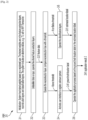
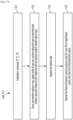
- FIG. 2 illustrates exemplary logic 2-0 associated with FIGS. 1A-1B .
- the system is initialized.
- weights of layers are trained based on a registered user. Exemplary layers are shown in FIG. 5 and described below.
- unlabelled data is input and a shared feature extraction layer is operated and produces feature data (item 2-21).
- feature data is referred to with the label "Z" (ZA for augmented and ZU for unlabelled).
- the feature data 2-21 is input to a reconstruction layer, which, at 2-3, reconstructs a fingerprint associated with the feature data 2-21.
- the reconstruction layers have previously been trained (see, e.g., FIG. 11 ). Note that no corresponding ground truth fingerprint exists for feature data 2-21, generally.
- the reconstruction layer evaluates an error measure of the reconstructed fingerprint and produces a reconstruction loss. This loss may be based on a conditional entropy. Since a loss is calculated weights may be updated even without a ground truth fingerprint.
- the logic flows to 2-4 and a user interface is activated to register an unknown person. During the registration, a ground truth label of the unknown person may be obtained (item 2-41).
- the classification layer is operated on the feature data 2-21, a value Y1 is produced, and an estimated location label (item 2-51).
- the estimated location label may be obtained from Y1 using an argmax function or a softmax function.
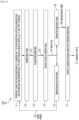
- FIG. 3 illustrates exemplary logic 3-0.
- the system has been trained based on a registered user, such as, for example, a person who owns the electronic device of FIG. 1A .
- Labelled data is a fingerprint along with a ground truth label telling where the person was at in the environment of FIG. 1B .
- the data may be input by a conversational procedure between the electronic device and the person. For example: 1. "I want to input data" (from person). 2. “where are you now?" (from electronic device). 3. “I am sitting on the sofa” (from person). 4. The electronic device collects a WiFi fingerprint from one or more WiFi devices (such as access points), and associates the fingerprint with a person at a location label of "sitting on the sofa.”
- the labelled data is augmented (or autoencoded, see FIG. 17 ) to produce an augmented fingerprint.
- Augmenting the data can include determining statistical moments of the labelled fingerprint such as mean and variance and generating a random realization from a distribution with the determined mean and variance.
- the random realization is called augmented data.
- Several such random realizations are obtained from a single determined distribution (see FIGS. 6A, 6B , 7A, 7B , 7C , 9A, 9B, 9C ); thus generally an augmented fingerprint includes several fingerprint waveforms.
- the feature extraction layer then operates on the augmented fingerprint and produces feature data (item 3-41).
- One feature data vector (or set of feature of data) is associated with each input fingerprint.
- XA producing ZA is one fingerprint producing one feature vector, thus one labelled X may produce many ZA vectors.
- one X will be augmented into multiple XA.
- one XA will produce one ZA.
- FIG. 8 corresponds to FIG. 7B (see below).
- the feature data 3-41 flows to both the reconstruction layers and to the classification layers.
- the reconstruction layers have a ground-truth label for the labelled fingerprint 3-21 and generate a loss used to train the layers (update weights, item 3-51, this action may be performed after 3-71 described below).
- the classification layers operate on the feature data 3-41 at 3-6 and produce Y1 (not shown in FIG. 3 ) and an estimated label 3-61.
- the application process operates on the estimated location label 3-61 and produced an application result, E (item 3-71).
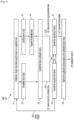
- FIG. 4 illustrates logic flow 4-0 which has some overlap with FIGS. 2 and 3 .
- the system has been trained (shown at 4-1). More than one activity occurs in logic flow 4-0, since both unlabelled data (an unlabelled fingerprint) is input (at 4-2) and labelled data is input (at 4-3).
- the labelled data is augmented at 4-4 to produce an augmented fingerprint.
- the feature extraction layers operate on both the unlabelled data and the augmented fingerprint resulting in a set of feature data ZU (item 4-51) from the unlabelled data and a (plural) set of feature data ZA (item 4-52) from the augmented fingerprint.
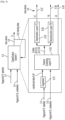
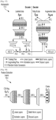
- FIG. 5 provides further details of training of the classification system 1 (item 5-3 in FIG. 5 ).
- Item 5-3 can be implemented as, for example, a neural network based AI model.
- a labelled fingerprint f1, item 5-1 is input to 5-3.
- an unlabelled fingerprint f2, item 5-2 is input to 5-3.
- the classification system 1 (item 5-3) processes these and produces loss values L1 (item 5-4) used as training data (item 5-5).
- Classification System 1 may be implemented as a neural network based AI model consisting of various neural network layers.
- the neural network based AI model of Classification System 1 may include feature extraction layers, classification layers and reconstruction layers.
- a neural network may be a computing system made up of a number of interconnected processing elements, which process information by their response to inputs. These processing elements may be organized in layers.
- a zoom-in picture is shown in FIG. 5 describing internal functions of the classification system 1.
- the functions may be realized as software executing on a CPU, as dedicated hardware, as off the shelf software configured according to FIG. 5 or any combination.
- the zoom-in illustration shows an augmenter 5-31 (also called autoencoder, FIG. 17 ), feature extraction layers TF (item 5-32, also referred to as ⁇ F) which output codes ZA (item 5-33) and ZU (item 5-34).
- ZA and ZU are input to classification layers TC (item 5-35, also referred to as ⁇ C) and reconstruction layers TR (item 5-36, also referred to as ⁇ R).
- TC outputs loss values LC (item 5-37);
- FIG. 6A illustrates a labelled finger print at location P1 and five random realizations based on statistics of the labelled finger print at location P1.
- FIG. 6B illustrates a labelled finger print at location P2 and five random realizations based on statistics of the labelled finger print at location P2.
- the ordinate is magnitude square value of CSI
- the abscissa is subcarrier index (frequency).
- FIG. 6 illustrates ZA for the fingerprint information of FIGS. 6A and 6B .
- FIG. 7A illustrates a labelled fingerprint at P1.
- FIGS. 7B and 7C illustrate random realizations generated based on statistics (moments) of the labelled fingerprint of FIG. 7A at P1.
- FIG. 8 illustrates a set of feature data corresponding to the augmented data of FIG. 7B .
- the ordinate is a dimensionless measure related to information and the abscissa is a feature vector index.
- FIGS. 9A, 9B, and 9C are similar to FIGS. 7A, 7B, and 7C except with respect to the label p2.
- FIG. 10 is similar to FIG. 8 .
- FIG. 11 illustrates values fed back for training.
- a labelled fingerprint f1 is input to an augmenter 11-1 which outputs Variational data 11-11 (also referred to as augmented fingerprint).
- Feature extraction layers TF output codes ZA 11-21, and ZU, 11-22.
- An unlabelled fingerprint, f2 is input directly to TF.
- a controller 11-5 processes loss values 11-31 (LC), 11-41 (LR), and 11-21 (LF) to produce feedback functions 11-51, 11-52 and 11-53. These functions are used to update, respectively, TR (item 11-4), TC (item 11-3), and TF (item 11-2).
- FIGS 12A , 12B, 12C, 12D, 12E, and 12F illustrate various embodiments of the application system.
- FIG. 12A illustrates an input fingerprint f1 or f2 (item 12-10) input to the classification system 1 (item 12-1).
- the classification system 1 is implied and not shown.
- FIG. 12A illustrates an exemplary embodiment in which application system A (item 12-2) produces an output EA (item 12-21).
- EA is the event of estimating that no one is present in a room, and turning off a TV.
- FIG. 12B illustrates an exemplary embodiment in which application system B (item 12-3) produces an output EB (item 12-31).
- EB is the event of estimating a person's location in a room, and beam forming sound from the TV to the location of the person. Beamforming sound means creating a constructive audio pattern of sound waves so that a pleasant sound effect is experienced by a person listening at the location corresponding to the estimated location label.
- FIG. 12C illustrates an exemplary embodiment in which application system C (item 12-4) produces an output EC (item 12-41).
- EC is the event of estimating a person's location in a room, and pan-tilting a TV toward the location corresponding to the estimated location label.
- Pan-tiling means rotating the TV screen about a vertical axis and rotating the TV screen about a horizontal axis to direct the screen to the person.
- FIG. 12D illustrates an exemplary embodiment in which application system D (item 12-5) produces an output ED (item 12-51).
- ED is the event of estimating a person's location in a room, and updating an augmented reality display for a person at the location corresponding to the estimated location label.
- An augmented reality display provides three dimensional imagery to a person wearing, for example, a special pair of display glasses or a viewer on their head in front of their eyes.
- FIG. 12E illustrates an exemplary embodiment in which application system E (item 12-6) produces an output EE (item 12-61).
- EE is the event of estimating a person's location in a room, and updating an advertisement for a person at the location corresponding to the estimated location label.
- an ad displaying screen is configured by the application system.
- the application system controls the displaying screen to be turned be turn on/off automatically based on whether there is someone present in the room or a geographic area of interest within viewing distance of the displaying screen.
- FIG. 12F illustrates an exemplary embodiment in which application system F (item 12-7) produces an output EF (item 12-71).
- EF is the event of estimating a person's location in an environment, for example a shop, and performing a financial transaction for the person at the location corresponding to the estimated location label.
- FIG. 13 illustrates exemplary logic 13-0 involving querying a user.
- the layers TF, TC and TR are initialized, for example, by randomization.
- a user is queried as to whether they are existing or new, a profile is obtained for a new user and a dialog is performed with the user to determine their location, and associate measured fingerprint with the reported location, and labelled data is input.
- the labelled data is augmented to produce an augmented fingerprint.
- TF is operated to produce ZA.
- ZA is input to TR and TC. Subsequent events may take place as in the logic flows of FIGS. 2 , 3 or 4 .
- FIG. 14 illustrates exemplary logic 14-0 involving an unknown user.
- the layers TF, TC and TR have already been trained, for example, based on labelled data.
- a fingerprint is obtained without a label.
- the unlabelled data is processed by TF to produce ZU.
- ZU is input to TR and possibly TC. Subsequent events may take place as in the logic flows of FIGS. 2 , 3 or 4 . Particularly note the threshold event at 2-3 in FIG. 2 .
- FIG. 15 illustrates exemplary logic 15-0 involving an unknown user.
- the layers TF, TC and TR have already been trained, for example, based on labelled data and unlabelled data.
- a fingerprint is obtained without a label.
- the unlabelled data is processed by TF to produce ZU.
- ZU is input to TR.
- Subsequent events may take place as in FIG. 2 (the threshold event at 2-3 in FIG. 2 ).
- An estimated location label 2-51 is obtained based on Y1 15-31 (similar to estimated location label 2-51 of FIG. 2 ).
- the application process is run producing the application result E item 15-41. See, for example, exemplary applications in FIGS. 12A , 12B , etc.
- Logic 16-0 of FIG. 16 illustrates an example of a re-training event.
- the classification system 1 has already been trained.
- unlabelled data is input.
- TF and TR are operated.
- a loss measurement at TR is high, above a re-training threshold.
- weight initial conditions are: i) existing weights, ii) randomized weights, iii) zero weights.
- randomized weights for initialization is a preferred embodiment.
- classification then proceeds. For example, at 16-5, TC is operated with the re-trained weights and Y1 (item 16-51) is obtained (or a location label). At 16-6, the application process then operates and produces an application result, E (item 16-61).
- FIG. 17 provides an exemplary structure of an auto encoder (item 17-0) for performing data augmentation such as FIGS. 7B, 7C , 9B and 9C .
- Data augmentation aims to enhance the diversity and sample size of the training data to improve the final performance of learned models. It is commonly used for image classification tasks and has also shown its effectiveness for several other applications including machine fault detection and recommendation.
- General data augmentation methods include translation, rotation, shearing, and flipping of the original data.
- Generative models can be a kind of data augmentation method.
- Data augmentation with GANs may be used on few-shot learning settings.
- the training data set is enlarged with data generated by VAE models.
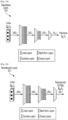
- FIG. 18 provides an exemplary structure of feature extraction layers, TF (item 18-0), for extracting features such as shown in FIGS. 8 and 10 . Further discussion of the feature extraction layers is given below.
- FIG. 19 provides an exemplary structure of classification layers, TC (item 19-0), for producing probabilities Y1. Further discussion of the classification layers is given below.
- FIG. 20 provides an exemplary structure of reconstruction layers, TR (item 20-0), for reconstructed fingerprints. Further discussion of the reconstruction layers is given below.
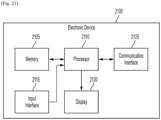
- FIG. 21 is a block diagram of an electronic device 2100 implementing an electronic device for location-aware applications, according to embodiments.
- the electronic device 2100 includes a memory 2105, a processor 2110, an input interface 2115, a display 2120 and a communication interface 2125.
- the classification system 1 and/or application system of FIG. 1 may be implemented as the electronic device 2100.
- the processor 2110 takes overall control of the electronic device 2100.
- the processor 2110 executes one or more programs stored in the memory 2105.
- the memory 2105 stores various data, programs, or applications for driving and controlling the electronic device 2100.
- a program stored in the memory 2105 includes one or more instructions.
- a program (one or more instructions) or an application stored in the memory 2105 may be executed by the processor 2110.
- the processor 2110 may perform any one or any combination of operations of the electronic device of FIG. 1 .
- the input interface 2115 may receive a user input and/or a data such as a 2D image.
- the input interface 2115 may include, for example, a touchscreen, a camera, a microphone, a keyboard, a mouse or any combination thereof.
- the display 2120 may obtain data from, e.g., the processor 2110, and may display the obtained data.
- the display 2120 may include, for example, a touchscreen, a television, a computer monitor and the like.
- the communication interface 2125 transmits and receives data to and from other electronic devices, and may include one or more components causing communication to be performed via a local area network (LAN), a wide area network (WAN), a value added network (VAN), a mobile radio communication network, a satellite communication network, or a combination thereof.
- LAN local area network
- WAN wide area network
- VAN value added network
- mobile radio communication network a satellite communication network, or a combination thereof.
- the block diagram of the electronic device 2100 is provided as an example. Each component in the block diagram may be integrated, added, or omitted depending upon specifications of the electronic device 2100 that is actually implemented. That is, two or more components may be integrated into one component or one component may be divided into two or more components, as needed.
- functions performed by the respective blocks are provided for illustrating the embodiments of the disclosure, and operations or devices of the respective blocks do not limit the scope of the disclosure.
- each WiFi frequency channel is divided into NSC frequency subcarriers via OFDM.
- hi,j[t] denote the complex WiFi CSI value of the ith stream on the jth subcarrier collected at time t.
- x[t] the data inputted to the localization system at time t as x[t].
- an input data point i.e., a CSI magnitude vector such as f1 or f2 of FIG. 5
- a location label i.e., a CSI magnitude vector such as f1 or f2 of FIG. 5
- it is called a labelled data point, denoted as xL[t] (for example f1).
- an unlabelled data point denoted as xU [t] (for example f2).
- XU xU [t] denote all the unlabelled data points already collected.
- F ⁇ f [t] ⁇ denote the set of all collected fingerprints.
- Embodiments provided herein train a classifier using F and XU, and predict the y[t] accurately given an x[t].
- the data augmenter first takes in the collected fingerprints F (i.e., labelled data), and generates synthetic fingerprints.
- FS fS [t] denote the set of all synthetic fingerprints.
- the data augmenter may be considered as a first neural network, for example, a Neural Network 1.
- this classifier uses a Joint Classification-Reconstruction (JCR) structure.
- JCR Joint Classification-Reconstruction
- the classifier consists of two paths: the classification path and the reconstruction path.
- the classification path contains feature extraction layers followed by the classification layers. This path takes in a data point (either labelled or not), and predicts a location label.
- the reconstruction path shares the same feature extraction layers with the classification path, and then diverges into separate reconstruction layers. This path takes in a data point (either labelled or not), and reproduces it as similarly as possible.
- the domain adaptive classifier may be considered as a second neural network, for example, a Neural Network 2.
- a first system may consist only of Neural Network 2.
- a system may include both Neural Network 1 and Neural Network 2.
- the path passes the data part xA[t], an augmented fingerprint, through the feature extraction layers to calculate a feature vector zA[t] (corresponding to ZA of, for example, FIG. 5 ).
- the classification layers predict a location probability vector y ⁇ A[t], denoted as Y1 in FIGS. 1-21 .
- ⁇ k[t], ⁇ k[t] are the kth elements of yA[t], y ⁇ A[t], respectively.
- For the classification path when an unlabelled data point xU [t] comes (unlabelled fingerprint), this data point travels through the layers in the same way as a labelled data point xA[t]. A feature vector zU [t] is extracted, and a prediction y ⁇ U [t] is produced. Since there is not a ground-truth label for this unlabelled data point, a classification loss as in Eq. (9) is not calculated.
- this clustering loss follows the cluster assumption in the area of domain adaptation and semi- supervised/unsupervised learning. This cluster assumption states that decision boundaries should avoid high-density regions. By minimizing the clustering loss in Eq. (11), the classifier is more confident on the unlabelled data, and thus drives the decision boundaries away from them.
- both XA and XU will flow through it in the same procedure.
- Next embodiments take an unlabelled data point xU [t] as an example. If an unlabelled data point xU [t] comes, the reconstruction path first passes xU [t] through the shared feature extraction layers to obtain a feature vector zU [t]. Given this zU [t], the reconstruction layers output a x ⁇ U [t], which tries to reproduce xU [t] as much as possible. Similarly for a labelled data point xA[t], an intermediate feature vector zA[t] and a reproduction x ⁇ A[t] based on this vector are generated.
- classification layers use features that are representative for both labelled and unlabelled data.
- the classifier can adapt itself to unlabelled domains, where the unlabelled data come from. Unlabelled data is used to adapt a classifier to new domains. Therefore, Challenge 2 is solved.
- the augmenter ( FIG. 17 ) generates synthetic fingerprints from a limited amount of collected (labelled) fingerprints.
- the data augmenter implements NS2 Variational Autoencoders (VAEs).
- VAEs Variational Autoencoders
- Each VAE see FIG. 17 , is dedicated to one location out of the NS2 supported locations.
- the kth VAE is trained with fingerprints collected at the kth location, and produces synthetic fingerprints for this location only.
- a VAE has an encoder-decoder structure.
- the encoder of a VAE aims to encode the input into a normal distribution N (0, ykI), where ⁇ k is a pre-selected hyperparameter and I is an identity matrix.
- N is a normal distribution
- the decoder tries to reproduce the input from this normal distribution.
- embodiments feed samples drawn from N (0, ⁇ kI) into the decoder, to generate a large amount of synthetic data similar to yet different from the training data.
- the data augmenter separates the fingerprints into N ⁇ subsets according to their location labels.
- the data flow is described using one single data point xk[t] ⁇ Xb as an example.
- the encodes From the 90-dimensional input xk[t], the encodes extracts a 10-dimensional vector of means ⁇ k[t] and a 10-dimensional vector of standard deviations ⁇ k[t]. These two vectors define a 10-dimensional normal distribution, from which a latent vector ⁇ k[t] is drawn.
- ⁇ k[t] is drawn from the normal distribution N (0, I), with I being 10-dimensional.
- Eq. (13) is implemented by inserting two elementwise arithmetic nodes in the network model.
- the output of the encoder (i.e., ⁇ k[t]) is then passed to the decoder, which generates a vector x ⁇ k[t] to rebuild the input xk[t].
- the 1-on-1 VAE-location mapping allows each VAE to automatically label the synthetic data points using the location dedicated to this VAE.
- the feature extraction layers are the starting point of both the classification path and the reconstruction path. All augmented (labelled) and unlabelled data will pass through these layers to generate their feature vectors. Next augmented data XA are taken as an example to describe how data flows through these layers. The flow of unlabelled data XU is the same in these layers.
- Fig. 18 illustrates this data flow, from left to right.
- An augmented data point xA[t] XA enters the 1st linear layer, which extends this 90-dimensional vector into a 360- dimensional vector.
- the 2nd linear layer extends the 360- dimensional vector into a 480-dimensional vector.
- the 3rd linear layer further extends the dimensions from 480 to 600, and outputs the feature vector zA[t].
- the above three layers compute linear combinations of CSI magnitudes on different subcarriers and streams to generate meaningful features.
- embodiments insert a sigmoid activation layer, a batch normal- ization layer and a dropout layer (dropout rate 0.3) between the 1st and the 2nd linear layers, as well as between the 2nd and the 3rd linear layers.
- the sigmoid layers introduce non- linearity; the batch normalization layers speed up the training; and the dropout layers try to avoid overfitting.
- the classification path and the reconstruction path diverge from each other.
- the classification path flows into the classification layers, after the feature vectors are extracted. Both ZA and ZU go through these classification layers to produce predictions Y ⁇ A and Y ⁇ U, respectively. Fig. 18 presents the detailed design of these layers.
- the feature vector of a labelled data point is an example.
- a 600-dimensional feature vector zA[t] is shrunk to a 300-dimensional vector and then a 100- dimensional vector, by the 1st and the 2nd linear layers, respectively.
- This 100-dimensional vector is then passed to the third linear layer to predict a NS2-dimensional one-hot encoded location probability vector y ⁇ A[t].
- a sigmoid activation layer, a batch normalization layer and a dropout layer (dropout rate 0.3) exist between the 1st and the 2nd linear layers.
- a sigmoid activation layer and a batch normalization layer exist between the 2nd and the 3rd linear layers.
- embodiments calculate the classification loss 1C [t] of one data point according to Eq. (9). Then, the aggregated classification loss LC of all augmented data (or a batch of augmented data) is computed according to Eq. (8). Similarly, these classification layers predict a location probability vector y ⁇ U [t], also referred to as Y1, for a given zU [t]. The conditional entropy is calculated using Eq. (10), and the aggregated clustering loss is calculated of all unlabelled data (or a batch of unlabelled data) using Eq. (11).
- the reconstruction path flows into the reconstruction layers ( FIGS. 5 , 20 ), which take both augmented and unlabelled data as inputs.
- a 600-dimensional feature vector zU [t] is shrunk to a 480-dimensional vector and later a 360- dimensional vector by the 1st and the 2nd linear layers, respectively. From this 360-dimensional vector, the 3rd linear layer tries to generate a 90-dimensional vector x ⁇ U [t] that reproduces xU [t] as much as possible.
- An aggregated reconstruction loss is computed for all data with and/or without labels (or a batch of unlabelled and/or augmented data points) using Eq. (12).
- the aforementioned layers form a JCR structure, with the shared feature extraction layers as the joint of the two paths.
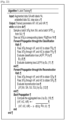
- a joint training algorithm is illustrated in FIG. 22 ("Algorithm 1").
- the extracted features are representative for both labelled and unlabelled data, and assist the classifier to extend its coverage to the unlabelled domains (i.e., unlabelled users in this paper).
- Embodiments provided herein still automatically learns to utilize the features of the new users or the changed environments.
- a joint training algorithm is applied. This joint training algorithm has some efficiency benefits over the alternating training algorithm used by WiDo.
- TF feature extraction layers
- TC classification layers
- TR ⁇ R
- embodiments Given the augmented fingerprints FA (including the data points XA and their labels YA) and the unlabelled data XU , to the newly collected unlabelled data, embodiments first sample a batch of labelled data points Xb (and the corresponding Y b from YA), and a batch of unlabelled data point Xb from XU . Both batches are then removed from their original sets, respectively. Embodiments pass XbA and XbU the feature extraction layers, which extract features ZbA and ZbU. See FIG. 5 and FIG. 18 . These features are fed into the classification layers FIG. 19 to produce location predictions Y ⁇ b and Y ⁇ b . In the meantime, these features go through the reconstruction layers FIG.
- Embodiments can calculate the losses.
- Embodiments calculate the classification loss L (Y b, Y ⁇ b ) using Eq. (8), and compute the clustering loss LU (Y ⁇ b ) based on Eq. (11).
- ⁇ C is updated by ⁇ 1LA + ⁇ 2LU
- ⁇ R is updated by ⁇ 2LU + ⁇ 3LR
- ⁇ F is updated by L.
- ⁇ F is trained to capture features that are able to support two different tasks: (1) predicting a location, and (2) representing both labelled and unlabelled data in the same embedding space. Since these two tasks are trained in a joint manner, the classifier is able to predict a location using features that are representative for both labelled and unlabelled data points. In this way, embodiments are able to adapt prediction to the newly collected unlabelled data.
- Fig. 23 Experiment environment and device placements are illustrated in Fig. 23 .
- p0 is a virtual location corresponding to a status that the room is empty.
- the rest locations were distributed inside the room with a minimum distance of 70cm.
- a Dell Latitude E7440 laptop with Intel 5300 WiFi chip was connected to a TP-Link AC1750 WiFi router to create standard WiFi signals covering the whole room.
- Embodiments installed the Linux CSI on the laptop to extract CSI readings and fed them to Widora (and other systems), which also reside on the laptop.
- embodiments turned on 1 antenna (out of 3) on the WiFi router, and enabled all 3 antennas on the laptop.
- the Intel 5300 WiFi chip measures CSI on 30 subcarriers.
- Table 3 Data Separation for User Diversity Labelled data Unlabelled data Training ⁇ 5K from ID2&ID4 ⁇ 1.08M from ID1-ID9 Testing ⁇ 1.08M from ID1-ID9 n/a
- Table 4 Data Separation for Environment Changes Labelled data Unlabelled data Training ⁇ 20K from source ⁇ 700K from both Testing ⁇ 720K from both n/a
- Embodiments To study the impact of environment changes, embodiments first defined several environments in Table 1. Embodiments then deliberately introduced some commonly-seen daily changes to the environments. For instance, Environment 1 was altered into Environment 2 by the action of opening the glass door. Embodiments further considered that, for Change 1, Environment 1 was the source domain and Environment 2 was the target domain. As an example, an environment change is defined as a combination of 1) a daily action, 2) the source domain to which the action is applied, and 3) the resulting target domain. Thereby, embodiments defined Change 1, Change 2 and Change 3 in Table 2.
- Embodiments include the router periodically sending pings to the laptop, with a speed of 100 packets per second. This corresponds to a 51.2 Kbps traffic, consuming only a tiny fraction of WiFi capacity. The concepts of iterations and runs of data collection are now described.
- One iteration of data collection While one volunteer stands at one location for 60 seconds, the corresponding WiFi CSI readings are recorded and labelled with this location. This is one iteration of data collection. During an iteration, a volunteer is allowed to move freely and naturally (e.g., turning around, stretching, doing arms akimbo, etc.), as long as a he/she remains on the location.
- a volunteer conducts 5 iterations at the first location, moves to the second location, finishes another 5 iterations, and keeps repeating so, until all the locations are covered.
- Widora and WiDo have been disclosed herein.
- WiDo as opposed to Widora, does not apply the cluster assumption used in Widora, and thus resulted in a relatively high class ambiguity in the target domain.
- VAE-only only implemented the data augmenter of Widora, and connected the augmenter only to the classification path. The reconstruction path and the clustering loss were discarded. VAE-only was used to conduct ablation study of Widora's modules.
- AutoFi served as a representative of existing fingerprint-updating methods (e.g., MSDFL, which utilized a fully connected NN instead of the autoencoder in AutoFi.).
- AutoFi required neither class labels nor domain labels as inputs. Instead, it periodically detected whether the room is empty or not, and used this empty-room status as an indicator of domain changes. All new data collected after a detection of an empty-room status were automatically tagged with a new domain label. A polynomial mapping function and an autoencoder were then applied to update the CSI fingerprint database.
- the two smallest volunteers i.e., ID2 and ID4 were example users (of whom 5K data points were used as labelled training data) in an evaluation.
- the data is separated as shown in Table 3. Widora and DAV-only were able to leverage both the 5K labelled training data and the 1.08M unlabelled training data. Note that AutoFi and VAE-only could only use the 5K labelled data as training data (VAE-only augmented the training data to get 10 times more data points).
- Table 6 lists the average recall, precision, and weighted F1 score (i.e., the harmonic mean of precision and recall, weighted by the number of true labels of each class) across all locations and IDs. It is shown that AutoFi had the worst performance, due to its incapability to handle the diversity of users. AutoFi yielded recall and precision as low as 72.9% and 75.8%, respectively. By augmenting the limited labelled data, VAE-only was able to cover more potential users, and thus increased recall and precision to 81.0% and 81.1%, respectively. WiDo embraced both the augmentation of labelled data and the domain adaptation with unlabelled data, and consequently improved recall and precision to 84.6% and 85.0%, respectively.
- Widora By introducing a clustering loss, Widora further enhanced WiDo, and achieved the best performance among all. Compared to the baseline AutoFi, Widora improved recall, precision and F1 scores (in absolute numbers) by 17.7%, 14.9% and 17.8%, respectively. Moreover, compared to WiDo, Widora also increased these metrics by 6.0%, 5.7% and 6.0%, respectively.
- the domain-adaptive classifier design assisted WiDo and Widora to tackle the overfitting, and improved the worst-case TPR to 80.4%, while maintaining the best-case TPR as high as 93.3%.
- Widora further enhanced the best-case TPR to 99.0%, while keeping the same worst-case TPR as WiDo. This means that Widora not only provided the maximum worst-case performance, but also functioned consistently well across different locations.
- Table 7 Average F1 scores over all locations in the presence of different environment changes.
- Target-Domain F1 score Source-domain F1 score Change 1 Change 2 Change 3 Change 1 Change 2 Change 3 AutoFi 63.9% 57.1% 67.8% 92.8% 93.5% 95.5% VAE-only 77.2%(+13.3%) 64.9%(+7.8%) 70.7%(+2.9%) 97.4% 97.0% 94.9% WiDo 79.3%(+15.4%) 72.8%(+15.7%) 71.7%(+3.9%) 93.3% 96.2% 95.3% Widora 87.0%(+23.1%) 77.2%(+20.1%) 87.3%(+19.5%) 94.7% 96.5% 95.5%
- Embodiments use the average height of example users (i.e., ID2 and ID4) as the example height, and divide all users into three groups based on their absolute differences to this example height. It was confirmed that the localization accuracy decreased with the increase in the height difference between the testing user and the example users. AutoFi decreased most drastically, suggesting that it was not able to handle the variation in users' heights. When applied to the example users, AutoFi's accuracy is as high as 96.2%. However, this number dropped below 69.1%, if a testing user was around 10cm taller than the example users. This is the evidence that AutoFi was overfitted by the data of example users.
- Widora, WiDo and VAE-only were able to learn localization features that are less correlated with users' heights, and thus achieved better and more robust performance than the baseline.
- Widora maintained its accuracy above 87.1% even the height difference is bigger than 20cm.
- Widora outperformed WiDo on unlabelled users by up to 5.8%, WiDo achieved 1.7% higher accuracy than Widora on example users. This suggested that WiDo was still, to some extent, overfitted to the example users. By utilizing the clustering loss, Widora refined the decision boundaries, and, as an unintended benefit, further corrected the overfitting.
- Embodiments took the average weight of example users as the example weight, and divided all users into three groups according to their absolute differences to this example weight. The four groups were ⁇ 5kg, 5kg 20kg, > 20kg, respectively. In general, localization accuracy decreased, when the absolute weight difference between example users and testing users increased. AutoFi was overfitted to the example users. Its accuracy dropped as low as 66.2%, if testing users were 20kg heavier than the example users. On the contrary, Widora had the most robust performance in the presence of diverse user weights. Widora was able to maintain its accuracy above 87.9%, even when it was trained on the lightest users and tested on the heaviest users. Compared with AutoFi and WiDo, the improvement were 21.7% and 6.4%, respectively.
- VAE-only was, to some extent, overfitted to the augmented data; and 2) the JCR structure of WiDo (and Widora) was able to correct this overfitting by learning more generic features from both labelled and unlabelled data.
- VAE-only outperformed AutoFi in both target and source domains. This suggested that the data augmentation not only provided more data points to enhance source-domain performance, but also extended the coverage of the labelled data to improve target-domain accuracy.
- Widora As disclosed herein the inconsistency issue of device-free WiFi fingerprints across different users and/or different environments has been addressed. To address this issue, Widora is described - a WiFi based domain-adaptive localization system, which leverages a data augmenter based on VAEs and a domain- adaptive classifier with a joint classification-reconstruction structure. Unlike existing domain adversarial solutions, Widora does not require implicit labels to distinguish target domain data from source domain data, making it more practical. Compared to WiDo, also disclosed herein, Widora further employs a cluster assumption, and thus reduces the class ambiguity in the new/unseen domains.
- Widora not only provided sub-meter level localization resolution with largely improved accuracy (+20.2% on the worst-case accuracy), but also provided the most robust performance in the presence of diverse unlabelled users and daily environment changes.
- the medium may continuously store the computer-executable programs or instructions, or temporarily store the computer-executable programs or instructions for execution or downloading.
- the medium may be any one of various recording media or storage media in which a single piece or plurality of pieces of hardware are combined, and the medium is not limited to a medium directly connected to a computer system, but may be distributed on a network.
- Examples of the medium include magnetic media, such as a hard disk, a floppy disk, and a magnetic tape, optical recording media, such as CD-ROM and DVD, magneto-optical media such as a floptical disk, and ROM, RAM, and a flash memory, which are configured to store program instructions.
- Other examples of the medium include recording media and storage media managed by application stores distributing applications or by websites, servers, and the like supplying or distributing other various types of software.
- a model related to the DNN or CNN described above may be implemented via a software module.
- the DNN or CNN model may be stored in a computer-readable recording medium.
- the DNN or CNN model may be a part of the apparatus 100 described above by being integrated in a form of a hardware chip.
- the DNN or CNN model may be manufactured in a form of a dedicated hardware chip for AI, or may be manufactured as a part of an existing general-purpose processor (for example, CPU or application processor) or a graphic-dedicated processor (for example GPU).
- the DNN or CNN model may be provided in a form of downloadable software.
- a computer program product may include a product (for example, a downloadable application) in a form of a software program electronically distributed through a manufacturer or an electronic market.
- a product for example, a downloadable application
- the software program may be stored in a storage medium or may be temporarily generated.
- the storage medium may be a server of the manufacturer or electronic market, or a storage medium of a relay server.
Landscapes
- Engineering & Computer Science (AREA)
- Theoretical Computer Science (AREA)
- Physics & Mathematics (AREA)
- General Physics & Mathematics (AREA)
- Data Mining & Analysis (AREA)
- General Engineering & Computer Science (AREA)
- Health & Medical Sciences (AREA)
- Artificial Intelligence (AREA)
- Evolutionary Computation (AREA)
- Life Sciences & Earth Sciences (AREA)
- General Health & Medical Sciences (AREA)
- Software Systems (AREA)
- Business, Economics & Management (AREA)
- Biomedical Technology (AREA)
- Mathematical Physics (AREA)
- Computing Systems (AREA)
- Molecular Biology (AREA)
- Computational Linguistics (AREA)
- Biophysics (AREA)
- Signal Processing (AREA)
- Strategic Management (AREA)
- Development Economics (AREA)
- Finance (AREA)
- Accounting & Taxation (AREA)
- Computer Networks & Wireless Communication (AREA)
- Marketing (AREA)
- Game Theory and Decision Science (AREA)
- General Business, Economics & Management (AREA)
- Economics (AREA)
- Entrepreneurship & Innovation (AREA)
- Otolaryngology (AREA)
- Acoustics & Sound (AREA)
- Bioinformatics & Cheminformatics (AREA)
- Evolutionary Biology (AREA)
- Computer Vision & Pattern Recognition (AREA)
- Bioinformatics & Computational Biology (AREA)
- Computer Security & Cryptography (AREA)
- Computer Hardware Design (AREA)
- Image Analysis (AREA)
Claims (11)
- Verfahren zur Standortbestimmung, das von einer elektronischen Vorrichtung (2100) durchgeführt wird, das einen WiFi-Sendeempfänger und einen Speicher (2105) beinhaltet, der ein neuronales Netz speichert, das Verfahren umfassend:Empfangen, über den WiFi-Sendeempfänger, eines ersten WiFi-Fingerabdrucks, der mit einer ersten Person und einer ersten Umgebung assoziiert ist, der ersten Person in der ersten Umgebung, wobei die erste Person ein nicht registrierter Benutzer ist;Erlangen (2-2), unter Verwendung einer gemeinsamen Merkmalsextraktionsschicht (5-32) des neuronalen Netzes und basierend auf dem ersten Fingerabdruck, eines ersten Satzes von Merkmalsdaten (2-21);Bestimmen (2-3), unter Verwendung einer Rekonstruktionsschicht (5-36) des neuronalen Netzes und basierend auf dem ersten Satz von Merkmalsdaten (2-21) aus der gemeinsamen Merkmalsextraktionsschicht (5-32), eines Rekonstruktionsverlusts (5-38), der mit der ersten Person und dem ersten Fingerabdruck assoziiert ist;wenn der Rekonstruktionsverlust (5-38) auf oder unter einem Schwellenwert ist:Klassifizieren (2-5), unter Verwendung einer Klassifizierungsschicht (5-35) des neuronalen Netzes und basierend auf dem ersten Satz von Merkmalsdaten (2-21) von der gemeinsamen Merkmalsextraktionsschicht (5-32), des ersten Fingerabdrucks, um ein erstes geschätztes Standortlabel der ersten Person zu erlangen, undAusgeben, durch sichtbare oder hörbare Einrichtungen, eines Indikators des ersten geschätzten Standortlabels (2-51) der ersten Person;wenn der Rekonstruktionsverlust (5-38) über dem Schwellenwert ist, Durchführen einer Registrierung (2-4) der ersten Person.
- Verfahren nach Anspruch 1, wobei die Registrierung Folgendes beinhaltet:Erlangen, über eine Benutzerschnittstelle des Systems, einer Kennung der ersten Person, Erlangen, über die Benutzerschnittstelle, eines Bodendaten-Standortlabels der ersten Person, undErlangen, über den WiFi-Sendeempfänger, eines zweiten Fingerabdrucks, der mit dem Bodendaten-Standortlabel assoziiert ist; undwobei das Verfahren ferner ein Bereitstellen einer Ausgabe basierend auf dem ersten geschätzten Standortlabel oder dem Bodendaten-Standortlabel umfasst.
- Verfahren nach Anspruch 1, ferner umfassend ein Trainieren von Gewichtungen basierend auf einem dritten Fingerabdruck, der mit der ersten Umgebung und mit einer zweiten Person, die ein registrierter Benutzer ist, assoziiert ist, um aktualisierte Gewichtungen zu erlangen.
- Verfahren nach Anspruch 3, wobei die Trainingsgewichtungen Folgendes umfassen:Empfangen des dritten Fingerabdrucks, der mit der ersten Umgebung und der zweiten Person assoziiert ist;Erweitern des dritten Fingerabdrucks, um einen ersten erweiterten Fingerabdruck zu bilden; und Aktualisieren von Gewichtungen des Systems basierend auf dem ersten erweiterten Fingerabdruck.
- Verfahren nach Anspruch 3, wobei das Bestimmen eines Rekonstruktionsverlusts Folgendes umfasst: Empfangen, über den WiFi-Sendeempfänger, des ersten Fingerabdrucks;Bestimmen, basierend auf den aktualisierten Gewichtungen unter Verwendung der gemeinsamen Merkmalsextraktionsschicht, des ersten Satzes von Merkmalsdaten;Bestimmen, basierend auf dem ersten Satz von Merkmalsdaten, eines ersten rekonstruierten Fingerabdrucks der ersten Person; undBestimmen, basierend auf dem ersten Fingerabdrucks und dem ersten rekonstruierten Fingerabdruck, des Rekonstruktionsverlusts des ersten rekonstruierten Fingerabdrucks.
- Verfahren nach Anspruch 2, wobei die Ausgabe mindestens eines davon beinhaltet, dass die elektronische Vorrichtung basierend auf einem Erkennen, dass ein Raum leer ist, automatisch abschaltet; Strahlformen, durch die elektronische Vorrichtung, angepasst an das erste geschätzte Standortlabel der ersten Person; Schwenken, durch die elektronische Vorrichtung, eines Anzeigebildschirms der elektronischen Vorrichtung abhängig von dem ersten geschätzten Standortlabel der ersten Person; Aktualisieren einer Präsentation erweiterter Realität an die erste Person basierend auf dem ersten geschätzten Standortlabel der ersten Person; und Bereitstellen einer Ankündigung für eine persönliche elektronische Vorrichtung der ersten Person basierend auf dem ersten geschätzten Standortlabel der ersten Person.
- Verfahren nach Anspruch 1, das Verfahren ferner umfassend:gemeinsames Trainieren, basierend auf einem Rekonstruktionsverlust und einem Clustering-Verlust von Merkmalsextraktionsschichten, von Rekonstruktionsschichten und Klassifikationsschichten des neuronalen Netzes, wobei die Rekonstruktionsschichten konfiguriert sind, um den Rekonstruktionsverlust bereitzustellen, und die Klassifikationsschichten konfiguriert sind, um den Clustering-Verlust bereitzustellen;Verarbeiten eines Fingerabdrucks, um einen erweiterten Fingerabdruck zu erlangen;Betreiben der Merkmalsextraktionsschichten an dem erweiterten Fingerabdruck, um Codes zu erzeugen;Klassifizieren, mit den Klassifizierungsschichten, der Codes, um ein geschätztes Standortlabel zu erlangen; undBereitstellen einer Ausgabe basierend auf dem geschätzten Standortlabel.
- Verfahren nach Anspruch 7, wobei die Ausgabe mindestens eines davon beinhaltet, dass die elektronische Vorrichtung basierend auf einem Erkennen, dass ein Raum leer ist, automatisch abschaltet; Strahlformen, durch die elektronische Vorrichtung, angepasst an das geschätzte Standortlabel; Schwenken, durch die elektronische Vorrichtung, eines Anzeigebildschirms der elektronischen Vorrichtung abhängig von dem geschätzten Standortlabel; Aktualisieren einer Präsentation erweiterter Realität an eine Person basierend auf dem geschätzten Standortlabel; und Bereitstellen einer Ankündigung für eine persönliche elektronische Vorrichtung einer Person basierend auf dem geschätzten Standortlabel.
- Elektronische Vorrichtung (2100) zur Standortbestimmung, die elektronische Vorrichtung (2100) umfassend:einen oder mehrere Speicher (2105), wobei der eine oder die mehreren Speicher (2105) Anweisungen beinhalten und ein neuronales Netz speichern;einen WiFi-Sendeempfänger; undeinen oder mehrere Prozessoren (2110), wobei der eine oder die mehreren Prozessoren (2110) konfiguriert sind, um die Anweisungen zu Folgendem auszuführen:Empfangen, über den WiFi-Sendeempfänger, eines ersten WiFi-Fingerabdrucks, der mit einer ersten Person und einer ersten Umgebung assoziiert ist, der ersten Person in der ersten Umgebung, wobei die erste Person ein nicht registrierter Benutzer ist,Erlangen, unter Verwendung gemeinsamer Merkmalsextraktionsschichten (5-32) und basierend auf dem ersten Fingerabdruck, eines ersten Satzes von Merkmalsdaten, wobei ein neuronales Netz die gemeinsame Merkmalsextraktionsschicht (5-32) beinhaltet,Bestimmen, unter Verwendung von Rekonstruktionsschichten (5-36) und basierend auf dem ersten Satz von Merkmalsdaten aus der gemeinsamen Merkmalsextraktionsschicht (5-32), eines Rekonstruktionsverlustes (5-38), der mit der ersten Person und dem ersten Fingerabdruck assoziiert ist, wobei das neuronale Netz die Rekonstruktionsschicht (5-36) beinhaltet,wenn der Rekonstruktionsverlust (5-38) auf oder unter einem Schwellenwert ist:Klassifizieren, unter Verwendung von Klassifizierungsschichten (5-35) und basierend auf dem ersten Satz von Merkmalsdaten aus der gemeinsamen Merkmalsextraktionsschicht (5-32), des ersten Fingerabdrucks, um ein erstes geschätztes Standortlabel der ersten Person zu erlangen, wobei das neuronale Netz die Klassifizierungsschichten (5-35) beinhaltet, undAusgeben, durch sichtbare oder hörbare Einrichtungen, eines Indikators des ersten geschätzten Standortlabels der ersten Person,wenn der Rekonstruktionsverlust (5-38) über dem Schwellenwert ist, Durchführen einer Registrierung der ersten Person.
- Elektronische Vorrichtung nach Anspruch 9, wobei der eine oder die mehreren Prozessoren ferner konfiguriert sind, um die Anweisungen zu Folgendem auszuführen:
Durchführen der Registrierung durch:Erlangen, über eine Benutzerschnittstelle der elektronischen Vorrichtung, einer Kennung der ersten Person,Erlangen, über die Benutzerschnittstelle, eines Bodendaten-Standortlabels der ersten Person, undErlangen eines zweiten Fingerabdrucks, der mit dem Bodendaten-Standortlabel assoziiert ist; undBereitstellen einer Ausgabe basierend auf dem ersten geschätzten Standortlabel oder dem Bodendaten-Standortlabel. - Maschinenlesbares Speichermedium, das Anweisungen speichert, die, wenn sie ausgeführt werden, mindestens einen Prozessor einer elektronischen Vorrichtung veranlassen, einen der Ansprüche 1 bis 8 durchzuführen.
Applications Claiming Priority (3)
| Application Number | Priority Date | Filing Date | Title |
|---|---|---|---|
| US201962910835P | 2019-10-04 | 2019-10-04 | |
| US16/913,493 US11363416B2 (en) | 2019-10-04 | 2020-06-26 | System and method for WiFi-based indoor localization via unsupervised domain adaptation |
| PCT/KR2020/011757 WO2021066330A1 (en) | 2019-10-04 | 2020-09-02 | System and method for wifi-based indoor localization via unsupervised domain adaptation |
Publications (4)
| Publication Number | Publication Date |
|---|---|
| EP4004579A1 EP4004579A1 (de) | 2022-06-01 |
| EP4004579A4 EP4004579A4 (de) | 2022-08-31 |
| EP4004579C0 EP4004579C0 (de) | 2024-10-30 |
| EP4004579B1 true EP4004579B1 (de) | 2024-10-30 |
Family
ID=75273701
Family Applications (1)
| Application Number | Title | Priority Date | Filing Date |
|---|---|---|---|
| EP20871681.1A Active EP4004579B1 (de) | 2019-10-04 | 2020-09-02 | System und verfahren zur wifi-basierten lokalisierung in innenräumen über unüberwachte domänenanpassung |
Country Status (4)
| Country | Link |
|---|---|
| US (2) | US11363416B2 (de) |
| EP (1) | EP4004579B1 (de) |
| CN (1) | CN114514759B (de) |
| WO (1) | WO2021066330A1 (de) |
Families Citing this family (21)
| Publication number | Priority date | Publication date | Assignee | Title |
|---|---|---|---|---|
| CN110826424B (zh) * | 2019-10-21 | 2021-07-27 | 华中科技大学 | 一种基于行人重识别驱动定位调整的行人搜索方法 |
| US11438886B2 (en) * | 2020-02-27 | 2022-09-06 | Psj International Ltd. | System for establishing positioning map data and method for the same |
| US11909482B2 (en) * | 2020-08-18 | 2024-02-20 | Qualcomm Incorporated | Federated learning for client-specific neural network parameter generation for wireless communication |
| US20220067688A1 (en) | 2020-09-01 | 2022-03-03 | Lg Electronics Inc. | Automated shopping experience using cashier-less systems |
| US20230403573A1 (en) * | 2020-10-08 | 2023-12-14 | Telefonaktiebolaget Lm Ericsson (Publ) | Managing a radio access network operation |
| US11776550B2 (en) * | 2021-03-09 | 2023-10-03 | Qualcomm Incorporated | Device operation based on dynamic classifier |
| CN113344212B (zh) * | 2021-05-14 | 2024-01-19 | 香港中文大学(深圳) | 模型训练方法、装置、计算机设备及可读存储介质 |
| CN113271539B (zh) * | 2021-05-21 | 2024-06-25 | 南京邮电大学 | 一种基于改进的cnn模型的室内目标定位方法 |
| US12051216B2 (en) * | 2021-07-14 | 2024-07-30 | GE Precision Healthcare LLC | System and methods for visualizing variations in labeled image sequences for development of machine learning models |
| CN113596731B (zh) * | 2021-08-16 | 2024-04-02 | 吉林建筑大学 | 一种基于卷积神经网络的ZigBee惯性辅助定位系统 |
| US20230072968A1 (en) * | 2021-08-25 | 2023-03-09 | Northeastern University | System and Method for Sensing an Environment |
| CN113916231A (zh) * | 2021-09-28 | 2022-01-11 | 上海浦东发展银行股份有限公司 | 移动设备定位导航方法、装置、移动设备及存储介质 |
| CN113923773A (zh) * | 2021-11-11 | 2022-01-11 | 深圳大学 | 基于深度学习的室内定位方法及装置 |
| US20230261774A1 (en) * | 2022-02-15 | 2023-08-17 | L3Harris Technologies, LLC | Systems and methods of anomaly detection in antenna networks using variational autoencoders |
| CN114861825B (zh) * | 2022-05-31 | 2025-07-08 | 上海银基信息安全技术股份有限公司 | 数字钥匙端定位性能分类方法及装置、分类设备及介质 |
| CN115499777A (zh) * | 2022-09-15 | 2022-12-20 | 南京邮电大学 | 一种基于csi针对多体态用户的室内无源定位方法 |
| CN116246014B (zh) * | 2022-12-28 | 2024-05-14 | 支付宝(杭州)信息技术有限公司 | 一种形象生成方法、装置、存储介质及电子设备 |
| US20240244396A1 (en) * | 2023-01-17 | 2024-07-18 | Dell Products L.P. | Unsupervised programmatic labeling for transitional interval in smart logistics |
| CN120358454A (zh) * | 2024-01-19 | 2025-07-22 | 北京邮电大学 | 一种用于定位的指纹扩充方法和装置 |
| KR20250176868A (ko) | 2024-06-13 | 2025-12-22 | 이화여자대학교 산학협력단 | 퓨샷 학습 기반 실내 측위 방법 및 측위 장치 |
| CN120512692B (zh) * | 2025-07-22 | 2025-09-26 | 中国铁塔股份有限公司 | 移动通信室内信号监测器的测试方法、系统及存储介质 |
Family Cites Families (18)
| Publication number | Priority date | Publication date | Assignee | Title |
|---|---|---|---|---|
| WO2010030950A2 (en) | 2008-09-12 | 2010-03-18 | University Of Utah Research Foundation | Method and system for detecting unauthorized wireless access points using clock skews |
| US8577354B2 (en) | 2011-10-07 | 2013-11-05 | Newaer, Inc. | Automating actions within a phone network based upon scanned wireless signals |
| JP5952495B2 (ja) | 2012-06-01 | 2016-07-13 | 韓国科学技術院Korea Advanced Institute Of Science And Technology | ワイファイ信号マップ構築装置及び方法(deviceandmethodformakingwi−firadiomap) |
| KR101424022B1 (ko) | 2012-10-29 | 2014-07-28 | 주식회사 유젠시스 | 와이파이를 이용한 위치관리시스템 및 위치관리방법 |
| US9107045B2 (en) | 2013-07-09 | 2015-08-11 | Google Inc. | Crowdsourcing method to detect broken WiFi indoor locationing model |
| EP3151030A4 (de) | 2014-07-22 | 2017-11-01 | Huawei Technologies Co., Ltd. | Zugangspunkt, endgerät und wi-fi-innenraumortungsverfahren |
| US9945928B2 (en) * | 2014-10-30 | 2018-04-17 | Bastille Networks, Inc. | Computational signal processing architectures for electromagnetic signature analysis |
| KR101625757B1 (ko) | 2014-11-25 | 2016-05-31 | 한국과학기술원 | 무선랜 라디오맵 자동 구축 방법 및 시스템 |
| CN105162778B (zh) * | 2015-08-19 | 2018-06-26 | 电子科技大学 | 基于射频指纹的跨层认证方法 |
| CN106127170B (zh) | 2016-07-01 | 2019-05-21 | 重庆中科云从科技有限公司 | 一种融合关键特征点的训练方法、识别方法及系统 |
| KR102150276B1 (ko) | 2017-09-13 | 2020-09-01 | 한국전자통신연구원 | 통신 네트워크에서 무선 맵을 위한 핑거 프린트 생성 방법 및 장치 |
| CN107896362A (zh) * | 2017-10-25 | 2018-04-10 | 电子科技大学 | 一种基于深度学习的wifi位置指纹定位方法及系统 |
| US11100399B2 (en) * | 2017-11-21 | 2021-08-24 | International Business Machines Corporation | Feature extraction using multi-task learning |
| US11516051B2 (en) * | 2018-03-06 | 2022-11-29 | Samsung Electronics Co., Ltd. | Method and apparatus for AI-based UE speed estimation using uplink SRS measurements |
| CN108696932B (zh) * | 2018-04-09 | 2020-03-17 | 西安交通大学 | 一种利用csi多径及机器学习的室外指纹定位方法 |
| CN109040957A (zh) | 2018-08-14 | 2018-12-18 | 广东小天才科技有限公司 | 一种基于wifi的室内定位方法及装置 |
| US10872209B2 (en) * | 2018-10-13 | 2020-12-22 | Massachusetts Institute Of Technology | Methods and apparatus for radio frequency sensing in diverse environments |
| CN110225460B (zh) * | 2019-06-05 | 2021-03-23 | 三维通信股份有限公司 | 一种基于深度神经网络的室内定位方法及装置 |
-
2020
- 2020-06-26 US US16/913,493 patent/US11363416B2/en active Active
- 2020-09-02 EP EP20871681.1A patent/EP4004579B1/de active Active
- 2020-09-02 WO PCT/KR2020/011757 patent/WO2021066330A1/en not_active Ceased
- 2020-09-02 CN CN202080070253.XA patent/CN114514759B/zh active Active
-
2022
- 2022-06-01 US US17/829,883 patent/US11941663B2/en active Active
Also Published As
| Publication number | Publication date |
|---|---|
| CN114514759B (zh) | 2025-07-18 |
| US11941663B2 (en) | 2024-03-26 |
| WO2021066330A1 (en) | 2021-04-08 |
| EP4004579A1 (de) | 2022-06-01 |
| EP4004579A4 (de) | 2022-08-31 |
| EP4004579C0 (de) | 2024-10-30 |
| CN114514759A (zh) | 2022-05-17 |
| US11363416B2 (en) | 2022-06-14 |
| US20220295233A1 (en) | 2022-09-15 |
| US20210105578A1 (en) | 2021-04-08 |
Similar Documents
| Publication | Publication Date | Title |
|---|---|---|
| EP4004579B1 (de) | System und verfahren zur wifi-basierten lokalisierung in innenräumen über unüberwachte domänenanpassung | |
| US11461699B2 (en) | Device-free localization robust to environmental changes | |
| Nirmal et al. | Deep learning for radio-based human sensing: Recent advances and future directions | |
| Chen et al. | Fido: Ubiquitous fine-grained wifi-based localization for unlabelled users via domain adaptation | |
| Zhou et al. | MetaFi++: WiFi-enabled transformer-based human pose estimation for metaverse avatar simulation | |
| Li et al. | Pseudo label-driven federated learning-based decentralized indoor localization via mobile crowdsourcing | |
| JP2025515925A (ja) | 視聴覚補助用の細粒度触覚信号の再構築方法 | |
| Chidlovskii et al. | Semi-supervised variational autoencoder for WiFi indoor localization | |
| Canal et al. | Active embedding search via noisy paired comparisons | |
| EP4330957B1 (de) | Verbesserte benutzererfahrung durch erzeugung bidirektionaler audio- und visueller signale | |
| Quéméneur et al. | Fedpylot: Navigating federated learning for real-time object detection in internet of vehicles | |
| Wu et al. | Ensemble strategy utilizing a broad learning system for indoor fingerprint localization | |
| Wei et al. | A survey on WiFi-based human identification: Scenarios, challenges, and current solutions | |
| Gkillas et al. | Federated learning for lidar super resolution on automotive scenes | |
| Pan et al. | SC-GAN: A spectrum cartography with satellite Internet based on Pix2Pix generative adversarial network | |
| Chen et al. | HPFL: Federated learning by fusing multiple sensor modalities with heterogeneous privacy sensitivity levels | |
| Shen et al. | BTS: Bifold teacher-student in semi-supervised learning for indoor two-room presence detection under time-varying CSI | |
| Zhuang et al. | A robust wifi localization algorithm using data augmentation and stacked denoising autoencoder | |
| Luong et al. | Diffusion models for future networks and communications: A comprehensive survey | |
| Wu et al. | Matrix Completion under Gaussian Models Using MAP and EM Algorithms. | |
| US20260006286A1 (en) | Equipping machine learning models with social network knowledge, video editing via factorized diffusion distillation & efficient depth stabilizer for mixed reality & augmented reality | |
| Miao et al. | Transfer Learning based Fingerprint Database Reconstruction Scheme in Indoor Location Scenarios | |
| Kaada et al. | Classification with Synthetic Radio Data for Real-life Environment Sensing | |
| Liu | Efficient machine learning techniques for indoor localization in wireless communication systems | |
| Lu | Federated Learning and Its Applications in Multi-UAVs System |
Legal Events
| Date | Code | Title | Description |
|---|---|---|---|
| STAA | Information on the status of an ep patent application or granted ep patent |
Free format text: STATUS: THE INTERNATIONAL PUBLICATION HAS BEEN MADE |
|
| PUAI | Public reference made under article 153(3) epc to a published international application that has entered the european phase |
Free format text: ORIGINAL CODE: 0009012 |
|
| STAA | Information on the status of an ep patent application or granted ep patent |
Free format text: STATUS: REQUEST FOR EXAMINATION WAS MADE |
|
| 17P | Request for examination filed |
Effective date: 20220222 |
|
| AK | Designated contracting states |
Kind code of ref document: A1 Designated state(s): AL AT BE BG CH CY CZ DE DK EE ES FI FR GB GR HR HU IE IS IT LI LT LU LV MC MK MT NL NO PL PT RO RS SE SI SK SM TR |
|
| A4 | Supplementary search report drawn up and despatched |
Effective date: 20220801 |
|
| RIC1 | Information provided on ipc code assigned before grant |
Ipc: G06K 9/62 20220101ALI20220726BHEP Ipc: G06N 3/02 20060101ALI20220726BHEP Ipc: G01S 5/02 20100101AFI20220726BHEP |
|
| DAV | Request for validation of the european patent (deleted) | ||
| DAX | Request for extension of the european patent (deleted) | ||
| STAA | Information on the status of an ep patent application or granted ep patent |
Free format text: STATUS: EXAMINATION IS IN PROGRESS |
|
| 17Q | First examination report despatched |
Effective date: 20230801 |
|
| REG | Reference to a national code |
Ref country code: DE Ref legal event code: R079 Free format text: PREVIOUS MAIN CLASS: G01S0005020000 Ipc: G06N0003020000 Ref country code: DE Ref legal event code: R079 Ref document number: 602020040542 Country of ref document: DE Free format text: PREVIOUS MAIN CLASS: G01S0005020000 Ipc: G06N0003020000 |
|
| GRAP | Despatch of communication of intention to grant a patent |
Free format text: ORIGINAL CODE: EPIDOSNIGR1 |
|
| STAA | Information on the status of an ep patent application or granted ep patent |
Free format text: STATUS: GRANT OF PATENT IS INTENDED |
|
| RIC1 | Information provided on ipc code assigned before grant |
Ipc: H04W 84/12 20090101ALI20240412BHEP Ipc: H04W 4/029 20180101ALI20240412BHEP Ipc: H04R 3/12 20060101ALI20240412BHEP Ipc: G06N 3/045 20230101ALI20240412BHEP Ipc: G06N 3/088 20230101ALI20240412BHEP Ipc: G06Q 30/0251 20230101ALI20240412BHEP Ipc: G06F 21/31 20130101ALI20240412BHEP Ipc: G06F 18/214 20230101ALI20240412BHEP Ipc: G06N 3/02 20060101AFI20240412BHEP |
|
| INTG | Intention to grant announced |
Effective date: 20240503 |
|
| GRAS | Grant fee paid |
Free format text: ORIGINAL CODE: EPIDOSNIGR3 |
|
| GRAA | (expected) grant |
Free format text: ORIGINAL CODE: 0009210 |
|
| STAA | Information on the status of an ep patent application or granted ep patent |
Free format text: STATUS: THE PATENT HAS BEEN GRANTED |
|
| AK | Designated contracting states |
Kind code of ref document: B1 Designated state(s): AL AT BE BG CH CY CZ DE DK EE ES FI FR GB GR HR HU IE IS IT LI LT LU LV MC MK MT NL NO PL PT RO RS SE SI SK SM TR |
|
| REG | Reference to a national code |
Ref country code: GB Ref legal event code: FG4D |
|
| REG | Reference to a national code |
Ref country code: CH Ref legal event code: EP |
|
| REG | Reference to a national code |
Ref country code: IE Ref legal event code: FG4D |
|
| REG | Reference to a national code |
Ref country code: DE Ref legal event code: R096 Ref document number: 602020040542 Country of ref document: DE |
|
| U01 | Request for unitary effect filed |
Effective date: 20241119 |
|
| U07 | Unitary effect registered |
Designated state(s): AT BE BG DE DK EE FI FR IT LT LU LV MT NL PT RO SE SI Effective date: 20241122 |
|
| PG25 | Lapsed in a contracting state [announced via postgrant information from national office to epo] |
Ref country code: HR Free format text: LAPSE BECAUSE OF FAILURE TO SUBMIT A TRANSLATION OF THE DESCRIPTION OR TO PAY THE FEE WITHIN THE PRESCRIBED TIME-LIMIT Effective date: 20241030 Ref country code: IS Free format text: LAPSE BECAUSE OF FAILURE TO SUBMIT A TRANSLATION OF THE DESCRIPTION OR TO PAY THE FEE WITHIN THE PRESCRIBED TIME-LIMIT Effective date: 20250228 |
|
| PG25 | Lapsed in a contracting state [announced via postgrant information from national office to epo] |
Ref country code: ES Free format text: LAPSE BECAUSE OF FAILURE TO SUBMIT A TRANSLATION OF THE DESCRIPTION OR TO PAY THE FEE WITHIN THE PRESCRIBED TIME-LIMIT Effective date: 20241030 |
|
| PG25 | Lapsed in a contracting state [announced via postgrant information from national office to epo] |
Ref country code: NO Free format text: LAPSE BECAUSE OF FAILURE TO SUBMIT A TRANSLATION OF THE DESCRIPTION OR TO PAY THE FEE WITHIN THE PRESCRIBED TIME-LIMIT Effective date: 20250130 |
|
| PG25 | Lapsed in a contracting state [announced via postgrant information from national office to epo] |
Ref country code: GR Free format text: LAPSE BECAUSE OF FAILURE TO SUBMIT A TRANSLATION OF THE DESCRIPTION OR TO PAY THE FEE WITHIN THE PRESCRIBED TIME-LIMIT Effective date: 20250131 |
|
| PG25 | Lapsed in a contracting state [announced via postgrant information from national office to epo] |
Ref country code: PL Free format text: LAPSE BECAUSE OF FAILURE TO SUBMIT A TRANSLATION OF THE DESCRIPTION OR TO PAY THE FEE WITHIN THE PRESCRIBED TIME-LIMIT Effective date: 20241030 |
|
| PG25 | Lapsed in a contracting state [announced via postgrant information from national office to epo] |
Ref country code: RS Free format text: LAPSE BECAUSE OF FAILURE TO SUBMIT A TRANSLATION OF THE DESCRIPTION OR TO PAY THE FEE WITHIN THE PRESCRIBED TIME-LIMIT Effective date: 20250130 |
|
| PG25 | Lapsed in a contracting state [announced via postgrant information from national office to epo] |
Ref country code: SM Free format text: LAPSE BECAUSE OF FAILURE TO SUBMIT A TRANSLATION OF THE DESCRIPTION OR TO PAY THE FEE WITHIN THE PRESCRIBED TIME-LIMIT Effective date: 20241030 |
|
| PG25 | Lapsed in a contracting state [announced via postgrant information from national office to epo] |
Ref country code: SK Free format text: LAPSE BECAUSE OF FAILURE TO SUBMIT A TRANSLATION OF THE DESCRIPTION OR TO PAY THE FEE WITHIN THE PRESCRIBED TIME-LIMIT Effective date: 20241030 |
|
| PG25 | Lapsed in a contracting state [announced via postgrant information from national office to epo] |
Ref country code: CZ Free format text: LAPSE BECAUSE OF FAILURE TO SUBMIT A TRANSLATION OF THE DESCRIPTION OR TO PAY THE FEE WITHIN THE PRESCRIBED TIME-LIMIT Effective date: 20241030 |
|
| PLBE | No opposition filed within time limit |
Free format text: ORIGINAL CODE: 0009261 |
|
| STAA | Information on the status of an ep patent application or granted ep patent |
Free format text: STATUS: NO OPPOSITION FILED WITHIN TIME LIMIT |
|
| 26N | No opposition filed |
Effective date: 20250731 |
|
| PGFP | Annual fee paid to national office [announced via postgrant information from national office to epo] |
Ref country code: GB Payment date: 20250820 Year of fee payment: 6 |
|
| U20 | Renewal fee for the european patent with unitary effect paid |
Year of fee payment: 6 Effective date: 20250924 |
|
| REG | Reference to a national code |
Ref country code: CH Ref legal event code: H13 Free format text: ST27 STATUS EVENT CODE: U-0-0-H10-H13 (AS PROVIDED BY THE NATIONAL OFFICE) Effective date: 20260425 |