EP4004704B1 - Rendu fovéal à l'aide de fréquences d'images variables - Google Patents
Rendu fovéal à l'aide de fréquences d'images variables Download PDFInfo
- Publication number
- EP4004704B1 EP4004704B1 EP20753625.1A EP20753625A EP4004704B1 EP 4004704 B1 EP4004704 B1 EP 4004704B1 EP 20753625 A EP20753625 A EP 20753625A EP 4004704 B1 EP4004704 B1 EP 4004704B1
- Authority
- EP
- European Patent Office
- Prior art keywords
- frame
- partial
- full
- rendering
- rendered
- Prior art date
- Legal status (The legal status is an assumption and is not a legal conclusion. Google has not performed a legal analysis and makes no representation as to the accuracy of the status listed.)
- Active
Links
Images



Classifications
-
- G—PHYSICS
- G02—OPTICS
- G02B—OPTICAL ELEMENTS, SYSTEMS OR APPARATUS
- G02B27/00—Optical systems or apparatus not provided for by any of the groups G02B1/00 - G02B26/00, G02B30/00
- G02B27/0093—Optical systems or apparatus not provided for by any of the groups G02B1/00 - G02B26/00, G02B30/00 with means for monitoring data relating to the user, e.g. head-tracking, eye-tracking
-
- G—PHYSICS
- G02—OPTICS
- G02B—OPTICAL ELEMENTS, SYSTEMS OR APPARATUS
- G02B27/00—Optical systems or apparatus not provided for by any of the groups G02B1/00 - G02B26/00, G02B30/00
- G02B27/01—Head-up displays
- G02B27/017—Head mounted
-
- G—PHYSICS
- G06—COMPUTING OR CALCULATING; COUNTING
- G06F—ELECTRIC DIGITAL DATA PROCESSING
- G06F3/00—Input arrangements for transferring data to be processed into a form capable of being handled by the computer; Output arrangements for transferring data from processing unit to output unit, e.g. interface arrangements
- G06F3/01—Input arrangements or combined input and output arrangements for interaction between user and computer
- G06F3/011—Arrangements for interaction with the human body, e.g. for user immersion in virtual reality
- G06F3/013—Eye tracking input arrangements
-
- G—PHYSICS
- G06—COMPUTING OR CALCULATING; COUNTING
- G06F—ELECTRIC DIGITAL DATA PROCESSING
- G06F3/00—Input arrangements for transferring data to be processed into a form capable of being handled by the computer; Output arrangements for transferring data from processing unit to output unit, e.g. interface arrangements
- G06F3/14—Digital output to display device ; Cooperation and interconnection of the display device with other functional units
- G06F3/147—Digital output to display device ; Cooperation and interconnection of the display device with other functional units using display panels
-
- G—PHYSICS
- G06—COMPUTING OR CALCULATING; COUNTING
- G06T—IMAGE DATA PROCESSING OR GENERATION, IN GENERAL
- G06T15/00—Three-dimensional [3D] image rendering
- G06T15/005—General purpose rendering architectures
-
- G—PHYSICS
- G06—COMPUTING OR CALCULATING; COUNTING
- G06T—IMAGE DATA PROCESSING OR GENERATION, IN GENERAL
- G06T3/00—Geometric image transformations in the plane of the image
- G06T3/18—Image warping, e.g. rearranging pixels individually
-
- G—PHYSICS
- G06—COMPUTING OR CALCULATING; COUNTING
- G06T—IMAGE DATA PROCESSING OR GENERATION, IN GENERAL
- G06T7/00—Image analysis
- G06T7/70—Determining position or orientation of objects or cameras
- G06T7/73—Determining position or orientation of objects or cameras using feature-based methods
-
- G—PHYSICS
- G09—EDUCATION; CRYPTOGRAPHY; DISPLAY; ADVERTISING; SEALS
- G09G—ARRANGEMENTS OR CIRCUITS FOR CONTROL OF INDICATING DEVICES USING STATIC MEANS TO PRESENT VARIABLE INFORMATION
- G09G3/00—Control arrangements or circuits, of interest only in connection with visual indicators other than cathode-ray tubes
- G09G3/20—Control arrangements or circuits, of interest only in connection with visual indicators other than cathode-ray tubes for presentation of an assembly of a number of characters, e.g. a page, by composing the assembly by combination of individual elements arranged in a matrix no fixed position being assigned to or needed to be assigned to the individual characters or partial characters
-
- G—PHYSICS
- G09—EDUCATION; CRYPTOGRAPHY; DISPLAY; ADVERTISING; SEALS
- G09G—ARRANGEMENTS OR CIRCUITS FOR CONTROL OF INDICATING DEVICES USING STATIC MEANS TO PRESENT VARIABLE INFORMATION
- G09G5/00—Control arrangements or circuits for visual indicators common to cathode-ray tube indicators and other visual indicators
- G09G5/001—Arbitration of resources in a display system, e.g. control of access to frame buffer by video controller and/or main processor
-
- G—PHYSICS
- G09—EDUCATION; CRYPTOGRAPHY; DISPLAY; ADVERTISING; SEALS
- G09G—ARRANGEMENTS OR CIRCUITS FOR CONTROL OF INDICATING DEVICES USING STATIC MEANS TO PRESENT VARIABLE INFORMATION
- G09G5/00—Control arrangements or circuits for visual indicators common to cathode-ray tube indicators and other visual indicators
- G09G5/14—Display of multiple viewports
-
- G—PHYSICS
- G09—EDUCATION; CRYPTOGRAPHY; DISPLAY; ADVERTISING; SEALS
- G09G—ARRANGEMENTS OR CIRCUITS FOR CONTROL OF INDICATING DEVICES USING STATIC MEANS TO PRESENT VARIABLE INFORMATION
- G09G5/00—Control arrangements or circuits for visual indicators common to cathode-ray tube indicators and other visual indicators
- G09G5/36—Control arrangements or circuits for visual indicators common to cathode-ray tube indicators and other visual indicators characterised by the display of a graphic pattern, e.g. using an all-points-addressable [APA] memory
- G09G5/39—Control of the bit-mapped memory
- G09G5/395—Arrangements specially adapted for transferring the contents of the bit-mapped memory to the screen
- G09G5/397—Arrangements specially adapted for transferring the contents of two or more bit-mapped memories to the screen simultaneously, e.g. for mixing or overlay
-
- G—PHYSICS
- G02—OPTICS
- G02B—OPTICAL ELEMENTS, SYSTEMS OR APPARATUS
- G02B27/00—Optical systems or apparatus not provided for by any of the groups G02B1/00 - G02B26/00, G02B30/00
- G02B27/01—Head-up displays
- G02B27/0101—Head-up displays characterised by optical features
- G02B2027/0147—Head-up displays characterised by optical features comprising a device modifying the resolution of the displayed image
-
- G—PHYSICS
- G09—EDUCATION; CRYPTOGRAPHY; DISPLAY; ADVERTISING; SEALS
- G09G—ARRANGEMENTS OR CIRCUITS FOR CONTROL OF INDICATING DEVICES USING STATIC MEANS TO PRESENT VARIABLE INFORMATION
- G09G2340/00—Aspects of display data processing
- G09G2340/04—Changes in size, position or resolution of an image
- G09G2340/0407—Resolution change, inclusive of the use of different resolutions for different screen areas
- G09G2340/0435—Change or adaptation of the frame rate of the video stream
-
- G—PHYSICS
- G09—EDUCATION; CRYPTOGRAPHY; DISPLAY; ADVERTISING; SEALS
- G09G—ARRANGEMENTS OR CIRCUITS FOR CONTROL OF INDICATING DEVICES USING STATIC MEANS TO PRESENT VARIABLE INFORMATION
- G09G2354/00—Aspects of interface with display user
-
- G—PHYSICS
- G09—EDUCATION; CRYPTOGRAPHY; DISPLAY; ADVERTISING; SEALS
- G09G—ARRANGEMENTS OR CIRCUITS FOR CONTROL OF INDICATING DEVICES USING STATIC MEANS TO PRESENT VARIABLE INFORMATION
- G09G2360/00—Aspects of the architecture of display systems
- G09G2360/18—Use of a frame buffer in a display terminal, inclusive of the display panel
Definitions
- the systems, devices, computer-readable media, and methods disclosed herein may provide approaches for rendering regions of frames of computer graphics content differently based on a position of one or more eyes of a user relative to a coordinate system and/or a device (hereinafter, an "eye position").
- an eye position For example, one or more higher resolution regions and one or more lower resolutions regions may be rendered in the same image/frame.
- a higher resolution may be any region that is greater than a lower resolution region.
- a higher resolution can be, for example, 1400X1200 pixels, 1080X1200 pixels, etc. and lower resolutions can be, for example, one half, one quarter, one eighth, one sixteenth, etc. of the higher resolution.
- different regions of frames of computer graphics content can be rendered at different framerates.
- one or more higher framerate regions and one or more lower framerate regions may be rendered across multiple images/frames.
- a higher framerate may be any framerate that is greater than a lower framerate.
- a higher framerate can be, for example, 30 frames per second (FPS), 60 FPS, 120 FPS, and the like, and lower frame rates can be, for example, one half, one third, one quarter, one eighth, one sixteenth, etc. of the higher framerate.
- FPS frames per second
- 120 FPS 120 FPS
- lower frame rates can be, for example, one half, one third, one quarter, one eighth, one sixteenth, etc. of the higher framerate.
- a higher framerate can represent a full framerate of a display device or application using the display device and lower framerates can be fractional framerates of the full framerate. In other embodiments, a higher framerate can be less than a full framerate of a particular display device or application using the display device.
- variable resolutions can be used in combination with variable framerates, as well as with other rendering parameters that can be different across regions of the same frame, such as antialiasing (AA) levels, blurring levels, filters used, levels of geometric detail, texture mipmap levels, and the like.
- AA antialiasing
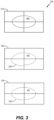
- a "region" of the graphics content can refer to a regular grid in optical space corresponding to a subset of a frame of the graphics content.
- the regions can be the same for each frame of the graphics content.
- each frame of the graphics content can be segmented into the same 64 regions.
- the number and shapes of the regions can vary from frame to frame in the graphics content.
- Rendering inefficiency may be one current technical problem in computer graphics rendering.
- generating graphics content using a VR program, application, and/or device may include rendering two views of graphics content, which may make content twice as slow to render (potentially causing some latency, limiting available bandwidth on hardware component buses, affecting the displayed frame rate, affecting the motion-to-photon latency, etc.) and/or cause a device to utilize more power.
- One approach to solve the technical problem may be to render a region of the graphics content using parameters that utilize more processing resources (e.g., at a higher resolution and/or a higher framerate) and render the other region(s) of the scene using parameters that utilize fewer processing resources (e.g., at one or more lower resolutions and/or lower framerates).
- the user may be primarily focused on the center of the graphics content.
- the outer portions are more likely to be in the user's peripheral vision such that, for example, the user's visual system cannot recognize artifacts and/or appreciate detail at the same levels as in the center of the graphics content. Accordingly, the user's experience may not be negatively impacted by rendering the outer regions at one or more lower resolutions and/or lower framerates and rendering efficiency is gained by not rendering those regions at a higher resolution and/or a higher framerate.
- identifying the region of the user's gaze may involve performing eye tracking to determine a region of the graphics content in the user's foveal vision.
- a user's foveal vision can refer to vision in the center of the user's field of vision, where visual acuity is usually the highest.
- a region of graphics content in (or determined to be in) the user's foveal vision can refer to a region of the graphics content that represents the intersection of a projection of the user's foveal vision and a two-dimensional cross section of the graphics content that intersects the projection.
- an application may dynamically hint at which region should be rendered as if within the user's foveal vision (e.g., based on content, the scene, etc.).
- foveated rendering can refer to the process of rendering different regions of a scene based on different foveation parameters.
- the foveation parameters can include, but are not limited to, resolutions, framerates, AA levels, blurring levels, filters to apply, levels of geometric detail, and texture mipmap levels.
- pose information can refer to a position of the user (e.g., body and/or head) and/or a position of the user's eye(s) and/or gaze.
- a foveated region can refer to a region in one or more frames of graphics content that is rendered using parameters that utilize more processing resources.
- a foveated region can be determined based on the region being predetermined (i.e., static regions), determined, predicted, and/or presumed to be within the user's foveal vision.
- foveated regions can be regions that are rendered at higher resolutions, at a higher framerate, with higher AA levels, with lower blurring levels, with filters to improve the quality of the region, at higher levels of geometric detail, at higher texture mipmap levels, and the like.
- foveated regions can be adjusted based on sensor readings other than eye position/coordinates.
- non-foveated regions can refer to regions in one or more frames of graphics content that are rendered using parameters that utilize fewer processing resources.
- a non-foveated region can be determined based on the region not being predetermined (i.e., static regions), determined, predicted, and/or presumed to be within the user's foveal vision (e.g., within the user's peripheral vision).
- non-foveated regions can be regions that are rendered at lower resolutions, at lower framerates, with lower AA levels, with higher blurring levels, with filters to improve processing efficiency, at lower levels of geometric detail, at lower texture mipmap levels, and the like.
- Rendering foveated regions differently than non-foveated regions may be particularly useful in mobile devices, which are often battery powered and have constrained form factors that can affect component sizes and available space for, for example, processors, batteries, and the like. Thus, power savings and processing efficiencies are of particular importance.
- Motion-to-photon latency can be described as the time needed for a user's movement to be reflected on a display screen. If motion-to-photon latency is high (e.g., greater than 20 milliseconds (ms)), the user's experience may be negatively impacted because the display screen may not accurately reflect what the user expects to be on the screen based on their movement and/or the user may experience visual artifacts caused by the user's gaze moving to a region that was rendered based on the region being determined to be within the user's peripheral vision (e.g., rendered at a lower resolution/framerate or using parameters for more efficient/less detailed display). These effects can cause the user to experience disorientation and/or motion sickness, and may also break the VR experience for the user.
- ms milliseconds
- Motion-to-photon latency may also decrease the user experience in other applications that use eye or head tracking for foveated rendering such as mobile gaming applications, or applications displayed on very large screens.
- pose information e.g., eye position
- a rendering command is generated.
- a graphics processor e.g., a graphics processing unit (GPU)
- the portion of graphics content is more likely to be displayed based on the user's position.
- the rendered frames can be warped using a reprojection technique (e.g., Asynchronous Timewarp) to adjust for any changes in the user's position after the rendering commands were generated.
- Asynchronous Timewarp e.g., Asynchronous Timewarp
- a further technical problem can result from a movement of an object within a scene, the movement of the user position (e.g., of the user's body and/or head), the movement of the user's eye position between frames, etc.
- the user position e.g., of the user's body and/or head
- the non-foveated region may not be updated every time the foveated region is updated.
- an object that is within both regions and that moves position between two frames may cause artifacts at the boundary of the two regions. These artifacts could negatively affect the user's experience, cause disorientation, and/or cause motion sickness.
- these technical problems can be addressed by combining, using a reprojection algorithm, the current partial frame of the foveated region with parts of a previous frame of the non-foveated regions.
- the boundaries of the foveated regions and non-foveated regions can be blended to further smooth out the artifacts. This can provide the improved efficiency of foveated rendering using variable framerates, while reducing or eliminating the artifacts caused by the regions being rendered at different framerates.
- FIGs. where like reference numbers may indicate functionally similar elements.
- the systems and methods as generally described and illustrated in the FIGs. herein could be arranged and designed in a wide variety of different configurations.
- the following more detailed description of several configurations, as represented in the FIGs. is not intended to limit the scope, as claimed, but is merely representative of example systems and methods.
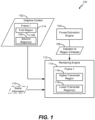
- FIG. 1 depicts an illustrative example of a device 100 that can perform foveated rendering.
- the device 100 may include or be included in a graphics processing unit (GPU) or any other type of processing unit (e.g., a central processing unit (CPU) or a digital signal processor (DSP)) that is configured to perform a graphics processing operation using the graphics content 102, as an illustrative example.
- the graphics content 102 may correspond to graphics content from an AR application, a VR application, a mixed reality application, or any other type of computer graphics application.
- the graphics content 102 can include one or more frames, such as a first frame 114.
- the first frame 114 may include a first region 108 and one or more second regions 109.
- the graphics content 102 can be generated based on a state of a computer graphics application, based on position information of the device 100 (e.g., based on global positioning system (GPS) coordinates, local coordinates, locations of real-world objects, etc.), based on an orientation of the device 100, and/or based on determined motion of the device 100, a user (e.g., head or eye position), or a real-world object captured by a camera (not pictured) of the device 100.
- the device 100 can include a fovea estimation engine 104.
- the device 100 can further include a rendering engine 112 that performs foveated rendering of graphics content 102.
- the first region 108 of the first frame 114 may be a region that is rendered at a first framerate.
- the first frame 114 in the rendering engine 112 can include a higher framerate region 116 that is based on the first region 108 of the first frame 114 of the graphics content 102.
- the second region(s) 109 of the first frame 114 may be region(s) that is/are rendered at lower framerate(s).
- the first frame 114 in the rendering engine 112 can include one or more lower framerate regions 118 that is based on the one or more second regions 109 of the first frame 114 of the graphics content 102.
- the rendering engine 112 may be, may include, or may be part of a GPU or another type of processor.
- the fovea estimation engine 104 may be configured to generate an indication of a region of interest 106 (e.g., the first region 108) of the graphics content 102.
- the fovea estimation engine 104 may receive eye position information from a sensor (not pictured) and determine a region of interest within a display that is within a user's foveal vision.
- the eye position data can include an estimated direction of the user's gaze, as well as other sensor readings, such as coordinates of the user's pupil or a measure of the user's eye's openness.
- the region of interest may be associated with the first region 108 of the first frame 114.
- the fovea estimation engine 104 can send an indication of the region of interest 106 to the rendering engine 112, and the rendering engine 112 can determine that the first region 108 should be the higher framerate region 116 and the second region(s) 109 (not in the region of interest) should be the one or more lower framerate regions 118.
- the fovea estimation engine 104 may be part of the same processor as the rendering engine 112 while, in other implementations, the fovea estimation engine 104 may part of a separate processor.
- the device 100 may receive scene information 110.
- the scene information 110 may be captured by a camera (not pictured) of the device 100, and the device 100 may superimpose the graphics content 102 on the scene information 110.
- the device 200 can be the same or similar to the device 100 in FIG. 1 .
- the device 200 can be configured to render graphics content using tiled rendering and, accordingly, can include a tiling engine 206.
- a "tile” can refer to the grid in optical space (e.g., a 16X16 or a 32X32 grid of pixels) and/or a "tile” can refer to a section of tile memory where the samples values associated with the grid in optical space are stored.
- a “sample” or a “sample value” can refer to a value that represents the intersection of a channel (e.g., red, green, or blue) and a pixel.
- reference to a sample can include a sample with multiple subsamples. For example, in red, green, blue (RGB) color space, a sample can include 3 subsamples, and in red, green, blue, alpha, (RGBA) color space, a sample can include 4 subsamples.
- RGB red, green, blue
- RGBA alpha,
- the graphics processor 404 can retrieve the rendered full frame from the eyebuffer 407 and, at element 418, the graphics processor 404 can perform a warp (i.e., a reprojection technique, such as Asynchronous Timewarp), also referred to as a warping algorithm, to adjust for the time passed after the rendering commands were generated (in element 410).
- a warp i.e., a reprojection technique, such as Asynchronous Timewarp
- the graphics processor 404 may receive updated pose information (e.g., head and/or eye positions) and further perform the warp based on the updated pose information and the time that has passed.
- the head and/or eye position of the user may change between when the commands were generated in element 410 and the warp was performed in element 418, thus, by warping the rendered full frame, the new position of the user can be accounted for, the rendered objects can be adjusted, as needed, and the foveation parameters can be adjusted, as needed.
- the updated pose information can be received from the one or more other processors 402 and can be determined after the full frame is rendered in element 412.
- the graphics processor 404 can send the warped full frame to the system memory 406, where the full frame can subsequently be output to a display.
- the graphics processor 404 can render a partial frame based on the commands and pose information received from the one or more processors 402. For example, the graphics processor 404 can execute the commands to render the partial frame where not every region of the frame is rendered. Additionally, in some embodiments, the graphics processor 404 can render different regions in the partial frame based on the current eye position using different foveation parameters (e.g., resolutions, AA levels, blurring levels, filters to apply, levels of geometric detail, texture mipmap levels, etc.). For instance, the partial frame could include different regions with different resolutions.
- different foveation parameters e.g., resolutions, AA levels, blurring levels, filters to apply, levels of geometric detail, texture mipmap levels, etc.
- the graphics processor 404 can send the warped full frame (combining the full frame from the eyebuffer 407 and the partial frame from the eyebuffer 408) to the system memory 406, where the full frame can subsequently be output to a display.
- the one or more processors 402 can determine current pose information (e.g., head and eye positions) and generate rendering commands based on the current pose information and can send the commands and the current pose information to the graphics processor 404. For example, the one or more processors 402 can determine what to render based on the head position and which regions are within the user's foveal vision based on the eye position. Additionally, because, in the example shown in FIG. 4 , the foveated regions are rendered at a full framerate and the non-foveated regions are rendered at half of the full frame rate, at element 434, the commands can correspond to rendering another full frame.
- current pose information e.g., head and eye positions
- the graphics processor 404 can render the full frame based on the commands and pose information received from the one or more processors 402.
- the graphics processor 404 can store the rendered full frame in the eyebuffer 407.
- the rendered current full frame can replace at least part of a previous full frame in the eyebuffer 407.
- the graphics processor 404 can retrieve the rendered full frame from the eyebuffer 407 and, at element 442, the graphics processor 404 can perform a warp to adjust for the time passed after the rendering commands were generated (in element 434) and/or based on updated pose information.
- the graphics processor 404 can send the warped full frame to the system memory 406, where the full frame can subsequently be output to a display.
- the one or more processors 402 can determine current pose information (e.g., head and eye positions) and generate rendering commands based on the current pose information and can send the commands and the current pose information to the graphics processor 404.
- the one or more processors 402 may only generate rendering commands for regions of the current frame that are within the user's foveal vision (e.g., based on the current eye position) so that every other frame is only partially rendered.
- the one or more processors 402 may also generate and send metadata indicating which regions of the current partial frame are being rendered and/or which regions of the current partial frame are not being rendered.
- the graphics processor 404 can render a partial frame based on the commands and pose information received from the one or more processors 402. For example, the graphics processor 404 can execute the commands to render the partial frame where not every region of the frame is rendered.
- the graphics processor 404 can store the rendered partial frame in the eyebuffer 408.
- the graphics processor 404 can additionally store the metadata, that indicates which regions are rendered, in the eyebuffer 408.
- the rendered current partial frame and/or the current metadata may replace at least part of a previous partial frame and/or previous metadata stored in the eyebuffer 408.
- the graphics processor 404 can retrieve the rendered partial frame from the eyebuffer 408.
- the graphics processor 404 can also retrieve the rendered previous full frame (or parts thereof) from the eyebuffer 407.
- the graphics processor 404 may determine which parts of the previous full frame to retrieve based on the metadata indicating which regions are rendered in the current partial frame.
- the graphics processor 404 can perform a warp to adjust for the time passed after the rendering commands were generated and up until the warp is performed.
- the graphics processor 404 may receive updated pose information and further perform the warp based on the updated pose information and the time that has passed.
- the graphics processor 404 may warp the partial frame retrieved from the eyebuffer 408 differently from the full frame (or parts thereof) retrieved from the eyebuffer 407, as discussed above, to generate a warped full frame. Additionally, in some embodiments, the graphics processor can blend a portion of the combined frame, as discussed in further detail below.
- the graphics processor 404 can send the warped full frame (combining the full frame from the eyebuffer 407 and the partial frame from the eyebuffer 408) to the system memory 406, where the full frame can subsequently be output to a display.
- FIG. 5 depicts a process (500A and 500B) that can be performed by a computing device that utilizes foveated rendering with a variable framerate, such as the device 100 or the device 200, shown in FIGs. 1 and 2 , respectively.
- the process (500A and 500B) described in FIG. 5 can be performed using a graphics processor 504 (e.g., a GPU) and one or more other processors 502 (e.g., a CPU, a GPU, a DSP, and the like) of a device.
- a graphics processor 504 e.g., a GPU
- processors 502 e.g., a CPU, a GPU, a DSP, and the like
- the eyebuffers 507, 508, and 509 can correspond to the same buffer/memory that can, for example, store all of a full frame and two partial frames.
- the foveated regions are rendered at a full framerate (e.g., 120 FPS, 90 FPS, 60 FPS, 30 FPS, etc.) and the non-foveated regions are rendered at one-third of the full frame rate (e.g., 40 FPS, 30 FPS, 20 FPS, 10 FPS, etc.).
- the graphics processor 504 can store the rendered full frame in the eyebuffer 507.
- the graphics processor 504 can send the warped full frame to the system memory 506, where the full frame can subsequently be output to a display.
- the one or more processors 502 can determine current pose information and generate rendering commands based on the current pose information and can send the commands and the current pose information to the graphics processor 504.
- the one or more processors 502 may only generate rendering commands for regions of the current frame that are within the user's foveal vision (e.g., based on the current eye position).
- the one or more processors 502 may also generate and send metadata indicating which regions of the current partial frame are being rendered and/or which regions of the current partial frame are not being rendered. Thus, processing resources and bandwidth that would be used to generate and send the remaining regions of the frame may not be used for the current frame.
- the graphics processor 504 can render a partial frame based on the commands and pose information received from the one or more processors 502. For example, the graphics processor 504 can execute the commands to render the partial frame where not every region of the frame is rendered. Additionally, in some embodiments, the graphics processor 504 can render different regions in the partial frame based on the current eye position using different foveation parameters (e.g., resolutions, AA levels, blurring levels, filters to apply, levels of geometric detail, texture mipmap levels, etc.). For instance, the partial frame could include different regions with different resolutions.
- different foveation parameters e.g., resolutions, AA levels, blurring levels, filters to apply, levels of geometric detail, texture mipmap levels, etc.
- the graphics processor 504 can store the rendered partial frame in the eyebuffer 508. In some embodiments, the graphics processor 504 can additionally store the metadata, that indicates which regions are rendered, in the eyebuffer 508.
- the graphics processor 504 can retrieve the rendered partial frame from the eyebuffer 508.
- the graphics processor 504 can also retrieve the rendered previous full frame (or parts thereof) from the eyebuffer 507.
- the graphics processor 504 may determine which parts of the previous full frame to retrieve based on the metadata indicating which regions are rendered in the current partial frame.
- the graphics processor 504 can render a partial frame based on the commands and pose information received from the one or more processors 502. For example, the graphics processor 504 can execute the commands to render the partial frame where not every region of the frame is rendered. Additionally, in some embodiments, the graphics processor 504 can render different regions in the partial frame based on the current eye position using different foveation parameters.
- the graphics processor 504 can perform a warp to adjust for the time passed after the rendering commands were generated and up until the warp is performed.
- the graphics processor 504 may receive updated pose information and perform the warp based on the updated pose information and the time that has passed.
- the graphics processor 504 may warp the partial frame retrieved from the eyebuffer 509 differently from the partial frame (or parts thereof) retrieved from the eyebuffer 508 and the full frame (or parts thereof) retrieved from the eyebuffer 507.
- the graphics processor 504 can send the warped full frame (combining the full frame from the eyebuffer 507, the previous partial frame from the eyebuffer 508, and the current partial frame from the eyebuffer 509) to the system memory 506, where the full frame can subsequently be output to a display.
- an example process 600 of foveated rendering using variable framerates is shown.
- the example process 600 can be performed by a computing device, such as the device 100 depicted in FIG. 1 , the device 200 depicted in FIG. 2 , or a device 700 described below with regard to FIG. 7 .
- the example process 600 can be performed using one or more processors, such as a CPU, a DSP, and/or a GPU.
- the process 600 can be performed by the graphics processor 404 shown in FIG. 4 and/or the graphics processor 504 shown in FIGs. 5A and 5B .
- the computing device can be a VR headset, an AR headset, a cellular handset (or other wireless communication device), a laptop computer, a tablet computer, a desktop computer, a server, a set of networked devices, an advanced driver assistance system, a smartwatch, smart glasses, and the like.
- the computing device may include, may be connected to, and/or may be able to transmit information to a display device.
- the processor can obtain rendering commands and pose information for a first frame.
- the rendering commands can include samples from an application (e.g., a VR application, mobile gaming applications, or applications displayed on large screens) and instructions including, for example, instructions to downscale the samples, instructions on how to downscale the samples (e.g., how to weight the samples), instructions to upscale the samples, etc.
- the pose information can include, for example, a position of the user's head, a position of the user's eyes, a location of the user's gaze, and/or positions of objects in the environment.
- the rendering commands can be obtained from the application and the pose information can be obtained from one or more sensors.
- the processor can determine rendering commands based, at least partially, on the pose information.
- the processor can render a full first frame of graphics content based on the rendering commands and the pose information obtained in 610. For example, the processor can execute the rendering commands to render the full frame. Additionally, in some embodiments, the processor can render different regions based on the pose information using different foveation parameters (e.g., resolutions, AA levels, blurring levels, filters to apply, levels of geometric detail, texture mipmap levels, etc.). Additionally, in block 620, the processor can store the full first frame in an eyebuffer. In some embodiments, the processor can overwrite a previous full frame that was stored in the eyebuffer when storing the current full frame.
- different foveation parameters e.g., resolutions, AA levels, blurring levels, filters to apply, levels of geometric detail, texture mipmap levels, etc.
- the full first frame of graphics content can be rendered on a device that is different than the device that will display the full first frame of graphics content to a user.
- a similar process can be performed for partial frames, discussed below.
- Such embodiments can be referred to as "split rendering.” Accordingly, the processor (of a server) can obtain the rendering commends (from itself, from another processor of the server, from a user device, etc.), render the full first frame, and send the full first frame to the user device.
- the processor can obtain additional pose information and the full first frame from the eyebuffer.
- the pose of the user may have changed from the pose obtained in block 610 and the processor can obtain updated pose information from one or more sensors.
- the pose information obtained in block 630 can be the same pose information obtained in block 610.
- the processor can warp the full first frame and send the warped full first frame to system memory.
- warping can include using a reprojection algorithm (e.g., an asynchronous reprojection, such as Asynchronous TimeWarp(ATW)) and inputting one or more of the full first frame, the latest pose information (if different from the original pose information used to generate the rendering commands for and/or render the first frame), and/or the amount of time that passed from when the original pose data was determined.
- the reprojection algorithm can shift the rendered image to adjust for any pose changes (or estimated changes) that occurred after the original pose data was determined.
- the warped full first frame can be sent to system memory, and, from system memory, the full first frame can be output to a display.
- the processor can further render and/or warp the full first frame received from a server based the additional pose information that was not available to the server when the commands were generated.
- a similar process can be performed for partial frames, discussed below.
- larger processing resources of a server can be used to perform a larger part of the rendering, and the smaller processing resources of the user device can be used to fine-tune the rendered frame using the latest pose information obtained by the user device. This can allow the user device to use less power and be smaller in size and weight, while still being able to effectively process the frame.
- the full first frame can be rendered to cover more area than is displayed on the display.
- the warping in block 640 can include selecting a subset of the over-rendered full first frame corresponding to the latest pose information and sending the selected subset to system memory.
- full frames such as the full first frame described above, may not be warped and can be output from the eyebuffer to system memory.
- the processor can obtain rendering commands and pose information for a next frame.
- the rendering commands can correspond to a partial frame, and the rendering commands can include coordinates of the partial frame that are already selected based on the pose information.
- the processor can obtain rendering commands for a full frame, and only part of the full frame may be rendered in block 660 based on the pose information.
- the pose information can include an eye position that is used to determine an area within the frame that is currently within the user's foveal vision. Accordingly, the subset of the full frame corresponding to the area within the user's foveal vision may correspond to the coordinates of the partial frame.
- the processor can render a partial frame of graphics content based on the rendering commands and the pose information obtained in 650. For example, the processor can execute the rendering commands corresponding to a partial frame or select rendering commands to execute based on the pose information to render a partial frame. Additionally, in some embodiments, the processor can render different regions of the partial frame based on the pose information using different foveation parameters. Additionally, in block 660, the processor can store the rendered partial frame in an eyebuffer. In some embodiments, the processor can overwrite a previous partial frame that was stored in the eyebuffer when storing the current full frame. In further embodiments, the processor can additional store metadata indicating which region of the full frame corresponds to the partial frame stored in the eyebuffer.
- the processor can obtain additional pose information and the full frame (stored in element 620) from the appropriate eyebuffer and any partial frames (stored in element 660) from the appropriate eyebuffer(s). For example, in some embodiments, the pose of the user may have changed from the pose obtained in block 650 and the processor can obtain updated pose information from one or more sensors. In other embodiments, the pose information obtained in block 650 can be the same pose information obtained in block 670. In some embodiments, the processor can also obtain coordinates (e.g., stored as metadata in an eyebuffer) indicating a location of the partial frames(s) within the full frame.
- coordinates e.g., stored as metadata in an eyebuffer
- the processor can combine and warp the full frame and any partial frames obtained in element 670.
- warping can include inputting one or more of the full first frame, the partial frame(s), metadata including the coordinates indicating a location of the partial frames(s) within the full frame, the latest pose information (if different from the original pose information used to generate the rendering commands for and/or render the full frame or any partial frames), and/or the amount of time that passed from when any original pose data was determined.
- the reprojection algorithm can combine the full frame with the partial frame(s), using the coordinates to overwrite portions of the full frame that are also covered by the partial frame(s), and shift the rendered image to adjust for any pose changes (or estimated changes) that occurred after the original pose data was determined.
- the shift performed during the warp can be different for the areas covered by the partial frame(s) than the areas that correspond to the full frame. Because more time has passed from when the full frame was rendered, the areas that correspond to the full frame may be shifted or otherwise warped more than the areas covered by the partial frame.
- the processor can blend the combined frame and send the blended combined frame to system memory.
- warp correction and/or blending can be performed on the combined frame to remove or otherwise mitigate these artifacts.
- the warp correction and/or blending may include alpha blending, circular blur or blending (e.g., away from the focal point), and/or feathering boundary regions by sampling both sides of the boundary.
- the warp correction and/or blending may be content adaptive.
- an element of content to be displayed across tiles can be identified, and the correction/blending can be performed to maintain the expected shape of the content.
- the combined, warped, and blended frame can be sent to system memory, and, from system memory, the combined, warped, and blended frame can be output to a display.
- the processor can determine whether to proceed with a partial frame or a full frame for the next frame to be displayed. For example, if the partial regions are rendered at one half of the full framerate, then following rendering a partial frame, the processor can proceed back to block 610 to render a full frame as the next frame (695, YES). As an additional example, if the partial regions are rendered at one third of the full frame rate, then following rendering a first partial frame, the processor can proceed back to block 650 to render a second partial frame (695, NO). In such a manner, different regions of a frame can be rendered at different framerates.
- the high framerate regions (updated each partial frame and each full frame) can correspond to region(s) with in the user's foveal vision
- the low frame rate regions (updated each full frame) can correspond to region(s) not in the user's foveal vision (e.g., in the user's peripheral vision).
- the electronic device 700 includes one or more processors, such as a processor 710 and a graphics processing unit (GPU) 796.
- the processor 710 may include a central processing unit (CPU), a digital signal processor (DSP), another processing device, or a combination thereof.
- the processor may include the fovea estimation engine 704 and the GPU 796 may include the rendering engine 712.
- the rendering engine 712 may be included in the processor 710 and/or the fovea estimation engine 704 may be included in the GPU 796, etc.
- the processor 710 may be coupled to the GPU 796.
- the processor 710 may be configured to communicate with the GPU 796 using graphics application programming interface (API) calls.
- the GPU 796 may include an API calls analyzer (not shown), and the processor 710 may be configured to provide the API calls to the API calls analyzer during graphics processing performed by the GPU 796.
- the electronic device 700 may further include one or more memories, such as a memory 732.
- the memory 732 may be coupled to the processor 710, to the GPU 796, or to both.
- the memory 732 may include random access memory (RAM), magnetoresistive random access memory (MRAM), flash memory, read-only memory (ROM), programmable read-only memory (PROM), erasable programmable read-only memory (EPROM), electrically erasable programmable read-only memory (EEPROM), one or more registers, a hard disk, a removable disk, a compact disc read-only memory (CD-ROM), another memory device, or a combination thereof.
- RAM random access memory
- MRAM magnetoresistive random access memory
- ROM read-only memory
- PROM programmable read-only memory
- EPROM erasable programmable read-only memory
- EEPROM electrically erasable programmable read-only memory
- registers a hard disk, a removable disk, a compact disc read-only memory (
- the memory 732 may store instructions 760.
- the instructions 760 may be executable by the processor 710, by the GPU 796, or by both. In some embodiments, the instructions 760 may instruct the processor 710 and/or the GPU 796 to perform the processes described with regard to FIGs. 4-6 .
- a coder/decoder (CODEC) 734 can also be coupled to the processor 710.
- the CODEC 734 may be coupled to one or more microphones, such as a microphone 738.
- the CODEC 734 may also be coupled to one or more speakers, such as a speaker 736.
- the CODEC 734 may include a memory 790 storing instructions 795 executable by the CODEC 734.
- FIG. 7 also shows a display controller 726 that is coupled to the processor 710 and to a display 728.
- the electronic device 700 may further include a wireless controller 740 coupled to an antenna 742.
- the electronic device 700 may further include a wired network controller (not shown) coupled to a computer network cable.
- the processor 710, the GPU 796, the memory 732, the display controller 726, the CODEC 734, and the wireless controller 740 are included in a system-on-chip (SoC) device.
- SoC system-on-chip
- an input device 730 and a power supply 744 may be coupled to the SoC device 722.
- the display 728, the input device 730, the speaker 736, the microphone 738, the antenna 742, the power supply 744, and the sensor 750 are external to the SoC device 722.
- Coupled may include communicatively coupled, electrically coupled, magnetically coupled, physically coupled, optically coupled, and combinations thereof.
- Two devices (or components) may be coupled (e.g., communicatively coupled, electrically coupled, or physically coupled) directly or indirectly via one or more other devices, components, wires, buses, networks (e.g., a wired network, a wireless network, or a combination thereof), etc.
- Two devices (or components) that are electrically coupled may be included in the same device or in different devices and may be connected via electronics, one or more connectors, or inductive coupling, as illustrative, non-limiting examples.
- two devices (or components) that are communicatively coupled, such as in electrical communication may send and receive electrical signals (digital signals or analog signals) directly or indirectly, such as via one or more wires, buses, networks, etc.
Landscapes
- Engineering & Computer Science (AREA)
- Physics & Mathematics (AREA)
- General Physics & Mathematics (AREA)
- Theoretical Computer Science (AREA)
- Computer Hardware Design (AREA)
- General Engineering & Computer Science (AREA)
- Optics & Photonics (AREA)
- Human Computer Interaction (AREA)
- Computer Vision & Pattern Recognition (AREA)
- Multimedia (AREA)
- Computer Graphics (AREA)
- Processing Or Creating Images (AREA)
- Controls And Circuits For Display Device (AREA)
Claims (10)
- Dispositif (100, 200) de génération de contenu graphique (102, 201), comprenant :une mémoire (406, 506) ; etun processeur (404, 402, 504, 502) couplé à la mémoire configuré pour amener le dispositif à :obtenir une commande de rendu pour une première trame du contenu graphique ;rendre une trame complète en fonction de la commande de rendu de la première trame ;stocker la trame complète dans une mémoire tampon (407, 408, 507, 508, 509) ;obtenir une commande de rendu pour une région d'une deuxième trame du contenu graphique en fonction de données obtenues de position d'œil d'un utilisateur, les données de position d'œil servant à identifier la région de la deuxième trame ;rendre une trame partielle en fonction de la commande de rendu de la deuxième trame, dans lequel la trame partielle correspond à la région de la deuxième trame ;obtenir la trame complète à partir de la mémoire tampon ;combiner la trame complète et la trame partielle à l'aide d'un algorithme de déformation pour générer la deuxième trame, l'algorithme de déformation étant configuré pour déformer la trame complète et la trame partielle pour les ajuster au temps écoulé après la génération des commandes de rendu et jusqu'à ce que la déformation soit réalisée, dans lequel la trame complète et la trame partielle sont déformées en fonction de données de pose de l'utilisateur reçues après le rendu de la trame partielle, et la trame complète est déformée différemment de la trame partielle ; etdélivrer en sortie la deuxième trame.
- Dispositif selon la revendication 1, le processeur étant configuré en outre pour :déformer la trame complète en fonction de données de pose déterminées après le rendu de la trame complète ; etdélivrer en sortie la première trame après que la trame complète a été déformée et avant la délivrance en sortie de la deuxième trame, dans lequel la première trame comprend la trame complète
- Dispositif selon la revendication 1, le processeur étant configuré en outre pour :stocker la trame partielle dans une seconde mémoire tampon différente de la mémoire tampon ; etobtenir la trame partielle à partir de la seconde mémoire tampon avant de délivrer en sortie la deuxième trame.
- Dispositif selon la revendication 3, dans lequel le stockage de la trame complète dans la mémoire tampon comprend le remplacement dans la mémoire tampon de données correspondant à une trame complète précédente ; et dans lequel le stockage de la trame partielle dans la seconde mémoire tampon comprend le remplacement dans la seconde mémoire tampon de données correspondant à une trame partielle précédente.
- Dispositif selon la revendication 3, dans lequel la mémoire tampon est plus grande que la seconde mémoire tampon.
- Dispositif selon la revendication 1, le processeur étant configuré en outre pour :stocker la trame partielle dans une seconde mémoire tampon ;obtenir une commande de rendu pour une région d'une troisième trame du contenu graphique en fonction de données obtenues de position d'œil de l'utilisateur, les données de position d'œil identifiant la région de la troisième trame ;rendre une deuxième trame partielle en fonction de la commande de rendu de la troisième trame, dans laquelle la deuxième trame partielle correspond à la région de la troisième trame ;obtenir la trame complète à partir de la mémoire tampon ;obtenir la trame partielle à partir de la seconde mémoire tampon ; etdélivrer en sortie la troisième trame, dans lequel la troisième trame est basée sur la trame complète, la trame partielle et la deuxième trame partielle.
- Dispositif selon la revendication 1, comprenant en outre un afficheur, dans lequel la délivrance en sortie de la deuxième trame comprend la délivrance en sortie vers l'afficheur.
- Dispositif selon la revendication 1, le dispositif étant un ou plusieurs d'un dispositif de communication sans fil, d'un casque de réalité augmentée ou d'un casque de réalité virtuelle.
- Procédé de génération de contenu graphique comprenant :l'obtention (410, 510) d'une commande de rendu pour une première trame du contenu graphique ;le rendu (412, 512) d'une trame complète en fonction de la commande de rendu de la première trame ;le stockage (414, 514) de la trame entière dans une mémoire tampon ;l'obtention d'une commande de rendu pour une région d'une deuxième trame du contenu graphique en fonction de données obtenues de position d'œil d'un utilisateur, les données de position d'œil servant à identifier la région de la deuxième trame ;le rendu (424, 524) d'une trame partielle en fonction de la commande de rendu de la deuxième trame, dans lequel la trame partielle correspond à la région de la deuxième trame ;l'obtention de la trame complète à partir de la mémoire tampon ;la combinaison (430, 530) de la trame complète et de la trame partielle à l'aide d'un algorithme de déformation pour générer la deuxième trame, l'algorithme de déformation étant configuré pour déformer la trame complète et la trame partielle pour les ajuster au temps écoulé après la génération des commandes de rendu et jusqu'à ce que la déformation soit réalisée, dans lequel la trame complète et la trame partielle sont déformées en fonction de données de pose de l'utilisateur reçues après que la trame partielle a été rendue, et la trame complète est déformée différemment de la trame partielle ; etla délivrance en sortie (432, 532) de la deuxième trame.
- Support lisible par ordinateur non transitoire pour générer un contenu graphique, le support lisible par ordinateur non transitoire stockant un programme contenant des instructions qui, à leur exécution par un processeur d'un dispositif, amènent le dispositif à réaliser le procédé selon la revendication 9.
Applications Claiming Priority (2)
| Application Number | Priority Date | Filing Date | Title |
|---|---|---|---|
| US16/520,711 US10997954B2 (en) | 2019-07-24 | 2019-07-24 | Foveated rendering using variable framerates |
| PCT/US2020/042965 WO2021016292A1 (fr) | 2019-07-24 | 2020-07-22 | Rendu fovéal à l'aide de fréquences d'images variables |
Publications (3)
| Publication Number | Publication Date |
|---|---|
| EP4004704A1 EP4004704A1 (fr) | 2022-06-01 |
| EP4004704B1 true EP4004704B1 (fr) | 2025-07-09 |
| EP4004704C0 EP4004704C0 (fr) | 2025-07-09 |
Family
ID=71995162
Family Applications (1)
| Application Number | Title | Priority Date | Filing Date |
|---|---|---|---|
| EP20753625.1A Active EP4004704B1 (fr) | 2019-07-24 | 2020-07-22 | Rendu fovéal à l'aide de fréquences d'images variables |
Country Status (5)
| Country | Link |
|---|---|
| US (1) | US10997954B2 (fr) |
| EP (1) | EP4004704B1 (fr) |
| CN (1) | CN114127666B (fr) |
| TW (1) | TW202110174A (fr) |
| WO (1) | WO2021016292A1 (fr) |
Families Citing this family (18)
| Publication number | Priority date | Publication date | Assignee | Title |
|---|---|---|---|---|
| JP7392105B2 (ja) * | 2019-07-28 | 2023-12-05 | グーグル エルエルシー | 没入型ビデオコンテンツをフォービエイテッドメッシュを用いてレンダリングするための方法、システム、および媒体 |
| JP7649132B2 (ja) * | 2020-12-15 | 2025-03-19 | キヤノン株式会社 | 撮像システム、配信装置、撮像装置、制御方法、及び、プログラム |
| US12069230B2 (en) * | 2020-12-23 | 2024-08-20 | Meta Platforms Technologies, Llc | Temporal foveated rendering |
| US12142185B2 (en) * | 2021-01-05 | 2024-11-12 | Google Llc | Hidden display interfaces and associated systems and methods |
| US12008675B2 (en) | 2021-03-18 | 2024-06-11 | Samsung Electronics Co., Ltd. | Method and apparatus for isolating 3D draw calls for selective upscaling |
| CN117121494A (zh) | 2021-03-30 | 2023-11-24 | 三星电子株式会社 | 用于提供媒体流的装置和方法 |
| US11748842B2 (en) | 2021-04-13 | 2023-09-05 | Qualcomm Incorporated | Methods and apparatus for content shifting in foveated rendering |
| CN115309256B (zh) * | 2021-05-07 | 2026-03-27 | 华为技术有限公司 | 一种显示方法与电子设备 |
| US12254587B2 (en) | 2021-09-24 | 2025-03-18 | Apple Inc. | Protected access to rendering information for electronic devices |
| EP4374275B1 (fr) * | 2021-09-24 | 2025-04-16 | Apple Inc. | Accès protégé à des informations de rendu pour dispositifs électroniques |
| US20230136064A1 (en) * | 2021-11-04 | 2023-05-04 | Meta Platforms Technologies, Llc | Priority-based graphics rendering for multi-part systems |
| US11917011B2 (en) | 2022-01-10 | 2024-02-27 | Meta Platforms Technologies, Llc | Resilient rendering for augmented-reality devices |
| CN114581583B (zh) * | 2022-04-19 | 2025-04-18 | 北京视延科技有限公司 | 图像处理方法、装置及存储介质 |
| CN115797526A (zh) * | 2022-12-07 | 2023-03-14 | 广州随手玩网络科技有限公司 | 一种gif渲染方法及装置 |
| TWI835567B (zh) * | 2023-02-20 | 2024-03-11 | 瑞昱半導體股份有限公司 | 不固定幀速率的影像幀讀寫方法與系統 |
| US20250172806A1 (en) * | 2023-11-23 | 2025-05-29 | Samsung Electronics Co., Ltd. | Wearable device for changing frame rate associated with foveated rendering according to movement speed of gaze position and method thereof |
| US20250330722A1 (en) * | 2024-04-17 | 2025-10-23 | Qualcomm Incorporated | Adaptive foveation sensing systems |
| CN120431888B (zh) * | 2025-07-04 | 2025-09-09 | 上海龙田数码科技有限公司 | 一种动态调整显示界面的方法及系统 |
Family Cites Families (12)
| Publication number | Priority date | Publication date | Assignee | Title |
|---|---|---|---|---|
| US9269328B2 (en) * | 2014-06-24 | 2016-02-23 | Google Inc. | Efficient frame rendering |
| US10446118B2 (en) * | 2015-06-02 | 2019-10-15 | Intel Corporation | Apparatus and method using subdivided swapchains for improved virtual reality implementations |
| US10157448B2 (en) * | 2016-02-12 | 2018-12-18 | Qualcomm Incorporated | Foveated video rendering |
| GB2553744B (en) * | 2016-04-29 | 2018-09-05 | Advanced Risc Mach Ltd | Graphics processing systems |
| US10379611B2 (en) * | 2016-09-16 | 2019-08-13 | Intel Corporation | Virtual reality/augmented reality apparatus and method |
| US10306180B2 (en) * | 2016-10-21 | 2019-05-28 | Liquidsky Software, Inc. | Predictive virtual reality content streaming techniques |
| US10424097B2 (en) * | 2017-04-01 | 2019-09-24 | Intel Corporation | Predictive viewport renderer and foveated color compressor |
| WO2018213812A2 (fr) * | 2017-05-18 | 2018-11-22 | Synaptics Incorporated | Interface d'affichage à compression fovéale |
| US10885607B2 (en) | 2017-06-01 | 2021-01-05 | Qualcomm Incorporated | Storage for foveated rendering |
| US10504272B2 (en) * | 2017-06-13 | 2019-12-10 | Intel Corporation | Apparatus and method for optimizing time/space warp for virtual reality using dynamic tiling and dirty tile marking |
| GB2575824B (en) * | 2018-07-24 | 2022-08-03 | Displaylink Uk Ltd | Generating display data |
| GB2578769B (en) * | 2018-11-07 | 2022-07-20 | Advanced Risc Mach Ltd | Data processing systems |
-
2019
- 2019-07-24 US US16/520,711 patent/US10997954B2/en active Active
-
2020
- 2020-07-22 EP EP20753625.1A patent/EP4004704B1/fr active Active
- 2020-07-22 CN CN202080051750.5A patent/CN114127666B/zh active Active
- 2020-07-22 WO PCT/US2020/042965 patent/WO2021016292A1/fr not_active Ceased
- 2020-07-23 TW TW109124931A patent/TW202110174A/zh unknown
Also Published As
| Publication number | Publication date |
|---|---|
| CN114127666B (zh) | 2024-07-16 |
| TW202110174A (zh) | 2021-03-01 |
| US20210027752A1 (en) | 2021-01-28 |
| EP4004704C0 (fr) | 2025-07-09 |
| CN114127666A (zh) | 2022-03-01 |
| EP4004704A1 (fr) | 2022-06-01 |
| WO2021016292A1 (fr) | 2021-01-28 |
| US10997954B2 (en) | 2021-05-04 |
Similar Documents
| Publication | Publication Date | Title |
|---|---|---|
| EP4004704B1 (fr) | Rendu fovéal à l'aide de fréquences d'images variables | |
| US11194389B2 (en) | Foveated rendering of graphics content using a rendering command and subsequently received eye position data | |
| US10997951B2 (en) | Preserving sample data in foveated rendering of graphics content | |
| US10957093B2 (en) | Scene-based foveated rendering of graphics content | |
| US11875453B2 (en) | Decoupled shading pipeline | |
| EP3120321B1 (fr) | Codage et décodage d'images grand-angle. | |
| EP3120328A1 (fr) | Procédé de traitement d'informations, dispositif de traitement d'informations, et programme | |
| KR101713041B1 (ko) | 일반화된 플레인 인코딩을 이용한 확률적 깊이 버퍼 압축 | |
| US20170124742A1 (en) | Variable Rasterization Order for Motion Blur and Depth of Field | |
| CN104737198B (zh) | 在输入几何对象粒度上记录可见度测试的结果 | |
| US9183652B2 (en) | Variable rasterization order for motion blur and depth of field | |
| US9767602B2 (en) | Techniques for reduced pixel shading | |
| CN112567760A (zh) | 图像处理装置、图像处理方法和图像处理程序 |
Legal Events
| Date | Code | Title | Description |
|---|---|---|---|
| STAA | Information on the status of an ep patent application or granted ep patent |
Free format text: STATUS: UNKNOWN |
|
| STAA | Information on the status of an ep patent application or granted ep patent |
Free format text: STATUS: THE INTERNATIONAL PUBLICATION HAS BEEN MADE |
|
| PUAI | Public reference made under article 153(3) epc to a published international application that has entered the european phase |
Free format text: ORIGINAL CODE: 0009012 |
|
| STAA | Information on the status of an ep patent application or granted ep patent |
Free format text: STATUS: REQUEST FOR EXAMINATION WAS MADE |
|
| 17P | Request for examination filed |
Effective date: 20220120 |
|
| AK | Designated contracting states |
Kind code of ref document: A1 Designated state(s): AL AT BE BG CH CY CZ DE DK EE ES FI FR GB GR HR HU IE IS IT LI LT LU LV MC MK MT NL NO PL PT RO RS SE SI SK SM TR |
|
| DAV | Request for validation of the european patent (deleted) | ||
| DAX | Request for extension of the european patent (deleted) | ||
| STAA | Information on the status of an ep patent application or granted ep patent |
Free format text: STATUS: EXAMINATION IS IN PROGRESS |
|
| 17Q | First examination report despatched |
Effective date: 20230310 |
|
| GRAP | Despatch of communication of intention to grant a patent |
Free format text: ORIGINAL CODE: EPIDOSNIGR1 |
|
| STAA | Information on the status of an ep patent application or granted ep patent |
Free format text: STATUS: GRANT OF PATENT IS INTENDED |
|
| INTG | Intention to grant announced |
Effective date: 20250131 |
|
| GRAS | Grant fee paid |
Free format text: ORIGINAL CODE: EPIDOSNIGR3 |
|
| GRAA | (expected) grant |
Free format text: ORIGINAL CODE: 0009210 |
|
| STAA | Information on the status of an ep patent application or granted ep patent |
Free format text: STATUS: THE PATENT HAS BEEN GRANTED |
|
| AK | Designated contracting states |
Kind code of ref document: B1 Designated state(s): AL AT BE BG CH CY CZ DE DK EE ES FI FR GB GR HR HU IE IS IT LI LT LU LV MC MK MT NL NO PL PT RO RS SE SI SK SM TR |
|
| REG | Reference to a national code |
Ref country code: GB Ref legal event code: FG4D |
|
| REG | Reference to a national code |
Ref country code: CH Ref legal event code: EP |
|
| REG | Reference to a national code |
Ref country code: IE Ref legal event code: FG4D |
|
| REG | Reference to a national code |
Ref country code: DE Ref legal event code: R096 Ref document number: 602020054212 Country of ref document: DE |
|
| U01 | Request for unitary effect filed |
Effective date: 20250730 |
|
| U07 | Unitary effect registered |
Designated state(s): AT BE BG DE DK EE FI FR IT LT LU LV MT NL PT RO SE SI Effective date: 20250808 |
|
| U20 | Renewal fee for the european patent with unitary effect paid |
Year of fee payment: 6 Effective date: 20250806 |
|
| PGFP | Annual fee paid to national office [announced via postgrant information from national office to epo] |
Ref country code: GB Payment date: 20250722 Year of fee payment: 6 |
|
| PGFP | Annual fee paid to national office [announced via postgrant information from national office to epo] |
Ref country code: IE Payment date: 20250722 Year of fee payment: 6 |
|
| PG25 | Lapsed in a contracting state [announced via postgrant information from national office to epo] |
Ref country code: IS Free format text: LAPSE BECAUSE OF FAILURE TO SUBMIT A TRANSLATION OF THE DESCRIPTION OR TO PAY THE FEE WITHIN THE PRESCRIBED TIME-LIMIT Effective date: 20251109 |
|
| PG25 | Lapsed in a contracting state [announced via postgrant information from national office to epo] |
Ref country code: NO Free format text: LAPSE BECAUSE OF FAILURE TO SUBMIT A TRANSLATION OF THE DESCRIPTION OR TO PAY THE FEE WITHIN THE PRESCRIBED TIME-LIMIT Effective date: 20251009 |
|
| PG25 | Lapsed in a contracting state [announced via postgrant information from national office to epo] |
Ref country code: HR Free format text: LAPSE BECAUSE OF FAILURE TO SUBMIT A TRANSLATION OF THE DESCRIPTION OR TO PAY THE FEE WITHIN THE PRESCRIBED TIME-LIMIT Effective date: 20250709 |
|
| PG25 | Lapsed in a contracting state [announced via postgrant information from national office to epo] |
Ref country code: GR Free format text: LAPSE BECAUSE OF FAILURE TO SUBMIT A TRANSLATION OF THE DESCRIPTION OR TO PAY THE FEE WITHIN THE PRESCRIBED TIME-LIMIT Effective date: 20251010 |
|
| PG25 | Lapsed in a contracting state [announced via postgrant information from national office to epo] |
Ref country code: PL Free format text: LAPSE BECAUSE OF FAILURE TO SUBMIT A TRANSLATION OF THE DESCRIPTION OR TO PAY THE FEE WITHIN THE PRESCRIBED TIME-LIMIT Effective date: 20250709 |
|
| PG25 | Lapsed in a contracting state [announced via postgrant information from national office to epo] |
Ref country code: RS Free format text: LAPSE BECAUSE OF FAILURE TO SUBMIT A TRANSLATION OF THE DESCRIPTION OR TO PAY THE FEE WITHIN THE PRESCRIBED TIME-LIMIT Effective date: 20251009 |
|
| PG25 | Lapsed in a contracting state [announced via postgrant information from national office to epo] |
Ref country code: ES Free format text: LAPSE BECAUSE OF FAILURE TO SUBMIT A TRANSLATION OF THE DESCRIPTION OR TO PAY THE FEE WITHIN THE PRESCRIBED TIME-LIMIT Effective date: 20250709 |
|
| REG | Reference to a national code |
Ref country code: CH Ref legal event code: H13 Free format text: ST27 STATUS EVENT CODE: U-0-0-H10-H13 (AS PROVIDED BY THE NATIONAL OFFICE) Effective date: 20260224 |
|
| PG25 | Lapsed in a contracting state [announced via postgrant information from national office to epo] |
Ref country code: SM Free format text: LAPSE BECAUSE OF FAILURE TO SUBMIT A TRANSLATION OF THE DESCRIPTION OR TO PAY THE FEE WITHIN THE PRESCRIBED TIME-LIMIT Effective date: 20250709 |
|
| PG25 | Lapsed in a contracting state [announced via postgrant information from national office to epo] |
Ref country code: CH Free format text: LAPSE BECAUSE OF NON-PAYMENT OF DUE FEES Effective date: 20250731 Ref country code: CZ Free format text: LAPSE BECAUSE OF FAILURE TO SUBMIT A TRANSLATION OF THE DESCRIPTION OR TO PAY THE FEE WITHIN THE PRESCRIBED TIME-LIMIT Effective date: 20250709 |
|
| PG25 | Lapsed in a contracting state [announced via postgrant information from national office to epo] |
Ref country code: SK Free format text: LAPSE BECAUSE OF FAILURE TO SUBMIT A TRANSLATION OF THE DESCRIPTION OR TO PAY THE FEE WITHIN THE PRESCRIBED TIME-LIMIT Effective date: 20250709 |