EP4005460B1 - Dispositif et procédé de nettoyage des ustensiles de soin - Google Patents
Dispositif et procédé de nettoyage des ustensiles de soin Download PDFInfo
- Publication number
- EP4005460B1 EP4005460B1 EP20210050.9A EP20210050A EP4005460B1 EP 4005460 B1 EP4005460 B1 EP 4005460B1 EP 20210050 A EP20210050 A EP 20210050A EP 4005460 B1 EP4005460 B1 EP 4005460B1
- Authority
- EP
- European Patent Office
- Prior art keywords
- foam
- cleaning
- washing chamber
- items
- air
- Prior art date
- Legal status (The legal status is an assumption and is not a legal conclusion. Google has not performed a legal analysis and makes no representation as to the accuracy of the status listed.)
- Active
Links
Images


Classifications
-
- A—HUMAN NECESSITIES
- A61—MEDICAL OR VETERINARY SCIENCE; HYGIENE
- A61G—TRANSPORT, PERSONAL CONVEYANCES, OR ACCOMMODATION SPECIALLY ADAPTED FOR PATIENTS OR DISABLED PERSONS; OPERATING TABLES OR CHAIRS; CHAIRS FOR DENTISTRY; FUNERAL DEVICES
- A61G9/00—Bed-pans, urinals or other sanitary devices for bed-ridden persons; Cleaning devices therefor, e.g. combined with toilet-urinals
- A61G9/02—Cleaning devices
-
- A—HUMAN NECESSITIES
- A47—FURNITURE; DOMESTIC ARTICLES OR APPLIANCES; COFFEE MILLS; SPICE MILLS; SUCTION CLEANERS IN GENERAL
- A47L—DOMESTIC WASHING OR CLEANING; SUCTION CLEANERS IN GENERAL
- A47L15/00—Washing or rinsing machines for crockery or tableware
- A47L15/0076—Washing or rinsing machines for crockery or tableware of non-domestic use type, e.g. commercial dishwashers for bars, hotels, restaurants, canteens or hospitals
-
- A—HUMAN NECESSITIES
- A47—FURNITURE; DOMESTIC ARTICLES OR APPLIANCES; COFFEE MILLS; SPICE MILLS; SUCTION CLEANERS IN GENERAL
- A47L—DOMESTIC WASHING OR CLEANING; SUCTION CLEANERS IN GENERAL
- A47L15/00—Washing or rinsing machines for crockery or tableware
- A47L15/42—Details
- A47L15/44—Devices for adding cleaning agents; Devices for dispensing cleaning agents, rinsing aids or deodorants
Definitions
- the present invention relates to a device and a method for cleaning and thermal disinfection of items to be cleaned, in particular care dishes.
- the cleaning methods known to date often have disadvantages because particularly intensive cleaning is not possible with the cleaning devices known from the state of the art.
- the cleaning and disinfection devices have a deep-drawn washing chamber which is provided with a siphon bend for the drain.
- a key difference between the cleaning and disinfection devices and dishwashers is that the water and the cleaning and disinfection agents used are not circulated. The circulation process is not possible because the water or cleaning agent is drained directly via the drain provided with the siphon bend.
- the cleaning disinfection devices for the items being cleaned must meet certain requirements and test procedures in accordance with EN ISO 15883-3.
- the program control must be automatic and sensors must be present to regulate and monitor the disinfection.
- process chemicals must be dosed automatically and this process must be automatically monitored.
- DE 10 2010 006448 A1 discloses a cleaning and disinfection device for care utensils. Cleaning is carried out using various nozzles, water and rinsing medium. Steam is used for disinfection.
- US 2019/075998 A1 discloses a cleaning device for heavily soiled kitchen utensils, whereby the dirt on the objects to be cleaned is softened with a cleaning foam sprayed through the nozzles.
- DE 30 18 048 A1 discloses an arrangement for developing and dispensing foams for the odorless deposit of excrement in bedpans, the application also being suitable for cleaning purposes.
- the object of the present invention is therefore to provide a method and a device to enable foam cleaning for the care dishes.
- the cleaning and disinfection device further comprises a device for generating a cleaning foam.
- the device further comprises a device for distributing the cleaning foam inside the device.
- the foam distribution is directed on the one hand to the surfaces of the care utensils or the items to be cleaned, but also to the inside of the cleaning and disinfection device.
- the devices for distributing the foam can be separate and/or additional devices. However, the invention also provides for the use of a combination of these distribution devices.
- the object is further achieved in that a kit is made available which designs the cleaning and disinfection device in such a way that the method for distributing the foam on the surfaces of the items to be cleaned can be carried out.
- the present invention relates to a cleaning device for cleaning and thermally disinfecting items to be washed, comprising a washing chamber for receiving items to be cleaned, wherein the washing chamber is provided with a siphon bend for drainage, characterized in that the device further comprises at least one device for generating a cleaning foam, at least one device for distributing the cleaning foam in the interior of the washing chamber or a combination of the devices for generating and distributing the cleaning foam.
- a cleaning device wherein the at least one device for generating and/or distributing the cleaning foam is selected from at least one foam spray nozzle or at least one foam lance.
- the at least one device for generating and/or distributing the Cleaning foam comprises at least one container for providing a foam-forming agent, wherein the foam formation takes place by means of a foamer, which preferably comprises a sieve device, a sponge-like structure made of metals and/or plastics, a mesh made of metals and/or plastics or a similar device for producing foam.
- a foamer which preferably comprises a sieve device, a sponge-like structure made of metals and/or plastics, a mesh made of metals and/or plastics or a similar device for producing foam.
- the foam spray nozzle or foam lance is arranged inside the washing chamber in such a way that the cleaning foam can be applied directly to the items to be washed.
- the foam spray nozzle or foam lance is arranged and/or aligned inside the washing chamber such that the cleaning foam can be applied directly to the inner walls of the washing chamber.
- a cleaning device is also preferred, wherein a device for introducing air or other gases into the foam-forming agent is provided for foam generation.
- the device for introducing air or other gases is a Venturi nozzle, an air or gas pressure piston, a compressor, an air generator, an air or gas supply opening in the supply area of the foam-forming agent or a combination of the devices mentioned.
- Particularly preferred according to the invention is a process in which mixed water is used in the at least one first rinsing step c).
- a method particularly preferred according to the invention is one in which the cleaning foam is applied during the pre-rinse step b) and/or during the first rinse step c) and/or during the intensive cleaning step d).
- Very particularly preferred is a process in which the cleaning foam is applied several times during steps b), c) or d), optionally carrying out a rinsing step with mixed or pure water in order to remove the cleaning foam from the items to be cleaned.
- the foam cleaning step g) is carried out after the pre-rinse step b) and/or after the first rinse step c) and/or after the intensive cleaning step d).
- the foam cleaning step g) is carried out at a temperature between 20 °C and 60 °C; preferably at a temperature of 30 °C to 40 °C; particularly preferably at a temperature of 32 °C to 37 °C.
- foam cleaning step g) is carried out for 0.25 min to 10 min; preferably 3 min to 8 min; particularly preferably 4 min to 5 min.
- a method is also preferred, wherein the foam cleaning step g) is carried out in such a way as to clean the insides of the washing chamber of the cleaning device. It is particularly preferred that the foam cleaning step g) is carried out before step b) or after step f) of the method in order to clean the inside of the washing chamber.
- a cleaning foam is applied to the items to be washed before the step of thermal disinfection with steam and/or chemical disinfection.
- the foam generating device serves to foam a cleaning agent, whereby the foaming is brought about by the addition of air or other gases.
- Foam generating devices are known in the prior art. These are in particular foam distribution devices, frothers which have a sieve-like component, a sponge-like structure made of metals and/or plastics, a mesh made of metals and/or plastics or a similar device for generating foam, devices for enriching the foam generating agent with air or other gases, liquid lines and storage containers for foam generating agents and the like.
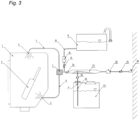
- the Figures 1 to 3 The devices shown show various embodiments of the present invention. This is a cleaning device for cleaning and thermal disinfection of washware.
- the Figures 1 to 3 The features shown relate exclusively to the device according to the invention for producing a cleaning foam.
- the features which are known in the prior art for such cleaning devices and which are used, for example, to meet the hygienic requirements for the cleaning and disinfection of the items to be washed are not shown.
- the devices shown for generating and applying a cleaning foam essentially comprise the actual washing chamber 1, with the items to be washed 2 placed therein.
- the washing chamber 1 is closed by a door and has a drain in the floor area, which is preferably designed like a siphon (not shown).
- Foam nozzles 3, 4 are arranged on the side walls of the washing chamber 1, which are preferably aimed directly at the items to be washed and which are fluidically connected to a frother 7 by means of the foam lines 5, 6.
- the Figure 1 The device shown now describes that the frother 7 is still fluidically connected to the water tank 9 and the detergent container 8.
- the detergent container 8 is fluidically connected to the canister 23 in order to introduce the detergent stored in the canister 23 into the container 8.
- the detergent container 8 is still fluidically connected via Pneumatic hose 20 is connected to a pressure supply system.
- Cleaning agent container 8 is also designed to be pressure-resistant.
- the foam cleaning process according to the invention is carried out as follows using the components shown.
- the cleaning process is carried out with the aid of a linear drive motor (LAM) 18.
- the LAM is connected to the piston 16 of the cylinder 17 by a coupling 19.
- the piston 16 is set in motion by driving the LAM.
- the air is compressed in the cylinder 17 and fed through the pneumatic hose 20 into the cleaning agent container 8.
- Overpressure is created in the container and as a result the cleaning agent is fed further into the system through the liquid hose 14.
- a small air supply opening 15 is provided on the liquid hose (in the container) above the cleaning agent level, which is necessary for foam formation. The overpressure created in the container not only forces cleaning agent into the liquid hose, but also air through the air supply opening 15.
- the air and the cleaning agent are mixed together in the pipe.
- This mixture is fed to the frother 7 via the liquid hose 14.
- a very fine sieve is arranged in the foamer 7, through which the cleaning air mixture is pressed with the pressure generated. This causes the air bubbles in the cleaning agent to be broken down very finely, creating the cleaning foam.
- the foam is then passed through the foam line 5 to the upper foam nozzle 3 and through the foam line 6 to the lower foam nozzle 4.
- the foam is distributed in the washing chamber 1 onto the items to be washed 2 via the foam nozzles. It is clear that further foam nozzles can be arranged in the washing chamber. These are then also fed with the cleaning foam via foam lines.
- the system should be rinsed with clear water either after each wash cycle or after a certain period of time. To do this, water is fed from the water tank 9 of the dishwasher into the rinse water line 13 using the liquid pump 11 and thus rinses the foam lines 5, 6, frother 7 and nozzles 3, 4.
- the self-closing check valve 12 ensures that the cleaning agent does not enter the water tank when the foam generation system is operating.
- the self-closing check valve 10 ensures that the water does not enter the cleaning agent container 8 during the rinsing process.
- the return movement of the piston 16 is used to refill the cleaning agent container 8. Since a negative pressure is created in the cylinder 17 when the piston 16 returns, a suction effect occurs in the container 8 and in the canister 23. This negative pressure causes the container 8 to be refilled by the canister 23.
- the self-closing check valve 22 serves to ensure that excess pressure can build up in the cleaning agent container 8 during operation of the foam generation system, i.e. that air is not directed into the canister 23.
- the Figure 2 The device shown now describes that the frother 7 is also fluidically connected to the water tank 9 and canister 23, which contains the cleaning agent. This fluidic connection is made via a 3-way solenoid valve 25. The corresponding fluids are then transferred to the frother 7 by means of the liquid pump 11.
- the foam cleaning process according to the invention is carried out as follows using the components shown.
- the cleaning process is carried out by means of the liquid pump 11 and a 3-way solenoid changeover valve 25.
- the 3-way solenoid changeover valve 25 is used to switch between the circuits: cleaner (item 1) and water (item 2).
- position 1 of the changeover valve 25 when the liquid pump 11 is driven, a negative pressure is generated in the liquid hose 24 and the cleaner is thus sucked from the canister 23 into the foam generation system, in particular into the frother 7.
- a small air supply opening 15 is provided on the liquid hose above the cleaning agent level, which is necessary for the foam formation. Due to the negative pressure created in the liquid hose 24, not only cleaning agent is drawn into the liquid hose 24, but also air through the air supply opening 15. The air and the cleaning agent are mixed together in the liquid hose 24. This Mixture is fed to the frother 7. A very fine sieve is arranged in the frother 7, through which the cleaning air mixture is pressed with the pressure generated. This breaks up the air bubbles in the cleaning agent very finely and creates the cleaning foam. The foam is then fed through the foam line 5 to the upper foam nozzle 3 and through the foam line 6 to the lower foam nozzle 4. The foam is distributed in the washing chamber 1 onto the items to be washed 2 via the foam nozzles. It is clear that further foam nozzles can be arranged in the washing chamber. These are then also fed with the cleaning foam via foam lines.
- the system should be rinsed with clear water either after each wash cycle or after a certain period of time. To do this, water from the water tank 9 of the dishwasher is fed into the rinse water line 13 using the liquid pump 11 and the position of the 3-way solenoid changeover valve 25, thus flushing the liquid pump 11, foam lines 5, 6, frother 7 and nozzles 3, 4.
- the Figure 3 The device shown now describes that the frother 7 is also fluidically connected to the water tank 9 and canister 23, which contains the cleaning agent. This fluidic connection is made via a Venturi nozzle 27, which is connected to a water line 30 via a water pressure regulator 28 and a check valve 29. The corresponding fluids are then transferred to the frother 7 by means of the Venturi nozzle 27.
- a cleaning agent flow adjustment valve 26 is used for the adjustable dosing of the cleaning agent.
- the foam cleaning process according to the invention is carried out as follows using the components shown.
- the cleaning process works according to the Venturi principle.
- the water flows through a pipe section 27 with a narrowing of the cross-section (Venturi nozzle). This narrowing creates a negative pressure in the connected liquid hose 24 (Venturi effect) and the cleaner is sucked out of the canister 23 via the liquid hose 24 into the Venturi nozzle 27.
- the water for the Foam generation is provided from the water line 30.
- a check valve 29 is used to prevent backflow of water into the water line.
- a water pressure regulator 28 is installed in the water line.
- a small air supply opening 15 is provided on the liquid hose 24 above the cleaning agent level, which is necessary for the formation of foam.
- the negative pressure created in the liquid hose 24 not only draws cleaning agent into the liquid hose 24, but also air through the air supply opening 15.
- the air and the cleaning agent are mixed together in the liquid hose 24.
- This mixture is fed to the frother 7.
- a very fine sieve is arranged in the frother 7, through which the cleaning air mixture is pressed with the pressure generated. This breaks down the air bubbles in the cleaning agent very finely and this is how the cleaning foam is created.
- the foam is then fed further through the foam line 5 to the upper foam nozzle 3 and through the foam line 6 to the lower foam nozzle 4.
- the foam in the wash chamber 1 is distributed onto the items to be washed 2 via the foam nozzles. It is clear that further foam nozzles can be arranged in the wash chamber. These are then also fed with the cleaning foam via foam lines.
- the system should be rinsed with clear water either after each wash cycle or after a certain period of time. To do this, water is fed from the water tank 9 of the dishwasher into the rinse water line 13 using the liquid pump 11 and thus rinses the foam lines 5, 6, frother 7 and nozzles 3, 4.
- the self-closing check valve 12 ensures that the cleaning agent does not enter the water tank when the foam generation system is operating.
- the self-closing check valve 31 ensures that the water does not enter the cleaning agent container 23 during the rinsing process.
Landscapes
- Health & Medical Sciences (AREA)
- Epidemiology (AREA)
- Life Sciences & Earth Sciences (AREA)
- Animal Behavior & Ethology (AREA)
- General Health & Medical Sciences (AREA)
- Public Health (AREA)
- Veterinary Medicine (AREA)
- Cleaning By Liquid Or Steam (AREA)
Claims (13)
- Dispositif de nettoyage pour le nettoyage et la désinfection thermique d'articles à laver, comprenant une chambre de lavage (1) pour recevoir des articles à nettoyer, la chambre de lavage (1) étant munie d'un coude de siphon pour l'écoulement, caractérisé en ce que le dispositif de nettoyage comprend en outre au moins un dispositif pour générer une mousse de nettoyage, au moins un dispositif pour répartir la mousse de nettoyage dans la zone intérieure de la chambre de lavage ou une combinaison des dispositifs pour générer et répartir la mousse de nettoyage,ledit au moins un dispositif pour produire et/ou distribuer la mousse de nettoyage étant choisi parmi au moins une buse (3, 4) de pulvérisation de mousse ou au moins une lance à mousse (3, 4),la buse (3, 4) de pulvérisation de mousse ou la lance à mousse (3, 4) étant placée à l'intérieur de la chambre de lavage (1) de telle sorte que la mousse de nettoyage puisse être appliquée directement sur les articles à laver, etla buse (3, 4) de pulvérisation de mousse ou la lance à mousse (3, 4) étant agencée et/ou orientée à l'intérieur de la chambre de lavage (1) de telle sorte que la mousse de nettoyage puisse être appliquée directement sur les parois intérieures de la chambre de lavage.
- Dispositif de nettoyage selon la revendication 1, caractérisé en ce que ledit au moins un dispositif de production et/ou de distribution de la mousse de nettoyage comprend au moins un réservoir (8, 23) de fourniture d'un agent moussant, la formation de la mousse étant réalisée au moyen d'un mousseur (7) comprenant de préférence un dispositif à tamis, une structure spongieuse en métaux et/ou en matières plastiques, un treillis en métaux et/ou en matières plastiques ou un dispositif similaire de production de mousse.
- Dispositif de nettoyage selon au moins l'une des revendications 1 à 2, caractérisé en ce que, pour la production de mousse, un dispositif est prévu pour introduire de l'air ou d'autres gaz dans le moyen de production de mousse.
- Dispositif de nettoyage selon la revendication 3, caractérisé en ce que le dispositif d'introduction d'air ou d'autres gaz est une buse à effet Venturi, un piston à pression d'air ou de gaz, un compresseur, un générateur d'air, un orifice d'alimentation en air ou en gaz dans la zone d'alimentation de l'agent moussant ou une combinaison desdits dispositifs.
- Procédé de nettoyage et de désinfection thermique d'articles à nettoyer, comprenant un programme de nettoyage dans le déroulement duquel on met en oeuvre les étapes suivantes :a) fourniture d'un dispositif de nettoyage selon au moins l'une des revendications précédentes,b) au moins une étape de prérinçage,c) au moins une première étape de rinçage, optionnellement avec de l'eau en mélange,d) au moins une étape de nettoyage intensif,e) au moins une étape de désinfection thermique et/ou chimique, etf) au moins une étape de refroidissement,
caractérisé parg) la mise en oeuvre d'au moins une étape supplémentaire de nettoyage par mousse,de sorte qu'on applique une mousse de nettoyage sur les articles à nettoyer et sur l'intérieur de la chambre de lavage. - Procédé selon la revendication 5, caractérisé en ce que l'on utilise de l'eau en mélange dans ladite au moins une première étape de lavage c).
- Procédé selon la revendication 5 ou la revendication 6, caractérisé en ce que l'on applique la mousse de nettoyage selon l'étape g) pendant l'étape de prérinçage b) et/ou pendant la première étape de rinçage c) et/ou pendant l'étape de nettoyage intensif d).
- Procédé selon la revendication 7, caractérisé en ce qu'on applique la mousse de nettoyage selon l'étape g) plusieurs fois pendant les étapes b), c) ou d), en mettant optionnellement en oeuvre une étape de rinçage avec de l'eau en mélange ou de l'eau pure afin d'éliminer la mousse de nettoyage des articles à nettoyer.
- Procédé selon au moins l'une des revendications 5 à 8 précédentes, caractérisé en ce que l'on met en oeuvre l'étape g) de nettoyage par mousse après l'étape b) de prérinçage et/ou après la première étape c) de rinçage et/ou après l'étape d) de nettoyage intensif.
- Procédé selon au moins l'une des revendications 5 à 9 précédentes, caractérisé en ce que l'on met en oeuvre l'étape de nettoyage par mousse g) à une température comprise entre 20°C et 60°C ; de préférence à une température comprise entre 30°C et 40°C ; de manière particulièrement préférée à une température comprise entre 32°C et 37°C.
- Procédé selon au moins l'une des revendications 5 à 10 précédentes, caractérisé en ce que l'on effectue l'étape g) de nettoyage par mousse pendant 0,25 min à 10 min ; de préférence 3 min à 8 min ; de manière particulièrement préférée 4 min à 5 min.
- Procédé selon au moins l'une des revendications 5 à 11 précédentes, caractérisé en ce que l'on met en oeuvre l'étape g) de nettoyage par mousse de manière à nettoyer les faces internes de la chambre de lavage du dispositif de nettoyage.
- Procédé selon la revendication 12, caractérisé en ce que l'on met en oeuvre l'étape g) de nettoyage par mousse avant l'étape b) ou après l'étape f) du procédé selon la revendication 5.
Priority Applications (1)
| Application Number | Priority Date | Filing Date | Title |
|---|---|---|---|
| EP20210050.9A EP4005460B1 (fr) | 2020-11-26 | 2020-11-26 | Dispositif et procédé de nettoyage des ustensiles de soin |
Applications Claiming Priority (1)
| Application Number | Priority Date | Filing Date | Title |
|---|---|---|---|
| EP20210050.9A EP4005460B1 (fr) | 2020-11-26 | 2020-11-26 | Dispositif et procédé de nettoyage des ustensiles de soin |
Publications (3)
| Publication Number | Publication Date |
|---|---|
| EP4005460A1 EP4005460A1 (fr) | 2022-06-01 |
| EP4005460C0 EP4005460C0 (fr) | 2024-10-16 |
| EP4005460B1 true EP4005460B1 (fr) | 2024-10-16 |
Family
ID=73598755
Family Applications (1)
| Application Number | Title | Priority Date | Filing Date |
|---|---|---|---|
| EP20210050.9A Active EP4005460B1 (fr) | 2020-11-26 | 2020-11-26 | Dispositif et procédé de nettoyage des ustensiles de soin |
Country Status (1)
| Country | Link |
|---|---|
| EP (1) | EP4005460B1 (fr) |
Family Cites Families (7)
| Publication number | Priority date | Publication date | Assignee | Title |
|---|---|---|---|---|
| DE3018048A1 (de) * | 1970-05-12 | 1981-11-12 | Hans 8700 Würzburg Burmeister | Anordnung zum entwickeln und abgeben von schaeumen |
| DE3317391C1 (de) * | 1983-05-13 | 1984-05-24 | ZK Hospital GmbH & Co KG, 4353 Oer-Erkenschwick | Verfahren zum Reinigen von Steckbeckensitzflächen in Fäkalienspülgeräten sowie Fäkalienspülgerät zur Durchführung dieses Verfahrens |
| JPH08302796A (ja) * | 1995-03-09 | 1996-11-19 | Inax Corp | 水洗便器用泡発生装置 |
| NL1006700C2 (nl) | 1997-07-31 | 1999-02-02 | Epenhuysen Chem Nv | Machinale vaatwaswerkwijze, reinigingssamenstelling daarvoor, toepassing van een reinigingssamenstelling in die vaatwaswerkwijze alsmede vaatwasmachine voor het uitvoeren van die werkwijze. |
| JP4207144B2 (ja) * | 2000-12-28 | 2009-01-14 | 株式会社 弘久社 | 自力真空水洗トイレ |
| DE102010006448B4 (de) * | 2009-05-29 | 2017-05-18 | Leonhard Lischka | Reinigungs- und Desinfektionsgerät für Pflegegeschirr und Verfahren zur Reinigung und Desinfektion von Pflegegeschirr |
| WO2017190201A1 (fr) * | 2016-05-06 | 2017-11-09 | Rp Ideas Pty Ltd | Appareil de lavage intensif |
-
2020
- 2020-11-26 EP EP20210050.9A patent/EP4005460B1/fr active Active
Also Published As
| Publication number | Publication date |
|---|---|
| EP4005460C0 (fr) | 2024-10-16 |
| EP4005460A1 (fr) | 2022-06-01 |
Similar Documents
| Publication | Publication Date | Title |
|---|---|---|
| DE10109247B4 (de) | Vorrichtung und Verfahren zur Reinigung eines Gargerätes | |
| DE102006025150B4 (de) | Geschirrspülmaschine | |
| DE2947576C2 (de) | Vorrichtung zum Reinigen eines Endoskops | |
| DE102008005876B3 (de) | Verfahren zur Selbstreinigung einer Durchlaufspülmaschine | |
| DE20321304U1 (de) | Reinigungs- und Desinfektionsautomat | |
| EP1878370B1 (fr) | Dispositif de nettoyage | |
| EP2747606A1 (fr) | Appareil de cuisson pourvu d'une cuve et procédé de nettoyage de la cuve | |
| WO2008055811A1 (fr) | Procédé de désinfection de systèmes de conduites d'un appareil ménager à débit d'eau, et appareil ménager de ce type | |
| DE102007025264A1 (de) | Vorrichtung zur Reinigung durch Mikrowellen | |
| DE102008024322A1 (de) | Geschirrspülmaschine mit Ozongenerator und Verfahren zur Verbesserung der Hygiene in einem Geschirrspüler | |
| EP4179946B1 (fr) | Procédé de fonctionnement d'un appareil ménager à circulation d'eau | |
| DE102009009768A1 (de) | Verfahren zum Reinigen und/oder Desinfizieren von Spülgut und Reinigungs- und/oder Desinfektionsautomat zur Durchführung eines solchen Verfahrens | |
| EP4005460B1 (fr) | Dispositif et procédé de nettoyage des ustensiles de soin | |
| EP2217124A1 (fr) | Lave-vaisselle et procédé permettant de le faire fonctionner | |
| DE19838180C2 (de) | Verfahren und Vorrichtung zum Reinigen und Desinfizieren von Gefäßen | |
| DE102005022634B4 (de) | Verfahren und Vorrichtung zur Aufbereitung von Ausscheidungsgefäßen | |
| WO2014177648A1 (fr) | Dispositif de nettoyage de contenants | |
| DE102006005074A1 (de) | Transportgeschirrspülmaschine | |
| DE3826001C2 (fr) | ||
| EP2033611B1 (fr) | Méthodes et dispositifs destinés à la suppression de la vapeur dans des automates de nettoyage et de désinfection pour des bassins de lit et des articles sanitaires | |
| EP2425806B1 (fr) | Procédé de nettoyage pour des bassins de lit | |
| DE102014102064A1 (de) | Druckluftunterstützte Reinigung | |
| EP3585238A1 (fr) | Lave-vaisselle à dispositif hydraulique permettant de nettoyer un appareil de filtrage et procédé | |
| DE4445434C2 (de) | Spülvorrichtung zum Reinigen von Gegenständen, insbesondere von Endoskopen | |
| DE19626872B4 (de) | Spülverfahren für medizinische oder chirurgische Instrumente in einem programmgesteuerten Spülautomaten und Reiniger für das Verfahren |
Legal Events
| Date | Code | Title | Description |
|---|---|---|---|
| PUAI | Public reference made under article 153(3) epc to a published international application that has entered the european phase |
Free format text: ORIGINAL CODE: 0009012 |
|
| STAA | Information on the status of an ep patent application or granted ep patent |
Free format text: STATUS: THE APPLICATION HAS BEEN PUBLISHED |
|
| AK | Designated contracting states |
Kind code of ref document: A1 Designated state(s): AL AT BE BG CH CY CZ DE DK EE ES FI FR GB GR HR HU IE IS IT LI LT LU LV MC MK MT NL NO PL PT RO RS SE SI SK SM TR |
|
| STAA | Information on the status of an ep patent application or granted ep patent |
Free format text: STATUS: REQUEST FOR EXAMINATION WAS MADE |
|
| 17P | Request for examination filed |
Effective date: 20221125 |
|
| RBV | Designated contracting states (corrected) |
Designated state(s): AL AT BE BG CH CY CZ DE DK EE ES FI FR GB GR HR HU IE IS IT LI LT LU LV MC MK MT NL NO PL PT RO RS SE SI SK SM TR |
|
| GRAP | Despatch of communication of intention to grant a patent |
Free format text: ORIGINAL CODE: EPIDOSNIGR1 |
|
| STAA | Information on the status of an ep patent application or granted ep patent |
Free format text: STATUS: GRANT OF PATENT IS INTENDED |
|
| RIC1 | Information provided on ipc code assigned before grant |
Ipc: A47L 15/44 20060101ALN20240419BHEP Ipc: A61G 9/02 20060101ALI20240419BHEP Ipc: A47L 15/00 20060101AFI20240419BHEP |
|
| INTG | Intention to grant announced |
Effective date: 20240521 |
|
| GRAS | Grant fee paid |
Free format text: ORIGINAL CODE: EPIDOSNIGR3 |
|
| GRAA | (expected) grant |
Free format text: ORIGINAL CODE: 0009210 |
|
| STAA | Information on the status of an ep patent application or granted ep patent |
Free format text: STATUS: THE PATENT HAS BEEN GRANTED |
|
| AK | Designated contracting states |
Kind code of ref document: B1 Designated state(s): AL AT BE BG CH CY CZ DE DK EE ES FI FR GB GR HR HU IE IS IT LI LT LU LV MC MK MT NL NO PL PT RO RS SE SI SK SM TR |
|
| REG | Reference to a national code |
Ref country code: GB Ref legal event code: FG4D Free format text: NOT ENGLISH |
|
| REG | Reference to a national code |
Ref country code: CH Ref legal event code: EP |
|
| REG | Reference to a national code |
Ref country code: IE Ref legal event code: FG4D Free format text: LANGUAGE OF EP DOCUMENT: GERMAN |
|
| REG | Reference to a national code |
Ref country code: DE Ref legal event code: R096 Ref document number: 502020009488 Country of ref document: DE |
|
| U01 | Request for unitary effect filed |
Effective date: 20241018 |
|
| U07 | Unitary effect registered |
Designated state(s): AT BE BG DE DK EE FI FR IT LT LU LV MT NL PT RO SE SI Effective date: 20241104 |
|
| U20 | Renewal fee for the european patent with unitary effect paid |
Year of fee payment: 5 Effective date: 20241104 |
|
| PG25 | Lapsed in a contracting state [announced via postgrant information from national office to epo] |
Ref country code: HR Free format text: LAPSE BECAUSE OF FAILURE TO SUBMIT A TRANSLATION OF THE DESCRIPTION OR TO PAY THE FEE WITHIN THE PRESCRIBED TIME-LIMIT Effective date: 20241016 Ref country code: IS Free format text: LAPSE BECAUSE OF FAILURE TO SUBMIT A TRANSLATION OF THE DESCRIPTION OR TO PAY THE FEE WITHIN THE PRESCRIBED TIME-LIMIT Effective date: 20250216 |
|
| PG25 | Lapsed in a contracting state [announced via postgrant information from national office to epo] |
Ref country code: ES Free format text: LAPSE BECAUSE OF FAILURE TO SUBMIT A TRANSLATION OF THE DESCRIPTION OR TO PAY THE FEE WITHIN THE PRESCRIBED TIME-LIMIT Effective date: 20241016 |
|
| PG25 | Lapsed in a contracting state [announced via postgrant information from national office to epo] |
Ref country code: NO Free format text: LAPSE BECAUSE OF FAILURE TO SUBMIT A TRANSLATION OF THE DESCRIPTION OR TO PAY THE FEE WITHIN THE PRESCRIBED TIME-LIMIT Effective date: 20250116 |
|
| PG25 | Lapsed in a contracting state [announced via postgrant information from national office to epo] |
Ref country code: GR Free format text: LAPSE BECAUSE OF FAILURE TO SUBMIT A TRANSLATION OF THE DESCRIPTION OR TO PAY THE FEE WITHIN THE PRESCRIBED TIME-LIMIT Effective date: 20250117 |
|
| PG25 | Lapsed in a contracting state [announced via postgrant information from national office to epo] |
Ref country code: PL Free format text: LAPSE BECAUSE OF FAILURE TO SUBMIT A TRANSLATION OF THE DESCRIPTION OR TO PAY THE FEE WITHIN THE PRESCRIBED TIME-LIMIT Effective date: 20241016 |
|
| PG25 | Lapsed in a contracting state [announced via postgrant information from national office to epo] |
Ref country code: RS Free format text: LAPSE BECAUSE OF FAILURE TO SUBMIT A TRANSLATION OF THE DESCRIPTION OR TO PAY THE FEE WITHIN THE PRESCRIBED TIME-LIMIT Effective date: 20250116 |
|
| REG | Reference to a national code |
Ref country code: CH Ref legal event code: PL |
|
| PG25 | Lapsed in a contracting state [announced via postgrant information from national office to epo] |
Ref country code: SM Free format text: LAPSE BECAUSE OF FAILURE TO SUBMIT A TRANSLATION OF THE DESCRIPTION OR TO PAY THE FEE WITHIN THE PRESCRIBED TIME-LIMIT Effective date: 20241016 |
|
| PG25 | Lapsed in a contracting state [announced via postgrant information from national office to epo] |
Ref country code: MC Free format text: LAPSE BECAUSE OF FAILURE TO SUBMIT A TRANSLATION OF THE DESCRIPTION OR TO PAY THE FEE WITHIN THE PRESCRIBED TIME-LIMIT Effective date: 20241016 |
|
| REG | Reference to a national code |
Ref country code: CH Ref legal event code: PL |
|
| PG25 | Lapsed in a contracting state [announced via postgrant information from national office to epo] |
Ref country code: CH Free format text: LAPSE BECAUSE OF NON-PAYMENT OF DUE FEES Effective date: 20241130 |
|
| PG25 | Lapsed in a contracting state [announced via postgrant information from national office to epo] |
Ref country code: SK Free format text: LAPSE BECAUSE OF FAILURE TO SUBMIT A TRANSLATION OF THE DESCRIPTION OR TO PAY THE FEE WITHIN THE PRESCRIBED TIME-LIMIT Effective date: 20241016 |
|
| PG25 | Lapsed in a contracting state [announced via postgrant information from national office to epo] |
Ref country code: CZ Free format text: LAPSE BECAUSE OF FAILURE TO SUBMIT A TRANSLATION OF THE DESCRIPTION OR TO PAY THE FEE WITHIN THE PRESCRIBED TIME-LIMIT Effective date: 20241016 |
|
| PLBE | No opposition filed within time limit |
Free format text: ORIGINAL CODE: 0009261 |
|
| STAA | Information on the status of an ep patent application or granted ep patent |
Free format text: STATUS: NO OPPOSITION FILED WITHIN TIME LIMIT |
|
| 26N | No opposition filed |
Effective date: 20250717 |
|
| GBPC | Gb: european patent ceased through non-payment of renewal fee |
Effective date: 20250116 |
|
| PG25 | Lapsed in a contracting state [announced via postgrant information from national office to epo] |
Ref country code: GB Free format text: LAPSE BECAUSE OF NON-PAYMENT OF DUE FEES Effective date: 20250116 |
|
| PG25 | Lapsed in a contracting state [announced via postgrant information from national office to epo] |
Ref country code: IE Free format text: LAPSE BECAUSE OF NON-PAYMENT OF DUE FEES Effective date: 20241126 |
|
| U20 | Renewal fee for the european patent with unitary effect paid |
Year of fee payment: 6 Effective date: 20251126 |
|
| PG25 | Lapsed in a contracting state [announced via postgrant information from national office to epo] |
Ref country code: HU Free format text: LAPSE BECAUSE OF FAILURE TO SUBMIT A TRANSLATION OF THE DESCRIPTION OR TO PAY THE FEE WITHIN THE PRESCRIBED TIME-LIMIT; INVALID AB INITIO Effective date: 20201126 |
|
| PG25 | Lapsed in a contracting state [announced via postgrant information from national office to epo] |
Ref country code: CY Free format text: LAPSE BECAUSE OF FAILURE TO SUBMIT A TRANSLATION OF THE DESCRIPTION OR TO PAY THE FEE WITHIN THE PRESCRIBED TIME-LIMIT; INVALID AB INITIO Effective date: 20201126 |