EP4005527A1 - Outil orthodontique - Google Patents
Outil orthodontique Download PDFInfo
- Publication number
- EP4005527A1 EP4005527A1 EP20847074.0A EP20847074A EP4005527A1 EP 4005527 A1 EP4005527 A1 EP 4005527A1 EP 20847074 A EP20847074 A EP 20847074A EP 4005527 A1 EP4005527 A1 EP 4005527A1
- Authority
- EP
- European Patent Office
- Prior art keywords
- dentition
- inner peripheral
- peripheral wall
- orthodontic appliance
- base portion
- Prior art date
- Legal status (The legal status is an assumption and is not a legal conclusion. Google has not performed a legal analysis and makes no representation as to the accuracy of the status listed.)
- Withdrawn
Links
- 230000002093 peripheral effect Effects 0.000 claims abstract description 102
- 210000004513 dentition Anatomy 0.000 claims abstract description 97
- 230000036346 tooth eruption Effects 0.000 claims abstract description 97
- 210000004225 permanent dentition Anatomy 0.000 claims description 18
- 230000036342 permanent tooth eruption Effects 0.000 claims description 18
- 230000036343 milk tooth eruption Effects 0.000 claims description 12
- 210000003133 primary dentition Anatomy 0.000 claims description 12
- 239000000463 material Substances 0.000 claims description 10
- 229920005989 resin Polymers 0.000 claims description 9
- 239000011347 resin Substances 0.000 claims description 9
- 241000282465 Canis Species 0.000 claims description 6
- 210000000214 mouth Anatomy 0.000 abstract description 22
- 230000004220 muscle function Effects 0.000 abstract description 13
- 230000000694 effects Effects 0.000 description 9
- 210000004283 incisor Anatomy 0.000 description 4
- 206010049244 Ankyloglossia congenital Diseases 0.000 description 2
- PPBRXRYQALVLMV-UHFFFAOYSA-N Styrene Chemical compound C=CC1=CC=CC=C1 PPBRXRYQALVLMV-UHFFFAOYSA-N 0.000 description 2
- 210000003205 muscle Anatomy 0.000 description 2
- 238000009751 slip forming Methods 0.000 description 2
- 239000004925 Acrylic resin Substances 0.000 description 1
- 229920000178 Acrylic resin Polymers 0.000 description 1
- 206010061274 Malocclusion Diseases 0.000 description 1
- XUIMIQQOPSSXEZ-UHFFFAOYSA-N Silicon Chemical compound [Si] XUIMIQQOPSSXEZ-UHFFFAOYSA-N 0.000 description 1
- 210000004763 bicuspid Anatomy 0.000 description 1
- 210000002455 dental arch Anatomy 0.000 description 1
- 229920005672 polyolefin resin Polymers 0.000 description 1
- 230000029058 respiratory gaseous exchange Effects 0.000 description 1
- 229910052710 silicon Inorganic materials 0.000 description 1
- 239000010703 silicon Substances 0.000 description 1
- 210000004357 third molar Anatomy 0.000 description 1
Images



Classifications
-
- A—HUMAN NECESSITIES
- A61—MEDICAL OR VETERINARY SCIENCE; HYGIENE
- A61C—DENTISTRY; APPARATUS OR METHODS FOR ORAL OR DENTAL HYGIENE
- A61C7/00—Orthodontics, i.e. obtaining or maintaining the desired position of teeth, e.g. by straightening, evening, regulating, separating, or by correcting malocclusions
- A61C7/08—Mouthpiece-type retainers or positioners, e.g. for both the lower and upper arch
-
- A—HUMAN NECESSITIES
- A61—MEDICAL OR VETERINARY SCIENCE; HYGIENE
- A61C—DENTISTRY; APPARATUS OR METHODS FOR ORAL OR DENTAL HYGIENE
- A61C7/00—Orthodontics, i.e. obtaining or maintaining the desired position of teeth, e.g. by straightening, evening, regulating, separating, or by correcting malocclusions
- A61C7/36—Devices acting between upper and lower teeth
Definitions
- the present invention relates to an orthodontic appliance to be used, for example, for a child whose deciduous dentition is being replaced with a permanent dentition.
- examples of an appliance for correcting a dentition include a mouthpiece to be attached to the dentition.
- a mouthpiece is formed in a shape covering the entire upper teeth or the entire lower teeth. That is, the mouthpiece has an open frame structure so that when inserted into an oral cavity and attached to a corresponding dental arch of a user, a tooth engaging member imparts an orthodontic force to the arch (e.g., see Patent Document 1).
- Patent Document 1 Japanese Patent No. 5705794
- the tongue and muscles around the oral cavity may not be positioned in a harmonious position. Such disharmony of the muscles around the oral cavity may be a cause of malocclusion.
- an object of the present invention to provide an orthodontic appliance capable of correcting a dentition while spreading the dentition in the lateral direction, and adjusting a muscle function around an oral cavity.
- an orthodontic appliance including a base portion configured to be sandwiched between an upper dentition of an upper jaw and a lower dentition of a lower jaw and formed in a U-shape in plan view, an outer peripheral wall arranged on an outer peripheral edge side of the base portion and protruding in an up-down direction, and an inner peripheral wall arranged on an inner peripheral edge side of the base portion and protruding in the up-down direction.
- the inner peripheral wall includes an upper wall arranged above the base portion and a lower wall arranged below the base portion.
- the upper wall and the lower wall include upper side surface portions and lower side surface portions approaching the base portion, respectively.
- Each of the upper side surface portions includes an upper inclined surface formed to be capable of being in contact with the upper dentition and having a distance with respect to the outer peripheral wall becoming narrower from an upper side toward a lower side.
- Each of the lower side surface portions includes a lower inclined surface formed to be capable of being in contact with the lower dentition having a distance with respect to the outer peripheral wall becoming narrower from a lower side toward an upper side.
- the inner peripheral wall may be formed more angularly than the U-shape in plan view.
- the angular corner parts of the inner peripheral wall may be formed at positions corresponding to positions between a canine and a premolar on both the right and left sides, respectively.
- a distance between the upper inclined surfaces at the right and left lowermost parts and a distance between the lower inclined surfaces at the uppermost parts, corresponding to right and left first molars may be set to 36 mm to 41 mm.
- the base portion, the outer peripheral wall, and the inner peripheral wall may be integrally formed of an elastic resin material.
- the orthodontic appliance of the present invention may be attached to the upper dentition of the upper jaw and the lower dentition of the lower jaw when a deciduous dentition is being replaced with a permanent dentition.
- the inner peripheral wall includes the upper wall and the lower wall
- the upper wall and the lower wall include the upper side surface portions and the lower side surface portions approaching the base portion, respectively
- each of the upper side surface portions has the upper inclined surface capable of being in contact with the upper dentition
- each of the lower side surface portions has the lower inclined surface capable of being in contact with the lower dentition.
- the tongue can be restrained at a correct position, and the muscle function around the oral cavity can be further adjusted.
- the orthodontic appliance can be reliably fitted to the upper dentition and the lower dentition.
- the spreading effect and the correction effect of the permanent dentition can be further enhanced.
- the distance between the upper inclined surfaces at the right and left lowermost parts and the distance between the lower inclined surfaces at the right and left uppermost parts, corresponding to the right and left first molars, are set to 36 mm to 41 mm. Accordingly, the permanent dentition can be arranged to be at a desired position while being spread in the lateral direction and the permanent dentition can be corrected.
- the base portion, the outer peripheral wall, and the inner peripheral wall are integrally formed of an elastic resin material, it is possible to enhance the wearing feeling.
- the orthodontic appliance is attached to the upper dentition of the upper jaw and the lower dentition of the lower jaw when a deciduous dentition is being replaced with a permanent dentition. Accordingly, the dentition can be corrected while being easily spread in the lateral direction, and a muscle function around an oral cavity can be adjusted.
- FIGs. 1 to 4 show an embodiment of the present invention.
- FIG. 1 is a perspective view showing an orthodontic appliance according to the embodiment of the present invention.
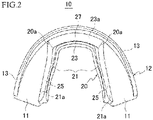
- FIG. 2 is a plan view of FIG. 1 .
- FIG. 3 is a rear view of FIG. 1 .
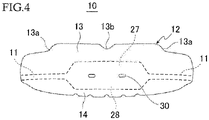
- FIG. 4 is a front view of FIG. 1 .
- a front tooth side is defined as a front side
- a back tooth side is defined as a back side
- a left side and a right side with respect to the front tooth are defined as a left side and a right side, respectively.
- the front teeth are incisors and include right and left central incisors, right and left lateral incisors, and right and left canines.
- the back teeth are molar teeth and include right and left first and second premolars, and right and left first to third molars.
- the orthodontic appliance 10 of the present embodiment is a mouthpiece type attached to the upper dentition of the upper jaw and the lower dentition of the lower jaw.
- the orthodontic appliance 10 of the present embodiment is attached to the upper dentition of the upper jaw and the lower dentition of the lower jaw to move and correct the individual teeth of the upper dentition and the lower dentition in the directions to be aligned while spreading the upper dentition and the lower dentition in the lateral direction, and adjusts a muscle function around the oral cavity.
- the orthodontic appliance 10 of the present embodiment is integrally formed of an elastic resin material as a whole.
- the resin material is selected from, for example, silicon resin, polyolefin-based resin, styrene-based resin, acrylic resin, and the like. It is desirable that the above resin material is colorless transparent or opalescent. Accordingly, when inserted into the oral cavity, wearing on the upper dentition and the lower dentition is inconspicuous, thereby providing an excellent looking.
- the orthodontic appliance 10 is a molded product (aligner) molded into a shape which gradually moves the individual teeth of the upper dentition and the lower dentition in the directions to be aligned. For example, a plurality of the orthodontic appliances 10 having different sizes or different hardness are prepared in stages, and orthodontic treatment is performed by periodically replacing the orthodontic appliances 10.
- the orthodontic appliance 10 mainly includes a base portion 11, an outer peripheral wall 12, and an inner peripheral wall 20.
- the base portion 11 is a portion sandwiched between the upper dentition of the upper jaw and the lower dentition of the lower jaw when the orthodontic appliance 10 is inserted into the oral cavity, and is formed in a U-shape in plan view between the outer peripheral wall 12 and the inner peripheral wall 20.
- the outer peripheral wall 12 is arranged on the outer peripheral edge side of the base portion 11 and is formed to protrude in the up-down direction.
- the outer peripheral wall 12 includes an outer peripheral upper wall 13 arranged above the base portion 11, and an outer peripheral lower wall 14 arranged below the base portion 11.
- the outer peripheral upper wall 13 and the outer peripheral lower wall 14 are formed in a bilaterally symmetrical shape with respect to a portion corresponding to the central incisors of the front teeth.
- the outer peripheral upper wall 13 is formed such that the height thereof with respect to the base portion 11 is slightly larger on the front teeth side than on the back teeth side. Therefore, in the outer peripheral upper wall 13, a pair of right and left gentle stepped portions 13a are formed at right and left symmetrical positions between the back teeth side and the front teeth side in order to avoid buccal frenulums. In the outer peripheral upper wall 13, a V-shaped notch 13b is formed at the center in the right-left direction so that the upper labial frenulum is fitted. As shown in FIG. 3 , the outer peripheral lower wall 14 is formed such that the height thereof with respect to the base portion 11 gradually increases from the back teeth side to the front teeth side.
- the inner peripheral wall 20 is arranged on the inner peripheral edge side of the base portion 11 and is formed to protrude in the up-down direction.
- the inner peripheral wall 20 protruding in the up-down direction is formed more angularly than the U-shape in plan view.
- the inner peripheral surface of the inner peripheral wall 20 angularly formed as described above is perpendicular to the base portion 11 and forms a space for enclosing a tongue. This space restrains the tongue in the oral cavity to adjust the muscle function.
- the angular corner parts 20a are formed at positions, when the orthodontic appliance 10 is worn, corresponding to the positions between the canine and the premolar on both the right and left sides, respectively.
- the upper and lower angular short sides are formed at positions corresponding to the front teeth, and the upper and lower two long sides are formed at positions corresponding to the right and left back teeth, respectively.
- the inner peripheral wall 20 includes right and left inner peripheral upper walls (upper walls) 21 arranged above the base portion 11 at positions corresponding to the back teeth on the right and left sides of the upper dentition, and right and left inner peripheral lower walls (lower walls) 22 arranged below the base portion 11 at positions corresponding to the back teeth on the right and left sides of the lower dentition.
- the inner peripheral wall 20 includes a front inner peripheral upper wall 23 arranged above the base portion 11 at a position corresponding to the front teeth of the upper dentition, and a front inner peripheral lower wall 24 arranged below the base portion 11 at a position corresponding to the front teeth of the lower dentition.
- the right and left inner peripheral upper walls 21 and the right and left inner peripheral lower walls 22 include, respectively, right and left upper side surface portions (upper side surface portions) 21a and right and left lower side surface portions 22a (lower side surface portions) approaching the base portion 11.
- the front inner peripheral upper wall 23 and the front inner peripheral lower wall 24 have a front upper side surface portion 23a and a front lower side surface portion 24a extending to the lowermost part of the outer peripheral upper wall 13 and the uppermost part of the outer peripheral lower wall 14, respectively.
- the right and left inner peripheral upper walls 21 and the front inner peripheral upper wall 23 are continuously formed, and the right and left inner peripheral lower walls 22 and the front inner peripheral lower wall 24 are continuously formed.
- the right and left upper side surface portions 21a include right and left upper inclined surfaces (upper inclined surfaces) 25 formed to be capable of being in contact with the back teeth of the upper dentition with a distance to the outer peripheral wall 12 becoming gradually narrower from the upper side toward the lower side.
- the right and left lower side surface portions 22a include right and left lower inclined surfaces (lower inclined surfaces) 26 formed to be capable of being in contact with the back teeth of the lower dentition with a distance to the outer peripheral wall 12 becoming gradually narrower from the lower side toward the upper side.
- the front upper side surface portion 23a includes a front upper inclined surface 27 formed to be capable of being in contact with the front teeth of the upper dentition with a distance to the outer peripheral wall 12 becoming gradually narrower from the upper side toward the lower side.
- the lower side of the front upper inclined surface 27 extends to the lowermost part of the outer peripheral upper wall 13.
- the front lower side surface portion 24a includes a front lower inclined surface 28 formed to be capable of being in contact with the front teeth of the lower dentition with a distance to the outer peripheral wall 12 becoming gradually narrower from the lower side toward the upper side.
- the upper side of the front lower inclined surface 28 extends to the uppermost part of the outer peripheral lower wall 14.
- the right and left upper inclined surfaces 25 and the right and left lower inclined surfaces 26 are arranged such that the distance between the lowermost parts and as well as between the uppermost parts, corresponding to the right and left first molars, is set to 36 mm to 41 mm (37.75 mm in the present embodiment). Such a distance is set to spread the dentition in the lateral direction and correct the dentition, for most Japanese people, when a deciduous dentition is being replaced with a permanent dentition.
- vent holes 30 are formed between the front upper inclined surface 27 and the front lower inclined surface 28 in the up-down direction at a predetermined distance in the left-right direction.
- the vent holes 30 are used for breathing when the orthodontic appliance 10 of the present embodiment is inserted into the oral cavity of a child.
- the orthodontic appliance 10 of the present embodiment is applied to, for example, a child aged 6 to 9 years whose deciduous dentition is being replaced with a permanent dentition.
- the orthodontic appliance 10 is inserted into the oral cavity of the child, and is attached to the upper dentition and the lower dentition.
- the back teeth on the right and left sides of the upper dentition and the lower dentition are brought into contact with the right and left upper inclined surfaces 25 and the right and left lower inclined surfaces 26.
- the front teeth of the upper dentition and the lower dentition are brought into contact with the front upper inclined surface 27 and the front lower inclined surface 28, respectively.
- the mouth is closed so that the upper lip and the lower lip come into contact with each other.
- the muscle function can be adjusted by developing the muscle function around the oral cavity.
- the back teeth on the right and left sides of the upper dentition and the lower dentition are brought into contact with the right and left upper inclined surfaces 25 and the right and left lower inclined surfaces 26 when a deciduous dentition is being replaced with a permanent dentition
- the back teeth on the right and left sides of the upper dentition and the lower dentition are gradually spread in the lateral direction by being guided by the right and left upper inclined surfaces 25 and the right and left lower inclined surfaces 26 and crowding and the like of the back teeth on the right and left sides of the upper dentition and the lower dentition can be corrected.
- the front teeth of the upper dentition and the lower dentition are brought into contact with the front upper inclined surface 27 and the front lower inclined surface 28, the front teeth of the upper dentition and the lower dentition are gradually spread frontward by being guided by the front upper inclined surface 27 and the front lower inclined surface 28 and crowding and the like of the front teeth of the upper dentition and the lower dentition can be easily corrected.
- the orthodontic appliance 10 may be replaced with another orthodontic appliance having a larger distance between the lowermost parts as well as between the uppermost parts corresponding to the right and left first molars, or with the orthodontic appliance made of a harder material.
- the inner peripheral wall 12 includes the right and left inner peripheral upper walls 21 and the right and left inner peripheral lower walls 22, the right and left inner peripheral upper walls 21 and the right and left inner peripheral lower walls 22 include the right and left upper side surface portions 21a and the right and left lower side surface portions 22a approaching the base portion 11, respectively, the right and left upper side surface portions 21a have the right and left upper inclined surfaces 25 capable of being in contact with the upper dentition, and the right and left lower side surface portions 22a have the right and left lower inclined surfaces 26 capable of being in contact with the lower dentition.
- the upper dentition and the lower dentition can be corrected while being spread in the lateral direction, and the muscle function around the oral cavity can be adjusted.
- the orthodontic appliance 10 is worn when a deciduous dentition is being replaced with a permanent dentition, remarkable effects can be obtained.
- the inner peripheral wall 20 is formed more angularly than a U-shape in plan view, the tongue can always be restrained at a correct position, and the muscle function around the oral cavity can be further adjusted.
- the orthodontic appliance 10 can be reliably fitted to the upper dentition and the lower dentition. As a result, the spreading effect and the correction effect on the permanent dentition can be further enhanced.
- the distance between the right and left upper inclined surfaces 25 at the right and left lowermost parts and the distance between the right and left lower inclined surfaces 26 at the right and left uppermost parts, corresponding to the right and left first molars are set to 36 mm to 41 mm. Accordingly, for example, when a deciduous dentition is being replaced with a permanent dentition, the permanent dentition can be arranged to be at a desired position while being spread in the lateral direction and the permanent dentition can be corrected.
- the base portion 11, the outer peripheral wall 12, and the inner peripheral wall 20 are integrally formed of an elastic resin material, it is possible to enhance the wearing feeling.
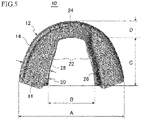
- FIG. 5 is a bottom view showing an orthodontic appliance according to an embodiment of the present invention.
- FIG. 6 is a rear view of FIG. 5 .
- the width A from one end to the other end of the outer peripheral lower wall 14 is 68.09 mm
- the width B from one end to the other end of the right and left inner peripheral lower walls 22 is 29.95 mm
- the distance C from the frontmost part on the inner peripheral side to the rearmost part of the right and left inner peripheral lower walls 22 is 31.06 mm
- the distance D from the frontmost part on the outer peripheral side of the outer peripheral wall 12 to the frontmost part on the inner peripheral side of the inner peripheral wall 20 is 10.80 mm
- the distance E from the outer side of the outer peripheral wall 12 to the inner side of the inner peripheral wall 20 at the positions corresponding to the back teeth of the upper dentition and the lower dentition is 18.35 mm.
- the widths A, B described above are set within a range of about ⁇ 3 mm.
- the width F at the uppermost parts from one end to the other end of the right and left inner peripheral lower walls 22 is 37.75 mm
- the distance G from the uppermost parts of the right and left inner peripheral lower walls 22 to the outer peripheral wall 12 is 15.04 mm
- the height H in the up-down direction of the orthodontic appliance 10 is 21.99 mm
- the height I from the upper end of the right and left inner peripheral upper walls 21 to the lower end of the right and left inner peripheral lower walls 22 is 12.00 mm
- the distance J between the two vent holes 30 is 9.79 mm
- the width K of each vent hole 30 is 2.70 mm
- the height L of each vent hole 30 is 1.50 mm.
- the right and left upper inclined surfaces 25 as well as the right and left lower inclined surfaces 26 are arranged such that the angle of each thereof with respect to the base portion 11 is, for example, in a range of 50 to 70 degrees, and in the present embodiment, is approximately 60 degrees. According to such setting of the angles, the effect of spreading the upper dentition and the lower dentition in the lateral direction can be further enhanced.
- the specific dimensions of the orthodontic appliance 10 of the present embodiment are set as described above, when the orthodontic appliance 10 is worn by a child aged 6 to 9 years, the dentition can be corrected while being spread in the lateral direction, and the muscle function around the oral cavity can be adjusted.
- any material may be adopted as long as it can be inserted into the oral cavity and has the same function.
Landscapes
- Health & Medical Sciences (AREA)
- Oral & Maxillofacial Surgery (AREA)
- Dentistry (AREA)
- Epidemiology (AREA)
- Life Sciences & Earth Sciences (AREA)
- Animal Behavior & Ethology (AREA)
- General Health & Medical Sciences (AREA)
- Public Health (AREA)
- Veterinary Medicine (AREA)
- Dental Tools And Instruments Or Auxiliary Dental Instruments (AREA)
- Orthopedics, Nursing, And Contraception (AREA)
Applications Claiming Priority (2)
| Application Number | Priority Date | Filing Date | Title |
|---|---|---|---|
| JP2019141471A JP6875018B2 (ja) | 2019-07-31 | 2019-07-31 | 歯科矯正具 |
| PCT/JP2020/011918 WO2021019832A1 (fr) | 2019-07-31 | 2020-03-18 | Outil orthodontique |
Publications (2)
| Publication Number | Publication Date |
|---|---|
| EP4005527A1 true EP4005527A1 (fr) | 2022-06-01 |
| EP4005527A4 EP4005527A4 (fr) | 2022-12-28 |
Family
ID=74230627
Family Applications (1)
| Application Number | Title | Priority Date | Filing Date |
|---|---|---|---|
| EP20847074.0A Withdrawn EP4005527A4 (fr) | 2019-07-31 | 2020-03-18 | Outil orthodontique |
Country Status (6)
| Country | Link |
|---|---|
| US (1) | US20220257346A1 (fr) |
| EP (1) | EP4005527A4 (fr) |
| JP (1) | JP6875018B2 (fr) |
| CN (1) | CN114072093B (fr) |
| TW (1) | TWI740437B (fr) |
| WO (1) | WO2021019832A1 (fr) |
Families Citing this family (2)
| Publication number | Priority date | Publication date | Assignee | Title |
|---|---|---|---|---|
| USD1057960S1 (en) * | 2023-06-26 | 2025-01-14 | Akervall Technologies, Inc. | Whitening tray for teeth |
| TWI919605B (zh) | 2024-11-27 | 2026-03-21 | 洪澄祥 | 護齒器 |
Family Cites Families (21)
| Publication number | Priority date | Publication date | Assignee | Title |
|---|---|---|---|---|
| FR67616E (fr) * | 1955-02-21 | 1958-03-14 | Gouttière orthodontique | |
| US3842107A (en) | 1973-07-23 | 1974-10-15 | Smithkline Corp | Phosphine or phosphite gold complexes of thiobenzoic acid and substituted thiophenols |
| FR2641964B1 (fr) * | 1989-01-26 | 1998-02-20 | Besombes Andre | Activateurs-gouttieres pour traitements d'orthopedie dento-faciale et parodontologie |
| FR2751865B1 (fr) * | 1996-07-30 | 1998-10-16 | Mathieu Rodrigue | Appareils pour traitements d'orthopedie fonctionnelle dento-faciale et parodontologie |
| US5876199A (en) * | 1997-08-28 | 1999-03-02 | Ortho-Tain, Inc. | Appliance adapted to fit many mouth and tooth sizes for orthodontic correction and other uses |
| NZ525382A (en) * | 2002-08-30 | 2004-09-24 | Christopher John Farrell | Oral appliance suitable for use as sports guard |
| US20060084024A1 (en) * | 2004-10-14 | 2006-04-20 | Farrell Christopher J | Oral appliance |
| US7798149B2 (en) * | 2007-01-30 | 2010-09-21 | Han Haduong | Method and system for swallow control resulting in improved posture |
| KR100883168B1 (ko) * | 2007-05-23 | 2009-02-10 | 정수용 | 턱관절 보호 기구 |
| KR200461324Y1 (ko) * | 2011-02-07 | 2012-07-12 | 이영준 | 슬릿형 턱관절 균형 장치 |
| FR2973219B1 (fr) * | 2011-04-01 | 2014-04-25 | So Dis Ap F | Appareil d'orthopedie fonctionnelle dento-faciale |
| JP5564079B2 (ja) * | 2012-07-26 | 2014-07-30 | 淳 大塚 | 歯科矯正装置 |
| WO2015020293A1 (fr) * | 2013-08-09 | 2015-02-12 | 경희대학교 산학협력단 | Appareil dentaire temporaire à relier aux dents, et son procédé de production |
| JP2015150179A (ja) * | 2014-02-14 | 2015-08-24 | キープ・アップ株式会社 | 歯科矯正装置 |
| US10376408B2 (en) * | 2014-08-25 | 2019-08-13 | Airway Technologies, Llc | Oral appliance |
| KR101637087B1 (ko) * | 2014-10-23 | 2016-07-07 | 주식회사 진바이오테크 | 경추 교정용 턱관절 균형 장치 |
| ITUB20154030A1 (it) * | 2015-09-30 | 2017-03-30 | Francesco Magistro | Dispositivo ortodontico-elastico-armonizzatore dento-cranio-facciale |
| CN107865705B (zh) * | 2016-09-26 | 2023-07-07 | 上海慕港医疗科技有限公司 | 一种口腔正畸用的多功能矫正器 |
| TWM550126U (zh) * | 2017-06-02 | 2017-10-11 | Soo-Chang Jung | 牙齒矯正與顳顎關節平衡器 |
| CN208756201U (zh) * | 2018-02-08 | 2019-04-19 | 陈勇 | 一种牙齿正畸矫正器 |
| CN209136919U (zh) * | 2018-04-25 | 2019-07-23 | 上海慕港医疗科技有限公司 | 一种口腔多功能矫正器 |
-
2019
- 2019-07-31 JP JP2019141471A patent/JP6875018B2/ja active Active
-
2020
- 2020-03-18 EP EP20847074.0A patent/EP4005527A4/fr not_active Withdrawn
- 2020-03-18 WO PCT/JP2020/011918 patent/WO2021019832A1/fr not_active Ceased
- 2020-03-18 US US17/622,115 patent/US20220257346A1/en not_active Abandoned
- 2020-03-18 CN CN202080048947.3A patent/CN114072093B/zh not_active Expired - Fee Related
- 2020-03-31 TW TW109110945A patent/TWI740437B/zh not_active IP Right Cessation
Also Published As
| Publication number | Publication date |
|---|---|
| CN114072093B (zh) | 2022-09-09 |
| WO2021019832A1 (fr) | 2021-02-04 |
| JP2021023419A (ja) | 2021-02-22 |
| TWI740437B (zh) | 2021-09-21 |
| EP4005527A4 (fr) | 2022-12-28 |
| TW202106258A (zh) | 2021-02-16 |
| CN114072093A (zh) | 2022-02-18 |
| JP6875018B2 (ja) | 2021-05-19 |
| US20220257346A1 (en) | 2022-08-18 |
Similar Documents
| Publication | Publication Date | Title |
|---|---|---|
| US9707055B2 (en) | Correction device | |
| US4799884A (en) | Expansion/buccal shield appliance | |
| US4997182A (en) | Tongue thrust corrective device | |
| KR101676584B1 (ko) | 투명교정시스템 | |
| US20180078342A1 (en) | Dental Appliance For Use as an Aligner and as a Tool to Reduce Temporomandibular Dysfunction | |
| US20030224313A1 (en) | Dental appliances having attachable upper and lower halves and systems and methods for treating malocclusions | |
| KR101638329B1 (ko) | 가철식 곡선 이동형 치열교정기구 | |
| CA2863727A1 (fr) | Appareil d'entrainement postural et de developpement anterieur | |
| US20240024078A1 (en) | Clear Plastic Aligner with Configurable Protrusions For Anterior Or Open Bite Treatment And Mattress Plastic Material For Invisible Aligners | |
| JP6736614B2 (ja) | 歯列矯正装置 | |
| WO2014017646A1 (fr) | Dispositif orthodontique | |
| US20220257346A1 (en) | Orthodontic appliance | |
| KR101629717B1 (ko) | 치열교정용 브라켓 시스템 | |
| US11033363B2 (en) | Orthodontic appliance for dentistry | |
| JP7295580B1 (ja) | 歯科矯正具 | |
| WO2021251068A1 (fr) | Dispositif de correction de dentition | |
| JP6963855B1 (ja) | 歯科矯正具 | |
| JP6986254B2 (ja) | 可撤式矯正装置 | |
| JP7020727B1 (ja) | 歯科矯正具 | |
| JP3200349U (ja) | 顎位矯正器具 | |
| US20120009537A1 (en) | Orthodontic Appliance | |
| JP6902301B1 (ja) | 筋機能療法装置 | |
| CN221470017U (zh) | 矫治器件 | |
| JP3200643U (ja) | 顎位矯正器具 | |
| JP2023131444A (ja) | 歯科矯正具 |
Legal Events
| Date | Code | Title | Description |
|---|---|---|---|
| STAA | Information on the status of an ep patent application or granted ep patent |
Free format text: STATUS: THE INTERNATIONAL PUBLICATION HAS BEEN MADE |
|
| PUAI | Public reference made under article 153(3) epc to a published international application that has entered the european phase |
Free format text: ORIGINAL CODE: 0009012 |
|
| STAA | Information on the status of an ep patent application or granted ep patent |
Free format text: STATUS: REQUEST FOR EXAMINATION WAS MADE |
|
| 17P | Request for examination filed |
Effective date: 20220203 |
|
| AK | Designated contracting states |
Kind code of ref document: A1 Designated state(s): AL AT BE BG CH CY CZ DE DK EE ES FI FR GB GR HR HU IE IS IT LI LT LU LV MC MK MT NL NO PL PT RO RS SE SI SK SM TR |
|
| DAV | Request for validation of the european patent (deleted) | ||
| DAX | Request for extension of the european patent (deleted) | ||
| A4 | Supplementary search report drawn up and despatched |
Effective date: 20221124 |
|
| RIC1 | Information provided on ipc code assigned before grant |
Ipc: A61C 7/08 20060101AFI20221118BHEP |
|
| STAA | Information on the status of an ep patent application or granted ep patent |
Free format text: STATUS: THE APPLICATION HAS BEEN WITHDRAWN |
|
| 18W | Application withdrawn |
Effective date: 20230105 |