EP4005539B1 - Kompressionskleidung zur korrektur der form des unterkörpers und des gangbildes bei winkelverformung der beine - Google Patents
Kompressionskleidung zur korrektur der form des unterkörpers und des gangbildes bei winkelverformung der beine Download PDFInfo
- Publication number
- EP4005539B1 EP4005539B1 EP19940124.1A EP19940124A EP4005539B1 EP 4005539 B1 EP4005539 B1 EP 4005539B1 EP 19940124 A EP19940124 A EP 19940124A EP 4005539 B1 EP4005539 B1 EP 4005539B1
- Authority
- EP
- European Patent Office
- Prior art keywords
- correction band
- main body
- area
- correction
- garment main
- Prior art date
- Legal status (The legal status is an assumption and is not a legal conclusion. Google has not performed a legal analysis and makes no representation as to the accuracy of the status listed.)
- Active
Links
Images

Classifications
-
- A—HUMAN NECESSITIES
- A61—MEDICAL OR VETERINARY SCIENCE; HYGIENE
- A61F—FILTERS IMPLANTABLE INTO BLOOD VESSELS; PROSTHESES; DEVICES PROVIDING PATENCY TO, OR PREVENTING COLLAPSING OF, TUBULAR STRUCTURES OF THE BODY, e.g. STENTS; ORTHOPAEDIC, NURSING OR CONTRACEPTIVE DEVICES; FOMENTATION; TREATMENT OR PROTECTION OF EYES OR EARS; BANDAGES, DRESSINGS OR ABSORBENT PADS; FIRST-AID KITS
- A61F5/00—Orthopaedic methods or devices for non-surgical treatment of bones or joints; Nursing devices ; Anti-rape devices
- A61F5/01—Orthopaedic devices, e.g. long-term immobilising or pressure directing devices for treating broken or deformed bones such as splints, casts or braces
- A61F5/04—Devices for stretching or reducing fractured limbs; Devices for distractions; Splints
- A61F5/042—Devices for stretching or reducing fractured limbs; Devices for distractions; Splints for extension or stretching
-
- A—HUMAN NECESSITIES
- A61—MEDICAL OR VETERINARY SCIENCE; HYGIENE
- A61F—FILTERS IMPLANTABLE INTO BLOOD VESSELS; PROSTHESES; DEVICES PROVIDING PATENCY TO, OR PREVENTING COLLAPSING OF, TUBULAR STRUCTURES OF THE BODY, e.g. STENTS; ORTHOPAEDIC, NURSING OR CONTRACEPTIVE DEVICES; FOMENTATION; TREATMENT OR PROTECTION OF EYES OR EARS; BANDAGES, DRESSINGS OR ABSORBENT PADS; FIRST-AID KITS
- A61F5/00—Orthopaedic methods or devices for non-surgical treatment of bones or joints; Nursing devices ; Anti-rape devices
- A61F5/01—Orthopaedic devices, e.g. long-term immobilising or pressure directing devices for treating broken or deformed bones such as splints, casts or braces
- A61F5/0102—Orthopaedic devices, e.g. long-term immobilising or pressure directing devices for treating broken or deformed bones such as splints, casts or braces specially adapted for correcting deformities of the limbs or for supporting them; Ortheses, e.g. with articulations
- A61F5/0104—Orthopaedic devices, e.g. long-term immobilising or pressure directing devices for treating broken or deformed bones such as splints, casts or braces specially adapted for correcting deformities of the limbs or for supporting them; Ortheses, e.g. with articulations without articulation
- A61F5/0106—Orthopaedic devices, e.g. long-term immobilising or pressure directing devices for treating broken or deformed bones such as splints, casts or braces specially adapted for correcting deformities of the limbs or for supporting them; Ortheses, e.g. with articulations without articulation for the knees
- A61F5/0109—Sleeve-like structures
-
- A—HUMAN NECESSITIES
- A41—WEARING APPAREL
- A41D—OUTERWEAR; PROTECTIVE GARMENTS; ACCESSORIES
- A41D1/00—Garments
- A41D1/007—Garments made by a helically or spirally wound material
-
- A—HUMAN NECESSITIES
- A41—WEARING APPAREL
- A41D—OUTERWEAR; PROTECTIVE GARMENTS; ACCESSORIES
- A41D1/00—Garments
- A41D1/06—Trousers
- A41D1/067—Trousers with reinforcement patches
-
- A—HUMAN NECESSITIES
- A41—WEARING APPAREL
- A41F—GARMENT FASTENINGS; SUSPENDERS
- A41F9/00—Belts, girdles, or waistbands for trousers or skirts
- A41F9/002—Free belts
-
- A—HUMAN NECESSITIES
- A61—MEDICAL OR VETERINARY SCIENCE; HYGIENE
- A61F—FILTERS IMPLANTABLE INTO BLOOD VESSELS; PROSTHESES; DEVICES PROVIDING PATENCY TO, OR PREVENTING COLLAPSING OF, TUBULAR STRUCTURES OF THE BODY, e.g. STENTS; ORTHOPAEDIC, NURSING OR CONTRACEPTIVE DEVICES; FOMENTATION; TREATMENT OR PROTECTION OF EYES OR EARS; BANDAGES, DRESSINGS OR ABSORBENT PADS; FIRST-AID KITS
- A61F13/00—Bandages or dressings; Absorbent pads
- A61F13/06—Bandages or dressings; Absorbent pads specially adapted for feet or legs; Corn-pads; Corn-rings
- A61F13/08—Elastic stockings; for contracting aneurisms
-
- A—HUMAN NECESSITIES
- A61—MEDICAL OR VETERINARY SCIENCE; HYGIENE
- A61F—FILTERS IMPLANTABLE INTO BLOOD VESSELS; PROSTHESES; DEVICES PROVIDING PATENCY TO, OR PREVENTING COLLAPSING OF, TUBULAR STRUCTURES OF THE BODY, e.g. STENTS; ORTHOPAEDIC, NURSING OR CONTRACEPTIVE DEVICES; FOMENTATION; TREATMENT OR PROTECTION OF EYES OR EARS; BANDAGES, DRESSINGS OR ABSORBENT PADS; FIRST-AID KITS
- A61F5/00—Orthopaedic methods or devices for non-surgical treatment of bones or joints; Nursing devices ; Anti-rape devices
- A61F5/01—Orthopaedic devices, e.g. long-term immobilising or pressure directing devices for treating broken or deformed bones such as splints, casts or braces
- A61F5/0102—Orthopaedic devices, e.g. long-term immobilising or pressure directing devices for treating broken or deformed bones such as splints, casts or braces specially adapted for correcting deformities of the limbs or for supporting them; Ortheses, e.g. with articulations
- A61F5/0104—Orthopaedic devices, e.g. long-term immobilising or pressure directing devices for treating broken or deformed bones such as splints, casts or braces specially adapted for correcting deformities of the limbs or for supporting them; Ortheses, e.g. with articulations without articulation
-
- A—HUMAN NECESSITIES
- A61—MEDICAL OR VETERINARY SCIENCE; HYGIENE
- A61F—FILTERS IMPLANTABLE INTO BLOOD VESSELS; PROSTHESES; DEVICES PROVIDING PATENCY TO, OR PREVENTING COLLAPSING OF, TUBULAR STRUCTURES OF THE BODY, e.g. STENTS; ORTHOPAEDIC, NURSING OR CONTRACEPTIVE DEVICES; FOMENTATION; TREATMENT OR PROTECTION OF EYES OR EARS; BANDAGES, DRESSINGS OR ABSORBENT PADS; FIRST-AID KITS
- A61F5/00—Orthopaedic methods or devices for non-surgical treatment of bones or joints; Nursing devices ; Anti-rape devices
- A61F5/01—Orthopaedic devices, e.g. long-term immobilising or pressure directing devices for treating broken or deformed bones such as splints, casts or braces
- A61F5/30—Pressure pads
-
- A—HUMAN NECESSITIES
- A41—WEARING APPAREL
- A41D—OUTERWEAR; PROTECTIVE GARMENTS; ACCESSORIES
- A41D2400/00—Functions or special features of garments
- A41D2400/32—Therapeutic use
-
- A—HUMAN NECESSITIES
- A41—WEARING APPAREL
- A41D—OUTERWEAR; PROTECTIVE GARMENTS; ACCESSORIES
- A41D2400/00—Functions or special features of garments
- A41D2400/38—Shaping the contour of the body or adjusting the figure
-
- A—HUMAN NECESSITIES
- A61—MEDICAL OR VETERINARY SCIENCE; HYGIENE
- A61F—FILTERS IMPLANTABLE INTO BLOOD VESSELS; PROSTHESES; DEVICES PROVIDING PATENCY TO, OR PREVENTING COLLAPSING OF, TUBULAR STRUCTURES OF THE BODY, e.g. STENTS; ORTHOPAEDIC, NURSING OR CONTRACEPTIVE DEVICES; FOMENTATION; TREATMENT OR PROTECTION OF EYES OR EARS; BANDAGES, DRESSINGS OR ABSORBENT PADS; FIRST-AID KITS
- A61F5/00—Orthopaedic methods or devices for non-surgical treatment of bones or joints; Nursing devices ; Anti-rape devices
- A61F5/01—Orthopaedic devices, e.g. long-term immobilising or pressure directing devices for treating broken or deformed bones such as splints, casts or braces
- A61F2005/0197—Orthopaedic devices, e.g. long-term immobilising or pressure directing devices for treating broken or deformed bones such as splints, casts or braces with spring means
Definitions
- This embodiment relates to a compression garment for correcting lower body shape and walking gait for angular deformity of legs.
- the femur and tibia should form an ideal angle, and the left and right knee joints should be balanced, but the hip joint and knee joint are misaligned due to congenital causes or acquired lifestyle or posture, resulting in a bow leg such as an O-shaped leg or an X-shaped leg.
- the bow leg is not good to look at, and there is a problem that the outer gap of the knee joint widens and the friction of the inner cartilage of the knee increases, which leads to the development of degenerative arthritis. Therefore, correcting the bent legs is a subject of much interest in terms of beauty and health.
- KR 20130003370U relates to a bandage composite calibration band assembly for eliminating or improving a major cause of the varus angle and a main cause of the varus angle, according to the preamble of claim 1.
- the present embodiment is proposed to improve the above problems, and it is to provide a compression garment for correcting lower body shape and walking gait for angular deformity of legs, in which the leg is firstly pressed using taping members with different densities, and the leg is secondarily pressed using a correction band made of an inelastic material, thereby being able to correct bow leg and pelvis.
- a compression garment for correcting a lower body shape and a walking gait for an angular deformity of the legs comprises: a bottom garment main body; and a correction band disposed on the bottom, wherein the correction band includes a first correction band disposed in a first area of the bottom garment main body and a second correction band disposed in a second area of the bottom garment main body, wherein the first correction band includes a first part disposed above the first area, a second part disposed below the first area, and a third part connecting the first part of the first correction band and the second part of the first correction band, wherein the second correction band includes a first part disposed above the second area, a second part disposed below the second area, and a third part connecting the first part of the second correction band and the second part of the second correction band, wherein the first correction band includes a connecting member disposed on the first part of the first correction band and including a hole, and wherein the first part of the second correction band is inserted into the hole of the connecting member of
- first part and the third part of the first correction band and the first part and the third part of the second correction band are formed of an inelastic material, and the second part of the first correction band and the second part of the second correction band may be formed of an elastic material.
- the third part of the first correction band includes a bent portion formed in a portion being connected from the front side of the first area of the bottom garment main body to the rear side thereof
- the third part of the second correction band may include a bent portion being formed in a portion being connected from a front side of the second area of the bottom garment main body to a rear side thereof.
- the first area of the bottom garment main body includes a ring formed at a position corresponding to the bent portion of the third part of the first correction band
- the second area of the bottom garment main body may include a ring formed at a position corresponding to the bent portion of the third part of the second correction band.
- the bent portion of the third part of the first correction band includes a first bent portion disposed on an outer side surface of the first area of the bottom garment main body, and a second bent portion spaced apart from the first bent portion and disposed on an inner side surface of the first area of the bottom garment main body; and the bent portion of the third part of the second correction band may include a third bent portion disposed on an outer side surface of the second area of the bottom garment main body, and a fourth bent portion spaced apart from the third bent portion and disposed on an inner side surface of the second area of the bottom garment main body.
- first bent portion of the third part of the first correction band is disposed closer to the second part of the first correction band than the first part of the first correction band; the second bent portion of the third part of the first correction band is disposed closer to the first part of the first correction band than the second part of the first correction band; the third bent portion of the third part of the second correction band is disposed closer to the second part of the second correction band than the first part of the second correction band; and the fourth bent portion of the third part of the second correction band may be disposed closer to the first part of the second correction band than the second part of the second correction band.
- the first area of the bottom garment main body includes first and second rings formed at positions corresponding to the first and second bent portions of the first correction band and including holes;
- the second area of the bottom garment main body includes third and fourth rings formed at positions corresponding to the third and fourth bent portions of the second correction band and including holes; each of the first and second bent portions of the first correction band is respectively inserted into the first and second rings of the first area of the bottom garment main body; and each of the third and fourth bent portions of the second correction band may be respectively inserted into the third and fourth rings of the second area of the bottom garment main body.
- first to fourth rings may be detachable from and attachable to the bottom garment main body.
- the bottom garment main body includes: a first taping member continuously wound in a first direction from an upper portion of the first area to a lower portion of the first area; and a second taping member continuously wound in a second direction from an upper portion of the first area to a lower portion of the first area, wherein the first direction and the second direction may be opposite directions.
- a density of the first taping member may be different from a density of the second taping member.
- the density of the first taping member may be greater than the density of the second taping member.
- correction band may be detachable from and attachable to the bottom garment main body.
- the position of the correction band can be adjusted according to the user's characteristics.
- the singular form may include the plural form unless specifically stated in the phrase, and when described as "at least one (or more than one) of A and B and C", it may include one or more of all combinations that can be combined with A, B, and C.
- first, second, A, B, (a), and (b) may be used. These terms are merely intended to distinguish the components from other components, and the terms do not limit the nature, order or sequence of the components.
- a component when a component is described as being 'connected', 'coupled' or 'interconnected' to another component, the component is not only directly connected, coupled or interconnected to the other component, but may also include cases of being 'connected', 'coupled', or 'interconnected' due that another component between that other components.
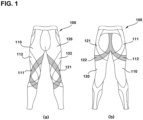
- FIG. 1 (a) is a drawing illustrating the front of a bottom garment main body of a compression garment for correcting lower body shape and walking gait for angular deformity of legs according to the present embodiment
- FIG. 1 (b) is a drawing illustrating a rear side of the bottom garment main body of a compression garment for correcting lower body shape and walking gait for angular deformity of legs according to the present embodiment
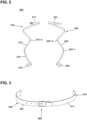
- FIG. 2 is a drawing illustrating a correction band of a compression garment for correcting lower body shape and walking gait for angular deformity of legs according to the present embodiment.
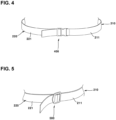
- FIG. 3 to 5 are diagrams illustrating a partial configuration of the correction band of a compression garment for correcting lower body shape and walking gait for angular deformity of legs according to the present embodiment.
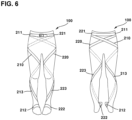
- FIG. 6 is a drawing illustrating an assembly view of the bottom garment main body and correction band of a compression garment for correcting lower body shape and walking gait for angular deformity of legs according to the present embodiment.
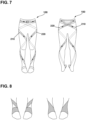
- FIG. 7 is a drawing illustrating a direction corrected by a correction band of a compression garment for correcting lower body shape and walking gait for angular deformity of legs according to the present embodiment.
- the compression garment for correcting lower body shape and walking gait for angular deformity of legs may be for correcting O-legs.
- the compression garment for correcting lower body shape and walking gait for angular deformity of legs may be for correcting bow legs.
- a compression garment for correcting lower body shape and walking gait for angular deformity of legs may be for correcting X-shaped legs.
- a compression garment for correcting lower body shape and walking gait for angular deformity of legs may be for walking gait correction. Specifically, it may be for inducing an incorrect walking gait such as a nasolabial gait to a straight walking gait.
- the present invention is not limited thereto and may be used for angle correction of rotational deformation of the knee joint, deformation of the pelvis, rotational deformation of the ankle, or the like.
- the compression garment for correcting lower body shape and walking gait for angular deformity of legs may include a bottom garment main body 100.
- the bottom garment main body 100 may be formed in the form of pants worn on the user's lower body.
- the bottom garment main body 100 may be formed in the form of long pants or shorts.
- the upper part of the bottom garment main body 100 may include a waist portion that is placed on the user's waist.
- the bottom garment main body 100 may include a calf portion that is placed on the user's calf.
- the lower part of the bottom garment main body 100 may include an ankle portion disposed on the user's ankle.
- the bottom garment main body 100 may be extended from the upper part to the lower part.
- the bottom garment main body 100 may include a first area 110 disposed on the left side and a second area 120 disposed on the right side based on (a) of FIG. 1 . It may be extended from the top to the bottom of the first area 110.
- the second area 120 may be extended from the upper part to the lower part.
- the compression garment for correcting lower body shape and walking gait for angular deformity of legs may include a first taping member 111.
- the first taping member 111 may be disposed in the first area 110 of the bottom garment main body 100.
- the first taping member 111 may be continuously wound from the upper part of the bottom garment main body 100 to the lower part of the first area 110. At this time, the first taping member 111 may be rotated in a first direction.
- the first taping member 111 may be rotated spirally.
- the first taping member 111 may be rotated and wound around the bottom garment main body 100 at least twice.
- the density of the first taping member 111 may be different from the density of the bottom garment main body 100. Specifically, the density of the first taping member 111 may be greater than the density of the bottom garment main body 100. In this case, it may be possible to correct bow legs due to the pressure difference according to the difference in density of the fabric constituting the bottom garment main body 100 and the first taping member 111.
- the compression garment for correcting lower body shape and walking gait for angular deformity of legs may include a second taping member 112.
- the second taping member 112 may be disposed in a first area 110 of the bottom garment main body 100. A portion of the second taping member 112 may be spaced apart from the first taping member 111. At least a portion of the second taping member 112 may be overlapped with the first taping member 111.
- the second taping member 112 may be wound continuously from the upper part to the lower part of the bottom garment main body 100.
- the second taping member 112 may be rotated and wound around the bottom garment main body 100 at least twice or more. In this case, the second taping member 112 may be rotated in a second direction.
- the second taping member 112 may be rotated in a spiral manner.
- the first direction may be opposite to the second direction. Specifically, when the first direction is a clockwise direction, the second direction may be a counterclockwise direction. When the first direction is a counterclockwise direction, the second direction may be a clockwise direction.
- the compression garment for correcting lower body shape and walking gait for angular deformity of legs may include a third taping member 121.
- the third taping member 121 may be disposed in the second area 120 of the bottom garment main body 100.
- the third taping member 121 may be continuously wound from the upper part of the bottom garment main body 100 to the lower part of the second area 120.
- the third taping member 121 may be rotated in a third direction.
- the third taping member 121 may be rotated in a spiral manner.
- the third taping member 121 may be rotated and wound around the bottom garment main body 100 at least twice or more.
- the density of the third taping member 121 may be different from the density of the bottom garment main body 100. Specifically, the density of the third taping member 121 may be greater than the density of the bottom garment main body 100. In this case, it may be possible to correct bow legs due to the pressure difference according to the difference in density of the fabric constituting the bottom garment main body 100 and the third taping member 121.
- the compression garment for correcting lower body shape and walking gait for angular deformity of legs may include a fourth taping member 122.
- the fourth taping member 122 may be disposed in a second area 120 of the bottom garment main body 100. A portion of the fourth taping member 122 may be spaced apart from the third taping member 121. At least a portion of the fourth taping member 122 may be overlapped with the third taping member 121.
- the fourth taping member 122 may be continuously wound from the upper part to the lower part of the bottom garment main body 100.
- the fourth taping member 122 may be rotated and wound around the bottom garment main body 100 at least twice or more. At this time, the fourth taping member 122 may be rotated in a fourth direction.
- the fourth taping member 122 may be helically rotated.
- the third direction may be opposite to the fourth direction. Specifically, when the third direction is a clockwise direction, the fourth direction may be a counterclockwise direction. When the third direction is a counterclockwise direction, the fourth direction may be a clockwise direction.
- the first direction and the third direction may be the same direction.
- the second direction and the fourth direction may be the same direction. However, it is not limited thereto, and each of the first to fourth directions may be appropriately adjusted according to the body type to be corrected.
- the density of the second taping member 112 may be different from the density of the bottom garment main body 100. Specifically, the density of the second taping member 112 may be greater than the density of the bottom garment main body 100. In this case, bow legs can be corrected due to the pressure difference owing to the difference in the densities of the fabric constituting the bottom garment main body 100 and the second taping member 112.
- the density of the first taping member 111 may be different from that of the second taping member 112.
- the density of the first taping member 111 may be greater than that of the second taping member 112.
- bow legs can be corrected by the force being pushed from the outer side to the inner side by the first taping member 111 disposed on an outer side near the knee joint.
- the density of the first taping member 111 may be less than that of the second taping member 112.
- the X-shaped leg correction may be possible due to a pressure difference between the first taping member 111 and the second taping member 112.
- the X-shaped leg can be corrected by the force being pushed from the inner side to the outer side by the second taping member 112 disposed on an inner side near the knee joint.
- the density of the third taping member 121 may be different from that of the fourth taping member 122.
- the density of the third taping member 121 may be greater than that of the fourth taping member 122.
- bow legs can be corrected by the force being pushed from the outer side to the inner side by the third taping member 121 disposed on the outer side near the knee joint of the second area 120 of the bottom garment main body 100.
- the density of the third taping member 121 may be less than that of the fourth taping member 122.
- X-shaped legs can be corrected due to a pressure difference between the third taping member 121 and the fourth taping member 122. Specifically, referring to FIG. 1 , X-shaped legs can be corrected by the force being pushed from the inner side to the outer side by the third taping member 121 disposed on the inner side of the knee joint of the second area 120 of the bottom garment main body 100.
- the first taping member 111 and the third taping member 121 may have the same density, and the second taping member 112 and the fourth taping member 122 may have the same density. Through this, it may be possible to correct bow legs or X-shaped legs. However, it is not limited thereto, and the density of each of the first to fourth taping members 111, 112, 121, and 122 may be variously set according to a body shape to be corrected.
- the compression garment for correcting lower body shape and walking gait for angular deformity of legs may include a correction band 200.
- the correction band 200 may be disposed on the bottom garment main body 100.
- the correction band 200 may be detachable from and attachable to the bottom garment main body 100.
- the correction band 200 may be disposed on the upper surfaces of the first to third taping members 111, 112, 121, and 122.
- the correction band 200 may be detachable from and attachable to the bottom garment main body 100.
- the correction band 200 may include a first correction band 210 disposed in the first area 110 of the bottom garment main body 100.
- the correction band 200 may include a second correction band 220 in which the bottom garment main body 100 is disposed in the second area 120.
- the first correction band 210 may include a first part 211 disposed on the upper portion of the bottom garment main body 100.
- the second correction band 220 may include a second part 212 disposed in at least a portion of the lower portion of the first area 110 of the bottom garment main body 100.
- the first correction band 210 may include a third part 213 connecting the first part 211 and the second part 212 of the first correction band 210.
- the second correction band 220 may include a first part 221 disposed on the upper portion of the bottom garment main body 100.
- the second correction band 220 may include a second part 222 disposed in at least a portion of the lower portion of the second area 120 of the bottom garment main body 100.
- the second correction band 220 may include a third part 223 connecting the first part 221 and the second part 222 of the second correction band 220.
- the first correction band 210 and the second correction band 220 may be combined by a belt fastening method.
- the first part 211 of the first correction band 210 may include a connecting member 300.
- the connecting member 300 may include a hole.
- the connecting member 300 may include a buckle, a hole, and a pin.
- the second part 221 of the second correction band 220 is inserted into the hole of the connecting member 300 of the first part 211 of the first correction band 210 and may be fixed by the belt fastening method.
- a plurality of holes may be formed in the first part 221 of the second correction band 220.
- the correction band 200 can adjust the size according to the user's body type.
- first correction band 210 and the second correction band 220 may be fixed with a Velcro tape in addition to the belt fastening method.
- a first Velcro tape (not shown) may be disposed on the first part 211 of the first correction band 210
- a second Velcro tape (not shown) may be disposed on the first part 221 of the second correction band 220.
- the correction band 200 may be fixed by the first and second Velcro tapes.
- the horizontal lengths of the first and second Velcro tapes may be extended along the first parts 211 and 221 of the first and second correction bands 210 and 220 so that the correction band 200 can be fixed according to the user's body size.
- the first correction band 210 and the second correction band 220 may be fixed in a strap type other than the belt fastening method.
- the correction band 200 may be fixed by bundling the first part 211 of the first correction band 210 and the first part 221 of the second correction band 220. In this case, no fixing member is required, and the size may be adjusted according to the user's body. In addition, correction efficiency can be increased by adjusting the bundling position or strength according to the degree of correction required.
- first correction band 210 and the second correction band 220 may be fixed in a hook type other than the belt fastening method.
- a hook (not shown) may be disposed on the first part 211 of the first correction band 210
- a hook (not shown) may be disposed on the first part 221 of the second correction band 220.
- the correction band 200 may be fixed as the hook is caught in the ring.
- first correction band 210 and the second correction band 220 may be fixed through the fastening member 400 in addition to the belt fastening method.
- first fastening member may be disposed on the first part 211 of the first correction band 210
- second fastening member may be disposed on the first part 221 of the second correction band 220.
- the second fastening member may be inserted into and fixed to the first fastening member.
- first correction band 210 and the second correction band 220 may be fixed through the length adjusting member 500 in addition to the belt fastening method.
- the length adjusting member 500 may be disposed in the first part 211 of the first correction band 210.
- the length adjustment member 500 may include a first hole and a second hole that are spaced apart. The first part 221 of the second correction band 220 may pass through the first hole of the length adjusting member 500 and be inserted into the second hole to be fixed.
- the first correction band 210 may include a bent portion.
- the bent portion may be formed in the third part 213 of the first correction band 210.
- the bent portion may be formed in a portion being connected from the front side of the first area 110 of the bottom garment main body 100 to the rear side thereof.
- the bent portion may be formed in a portion being connected from the rear side of the first area 110 of the bottom garment main body 100 to the front side thereof.
- the bent portion may include the first bent portion 213-1.
- the first bent portion 213-1 may be disposed on an outer side surface of the first area 110 of the bottom garment main body 100.
- the first bent portion 213-1 may be disposed on an outer side surface being connected from the front side of the first area 110 of the bottom garment main body 100 to the rear side thereof.
- the bent portion may include a second bent portion 213-2.
- the second bent portion 213-2 may be disposed on an inner side surface of the first area 110 of the bottom garment main body 100.
- the second bent portion 213-2 may be disposed on an inner surface being connected from the rear side of the first area 110 of the bottom garment main body 100 to the front side thereof.
- the first bent portion 213-1 may be disposed closer to the second part 212 than the first part 211 of the first correction band 200.
- the second bent portion 213-2 may be disposed closer to the first part 111 than the second part 212 of the first correction band 210.
- the first area 110 of the bottom garment main body 100 may include a ring formed at a position corresponding to the bent portion of the third part 213 of the first correction band 210.
- the first area 110 of the bottom garment main body 100 is formed at a position corresponding to the first and second bent portions 213-1 and 213-2 of the first correction band 210 and may include a first and a second rings 113 and 114 including holes therein respectively.
- the third part 213 of the first correction band 210 may pass through the first ring 113.
- the first correction band 210 passing through the first ring 113 may be extended to the second ring 114 and pass through the second ring 114. Due to this, the first correction band 210 may generate a pressure applied in the direction from the outer side to the inner side of the user's leg. That is, due to the first correction band 210, it may be possible to correct bow legs.
- first correction band 210 when using the first correction band 210 together with the first and second taping members 111 and 112 of the bottom garment main body 100, it is possible to strongly press from the outer side to the inner side of the user's leg, so that an effect in correction can be seen in a short time, and correction can be possible even in the case of severe bow legs.
- the second correction band 220 may include a bent portion.
- the bent portion may be formed in the third part 223 of the second correction band 220.
- the bent portion may be formed in a portion being connected from the front side of the second area 120 of the bottom garment main body 100 to rear side thereof.
- the bent portion may be formed in a portion being connected from the rear side of the second area 120 of the bottom garment main body 100 to the front side thereof.
- the bent portion may include a third bent portion 223-1.
- the third bent portion 223-1 may be disposed on the outer side surface of the second area 120 of the bottom garment main body 100.
- the third bent portion 223-1 may be disposed on an outer surface being connected from the front side of the second area 120 of the bottom garment main body 100 to the rear side thereof.
- the bent portion may include a fourth bent portion 223-2.
- the fourth bent portion 223-2 may be disposed on an inner side surface of the second area 120 of the bottom garment main body 100.
- the fourth bent portion 223-2 may be disposed on an inner side surface being connected from the rear side of the second area 120 of the bottom garment main body 100 to the front side thereof.
- the third bent portion 223-1 of the third part 223 of the second correction band 220 may be disposed closer to the second part 222 than the first part 221 of the second correction band 220.
- the fourth bent portion 223-2 of the third part 223 of the second correction band 220 may be disposed closer to the first part 221 than the second part 222 of the second correction band 220.
- the second area 120 of the bottom garment main body 100 may include a third and a fourth rings 123 and 124 formed at a position corresponding to the third and fourth bent portions 223-1 and 223-2 of the second correction band 220 and including a hole.
- Each of the first and second bent portions 213-1 and 213-2 of the first correction band 210 can be respectively inserted into the first and second rings 113 and 114 of the first area 110 of the bottom garment main body 100.
- Each of the third and fourth bent portions 223-1 and 223-2 of the second correction band 220 can be respectively inserted into the third and fourth rings 123 and 124 of the second area 120 of the bottom garment main body 100.
- the third part 223 of the second correction band 220 may pass through the third ring 123.
- the second correction band 220 passing through the third ring 123 may be extended to the fourth ring 124 and pass through the fourth ring 124. Due to this, the second correction band 220 may generate a pressure applied in the direction from the outer side to the inner side of the user's leg. That is, due to the second correction band 220, it may be possible to correct bow legs.
- the bottom garment main body 100 may include a fifth hook 126 disposed on a rear side of an upper portion of the bottom garment main body 100.
- the first part 111 of the first correction band 210 and the first part 221 of the second correction band 220 may pass through the fifth ring 126.
- at least a portion of the first part 211 of the first correction band 210 may be overlapped with the first part 221 of the second correction band 220.
- the bottom garment main body 100 may include sixth and seventh rings 115 and 125 disposed on an outer side surface of an upper portion of the bottom garment main body 100.
- a first correction band 210 being extended from the second bent portion 213-2 passes through the sixth ring 115 and may be inserted into the fifth ring 126 of the rear side of the bottom garment main body 100.
- a second correction band 220 being extended from the fourth bent portion 223-2 passes through the seventh ring 125 and may be inserted into the fifth ring 126 of the rear side of the bottom garment main body 100.
- the first to seventh rings may be detachable and attachable.
- the first to seventh rings may be coupled to the bottom garment main body 100 through hooks, Velcro tapes, and buttons. Through this, the positions of the first to seventh rings can be changed. Through this, the position at which the correction band 200 is being bent can be changed, so that it is possible to deform the pelvis and correct X-shaped legs. That is, it can be corrected by attaching the first to seventh rings to the area in need of correction.
- the first part 211 and the third part 213 of the first correction band 210 and the first part 221 and the third part 223 of the second correction band 220 may be formed of an inelastic material.
- the inelastic material may include nylon, but is not limited thereto.
- the second part 212 of the first correction band 210 and the second part 222 of the second correction band 220 may be formed of an elastic material.
- the elastic material may include spandex.
- first part 211 of the first correction band 210, the first part 221 of the third part 213, the second correction band 220, and the third part 223 may be formed by any one among a stretchable material, a non-stretchable material, and a blend of stretchable and non-stretchable materials.
- the second parts 212 and 222 of the first and second correction bands 210 and 220 are formed of an elastic material and can be deformed to fit the size of the user's foot. Specifically, referring to FIG. 6 , the second parts 212 and 222 of the first and second correction bands 210 and 220 may be formed to cover only the user's instep. In addition, the second parts 212 and 222 of the first and second correction bands 210 and 220 may be formed to cover the user's instep and at least a portion of a portion being connected from the instep to the ankle.
- first and third parts 211 and 213 of the first correction band 210 and the first and third parts 221 and 223 of the second correction band 220 are formed of an inelastic material, the effect of correction may be increased.
- the second parts 212 and 222 of the first and second correction bands 210 and 220 may be formed of any one among a stretchable material, a non-stretchable material, and a blend of stretchable and non-stretchable materials.
- a posture for correct walking may be naturally maintained when a user walks while wearing the correction band 200. Specifically, it is possible to prevent the user's ankle joint from being rotated outwardly by the third parts 213 and 223 of the first and second correction bands 210 and 220. That is, the angle of the user's ankle joint may be maintained at an ideal angle for a straight walking gait.
- the correction band 200 may apply pressure in a direction from an outer side to an inner side of the knee joint. Through this, it is possible to prevent the user's knee joint from being rotated outward. That is, the angle of the user's knee joint may be maintained at an ideal angle for a straight walking gait.
- the compression garment for correcting lower body shape and walking gait for angular deformity of legs it is possible to prevent rotational deformation of the pelvis and knee joints, which are the central axes of walking.
- incorrect walking gait such as nasolabial walking gait can be corrected through angular correction of rotational deformation of the pelvis or ankle joint.
- musculoskeletal diseases such as spinal diseases and knees caused by incorrect walking gait.
Landscapes
- Health & Medical Sciences (AREA)
- Engineering & Computer Science (AREA)
- Veterinary Medicine (AREA)
- Animal Behavior & Ethology (AREA)
- Textile Engineering (AREA)
- Biomedical Technology (AREA)
- Heart & Thoracic Surgery (AREA)
- Vascular Medicine (AREA)
- Life Sciences & Earth Sciences (AREA)
- Public Health (AREA)
- General Health & Medical Sciences (AREA)
- Nursing (AREA)
- Orthopedic Medicine & Surgery (AREA)
- Orthopedics, Nursing, And Contraception (AREA)
- Professional, Industrial, Or Sporting Protective Garments (AREA)
- Socks And Pantyhose (AREA)
Claims (12)
- Kompressionskleidung zum Korrigieren einer Form des Unterkörpers und eines Gangbildes bei einer Winkelverformung der Beine, umfassend:einen unteren Kleidungsgrundkörper (100); undein Korrekturband (200), das an dem unteren Kleidungsgrundkörper (100) angeordnet ist,wobei das Korrekturband (200) ein erstes Korrekturband (210), das in einem ersten Bereich (110) des unteren Kleidungsgrundkörpers (100) angeordnet ist, und ein zweites Korrekturband (220), das in einem zweiten Bereich (120) des unteren Kleidungsgrundkörpers (100) angeordnet ist, umfasst,wobei das erste Korrekturband (210) einen ersten Teil (211), der oberhalb des ersten Bereichs (110) angeordnet ist, einen zweiten Teil (212), der unterhalb des ersten Bereichs (211) angeordnet ist, und einen dritten Teil (213), der den ersten Teil (211) des ersten Korrekturbandes (210) und den zweiten Teil (212) des ersten Korrekturbandes (210) verbindet, umfasst,wobei das zweite Korrekturband (220) einen ersten Teil (221), der oberhalb des zweiten Bereichs (120) angeordnet ist, einen zweiten Teil (222), der unterhalb des zweiten Bereichs (120) angeordnet ist, und einen dritten Teil (223), der den ersten Teil (221) des zweiten Korrekturbandes (220) und den zweiten Teil (222) des zweiten Korrekturbandes (220) verbindet, umfasst, dadurch gekennzeichnet, dass das erste Korrekturband (210) ein Verbindungselement (300) beinhaltet, das an dem ersten Teil (211) des ersten Korrekturbandes (210) angeordnet ist und ein Loch aufweist, undwobei der erste Teil (211) des zweiten Korrekturbandes (220) in das Loch des Verbindungselements (300) des ersten Korrekturbandes (210) eingeführt und mittels eines Gurtbefestigungsverfahrens gekoppelt wird.
- Kompressionskleidung zum Korrigieren einer Form des Unterkörpers und eines Gangbildes bei einer Winkelverformung der Beine nach Anspruch 1, wobei der erste Teil (211) und der dritte Teil (213) des ersten Korrekturbandes (210) und der erste Teil und der dritte Teil (223) des zweiten Korrekturbandes (220) aus einem unelastischen Material gebildet sind und
wobei der zweite Teil (212) des ersten Korrekturbandes (210) und der zweite Teil (222) des zweiten Korrekturbandes (220) aus einem elastischen Material gebildet sind. - Kompressionskleidung zum Korrigieren einer Form des Unterkörpers und eines Gangbildes bei einer Winkelverformung der Beine nach Anspruch 1, wobei der dritte Teil (213) des ersten Korrekturbandes (210) einen gebogenen Abschnitt (213-1, 213-2) beinhaltet, der in einem Abschnitt ausgebildet ist, der von der Vorderseite des ersten Bereichs (110) des unteren Kleidungsgrundkörpers (100) mit der Rückseite desselben verbunden ist, und
wobei der dritte Teil (223) des zweiten Korrekturbandes (220) einen gebogenen Abschnitt (223-1, 223-2) beinhaltet, der in einem Abschnitt ausgebildet ist, der von einer Vorderseite des zweiten Bereichs (120) des unteren Kleidungsgrundkörpers (100) mit einer Rückseite desselben verbunden ist. - Kompressionskleidung zum Korrigieren einer Form des Unterkörpers und eines Gangbildes bei einer Winkelverformung der Beine nach Anspruch 3, wobei der erste Bereich (110) des unteren Kleidungsgrundkörpers (100) einen Ring (113, 114) beinhaltet, der an einer Position ausgebildet ist, die dem gebogenen Abschnitt (213-1, 213-2) des dritten Teils (213) des ersten Korrekturbandes (210) entspricht, und
wobei der zweite Bereich (120) des unteren Kleidungsgrundkörpers (100) einen Ring umfasst, der an einer Position (123, 124) ausgebildet ist, die dem gebogenen Abschnitt (223-1, 223-2) des dritten Teils (223) des zweiten Korrekturbandes (200) entspricht. - Kompressionskleidung zum Korrigieren einer Form des Unterkörpers und eines Gangbildes bei einer Winkelverformung der Beine nach Anspruch 3,wobei der gebogene Abschnitt des dritten Teils (213) des ersten Korrekturbandes (210) einen ersten gebogenen Abschnitt (213-1), der an einer äußeren Seitenfläche des ersten Bereichs (110) des unteren Kleidungsgrundkörpers (100) angeordnet ist, und einen zweiten gebogenen Abschnitt (213-2), der von dem ersten gebogenen Abschnitt (213-1) beabstandet ist und an einer inneren Seitenfläche des ersten Bereichs (110) des unteren Kleidungsgrundkörpers (100) angeordnet ist, umfasst undwobei der gebogene Abschnitt (223) des dritten Teils des zweiten Korrekturbandes (220) einen dritten gebogenen Abschnitt (223-1), der an einer äußeren Seitenfläche des zweiten Bereichs (120) des unteren Kleidungsgrundkörpers angeordnet ist, und einen vierten gebogenen Abschnitt (223-2), der von dem dritten gebogenen Abschnitt (223-1) beabstandet ist und an einer inneren Seitenfläche des zweiten Bereichs (120) des unteren Kleidungsgrundkörpers (100) angeordnet ist, umfasst.
- Kompressionskleidung zum Korrigieren einer Form des Unterkörpers und eines Gangbildes bei einer Winkelverformung der Beine nach Anspruch 5, wobei der erste gebogene Abschnitt (213-1) des dritten Teils (213) des ersten Korrekturbandes (210) näher an dem zweiten Teil (212) des ersten Korrekturbandes (210) angeordnet ist als der erste Teil (211) des ersten Korrekturbandes (210) und der zweite gebogene Abschnitt (213-2) des dritten Teils (213) des ersten Korrekturbandes (210) näher an dem ersten Teil (211) des ersten Korrekturbandes (210) angeordnet ist als der zweite Teil (212) des ersten Korrekturbandes (210) und
wobei der dritte gebogene Abschnitt (223-1) des dritten Teils (223) des zweiten Korrekturbandes (220) näher an dem zweiten Teil (222) des zweiten Korrekturbandes (220) angeordnet ist als der erste Teil (221) des zweiten Korrekturbandes (220) und der vierte gebogene Abschnitt (223-2) des dritten Teils (223) des zweiten Korrekturbandes (220) näher an dem ersten Teil (221) des zweiten Korrekturbandes (220) angeordnet ist als der zweite Teil (222) des zweiten Korrekturbandes (220). - Kompressionskleidung zum Korrigieren einer Form des Unterkörpers und eines Gangbildes bei einer Winkelverformung der Beine nach Anspruch 6, wobei der erste Bereich (110) des unteren Kleidungsgrundkörpers (100) einen ersten und einen zweiten Ring (113, 114) beinhaltet, die an Positionen ausgebildet sind, die dem ersten und dem zweiten gebogenen Abschnitt (213-1, 213-2) des ersten Korrekturbandes (210) entsprechen und Löcher beinhalten,wobei der zweite Bereich (120) des unteren Kleidungsgrundkörpers (100) einen dritten und einen vierten Ring (123, 124) beinhaltet, die an Positionen ausgebildet sind, die dem dritten und dem vierten gebogenen Abschnitt (223-1, 223-2) des zweiten Korrekturbandes (220) entsprechen und Löcher beinhalten,wobei jeder des ersten und des zweiten gebogenen Abschnitts (213-1, 213-2) des ersten Korrekturbandes (210) jeweils in den ersten und den zweiten Ring (113, 114) des ersten Bereichs (110) des unteren Kleidungsgrundkörpers (100) eingesetzt ist undwobei jeder des dritten und des vierten gebogenen Abschnitts (223-1, 223-2) des zweiten Korrekturbandes (220) jeweils in den dritten und den vierten Ring (123, 124) des zweiten Bereichs (120) des unteren Kleidungsgrundkörpers (100) eingesetzt ist.
- Kompressionskleidung zum Korrigieren einer Form des Unterkörpers und eines Gangbildes bei einer Winkelverformung der Beine nach Anspruch 7, wobei der erste bis vierte Ring (113, 114, 123, 124) von dem unteren Kleidungsgrundkörper (100) lösbar und daran befestigbar ist.
- Kompressionskleidung zum Korrigieren einer Form des Unterkörpers und eines Gangbildes bei einer Winkelverformung der Beine nach Anspruch 1, wobei der untere Kleidungsgrundkörper (100) ein erstes Umwicklungselement (111), das kontinuierlich in einer ersten Richtung von einem oberen Abschnitt des ersten Bereichs (110) zu einem unteren Abschnitt des ersten Bereichs gewickelt ist, und ein zweites Umwicklungselement (112), das kontinuierlich in einer zweiten Richtung von einem oberen Abschnitt des ersten Bereichs (110) zu einem unteren Abschnitt des ersten Bereichs (110) gewickelt ist, beinhaltet und
wobei die erste Richtung und die zweite Richtung entgegengesetzte Richtungen sind. - Kompressionskleidung zum Korrigieren einer Form des Unterkörpers und eines Gangbildes bei einer Winkelverformung der Beine nach Anspruch 9, wobei die Dichte des ersten Umwicklungselements (111) von der Dichte des zweiten Umwicklungselements (112) verschieden ist.
- Kompressionskleidung zum Korrigieren einer Form des Unterkörpers und eines Gangbildes bei einer Winkelverformung der Beine nach Anspruch 10, wobei die Dichte des ersten Umwicklungselements (111) größer als die Dichte des zweiten Umwicklungselements (112) ist.
- Kompressionskleidung zum Korrigieren einer Form des Unterkörpers und eines Gangbildes bei einer Winkelverformung der Beine nach Anspruch 1, wobei das Korrekturband (200) von dem unteren Kleidungsgrundkörper (100) lösbar und daran befestigbar ist.
Applications Claiming Priority (2)
| Application Number | Priority Date | Filing Date | Title |
|---|---|---|---|
| KR1020190091646A KR102095762B1 (ko) | 2019-07-29 | 2019-07-29 | 휜 다리 변형에 대한 하부 체형 및 보행 교정용 압박 의류 |
| PCT/KR2019/011679 WO2021020641A1 (ko) | 2019-07-29 | 2019-09-10 | 휜 다리 변형에 대한 하부 체형 및 보행 교정용 압박 의류 |
Publications (3)
| Publication Number | Publication Date |
|---|---|
| EP4005539A1 EP4005539A1 (de) | 2022-06-01 |
| EP4005539A4 EP4005539A4 (de) | 2023-08-02 |
| EP4005539B1 true EP4005539B1 (de) | 2025-02-12 |
Family
ID=70276290
Family Applications (1)
| Application Number | Title | Priority Date | Filing Date |
|---|---|---|---|
| EP19940124.1A Active EP4005539B1 (de) | 2019-07-29 | 2019-09-10 | Kompressionskleidung zur korrektur der form des unterkörpers und des gangbildes bei winkelverformung der beine |
Country Status (6)
| Country | Link |
|---|---|
| US (1) | US12186218B2 (de) |
| EP (1) | EP4005539B1 (de) |
| JP (1) | JP7386316B2 (de) |
| KR (1) | KR102095762B1 (de) |
| CN (1) | CN114173719B (de) |
| WO (1) | WO2021020641A1 (de) |
Families Citing this family (8)
| Publication number | Priority date | Publication date | Assignee | Title |
|---|---|---|---|---|
| IT202000004468A1 (it) * | 2020-03-03 | 2021-09-03 | Macpi Spa Pressing Div | Semilavorato in maglia per la fabbricazione di calze, calzature e guanti e processo per la sua realizzazione |
| US11986028B2 (en) * | 2021-05-06 | 2024-05-21 | Ariat International, Inc. | Equestrian pants garments |
| KR102704859B1 (ko) * | 2022-04-19 | 2024-09-09 | 인제대학교 산학협력단 | 하지 교정장치 |
| US12458074B1 (en) * | 2023-06-01 | 2025-11-04 | Abigail Marie Britt | Active enhancement apparel |
| US20250186264A1 (en) * | 2023-12-12 | 2025-06-12 | Teresa Fitzpatrick | Compression clothing devices |
| USD1076402S1 (en) | 2024-11-12 | 2025-05-27 | Ralph L. Leonard | Loop for compression stocking |
| KR102946537B1 (ko) * | 2024-11-22 | 2026-03-31 | 김태희 | 자세 교정 기능을 갖는 기능성 바지 |
| USD1088485S1 (en) | 2025-01-08 | 2025-08-19 | Ralph L. Leonard | Tab for compression garment |
Family Cites Families (27)
| Publication number | Priority date | Publication date | Assignee | Title |
|---|---|---|---|---|
| US6142965A (en) | 1997-02-25 | 2000-11-07 | Mathewson; Paul R. | Variably adjustable bi-directional derotation bracing system |
| KR20000053733A (ko) * | 2000-03-13 | 2000-09-05 | 최경덕 | 체형교정방법 및 도구 |
| JP2002253701A (ja) | 2001-03-02 | 2002-09-10 | Kimio Hirose | 膝関節改善のための、大腿四頭筋強化用具 |
| JP3645840B2 (ja) * | 2001-07-23 | 2005-05-11 | 敬広 池田 | ボトム |
| JP3983223B2 (ja) | 2003-01-17 | 2007-09-26 | フットマーク株式会社 | 運動支援タイツ |
| JP2005160982A (ja) * | 2003-11-28 | 2005-06-23 | Kimio Hirose | 運動療法具 |
| JP2006149517A (ja) * | 2004-11-26 | 2006-06-15 | Koji Kato | 骨盤矯正補助具 |
| JP2010069267A (ja) * | 2008-09-17 | 2010-04-02 | Kimio Hirose | 運動療法器具 |
| KR101064031B1 (ko) * | 2009-05-15 | 2011-09-08 | 조종대 | 체형교정용 바지 |
| US8214926B2 (en) * | 2009-07-06 | 2012-07-10 | Intelliskin Usa, Llc | Posture improving garment |
| US8435202B2 (en) * | 2009-10-21 | 2013-05-07 | John P. Lartonoix | Hip, groin, and thigh support device |
| KR101291565B1 (ko) * | 2011-08-10 | 2013-08-08 | 박호철 | 벨트가 부착된 탈착형 히퍼지어 |
| KR20130003370U (ko) * | 2011-11-29 | 2013-06-07 | 기한상 | 휜다리 복합 교정밴드 조립체 |
| KR101352480B1 (ko) * | 2012-01-12 | 2014-01-17 | 박인식 | 다리 교정장치 |
| JP6278436B2 (ja) * | 2013-07-12 | 2018-02-14 | 有限会社エヌ・ツーフィットネス | トレーニングツール |
| KR20150095315A (ko) * | 2014-02-13 | 2015-08-21 | 주식회사 에이치비티 | 휜다리 교정기 |
| KR101467143B1 (ko) * | 2014-03-03 | 2014-12-01 | 안상호 | 지지밴드가 구비된 기능성 의복 |
| KR101500297B1 (ko) * | 2014-03-18 | 2015-03-13 | 정홍균 | 휜 다리 교정용 하의 |
| CN105982769A (zh) * | 2015-02-04 | 2016-10-05 | 李承儿 | 骨盆矫正用内衣 |
| CN204483146U (zh) * | 2015-03-12 | 2015-07-22 | 深圳市茜施尔服装有限公司 | O型腿矫正保暖裤 |
| KR101707548B1 (ko) * | 2015-04-21 | 2017-03-09 | 최범 | 운동겸용 보정 옷 하의 |
| JP2017047151A (ja) | 2015-08-31 | 2017-03-09 | 公夫 広瀬 | 運動療法用具 |
| KR200487233Y1 (ko) * | 2016-12-29 | 2018-08-27 | 오윤경 | 기능성 레깅스 |
| KR102088797B1 (ko) * | 2017-10-25 | 2020-03-13 | 이성완 | 인체 다리 교정 장치 |
| CN111432760B (zh) * | 2017-11-27 | 2022-09-20 | 奥索冰岛有限公司 | 矫形装置 |
| CN208640993U (zh) * | 2018-04-24 | 2019-03-26 | 刘杰 | 一种内外旋矫正绷带 |
| CN109864842B (zh) * | 2018-12-17 | 2022-03-29 | 天津理工大学 | 一种tka术后关节不稳矫正裤 |
-
2019
- 2019-07-29 KR KR1020190091646A patent/KR102095762B1/ko active Active
- 2019-09-10 WO PCT/KR2019/011679 patent/WO2021020641A1/ko not_active Ceased
- 2019-09-10 JP JP2022506386A patent/JP7386316B2/ja active Active
- 2019-09-10 US US17/597,905 patent/US12186218B2/en active Active
- 2019-09-10 CN CN201980098914.7A patent/CN114173719B/zh active Active
- 2019-09-10 EP EP19940124.1A patent/EP4005539B1/de active Active
Also Published As
| Publication number | Publication date |
|---|---|
| US12186218B2 (en) | 2025-01-07 |
| EP4005539A1 (de) | 2022-06-01 |
| CN114173719A (zh) | 2022-03-11 |
| JP7386316B2 (ja) | 2023-11-24 |
| US20220241100A1 (en) | 2022-08-04 |
| CN114173719B (zh) | 2024-07-09 |
| EP4005539A4 (de) | 2023-08-02 |
| KR102095762B1 (ko) | 2020-04-01 |
| JP2022542615A (ja) | 2022-10-05 |
| WO2021020641A1 (ko) | 2021-02-04 |
Similar Documents
| Publication | Publication Date | Title |
|---|---|---|
| EP4005539B1 (de) | Kompressionskleidung zur korrektur der form des unterkörpers und des gangbildes bei winkelverformung der beine | |
| US12433778B2 (en) | Orthopedic device for treating complications of the hip | |
| CN105377198B (zh) | 用于治疗髋部并发症的矫形装置 | |
| US9554935B2 (en) | Orthopedic device for treating complications of the hip | |
| US20120095379A1 (en) | Pelvic belt | |
| JP6739625B2 (ja) | 内外反膝矯正装置 | |
| EP3328327B1 (de) | Orthopädische vorrichtung zur behandlung von komplikationen der hüfte | |
| CN206443802U (zh) | 一种膝内翻矫形支具 | |
| EP3123986B1 (de) | Kniestütze zur behandlung von osteoarthritis | |
| US9931536B2 (en) | Hip harness | |
| EP2571462B1 (de) | Hüftstützende vorrichtung | |
| US8894595B2 (en) | Traction hip brace | |
| US20050277527A1 (en) | Therapeutic knee exercise apparatus | |
| KR102014538B1 (ko) | 골반 및 고관절 회전 조절이 가능한 보조기 | |
| EP4199868B1 (de) | Sakroiliakalorthese | |
| KR20190135812A (ko) | 하지 관절회전 조절을 통한 자세교정 보조기 | |
| US20240091040A1 (en) | Orthotic ankle support device | |
| CN218870611U (zh) | 一种下肢矫正装具 | |
| KR20250060633A (ko) | 신체 지지 장치 | |
| CN200939195Y (zh) | 一种预防脊柱胸廓畸形服 | |
| KR20120017729A (ko) | 골반 교정 속옷 | |
| JP2020199024A (ja) | 股関節用サポーター | |
| JP2003105603A (ja) | ガードル | |
| KR20190043055A (ko) | 사용자의 상체에 착용되는 척추 교정용 보조 장치 | |
| HK1214121B (en) | Sacroiliac joint protection belt |
Legal Events
| Date | Code | Title | Description |
|---|---|---|---|
| STAA | Information on the status of an ep patent application or granted ep patent |
Free format text: STATUS: THE INTERNATIONAL PUBLICATION HAS BEEN MADE |
|
| PUAI | Public reference made under article 153(3) epc to a published international application that has entered the european phase |
Free format text: ORIGINAL CODE: 0009012 |
|
| STAA | Information on the status of an ep patent application or granted ep patent |
Free format text: STATUS: REQUEST FOR EXAMINATION WAS MADE |
|
| 17P | Request for examination filed |
Effective date: 20220224 |
|
| AK | Designated contracting states |
Kind code of ref document: A1 Designated state(s): AL AT BE BG CH CY CZ DE DK EE ES FI FR GB GR HR HU IE IS IT LI LT LU LV MC MK MT NL NO PL PT RO RS SE SI SK SM TR |
|
| DAV | Request for validation of the european patent (deleted) | ||
| DAX | Request for extension of the european patent (deleted) | ||
| REG | Reference to a national code |
Ref country code: DE Free format text: PREVIOUS MAIN CLASS: A61F0005042000 Ipc: A61F0013080000 Ref country code: DE Ref legal event code: R079 Ref document number: 602019065999 Country of ref document: DE Free format text: PREVIOUS MAIN CLASS: A61F0005042000 Ipc: A61F0013080000 |
|
| A4 | Supplementary search report drawn up and despatched |
Effective date: 20230703 |
|
| RIC1 | Information provided on ipc code assigned before grant |
Ipc: A41D 1/00 20180101ALI20230627BHEP Ipc: A41D 1/06 20060101ALI20230627BHEP Ipc: A41F 9/00 20060101ALI20230627BHEP Ipc: A61F 13/08 20060101AFI20230627BHEP |
|
| GRAP | Despatch of communication of intention to grant a patent |
Free format text: ORIGINAL CODE: EPIDOSNIGR1 |
|
| STAA | Information on the status of an ep patent application or granted ep patent |
Free format text: STATUS: GRANT OF PATENT IS INTENDED |
|
| INTG | Intention to grant announced |
Effective date: 20240909 |
|
| GRAS | Grant fee paid |
Free format text: ORIGINAL CODE: EPIDOSNIGR3 |
|
| GRAA | (expected) grant |
Free format text: ORIGINAL CODE: 0009210 |
|
| STAA | Information on the status of an ep patent application or granted ep patent |
Free format text: STATUS: THE PATENT HAS BEEN GRANTED |
|
| AK | Designated contracting states |
Kind code of ref document: B1 Designated state(s): AL AT BE BG CH CY CZ DE DK EE ES FI FR GB GR HR HU IE IS IT LI LT LU LV MC MK MT NL NO PL PT RO RS SE SI SK SM TR |
|
| RAP3 | Party data changed (applicant data changed or rights of an application transferred) |
Owner name: SLIMMINGGO GROUP |
|
| REG | Reference to a national code |
Ref country code: GB Ref legal event code: FG4D |
|
| REG | Reference to a national code |
Ref country code: CH Ref legal event code: EP |
|
| REG | Reference to a national code |
Ref country code: DE Ref legal event code: R096 Ref document number: 602019065999 Country of ref document: DE |
|
| REG | Reference to a national code |
Ref country code: IE Ref legal event code: FG4D |
|
| REG | Reference to a national code |
Ref country code: SE Ref legal event code: TRGR |
|
| REG | Reference to a national code |
Ref country code: NL Ref legal event code: MP Effective date: 20250212 |
|
| PG25 | Lapsed in a contracting state [announced via postgrant information from national office to epo] |
Ref country code: RS Free format text: LAPSE BECAUSE OF FAILURE TO SUBMIT A TRANSLATION OF THE DESCRIPTION OR TO PAY THE FEE WITHIN THE PRESCRIBED TIME-LIMIT Effective date: 20250512 |
|
| PG25 | Lapsed in a contracting state [announced via postgrant information from national office to epo] |
Ref country code: FI Free format text: LAPSE BECAUSE OF FAILURE TO SUBMIT A TRANSLATION OF THE DESCRIPTION OR TO PAY THE FEE WITHIN THE PRESCRIBED TIME-LIMIT Effective date: 20250212 |
|
| PG25 | Lapsed in a contracting state [announced via postgrant information from national office to epo] |
Ref country code: PL Free format text: LAPSE BECAUSE OF FAILURE TO SUBMIT A TRANSLATION OF THE DESCRIPTION OR TO PAY THE FEE WITHIN THE PRESCRIBED TIME-LIMIT Effective date: 20250212 |
|
| PG25 | Lapsed in a contracting state [announced via postgrant information from national office to epo] |
Ref country code: ES Free format text: LAPSE BECAUSE OF FAILURE TO SUBMIT A TRANSLATION OF THE DESCRIPTION OR TO PAY THE FEE WITHIN THE PRESCRIBED TIME-LIMIT Effective date: 20250212 |
|
| REG | Reference to a national code |
Ref country code: LT Ref legal event code: MG9D |
|
| PG25 | Lapsed in a contracting state [announced via postgrant information from national office to epo] |
Ref country code: NO Free format text: LAPSE BECAUSE OF FAILURE TO SUBMIT A TRANSLATION OF THE DESCRIPTION OR TO PAY THE FEE WITHIN THE PRESCRIBED TIME-LIMIT Effective date: 20250512 Ref country code: IS Free format text: LAPSE BECAUSE OF FAILURE TO SUBMIT A TRANSLATION OF THE DESCRIPTION OR TO PAY THE FEE WITHIN THE PRESCRIBED TIME-LIMIT Effective date: 20250612 |
|
| PG25 | Lapsed in a contracting state [announced via postgrant information from national office to epo] |
Ref country code: NL Free format text: LAPSE BECAUSE OF FAILURE TO SUBMIT A TRANSLATION OF THE DESCRIPTION OR TO PAY THE FEE WITHIN THE PRESCRIBED TIME-LIMIT Effective date: 20250212 |
|
| PG25 | Lapsed in a contracting state [announced via postgrant information from national office to epo] |
Ref country code: HR Free format text: LAPSE BECAUSE OF FAILURE TO SUBMIT A TRANSLATION OF THE DESCRIPTION OR TO PAY THE FEE WITHIN THE PRESCRIBED TIME-LIMIT Effective date: 20250212 |
|
| PG25 | Lapsed in a contracting state [announced via postgrant information from national office to epo] |
Ref country code: LV Free format text: LAPSE BECAUSE OF FAILURE TO SUBMIT A TRANSLATION OF THE DESCRIPTION OR TO PAY THE FEE WITHIN THE PRESCRIBED TIME-LIMIT Effective date: 20250212 Ref country code: PT Free format text: LAPSE BECAUSE OF FAILURE TO SUBMIT A TRANSLATION OF THE DESCRIPTION OR TO PAY THE FEE WITHIN THE PRESCRIBED TIME-LIMIT Effective date: 20250612 |
|
| PG25 | Lapsed in a contracting state [announced via postgrant information from national office to epo] |
Ref country code: GR Free format text: LAPSE BECAUSE OF FAILURE TO SUBMIT A TRANSLATION OF THE DESCRIPTION OR TO PAY THE FEE WITHIN THE PRESCRIBED TIME-LIMIT Effective date: 20250513 Ref country code: BG Free format text: LAPSE BECAUSE OF FAILURE TO SUBMIT A TRANSLATION OF THE DESCRIPTION OR TO PAY THE FEE WITHIN THE PRESCRIBED TIME-LIMIT Effective date: 20250212 |
|
| REG | Reference to a national code |
Ref country code: AT Ref legal event code: MK05 Ref document number: 1765396 Country of ref document: AT Kind code of ref document: T Effective date: 20250212 |
|
| PG25 | Lapsed in a contracting state [announced via postgrant information from national office to epo] |
Ref country code: SM Free format text: LAPSE BECAUSE OF FAILURE TO SUBMIT A TRANSLATION OF THE DESCRIPTION OR TO PAY THE FEE WITHIN THE PRESCRIBED TIME-LIMIT Effective date: 20250212 |
|
| PG25 | Lapsed in a contracting state [announced via postgrant information from national office to epo] |
Ref country code: DK Free format text: LAPSE BECAUSE OF FAILURE TO SUBMIT A TRANSLATION OF THE DESCRIPTION OR TO PAY THE FEE WITHIN THE PRESCRIBED TIME-LIMIT Effective date: 20250212 |
|
| PG25 | Lapsed in a contracting state [announced via postgrant information from national office to epo] |
Ref country code: AT Free format text: LAPSE BECAUSE OF FAILURE TO SUBMIT A TRANSLATION OF THE DESCRIPTION OR TO PAY THE FEE WITHIN THE PRESCRIBED TIME-LIMIT Effective date: 20250212 |
|
| PG25 | Lapsed in a contracting state [announced via postgrant information from national office to epo] |
Ref country code: EE Free format text: LAPSE BECAUSE OF FAILURE TO SUBMIT A TRANSLATION OF THE DESCRIPTION OR TO PAY THE FEE WITHIN THE PRESCRIBED TIME-LIMIT Effective date: 20250212 Ref country code: CZ Free format text: LAPSE BECAUSE OF FAILURE TO SUBMIT A TRANSLATION OF THE DESCRIPTION OR TO PAY THE FEE WITHIN THE PRESCRIBED TIME-LIMIT Effective date: 20250212 |
|
| PG25 | Lapsed in a contracting state [announced via postgrant information from national office to epo] |
Ref country code: RO Free format text: LAPSE BECAUSE OF FAILURE TO SUBMIT A TRANSLATION OF THE DESCRIPTION OR TO PAY THE FEE WITHIN THE PRESCRIBED TIME-LIMIT Effective date: 20250212 |
|
| PG25 | Lapsed in a contracting state [announced via postgrant information from national office to epo] |
Ref country code: SK Free format text: LAPSE BECAUSE OF FAILURE TO SUBMIT A TRANSLATION OF THE DESCRIPTION OR TO PAY THE FEE WITHIN THE PRESCRIBED TIME-LIMIT Effective date: 20250212 |
|
| REG | Reference to a national code |
Ref country code: DE Ref legal event code: R097 Ref document number: 602019065999 Country of ref document: DE |
|
| PGFP | Annual fee paid to national office [announced via postgrant information from national office to epo] |
Ref country code: LU Payment date: 20251017 Year of fee payment: 7 |
|
| PLBE | No opposition filed within time limit |
Free format text: ORIGINAL CODE: 0009261 |
|
| STAA | Information on the status of an ep patent application or granted ep patent |
Free format text: STATUS: NO OPPOSITION FILED WITHIN TIME LIMIT |
|
| PGFP | Annual fee paid to national office [announced via postgrant information from national office to epo] |
Ref country code: DE Payment date: 20251020 Year of fee payment: 7 |
|
| PGFP | Annual fee paid to national office [announced via postgrant information from national office to epo] |
Ref country code: GB Payment date: 20251024 Year of fee payment: 7 |
|
| PGFP | Annual fee paid to national office [announced via postgrant information from national office to epo] |
Ref country code: IT Payment date: 20251031 Year of fee payment: 7 |
|
| PGFP | Annual fee paid to national office [announced via postgrant information from national office to epo] |
Ref country code: FR Payment date: 20251017 Year of fee payment: 7 |
|
| PGFP | Annual fee paid to national office [announced via postgrant information from national office to epo] |
Ref country code: SE Payment date: 20251023 Year of fee payment: 7 |
|
| 26N | No opposition filed |
Effective date: 20251113 |