EP4005547A1 - Biopharmazeutischer behälter, beutel für biopharmazeutischen behälter und verfahren zur herstellung und verwendung dieses biopharmazeutischen behälters - Google Patents
Biopharmazeutischer behälter, beutel für biopharmazeutischen behälter und verfahren zur herstellung und verwendung dieses biopharmazeutischen behälters Download PDFInfo
- Publication number
- EP4005547A1 EP4005547A1 EP21216412.3A EP21216412A EP4005547A1 EP 4005547 A1 EP4005547 A1 EP 4005547A1 EP 21216412 A EP21216412 A EP 21216412A EP 4005547 A1 EP4005547 A1 EP 4005547A1
- Authority
- EP
- European Patent Office
- Prior art keywords
- container
- connector
- biopharmaceutical
- chamber
- Prior art date
- Legal status (The legal status is an assumption and is not a legal conclusion. Google has not performed a legal analysis and makes no representation as to the accuracy of the status listed.)
- Pending
Links
Images




Classifications
-
- A—HUMAN NECESSITIES
- A61—MEDICAL OR VETERINARY SCIENCE; HYGIENE
- A61J—CONTAINERS SPECIALLY ADAPTED FOR MEDICAL OR PHARMACEUTICAL PURPOSES; DEVICES OR METHODS SPECIALLY ADAPTED FOR BRINGING PHARMACEUTICAL PRODUCTS INTO PARTICULAR PHYSICAL OR ADMINISTERING FORMS; DEVICES FOR ADMINISTERING FOOD OR MEDICINES ORALLY; BABY COMFORTERS; DEVICES FOR RECEIVING SPITTLE
- A61J1/00—Containers specially adapted for medical or pharmaceutical purposes
- A61J1/05—Containers specially adapted for medical or pharmaceutical purposes for collecting, storing or administering blood, plasma or medical fluids ; Infusion or perfusion containers
- A61J1/10—Bag-type containers
-
- A—HUMAN NECESSITIES
- A61—MEDICAL OR VETERINARY SCIENCE; HYGIENE
- A61J—CONTAINERS SPECIALLY ADAPTED FOR MEDICAL OR PHARMACEUTICAL PURPOSES; DEVICES OR METHODS SPECIALLY ADAPTED FOR BRINGING PHARMACEUTICAL PRODUCTS INTO PARTICULAR PHYSICAL OR ADMINISTERING FORMS; DEVICES FOR ADMINISTERING FOOD OR MEDICINES ORALLY; BABY COMFORTERS; DEVICES FOR RECEIVING SPITTLE
- A61J1/00—Containers specially adapted for medical or pharmaceutical purposes
- A61J1/14—Details; Accessories therefor
- A61J1/1443—Containers with means for dispensing liquid medicaments in a filtered or sterile way, e.g. with bacterial filters
-
- A—HUMAN NECESSITIES
- A61—MEDICAL OR VETERINARY SCIENCE; HYGIENE
- A61J—CONTAINERS SPECIALLY ADAPTED FOR MEDICAL OR PHARMACEUTICAL PURPOSES; DEVICES OR METHODS SPECIALLY ADAPTED FOR BRINGING PHARMACEUTICAL PRODUCTS INTO PARTICULAR PHYSICAL OR ADMINISTERING FORMS; DEVICES FOR ADMINISTERING FOOD OR MEDICINES ORALLY; BABY COMFORTERS; DEVICES FOR RECEIVING SPITTLE
- A61J1/00—Containers specially adapted for medical or pharmaceutical purposes
- A61J1/14—Details; Accessories therefor
- A61J1/1475—Inlet or outlet ports
-
- A—HUMAN NECESSITIES
- A61—MEDICAL OR VETERINARY SCIENCE; HYGIENE
- A61M—DEVICES FOR INTRODUCING MEDIA INTO, OR ONTO, THE BODY; DEVICES FOR TRANSDUCING BODY MEDIA OR FOR TAKING MEDIA FROM THE BODY; DEVICES FOR PRODUCING OR ENDING SLEEP OR STUPOR
- A61M39/00—Tubes, tube connectors, tube couplings, valves, access sites or the like, specially adapted for medical use
- A61M39/10—Tube connectors; Tube couplings
-
- B—PERFORMING OPERATIONS; TRANSPORTING
- B29—WORKING OF PLASTICS; WORKING OF SUBSTANCES IN A PLASTIC STATE IN GENERAL
- B29L—INDEXING SCHEME ASSOCIATED WITH SUBCLASS B29C, RELATING TO PARTICULAR ARTICLES
- B29L2031/00—Other particular articles
- B29L2031/712—Containers; Packaging elements or accessories, Packages
- B29L2031/7148—Blood bags, medical bags
Definitions
- the invention relates to the field of biopharmaceutical containers, biopharmaceutical container pouches, and methods of making and using the biopharmaceutical containers.
- the invention can also be applied to the final filling steps of biopharmaceutical pouches under aseptic conditions, including for filling biopharmaceutical fluid as described for example in the patent EP 2534052B1 incorporated by reference.
- the biopharmaceutical containers are filled with a biopharmaceutical content, in particular of the type biopharmaceutical materials or solid or liquid biopharmaceutical products.
- This biopharmaceutical content often sterile or sterilized, for example sterilized by gamma irradiation or by steam, will usually be transferred into an often sterile biopharmaceutical chamber, for example an isolator, to be stored there or else to carry out a step for manufacturing a biopharmaceutical product or to carry out the final filling of this product.
- the transfer between biopharmaceutical container and biopharmaceutical chamber is a delicate operation during which the biopharmaceutical content can be contaminated simply by the often non-sterile external environment.
- the structure of the biopharmaceutical container and the corresponding structure of the biopharmaceutical chamber are determined on the one hand to eradicate, minimize or at least reduce this risk of contamination, and secondly to facilitate the transfer of the contents of the container to the chamber.
- a first type of biopharmaceutical container is known, in particular described in connection with the figure 1 , wherein the container pocket is welded to the container connector.
- this container could be optimized, both with respect to the safety of the transfer and the associated risk of contamination as well as with respect to the ease and fluidity of the transfer of the contents of the container to the chamber.
- a second type of biopharmaceutical container is known, in particular described in connection with the picture 3 , in which the pocket of the container is assembled with a transfer protection tube by shrinking, that is to say using a shrinking ring.
- This container has the advantage, compared to the first type of biopharmaceutical container, of both an improvement in the safety of the transfer and a reduction in the associated risk of contamination, as well as an improvement in the ease and fluidity of the transfer of the contents of the container to the chamber. On the other hand, this container suffers from a certain complexity of structure and manufacture.
- the object of the present invention is to provide a biopharmaceutical container which at least partially overcomes the aforementioned drawbacks.
- the invention aims to provide a biopharmaceutical container having a simplification of structure and manufacture compared to the second type of container, while presenting an improvement in transfer safety with respect to the risk of contamination and an improvement in ease of transfer. compared to the first type of container.
- the invention aims to provide a biopharmaceutical container having a simplification of structure and manufacture comparable to those of the first type of container, while presenting an improvement in transfer safety with respect to the risk of contamination and an improvement in ease of transfer. comparable to those of the second type of container.
- the invention proposes to continue to ensure on the one hand the protection of the critical zone of passage between container and room, comprising a particular risk of contamination, and on the other hand the fluidity of the transfer of the contents from the container to the chamber by channeling and/or guiding this transfer, while simplifying the structure and the manufacture of the container, on the one hand by reducing the number of components necessary for the production of the container and/or on the other hand by reducing the number of manufacturing steps of the container, the whole optionally also facilitating the use of the container for carrying out the transfer of its contents.
- the present invention proposes a biopharmaceutical container, comprising: a connector intended to be fixed on a chamber connector, a pocket, with container function, part of which is fixed to the connector, a flexible trunk rolled up in the pocket and deployable outside the pouch through the connector, characterized in that: the trunk forms an integral part of the pouch, the trunk is a neck of reduced size extending the body of the pouch, the said portion of the pouch fixed to the connector is a fold of the wall of the pocket, the wall of the pocket forms on the one hand the body of the pocket on one side of the fold and on the other hand the tube on the other side of the fold.
- the connector considered, without further details, in the biopharmaceutical container just described is of course the connector of the container, except when it is explicitly mentioned that it is a chamber connector.
- This container is a substantially finished product during the container manufacturing process.
- the trunk is an integral part of the pouch.
- the proboscis and the pocket are made of the same material, or at least part of the proboscis and part of the pocket are made of the same material.
- the trunk and the pocket are only one element, manufactured in one piece, and not two elements manufactured separately and then assembled together.
- the part of the pocket fixed to the connector is a part of the pocket fixed around the connector; this part of the pocket fixed to the connector can also be a part of the pocket fixed inside the connector, or even at the edge of the connector.
- the flexible trunk has been directly integrated into the design of the pocket wall.
- the flexible trunk and the rest of the body of the pocket are then one and the same part constituting the wall of the pocket, extending from the bottom of the pocket to the open end of the pocket.
- the present invention also proposes a pouch for a biopharmaceutical container, comprising: a pouch body with container function, a part of the pouch intended to be fixed to a connector of the container, characterized in that it also comprises: a flexible trunk, which is rolled up in the body of the bag and deployable outside the body of the bag through the part of the bag intended to be fixed to a connector of the container, which is an integral part of the bag, and which is a neck of reduced size extending the body of the pocket, and in that: the part of the pocket intended to be fixed to a connector of the container is a fold in the wall of the pocket, the wall of the pocket forms on the one hand the body of the pocket on one side of the fold and on the other hand the tube on the other side of the fold.
- This pouch is an intermediate product during the manufacturing process of the container.
- the present invention also proposes a pouch for a biopharmaceutical container, comprising: a pouch body with container function, characterized in that it also comprises: a neck of reduced size, which extends the body of the pouch, which is intended to be a flexible tube for protecting the transfer of the contents of the pocket, and which forms an integral part of the pocket.
- This pouch is an initial product during the manufacturing process of the container.
- the present invention further proposes a method of using a biopharmaceutical container according to the invention, characterized in that it comprises: a step of fixing the container against an opening of a chamber, a step of unfolding flexible tube out of the body of the bag through the connector and through the opening of the chamber, a step of transferring the contents of the container to the chamber through the deployed tube.
- a step of concomitant opening is performed on the one hand of the doors of the biopharmaceutical container and on the other hand of the doors of the chamber.
- a step of opening the connector of the bag and the chamber allowing communication between the sterile interior spaces of the bag and the chamber, after the transfer step, successively a step of retracting the flexible tube, a step of closing the connector of the pocket and the chamber, and a step of disconnecting the container and the chamber.
- the present invention further proposes a method of using a biopharmaceutical container according to the invention, characterized in that it comprises: a step of fixing the container against an opening of a chamber, a step of unfolding of the flexible tube out of the body of the bag through the connector and through the opening of the chamber, a step of transferring the used contents of the chamber to the container through the deployed tube.
- This method of use is a method of using a container according to the invention.
- the present invention finally proposes a process for manufacturing a biopharmaceutical container, comprising: a step of manufacturing a pocket comprising a body of the pocket extended by a neck of reduced size, a step of rolling up the neck in the body of the pocket, forming a fold in the wall of the pocket between the body of the pocket and the neck of the pocket, a step of fixing the fold to a connector intended to be connected to a chamber.
- This method of manufacture is a method of manufacturing a container according to the invention.
- a biopharmaceutical container comprising: a connector intended to be fixed on a chamber connector, a pocket, with container function, part of which is fixed to the connector, a flexible tube rolled up in the pocket and deployable outside the pocket through the connector, characterized in that: the trunk is an integral part of the pocket, the trunk extends the body of the pocket, the trunk having the same diameter or the same size as the body, this same diameter or this same size corresponding to the largest dimension of the trunk in a section being between 100mm and 300mm, preferably between 150mm and 250mm, even more preferably between 190mm and 210mm, said pocket part fixed to the connector is a fold of the wall of the pocket, the wall of the pocket forms on the one hand the body of the pocket on one side of the fold and on the other hand the tube on the other side of the retreat.
- the body of the pocket may have a size equal to that of the trunk.
- the manufacturing process of the pouch including a body and a trunk of the same size is simpler, since the whole of the pouch, body and trunk, comes down to a bag of section of constant size, without shrinkage.
- This type of pocket, with a section of constant size is of particular interest for a certain range of sizes corresponding to a certain range of chamber door sizes.
- the pocket being preferably cylindrical with a circular cross-section, the range of corresponding diameters corresponds to 100-300mm, preferably 150-250mm, even more preferably 190-210mm, for example 200mm.
- the pocket may have a cross section different from a circular cross section, for example rectangular or square.
- the invention comprises one or more of the following features which can be used separately or in partial combination with each other or in total combination between them, with one or other of the objects of the invention previously presented.
- said part of the pocket fixed to the connector is a part of the pocket fixed around the connector.
- the fallback is more firmly fixed to the connector, in particular when deploying the fallopian tube through the connector, because when the fallopian tube deploys by pulling on the fallback, it rather tends to continue to tighten the fallback around the connector, rather than unhooking it towards the inside of the connector, which could be the case if the fold were fixed on the inside periphery of the connector.
- said part of the pocket attached to the connector is a part of the pocket attached to the inner periphery of the connector.
- the fold of the pocket wall comprises two pocket wall portions folded over one another, with no free space between them, these two portions being advantageously fixed against each other, these two portions being more advantageously welded against each other.
- this sensitive connection zone between the wall of the pocket and the connector not only does not appear as a zone of fragility, but also presents itself as a reinforcement zone thanks to the two layers well secured together, layers which are already the fold of the same wall therefore well attached to each other and which are thus even better attached to each other.
- the fold of the wall of the pocket is fixed to the connector, an overmoulding being placed between the connector and the fold, the fold being advantageously welded to the overmoulding.
- the material of the connector rather a rigid material, does not need to exhibit solder compatibility with the material of the pocket, rather a flexible material.
- the overmolding having a significant thickness can easily be overmolded to the connector, despite materials that are not compatible in welding.
- the overmolding will be chosen in a material compatible, and even easily compatible, in welding, with the material of the ladle.
- the overmolding comprises a hollow, the internal shape of which matches the external shape of a protuberance of the external wall of the connector.
- the interior of the container is sterile.
- the pocket is made of flexible plastic, preferably non-elastic plastic.
- the material used is for example a thermoplastic material which will be used in a sufficiently thin thickness to give the required flexibility.
- the pocket may be made of flexible and relatively elastic plastic to preserve the integrity of the container.
- the bag is easy to manufacture and to use, in particular when it is filled with a content and when its content is transferred.
- the pocket preferably avoids the risks of embrittlement linked to an excessive elastic deformation either arriving at rupture or making the plastic material more porous to contaminants.
- the pocket is rotationally symmetrical or the part of the pocket intended to be welded to the connector is rotationally symmetrical.
- the pocket is easier to manufacture and use.
- a two-dimensional pocket is extruded.
- a two-dimensional pocket is assembled.
- a three-dimensional pocket is produced with a generally parallelepiped shape.
- the container is filled with biopharmaceutical materials to be transferred into a chamber.
- This biopharmaceutical material can be, for example, packaging material, syringe caps, biopharmaceutical products, drugs, or sterilized tools used for operations in the biopharmaceutical field, as well as final containers, or even single-use products. for fluid transfer.
- the connector has a diameter of between 80mm and 300mm, preferably between 100mm and 210mm, or else the connector has a rectangular shape with a diagonal length of between 100mm and 350mm.
- the relatively small size of the communication space between container and chamber makes the invention all the more interesting in that it improves the fight against the risk of contamination and the ease of transferring the contents of the container to the chamber, two aspects that are all the more sensitive and even all the more critical as this communication space is cramped.
- the trunk is rolled up only over part of its length, advantageously over a part comprised between one third and two thirds of its length, even more advantageously over a part equal to about half its length.
- the tube has a length which is between 100mm and 900mm, preferably between 300mm and 900mm, and even more preferably between 600mm and 900mm.
- the trunk may not be rolled up, but may for example be left flat inside the container or even be accordion-folded at the connector.
- the neck comprises a visual mark representative of the limit position for rolling up the neck inside the body of the pocket.
- This visual mark serves as an error-proofing device making it possible to visualize the desired stop position for rolling up. This very simple corrector simplifies and further facilitates the method of manufacturing the pocket and therefore the container.
- this visual mark is the end of an additional length of weld along the pocket, the start of this additional length of weld along the pocket coinciding with the end of the neck of the pocket adjoining the narrowing of the poached.
- this visual mark has the following advantages: firstly, it remains clearly visible all the time, then, it can be produced during the welding steps during the bag manufacturing process, and not during a step separate from the manufacturing process of the pocket, then it does not require ink or color which is always potentially liable to diffuse through the wall of the pocket and contaminate the sterile or fragile contents of the pocket.
- a pouch for a biopharmaceutical container comprising: a pouch body with container function, a part of the pouch intended to be fixed to a connector of the container, characterized in that it also comprises: a flexible trunk, which is rolled up in the body of the bag and deployable outside the body of the bag through the part of the bag intended to be fixed to a connector of the container, which is a neck of reduced size extending the body of the pocket, and in that: the collar comprises a visual mark representative of the limit position of roll-up of the collar inside the body of the pocket, the collar comprises at at least one longitudinal weld delimiting the neck by extending all along the neck, the neck comprises at least one additional weld extending along only part of this longitudinal weld, the end of this additional weld, located from the side of the neck opening, constituting said visual mark.
- the length of the additional solder whose end materializes the visual mark corresponds substantially to the width of the ring, circular or not, constituting the connector.
- the free end of the tube or neck is open.
- the tube will be ready for use as soon as it has been deployed, without requiring any additional step of opening an orifice at the end of the tube to allow the contents to pass during their transfer from the container to the chamber. Furthermore, the fact that the tube is rolled up inside the pocket and that the passage of the connector is closed by another element, allows the end of the tube to be opened without significant inconvenience for the sterility of the container.
- the pouch in the biopharmaceutical container pouch, includes a gradual narrowing of the body of the pouch before the proboscis or the neck of the pouch.
- This narrowing, advantageously funnel-shaped, and preferably conical, increases the fluidity of the transfer of the contents of the container to the chamber.
- the trunk or the neck has a section at least 4 times smaller than the section of the body of the pocket, advantageously at least 10 times smaller.
- the fluidity of the transfer of the contents of the container to the chamber remains guaranteed, even when the container has a large body section, which increases its capacity, and when simultaneously the opening of the chamber has a relatively small section, which reduces the size and complexity of the door closing this opening of the chamber in the absence of transfer from a container.
- the trunk or the neck has a length equal to at least one tenth of the length of the body of the pocket, advantageously at least one quarter.
- the trunk allows a channeling and even a guide through all the communication space located between container and chamber, so as to release the contents of the container only well inside the chamber, where it can be more easily manipulated by a user or by a robot.
- the method for manufacturing a biopharmaceutical container also comprises: a step of closing the connector by a door so as to seal the container at the level of the connector, a step of filling the container with content, a step of closing pocket bottom so as to seal the container at the pocket bottom, a step of sterilizing the container filled with content.
- a step of closing the connector by a door so as to seal the container at the level of the connector
- a step of filling the container with content a step of closing pocket bottom so as to seal the container at the pocket bottom
- a step of sterilizing the container filled with content a step of sterilizing the container filled with content.
- the process for manufacturing a biopharmaceutical container also comprises: a step of filling the container with content, a step of closing the connector by a door so as to seal the container at the level of the connector, a step of sterilizing the container filled with contents.
- a filled, closed and sterile container can be easily stored and transported, before being brought into contact with the chamber to pour its sterile contents therein.
- the bag comprises two connectors, one at each end.
- the bag is delivered sterile.
- material sterilization is carried out in an autoclave provided with an autoclave connector of the type of a chamber or isolator connector.
- the material is transferred from the autoclave to the bag via the first connector of the bag.
- the second connector of the pocket will be used to make the connection between the pocket and the isolator.
- the pocket is extruded or assembled, between the rolling up step and the fixing step, one or more possible folding steps.
- the figure 1 schematically represents a cross-sectional view of an example of the first type of welded biopharmaceutical container without a tube.
- a container 31 comprises two main parts which are a flexible but non-elastic pocket 1 and a rigid connector 14, the pocket 1 and the connector 14 being both cylindrical of revolution, the pocket 1 being fixed around the connector 14 by means of an overmolding 12 located between the two.
- Pocket 1, connector 14 and overmoulding 12 are cylindrical with rotational symmetry.
- the connector 14 comprises a flange 17, a fixing surface 15 having a protrusion 16.
- the communication space 18 located between container 31 and chamber not shown in this figure 1 for the sake of clarity but represented on the figure 2 .
- the overmolding 12 comprises a rim 24 and a recess 13.
- the overmolding 12 is overmolded in an annular manner on the fixing surface 15 of the connector 14, the recess 13 of the overmolding 12 fitting into the protrusion 16 of the connector 14.
- Pouch 1 comprises a bottom 6, a cylindrical wall 32 of revolution extending along a body 2.
- Body 2 of pouch 1 is welded in an annular manner to the periphery 24 of overmolding 12.
- pocket 1 is closed by its bottom 6. More precisely, pocket 1 is for example tubular or else formed of two sheets of film affixed one on the other in the longitudinal extension of one another. For the welding of the bottom 6 of the pocket 1, the end of the pocket 1 on the side of the bottom 6 is flattened, and a weld is made across the width.
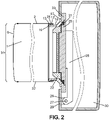
- the picture 2 schematically depicts a cross-sectional view of an exemplary chamber and biopharmaceutical container assembly using a first type of sealed biopharmaceutical container without a tube.
- the container 31 of the figure 1 is shown attached to the opening 33 of the chamber 30, or more precisely on the periphery of the opening 33 of the chamber 30.
- This opening 33 is closed by a door 25 of the chamber 30, a seal 21 being disposed between the periphery of the opening 33 and the door 25.
- This opening 33, or more precisely this periphery of the opening 33 plays the role of chamber connector 30, and it is on this connector 33 of chamber 30 that is fixed the connector 14 of the container 31.
- a cover 22 of the door of the container 31 closes this container 31, and is fixed against the door 25 of the chamber 30.
- An arm 26 is integral with the door 25 to tilt in the chamber 30 the together made up of, on the one hand, the door of the container 31 of which only the cover 22 is shown and, on the other hand, the door 25 of the chamber 30. This tilting is done around an axis of rotation 27 carried by an anchor base 28 to the wall 29 of the chamber 30.
- the secured assembly consisting of the cover 22 and the door 25, carried by the arm 26, tilts around the axis of rotation 27, inwards. of the chamber 30 leaving free the central space of the connector 14, through which the contents of the container 31 can be discharged into the chamber 30.
- the picture 3 schematically represents a sectional view of an example of the second type of shrouded biopharmaceutical container with trunk according to the prior art.
- the door of the container comprises a metal plate 23 overmoulded at the level of the center of the lid 22.
- This metal plate 23 is magnetized and is located on the exterior side, therefore in the open air and therefore contaminated.
- This magnetic metal plate 23 presses the connector 14 against the door of the chamber.
- a protective tube 19 is fixed to the connector 14 with the narrowing 3 of the container by shrink-fitting, that is to say by being tightened on the connector just like the narrowing 3 by a ring 20 for shrinking.
- This second type of container comprises many separate parts, including the tube 19 added to the constriction 3, and including the ring 20 for shrinking. The manufacture of this second type of container is relatively delicate and complex.
- the figure 4 schematically shows a cross-sectional view of an example of a third type welded biopharmaceutical container with trunk.
- this third type of possible container not yet known from the prior art, would still have two distinct parts, narrowing 3 and attached horn 19, to be soldered together either directly on the connector 14, or via the overmoulding 12, hence a certain remaining complexity which the invention has chosen to simplify, as now described and explained in connection with the figure 5 .
- the figure 5 schematically represents a cross-sectional view of an example of an embodiment of a welded biopharmaceutical container with a tube according to the invention.
- the container 31 of the figure 5 can be fixed in the same way as the container 31 of the figure 1 on room 30 of the picture 2 .
- the diameter D represents the diameter of the end of the constriction 3 fixed on the connector 14, when arriving on the overmolding 12. This diameter D is greater than the diameter d of the opening end of the neck 4.
- a container 31 comprises two main parts which are a flexible but non-elastic pocket 1 and a rigid connector 14, the pocket 1 and the connector 14 being both cylindrical of revolution, the pocket 1 being fixed around the connector 14 by means of an overmolding 12 located between the two.
- Pocket 1, connector 14 and overmoulding 12 are cylindrical with rotational symmetry.
- the connector 14 comprises a flange 17, a fixing surface 15 having a protrusion 16.
- the communication space 18 located between container 31 and chamber not shown in this figure 5 for the sake of clarity but represented on the figure 2 .
- the overmolding 12 comprises a rim 24 and a recess 13.
- the overmolding 12 is overmolded in an annular manner on the fixing surface 15 of the connector 14, the recess 13 of the overmolding 12 fitting into the protrusion 16 of the connector 14.
- Pocket 1 comprises a bottom 6, a cylindrical wall 32 of revolution extending along a body 2 and a constriction 3.
- a fold 7 is formed in the wall 32 of pocket 1.
- the fold 7, formed by the superposition of the two layers respectively constituted by the narrowing 3 and the integrated horn 10, is welded in an annular manner on the circumference 24 of the overmolding 12, so that the constriction 3 is welded against the integrated horn 10 itself welded against the periphery 24 of the overmolding 12.
- a shutter element to close the communication space 18 so that the container 31 is finalized. Either the container 31 is filled first and then the closure element is put in place next, or the closure element is put in place first, then the container 31 is filled next, and finally the bottom 6 is welded to the body 2 to close the pocket 1 and therefore the container 31 instead of having been previously welded to the body 2.
- the pocket 1 may in particular be a pocket adapted for the transfer of a fluid.
- a pipe having at its end a fluidic connector allowing an aseptic connection passes sterilely through the wall 32 of the bag 1.
- This pipe can thus then be inserted sterilely into the chamber 30 to form a sterile line between on the one hand a end of the pipe, through which the biopharmaceutical content can be entered, and on the other hand the chamber 30 to which this biopharmaceutical content can be conveyed.
- the figure 6 schematically represents an example of a first step of a method of manufacturing an embodiment of a welded biopharmaceutical container with a tube according to the invention, this container being represented in profile.
- This pocket 1 comprises a wall 32, extending between the bottom 6 of the pocket 1 and the opening 5 of the neck 4, encompassing the body 2, the narrowing 3 and the neck 4 of the pocket 1.
- the pocket 1 has an overall bottle shape, the diameter d of the opening 5 of the neck being for example 110mm, or even 200mm.
- the wall 32, including the body 2, the narrowing 3 and the neck 4 is in one piece.
- the body 2 and the neck 4 have a cylindrical shape of revolution, while the constriction 3 has a conical shape of revolution.
- the figure 7 schematically represents an example of a second step of a manufacturing method of an embodiment of a welded biopharmaceutical container with a tube according to the invention, this container being represented in profile.
- the collar 4 is rolled up over half of its length 8, keeping the end 9 not rolled up, and forming a fold 7 between the part 8 and the narrowing 3.
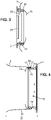
- the figure 8 schematically represents an example of a third step of a method of manufacturing an embodiment of a welded biopharmaceutical container with a tube according to the invention, this container being represented in profile.
- the fold 7 is welded around the periphery of the connector 14 in the center of which is placed a door 11 which closes the container 31.
- the welding of the fold 7 is carried out for example around 120° C., so as to melt the wall 32, but far from the melting point of the connector 14, which can be for example around 200°C.
- the constriction 3 is welded against the part 8 of the wall 32 itself welded to the connector 14, either directly or by means of an overmoulding not shown on the figure 8 for the sake of clarity.
- the figure 9 schematically represents an example of a first step of a method of using an embodiment of a sealed biopharmaceutical container with a tube according to the invention, this container being shown in profile.
- the container 31 can be used. It is also possible to weld the bottom 6 only at the end of this third manufacturing step completed at the level of the figure 8 , once door 11 is installed, and after having filled the container 31 by its bottom 6.
- the door 11 is open, making it accessible, from inside the chamber, the end 9 of the the integrated tube 10. The user or the robot, located in the chamber, only has to grab the end 9 and pull it towards the inside of the chamber (to the right on the figure 9 ), to deploy this tube 10 integrated into the wall 32 of the pocket 1.
- the figure 10 schematically represents an example of a second step of a method of using an embodiment of a sealed biopharmaceutical container with a tube according to the invention, this container being shown in profile.
- the integrated trunk 10 has been deployed.
- the contents of the container 31, located in the body 2 can pass through the narrowing 3, then through the integrated tube 10, then crossing the communication space (not shown for the sake of clarity) located between the container 31 and the chamber, to exit of the tube 10 integrated by the opening 5 to reach the interior of the chamber.
- the manufacturing process will be used in particular to assemble a pocket 1 whose wall 32 is made of plastic film with a connector 14 made of polycarbonate (PC) or acrylonitrile butadiene styrene (ABS) or polyvinyldene fluoride (PVDF) or polybutylene terephthalate (PBT).
- a connector 14 made of polycarbonate (PC) or acrylonitrile butadiene styrene (ABS) or polyvinyldene fluoride (PVDF) or polybutylene terephthalate (PBT).
- PC polycarbonate
- ABS acrylonitrile butadiene styrene
- PVDF polyvinyldene fluoride
- PBT polybutylene terephthalate
- the plastic film of the wall 32 of the bag 1 may in particular be polyethylene (PE), high density polyethylene (HDPE) or low density polyethylene (PELD).
- PE polyethylene
- HDPE high density polyethylene
- PELD low density polyethylene
- the overmolding product 12 will then be, for example, polyethylene (PE), high density (HDPE) or in the form of thermoplastic elastomer (TPE) or may also be thermoplastic elastomer or polypropylene or polyvinyldene fluoride (PVDF).
- PE polyethylene
- HDPE high density
- TPE thermoplastic elastomer
- PVDF polyvinyldene fluoride
- the welding of the plastic film of the fold 7 on the overmoulding 12 resists well to sterilization with gamma rays or to steam sterilization.
- the film of the wall 32 of the pocket 1 and the overmolding 12 will begin to melt almost at the same time, therefore in temperature ranges close to the order of 120° C. (far from the welding temperatures of the materials chosen for the connector 14 being more like about 200°C).
- the figure 11 represents a first example of a type of method for manufacturing a pocket according to the invention, by extrusion of a plastic film.
- Pouch 1 in the form of a generally cylindrical plastic film of revolution, comprises a wall 32, extending between bottom 6 of pouch 1 and opening 5 of neck 4, encompassing body 2, narrowing 3 and neck 4 of pocket 1.
- Pocket 1 has the overall shape of a bottle.
- the wall 32, including the body 2, the constriction 3 and the neck 4, is in one piece.
- the body 2 and the neck 4 have a cylindrical shape of revolution, while the constriction 3 has a conical shape of revolution.
- the wall 32 mainly comprises an extruded cylindrical film constituting the body 2, the constriction 3 and the neck 4 being delimited by welds 35. Outside the interior space of the pocket 1, delimited by the welds 35, are two lugs 37 pierced with holes 38 allowing the pocket 1 to be hooked.
- an additional weld 36 is made, of length 1 equal to approximately 100mm, which begins at the end of the constriction 3 and which ends at the level of the visual mark 34; in fact, it is the end of the additional weld 36 which constitutes a physical protrusion materializing the visual mark 34.
- This visual mark 34 will be used to roll up the collar 4 in the pocket 1 during the final stages of the manufacture of the pocket 1 .
- the plastic film is flexible but not elastic.
- This film may consist of layers of copolyester ethers, the pocket 1 being able to be sterilized by steam and by y (gamma) rays.
- This film can also be multilayered and then consist of a succession of the following layers: polyethylene (PE)/polyacrylate (PA)/polyethylene (PE), the bag 1 being able to be sterilized by y-rays.
- the figure 12 represents a second example of a type of method for manufacturing a pouch according to the invention, by welding two sheets of plastic film to one another.
- This second type of pouch manufacturing process differs from the first type of pouch manufacturing process described above, also in terms of the result, that is to say the pouch obtained.
- the welds 35, located on each side of the constriction 3, extend all along the body 2.
- the plastic film is flexible but not elastic.
- This film may consist of a layer of high density polyethylene (HDPE). All or at least part of one of the two films welded to one another, for example the half of the body 2 located furthest from the constriction 3, can be made of a layer of interconnected fibers of polyethylene high density (HDPE), the bag 1 can then be sterilized by steam.
- This film can also consist of a layer of high density polyethylene (HDPE). All or at least part of one of the two films welded to one another, for example the half of the body 2 located furthest from the constriction 3, can consist of a PES membrane (polyethylene sulfone ), the pocket 1 then being able to be sterilized by steam.
- This membrane may alternatively comprise a polyethylene sulphone (PES) membrane and polypropylene (PP) fiber flakes coated with polyethylene (PE).
- the figure 13 represents a third example of a type of method for manufacturing a pocket according to the invention, by welding two sheets of plastic film to one another, with welding of two lateral folds between the two plastic sheets.
- This third type of pouch manufacturing process differs from the second type of pouch manufacturing process previously described, also in terms of the result, that is to say the pouch obtained.
- the welds 35, located on each side of the body are split, due to the insertion, all along the body 2, of lateral folds 40 advantageously in the shape of a V.
- the welds 35 of each side of the pocket 1 can be welded together two by two, so that the side folds 40 are then entirely inside the pocket 1 and are no longer in direct contact with the environment outside the pocket 1 .
- the plastic film is flexible but not elastic.
- This film may consist of layers of copolyester ethers, the pocket 1 being able to be sterilized by steam and by y rays.
- This film can also be multilayer and consist of a succession of the following layers: polyethylene (PE)/polyacrylate (PA)/polyethylene (PE), the bag 1 being able to be sterilized by y-rays.
- This film can also consist of a layer of high density polyethylene (HDPE). All or at least part of one of the two films welded to one another, for example the half of the body 2 located furthest from the constriction 3, can consist of a PES membrane, the pocket 1 can then be sterilized by steam through this PES membrane.
- the two films consist of a layer of high density polyethylene (HDPE).
- the side folds 40 then consist of a PES membrane, the pocket 1 then being able to be sterilized by steam through this membrane.
- This membrane may alternatively comprise a polyethylene sulphone (PES) membrane and polypropylene (PP) fiber flakes coated with polyethylene (PE).
- This film may also consist of a layer of high density polyethylene (HDPE). All or at least part of one of the two films welded to one another, for example the half of the body 2 located furthest from the constriction 3, can be made of a layer of interconnected fibers of polyethylene high density (HDPE), the bag 1 can then be sterilized by steam, through this layer of interconnected fibers of high density polyethylene (HDPE).
- the side folds 40 consist of a layer of interconnected fibers of high density polyethylene (HDPE), the pocket 1 then being able to be sterilized by steam, through this layer of interconnected fibers of high density polyethylene (HDPE).
- the figure 14 represents an example of the bottom of a pouch according to the invention.
- the pocket 1, at the level of the body 2, on the side of the bottom 6, has two longitudinal welds 35 delimiting the body 2, and a transverse weld 35 applied after filling the pocket 1 with its contents, so as to constitute the bottom 6 of the pocket 1.
- two holes 38 are made in order to be able to hang the pocket 1 from below.
- Colored rings 39 can constitute a color code making it possible to distinguish at a glance the type of pocket 1 concerned.
- the figure 15 represents an example of a pocket according to the invention, having a short tube.
- the pocket 1 shown is a pocket with a short neck 4 because this neck 4 only extends the narrowing 3 by a reduced length, here 1 being for example approximately 100mm.
- the additional weld 34 extends over the entire length of the short neck 4.
- the visual mark 34 is therefore located at the open end 5 of the short neck 4.
- the figure 16 represents another example of a bag according to the invention, having a long tube.
- the pocket 1 shown is a pocket with a long neck 4 because this neck 4 extends the constriction 3 by a significant length, here L being for example approximately 900mm.
- the additional weld 34 only extends over part of the length of the long neck 4, namely over a length 1 equal to 100mm, for example.
- the visual mark 34 is therefore located far from the open end 5 of the long neck 4.
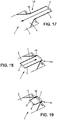
- the figure 17 represents a step in the method of manufacturing an example of a pocket according to the invention, essentially consisting in rolling up the collar in the pocket.
- the arrow indicates that part of the long collar 4 will be rolled up inside the pocket 1, in fact even inside the constriction 3 and the rest of the body 2. This long collar 4 will be rolled up in the pocket 1 until you reach the level of visual mark 34.
- the figure 18 represents a step in the method of manufacturing an example of a pocket according to the invention, essentially consisting in putting the end of the collar back into the rolled-up part itself located in the pocket.
- the figure 19 represents an example of a pocket according to the invention, ready to be fixed on a connector.
- the part of the long neck 4 rolled up inside itself is flush with the level of the visual mark 34.
- the end 9 of the neck 4 is ready to be pulled outwards by crossing the connector once that -it will have been installed, to be deployed inside the chamber to which the connector will have been secured.
- the figure 20 represents examples of dimensions of a pocket according to the invention, corresponding to the first and second examples of the type of method for manufacturing the pocket.
- the length 1 of additional weld 36 is between 80mm and 120mm, and is preferably 100mm.
- the length L of the neck 4 is between 100mm and 900mm, preferably between 300mm and 900mm, even more preferably between 600mm and 900mm.
- the diameter D of the neck 4 is between 300mm and 400mm, and is for example 340mm.
- the length L1 of the body 2 of the pocket 1 is between 900mm and 1100mm, and is for example 1000mm.
- the width L2 of the pocket 1 at the level of its body 2 is between 300mm and 600mm, preferably between 400mm and 500mm.
- the angle ⁇ of the constriction 3 is for example about 45 degrees.
- the figure 21 represents examples of dimensions of a pocket according to the invention, corresponding to the third example of type of method for manufacturing the pocket.
- the dimensions are similar or equal to those of the figure 20 .
- the height h of the side folds 40 is between 20mm and 60mm, and is for example 40mm.
Landscapes
- Health & Medical Sciences (AREA)
- Pharmacology & Pharmacy (AREA)
- Life Sciences & Earth Sciences (AREA)
- Animal Behavior & Ethology (AREA)
- General Health & Medical Sciences (AREA)
- Public Health (AREA)
- Veterinary Medicine (AREA)
- Hematology (AREA)
- Packages (AREA)
- Bag Frames (AREA)
- Medical Preparation Storing Or Oral Administration Devices (AREA)
Applications Claiming Priority (4)
| Application Number | Priority Date | Filing Date | Title |
|---|---|---|---|
| FR1670339 | 2016-07-22 | ||
| FR1670399A FR3054126B1 (fr) | 2016-07-22 | 2016-07-22 | Recipient biopharmaceutique, poche de recipient biopharmaceutique, procede de fabrication et d’utilisation de recipient biopharmaceutique |
| EP17751789.3A EP3487467B1 (de) | 2016-07-22 | 2017-07-12 | Biopharmazeutischer behälter, beutel für biopharmazeutischen behälter und verfahren zur herstellung und verwendung dieses biopharmazeutischen behälters |
| PCT/FR2017/000141 WO2018015618A1 (fr) | 2016-07-22 | 2017-07-12 | Recipient biopharmaceutique, poche de recipient biopharmaceutique, procede de fabrication et d'utilisation de recipient biopharmaceutique |
Related Parent Applications (2)
| Application Number | Title | Priority Date | Filing Date |
|---|---|---|---|
| EP17751789.3A Division EP3487467B1 (de) | 2016-07-22 | 2017-07-12 | Biopharmazeutischer behälter, beutel für biopharmazeutischen behälter und verfahren zur herstellung und verwendung dieses biopharmazeutischen behälters |
| EP17751789.3A Division-Into EP3487467B1 (de) | 2016-07-22 | 2017-07-12 | Biopharmazeutischer behälter, beutel für biopharmazeutischen behälter und verfahren zur herstellung und verwendung dieses biopharmazeutischen behälters |
Publications (1)
| Publication Number | Publication Date |
|---|---|
| EP4005547A1 true EP4005547A1 (de) | 2022-06-01 |
Family
ID=57396748
Family Applications (2)
| Application Number | Title | Priority Date | Filing Date |
|---|---|---|---|
| EP21216412.3A Pending EP4005547A1 (de) | 2016-07-22 | 2017-07-12 | Biopharmazeutischer behälter, beutel für biopharmazeutischen behälter und verfahren zur herstellung und verwendung dieses biopharmazeutischen behälters |
| EP17751789.3A Active EP3487467B1 (de) | 2016-07-22 | 2017-07-12 | Biopharmazeutischer behälter, beutel für biopharmazeutischen behälter und verfahren zur herstellung und verwendung dieses biopharmazeutischen behälters |
Family Applications After (1)
| Application Number | Title | Priority Date | Filing Date |
|---|---|---|---|
| EP17751789.3A Active EP3487467B1 (de) | 2016-07-22 | 2017-07-12 | Biopharmazeutischer behälter, beutel für biopharmazeutischen behälter und verfahren zur herstellung und verwendung dieses biopharmazeutischen behälters |
Country Status (5)
| Country | Link |
|---|---|
| US (1) | US11690784B2 (de) |
| EP (2) | EP4005547A1 (de) |
| CN (1) | CN109562016B (de) |
| FR (1) | FR3054126B1 (de) |
| WO (1) | WO2018015618A1 (de) |
Families Citing this family (4)
| Publication number | Priority date | Publication date | Assignee | Title |
|---|---|---|---|---|
| TWI814848B (zh) | 2018-06-29 | 2023-09-11 | 美商陶氏全球科技有限責任公司 | 可分配容器、分配器及操作分配器之方法 |
| FR3113653B1 (fr) * | 2020-08-27 | 2024-05-31 | Getinge La Calhene | Sac de transfert étanche présentant une résistance mécanique augmentée |
| CA3221871A1 (en) | 2021-06-18 | 2022-12-22 | Anais Eymery | Flexible trunk and rigid support arrangement for the transfer of sterile components from a container |
| EP4620498A1 (de) * | 2024-03-22 | 2025-09-24 | Becton Dickinson France | Anordnung zur aufbewahrung loser gegenstände wie z.b. stopfen für spritzen |
Citations (3)
| Publication number | Priority date | Publication date | Assignee | Title |
|---|---|---|---|---|
| US6068031A (en) * | 1995-11-22 | 2000-05-30 | Laboratoires Msd- Chibret | Transfer system between a bag and a sterile enclosure |
| EP2111210B1 (de) * | 2007-01-22 | 2013-11-13 | Baxter International Inc. | Brechen eines siegels vor zugang zu einem doppelkammer-beutel |
| EP2534052B1 (de) | 2010-02-10 | 2014-06-18 | Sartorius Stedim Fmt Sas | Verfahren und einheit zur sterilen füllung eines finalen grundbehälters mit für den biopharmaziebereich vorgesehenen inhalten |
Family Cites Families (7)
| Publication number | Priority date | Publication date | Assignee | Title |
|---|---|---|---|---|
| US4114669A (en) * | 1974-06-17 | 1978-09-19 | Marilyn Bishop | Sterile port structure |
| FR2695343B1 (fr) * | 1992-09-04 | 1994-11-25 | Sne Calhene | Mécanisme de commande centralisé, à sécurités incorporées, pour un dispositif de transfert étanche entre deux volumes clos. |
| FR2721289B1 (fr) * | 1994-06-17 | 1996-08-30 | Idc Isolateur Denominateur | Dispositif de jonction étanche entre deux enceintes isolées d'un milieu extérieur. |
| FR2942778B1 (fr) * | 2009-03-06 | 2016-02-05 | Sartorius Stedim Biotech Sa | Montage a enceinte torique de maintien pour l'obturation de, ou le raccord sur, une collerette annulaire, a mise en place et enlevement rapides, destine au domaine biopharmaceutique |
| DE102012007904B4 (de) | 2012-04-23 | 2015-08-27 | Fresenius Medical Care Deutschland Gmbh | Beutel mit verbundenem biegesteifen Kunststoffteil |
| JP6378695B2 (ja) * | 2013-12-25 | 2018-08-22 | テルモ株式会社 | 医療用液体収納用容器体およびそれを用いた薬剤充填済み医療用容器 |
| US20150330541A1 (en) * | 2014-05-15 | 2015-11-19 | Ayrlett Llc | Process of making a plumbing fitting, and the product thereof |
-
2016
- 2016-07-22 FR FR1670399A patent/FR3054126B1/fr active Active
-
2017
- 2017-07-12 WO PCT/FR2017/000141 patent/WO2018015618A1/fr not_active Ceased
- 2017-07-12 US US16/319,388 patent/US11690784B2/en active Active
- 2017-07-12 EP EP21216412.3A patent/EP4005547A1/de active Pending
- 2017-07-12 EP EP17751789.3A patent/EP3487467B1/de active Active
- 2017-07-12 CN CN201780045169.0A patent/CN109562016B/zh active Active
Patent Citations (3)
| Publication number | Priority date | Publication date | Assignee | Title |
|---|---|---|---|---|
| US6068031A (en) * | 1995-11-22 | 2000-05-30 | Laboratoires Msd- Chibret | Transfer system between a bag and a sterile enclosure |
| EP2111210B1 (de) * | 2007-01-22 | 2013-11-13 | Baxter International Inc. | Brechen eines siegels vor zugang zu einem doppelkammer-beutel |
| EP2534052B1 (de) | 2010-02-10 | 2014-06-18 | Sartorius Stedim Fmt Sas | Verfahren und einheit zur sterilen füllung eines finalen grundbehälters mit für den biopharmaziebereich vorgesehenen inhalten |
Also Published As
| Publication number | Publication date |
|---|---|
| CN109562016A (zh) | 2019-04-02 |
| WO2018015618A1 (fr) | 2018-01-25 |
| US20190274922A1 (en) | 2019-09-12 |
| EP3487467A1 (de) | 2019-05-29 |
| EP3487467B1 (de) | 2024-05-29 |
| CN109562016B (zh) | 2021-11-12 |
| FR3054126A1 (fr) | 2018-01-26 |
| US11690784B2 (en) | 2023-07-04 |
| FR3054126B1 (fr) | 2019-07-26 |
Similar Documents
| Publication | Publication Date | Title |
|---|---|---|
| EP3487467B1 (de) | Biopharmazeutischer behälter, beutel für biopharmazeutischen behälter und verfahren zur herstellung und verwendung dieses biopharmazeutischen behälters | |
| FR2987609A1 (fr) | Moyens antiaffaissement | |
| WO2018078242A1 (fr) | Emballage, de preference medical, et ensemble d'emballages correspondant | |
| EP2999450B1 (de) | Stopfen für verbinder für einen infusionsbeutel | |
| FR2490188A1 (fr) | Recipient en matiere plastique muni d'une jupe pour fixer une etiquette | |
| FR2921905A1 (fr) | Recipient de traitement et/ou de controle de produits comprenant une chambre de protection de moyens de traitement et/ou de controle de ces produits, et conteneur comprenant un tel recipient | |
| EP2091832B1 (de) | Abgabekopf mit angelenkter kappe | |
| WO2017109420A1 (fr) | Procede de fabrication d'un recipient etanche | |
| FR2901255A1 (fr) | Valve a deux voies | |
| FR2944780A1 (fr) | Dispositif de conditionnement et de distribution du type flacon-poche. | |
| WO2014188126A1 (fr) | Embase d'un connecteur pour poche de perfusion | |
| FR2801282A1 (fr) | Emballage souple transportable pour produits alimentaires permettant une ingestion directe | |
| EP2193086B1 (de) | Flexibler transportbehälter und herstellungsverfahren dafür | |
| FR2958853A1 (fr) | Emballage biopharmaceutique sterilisable. | |
| EP2196170B1 (de) | Beutel und Beutelverbund für die Verpackung einer flüssigen biologischen Substanz, wie beispielsweise Tiersamen | |
| EP0297193B1 (de) | Stopfen zum Verschliessen von Tuben und Flaschen, insbesondere für pharmazeutische Produkte | |
| FR2889461A1 (fr) | Microtube de laboratoire. | |
| EP4297910B1 (de) | Reservoir sowie fluidabgabevorrichtung | |
| EP2604543A1 (de) | Verpackung mit nach innen geschlagenem Verschluss für den Transport von Artikeln im Innern eines Schlauchs eines pneumatischen Netzes | |
| EP3947188B1 (de) | Verpackung und entsprechendes auspackverfahren | |
| FR2759984A1 (fr) | Bidon en matiere plastique avec sac interieur amovible | |
| CA3131333C (fr) | Emballage et procede de deconditionnement correspondant | |
| FR3088318A1 (fr) | Connecteur pour connecter un recipient a une conduite de prelevement | |
| BE1019366A5 (fr) | Conteneur pour liquides. | |
| WO2025017126A1 (fr) | Dispositif de connexion étanche pour transfert d'objets à déversement amélioré |
Legal Events
| Date | Code | Title | Description |
|---|---|---|---|
| PUAI | Public reference made under article 153(3) epc to a published international application that has entered the european phase |
Free format text: ORIGINAL CODE: 0009012 |
|
| STAA | Information on the status of an ep patent application or granted ep patent |
Free format text: STATUS: REQUEST FOR EXAMINATION WAS MADE |
|
| 17P | Request for examination filed |
Effective date: 20211221 |
|
| AC | Divisional application: reference to earlier application |
Ref document number: 3487467 Country of ref document: EP Kind code of ref document: P |
|
| AK | Designated contracting states |
Kind code of ref document: A1 Designated state(s): AL AT BE BG CH CY CZ DE DK EE ES FI FR GB GR HR HU IE IS IT LI LT LU LV MC MK MT NL NO PL PT RO RS SE SI SK SM TR |
|
| STAA | Information on the status of an ep patent application or granted ep patent |
Free format text: STATUS: EXAMINATION IS IN PROGRESS |
|
| 17Q | First examination report despatched |
Effective date: 20241002 |
|
| RAP3 | Party data changed (applicant data changed or rights of an application transferred) |
Owner name: SARTORIUS STEDIM FMT |
|
| RAP3 | Party data changed (applicant data changed or rights of an application transferred) |
Owner name: SARTORIUS STEDIM FMT |