EP4005761A1 - Vorgespannter beton - Google Patents
Vorgespannter beton Download PDFInfo
- Publication number
- EP4005761A1 EP4005761A1 EP20842993.6A EP20842993A EP4005761A1 EP 4005761 A1 EP4005761 A1 EP 4005761A1 EP 20842993 A EP20842993 A EP 20842993A EP 4005761 A1 EP4005761 A1 EP 4005761A1
- Authority
- EP
- European Patent Office
- Prior art keywords
- concrete
- fiber
- prestressed concrete
- expansive material
- wire
- Prior art date
- Legal status (The legal status is an assumption and is not a legal conclusion. Google has not performed a legal analysis and makes no representation as to the accuracy of the status listed.)
- Pending
Links
Images



Classifications
-
- C—CHEMISTRY; METALLURGY
- C04—CEMENTS; CONCRETE; ARTIFICIAL STONE; CERAMICS; REFRACTORIES
- C04B—LIME, MAGNESIA; SLAG; CEMENTS; COMPOSITIONS THEREOF, e.g. MORTARS, CONCRETE OR LIKE BUILDING MATERIALS; ARTIFICIAL STONE; CERAMICS; REFRACTORIES; TREATMENT OF NATURAL STONE
- C04B38/00—Porous mortars, concrete, artificial stone or ceramic ware; Preparation thereof
- C04B38/02—Porous mortars, concrete, artificial stone or ceramic ware; Preparation thereof by adding chemical blowing agents
-
- C—CHEMISTRY; METALLURGY
- C04—CEMENTS; CONCRETE; ARTIFICIAL STONE; CERAMICS; REFRACTORIES
- C04B—LIME, MAGNESIA; SLAG; CEMENTS; COMPOSITIONS THEREOF, e.g. MORTARS, CONCRETE OR LIKE BUILDING MATERIALS; ARTIFICIAL STONE; CERAMICS; REFRACTORIES; TREATMENT OF NATURAL STONE
- C04B14/00—Use of inorganic materials as fillers, e.g. pigments, for mortars, concrete or artificial stone; Treatment of inorganic materials specially adapted to enhance their filling properties in mortars, concrete or artificial stone
- C04B14/38—Fibrous materials; Whiskers
- C04B14/386—Carbon
-
- C—CHEMISTRY; METALLURGY
- C04—CEMENTS; CONCRETE; ARTIFICIAL STONE; CERAMICS; REFRACTORIES
- C04B—LIME, MAGNESIA; SLAG; CEMENTS; COMPOSITIONS THEREOF, e.g. MORTARS, CONCRETE OR LIKE BUILDING MATERIALS; ARTIFICIAL STONE; CERAMICS; REFRACTORIES; TREATMENT OF NATURAL STONE
- C04B22/00—Use of inorganic materials as active ingredients for mortars, concrete or artificial stone, e.g. accelerators or shrinkage compensating agents
- C04B22/008—Cement and like inorganic materials added as expanding or shrinkage compensating ingredients in mortar or concrete compositions, the expansion being the result of a recrystallisation
-
- C—CHEMISTRY; METALLURGY
- C04—CEMENTS; CONCRETE; ARTIFICIAL STONE; CERAMICS; REFRACTORIES
- C04B—LIME, MAGNESIA; SLAG; CEMENTS; COMPOSITIONS THEREOF, e.g. MORTARS, CONCRETE OR LIKE BUILDING MATERIALS; ARTIFICIAL STONE; CERAMICS; REFRACTORIES; TREATMENT OF NATURAL STONE
- C04B28/00—Compositions of mortars, concrete or artificial stone, containing inorganic binders or the reaction product of an inorganic and an organic binder, e.g. polycarboxylate cements
- C04B28/02—Compositions of mortars, concrete or artificial stone, containing inorganic binders or the reaction product of an inorganic and an organic binder, e.g. polycarboxylate cements containing hydraulic cements other than calcium sulfates
-
- C—CHEMISTRY; METALLURGY
- C04—CEMENTS; CONCRETE; ARTIFICIAL STONE; CERAMICS; REFRACTORIES
- C04B—LIME, MAGNESIA; SLAG; CEMENTS; COMPOSITIONS THEREOF, e.g. MORTARS, CONCRETE OR LIKE BUILDING MATERIALS; ARTIFICIAL STONE; CERAMICS; REFRACTORIES; TREATMENT OF NATURAL STONE
- C04B28/00—Compositions of mortars, concrete or artificial stone, containing inorganic binders or the reaction product of an inorganic and an organic binder, e.g. polycarboxylate cements
- C04B28/02—Compositions of mortars, concrete or artificial stone, containing inorganic binders or the reaction product of an inorganic and an organic binder, e.g. polycarboxylate cements containing hydraulic cements other than calcium sulfates
- C04B28/06—Aluminous cements
- C04B28/065—Calcium aluminosulfate cements, e.g. cements hydrating into ettringite
-
- E—FIXED CONSTRUCTIONS
- E04—BUILDING
- E04B—GENERAL BUILDING CONSTRUCTIONS; WALLS, e.g. PARTITIONS; ROOFS; FLOORS; CEILINGS; INSULATION OR OTHER PROTECTION OF BUILDINGS
- E04B5/00—Floors; Floor construction with regard to insulation; Connections specially adapted therefor
- E04B5/02—Load-carrying floor structures formed substantially of prefabricated units
- E04B5/04—Load-carrying floor structures formed substantially of prefabricated units with beams or slabs of concrete or other stone-like material, e.g. asbestos cement
-
- E—FIXED CONSTRUCTIONS
- E04—BUILDING
- E04C—STRUCTURAL ELEMENTS; BUILDING MATERIALS
- E04C5/00—Reinforcing elements, e.g. for concrete; Auxiliary elements therefor
- E04C5/07—Reinforcing elements of material other than metal, e.g. of glass, of plastics, or not exclusively made of metal
-
- E—FIXED CONSTRUCTIONS
- E04—BUILDING
- E04C—STRUCTURAL ELEMENTS; BUILDING MATERIALS
- E04C5/00—Reinforcing elements, e.g. for concrete; Auxiliary elements therefor
- E04C5/08—Members specially adapted to be used in prestressed constructions
-
- E—FIXED CONSTRUCTIONS
- E04—BUILDING
- E04C—STRUCTURAL ELEMENTS; BUILDING MATERIALS
- E04C5/00—Reinforcing elements, e.g. for concrete; Auxiliary elements therefor
- E04C5/08—Members specially adapted to be used in prestressed constructions
- E04C5/085—Tensile members made of fiber reinforced plastics
-
- B—PERFORMING OPERATIONS; TRANSPORTING
- B28—WORKING CEMENT, CLAY, OR STONE
- B28B—SHAPING CLAY OR OTHER CERAMIC COMPOSITIONS; SHAPING SLAG; SHAPING MIXTURES CONTAINING CEMENTITIOUS MATERIAL, e.g. PLASTER
- B28B23/00—Arrangements specially adapted for the production of shaped articles with elements wholly or partly embedded in the moulding material; Production of reinforced objects
- B28B23/02—Arrangements specially adapted for the production of shaped articles with elements wholly or partly embedded in the moulding material; Production of reinforced objects wherein the elements are reinforcing members
- B28B23/04—Arrangements specially adapted for the production of shaped articles with elements wholly or partly embedded in the moulding material; Production of reinforced objects wherein the elements are reinforcing members the elements being stressed
-
- C—CHEMISTRY; METALLURGY
- C04—CEMENTS; CONCRETE; ARTIFICIAL STONE; CERAMICS; REFRACTORIES
- C04B—LIME, MAGNESIA; SLAG; CEMENTS; COMPOSITIONS THEREOF, e.g. MORTARS, CONCRETE OR LIKE BUILDING MATERIALS; ARTIFICIAL STONE; CERAMICS; REFRACTORIES; TREATMENT OF NATURAL STONE
- C04B2111/00—Mortars, concrete or artificial stone or mixtures to prepare them, characterised by specific function, property or use
- C04B2111/10—Compositions or ingredients thereof characterised by the absence or the very low content of a specific material
- C04B2111/105—Alumina-free or very low alumina-content materials
Definitions
- the present invention relates to a prestressed concrete in which a chemical stress induced by a concrete expansive material and a mechanical stress using a continuous fiber reinforcing wire are introduced together.
- a concrete is poured while a PC steel wire or a PC steel strand wire obtained by twisting two or three wires is tensioned by a long line method or a form fixing method, and these PC steel wires are cut after curing and hardening to manufacture a prestressed concrete.
- PC steel material high-tensile steel material
- JP 2004-155623 A discloses a technique for expressing the high tensile strength or high shear strength of a prestressed concrete.
- JP 2002-326285 A discloses a technique for a prestressed concrete tensional material using a continuous fiber reinforced plastic composite material.
- the expansive material contains a material expanding in accordance with hydration reaction, and prevents drying shrinkage of a concrete structure due to hydration expansion.
- JP 2005-162564 A discloses an expansive material of a concrete. This makes inexpensive quick lime sufficiently usable as an expansive material for a mortar or a concrete, for example, without subjecting the quick lime to a complicated treatment such as a treatment for manufacturing a clinker burning material by adding another raw material component as in prior art, and almost without causing an increase in cost.
- This provides an expansive material capable of granting such a stable expansion force to be able to compete sufficiently with contraction of a mortar or a concrete or an external pressure, in particular, an expansive material capable of introducing a chemical prestress without using a large amount of the expansive material, and a concrete capable of introducing a chemical prestress.
- a prestressed concrete has been developed in order to overcome the largest problem of a concrete that the concrete is resistant to compression but is not resistant to tension.
- the prestressed concrete is maintained in a state that a compressive force is applied (prestressed) to a concrete member before a load is applied, prevents generation of a tensile stress in the concrete when the concrete receives the load, or controls the tensile stress.
- the prestressed concrete can prevent cracking due to a tensile stress compared to a reinforced concrete.
- a conventional prestressed concrete is often used for a bridge, an electric pole, a concrete pile, a construction member, a beam of a building, or the like, and is mainly used for a structural material.
- a prestressed concrete is an effective technique capable of suppressing the cracking on a surface, which may be a fate of a concrete.
- the prestressed concrete is used for structural materials, but is hardly used for non-structural materials such as general construction members.
- An object thereof is to provide a prestressed concrete that can be widely used for general building members, in which a chemical stress induced by an expansive material and a mechanical stress induced by a continuous fiber reinforcing wire are used together, and due to a synergistic effect of the mechanical stress and the chemical stress, the strength is increased, the reduction in weight, reduction in thickness, and suppression of cracking are achieved, and the degree of freedom in design is increased.
- claim 1 of the present invention provides a prestressed concrete being a concrete into which a prestress is introduced, characterized in that a mechanical stress induced by a tensional material and a chemical stress induced by an expansive material for a concrete are introduced simultaneously into the concrete, the tensional material is a continuous fiber reinforcing wire, the expansive material for a concrete is contained in an amount of 5 to 30 kg /m3 to the concrete material, and aluminum oxide is contained in an amount of 0.2 to 2.0% by weight to the expansive material for a concrete.
- the mechanical stress induced by a tensional material may be any stress as long as a mechanical tensile stress can be introduced into a concrete in advance by using various kinds of continuous fiber reinforcing wires as a tensional material.
- a prestress may be introduced by a pretension method or a posttension method.
- any expansive material that is used for a concrete may be used, and such an expansive material is contained preferably in an amount of 5 to 30 kg /m3 to the concrete material.
- Such an expansive material is contained more preferably in an amount of 10 to 25 kg /m3, and furthermore preferably in an amount of 15 to 25 kg /m3.
- the strength may be largely reduced, and therefore such a case is not preferable.
- the content of aluminum oxide in the expansive material for a concrete only needs to be 0.2 to 2.0% by weight.
- the content is preferably 0.3 to 1.9% by weight, and more preferably 0.5 to 1.8% by weight.
- the expansion effect is weak, and a synergistic effect of a chemical stress cannot be expected.
- the content largely influences the quick hardening of a concrete, and the concrete hardens before exhibiting sufficient strength, and therefore, such a case is not preferable.
- the mechanical stress is a shrinkage stress due to a tensional material to which a tensile load is applied
- the chemical stress is an expansion stress of a concrete due to an expansive material.
- the adhesion force between the tensional material and the concrete is important. If the adhesion force is weak, the synergistic effect cannot be sufficiently shown.
- alumina cement As a cement containing aluminum oxide in a large amount, alumina cement is known.
- This alumina cement is mainly made of calcium aluminate and has quick hardening, of which the fire resistance and chemical resistance are excellent, but the long-term strength becomes unstable due to the conversion of hydrates.
- the alumina cement is used for emergency works, a water blocking material, a refractory, or the like.
- the alumina cement when used, the alumina cement rapidly hardens due to the quick hardening before the expansion by an expansive material, the expansion and hardening are completed while the adhesion force between the tensional material and the concrete is weak, and therefore, the synergistic effect cannot be expected.
- the alumina cement is effective for emergency works which require quick hardening, a water blocking material, or a refractory, but is not suitable for a prestressed concrete that requires sufficient strength.
- An expansive material that can achieve an appropriate hardening rate and a high adhesion force between the tensional material and the concrete is required, and an appropriate content of aluminum oxide is important.
- the prestressed concrete according to the present invention is effective, for example, as a concrete member used for a structural portion requiring high strength such as a bridge, an electric pole, a concrete pile, a construction member, or a beam of a building; or as a general building member such as a construction member used for members other than primary structural members, a flooring material, a ceiling material, a wall material, a finishing member, a design member, a furniture material, a partition wall member, a cosmetic member, a fitting member, or a mounting member.
- a concrete member used for a structural portion requiring high strength such as a bridge, an electric pole, a concrete pile, a construction member, or a beam of a building
- a general building member such as a construction member used for members other than primary structural members, a flooring material, a ceiling material, a wall material, a finishing member, a design member, a furniture material, a partition wall member, a cosmetic member, a fitting member, or a mounting member.
- the prestressed concrete can be used as an alternate member for a metal member, a glass member, a hard resin member, a wood member, an impact energy absorbing member such as a damping member or a vibration isolation member, or the like.
- the shape of the concrete is not limited. Examples thereof include a plate shape, a character object shape, a hollow shape, and a three-dimensional shape.
- Claim 2 provides a prestressed concrete, characterized in that the continuous fiber reinforcing wire is a reinforcing fiber wire of one or more kinds of fibers selected from an aramid fiber, a carbon fiber, a glass fiber, a poly-p-phenylenebenzobisoxazole fiber, a stone material fiber such as a basalt fiber, and a rust prevention-treated PC steel strand wire.
- the continuous fiber reinforcing wire is a reinforcing fiber wire of one or more kinds of fibers selected from an aramid fiber, a carbon fiber, a glass fiber, a poly-p-phenylenebenzobisoxazole fiber, a stone material fiber such as a basalt fiber, and a rust prevention-treated PC steel strand wire.
- the continuous fiber reinforcing wire is a linear continuous fiber reinforcing material, and is a PC tensional material using a reinforced fiber reinforcing material continuously molded in a linear shape.
- the continuous fiber reinforcing material is a generic name of a material obtained by binding a carbon fiber, a glass fiber, an aramid fiber, a vinylon fiber, or the like with an epoxy resin or the like.
- the reinforced fiber reinforcing material has better physical properties (tensile strength, elastic modulus) such as light weight, high strength, high elasticity, corrosion resistance, a non-conductive property, or a nonmagnetic property than reinforcement, and excellent corrosion resistance and electromagnetic characteristics which reinforcement does not have.
- the linear shape generally means a linear shape or a two-dimensionally or three-dimensionally assembled shape of the linear shape units, such as a round shape, a rectangular shape, an irregular-shaped (rib or indented surface) rod, a braid-shaped rod, a twisted wire-shaped strand, or a lattice shape.
- Claim 3 provides a prestressed concrete, characterized in that the expansive material for a concrete is a mixture of one or more kinds selected from a lime-based expansive material such as quick lime, an ettringite-based expansive material such as calcium sulfoaluminate, an ettringite-lime composite-based expansive material, an iron powder-based expansive material, a magnesium-based expansive material, an aluminum powder-based expansive material, a shale-based expansive material, and a silica-based expansive material.
- a lime-based expansive material such as quick lime
- an ettringite-based expansive material such as calcium sulfoaluminate
- an ettringite-lime composite-based expansive material such as iron powder-based expansive material
- a magnesium-based expansive material such as magnesium-based expansive material
- aluminum powder-based expansive material such as aluminum powder-based expansive material
- a shale-based expansive material such as aluminum powder-based expansive material
- the expansive material may have an aluminum oxide content of 0.2 to 2.0% by weight, and the combination thereof is not limited.
- Claim 4 provides a prestressed concrete, characterized in that the wire of the tensional material has a wire diameter of 18 mm or less.
- the wire diameter may be any value as long as it is 18.0 mm or less.
- the wire diameter only needs to be able to ensure the tensile strength with which a mechanical prestress can be introduced.
- the wire diameter is preferably from 5.0 mm to 13.5 mm, and more preferably from 5.0 mm to 10.0 mm.
- the wire diameter of 18.0 mm or more In case of the wire diameter of 18.0 mm or more, a covering thickness of a concrete is increased, and the degree of freedom in design is limited. Therefore, the wire diameter of 18.0 mm or more is not preferable from the viewpoint of a design property.
- Claim 5 provides a prestressed concrete, characterized in that the tensional material has a tensile load of 300 kN or less per the wire.
- the tensile load may be any value as long as it is 300 kN or less.
- the tensile load only needs to be able to ensure a tensile load with which the cracking on a surface of a concrete can be effectively suppressed and the bending resistance can be enhanced after a prestress is introduced.
- the tensile load is preferably from 5 kN to 200 kN, more preferably from 10 kN to 150 kN, and furthermore preferably about from 15 kN to 80 kN.
- the tensile load can be adjusted arbitrarily according to a plate thickness of a prestressed concrete.
- the tensile load may be 50 kN or less.
- Claim 6 provides a prestressed concrete, characterized in that the concrete has a thickness of 80 mm or less.
- the concrete thickness may be any value as long as it is 80 mm or less.
- the concrete thickness only needs to be able to ensure a minimum covering thickness with the use of a continuous fiber reinforcing wire as a tensional material.
- the concrete thickness is preferably 50 mm or less, and more preferably 40 mm or less.
- explosion to be caused by rust or the like does not occur because of the rust resistance, and therefore, the covering thickness can be suppressed to 10 mm or less.
- Claim 7 provides a prestressed concrete, characterized in that a discontinuous fiber reinforcing material is used.
- the discontinuous fiber reinforcing material may be any material as long as it is a fiber reinforcing material in a discontinuous state.
- a diameter of 0.005 to 1.5 mm and a length of 5 to 50 mm are applicable from the viewpoints of preventing the material separation of fibers in a formulation and improving the bending strength or toughness after hardening. Further, as the size of a fiber, a diameter of 0.1 to 1.0 mm and a length of 5 to 30 mm are preferable.
- An aspect ratio of a carbon fiber (fiber length/fiber diameter) is preferably from 10 to 200, more preferably from 20 to 150, and furthermore preferably from 30 to 100.
- the blending amount thereof is properly from 0.2 to 5.0%, of concrete preferably from 0.3 to 3.0%, and more preferably from 0.5 to 2.0% in terms of volume percent in a formulation. With the blending amount of less than 0.2%, the effect of improving the flexural strength or toughness of a structural member is low, and therefore, such a blending amount is not preferable. On the other hand, if the blending amount exceeds 5.0%, a unit amount of water is increased in order to ensure the flowability or the like, and further an effect for reinforcing a fiber is not enhanced even with the increase of the blending amount, and therefore, such a blending amount is not economical. In addition, with the blending amount exceeding 5.0%, a so-called fiber ball easily generates in a kneaded product, and therefore, such a blending amount is not preferable.
- Claim 8 provides a prestressed concrete, characterized in that the discontinuous fiber reinforcing material is a reinforcing fiber material formed of one or more kinds of fibers selected from a carbon fiber, a glass fiber, a resin fiber, and a stone material fiber such as a basalt fiber.
- the discontinuous fiber reinforcing material is a reinforcing fiber material formed of one or more kinds of fibers selected from a carbon fiber, a glass fiber, a resin fiber, and a stone material fiber such as a basalt fiber.
- Claim 9 provides a prestressed concrete, characterized in that a pigment is mixed.
- the pigment may be any pigment as long as it is blended in a concrete raw material and coloring a concrete.
- the pigment can be appropriately selected from conventional pigments according to a desired color, and can be blended. Specific examples thereof include a powdery inorganic pigment such as red iron oxide, titanium white, chrome yellow, ultramarine blue, cobalt blue, or cobalt purple.
- Examples thereof further include titanium dioxide, zinc sulfide, zinc oxide, iron oxide, magnetite, magnesium iron oxide, chromium oxide, ultramarine blue, cobalt oxide, nickel or chromium-antimony-titanium oxide, manganese-titanium-rutile, cobalt oxide, a mixed oxide of cobalt and aluminum, a rutile mixed-phase pigment, a sulfide of rare earth, spinel of cobalt, nickel, and zinc, spinel of copper, zinc, and manganese based on iron and chromium, a bismuth-vanadium salt, and a blend pigment.
- examples of a color index pigment include pigment yellow 184, pigment yellow 53, pigment yellow 42, pigment yellow brown 24, pigment red 101, pigment blue 28, pigment blue 36, pigment green 50, pigment green 17, pigment black 11, pigment black 33, and pigment white 6.
- a mixture of these inorganic pigments may be used.
- an organic pigment examples include a monoazo pigment, a disazo pigment, a laked azo pigment, a ⁇ -naphthol pigment, a naphthol AS pigment, a benzimidazolone pigment, a disazo condensation pigment, an azo metal complex pigment, a polycyclic pigment such as a phthalocyanine pigment, a quinacridone pigment, a perylene pigment, a perinone pigment, a thioindigo pigment, an anthanthrone pigment, an anthraquinone pigment, a flavanthrone pigment, an indathrone pigment, an isobioranthrone pigment, a pyranthrone pigment, a dioxazine pigment, a quinophthalone pigment, an isoindolinone pigment, an isoindoline pigment, or a diketopyrrolopyrrole pigment, and carbon black.
- a mixture of these organic pigments may be used.
- a pigment is powdery, and the addition amount of the pigment is small. Therefore, even when the pigment is added directly to a concrete kneaded product and is stirred, the pigment is not dispersed uniformly in many cases.
- a pigment is preferably prepared in a form of slurry by using a water reducing agent and water.
- the water reducing agent is used in order to prevent aggregation of a pigment in water, to improve the dispersion thereof, and to make the dispersion of the pigment in a concrete kneaded product easier.
- the absolute amount of the water reducing agent contained in the slurry is small. Therefore, the water reducing agent hardly influences a characteristic such as strength of a colored concrete.
- water reducing agent used for slurry examples include lignin-based, naphthalene sulfonic acid-based, melamine-based, and polycarboxylic acid-based water reducing agents for a cement, an AE water reducing agent, a high-performance water reducing agent, and a high-performance AE water reducing agent, which are general water reducing agents. It is only necessary to use a water reducing agent selected from these examples, and two or more kinds thereof can be used together.
- the same agent as that blended in the concrete kneaded product is preferably used because of being stirred with the concrete kneaded product rapidly.
- Viscosity of slurry is determined appropriately considering the pigment fineness, the kind and amount of the water reducing agent, the amount of water, and the like.
- Claim 10 provides a prestressed concrete, characterized in that any irregularities are formed on a surface the prestressed concrete using a soft form.
- the soft form may be any form as long as it is a soft form using a soft material such as a resin or a rubber and can form any irregularities on a surface of a concrete.
- Examples of the resin that is a soft material include a thermoplastic resin and a thermosetting resin.
- examples of the thermoplastic resin include polypropylene, polycarbonate, PET, and PBT, which are obtained by kneading a short fiber.
- examples of the thermosetting resin include an epoxy resin, a vinyl ester resin, an unsaturated polyester resin, and a resin obtained by combining these resins appropriately.
- Examples of a fiber reinforced material include a glass fiber, a carbon fiber, an aramid fiber, and a stone material fiber such as a basalt fiber, which are usually used for a fiber reinforced plastic.
- a foamed resin form formed of a foamed body of a resin such as polyethylene, polypropylene, polystyrene, or polyurethane may be used.
- Examples of the rubber that is a soft material include a natural rubber and a synthetic rubber.
- Examples of the synthetic rubber include a silicone rubber, a urethane rubber, a fluorocarbon rubber, an isoprene rubber, an ethylene propylene rubber, a styrene butadiene rubber, and a chloroprene rubber.
- the soft form may be any form as long as it is a plate-shaped elastic form in which any irregularities have been formed such that irregularities appear on a surface of a concrete after the soft form is peeled.
- Examples thereof include a form obtained by solidifying and molding a resin material or a rubber material such that any shape appears on a surface, a form obtained by subjecting a surface of a plate body of a resin material or a rubber material to laser processing, and a form obtained by molding a resin material or a rubber material using a 3D printer.
- Any irregular shape may be any shape as long as it is designed so as to enhance a design property. Examples thereof include a cast stone pattern, a grain pattern, a geometric pattern, a perforated panel, and an expression of a shape such as a letter, a photograph, or a character authorized by copyright.
- the present invention exhibits the following effects.
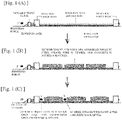
- Fig. 1 illustrates a method for introducing a mechanical prestress by a conventional pretension method.
- Fig. 1 is an explanatory view of a pretension bed (manufacturing apparatus).
- Fig. 1 three prestressed concrete members are simultaneously manufactured in a longitudinal direction on a pretension bed (manufacturing apparatus 1) by a long line system.
- the PC steel strand wire is stretched between reaction force bases, and is tensed by a jack on a left side with a tensile load of 50 tons (490 kN) to add a prestress force.
- a lattice reinforcement (reinforcement) and a form are assembled while the PC steel strand wire is tensed, and a concrete is poured and cured.
- a conventional prestressed concrete is manufactured in this way.
- the concrete manufactured in this conventional example is a prestressed concrete for structural materials.
- the present invention provides a prestressed concrete that can be used for general buildings.
- a mechanical prestress can be introduced by a method similar to that in the conventional example ( Fig. 1 ).
- the prestressed concrete according to the present invention is achieved by a novel composition of a concrete, a tensional material, and a tensile load.
- a mixing ratio of an expansive agent is 20 kg/m3 as described above.
- the aluminum oxide in the expansive material is 1.2% by weight.
- a strand wire of a carbon fiber reinforced polymer (CFRP) material having a diameter of 12.5 mm was used.
- a prestressed concrete having a size of 3 m ⁇ 2.4 m ⁇ 36 mm was used as one body, and five wires of the tensional materials were disposed at an interval of 500 mm in a lateral direction.
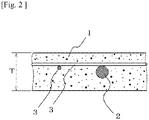
- Fig. 2 illustrates an arrangement view of a tensional material.
- a thickness T of a prestressed concrete 1 was 36 mm, and a tensional material 2 of ⁇ 12.5 mm was disposed in a central portion of the plate thickness.
- a lattice reinforcement 3 was disposed on an upper surface of the tensional material.
- a covering thickness was about 7 mm.
- the tensional material was disposed, and a tensile load of 18 kN was introduced into each wire of the tensional material.
- the compressive strength was 60 MPa or more, satisfying reference strength.
- the prestressed concrete of the present invention has a plate thickness of 36 mm.
- a conventional prestressed concrete using a steel tensional material ( ⁇ 12.5 mm) needs to have a covering thickness of about 30 mm considering a problem such as rust, and therefore needs to have a larger plate thickness than the prestressed concrete of the present invention by a difference (30 mm - 7 mm) in covering thickness, that is, about 23 mm on one side.
- the prestressed concrete according to the present invention had a weight of 648 kg.
- a conventional prestressed concrete using a steel tensional material has a plate thickness of 82 mm considering a covering thickness.
- cracking occurred when one person with a body weight of 70 kg was placed on a central portion of the prestressed concrete plate according to the present invention and jumped about 30 cm to apply a shock with the body weight while fulcrums were put on lower parts of four corners of the prestressed concrete plate and the prestressed concrete plate was placed horizontally.
- the cracking was completely closed by a crimping effect due to a prestress, and water leakage was not observed at all when a water leakage test was performed.
- test bodies 10 were subjected to a bending test according to JISA1414 while conditions of a mechanical stress induced by a continuous fiber reinforcing wire (hereinafter, abbreviated as MS) and a chemical stress induced by an expansive material for a concrete (hereinafter, abbreviated as CS) were changed.
- MS mechanical stress induced by a continuous fiber reinforcing wire
- CS chemical stress induced by an expansive material for a concrete
- a composition of the concrete was similar to the above case in Fig. 2 .
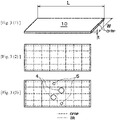
- Each of the test bodies 10 had a size of length (L) 2 m ⁇ width (W) 1 m ⁇ thickness (t) 38 mm.
- each of the test bodies 10 was a concrete thin plate, and three carbon fiber wires (CFRP) of ⁇ 7.5 mm were embedded therein.
- the carbon fiber wires (CFRP) are indicated by a broken line, and spine reinforcement (SR) is indicated by a dashed line.
- CFRP carbon fiber wires
- SR spine reinforcement
- three test bodies had no holes.
- the other three test bodies had two through holes (large) 4: ⁇ 150 mm and two through holes (small) 5: ⁇ 75 mm around the center.
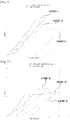
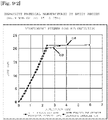
- Figs. 6 and 7 are diagrams illustrating a relationship between a load and deflection.
- Fig. 6 illustrates results of CASE-1 to CASE-3.
- Fig. 6 illustrates a comparison result among three types each having no holes
- Fig. 7 illustrates results of CASE-4 to CASE-6.
- Fig. 7 illustrates a comparison result among three types each having holes
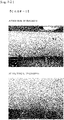
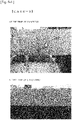
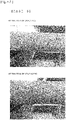
- Figs. 8-1 to 8-6 are photographs comparing situations at the time of cracking and at the time of unloading in bending tests of CASE-1 to CASE-6.
- Results of the test bodies each having no holes (CASE-1 to CASE-3) and test bodies each having holes (CASE-4 to CASE-6) indicate that in test bodies each having no holes ( Fig. 6 ), CASE-1 (MS + CS) and CASE-2 (MS) have a high fracture load to approximately the same extent and CASE-3 (CS) has a slightly lower fracture load, by comparison between two graphs ( Figs. 6 and 7 ).
- CASE-4 (MS + CS) has a higher fracture load
- CASE-5 (MS) and CASE-6 (CS) have a low fracture load to approximately the same extent.
- test body having a size similar to that of the above [Example 1 of bending test] was manufactured.
- an expansive material for the present invention and a commercially available expansive material were used as follows.
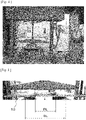
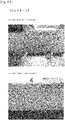
- Fig. 9-2 in the graph of the expansive material manufactured by Buddy Rhodes (aluminum oxide: 15 to 25% by weight), G3 (with tension and with an expansive material) and G4 (with tension and without an expansive material) have approximately the same values.
- Commercially available expansive material in a case of using an expansive material manufactured by Buddy Rhodes (aluminum oxide: 15 to 25% by weight), a synergistic effect has not been observed.
- the prestressed concrete of the present invention has high flexural strength, and a significant effect of reduction in thickness, reduction in weight, and suppression of cracking. Therefore, the prestressed concrete can be applied to an outer wall, a partition wall, a floorboard, a furniture material, or the like as a general building member, and becomes an excellent concrete plate having a completely new design property due to the lightweight thin plate and having a potential of a design property.
Landscapes
- Chemical & Material Sciences (AREA)
- Engineering & Computer Science (AREA)
- Ceramic Engineering (AREA)
- Structural Engineering (AREA)
- Architecture (AREA)
- Materials Engineering (AREA)
- Organic Chemistry (AREA)
- Civil Engineering (AREA)
- Chemical Kinetics & Catalysis (AREA)
- Inorganic Chemistry (AREA)
- Nanotechnology (AREA)
- General Chemical & Material Sciences (AREA)
- Physics & Mathematics (AREA)
- Electromagnetism (AREA)
- Manufacturing & Machinery (AREA)
- Mechanical Engineering (AREA)
- Reinforcement Elements For Buildings (AREA)
Applications Claiming Priority (4)
| Application Number | Priority Date | Filing Date | Title |
|---|---|---|---|
| JP2019134758 | 2019-07-22 | ||
| JP2020034583 | 2020-03-02 | ||
| JP2020119702A JP6865339B1 (ja) | 2019-07-22 | 2020-07-13 | プレストレストコンクリート |
| PCT/JP2020/033724 WO2021015299A1 (ja) | 2019-07-22 | 2020-09-07 | プレストレストコンクリート |
Publications (2)
| Publication Number | Publication Date |
|---|---|
| EP4005761A1 true EP4005761A1 (de) | 2022-06-01 |
| EP4005761A4 EP4005761A4 (de) | 2023-08-16 |
Family
ID=74193338
Family Applications (1)
| Application Number | Title | Priority Date | Filing Date |
|---|---|---|---|
| EP20842993.6A Pending EP4005761A4 (de) | 2019-07-22 | 2020-09-07 | Vorgespannter beton |
Country Status (4)
| Country | Link |
|---|---|
| US (1) | US20220267222A1 (de) |
| EP (1) | EP4005761A4 (de) |
| AU (1) | AU2020317713B2 (de) |
| WO (1) | WO2021015299A1 (de) |
Family Cites Families (8)
| Publication number | Priority date | Publication date | Assignee | Title |
|---|---|---|---|---|
| JPH1086121A (ja) * | 1996-09-19 | 1998-04-07 | Ozawa Concrete Kogyo Kk | 型枠用コンクリートボード及びその製造方法 |
| JP4750309B2 (ja) | 2001-05-01 | 2011-08-17 | 東レ・デュポン株式会社 | 耐熱性に優れた連続繊維強化プラスチック棒材 |
| JP2004155623A (ja) | 2002-11-08 | 2004-06-03 | Taiheiyo Cement Corp | プレストレストコンクリート |
| JP2005162564A (ja) | 2003-12-05 | 2005-06-23 | Taiheiyo Material Kk | モルタル・コンクリート用膨張材及びこれを用いたコンクリート |
| JP5768197B1 (ja) * | 2014-08-11 | 2015-08-26 | 昌樹 阿波根 | 非主用構造部材用プレストレストコンクリート |
| JP6055953B1 (ja) * | 2015-10-05 | 2016-12-27 | 昌樹 阿波根 | プレストレストコンクリートの製造方法 |
| CN109415260B (zh) * | 2016-06-27 | 2022-02-22 | 株式会社Hpc冲绳 | 预应力混凝土的制造方法 |
| LV15383B (lv) * | 2017-07-14 | 2019-10-20 | Filigran Primekss, Sia | Daļēji saliekama dzelzsbetona pārseguma elementu sistēma |
-
2020
- 2020-09-07 AU AU2020317713A patent/AU2020317713B2/en active Active
- 2020-09-07 US US17/629,147 patent/US20220267222A1/en active Pending
- 2020-09-07 EP EP20842993.6A patent/EP4005761A4/de active Pending
- 2020-09-07 WO PCT/JP2020/033724 patent/WO2021015299A1/ja not_active Ceased
Also Published As
| Publication number | Publication date |
|---|---|
| AU2020317713B2 (en) | 2025-10-02 |
| WO2021015299A1 (ja) | 2021-01-28 |
| EP4005761A4 (de) | 2023-08-16 |
| AU2020317713A1 (en) | 2022-03-03 |
| US20220267222A1 (en) | 2022-08-25 |
Similar Documents
| Publication | Publication Date | Title |
|---|---|---|
| EP3138824B1 (de) | Spannbeton für nebenstrukturelemente | |
| Afroz et al. | Effects of hybrid fibers on the development of high volume fly ash cement composite | |
| Chen et al. | Properties of lightweight expanded polystyrene concrete reinforced with steel fiber | |
| Corinaldesi et al. | Mechanical characterization of Engineered Cement-based Composites prepared with hybrid fibres and expansive agent | |
| Shafigh et al. | Oil palm shell lightweight concrete as a ductile material | |
| Tosun-Felekoglu et al. | Effects of fibre hybridization on multiple cracking potential of cement-based composites under flexural loading | |
| EP2067753A1 (de) | Betonmischung | |
| WO2009111292A3 (en) | Cement based laminated armor panels | |
| JP6055953B1 (ja) | プレストレストコンクリートの製造方法 | |
| WO2009142791A3 (en) | Process of manufacturing cement based armor panels | |
| Hemzah et al. | Experimental investigation for structural behaviour of self-compacting reinforced concrete hollow beams with in-place circular openings strengthened with CFRP laminates | |
| EP3061734A1 (de) | Leichte betone und mörtel | |
| US20230391670A1 (en) | Hybrid fiber reinforced cementitious material | |
| KR100954144B1 (ko) | 경량 고강도 콘크리트 | |
| KR100749926B1 (ko) | 굴 껍질을 이용한 내진형 섬유보강 모르타르 및 자동수평재 | |
| EP4005761A1 (de) | Vorgespannter beton | |
| KR20040079629A (ko) | 단섬유보강 고인성 시멘트복합재료의 제조방법 | |
| WO2018003190A1 (ja) | プレストレストコンクリートの製造方法 | |
| GB2525454A (en) | Construction material | |
| JP6865339B1 (ja) | プレストレストコンクリート | |
| KR20160144554A (ko) | 유·무기 복합섬유를 이용한 고인성 복합 섬유보강 콘크리트의 제조방법 및 이에 의해 제조된 방폭 섬유보강 콘크리트 | |
| Mohammed et al. | An innovative method of voided reinforced concrete one-way slabs using bundled waste PET bottled tubes | |
| TWI911164B (zh) | 預力混凝土 | |
| SK5342001A3 (en) | Thin-walled component made from hydraulically hardened cement paste material and method for the production thereof | |
| US20030000425A1 (en) | Micro-encapsulated crack resistant cement |
Legal Events
| Date | Code | Title | Description |
|---|---|---|---|
| STAA | Information on the status of an ep patent application or granted ep patent |
Free format text: STATUS: THE INTERNATIONAL PUBLICATION HAS BEEN MADE |
|
| PUAI | Public reference made under article 153(3) epc to a published international application that has entered the european phase |
Free format text: ORIGINAL CODE: 0009012 |
|
| STAA | Information on the status of an ep patent application or granted ep patent |
Free format text: STATUS: REQUEST FOR EXAMINATION WAS MADE |
|
| 17P | Request for examination filed |
Effective date: 20220207 |
|
| AK | Designated contracting states |
Kind code of ref document: A1 Designated state(s): AL AT BE BG CH CY CZ DE DK EE ES FI FR GB GR HR HU IE IS IT LI LT LU LV MC MK MT NL NO PL PT RO RS SE SI SK SM TR |
|
| DAV | Request for validation of the european patent (deleted) | ||
| DAX | Request for extension of the european patent (deleted) | ||
| REG | Reference to a national code |
Ref country code: DE Ref legal event code: R079 Free format text: PREVIOUS MAIN CLASS: B28B0023040000 Ipc: C04B0022000000 |
|
| A4 | Supplementary search report drawn up and despatched |
Effective date: 20230714 |
|
| RIC1 | Information provided on ipc code assigned before grant |
Ipc: E04C 5/08 20060101ALI20230710BHEP Ipc: E04C 5/07 20060101ALI20230710BHEP Ipc: E04B 5/04 20060101ALI20230710BHEP Ipc: B28B 23/04 20060101ALI20230710BHEP Ipc: C04B 32/02 20060101ALI20230710BHEP Ipc: C04B 28/02 20060101ALI20230710BHEP Ipc: C04B 28/06 20060101ALI20230710BHEP Ipc: C04B 22/00 20060101AFI20230710BHEP |