EP4006485A1 - Procédé d'adaptation automatique d'un taux de projection de motif dans un système de perception active - Google Patents
Procédé d'adaptation automatique d'un taux de projection de motif dans un système de perception active Download PDFInfo
- Publication number
- EP4006485A1 EP4006485A1 EP20209903.2A EP20209903A EP4006485A1 EP 4006485 A1 EP4006485 A1 EP 4006485A1 EP 20209903 A EP20209903 A EP 20209903A EP 4006485 A1 EP4006485 A1 EP 4006485A1
- Authority
- EP
- European Patent Office
- Prior art keywords
- event
- events
- projection
- counter
- light pattern
- Prior art date
- Legal status (The legal status is an assumption and is not a legal conclusion. Google has not performed a legal analysis and makes no representation as to the accuracy of the status listed.)
- Granted
Links
Images
Classifications
-
- G—PHYSICS
- G01—MEASURING; TESTING
- G01B—MEASURING LENGTH, THICKNESS OR SIMILAR LINEAR DIMENSIONS; MEASURING ANGLES; MEASURING AREAS; MEASURING IRREGULARITIES OF SURFACES OR CONTOURS
- G01B11/00—Measuring arrangements characterised by the use of optical techniques
- G01B11/24—Measuring arrangements characterised by the use of optical techniques for measuring contours or curvatures
- G01B11/25—Measuring arrangements characterised by the use of optical techniques for measuring contours or curvatures by projecting a pattern, e.g. one or more lines, moiré fringes on the object
- G01B11/2513—Measuring arrangements characterised by the use of optical techniques for measuring contours or curvatures by projecting a pattern, e.g. one or more lines, moiré fringes on the object with several lines being projected in more than one direction, e.g. grids, patterns
-
- G—PHYSICS
- G01—MEASURING; TESTING
- G01B—MEASURING LENGTH, THICKNESS OR SIMILAR LINEAR DIMENSIONS; MEASURING ANGLES; MEASURING AREAS; MEASURING IRREGULARITIES OF SURFACES OR CONTOURS
- G01B11/00—Measuring arrangements characterised by the use of optical techniques
- G01B11/24—Measuring arrangements characterised by the use of optical techniques for measuring contours or curvatures
- G01B11/25—Measuring arrangements characterised by the use of optical techniques for measuring contours or curvatures by projecting a pattern, e.g. one or more lines, moiré fringes on the object
- G01B11/254—Projection of a pattern, viewing through a pattern, e.g. moiré
-
- G—PHYSICS
- G06—COMPUTING OR CALCULATING; COUNTING
- G06V—IMAGE OR VIDEO RECOGNITION OR UNDERSTANDING
- G06V20/00—Scenes; Scene-specific elements
- G06V20/60—Type of objects
- G06V20/64—Three-dimensional [3D] objects
-
- G—PHYSICS
- G06—COMPUTING OR CALCULATING; COUNTING
- G06T—IMAGE DATA PROCESSING OR GENERATION, IN GENERAL
- G06T7/00—Image analysis
- G06T7/50—Depth or shape recovery
- G06T7/521—Depth or shape recovery from laser ranging, e.g. using interferometry; from the projection of structured light
-
- G—PHYSICS
- G06—COMPUTING OR CALCULATING; COUNTING
- G06V—IMAGE OR VIDEO RECOGNITION OR UNDERSTANDING
- G06V10/00—Arrangements for image or video recognition or understanding
- G06V10/10—Image acquisition
- G06V10/12—Details of acquisition arrangements; Constructional details thereof
- G06V10/14—Optical characteristics of the device performing the acquisition or on the illumination arrangements
- G06V10/145—Illumination specially adapted for pattern recognition, e.g. using gratings
-
- H—ELECTRICITY
- H04—ELECTRIC COMMUNICATION TECHNIQUE
- H04N—PICTORIAL COMMUNICATION, e.g. TELEVISION
- H04N25/00—Circuitry of solid-state image sensors [SSIS]; Control thereof
- H04N25/70—SSIS architectures; Circuits associated therewith
- H04N25/703—SSIS architectures incorporating pixels for producing signals other than image signals
- H04N25/707—Pixels for event detection
Definitions
- the present invention relates to the use of event-based cameras for capturing scenes in an active perception system, in particular a structured light perception system.
- a sequence of spatial patterns is projected onto a scene and captured by a camera sensor array for performing a three-dimensional reconstruction by triangulation.
- the pattern projection is captured by two distinct cameras.
- Patent application WO2020/169834 discloses a structured light perception system using an event-based camera for capturing the projected patterns.
- the use of an event-based camera significantly reduces the image data rate and thus the image processing resources for the 3D reconstruction process.
- the system could be further improved by using other properties of an event-based camera.
- a method for adjusting a pattern projection rate in an active perception system comprising the steps of observing a scene with an event-based sensor array; projecting a current light pattern of a sequence of light patterns on the scene for a given interval of time; retrieving events generated by the event-based sensor array in response to the projection of the current light pattern; monitoring a property of the event retrieval progress; and dynamically controlling the projection of the light pattern based on the property.
- the method may further comprise the step of dynamically triggering the projection of the next light pattern in the sequence when the property meets an end-of-burst criterion.
- the method may comprise the further steps of setting a counter with a value based on the number of generated events; and decrementing the counter as the events are retrieved; wherein the end-of-burst criterion is met when the counter value falls below a threshold.
- the method may alternatively comprise the further step of computing an event retrieval rate as the events are retrieved; wherein the end-of-burst criterion is met when the event retrieval rate falls below a threshold.
- the end-of-burst criterion may alternatively be met when no events are generated over a number of successive cycles of a system clock.
- Monitoring of the property may start an amount of time after the beginning of the projection.
- the projection of the next light pattern may occur a fixed amount of time after the end-of-burst condition is met.
- the sensor array may include pixels organized in rows, the method comprising the steps of generating a request for each row in which at least one pixel generates an event; setting the counter with the number of rows having generated a request; and decrementing the counter by one each time all the events of one row are retrieved.
- the event retrieval rate may be computed as a sliding average over several retrieval cycles.
- the method may comprise the further step of dynamically stopping the projection of the current light pattern when the property meets a peak event generation criterion.
- the method may comprise the further step of delaying the event retrieval until the counter meets a stationary condition.
- the successive light patterns of a sequence are projected at a fixed rate, where the time separating two projections, or flashes, is constant and selected at a value corresponding to a worst-case situation.
- the camera should be given time to acquire all changes in the scene caused by the preceding flash.
- the camera operates at a constant frame rate on which the flash rate is synchronized.
- the time required to retrieve the events caused by a flash depends on the number of events, i.e. the number of pixels that see a change of lighting, which may vary with the specific pattern projected, movement in the scene, the relative locations of the scene, the structured light projector and the camera, etc.
- the projection rate is usually set with a period equal to the time required to retrieve a number of events corresponding to all the pixels of the camera sensor, which is most of the time slower than necessary.
- the present disclosure provides to make the projection rate variable and dynamically adapted to the time used for retrieving a burst of events caused by each flash. Indeed, a next flash in a sequence can be triggered as soon as all the events caused by the previous flash are retrieved - whereby the projection rate is increased in average relative to a worst-case situation where all the pixels of the sensor should be read out.
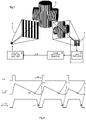
- Figure 1 schematically illustrates an exemplary structured light perception system including an embodiment of an adaptive projection rate control system.
- a scene including a three-dimensional object 10 is illuminated by a projector 12 and observed at an angle by an event-based camera EBC.
- the projector 12 is designed to project a sequence of patterns adapted to a 3D reconstruction of the object, such as a set of vertical line patterns, where the white lines, representing light, assume different positions across the multiple patterns of the set, such that the lines scan all of the surface area of the scene.
- the camera EBC includes a sensor array 14 on which the scene is focused and an event processing circuit 16, often called arbiter, designed to retrieve the events from the sensor array as they occur asynchronously.
- the retrieved events are output through an interface in a known format, usually conveying the type, the address (position in the array) and a time stamp.
- the event type is typically "positive” or “on” for a brightness increase, and “negative” or “off' for a brightness decrease.
- the system moreover includes a device 18 connected to receive event data from the camera EBC, and configured to detect the end of a burst of events caused by each flash. Each time an end-of-burst is detected, the device enables an end-of-burst signal EOB.
- EOB end-of-burst signal
- the EOB signal is enabled for a short amount of time, forming a pulse. Examples of criteria for an end-of-burst detection are disclosed subsequently.
- a control circuit 20 of the projector designed to set the projection rate of the sequence of patterns, may be modified to use the EOB signal as a clock, whereby a next projection is triggered each time the EOB signal exhibits a pulse.
- the projector 12 may be designed to conventionally project the sequence of patterns in a free-running mode, at a fixed frequency corresponding to the worst-case situation.
- the EOB pulses then override the free-running mode as they appear.
- Figure 2 illustrates time diagrams of two examples of an adaptive projection rate control process that can be implemented in the system of Figure 1 , especially the end-of-burst detection device 18.
- the top diagram illustrates a sequence of pulses corresponding to projections of patterns, or flashes, by the projector 12.
- Each flash except for the first is triggered by an end-of-burst condition EOB that may be determined by various methods, two of which are exemplified in the two lower diagrams.
- the camera EBC in particular its event processor 16, includes an event counter that is incremented asynchronously as events appear, and decremented as the events are retrieved and cleared.
- events may be "on” or "off' events.
- Each flash will in practice cause a burst of on-events followed, normally, by a burst of off-events.
- the on-events may be considered, so the events referred to hereinafter will in fact be on-events.
- the second diagram thus illustrates the evolution of the event counter, that will be evaluated to detect an end-of-burst criterion and trigger the next flash when that criterion is met.
- the counter is initially at zero. Just after the start of a flash, the event count rapidly increases to reach a peak value as the largest pixel latency time is reached, which may happen typically, as shown, before the flash ends.
- the event count gradually decreases as the events are retrieved and cleared by the event processor 16 ( Fig. 1 ).
- the end-of-burst criterion could be met as soon as the event count reaches zero again. In practice, however, spurious events are triggered due to noise, whereby the event count does not assume a stable zero value, or sometimes never even reaches zero. Therefore, preferably, the EOB criterion is assumed satisfied when the event count falls below a threshold ThC.
- the count threshold ThC may be several tens, for example.
- next flash may be triggered almost immediately, just after a short period of time required for retrieving the events remaining below the threshold ThC.
- a limit may be imposed on the shortest time between two flashes, for instance for ensuring eye-safety or for offering sufficient processing time to the 3D reconstruction system.
- the next flash may be delayed by a given time margin Tm after the EOB criterion is met, as shown.
- the EOB criterion may be evaluated using the count history and be considered as met when the current count is below the threshold ThC while one or several previous counts are above the threshold. Another alternative is to simply compare the current count with the threshold, and to enable the comparator output after a given delay following the flash triggering, to allow the count to exceed the threshold at the beginning of the burst.
- the diagrams illustrate an exemplary situation where the sizes of the event bursts decrease from one flash to the next, illustrating variations in the scene properties, such as when the object moves away from the camera. It is apparent that the time intervals between the flashes decrease correspondingly.
- events are evaluated by rows of the sensor array, i.e. as soon as a first event occurs in a row, the row issues a request for retrieval to an arbiter, and only one such request is issued no matter how many events occur later in the row before the arbiter processes the request.
- the counter may simply count the row requests instead of the actual events, and be decremented as the row requests are processed and cleared by the arbiter. The event count is then less accurate but remains commensurate with a burst size and the desired functionality is still achieved.
- the end-of-burst criterion is based on the evolution of the instantaneous event retrieval rate.
- the event processor 16 retrieves both on-and off-events, but, preferably, only the on-events are considered, because they occur earlier.
- the bottom diagram thus illustrates the evolution of the instantaneous event retrieval rate, that will be monitored to detect an end-of-burst criterion and trigger the next flash when that criterion is met.
- the retrieval rate is initially zero. From the beginning of the first flash, the retrieval rate increases as the events appear, and caps at a peak speed where events are retrieved using the system's full bandwidth. The peak speed is maintained as long as events remain to be retrieved, and drops abruptly when no events remain, i.e. when the burst of events caused by the flash has been fully retrieved.
- the raise and drop of the retrieval rate are shown as progressive, because, in practice, the event rate may be computed as a sliding average over several clock cycles to filter noise and spurious variations.
- the next flash may be delayed by a given time margin, as shown.
- the EOB criterion could be considered as met when the retrieval rate reaches zero. In practice, however, spurious events are triggered due to noise, whereby the retrieval rate does not assume a stable zero value, or sometimes never even reaches zero. Therefore, preferably, the EOB criterion is assumed satisfied when the retrieval rate falls below a threshold ThR of, for example, around 10% of the peak rate.
- the EOB criterion may be evaluated using the instantaneous rate history and be considered as met when the current rate value is below the threshold ThR while one or several previous rate values are above the threshold. Another alternative is to simply compare the current rate value with the threshold, and to enable the comparator output after a given delay following the flash triggering, to allow the rate value to exceed the threshold at the beginning of the burst.
- the event retrieval rate evolution shown follows an exemplary model where a same number of events are retrieved at each cycle of a system clock, typically one event per cycle for first generation event-based cameras.
- the pixels of each row may be grouped in "vectors", where one vector containing at least one event is retrieved at each cycle.
- a variable number of events is retrieved at each cycle, between one and the size of the vector.
- Another method for determining an end-of-burst condition may be based on the relative quiescence occurring after a burst. For this purpose, an absence of events may be monitored after each flash, and the EOB condition be assumed satisfied if no events have been generated over a number of successive clock cycles, for instance 3 to 10 cycles.
- the count may reach a peak before the end of the flash.
- the flash duration appears to be longer than necessary. It could be useful to end the flash earlier, which would reduce motion blurriness and further increase the average projection rate.
- the system may be configured to stop the flash as soon as a peak in the event count is detected.
- the retrieval of the events may be delayed until the count reaches a stationary condition, such as remaining at a same value for a few clock cycles.
- a stationary value would in principle be the peak count value.
- a similar functionality for adjusting the flash duration may be achieved by detecting that the event retrieval rate (last diagram of figure 2 ) caps out.
Landscapes
- Engineering & Computer Science (AREA)
- Physics & Mathematics (AREA)
- General Physics & Mathematics (AREA)
- Computer Vision & Pattern Recognition (AREA)
- Theoretical Computer Science (AREA)
- Multimedia (AREA)
- Artificial Intelligence (AREA)
- Optics & Photonics (AREA)
- Signal Processing (AREA)
- Studio Devices (AREA)
- Image Analysis (AREA)
Priority Applications (5)
| Application Number | Priority Date | Filing Date | Title |
|---|---|---|---|
| EP20209903.2A EP4006485B1 (fr) | 2020-11-25 | 2020-11-25 | Procédé d'adaptation automatique d'un taux de projection de motif dans un système de perception active |
| JP2021165424A JP2022083974A (ja) | 2020-11-25 | 2021-10-07 | アクティブ知覚システムにおいてパターン投影率を自動的に適応させるための方法 |
| KR1020210161327A KR20220072774A (ko) | 2020-11-25 | 2021-11-22 | 능동 인식 시스템에서 패턴 투사 속도를 자동으로 조정하는 방법 |
| CN202111410695.7A CN114543703A (zh) | 2020-11-25 | 2021-11-24 | 用于在主动感知系统中自动适配图案投影率的方法 |
| US17/534,884 US12462590B2 (en) | 2020-11-25 | 2021-11-24 | Method for automatically adapting a pattern projection rate in an active perception system |
Applications Claiming Priority (1)
| Application Number | Priority Date | Filing Date | Title |
|---|---|---|---|
| EP20209903.2A EP4006485B1 (fr) | 2020-11-25 | 2020-11-25 | Procédé d'adaptation automatique d'un taux de projection de motif dans un système de perception active |
Publications (3)
| Publication Number | Publication Date |
|---|---|
| EP4006485A1 true EP4006485A1 (fr) | 2022-06-01 |
| EP4006485B1 EP4006485B1 (fr) | 2025-09-24 |
| EP4006485C0 EP4006485C0 (fr) | 2025-09-24 |
Family
ID=73598006
Family Applications (1)
| Application Number | Title | Priority Date | Filing Date |
|---|---|---|---|
| EP20209903.2A Active EP4006485B1 (fr) | 2020-11-25 | 2020-11-25 | Procédé d'adaptation automatique d'un taux de projection de motif dans un système de perception active |
Country Status (5)
| Country | Link |
|---|---|
| US (1) | US12462590B2 (fr) |
| EP (1) | EP4006485B1 (fr) |
| JP (1) | JP2022083974A (fr) |
| KR (1) | KR20220072774A (fr) |
| CN (1) | CN114543703A (fr) |
Families Citing this family (4)
| Publication number | Priority date | Publication date | Assignee | Title |
|---|---|---|---|---|
| WO2022102302A1 (fr) * | 2020-11-10 | 2022-05-19 | ソニーセミコンダクタソリューションズ株式会社 | Système de mesure de forme |
| EP4006485B1 (fr) * | 2020-11-25 | 2025-09-24 | Prophesee | Procédé d'adaptation automatique d'un taux de projection de motif dans un système de perception active |
| CN119032035A (zh) | 2022-05-23 | 2024-11-26 | 株式会社电装 | 处理系统和信息呈现装置 |
| EP4600904A4 (fr) * | 2022-10-05 | 2026-01-21 | Sony Group Corp | Dispositif de traitement d'informations, système, procédé de traitement d'informations et programme |
Citations (3)
| Publication number | Priority date | Publication date | Assignee | Title |
|---|---|---|---|---|
| US20150285625A1 (en) * | 2014-04-07 | 2015-10-08 | Samsung Electronics Co., Ltd. | High resolution, high frame rate, low power image sensor |
| US20200058205A1 (en) * | 2018-08-14 | 2020-02-20 | Samsung Electronics Co., Ltd. | System and method for pulsed light pattern capturing using a dynamic vision sensor |
| WO2020169834A1 (fr) | 2019-02-22 | 2020-08-27 | Prophesee | Imagerie et détection tridimensionnelles à l'aide d'un capteur à vision dynamique et d'une projection de motif |
Family Cites Families (3)
| Publication number | Priority date | Publication date | Assignee | Title |
|---|---|---|---|---|
| JP2014032159A (ja) * | 2012-08-06 | 2014-02-20 | Canon Inc | 投影撮像システム及び投影撮像システムの制御方法 |
| EP3506622A1 (fr) * | 2017-12-26 | 2019-07-03 | Prophesee | Procédé pour produire un signal à partir d'un capteur basé sur des événements, et capteur utilisant un tel procédé |
| EP4006485B1 (fr) * | 2020-11-25 | 2025-09-24 | Prophesee | Procédé d'adaptation automatique d'un taux de projection de motif dans un système de perception active |
-
2020
- 2020-11-25 EP EP20209903.2A patent/EP4006485B1/fr active Active
-
2021
- 2021-10-07 JP JP2021165424A patent/JP2022083974A/ja active Pending
- 2021-11-22 KR KR1020210161327A patent/KR20220072774A/ko active Pending
- 2021-11-24 US US17/534,884 patent/US12462590B2/en active Active
- 2021-11-24 CN CN202111410695.7A patent/CN114543703A/zh active Pending
Patent Citations (3)
| Publication number | Priority date | Publication date | Assignee | Title |
|---|---|---|---|---|
| US20150285625A1 (en) * | 2014-04-07 | 2015-10-08 | Samsung Electronics Co., Ltd. | High resolution, high frame rate, low power image sensor |
| US20200058205A1 (en) * | 2018-08-14 | 2020-02-20 | Samsung Electronics Co., Ltd. | System and method for pulsed light pattern capturing using a dynamic vision sensor |
| WO2020169834A1 (fr) | 2019-02-22 | 2020-08-27 | Prophesee | Imagerie et détection tridimensionnelles à l'aide d'un capteur à vision dynamique et d'une projection de motif |
Also Published As
| Publication number | Publication date |
|---|---|
| JP2022083974A (ja) | 2022-06-06 |
| EP4006485B1 (fr) | 2025-09-24 |
| US12462590B2 (en) | 2025-11-04 |
| EP4006485C0 (fr) | 2025-09-24 |
| KR20220072774A (ko) | 2022-06-02 |
| CN114543703A (zh) | 2022-05-27 |
| US20220166944A1 (en) | 2022-05-26 |
Similar Documents
| Publication | Publication Date | Title |
|---|---|---|
| US12462590B2 (en) | Method for automatically adapting a pattern projection rate in an active perception system | |
| CN106412626B (zh) | 一种直播视频的处理方法及装置 | |
| EP3732875B1 (fr) | Procédé pour produire un signal à partir d'un capteur basé sur des événements, et capteur utilisant un tel procédé | |
| US4160998A (en) | Television-based alarm system | |
| US8284992B2 (en) | Monitoring system, monitoring method and program | |
| CN108923876A (zh) | 时间同步方法、装置及系统 | |
| GB2448425A (en) | Zoom-dependent exposure control for cameras | |
| GB2117539A (en) | Automatic focusing system for video cameras | |
| US10855915B2 (en) | Image pickup apparatus capable of consecutively displaying different types of image, control method, and storage medium | |
| CN213092100U (zh) | 一种曝光系统 | |
| US12229986B2 (en) | Information processing apparatus, information processing method, and storage medium for displaying am image indicating a pixel where a luminance change occurs based on a signal | |
| US20230125031A1 (en) | Event filtering method for operating an event-based image sensor | |
| CN109302567A (zh) | 摄像头图像低延迟同步系统及图像低延迟同步方法 | |
| CN112884805A (zh) | 一种跨尺度自适应映射的光场成像方法 | |
| US20200334481A1 (en) | Image processing apparatus, method for detecting event from image, and storage medium | |
| CN110636183B (zh) | 一种抗干扰方法、系统及存储介质 | |
| CN102377984A (zh) | 监视影像录制方法和监视系统以及计算机程序产品 | |
| JP2008079055A (ja) | 顔画像検出装置およびその制御方法 | |
| JP2012004643A (ja) | 録画装置、録画システム及び録画方法 | |
| JP4419640B2 (ja) | 監視カメラ及び監視システム | |
| CN105590299B (zh) | 一种噪点变化判断方法及装置 | |
| US20080218616A1 (en) | Method and apparatus for video acquisition | |
| US11792527B2 (en) | Sensor system, image processing apparatus, image processing method, and program | |
| EP0979002B1 (fr) | Méthode et appareil de détection de l'atténuation d'image dans un signal vidéo | |
| Ding et al. | Synchronization detection of multicamera system based on LED matrix |
Legal Events
| Date | Code | Title | Description |
|---|---|---|---|
| PUAI | Public reference made under article 153(3) epc to a published international application that has entered the european phase |
Free format text: ORIGINAL CODE: 0009012 |
|
| STAA | Information on the status of an ep patent application or granted ep patent |
Free format text: STATUS: THE APPLICATION HAS BEEN PUBLISHED |
|
| AK | Designated contracting states |
Kind code of ref document: A1 Designated state(s): AL AT BE BG CH CY CZ DE DK EE ES FI FR GB GR HR HU IE IS IT LI LT LU LV MC MK MT NL NO PL PT RO RS SE SI SK SM TR |
|
| STAA | Information on the status of an ep patent application or granted ep patent |
Free format text: STATUS: REQUEST FOR EXAMINATION WAS MADE |
|
| 17P | Request for examination filed |
Effective date: 20221121 |
|
| RBV | Designated contracting states (corrected) |
Designated state(s): AL AT BE BG CH CY CZ DE DK EE ES FI FR GB GR HR HU IE IS IT LI LT LU LV MC MK MT NL NO PL PT RO RS SE SI SK SM TR |
|
| P01 | Opt-out of the competence of the unified patent court (upc) registered |
Effective date: 20230530 |
|
| STAA | Information on the status of an ep patent application or granted ep patent |
Free format text: STATUS: EXAMINATION IS IN PROGRESS |
|
| 17Q | First examination report despatched |
Effective date: 20240318 |
|
| GRAP | Despatch of communication of intention to grant a patent |
Free format text: ORIGINAL CODE: EPIDOSNIGR1 |
|
| STAA | Information on the status of an ep patent application or granted ep patent |
Free format text: STATUS: GRANT OF PATENT IS INTENDED |
|
| RIC1 | Information provided on ipc code assigned before grant |
Ipc: G03B 21/00 20060101ALI20250327BHEP Ipc: H04N 9/31 20060101ALI20250327BHEP Ipc: G06T 7/579 20170101ALI20250327BHEP Ipc: G06T 7/521 20170101ALI20250327BHEP Ipc: G01B 11/25 20060101AFI20250327BHEP |
|
| INTG | Intention to grant announced |
Effective date: 20250428 |
|
| GRAS | Grant fee paid |
Free format text: ORIGINAL CODE: EPIDOSNIGR3 |
|
| GRAA | (expected) grant |
Free format text: ORIGINAL CODE: 0009210 |
|
| STAA | Information on the status of an ep patent application or granted ep patent |
Free format text: STATUS: THE PATENT HAS BEEN GRANTED |
|
| AK | Designated contracting states |
Kind code of ref document: B1 Designated state(s): AL AT BE BG CH CY CZ DE DK EE ES FI FR GB GR HR HU IE IS IT LI LT LU LV MC MK MT NL NO PL PT RO RS SE SI SK SM TR |
|
| REG | Reference to a national code |
Ref country code: GB Ref legal event code: FG4D |
|
| REG | Reference to a national code |
Ref country code: CH Ref legal event code: EP |
|
| REG | Reference to a national code |
Ref country code: DE Ref legal event code: R096 Ref document number: 602020059253 Country of ref document: DE |
|
| REG | Reference to a national code |
Ref country code: IE Ref legal event code: FG4D |
|
| U01 | Request for unitary effect filed |
Effective date: 20251008 |
|
| U07 | Unitary effect registered |
Designated state(s): AT BE BG DE DK EE FI FR IT LT LU LV MT NL PT RO SE SI Effective date: 20251016 |
|
| U20 | Renewal fee for the european patent with unitary effect paid |
Year of fee payment: 6 Effective date: 20251117 |
|
| PG25 | Lapsed in a contracting state [announced via postgrant information from national office to epo] |
Ref country code: NO Free format text: LAPSE BECAUSE OF FAILURE TO SUBMIT A TRANSLATION OF THE DESCRIPTION OR TO PAY THE FEE WITHIN THE PRESCRIBED TIME-LIMIT Effective date: 20251224 |
|
| PG25 | Lapsed in a contracting state [announced via postgrant information from national office to epo] |
Ref country code: HR Free format text: LAPSE BECAUSE OF FAILURE TO SUBMIT A TRANSLATION OF THE DESCRIPTION OR TO PAY THE FEE WITHIN THE PRESCRIBED TIME-LIMIT Effective date: 20250924 |
|
| PG25 | Lapsed in a contracting state [announced via postgrant information from national office to epo] |
Ref country code: GR Free format text: LAPSE BECAUSE OF FAILURE TO SUBMIT A TRANSLATION OF THE DESCRIPTION OR TO PAY THE FEE WITHIN THE PRESCRIBED TIME-LIMIT Effective date: 20251225 |
|
| PG25 | Lapsed in a contracting state [announced via postgrant information from national office to epo] |
Ref country code: RS Free format text: LAPSE BECAUSE OF FAILURE TO SUBMIT A TRANSLATION OF THE DESCRIPTION OR TO PAY THE FEE WITHIN THE PRESCRIBED TIME-LIMIT Effective date: 20251224 |
|
| PG25 | Lapsed in a contracting state [announced via postgrant information from national office to epo] |
Ref country code: SM Free format text: LAPSE BECAUSE OF FAILURE TO SUBMIT A TRANSLATION OF THE DESCRIPTION OR TO PAY THE FEE WITHIN THE PRESCRIBED TIME-LIMIT Effective date: 20250924 |
|
| PG25 | Lapsed in a contracting state [announced via postgrant information from national office to epo] |
Ref country code: ES Free format text: LAPSE BECAUSE OF FAILURE TO SUBMIT A TRANSLATION OF THE DESCRIPTION OR TO PAY THE FEE WITHIN THE PRESCRIBED TIME-LIMIT Effective date: 20250924 |
|
| PG25 | Lapsed in a contracting state [announced via postgrant information from national office to epo] |
Ref country code: IS Free format text: LAPSE BECAUSE OF FAILURE TO SUBMIT A TRANSLATION OF THE DESCRIPTION OR TO PAY THE FEE WITHIN THE PRESCRIBED TIME-LIMIT Effective date: 20260124 |
|
| PG25 | Lapsed in a contracting state [announced via postgrant information from national office to epo] |
Ref country code: CZ Free format text: LAPSE BECAUSE OF FAILURE TO SUBMIT A TRANSLATION OF THE DESCRIPTION OR TO PAY THE FEE WITHIN THE PRESCRIBED TIME-LIMIT Effective date: 20250924 |
|
| PG25 | Lapsed in a contracting state [announced via postgrant information from national office to epo] |
Ref country code: PL Free format text: LAPSE BECAUSE OF FAILURE TO SUBMIT A TRANSLATION OF THE DESCRIPTION OR TO PAY THE FEE WITHIN THE PRESCRIBED TIME-LIMIT Effective date: 20250924 |
|
| PG25 | Lapsed in a contracting state [announced via postgrant information from national office to epo] |
Ref country code: SK Free format text: LAPSE BECAUSE OF FAILURE TO SUBMIT A TRANSLATION OF THE DESCRIPTION OR TO PAY THE FEE WITHIN THE PRESCRIBED TIME-LIMIT Effective date: 20250924 |