EP4006656A1 - Commande d'un système d'alimentation en eau - Google Patents
Commande d'un système d'alimentation en eau Download PDFInfo
- Publication number
- EP4006656A1 EP4006656A1 EP20210299.2A EP20210299A EP4006656A1 EP 4006656 A1 EP4006656 A1 EP 4006656A1 EP 20210299 A EP20210299 A EP 20210299A EP 4006656 A1 EP4006656 A1 EP 4006656A1
- Authority
- EP
- European Patent Office
- Prior art keywords
- pumping
- computer
- water supply
- supply system
- pressure
- Prior art date
- Legal status (The legal status is an assumption and is not a legal conclusion. Google has not performed a legal analysis and makes no representation as to the accuracy of the status listed.)
- Withdrawn
Links
Images

Classifications
-
- F—MECHANICAL ENGINEERING; LIGHTING; HEATING; WEAPONS; BLASTING
- F17—STORING OR DISTRIBUTING GASES OR LIQUIDS
- F17D—PIPE-LINE SYSTEMS; PIPE-LINES
- F17D3/00—Arrangements for supervising or controlling working operations
- F17D3/01—Arrangements for supervising or controlling working operations for controlling, signalling, or supervising the conveyance of a product
-
- E—FIXED CONSTRUCTIONS
- E03—WATER SUPPLY; SEWERAGE
- E03B—INSTALLATIONS OR METHODS FOR OBTAINING, COLLECTING, OR DISTRIBUTING WATER
- E03B5/00—Use of pumping plants or installations; Layouts thereof
-
- E—FIXED CONSTRUCTIONS
- E03—WATER SUPPLY; SEWERAGE
- E03B—INSTALLATIONS OR METHODS FOR OBTAINING, COLLECTING, OR DISTRIBUTING WATER
- E03B7/00—Water main or service pipe systems
- E03B7/02—Public or like main pipe systems
-
- E—FIXED CONSTRUCTIONS
- E03—WATER SUPPLY; SEWERAGE
- E03B—INSTALLATIONS OR METHODS FOR OBTAINING, COLLECTING, OR DISTRIBUTING WATER
- E03B7/00—Water main or service pipe systems
- E03B7/07—Arrangement of devices, e.g. filters, flow controls, measuring devices, siphons or valves, in the pipe systems
- E03B7/075—Arrangement of devices for control of pressure or flow rate
-
- G—PHYSICS
- G05—CONTROLLING; REGULATING
- G05B—CONTROL OR REGULATING SYSTEMS IN GENERAL; FUNCTIONAL ELEMENTS OF SUCH SYSTEMS; MONITORING OR TESTING ARRANGEMENTS FOR SUCH SYSTEMS OR ELEMENTS
- G05B13/00—Adaptive control systems, i.e. systems automatically adjusting themselves to have a performance which is optimum according to some preassigned criterion
- G05B13/02—Adaptive control systems, i.e. systems automatically adjusting themselves to have a performance which is optimum according to some preassigned criterion electric
- G05B13/04—Adaptive control systems, i.e. systems automatically adjusting themselves to have a performance which is optimum according to some preassigned criterion electric involving the use of models or simulators
- G05B13/042—Adaptive control systems, i.e. systems automatically adjusting themselves to have a performance which is optimum according to some preassigned criterion electric involving the use of models or simulators in which a parameter or coefficient is automatically adjusted to optimise the performance
-
- F—MECHANICAL ENGINEERING; LIGHTING; HEATING; WEAPONS; BLASTING
- F04—POSITIVE - DISPLACEMENT MACHINES FOR LIQUIDS; PUMPS FOR LIQUIDS OR ELASTIC FLUIDS
- F04D—NON-POSITIVE-DISPLACEMENT PUMPS
- F04D15/00—Control, e.g. regulation, of pumps, pumping installations or systems
Definitions
- the invention relates to a computer-implemented method and a device for controlling a pressure and flow distribution of a water supply system and a computer program product for carrying out the method.
- a central entity usually specifies which pumping station of the water supply system should build up which pressure on the outlet side in order to achieve the desired flow distribution in the water supply system.
- the requirements for the tanks with regard to the permissible water levels, for the overall system with regard to the permissible pressure distributions, for the pumping stations with regard to the permissible energy consumption and/or the forecast water consumption by the consumers must be served. Changes in the water levels in tanks in turn influence the pressure and/or flow behavior of the overall system.
- a decision must be made as to which pumps should actually be operated and at what speed in order to build up the required outlet pressure.
- a water supply system is operated manually or rule-based. However, this can be resource intensive.
- “computer-aided” or “computer-aided” can be understood, for example, as an implementation of the method in which, in particular, a processor executes at least one method step of the method.
- the terms “perform”, “calculate”, “computer-aided”, “calculate”, “determine”, “generate”, “configure”, “reconstruct” and the like preferably refer to Actions and/or processes and/or processing steps that change and/or generate data and/or convert the data into other data, with the data being represented in particular as physical quantities or may be present, for example as electrical impulses.
- the term “computer” should be interpreted as broadly as possible, in particular to cover all electronic devices with data processing properties. Computers can thus be, for example, personal computers, servers, programmable logic controllers (PLCs), handheld computer systems, pocket PC devices, mobile radio devices and other communication devices that can process computer-aided data, processors and other electronic devices for data processing.
- PLCs programmable logic controllers
- a “module” can be understood to mean, for example, a processor and/or a memory unit for storing program instructions.
- the processor is specially set up to execute the program instructions in such a way that the processor executes functions in order to implement or realize the method according to the invention or a step of the method according to the invention.
- a “water supply system” can be understood in particular as a water supply network or a pipeline.
- the water supply system comprises a multiplicity of pumping stations, which in turn comprise a multiplicity of pumps/pump devices, and a multiplicity of tanks or containers.
- the values of the flows and pressures in the water supply system change, in particular as a result of withdrawals by consumers and by filling the tanks, although limit levels should be observed.
- a "hydraulic model” can be understood in particular as a computer-aided model that depicts a time-dependent pressure and flow distribution of the water supply system depending on the operation of the system.
- the operating behavior of the pumping stations and tank systems, the withdrawals from the system (by consumers) and/or the feeds from reservoirs can be mapped using the hydraulic model.
- the hydraulic model includes models for all relevant components of the water supply system, such as pipes, tanks, consumers, reservoirs, valves, pumping stations.
- the hydraulic model preferably includes simple surrogate models to model respective pumping stations and to accelerate optimization of the pressure and flow distribution of the water supply system.
- a replacement model can be a regression model, for example. The pumping stations and their pumping efficiency/behaviour are therefore not modeled in detail.
- “resource-optimized pressure and flow target values” can be understood in particular as pressure and flow values for a pumping station, for compliance with which the pumping station is operated energy-efficiently/with minimal energy and/or cost-efficiently/cost-effectively.
- an "optimization method” can be understood in particular as a computer-aided optimization method.
- known optimization methods can be used.
- a “pump model” can in particular be a pump curve or pump characteristic curve that describes the operating behavior of a pump device.
- the pump model describes in particular the characteristics of a pump with regard to hydraulics and efficiency.
- a pump characteristic represents, for example, the relationship between a delivery head and a delivery flow.
- An "operating parameter" for a pumping device can be understood, for example, as an operating state, such as "on"/"off” (switched on/off), and/or a speed at which the pumping device is operated.
- optimized pressure and flow values for individual pumping stations of the water supply system This first optimization preferably takes place for a predetermined forecast period.
- a second optimization method is used to determine resource-optimized operation of the individual pumping devices of the respective pumping stations as a function of the previously determined optimized pressure and flow values of the respective pumping station.
- This second optimization preferably takes place at a current point in time. In particular, in the second optimization it can first be determined which pumping devices of a pumping station are to be operated.
- the optimization problem is thus solved on two levels.
- the pumping stations of the water supply system can be modeled in less detail/roughly during the first optimization step, e.g. by means of substitute models. A detailed modeling takes place in the second optimization step.
- Operating parameters for the operation of the pumping devices of a pumping station at the current time can thus be determined on the basis of a prognosis for the operation of the water supply system.
- the resource-optimized pressure and/or flow target values of the pumping station can be used as boundary conditions for the second optimization method.
- Consistency between the two optimization levels can be achieved by transferring the flow and pressure setpoints from the upper to the lower level.
- the operating parameters for the pumping devices can be determined in such a way that the resource-optimized pressure and flow target values of the pumping station are met at the specified point in time.
- the result from the first optimization can thus be used to optimize the operating behavior of the pumping devices of the respective pumping stations in detail.
- individual pumping devices of the pumping station can be selected as a function of the determined pressure and flow target value of this pumping station and resource-optimized operating parameters can only be determined for the selected pumping devices.
- method steps (c) to (e) can be carried out for each pumping station of the water supply system.
- the second optimization is preferably carried out for each pump station, so that resource-optimized operating parameters for pump devices of each pump station are determined.
- method steps (b) to (d) can be iterated after a predetermined time step.
- a current prognosis from the first optimization step is thus used for the second optimization step at a current or predetermined point in time.
- pumping stations of the water supply system can be mapped in the computer-aided hydraulic model of the water supply system using substitute models.
- an operating behavior e.g. pumping efficiency
- the pumping stations are therefore preferably not modeled in detail at the upper optimization level, but are represented by less complex models.
- the pump model can include pump characteristics of the pump devices.
- an efficiency value of the pumping station can be determined using a second optimization method.
- the computer-assisted hydraulic model can be updated based on the efficiency value of the pumping station and used to determine the resource-optimized pressure and flow target values for the pumping stations of the water supply system.
- the hydraulic model can be updated depending on the results of the second optimization method.
- a regression model of a respective pumping station can be updated in this way. Consistency between the two optimization levels can also be achieved in this way.
- the pumping devices of the pumping station can be controlled using the resource-optimized operating parameters.
- the invention relates to a computer program product which can be loaded directly into a programmable computer, comprising program code parts which, when the program is executed by a computer, cause the latter to carry out the steps of a method according to the invention.
- a computer program product can, for example, be provided on a storage medium such as a memory card, USB stick, CD-ROM, DVD, a non-transitory storage medium or in the form of a downloadable file from a server in a network or be delivered.
- a storage medium such as a memory card, USB stick, CD-ROM, DVD, a non-transitory storage medium or in the form of a downloadable file from a server in a network or be delivered.
- figure 1 shows an embodiment of the method according to the invention for controlling a pressure and flow distribution of a water supply system as a flow chart.
- the water supply system includes a plurality of pumping stations, each containing a plurality of pumps/pumping devices, and reservoirs to regulate pressure and flow throughout the system so that the pressure and flow at the consumer meets setpoints.
- a computer-assisted hydraulic model of the water supply system is read.
- the computer-assisted hydraulic model depicts a time-dependent pressure and flow distribution of the water supply system.
- the hydraulic model preferably includes replacement models, also referred to as efficiency models, of the respective pumping stations of the water supply system. The operating behavior of the pumping stations can be mapped with these substitute models.
- a replacement model can be a regression model, for example.
- step S2 of the method resource-optimized pressure and flow target values for the pumping stations of the water supply system are determined for a predetermined forecast period using the hydraulic model and a first optimization method.
- a longer period of time is therefore considered here, for example in order to correctly depict the use of the containers.
- the containers represent a storage capacity that allows the provision of water and its consumption by consumers to be decoupled in terms of time. This is the only way to absorb consumption peaks. With variable energy prices, pumping can also be shifted to more cost-effective time windows.
- the flow and pressure distribution for the water supply system is optimized using the hydraulic model for a predetermined period of time, preferably starting from a current point in time.
- the determined time-resolved pressure and flow target values for the pumping stations of the water supply system are output.
- At least one pump model for at least one pumping station is read.
- a corresponding pump model is preferably read in for each pump station of the water supply system.
- a respective pump model is set up to depict an operating behavior of pump devices/pumps of the pump station.
- a pump model can include, for example, a pump characteristic or pump curve for a pump device.
- resource-optimized operating parameters for the pumping devices of the pumping station are determined for a specified point in time using the pump model using a second optimization method depending on the pressure and flow setpoint of this pumping station for the specified point in time.
- the second optimization method can, for example, also be the same as the first optimization method.
- the resource-optimized operating parameters are preferably determined at a current point in time.
- the resource-optimized pressure and/or flow target values of the pumping station under consideration are preferably used as a boundary condition for the second optimization method.
- the calculation results from the first optimization step S2 can thus be used for the detailed optimization of the operating behavior of the individual pumps in a pumping station.
- the operating parameters for the pumping devices are determined in such a way that the previously determined, resource-optimized pressure and flow target values of the respective pumping station are met at the specified point in time.
- step S5 the resource-optimized operating parameters for controlling the pumping devices of the respective pumping station, and thus for controlling the water supply system, are output.
- the steps S3 to S5 of the method are preferably carried out for each pumping station of the water supply system.
- it can be determined here in each case which of the pumping devices of the respective pumping station is to be activated.
- individual pumping devices of a pumping station can be selected as a function of the determined pressure and flow target value of this pumping station and resource-optimized operating parameters can only be determined for the selected pumping devices.
- hydraulic model or the substitute models/efficiency models can be updated using the optimization results from steps S3 to S5 in order to adapt them to a adapt dynamic behavior of the water supply system.
- the method steps S2 to S5 can be repeated in particular for a subsequent forecast period after a specified time step.
- the pumping devices of the pumping stations can be controlled according to the determined resource-optimized operating parameters. Updated operating parameters can accordingly be output when method steps S2 to S5 are iterated again.
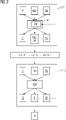
- figure 2 shows a further exemplary embodiment of the method according to the invention for controlling a pressure and flow distribution of a water supply system in a block diagram.
- the process includes two levels of optimization.
- the optimization method OPT1 is applied to a computer-aided hydraulic model HM, which depicts a flow and pressure distribution in the water supply system.
- time- and location-resolved forecast values P of withdrawals/consumers are transferred to the hydraulic model HM.
- time-resolved flow values and outlet pressures FDin of the pumping stations of the water supply system and current status data SD of containers and at the start of the forecast, such as levels of reservoirs are transferred to the hydraulic model HM.
- the hydraulic model HM includes at least one regression model RM of a pumping station of the water supply system, the regression model RM describing the efficiency of the pumping station.
- the hydraulic model HM With the hydraulic model HM, time-resolved flows F(t) and pressures D(t) in the water supply system, the energy requirement E1 for the regulation of the flows and pressures and tank levels FS can be determined for a given forecast period.
- the hydraulic model HM includes the dynamic behavior of the water supply system over the forecast period.
- resource-optimized pressure and flow setpoints ((D1, F1, ..., (Di, Fi), ..., (Dn, Fn)) for the respective pumping stations of the water supply system for the specified
- the flows and outlet pressures of the pumping stations i.e. the optimization variables
- the flows and outlet pressures of the pumping stations are determined in the forecast period in such a way that the flows and pressures in the water supply system comply with restrictions at all times (boundary conditions of the optimization) and tank levels remain within specified limits, and the energy demand and/or or the costs are optimal
- the energy requirement and/or the costs are therefore the objective function of this optimization.
- the pressure and flow setpoints ((D1, F1, ..., (Di, Fi), ..., (Dn, Fn)) determined in this way for the respective pumping stations of the water supply system are provided for the second optimization.
- the second optimization step is preferably carried out for each pump station.Preferably, the second optimization step is carried out for a current point in time and/or the point in time for which a specific control decision regarding the operation of the pumps is pending.
- the pressure setpoint Di which was determined in the previous optimization step for this pumping station, is transferred to the pump model PM as the outlet pressure for the point in time under consideration.
- the pump model PM transmits an input pressure Din of the pumps of the pumping station and information about the operating status OS of the pumps.
- a flow, energy requirement E2 and an efficiency value Eff of the pumping station can be determined using the pump model.
- an operating state of the pumps (optimization variable) can be determined in such a way that a flow value achieves at least the flow setpoint Fi of the pumping station from the first optimization step for the point in time under consideration and the energy requirement of this pumping station is optimal.
- the flux setpoint Fi from the first optimization step is a boundary condition for the second optimization OPT2.
- Operating parameters Ri for the respective pumping station can be derived from the operating state determined in this way and made available for the control of the pumping station.
- the determined efficiency value Eff can be used to update the regression model RM for the corresponding pump station in order to adapt it to the dynamic operating behavior of the water supply system.
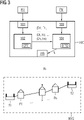
- FIG 3 shows an embodiment of the device 100 according to the invention for controlling a pressure and flow distribution of a water supply system WVS, such as a pipeline.
- the water supply system includes a large number of pumping stations PS1, ..., PSi, ..., PSn and several tanks T1, T2.
- the device 100 is set up in particular in such a way that the steps of a method according to the invention, as exemplified with reference to FIG figures 1 and 2 explained to carry out.
- the device and/or its modules can be designed in particular in terms of software and/or hardware.
- the device 100 includes a first interface 101 which is set up to read in a computer-aided hydraulic model HM of the water supply system WVS, the computer-aided hydraulic model HM being set up to map a time-dependent pressure and flow distribution of the water supply system.
- the device 100 further comprises a first optimization module 102, which is set up in such a way that resource-optimized pressure and flow target values (D1, F1),..., (Di,Fi),..., (Dn,Fn) for the pumping stations P1, ..., Pn of the water supply system for a predetermined forecast period based on the computer-assisted hydraulic model HM using a first optimization method OPT1.
- a first optimization module 102 which is set up in such a way that resource-optimized pressure and flow target values (D1, F1),..., (Di,Fi),..., (Dn,Fn) for the pumping stations P1, ..., Pn of the water supply system for a predetermined forecast period based on the computer-assisted hydraulic model HM using a first optimization method OPT1.
- the device 100 further comprises a second interface 103 which is set up in such a way to read in a pump model PM, such as a pump characteristic curve, for each pumping station P1,...,Pn.
- the respective pump model PM is set up to map an operating behavior of pump devices of the respective pump station, i.e. a different pump model can be read in particular for each pump station.
- the device 100 further comprises a second optimization module 104, which is set up in such a way that resource-optimized operating parameters Ri for the pumping devices of each pumping station based on the pump model PM at a specified point in time by means of a second optimization method OPT2 as a function of the pressure and flow setpoint of this pumping station for the specified point in time, to investigate.
- a second optimization method OPT2 as a function of the pressure and flow setpoint of this pumping station for the specified point in time
- the resource-optimized operating parameters Ri for the pumping station Pi are output by an output module 105 of the device 100 for controlling the pumping devices of the pumping station.
- the resource-optimized operating parameters can be transmitted to a control unit of the water supply system in order to control the pumps accordingly.
Landscapes
- Engineering & Computer Science (AREA)
- Health & Medical Sciences (AREA)
- Life Sciences & Earth Sciences (AREA)
- Hydrology & Water Resources (AREA)
- Public Health (AREA)
- Water Supply & Treatment (AREA)
- Physics & Mathematics (AREA)
- Mechanical Engineering (AREA)
- General Engineering & Computer Science (AREA)
- Evolutionary Computation (AREA)
- Medical Informatics (AREA)
- Software Systems (AREA)
- Computer Vision & Pattern Recognition (AREA)
- General Physics & Mathematics (AREA)
- Automation & Control Theory (AREA)
- Fluid Mechanics (AREA)
- Artificial Intelligence (AREA)
- Control Of Non-Positive-Displacement Pumps (AREA)
- Control Of Water Turbines (AREA)
- Control Of Positive-Displacement Pumps (AREA)
Priority Applications (7)
| Application Number | Priority Date | Filing Date | Title |
|---|---|---|---|
| EP20210299.2A EP4006656A1 (fr) | 2020-11-27 | 2020-11-27 | Commande d'un système d'alimentation en eau |
| EP21805898.0A EP4204632B1 (fr) | 2020-11-27 | 2021-11-02 | Commande d'un système d'alimentation en eau |
| PCT/EP2021/080354 WO2022111950A1 (fr) | 2020-11-27 | 2021-11-02 | Commande d'un système d'alimentation en eau |
| CN202180079422.0A CN116583647A (zh) | 2020-11-27 | 2021-11-02 | 供水系统的控制 |
| ES21805898T ES2990022T3 (es) | 2020-11-27 | 2021-11-02 | Control de un sistema de suministro de agua |
| US18/037,415 US12595886B2 (en) | 2020-11-27 | 2021-11-02 | Control of a water supply system using pumping stations with resource optimized pressure and flow target values |
| SA523440816A SA523440816B1 (ar) | 2020-11-27 | 2023-05-18 | التحكم في نظام للإمداد بالمياه |
Applications Claiming Priority (1)
| Application Number | Priority Date | Filing Date | Title |
|---|---|---|---|
| EP20210299.2A EP4006656A1 (fr) | 2020-11-27 | 2020-11-27 | Commande d'un système d'alimentation en eau |
Publications (1)
| Publication Number | Publication Date |
|---|---|
| EP4006656A1 true EP4006656A1 (fr) | 2022-06-01 |
Family
ID=73642659
Family Applications (2)
| Application Number | Title | Priority Date | Filing Date |
|---|---|---|---|
| EP20210299.2A Withdrawn EP4006656A1 (fr) | 2020-11-27 | 2020-11-27 | Commande d'un système d'alimentation en eau |
| EP21805898.0A Active EP4204632B1 (fr) | 2020-11-27 | 2021-11-02 | Commande d'un système d'alimentation en eau |
Family Applications After (1)
| Application Number | Title | Priority Date | Filing Date |
|---|---|---|---|
| EP21805898.0A Active EP4204632B1 (fr) | 2020-11-27 | 2021-11-02 | Commande d'un système d'alimentation en eau |
Country Status (6)
| Country | Link |
|---|---|
| US (1) | US12595886B2 (fr) |
| EP (2) | EP4006656A1 (fr) |
| CN (1) | CN116583647A (fr) |
| ES (1) | ES2990022T3 (fr) |
| SA (1) | SA523440816B1 (fr) |
| WO (1) | WO2022111950A1 (fr) |
Citations (1)
| Publication number | Priority date | Publication date | Assignee | Title |
|---|---|---|---|---|
| US20170299123A1 (en) * | 2016-04-19 | 2017-10-19 | Siemens Aktiengesellschaft | Pump station and pipeline optimization |
Family Cites Families (6)
| Publication number | Priority date | Publication date | Assignee | Title |
|---|---|---|---|---|
| US8265911B1 (en) * | 2008-08-29 | 2012-09-11 | Bentley Systems, Incorporated | System and method for modeling and simulating water distribution and collection systems including variable speed pumps |
| DE102010005955B4 (de) * | 2010-01-27 | 2020-03-05 | Abb Schweiz Ag | Anordnung und Verfahren zur Optimierung der Arbeitsweise eines Versorgungsnetzes |
| US20140052421A1 (en) * | 2010-09-14 | 2014-02-20 | Massachusetts Institute Of Technology | System and method for water distribution modelling |
| KR101674260B1 (ko) * | 2014-10-14 | 2016-11-08 | 엘에스산전 주식회사 | 상수관망 수운영 시스템 및 운영방법 |
| EP3643922A1 (fr) * | 2018-10-25 | 2020-04-29 | ABB Schweiz AG | Optimisation d'économie d'énergie pour une installation de pompage |
| WO2022039963A1 (fr) * | 2020-08-21 | 2022-02-24 | The Board Of Trustees Of The Leland Stanford Junior University | Systèmes et procédés d'optimisation de la gestion d'un système d'eau par calcul des attributs marginaux d'eau distribuée à des emplacements et à des temps spécifiques |
-
2020
- 2020-11-27 EP EP20210299.2A patent/EP4006656A1/fr not_active Withdrawn
-
2021
- 2021-11-02 US US18/037,415 patent/US12595886B2/en active Active
- 2021-11-02 WO PCT/EP2021/080354 patent/WO2022111950A1/fr not_active Ceased
- 2021-11-02 ES ES21805898T patent/ES2990022T3/es active Active
- 2021-11-02 CN CN202180079422.0A patent/CN116583647A/zh active Pending
- 2021-11-02 EP EP21805898.0A patent/EP4204632B1/fr active Active
-
2023
- 2023-05-18 SA SA523440816A patent/SA523440816B1/ar unknown
Patent Citations (1)
| Publication number | Priority date | Publication date | Assignee | Title |
|---|---|---|---|---|
| US20170299123A1 (en) * | 2016-04-19 | 2017-10-19 | Siemens Aktiengesellschaft | Pump station and pipeline optimization |
Non-Patent Citations (3)
| Title |
|---|
| COULBECK B ET AL: "A HIERARCHICAL APPROACH TO OPTIMIZED CONTROL OF WATER DISTRIBUTION SYSTEMS: PART I DECOMPOSITION KEY WORDS Decomposition Multi-level control structures Optimal control of large-scale systems Water distribution systems Computer applications", OPTIMAL CONTROL APPLICATIONS & METHODS, vol. 9, 1 January 1988 (1988-01-01), pages 51 - 61, XP055801177 * |
| COULBECK B ET AL: "A HIERARCHICAL APPROACH TO OPTIMIZED CONTROL OF WATER DISTRIBUTION SYSTEMS: PART II. LOWER-LEVEL ALGORITHM", OPTIMAL CONTROL APPLICATIONS & METHODS, vol. 9, 1 January 1988 (1988-01-01), pages 109 - 126, XP055801186, DOI: 10.1002/oca.4660090202 * |
| JENS BURGSCHWEIGER ET AL: "Optimization models for operative planning in drinking water networks", OPTIMIZATION AND ENGINEERING ; INTERNATIONAL MULTIDISCIPLINARY JOURNAL TO PROMOTE OPTIMIZATIONAL THEORY & APPLICATIONS IN ENGIN, KLUWER ACADEMIC PUBLISHERS, BO, vol. 10, no. 1, 14 February 2008 (2008-02-14), pages 43 - 73, XP019685910, ISSN: 1573-2924 * |
Also Published As
| Publication number | Publication date |
|---|---|
| US12595886B2 (en) | 2026-04-07 |
| CN116583647A (zh) | 2023-08-11 |
| EP4204632A1 (fr) | 2023-07-05 |
| EP4204632B1 (fr) | 2024-07-17 |
| EP4204632C0 (fr) | 2024-07-17 |
| ES2990022T3 (es) | 2024-11-28 |
| US20230417371A1 (en) | 2023-12-28 |
| SA523440816B1 (ar) | 2025-04-27 |
| WO2022111950A1 (fr) | 2022-06-02 |
Similar Documents
| Publication | Publication Date | Title |
|---|---|---|
| EP2192457B1 (fr) | Elément d'automatisation pour une installation d'automatisation industrielle et procédé d'activation d'un état de fonctionnement | |
| EP3408714B1 (fr) | Module pour installation technique et procédé pour commander une installation technique | |
| DE102010005955B4 (de) | Anordnung und Verfahren zur Optimierung der Arbeitsweise eines Versorgungsnetzes | |
| EP3523703B1 (fr) | Procédé de mise à jour logicielle sur les passerelles dans les cloud, programme informatique avec mise en oeuvre du procédé et unité de traitement pour réaliser le procédé | |
| EP3353609B1 (fr) | Module pour une installation technique, système et procédé pour mettre en ouvre un processus technique | |
| DE102011115809A1 (de) | Verfahren zur Konfigurierung einer Steuereinrichtung | |
| EP3384352B1 (fr) | Procédé et système d'optimisation de la mise en service d'au moins un appareil de champ d'une pluralité d'appareils de champ de la technique d'automatisation | |
| EP3246773B1 (fr) | Procede de paramétrage d'une installation technique de processus ou de procede | |
| EP3429050A1 (fr) | Procédé de réglage de la puissance active d'un parc éolien et parc éolien correspondant | |
| EP3384353B1 (fr) | Procédé et système d'optimisation de la commande d'au moins un appareil de champ d'une pluralité d'appareils de champ du secteur de la robotique | |
| EP4204632B1 (fr) | Commande d'un système d'alimentation en eau | |
| EP3082001B1 (fr) | Procédé d'extension d'un dispositif d'automatisation avec un virtuel appareil d'automatisation et dispositif d'automatisation | |
| EP3051373A1 (fr) | Changement d'un composant d'installation défectueux dans une installation d'automatisation | |
| EP3056955A1 (fr) | Procédé de planification et d'ingénierie, outil et système de logiciel pour une installation technique de processus | |
| DE102019129969A1 (de) | System zur Ressourcenverwaltung in einer Anlage der Automatisierungstechnik | |
| WO2015172814A1 (fr) | Procédé et outil d'ingénierie pour l'automatisation d'une installation industrielle | |
| EP3000004B1 (fr) | Dispositif et procédé pour faire fonctionner un système technique et procédé de fabrication d'un système technique | |
| DE102018123436A1 (de) | Verfahren zum Überwachen einer Anlage der Automatisierungstechnik | |
| DE10394242T5 (de) | Verfahren und Instrument zur Zuweisung von Rechenressourcen in einem verteilten Steuersystem | |
| WO2020212100A1 (fr) | Procédé, dispositifs et système d'usinage d'une pièce | |
| DE102013216069A1 (de) | Verfahren zum energieeffizienten Betrieb von Automatisierungsgeräten eines industriellen Automatisierungssystems und Simulationssystem | |
| EP3696621A1 (fr) | Procédé et appareil mis en uvre par ordinateur permettant de commander un système technique modulaire | |
| EP2811349A1 (fr) | Procédé destiné au fonctionnement d'un système d'automatisation | |
| DE102018131119A1 (de) | Integration mehrerer Anlagenmodule mit jeweils wenigstens einer prozesstechnischen Einheit zu einer modular aufgebauten Gesamtanlage | |
| DE102017219864A1 (de) | Verfahren zur Diagnose wenigstens einer Automatisierungsanlage und System |
Legal Events
| Date | Code | Title | Description |
|---|---|---|---|
| PUAI | Public reference made under article 153(3) epc to a published international application that has entered the european phase |
Free format text: ORIGINAL CODE: 0009012 |
|
| STAA | Information on the status of an ep patent application or granted ep patent |
Free format text: STATUS: THE APPLICATION HAS BEEN PUBLISHED |
|
| AK | Designated contracting states |
Kind code of ref document: A1 Designated state(s): AL AT BE BG CH CY CZ DE DK EE ES FI FR GB GR HR HU IE IS IT LI LT LU LV MC MK MT NL NO PL PT RO RS SE SI SK SM TR |
|
| STAA | Information on the status of an ep patent application or granted ep patent |
Free format text: STATUS: THE APPLICATION IS DEEMED TO BE WITHDRAWN |
|
| 18D | Application deemed to be withdrawn |
Effective date: 20221202 |