EP4006785A1 - Procédé d'apprentissage de représentations moins sujettes à un oubli catastrophique - Google Patents
Procédé d'apprentissage de représentations moins sujettes à un oubli catastrophique Download PDFInfo
- Publication number
- EP4006785A1 EP4006785A1 EP20306458.9A EP20306458A EP4006785A1 EP 4006785 A1 EP4006785 A1 EP 4006785A1 EP 20306458 A EP20306458 A EP 20306458A EP 4006785 A1 EP4006785 A1 EP 4006785A1
- Authority
- EP
- European Patent Office
- Prior art keywords
- domain
- auxiliary
- primary
- model
- model parameters
- Prior art date
- Legal status (The legal status is an assumption and is not a legal conclusion. Google has not performed a legal analysis and makes no representation as to the accuracy of the status listed.)
- Pending
Links
Images



Classifications
-
- G—PHYSICS
- G06—COMPUTING OR CALCULATING; COUNTING
- G06N—COMPUTING ARRANGEMENTS BASED ON SPECIFIC COMPUTATIONAL MODELS
- G06N3/00—Computing arrangements based on biological models
- G06N3/02—Neural networks
- G06N3/08—Learning methods
- G06N3/084—Backpropagation, e.g. using gradient descent
-
- G—PHYSICS
- G06—COMPUTING OR CALCULATING; COUNTING
- G06N—COMPUTING ARRANGEMENTS BASED ON SPECIFIC COMPUTATIONAL MODELS
- G06N3/00—Computing arrangements based on biological models
- G06N3/02—Neural networks
- G06N3/08—Learning methods
-
- G—PHYSICS
- G06—COMPUTING OR CALCULATING; COUNTING
- G06F—ELECTRIC DIGITAL DATA PROCESSING
- G06F18/00—Pattern recognition
- G06F18/20—Analysing
- G06F18/21—Design or setup of recognition systems or techniques; Extraction of features in feature space; Blind source separation
- G06F18/214—Generating training patterns; Bootstrap methods, e.g. bagging or boosting
- G06F18/2148—Generating training patterns; Bootstrap methods, e.g. bagging or boosting characterised by the process organisation or structure, e.g. boosting cascade
-
- G—PHYSICS
- G06—COMPUTING OR CALCULATING; COUNTING
- G06F—ELECTRIC DIGITAL DATA PROCESSING
- G06F18/00—Pattern recognition
- G06F18/20—Analysing
- G06F18/21—Design or setup of recognition systems or techniques; Extraction of features in feature space; Blind source separation
- G06F18/217—Validation; Performance evaluation; Active pattern learning techniques
-
- G—PHYSICS
- G06—COMPUTING OR CALCULATING; COUNTING
- G06N—COMPUTING ARRANGEMENTS BASED ON SPECIFIC COMPUTATIONAL MODELS
- G06N3/00—Computing arrangements based on biological models
- G06N3/02—Neural networks
- G06N3/04—Architecture, e.g. interconnection topology
- G06N3/0464—Convolutional networks [CNN, ConvNet]
-
- G—PHYSICS
- G06—COMPUTING OR CALCULATING; COUNTING
- G06N—COMPUTING ARRANGEMENTS BASED ON SPECIFIC COMPUTATIONAL MODELS
- G06N3/00—Computing arrangements based on biological models
- G06N3/02—Neural networks
- G06N3/08—Learning methods
- G06N3/09—Supervised learning
-
- G—PHYSICS
- G06—COMPUTING OR CALCULATING; COUNTING
- G06N—COMPUTING ARRANGEMENTS BASED ON SPECIFIC COMPUTATIONAL MODELS
- G06N3/00—Computing arrangements based on biological models
- G06N3/02—Neural networks
- G06N3/08—Learning methods
- G06N3/096—Transfer learning
-
- G—PHYSICS
- G06—COMPUTING OR CALCULATING; COUNTING
- G06N—COMPUTING ARRANGEMENTS BASED ON SPECIFIC COMPUTATIONAL MODELS
- G06N3/00—Computing arrangements based on biological models
- G06N3/02—Neural networks
- G06N3/08—Learning methods
- G06N3/0985—Hyperparameter optimisation; Meta-learning; Learning-to-learn
-
- G—PHYSICS
- G06—COMPUTING OR CALCULATING; COUNTING
- G06N—COMPUTING ARRANGEMENTS BASED ON SPECIFIC COMPUTATIONAL MODELS
- G06N5/00—Computing arrangements using knowledge-based models
- G06N5/01—Dynamic search techniques; Heuristics; Dynamic trees; Branch-and-bound
-
- G—PHYSICS
- G06—COMPUTING OR CALCULATING; COUNTING
- G06T—IMAGE DATA PROCESSING OR GENERATION, IN GENERAL
- G06T3/00—Geometric image transformations in the plane of the image
- G06T3/60—Rotation of whole images or parts thereof
Definitions
- the present disclosure relates to a learning method for a model.
- the present disclosure relates to lifelong learning.
- the present disclosure presents methods and systems for training a model.
- a computer-implemented method for training a model comprises determining at least one set of auxiliary model parameters by simulating at least one first optimization step (e.g. at least one first gradient descent step) based on a set of current model parameters and at least one auxiliary domain, wherein the at least one auxiliary domain is associated with a primary domain comprising one or more data points for training a model, determining a set of primary model parameters by performing a second optimization step (e.g. a second gradient descent step) based on the set of current model parameters and the primary domain and based on the at least one set of auxiliary model parameters and at least one of the primary domain and the at least one auxiliary domain, and updating the model with the set of primary model parameters.
- a first optimization step e.g. at least one first gradient descent step
- auxiliary domain is associated with a primary domain comprising one or more data points for training a model
- determining a set of primary model parameters by performing a second optimization step (e.g. a second gradient descent step) based
- the method further comprises generating the at least one auxiliary domain from the primary domain.
- the generating of the at least one auxiliary domain from the primary domain may comprise modifying the one or more data points of the primary domain via data manipulation.
- the at least one auxiliary domain may comprise the one or more modified data points.
- the generating of the at least one auxiliary domain from the primary domain may comprise selecting the one or more data points from the primary domain.
- the data manipulation may be performed automatically.
- the modifying of the one or more data points of the primary domain via data manipulation may comprise automatically and/or randomly selecting one or more transformations from a set of transformations, wherein each auxiliary domain of the at least one auxiliary domain is defined by one or more respective transformations of the set of transformations.
- the data manipulation may comprise at least one image transformation, and wherein the at least one image transformation comprises at least one of a photometric and a geometric transformation.
- an efficient method is provided that can simulate additional (auxiliary) domains based on a current domain.
- the additional (auxiliary) domains allow training of a model that accurately performs on old data domains when being fine-tuned to new domains without having access to the other domains than the current domain. This saves memory space, since no information storage regarding the old training or model, no storage of data points of domains that have previously been used for training, and no complex heuristics to remember old patterns is required.
- a loss function is associated with the second optimization step and comprises (i) a first loss function associated with the set of current model parameters and the primary domain, and at least one of (ii) a second loss function associated with the at least one set of auxiliary model parameters and the primary domain, and (iii) a third loss function associated with the at least one set of auxiliary model parameters and the at least one auxiliary domain.
- a set of auxiliary model parameters of the at least one set of auxiliary model parameters may minimize a respective loss associated with a respective auxiliary domain of the at least one auxiliary domain with respect to the set of current model parameters.
- the set of primary model parameters may minimize a loss associated with the at least one set of auxiliary model parameters and at least one of the primary domain and the at least one auxiliary domain with respect to the current model parameters.
- the model may be initialized, wherein the initializing the model comprises setting model parameters of a pre-trained model as initial model parameters for the model to fine-tune the pre-trained model.
- the steps of determining at least one set of auxiliary model parameters, determining a set of primary model parameters and updating the model may be repeated until at least one of a gradient descent step size for the second optimization is below a threshold and a maximum number of gradient descent steps is reached.
- a gradient descent step is proportional to a gradient (or approximate gradient) of a loss function at a current point.
- the model may be trained on data points of the primary domain being a first primary domain in a first step, and the trained model may subsequently be trained on data points of a second primary domain in a second step without accessing data points of the first primary domain in the second step.
- the one or more data points of the primary domain may comprise or may be divided into a first set of data points for training the model, a second set of data points for validating the model and a third set of data points for testing the model.
- the model may be trained by empirical risk minimization, ERM.
- a computer-readable storage medium having computer-executable instructions stored thereon is provided. When executed by one or more processors, the computer-executable instructions perform the method for training a model described above.
- an apparatus comprising processing circuitry.
- the processing circuitry is configured to perform the method for training a model described above.
- Described herein are systems and methods for training a model. For purposes of explanation, numerous examples and specific details are set forth in order to provide a thorough understanding of the described embodiments. Embodiments as defined by the claims may include some or all of the features in these examples alone or in combination with other features described below, and may further include modifications and equivalents of the features and concepts described herein.
- the illustrative embodiments will be described with reference to the drawings wherein elements and structures are indicated by reference numbers. Further, where an embodiment is a method, steps and elements of the method may be combinable in parallel or sequential execution. As far as they are not contradictory, all embodiments described below can be combined with each other.
- Lifelong learning also commonly referred to as continual learning, can involve continuously learning new classes, new tasks, or new domains.
- continual learning can involve continuously learning new classes, new tasks, or new domains.
- the corresponding approaches try to avoid forgetting previously learned patterns throughout the lifespan of a model.
- the latter case relates to scenarios where the domain sequentially changes but the task remains the same.
- Meta-learning generally relies on a series of meta-train and meta-test splits, and the optimization process enforces that a few gradient descent steps on the meta-train splits lead to a generalization performance on the meta-test.
- Lifelong learning can be provided by training a model with a loss that penalizes catastrophic forgetting and encourages adaptation to new domains without replaying old data or increasing the model capacity over time.
- a two-fold regularizer is disclosed that, on the one hand, encourages models to remember previously encountered domains when exposed to new ones (by means of optimization updates, such as gradient descent updates, on these tasks), and on the other hand, encourages an efficient adaptation to such domains.
- prior art solutions that rely on meta-learning to handle continual learning problems require access to either old memories or training data streams.
- a meta-learning and a regularization strategy forces a model to train for a task of interest on a current domain, while learning to be resilient to potential domain shifts.
- optimization steps such as gradient descent steps, can be simulated to optimize objectives slightly different from a main objective, and to encourage a loss associated with the current domain to remain low, thus, avoiding catastrophic forgetting.
- meta-learning approaches require access to a number of different meta-tasks (or meta-domains), in some scenarios this access is not possible or allowed and only access to samples from the current domain is allowed for training a model.
- artificial meta-domains that are automatically produced by perturbing samples from an original distribution with data transformations is disclosed. These meta-domains may be obtained using standard image manipulations.
- Embodiments allow training a model to efficiently adapt to new domains. Both resilience to catastrophic forgetting and efficient adaptation are tackled by the disclosed meta-learning strategy.
- Models such as neural networks, can be trained by optimizing an objective that takes into account (i) the loss associated with the current domain, (ii) the loss associated with the current domain after some gradient updates on new artificial domains, and (iii) a term to foster adaptation.
- Figure 1 is a process flow diagram of an exemplary method 100 for training a model in accordance with an embodiment.
- the method 100 for training a model or a neural network model may be a method for learning a task in a plurality of domains sequentially provided during training.
- the method comprises initializing the model.
- the model may be initialized by setting model parameters of a pre-trained model as initial model parameters for the model to fine-tune the pre-trained model.
- the model may be initialized by setting random numbers for the model parameters of the model.
- Model parameters may comprise weights and/or biases of the model.
- step 120 at least one auxiliary domain is generated from the primary domain.
- generating the at least one auxiliary domain from the primary domain may comprise the step 122 of selecting one or more data points from the primary domain.
- the selected one or more data points may be modified via data manipulation in step 124.
- all data points of the primary domain may be selected and modified prior to the following steps.
- only some of the data points of the primary domain may be selected and modified prior to the following steps. Specifically, only the data points of the primary domain that are used for a current optimization step are modified, and new or different data points of the primary domain are modified subsequently prior to a next optimization step.
- the at least one auxiliary domain comprises the one or more modified data points.
- the step of modifying the one or more data points of the primary domain via data manipulation may comprise automatically and/or randomly selecting one or more transformations from a set of transformations.
- Each auxiliary domain of the at least one auxiliary domain may be defined by one or more respective transformations of the set of transformations.
- a plurality of basic transformations may be combined to obtain modified data points for an auxiliary domain defined by the combination of the plurality of basic transformations.
- the data manipulation or modification may be performed automatically.
- the data manipulation comprises at least one image transformation, and which comprises at least one of a photometric and a geometric transformation.
- the set of transformations may comprise at least one of a brightness transformation, a color transformation, a contrast transformation, a RGB-rand transformation, a solarize transformation, a grayscale transformation, a rotate transformation, a Gaussian noise transformation, and a blur transformation.
- At least one set of auxiliary model parameters are determined by simulating at least one first optimization step, such as at least one gradient descent step, based on a set of current model parameters and at least one auxiliary domain.
- the at least one auxiliary domain is associated with the primary domain comprising the one or more data points.
- the data points of the primary domain and the modified data points comprised in the auxiliary data domain are used for the training of the model.
- the at least one set of auxiliary model parameters may be determined based a set of current model parameters and one or more data points, such as a single sample or a batch of samples, of the auxiliary domain.
- Simulating at least one first optimization step may mean that the regions, defined by the at least one set of auxiliary model parameters, in the weight/parameter space are evaluated to calculate loss values associated with the primary task.
- the at least one set of auxiliary model parameters are not actually set as new model parameters of the model.
- a second sample or batch of samples is selected for a second optimization step.
- the second sample or batch of samples may be different from the one or more data points selected in step 122.
- the second sample or batch of samples may comprise the data points selected in step 122.
- the same data points selected in step 122 can be used for the second optimization step.
- a set of primary model parameters is determined based at least in part on the auxiliary model parameters.
- the set of primary model parameters may be determined by performing a second optimization step, such as a gradient descent step based on the set of current model parameters and the primary domain and based on the at least one set of auxiliary model parameters and at least one of the primary domain and the at least one auxiliary domain.
- a loss function may be associated with the second optimization or gradient descent step.
- the loss function may comprise (i) a first loss function associated with the set of current model parameters and the primary domain and at least one of (ii) a second loss function associated with the at least one set of auxiliary model parameters and the primary domain and (iii) a third loss function associated with the at least one set of auxiliary model parameters and the at least one auxiliary domain.
- a set of auxiliary model parameters of the at least one set of auxiliary model parameters minimizes a respective loss associated with a respective auxiliary domain of the at least one auxiliary domain with respect to the set of current model parameters
- the set of primary model parameters minimizes a loss associated with the at least one set of auxiliary model parameters and at least one of the primary domain and the at least one auxiliary domain with respect to the current model parameters.
- the data points or samples for the optimizations steps may be identically and independently distributed samples or data points.
- a first sample or a first batch of samples may be selected from the auxiliary domain for step 130 comprising the determining at least one set of auxiliary model parameters.
- a second sample or a second batch of samples may be selected from the primary domain for the determining a set of primary model parameters, as well as at least one of a third sample or a third batch of samples selected from the primary domain and a fourth sample or a fourth batch of samples selected from the at least one auxiliary domain.
- Some or all of the first, second and third samples or batches of samples may be the same or different.
- step 160 the model comprising the current model parameters is updated with the set of determined primary model parameters.
- Arrow 162 indicates that at least some steps are repeated during the training of the model. For example, the steps 130, 150 and 160 are repeated until at least one of a step size for the second optimization is below a threshold and a maximum number of steps is reached. Additionally, the steps 122 and 124 may also be repeated to generate a new and/or different sample or batch of samples comprising modified data points of the primary domain for a subsequent optimization step.
- a step of selecting a new and/or different sample or batch of samples from the auxiliary domain may be repeated until at least one of a step size for the second optimization is below a threshold and a maximum number of steps is reached.
- step 170 the training is finished and the updated model parameters obtained in the last step 150 define the trained model.
- Method 100 illustrates a training on one primary domain, but the model can subsequently be trained on further and/or different primary domains.
- the model may be trained on the one or more data points of the primary domain being a first primary domain in a first stage, and, as shown by arrow 164, the trained model may subsequently be trained or fine-tuned on data points of a second primary domain in a second stage without accessing data points of the first primary domain in the second stage.
- the training in the second stage and/or any subsequent stage after that may be performed according to the method 100.
- the model may be trained by empirical risk minimization, ERM.
- the one or more data points of the primary domain may be divided into a first set of data points for training the model, a second set of data points for validating the model and a third set of data points for testing the model.
- the method 100 allows for continual domain adaptation and mitigates the performance drop of a model on past domains while facing new ones. Transformations can be used to efficiently generate data points that compose automatically produced meta-domains. Experiments show that the disclosed meta-leaming strategy improves over simply using these data points in a standard data augmentation fashion.
- Figure 2 illustrates a graphical overview of a life cycle of a model that is used for continuous learning.
- the model 202 is trained by sequentially exposing the model to a series of different domains 204 - 208.
- a domain may comprise a plurality of labeled images.
- the training may comprise meta-learning to overcome catastrophic forgetting. For example, a regularizer may penalize the loss associated with a current domain 204 when the model 202 is transferred to new domains (e.g. Primary Domain 204 associated with model 202, Primary Domain 206 associated with model 207, and Primary Domain 208 associated with model 210), while also easing adaptation, and can be used during the training.
- new domains e.g. Primary Domain 204 associated with model 202, Primary Domain 206 associated with model 207, and Primary Domain 208 associated with model 210
- Figure 2 illustrates the life cycle of a model when training for continual domain adaptation.
- the training architecture method 203 e.g., set out as in Figure 1 and Algorithm 1 below
- the training architecture method 203 is applied to the training set of that domain (e.g., Primary Domain 204) and on the generated auxiliary meta-domains (e.g., Auxiliary Meta-Domains 205).
- the final model e.g., Final Model 210) is evaluated on test images from all the encountered domains (e.g., test images 211) to evaluate resilience to catastrophic forgetting.
- a model is sequentially trained for the task of visual feature recognition of streets across multiple domains.
- the primary domain of streets in sunny weather 204 is trained, followed in subsequent stages by the primary domain of streets in rainy weather 206 and the primary domain of streets in foggy weather 208.
- the Final Model 210 though sequentially trained independently for each additional primary domain, is adapted to perform the task for each domain.
- a model e.g., Model 202 trained earlier on primary domains (e.g., Primary Domain 204) may be sequentially trained or fine-tuned (e.g., Model 207) on additional primary domains (e.g., Primary Domains 206 and 208) without accessing the earlier trained primary domains (e.g., Primary Domain 204), where the model trained at each stage is adapted to carry out a task associated with the earlier trained primary domain and any additional trained primary domain.
- primary domains e.g., Primary Domain 204
- additional primary domains e.g., Primary Domains 206 and 208
- the model trained at each stage is adapted to carry out a task associated with the earlier trained primary domain and any additional trained primary domain.
- the training method shown in Figures 1 and 2 prepares a model to be more resilient to catastrophic forgetting of earlier trained primary domains as additional trained primary domains are sequentially added independent of earlier trained primary domains using auxiliary meta-domains associated with each primary domain.
- auxiliary meta-domains 205 associated with primary domain 204 are used to train the model 202 in advance of any subsequent training of additional Primary Domain 206 so that the model 207 is resilient to catastrophic forgetting of earlier trained Primary Domain 204, when trained on Primary Domain 206 independent of Primary Domain 204, such that the resulting model 207 is adapted to perform a task in both Primary Domains 204 and 206.
- a model M ⁇ such as a neural network or a deep neural network, can be trained to solve a task , relying on some data points that follow a distribution .
- the model can be trained by empirical risk minimization (ERM), optimizing a loss For example, for the supervised training of a multi-class classifier, this loss can be the cross-entropy between the predictions of the model ⁇ and the ground-truth annotations y .
- neural network models trained via ERM have been very effective in a broad range of problems, they are prone to forget about their initial task when fine-tuned on a new one, even if the two tasks appear very similar at first glance.
- the task remains the same when fine-tuning the model, but the domain varies instead.
- the model may be sequentially exposed to a list of different domains.
- the model is able to adapt to each new domain without degrading its performance on the old ones. This is referred to as continual domain adaptation.
- Models that have been trained in accordance with embodiments of the present invention mitigate catastrophic forgetting on previously seen domains. More formally, given a task that remains constant, the model may be exposed to and/or trained on a sequence of domains D i , i ⁇ ⁇ 0,..., T ⁇ , each characterized by a distribution from which specific samples S i can be drawn.
- Each set of samples S i may become unavailable when the next domain D i +1 with samples S i +1 is encountered.
- the performance of the model may be assessed at the end of the training sequence, and for every domain D i .
- a naive approach to tackle the problem above is to start from the model M i obtained after training on domain D i and to fine-tune it using samples from D i +1 . Due to catastrophic forgetting, this baseline will typically perform poorly on older domains i ⁇ T when it reaches the end of its training cycle. This can be regarded as an experimental lower bound.
- a training objective comprises, at the same time, (i) learning a task of interest ; (ii) mitigating catastrophic forgetting when the model is transferred to different domains; and (iii) easing adaptation to a new domain.
- a number of meta-domains can be accessed, which can be used to run meta-gradient updates throughout the training procedure.
- the loss associated with both the original domain (the training data) and the meta-domains (described later) is enforced to be small in the points reached in the weight space, both reducing catastrophic forgetting and easing adaptation.
- meta-domains may be automatically produced using standard image transformations.
- Different meta-domains D Aj may each be defined by a set of samples S Aj and available for the training of the model. Training models, such as neural networks, typically involves a number of gradient descent steps to minimize a given loss (see for instance Eq. (1) for classification tasks).
- an arbitrary number of optimization steps may be simulated to minimize the losses associated with the given or available auxiliary domains.
- a single gradient descent step can be run on each of K different domains at iteration t , which results in K different points in the weight space, defined as where A j indicates the j-th auxiliary domain.
- these weight configurations can be used to compute the loss associated with the primary domain (observed through the provided training set S 0 ) after adaptation, Minimizing these loss values enforces the model to be less prone to catastrophic forgetting. Their sum may be defined as . Furthermore, loss values associated with the meta-domains, observed through the auxiliary sets can be computed. Their sum may be defined as . These losses can be combined in any possible combinations.
- the loss that is minimized at each step is:
- the three terms of this objective can embody the points (i), (ii) and (iii) described above (learning one task, avoiding catastrophic forgetting, and encouraging adaptation, respectively).
- auxiliary domains D Aj are accessed.
- auxiliary distributions are accessed, from which samples or sample data points can be obtained to run the meta-updates.
- auxiliary domains An arbitrary number of auxiliary domains can be created by modifying data points, such as images, from the original training set S 0 via data manipulations. For example, by applying transformations, such as photometric and/or geometric transformations, to images of a training set, new training samples can be generated.
- transformations such as photometric and/or geometric transformations
- a set of functions ⁇ is accessed, where each element of the set may be a specific transformation or a specific transformation with a specific magnitude level (e.g., "increased brightness by 10%").
- a learning procedure according to an embodiment is detailed in Algorithm 1.
- a first experimental protocol concerns digit recognition, i.e., an image-level classification task. Although challenging, the small scale of the images and domain sets allows for an extensive ablative study.
- a second experimental protocol concerns semantic segmentation. By leveraging synthetic data for urban environments, the protocol considers arbitrary sequences of domains, including different cities and weather conditions, which one could observe in a real application.
- An experiment that has been conducted in accordance with embodiments comprises digit recognition.
- Standard digit datasets broadly adopted by the computer vision community are used: MNIST ( Yann Lecun, Leon Bottou, Yoshua Bengio, and Patrick Haffner: "Gradient-based learning applied to document recognition", in Proceedings of the IEEE, pages 2278-2324, 1998 ), SVHN ( Yuval Netzer, TaoWang, Adam Coates, Alessandro Bissacco, BoWu, and Andrew Y.
- training trajectories comprise training on samples from one dataset in a first step, then training on samples from a second dataset in a second step, and so on.
- a final accuracy is used on every test set as a metric (in [0, 1]), For compatibility, all images are resized to 32 x 32 pixels, and, for each dataset, 10,000 training samples are used.
- the standard PyTorch implementation of ResNet-18 is used in both protocols.
- One set of functions or transformations may comprise color perturbations ( ⁇ 1 ), one that also allows for rotations ( ⁇ 2 ), and one that also allows for noise perturbations ( ⁇ 3 ).
- the Virtual KITTI 2 ( Yohann Cabon, Naila Murray, and Martin Humenberger: "Virtual KITTI 2", arXiv:2001.10773 [cs.CV], 2020 .) dataset is used to generate sequences of domains. For example, 30 simulated scenes are provided, each corresponding to one of the 5 different urban city environments and one of the 6 different weather/daylight conditions. Ground-truth for several tasks is given for each data point. In this experiment, the semantic segmentation task is investigated.
- Virtual KITTI 2 does not provide any default train / validation / test split, for each scene / condition the first 70% of the sequence are used for training, the next 15% for validation and the final 15% for testing. Samples are used from both cameras and horizontal mirroring is used for data augmentation in every experiment.
- a U-Net architecture with a ResNet-34 backbone pre-trained on ImageNet may be used. The model is trained for 20 epochs on the first sequence, and for 10 epochs on the following ones. The batch size is set to 8.
- a transformation set or a set of functions comprising transformations for color perturbations are used.
- a publicly available semantic segmentation suite is used that is based on PyTorch. The performance on every domain explored during the learning trajectory is assessed, using mean intersection over union (mloU, in [0, 1]) as a metric.
- models can either be trained on samples from the joint distribution from the beginning ( P 0 ⁇ P 1 ... ⁇ P T , oracle ( all )), or grow the distribution over iterations (first train on P 0 , then on P 0 ⁇ P 1 , etc., oracle ( cumulative )) .
- these oracles can serve the role of an upper bound for the experiments in this application.
- Table 1 Ablation study of the loss terms in Eq. 2. The results are averaged over 3 runs, and the models are trained using ⁇ 3 . The performance is evaluated on all domains at the end of the training sequence P1. Digits experiment: ablation study Losses Training Protocol: P1 L recall L adapt MNIST (1) MNIST-M (2) SYN (3) SVHN (4) .837 ⁇ .064 .688 ⁇ .034 .923 ⁇ .004 .869 ⁇ .001 X .943 ⁇ .007 .765 ⁇ .006 .944 ⁇ .000 .895 ⁇ .892 X .897 ⁇ .005 .746 ⁇ .001 .954 ⁇ .001 .919 ⁇ .000 X .920 ⁇ .006 .751 ⁇ .005 .954 ⁇ .003 .919 ⁇ .002
- Table 1 shows results of an ablation study, where the performance is evaluated by including the different terms in the proposed loss (in Eq. 2).
- the performance is listed for models trained via Algorithm 1 on protocol P1. Accuracy values were computed after having trained on the four datasets. These results show that, in this setting, the first regularizer helps retaining performance on older tasks (cf. MNIST performance with and without L recall ). Without the second regularizer though, performance on late tasks is penalized (cf. performance on SYN and SVHN with and without L adapt ). The last row shows that the two terms do not conflict when used in tandem, allowing for good performance on early tasks while better adapting to new ones.
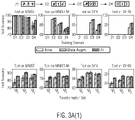
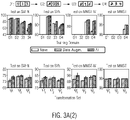
- Figure 3A shows results related to protocols P1 ( Figure 3A(1) ) and P2 ( Figure 3A(2) ) of digit experiments.
- Upper plots show the performance throughout the training sequence (after having trained on each of the four domains).
- Lower plots show performance at the end of the training sequence for different transformation sets ⁇ i .
- Figure 3A (top) shows how accuracy evolves as the model is fine-tuned on each of the different domains, for the two protocols (P1 and P2, in Figure 3A(1) and Figure 3A(2) , respectively).
- Performance achieved with a model (A1) trained with the method according to an embodiment (A1, right bar of the three bars) is compared with the naive training procedure, with (Data Augm., middle bar) and without data augmentation (Naive, left bar).
- Figure 3B shows the performance achieved with the support of different transformation sets to generate auxiliary domains.
- Figure 3B shows KITTI results on protocols P1, P2 and P3 (left, middle and right, respectively) for models trained via non-augmented (“x") and augmented naive baseline ("+”) and via Algorithm 1 ("*"). Curves are averaged across 10 random permutations of A, B, C environments.
- Table 3 shows the final numeric results. Results are benchmarked against the data augmentation baseline trained with the same sets. These results show that the meta-learning strategy according to an embodiment consistently outperforms the data augmentation baselines across several choices for the auxiliary set.
- Table 2 shows the comparison between models trained with the method according to an embodiment, the augmented and non-augmented baselines, and the oracles and EWC / L2.
- the model obtained with the method according to an embodiment compares favorably with all non-oracle approaches.
- a testbed in which the method performs worse than a competing algorithm is SVHN in protocol P2, where L2 regularization performs better. This might be due to the fact that SVHN is a very complex domain already, with respect to the others, so it is less effective to simulate auxiliary domains from this starting point.
- Table 2 Test accuracy results on MNIST, MNIST-M, SYN and SVHN at the end of protocols P1 (left) and P2 (right).
- the model obtained with the method according to an embodiment indicates results obtained via Algorithm 1.
- the same transformation set ⁇ 3 was used for the method according to an embodiment and for baselines that rely on data augmentation (DA). Oracles can access data from all domains at any time during training and, thus, perform better.
- DA data augmentation
- Table 3 shows results related to protocols P1, P2 and P3 (left, middle and right, respectively), and the respective curves in Figure 3B from an experiment related to semantic scene segmentation.
- Algorithm 1 (A1) is compared with augmented and non-augmented naive baselines (DA and N. rows, respectively). Also in these settings, heavy data augmentation proved to be effective to better remember the previous domains. In general, using Algorithm 1 allows for better or comparable performance using the same transformation set. Models obtained with the method according to an embodiment are less effective when the domain shift is less pronounced (P3). In this case, neither data augmentation nor the model according to Algorithm 1 provide the same benefit that can be observed in the other protocols, or in the experiment on digits (Table 2).
- Table 3 Mean intersection over union (mloU) results on the domains that characterize protocols P1, P2 and P3 at the end of the training sequences (left, middle and right, respectively).
- N. and DA are the non-augmented and augmented baselines.
- Some or all of the method steps may be implemented by a computer in that they are executed by (or using) a processor, a microprocessor, an electronic circuit or processing circuitry.
- the embodiments described above may be implemented in hardware or in software.
- the implementation can be performed using a non-transitory storage medium such as a computer-readable storage medium, for example a floppy disc, a DVD, a Blu-Ray, a CD, a ROM, a PROM, and EPROM, an EEPROM or a FLASH memory.
- a computer-readable storage medium for example a floppy disc, a DVD, a Blu-Ray, a CD, a ROM, a PROM, and EPROM, an EEPROM or a FLASH memory.
- Such computer-readable media can be any available media that can be accessed by a general-purpose or special-purpose computer system.
- embodiments can be implemented as a computer program product with a program code or computer-executable instructions, the program code or computer-executable instructions being operative for performing one of the methods when the computer program product runs on a computer.
- the program code or the computer-executable instructions may be stored on a computer-readable storage medium.
- a storage medium (or a data carrier, or a computer-readable medium) comprises, stored thereon, the computer program or the computer-executable instructions for performing one of the methods described herein when it is performed by a processor.
- an apparatus comprises one or more processors and the storage medium mentioned above.
- an apparatus comprises means, for example processing circuitry such as, e.g., a processor communicating with a memory, the means being configured to, or adapted to perform, one of the methods described herein.
- processing circuitry such as, e.g., a processor communicating with a memory, the means being configured to, or adapted to perform, one of the methods described herein.
- a further embodiment comprises a computer having installed thereon the computer program or instructions for performing one of the methods described herein.
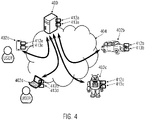
- FIG. 4 The above-mentioned methods and embodiments may be implemented within an architecture such as that illustrated in Figure 4 , which comprises server 400 and one or more client devices 402 that communicate over a network 404 (which may be wireless and / or wired) such as the Internet for data exchange.
- Server 400 and the client devices 402 include a data processor 412 and memory 413 such as a hard disk.
- the client devices 402 may be any device that communicates with server 400, including autonomous vehicle 402b, robot 402c, computer 402d, or cell phone 402e.
- the method according to the embodiment of Figure 1 may be performed at server 400 for a task in a plurality of domains.
- the task may be the recognition of images or features of images in a domain (e.g., an image categorizer used by an application on robot 402c, autonomous vehicle 402b or cell phone 402e to identify streets in sunny weather, rainy weather, or foggy weather as shown in Figure 2 ).
- the method may be used to add new domains or refine domains over time, while minimizing catastrophic forgetting of domains learned earlier in time.
- Other examples of tasks may be natural language understanding, search and translation.
- the methods according to the embodiments of Figure 1 may be performed at client device 402 partially or completely.
- the methods may be performed at a different server or on a plurality of servers in a distributed manner.
- a novel meta-learning approach that can easily be applicable when a model needs to be sequentially adapted to different domains is disclosed.
- the method is based on the concept of "auxiliary domains”. Further new benchmarks to assess lifelong learning strategies for computer vision research are disclosed.
- the method may comprise designing effective auxiliary sets that significantly improve adaptation to more diverse domains. Further, in an aspect, the method may comprise "learning to optimize" strategies that proved to be effective, e.g., in few-shot learning.
Landscapes
- Engineering & Computer Science (AREA)
- Theoretical Computer Science (AREA)
- Physics & Mathematics (AREA)
- Data Mining & Analysis (AREA)
- General Physics & Mathematics (AREA)
- Artificial Intelligence (AREA)
- General Engineering & Computer Science (AREA)
- Evolutionary Computation (AREA)
- Life Sciences & Earth Sciences (AREA)
- Mathematical Physics (AREA)
- Software Systems (AREA)
- Computing Systems (AREA)
- Computational Linguistics (AREA)
- Health & Medical Sciences (AREA)
- Biomedical Technology (AREA)
- Biophysics (AREA)
- General Health & Medical Sciences (AREA)
- Molecular Biology (AREA)
- Bioinformatics & Computational Biology (AREA)
- Computer Vision & Pattern Recognition (AREA)
- Bioinformatics & Cheminformatics (AREA)
- Evolutionary Biology (AREA)
- Image Analysis (AREA)
Priority Applications (2)
| Application Number | Priority Date | Filing Date | Title |
|---|---|---|---|
| EP20306458.9A EP4006785A1 (fr) | 2020-11-27 | 2020-11-27 | Procédé d'apprentissage de représentations moins sujettes à un oubli catastrophique |
| US17/514,698 US20220172048A1 (en) | 2020-11-27 | 2021-10-29 | Method and system for learning representations less prone to catastrophic forgetting |
Applications Claiming Priority (1)
| Application Number | Priority Date | Filing Date | Title |
|---|---|---|---|
| EP20306458.9A EP4006785A1 (fr) | 2020-11-27 | 2020-11-27 | Procédé d'apprentissage de représentations moins sujettes à un oubli catastrophique |
Publications (1)
| Publication Number | Publication Date |
|---|---|
| EP4006785A1 true EP4006785A1 (fr) | 2022-06-01 |
Family
ID=74701362
Family Applications (1)
| Application Number | Title | Priority Date | Filing Date |
|---|---|---|---|
| EP20306458.9A Pending EP4006785A1 (fr) | 2020-11-27 | 2020-11-27 | Procédé d'apprentissage de représentations moins sujettes à un oubli catastrophique |
Country Status (2)
| Country | Link |
|---|---|
| US (1) | US20220172048A1 (fr) |
| EP (1) | EP4006785A1 (fr) |
Families Citing this family (2)
| Publication number | Priority date | Publication date | Assignee | Title |
|---|---|---|---|---|
| CN116310478B (zh) * | 2022-11-28 | 2025-09-02 | 电子科技大学 | 基于约束参数路径的连续学习的图像分类方法 |
| CN117390685B (zh) * | 2023-12-07 | 2024-04-05 | 湖北省楚天云有限公司 | 一种基于遗忘学习的行人重识别数据隐私保护方法和系统 |
Family Cites Families (11)
| Publication number | Priority date | Publication date | Assignee | Title |
|---|---|---|---|---|
| US8112484B1 (en) * | 2006-05-31 | 2012-02-07 | Proofpoint, Inc. | Apparatus and method for auxiliary classification for generating features for a spam filtering model |
| AU2019210306A1 (en) * | 2018-01-22 | 2020-07-30 | Jack Copper | Systems and methods for preparing data for use by machine learning algorithms |
| US11210559B1 (en) * | 2018-10-23 | 2021-12-28 | Hrl Laboratories, Llc | Artificial neural networks having attention-based selective plasticity and methods of training the same |
| CN113168568B (zh) * | 2018-10-23 | 2026-01-09 | 斯坦福大学托管董事会 | 用于具有深度特征化的主动迁移学习的系统和方法 |
| WO2020102435A1 (fr) * | 2018-11-13 | 2020-05-22 | Google Llc | Prédiction d'événements de santé défavorables futurs à l'aide de réseaux neuronaux par prétraitement de séquences d'entrée pour qu'elles incluent des éléments de présence |
| US11625612B2 (en) * | 2019-02-12 | 2023-04-11 | D-Wave Systems Inc. | Systems and methods for domain adaptation |
| US20200293033A1 (en) * | 2019-03-13 | 2020-09-17 | General Electric Company | Knowledge-based systematic health monitoring system |
| US11030484B2 (en) * | 2019-03-22 | 2021-06-08 | Capital One Services, Llc | System and method for efficient generation of machine-learning models |
| US11373390B2 (en) * | 2019-06-21 | 2022-06-28 | Adobe Inc. | Generating scene graphs from digital images using external knowledge and image reconstruction |
| EP3772720B1 (fr) * | 2019-08-08 | 2021-09-29 | Siemens Healthcare GmbH | Procédé et système d'analyse d'images |
| GB202015297D0 (en) * | 2020-09-28 | 2020-11-11 | Microsoft Technology Licensing Llc | Auxiliary model for predicting new model parameters |
-
2020
- 2020-11-27 EP EP20306458.9A patent/EP4006785A1/fr active Pending
-
2021
- 2021-10-29 US US17/514,698 patent/US20220172048A1/en active Pending
Non-Patent Citations (10)
| Title |
|---|
| ANDREAS GEIGERPHILIP LENZRAQUEL URTASUN: "Are we ready for autonomous driving? the KITTI vision benchmark suite", PROCEEDINGS OF THE IEEE CONFERENCE ON COMPUTER VISION AND PATTERN RECOGNITION (CVPR, 2012 |
| DA LI ET AL: "Learning to Generalize: Meta-Learning for Domain Generalization", ARXIV.ORG, CORNELL UNIVERSITY LIBRARY, 201 OLIN LIBRARY CORNELL UNIVERSITY ITHACA, NY 14853, 10 October 2017 (2017-10-10), XP080827512 * |
| DA LI ET AL: "Sequential Learning for Domain Generalization", ARXIV.ORG, CORNELL UNIVERSITY LIBRARY, 201 OLIN LIBRARY CORNELL UNIVERSITY ITHACA, NY 14853, 3 April 2020 (2020-04-03), XP081635847 * |
| HANKOOK LEE ET AL: "Self-supervised Label Augmentation via Input Transformations", ARXIV.ORG, CORNELL UNIVERSITY LIBRARY, 201 OLIN LIBRARY CORNELL UNIVERSITY ITHACA, NY 14853, 29 June 2020 (2020-06-29), XP081680388 * |
| JAMES KIRKPATRICKRAZVAN PASCANUNEIL RABINOWITZJOEL VENESSGUILLAUME DESJARDINSANDREI A. RUSUKIERAN MILANJOHN QUANTIAGO RAMALHOAGNIE: "Overcoming catastrophic forgetting in neural networks", PNAS, 2017 |
| RAJASEGARAN JATHUSHAN ET AL: "iTAML: An Incremental Task-Agnostic Meta-learning Approach", 2020 IEEE/CVF CONFERENCE ON COMPUTER VISION AND PATTERN RECOGNITION (CVPR), IEEE, 13 June 2020 (2020-06-13), pages 13585 - 13594, XP033804654, DOI: 10.1109/CVPR42600.2020.01360 * |
| YANN LECUNLEON BOTTOUYOSHUA BENGIOPATRICK HAFFNER: "Gradient-based learning applied to document recognition", PROCEEDINGS OF THE IEEE, 1998, pages 2278 - 2324 |
| YAROSLAV GANINVICTOR LEMPITSKY: "Unsupervised domain adaptation by backpropagation", PROCEEDINGS OF THE 36TH INTERNATIONAL CONFERENCE ON MACHINE LEARNING (ICML, 2015 |
| YUVAL NETZERTAOWANGADAM COATESALESSANDRO BISSACCOBOWUANDREW Y. NG: "Reading digits in natural images with unsupervised feature learning", NIPS WORKSHOP ON DEEP LEARNING AND UNSUPERVISED FEATURE LEARNING, 2011 |
| ZHIQIANG TANG ET AL: "OnlineAugment: Online Data Augmentation with Less Domain Knowledge", ARXIV.ORG, CORNELL UNIVERSITY LIBRARY, 201 OLIN LIBRARY CORNELL UNIVERSITY ITHACA, NY 14853, 22 August 2020 (2020-08-22), XP081746338 * |
Also Published As
| Publication number | Publication date |
|---|---|
| US20220172048A1 (en) | 2022-06-02 |
Similar Documents
| Publication | Publication Date | Title |
|---|---|---|
| Thoma | Analysis and optimization of convolutional neural network architectures | |
| US11657274B2 (en) | Weakly-supervised semantic segmentation with self-guidance | |
| CN112784954B (zh) | 确定神经网络的方法和装置 | |
| Zhang et al. | Learning noise-aware encoder-decoder from noisy labels by alternating back-propagation for saliency detection | |
| US10074054B2 (en) | Systems and methods for Bayesian optimization using non-linear mapping of input | |
| US20210027098A1 (en) | Weakly Supervised Image Segmentation Via Curriculum Learning | |
| CN104217225B (zh) | 一种视觉目标检测与标注方法 | |
| CN113643302B (zh) | 基于主动轮廓模型的无监督医学图像分割方法和系统 | |
| EP3745309A1 (fr) | Apprentissage d'un réseau antagoniste génératif | |
| US20240037398A1 (en) | Reinforcement learning-based techniques for training a natural media agent | |
| CN114220086B (zh) | 一种成本高效的场景文字检测方法及系统 | |
| CN111160459A (zh) | 超参数的优化装置和方法 | |
| CN116740362A (zh) | 一种基于注意力的轻量化非对称场景语义分割方法及系统 | |
| CN117876383B (zh) | 一种基于yolov5l的公路表面条状裂缝检测方法 | |
| CN111832435A (zh) | 基于迁移与弱监督的美丽预测方法、装置及存储介质 | |
| EP4006785A1 (fr) | Procédé d'apprentissage de représentations moins sujettes à un oubli catastrophique | |
| CN104021552A (zh) | 一种基于图论分割过程的多目标粒子群参数优化方法 | |
| CN118152897B (zh) | 敏感信息识别模型的训练方法、装置、设备及存储介质 | |
| CN114463574A (zh) | 一种遥感图像的场景分类方法及装置 | |
| CN116883432A (zh) | 病灶图像的分割方法、装置、电子设备及可读存储介质 | |
| CN114139631B (zh) | 一种面向多目标训练对象可选择的灰盒的对抗样本生成方法 | |
| Wang et al. | Voxel-wise cross-volume representation learning for 3D neuron reconstruction | |
| CN118014048A (zh) | 一种低照度人脸检测模型构建方法、装置及终端 | |
| Wang et al. | Weight masking in image classification networks: class-specific machine unlearning | |
| CN115222772A (zh) | 一种基于多核学习的聚合相关滤波目标跟踪方法 |
Legal Events
| Date | Code | Title | Description |
|---|---|---|---|
| PUAI | Public reference made under article 153(3) epc to a published international application that has entered the european phase |
Free format text: ORIGINAL CODE: 0009012 |
|
| STAA | Information on the status of an ep patent application or granted ep patent |
Free format text: STATUS: THE APPLICATION HAS BEEN PUBLISHED |
|
| AK | Designated contracting states |
Kind code of ref document: A1 Designated state(s): AL AT BE BG CH CY CZ DE DK EE ES FI FR GB GR HR HU IE IS IT LI LT LU LV MC MK MT NL NO PL PT RO RS SE SI SK SM TR |
|
| STAA | Information on the status of an ep patent application or granted ep patent |
Free format text: STATUS: REQUEST FOR EXAMINATION WAS MADE |
|
| 17P | Request for examination filed |
Effective date: 20221122 |
|
| RBV | Designated contracting states (corrected) |
Designated state(s): AL AT BE BG CH CY CZ DE DK EE ES FI FR GB GR HR HU IE IS IT LI LT LU LV MC MK MT NL NO PL PT RO RS SE SI SK SM TR |
|
| STAA | Information on the status of an ep patent application or granted ep patent |
Free format text: STATUS: EXAMINATION IS IN PROGRESS |
|
| 17Q | First examination report despatched |
Effective date: 20231011 |