EP4006796A1 - Système électronique de suivi des utilisateurs, en particulier permettant de lutter contre une pandémie - Google Patents
Système électronique de suivi des utilisateurs, en particulier permettant de lutter contre une pandémie Download PDFInfo
- Publication number
- EP4006796A1 EP4006796A1 EP20210115.0A EP20210115A EP4006796A1 EP 4006796 A1 EP4006796 A1 EP 4006796A1 EP 20210115 A EP20210115 A EP 20210115A EP 4006796 A1 EP4006796 A1 EP 4006796A1
- Authority
- EP
- European Patent Office
- Prior art keywords
- user
- venue
- data
- server
- trace
- Prior art date
- Legal status (The legal status is an assumption and is not a legal conclusion. Google has not performed a legal analysis and makes no representation as to the accuracy of the status listed.)
- Pending
Links
Images





Classifications
-
- G—PHYSICS
- G06—COMPUTING OR CALCULATING; COUNTING
- G06Q—INFORMATION AND COMMUNICATION TECHNOLOGY [ICT] SPECIALLY ADAPTED FOR ADMINISTRATIVE, COMMERCIAL, FINANCIAL, MANAGERIAL OR SUPERVISORY PURPOSES; SYSTEMS OR METHODS SPECIALLY ADAPTED FOR ADMINISTRATIVE, COMMERCIAL, FINANCIAL, MANAGERIAL OR SUPERVISORY PURPOSES, NOT OTHERWISE PROVIDED FOR
- G06Q10/00—Administration; Management
- G06Q10/06—Resources, workflows, human or project management; Enterprise or organisation planning; Enterprise or organisation modelling
-
- G—PHYSICS
- G06—COMPUTING OR CALCULATING; COUNTING
- G06Q—INFORMATION AND COMMUNICATION TECHNOLOGY [ICT] SPECIALLY ADAPTED FOR ADMINISTRATIVE, COMMERCIAL, FINANCIAL, MANAGERIAL OR SUPERVISORY PURPOSES; SYSTEMS OR METHODS SPECIALLY ADAPTED FOR ADMINISTRATIVE, COMMERCIAL, FINANCIAL, MANAGERIAL OR SUPERVISORY PURPOSES, NOT OTHERWISE PROVIDED FOR
- G06Q50/00—Information and communication technology [ICT] specially adapted for implementation of business processes of specific business sectors, e.g. utilities or tourism
- G06Q50/10—Services
- G06Q50/26—Government or public services
-
- G—PHYSICS
- G16—INFORMATION AND COMMUNICATION TECHNOLOGY [ICT] SPECIALLY ADAPTED FOR SPECIFIC APPLICATION FIELDS
- G16H—HEALTHCARE INFORMATICS, i.e. INFORMATION AND COMMUNICATION TECHNOLOGY [ICT] SPECIALLY ADAPTED FOR THE HANDLING OR PROCESSING OF MEDICAL OR HEALTHCARE DATA
- G16H40/00—ICT specially adapted for the management or administration of healthcare resources or facilities; ICT specially adapted for the management or operation of medical equipment or devices
- G16H40/60—ICT specially adapted for the management or administration of healthcare resources or facilities; ICT specially adapted for the management or operation of medical equipment or devices for the operation of medical equipment or devices
- G16H40/67—ICT specially adapted for the management or administration of healthcare resources or facilities; ICT specially adapted for the management or operation of medical equipment or devices for the operation of medical equipment or devices for remote operation
-
- G—PHYSICS
- G16—INFORMATION AND COMMUNICATION TECHNOLOGY [ICT] SPECIALLY ADAPTED FOR SPECIFIC APPLICATION FIELDS
- G16H—HEALTHCARE INFORMATICS, i.e. INFORMATION AND COMMUNICATION TECHNOLOGY [ICT] SPECIALLY ADAPTED FOR THE HANDLING OR PROCESSING OF MEDICAL OR HEALTHCARE DATA
- G16H50/00—ICT specially adapted for medical diagnosis, medical simulation or medical data mining; ICT specially adapted for detecting, monitoring or modelling epidemics or pandemics
- G16H50/80—ICT specially adapted for medical diagnosis, medical simulation or medical data mining; ICT specially adapted for detecting, monitoring or modelling epidemics or pandemics for detecting, monitoring or modelling epidemics or pandemics, e.g. flu
Definitions
- the invention relates to an electronic system for tracing users, in particular for tracing users in emergency scenarios such as fighting a pandemic such as Covid-19, and a corresponding digital storage medium on which a computer program or an app is stored.
- the invention is based on the object of creating an improved method and system for tracing visitors, which offers better protection of sensitive personal data.
- the server since the check-in data records, in particular the encrypted ID data of the user, are encrypted with the entity key (and optionally also with a venue key), neither the server nor the venue can identify which person has visited the venue. If the venue encrypts the check-in datasets with its venue key before uploading them, the server can, according to embodiments not even determine how many visitors a venue had at a certain point in time (if the timestamps are also encrypted).
- Embodiments of the invention can thus have the advantage that anonymous and secure transmission and storage of contact information is made possible, which allows individual users to be traced, but only if the user also agrees to the tracing.
- This enables visitors and guests of public or private events to provide the organizer with their contact details anonymously. Only in the event of an infection will the local health authorities be granted access to the contact details with the consent of the guest and preferably also with the consent of the organiser.
- the contact details can be used to inform possible contact persons.
- the system can be used to make contact tracing for venues, restaurants and other spatial areas (train compartment, airplane, stadiums, concert halls, buildings, rooms, outdoor concert areas etc.) safer and easier and in particular a safer and machine and thus to provide an efficient and scalable tracing solution.
- venues restaurants and other spatial areas (train compartment, airplane, stadiums, concert halls, buildings, rooms, outdoor concert areas etc.) safer and easier and in particular a safer and machine and thus to provide an efficient and scalable tracing solution.
- the anonymous and secure tracing system or method can be used in various application scenarios.
- An application example is the tracing of infected people in the event of a pandemic such as Covid-19 or other contagious diseases.
- Another use case is tracking people in the event of other types of emergencies or to investigate security incidents.
- an owner of a spatial area with high visitor traffic such as zoos, amusement parks or train stations, could use the system to anonymously register visitors entering the spatial area as part of a check-in at the entrance. This means that the owner saves the check-in data (the venue ID linked to the trace ID of the user and possibly other data) on the server without the visitor disclosing his identity to the owner or operator of the venue would have to.
- the venue operator may make a public appeal to contact the relevant entity (E.g. competent authority or competent, trustworthy organization.) to participate, for example, as a witness (whose presence is documented by check-in and optionally also check-out events and data records stored on the server.
- relevant entity E.g. competent authority or competent, trustworthy organization.
- the user IDs are data values which are created individually for the user and which do not reveal the identity of the user (in particular name, contact details and/or address and personal attributes such as account number, date of birth, place of birth, etc.).
- the trace ID contains the user ID only in encoded or encrypted form, so that the server cannot recognize the user ID of the associated user based on the trace ID.
- the trace IDs are data values that do not reveal the identity of the user (in particular name, contact details and/or address and personal attributes such as account number, date of birth, place of birth, etc.).
- the trace ID generated during check-in is calculated using a derivation function, specifically as a function of the combination of the user ID to be represented and the current time information to be represented at check-in.
- Each of the candidate trace IDs is calculated using the same derivation function as a function of the combination of the user ID contained in the message and one of the candidate time information items for a possible check-in time in the past.
- the derivation function preferably includes a rounding of the current or candidate time information to points in time within predefined time intervals, the time intervals being in particular minutes or hours or days.
- the current time can be continuously recorded by the user device, rounded down to the nearest minute after recording, and then passed to the derivation function as input together with the user ID.
- the tracing ID and the venue ID can then be linked to additional optional data and encoded in the form of a QR code and displayed on the user device for check-in purposes.
- the user device is configured to automatically generate a new trace ID and possibly also a to generate a new QR code when the time interval (here, for example, a minute) has elapsed and more up-to-date time information (current minute, rounded down) has been received. If the old QR code has not been used for check-in by then, the trace ID it contains will not be stored on the server either and will be discarded from the user device.
- the trace ID is generated based on time and it is therefore impossible to assign the trace IDs to individual users or even to group them by user.
- the operator of the venue and the server cannot even create anonymous movement profiles of the individual visitors on the basis of the trace IDs formed in this way, since the trace IDs are formed as a derivation of a constant data value (user ID) and a regularly changing time value . This increases the security of users against unauthorized tracing should an attacker gain access to the venue device against which the check-in is made and/or access to the server.
- the user device is configured to generate a random value (“userTracingSecret”) in the course of registration with the server and store it exclusively in the user device in an access-protected manner.
- the derivation function used in the course of checking in and/or tracing a user to generate the candidate trace IDs calculates the trace ID as a function (also) of the random value ("userTracingSecret").
- the user device is configured to obtain confirmation for the transmission of the random value from the user to whom it is assigned, and only in response to the confirmation to transmit the random value to the server (e.g. within a tracing secret transfer object) in order to enable it to derive the Allow candidate trace IDs.
- the user device may be configured to transmit the random value to an entity device of the entity only in response to the confirmation (e.g. within a tracing secret transfer object) to enable the entity to derive the candidate trace IDs.
- the application programs or apps installed on the user device, the server and/or the entity device have the necessary interfaces in order to exchange data with one another directly or indirectly via a network.
- the user device is configured to generate a random value in the course of registration with the server, hereinafter referred to as userVerificationSecret, and to store it exclusively in the user device in an access-protected manner.
- the user device is configured to use the userVerificationSecret during check-in to the venue in order to calculate a verification data value as a function of the trace ID and the encrypted ID data and link it to the trace ID on the server to save.
- storage on the server can take place directly or indirectly by the check-in data first being recorded by a venue device and the venue device then forwarding this data to the server in order to store it on the server side.
- the entity is assigned an asymmetric cryptographic key pair with a public and a private entity key.
- the user's device is configured to additionally encrypt the user data already encrypted with the user data key with the public entity key in the course of registration.
- the user's user device is configured to encrypt the user data decryption key required for decrypting this encrypted user data during check-in using the public entity key together with the user's user ID in order to encrypt encrypted ID card data generate.
- the user device saves the encrypted ID card data associated with the venue ID of the one venue on the server.
- This storage can take place directly if, for example, the venue operator does not have a venue device and the user device carries out the "check-in" itself by recording the data of the venue and using it for the check-in and the check-in data together with the venue -ID transmitted to the server for storage.
- storage can also take place indirectly by means of the venue device, in that the venue device records the user's check-in data, links it to the venue ID of the venue to which the venue device is assigned, and sends it to the user for storage Server submitted.
- an entity key e.g. a public encryption key of an authority, e.g. the health department
- an authority e.g. the health department
- uses its private entity key corresponding to the public entity key to link the ID card data stored with the trace ID, and thereby obtain the user ID and the associated user data decryption key.
- the agency can use the user data decryption key to decrypt the encrypted user data in order to find out the identity of the user.
- these features can have the advantage that the tracing data sets consume less storage space on the server, and the tracing data can be encoded in a graphical code such as a QR code: as the user ID and the user data decryption key (User data decryption key) to generate the encrypted ID card data, but not the complete user data, which can also be quite extensive, this data transmitted at check-in can be easily encoded in a QR code, which facilitates automatic check-in.
- a graphical code such as a QR code: as the user ID and the user data decryption key (User data decryption key) to generate the encrypted ID card data, but not the complete user data, which can also be quite extensive, this data transmitted at check-in can be easily encoded in a QR code, which facilitates automatic check-in.
- the electronic system includes at least one entity device associated with the entity.
- the entity device is configured to sequentially generate a plurality of asymmetric cryptographic key pairs assigned to the entity, where upon generation of a new entity key pair, the previously valid one is invalidated, and each of the entity key pairs is assigned a key version number.
- the at least one entity device is configured to transmit the public key of the generated and currently valid key pair to the user devices.
- the user devices are configured to only ever use the most recently transmitted entity key to generate the multiply encrypted user data and/or to generate the encrypted ID card data.
- the entity devices can be, for example, data processing devices, e.g. desktop computers or notebooks, or other computers, in particular from employees of a public authority, or data processing devices from third-party providers, which the entity uses to fulfill a task of the entity.
- data processing devices e.g. desktop computers or notebooks, or other computers, in particular from employees of a public authority, or data processing devices from third-party providers, which the entity uses to fulfill a task of the entity.
- a new entity key pair may be generated daily, e.g. in response to the initial launch of an entity tracing application on one of the entity's entity devices by one of the entity's employees, or at a predefined time (e.g. daily at 7:00 a.m AM on a predefined entity device).
- the version number of the entity key used in each case can be linked to the multiply encrypted user data and/or linked to the encrypted ID card data on the server, so that the entity device uses the version number to find the private entity key suitable for decryption with the same version number can identify.
- the at least one entity device consists of a plurality of entity devices.
- the one of the entity devices that generates the current asymmetric entity key pair sends the private key of the currently generated asymmetric entity key pair in encrypted form to all other of the entity devices over a network, e.g. the Internet and/or an intranet.
- Each of the entity devices is configured to generate and send to the server a notification of an emergency related to one of the users.
- the entity device is configured to decrypt the encrypted user data and/or the encrypted ID card data using one of the previously received private entity keys.
- This can be advantageous as it ensures that different entity employees using different entity devices still have the same entity private key for decrypting user data on any given day for which an emergency (e.g. positive test in the event of a pandemic ) exists.
- This provides a tracing solution that is secure and scalable, since it builds a decentralized IT infrastructure that includes several entity devices, which regularly (especially daily) newly generated entity key pairs for encrypting and decrypting user data and/or or ID card data.
- the electronic system includes multiple venue devices. Each of the venues is assigned one or more of the venue devices.
- the venue may be a multi-entrance venue, with a venue device attached to each entrance for automated guest check-in and, optionally, automated guest check-out.
- the venue is a train or train compartment or an airplane or an individual seat of an airplane and at least one venue device is attached at the entrances and/or exits of the respective venues.
- the direct communication link can be, for example, a near-field communication link or an optical data transmission channel.
- the data transmission via the optical data transmission channel includes a detection of a graphic code, which encodes the check-in data packet and is displayed on a display of the user device, by an optical sensor of the venue device.
- the venue device decodes the data contained in the code (e.g. QR code or barcode), including e.g. the trace ID and optionally further data such as the encrypted ID data, verification values, QR code version number, timestamp of the check-in and /or other data, and saves this linked to the venue ID stored in the venue device on the server.
- the venue device is the smartphone of the operator of the venue, on which, for example, a venue app from a tracing service provider is installed, which implements the steps of the tracing method on the venue device side.
- the near-field communication link can be, for example, a radio link, an infrared link, a Bluetooth link, or other forms of link in the near field of the venue device.
- This embodiment variant can be advantageous since suitable venue devices can greatly simplify and accelerate the check-in process, thereby enabling seamless integration of the recorded check-in data into the tracing system without additional effort for the visitor or venue operator.
- the trace ID and preferably also the ID data of the user checking in are transmitted to the server by the user device, with the decoded venue ID also being stored on the server linked to the trace ID.
- the venue code is preferably a QR code or barcode that is visible on an imprint or a digital display, and/or the carrier object is preferably a table display or a door sign for a vehicle, vehicle compartment, building or room.
- the data encoded in the venue code is used by the user device to "personalize" a simulated venue device with the ID and, if necessary, further data of the venue and then to carry out the check-in with this simulated venue device.
- the trace ID is linked with the venue ID and, if necessary, other data from the user device directly to the server for storage on the server.
- the electronic system is configured such that a check-out time is transmitted to the server from the user device of one of the users or from the venue device when the user leaves the venue.
- the check-out time is assigned to the trace ID previously received for this user, so that the user's length of stay at the venue is stored in the form of a combination of the check-in time and the check-out time.
- the creation of the tracing secret transfer object by the user device is initiated exclusively by an explicit command from the user to whom the user device is assigned, for example by the user selecting the "Release identity and visit history" function on a tracing app on his user device .
- the user can do this after receiving a positive result for an infectious disease after a request from the health department (e.g. by e-mail, letter or telephone call).
- the entity cannot generate the candidate trace IDs and thus cannot identify the venues visited or potential contact persons of the user at these venues. If the user in question who is to be traced transmits his tracing secrets (i.e. all data required to generate the candidate trace IDs for a specific user) to the office, e.g. by means of a tracing secret transfer object, this puts the office in the able to recognize the identity of the potential contacts (whose user data can be decrypted by the office with the UserDataKeys of these users, which are part of the check-in data of the venues visited in the period in question), but not to trace these potential contact persons, since they have to transmit their tracing secret to the entity.
- his tracing secrets i.e. all data required to generate the candidate trace IDs for a specific user
- the tracing secret transfer object additionally contains a random value (“userTracingSecret”) generated in the course of the registration of the random value (“userTracingSecret”) generated with respect to the server and stored access-protected exclusively in the user device.
- the server is configured to calculate the candidate trace IDs using this random value based on a large number of points in time within the past period and the user ID.
- the office cannot calculate the candidate trace IDs before receiving the tracing secret transfer object with the userTracingSecret and therefore cannot use them as a search value in the server's data to identify check-in data records that belong to the concerned users belong.
- the office cannot determine when and at which venues the user checked in.
- the at least one entity device is configured to treat the assignment of the trace ID to the user as manipulated in the event of the result that the comparison shows a mismatch of the verification data values.
- the creation of the userVerificationSecret in the course of the user's registration process, the use of this userVerificationSecret to calculate a verification data value, which is transmitted directly or indirectly from the user device to the server as part of a check-in message or QR code, and the provision of the userVerificationSecret as part of the tracing secret transfer object to the office can have the advantage that the office is able to check whether a specific check-in data record was generated by the same user device (and thus the same user) that has also currently transmitted the tracing secret transfer object.
- the electronic system and in particular the server, is configured in such a way that those users are determined who have also visited one or more of the determined venues during the past period and during the user's stay.
- those of the check-in data records are determined (and their trace IDs) that contain a venue ID and a check-in time stamp from which it can be seen that the respective check-in events occurred at one of the determined venues during a period of time have arisen at which the user to be traced was also in the venue.
- the entity By decrypting the identity card data encrypted with the entity key of these determined check-in data records, the entity obtains the decryption key for the user data of the possible contact persons, and thus the contact data of the possible contact persons.
- the venue devices have additionally encrypted the ID card data in the check-in data records generated by them with a key of the venue device, so that in this case the server first sends the determined check-in data records to the venue identified by the venue ID. device has to send in order to have it decrypt the credential data and to make the decrypted credential data, which is still encrypted with the entity key, available to the entity device via the server.
- the invention relates to an electronic system comprising only one or some of the components of the system described above, eg only the server, only the user device, only an entity device, only a venue device, or eg a combination the server and a user device, a combination of the server and the venue device, a combination of the server and the entity device, or a combination of the venue device or venue object and the user device.
- the invention relates to a digital storage medium with program instructions that can be executed by a processor of a user device for carrying out those steps for which the electronic system is configured according to one of the embodiments of the invention described here, which relate to the user device.
- the invention relates to a digital storage medium with program instructions executable by a processor for carrying out those steps for carrying out which the electronic system is configured according to one of the embodiments of the invention described here, which relate to the server.
- the invention relates to a digital storage medium with program instructions executable by a processor for carrying out those steps for carrying out which the electronic system is configured according to one of the embodiments of the invention described here, which relate to the at least one venue device.
- the invention relates to a digital storage medium with program instructions executable by a processor for carrying out those steps for carrying out which the electronic system is configured according to one of the embodiments of the invention described here, which relate to the at least one entity device.
- the method includes further steps which are carried out by one or more components of an electronic system for tracing users and which have already been described with regard to these embodiment variants of the electronic system.
- the electronic system is configured such that the user device of one of the users transmits a check-out time to the server when the user leaves the venue, the check-out time of the trace ID previously received for this user is assigned, so that the period of stay at the venue is saved for the user.
- the electronic system is configured in such a way that those users are identified who have also visited one or more of the identified venues during the past period of time and during a length of stay of the user, including those of the trace IDs which are identified by the identified venues during the past period of time have been transmitted to the server can be determined.
- the invention relates to a digital storage medium with program instructions that can be executed by a processor of a data processing device for carrying out those steps for carrying out the electronic system according to one of the embodiments described here, which relate to the data processing device, the data processing device being the user device, an entity device, a venue device, or the server.
- the electronic system is configured such that a check-out time is transmitted to the server from the user device of one of the users or from the venue device when the user leaves the venue, with the check-out time being the same as previously for assigned to the trace ID received by this user, so that the period of stay at the venue is saved for the user.
- the electronic system is configured in such a way that those users are identified who have also visited one or more of the identified venues during the past period of time and during a length of stay of the user, including those of the trace IDs which are identified by the identified venues during the past period of time have been transmitted to the server can be determined.
- the invention relates to a digital storage medium with program instructions that can be executed by a processor of a data processing device for carrying out those steps for carrying out the electronic system according to one of the embodiments described here, which relate to the data processing device, the data processing device being the user device, an entity device, a venue device, or the server.
- a “user device” is understood here to mean a portable data processing system, in particular a battery-powered data processing system such as a user device, a notebook, a tablet computer or an integrated device that was specifically designed for the automatic check-in and tracing of visitors at a venue and/or is used.
- a “mobile radio device” is understood here to mean a portable electronic system, in particular a battery-powered telecommunications device, which has at least one processor for executing program instructions, in particular for executing so-called apps.
- a mobile radio device has a network interface for setting up communication connections via a telecommunications network, which can be designed according to a mobile radio standard.
- the user device can optionally have additional communication interfaces, such as a display device, i.e. a so-called display, for visual communication with the user or also for machine communication, for example by displaying visual patterns such as a QR code. Communication takes place directly via this further communication interface, ie without the interposition of a network.
- a display device i.e. a so-called display
- Communication takes place directly via this further communication interface, ie without the interposition of a network.
- the user device also has an or several near-field communication interfaces, for example according to the Bluetooth and/or NFC standard.
- the user device also has at least one memory in which data can be stored.
- a user device is uniquely assigned to a user. This is often done, especially with mobile phones, via a SIM or eSIM.
- a “venue” device is understood here to mean, in particular, an electronic device which the operator of a venue, i.e. a venue for a public or private event or a pub, such as a restaurant, club or the like, uses to who visit the venue.
- a venue can also be a means of transportation or an area within it, such as an airplane, train, or train compartment.
- Venue equipment can be implemented as a monolithic or distributed data processing system, e.g., as a mobile radio or as a stationary terminal, such as a personal computer.
- Venue equipment can also be an automated access control device, such as a turnstile or gate.
- the venue device may also be a third-party data processing system, e.g. for ticketing purposes (automated payment, visitor management, etc.).
- the venue device has an interface for direct communication with the corresponding interface of the user device as well as a network interface for communication with a server via a telecommunications network, which can be wired or wireless.
- a “server” is understood here to mean a data processing system, in particular a server computer, a virtual server or a distributed server which is implemented using cloud computing, for example.
- the server is used for tracing the users, whereby "tracing" means the possibility of tracing past visits by a user to venues and optionally also the possibility of determining those users who are at the same time with a specific user who infected with Covid-19, for example, have stayed at one of the venues.
- the server may also integrate and utilize third party computers and/or functions.
- a "user” is understood here as a natural person who can act as a visitor to one or more spatial areas (venues).
- tracing is understood here to mean the tracking of contacts of a specific user over a period of time, with preferably no movement profiles being or having to be created.
- An “entity” is understood here to mean a trustworthy natural or legal person, in particular an institution that, for example, has sovereign rights to determine the whereabouts of users, such as the health department in the event of a pandemic.
- the procedure is such that the users first register using the respective user devices.
- user data is first recorded, for example by entering the user data into the relevant user device or by reading the user data, for example from an electronic identity card of the user into the user device.
- the user data is then encrypted by the user device using the public entity key, for example using a public key from the health department, and the result of this encryption is encrypted with a user data key of the user concerned, the user data being -Key is, for example, a random value with high entropy, such as a length of 16 bytes.
- the user data can be encrypted directly using the user data key (user-specific encryption key for the user's user data) generated for the user during registration.
- the encryption is done directly by the public entity key.
- the encryption of the user data takes place through a double sequential encryption, first with the user data key and then with the public entity key or vice versa.
- the user device derives a further key from the public entity key according to a predefined method which is then used to encrypt the user data.
- the additional key can be derived from the public entity key and the user data key.
- the entity key can be a master key or the key of a dependent entity associated with the entity.
- the entity key can be the master key of the health department or a key of the responsible local health department.
- the user data key can, for example, be made available for registration purposes by the operating system of the user device.
- the user device has a binary symmetric source for generating random values of high entropy.
- the user data is stored on the server in a form that initially does not enable the server to decrypt this user data, since this would not be possible without the private entity key and/or the user data decryption key corresponding to the user data key is possible.
- the user data key is a symmetric key, ie the user data key used for encrypting the user data and the user data decryption key used for decryption are identical.
- the user data key and the user data decryption key are an asymmetric cryptographic key pair, the user data key being used for encryption and the user data decryption key being used for decryption.
- This user data key is persistently stored in a non-volatile memory in the user device.
- the server Based on the registration on the server, the server generates a user ID, i.e. a unique identifier for the user in question, which the server returns to the user device based on the registration.
- the user ID is persistently stored in the user device in a non-volatile memory.
- the procedure is as follows:
- the user device generates a trace ID that is representative of a combination of the user ID and current time information.
- the current time information is the current time when the user checks in at the venue, with this current time being determined by the user device via the network. This current time is preferably rounded off according to a predefined rounding method, for example rounded up or down to the full minute.
- the user device generates encrypted ID card data, for example by encrypting the user ID and the user data decryption key required to decrypt the user data with the public entity key.
- the encrypted ID data therefore only contains a user ID instead of the user data, i.e. it is so small that the encrypted ID data together with the trace ID and optional further data can be transmitted quickly and efficiently to the venue device, e.g. by the fact that these Data encoded in a QR code and displayed on a display of the user device and captured by a camera of the venue device.
- the optional additional data include, for example, the time stamp that was used to derive the trace ID and, if applicable, a verification data value and/or a QR code version.
- Said information can also be transmitted during an automatic check-out, in which case the same trace ID is preferably used as for check-in, and the time currently recorded and transmitted to the venue device represents the check-out time.
- the venue device checks for detecting a user at check-in whether the time information on which the trace ID is based is sufficiently up-to-date, and for this purpose also uses time information obtained via a network for synchronization with the from The time base used by the user device and/or as a reference value for comparison with the time information received from the user device.
- the time information is considered to be sufficiently up-to-date if, for example, it lies within a specified tolerance range, ie is not older than a few seconds or minutes, for example.
- the time information is coded in the trace ID in such a way that it is not extracted from the trace ID by the venue device can.
- the user device in addition to the trace ID, can transmit the check-in time, which was used as the basis for deriving the trace ID, to the venue device so that the venue device can compare this additional time with a reference time (e.g. the system time of the venue device or one from a time server via the Internet). If the time information on which the trace ID is based is sufficiently up-to-date, the venue device, according to embodiments, transmits the trace ID with a venue ID assigned to the venue device and preferably also other data such as, in particular, a ciphertext (i.e.
- the ID card data encrypted with the public entity key and, if applicable, one or more of the other data to the server.
- This information is stored on the server, preferably with the storage taking place in such a way that the trace ID serves as a search key.
- a searchable index can be created in a database over the "Trace ID" column to enable efficient searching of the entirety of all check-in records of users registered with the server versus venues registered with the server.
- candidate trace IDs are then used as search criteria to retrieve corresponding trace IDs stored on the server for the past period, so that the venue IDs of those venues from which the user was tracked during the past period are identified.
- the health department receives the venue IDs of the determined Venus that the user had visited in the past period, for example two weeks, in which he was possibly already infectious.
- a comparison of 20,000 data values via a searchable database index can be carried out very quickly and usually in real time on the basis of today's database technology.
- the electronic system is configured such that a check-out time is transmitted to the server from the user device of a user registered by a venue device, ie after checking in, when the user leaves the venue.
- This check-out time is assigned to the trace ID previously received for this user, so that the information is available on the server side as to the period during which the user was at the venue. Alternatively, this is done through the venue device.
- this check-out takes place through manual input into the user device or automatically through so-called geofencing.
- the check-out time with the assigned Trace ID is automatically sent from the user device to the server as soon as the user leaves the venue. Alternatively, this is done through the venue device.
- This information is preferably included in the determination of those users who were also at the venue by restricting the search to those users who had not only visited the same venue, but also there at least with the residence period of the recognized user overlapping periods of stay have been.
- the venue IDs and check-in and optionally also check-out times can be specified in plain text, so that the check-in data records of users, who were in a particular venue at the same time as the user to whom the emergency relates.
- the name and/or address, an identifier or the geographic coordinates of the venue can serve as the venue ID.
- figure 2 12 shows a block diagram of a distributed electronic system 200 for tracing users.
- the system 200 includes a server 202, which is provided, for example, by an operator of a tracing service.
- the server may include a backend application 212, which may include various functionality, for example functionality for registering users 240, venues 242, and entities 246, and/or storing, managing, and searching user and check-in data and/or to generate candidate trace IDs.
- the backend server can contain a database 214 or be operatively linked to it for storing the data, in particular contact data of the users, venues and entities registered with the server 202, for storing check-in data records and/or tracing data records.
- the database can be, for example, a relational database or another form of structured data storage.
- the server may include an email service 218 and/or an SMS service 216 that can be used to contact the users registered with the system if necessary and, for example, to warn that they are concurrent with an infected person stayed at a particular venue.
- the SMS service can be used to validate phone numbers.
- the system further comprises a plurality of user devices 204 which are each assigned to a user 240 .
- the user devices are data processing devices, in particular portable data processing devices, for example mobile radio devices.
- the users to whom the user devices are assigned are people who are temporarily in different spatial areas (venues) and can therefore act as (paying or non-paying) guests of the venue.
- An application program 214 referred to here as a guest application, can be instantiated on each of the user devices, which is interoperable with the backend application program 212 of the server 202.
- the application program 218 can be in the form of an app, for example, and can include various functions.
- the functions may include, for example, a user registration function 222 to the server 202, a user 240 check-in function 226 to a venue, a self-check-in function 228 to a venue that instead of via a venue device is only equipped with an automatically detectable venue ID via a carrier object, and/or a functionality 224 for the transmission of a tracing secret transfer object with user-related sensitive data in order to grant an entity 246 access to the user data of the user.
- the system further includes multiple entity devices 208 each associated with an entity 246 .
- entity is a trustworthy, generally sovereign authority, for example an office or an authority, for example a health authority.
- entity In order for the entity to be able to use the tracing system, it must have registered with the server 202, with the registration of the entity generating an asymmetric cryptographic entity key pair which, according to embodiments of the invention, is updated regularly, for example daily, by an up-to-date valid key pair is replaced.
- the public part of this key pair is provided to the server 202 to enable it to provide the public encryption key of the entity to the user devices 204 and/or the venue devices 206 so that they can use the public entity key to access certain parts of the Check-in data records (in particular the ID data records) and optionally also the user data can be encrypted before said data is uploaded to the server and stored there centrally in the database 214.
- entities e.g. health authorities
- entity devices e.g. data processing devices (computers) of the employees of the respective authority.
- multiple entities can be integrated into the system by that they use the same asymmetric entity key pair for encrypting and decrypting check-in data and/or user data, which can be realized, for example, in that the entity application has a functionality for synchronizing both the public and the private part this asymmetric cryptographic key pair with all other entity applications of the same or a cooperating entity (or all entities intended to function functionally as one entity).
- the entity application has a functionality for synchronizing both the public and the private part this asymmetric cryptographic key pair with all other entity applications of the same or a cooperating entity (or all entities intended to function functionally as one entity).
- at least the private parts of the key pair are exchanged and synchronized in encrypted form, for example by being encrypted with a public transport key of the respective recipient entity device.
- the synchronization of entity keys between multiple employees and entity devices of an entity is realized through daily key rotation: the keys are identified by a key ID (integer) that is incremented with each new key.
- the rotation is triggered by every employee of the health department who logs in after the validity of the last public entity key, which was valid for e.g. one day, has expired.
- the daily entity public key is the sole property of the health authorities and is used to secure the user's check-in data.
- the rotation procedure means that in the course of registration and/or in the course of a user's check-in, the currently valid public daily key of the entity is transmitted to the user device, so that the user device uses the key to encrypt the ID card data during check-in and optionally can also use the user data during user registration.
- the expiry time of a daily key pair is 24 hours, for example.
- the office employee When a daily entity key pair has expired, the office employee generates a new current day entity key pair whose public key is uploaded from the entities application to the server and automatically distributed from the server over the network to the users' user devices.
- the participating entity devices download the respective (static) public keys of the other entity devices of the entity.
- the entity device which has just generated the entity key pair updated for the day, also encrypts the public static keys of the respective other entity devices the current private entity key valid on a daily basis, and sends this ciphertext formed in this way to the entity device in question, which decrypts the ciphertext and is therefore also in possession of the private entity key that is valid on a daily basis. It is also possible for different health authorities to send each other new private entity keys on a daily basis (or at another predefined time interval) using the said key rotation procedure.
- This process preferably takes place fully automatically in the background without any active involvement by the employees of the office and/or the individual users.
- the system further includes multiple venue devices 206 from multiple different venues 242. It is possible for a venue to have multiple venue devices 206 attached, for example one device at each of multiple entrances to the venue.
- a venue application 230 can be instantiated on each venue device, which contains, for example, functionalities 232, 234 for a check-in process for a user with respect to the venue and/or for registering the venue with respect to the server 202.
- the venue device 206 may include a camera configured to capture a QR code displayed on a display of the user device 204 in which check-in data of a guest is encoded. The QR code is decoded by the venue application 230 and at least some of the decorated data is stored on the server 204 associated with a venue ID of the venue 242 .
- the system may include one or more other data processing devices 210 for static graphic code generation.
- This can be advantageous because it means that people who are not very IT-savvy and who cannot or do not want to create their own user account can also use the tracing system 200 .
- an employee of a care facility can register himself or the care facility as a user with the server 202 and cause the data processing device 210 to create a specific quantity, for example 50 or 100 pieces, of a QR code.
- These pre-created and not yet personalized QR codes can be used to send to guests of the nursing home to enable them to visit a venue (e.g. a concert hall, a theater, etc.) without having to create their own account.
- the person who ordered the QR code and received and printed it out for example by post or via the Internet, distributes the QR code to the guests of the nursing home and, in the course of the issue, notes that the QR code issued has been assigned to a specific person .
- the ordered QR codes can be provided with a serial number, and the nursing staff creates a list by hand or electronically, in which an assignment of the issued code to the person who received the code is contained.
- the list can be created on paper, for example, but it can also be created and stored via a functionality of an application on the generator device 214 that is made available, for example, via the Internet.
- the individual components of the system are connected to each other via network 244.
- the network can be the Internet, for example, in which case data can be transmitted by cable and/or wirelessly.
- data can be transmitted between user devices 204 and server 202 via a cellular connection or WLAN.
- Check-in data can be transmitted from a user's user device to a venue device 206, for example, via an optical data transmission channel and/or via a near-field signal such as Bluetooth.
- steps target input data output data
- Venue registration (at the server) Enables private and commercial venue operators to automatically register guests and trace them retrospectively in the event of an emergency.
- Email, Password, Location Information Venue-specific asymmetric key pair venuePrivKey and VenuePubKey Entity registration (at the server) Allows employees of an office to trace visitors to the venues certificate Entity specific asym.
- FIGS 3A-3C show various examples for the generation and storage of user data ("User Data Package”, “User Data Record”).
- FIG. 3 shows a user data record 300 as stored on server 202 according to one embodiment.
- the data record 300 includes at least one user ID 302 in plain text, with which other user-related data are linked and stored on the server.
- This additional data includes at least encrypted user data 306 of a person.
- further personal data can be contained in the user data record 300, for example a public key 304 of an asymmetric cryptographic key pair, which is specific to this user in the course whose registration has been issued.
- the user data can optionally contain further data such as a signature 308 .
- the encrypted data 306 can be generated by encrypting the user's personal user data 314 , for example the user's name, address and/or other contact information, with a user data encryption key 310 .
- the key 310 can be a symmetrical cryptographic key that was generated specifically for this user in the course of the user's registration and which also enables the encrypted data 306 to be decrypted at the same time.
- the personal user data 314 is preferably encrypted together with a user-specific verification secret 316 by the user data key 310 and/or the secret 316 is used as a parameter in the course of the encryption for generating the encrypted user data 306 .
- the UserDataKey is generated as an asymmetric cryptographic key pair in the course of the user's registration.
- only the private part used for decryption must be stored securely in the user device and transmitted to the server in encrypted form as part of the ID data or check-in data upon check-in.
- the optional signature 308 can be generated, for example, in that a private cryptographic key (signature key) 312, which was generated specifically for the user upon registration, signs the encrypted user data 306 and the user data key 310 used to encrypt the user data 314.
- the public key 304 can be a signature verification key corresponding to the key 312 . This allows the Office to check whether the user data set has possibly been manipulated after it was saved and signed.
- FIG. 3B A user data record 320 is shown according to another embodiment.
- Data values or keys of data record 320 that correspond to one of the data values or Keys of the data set 300 correspond in terms of content and/or function are marked with the same reference numbers.
- the box surrounded by the frame identifies the user record as it is stored on the server.
- the boxes below represent input data values or keys that were used to generate corresponding elements of the user data set.
- the mac is a message authentication code that was created, for example, using an HMAC-SHA256 algorithm on the basis of the encrypted user data 306 .
- the abbreviation "iv" represents a random value.
- the signature includes not only the encrypted user data 306, but also the mac and the random value iv.
- FIG. 3C a user data record 330 according to a further embodiment is shown.
- Data values or keys of data record 330 which correspond in terms of content and/or function to one of the data values or keys of data record 300 are identified by the same reference numbers.
- the box surrounded by the frame identifies the user record as it is stored on the server.
- the encrypted user data 306 is formed by double encryption.
- the personal user data 314 and preferably also a user verification secret 316 are encrypted with a public entity key 332 .
- the ciphertext generated in this step is encrypted again in a further encryption step using the user-specifically created user data key 310 in order to obtain the (doubly) encrypted user data 306 and store it on the server.
- the user of the app (application program) 218 of his user device makes his contact information 314 available in the course of a registration process.
- the application generates an EC secp256r1 key pair (user public key and user private key) 312, 304, a user trace secret 410, ie a user trace secret (16 bytes entropy), a user verification secret 412, ie user verification secret (16 bytes entropy) and a symmetric user data key, i.e. user data key (16 bytes entropy) 310.
- the user data key 310 is used to encrypt the personal user data 314 to obtain the encrypted user data 306 .
- the application can calculate an encryption key with ECDH using the user's private key and the public health authority's master key (entity key).
- entity key the public health authority's master key
- the app 218 calculates an HMAC-SHA256 with the ECDH output as data and the data key as key.
- the application then encrypts the personal information and user verification secret with this encryption key, for example with AES-128-CBC.
- the application 218 then uploads this encrypted data to the server 202 and signs it with the user's private key 312 along with the user's public key.
- the server returns a user identifier, i.e. User-ID.
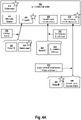
- Figures 4A-3C show different examples 400, 420, 430 for the content of a check-in QR code. If a graphical code is not used to transmit a user's check-in data to the venue device, but for example a near-field signal, the designated data is not in the form of a graphical code but as a near-field signal, for example a Bluetooth signal , represented.
- the user device can have its own clock, in particular a real-time clock, and/or receive a current time regularly via the network from a time server.
- the user device records a current time value 404 and performs a derivation function on this time value 404 and the user ID 302 to obtain a trace ID 406.
- This derivation preferably enters a tracing secret 410, which can be a random value, for example, which is assigned to the user in the course of registration and stored securely on the user device.
- the type of derivation function preferably ensures that the user ID does not emerge from the trace ID in plain text and it is preferably also not evident from the trace IDs whether they belong to the same or different users.
- the fact that current time information 404 is included in the trace ID 406 is symbolized by the asterisk.
- venues each represented by one or more venue devices, can also register with the server.
- the data stored in the course of registration may include: name of the location, name and e-mail of the contact person, address of the location, coordinates of the location and/or check-in radius.
- the record 400 as in Figure 4A 4 also includes encrypted credentials 408 formed by using an entity's public encryption key 332 to encrypt the user's user ID 302 and the user-specific decryption key 310 (e.g., the symmetric user data key).
- the ID data 408, in which the user ID is contained in encrypted form, means that this check-in data record can be assigned to a specific user, but only for a party who can decrypt the ID data 408 (i.e. the entity). However, since the ID card data only contains the user ID and not the entire user data 314 , they are so small that they are suitable for coding within a QR code.
- the office decrypts the encrypted ID card data 408 with its private entity key, it not only learns the user ID of the user to which this check-in data record 400 belongs, but also receives the decryption key 310, which is necessary to access the user's contact data get to know.
- the QR code data record 400 can also contain a verification data value 414, which offers additional protection since it allows the entity to check whether the check-in data record has been tampered with.
- the verification data value 414 is generated by encrypting the trace ID 406 and the encrypted identification data 408 with a user verification secret 412 .
- the user verification secret is preferably a random number that is generated in the course of the user's registration on the server and is stored in a protected manner in a memory of the user's user device. So if an unauthorized user should try to steal another user's trace ID and use a manipulated check-in record with the stolen trace ID, the unauthorized user would not be able to use the verification data value matching this trace ID 414 as long as the unauthorized user does not also gain possession of the user device of the authorized user, since the user verification secret 412 required to derive the verification data value 414 is only stored there.
- the user device is configured to regularly check whether the currently generated check-in data is still up to date. If the trace ID derivation function always uses the current time rounded down to the minute as a time stamp 404 to derive the trace ID 406, a QR code or check-in data record 400 is considered obsolete as soon as the new minute has begun . In this case, the user device automatically discards the current check-in data record 400 or the QR code 400 and, as described above, generates a new, current check-in data record based on the current time information 404, i.e. based on the newly started rounded data, for example Minute.
- the check-in data record 400 can be generated by the user device without that this is transmitted to a venue device and does not contain information about a QR code version or other technical parameters for data transmission to a venue device. Rather, such a data set can then be directly linked to the enriched with the Venue ID received from the user device and transmitted to the server as a complete check-in data set.
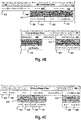
- FIG 4B a check-in record 420 or a QR code that encodes it is shown according to a further embodiment.
- Data values or keys of data record 420 which correspond in terms of content and/or function to one of the data values or keys of data record 400 are identified by the same reference numbers.
- the first two lines of the data structure of the Figure 4B show the part of the check-in data record 420 as it is transmitted to the venue device (in the check-in variants with a venue device).
- the boxes below represent input data values or keys used to generate corresponding elements of data set 420.
- the data structure 420 contains further optional data values such as the version 402 of the algorithm used to generate the QR code ("QR code version"), the device type of the user device, an identifier of the (daily updated) asymmetric cryptographic entity key pair, whose public part was used to encrypt the ID card data, etc.
- QR code version the version 402 of the algorithm used to generate the QR code
- device type of the user device the device type of the user device
- an identifier of the (daily updated) asymmetric cryptographic entity key pair whose public part was used to encrypt the ID card data, etc.
- a check-out time can also be included.
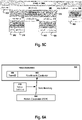
- FIG 4C a check-in record 430 or a QR code that encodes it is shown according to a further embodiment.
- the user verification data value 414 is indirectly derived from the current time (via the trace ID).
- Figures 5A-5C show various examples for the generation and storage of check-in data as they are stored on the server.
- the venue device receives a check-in data record 400, 420, 430 from the user's user device.
- the data contained in the received data record can be linked as it is with other data, in particular the venue ID, in order to obtain a complete check-in data record that is stored on the server.
- the server's check-in records can look like the records 400, 420, 430, each linked to further data, in particular the venue ID of the venue of the venue device.
- check-in records may actually be check-out records, and may include check-out time 504 in addition to or as an alternative to check-in time 404 .
- the venue device carries out further data processing steps with the check-in data 400, 420, 430 received from the user device in order to generate the finished check-in data records to be transmitted to the server on the basis of the check-in data records received from the user device to create.
- each venue can be assigned a symmetric or asymmetric key pair during registration, and the venue device can use the private part of the key pair (in the asymmetric case) to decode at least parts of each check-in record (apart from the trace ID, which must be in plain text) to encrypt.
- Some parts of the check-in data record are therefore available in double or even triple encrypted form: for example, the ID card data 408 was generated with the public key 332 of the entity; it can optionally also be encrypted with the user data key 310 of the user, and optionally also with the public venue key.
- the venue device can, for example, also encrypt the time stamp 404, the user verification data value 414 and other data with the private venue key 512 in order to obtain the encrypted check-in data 506, which are uploaded to the server 202 .
- Figures 5B and 5C show further alternative variants for check-in data sets as they are stored on the server (first two lines) as well as the data values and keys below that are used to form the values stored on the server.
- the event location i.e. the venue device, first checks after receipt of check-in data whether the time stamp 404 is more recent and does not carry out any further validation.
- the encrypted check-in data 506 can be formed in that the app 218 generates a signal for the transmission of the trace ID for each check-in, which is transmitted by direct communication, for example by displaying a QR code, with a ephemeral ECC key pair secp256r1 and an encryption key are preferably formed for each new QR code.
- the trace ID 406 can be e.g. an HMAC-SHA256, which is derived from the user ID 302 and the current time stamp 404 (rounded down to the current minute) as (input) data and the user trace secret as a key and to which first 16 bytes is truncated.
- the total payload is 94 bytes, which are simply concatenated and then encoded with ASCII85 as QR code content.
- the ephemeral key pair can be discarded.
- the venue encrypts the encrypted data received from the user device, the ephemeral public key and the verification tag using e.g. AES-128-CBC with the ECDH of an ephemeral key pair and the venue's public key.
- Venue creates an authentication key using HMAC-SHA256 with trace ID 406 as data and verification data value ("verification tag") 414 as key.
- the venue will upload the check-in time, encrypted data and authentication key to the server.
- the generation of in the figures 4 and 5 The data structures shown can, for example, be such that the app 218 generates a trace ID for each new QR code on the user device.
- the trace ID is an HMAC-SHA256 derived from the user ID and the current timestamp (rounded down to the current minute) as data and the user tracing secret as key, truncated to the first 16 bytes).
- the Userld and UserDataKey are encrypted using the asymmetric encryption scheme described above for the current DailyPublicKey, with the IV in records 420 and 520 of the Figures 4B and 5B is defined as the first 16 bytes of the ephemeral PublicKey.
- the app 218 generates a QR code with the following content (which is updated every minute with the current time stamp) (see Figure 4B and C ): App Badge Data, QR Code Version (1 byte), Device Type (1 byte), Key ID (2 bytes) (indicates which DailyPublicKey was used), Time Stamp (4 bytes), Trace ID (16 bytes), encrypted data (32 bytes) (userDataKey and user ID encrypted according to the asymmetric scheme described above for the entity public key with the first 16 bytes of the ephemeral publicKey as IV), ephemeral public key (33 bytes), and verification tag (8 bytes) (HMAC-SHA256 with timestamp and encrypted data as data and user's verification secret as key, truncated to the first 8 bytes).
- the total payload is 95 bytes, which are simply concatenated and then encoded with ASCII85 as QR code content.
- the venue device at the venue will first extract the received encrypted data from the received QR code.
- the venue device then preferably checks that the check-in timestamp 404 contained in the code is up-to-date and discards the code if the timestamp is older than a maximum age, e.g. 30 seconds.
- the venue device can create the following data record, e.g. using encryption of concatenated values (
- venuePublicKey This creates the encCheckInData value.
- the user device uploads the following data to the server: trace ID, venue device ID, timestamp, encCheckInData.
- the server saves e.g. at least the trace ID, the venue ID ("locationID" or "scannerID”), check-in time, the encrypted data encCheckINData, the mac value, iv and the ephPublicKey.
- the venue operator only provides a carrier object, e.g., a table display with a QR code that encodes the venue ID of the venue.
- the user scans the QR code containing a URL with their smartphone.
- the URL includes a venue ID, and reading the URL causes the app 218 to retrieve the venue's information from the server 202, as well as optional ancillary venue data.
- the app 218 can register this URL as a universal URL (deep link) and obtain the venue ID and the venuePublicKey from the server via this deep link.
- this data is already encoded in the QR code.
- the app 218 then generates all QR code information as described above and processes it like the venue device described above (re-encrypt QR code data with venuePublicKey 512 and include the trace ID, venue ID, check-in time, encrypted data, mac, iv and upload the ephemeral public key to the server).
- Figures 6A , 6B show examples of additional venue data 600, 620.
- the additional venue data can only be stored locally on the venue devices and/or on the server linked to the venue IDs.
- the additional data is data relating to the user and/or their environment during the check-in process.
- the additional data can contain further information that the operator of the venue needs in order to automatically provide the user with certain services during his stay in the venue and/or to document and/or organize the visit in venue-related management software.
- the additional data can contain a table number and designate the table at which a guest sits.
- the additional data can relate to a service or a ride that the visitor has selected via an app on his user device and/or to data that is used, for example, to initiate an automatic payment process.
- the venue device can send a request to the user device, thereby causing the user device to request the user to enter further additional data via a graphical user interface.
- the user enters the data relevant to the venue (table number, booked ride, additional or service features, age of the user, etc.), and the user device then generates a data object (e.g. in JSON format) that contains the data entered by the user , and sends it back to the venue device.
- a data object e.g. in JSON format
- the applications 218 on the user device and the application 230 on the venue device can be implemented as interoperable applications of a distributed software system for privacy-compliant and secure tracking of visitors.
- the additional venue data 604 is preferably stored in encrypted form 602 locally and/or on the server linked to a trace ID 406 of the check-in process in the context of which the additional data was recorded.
- a venue-specific encryption key 512 can be used for encryption so that the server cannot access the data or only with the consent of the venue operator.
- the storage of the additional venue data can be advantageous since the whereabouts of the visitor can be reconstructed even more precisely on the basis of, for example, the table number or the selected amusement park ride.
- the user device can also generate additional user data during a check-in process, which is encrypted with the UserDataKey (i.e. the user-specific (public asymmetric or symmetric) encryption key of this user and/or with the entity key.
- This additional data is about it is data that is also in the context of the check-in process and which can facilitate the subsequent tracing of this user and/or his companions or contact persons.
- the app 218 can be designed to detect the user at check-in (or before) to specify which companion will enter the Venue and/or which other persons in the Venue should be visited, i.e.
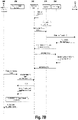
- figure 7 shows a UML diagram of an example of the tracing method.
- the persons or system components represented by the dashed lines correspond to those in figure 2 components shown.
- the method for tracing a user integrates the entire process from the first contact of an infected guest with the health department to the disclosure of the contact details of possible contact persons to the department. In order to find the contact persons, the health department needs the TAN of an infected person.
- figure 7 illustrates the case where a user (guest) who has visited various venues in the past has received a test result according to which the user is or at least was infected with a contagious disease (e.g. Covid 19).
- the user, the doctor or the laboratory communicates this test result to the health authority.
- the infected guests will be contacted by the local health authority.
- the health department employee After contacting the infected guest, the health department employee enters the TAN in the health department’s front-end application.
- the employee is registered, e.g. using his certificate generated during the registration process, which verifies the identity of the user.
- the healthcare worker In order for the process to begin, the healthcare worker needs access to all relevant DailyKeypairs from the health department. Therefore, he fetches the encrypted, daily newly created asymmetric key pair of the Health Department (HealthDepartmentEncryptionKeyPair), which he can decrypt with his personal private encryption key. Using the locally decrypted healthDepartmentEncryptionKeyPair, it can retrieve and read the EncryptedDailyKeypairs.
- HealthDepartmentEncryptionKeyPair asymmetric key pair of the Health Department
- obtaining the entity keys can also be simpler and include reading the private entity key.
- the employee at the office After the registered employee has received the TAN from the user, e.g. by telephone, e-mail or post, the employee at the office sends a tracing request to the server, with the request containing the TAN.
- the server identifies the stored tracing secret transfer object linked to the TAN and makes it available to the authority employee for download.
- the transfer object is preferably encrypted with the current public key of the health department and is decrypted by the employee of the department with the corresponding private key.
- the decrypted secrets of the tracing secret transfer object now available to the health authority contain the Userld and the UserTracingSecret of the user to be traced, so that the authority (i.e. an entity device that is assigned to the authority) can use the candidate tracing IDs of this guest for e.g. the last 14 days (20,160 candidate trace IDs).
- the health department sends a request to the server containing the calculated candidate tracing IDs.
- the server searches its check-in data records in its database and determines all venue IDs of all check-in data records whose trace IDs are identical to one of the candidate trace IDs transmitted in the request. The contact details of these identified venues are returned to the office by the server.
- the public health department can then request the venues (venues or the venue devices) to grant access to all check-in records that were at the venue at the same time as the infected users.
- the venues are contacted, e.g. by email, to inform them about the ongoing tracing process and to ask for the release of the check-in data records related to this venue.
- the venue device If the venue agrees, it will download all check-in records (or all check-in records up to a maximum age if the check-in time is contained in plain text in the check-in records) originating from this venue , decrypt them and, for example, use the time stamp 404 to check which guests could be contact persons. Then the venue device uploads the check-in data of the possible contact persons (whose sensitive data like the ID data are still encrypted with the entity's DailyPublicKey) to the server, which forwards this data to the health department. In an alternative embodiment, the venue device can also send the data decrypted with the private venue key directly to the entity device.
- This detour via the venue is only necessary in embodiments in which the check-in data records are additionally encrypted with the public venue key and the venue has to decrypt the check-in data records again with the corresponding decryption key so that the entity can process them. If the check-in data is not additionally encrypted with the venue key, it is also possible for the check-in data records of the possible contact persons encrypted with the entity key to be transmitted directly from the server to the entity device.
- the entity device After the entity device has received all check-in records of the possible contact persons in the period in question and these are not (or no longer) encrypted with the venue key, the entity device can decrypt these check-in records with the corresponding DailyPrivateKeys of the entity.
- the entities device can receive the Request encrypted user data records of these possible contact persons and decrypt them with the respective user-specific UserDataKeys and contact these users.
- the office cannot carry out any tracing for these contact persons as long as they do not make their tracing secret transfer object available to the office.
- the health authority can now also verify the integrity of the check-in with the verification secret.
- the user's personal data is encrypted at all times and can only be read by persons who have knowledge of the UserDataKey.
- the userDataKey can only be obtained by the user themselves or in encrypted form from a venue device that has scanned a user's check-in QR code. All decryption processes are preferably carried out locally by the respective system components.
- all data stored on the server and/or the system components is in some way signed/mac'ed by the owner of the data (i.e. has been input a MAC function to calculate a mac value) so that no employee can change the data.
Landscapes
- Engineering & Computer Science (AREA)
- Business, Economics & Management (AREA)
- Health & Medical Sciences (AREA)
- Public Health (AREA)
- Human Resources & Organizations (AREA)
- Economics (AREA)
- General Health & Medical Sciences (AREA)
- Tourism & Hospitality (AREA)
- Medical Informatics (AREA)
- Primary Health Care (AREA)
- Strategic Management (AREA)
- Biomedical Technology (AREA)
- General Business, Economics & Management (AREA)
- Theoretical Computer Science (AREA)
- Entrepreneurship & Innovation (AREA)
- General Physics & Mathematics (AREA)
- Physics & Mathematics (AREA)
- Epidemiology (AREA)
- Marketing (AREA)
- Development Economics (AREA)
- Educational Administration (AREA)
- Databases & Information Systems (AREA)
- Pathology (AREA)
- Data Mining & Analysis (AREA)
- Game Theory and Decision Science (AREA)
- Operations Research (AREA)
- Quality & Reliability (AREA)
- Management, Administration, Business Operations System, And Electronic Commerce (AREA)
Priority Applications (3)
| Application Number | Priority Date | Filing Date | Title |
|---|---|---|---|
| EP20210115.0A EP4006796A1 (fr) | 2020-11-26 | 2020-11-26 | Système électronique de suivi des utilisateurs, en particulier permettant de lutter contre une pandémie |
| PCT/EP2021/076810 WO2022069551A1 (fr) | 2020-09-29 | 2021-09-29 | Système électronique de traçage d'utilisateurs, en particulier pour lutter contre une pandémie |
| EP21786814.0A EP4172899B1 (fr) | 2020-09-29 | 2021-09-29 | Système électronique de suivi des utilisateurs, en particulier permettant de lutter contre une pandémie |
Applications Claiming Priority (1)
| Application Number | Priority Date | Filing Date | Title |
|---|---|---|---|
| EP20210115.0A EP4006796A1 (fr) | 2020-11-26 | 2020-11-26 | Système électronique de suivi des utilisateurs, en particulier permettant de lutter contre une pandémie |
Publications (1)
| Publication Number | Publication Date |
|---|---|
| EP4006796A1 true EP4006796A1 (fr) | 2022-06-01 |
Family
ID=73598792
Family Applications (1)
| Application Number | Title | Priority Date | Filing Date |
|---|---|---|---|
| EP20210115.0A Pending EP4006796A1 (fr) | 2020-09-29 | 2020-11-26 | Système électronique de suivi des utilisateurs, en particulier permettant de lutter contre une pandémie |
Country Status (1)
| Country | Link |
|---|---|
| EP (1) | EP4006796A1 (fr) |
-
2020
- 2020-11-26 EP EP20210115.0A patent/EP4006796A1/fr active Pending
Non-Patent Citations (4)
| Title |
|---|
| ERHARDT CHRISTIAN: "Corona-App: Wie Jena Restaurantbesuche bald wieder ermöglichen will", KOMMUNAL.DE, 9 November 2020 (2020-11-09), XP055797713, Retrieved from the Internet <URL:https://kommunal.de/jena-restaurantbesuche> [retrieved on 20210421] * |
| GILLES BARTHE ET AL: "PanCast: Listening to Bluetooth Beacons for Epidemic Risk Mitigation", ARXIV.ORG, CORNELL UNIVERSITY LIBRARY, 201 OLIN LIBRARY CORNELL UNIVERSITY ITHACA, NY 14853, 16 November 2020 (2020-11-16), XP081815091 * |
| LEONIE REICHERT ET AL: "Lighthouses: A Warning System for Super-Spreader Events", vol. 20201124:122446, 24 November 2020 (2020-11-24), pages 1 - 8, XP061041740, Retrieved from the Internet <URL:http://eprint.iacr.org/2020/1473.pdf> [retrieved on 20201124] * |
| VERSION ET AL: "CrowdNotifier Decentralized privacy-preserving presence tracing", 8 October 2020 (2020-10-08), XP055797686, Retrieved from the Internet <URL:https://github.com/CrowdNotifier/documents/raw/b3340baa3c5345b2379710a44778dad13fb41df4/CrowdNotifier%20-%20White%20Paper.pdf> [retrieved on 20210421] * |
Similar Documents
| Publication | Publication Date | Title |
|---|---|---|
| US11468408B2 (en) | Building automation system with visitor management | |
| DE102018007534A1 (de) | Zeitgebundener sicherer Zugang | |
| CN108961475B (zh) | 一种门禁部署方法及门禁部署服务器 | |
| DE102016125808B4 (de) | Peer-gestützte offline-Übermittlung von Benachrichtigungen | |
| US20040153553A1 (en) | System and method for use of mobile wireless devices for authentication of personal identification and registration with security network | |
| EP2646940B1 (fr) | Procédé d'affichage localement restreint de contenus lisibles sur un lecteur mobile | |
| DE112017003354T5 (de) | Vorrichtung und verfahren zum schaffen von benutzerkonfiguriertenvertrauensdomänen | |
| CN110570559A (zh) | 基于移动终端的门禁系统中电子钥匙分享方法 | |
| CN114863597B (zh) | 一种基于可信条码的出入管理方法、系统和装置 | |
| CN109614430A (zh) | 基于wlan的可配置数据采集及数据校验系统和方法 | |
| CN120748081A (zh) | 一种智慧高校访客预约系统 | |
| KR20200042896A (ko) | 정보 상호작용 방법 및 시스템 | |
| CN114862630B (zh) | 一种基于可信条码的网约房管理方法及系统 | |
| US20220328174A1 (en) | Centralized system for vaccination verification, inventory management, and analysis | |
| EP4172899B1 (fr) | Système électronique de suivi des utilisateurs, en particulier permettant de lutter contre une pandémie | |
| EP4006796A1 (fr) | Système électronique de suivi des utilisateurs, en particulier permettant de lutter contre une pandémie | |
| DE202021100724U1 (de) | Verifikationssystem zum Verifizieren einer qualifizierten Testung | |
| KR102479988B1 (ko) | 사용자 의사정보 식별자를 생성하는 방법 및 이를 위한 시스템 | |
| CN115190122B (zh) | 基于区块链的行程关联方法、装置、设备及存储介质 | |
| CN111402468A (zh) | 电子钥匙生成方法、装置、计算机设备和计算机存储介质 | |
| KR102479989B1 (ko) | 비밀성이 제고된 온라인 투표 방법 및 이를 위한 시스템 | |
| JP2016224577A (ja) | 入局管理システムおよび入局管理方法 | |
| WO2021204313A1 (fr) | Système de suivi assurant la confidentialité | |
| TWI541750B (zh) | 行動打卡系統與方法及其雲端系統 | |
| KR102779426B1 (ko) | 도시정비사업의 총회 관리 서비스 제공 시스템 |
Legal Events
| Date | Code | Title | Description |
|---|---|---|---|
| PUAI | Public reference made under article 153(3) epc to a published international application that has entered the european phase |
Free format text: ORIGINAL CODE: 0009012 |
|
| STAA | Information on the status of an ep patent application or granted ep patent |
Free format text: STATUS: THE APPLICATION HAS BEEN PUBLISHED |
|
| STAA | Information on the status of an ep patent application or granted ep patent |
Free format text: STATUS: REQUEST FOR EXAMINATION WAS MADE |
|
| AK | Designated contracting states |
Kind code of ref document: A1 Designated state(s): AL AT BE BG CH CY CZ DE DK EE ES FI FR GB GR HR HU IE IS IT LI LT LU LV MC MK MT NL NO PL PT RO RS SE SI SK SM TR |
|
| 17P | Request for examination filed |
Effective date: 20220517 |
|
| RBV | Designated contracting states (corrected) |
Designated state(s): AL AT BE BG CH CY CZ DE DK EE ES FI FR GB GR HR HU IE IS IT LI LT LU LV MC MK MT NL NO PL PT RO RS SE SI SK SM TR |
|
| STAA | Information on the status of an ep patent application or granted ep patent |
Free format text: STATUS: EXAMINATION IS IN PROGRESS |
|
| 17Q | First examination report despatched |
Effective date: 20241014 |