EP4006834B1 - Détection de panneaux de carrosserie à l'aide de l'apprentissage automatique - Google Patents
Détection de panneaux de carrosserie à l'aide de l'apprentissage automatique Download PDFInfo
- Publication number
- EP4006834B1 EP4006834B1 EP21208984.1A EP21208984A EP4006834B1 EP 4006834 B1 EP4006834 B1 EP 4006834B1 EP 21208984 A EP21208984 A EP 21208984A EP 4006834 B1 EP4006834 B1 EP 4006834B1
- Authority
- EP
- European Patent Office
- Prior art keywords
- image
- damage
- neural network
- areas
- hail
- Prior art date
- Legal status (The legal status is an assumption and is not a legal conclusion. Google has not performed a legal analysis and makes no representation as to the accuracy of the status listed.)
- Active
Links
Images




Classifications
-
- G—PHYSICS
- G06—COMPUTING OR CALCULATING; COUNTING
- G06T—IMAGE DATA PROCESSING OR GENERATION, IN GENERAL
- G06T7/00—Image analysis
- G06T7/0002—Inspection of images, e.g. flaw detection
- G06T7/0004—Industrial image inspection
-
- G—PHYSICS
- G06—COMPUTING OR CALCULATING; COUNTING
- G06F—ELECTRIC DIGITAL DATA PROCESSING
- G06F30/00—Computer-aided design [CAD]
- G06F30/20—Design optimisation, verification or simulation
- G06F30/27—Design optimisation, verification or simulation using machine learning, e.g. artificial intelligence, neural networks, support vector machines [SVM] or training a model
-
- G—PHYSICS
- G06—COMPUTING OR CALCULATING; COUNTING
- G06N—COMPUTING ARRANGEMENTS BASED ON SPECIFIC COMPUTATIONAL MODELS
- G06N3/00—Computing arrangements based on biological models
- G06N3/02—Neural networks
- G06N3/04—Architecture, e.g. interconnection topology
- G06N3/0464—Convolutional networks [CNN, ConvNet]
-
- G—PHYSICS
- G06—COMPUTING OR CALCULATING; COUNTING
- G06N—COMPUTING ARRANGEMENTS BASED ON SPECIFIC COMPUTATIONAL MODELS
- G06N3/00—Computing arrangements based on biological models
- G06N3/02—Neural networks
- G06N3/04—Architecture, e.g. interconnection topology
- G06N3/0475—Generative networks
-
- G—PHYSICS
- G06—COMPUTING OR CALCULATING; COUNTING
- G06N—COMPUTING ARRANGEMENTS BASED ON SPECIFIC COMPUTATIONAL MODELS
- G06N3/00—Computing arrangements based on biological models
- G06N3/02—Neural networks
- G06N3/08—Learning methods
-
- G—PHYSICS
- G06—COMPUTING OR CALCULATING; COUNTING
- G06N—COMPUTING ARRANGEMENTS BASED ON SPECIFIC COMPUTATIONAL MODELS
- G06N3/00—Computing arrangements based on biological models
- G06N3/02—Neural networks
- G06N3/08—Learning methods
- G06N3/09—Supervised learning
-
- G—PHYSICS
- G06—COMPUTING OR CALCULATING; COUNTING
- G06N—COMPUTING ARRANGEMENTS BASED ON SPECIFIC COMPUTATIONAL MODELS
- G06N3/00—Computing arrangements based on biological models
- G06N3/02—Neural networks
- G06N3/08—Learning methods
- G06N3/094—Adversarial learning
-
- G—PHYSICS
- G06—COMPUTING OR CALCULATING; COUNTING
- G06V—IMAGE OR VIDEO RECOGNITION OR UNDERSTANDING
- G06V10/00—Arrangements for image or video recognition or understanding
- G06V10/20—Image preprocessing
- G06V10/25—Determination of region of interest [ROI] or a volume of interest [VOI]
-
- G—PHYSICS
- G06—COMPUTING OR CALCULATING; COUNTING
- G06V—IMAGE OR VIDEO RECOGNITION OR UNDERSTANDING
- G06V10/00—Arrangements for image or video recognition or understanding
- G06V10/70—Arrangements for image or video recognition or understanding using pattern recognition or machine learning
- G06V10/764—Arrangements for image or video recognition or understanding using pattern recognition or machine learning using classification, e.g. of video objects
-
- G—PHYSICS
- G06—COMPUTING OR CALCULATING; COUNTING
- G06V—IMAGE OR VIDEO RECOGNITION OR UNDERSTANDING
- G06V10/00—Arrangements for image or video recognition or understanding
- G06V10/70—Arrangements for image or video recognition or understanding using pattern recognition or machine learning
- G06V10/82—Arrangements for image or video recognition or understanding using pattern recognition or machine learning using neural networks
-
- G—PHYSICS
- G06—COMPUTING OR CALCULATING; COUNTING
- G06V—IMAGE OR VIDEO RECOGNITION OR UNDERSTANDING
- G06V20/00—Scenes; Scene-specific elements
-
- G—PHYSICS
- G06—COMPUTING OR CALCULATING; COUNTING
- G06T—IMAGE DATA PROCESSING OR GENERATION, IN GENERAL
- G06T2207/00—Indexing scheme for image analysis or image enhancement
- G06T2207/10—Image acquisition modality
- G06T2207/10004—Still image; Photographic image
- G06T2207/10012—Stereo images
-
- G—PHYSICS
- G06—COMPUTING OR CALCULATING; COUNTING
- G06T—IMAGE DATA PROCESSING OR GENERATION, IN GENERAL
- G06T2207/00—Indexing scheme for image analysis or image enhancement
- G06T2207/20—Special algorithmic details
- G06T2207/20081—Training; Learning
-
- G—PHYSICS
- G06—COMPUTING OR CALCULATING; COUNTING
- G06T—IMAGE DATA PROCESSING OR GENERATION, IN GENERAL
- G06T2207/00—Indexing scheme for image analysis or image enhancement
- G06T2207/20—Special algorithmic details
- G06T2207/20084—Artificial neural networks [ANN]
-
- G—PHYSICS
- G06—COMPUTING OR CALCULATING; COUNTING
- G06T—IMAGE DATA PROCESSING OR GENERATION, IN GENERAL
- G06T2207/00—Indexing scheme for image analysis or image enhancement
- G06T2207/30—Subject of image; Context of image processing
- G06T2207/30108—Industrial image inspection
- G06T2207/30156—Vehicle coating
-
- G—PHYSICS
- G06—COMPUTING OR CALCULATING; COUNTING
- G06T—IMAGE DATA PROCESSING OR GENERATION, IN GENERAL
- G06T2207/00—Indexing scheme for image analysis or image enhancement
- G06T2207/30—Subject of image; Context of image processing
- G06T2207/30248—Vehicle exterior or interior
- G06T2207/30252—Vehicle exterior; Vicinity of vehicle
-
- G—PHYSICS
- G06—COMPUTING OR CALCULATING; COUNTING
- G06V—IMAGE OR VIDEO RECOGNITION OR UNDERSTANDING
- G06V2201/00—Indexing scheme relating to image or video recognition or understanding
- G06V2201/08—Detecting or categorising vehicles
Definitions
- Repairing damage to bodywork is a common task undertaken by repair shops and garages world-wide. In the mid-western US alone approximately 20 000 insurance claims relating to hail damage are filed every year. Repair shops therefore need to assess damage associated with hail storms and other body-work damage in an efficient manner.
- a hybrid 3D optical scanning system can be used for damage detection.
- An example 3D system may combine methodologies of active stereo 3D reconstruction and deflectometry to provide accurate 3D surface measurements of an object under inspection.
- Such techniques require a relatively long inspection time and are limited in their ability to detect all damage on a portion of a vehicle, especially at the edges of panels. As the accuracy is not sufficiently reliable manual verification is required, which further increases the time required to complete an inspection.
- Deep Learning Model to Classify Hail Damage Claims GadgEon Engineering Smartness (22 June 2020), retrieved from the Internet, URL: https://www.gadgeon.com/ web/images/story/doc/2731_deep-learningmodel-to-classify-hail-damage-claims_success_story.pdf describes a neural network model to classify dents caused by hail-storm.
- US 10,521,952 describes a three-dimensional imaging system that can be used in the hail damage assessment of vehicles.
- US 2017/0352104 describes systems and methods for automatically determining and publishing damage information.
- KR 102148884B1 describes a system and method for analyzing damage to a vehicle that calculates repair information according to a type and degree of damage for each part using an accident image of the vehicle.
- This specification describes a neural network system implemented as computer programs on one or more computers in one or more locations that is configured process images to generate a damage density estimate.
- a method including, receiving an image of at least a section of a vehicle, processing the received image using damage detection neural network to detect a plurality of hail damage areas on the section of the vehicle and to classify each of the plurality of areas of damage according to the seriousness of the damage, wherein, detecting a plurality of hail damage includes, detecting a plurality of damaged areas distributed over the entire section of the vehicle, and differentiating the plurality of damaged areas from one or more areas of noise, processing the received image using a further neural network to classify one or more sections of the vehicle as one or more panels of the vehicle bodywork, and using the detected areas of damage, the classification of the seriousness of the damage and the classification of one or more panels to compute a panel damage density estimate.
- the received image is selected from one of a monocular image or a stereo image.
- processing the converted image using a generator neural network to generate a modified image wherein the generator neural network has been trained jointly with a discriminator neural network to generate modified images that have reduced image noise relative to input images to the generator neural network.
- the plurality of areas of damage are one or more dents in the panels of the vehicle bodywork.
- the seriousness of the damage is classified according to the depth and density of the dents.
- the first neural network is trained on a data set comprising a mix of image formats
- the further neural network is trained on a data set comprising a mix of image formats
- the mix of image formats include one or more 3D geometry files.
- the one more 3D geometry files are augmented with simulated hail damage, the simulated hail damage simulated using hail impact analysis.
- detecting a plurality of hail damage further comprises differentiating the plurality of damaged areas from one or more sources of noise.
- the one or more sources of noise are selected from dust particles, dirt and specular reflection.
- a system including, one or more cameras,
- one or more computing devices and one or more storage devices storing instructions that when executed by the one or more computers cause the one or more computers to perform operations comprising, receiving an image of at least a section of a vehicle, processing the received image using damage detection neural network to detect a plurality of hail damage areas on the section of the vehicle and to classify each of the plurality of areas of damage according to the seriousness of the damage, wherein, detecting a plurality of hail damage comprises, detecting a plurality of damaged areas distributed over the entire section of the vehicle, and differentiating the plurality of damaged areas from one or more areas of noise, processing the received image using a further neural network to classify one or more sections of the vehicle as one or more panels of the vehicle bodywork, and
- the one or more cameras comprise at least two cameras and the image is a composite stereo 3D image generated from the at least two cameras
- the one or more cameras comprise a cell-phone camera.
- one or more cameras are located at a first location and the one or more computing and one or more storage devices are located at a second location.
- one or more non-transitory computer-readable media storing instructions that when executed by one or more computers cause the one or more computers to perform operations comprising, receiving an image of at least a section of a vehicle, processing the received image using damage detection neural network to detect a plurality of hail damage areas on the section of the vehicle and to classify each of the plurality of areas of damage according to the seriousness of the damage, wherein, detecting a plurality of hail damage comprises, detecting a plurality of damaged areas distributed over the entire section of the vehicle, and differentiating the plurality of damaged areas from one or more areas of noise, processing the received image using a further neural network to classify one or more sections of the vehicle as one or more panels of the vehicle bodywork, and using the detected areas of damage, the classification of the seriousness of the damage and the classification of one or more panels to compute a panel damage density estimate.
- a method comprising, receiving an image of at least a section of a vehicle, generating an input to a neural network from the received image by converting the received image to a binary image, processing the converted image using a generator neural network to generate a modified image, wherein the generator neural network has been trained jointly with a discriminator neural network to generate modified images that have reduced image noise relative to input images to the generator neural network, and processing the converted image using a further neural network to classify one or more sections of the vehicle as one or more panels of the vehicle bodywork.
- the received image is a CAD image.
- the one more CAD images are augmented with simulated hail damage, the simulated hail damage simulated using hail impact analysis.
- the method includes using the processed image as input to a damage detection neural network.
- the modified image is used as a training input to one or more of a damaged detection neural network and a neural network to classify one or more sections of the vehicle.
- FIG. 1 shows a flow diagram of an example process 100 for damage detection.
- the process 200 is performed by an appropriately programmed system of one or more computers located in one or more locations, e.g., a system for detecting damage, the system for detecting damage, receives 102 an image of at least a section of a vehicle.
- the image can be an image of a part or parts of a vehicle, e.g. fender, door, wheel arch etc.
- the image may be a three-dimensional stereo image, monocular image or other appropriate image.
- the system processes 104 the received image to detect a plurality of hail damage areas on the section of the vehicle and to classify each of the plurality of areas of damage according to the seriousness of the damage.
- Detecting the plurality of hail damage areas can include detecting a plurality of damaged areas distributed over the entire section of the vehicle and differentiating the plurality of damaged areas from one or more areas of noise, the detection may be done using a neural network or other machine learning technique.
- Sources of noise include dust particles, dirt, specular reflection, flaws in paint etc.
- the system further processes 106 the received image using a further neural network to classify one or more sections of the vehicle as one or more panels of the vehicle bodywork.
- the system can use the detected areas of damage, the classification of the seriousness of the damage and the classification of one or more panels to compute 108 a panel damage density estimate (see, for example, table 1).
- Table 1 Dent size classification Panel type Small Medium Large Total per Panel Density per panel Left Front Door 200 20 25 245 0.314 Left Rail 5 25 15 45 0.058 Left Front Fender 56 7 9 72 0.092
- the received image may be pre-processed to generate a standard image, for example a binary image.
- the binary image may also have noise removed.
- Pre-processing may include converting the image using a generator neural network to generate a modified image, wherein the generator neural network has been trained jointly with a discriminator neural network to generate modified images that have reduced image noise relative to input images to the generator neural network. Pre-processing is described in more detail with respect to FIG. 4 and FIG. 5 below.
- the system processes the received image using a neural network, for example, a masked R-CNN.
- a masked RCNN is one example of an appropriate technique for classifying hail damage according the size and seriousness of the damage, the skilled person will be aware that other implementations are possible, for example, other neural network implementations e.g. Fast RCNN, Yolo, or non-neural network based Machine Learning techniques e.g. random forests, gradient boosting etc.
- a masked R-CNN is a deep neural network. It consists of a bottom-up pathway, a top-bottom pathway and lateral connections.
- the bottom-up pathway can be any convolutional neural network which extracts features from raw images e.g. ResNet, VGG etc.
- the top-bottom pathway (e.g. forward pass) generates a feature map.
- the forward pass of the CNN results in feature maps at different layers i.e. builds s multi-level representation at different scales. Top-down features are propagated to high resolution feature maps thus having features across all levels
- the Lateral connections are convolution and adding operations between two corresponding levels of the two pathways.
- the masked R-CNN proposes regions of interest in a feature map by using a selective search to generate region proposals for each image using a Region Prediction Network (RPN).
- RPN Region Prediction Network
- the masked R-CNN uses a region of interest pooling layer to extract feature maps from each region of interest and performs classification and bounding box detection on the extracted feature maps.
- the pooling layer converts each variable size region of interest into a fixed size to be fed to a connected layer by performing segmentation and pooling e.g. max-pooling.
- Bounding box regression is used to refine the bounding boxes such that class labels and bounding boxes are predicted.
- the R-CNN uses a region of interest alignment layer.
- the region of interest alignment layer takes the proposed region of interest and dividing it into a specified number of equal size boxes and applying bilinear interpolation inside each box to compute the exact values of the input features at regularly sampled locations, e.g. 4 regularly sampled locations.
- the masked R-CNN can further generate a segmentation mask.
- An intersection over union (IoU) is computed for each bounding box with a ground truth bounding box. Where the IoU of a bounding box with a ground truth bounding box is greater than a threshold level the bounding box is selected as a region of interest.
- the masked R-CNN can then further encode a binary mask per class for each region of interest.
- a plurality of areas of hail damage can be detected on a received image of at least a section of a vehicle using the masked R-CNN.
- the plurality of bounding boxes can be used to generate a count of the number of detections of hail damage in the received image and the size of the bounding box may be used to generate an estimate of the seriousness of each area of hail damage.
- Each area of hail damage can further be labelled as e.g. slight, moderate, severe. Alternatively the damage can be labelled as small, medium, large etc.
- the binary mask for each region can be used to compute an overall area effected.
- the system can use a masked R-CNN to generate a respective classification of one or more sections of the vehicle.
- the masked R-CNN extracts a feature map from the image and executes a regression such that bounding boxes and class labels are extracted from the feature map and the generates a mask is generated that identifies the damaged section of the vehicle. More generally, however, any appropriate machine learning model can be used to perform the classification.
- the system may take the detected panel from the classification of the one or more panel and use the make, model and year of the vehicle to determine the dimensions of the identified panel.
- the percentage of damage of the identified panel can then be computed and a proportion of the damage that is slight, moderate and severe can be identified.
- Using the damage density estimate a user of the system can therefore determine whether it is cost effective to repair the panel or whether the panel should be replaced.
- a first neural network (arranged to detect a plurality of areas of hail damage) and a further neural network (arranged to identify one or more panels in an image of a section of a vehicle) are trained on a data set including a mix of image formats.
- the images can be annotated with training labels, for example, the training labels can be provided in COCO format.
- COCO is large scale images with Common Objects in Context (COCO) for object detection, segmentation, and captioning data set.
- the mix of image formats may include one or more 3-D geometry files e.g. CAD files.
- the 3-D geometry files may be augmented with hail damage simulated using impact analysis. Impact analysis make be executed using an appropriate simulation method e.g. finite element analysis. Examples of commercially available products for finite element analysis include Ansys (Ansys, Inc.) and Abaqus (Dassault Systemes).
- the hail damage may be simulated under different lighting conditions, lighting conditions can be simulated using appropriate lighting techniques, e.g. ray-tracing, ray-casting etc.
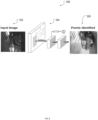
- FIG. 2 is a schematic diagram 200 of an example of dent detection.
- An input image 202 is received.
- the input image 202 may have undergone various pre-processing steps prior to being input into the dent detection system.
- the image may be pre-processed to remove background features, remove noise, convert the image to greyscale etc.
- the received image can be converted to a binary image prior to undergoing processing.
- the received image may be selected from a stereo image or a monocular image.
- the image may be an image from one or more high resolution cameras.
- the image may be an image from one or more consumer grade cameras e.g. a cell-phone camera, D-SLR or other appropriate camera.
- the image undergoes processing at a machine learning system 204, e.g. a system that performs the method of processing images described with reference to FIG. 1 .
- the system having been previously trained using a training data set that is labelled and/or masked to train the system to detect a plurality of regions of hail damage.
- the image can be converted into a feature map and undergo one or more convolutions and/or regressions to output one or more classifications and one or more bounding boxes and/or masks associated with one or more detected areas of hail damage in the input image.
- An output image 206 may be generated which indicates the one or more identified areas of hail damage on the received input image.
- FIG. 3 is a schematic diagram 300 of panel detection.
- An input image 302 is received.
- the input image 302 may have undergone various pre-processing steps prior to being input into the dent detection system.
- the image can be pre-processed to remove background features, remove noise, convert the image to greyscale etc.
- the received image is converted to a binary image prior to undergoing processing.
- the received image can be selected from a stereo image or a monocular image.
- the image may be an image from one or more high resolution cameras.
- the image may be an image from one or more consumer grade cameras e.g. a cell-phone camera, D-SLR or other appropriate camera.
- the image under goes processing at a machine learning system 304 e.g. a system that performs the method of processing images described with reference to FIG. 1 .
- the system having been previously trained using a training data set that is labelled and/or masked to train the system to detect panels of a vehicle.
- the image can be converted into a feature map and undergo one or more convolutions and/or regressions to output one or more classifications and one or more bounding boxes and/or masks associated with panel classifications in the image.
- An output image 306 can be generated which indicates e.g. using a mask generated by the neural network one or more identified panels in the image.
- FIG. 4 is a schematic diagram of an example system 400 for reducing noise in images for damage detection.
- the system uses a Generative Adversarial Network (GAN).
- GAN Generative Adversarial Network
- the generator network 402 receives an input image 404 and generates a new output image 406 from the input image using learned parameters.
- the output image 406 is passed to a discriminator network 408 to predict whether the output image 406 has been generated by the generator network 404 or is a real image.
- the two networks are trained on an objective function that causes the two networks to "compete” with each other, the generator network to fool the discriminator network and the discriminator network to correctly predict which images are real.
- the generator network is therefore trained to effectively perform a specific task, e.g. remove noise from an image.
- the training data set may be, for example a set of images to which noise has been artificially added.
- the training data set may include noise and/or artifacts that are associated with dents and/or panels and may also include noise and/or artifacts that are not associated with any panels.
- the generator network 402 can be trained to remove the noise from the image.
- the discriminator network 408 can predict whether the image is an image output by the generator network 402 or whether it is a target image 410 from the ground truth data set, i.e., an image from the data set that includes the images prior to the noise being artificially added.
- a first comparison can be made between the target image 410 and the output image 406 and a second comparison can be made between the target image 410 and the prediction of the discriminator network 408.
- the comparisons can be passed to an optimizer 412 which updates the weights 414 of the generator network and the discriminator neural network to optimize a GAN objective.
- minimax equation derived from KL-divergence criterion
- the goal of the generative model is to come up with a procedure of matching its generated distribution to a real data distribution so it can fake the discriminator network. Minimizing the distance between the two distributions is critical for optimizing the generator network so it could generate images that are identical to a sample from the original data distribution (p(x)).
- JSD Jensen Shannon Divergence
- KLD Kullbach-Liebler Divergence
- EM Earth-Mover
- AKA Wasserstein distance Relaxed Wasserstein GAN
- the trained generator network 402 is then used to generate de-noised input images for input into one or more or of a panel detection neural network and a dent detection neural network.
- the images can be, for example, a set comprising a mix of image formats, and wherein the further neural network is trained on a data set comprising a mix of image formats.
- the output image are de-noised binary images.
- FIG. 5 is a flow diagram of an example method 500 for generating images in a standard format for hail damage analysis.
- the method 500 may be executing using, for example, a GAN network, as described with reference to FIG. 5 above.
- the method may be used to generate images in a standard format for training a damage detection neural network and/or a panel detection neural network as described above. Alternatively, it may be used to increase the quality of images fed to a network during a prediction phase. For example, reducing the amount of noise and/or sources of confusion in the image e.g. noise dust particles, dirt and specular reflection,
- An input image is received 502, the input image comprising an image of at least a section of a vehicle.
- the input image may include a plurality of damaged areas distributed over the entire section of the vehicle, the image may also include one or more areas of noise.
- the input image may be a 3D geometry file, for example a CAD file that includes one or more simulated areas of damage.
- An input to a neural network may be generated by converting the received image to a binary image 504,
- the converted image can be processed 506 using a generator neural network to generate a modified image, wherein the generator neural network has been trained jointly with a discriminator neural network to generate modified images that have reduced image noise relative to input images to the generator neural network.
- the output images may be used as input to a machine learning system to detect hail damage.
- the machine learning system to detect hail damage processing the modified image using a further neural network to classify one or more sections of the vehicle as one or more panels of the vehicle bodywork.
- the machine learning system can further detect a plurality of damaged areas distributed over the entire section of the vehicle and differentiate the plurality of damaged areas from one or more areas of noise.
- FIG. 6 is an example of a 3D geometry file (e.g. a CAD file) 600 with generated hail dents as used to train one or more of the machine learning systems described above.
- a 3D geometry file e.g. a CAD file
- FIG. 7 is a schematic diagram of an example system 700 for image processing.
- the system may include one or more cameras, e.g. camera 702 and smartphone camera 704.
- the cameras may be one or more specialist or high resolution cameras e.g. active or passive stereo vision cameras, Gigapixel monocular or single vision cameras etc.
- the one or more consumer grade cameras e.g. smartphone camera 704, DSLR camera etc.
- a combination of specialist and consumer grade cameras may be used.
- the one or more cameras can be connected to one or more computing devices, e.g. laptop 704 or terminal 708 via a network 710.
- the network 710 can be a wired or wireless network.
- the cameras may be enabled to transfer images via a wireless network, e.g. cellular network, wireless, Bluetooth, NFC or other standard wireless network protocol.
- the cameras may alternatively or additionally be enabled to transfer the images via a wired network, e.g. via a computer network cable (e.g. CAT 5, 6 etc.), USB cable.
- the images can be transferred via other physical media; flash drive, memory card, CD, DVD etc.
- the system may further include one or more storage devices, e.g. storage device 712 which is arranged to store instructions.
- Storage device 712 may be a separate storage device, e.g. external storage, cloud storage etc. or may be storage that is internal to the computing device.
- the instructions stored at storage device 712 When the instructions stored at storage device 712 are executed by one or more computers 704, 708 the instructions cause the one or more computing devices to perform operations including; receive an image of at least a section of a vehicle, process the received image using damage detection neural network to detect a plurality of hail damage areas on the section of the vehicle and to classify each of the plurality of areas of damage according to the seriousness of the damage, process the received image using a further neural network to classify one or more sections of the vehicle as one or more panels of the vehicle bodywork; and compute a panel damage density estimate, as described in more detail above with reference to FIG 1 .
- the system set out in FIG. 7 may further be implemented to execute any of the foregoing methods.
- the one or more computing devices may be arranged to execute the instructions in serial, i.e. on a single processor at a single at a single computing device, or in parallel, i.e. on a plurality of processors located on one or more computing devices.
Landscapes
- Engineering & Computer Science (AREA)
- Theoretical Computer Science (AREA)
- Physics & Mathematics (AREA)
- General Physics & Mathematics (AREA)
- Evolutionary Computation (AREA)
- Artificial Intelligence (AREA)
- Software Systems (AREA)
- Computing Systems (AREA)
- Health & Medical Sciences (AREA)
- General Health & Medical Sciences (AREA)
- General Engineering & Computer Science (AREA)
- Computer Vision & Pattern Recognition (AREA)
- Biophysics (AREA)
- Life Sciences & Earth Sciences (AREA)
- Data Mining & Analysis (AREA)
- Mathematical Physics (AREA)
- Computational Linguistics (AREA)
- Biomedical Technology (AREA)
- Molecular Biology (AREA)
- Multimedia (AREA)
- Medical Informatics (AREA)
- Quality & Reliability (AREA)
- Databases & Information Systems (AREA)
- Computer Hardware Design (AREA)
- Geometry (AREA)
- Image Analysis (AREA)
Claims (12)
- Procédé (300) comportant les étapes consistant à :recevoir une image (302) d'au moins une section d'un véhicule;convertir (504) l'image reçue en une image binaire;traiter (506) l'image convertie à l'aide d'un réseau neuronal générateur pour générer une image modifiée, le réseau neuronal générateur ayant été entraîné conjointement avec un réseau neuronal discriminateur pour générer des images modifiées qui présentent un bruit d'image réduit par rapport à des images introduites dans le réseau neuronal générateur; ettraiter (304) l'image modifiée à l'aide d'un réseau neuronal supplémentaire pour classifier une ou plusieurs sections du véhicule comme étant un ou plusieurs panneaux de la carrosserie du véhicule.
- Procédé selon la revendication 1, l'image reçue étant une image de CAO, l'image de CAO étant optionnellement enrichie par des dégâts simulés dus à la grêle, les dégâts simulés dus à la grêle étant simulés à l'aide d'une analyse d'impacts de grêle.
- Procédé selon la revendication 1, comportant en outre l'utilisation de l'image modifiée en tant qu'entrée pour un réseau neuronal de détection de dégâts.
- Procédé selon la revendication 1, l'image modifiée étant en outre utilisée en tant qu'entrée d'apprentissage pour un réseau neuronal de détection de dégâts et/ou le réseau neuronal supplémentaire afin de classifier une ou plusieurs sections du véhicule.
- Procédé selon la revendication 1, comportant en outre les étapes consistant à :traiter (104) l'image reçue à l'aide d'un réseau neuronal de détection de dégâts pour détecter une pluralité de zones de dégâts dus à la grêle sur la section du véhicule et pour classifier chacune de la pluralité de zones de dégâts dus à la grêle selon la gravité des dégâts ;la détection d'une pluralité de zones de dégâts dus à la grêle comportantla détection d'une pluralité de zones endommagées réparties sur toute la section du véhicule, etle fait de différencier la pluralité de zones endommagées d'une ou plusieurs zones de bruit ;l'utilisation (108) des zones détectées de dégâts dus à la grêle, de la classification de la gravité des dégâts, et de la classification d'un ou plusieurs panneaux pour calculer une estimation de densité d'endommagement de panneaux.
- Procédé selon la revendication 5, l'image reçue étant sélectionnée parmi une image monoculaire et une image stéréoscopique.
- Procédé selon la revendication 5, la pluralité de zones de dégâts dus à la grêle étant un ou plusieurs enfoncements dans les panneaux de la carrosserie du véhicule, la gravité des dégâts étant optionnellement classifiée selon la profondeur et la densité des enfoncements.
- Procédé selon la revendication 5, le réseau neuronal de détection de dégâts étant entraîné sur un jeu de données comportant un mélange de formats d'images, et le réseau neuronal supplémentaire étant entraîné sur un jeu de données comportant un mélange de formats d'images.
- Procédé selon la revendication 8, le mélange de formats d'images comprenant un ou plusieurs fichiers de géométrie 3D, et le ou les fichiers de géométrie 3D étant optionnellement enrichis par des dégâts simulés dus à la grêle, les dégâts simulés dus à la grêle étant simulés à l'aide d'une analyse d'impacts de grêle.
- Procédé selon la revendication 5, la détection d'une pluralité de zones de dégâts dus à la grêle comportant en outre le fait de différencier la pluralité de zones endommagées d'une ou de plusieurs sources de bruit, la ou les sources de bruit étant optionnellement sélectionnées parmi des particules de poussière, de la saleté et une réflexion spéculaire.
- Système comportant :une ou plusieurs caméras ;un ou plusieurs dispositifs informatiques ; etun ou plusieurs dispositifs de stockage conservant des instructions qui, lorsqu'elles sont exécutées par l'ordinateur ou les ordinateurs, amènent l'ordinateur ou les ordinateurs à réaliser le procédé selon l'une quelconque des revendications 1 à 10.
- Système selon la revendication 11 :la ou les caméras comportant au moins deux caméras et l'image étant une image 3D stéréoscopique composite générée à partir desdites au moins deux caméras ; oula ou les caméras comportant une caméra de téléphone cellulaire ; oula ou les caméras étant situées à un premier emplacement et le ou les dispositifs informatiques et le ou les dispositifs de stockage étant situés à un second emplacement.
Applications Claiming Priority (1)
| Application Number | Priority Date | Filing Date | Title |
|---|---|---|---|
| US17/105,184 US11574395B2 (en) | 2020-11-25 | 2020-11-25 | Damage detection using machine learning |
Publications (2)
| Publication Number | Publication Date |
|---|---|
| EP4006834A1 EP4006834A1 (fr) | 2022-06-01 |
| EP4006834B1 true EP4006834B1 (fr) | 2025-02-26 |
Family
ID=78695573
Family Applications (1)
| Application Number | Title | Priority Date | Filing Date |
|---|---|---|---|
| EP21208984.1A Active EP4006834B1 (fr) | 2020-11-25 | 2021-11-18 | Détection de panneaux de carrosserie à l'aide de l'apprentissage automatique |
Country Status (2)
| Country | Link |
|---|---|
| US (2) | US11574395B2 (fr) |
| EP (1) | EP4006834B1 (fr) |
Families Citing this family (9)
| Publication number | Priority date | Publication date | Assignee | Title |
|---|---|---|---|---|
| WO2021136939A1 (fr) | 2020-01-03 | 2021-07-08 | Tractable Ltd | Procédé de détermination d'opérations de réparation pour un véhicule endommagé |
| US11657373B2 (en) * | 2020-08-21 | 2023-05-23 | Accenture Global Solutions Limited | System and method for identifying structural asset features and damage |
| US11574395B2 (en) | 2020-11-25 | 2023-02-07 | Vehicle Service Group, Llc | Damage detection using machine learning |
| US11858514B2 (en) | 2021-03-30 | 2024-01-02 | Zoox, Inc. | Top-down scene discrimination |
| US11810225B2 (en) * | 2021-03-30 | 2023-11-07 | Zoox, Inc. | Top-down scene generation |
| US12033218B2 (en) * | 2022-01-31 | 2024-07-09 | Vehicle Service Group, Llc | Assessing damages on vehicles |
| US11557078B1 (en) * | 2022-02-08 | 2023-01-17 | Honeywell Federal Manufacturing & Technologies, Llc | Machine learning simulation of finite element analysis in augmented reality |
| CN118396953B (zh) * | 2024-04-24 | 2024-11-19 | 中航材利顿(北京)航空科技有限公司 | 一种航空器的健康可靠性分析方法及系统 |
| DE102024121834A1 (de) * | 2024-07-31 | 2026-02-05 | Ford Global Technologies, Llc | Verfahren und eine Baugruppe zum Überwachen eines Fahrzeugs |
Family Cites Families (30)
| Publication number | Priority date | Publication date | Assignee | Title |
|---|---|---|---|---|
| US4188544A (en) | 1977-08-22 | 1980-02-12 | Weyerhaeuser Company | Method and apparatus for automatically processing a workpiece employing calibrated scanning |
| WO2004051186A1 (fr) | 2002-11-29 | 2004-06-17 | OBE OHNMACHT & BAUMGäRTNER GMBH & CO. KG | Procede et dispositif de mesure de forme et/ou d'evaluation par voie optique |
| DE10303659B4 (de) | 2003-01-23 | 2005-07-28 | Berliner Elektronenspeicherring-Gesellschaft für Synchrotronstrahlung mbH | Optisches Messverfahren zur Ermittlung von Idealformabweichungen technisch polierter Oberflächen und Präzisionsmessmaschine zur Durchführung des Messverfahrens |
| EP1864081B1 (fr) | 2005-03-24 | 2014-05-07 | SAC Sirius Advanced Cybernetics GmbH | Dispositif pour detecter optiquement la forme d'objets et de surfaces |
| WO2007017941A1 (fr) | 2005-08-10 | 2007-02-15 | Raytex Corporation | Dispositif d'inspection de défauts à une extrémité |
| EP2063260A1 (fr) | 2007-11-19 | 2009-05-27 | Lambda-X | Système et procédé de déflectométrie de transformation de Fourier |
| CN101571497B (zh) | 2008-04-29 | 2012-02-22 | 同方威视技术股份有限公司 | 一种检测设备 |
| US8243289B2 (en) | 2009-05-29 | 2012-08-14 | Perceptron, Inc. | System and method for dynamic windowing |
| BRPI1000301B1 (pt) | 2010-01-27 | 2017-04-11 | Photonita Ltda | dispositivo óptico para medição e identificação de superfícies cilíndricas por deflectometria aplicado para identificação balística |
| US20130057678A1 (en) | 2010-05-17 | 2013-03-07 | Ford Espana S.L. | Inspection system and method of defect detection on specular surfaces |
| US20170352104A1 (en) | 2011-04-28 | 2017-12-07 | Allstate Insurance Company | Automatic Hail Damage Detection And Repair |
| BR112014002186B1 (pt) | 2011-07-29 | 2020-12-29 | Hewlett-Packard Development Company, L.P | sistema de projeção de captura, meio executável de processamento e método de colaboração em espaço de trabalho |
| CN104583713B (zh) | 2012-06-29 | 2019-04-19 | Inb视觉股份公司 | 使优选是结构化的物体表面成像的方法及用于成像的装置 |
| GB2505708B (en) | 2012-09-11 | 2015-02-25 | Barco Nv | Projection system with safety detection |
| DE202013000050U1 (de) | 2013-01-08 | 2013-02-08 | API - Automotive Process Institute GmbH | Vorrichtung zur Erfassung einer Oberfläche eines Kraftfahrzeugs |
| DE102014106238A1 (de) | 2014-05-05 | 2015-11-19 | Isra Vision Ag | Verfahren und Sensor zur Bestimmung der Oberfläche eines Objekts mittels Deflektometrie |
| DE102014224274B4 (de) | 2014-11-27 | 2016-09-22 | Fraunhofer-Gesellschaft zur Förderung der angewandten Forschung e.V. | Vorrichtung und verfahren zum optischen vermessen von gegenständen mittels spiegelndem fluss und stereo-regularisierung |
| US20170147990A1 (en) | 2015-11-23 | 2017-05-25 | CSI Holdings I LLC | Vehicle transactions using objective vehicle data |
| EP4567734A3 (fr) | 2016-04-12 | 2025-07-30 | Quidient, LLC | Moteur de reconstruction de scènes quotidiennes |
| DE102016006780A1 (de) | 2016-06-02 | 2017-12-07 | Eisenmann Se | Anlage zur optischen Überprüfung von Oberflächenbereichen von Gegenständen |
| US10921118B2 (en) | 2016-07-27 | 2021-02-16 | Vehicle Service Group, Llc | Hybrid 3D optical scanning system |
| EP3504676A4 (fr) | 2016-08-26 | 2020-03-25 | Allstate Insurance Company | Détection et réparation automatiques de dommages dus à la grêle |
| US10776881B1 (en) * | 2017-06-13 | 2020-09-15 | State Farm Mutual Automobile Insurance Company | Systems and methods for hail damage verification on rooftops using computer vision and artificial intelligence |
| US11333615B2 (en) | 2018-01-26 | 2022-05-17 | Vehicle Service Group, Llc | Vehicle surface scanning system |
| US20220005121A1 (en) * | 2018-05-21 | 2022-01-06 | State Farm Mutual Automobile Insurance Company | Machine learning systems and methods for analyzing emerging trends |
| US20200104940A1 (en) | 2018-10-01 | 2020-04-02 | Ramanathan Krishnan | Artificial intelligence enabled assessment of damage to automobiles |
| US11676365B2 (en) * | 2019-12-16 | 2023-06-13 | Accenture Global Solutions Limited | Explainable artificial intelligence (AI) based image analytic, automatic damage detection and estimation system |
| US11436443B2 (en) * | 2020-03-16 | 2022-09-06 | Accenture Globat, Solutions Limited | Testing machine learning (ML) models for robustness and accuracy using generative deep learning |
| KR102148884B1 (ko) | 2020-04-02 | 2020-08-27 | 주식회사 애자일소다 | 차량의 손상 분석 시스템 및 방법 |
| US11574395B2 (en) | 2020-11-25 | 2023-02-07 | Vehicle Service Group, Llc | Damage detection using machine learning |
-
2020
- 2020-11-25 US US17/105,184 patent/US11574395B2/en active Active
-
2021
- 2021-11-18 EP EP21208984.1A patent/EP4006834B1/fr active Active
-
2023
- 2023-01-05 US US18/150,665 patent/US12387308B2/en active Active
Also Published As
| Publication number | Publication date |
|---|---|
| US12387308B2 (en) | 2025-08-12 |
| EP4006834A1 (fr) | 2022-06-01 |
| US20230230221A1 (en) | 2023-07-20 |
| US11574395B2 (en) | 2023-02-07 |
| US20220164942A1 (en) | 2022-05-26 |
Similar Documents
| Publication | Publication Date | Title |
|---|---|---|
| EP4006834B1 (fr) | Détection de panneaux de carrosserie à l'aide de l'apprentissage automatique | |
| CN110569837B (zh) | 优化损伤检测结果的方法及装置 | |
| Cha et al. | Autonomous structural visual inspection using region‐based deep learning for detecting multiple damage types | |
| CN110930347B (zh) | 卷积神经网络的训练方法、焊点缺陷的检测方法及装置 | |
| US9235902B2 (en) | Image-based crack quantification | |
| US20180182039A1 (en) | Method, system, apparatus, and storage medium for realizing antifraud in insurance claim based on consistency of multiple images | |
| CN114972922B (zh) | 基于机器学习的煤矸分选识别方法、装置及设备 | |
| CN109919145B (zh) | 一种基于3d点云深度学习的矿卡检测方法及系统 | |
| CN115393601B (zh) | 一种基于点云数据的三维目标检测方法 | |
| CN103258213A (zh) | 一种用于智能交通系统中的动态车辆车型识别方法 | |
| Utaminingrum et al. | Feature selection of gray-level Cooccurrence matrix using genetic algorithm with Extreme learning machine classification for early detection of Pole roads | |
| CN111144425B (zh) | 检测拍屏图片的方法、装置、电子设备及存储介质 | |
| CN100561501C (zh) | 一种图像检测方法及装置 | |
| CN116824543A (zh) | 一种基于od-yolo的自动驾驶目标检测方法 | |
| CN118314388A (zh) | 一种基于fc-yolo网络模型的飞机蒙皮损伤检测方法及系统 | |
| CN116030056A (zh) | 一种钢表面裂缝的检测方法及系统 | |
| US12033218B2 (en) | Assessing damages on vehicles | |
| CN115661577A (zh) | 用于对象检测的方法、设备和计算机可读存储介质 | |
| US9104450B2 (en) | Graphical user interface component classification | |
| CN110570317B (zh) | 用于车辆核损的方法及装置 | |
| CN118298513A (zh) | 一种基于机器视觉的电力作业违规行为检测方法及系统 | |
| EP4564307A1 (fr) | Procédé d'apprentissage de modèle d'apprentissage automatique | |
| EP4564311A1 (fr) | Procédé d'apprentissage de modèle d'apprentissage automatique | |
| CN112287740A (zh) | 基于YOLOv3-tiny实现的输电线路的目标检测方法、装置、无人机 | |
| Rahmat et al. | Stereo Vision Based Vehicle Detection and Distance Estimation for Braking Anomaly Detection |
Legal Events
| Date | Code | Title | Description |
|---|---|---|---|
| PUAI | Public reference made under article 153(3) epc to a published international application that has entered the european phase |
Free format text: ORIGINAL CODE: 0009012 |
|
| STAA | Information on the status of an ep patent application or granted ep patent |
Free format text: STATUS: REQUEST FOR EXAMINATION WAS MADE |
|
| 17P | Request for examination filed |
Effective date: 20211118 |
|
| AK | Designated contracting states |
Kind code of ref document: A1 Designated state(s): AL AT BE BG CH CY CZ DE DK EE ES FI FR GB GR HR HU IE IS IT LI LT LU LV MC MK MT NL NO PL PT RO RS SE SI SK SM TR |
|
| GRAP | Despatch of communication of intention to grant a patent |
Free format text: ORIGINAL CODE: EPIDOSNIGR1 |
|
| STAA | Information on the status of an ep patent application or granted ep patent |
Free format text: STATUS: GRANT OF PATENT IS INTENDED |
|
| INTG | Intention to grant announced |
Effective date: 20240930 |
|
| GRAS | Grant fee paid |
Free format text: ORIGINAL CODE: EPIDOSNIGR3 |
|
| GRAA | (expected) grant |
Free format text: ORIGINAL CODE: 0009210 |
|
| STAA | Information on the status of an ep patent application or granted ep patent |
Free format text: STATUS: THE PATENT HAS BEEN GRANTED |
|
| AK | Designated contracting states |
Kind code of ref document: B1 Designated state(s): AL AT BE BG CH CY CZ DE DK EE ES FI FR GB GR HR HU IE IS IT LI LT LU LV MC MK MT NL NO PL PT RO RS SE SI SK SM TR |
|
| REG | Reference to a national code |
Ref country code: GB Ref legal event code: FG4D |
|
| REG | Reference to a national code |
Ref country code: CH Ref legal event code: EP |
|
| REG | Reference to a national code |
Ref country code: DE Ref legal event code: R096 Ref document number: 602021026705 Country of ref document: DE |
|
| REG | Reference to a national code |
Ref country code: IE Ref legal event code: FG4D |
|
| REG | Reference to a national code |
Ref country code: NL Ref legal event code: MP Effective date: 20250226 |
|
| PG25 | Lapsed in a contracting state [announced via postgrant information from national office to epo] |
Ref country code: RS Free format text: LAPSE BECAUSE OF FAILURE TO SUBMIT A TRANSLATION OF THE DESCRIPTION OR TO PAY THE FEE WITHIN THE PRESCRIBED TIME-LIMIT Effective date: 20250526 |
|
| PG25 | Lapsed in a contracting state [announced via postgrant information from national office to epo] |
Ref country code: FI Free format text: LAPSE BECAUSE OF FAILURE TO SUBMIT A TRANSLATION OF THE DESCRIPTION OR TO PAY THE FEE WITHIN THE PRESCRIBED TIME-LIMIT Effective date: 20250226 |
|
| PG25 | Lapsed in a contracting state [announced via postgrant information from national office to epo] |
Ref country code: PL Free format text: LAPSE BECAUSE OF FAILURE TO SUBMIT A TRANSLATION OF THE DESCRIPTION OR TO PAY THE FEE WITHIN THE PRESCRIBED TIME-LIMIT Effective date: 20250226 |
|
| PG25 | Lapsed in a contracting state [announced via postgrant information from national office to epo] |
Ref country code: ES Free format text: LAPSE BECAUSE OF FAILURE TO SUBMIT A TRANSLATION OF THE DESCRIPTION OR TO PAY THE FEE WITHIN THE PRESCRIBED TIME-LIMIT Effective date: 20250226 |
|
| REG | Reference to a national code |
Ref country code: LT Ref legal event code: MG9D |
|
| PG25 | Lapsed in a contracting state [announced via postgrant information from national office to epo] |
Ref country code: IS Free format text: LAPSE BECAUSE OF FAILURE TO SUBMIT A TRANSLATION OF THE DESCRIPTION OR TO PAY THE FEE WITHIN THE PRESCRIBED TIME-LIMIT Effective date: 20250626 Ref country code: NO Free format text: LAPSE BECAUSE OF FAILURE TO SUBMIT A TRANSLATION OF THE DESCRIPTION OR TO PAY THE FEE WITHIN THE PRESCRIBED TIME-LIMIT Effective date: 20250526 |
|
| PG25 | Lapsed in a contracting state [announced via postgrant information from national office to epo] |
Ref country code: NL Free format text: LAPSE BECAUSE OF FAILURE TO SUBMIT A TRANSLATION OF THE DESCRIPTION OR TO PAY THE FEE WITHIN THE PRESCRIBED TIME-LIMIT Effective date: 20250226 |
|
| PG25 | Lapsed in a contracting state [announced via postgrant information from national office to epo] |
Ref country code: HR Free format text: LAPSE BECAUSE OF FAILURE TO SUBMIT A TRANSLATION OF THE DESCRIPTION OR TO PAY THE FEE WITHIN THE PRESCRIBED TIME-LIMIT Effective date: 20250226 |
|
| PG25 | Lapsed in a contracting state [announced via postgrant information from national office to epo] |
Ref country code: PT Free format text: LAPSE BECAUSE OF FAILURE TO SUBMIT A TRANSLATION OF THE DESCRIPTION OR TO PAY THE FEE WITHIN THE PRESCRIBED TIME-LIMIT Effective date: 20250626 Ref country code: LV Free format text: LAPSE BECAUSE OF FAILURE TO SUBMIT A TRANSLATION OF THE DESCRIPTION OR TO PAY THE FEE WITHIN THE PRESCRIBED TIME-LIMIT Effective date: 20250226 |
|
| PG25 | Lapsed in a contracting state [announced via postgrant information from national office to epo] |
Ref country code: GR Free format text: LAPSE BECAUSE OF FAILURE TO SUBMIT A TRANSLATION OF THE DESCRIPTION OR TO PAY THE FEE WITHIN THE PRESCRIBED TIME-LIMIT Effective date: 20250527 Ref country code: BG Free format text: LAPSE BECAUSE OF FAILURE TO SUBMIT A TRANSLATION OF THE DESCRIPTION OR TO PAY THE FEE WITHIN THE PRESCRIBED TIME-LIMIT Effective date: 20250226 |
|
| REG | Reference to a national code |
Ref country code: AT Ref legal event code: MK05 Ref document number: 1771424 Country of ref document: AT Kind code of ref document: T Effective date: 20250226 |
|
| PG25 | Lapsed in a contracting state [announced via postgrant information from national office to epo] |
Ref country code: SE Free format text: LAPSE BECAUSE OF FAILURE TO SUBMIT A TRANSLATION OF THE DESCRIPTION OR TO PAY THE FEE WITHIN THE PRESCRIBED TIME-LIMIT Effective date: 20250226 |
|
| PG25 | Lapsed in a contracting state [announced via postgrant information from national office to epo] |
Ref country code: SM Free format text: LAPSE BECAUSE OF FAILURE TO SUBMIT A TRANSLATION OF THE DESCRIPTION OR TO PAY THE FEE WITHIN THE PRESCRIBED TIME-LIMIT Effective date: 20250226 |
|
| PG25 | Lapsed in a contracting state [announced via postgrant information from national office to epo] |
Ref country code: DK Free format text: LAPSE BECAUSE OF FAILURE TO SUBMIT A TRANSLATION OF THE DESCRIPTION OR TO PAY THE FEE WITHIN THE PRESCRIBED TIME-LIMIT Effective date: 20250226 |
|
| PG25 | Lapsed in a contracting state [announced via postgrant information from national office to epo] |
Ref country code: AT Free format text: LAPSE BECAUSE OF FAILURE TO SUBMIT A TRANSLATION OF THE DESCRIPTION OR TO PAY THE FEE WITHIN THE PRESCRIBED TIME-LIMIT Effective date: 20250226 |
|
| PG25 | Lapsed in a contracting state [announced via postgrant information from national office to epo] |
Ref country code: CZ Free format text: LAPSE BECAUSE OF FAILURE TO SUBMIT A TRANSLATION OF THE DESCRIPTION OR TO PAY THE FEE WITHIN THE PRESCRIBED TIME-LIMIT Effective date: 20250226 Ref country code: EE Free format text: LAPSE BECAUSE OF FAILURE TO SUBMIT A TRANSLATION OF THE DESCRIPTION OR TO PAY THE FEE WITHIN THE PRESCRIBED TIME-LIMIT Effective date: 20250226 |
|
| PG25 | Lapsed in a contracting state [announced via postgrant information from national office to epo] |
Ref country code: RO Free format text: LAPSE BECAUSE OF FAILURE TO SUBMIT A TRANSLATION OF THE DESCRIPTION OR TO PAY THE FEE WITHIN THE PRESCRIBED TIME-LIMIT Effective date: 20250226 |
|
| PG25 | Lapsed in a contracting state [announced via postgrant information from national office to epo] |
Ref country code: SK Free format text: LAPSE BECAUSE OF FAILURE TO SUBMIT A TRANSLATION OF THE DESCRIPTION OR TO PAY THE FEE WITHIN THE PRESCRIBED TIME-LIMIT Effective date: 20250226 |
|
| REG | Reference to a national code |
Ref country code: DE Ref legal event code: R097 Ref document number: 602021026705 Country of ref document: DE |
|
| PLBE | No opposition filed within time limit |
Free format text: ORIGINAL CODE: 0009261 |
|
| STAA | Information on the status of an ep patent application or granted ep patent |
Free format text: STATUS: NO OPPOSITION FILED WITHIN TIME LIMIT |
|
| PGFP | Annual fee paid to national office [announced via postgrant information from national office to epo] |
Ref country code: DE Payment date: 20251126 Year of fee payment: 5 |
|
| PGFP | Annual fee paid to national office [announced via postgrant information from national office to epo] |
Ref country code: GB Payment date: 20251125 Year of fee payment: 5 |
|
| PGFP | Annual fee paid to national office [announced via postgrant information from national office to epo] |
Ref country code: IT Payment date: 20251121 Year of fee payment: 5 |
|
| 26N | No opposition filed |
Effective date: 20251127 |