EP4006879A1 - Procédé et appareil de circulation au sol autonome - Google Patents
Procédé et appareil de circulation au sol autonome Download PDFInfo
- Publication number
- EP4006879A1 EP4006879A1 EP20275175.6A EP20275175A EP4006879A1 EP 4006879 A1 EP4006879 A1 EP 4006879A1 EP 20275175 A EP20275175 A EP 20275175A EP 4006879 A1 EP4006879 A1 EP 4006879A1
- Authority
- EP
- European Patent Office
- Prior art keywords
- aircraft
- route
- processing means
- nosewheel
- speed
- Prior art date
- Legal status (The legal status is an assumption and is not a legal conclusion. Google has not performed a legal analysis and makes no representation as to the accuracy of the status listed.)
- Ceased
Links
Images



Classifications
-
- G—PHYSICS
- G08—SIGNALLING
- G08G—TRAFFIC CONTROL SYSTEMS
- G08G5/00—Traffic control systems for aircraft
- G08G5/50—Navigation or guidance aids
- G08G5/51—Navigation or guidance aids for control when on the ground, e.g. taxiing or rolling
-
- G—PHYSICS
- G01—MEASURING; TESTING
- G01C—MEASURING DISTANCES, LEVELS OR BEARINGS; SURVEYING; NAVIGATION; GYROSCOPIC INSTRUMENTS; PHOTOGRAMMETRY OR VIDEOGRAMMETRY
- G01C23/00—Combined instruments indicating more than one navigational value, e.g. for aircraft; Combined measuring devices for measuring two or more variables of movement, e.g. distance, speed or acceleration
-
- G—PHYSICS
- G05—CONTROLLING; REGULATING
- G05D—SYSTEMS FOR CONTROLLING OR REGULATING NON-ELECTRIC VARIABLES
- G05D1/00—Control of position, course, altitude or attitude of land, water, air or space vehicles, e.g. using automatic pilots
- G05D1/0083—Control of position, course, altitude or attitude of land, water, air or space vehicles, e.g. using automatic pilots to help an aircraft pilot in the rolling phase
-
- G—PHYSICS
- G05—CONTROLLING; REGULATING
- G05D—SYSTEMS FOR CONTROLLING OR REGULATING NON-ELECTRIC VARIABLES
- G05D1/00—Control of position, course, altitude or attitude of land, water, air or space vehicles, e.g. using automatic pilots
- G05D1/02—Control of position or course in two dimensions
- G05D1/0202—Control of position or course in two dimensions specially adapted to aircraft
-
- G—PHYSICS
- G08—SIGNALLING
- G08G—TRAFFIC CONTROL SYSTEMS
- G08G5/00—Traffic control systems for aircraft
- G08G5/20—Arrangements for acquiring, generating, sharing or displaying traffic information
- G08G5/21—Arrangements for acquiring, generating, sharing or displaying traffic information located onboard the aircraft
-
- G—PHYSICS
- G01—MEASURING; TESTING
- G01S—RADIO DIRECTION-FINDING; RADIO NAVIGATION; DETERMINING DISTANCE OR VELOCITY BY USE OF RADIO WAVES; LOCATING OR PRESENCE-DETECTING BY USE OF THE REFLECTION OR RERADIATION OF RADIO WAVES; ANALOGOUS ARRANGEMENTS USING OTHER WAVES
- G01S19/00—Satellite radio beacon positioning systems; Determining position, velocity or attitude using signals transmitted by such systems
- G01S19/01—Satellite radio beacon positioning systems transmitting time-stamped messages, e.g. GPS [Global Positioning System], GLONASS [Global Orbiting Navigation Satellite System] or GALILEO
- G01S19/13—Receivers
- G01S19/14—Receivers specially adapted for specific applications
- G01S19/15—Aircraft landing systems
-
- G—PHYSICS
- G01—MEASURING; TESTING
- G01S—RADIO DIRECTION-FINDING; RADIO NAVIGATION; DETERMINING DISTANCE OR VELOCITY BY USE OF RADIO WAVES; LOCATING OR PRESENCE-DETECTING BY USE OF THE REFLECTION OR RERADIATION OF RADIO WAVES; ANALOGOUS ARRANGEMENTS USING OTHER WAVES
- G01S19/00—Satellite radio beacon positioning systems; Determining position, velocity or attitude using signals transmitted by such systems
- G01S19/38—Determining a navigation solution using signals transmitted by a satellite radio beacon positioning system
- G01S19/39—Determining a navigation solution using signals transmitted by a satellite radio beacon positioning system the satellite radio beacon positioning system transmitting time-stamped messages, e.g. GPS [Global Positioning System], GLONASS [Global Orbiting Navigation Satellite System] or GALILEO
- G01S19/40—Correcting position, velocity or attitude
Definitions
- Aircraft often land at airfields that are unknown to the pilot.
- the pilot may receive a route from the local air traffic control (ATC) to navigate.
- ATC local air traffic control
- the pilot may make a mistake.
- Figure 1 illustrates a typical airfield 100.
- the airfield comprises various taxiways A-G and a runway H.
- An aircraft might be required to navigate a route sent by the ATC.
- the route may comprise a route from a gate to a runway.
- the route may comprise a route from a runway to the gate.
- Other routes may also be desired. Navigating the taxiways may be difficult for a pilot, for example if weather conditions are poor, or if the airfield or particular route are unknown to the pilot. This may increase the probability of making mistakes and also may increase the workload of the pilot.
- an auto-taxiing method may be used, similar to an autopilot when in the air and may be referred to as an auto-taxi or taxi autopilot.
- the aircraft may comprise an arming mechanism for the auto-taxi.
- the arming mechanism may arm the taxi autopilot such that the autopilot can transition into an engaged mode once a number of conditions are satisfied.
- the conditions may comprise at least one of:
- the arming procedure may differ based on whether the aircraft is taxiing from the gate to the runway, or from runway to the gate.
- the autopilot may be armed after the aircraft is pushed back, after all initial checklists are complete, the correct taxi route is loaded into the system and the aircraft positon is within the pre-determined limit of the planned route.
- the taxi autopilot system may be armed on approach. Upon landing and following roll-out braking (auto or manual) to a safe taxi speed, the autopilot may engage once the programmed route was loaded into the system.
- a safe taxi speed may be nominally 35 knots.
- the taxi autopilot system may transition from an engaged mode to a disengaged mode, where the pilot has control.
- the transition may be made with haptic, visual, and audible warnings prior to pilot control being resumed, at the moment of transition and afterwards.
- the taxi autopilot may transition under a number of conditions, such as:
- the aircraft may comprise processing means configured to receive a route.
- the route may be sent by ATC or may be input by the crew.
- the route may be manually entered by the flight crew based on ATC instruction.
- the processing means may be configured to convert a selection of a route of taxiways into a set of Global Navigation Satellite System (GNSS) coordinates.
- GNSS Global Navigation Satellite System
- the route may be received from the ATC to the aircraft systems, such as via the Aircraft Communication and Reporting System (ACARS).
- ACARS Aircraft Communication and Reporting System
- the route may be converted into GNSS coordinates prior to being sent to the aircraft or after being sent to the aircraft.
- the GNSS coordinates may comprise Global Positioning System coordinates, or any other type of GNSS.
- the route may comprise a set of positon coordinates, such as GNSS coordinates.
- the coordinates may be used to define a series of straight and corner segments.
- a straight may be defined as a line between two sets of geographic coordinates which constitute the start and end point of the line.
- a curve may be defined from three sets of geographic coordinates. Two of the coordinates define the start and end point of the curve.
- the third coordinate may define a control point such that a Bezier curve is prescribed by the three sets of coordinates such that the shape of the corner is matched or matched within a predetermined safety threshold.
- the processing means may be configured to obtain a route line.
- the route line may comprise a center line of the route, such that the route line is the line that is in the middle of each line, and is the line that the nosewheel of the aircraft would be expected to follow.
- the route line may be pre-determined.
- the route line may be determined by the processing means.
- the processing means may be configured to determine route features along the route.
- a route feature may comprise a straight portion, a curve, a static hazard or a dynamic hazard.
- the processing means may also be configured to split the route into at least one segment.
- the number of segments may be based on the number of route features.
- the number of segments may be based on the number of a subset of route features, for example the number of straight and curved sections of the route.
- the processing means may be configured to determine a deviation of the nosewheel of the aircraft from the route line based on the current position of the aircraft provided by the aircraft GNSS.
- the positon may be determined by applying an offset to the GNSS determined positon, the offset based on the geometry of the particular aircraft.
- the nosewheel positon may be calculated using standard spherical-surface formulae. This technique may allow the nosewheel positon to be determined without adding extra cameras or LiDAR to an aircraft. This has an advantage of requiring less formal certification and testing.
- the GNSS may comprise a dual band system.
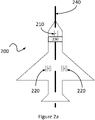
- Figure 2a illustrates a taxiing aircraft 200.
- Taxiing aircraft 200 comprises a nosewheel 210 and rear gear 220.
- the taxiing aircraft also comprises a GNSS receiver 230, configured to determine the location of the taxiing aircraft 200.
- GNSS receiver 230 it may be determined that the nosewheel 210 has substantially no offset to the route line 240.
- the same taxiing aircraft 200 is illustrated in Figure 2b .
- using the GNSS receiver 230 it may be determined that the taxiing aircraft has an offset 250 to the route line 250.
- the processing means is configured to output an adjustment to the nosewheel angle to correct the deviation from the route based on the deviation of the nosewheel from the route line.
- the adjustment may be calculated by the processing means using a Proportional Integral Derivative (PID) controller.
- PID Proportional Integral Derivative
- the bandwidth of the PID controller may be variable, or there may comprise multiple PID controllers with fixed and different bandwidths.
- a low bandwidth PID controller may be used in straight segments.
- a low bandwidth controller allows for small adjustments to be made at a low frequency.
- a high bandwidth PID controller may be used during curved segments or in other situations.
- a high bandwidth PID controller allows for larger adjustments to be made at a high frequency.
- a high bandwidth PID controller also may ensure the smooth movement of the aircraft during turns, and may ensure that lateral G-forces are minimised.
- the PID controller may also be tuned to avoid large nosewheel angles at high speeds while also allowing enough authority to maintain the route.
- the tuning may depend upon the particular limits of the aircraft and the airfield.
- the PID controller By sufficiently tuning the PID controller correct taxi manoeuvres can be allowed.
- the PID may be tuned such that the nosewheel moves past the required turn, and the nose of the aircraft is swung around to regain with the route. This is similar to a large body vehicle such as a bus or a lorry. In such a manoeuvre the main gear maintains its positon centralised on the route line.
- Existing nosewheel steering control systems may be actuated in order to allow the Flight Management System (FMS) and autopilot system to control nosewheel direction.
- FMS Flight Management System
- a nosewheel steering system may also employ an active control sidestick (ACS) linked to the nosewheel steering system.
- ACS active control sidestick
- the ACS based system could provide situational awareness to the pilot by back-driving the stick positon to indicate the manoeuvre being performed, as already performed for autopilots in the air on existing aircraft.
- the ACS based system may be configured to sense an input onto the active stick, such that the pilot would be able override the autopilot by applying a force to the active stick.
- there may comprise a threshold force to switch the autopilot from an active state to disarmed.
- any input below the threshold may be ignored.
- any input below the threshold force may be used to adjust the nosewheel angle or throttle without deactivating the taxi autopilot.
- the processing means also comprises means to send an adjustment to the speed of the aircraft.
- the adjustment of the speed is based on a current position on the route line and a proximity to the at least one determined route feature.
- the adjustment may comprise a speed limit imposed, which may be defined by the manufacturer of the aircraft or by the ATC.
- the speed limit of the aircraft is obtained from a look-up table. In some examples the speed limit is based on at least one of a aircraft weight, weather conditions, proximity to static hazards, and proximity to moving hazards based on information provided by other systems.
- the processor may comprise means to analyse a corner based on the defined route or route line.
- the analysis may be based on the degree of curvature of the corner, and takes into account the length of the corner and the angle of deviation from the start point to the end point of the corner. Using calculations based on these parameters a cornering profile can be determined.
- a Supervised Regression Machine Learning system may be used and trained on a large dataset of aircraft taxi manoeuvres in order to profile speeds travelled along defined routes. Once trained the resultant predictor function would then be able to analyse any given route and produce a set of speed limits for each section of the route.
- a speed can be determined such that the autothrottle system can adjust aircraft taxi speed to allow for optimal speed for the corner, where optimal may consider critical parameters such as lateral G-Forces, as well as factors such as reduced tyre wear or achieving best time to destination.
- Cornering profiles may reside with the route data itself, where there exists a profile or absolute speed for each corner in the programmed route.
- the autopilot system may calculate corner profiles programmatically based on the programmed route profile, thus allowing adjustments to be made for weight of aircraft, desired time to end of route, etc.
- the target speed for a corner needs to be made the setpoint for the PID Controller well in advance of reaching the corner so that only light braking is needed to reach the cornering speed from the current straight-line speed.
- This logic is an area where optimization can take place, where speed of taxiing can be balanced against factors such as passenger comfort, aircraft tyre wear, or engine manufacturer's requirement to warm aircraft engines to an optimal temperature range prior to arrival at the take-off hold point.
- Auto-taxi may allow taxi navigation in severe weather conditions such as CATIII. Optimal speeds could be maintained while reducing brake wear. Safety could be improved by reducing the risk of incorrect taxi turns taken due to navigation errors at unfamiliar airports. Consistent auto-taxi speeds could allow ATC to adjust routing and scheduling based on more reliable times to destination, therefore leading to increased airport throughput. There is also great potential to improve crew/cockpit resource management (CRM) during the taxi phase, allowing crew to concentrate on checklists and charts due to reducing the airport navigation to a monitoring task.
- CRM crew/cockpit resource management
- a method 300 to autonomously taxi an aircraft is illustrated in Figure 3 .
- the method comprises receiving, by a processing means, a route intended for the aircraft 310.
- GNSS global navigation satellite system
- processing components described above with reference to Figures 1-3 may in practice be implemented by a single chip or integrated circuit or plural chips or integrated circuits, optionally provided as a chipset, an application-specific integrated circuit (ASIC), field-programmable gate array (FPGA), digital signal processor (DSP), graphics processing units (GPUs), etc.
- the chip or chips may comprise circuitry (as well as possibly firmware) for embodying at least one or more of a data processor or processors, a digital signal processor or processors, baseband circuitry and radio frequency circuitry, which are configurable so as to operate in accordance with the exemplary embodiments.
- the exemplary embodiments may be implemented at least in part by computer software stored in (non-transitory) memory and executable by the processor, or by hardware, or by a combination of tangibly stored software and hardware (and tangibly stored firmware).
- the invention also extends to computer programs, particularly computer programs on or in a carrier, adapted for putting the invention into practice.
- the program may be in the form of non-transitory source code, object code, a code intermediate source and object code such as in partially compiled form, or in any other non-transitory form suitable for use in the implementation of processes according to the invention.
- the carrier may be any entity or device capable of carrying the program.
- the carrier may comprise a storage medium, such as a solid-state drive (SSD) or other semiconductor-based RAM; a ROM, for example a CD ROM or a semiconductor ROM; a magnetic recording medium; optical memory devices in general; etc.
- SSD solid-state drive
- ROM read-only memory
- magnetic recording medium such as a CD ROM or a semiconductor ROM
- optical memory devices in general; etc.
- the examples described herein are to be understood as illustrative examples of embodiments of the invention. Any methods described are not limited to the order in which they are described, and the steps of the method may happen in any order. Further embodiments and examples are envisaged. Any feature described in relation to any one example or embodiment may be used alone or in combination with other features.
- any feature described in relation to any one example or embodiment may also be used in combination with one or more features of any other of the examples or embodiments, or any combination of any other of the examples or embodiments.
- variations and modifications not described herein, as would be apparent to a person of ordinary skill in the relevant art, may also be employed within the scope of the invention, which is defined in the claims.
Landscapes
- Engineering & Computer Science (AREA)
- Aviation & Aerospace Engineering (AREA)
- Physics & Mathematics (AREA)
- General Physics & Mathematics (AREA)
- Radar, Positioning & Navigation (AREA)
- Remote Sensing (AREA)
- Automation & Control Theory (AREA)
- Traffic Control Systems (AREA)
Priority Applications (5)
| Application Number | Priority Date | Filing Date | Title |
|---|---|---|---|
| EP20275175.6A EP4006879A1 (fr) | 2020-11-26 | 2020-11-26 | Procédé et appareil de circulation au sol autonome |
| GB2117056.8A GB2603268B (en) | 2020-11-26 | 2021-11-25 | Autonomous taxiing method and apparatus |
| EP21815262.7A EP4252222A1 (fr) | 2020-11-26 | 2021-11-25 | Procédé et appareil de roulage autonome |
| PCT/GB2021/053067 WO2022112773A1 (fr) | 2020-11-26 | 2021-11-25 | Procédé et appareil de roulage autonome |
| US18/254,643 US12555485B2 (en) | 2020-11-26 | 2021-11-25 | Autonomous taxiing method and apparatus |
Applications Claiming Priority (1)
| Application Number | Priority Date | Filing Date | Title |
|---|---|---|---|
| EP20275175.6A EP4006879A1 (fr) | 2020-11-26 | 2020-11-26 | Procédé et appareil de circulation au sol autonome |
Publications (1)
| Publication Number | Publication Date |
|---|---|
| EP4006879A1 true EP4006879A1 (fr) | 2022-06-01 |
Family
ID=73642768
Family Applications (1)
| Application Number | Title | Priority Date | Filing Date |
|---|---|---|---|
| EP20275175.6A Ceased EP4006879A1 (fr) | 2020-11-26 | 2020-11-26 | Procédé et appareil de circulation au sol autonome |
Country Status (1)
| Country | Link |
|---|---|
| EP (1) | EP4006879A1 (fr) |
Citations (4)
| Publication number | Priority date | Publication date | Assignee | Title |
|---|---|---|---|---|
| EP0943527A2 (fr) * | 1998-03-20 | 1999-09-22 | Trw Inc. | Système de direction assistée électrique muni d'un moyen de commande de courant de moteur amélioré avec filtre coupe-bande |
| US20040059497A1 (en) * | 2002-09-20 | 2004-03-25 | Sankrithi Mithra M.K.V. | Autotiller control system for aircraft |
| US20130200209A1 (en) * | 2011-09-02 | 2013-08-08 | Borealis Technical Limited | System and method for maintaining aircraft ground travel speed and direction |
| US20190375405A1 (en) * | 2018-06-08 | 2019-12-12 | Subaru Corporation | Vehicle traveling control apparatus |
-
2020
- 2020-11-26 EP EP20275175.6A patent/EP4006879A1/fr not_active Ceased
Patent Citations (4)
| Publication number | Priority date | Publication date | Assignee | Title |
|---|---|---|---|---|
| EP0943527A2 (fr) * | 1998-03-20 | 1999-09-22 | Trw Inc. | Système de direction assistée électrique muni d'un moyen de commande de courant de moteur amélioré avec filtre coupe-bande |
| US20040059497A1 (en) * | 2002-09-20 | 2004-03-25 | Sankrithi Mithra M.K.V. | Autotiller control system for aircraft |
| US20130200209A1 (en) * | 2011-09-02 | 2013-08-08 | Borealis Technical Limited | System and method for maintaining aircraft ground travel speed and direction |
| US20190375405A1 (en) * | 2018-06-08 | 2019-12-12 | Subaru Corporation | Vehicle traveling control apparatus |
Similar Documents
| Publication | Publication Date | Title |
|---|---|---|
| US11900823B2 (en) | Systems and methods for computing flight controls for vehicle landing | |
| US12387607B2 (en) | Unmanned aircraft control using ground control station | |
| US12067889B2 (en) | Systems and methods for detect and avoid system for beyond visual line of sight operations of urban air mobility in airspace | |
| RU2712716C2 (ru) | Беспилотный летательный аппарат и способ безопасной посадки беспилотного летательного аппарата | |
| US7412324B1 (en) | Flight management system with precision merging | |
| US8965671B2 (en) | Aircraft taxiing system | |
| US12269610B2 (en) | Systems and methods for providing safe landing assistance for an aerial vehicle | |
| US7917254B2 (en) | Aircraft guidance using localizer capture criteria for rectilinear displacement data | |
| US11004349B2 (en) | Landing alert system | |
| US8566012B1 (en) | On-board aircraft system and method for achieving and maintaining spacing | |
| US20250341838A1 (en) | Unmanned Aircraft Control Using Engine Torque Control System | |
| US11842629B2 (en) | Dynamic radar vectoring guidance methods and systems | |
| US11377231B2 (en) | Automatically adjustable landing lights for aircraft | |
| US11094211B2 (en) | Judgmental oversteering taxi aid system and method | |
| US7941251B2 (en) | Consistent localizer captures | |
| US12555485B2 (en) | Autonomous taxiing method and apparatus | |
| EP3751541B1 (fr) | Système d'aide en cas de survirage subjectif pour taxi et procédé | |
| EP3982228B1 (fr) | Procédés et systèmes d'évitement de collisions automatisés | |
| CN114489123A (zh) | 一种固定翼飞行器水平航线切换的装置 | |
| WO2025088470A1 (fr) | Systèmes d'aéronef | |
| US20250022381A1 (en) | Vehicle traffic alert identification system | |
| EP4181104B1 (fr) | Systèmes et procédés pour fournir une aide à l'atterrissage sécurisée pour un véhicule | |
| Zammit et al. | An enhanced automatic taxi control algorithm for fixed wing aircraft | |
| Sadraey | Flight Path Control Systems | |
| EP4641542A1 (fr) | Systèmes et procédés permettant de réduire la probabilité d'utiliser une manoeuvre de remise des gaz lors de l'atterrissage d'un véhicule aérien |
Legal Events
| Date | Code | Title | Description |
|---|---|---|---|
| PUAI | Public reference made under article 153(3) epc to a published international application that has entered the european phase |
Free format text: ORIGINAL CODE: 0009012 |
|
| STAA | Information on the status of an ep patent application or granted ep patent |
Free format text: STATUS: THE APPLICATION HAS BEEN PUBLISHED |
|
| AK | Designated contracting states |
Kind code of ref document: A1 Designated state(s): AL AT BE BG CH CY CZ DE DK EE ES FI FR GB GR HR HU IE IS IT LI LT LU LV MC MK MT NL NO PL PT RO RS SE SI SK SM TR |
|
| STAA | Information on the status of an ep patent application or granted ep patent |
Free format text: STATUS: THE APPLICATION HAS BEEN REFUSED |
|
| 18R | Application refused |
Effective date: 20220620 |