EP4006883A1 - Rollbare anzeigevorrichtung - Google Patents
Rollbare anzeigevorrichtung Download PDFInfo
- Publication number
- EP4006883A1 EP4006883A1 EP19939321.6A EP19939321A EP4006883A1 EP 4006883 A1 EP4006883 A1 EP 4006883A1 EP 19939321 A EP19939321 A EP 19939321A EP 4006883 A1 EP4006883 A1 EP 4006883A1
- Authority
- EP
- European Patent Office
- Prior art keywords
- module cover
- display unit
- display device
- roller
- notch
- Prior art date
- Legal status (The legal status is an assumption and is not a legal conclusion. Google has not performed a legal analysis and makes no representation as to the accuracy of the status listed.)
- Granted
Links
Images




Classifications
-
- G—PHYSICS
- G09—EDUCATION; CRYPTOGRAPHY; DISPLAY; ADVERTISING; SEALS
- G09F—DISPLAYING; ADVERTISING; SIGNS; LABELS OR NAME-PLATES; SEALS
- G09F9/00—Indicating arrangements for variable information in which the information is built-up on a support by selection or combination of individual elements
- G09F9/30—Indicating arrangements for variable information in which the information is built-up on a support by selection or combination of individual elements in which the desired character or characters are formed by combining individual elements
- G09F9/301—Indicating arrangements for variable information in which the information is built-up on a support by selection or combination of individual elements in which the desired character or characters are formed by combining individual elements flexible foldable or roll-able electronic displays, e.g. thin LCD, OLED
-
- H—ELECTRICITY
- H05—ELECTRIC TECHNIQUES NOT OTHERWISE PROVIDED FOR
- H05K—PRINTED CIRCUITS; CASINGS OR CONSTRUCTIONAL DETAILS OF ELECTRIC APPARATUS; MANUFACTURE OF ASSEMBLAGES OF ELECTRICAL COMPONENTS
- H05K5/00—Casings, cabinets or drawers for electric apparatus
- H05K5/02—Details
- H05K5/0217—Mechanical details of casings
-
- G—PHYSICS
- G06—COMPUTING OR CALCULATING; COUNTING
- G06F—ELECTRIC DIGITAL DATA PROCESSING
- G06F1/00—Details not covered by groups G06F3/00 - G06F13/00 and G06F21/00
- G06F1/16—Constructional details or arrangements
-
- G—PHYSICS
- G06—COMPUTING OR CALCULATING; COUNTING
- G06F—ELECTRIC DIGITAL DATA PROCESSING
- G06F1/00—Details not covered by groups G06F3/00 - G06F13/00 and G06F21/00
- G06F1/16—Constructional details or arrangements
- G06F1/1601—Constructional details related to the housing of computer displays, e.g. of CRT monitors, of flat displays
-
- G—PHYSICS
- G06—COMPUTING OR CALCULATING; COUNTING
- G06F—ELECTRIC DIGITAL DATA PROCESSING
- G06F1/00—Details not covered by groups G06F3/00 - G06F13/00 and G06F21/00
- G06F1/16—Constructional details or arrangements
- G06F1/1613—Constructional details or arrangements for portable computers
- G06F1/1633—Constructional details or arrangements of portable computers not specific to the type of enclosures covered by groups G06F1/1615 - G06F1/1626
- G06F1/1637—Details related to the display arrangement, including those related to the mounting of the display in the housing
- G06F1/1652—Details related to the display arrangement, including those related to the mounting of the display in the housing the display being flexible, e.g. mimicking a sheet of paper, or rollable
-
- H—ELECTRICITY
- H05—ELECTRIC TECHNIQUES NOT OTHERWISE PROVIDED FOR
- H05K—PRINTED CIRCUITS; CASINGS OR CONSTRUCTIONAL DETAILS OF ELECTRIC APPARATUS; MANUFACTURE OF ASSEMBLAGES OF ELECTRICAL COMPONENTS
- H05K5/00—Casings, cabinets or drawers for electric apparatus
- H05K5/0017—Casings, cabinets or drawers for electric apparatus with operator interface units
Definitions
- the present disclosure relates to a rollable display device in which a display is rolled.
- LCDs liquid crystal displays
- PDPs plasma display panels
- ELDs electroluminescent displays
- VFDs vacuum fluorescent displays
- a display device using organic light emitting diodes has advantages of better luminance characteristics and better viewing angle characteristics compared to the liquid crystal display, and in that it can be implemented as an ultra-thin and flexible display device since it does not require a backlight unit.
- the flexible display can be applied and used in various fields.
- the flexible display may be implemented as a rollable display device that can be unrolled when a display is in use and that can be rolled up and kept in storage when the display is not in use.
- An object of the present disclosure is to address the above-described and other problems.
- Another object of the present disclosure is to provide a module cover capable of being used in a rollable display and a rollable display device including the same.
- An object of the present disclosure is to address the above-described and other problems.
- Another object of the present disclosure is to provide a module cover capable of being used in a rollable display and a rollable display device including the same.
- the present disclosure can enhance aesthetic feeling since a display panel is supported by a display unit with a thin thickness, and can reduce a size of a roller, on which the display unit is rolled, to implement a slim device.
- the present disclosure can efficiently protect a display unit weak to an impact since the display unit includes a bezel.
- a display panel will be described by taking an organic light emitting diode (OLED) display panel as an example.
- OLED organic light emitting diode
- the display panel applicable to the present disclosure is not limited to a liquid crystal display panel and may include flat panel displays that are configured to roll, such as a liquid crystal display (LCD) panel, a plasma display panel (PDP), or a field emission display (FED) panel.
- LCD liquid crystal display
- PDP plasma display panel
- FED field emission display
- FIG. 1 simply illustrates an overall appearance of a rollable display device according to an embodiment of the present disclosure
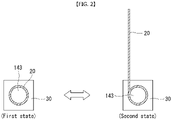
- FIG. 2 illustrates an operation state of the rollable display device.
- a rollable display device 100 may include a display unit 20 and a housing 30.
- the display unit 20 may be configured to display an image and may include a display panel 10 and a module cover 15.
- the display panel 10 may be provided at a front surface of the display device 100 and may display an image.
- the display panel 10 may split an image into a plurality of pixels and output the image by controlling each pixel to emit light while adjusting color, brightness, and saturation of each pixel.
- the display panel 10 may be divided into an active region where an image is displayed and an inactive region where no image is displayed.
- the display panel 10 may have a rectangular shape. However, the present disclosure is not limited thereto, and the display panel 10 may be shaped to have a predetermined curvature at an edge.
- the display panel 10 may be an organic light emitting diode (OLED) display panel in an exemplary embodiment. However, the present disclosure is not limited thereto, and the display panel 10 may be various types of flexible flat panel displays.
- OLED organic light emitting diode
- the module cover 15 may be provided at a rear surface of the display panel 10.
- the module cover 15 may be attached directly to the display panel 10.
- a size of the module cover 15 may be equal to or greater than a size of the display panel 10.
- the module cover 15 may support the display panel 10 and may be attached directly to the rear surface of the display panel 10 while the module cover 15 faces the display panel 10 in a face-to-face manner so that the display panel 10 is stably rolled.
- the module cover 15 may be attached to the display panel 10 by an adhesive having a given strength or higher once it is cured. As a result, the display panel 10 and the module cover 15 may form one assembly and operate as one body.
- the module cover 15 may be configured to move up and down the display unit 20 and may be folded or unfolded depending on the direction. The module cover 15 will be described in detail later.
- the housing 30 may accommodate the display panel 10 and may also mount multiple mechanical components for moving up and down the display unit 20 and driving circuits required to drive the display unit 20 therein.
- the rollable display device 100 may operate in a first state and a second state.
- the first state is a state in which the active region of the display unit 20 is positioned inside the housing 30, and the second state is a state in which the active region of the display unit 20 is exposed out of the housing 30.
- the first state may be a state in which the display unit 20 is accommodated inside the housing, and the second state may be a state in which the display unit 20 is unrolled.
- the active region of the display unit 20 may be positioned inside the housing 30. That is, this indicates that the display unit 20 may be shielded by the housing 30.
- the rollable display device 100 maintains the first state when it does not operate or no screen appears on the display, and maintains the second state when it operates or a screen appears on the display.
- the rollable display device 100 may further include a roller 143 for moving up and down the rollable display device 100.
- the roller 143 is configured to rotate clockwise or counterclockwise inside the housing 30.
- One end of the display unit 20 is connected to the roller 143, and may be unfolded out of the housing 30 or accommodated in the housing 30 while the display unit 20 moves up and down by a rotary motion of the roller 143.
- the display unit 20 is rolled on the roller 143 in the first state, and the display unit 20 is unrolled from the roller 143 and exposed in the second state.
- a detailed structure and operation method of the roller and the display unit 20 are described below.
- the display unit 20 may be in either the first state or the second state. Hence, since the display unit 20 can be exposed out of the housing 30 only when the display device 100 is in use, a space can be saved.
- FIG. 3 illustrates an appearance of a display unit connected to a roller
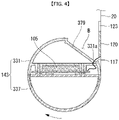
- FIG. 4 schematically illustrates a cross-section taken along line A-A' of FIG. 3 .
- the roller 143 may be connected to one end of the display panel 10.
- the roller 143 may wind or unwind the display panel 10 so that the display panel 10 is in either the first state or the second state.
- the roller 143 may be configured to move up the display unit 20 by rotating in the arrow direction (clockwise) and move down the display unit 20 by rotating counterclockwise.
- the display unit 20 may be disposed in such a way that the 'front' is a direction directed toward -z-axis and the 'back' is a direction directed toward +z-axis.
- the display unit 20 may be wound in such a way that the front of the display unit 20 displaying the image is directed toward the outward of the roller 143.
- the display unit 20 may move up while being positioned in proximity to the edge of the housing 30. Therefore, a space for containing an object above the housing 30 in front of the screen of the display unit 20 is eliminated, and thus the screen can be prevented from being blocked by the object positioned above the housing in front of the screen.
- the display unit 20 may be disposed in such a way that the 'front' is a direction directed toward +z-axis and the 'back' is a direction directed toward -z-axis.
- source PCBs 120 may be disposed on at least a portion of the rear surface (inside where the display unit 20 is wound on the roller) of the display unit 20.
- the source PCBs 120 may be spaced apart from the neighboring one.
- Signal lines for transmitting digital video data and timing control signals may be disposed on at least one source PCB 120.
- the source PCB 120 may be connected to the display panel 10 by a source chip-on film (COF) 123.
- the source COF 123 connected to one side of the source PCB 120 may be extended to the active region of the display panel 10 and connected to the display panel of the display unit 20.
- a seating portion 379 may be formed on an outer circumference of the roller 143.
- the seating portion 379 may be formed such that a part of the outer circumference of the roller 143 is stepped. In this case, an accommodation space B may be formed inside the roller 143.
- the seating portion 379 may be positioned where the PCB 120 adjoins the roller 143 when the display unit 20 is wound on the roller 143.
- the source PCB 120 When the display unit 20 is rolled up, the source PCB 120 may be accommodated in the accommodation space B formed by the seating portion 379. Hence, it is possible to prevent damage to the source PCB 120 when the roller 143 is rolled up.
- the timing controller board 105 may be mounted inside the roller 143.
- the timing controller board 105 and the source PCB 120 may be electrically connected by an FFC cable 117.
- the roller 143 may include two bodies, rather than one body, that is, an upper roller 331 and a lower roller 337.
- the upper roller 331 and the lower roller 337 may be assembled together by various methods without any restraint. For example, they may be screwed together.
- the timing controller board 105 may be mounted between the upper roller 331 and the lower roller 337.
- the FFC cable 117 may be connected to the timing controller board 105 and the source PCBs 120 through a hole 331a positioned in the upper roller 331.
- the timing controller board 104 rotates together with the roller 143, thereby preventing the FFC cable 117 from being entangled. Also, the timing controller board 105 is mounted inside the roller 143, thereby saving space.
- a main board and a power supply may be disposed inside the housing to drive the display unit 20.
- they may be mounted on an inner wall surface of the housing.
- the timing controller board 105 may be connected to the main board and the power supply through wiring.
- FIG. 5 illustrates an overall appearance of a rollable display device according to an embodiment
- FIG. 6 illustrates an appearance of the rear of a rollable display device of FIG. 5 .
- the rollable display device 100 may include a link assembly LA for moving up and down the display unit 20.
- the link assembly LA may be driven by a motor.
- the link assembly LA may allow the display unit 20, that is positioned in a folded state inside the housing 30, to be positioned inside the housing 30 while being rolled on the roller 143.
- the display unit 20 In the second state, the display unit 20 may be unfolded and may be exposed out of the housing 30.
- the housing 30 may function as a mounting where the link assembly LA and a motor assembly 137 are installed, and may support the link assembly LA and the motor assembly 137.
- the housing 30 may include a first base 31 and a second base 33.
- the first base 31 and the second base 33 may face each other at a predetermined distance between them.
- FIG. 5 illustrates that the first base 31 is removed so that the roller 143 is visible.
- the roller 143 may be disposed between the first base 31 and the second base 33, and both ends thereof may be axially connected to the housing 30 so as to rotate clockwise or counterclockwise. Accordingly, the roller 143 may rotate with respect to the central axis of the roller.
- the link assembly LA may be disposed on the first base 31.
- the link assembly LA may function to give support so that the display unit 20 moves up and down.
- the link assembly LA may move up and down a supporter 75 coupled to the upper part of the display unit 20.
- An upper end of the display unit 20 may be fixed to the supporter 75, and a lower end thereof may be fixed to the roller 143.
- the link assembly LA When the link assembly LA is unrolled (or unfolded), the link assembly LA may support the display unit 20 at the rear surface of the display unit so that the display unit 20 is unfolded neatly without folds.
- the motor assembly 137 may be positioned where the link assembly LA is connected to the housing 30.
- the motor assembly 137 may be driven to move up and down the link assembly LA.
- the motor assembly 137 may receive an electric signal and convert the electric signal into a physical force.
- the motor assembly 137 may transmit rotational energy to the link assembly LA and change it from the first state to the second state.
- the link assembly LA may include the supporter 75 and a pair of links 73 supporting both sides of the supporter 75.
- the supporter 75 fixes ends of the display unit 20.
- the display unit 20 may move up and down in accordance with the up and down operation of the supporter 75.
- the link 73 may include an upper link 73a and a lower link 73b, and may have a bar shape.
- the upper link 73a may be disposed at an upper part, and the lower link 73b may be disposed at a lower part.
- the upper ink 73a and the lower link 73b may be connected through a joint 152.
- One end of the upper link 73a may be fastened to the supporter 75, and other end of the upper link 73a may be fastened to the joint 152.
- one end of the lower link 73b may be rotatably and axially connected to the motor assembly 137, and other end of the lower link 73b may be fastened to the joint 152.
- the joint 512 may include gears (not shown) that are installed at the upper link 73a and the lower link 73b, respectively.
- the gear of the upper link 73a and the gear of the lower link 73b may engage each other.
- the links 73 may be configured to move symmetrically with respect to the joint 512.
- the link 73 may be provided on each of the left and right sides, and may operate as a pair. That is, the display unit 20 may move up and down in an upright position without tilting or creasing only when the left link and the right link are controlled to have the same momentum.
- the link assembly LA may further include a shock absorber 72 supporting the link 73.
- One end of the shock absorber 72 may be rotatably and axially connected to the link 73, more precisely, the lower link 73b, and the other end may be rotatably and axially connected to the first base 31.
- the shock absorber 72 may include an oil hydraulic cylinder, a pneumatic cylinder (or an air cylinder), or an actuator.
- the shock absorber according to this construction may include a piston and a cylinder, and the cylinder may be filled with oil or gas.
- FIGS. 7 and 8 illustrate a link assembly in a folded state.
- the links 73 may perform a rotating/pivoting motion by the operation of the motor assembly 137, and, as a result, the supporter 75 may operate move up and down.
- the rotary motion of the motor assembly 137 may be performed so that the links 73 rotate or pivot in a direction, in which the links 73 stand upright with respect to the base 31, by a gear configuration (not shown) disposed between the motor assembly 137 and the lower link 73b.
- an angle between the upper link 73a and the lower link 73b which are connected with respect to the joint 152 as the axis of the motor assembly 137 rotates may increase or decrease.
- Such an operation for decreasing or increasing the angle between the upper link 73a and the lower link 73b with respect to the joint 152 as the upper link 73a and the lower link 73b are folded and unfolded may be referred to as a pivot operation.
- a top case 950 may move in a direction of +y-axis. Hence, the display unit 20 whose one end is connected to the top case 950 may move upward while being unrolled from the roller 143.
- the links 73 pivot in a direction in which they stand upright with respect to the base 31, a length of the shock absorber 72 varies.
- the shock absorber 72 whose one end is connected to the lower link 73b is extended in its longitudinal direction, which may increase oil pressure and support the links 73 to maintain an upright position.
- a distance between the joint of the left link and the joint of the right link may decrease.
- the display unit 20 may be completely accommodated in the housing.
- the links 73 may be brought to a fully upright position (90 degrees between the links and the base), thereby fully unfolding the display unit 20.
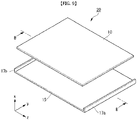
- FIG. 9 illustrates an appearance of the display unit 20 configured to roll according to an embodiment
- FIG. 10 illustrates a cross-section taken along line B-B' of FIG. 9 .
- the display unit 20 may be configured such that the flat display panel 10 is attached to the module cover 15 in a face-to-face manner.
- the display panel 10 may be configured such that it is rolled on or unrolled from the roller by rotating around the x-axis direction in the drawing.
- the display panel 10 may be a flexible organic light emitting diode panel, by way of example, but is not limited thereto. For example, as long as a flexible and foldable display panel is used, it can be implemented as the display panel 10 without particular limitations.
- the module cover 15 may be configured to have the shape of a thin plate.
- the module cover 15 may have a thickness of about 0.1 mm to 0.2 mm, and its thickness may vary depending on with the size of the display panel 10.
- the thickness of the module cover 15 may relatively decrease as the size of the display panel 10 decreases, and on the contrary, the thickness of the module cover 15 may increase as the size of the display panel 10 increases.
- the thickness of the module cover 15 may be adjusted depending on its structural stiffness. The thickness of the module cover 15 may increase so that the structural stiffness increases, and on the contrary, the thickness of the module cover 15 may decrease so that the structural stiffness decreases.
- the thickness of the module cover 15 may be adjusted depending on the size of the roller 143, more precisely, a diameter of the roller 143 of a cylindrical shape. For example, when the diameter of the roller 143 increases, a radius of curvature required for the display unit 20 may increase correspondingly, and therefore the thickness of the module cover 15 may increase. On the contrary, when the diameter of the roller 143 decreases, the radius of curvature required for the display unit 20 may decrease correspondingly, and therefore the thickness of the module cover 15 needs to decrease.
- the module cover 15 may be formed of a thin metal plate having an excellent elastic restoring force, and more preferably, a metal plate material having a yield strain of 0.5% or more.
- the module cover 15 may be made of titanium (Ti).
- Ti titanium
- the module cover 15 can be implemented using a thin plate, and the thin plate can prevent the module cover 15 from being damaged from contamination due to an excellent corrosion resistance.
- the yield strain (y) is a physical quantity defined as a value obtained by dividing yield strength by elastic modulus (yield strength/elastic modulus).
- the yield strength can be adjusted during the manufacturing process, but the elastic modulus is a unique physical quantity determined for each material. Therefore, if the module cover 15 is made of titanium having a low elastic modulus, there is an advantage in that the yield strain can be easily increased.
- the display unit 20 is rolled on the roller 143 or is unrolled from the roller 143, and thus serves as a display.
- a force for rotating the roller 143 is required to roll or unroll the display unit 20.
- a yield strain of the module cover 15 is less than 0.5%, permanent deformation may occur due to a deformation force inherent in the module cover 15.
- the yield strain of the module cover 15 is equal to or greater than at least 0.5%.
- the yield strain is a quantitative number (or ratio) that can define flexibility of any material. The thicker the material, the lower the flexibility, and the thinner the material, the better the flexibility.
- the thickness of the module cover 15 is 0.1 mm to 0.2 mm.
- the thickness is less than 0.1 mm, it is impossible to form a structural strength and rigidity within a desired range.
- the thickness is greater than 0.2 mm, the flexibility of the material is reduced, and the shape of the display unit cannot be maintained properly when the display unit is unfolded. Hence, it is practically impossible for the display unit to serve as a display.
- the display unit 20 can be stably wound on or unwound from the roller 143 without the permanent deformation even if the diameter of the roller 143 is configured to be 60 mm or less.
- the module cover 15 thus configured may be attached to the display panel 10 using an adhesive 13 in a face-to-face manner.
- an adhesive strength of the adhesive 13 is equal to or greater than 1,000 gf/25mm. If the adhesive strength of the adhesive 13 is less than 1,000 gf/25mm, there may occur a problem such as a gap between the display panel 10 and the module cover 15 due to an insufficient mechanical adhesive force when the display unit 20 is wound on or unwound from the roller 143.
- the module cover 15 may further include bezel portions 17a and 17b formed above than the display panel 10 so as to protect the edges of the display panel 10.
- the module cover 15 may include the first and second bezel portions 17a and 17b at both ends of the rotation axis (x-axis direction in the drawing).
- the bezel portions 17a and 17b may be elongated at the end of the module cover 15 along a direction (the z-axis direction in the drawing) intersecting the rotation axis.
- a thickness t1 of the bezel portions 17a and 17b is greater than a thickness t2 of the display panel 10.
- the edges of the display panel 10 can be protected from an impact due to the bezel portions 17a and 17b.
- the thickness of the display unit 10 may be 0.3 mm, and the thickness of the bezel portions 17a and 17b may be 1 mm or more.
- the end of the display panel 10 may be spaced apart from the bezel portions 17a and 17b by a predetermined distance d1.
- the predetermined distance d1 forms a border gap to prevent the display panel 10 from interfering with the bezel portions 17a and 17b when the display panel 10 is deformed due to a stress generated in the display panel 10.
- a stress may be inherent in the display panel 10, and thus the display panel 10 may be deformed.
- the display panel 10 may operate or thermally expand or contract by an ambient temperature. In this instance, the display panel 10 can be prevented from interfering with the bezel portions 17a and 17b.
- the module cover 15 may include a module cover 151 that may be made of titanium and a film portion 152 attached to the module cover 151 by a method such as a lamination, etc.
- a material of the film portion 152 is not particularly limited, but is preferably configured to have an elongation greater than an elongation of the module cover 151.
- the module cover 151 which may be formed of a metal plate, may give an impact to the display panel 10 when the material itself is hard and wound on the roller.
- the film portion 152 may elongate more than the module cover 151.
- the film portion 152 can effectively disperse the stress transferred from the module cover 151 to the display panel 10 and thus protect the display panel 10.
- the film portion 152 may include a first portion 152a formed on the first surface 151a and a second portion 152b formed on the second surface 151b, and a thickness S1 of the first portion 152a may be equal to or greater than a thickness S2 of the second portion 152b. Since the thickness S1 of the first portion 152a is greater than the thickness S2 of the second portion 152b, it is possible to effectively protect the display panel 10. In addition, since the first portion 152a and the second portion 152b are configured to have the different thicknesses, the overall thickness of the film portion 152 may be kept slim.
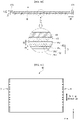
- FIGS. 11 and 12 illustrate a planar appearance of a module cover constructing the module cover 15.
- the module cover 151 may include one seamless plate material (see FIG. 11 ), or may include a plurality of plate materials 1511 to 1514 with a seam (Me).
- the module cover 151 may be configured to have a large area of 1,500 mm in horizontal width and 650 mm in vertical width. In this case, if flatness of the module cover 151 formed of a metal plate is not formed within a desired range, when the display panel 10 is attached to the module cover 15, the display panel 10 having a thin thickness may be formed by the module cover 15 and may be attached to the display panel 10.
- the module cover 151 may include a plurality of plate materials.
- the plate materials may be connected through butt welding.
- the butt welding refers to a method of attaching two base materials 1512 and 1513 by welding a butt portion (Me) of the two base materials 1512 and 1513 in a state where the two base materials 1512 and 1513 are placed on the same plane to butt each other.
- the plate materials 1511 to 1514 in the module cover 151 are connected to each other through the butt welding as described above, the plate materials 1511 to 1514 may be disposed on the same plane and may have desired flatness even if the module cover 151 has the large area.
- the plate materials 1511 to 1514 have the same size so that the same deformation force is generated in each plate material.
- the same size means that when the respective plate materials 1511 to 1514 have a rectangular shape, the respective plate materials 1511 to 1514 have the same width ⁇ length ⁇ thickness and thus have the same area.
- the seam (Me) When the plate materials are butt welded, it is preferable to perform spot welding rather than welding the seam (Me) as a whole.
- the spot welding refers to forming a welding portion (WP) in the shape of a point.
- the seam (Me) may include a plurality of welding portions (WP) disposed along a longitudinal direction of the seam. It is preferable that the welding portion (WP) is formed at a predetermined distance from the neighboring welding portion along the longitudinal direction of the seam.
- the seam (Me) includes a welding portion and a non-welding portion.
- the reason for configuring the seam as described above is to effectively disperse the stress inherent in the module cover 151 by the rolling when the module cover 15 is rolled and to prevent the stress from being concentrated on the seam Me.
- the deformation force may be condensed on the module cover 151.
- the deformation force may be concentrated on the weakest seam (Me) of the module cover 151, and the deformation force can be dispersed through a non-welded portion of the seam since a portion of the seam is not welded.
- the module cover 151 includes the plurality of plate materials as described above, there is an advantage in that the module cover of the large area can be efficiently manufactured.
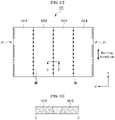
- the module cover 151 When the module cover 151 is in a rectangular shape having a long side (the side in the x-axis direction in the drawing) and a short side (the side in the y-axis direction in the drawing), the module cover 151 may include a notch 21 formed along an end of the short side.
- a plurality of notches 21 are formed at both ends in a direction (the x-axis direction in the drawing) intersecting a rolling direction (the x-axis direction in the drawing) of the module cover 151, and this is described in detail with reference to the drawings.
- a portion in which the notch 21 is formed may be implemented as a bending portion through a bending processing later.
- FIG. 14 enlargedly illustrates selectively an end at which a notch of a module cover is formed.
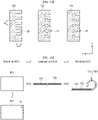
- FIG. 15 illustrates a process of forming a bending portion.
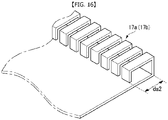
- FIG. 16 partially illustrates a bezel portion formed through a bending processing. A film portion is omitted in FIG. 16 for convenience of explanation.
- the module cover 151 may include the notch 21 formed at its end.
- the notch 21 is configured so that the bezel portions 17a and 17b can be easily bent.
- the notch 21 may be configured to have a predetermined length da1 in a second direction (the x-axis direction in the drawing) intersecting a rolling direction (the z-axis direction in the drawing) of the module cover 151.
- the length da1 of the notch 21 may be set depending on a width da2 of the bending portion 17a. In a preferable implementation, the length da1 of the notch 21 may be equal to or less than the width da2 of the bending portion 17a.
- the end of the module cover 151 in which the notch 21 is formed may be bent toward the center of the module cover 151 to form the bezel portion 17a.
- the notch 21 may be further formed in the inside of the module cover 151 by passing the bezel portion 17a. In this case, the notch 21 may be visually recognized, and structural rigidity of the module cover 151 having the thin thickness may be reduced.
- the notch 21 may not be visually exposed from the rear surface of the module cover 151, and the notch 21 may also be selectively formed only on the bezel portion 17a.
- the notch 21 may be spaced apart from the neighboring notch 21 by a predetermined distance in the first direction.
- a distance dt between the adjacent notches 21 may be determined depending on the size of the roller 143, that is, the diameter of the roller 143 having a cylindrical shape. For example, as the diameter of the roller 143 increases, the radius of curvature may increase in proportion to it. Therefore, the stress applied when the module cover 151 is rolled on the roller 143 can be reduced. Thus, the distance dt between the notches 21 may also increase. On the contrary, when the diameter of the roller 143 decreases, the stress applied to the module cover 151 rolled on the roller 143 increases in proportion to it. Accordingly, the bending may be performed easier by reducing the distance dt between the notches 21.
- the shape of the notch 21 may be configured to have various shapes without any particular limitation.
- the notch 21 may be formed in various shapes, such as a straight-line shape or a V-shaped groove, without any particular limitation.
- the bezel portions 17a and 17b may be formed by bending both ends of the module cover 151. This will be described in detail with reference to FIG. 15 .
- a first process S11 of forming the bezel portions 17a and 17b may be a notching process of forming the notch 21 by pressing both ends of the module cover 151.
- the notching refers to a press processing in which a part of a sheet is sheared using a mold.
- the notch 21 may have various shapes depending on a shape of the mold.
- a lamination process S12 may be performed to form a film portion on the notched module cover 151. Since the film is laminated after the notching process, the notch 21 formed through the notching process is configured so that the notch 21 is not visible to the outside, thereby enhancing the aesthetic feeling. Although it has been described that the film is laminated after the notching process, the notching process may be performed after laminating the film on the module cover 151.
- both ends of the notched module cover 151 may be bent to the inside of the module cover 151 to form the bezel portions 17a and 17b.
- the notches formed in the bezel portions 17a and 17b are configured such that the notches are visually invisible, and thus can enhance the aesthetic feeling.
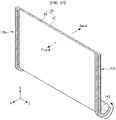
- FIG. 17 illustrates selectively only a display unit and a roller.
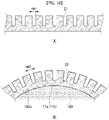
- FIG. 18 illustrates an operation of a notch formed in a bezel portion when a display unit is rolled on a roller.
- the notch is not actually seen to the outside by the film portion, but is shown in FIG. 17 for convenience of explanation.
- the display unit 20 may be rolled on or unrolled from the roller 143 by the operation of the link assembly as described above, and thus the display unit 20 may move up and down.
- the display unit 20 may be wound on the roller 143 so that the front surface of the display faces outward when the front surface of the display is wound on the roller 143. As described above, when the display unit 20 is wound to face outward, the display unit 20 including the bezel portions 17a and 17b may be bent more easily on the roller 143.
- the display unit 20 moves up and down (in the y-axis direction of the drawing).
- the display unit 20 structurally supports the display unit 20, and bezel portions 17a and 17b are further formed at both ends of the display unit 20 in the up-down direction of movement so as to protect the display panel 10.
- bezel portions 17a and 17b are formed at both ends of the display unit 20
- an imbalance in stress occurs when the display unit 20 is wound on the roller 143, and thus the display unit 20 may crumple or wrinkle when the display unit 20 is rolled on or unrolled from the roller 143.
- the notch 21 is formed in the bezel portions 17a and 17b along a rotation axis direction (the z-axis direction in the drawing) of the roller, i.e., the rolling direction of the display unit 20, the display unit 20 can be easily folded.
- the bezel portions 17a and 17b may also be bent to face the outward.
- the notch 21 formed in the bezel portions 17a and 17b is in a state illustrated in (A) when the display unit 20 is unfolded, but the bezel portions 17a and 17b are bent according to a surface 143a of the roller 143, i.e., the radius of curvature of the roller 143 when the display unit 20 is rolled on the roller 143.
- the bezel portions 17a and 17b are positioned in the opposite direction facing toward the roller 143.
- the outside of the bezel portions 17a and 17b is stretched while the inside is contracted.
- the notch 21 formed in the bezel portions 17a and 17b is formed outside the bezel portions, the outside of the bezel portions 17a and 17b may be stretched without any resistance while the notch 21 is stretched along its stretch direction (arrow direction in the drawings).
- the display unit 20 includes the bezel portions 17a and 17b at its both ends, the display unit 20 can be easily bent on the roller 143.
- a width nw1 of the notch 21 when the display unit 20 is unrolled may be less than a width nw2 of the notch 21 when the display unit 20 is unrolled.
Landscapes
- Engineering & Computer Science (AREA)
- Theoretical Computer Science (AREA)
- Physics & Mathematics (AREA)
- General Physics & Mathematics (AREA)
- General Engineering & Computer Science (AREA)
- Human Computer Interaction (AREA)
- Computer Hardware Design (AREA)
- Microelectronics & Electronic Packaging (AREA)
- Devices For Indicating Variable Information By Combining Individual Elements (AREA)
Applications Claiming Priority (1)
| Application Number | Priority Date | Filing Date | Title |
|---|---|---|---|
| PCT/KR2019/009321 WO2021020595A1 (ko) | 2019-07-26 | 2019-07-26 | 롤러블 디스플레이 디바이스 |
Publications (3)
| Publication Number | Publication Date |
|---|---|
| EP4006883A1 true EP4006883A1 (de) | 2022-06-01 |
| EP4006883A4 EP4006883A4 (de) | 2023-04-26 |
| EP4006883B1 EP4006883B1 (de) | 2025-09-10 |
Family
ID=74228991
Family Applications (1)
| Application Number | Title | Priority Date | Filing Date |
|---|---|---|---|
| EP19939321.6A Active EP4006883B1 (de) | 2019-07-26 | 2019-07-26 | Rollbare anzeigevorrichtung |
Country Status (4)
| Country | Link |
|---|---|
| US (1) | US12069820B2 (de) |
| EP (1) | EP4006883B1 (de) |
| KR (1) | KR102707450B1 (de) |
| WO (1) | WO2021020595A1 (de) |
Families Citing this family (5)
| Publication number | Priority date | Publication date | Assignee | Title |
|---|---|---|---|---|
| CN115116323B (zh) * | 2021-03-17 | 2025-04-08 | 京东方科技集团股份有限公司 | 柔性显示设备 |
| WO2023085452A1 (ko) * | 2021-11-10 | 2023-05-19 | 엘지전자 주식회사 | 디스플레이 디바이스 및 그 제어 방법 |
| USD1069221S1 (en) * | 2022-05-04 | 2025-04-01 | Atom H2O, Llc | Flexible OLED frame |
| KR20240161854A (ko) | 2023-05-03 | 2024-11-13 | 삼성디스플레이 주식회사 | 표시 장치 및 롤러블 전자 장치 |
| CN116434669B (zh) * | 2023-06-12 | 2023-10-03 | 深圳市华星光电半导体显示技术有限公司 | 显示装置、终端设备 |
Family Cites Families (15)
| Publication number | Priority date | Publication date | Assignee | Title |
|---|---|---|---|---|
| JP5341329B2 (ja) * | 2007-08-14 | 2013-11-13 | 株式会社カナイ | 換気口スクリーンとこれを用いた軒裏換気口構造 |
| KR101540163B1 (ko) | 2008-05-16 | 2015-07-28 | 신닛테츠스미킹 마테리알즈 가부시키가이샤 | 가요성 디스플레이용 스테인리스 강박 |
| KR102346955B1 (ko) * | 2015-01-30 | 2022-01-04 | 삼성디스플레이 주식회사 | 가요성 윈도우 기판 및 이를 구비한 가요성 표시 장치 |
| KR102378758B1 (ko) * | 2015-06-19 | 2022-03-25 | 엘지디스플레이 주식회사 | 플렉서블 표시 장치 |
| US10198040B2 (en) | 2016-05-20 | 2019-02-05 | Apple Inc. | Electronic devices with flexible displays |
| KR102019509B1 (ko) * | 2016-09-05 | 2019-09-09 | 엘지전자 주식회사 | 디스플레이 디바이스 |
| KR102605289B1 (ko) * | 2016-09-05 | 2023-11-24 | 엘지전자 주식회사 | 디스플레이 장치 |
| KR20190021523A (ko) * | 2017-08-22 | 2019-03-06 | 희성전자 주식회사 | 디스플레이 장치용 백 커버 및 이를 구비하는 디스플레이 장치 |
| KR102369318B1 (ko) * | 2017-08-30 | 2022-03-02 | 엘지디스플레이 주식회사 | 연성 디스플레이 장치 |
| KR102438579B1 (ko) * | 2017-12-18 | 2022-08-30 | 엘지디스플레이 주식회사 | 플렉서블 표시 장치 |
| KR102446200B1 (ko) | 2017-12-22 | 2022-09-21 | 엘지디스플레이 주식회사 | 플렉서블 디스플레이 장치 및 이를 포함하는 롤러블 디스플레이 장치 |
| CN113053250B (zh) * | 2017-12-28 | 2022-10-04 | 乐金显示有限公司 | 可折叠显示器 |
| KR101945985B1 (ko) | 2018-06-28 | 2019-02-08 | 엘지디스플레이 주식회사 | 표시 장치 |
| KR101975188B1 (ko) * | 2018-06-28 | 2019-05-07 | 엘지디스플레이 주식회사 | 표시 장치 |
| KR102718470B1 (ko) * | 2019-06-14 | 2024-10-17 | 엘지전자 주식회사 | 디스플레이 디바이스 |
-
2019
- 2019-07-26 US US17/629,989 patent/US12069820B2/en active Active
- 2019-07-26 EP EP19939321.6A patent/EP4006883B1/de active Active
- 2019-07-26 KR KR1020227001529A patent/KR102707450B1/ko active Active
- 2019-07-26 WO PCT/KR2019/009321 patent/WO2021020595A1/ko not_active Ceased
Also Published As
| Publication number | Publication date |
|---|---|
| US20220264755A1 (en) | 2022-08-18 |
| EP4006883A4 (de) | 2023-04-26 |
| KR102707450B1 (ko) | 2024-09-20 |
| US12069820B2 (en) | 2024-08-20 |
| WO2021020595A1 (ko) | 2021-02-04 |
| KR20220019825A (ko) | 2022-02-17 |
| EP4006883B1 (de) | 2025-09-10 |
Similar Documents
| Publication | Publication Date | Title |
|---|---|---|
| EP4006883B1 (de) | Rollbare anzeigevorrichtung | |
| US10687428B2 (en) | Display device | |
| US10905019B2 (en) | Display device | |
| US11665837B2 (en) | Display device | |
| US11723160B2 (en) | Display device | |
| US11127323B2 (en) | Display device | |
| CN109074766B (zh) | 显示装置 | |
| US12082356B2 (en) | Rollable display device | |
| US10531582B2 (en) | Display device | |
| KR102650633B1 (ko) | 디스플레이 장치 | |
| US20200043386A1 (en) | Rollable Display Device | |
| US11547002B2 (en) | Display device | |
| KR102891636B1 (ko) | 표시 장치 | |
| US12075572B2 (en) | Display device | |
| TW202225904A (zh) | 顯示裝置 | |
| CN115810311A (zh) | 显示装置 | |
| US12160963B2 (en) | Display device |
Legal Events
| Date | Code | Title | Description |
|---|---|---|---|
| STAA | Information on the status of an ep patent application or granted ep patent |
Free format text: STATUS: THE INTERNATIONAL PUBLICATION HAS BEEN MADE |
|
| PUAI | Public reference made under article 153(3) epc to a published international application that has entered the european phase |
Free format text: ORIGINAL CODE: 0009012 |
|
| STAA | Information on the status of an ep patent application or granted ep patent |
Free format text: STATUS: REQUEST FOR EXAMINATION WAS MADE |
|
| 17P | Request for examination filed |
Effective date: 20220120 |
|
| AK | Designated contracting states |
Kind code of ref document: A1 Designated state(s): AL AT BE BG CH CY CZ DE DK EE ES FI FR GB GR HR HU IE IS IT LI LT LU LV MC MK MT NL NO PL PT RO RS SE SI SK SM TR |
|
| DAV | Request for validation of the european patent (deleted) | ||
| DAX | Request for extension of the european patent (deleted) | ||
| A4 | Supplementary search report drawn up and despatched |
Effective date: 20230324 |
|
| RIC1 | Information provided on ipc code assigned before grant |
Ipc: G06F 1/16 20060101ALI20230321BHEP Ipc: G09F 9/30 20060101AFI20230321BHEP |
|
| REG | Reference to a national code |
Ref country code: DE Ref legal event code: R079 Ipc: G06F0001160000 Ref country code: DE Ref legal event code: R079 Ref document number: 602019075699 Country of ref document: DE Free format text: PREVIOUS MAIN CLASS: G09F0009300000 Ipc: G06F0001160000 |
|
| GRAP | Despatch of communication of intention to grant a patent |
Free format text: ORIGINAL CODE: EPIDOSNIGR1 |
|
| STAA | Information on the status of an ep patent application or granted ep patent |
Free format text: STATUS: GRANT OF PATENT IS INTENDED |
|
| RIC1 | Information provided on ipc code assigned before grant |
Ipc: G09F 9/30 20060101ALI20250325BHEP Ipc: G06F 1/16 20060101AFI20250325BHEP |
|
| INTG | Intention to grant announced |
Effective date: 20250414 |
|
| GRAS | Grant fee paid |
Free format text: ORIGINAL CODE: EPIDOSNIGR3 |
|
| GRAA | (expected) grant |
Free format text: ORIGINAL CODE: 0009210 |
|
| STAA | Information on the status of an ep patent application or granted ep patent |
Free format text: STATUS: THE PATENT HAS BEEN GRANTED |
|
| AK | Designated contracting states |
Kind code of ref document: B1 Designated state(s): AL AT BE BG CH CY CZ DE DK EE ES FI FR GB GR HR HU IE IS IT LI LT LU LV MC MK MT NL NO PL PT RO RS SE SI SK SM TR |
|
| REG | Reference to a national code |
Ref country code: GB Ref legal event code: FG4D |
|
| REG | Reference to a national code |
Ref country code: CH Ref legal event code: EP |
|
| REG | Reference to a national code |
Ref country code: DE Ref legal event code: R096 Ref document number: 602019075699 Country of ref document: DE |
|
| REG | Reference to a national code |
Ref country code: IE Ref legal event code: FG4D |
|
| PG25 | Lapsed in a contracting state [announced via postgrant information from national office to epo] |
Ref country code: NO Free format text: LAPSE BECAUSE OF FAILURE TO SUBMIT A TRANSLATION OF THE DESCRIPTION OR TO PAY THE FEE WITHIN THE PRESCRIBED TIME-LIMIT Effective date: 20251210 |
|
| REG | Reference to a national code |
Ref country code: LT Ref legal event code: MG9D |
|
| PG25 | Lapsed in a contracting state [announced via postgrant information from national office to epo] |
Ref country code: FI Free format text: LAPSE BECAUSE OF FAILURE TO SUBMIT A TRANSLATION OF THE DESCRIPTION OR TO PAY THE FEE WITHIN THE PRESCRIBED TIME-LIMIT Effective date: 20250910 |
|
| REG | Reference to a national code |
Ref country code: NL Ref legal event code: MP Effective date: 20250910 |
|
| PG25 | Lapsed in a contracting state [announced via postgrant information from national office to epo] |
Ref country code: HR Free format text: LAPSE BECAUSE OF FAILURE TO SUBMIT A TRANSLATION OF THE DESCRIPTION OR TO PAY THE FEE WITHIN THE PRESCRIBED TIME-LIMIT Effective date: 20250910 |
|
| PG25 | Lapsed in a contracting state [announced via postgrant information from national office to epo] |
Ref country code: GR Free format text: LAPSE BECAUSE OF FAILURE TO SUBMIT A TRANSLATION OF THE DESCRIPTION OR TO PAY THE FEE WITHIN THE PRESCRIBED TIME-LIMIT Effective date: 20251211 |
|
| PG25 | Lapsed in a contracting state [announced via postgrant information from national office to epo] |
Ref country code: SE Free format text: LAPSE BECAUSE OF FAILURE TO SUBMIT A TRANSLATION OF THE DESCRIPTION OR TO PAY THE FEE WITHIN THE PRESCRIBED TIME-LIMIT Effective date: 20250910 |
|
| PG25 | Lapsed in a contracting state [announced via postgrant information from national office to epo] |
Ref country code: LV Free format text: LAPSE BECAUSE OF FAILURE TO SUBMIT A TRANSLATION OF THE DESCRIPTION OR TO PAY THE FEE WITHIN THE PRESCRIBED TIME-LIMIT Effective date: 20250910 |
|
| PG25 | Lapsed in a contracting state [announced via postgrant information from national office to epo] |
Ref country code: BG Free format text: LAPSE BECAUSE OF FAILURE TO SUBMIT A TRANSLATION OF THE DESCRIPTION OR TO PAY THE FEE WITHIN THE PRESCRIBED TIME-LIMIT Effective date: 20250910 Ref country code: PL Free format text: LAPSE BECAUSE OF FAILURE TO SUBMIT A TRANSLATION OF THE DESCRIPTION OR TO PAY THE FEE WITHIN THE PRESCRIBED TIME-LIMIT Effective date: 20250910 |
|
| PG25 | Lapsed in a contracting state [announced via postgrant information from national office to epo] |
Ref country code: RS Free format text: LAPSE BECAUSE OF FAILURE TO SUBMIT A TRANSLATION OF THE DESCRIPTION OR TO PAY THE FEE WITHIN THE PRESCRIBED TIME-LIMIT Effective date: 20251210 |
|
| PG25 | Lapsed in a contracting state [announced via postgrant information from national office to epo] |
Ref country code: ES Free format text: LAPSE BECAUSE OF FAILURE TO SUBMIT A TRANSLATION OF THE DESCRIPTION OR TO PAY THE FEE WITHIN THE PRESCRIBED TIME-LIMIT Effective date: 20250910 |
|
| REG | Reference to a national code |
Ref country code: AT Ref legal event code: MK05 Ref document number: 1836555 Country of ref document: AT Kind code of ref document: T Effective date: 20250910 |
|
| PG25 | Lapsed in a contracting state [announced via postgrant information from national office to epo] |
Ref country code: NL Free format text: LAPSE BECAUSE OF FAILURE TO SUBMIT A TRANSLATION OF THE DESCRIPTION OR TO PAY THE FEE WITHIN THE PRESCRIBED TIME-LIMIT Effective date: 20250910 |
|
| PG25 | Lapsed in a contracting state [announced via postgrant information from national office to epo] |
Ref country code: SM Free format text: LAPSE BECAUSE OF FAILURE TO SUBMIT A TRANSLATION OF THE DESCRIPTION OR TO PAY THE FEE WITHIN THE PRESCRIBED TIME-LIMIT Effective date: 20250910 |
|
| PG25 | Lapsed in a contracting state [announced via postgrant information from national office to epo] |
Ref country code: AT Free format text: LAPSE BECAUSE OF FAILURE TO SUBMIT A TRANSLATION OF THE DESCRIPTION OR TO PAY THE FEE WITHIN THE PRESCRIBED TIME-LIMIT Effective date: 20250910 |
|
| PG25 | Lapsed in a contracting state [announced via postgrant information from national office to epo] |
Ref country code: IT Free format text: LAPSE BECAUSE OF FAILURE TO SUBMIT A TRANSLATION OF THE DESCRIPTION OR TO PAY THE FEE WITHIN THE PRESCRIBED TIME-LIMIT Effective date: 20250910 |
|
| PG25 | Lapsed in a contracting state [announced via postgrant information from national office to epo] |
Ref country code: IS Free format text: LAPSE BECAUSE OF FAILURE TO SUBMIT A TRANSLATION OF THE DESCRIPTION OR TO PAY THE FEE WITHIN THE PRESCRIBED TIME-LIMIT Effective date: 20260110 |
|
| PG25 | Lapsed in a contracting state [announced via postgrant information from national office to epo] |
Ref country code: PT Free format text: LAPSE BECAUSE OF FAILURE TO SUBMIT A TRANSLATION OF THE DESCRIPTION OR TO PAY THE FEE WITHIN THE PRESCRIBED TIME-LIMIT Effective date: 20260112 Ref country code: CZ Free format text: LAPSE BECAUSE OF FAILURE TO SUBMIT A TRANSLATION OF THE DESCRIPTION OR TO PAY THE FEE WITHIN THE PRESCRIBED TIME-LIMIT Effective date: 20250910 |
|
| PG25 | Lapsed in a contracting state [announced via postgrant information from national office to epo] |
Ref country code: EE Free format text: LAPSE BECAUSE OF FAILURE TO SUBMIT A TRANSLATION OF THE DESCRIPTION OR TO PAY THE FEE WITHIN THE PRESCRIBED TIME-LIMIT Effective date: 20250910 Ref country code: SK Free format text: LAPSE BECAUSE OF FAILURE TO SUBMIT A TRANSLATION OF THE DESCRIPTION OR TO PAY THE FEE WITHIN THE PRESCRIBED TIME-LIMIT Effective date: 20250910 |