EP4006896B1 - Orchestration automatique d'un fichier midi - Google Patents
Orchestration automatique d'un fichier midi Download PDFInfo
- Publication number
- EP4006896B1 EP4006896B1 EP22152232.9A EP22152232A EP4006896B1 EP 4006896 B1 EP4006896 B1 EP 4006896B1 EP 22152232 A EP22152232 A EP 22152232A EP 4006896 B1 EP4006896 B1 EP 4006896B1
- Authority
- EP
- European Patent Office
- Prior art keywords
- source
- midi file
- segment
- segments
- target
- Prior art date
- Legal status (The legal status is an assumption and is not a legal conclusion. Google has not performed a legal analysis and makes no representation as to the accuracy of the status listed.)
- Active
Links
Images

Classifications
-
- G—PHYSICS
- G10—MUSICAL INSTRUMENTS; ACOUSTICS
- G10H—ELECTROPHONIC MUSICAL INSTRUMENTS; INSTRUMENTS IN WHICH THE TONES ARE GENERATED BY ELECTROMECHANICAL MEANS OR ELECTRONIC GENERATORS, OR IN WHICH THE TONES ARE SYNTHESISED FROM A DATA STORE
- G10H1/00—Details of electrophonic musical instruments
- G10H1/0033—Recording/reproducing or transmission of music for electrophonic musical instruments
- G10H1/0041—Recording/reproducing or transmission of music for electrophonic musical instruments in coded form
- G10H1/0058—Transmission between separate instruments or between individual components of a musical system
- G10H1/0066—Transmission between separate instruments or between individual components of a musical system using a MIDI interface
-
- G—PHYSICS
- G10—MUSICAL INSTRUMENTS; ACOUSTICS
- G10H—ELECTROPHONIC MUSICAL INSTRUMENTS; INSTRUMENTS IN WHICH THE TONES ARE GENERATED BY ELECTROMECHANICAL MEANS OR ELECTRONIC GENERATORS, OR IN WHICH THE TONES ARE SYNTHESISED FROM A DATA STORE
- G10H1/00—Details of electrophonic musical instruments
- G10H1/0008—Associated control or indicating means
- G10H1/0025—Automatic or semi-automatic music composition, e.g. producing random music, applying rules from music theory or modifying a musical piece
-
- G—PHYSICS
- G10—MUSICAL INSTRUMENTS; ACOUSTICS
- G10H—ELECTROPHONIC MUSICAL INSTRUMENTS; INSTRUMENTS IN WHICH THE TONES ARE GENERATED BY ELECTROMECHANICAL MEANS OR ELECTRONIC GENERATORS, OR IN WHICH THE TONES ARE SYNTHESISED FROM A DATA STORE
- G10H2210/00—Aspects or methods of musical processing having intrinsic musical character, i.e. involving musical theory or musical parameters or relying on musical knowledge, as applied in electrophonic musical tools or instruments
- G10H2210/101—Music Composition or musical creation; Tools or processes therefor
- G10H2210/125—Medley, i.e. linking parts of different musical pieces in one single piece, e.g. sound collage, DJ mix
-
- G—PHYSICS
- G10—MUSICAL INSTRUMENTS; ACOUSTICS
- G10H—ELECTROPHONIC MUSICAL INSTRUMENTS; INSTRUMENTS IN WHICH THE TONES ARE GENERATED BY ELECTROMECHANICAL MEANS OR ELECTRONIC GENERATORS, OR IN WHICH THE TONES ARE SYNTHESISED FROM A DATA STORE
- G10H2210/00—Aspects or methods of musical processing having intrinsic musical character, i.e. involving musical theory or musical parameters or relying on musical knowledge, as applied in electrophonic musical tools or instruments
- G10H2210/101—Music Composition or musical creation; Tools or processes therefor
- G10H2210/131—Morphing, i.e. transformation of a musical piece into a new different one, e.g. remix
-
- G—PHYSICS
- G10—MUSICAL INSTRUMENTS; ACOUSTICS
- G10H—ELECTROPHONIC MUSICAL INSTRUMENTS; INSTRUMENTS IN WHICH THE TONES ARE GENERATED BY ELECTROMECHANICAL MEANS OR ELECTRONIC GENERATORS, OR IN WHICH THE TONES ARE SYNTHESISED FROM A DATA STORE
- G10H2210/00—Aspects or methods of musical processing having intrinsic musical character, i.e. involving musical theory or musical parameters or relying on musical knowledge, as applied in electrophonic musical tools or instruments
- G10H2210/555—Tonality processing, involving the key in which a musical piece or melody is played
- G10H2210/561—Changing the tonality within a musical piece
-
- G—PHYSICS
- G10—MUSICAL INSTRUMENTS; ACOUSTICS
- G10H—ELECTROPHONIC MUSICAL INSTRUMENTS; INSTRUMENTS IN WHICH THE TONES ARE GENERATED BY ELECTROMECHANICAL MEANS OR ELECTRONIC GENERATORS, OR IN WHICH THE TONES ARE SYNTHESISED FROM A DATA STORE
- G10H2240/00—Data organisation or data communication aspects, specifically adapted for electrophonic musical tools or instruments
- G10H2240/011—Files or data streams containing coded musical information, e.g. for transmission
- G10H2240/016—File editing, i.e. modifying musical data files or streams as such
- G10H2240/021—File editing, i.e. modifying musical data files or streams as such for MIDI-like files or data streams
-
- G—PHYSICS
- G10—MUSICAL INSTRUMENTS; ACOUSTICS
- G10H—ELECTROPHONIC MUSICAL INSTRUMENTS; INSTRUMENTS IN WHICH THE TONES ARE GENERATED BY ELECTROMECHANICAL MEANS OR ELECTRONIC GENERATORS, OR IN WHICH THE TONES ARE SYNTHESISED FROM A DATA STORE
- G10H2240/00—Data organisation or data communication aspects, specifically adapted for electrophonic musical tools or instruments
- G10H2240/011—Files or data streams containing coded musical information, e.g. for transmission
- G10H2240/046—File format, i.e. specific or non-standard musical file format used in or adapted for electrophonic musical instruments, e.g. in wavetables
- G10H2240/056—MIDI or other note-oriented file format
-
- G—PHYSICS
- G10—MUSICAL INSTRUMENTS; ACOUSTICS
- G10H—ELECTROPHONIC MUSICAL INSTRUMENTS; INSTRUMENTS IN WHICH THE TONES ARE GENERATED BY ELECTROMECHANICAL MEANS OR ELECTRONIC GENERATORS, OR IN WHICH THE TONES ARE SYNTHESISED FROM A DATA STORE
- G10H2240/00—Data organisation or data communication aspects, specifically adapted for electrophonic musical tools or instruments
- G10H2240/171—Transmission of musical instrument data, control or status information; Transmission, remote access or control of music data for electrophonic musical instruments
- G10H2240/281—Protocol or standard connector for transmission of analog or digital data to or from an electrophonic musical instrument
- G10H2240/295—Packet switched network, e.g. token ring
- G10H2240/305—Internet or TCP/IP protocol use for any electrophonic musical instrument data or musical parameter transmission purposes
Definitions
- the present disclosure relates to orchestration of a Musical Instrument Digital Interface (MIDI) file.
- MIDI Musical Instrument Digital Interface
- Orchestration in general is a task consisting in distributing various musical voices or parts to musical instruments. As such, orchestration is not very different from composition. In practice however, orchestration is a task performed usually by arrangers, i.e. musicians able to compose music material that somehow reveals a given music target such as a melody, a motive, or a theme.
- orchestration cannot be based on a model built from existing academic knowledge, as opposed to more constrained forms of musical polyphony.
- the orchestration problem (including its projective variant i.e., orchestration built from existing melodies) in general is ill-defined, as virtually all musical effects and means can be employed by the arranger to create a satisfying musical work. Even within the boundaries of tonal music, almost any instrument can be used. For a given instrument any musical production, provided they conform to the intrinsic limitations of the instrument such as its tessitura or playability constraints, can be employed.
- PIERRE ROY ET AL "Smart Edition of MIDI Files",ARXIV.ORG, CORNELL UNIVERSITY LIBRARY, 201 OLIN LIBRARY CORNELL UNIVERSITY ITHACA, NY 14853, 20 March 2019 (2019-03-20 ) defines an automatic process for cutting and pasting / merging MIDI files and handles repeating events and dead sounds. An additional step of harmonic preparation is mentioned briefly.
- US 2019/0237051 discloses an automated music composition and generation system and process for producing digital music, by providing a set of musical energy quality control parameters to an automated music composition and generation engine, applying certain of the selected musical energy quality control parameters as markers to specific spots along the timeline of a selected media object or event marker by the system user during a scoring process, and providing the selected set of musical energy quality control parameters to drive the automated music composition and generation engine to automatically compose and generate digital music with control over the specified qualities of musical energy embodied in and expressed by the digital music to composed and generated by the automated music composition and generation engine.
- the new MIDI file may be regarded as a re-orchestration of the target MIDI file based on the source MIDI file.
- a new MIDI file can be automatically prepared based on two existing MIDI files, herein called target and source MIDI files.
- target and source MIDI files By the source segments being reordered in relation to the source MIDI file, the new MIDI file differs from the source MIDI file.
- the new MIDI file By the new MIDI file having the same length (in time, i.e. duration) as the target MIDI file, the new MIDI file may be outputted (e.g. played) together with the target MIDI file, which may be preferred in some embodiments.
- a new MIDI file is generated as what is herein called an orchestration of a target MIDI file in the style of a source MIDI file.
- the target MIDI file may have a melody, a chord sequence, or both, and may generally any multitrack MIDI file.
- the source MIDI file may also be any multitrack MIDI file, typically a capture of a musical performance.
- orchestration may be seen as a sequence generation problem in which a good trade-off is found between 1) harmonic conformance of the generated new MIDI file to the target MIDI file and 2) sequence continuity with regards to the source MIDI file.
- the generated MIDI file may be intended to be played along with the target MIDI file, e.g. as a combined MIDI file.
- the target MIDI file e.g. as a combined MIDI file.
- other use cases are also envisioned.
- the new MIDI file may be in the style of the source MIDI file, e.g. preserving as much as possible of expression, transitions, groove, and idiosyncrasies.
- the new MIDI file may be harmonically, and, to some extent, rhythmically compatible with the target MIDI file.
- a new MIDI file O is automatically prepared.
- the new MIDI file O may be generated from the source MIDI file S as an orchestration of the target MIDI file T.
- the target and source MIDI files T and S are segmented, preferably in equal-length segments, e.g., one-beat-long or one-measure-long segments, such that the target MIDI file T is segmented into N target segments t and the source MIDI file S is segmented into P source segments s.
- the source segments s may be transposed, for example 12 times (e.g. from five semitones down to six semitones up, depending on the pitch range of the source MIDI file S).
- the new MIDI file may in some cases be formed from fewer source segments s than there are target segments t in the target MIDI file.
- domain augmentation may be used to generate a plurality of segments for the new MIDI file sequence of segments from a single source segment.
- the source MIDI file S need not have at least the same length in time as the target MIDI file T to form the new MIDI file having the same length as the target MIDI file.
- it is herein referred to MIDI files it is often the audio encoded by the MIDI file which is intended.
- the length of a MIDI file, or a segment thereof may is thus be regarded as e.g. the number of bars or beats of the audio encoded thereby, or a time duration of the audio when played at a predetermined tempo..
- the new MIDI file O is produced by reordering at least some of the (optionally transposed) source segments s and then concatenating the reordered source segments to create a new sequence of the same duration as the target MIDI file T.
- the new MIDI file O is a concatenation of N source segments s, and each target segment t is aligned with a source segment s in the new MIDI file, e.g., a first target segment t k is aligned with a first source segment s i in the new MIDI file, and a sequentially following second target segment t k+1 is aligned with a sequentially following second source segment s j in the new MIDI file.
- the first and second source segments s i and s j may be chosen so that either or both of properties (i) and (ii), below, are satisfied:
- Property (i) aims at ensuring that the new MIDI file O is conformant to the target MIDI file.
- the harmonic distance H(s, t) is typically close to zero if segments s and t use the same notes (or same pitch-classes). Conversely, H(s, t) is typically much more than zero if segments s and t contain different pitch-classes.
- Property (ii) states that two source segments s, here s i and s j , can be concatenated in this order if there exists an index l ⁇ P such that G(si, s i ) is close to zero and G(s l+1 , s j ) is close to zero.
- the graphical distance G may be endogenous to the source MIDI file S, whereas the harmonic distance H is computed between source and target segments s and t and is thus agnostic in terms of composition and performance style of the audio represented by the MIDI files.
- the distances H and G may, each or both together, be used to compute costs, such that a harmonic cost is computed using the harmonic distance H and/or a transition cost is computed using the graphical distances G.
- These costs may be interpreted as probabilities, harmonic probability and graphical probability, respectively, to be used by a sampling algorithm, e.g. using Belief Propagation as discussed further below.
- the harmonic distance H between source and target segments s and t may be based on a comparison between the pitch profiles of the two segments s and t.
- a simple pitch profile distance may be used which is not tuned for Western tonal music (e.g., taking into account the salience of pitches in a given scale).
- the harmonic distance H may be computed between Boolean matrices that represent corresponding piano rolls of the segments s and t.
- a Boolean matrix may be computed of size (128, 12b), such that a number 1 at position (i, j) in the matrix indicates that at least one note of pitch i is playing at time j.
- These matrices may be referred to as merged piano rolls.
- These matrices may be referred to as modulo 12 piano rolls.
- the harmonic distance H(t, s) between a target segment t and a source segment s may be computed by considering three quantities extracted from the modulo 12 piano roll p s and pt, for segments t and s respectively:
- Embodiments of the method of the present disclosure automatically prepares a new MIDI file O by recombining source segments s of the source MIDI file S, which results in new transitions between existing segments s.
- the quality of such a new transition may be measured in relation to the transitions between source segments s in the source MIDI file S. For example, if the source MIDI file S has unusual transitions that do not appear in other existing music, it may be desirable to reproduce such transitions in the new MIDI file O. In contrast, a general model may rank such transitions with a low score and will therefore not reproduce them.
- the quality of a transition may not depend only on harmonic features, but also on rhythm and on absolute pitches e.g., to prevent very large melodic intervals in transitions. Therefore, contrarily to the harmonic distance H, which may rely on modulo 12 piano rolls, the graphical distance G may rely on merged piano rolls, which retain information about absolute pitches.
- the graphical distance G between any source segments s x and s y may be implemented by computing the Hamming distance between the two merged piano rolls, i.e., the number of bit-positions where the bits differ in the two matrices.
- the Hamming distance may be normalized to within the range from 0 to 1.
- G s x s y Hamming PR s x , PR s y 128 ⁇ 12 b
- PR(s) is a Boolean matrix representing the piano roll of MIDI segment s
- b is the length, in beats, of the segment s.
- reordered sequences of source segments s for the new MIDI file O may be generated e.g. using Belief Propagation.
- This algorithm may sample solutions according to probabilities for harmonic conformance (unary factors or local fields) and for transitions (binary factors).
- the Belief Propagation typically requires two probabilities, which may be obtained from the harmonic and graphical distances H and G, respectively, e.g. as follows:
- the number of s j may be in o(l), where 1 is the size of the source MIDI file, why computing the two normalization factors Z H and Z G is typically fast.
- a plurality of possible source segment sequences for the new MIDI file may be ranked by means of the harmonic and/or graphical probabilities based on the harmonic and/or graphical distances H and G.
- a highly ranked source segment sequence i.e. with high probabilities (low distance(s)), e.g. the most highly ranked, may be chosen for the new MIDI file O which is then outputted, e.g. to a storage internal to the electronic device preparing the new MIDI file or to another electronic device such as a smartphone or smart speaker.
- the source segments s used for the new MIDI file O may be adjusted (augmented) to provide more creatively novel versions of the new MIDI file.
- each source segment s can be transformed to create better fits to a target segment t with which it is aligned.
- this may comprise generating samples s' of a source segment s, for a given pair of aligned source and target segments (s, t) so that: G s , s ′ ⁇ ⁇ , for an ⁇ > o and H t ,s ′ ⁇ H t ,s
- a possible mechanism to achieve this is by means of machine learning model, e.g. using a Variational Autoencoder (VAE), e.g. in accordance with Roberts, A., Engel, J., Raffel, C., Hawthorne, C., and Eck, D. "A hierarchical latent vector model for learning long-term structure in music", CoRR abs/1803.05428 (2018 ).
- VAE Variational Autoencoder
- Another approach to domain augmentation may comprise exploring small variations around each source segment s using ad hoc variation generators. This may allow control of the amount of creativity of the system preparing the new MIDI file O.
- any transformation of the source segment s may be used for domain augmentation.
- the "reversed" source segment may be used (produced by reversing the order of each note in the segment), any diatonic transposition of the source segment may be added in any key, the result of the basic version (non-augmented) of the source segment may be added, or any other transform of the source segment may be added, to the segment sequence of the new MIDI file O.
- augmented versions of the source segments s which may be "closer" harmonically to the target segments t with which they are aligned may be selected for the new MIDI file.
- Domain augmentation may be based on harmonic adaptation (augmentation).
- Harmonic augmentation may comprise exploring variations defined by imposing a small number (e.g. 0, 1 or 2) of pitch changes to the pitches of the source segment s. Only small pitch changes (e.g. ⁇ 1 semitones) may be considered, so that the resulting augmented source segments s' are close to the original source segment s, i.e., G(s, s') ⁇ o.
- Another example of an augmentation mechanism is to allow more transitions between source segments s (including their augmented variants s'). This may be achieved in principle with Deep Hash Nets, e.g. in accordance with Joslyn, K., Zhuang, N., and Hua, K. A. "Deep segment hash learning for music generation", arXi ⁇ preprint arXi ⁇ :1805.12176 (2016). In practice, it may be possible to use property (ii) discussed above, that the transition between each two consecutive source segments s in the new MIDI file O is musically similar to a transition between two consecutive source segments s in the source MIDI file S, applied to the augmented variants s' of the source segments s.
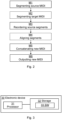
- FIG. 2 illustrates some different embodiments of the method of the present disclosure.
- the method is for automatically preparing a MIDI file based on a target MIDI file and a source MIDI file.
- the source MIDI file S is segmented M1 into a plurality of source segments s. Preferably, most or all of the source segments are of the same length, e.g. in respect of number of bars or beats.
- at least some of the source segments s are reordered M3, e.g. to form a sequence of source segments which may be used for the new MIDI file O. This reordering may be done several times to produce several different potential sequences of source segments for the new MIDI file.
- the sequence of source segments which is selected for the new MIDI file may be selected based on probabilities, e.g. harmonic and/or graphical probabilities as discussed herein, optionally using Belief Propagation. Then, the, e.g. selected sequence, of reordered M3 source segments s are concatenated M5 to obtain the new MIDI file O.
- the new MIDI file has the same length, e.g. in respect of number of bars or beats, as the target MIDI file T, e.g. allowing the new MIDI file O to be played together (in parallel) with the target MIDI file T. Then, the new MIDI file O is outputted, e.g.
- an internal data storage in the electronic device e.g. computer such as server, laptop or smartphone
- another electronic device e.g. computer such as server, laptop, smart speaker or smartphone
- a (e.g. internal or external) speaker for playing the new MIDI file e.g. internal or external
- the method may further comprise segmenting M2 the target MIDI file into target segments t.
- the target segments Preferably, most or all of the target segments have the same length(s), e.g. in respect of number of bars or beats, as the source segments s, allowing source and target segments of the same lengths to be aligned with each other.
- some or each of the target segments t of the target MIDI file T may be aligned M4 with a corresponding source segment s of the reordered M3 source segments s, before the outputting (M6) of the new MIDI file.
- the target segments t may be aligned M4 with a sequence of reordered M3 source segments which may form the new MIDI file.
- the sequence of target segments may be aligned to a sequence of reordered source segments (typically both sequences having the same length).
- the aligning M4 of each segment t of the target MIDI file T with a corresponding source segment s of the new MIDI file O results in a combined MIDI file C comprising the target MIDI file T aligned with the new MIDI file O.
- the outputting M6 of the new MIDI file may be done by outputting the combined MIDI file comprising the new MIDI file.
- each source segment s of the new MIDI file O is harmonically similar to its aligned M4 target segment t. Harmonic similarity may be determined by the harmonic distance H, optionally using harmonic probability, as discussed herein. In some embodiments, each source segment s is harmonically similar to its aligned M4 target segment t based on a harmonic distance H between a pitch profile of the source segment and a pitch profile of the target segment.
- a transition between two consecutive source segments, e.g. s i and s j , in the new MIDI file O is musically similar to a transition between two consecutive other source segments, e.g. s l and s l+1 , in the source MIDI file S.
- the transitions are musically similar based on graphical distances G, as discussed herein, e.g. dependent on Hamming distance.
- the graphical distances G are such that a graphical distance between a first source segment s i of the two consecutive source segments s i and s j in the new MIDI file O and a first segment s l of the two consecutive other source segments s l and s l+1 in the source MIDI file S is low and a graphical distance between a second source segment s j of the two consecutive source segments in the new MIDI file and a second segment s l+1 of the two consecutive other source segments in the source MIDI file is also low, e.g. as illustrated in figure 1 .
- the reordering M3 may be based on Belief Propagation.
- the Belief Propagation is dependent on a harmonic probability corresponding to the harmonic distance H between a pitch profile of a source segment s of the reordered M3 source segments and a pitch profile of a target segment t with which the source segment is aligned M4.
- the steps of reordering M3 and aligning M4 may e.g. be done iteratively until a reordered source segment s is a aligned with a target segment to which there is a relatively small harmonic distance H, corresponding to a high harmonic probability. This may be done for each of the target segments, e.g. until the sequence of target segments is aligned with a sequence of source segments where the combined harmonic distances H between all pairs of target and source segments is relatively small.
- the Belief Propagation is additionally or alternatively dependent on a graphical probability corresponding to graphical distances G of two consecutive source segments s i and s j of the reordered M3 source segments and two consecutive other source segments s l and s l+1 in the source MIDI file S. Again, this may be done for each pair of consecutive source segments of the reordered source segments to obtain a combined or average graphical distance which is relatively small.
- At least one of the reordered M3 source segments s is augmented to an augmented source segment s' (still being regarded as a source segment) before the concatenating M5.
- a machine learning model e.g. using a Variational Autoencoder (VAE) and/or by harmonic augmentation comprising imposing a pitch change to a pitch of the source segment.
- VAE Variational Autoencoder
- FIG. 3 schematically illustrates an embodiment of an electronic device 30.
- the electronic device 30 may be any device or user equipment (UE), mobile or stationary, enabled to process MIDI files in accordance with embodiments of the present disclosure.
- the electronic device may for instance be or comprise (but is not limited to) a mobile phone, smartphone, vehicles (e.g. a car), household appliances, media players, or any other type of consumer electronic, for instance but not limited to television, radio, lighting arrangements, tablet computer, laptop, or personal computer (PC).
- the electronic device 30 comprises processing circuitry 31 e.g. a central processing unit (CPU).
- the processing circuitry 31 may comprise one or a plurality of processing units in the form of microprocessor(s). However, other suitable devices with computing capabilities could be comprised in the processing circuitry 31, e.g. an application specific integrated circuit (ASIC), a field programmable gate array (FPGA) or a complex programmable logic device (CPLD).
- ASIC application specific integrated circuit
- FPGA field programmable gate array
- CPLD complex programmable logic device
- the processing circuitry 31 is configured to run one or several computer program(s) or software (SW) 33 stored in a storage 32 of one or several storage unit(s) e.g. a memory.
- the storage unit is regarded as a computer readable means, forming a computer program product together with the SW 33 stored thereon as computer-executable components, as discussed herein and may e.g. be in the form of a Random Access Memory (RAM), a Flash memory or other solid state memory, or a hard disk, or be a combination thereof.
- the processing circuitry 31 may also be configured to store data in the storage 32, as needed.
Landscapes
- Engineering & Computer Science (AREA)
- Physics & Mathematics (AREA)
- Acoustics & Sound (AREA)
- Multimedia (AREA)
- Theoretical Computer Science (AREA)
- Auxiliary Devices For Music (AREA)
Claims (13)
- Procédé de préparation automatique d'un fichier d'interface numérique d'instrument de musique, MIDI, basé sur un fichier MIDI cible (T) et un fichier MIDI source (S), le procédé comprenant de :segmenter (Ml) le fichier MIDI source en segments source(s);segmenter (M2) le fichier MIDI cible en segments cibles (t) ayant la ou les mêmes longueurs que les segments source(s);réorganiser (M3) au moins certains des segments source ;aligner (M4) chaque segment cible du fichier MIDI cible avec un segment source correspondant des segments source réorganisés (M3);concaténer (M5) des segments source réorganisés (M3) pour obtenir un nouveau fichier MIDI (O) ayant la même longueur que le fichier MIDI cible ; etproduire (M6) le nouveau fichier MIDI ;caractérisé en ce que l'alignement (M4) de chaque segment (t) du fichier MIDI cible (T) avec un ou des segment(s) source(s) correspondant(s) du nouveau fichier MIDI (O) aboutit à un fichier MIDI combiné (C) comprenant le fichier MIDI cible (T) aligné avec le nouveau fichier MIDI (O); etdans lequel la production (M6) du nouveau fichier MIDI comprend la sortie du fichier MIDI combiné comprenant le nouveau fichier MIDI.
- Procédé selon la revendication 1, dans lequel chaque segment source (s) du nouveau fichier MIDI (O) est harmoniquement similaire à son segment cible aligné (M4) (t).
- Procédé selon la revendication 2, dans lequel ledit ou chaque segment source (s) est harmoniquement similaire à son segment cible aligné (M4) (t) sur la base d'une distance harmonique (H) entre un profil de hauteur du segment source et un profil de hauteur du segment cible.
- Procédé selon une quelconque des revendications précédentes, dans lequel une transition entre deux segments source consécutifs (si, sj) dans le nouveau fichier MIDI (O) est musicalement similaire à une transition entre deux segments Autre source consécutifs (si, S1+1) dans le fichier MIDI source (S).
- Procédé selon la revendication 4, dans lequel les transitions sont musicalement similaires en fonction de distances graphiques (G) dépendant de la distance de Hamming.
- Procédé selon la revendication 5, dans lequel les distances graphiques (G) sont telles qu'une distance graphique entre un premier segment source (Si) des deux segments source consécutifs (si, sj) dans le nouveau fichier MIDI (O) et un premier segment (Sl) des deux autres segments source consécutifs (si, Sl+1) dans le fichier MIDI source (S) est faible et une distance graphique entre un second segment source (sj) des deux segments source consécutifs dans le nouveau fichier MIDI et un deuxième segment (Sl+1) des deux autres segments source consécutifs dans le fichier MIDI source est également faible.
- Procédé selon une quelconque des revendications précédentes, dans lequel la réorganisation (M3) est basée sur la propagation de croyance.
- Procédé selon la revendication 7, dans lequel la Propagation de Croyance est dépendante d'une probabilité harmonique correspondant à une distance harmonique (H) entre un profil de hauteur d'un segment de source (s) des segments de source réorganisés (M3) et un profil de hauteur d'un segment cible (t) avec lequel le segment source est aligné (M4).
- Procédé selon la revendication 8, dans lequel la Propagation de Croyance est dépendante d'une probabilité graphique correspondant à des distances graphiques (G) de deux segments source consécutifs (si, sj) des segments source réorganisés (M3) et deux autres segments source consécutifs (si, Sl+1) dans le fichier MIDI source (S).
- Procédé selon une quelconque des revendications précédentes, dans lequel au moins un des segments source (s) réorganisés (M3) est augmenté en un segment source augmenté (s') avant la concaténation (M5).
- Procédé selon la revendication 10, dans lequel le ou les segments source(s) sont augmentés au moyen d'un modèle d'apprentissage automatique, par ex. à l'aide d'un auto-encodeur variationnel, VAE, et/ou par augmentation harmonique comprenant l'imposition d'un changement de hauteur à une hauteur du segment source.
- Produit de programme informatique (32) comprenant des composants exécutables par ordinateur (33) pour amener un dispositif électronique (30) à exécuter le procédé d'une quelconque des revendications précédentes lorsque les composants exécutables par ordinateur sont exécutés sur des circuits de traitement (31) compris dans le dispositif électronique.
- Dispositif électronique (30) pour préparer automatiquement un fichier d'interface d'instrument de musique numérique, MIDI, le dispositif électronique comprenant :un circuit de traitement (31); etune mémoire de données (32) mémorisant des instructions (33) exécutables par ledit circuit de traitement grâce auquel ledit dispositif électronique fonctionne pour :segmenter un fichier MIDI source (S) en segments source (s);segmenter un fichier MIDI cible (T) en segments cibles (t) ayant la ou les mêmes longueurs que les segments source(s);réorganiser au moins certains des segments source ;aligner chaque segment cible du fichier MIDI cible avec un segment source correspondant des segments source réorganisés ;concaténer les segments source réorganisés pour obtenir un nouveau fichier MIDI (O) ayant la même longueur que le fichier MIDI cible, et produire le nouveau fichier MIDI ;caractérisé en ce quel'alignement de chaque segment (t) du fichier MIDI cible (T) avec un ou des segments source correspondants du nouveau fichier MIDI (O) donne un fichier MIDI combiné (C) comprenant le fichier MIDI cible (T) aligné avec le nouveau fichier MIDI (O); et dans lequel la production du nouveau fichier MIDI comprend la production du fichier MIDI combiné comprenant le nouveau fichier MIDI.
Priority Applications (1)
| Application Number | Priority Date | Filing Date | Title |
|---|---|---|---|
| EP22152232.9A EP4006896B1 (fr) | 2019-10-28 | 2019-10-28 | Orchestration automatique d'un fichier midi |
Applications Claiming Priority (2)
| Application Number | Priority Date | Filing Date | Title |
|---|---|---|---|
| EP19205553.1A EP3816989B1 (fr) | 2019-10-28 | 2019-10-28 | Orchestration automatique d'un fichier midi |
| EP22152232.9A EP4006896B1 (fr) | 2019-10-28 | 2019-10-28 | Orchestration automatique d'un fichier midi |
Related Parent Applications (2)
| Application Number | Title | Priority Date | Filing Date |
|---|---|---|---|
| EP19205553.1A Division EP3816989B1 (fr) | 2019-10-28 | 2019-10-28 | Orchestration automatique d'un fichier midi |
| EP19205553.1A Division-Into EP3816989B1 (fr) | 2019-10-28 | 2019-10-28 | Orchestration automatique d'un fichier midi |
Publications (2)
| Publication Number | Publication Date |
|---|---|
| EP4006896A1 EP4006896A1 (fr) | 2022-06-01 |
| EP4006896B1 true EP4006896B1 (fr) | 2023-08-09 |
Family
ID=68382252
Family Applications (2)
| Application Number | Title | Priority Date | Filing Date |
|---|---|---|---|
| EP22152232.9A Active EP4006896B1 (fr) | 2019-10-28 | 2019-10-28 | Orchestration automatique d'un fichier midi |
| EP19205553.1A Active EP3816989B1 (fr) | 2019-10-28 | 2019-10-28 | Orchestration automatique d'un fichier midi |
Family Applications After (1)
| Application Number | Title | Priority Date | Filing Date |
|---|---|---|---|
| EP19205553.1A Active EP3816989B1 (fr) | 2019-10-28 | 2019-10-28 | Orchestration automatique d'un fichier midi |
Country Status (2)
| Country | Link |
|---|---|
| US (1) | US11651758B2 (fr) |
| EP (2) | EP4006896B1 (fr) |
Families Citing this family (4)
| Publication number | Priority date | Publication date | Assignee | Title |
|---|---|---|---|---|
| EP4006896B1 (fr) * | 2019-10-28 | 2023-08-09 | Spotify AB | Orchestration automatique d'un fichier midi |
| EP3826000B1 (fr) * | 2019-11-21 | 2021-12-29 | Spotify AB | Préparation automatique d'un nouveau fichier midi |
| US12293746B2 (en) * | 2021-10-29 | 2025-05-06 | Soundtrap Ab | Systems and methods for generating a mixed audio file in a digital audio workstation |
| US12272341B2 (en) * | 2021-11-08 | 2025-04-08 | Lemon Inc. | Controllable music generation |
Family Cites Families (17)
| Publication number | Priority date | Publication date | Assignee | Title |
|---|---|---|---|---|
| US5693902A (en) * | 1995-09-22 | 1997-12-02 | Sonic Desktop Software | Audio block sequence compiler for generating prescribed duration audio sequences |
| US7601904B2 (en) * | 2005-08-03 | 2009-10-13 | Richard Dreyfuss | Interactive tool and appertaining method for creating a graphical music display |
| US7842874B2 (en) * | 2006-06-15 | 2010-11-30 | Massachusetts Institute Of Technology | Creating music by concatenative synthesis |
| US7541534B2 (en) * | 2006-10-23 | 2009-06-02 | Adobe Systems Incorporated | Methods and apparatus for rendering audio data |
| JP5135931B2 (ja) * | 2007-07-17 | 2013-02-06 | ヤマハ株式会社 | 楽曲加工装置およびプログラム |
| US8084677B2 (en) * | 2007-12-31 | 2011-12-27 | Orpheus Media Research, Llc | System and method for adaptive melodic segmentation and motivic identification |
| EP2362378B1 (fr) * | 2010-02-25 | 2016-06-08 | YAMAHA Corporation | Génération d'un son harmonique |
| IES86526B2 (en) * | 2013-04-09 | 2015-04-08 | Score Music Interactive Ltd | A system and method for generating an audio file |
| EP2808870B1 (fr) * | 2013-05-30 | 2016-03-16 | Spotify AB | Production participative de règles de re-mélange de musique en flux. |
| US10854180B2 (en) | 2015-09-29 | 2020-12-01 | Amper Music, Inc. | Method of and system for controlling the qualities of musical energy embodied in and expressed by digital music to be automatically composed and generated by an automated music composition and generation engine |
| US11024276B1 (en) * | 2017-09-27 | 2021-06-01 | Diana Dabby | Method of creating musical compositions and other symbolic sequences by artificial intelligence |
| WO2019121576A2 (fr) * | 2017-12-18 | 2019-06-27 | Bytedance Inc. | Production automatisée de musique |
| US10424280B1 (en) * | 2018-03-15 | 2019-09-24 | Score Music Productions Limited | Method and system for generating an audio or midi output file using a harmonic chord map |
| CN109979418B (zh) * | 2019-03-06 | 2022-11-29 | 腾讯音乐娱乐科技(深圳)有限公司 | 音频处理方法、装置、电子设备及存储介质 |
| EP4006896B1 (fr) * | 2019-10-28 | 2023-08-09 | Spotify AB | Orchestration automatique d'un fichier midi |
| EP3826000B1 (fr) * | 2019-11-21 | 2021-12-29 | Spotify AB | Préparation automatique d'un nouveau fichier midi |
| DK202170064A1 (en) * | 2021-02-12 | 2022-05-06 | Lego As | An interactive real-time music system and a computer-implemented interactive real-time music rendering method |
-
2019
- 2019-10-28 EP EP22152232.9A patent/EP4006896B1/fr active Active
- 2019-10-28 EP EP19205553.1A patent/EP3816989B1/fr active Active
-
2020
- 2020-10-05 US US17/063,347 patent/US11651758B2/en active Active
Also Published As
| Publication number | Publication date |
|---|---|
| US20210125593A1 (en) | 2021-04-29 |
| EP3816989A1 (fr) | 2021-05-05 |
| EP3816989B1 (fr) | 2022-03-02 |
| US11651758B2 (en) | 2023-05-16 |
| EP4006896A1 (fr) | 2022-06-01 |
Similar Documents
| Publication | Publication Date | Title |
|---|---|---|
| EP4006896B1 (fr) | Orchestration automatique d'un fichier midi | |
| Ji et al. | A comprehensive survey on deep music generation: Multi-level representations, algorithms, evaluations, and future directions | |
| Donahue et al. | LakhNES: Improving multi-instrumental music generation with cross-domain pre-training | |
| AU749235B2 (en) | Method and apparatus for composing original musical works | |
| US10068557B1 (en) | Generating music with deep neural networks | |
| US9076423B2 (en) | System and method for analysis and creation of music | |
| KR20220128672A (ko) | 음악 콘텐츠 생성 | |
| Paiement et al. | A probabilistic model for chord progressions | |
| CN115004294B (zh) | 编曲生成方法、编曲生成装置以及计算机程序产品 | |
| US12444394B2 (en) | Scalable similarity-based generation of compatible music mixes | |
| CN115375806A (zh) | 舞蹈动作预测模型训练方法、舞蹈合成方法、设备和产品 | |
| US20210225340A1 (en) | Systems, devices, and methods for varying digital representations of music | |
| Garani et al. | An algorithmic approach to South Indian classical music | |
| Giuliani et al. | Musicomb: a sample-based approach to music generation through constraints | |
| Janssen et al. | Algorithmic Ability to Predict the Musical Future: Datasets and Evaluation. | |
| Prang et al. | Signal-domain representation of symbolic music for learning embedding spaces | |
| Madsen et al. | Towards a Computational Model of Melody Identification in Polyphonic Music. | |
| Sabitha et al. | Artificial intelligence based music composition system-multi algorithmic music arranger (MAGMA) | |
| Sioros et al. | Syncopation as transformation | |
| Lopez-Rincon et al. | Algorithmic music generation by harmony recombination with genetic algorithm | |
| Smith et al. | Sonifications of quantum superpositions: Methods and musical applications | |
| Peer | Comparing neural network architectures for drum pattern generation | |
| Louboutin | Multi-scale and multi-dimensional modelling of music structure using polytopic graphs | |
| Jiang et al. | Versatile Symbolic Music-for-Music Modeling via Function Alignment | |
| De Villa | Generating musical continuations with repetition |
Legal Events
| Date | Code | Title | Description |
|---|---|---|---|
| PUAI | Public reference made under article 153(3) epc to a published international application that has entered the european phase |
Free format text: ORIGINAL CODE: 0009012 |
|
| STAA | Information on the status of an ep patent application or granted ep patent |
Free format text: STATUS: THE APPLICATION HAS BEEN PUBLISHED |
|
| AC | Divisional application: reference to earlier application |
Ref document number: 3816989 Country of ref document: EP Kind code of ref document: P |
|
| AK | Designated contracting states |
Kind code of ref document: A1 Designated state(s): AL AT BE BG CH CY CZ DE DK EE ES FI FR GB GR HR HU IE IS IT LI LT LU LV MC MK MT NL NO PL PT RO RS SE SI SK SM TR |
|
| STAA | Information on the status of an ep patent application or granted ep patent |
Free format text: STATUS: REQUEST FOR EXAMINATION WAS MADE |
|
| 17P | Request for examination filed |
Effective date: 20221130 |
|
| RBV | Designated contracting states (corrected) |
Designated state(s): AL AT BE BG CH CY CZ DE DK EE ES FI FR GB GR HR HU IE IS IT LI LT LU LV MC MK MT NL NO PL PT RO RS SE SI SK SM TR |
|
| GRAP | Despatch of communication of intention to grant a patent |
Free format text: ORIGINAL CODE: EPIDOSNIGR1 |
|
| STAA | Information on the status of an ep patent application or granted ep patent |
Free format text: STATUS: GRANT OF PATENT IS INTENDED |
|
| INTG | Intention to grant announced |
Effective date: 20230315 |
|
| P01 | Opt-out of the competence of the unified patent court (upc) registered |
Effective date: 20230513 |
|
| GRAS | Grant fee paid |
Free format text: ORIGINAL CODE: EPIDOSNIGR3 |
|
| GRAA | (expected) grant |
Free format text: ORIGINAL CODE: 0009210 |
|
| STAA | Information on the status of an ep patent application or granted ep patent |
Free format text: STATUS: THE PATENT HAS BEEN GRANTED |
|
| AC | Divisional application: reference to earlier application |
Ref document number: 3816989 Country of ref document: EP Kind code of ref document: P |
|
| AK | Designated contracting states |
Kind code of ref document: B1 Designated state(s): AL AT BE BG CH CY CZ DE DK EE ES FI FR GB GR HR HU IE IS IT LI LT LU LV MC MK MT NL NO PL PT RO RS SE SI SK SM TR |
|
| REG | Reference to a national code |
Ref country code: GB Ref legal event code: FG4D |
|
| REG | Reference to a national code |
Ref country code: CH Ref legal event code: EP |
|
| REG | Reference to a national code |
Ref country code: DE Ref legal event code: R096 Ref document number: 602019034911 Country of ref document: DE |
|
| REG | Reference to a national code |
Ref country code: IE Ref legal event code: FG4D |
|
| REG | Reference to a national code |
Ref country code: GB Ref legal event code: 732E Free format text: REGISTERED BETWEEN 20231012 AND 20231018 |
|
| REG | Reference to a national code |
Ref country code: LT Ref legal event code: MG9D |
|
| RAP2 | Party data changed (patent owner data changed or rights of a patent transferred) |
Owner name: SOUNDTRAP AB |
|
| REG | Reference to a national code |
Ref country code: NL Ref legal event code: MP Effective date: 20230809 |
|
| REG | Reference to a national code |
Ref country code: AT Ref legal event code: MK05 Ref document number: 1598453 Country of ref document: AT Kind code of ref document: T Effective date: 20230809 |
|
| PG25 | Lapsed in a contracting state [announced via postgrant information from national office to epo] |
Ref country code: GR Free format text: LAPSE BECAUSE OF FAILURE TO SUBMIT A TRANSLATION OF THE DESCRIPTION OR TO PAY THE FEE WITHIN THE PRESCRIBED TIME-LIMIT Effective date: 20231110 |
|
| PG25 | Lapsed in a contracting state [announced via postgrant information from national office to epo] |
Ref country code: IS Free format text: LAPSE BECAUSE OF FAILURE TO SUBMIT A TRANSLATION OF THE DESCRIPTION OR TO PAY THE FEE WITHIN THE PRESCRIBED TIME-LIMIT Effective date: 20231209 |
|
| PG25 | Lapsed in a contracting state [announced via postgrant information from national office to epo] |
Ref country code: SE Free format text: LAPSE BECAUSE OF FAILURE TO SUBMIT A TRANSLATION OF THE DESCRIPTION OR TO PAY THE FEE WITHIN THE PRESCRIBED TIME-LIMIT Effective date: 20230809 Ref country code: RS Free format text: LAPSE BECAUSE OF FAILURE TO SUBMIT A TRANSLATION OF THE DESCRIPTION OR TO PAY THE FEE WITHIN THE PRESCRIBED TIME-LIMIT Effective date: 20230809 Ref country code: PT Free format text: LAPSE BECAUSE OF FAILURE TO SUBMIT A TRANSLATION OF THE DESCRIPTION OR TO PAY THE FEE WITHIN THE PRESCRIBED TIME-LIMIT Effective date: 20231211 Ref country code: NO Free format text: LAPSE BECAUSE OF FAILURE TO SUBMIT A TRANSLATION OF THE DESCRIPTION OR TO PAY THE FEE WITHIN THE PRESCRIBED TIME-LIMIT Effective date: 20231109 Ref country code: NL Free format text: LAPSE BECAUSE OF FAILURE TO SUBMIT A TRANSLATION OF THE DESCRIPTION OR TO PAY THE FEE WITHIN THE PRESCRIBED TIME-LIMIT Effective date: 20230809 Ref country code: LV Free format text: LAPSE BECAUSE OF FAILURE TO SUBMIT A TRANSLATION OF THE DESCRIPTION OR TO PAY THE FEE WITHIN THE PRESCRIBED TIME-LIMIT Effective date: 20230809 Ref country code: LT Free format text: LAPSE BECAUSE OF FAILURE TO SUBMIT A TRANSLATION OF THE DESCRIPTION OR TO PAY THE FEE WITHIN THE PRESCRIBED TIME-LIMIT Effective date: 20230809 Ref country code: IS Free format text: LAPSE BECAUSE OF FAILURE TO SUBMIT A TRANSLATION OF THE DESCRIPTION OR TO PAY THE FEE WITHIN THE PRESCRIBED TIME-LIMIT Effective date: 20231209 Ref country code: HR Free format text: LAPSE BECAUSE OF FAILURE TO SUBMIT A TRANSLATION OF THE DESCRIPTION OR TO PAY THE FEE WITHIN THE PRESCRIBED TIME-LIMIT Effective date: 20230809 Ref country code: GR Free format text: LAPSE BECAUSE OF FAILURE TO SUBMIT A TRANSLATION OF THE DESCRIPTION OR TO PAY THE FEE WITHIN THE PRESCRIBED TIME-LIMIT Effective date: 20231110 Ref country code: FI Free format text: LAPSE BECAUSE OF FAILURE TO SUBMIT A TRANSLATION OF THE DESCRIPTION OR TO PAY THE FEE WITHIN THE PRESCRIBED TIME-LIMIT Effective date: 20230809 Ref country code: AT Free format text: LAPSE BECAUSE OF FAILURE TO SUBMIT A TRANSLATION OF THE DESCRIPTION OR TO PAY THE FEE WITHIN THE PRESCRIBED TIME-LIMIT Effective date: 20230809 |
|
| PG25 | Lapsed in a contracting state [announced via postgrant information from national office to epo] |
Ref country code: PL Free format text: LAPSE BECAUSE OF FAILURE TO SUBMIT A TRANSLATION OF THE DESCRIPTION OR TO PAY THE FEE WITHIN THE PRESCRIBED TIME-LIMIT Effective date: 20230809 |
|
| PG25 | Lapsed in a contracting state [announced via postgrant information from national office to epo] |
Ref country code: ES Free format text: LAPSE BECAUSE OF FAILURE TO SUBMIT A TRANSLATION OF THE DESCRIPTION OR TO PAY THE FEE WITHIN THE PRESCRIBED TIME-LIMIT Effective date: 20230809 |
|
| PG25 | Lapsed in a contracting state [announced via postgrant information from national office to epo] |
Ref country code: SM Free format text: LAPSE BECAUSE OF FAILURE TO SUBMIT A TRANSLATION OF THE DESCRIPTION OR TO PAY THE FEE WITHIN THE PRESCRIBED TIME-LIMIT Effective date: 20230809 Ref country code: RO Free format text: LAPSE BECAUSE OF FAILURE TO SUBMIT A TRANSLATION OF THE DESCRIPTION OR TO PAY THE FEE WITHIN THE PRESCRIBED TIME-LIMIT Effective date: 20230809 Ref country code: ES Free format text: LAPSE BECAUSE OF FAILURE TO SUBMIT A TRANSLATION OF THE DESCRIPTION OR TO PAY THE FEE WITHIN THE PRESCRIBED TIME-LIMIT Effective date: 20230809 Ref country code: EE Free format text: LAPSE BECAUSE OF FAILURE TO SUBMIT A TRANSLATION OF THE DESCRIPTION OR TO PAY THE FEE WITHIN THE PRESCRIBED TIME-LIMIT Effective date: 20230809 Ref country code: DK Free format text: LAPSE BECAUSE OF FAILURE TO SUBMIT A TRANSLATION OF THE DESCRIPTION OR TO PAY THE FEE WITHIN THE PRESCRIBED TIME-LIMIT Effective date: 20230809 Ref country code: CZ Free format text: LAPSE BECAUSE OF FAILURE TO SUBMIT A TRANSLATION OF THE DESCRIPTION OR TO PAY THE FEE WITHIN THE PRESCRIBED TIME-LIMIT Effective date: 20230809 Ref country code: SK Free format text: LAPSE BECAUSE OF FAILURE TO SUBMIT A TRANSLATION OF THE DESCRIPTION OR TO PAY THE FEE WITHIN THE PRESCRIBED TIME-LIMIT Effective date: 20230809 |
|
| REG | Reference to a national code |
Ref country code: DE Ref legal event code: R119 Ref document number: 602019034911 Country of ref document: DE |
|
| PG25 | Lapsed in a contracting state [announced via postgrant information from national office to epo] |
Ref country code: IT Free format text: LAPSE BECAUSE OF FAILURE TO SUBMIT A TRANSLATION OF THE DESCRIPTION OR TO PAY THE FEE WITHIN THE PRESCRIBED TIME-LIMIT Effective date: 20230809 Ref country code: MC Free format text: LAPSE BECAUSE OF FAILURE TO SUBMIT A TRANSLATION OF THE DESCRIPTION OR TO PAY THE FEE WITHIN THE PRESCRIBED TIME-LIMIT Effective date: 20230809 |
|
| REG | Reference to a national code |
Ref country code: CH Ref legal event code: PL |
|
| PLBE | No opposition filed within time limit |
Free format text: ORIGINAL CODE: 0009261 |
|
| STAA | Information on the status of an ep patent application or granted ep patent |
Free format text: STATUS: NO OPPOSITION FILED WITHIN TIME LIMIT |
|
| REG | Reference to a national code |
Ref country code: BE Ref legal event code: MM Effective date: 20231031 |
|
| PG25 | Lapsed in a contracting state [announced via postgrant information from national office to epo] |
Ref country code: LU Free format text: LAPSE BECAUSE OF NON-PAYMENT OF DUE FEES Effective date: 20231028 |
|
| PG25 | Lapsed in a contracting state [announced via postgrant information from national office to epo] |
Ref country code: LU Free format text: LAPSE BECAUSE OF NON-PAYMENT OF DUE FEES Effective date: 20231028 |
|
| 26N | No opposition filed |
Effective date: 20240513 |
|
| PG25 | Lapsed in a contracting state [announced via postgrant information from national office to epo] |
Ref country code: CH Free format text: LAPSE BECAUSE OF NON-PAYMENT OF DUE FEES Effective date: 20231031 |
|
| PG25 | Lapsed in a contracting state [announced via postgrant information from national office to epo] |
Ref country code: FR Free format text: LAPSE BECAUSE OF NON-PAYMENT OF DUE FEES Effective date: 20231031 Ref country code: DE Free format text: LAPSE BECAUSE OF NON-PAYMENT OF DUE FEES Effective date: 20240501 Ref country code: CH Free format text: LAPSE BECAUSE OF NON-PAYMENT OF DUE FEES Effective date: 20231031 Ref country code: SI Free format text: LAPSE BECAUSE OF FAILURE TO SUBMIT A TRANSLATION OF THE DESCRIPTION OR TO PAY THE FEE WITHIN THE PRESCRIBED TIME-LIMIT Effective date: 20230809 |
|
| PG25 | Lapsed in a contracting state [announced via postgrant information from national office to epo] |
Ref country code: BE Free format text: LAPSE BECAUSE OF NON-PAYMENT OF DUE FEES Effective date: 20231031 |
|
| PG25 | Lapsed in a contracting state [announced via postgrant information from national office to epo] |
Ref country code: IE Free format text: LAPSE BECAUSE OF NON-PAYMENT OF DUE FEES Effective date: 20231028 |
|
| PG25 | Lapsed in a contracting state [announced via postgrant information from national office to epo] |
Ref country code: IE Free format text: LAPSE BECAUSE OF NON-PAYMENT OF DUE FEES Effective date: 20231028 |
|
| PG25 | Lapsed in a contracting state [announced via postgrant information from national office to epo] |
Ref country code: BG Free format text: LAPSE BECAUSE OF FAILURE TO SUBMIT A TRANSLATION OF THE DESCRIPTION OR TO PAY THE FEE WITHIN THE PRESCRIBED TIME-LIMIT Effective date: 20230809 |
|
| PG25 | Lapsed in a contracting state [announced via postgrant information from national office to epo] |
Ref country code: BG Free format text: LAPSE BECAUSE OF FAILURE TO SUBMIT A TRANSLATION OF THE DESCRIPTION OR TO PAY THE FEE WITHIN THE PRESCRIBED TIME-LIMIT Effective date: 20230809 |
|
| PG25 | Lapsed in a contracting state [announced via postgrant information from national office to epo] |
Ref country code: CY Free format text: LAPSE BECAUSE OF FAILURE TO SUBMIT A TRANSLATION OF THE DESCRIPTION OR TO PAY THE FEE WITHIN THE PRESCRIBED TIME-LIMIT; INVALID AB INITIO Effective date: 20191028 |
|
| PG25 | Lapsed in a contracting state [announced via postgrant information from national office to epo] |
Ref country code: HU Free format text: LAPSE BECAUSE OF FAILURE TO SUBMIT A TRANSLATION OF THE DESCRIPTION OR TO PAY THE FEE WITHIN THE PRESCRIBED TIME-LIMIT; INVALID AB INITIO Effective date: 20191028 |
|
| PGFP | Annual fee paid to national office [announced via postgrant information from national office to epo] |
Ref country code: GB Payment date: 20250825 Year of fee payment: 7 |
|
| PG25 | Lapsed in a contracting state [announced via postgrant information from national office to epo] |
Ref country code: TR Free format text: LAPSE BECAUSE OF FAILURE TO SUBMIT A TRANSLATION OF THE DESCRIPTION OR TO PAY THE FEE WITHIN THE PRESCRIBED TIME-LIMIT Effective date: 20230809 |