EP4006921B1 - Bioelektrodenzusammensetzung, bioelektrode, verfahren zur herstellung der bioelektrode und reaktionskomposit - Google Patents
Bioelektrodenzusammensetzung, bioelektrode, verfahren zur herstellung der bioelektrode und reaktionskomposit Download PDFInfo
- Publication number
- EP4006921B1 EP4006921B1 EP21209358.7A EP21209358A EP4006921B1 EP 4006921 B1 EP4006921 B1 EP 4006921B1 EP 21209358 A EP21209358 A EP 21209358A EP 4006921 B1 EP4006921 B1 EP 4006921B1
- Authority
- EP
- European Patent Office
- Prior art keywords
- group
- bio
- electrode
- carbon
- electrode composition
- Prior art date
- Legal status (The legal status is an assumption and is not a legal conclusion. Google has not performed a legal analysis and makes no representation as to the accuracy of the status listed.)
- Active
Links
Images


Classifications
-
- A—HUMAN NECESSITIES
- A61—MEDICAL OR VETERINARY SCIENCE; HYGIENE
- A61B—DIAGNOSIS; SURGERY; IDENTIFICATION
- A61B5/00—Measuring for diagnostic purposes; Identification of persons
- A61B5/24—Detecting, measuring or recording bioelectric or biomagnetic signals of the body or parts thereof
- A61B5/25—Bioelectric electrodes therefor
- A61B5/263—Bioelectric electrodes therefor characterised by the electrode materials
-
- A—HUMAN NECESSITIES
- A61—MEDICAL OR VETERINARY SCIENCE; HYGIENE
- A61B—DIAGNOSIS; SURGERY; IDENTIFICATION
- A61B5/00—Measuring for diagnostic purposes; Identification of persons
- A61B5/24—Detecting, measuring or recording bioelectric or biomagnetic signals of the body or parts thereof
- A61B5/25—Bioelectric electrodes therefor
- A61B5/251—Means for maintaining electrode contact with the body
- A61B5/257—Means for maintaining electrode contact with the body using adhesive means, e.g. adhesive pads or tapes
- A61B5/259—Means for maintaining electrode contact with the body using adhesive means, e.g. adhesive pads or tapes using conductive adhesive means, e.g. gels
-
- A—HUMAN NECESSITIES
- A61—MEDICAL OR VETERINARY SCIENCE; HYGIENE
- A61B—DIAGNOSIS; SURGERY; IDENTIFICATION
- A61B5/00—Measuring for diagnostic purposes; Identification of persons
- A61B5/02—Detecting, measuring or recording for evaluating the cardiovascular system, e.g. pulse, heart rate, blood pressure or blood flow
- A61B5/024—Measuring pulse rate or heart rate
- A61B5/02444—Details of sensor
-
- A—HUMAN NECESSITIES
- A61—MEDICAL OR VETERINARY SCIENCE; HYGIENE
- A61B—DIAGNOSIS; SURGERY; IDENTIFICATION
- A61B5/00—Measuring for diagnostic purposes; Identification of persons
- A61B5/24—Detecting, measuring or recording bioelectric or biomagnetic signals of the body or parts thereof
- A61B5/25—Bioelectric electrodes therefor
- A61B5/251—Means for maintaining electrode contact with the body
- A61B5/257—Means for maintaining electrode contact with the body using adhesive means, e.g. adhesive pads or tapes
-
- A—HUMAN NECESSITIES
- A61—MEDICAL OR VETERINARY SCIENCE; HYGIENE
- A61B—DIAGNOSIS; SURGERY; IDENTIFICATION
- A61B5/00—Measuring for diagnostic purposes; Identification of persons
- A61B5/24—Detecting, measuring or recording bioelectric or biomagnetic signals of the body or parts thereof
- A61B5/25—Bioelectric electrodes therefor
- A61B5/263—Bioelectric electrodes therefor characterised by the electrode materials
- A61B5/265—Bioelectric electrodes therefor characterised by the electrode materials containing silver or silver chloride
-
- A—HUMAN NECESSITIES
- A61—MEDICAL OR VETERINARY SCIENCE; HYGIENE
- A61B—DIAGNOSIS; SURGERY; IDENTIFICATION
- A61B5/00—Measuring for diagnostic purposes; Identification of persons
- A61B5/24—Detecting, measuring or recording bioelectric or biomagnetic signals of the body or parts thereof
- A61B5/25—Bioelectric electrodes therefor
- A61B5/263—Bioelectric electrodes therefor characterised by the electrode materials
- A61B5/268—Bioelectric electrodes therefor characterised by the electrode materials containing conductive polymers, e.g. PEDOT:PSS polymers
-
- A—HUMAN NECESSITIES
- A61—MEDICAL OR VETERINARY SCIENCE; HYGIENE
- A61B—DIAGNOSIS; SURGERY; IDENTIFICATION
- A61B5/00—Measuring for diagnostic purposes; Identification of persons
- A61B5/24—Detecting, measuring or recording bioelectric or biomagnetic signals of the body or parts thereof
- A61B5/25—Bioelectric electrodes therefor
- A61B5/279—Bioelectric electrodes therefor specially adapted for particular uses
- A61B5/28—Bioelectric electrodes therefor specially adapted for particular uses for electrocardiography [ECG]
-
- C—CHEMISTRY; METALLURGY
- C08—ORGANIC MACROMOLECULAR COMPOUNDS; THEIR PREPARATION OR CHEMICAL WORKING-UP; COMPOSITIONS BASED THEREON
- C08F—MACROMOLECULAR COMPOUNDS OBTAINED BY REACTIONS ONLY INVOLVING CARBON-TO-CARBON UNSATURATED BONDS
- C08F212/00—Copolymers of compounds having one or more unsaturated aliphatic radicals, each having only one carbon-to-carbon double bond, and at least one being terminated by an aromatic carbocyclic ring
- C08F212/02—Monomers containing only one unsaturated aliphatic radical
- C08F212/04—Monomers containing only one unsaturated aliphatic radical containing one ring
- C08F212/14—Monomers containing only one unsaturated aliphatic radical containing one ring substituted by heteroatoms or groups containing heteroatoms
- C08F212/30—Sulfur
-
- C—CHEMISTRY; METALLURGY
- C08—ORGANIC MACROMOLECULAR COMPOUNDS; THEIR PREPARATION OR CHEMICAL WORKING-UP; COMPOSITIONS BASED THEREON
- C08F—MACROMOLECULAR COMPOUNDS OBTAINED BY REACTIONS ONLY INVOLVING CARBON-TO-CARBON UNSATURATED BONDS
- C08F220/00—Copolymers of compounds having one or more unsaturated aliphatic radicals, each having only one carbon-to-carbon double bond, and only one being terminated by only one carboxyl radical or a salt, anhydride ester, amide, imide or nitrile thereof
- C08F220/02—Monocarboxylic acids having less than ten carbon atoms; Derivatives thereof
- C08F220/10—Esters
- C08F220/12—Esters of monohydric alcohols or phenols
- C08F220/16—Esters of monohydric alcohols or phenols of phenols or of alcohols containing two or more carbon atoms
- C08F220/18—Esters of monohydric alcohols or phenols of phenols or of alcohols containing two or more carbon atoms with acrylic or methacrylic acids
- C08F220/1808—C8-(meth)acrylate, e.g. isooctyl (meth)acrylate or 2-ethylhexyl (meth)acrylate
-
- C—CHEMISTRY; METALLURGY
- C08—ORGANIC MACROMOLECULAR COMPOUNDS; THEIR PREPARATION OR CHEMICAL WORKING-UP; COMPOSITIONS BASED THEREON
- C08F—MACROMOLECULAR COMPOUNDS OBTAINED BY REACTIONS ONLY INVOLVING CARBON-TO-CARBON UNSATURATED BONDS
- C08F220/00—Copolymers of compounds having one or more unsaturated aliphatic radicals, each having only one carbon-to-carbon double bond, and only one being terminated by only one carboxyl radical or a salt, anhydride ester, amide, imide or nitrile thereof
- C08F220/02—Monocarboxylic acids having less than ten carbon atoms; Derivatives thereof
- C08F220/10—Esters
- C08F220/12—Esters of monohydric alcohols or phenols
- C08F220/16—Esters of monohydric alcohols or phenols of phenols or of alcohols containing two or more carbon atoms
- C08F220/18—Esters of monohydric alcohols or phenols of phenols or of alcohols containing two or more carbon atoms with acrylic or methacrylic acids
- C08F220/1809—C9-(meth)acrylate
-
- C—CHEMISTRY; METALLURGY
- C08—ORGANIC MACROMOLECULAR COMPOUNDS; THEIR PREPARATION OR CHEMICAL WORKING-UP; COMPOSITIONS BASED THEREON
- C08F—MACROMOLECULAR COMPOUNDS OBTAINED BY REACTIONS ONLY INVOLVING CARBON-TO-CARBON UNSATURATED BONDS
- C08F220/00—Copolymers of compounds having one or more unsaturated aliphatic radicals, each having only one carbon-to-carbon double bond, and only one being terminated by only one carboxyl radical or a salt, anhydride ester, amide, imide or nitrile thereof
- C08F220/02—Monocarboxylic acids having less than ten carbon atoms; Derivatives thereof
- C08F220/10—Esters
- C08F220/38—Esters containing sulfur
- C08F220/382—Esters containing sulfur and containing oxygen, e.g. 2-sulfoethyl (meth)acrylate
-
- C—CHEMISTRY; METALLURGY
- C08—ORGANIC MACROMOLECULAR COMPOUNDS; THEIR PREPARATION OR CHEMICAL WORKING-UP; COMPOSITIONS BASED THEREON
- C08F—MACROMOLECULAR COMPOUNDS OBTAINED BY REACTIONS ONLY INVOLVING CARBON-TO-CARBON UNSATURATED BONDS
- C08F220/00—Copolymers of compounds having one or more unsaturated aliphatic radicals, each having only one carbon-to-carbon double bond, and only one being terminated by only one carboxyl radical or a salt, anhydride ester, amide, imide or nitrile thereof
- C08F220/02—Monocarboxylic acids having less than ten carbon atoms; Derivatives thereof
- C08F220/10—Esters
- C08F220/38—Esters containing sulfur
- C08F220/387—Esters containing sulfur and containing nitrogen and oxygen
-
- C—CHEMISTRY; METALLURGY
- C08—ORGANIC MACROMOLECULAR COMPOUNDS; THEIR PREPARATION OR CHEMICAL WORKING-UP; COMPOSITIONS BASED THEREON
- C08F—MACROMOLECULAR COMPOUNDS OBTAINED BY REACTIONS ONLY INVOLVING CARBON-TO-CARBON UNSATURATED BONDS
- C08F220/00—Copolymers of compounds having one or more unsaturated aliphatic radicals, each having only one carbon-to-carbon double bond, and only one being terminated by only one carboxyl radical or a salt, anhydride ester, amide, imide or nitrile thereof
- C08F220/02—Monocarboxylic acids having less than ten carbon atoms; Derivatives thereof
- C08F220/52—Amides or imides
- C08F220/54—Amides, e.g. N,N-dimethylacrylamide or N-isopropylacrylamide
- C08F220/58—Amides, e.g. N,N-dimethylacrylamide or N-isopropylacrylamide containing oxygen in addition to the carbonamido oxygen, e.g. N-methylolacrylamide, N-(meth)acryloylmorpholine
- C08F220/585—Amides, e.g. N,N-dimethylacrylamide or N-isopropylacrylamide containing oxygen in addition to the carbonamido oxygen, e.g. N-methylolacrylamide, N-(meth)acryloylmorpholine and containing other heteroatoms, e.g. 2-acrylamido-2-methylpropane sulfonic acid [AMPS]
-
- C—CHEMISTRY; METALLURGY
- C08—ORGANIC MACROMOLECULAR COMPOUNDS; THEIR PREPARATION OR CHEMICAL WORKING-UP; COMPOSITIONS BASED THEREON
- C08F—MACROMOLECULAR COMPOUNDS OBTAINED BY REACTIONS ONLY INVOLVING CARBON-TO-CARBON UNSATURATED BONDS
- C08F230/00—Copolymers of compounds having one or more unsaturated aliphatic radicals, each having only one carbon-to-carbon double bond, and containing phosphorus, selenium, tellurium or a metal
- C08F230/04—Copolymers of compounds having one or more unsaturated aliphatic radicals, each having only one carbon-to-carbon double bond, and containing phosphorus, selenium, tellurium or a metal containing a metal
- C08F230/08—Copolymers of compounds having one or more unsaturated aliphatic radicals, each having only one carbon-to-carbon double bond, and containing phosphorus, selenium, tellurium or a metal containing a metal containing silicon
-
- C—CHEMISTRY; METALLURGY
- C08—ORGANIC MACROMOLECULAR COMPOUNDS; THEIR PREPARATION OR CHEMICAL WORKING-UP; COMPOSITIONS BASED THEREON
- C08K—Use of inorganic or non-macromolecular organic substances as compounding ingredients
- C08K3/00—Use of inorganic substances as compounding ingredients
- C08K3/02—Elements
- C08K3/04—Carbon
- C08K3/041—Carbon nanotubes
-
- C—CHEMISTRY; METALLURGY
- C08—ORGANIC MACROMOLECULAR COMPOUNDS; THEIR PREPARATION OR CHEMICAL WORKING-UP; COMPOSITIONS BASED THEREON
- C08K—Use of inorganic or non-macromolecular organic substances as compounding ingredients
- C08K3/00—Use of inorganic substances as compounding ingredients
- C08K3/02—Elements
- C08K3/08—Metals
-
- C—CHEMISTRY; METALLURGY
- C08—ORGANIC MACROMOLECULAR COMPOUNDS; THEIR PREPARATION OR CHEMICAL WORKING-UP; COMPOSITIONS BASED THEREON
- C08L—COMPOSITIONS OF MACROMOLECULAR COMPOUNDS
- C08L83/00—Compositions of macromolecular compounds obtained by reactions forming in the main chain of the macromolecule a linkage containing silicon with or without sulfur, nitrogen, oxygen or carbon only; Compositions of derivatives of such polymers
- C08L83/04—Polysiloxanes
-
- C—CHEMISTRY; METALLURGY
- C09—DYES; PAINTS; POLISHES; NATURAL RESINS; ADHESIVES; COMPOSITIONS NOT OTHERWISE PROVIDED FOR; APPLICATIONS OF MATERIALS NOT OTHERWISE PROVIDED FOR
- C09D—COATING COMPOSITIONS, e.g. PAINTS, VARNISHES OR LACQUERS; FILLING PASTES; CHEMICAL PAINT OR INK REMOVERS; INKS; CORRECTING FLUIDS; WOODSTAINS; PASTES OR SOLIDS FOR COLOURING OR PRINTING; USE OF MATERIALS THEREFOR
- C09D133/00—Coating compositions based on homopolymers or copolymers of compounds having one or more unsaturated aliphatic radicals, each having only one carbon-to-carbon double bond, and at least one being terminated by only one carboxyl radical, or of salts, anhydrides, esters, amides, imides, or nitriles thereof; Coating compositions based on derivatives of such polymers
- C09D133/04—Homopolymers or copolymers of esters
- C09D133/14—Homopolymers or copolymers of esters of esters containing halogen, nitrogen, sulfur or oxygen atoms in addition to the carboxy oxygen
-
- H—ELECTRICITY
- H01—ELECTRIC ELEMENTS
- H01B—CABLES; CONDUCTORS; INSULATORS; SELECTION OF MATERIALS FOR THEIR CONDUCTIVE, INSULATING OR DIELECTRIC PROPERTIES
- H01B1/00—Conductors or conductive bodies characterised by the conductive materials; Selection of materials as conductors
- H01B1/06—Conductors or conductive bodies characterised by the conductive materials; Selection of materials as conductors mainly consisting of other non-metallic substances
- H01B1/12—Conductors or conductive bodies characterised by the conductive materials; Selection of materials as conductors mainly consisting of other non-metallic substances organic substances
- H01B1/122—Ionic conductors
-
- H—ELECTRICITY
- H01—ELECTRIC ELEMENTS
- H01B—CABLES; CONDUCTORS; INSULATORS; SELECTION OF MATERIALS FOR THEIR CONDUCTIVE, INSULATING OR DIELECTRIC PROPERTIES
- H01B1/00—Conductors or conductive bodies characterised by the conductive materials; Selection of materials as conductors
- H01B1/20—Conductive material dispersed in non-conductive organic material
- H01B1/24—Conductive material dispersed in non-conductive organic material the conductive material comprising carbon-silicon compounds, carbon or silicon
-
- H—ELECTRICITY
- H01—ELECTRIC ELEMENTS
- H01B—CABLES; CONDUCTORS; INSULATORS; SELECTION OF MATERIALS FOR THEIR CONDUCTIVE, INSULATING OR DIELECTRIC PROPERTIES
- H01B5/00—Non-insulated conductors or conductive bodies characterised by their form
- H01B5/14—Non-insulated conductors or conductive bodies characterised by their form comprising conductive layers or films on insulating-supports
-
- A—HUMAN NECESSITIES
- A61—MEDICAL OR VETERINARY SCIENCE; HYGIENE
- A61B—DIAGNOSIS; SURGERY; IDENTIFICATION
- A61B2562/00—Details of sensors; Constructional details of sensor housings or probes; Accessories for sensors
- A61B2562/12—Manufacturing methods specially adapted for producing sensors for in-vivo measurements
- A61B2562/125—Manufacturing methods specially adapted for producing sensors for in-vivo measurements characterised by the manufacture of electrodes
-
- C—CHEMISTRY; METALLURGY
- C08—ORGANIC MACROMOLECULAR COMPOUNDS; THEIR PREPARATION OR CHEMICAL WORKING-UP; COMPOSITIONS BASED THEREON
- C08K—Use of inorganic or non-macromolecular organic substances as compounding ingredients
- C08K3/00—Use of inorganic substances as compounding ingredients
- C08K3/02—Elements
- C08K3/08—Metals
- C08K2003/0806—Silver
-
- C—CHEMISTRY; METALLURGY
- C08—ORGANIC MACROMOLECULAR COMPOUNDS; THEIR PREPARATION OR CHEMICAL WORKING-UP; COMPOSITIONS BASED THEREON
- C08K—Use of inorganic or non-macromolecular organic substances as compounding ingredients
- C08K2201/00—Specific properties of additives
- C08K2201/001—Conductive additives
Definitions
- the present invention relates to: a bio-electrode that is used in contact with the skin of a living body and capable of detecting physical conditions such as heart rate by an electric signal transmitted from the skin; a method for manufacturing the bio-electrode; and a bio-electrode composition desirably used for a bio-electrode.
- IoT Internet of Things
- Medical wearable devices are classified into two types: a type which is directly attached to body and a type which is incorporated into clothes.
- a type which is attached to a body it has been proposed a bio-electrode using water-soluble gel containing water and electrolyte, which are materials of the foregoing electro-conductive paste (Patent Document 1).
- the water-soluble gel contains sodium, potassium, or calcium as the electrolyte in a water-soluble polymer for retaining water, and converts changes of ion concentration from skin into electricity.
- the use of the hydrophilic gel containing water and electrolytes unfortunately brings about loss of electric conductivity due to water evaporation in drying process. Meanwhile, the use of a higher-ionization-tendency metal such as copper can cause some users to suffer from skin allergy.
- the use of an electro-conductive polymer such as PEDOT-PSS can also cause skin allergy due to the strong acidity of the electro-conductive polymer, and further cause peeling of the electro-conductive polymer from fibers during washing.
- Patent Documents 3, 4, and 5 By taking advantage of excellent electric conductivity, the use of metal nanowire, carbon black, carbon nanotube, and the like as electrode materials has been examined (Patent Documents 3, 4, and 5). With higher contact probability among metal nanowires, the wires can conduct electricity even when added in small quantities. The metal nanowire, however, can cause skin allergies since they are thin material with sharp tips. Even if these electrode materials themselves cause no allergic reaction in the manners described above, the biocompatibility may be degraded depending on the shape of a material and its inherent stimulation, thereby making it hard to satisfy both electric conductivity and biocompatibility.
- metal films seem to function as excellent bio-electrodes thanks to extremely high electric conductivity, this is not always the case.
- the human skin Upon heartbeat, the human skin releases not only extremely weak current, but also sodium ion, potassium ion, and calcium ion. It is thus necessary to convert changes in ion concentration into current.
- Noble metals however, are difficult to ionize and are inefficient in converting ions from skin to current. Therefore, the resulting bio-electrode using a noble metal is characterized by high impedance and high resistance to the skin during electrical conduction.
- Patent Document 6 the use of a battery containing an ionic liquid has been examined.
- the ionic liquid is thermally and chemically stable, and has excellent electric conductivity, providing wider battery applications.
- an ionic liquid having smaller molecular weight as shown in Patent Document 6 unfortunately dissolves into water.
- the ionic liquid is extracted from the bio-electrode by sweating, which not only lowers the electric conductivity, but also causes rough dry skin as a result of the skin soaking with the liquid.
- Non-Patent Document 1 Batteries using a lithium salt of polymer type sulfonimide have also been examined (Non-Patent Document 1). Lithium has been applied to batteries because of their high ionic mobility. However, this is not a biocompatible material. Additionally, lithium salts of fluorosulfonate have been examined in a form of a pendant on silicone (Non-Patent Document 2).
- the bio-electrode fails to obtain biological information if it is apart from the skin.
- a change in contact area solely affects the quantity of electricity traveling through the electrode, and hence affects the baseline of an electrocardiogram (electric signal).
- the bio-electrode is required to be in constant contact with the skin and make no changes in contact area.
- the bio-electrode is preferably adherent.
- the bio-electrode is required to have stretchability and flexibility so that the bio-electrode can follow changes in skin expansion or folding.
- bio-electrode composed of: silver chloride at a portion which comes into contact with skin; and silver deposited at a portion through which electricity is conducted to a device.
- Solid silver chloride has neither adhesive strength to skin nor stretchability, so that the ability to collect biological signals is lowered particularly when the user moves.
- a laminate film of silver chloride and silver is used as a bio-electrode with a water-soluble gel deposited between the bio-electrode and the skin. In this case, the aforementioned deterioration occurs when the gel is dried.
- Non-Patent Document 3 It has been reported that when an epoxy resin is mixed with carbon black, the curing reaction proceeds at lower temperature than when an epoxy resin is alone. This is because the reaction between the epoxy group and carboxyl group present on the surface of the carbon black allows the crosslinking reaction to proceed at lower temperature.
- Patent Document 7 A lithium ion battery using graphene oxide as a conduction auxiliary agent is reported (Patent Document 7).
- graphene oxide is used as a binder for improving the dispersibility and electric conductivity of the positive electrode material such as lithium cobaltate. Both ion battery and bio-electrode are required to have high ionic conductivity.
- Patent Documents are EP3718471A1 , US2020/113464 A1 and US 2019/209740 A1 disclosing bio-electrode compositions comprising ionic materials combined with carbon materials.
- An object of the present invention is to provide: a bio-electrode composition capable of forming a living body contact layer for a bio-electrode which is excellent in electric conductivity and biocompatibility, light-weight, and manufacturable at low cost, and which prevents significant reduction in the electric conductivity even when the bio-electrode is wetted with water or dried; a bio-electrode including a living body contact layer formed of the bio-electrode composition; and a method for manufacturing the bio-electrode.
- the present invention provides a bio-electrode composition according to claim 1 comprising
- Such a bio-electrode composition is a bio-electrode composition capable of forming a living body contact layer for a bio-electrode which is excellent in electric conductivity and biocompatibility, light-weight, and manufacturable at low cost, and which prevents significant reduction in the electric conductivity even when wetted with water or dried.
- the carbon particle is preferably selected from the group consisting of carbon black, carbon nanotube, graphite (black lead), and graphene.
- Such carbon particles are suitably usable in the present invention.
- the monomer having a structure selected from the group consisting of salts of ammonium, lithium, sodium, potassium, and silver formed with any of fluorosulfonic acid, fluorosulfonimide, and N-carbonyl-fluorosulfonamide preferably comprises a structure shown by any of the following general formulae (1)-1 to (1)-4, wherein Rf 1 and Rf 2 each represent a hydrogen atom, a fluorine atom, an oxygen atom, a methyl group, or a trifluoromethyl group, provided that when Rf 1 and Rf 2 represent an oxygen atom, the single oxygen atom represented by Rf 1 and Rf 2 bonds to a single carbon atom to form a carbonyl group; Rf 3 and Rf 4 each represent a hydrogen atom, a fluorine atom, or a trifluoromethyl group, provided that at least one of Rf 1 to Rf 4 is a fluorine atom or a trifluoromethyl group; Rf 5 , Rf 6 , and R
- the monomer having a structure selected from the group consisting of salts of ammonium, lithium, sodium, potassium, and silver formed with any of fluorosulfonic acid, fluorosulfonimide, and N-carbonyl-fluorosulfonamide is preferably shown by any of the following general formulae (2)-1 to (2)-4, wherein R 1 represents an alkylene group having 1 to 8 carbon atoms, optionally bonded to R 3 to form a ring, and optionally having an ether group; R 2 represents a hydrogen atom, or an alkyl group having 1 to 4 carbon atoms; R 3 represents a single bond, or a linear, branched, or cyclic alkylene group having 1 to 20 carbon atoms, and optionally has an aromatic group, an ether bond, an ester bond, a hydroxy group, or a nitrogen atom; R 4 represents a single bond or a methylene group; R 3 represents a single bond, or a hydrocarbon group with a valency of (n
- the component (A) is a reaction product between 100 parts by mass of the carbon particle and 5 parts by mass or more of the monomer having an ionic functional group.
- the component (A) comprises an ammonium ion shown by the following general formula (3) as an ammonium ion for forming the ammonium salts, wherein R 101d , R 101e , R 101f , and R 101g each represent a hydrogen atom, a linear, branched, or cyclic alkyl group having 1 to 13 carbon atoms, a linear, branched, or cyclic alkenyl group or alkynyl group having 2 to 12 carbon atoms, or an aromatic group having 4 to 20 carbon atoms, and optionally have one or more selected from the group consisting of an ether group, a carbonyl group, an ester group, a hydroxy group, an amino group, a nitro group, a sulfonyl group, a sulfinyl group, a halogen atom, and a sulfur atom; and R 101d and R 101e , or R 101d , R 101e , and R 101f , are optional
- Such bio-electrode compositions have a pendant of a monomer having an ionic functional group on the carbon particle, so that both of the ionic conductivity and electron conductivity are improved, and the sensitivity of the resulting bio-electrode is improved. Besides, it is possible to prevent the monomer having an ionic functional group from being extracted out of the bio-electrode film, and decrease in the sensitivity to biological signals due to the extraction can be prevented. Further, the permeability through skin and the stimulus to the skin are reduced. This makes it possible to more surely prevent the compositions from permeating the skin and causing allergies.
- the bio-electrode composition preferably further comprises a component (B) which is an adhesive resin.
- the component (B) is preferably one or more selected from the group consisting of a silicone resin, a (meth)acrylate resin, and a urethane resin.
- Such materials enable constant adhesion to skin and stable electric-signal collection for a long time.
- the component (B) comprises diorganosiloxane having an alkenyl group, and organohydrogenpolysiloxane having an SiH group.
- the component (B) preferably further comprises a silicone resin having an SiO 2 unit and an R x SiO (4-x) /2 unit, wherein
- Such materials can be suitably used in the bio-electrode composition.
- the bio-electrode composition preferably further comprises a component (C) which is a polymer compound having an ionic repeating unit.
- the ionic repeating unit of the component (C) preferably comprises a repeating unit having a structure selected from the group consisting of salts of ammonium, lithium, sodium, potassium, and silver formed with any of fluorosulfonic acid, fluorosulfonimide, and N-carbonyl-fluorosulfonamide.
- the bio-electrode composition contains a polymer compound having such repeating units, the effects of the present invention can be further enhanced.
- the bio-electrode composition preferably further comprises a component (D) which is a carbon powder and/or a metal powder.
- the carbon powder is preferably one or both of carbon black and carbon nanotube.
- the metal powder is preferably a powder of a metal selected from the group consisting of gold, silver, platinum, copper, tin, titanium, nickel, aluminum, tungsten, molybdenum, ruthenium, chromium, and indium.
- the metal powder is preferably a silver powder.
- Such materials further improve the electric conductivity.
- the bio-electrode composition preferably further comprises a component (E) which is an organic solvent.
- Such a material makes the coating property of the bio-electrode composition further favorable.
- the present invention provides a bio-electrode comprising an electro-conductive base material and a living body contact layer formed on the electro-conductive base material, wherein the living body contact layer is a cured product of the above-described bio-electrode composition.
- the inventive bio-electrode is excellent in electric conductivity and biocompatibility, light-weight, and manufacturable at low cost. Even when wetted with water or dried, the bio-electrode prevents significant reduction in the electric conductivity.
- the electro-conductive base material preferably comprises one or more selected from the group consisting of gold, silver, silver chloride, platinum, aluminum, magnesium, tin, tungsten, iron, copper, nickel, stainless steel, chromium, titanium, carbon, and electro-conductive polymer.
- Such electro-conductive base materials are particularly suitably usable.
- the present invention provides a method for manufacturing a bio-electrode having an electro-conductive base material and a living body contact layer formed on the electro-conductive base material, comprising:
- the inventive method for manufacturing a bio-electrode it is possible to easily manufacture a bio-electrode which is excellent in electric conductivity and biocompatibility, light-weight, and manufacturable at low cost, and which prevents significant reduction in the electric conductivity even when the bio-electrode is wetted with water or dried.
- the electro-conductive base material to be used preferably comprises one or more selected from the group consisting of gold, silver, silver chloride, platinum, aluminum, magnesium, tin, tungsten, iron, copper, nickel, stainless steel, chromium, titanium, carbon, and electro-conductive polymer.
- such electro-conductive base materials are particularly suitably usable.
- the present invention provides a reaction composite as defined in claim 14 in detail comprising a monomer having an ionic functional group and a carbon particle, wherein the reaction composite comprises the carbon particle bonded to the monomer having a structure selected from the group consisting of salts of ammonium, lithium, sodium, potassium, and silver formed with any of fluorosulfonic acid, fluorosulfonimide, and N-carbonyl-fluorosulfonamide.
- the carbon particle is preferably selected from the group consisting of carbon black, carbon nanotube, graphite (black lead), and graphene.
- the resulting particles become a particularly useful component of a bio-electrode composition capable of forming a living body contact layer for a bio-electrode which enables high-sensitive and efficient conduction of ions released from skin and electric signals to a device (i.e., excellent in electric conductivity), which causes no allergy even when the bio-electrode is attached to skin for a long period (i.e., excellent in biocompatibility), and which prevents significant reduction in the electric conductivity even when the bio-electrode is wetted with water or dried.
- the inventive bio-electrode composition containing a carbon particle having an ionic functional group-containing monomer bonded thereto makes it possible to form a living body contact layer for a bio-electrode that is capable of efficiently conducting electric signals from skin to a device (i.e., excellent in electric conductivity), free from the risk of causing allergies even when the bio-electrode is worn on skin for a long period (i.e., excellent in biocompatibility), light-weight, manufacturable at low cost, and free from significant reduction of the electric conductivity even when the bio-electrode is wetted with water or dried.
- the electric conductivity can be further enhanced by additionally adding an ionic polymer compound and/or an electro-conductive powder (carbon powder, metal powder).
- a bio-electrode having particularly high adhesive strength and high stretchability can be produced by the combination with a resin that has adhesion and stretchability.
- the stretchability and the adhesion to skin can be enhanced using additives, etc.
- the stretchability and the adhesion can also be adjusted by appropriately controlling the composition of the resin or the thickness of the living body contact layer.
- the inventive bio-electrode is allowed to achieve both of electric conductivity and biocompatibility, and is also allowed to have adhesion. Thus, it is possible to keep the contact area with skin constant and to stably obtain electric signals from skin with high sensitivity.
- inventive method for manufacturing a bio-electrode enables simple and low-cost manufacturing of the inventive bio-electrode, which is excellent in electric conductivity and biocompatibility, light-weight, and free from significant reduction of the electric conductivity even when it is wetted with water or dried.
- a bio-electrode composition that can form a living body contact layer for a bio-electrode which is excellent in biocompatibility and electric conductivity so as to detect biological signals with high sensitivity but low noise, which is light-weight and manufacturable at low cost, and which prevents significant reduction in the electric conductivity even when wetted with water or dried and prevents residue from remaining on skin after peeling from the skin; a bio-electrode including a living body contact layer formed from the bio-electrode composition; and a method for manufacturing the bio-electrode.
- the surface of skin releases ions of sodium, potassium, and calcium in accordance with heartbeat.
- a bio-electrode has to convert the increase and decrease of these ions released from skin to electric signals. Accordingly, the bio-electrode requires a material that is excellent in ionic conductivity to transmit the increase and decrease of ions.
- the electric potential on the skin surface also varies in accordance with heartbeat. This variation of the electric potential is so small that the bio-electrode also requires electron conductivity to transmit extremely weak current to a device.
- Water-soluble gels containing sodium chloride or potassium chloride have high ionic conductivity and electron conductivity. However, when the water is dried up, the electric conductivity is lost. Additionally, the electric conductivity is lowered by elution of sodium chloride or potassium chloride from the bio-electrode while the user takes a bath or shower, too.
- a bio-electrode using a metal such as gold or silver detects only extremely weak current and has low ionic conductivity, and the sensitivity as a bio-electrode is low.
- metals carbon has electron conductivity, but the electron conductivity is lower than those of metals, so that the sensitivity as a bio-electrode is lower than those of metals.
- Electro-conductive polymers represented by PEDOT-PSS have both electron conductivity and ionic conductivity. Nevertheless, since the polarity is low, the ionic conductivity is not so high.
- Salts of fluorosulfonic acid, fluorosulfonimide, and N-carbonyl-fluorosulfonamide have high polarity and high ionic conductivity.
- the present invention aims to combine such a salt with a carbon particle to achieve both high ionic conductivity and high electron conductivity.
- a bio-electrode film needs to have adhesion. Meanwhile, if a residue remains on skin when a bio-electrode is peeled after long-time attachment, the residue may cause rash or rough skin.
- the present invention has been devised, considering that the bio-electrode needs to incorporate an ionic monomer bonded to a carbon particle to prevent such residue.
- bio-electrode composition which contains an ionic polymer bonded to a carbon particle; and a bio-electrode including the cured bio-electrode composition.
- an ion compound decreases its permeability through skin and irritation to the skin as the molecular weight is larger. Accordingly, an ion compound is preferably in a form of a polymer with higher molecular weight or bonded to a particle of carbon, silica, etc.
- an ion compound is preferably in a form of a polymer with higher molecular weight or bonded to a particle of carbon, silica, etc.
- this salt when this salt is mixed with, for example, a silicone-based, acrylic-based, or urethane-based adhesive (resin), the use of this mixture enables constant adhesion to skin and stable electric-signal collection for a long term.
- a silicone-based, acrylic-based, or urethane-based adhesive resin
- Both of high ionic conductivity and high electron conductivity are important to form a bio-electrode of high sensitivity.
- adding a metal powder and/or a carbon powder is effective.
- the present invention is a bio-electrode composition
- a bio-electrode composition comprising
- the inventive bio-electrode composition contains (A) a reaction composite of a monomer having an ionic functional group (ionic monomer) and a carbon particle, and preferably contains (B) an adhesive resin.
- A a reaction composite of a monomer having an ionic functional group (ionic monomer) and a carbon particle, and preferably contains (B) an adhesive resin.
- the reaction composite (A) of a monomer having an ionic functional group and a carbon particle is in a particulate form made of carbon bonding to the monomer which has a structure selected from the group consisting of salts of ammonium, lithium, sodium, potassium, and silver formed with any of fluorosulfonic acid, fluorosulfonimide, and N-carbonyl-fluorosulfonamide.
- the reaction composite (A) a material in which a monomer having an oxirane group or an oxetane group in addition to the ionic structure is bonded to the carbon particle by reaction.
- Rf 1 and Rf 2 each represent a hydrogen atom, a fluorine atom, an oxygen atom, a methyl group, or a trifluoromethyl group.
- Rf 1 and Rf 2 represent an oxygen atom
- the single oxygen atom represented by Rf 1 and Rf 2 bonds to a single carbon atom to form a carbonyl group.
- Rf 3 and Rf 4 each represent a hydrogen atom, a fluorine atom, or a trifluoromethyl group. At least one of Rf 1 to Rf 4 is a fluorine atom or a trifluoromethyl group.
- Rf 5 , Rf 6 , and Rf 7 each represent a fluorine atom, or a linear or branched alkyl group having 1 to 4 carbon atoms, and have at least one fluorine atom.
- "m" represents an integer of 1 to 4.
- M + represents an ion selected from the group consisting of an ammonium ion, a lithium ion, a sodium ion, a potassium ion, and a silver ion.
- the monomer having a structure selected from the group consisting of salts of ammonium, lithium, sodium, potassium, and silver formed with any of fluorosulfonic acid, fluorosulfonimide, and N-carbonyl-fluorosulfonamide is a monomer having an oxirane group or an oxetane group in addition to these structures, and more preferably shown by any of the following general formulae (2)-1 to (2)-4.
- R 1 represents an alkylene group having 1 to 8 carbon atoms optionally bonded to R 3 to form a ring, and optionally having an ether group.
- R 2 represents a hydrogen atom, or an alkyl group having 1 to 4 carbon atoms.
- R 3 represents a single bond, or a linear, branched, or cyclic alkylene group having 1 to 20 carbon atoms, and optionally has an aromatic group, an ether bond, an ester bond, a hydroxy group, or a nitrogen atom.
- R 4 represents a single bond or a methylene group.
- R 3 represents a single bond, or a hydrocarbon group with a valency of (n+1) having 1 to 10 carbon atoms and optionally having an ether group or an ester group.
- "n” represents 1 or 2.
- Rf 1 to Rf 7 , M + , and "m" are as defined above.
- Rf 1 to Rf 7 are preferably a fluorine atom, a hydrogen atom, or a trifluoromethyl group.
- Specific examples of the monomer shown by the general formula (2)-1 can include the following.
- Specific examples of the monomer shown by the general formula (2)-2 can include the following.
- Specific examples of the monomer shown by the general formula (2)-3 can include the following.
- the component (A) preferably contains an ammonium ion (ammonium cation) shown by the following general formula (3) as an ammonium ion for forming the ammonium salts, particularly as M + in the monomers shown by the general formulae (2)-1 to (2)-4.
- ammonium ion ammonium cation
- R 101d , R 101e , R 101f , and R 101g each represent a hydrogen atom, a linear, branched, or cyclic alkyl group having 1 to 13 carbon atoms, a linear, branched, or cyclic alkenyl group or alkynyl group having 2 to 12 carbon atoms, or an aromatic group having 4 to 20 carbon atoms, and optionally have one or more selected from the group consisting of an ether group, a carbonyl group, an ester group, a hydroxy group, an amino group, a nitro group, a sulfonyl group, a sulfinyl group, a halogen atom, and a sulfur atom.
- R 101d and R 101e , or R 101d , R 101e , and R 101f are optionally bonded to each other together with a nitrogen atom bonded therewith to form a ring in which R 101d and R 101e , or R 101d , R 101e , and R 101f , represent an alkylene group having 3 to 10 carbon atoms, or to form a heteroaromatic ring having the nitrogen atom in the formula within the ring.
- ammonium ion shown by the general formula (3) can include the following.
- ammonium ion shown by the general formula (3) is particularly preferably a tertiary or quaternary ammonium ion.
- Examples of the carbon particle (carbon powder) which reacts with the monomer having an ionic functional group (ionic monomer) (particularly, the monomers of the general formulae (2)-1 to (2)-4) include carbon black, carbon nanotube, graphite (black lead), and graphene.
- the carbon nanotube and graphene may be single layer or may have a multilayer structure.
- the carbon particle preferably has a reactive group, such as a hydroxy group, a carboxyl group, and an amino group.
- the ionic monomer in the component (A) has an oxirane group or an oxetane group. Such a group reacts with and bonds to a hydroxy group, a carboxyl group, or an amino group on the surface of the carbon particle.
- the component (A) is preferably a reaction product between 100 parts by mass of the carbon particle and 5 parts by mass or more of the ionic monomer (particularly, the monomers of the general formulae (2)-1 to (2)-4).
- Having the ionic monomer in a pendant form on the carbon powder enhances both the ionic conductivity and electron conductivity, and thus enhances the sensitivity of the resulting bio-electrode. Furthermore, it is possible to prevent extraction of the ionic monomer out of the bio-electrode film, and prevent a decrease in the sensitivity to biological signals due to the extraction. Further, the permeability through skin is also reduced, and the irritation to the skin is reduced. Thus, the composition can be more surely prevented from permeating the skin and causing allergies.
- the ionic monomer reacts with the carbon powder, the ionic monomer adheres to the carbon powder surface by chemical bonding.
- the reaction for forming the composite of an ionic monomer and carbon powder is performed after the ionic monomer and the carbon powder are mixed, and the reaction proceeds at room temperature or by heating.
- the reaction can be promoted by heating. Nevertheless, if the heating temperature is too high, the ionic monomer breaks down.
- the heating temperature is preferably 300°C or less.
- a catalyst for promoting the reaction can also be added.
- the ionic monomer has an oxirane group or an oxetane group and the carbon powder has a carboxyl group
- the component (A) is blended in an amount of preferably 0.1 to 300 parts by mass, more preferably 1 to 200 parts by mass, relative to 100 parts by mass of the component (B) to be described below. Additionally, one kind of the component (A) may be used alone, or two or more kinds thereof may be used in mixture.
- not all molecules of the monomer containing an ion component shown by any of the general formulae (2)-1 to (2)-4 and an oxirane group or an oxetane group are consumed in the reaction with the carbon powder.
- the unreacted monomer can be removed by washing the carbon powder with a solvent.
- a polymer compound is formed through cationic polymerization of the oxirane group or oxetane group, the performance as a bio-electrode is not lowered, and the irritation to skin is not increased.
- the adhesive resin (B) to be blended in the inventive bio-electrode composition is a component compatibilized (well mixed) with and holds the ionic carbon powder (A).
- the adhesive resin (B) also holds an electric conductivity improver such as metal powder, carbon powder, silicon powder, and lithium titanate powder, and an additive such as ionic polymer and moisturizer, and exhibits adhesion.
- the resin as the component (B) is preferably either or both of a thermosetting resin and a photo-curable resin, particularly preferably one or more selected from the group consisting of silicone-based resin (silicone resin), acrylic-based resin ((meth)acrylate resin), and urethane-based resin (urethane resin).
- adherent (adhesive) silicone-based resin examples include an addition reaction-curable (addition-curable) type and a radical crosslinking reaction-curable (radical curable) type.
- addition reaction-curable type it is possible to use one that contains diorganosiloxane having an alkenyl group(s), an MQ resin having R 3 SiO 0.5 and SiO 2 units, organohydrogenpolysiloxane having multiple SiH groups, a platinum catalyst, an addition-reaction inhibitor, and an organic solvent, for example, described in JP 2015-193803A .
- radical crosslinking reaction-curable type it is possible to use one that contains diorganopolysiloxane with or without an alkenyl group, an MQ resin having R 3 SiO 0.5 and SiO 2 units, organic peroxide, and an organic solvent, for example, described in JP 2015-193803A .
- R represents a substituted or unsubstituted monovalent hydrocarbon group having 1 to 10 carbon atoms.
- a polysiloxane-resin integrated compound that is formed by condensation reaction of an MQ resin and polysiloxane having silanol at the terminal or the side chain of the polymer.
- the MQ resin contains many silanols, and improves adhesive strength by addition of it, but does not bind to the polysiloxane in molecular level because it is not crosslinkable.
- the adhesive strength can be increased by integrating the polysiloxane and the resin as described above.
- the silicone-based resin may contain modified siloxane that has a functional group selected from the group consisting of an amino group, an oxirane group, an oxetane group, a polyether group, a hydroxy group, a carboxyl group, a mercapto group, a methacryl group, an acryl group, a phenol group, a silanol group, a carboxylic anhydride group, an aryl group, an aralkyl group, an amide group, an ester group, and a lactone ring.
- the addition of the modified siloxane improves dispersibility of the component (A) in the silicone resin.
- the modified siloxane may be modified at any part such as one terminal, both terminals, or a side chain of the siloxane.
- adherent acrylic-based resin it is possible to use one having hydrophilic (meth)acrylic ester and hydrophobic long chain (meth)acrylic ester as the repeating units described in JP 2016-011338A , for example. In some cases, it is also possible to copolymerize (meth)acrylic ester having a functional group or (meth)acrylic ester having a siloxane bond.
- adherent urethane-based resin it is possible to use one having a urethane bond with a polyether bond, a polyester bond, a polycarbonate bond, or a siloxane bond described in JP 2016-065238A , for example.
- the resin of the component (B) preferably has high compatibility with the component (A) to prevent lowering of the electric conductivity due to separation of the component (A) from the resulting living body contact layer.
- the resin of the component (B) preferably has high adhesion to the electro-conductive base material to prevent peeling of the living body contact layer from the electro-conductive base material. In order to increase the adhesion to the electro-conductive base material and the compatibility with the salt, a use of a resin with high polarity as the resin of the component (B) is effective.
- the resin of the component (B) preferably has high repellency and is hardly hydrolyzed. To make the resin of the component (B) be highly repellent and hardly hydrolyzed, the use of a silicon-containing resin is effective.
- the silicon atom-containing polyacrylic resin includes a polymer that has a silicone main chain and a polymer that has a silicon atom(s) on the side chain, either of which can be suitably used.
- a polymer that has a silicone main chain siloxane, silsesquioxane, or the like having a (meth)acrylpropyl group can be used.
- an addition of a photoradical generator allows the (meth)acryl moiety to polymerize to cure.
- polyamide silicone resins described in JP 2011-079946A and US 5981680B for example.
- Such polyamide silicone resins can be synthesized by combining, for example, a silicone or non-silicone compound having amino groups at both terminals and a non-silicone or silicone compound having carboxyl groups at both terminals.
- polyamic acid before cyclization thereof, which is obtained by reacting carboxylic anhydride and amine.
- the carboxyl group of the polyamic acid may be crosslinked by using a crosslinking agent such as an epoxy type and an oxetane type. It is also possible to esterify the carboxyl group with hydroxyethyl (meth)acrylate to perform photoradical crosslinking of the (meth)acrylate moiety.
- silicon atom-containing polyimide resin it is possible to suitably use polyimide silicone resins described in JP 2002-332305A , for example.
- polyimide resins have very high viscosity, the viscosity can be decreased by blending a (meth)acrylic monomer as a solvent and a crosslinking agent.
- silicon atom-containing polyurethane resin examples include polyurethane silicone resins.
- Such polyurethane silicone resins can be crosslinked through urethane bond by blending a compound having isocyanate groups at both terminals and a compound having a hydroxy group(s) at the terminal(s), followed by heating.
- a silicon atom(s) (siloxane bond) have to be contained in either or both of the compound having isocyanate groups at both terminals and the compound having a hydroxy group(s) at the terminal(s).
- polysiloxane and a urethane (meth)acrylate monomer can be blended and photocrosslinked as described in JP 2005-320418A .
- a material having a polyurethane main chain with a silicone chain on a side chain as described in JP 2018-123304A and JP 2019-70109A is preferable because of the properties of high strength and high stretchability.
- the silicon atom-containing polythiourethane resin can be obtained by reaction of a compound having a thiol group(s) and a compound having an isocyanate group(s), provided that at least one of them contains a silicon atom(s). It can also be photo-cured if (meth)acrylate groups are contained at the terminals.
- the silicone-based resin can be improved in compatibility with the foregoing salt by adding modified siloxane that has a functional group selected from the group consisting of an amino group, an oxirane group, an oxetane group, a polyether group, a hydroxy group, a carboxyl group, a mercapto group, a methacryl group, an acryl group, a phenol group, a silanol group, a carboxylic anhydride group, an aryl group, an aralkyl group, an amide group, an ester group, and a lactone ring, in addition to the diorganosiloxane having an alkenyl group (s), the MQ resin having R 3 SiO 0.5 and SiO 2 units, and the organohydrogenpolysiloxane having multiple SiH groups.
- modified siloxane that has a functional group selected from the group consisting of an amino group, an oxirane group, an oxetane group, a
- the diorganosiloxane having an alkenyl group(s) and the organohydrogenpolysiloxane having multiple SiH groups can be crosslinked through an addition reaction with a platinum catalyst.
- platinum catalyst examples include platinum-based catalysts such as chloroplatinic acid, alcohol solution of chloroplatinic acid, reaction product of chloroplatinic acid and alcohol, reaction product of chloroplatinic acid and an olefin compound, reaction product of chloroplatinic acid and vinyl group-containing siloxane, a platinum-olefin complex, and a complex of platinum and vinyl group-containing siloxane; platinum group metal-based catalysts such as a rhodium complex and a ruthenium complex; etc. These catalysts may be used after dissolved or dispersed in alcohol solvent, hydrocarbon solvent, or siloxane solvent.
- platinum-based catalysts such as chloroplatinic acid, alcohol solution of chloroplatinic acid, reaction product of chloroplatinic acid and alcohol, reaction product of chloroplatinic acid and an olefin compound, reaction product of chloroplatinic acid and vinyl group-containing siloxane, a platinum-olefin complex, and a complex of platinum and vinyl group-
- the platinum catalyst is added in an amount preferably within 5 to 2,000 ppm, particularly preferably 10 to 500 ppm, relative to 100 parts by mass of the resin of the component (B).
- the component (B) is blended in an amount of preferably 0 to 10000 parts by mass, more preferably 10 to 5000 parts by mass, relative to 100 parts by mass of the ion carbon powder of the component (A).
- one kind of the component (B) may be used singly, or two or more kinds thereof may be used in mixture.
- an addition-reaction inhibitor may be added. This addition-reaction inhibitor is added as a quencher to prevent the action of the platinum catalyst in the solution and under a low temperature circumstance after forming the coating film and before heat curing.
- addition-reaction inhibitor examples include 3-methyl-1-butyn-3-ol, 3-methyl-1-pentyn-3-ol, 3,5-dimethyl-1-hexyn-3-ol, 1-ethynylcyclohexanol, 3-methyl-3-trimethylsiloxy-1-butyne, 3-methyl-3-trimethylsiloxy-1-pentyne, 3,5-dimethyl-3-trimethylsiloxy-1-hexyne, 1-ethynyl-1-trimethylsiloxycyclohexane, bis(2,2-dimethyl-3-butynoxy)dimethylsilane, 1,3,5,7-tetramethyl-1,3,5,7-tetravinylcyclotetrasiloxane, 1,1,3,3-tetramethyl-1,3-divinyldisiloxane, etc.
- the addition-reaction inhibitor is added in an amount preferably within 0 to 10 parts by mass, particularly preferably 0.05 to 3 parts by mass, relative to 100 parts by mass of the resin of the component (B).
- the resin of the component (B) more preferably contains diorganosiloxane having an alkenyl group, and organohydrogenpolysiloxane having an SiH group.
- the resin of the component (B) further contains a silicone resin having an SiO 2 unit and an R x SiO (4-x)/2 unit, where R represents a substituted or unsubstituted monovalent hydrocarbon group having 1 to 10 carbon atoms, and "x" represents a number in a range of 2.5 to 3.5.
- the living body contact layer is a cured product of the bio-electrode composition.
- the curing improves the adhesion of the living body contact layer to both of skin and the electro-conductive base material.
- the curing means is not particularly limited, and common means can be used, including crosslinking reaction by either or both of heat and light, or with an acid catalyst or a base catalyst, for example.
- the crosslinking reaction can be performed, for example, by appropriately selecting methods described in " Kakyou han-nou handbook (handbook of crosslinking reaction)", Chapter 2, pages 51-371, Yasuharu Nakayama, Maruzen Publishing Co., Ltd. (2013 ).
- the inventive bio-electrode composition can also contain, as a component (C), a polymer compound having an ionic repeating unit, preferably, an ionic polymer containing a repeating unit having a structure selected from the group consisting of salts of ammonium, lithium, sodium, potassium, and silver formed with any of fluorosulfonic acid, fluorosulfonimide, and N-carbonyl-fluorosulfonamide.
- a repeating unit of the ionic polymer it is possible to employ ones described in paragraphs 0058 to 0130 of JP 2020-002342A .
- the ionic polymer is preferably added in an amount within 0.1 to 100 parts by mass relative to 100 parts by mass of the resin of the component (B).
- the inventive bio-electrode composition may contain a metal powder as the component (D) in order to improve electron conductivity.
- the metal powder is a powder of a metal selected from the group consisting of gold, silver, platinum, copper, tin, titanium, nickel, aluminum, tungsten, molybdenum, ruthenium, chromium, and indium.
- the metal powder is added in an amount preferably within 1 to 50 parts by mass relative to 100 parts by mass of the resin of the component (B).
- gold, silver, and platinum are preferable from the viewpoint of electric conductivity; and silver, copper, tin, titanium, nickel, aluminum, tungsten, molybdenum, ruthenium, and chromium are preferable from the viewpoint of cost. From the viewpoint of biocompatibility, noble metals are preferable. From comprehensive viewpoint including the above, silver is most preferable.
- the metal powder may have any shape, such as a spherical shape, a disk shape, a flaky shape, and a needle shape.
- the addition of flaky powder brings highest electric conductivity and is preferable thereby.
- the metal powder is preferably a flake having relatively lower density and larger specific surface area with a size of 100 ⁇ m or less, a tapped density of not more than 5 g/cm 3 , and a specific surface area of not less than 0.5 m 2 /g.
- a carbon material (carbon powder) other than that in the component (A) can be added as an electric conductivity improver.
- the carbon material include carbon black, black lead, carbon nanotube, carbon fiber, etc.
- the carbon nanotube may be either single layer or multilayer, and the surface may be modified with an organic group(s).
- the carbon material is added in an amount preferably within 1 to 50 parts by mass relative to 100 parts by mass of the resin of the component (B).
- the inventive bio-electrode composition may contain a silicon powder to enhance ion reception sensitivity.
- the silicon powder include powders of silicon, silicon monoxide, or silicon carbide.
- the particle diameter of the powder is preferably smaller than 100 ⁇ m, more preferably 1 ⁇ m or less. Since finer particles have a larger surface area, the resulting bio-electrode can receive a larger amount of ions and has higher sensitivity.
- the silicon powder is added in an amount preferably within 1 to 50 parts by mass relative to 100 parts by mass of the resin of the component (B).
- the inventive bio-electrode composition may contain a lithium titanate powder to enhance ion reception sensitivity.
- the lithium titanate powder include powders containing a compound shown by molecular formulae Li 2 TiO 3 , LiTiO 2 , or Li 4 Ti 5 O 12 with a spinel structure.
- the lithium titanate powder preferably has a spinel structure. It is also possible to use carbon-incorporated lithium titanate particles.
- the particle diameter of the powder is preferably smaller than 100 ⁇ m, more preferably 1 ⁇ m or less. Since finer particles have a larger surface area, the bio-electrode can receive a larger amount of ions, and has higher sensitivity.
- the aforementioned powders may be composite powders with carbon.
- the lithium titanate powder is added in an amount preferably within 1 to 50 parts by mass relative to 100 parts by mass of the resin of the component (B).
- the inventive bio-electrode composition may contain the component (E), which is an organic solvent.
- the organic solvent include: aromatic hydrocarbon solvents, such as toluene, xylene, cumene, 1,2,3-trimethylbenzene, 1,2,4-trimethylbenzene, 1,3,5-trimethylbenzene, styrene, ⁇ -methylstyrene, butylbenzene, sec-butylbenzene, isobutylbenzene, cymene, diethylbenzene, 2-ethyl-p-xylene, 2-propyltoluene, 3-propyltoluene, 4-propyltoluene, 1,2,3,5-tetramethyltoluene, 1,2,4,5-tetramethyltoluene, tetrahydronaphthalene, 4-phenyl-1-butene, tert-amylbenzene, amylbenzene, 2-tert-amy
- organic solvent is added in an amount preferably within 10 to 50,000 parts by mass relative to 100 parts by mass of the resin of the component (B).
- the inventive bio-electrode composition can be mixed with a crosslinking agent, a crosslinking catalyst, and an ionic additive, and further with silica particles, polyether silicone, and polyglycerin silicone, besides the platinum catalyst and addition-reaction inhibitor described for the component (B).
- Silica particles have hydrophilic surfaces and favorable compatibility with the hydrophilic ion polymer, polyether silicone, and polyglycerin silicone, and can improve the dispersibility of the ionic polymer, polyether silicone, and polyglycerin silicone in the hydrophobic silicone adhesive.
- the silica particles may be either dry type or wet type both of which are preferably usable.
- the inventive bio-electrode composition may contain an epoxy-type crosslinking agent.
- This crosslinking agent is a compound having multiple epoxy groups or oxetane groups in one molecule.
- the amount of the crosslinking agent added is preferably 1 to 30 parts by mass relative to 100 parts by mass of the resin of the component (B).
- the inventive bio-electrode composition may also contain a catalyst for crosslinking the epoxy groups or the oxetane groups.
- a catalyst for crosslinking the epoxy groups or the oxetane groups As this catalyst, ones described in paragraphs 0027 to 0029 of JP 2019-503406A can be used.
- the amount of the catalyst added is preferably 0.01 to 10 parts by mass relative to 100 parts by mass of the resin of the component (B).
- the inventive bio-electrode composition may contain an ionic additive to enhance the ionic conductivity.
- the ionic additive include sodium chloride, potassium chloride, calcium chloride, magnesium chloride, saccharin sodium salt, acesulfame potassium, sodium carboxylate, potassium carboxylate, calcium carboxylate, sodium sulfonate, potassium sulfonate, calcium sulfonate, sodium phosphate, potassium phosphate, calcium phosphate, magnesium phosphate, betaine, and salts disclosed in JP 2018-44147A , JP 2018-59050A , JP 2018-59052A , and JP 2018-130534A .
- the inventive bio-electrode composition may contain a silicone compound having a polyglycerin structure to enhance the sensitivity to ions released from skin and the ionic conductivity by enhancing the moisture-holding property of the film.
- the silicone compound having a polyglycerin structure is blended in an amount of preferably 0.01 to 100 parts by mass, more preferably 0.5 to 60 parts by mass, relative to 100 parts by mass of a total of the components (A) and (B). Additionally, one kind of the silicone compound having a polyglycerin structure may be used singly, or two or more kinds thereof may be used in mixture.
- the silicone compound having a polyglycerin structure is preferably shown by any of the following general formulae (4)' and (5)'.
- each R 1 ' is identical to or different from one another, and independently represents a hydrogen atom, a phenyl group, a linear or branched alkyl group having 1 to 50 carbon atoms, or a silicone chain shown by a general formula (6)', and optionally contains an ether group.
- R 2 ' represents a group having a polyglycerin group structure shown by the formula (4)'-1 or (4)'-2.
- Each R 3 ' is identical to or different from the other, and independently represents the R 1 ' group or the R 2 ' group.
- Each R 4 ' is identical to or different from the other, and independently represents the R 1 ' group, the R 2 ' group, or an oxygen atom.
- R 4 ' represents an oxygen atom
- the two R 4 ' moieties bond to each other and optionally constitute an ether group to form a ring together with silicon atoms.
- Each a' is identical to or different from one another and represents 0 to 100
- b' represents 0 to 100
- a'+b' is 0 to 200. Nevertheless, when b' is 0, at least one R 3 ' is the R 2 ' group.
- R 5 ' represents an alkylene group having 2 to 10 carbon atoms or an aralkylene group having 7 to 10 carbon atoms
- R 6 ' and R 7 ' each represent an alkylene group having 2 to 6 carbon atoms, but R 7 ' may represent an ether bond.
- c' represents 0 to 20.
- d' represents 1 to 20.
- silicone compound having a polyglycerin structure can include the following.
- a', b', c', and d' are as defined above.
- the resulting bio-electrode composition is capable of forming a living body contact layer that can exhibit more excellent moisture-holding property and consequently exhibit more excellent sensitivity to ions released from skin.
- the inventive bio-electrode composition makes it possible to form a living body contact layer for a bio-electrode that is capable of efficiently conducting electric signals from skin to a device (i.e., excellent in electric conductivity), free from a risk of causing allergies even when the bio-electrode is attached to skin for a long period (i.e., excellent in biocompatibility), light-weight, manufacturable at low cost, and free from significant reduction in the electric conductivity even when the bio-electrode is wetted with water or dried.
- bio-electrode with particularly high adhesive strength and high stretchability by combining the inventive bio-electrode composition with a resin having adhesion and stretchability.
- stretchability and adhesion to skin can be enhanced with an additive and so forth.
- the stretchability and adhesion can also be controlled by appropriately adjusting the composition of the resin and the thickness of the living body contact layer.
- the present invention also provides a bio-electrode including an electro-conductive base material and a living body contact layer formed on the electro-conductive base material, the living body contact layer being a cured product of the inventive bio-electrode composition described above.
- FIG. 1 is a schematic sectional view showing an example of the inventive bio-electrode.
- a bio-electrode 1 has an electro-conductive base material 2 and a living body contact layer 3 formed on the electro-conductive base material 2.
- the living body contact layer 3 is formed from a cured product of the inventive bio-electrode composition.
- the living body contact layer 3 is constituted of an ion monomer-composite carbon particle 4 that is a reaction composite of a monomer having an ionic functional group and a carbon particle (e.g., the above-described carbon powder modified with an ion monomer).
- the living body contact layer 3 can further contain an adhesive resin 6 and an ionic polymer 5 other than the ion monomer-composite carbon particle 4.
- the living body contact layer 3 is described as a layer in which the ion monomer-composite carbon particle 4 and the ionic polymer 5 are dispersed in the adhesive resin 6. Nevertheless, the inventive bio-electrode is not limited to this embodiment.
- the living body contact layer 3 i.e., the layer in which the ion monomer-composite carbon particle 4 and the ionic polymer 5 are dispersed in the adhesive resin 6) is brought into contact with a living body 7 as shown in FIG. 2 .
- Electric signals are picked from the living body 7 through the ion monomer-composite carbon particle 4 and the ionic polymer 5, and then conducted to a sensor device or the like (not shown) via the electro-conductive base material 2.
- the inventive bio-electrode is capable of coping with both electric conductivity and biocompatibility by using the ion monomer-composite carbon particle 4 described above, and obtaining electric signals from skin stably in high sensitivity because the contact area with the skin is kept constant due to the adhesion thereof.
- the inventive bio-electrode has an electro-conductive base material.
- This electro-conductive base material is usually connected electrically with a sensor device etc., and conducts electrical signals picked from a living body through the living body contact layer to the sensor device etc.
- the electro-conductive base material is not particularly limited, as long as it has electric conductivity.
- the electro-conductive base material preferably contains one or more selected from the group consisting of gold, silver, silver chloride, platinum, aluminum, magnesium, tin, tungsten, iron, copper, nickel, stainless steel, chromium, titanium, carbon, and electro-conductive polymer, for example.
- the electro-conductive base material may be a hard electro-conductive substrate, an electro-conductive film having flexibility, a cloth with the surface being coated with electro-conductive paste, a cloth into which electro-conductive polymer is kneaded, or the like without being limited to particular substrates.
- the electro-conductive base material may be flat, uneven, or mesh-form of woven metal wires, which can be appropriately selected in accordance with the use of the bio-electrode, and so forth.
- the inventive bio-electrode has a living body contact layer formed on the electro-conductive base material.
- This living body contact layer is a part to be actually in contact with a living body when using the bio-electrode.
- the living body contact layer has electric conductivity and adhesion.
- the living body contact layer is a cured product of the inventive bio-electrode composition described above; that is, an adherent resin layer formed from a cured composition containing: the component (A); and as necessary the component (B), the component (C), the component (D), the component (E), and the other component(s) (F).
- the living body contact layer preferably has an adhesive strength in a range of 0.5 N/25mm or more and 20 N/25mm or less.
- the adhesive strength is commonly measured by the method described in JIS Z 0237, in which a metal substrate such as a stainless steel (SUS) substrate or a polyethylene terephthalate (PET) substrate can be used as a base material.
- a metal substrate such as a stainless steel (SUS) substrate or a polyethylene terephthalate (PET) substrate can be used as a base material.
- SUS stainless steel
- PET polyethylene terephthalate
- human skin can be used for measuring. Human skin has lower surface energy than metals and various plastics, and the energy is as low as that of Teflon (registered trademark). Human skin is hard to adhere.
- the living body contact layer of the bio-electrode has a thickness of preferably 1 ⁇ m or more and 5 mm or less, more preferably 2 ⁇ m or more and 3 mm or less. As the living body contact layer is thinner, the adhesive strength lowers, but the flexibility is improved, the weight decreases and the compatibility with skin is improved.
- the thickness of the living body contact layer can be selected based on the balance of adhesion and texture to the skin.
- the inventive bio-electrode may be additionally provided with an adherent film on the living body contact layer as in conventional bio-electrodes (e.g., the bio-electrode described in JP 2004-033468A ) in order to prevent peeling off of the bio-electrode from a living body during the use.
- the adherent film may be formed by using a raw material for the adherent film such as an acrylic type, a urethane type, and a silicone type.
- the silicone type is suitable because of: the high oxygen permeability, which enables dermal respiration while the electrode is attached to the skin; the high water repellency, which suppresses lowering of adhesion due to perspiration; and the low irritation to skin.
- the inventive bio-electrode does not necessarily require this adherent film that is provided separately, because peeling off from a living body can be prevented by adding a tackifier to the bio-electrode composition or using a resin having good adhesion to a living body as described above.
- wiring between the bio-electrode and a sensor device, and other components are not limited to particular ones.
- the inventive bio-electrode includes the living body contact layer formed from the cured product of the aforementioned inventive bio-electrode composition
- the inventive bio-electrode is capable of efficiently conducting electric signals from skin to a device (i.e., excellent in electric conductivity), does not cause allergies even after long-period attachment to skin (i.e., excellent in biocompatibility), is light-weight and manufacturable at low cost, and prevents significant reduction in the electric conductivity even when wetted with water or dried.
- the inventive bio-electrode as described above is particularly suitable as a bio-electrode used for a medical wearable device.
- the present invention also provides a method for manufacturing a bio-electrode having an electro-conductive base material and a living body contact layer formed on the electro-conductive base material, the method including:
- electro-conductive base material etc. used in the inventive method for manufacturing a bio-electrode may be the same as those described above.
- the method for applying the bio-electrode composition onto the electro-conductive base material is not particularly limited.
- suitable method include dip coating, spray coating, spin coating, roll coating, flow coating, doctor coating, screen printing, flexographic printing, gravure printing, inkjet printing, etc.
- the method for curing the resin is not particularly limited and can be appropriately selected based on the kind of the components (A) and (B) used for the bio-electrode composition.
- the bio-electrode composition is preferably cured by either or both of heat and light.
- the foregoing bio-electrode composition can also be cured by adding a catalyst in advance to generate acid or base to the bio-electrode composition, which causes a crosslinking reaction.
- the heating temperature is not particularly limited and may be appropriately selected based on the kind of the components (A) and (B) used for the bio-electrode composition, but is preferably about 50 to 250°C, for example.
- the heating and light irradiation When the heating and light irradiation are combined, it is possible to perform the heating and the light irradiation simultaneously, to perform the light irradiation and then the heating, or to perform the heating and then the light irradiation. It is also possible to perform air-drying to evaporate the solvent before heating the coating film.
- Water droplets may be attached to the surface of the cured film; alternatively, the film surface may be sprayed with water vapor or mist. These treatments improve the compatibility with skin, and enable quick collection of biological signals. Water mixed with alcohol can be used to reduce size of water droplets in water vapor or mist.
- the film surface may be wetted by bringing an absorbent cotton or cloth containing water into contact therewith.
- the water for making the surface of the cured film wet may contain a salt.
- the water-soluble salt mixed with the water is selected from the group consisting of sodium salts, potassium salts, calcium salts, magnesium salts, and betaines.
- the water-soluble salt can be a salt selected from the group consisting of sodium chloride, potassium chloride, calcium chloride, magnesium chloride, saccharin sodium salt, acesulfame potassium, sodium carboxylate, potassium carboxylate, calcium carboxylate, sodium sulfonate, potassium sulfonate, calcium sulfonate, sodium phosphate, potassium phosphate, calcium phosphate, magnesium phosphate, and betaines. It should be noted that the components (A) and (C) described above are excluded from the water-soluble salt.
- water-soluble salt examples include, besides the aforementioned examples, sodium acetate, sodium propionate, sodium pivalate, sodium glycolate, sodium butyrate, sodium valerate, sodium caproate, sodium enanthate, sodium caprylate, sodium pelargonate, sodium caprate, sodium undecylate, sodium laurate, sodium tridecylate, sodium myristate, sodium pentadecylate, sodium palmitate, sodium margarate, sodium stearate, sodium benzoate, disodium adipate, disodium maleate, disodium phthalate, sodium 2-hydroxybutyrate, sodium 3-hydroxybutyrate, sodium 2-oxobutyrate, sodium gluconate, sodium methanesulfonate, sodium 1-nonanesulfonate, sodium 1-decanesulfonate, sodium 1-dodecanesulfonate, sodium 1-undecanesulfonate, sodium cocoyl isethionate, sodium lauroyl methylalan
- the water for wetting the surface of the cured film can further contain a monohydric alcohol or polyhydric alcohol having 1 to 4 carbon atoms.
- the alcohol is preferably selected from the group consisting of ethanol, isopropyl alcohol, ethylene glycol, diethylene glycol, triethylene glycol, glycerin, polyethylene glycol, polypropylene glycol, polyglycerin, diglycerin, and a silicone compound having a polyglycerin structure. More preferably, the silicone compound having a polyglycerin structure is shown by the general formula (4)' or (5)'.
- the cured bio-electrode film can be wetted by a spraying method, a droplet-dispensing method, etc.
- the bio-electrode film can also be wetted under a high-temperature, high-humidity condition like sauna.
- a protective film can be further stacked on the permeated layer to cover the surface. Since the protective film needs to be removed immediately before the bio-electrode is attached to skin, the protective film may be coated with a release agent, or a peelable Teflon(registered trademark) film may be used as the protective film.
- the dry electrode covered with the peelable film is preferably sealed in a bag that is covered with aluminum etc. To prevent drying in the bag covered with aluminum, it is preferable to include water therein, too.
- the skin Before the inventive bio-electrode is attached to skin, the skin may be moisturized with water, alcohol, etc., or the skin may be wiped with a cloth or absorbent cotton containing water, alcohol, etc.
- the water and the alcohol may contain the above-described salts.
- the inventive method for manufacturing a bio-electrode makes it possible to manufacture the inventive bio-electrode easily and at low cost, with the bio-electrode being excellent in electric conductivity and biocompatibility, light-weight, and capable of preventing significant reduction in the electric conductivity even when wetted with water or dried.
- Ionic monomers 1 to 14 used in Examples are shown below.
- MIBK methyl isobutyl ketone
- pyridine a compound formed by Denka Co., Ltd.
- carbon black DENKA BLACK Li-400 manufactured by Denka Co., Ltd.
- Ionic monomer 1 a compound formed by Denka Co., Ltd.
- MIBK methyl isobutyl ketone
- Ionic monomer 2-composite carbon black to Ionic monomer 14-composite carbon black were synthesized.
- MIBK methyl isobutyl ketone
- carboxylated multilayer carbon nanotube manufactured by SIGMA-Aldrich Co., LLC., average diameter: 9.5 nm, average length: 1.5 ⁇ m
- pyridine a carboxylated multilayer carbon nanotube
- Ionic monomer 5 was added dropwise and stirred at 60°C for 20 hours. Then, the resultant was filtered, washed twice with a MIBK solution, and dried.
- MIBK methyl isobutyl ketone
- MIBK methyl isobutyl ketone
- graphene oxide manufactured by SIGMA-Aldrich Co., LLC.
- pyridine a methyl isobutyl ketone
- Ionic monomer 10 was added dropwise and stirred at 60°C for 20 hours. Then, the resultant was filtered, washed twice with a MIBK solution, and dried. Thus, Ionic monomer 10-composite graphene oxide was synthesized.
- MIBK methyl isobutyl ketone
- black lead manufactured by SIGMA-Aldrich Co., LLC.
- pyridine a methyl isobutyl ketone
- Ionic monomer 10 was added dropwise and stirred at 60°C for 20 hours. Then, the resultant was filtered, washed twice with a MIBK solution, and dried. Thus, Ionic monomer 10-composite black lead was synthesized.
- AIBN azobisisobutyronitrile
- the molecular weight (Mw) and the dispersity (Mw/Mn) of the obtained polymer were determined by gel permeation chromatography (GPC) using tetrahydrofuran (THF) as a solvent. Ionic polymer 1 is shown below.
- Ionic polymers 2 to 5 shown below were synthesized by the same method for synthesizing Ionic polymer 1.
- Siloxane compounds 1 to 4 which were blended as silicone-based resin to the bio-electrode composition solutions, are shown below.
- Siloxane compound 1 was vinyl group-containing polydimethylsiloxane having an alkenyl group-content of 0.007 mol/100 g in which the terminals of molecular chain were capped with SiMe 2 Vi groups, with the 30% solution in toluene having a viscosity of 27,000 mPa ⁇ s.
- a solution composed of 40 parts by mass of vinyl group-containing polydimethylsiloxane having an alkenyl group-content of 0.007 mol/100 g in which the terminals of molecular chain were capped with
- Polyglycerin-silicone compounds (Polyglycerin compounds) 1 to 7 are shown below.
- Lithium titanate powder, platinum catalyst, and electric conductivity improver carbon black, carbon nanotube, black lead, silver powder, which were blended as additives to the bio-electrode composition solutions, are shown below.
- compositions shown in Tables 1 to 3 the ionic monomer-composite carbon blacks, ionic monomer-composite multilayer carbon nanotube, ionic monomer-composite graphene oxide, ionic monomer-composite black lead, resins, ionic polymers, organic solvents, and additives (platinum catalyst, electric conductivity improver) were blended to prepare bio-electrode composition solutions (Bio-electrode composition solutions 1 to 17, Comparative bio-electrode composition solutions 1, 2).
- Bio-electrode composition solution Ionic monomer-composite carbon particle (parts by mass) Resin (parts by mass) Ionic polymer (parts by mass) Organic solvent (parts by mass) Additive (parts by mass) Bio-electrode composition solution 1 Ionic monomer 1-composite carbon black (20) Siloxane compound 1(40) - ISOPAR G (100) CAT-PL-50T(0.7) Siloxane compound 2(100) Siloxane lithium titanate powder (12) silver flake(8) compound 4(3) 1-ethynyl cyclohexanol(2) Bio-electrode composition solution 2 Ionic monomer 2-composite carbon black (10) Siloxane Ionic polymer 1 (10) n-octane (40) CAT-PL-50T(1.5) compound 3(126) Siloxane n-decane(20) carbon black(5) 1-ethynyl compound 4(3) cyclopenta-none (70) cyclohexanol
- thermoplastic urethane (TPU) film ST-604 (manufactured by Bemis Associates Inc.) designated by 20 was coated with an electro-conductive paste DOTITE FA-333 (manufactured by Fujikura Kasei Co., Ltd.) by screen printing.
- the coating film was baked in an oven at 120°C for 10 minutes to print a keyhole-shaped electro-conductive pattern 2 including a circular portion with a diameter of 2 cm.
- one of the bio-electrode composition solutions shown in Tables 1 to 3 was applied onto the circular portion by screen printing.
- bio-electrodes 1 were prepared.
- the urethane film having the bio-electrode 1 printed thereon was cut out and pasted on a double-sided tape 21. In this manner, three bio-electrode samples 10 were prepared for each of the composition solutions.
- the electro-conductive wiring pattern formed from the electro-conductive paste of each bio-electrode sample was connected to a portable electrocardiograph HCG-901 (manufactured by OMRON HEALTHCARE Co., Ltd.) through an electro-conductive wire.
- a positive electrode of the electrocardiograph was attached to the location LA in FIG. 5 on a human body, a negative electrode was attached to the location LL, and an earth was attached to the location RA.
- the electrocardiogram measurement was started to measure the time until an electrocardiogram waveform including P, Q, R, S, and T waves appeared as shown in FIG. 6 . Table 4 shows the result.
- Bio-electrode composition solution Resin thickness ( ⁇ m) Time (min.) until ECG signal appeared
Landscapes
- Health & Medical Sciences (AREA)
- Life Sciences & Earth Sciences (AREA)
- Chemical & Material Sciences (AREA)
- Physics & Mathematics (AREA)
- Engineering & Computer Science (AREA)
- Organic Chemistry (AREA)
- Chemical Kinetics & Catalysis (AREA)
- Medicinal Chemistry (AREA)
- Polymers & Plastics (AREA)
- Molecular Biology (AREA)
- Public Health (AREA)
- Pathology (AREA)
- Veterinary Medicine (AREA)
- Biomedical Technology (AREA)
- Heart & Thoracic Surgery (AREA)
- Medical Informatics (AREA)
- Biophysics (AREA)
- Surgery (AREA)
- Animal Behavior & Ethology (AREA)
- General Health & Medical Sciences (AREA)
- Cardiology (AREA)
- Dispersion Chemistry (AREA)
- Spectroscopy & Molecular Physics (AREA)
- Materials Engineering (AREA)
- Physiology (AREA)
- Nanotechnology (AREA)
- Wood Science & Technology (AREA)
- Measurement And Recording Of Electrical Phenomena And Electrical Characteristics Of The Living Body (AREA)
- Compositions Of Macromolecular Compounds (AREA)
- Conductive Materials (AREA)
- Heterocyclic Carbon Compounds Containing A Hetero Ring Having Oxygen Or Sulfur (AREA)
- Materials For Medical Uses (AREA)
Claims (15)
- Bioelektrodenzusammensetzung, die Folgendes umfasst(A) einen Reaktionsverbundstoff, der ein Monomer mit einer ionischen funktionellen Gruppe und ein Kohlenstoffteilchen umfasst, wobei
die Komponente (A) das Kohlenstoffteilchen umfasst, das an das Monomer gebunden ist, das eine Struktur aufweist, die aus der Gruppe ausgewählt ist, die aus Salzen von Ammonium, Lithium, Natrium, Kalium und Silber besteht, die mit Fluorsulfonsäure, Fluorsulfonimid und N-Carbonylfluorsulfonamid gebildet werden, und in der Komponente (A) das Monomer mit einer ionischen funktionellen Gruppe eine Oxirangruppe oder eine Oxetangruppe aufweist und die Oxirangruppe oder die Oxetangruppe mit einer Hydroxygruppe, einer Carboxylgruppe oder einer Aminogruppe auf einer Oberfläche des Kohlenstoffteilchens umgesetzt und daran gebunden ist. - Bioelektrodenzusammensetzung nach Anspruch 1,wobei das Kohlenstoffteilchen aus der Gruppe ausgewählt ist, die aus Ruß, Kohlenstoffnanoröhrchen,Graphit(schwarzes Blei) und Graphen besteht.
- Bioelektrodenzusammensetzung nach Anspruch 1 oder 2, wobei das Monomer mit einer Struktur, ausgewählt aus der Gruppe bestehend aus Ammonium-, Lithium-, Natrium-, Kalium- und Silbersalzen, die mit Fluorsulfonsäure, Fluorsulfonimid und N-Carbonylfluorsulfonamid gebildet werden, eine Struktur umfasst, die durch eine der folgenden allgemeinen Formeln (1)-1 bis (1)-4 dargestellt ist,


wobei das Monomer, das eine Struktur aufweist, die aus der Gruppe ausgewählt ist, die aus Salzen von Ammonium, Lithium, Natrium, Kalium und Silber besteht, die mit Fluorsulfonsäure, Fluorsulfonimid und N-Carbonylfluorsulfonamid gebildet werden, durch eine der folgenden allgemeinen Formeln (2)-1 bis (2)-4 dargestellt ist,
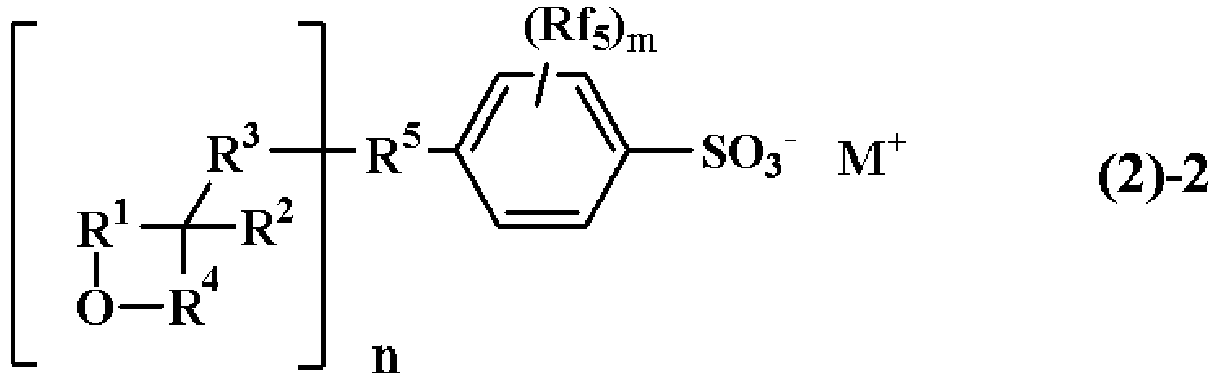


- Bioelektrodenzusammensetzung nach einem der Ansprüche 1 bis 3, wobei die Komponente (A) ein Reaktionsprodukt zwischen 100 Masseteilen des Kohlenstoffteilchens und 5 Masseteilen oder mehr des Monomers mit einer ionischen funktionellen Gruppe ist.
- Bioelektrodenzusammensetzung nach einem der Ansprüche 1 bis 4, wobei die Komponente (A) ein durch die folgende allgemeine Formel (3) dargestelltes Ammoniumion als Ammoniumion zur Bildung der Ammoniumsalze enthält,

- Bioelektrodenzusammensetzung nach einem der Ansprüche 1 bis 5, die ferner eine Komponente (B) umfasst, bei der es sich vorzugsweise um ein Klebharz handelt,
wobei die Komponente (B) eine oder mehrere aus der Gruppe bestehend aus einem Silikonharz, einem (Meth)acrylatharz und einem Urethanharz ist. - Bioelektrodenzusammensetzung nach Anspruch 6, wobei die Komponente (B) Diorganosiloxan mit einer Alkenylgruppe und Organohydrogenpolysiloxan mit einer SiH-Gruppe umfasst, vorzugsweise, wobeidie Komponente (B) ferner ein Silikonharz mit einer SiO2 Einheit und einer RxSiO(4-x)/2 Einheitumfasst, wobeiR eine substituierte oder unsubstituierte einwertige Kohlenwasserstoffgruppe mit 1 bis 10 Kohlenstoffatomen darstellt und"x" steht für eine Zahl in einem Bereich von 2,5 bis 3,5.
- Bioelektrodenzusammensetzung nach einem der Ansprüche 1 bis 7, die ferner eine Komponente (C) umfasst, bei der es sich um eine Polymerverbindung mit einer ionischen Wiederholungseinheit handelt, vorzugsweise,
wobei die ionische Wiederholungseinheit der Komponente (C) eine Wiederholungseinheit mit einer Struktur umfasst, die aus der Gruppe ausgewählt ist, die aus Salzen von Ammonium, Lithium, Natrium, Kalium und Silber besteht, die mit Fluorsulfonsäure, Fluorsulfonimid und N-Carbonylfluorsulfonamid gebildet werden. - Bioelektrodenzusammensetzung nach einem der Ansprüche 1 bis 8, die ferner eine Komponente (D) umfasst, bei der es sich vorzugsweise um ein Kohlenstoffpulver und/oder ein Metallpulver handelt,
wobei es sich bei dem Kohlenstoffpulver um Ruß oder Kohlenstoff-Nanoröhrchen oder beides handelt. - Bioelektrodenzusammensetzung nach Anspruch9, wobei das Metallpulver ein Pulver eines Metalls ist, das vorzugsweise aus der Gruppe ausgewählt ist, die aus Gold, Silber, Platin, Kupfer, Zinn, Titan, Nickel, Aluminium, Wolfram, Molybdän, Ruthenium, Chrom und Indium besteht,
wobei das Metallpulver ein Silberpulver ist. - Bioelektrodenzusammensetzung nach einem der Ansprüche 1 bis 10, die ferner eine Komponente (E) umfasst, die ein organisches Lösungsmittel ist.
- Bioelektrode, die ein elektrisch leitendes Basismaterial und eine auf dem elektrisch leitenden Basismaterial ausgebildete Lebendkörperkontaktschicht umfasst, wobeidie Lebendkörperkontaktschicht ein gehärtetes Produkt der Bioelektrodenzusammensetzung nach einem der Ansprüche 1 bis 11 ist,vorzugsweise umfasst das elektrisch leitende Basismaterial eines oder mehrere Materialien aus der Gruppe Gold, Silber, Silberchlorid, Platin, Aluminium, Magnesium, Zinn, Wolfram, Eisen, Kupfer, Nickel, rostfreier Stahl, Chrom, Titan, Kohlenstoff und elektrisch leitendes Polymer.
- Verfahren zur Herstellung einer Bioelektrode mit einem elektrisch leitenden Basismaterial und einer auf dem elektrisch leitenden Basismaterial ausgebildeten Lebendkörperkontaktschicht, umfassendAufbringen der Bioelektrodenzusammensetzung nach einem der Ansprüche 1 bis 11 auf das elektrisch leitende Basismaterial; undAushärten der Bioelektrodenzusammensetzung, um vorzugsweise die Lebendkörperkontaktschicht zu bilden,wobei das elektrisch leitende Basismaterial eines oder mehrere aus der Gruppe bestehend aus Gold, Silber, Silberchlorid, Platin, Aluminium, Magnesium, Zinn, Wolfram, Eisen, Kupfer, Nickel, rostfreiem Stahl, Chrom, Titan, Kohlenstoff und elektrisch leitendem Polymer umfasst.
- Reaktionskomposit, das ein Monomer mit einer ionischen funktionellen Gruppe und ein Kohlenstoffteilchen umfasst, wobei
das Reaktionskomposit das Kohlenstoffteilchen umfasst, das an das Monomer gebunden ist, das eine Struktur aufweist, die aus der Gruppe ausgewählt ist, die aus Salzen von Ammonium, Lithium, Natrium, Kalium und Silber besteht, die mit irgendeiner von Fluorsulfonsäure, Fluorsulfonimid und N-Carbonylfluorsulfonamid gebildet werden, und in dem Reaktionsverbund das Monomer mit einer ionischen funktionellen Gruppe eine Oxirangruppe oder eine Oxetangruppe aufweist und die Oxirangruppe oder die Oxetangruppe mit einer Hydroxygruppe, einer Carboxylgruppe oder einer Aminogruppe auf einer Oberfläche des Kohlenstoffteilchens umgesetzt und daran gebunden ist. - Reaktionskomposit nach Anspruch 14, wobei das Kohlenstoffpartikel ausgewählt ist aus der Gruppe bestehend aus Ruß, Kohlenstoffnanoröhrchen, Graphit (schwarzes Blei) und Graphen.
Applications Claiming Priority (1)
| Application Number | Priority Date | Filing Date | Title |
|---|---|---|---|
| JP2020196158 | 2020-11-26 |
Publications (3)
| Publication Number | Publication Date |
|---|---|
| EP4006921A2 EP4006921A2 (de) | 2022-06-01 |
| EP4006921A3 EP4006921A3 (de) | 2022-06-15 |
| EP4006921B1 true EP4006921B1 (de) | 2024-10-16 |
Family
ID=78709345
Family Applications (1)
| Application Number | Title | Priority Date | Filing Date |
|---|---|---|---|
| EP21209358.7A Active EP4006921B1 (de) | 2020-11-26 | 2021-11-19 | Bioelektrodenzusammensetzung, bioelektrode, verfahren zur herstellung der bioelektrode und reaktionskomposit |
Country Status (6)
| Country | Link |
|---|---|
| US (1) | US12453501B2 (de) |
| EP (1) | EP4006921B1 (de) |
| JP (1) | JP7507737B2 (de) |
| KR (1) | KR102700276B1 (de) |
| CN (1) | CN114533073B (de) |
| TW (1) | TWI806255B (de) |
Families Citing this family (2)
| Publication number | Priority date | Publication date | Assignee | Title |
|---|---|---|---|---|
| US20230397870A1 (en) * | 2022-05-25 | 2023-12-14 | The Trustees Of The University Of Pennsylvania | Conductive Hydrogel-Based Wearable Health Monitors |
| CN117777061B (zh) * | 2023-09-25 | 2025-11-11 | 上海交通大学绍兴新能源与分子工程研究院 | 一种环氧功能化的磺酰亚胺锂及其制备方法与应用 |
Family Cites Families (30)
| Publication number | Priority date | Publication date | Assignee | Title |
|---|---|---|---|---|
| JPH07106197B2 (ja) | 1991-10-09 | 1995-11-15 | 日本メクトロン株式会社 | 導電性ミラブルウレタンゴム電極 |
| US5981680A (en) | 1998-07-13 | 1999-11-09 | Dow Corning Corporation | Method of making siloxane-based polyamides |
| KR20040014444A (ko) | 2000-12-23 | 2004-02-14 | 웬 루 | 이온성 액체를 구비한 긴 수명 공명 폴리머 전기화학 장치 |
| JP3865046B2 (ja) | 2001-05-08 | 2007-01-10 | 信越化学工業株式会社 | 無溶剤型ポリイミドシリコーン系樹脂組成物 |
| JP2003225217A (ja) | 2002-02-01 | 2003-08-12 | Shin Etsu Chem Co Ltd | 生体電極用シリコーンゴム組成物及び生体用電極 |
| JP3923861B2 (ja) | 2002-07-03 | 2007-06-06 | フクダ電子株式会社 | 生体電極 |
| JP2005320418A (ja) | 2004-05-07 | 2005-11-17 | Shin Etsu Chem Co Ltd | 紫外線硬化型オルガノポリシロキサン組成物 |
| JP5646153B2 (ja) | 2009-10-06 | 2014-12-24 | 東レ・ダウコーニング株式会社 | ポリアミドシリコーンコポリマーの製造方法 |
| JP2013514963A (ja) * | 2009-12-22 | 2013-05-02 | スー・クワンスック | グラフェン分散液およびグラフェン−イオン性液体高分子複合物 |
| WO2012165358A1 (en) | 2011-06-03 | 2012-12-06 | Semiconductor Energy Laboratory Co., Ltd. | Method of manufacturing electrode |
| WO2013039151A1 (ja) | 2011-09-15 | 2013-03-21 | 積水化成品工業株式会社 | 生体用電極被覆パッド |
| CN104871595B (zh) | 2012-12-19 | 2018-10-19 | Lg电子株式会社 | 支持多址接入网络的无线通信系统中的通信方法以及支持该方法的设备 |
| JP6296530B2 (ja) | 2013-07-18 | 2018-03-20 | 国立研究開発法人科学技術振興機構 | 生体適合性電極構造体及びその製造方法、並びに、デバイス及びその製造方法 |
| KR20150019806A (ko) | 2013-08-16 | 2015-02-25 | 현대모비스 주식회사 | 벌브 홀더 및 이를 포함하는 차량용 램프 |
| JP6073776B2 (ja) | 2013-11-28 | 2017-02-01 | 日本電信電話株式会社 | 生体電気信号モニタ用衣類 |
| JP6348434B2 (ja) | 2014-03-28 | 2018-06-27 | 信越化学工業株式会社 | シリコーン粘着剤組成物、その製造法及び粘着フィルム |
| JP6358874B2 (ja) | 2014-06-27 | 2018-07-18 | ニチバン株式会社 | アクリル系粘着剤組成物、及び、粘着テープまたはシート |
| US20170275510A1 (en) | 2014-09-19 | 2017-09-28 | Cosmed Pharmaceutical Co., Ltd. | Urethane-based adhesive composition |
| EP3170877B1 (de) | 2015-11-19 | 2020-11-18 | 3M Innovative Properties Company | Strukturklebstoff mit verbessertem fehlermodus |
| JP6744848B2 (ja) | 2016-09-13 | 2020-08-19 | 信越化学工業株式会社 | 粘着剤組成物、生体電極、及び生体電極の製造方法 |
| JP6761384B2 (ja) | 2016-09-29 | 2020-09-23 | 信越化学工業株式会社 | 粘着剤組成物、生体電極、及び生体電極の製造方法 |
| JP6761386B2 (ja) | 2016-09-29 | 2020-09-23 | 信越化学工業株式会社 | 粘着剤組成物、生体電極、生体電極の製造方法、及び塩 |
| JP6919992B2 (ja) | 2017-01-30 | 2021-08-18 | 信越化学工業株式会社 | 伸縮性膜及びその形成方法 |
| JP6836520B2 (ja) * | 2017-02-14 | 2021-03-03 | 信越化学工業株式会社 | 生体電極組成物、生体電極、及び生体電極の製造方法 |
| JP6882236B2 (ja) | 2017-10-10 | 2021-06-02 | 信越化学工業株式会社 | 珪素含有化合物、ウレタン樹脂、伸縮性膜、及びその形成方法 |
| JP6839107B2 (ja) * | 2018-01-09 | 2021-03-03 | 信越化学工業株式会社 | 生体電極組成物、生体電極、及び生体電極の製造方法 |
| JP7111653B2 (ja) | 2018-06-25 | 2022-08-02 | 信越化学工業株式会社 | 生体電極組成物、生体電極、及び生体電極の製造方法 |
| JP7045768B2 (ja) | 2019-04-03 | 2022-04-01 | 信越化学工業株式会社 | 生体電極組成物、生体電極、及び生体電極の製造方法 |
| KR102771105B1 (ko) | 2019-06-07 | 2025-02-21 | 삼성디스플레이 주식회사 | 표시 장치와 그의 음향 제공 방법 |
| JP7569298B2 (ja) * | 2020-11-05 | 2024-10-17 | 信越化学工業株式会社 | 生体電極組成物、生体電極、生体電極の製造方法及び反応複合体 |
-
2021
- 2021-11-01 JP JP2021179049A patent/JP7507737B2/ja active Active
- 2021-11-09 US US17/522,306 patent/US12453501B2/en active Active
- 2021-11-19 EP EP21209358.7A patent/EP4006921B1/de active Active
- 2021-11-22 KR KR1020210161535A patent/KR102700276B1/ko active Active
- 2021-11-24 TW TW110143642A patent/TWI806255B/zh active
- 2021-11-25 CN CN202111412135.5A patent/CN114533073B/zh active Active
Also Published As
| Publication number | Publication date |
|---|---|
| TW202229437A (zh) | 2022-08-01 |
| KR102700276B1 (ko) | 2024-08-28 |
| EP4006921A3 (de) | 2022-06-15 |
| EP4006921A2 (de) | 2022-06-01 |
| TWI806255B (zh) | 2023-06-21 |
| JP7507737B2 (ja) | 2024-06-28 |
| CN114533073A (zh) | 2022-05-27 |
| CN114533073B (zh) | 2024-09-27 |
| US20220160281A1 (en) | 2022-05-26 |
| US12453501B2 (en) | 2025-10-28 |
| JP2022084534A (ja) | 2022-06-07 |
| KR20220073663A (ko) | 2022-06-03 |
Similar Documents
| Publication | Publication Date | Title |
|---|---|---|
| EP3995548A1 (de) | Bioelektrodenzusammensetzung, bioelektrode, verfahren zur herstellung der bioelektrode und reaktionskomposit | |
| EP3854303B1 (de) | Bioelektrodenzusammensetzung, bioelektrode und verfahren zur herstellung einer bioelektrode | |
| EP3587473B1 (de) | Bioelektrodenzusammensetzung, bioelektrode und verfahren zur herstellung einer bioelektrode | |
| EP3995544B1 (de) | Bioelektrodenzusammensetzung, bioelektrode und verfahren zur herstellung einer bioelektrode | |
| EP3718471B1 (de) | Bioelektrodenzusammensetzung, bioelektrode und verfahren zur herstellung einer bioelektrode | |
| EP3587474B1 (de) | Bioelektrodenzusammensetzung, bioelektrode und verfahren zur herstellung der bioelektrode | |
| EP3984456B1 (de) | Bioelektrodenzusammensetzung, bioelektrode, verfahren zur herstellung einer bioelektrode, polymerverbindung und verbundstoff | |
| EP3881766B1 (de) | Bio-elektrode, verfahren zur herstellung einer bio-elektrode und verfahren zur messung biologischer signale | |
| EP4026860A1 (de) | Bioelektrodenzusammensetzung, bioelektrode und verfahren zur herstellung einer bioelektrode | |
| EP4074754B1 (de) | Bioelektrodenzusammensetzung, bioelektrode und verfahren zur herstellung einer bioelektrode | |
| EP4006921B1 (de) | Bioelektrodenzusammensetzung, bioelektrode, verfahren zur herstellung der bioelektrode und reaktionskomposit | |
| EP3968343A2 (de) | Bio-elektrodenzusammensetzung, bio-elektrode, verfahren zur herstellung einer bio-elektrode und siliziummaterialteilchen | |
| EP4309582B1 (de) | Bioelektrodenzusammensetzung, bioelektrode und verfahren zur herstellung davon | |
| EP4435803A1 (de) | Bioelektrodenzusammensetzung, bioelektrode und verfahren zur herstellung davon | |
| EP4492406B1 (de) | Bioelektrodenzusammensetzung, bioelektrode, verfahren zur herstellung der bioelektrode | |
| EP4654222A1 (de) | Niedrigschmelzende eutektische flüssigkeit, bioelektrodenzusammensetzung, bioelektrode und verfahren zur herstellung der bioelektrode | |
| EP4651157A1 (de) | Bioelektrodenzusammensetzung, bioelektrode und verfahren zur herstellung der bioelektrode |
Legal Events
| Date | Code | Title | Description |
|---|---|---|---|
| PUAI | Public reference made under article 153(3) epc to a published international application that has entered the european phase |
Free format text: ORIGINAL CODE: 0009012 |
|
| STAA | Information on the status of an ep patent application or granted ep patent |
Free format text: STATUS: THE APPLICATION HAS BEEN PUBLISHED |
|
| PUAL | Search report despatched |
Free format text: ORIGINAL CODE: 0009013 |
|
| AK | Designated contracting states |
Kind code of ref document: A2 Designated state(s): AL AT BE BG CH CY CZ DE DK EE ES FI FR GB GR HR HU IE IS IT LI LT LU LV MC MK MT NL NO PL PT RO RS SE SI SK SM TR |
|
| AK | Designated contracting states |
Kind code of ref document: A3 Designated state(s): AL AT BE BG CH CY CZ DE DK EE ES FI FR GB GR HR HU IE IS IT LI LT LU LV MC MK MT NL NO PL PT RO RS SE SI SK SM TR |
|
| RIC1 | Information provided on ipc code assigned before grant |
Ipc: C09D 151/08 20060101ALI20220509BHEP Ipc: C09D 133/08 20060101ALI20220509BHEP Ipc: C08F 220/58 20060101ALI20220509BHEP Ipc: C08F 220/38 20060101ALI20220509BHEP Ipc: C08F 220/18 20060101ALI20220509BHEP Ipc: A61B 5/279 20210101ALI20220509BHEP Ipc: A61B 5/268 20210101ALI20220509BHEP Ipc: H01B 1/24 20060101ALI20220509BHEP Ipc: H01B 1/12 20060101AFI20220509BHEP |
|
| STAA | Information on the status of an ep patent application or granted ep patent |
Free format text: STATUS: REQUEST FOR EXAMINATION WAS MADE |
|
| 17P | Request for examination filed |
Effective date: 20221213 |
|
| RBV | Designated contracting states (corrected) |
Designated state(s): AL AT BE BG CH CY CZ DE DK EE ES FI FR GB GR HR HU IE IS IT LI LT LU LV MC MK MT NL NO PL PT RO RS SE SI SK SM TR |
|
| STAA | Information on the status of an ep patent application or granted ep patent |
Free format text: STATUS: EXAMINATION IS IN PROGRESS |
|
| 17Q | First examination report despatched |
Effective date: 20230504 |
|
| GRAP | Despatch of communication of intention to grant a patent |
Free format text: ORIGINAL CODE: EPIDOSNIGR1 |
|
| STAA | Information on the status of an ep patent application or granted ep patent |
Free format text: STATUS: GRANT OF PATENT IS INTENDED |
|
| RIC1 | Information provided on ipc code assigned before grant |
Ipc: C09D 133/14 20060101ALI20240508BHEP Ipc: A61B 5/28 20210101ALI20240508BHEP Ipc: C09D 151/08 20060101ALI20240508BHEP Ipc: C09D 133/08 20060101ALI20240508BHEP Ipc: C08F 220/58 20060101ALI20240508BHEP Ipc: C08F 220/38 20060101ALI20240508BHEP Ipc: C08F 220/18 20060101ALI20240508BHEP Ipc: A61B 5/279 20210101ALI20240508BHEP Ipc: A61B 5/268 20210101ALI20240508BHEP Ipc: H01B 1/24 20060101ALI20240508BHEP Ipc: H01B 1/12 20060101AFI20240508BHEP |
|
| INTG | Intention to grant announced |
Effective date: 20240528 |
|
| GRAS | Grant fee paid |
Free format text: ORIGINAL CODE: EPIDOSNIGR3 |
|
| GRAA | (expected) grant |
Free format text: ORIGINAL CODE: 0009210 |
|
| STAA | Information on the status of an ep patent application or granted ep patent |
Free format text: STATUS: THE PATENT HAS BEEN GRANTED |
|
| AK | Designated contracting states |
Kind code of ref document: B1 Designated state(s): AL AT BE BG CH CY CZ DE DK EE ES FI FR GB GR HR HU IE IS IT LI LT LU LV MC MK MT NL NO PL PT RO RS SE SI SK SM TR |
|
| REG | Reference to a national code |
Ref country code: GB Ref legal event code: FG4D |
|
| REG | Reference to a national code |
Ref country code: CH Ref legal event code: EP |
|
| REG | Reference to a national code |
Ref country code: IE Ref legal event code: FG4D |
|
| REG | Reference to a national code |
Ref country code: DE Ref legal event code: R096 Ref document number: 602021020293 Country of ref document: DE |
|
| REG | Reference to a national code |
Ref country code: NL Ref legal event code: FP |
|
| REG | Reference to a national code |
Ref country code: LT Ref legal event code: MG9D |
|
| REG | Reference to a national code |
Ref country code: AT Ref legal event code: MK05 Ref document number: 1733639 Country of ref document: AT Kind code of ref document: T Effective date: 20241016 |
|
| PG25 | Lapsed in a contracting state [announced via postgrant information from national office to epo] |
Ref country code: PT Free format text: LAPSE BECAUSE OF FAILURE TO SUBMIT A TRANSLATION OF THE DESCRIPTION OR TO PAY THE FEE WITHIN THE PRESCRIBED TIME-LIMIT Effective date: 20250217 Ref country code: IS Free format text: LAPSE BECAUSE OF FAILURE TO SUBMIT A TRANSLATION OF THE DESCRIPTION OR TO PAY THE FEE WITHIN THE PRESCRIBED TIME-LIMIT Effective date: 20250216 Ref country code: HR Free format text: LAPSE BECAUSE OF FAILURE TO SUBMIT A TRANSLATION OF THE DESCRIPTION OR TO PAY THE FEE WITHIN THE PRESCRIBED TIME-LIMIT Effective date: 20241016 |
|
| PG25 | Lapsed in a contracting state [announced via postgrant information from national office to epo] |
Ref country code: FI Free format text: LAPSE BECAUSE OF FAILURE TO SUBMIT A TRANSLATION OF THE DESCRIPTION OR TO PAY THE FEE WITHIN THE PRESCRIBED TIME-LIMIT Effective date: 20241016 |
|
| PG25 | Lapsed in a contracting state [announced via postgrant information from national office to epo] |
Ref country code: BG Free format text: LAPSE BECAUSE OF FAILURE TO SUBMIT A TRANSLATION OF THE DESCRIPTION OR TO PAY THE FEE WITHIN THE PRESCRIBED TIME-LIMIT Effective date: 20241016 |
|
| PG25 | Lapsed in a contracting state [announced via postgrant information from national office to epo] |
Ref country code: ES Free format text: LAPSE BECAUSE OF FAILURE TO SUBMIT A TRANSLATION OF THE DESCRIPTION OR TO PAY THE FEE WITHIN THE PRESCRIBED TIME-LIMIT Effective date: 20241016 |
|
| PG25 | Lapsed in a contracting state [announced via postgrant information from national office to epo] |
Ref country code: NO Free format text: LAPSE BECAUSE OF FAILURE TO SUBMIT A TRANSLATION OF THE DESCRIPTION OR TO PAY THE FEE WITHIN THE PRESCRIBED TIME-LIMIT Effective date: 20250116 |
|
| PG25 | Lapsed in a contracting state [announced via postgrant information from national office to epo] |
Ref country code: GR Free format text: LAPSE BECAUSE OF FAILURE TO SUBMIT A TRANSLATION OF THE DESCRIPTION OR TO PAY THE FEE WITHIN THE PRESCRIBED TIME-LIMIT Effective date: 20250117 Ref country code: LV Free format text: LAPSE BECAUSE OF FAILURE TO SUBMIT A TRANSLATION OF THE DESCRIPTION OR TO PAY THE FEE WITHIN THE PRESCRIBED TIME-LIMIT Effective date: 20241016 Ref country code: AT Free format text: LAPSE BECAUSE OF FAILURE TO SUBMIT A TRANSLATION OF THE DESCRIPTION OR TO PAY THE FEE WITHIN THE PRESCRIBED TIME-LIMIT Effective date: 20241016 |
|
| PG25 | Lapsed in a contracting state [announced via postgrant information from national office to epo] |
Ref country code: PL Free format text: LAPSE BECAUSE OF FAILURE TO SUBMIT A TRANSLATION OF THE DESCRIPTION OR TO PAY THE FEE WITHIN THE PRESCRIBED TIME-LIMIT Effective date: 20241016 |
|
| PG25 | Lapsed in a contracting state [announced via postgrant information from national office to epo] |
Ref country code: RS Free format text: LAPSE BECAUSE OF FAILURE TO SUBMIT A TRANSLATION OF THE DESCRIPTION OR TO PAY THE FEE WITHIN THE PRESCRIBED TIME-LIMIT Effective date: 20250116 |
|
| REG | Reference to a national code |
Ref country code: CH Ref legal event code: PL |
|
| PG25 | Lapsed in a contracting state [announced via postgrant information from national office to epo] |
Ref country code: SM Free format text: LAPSE BECAUSE OF FAILURE TO SUBMIT A TRANSLATION OF THE DESCRIPTION OR TO PAY THE FEE WITHIN THE PRESCRIBED TIME-LIMIT Effective date: 20241016 |
|
| PG25 | Lapsed in a contracting state [announced via postgrant information from national office to epo] |
Ref country code: MC Free format text: LAPSE BECAUSE OF FAILURE TO SUBMIT A TRANSLATION OF THE DESCRIPTION OR TO PAY THE FEE WITHIN THE PRESCRIBED TIME-LIMIT Effective date: 20241016 |
|
| PG25 | Lapsed in a contracting state [announced via postgrant information from national office to epo] |
Ref country code: DK Free format text: LAPSE BECAUSE OF FAILURE TO SUBMIT A TRANSLATION OF THE DESCRIPTION OR TO PAY THE FEE WITHIN THE PRESCRIBED TIME-LIMIT Effective date: 20241016 |
|
| PG25 | Lapsed in a contracting state [announced via postgrant information from national office to epo] |
Ref country code: LU Free format text: LAPSE BECAUSE OF NON-PAYMENT OF DUE FEES Effective date: 20241119 |
|
| REG | Reference to a national code |
Ref country code: CH Ref legal event code: PL |
|
| REG | Reference to a national code |
Ref country code: DE Ref legal event code: R097 Ref document number: 602021020293 Country of ref document: DE |
|
| PG25 | Lapsed in a contracting state [announced via postgrant information from national office to epo] |
Ref country code: EE Free format text: LAPSE BECAUSE OF FAILURE TO SUBMIT A TRANSLATION OF THE DESCRIPTION OR TO PAY THE FEE WITHIN THE PRESCRIBED TIME-LIMIT Effective date: 20241016 |
|
| PG25 | Lapsed in a contracting state [announced via postgrant information from national office to epo] |
Ref country code: CH Free format text: LAPSE BECAUSE OF NON-PAYMENT OF DUE FEES Effective date: 20241130 |
|
| PG25 | Lapsed in a contracting state [announced via postgrant information from national office to epo] |
Ref country code: RO Free format text: LAPSE BECAUSE OF FAILURE TO SUBMIT A TRANSLATION OF THE DESCRIPTION OR TO PAY THE FEE WITHIN THE PRESCRIBED TIME-LIMIT Effective date: 20241016 |
|
| PG25 | Lapsed in a contracting state [announced via postgrant information from national office to epo] |
Ref country code: SK Free format text: LAPSE BECAUSE OF FAILURE TO SUBMIT A TRANSLATION OF THE DESCRIPTION OR TO PAY THE FEE WITHIN THE PRESCRIBED TIME-LIMIT Effective date: 20241016 |
|
| PG25 | Lapsed in a contracting state [announced via postgrant information from national office to epo] |
Ref country code: CZ Free format text: LAPSE BECAUSE OF FAILURE TO SUBMIT A TRANSLATION OF THE DESCRIPTION OR TO PAY THE FEE WITHIN THE PRESCRIBED TIME-LIMIT Effective date: 20241016 |
|
| PG25 | Lapsed in a contracting state [announced via postgrant information from national office to epo] |
Ref country code: IT Free format text: LAPSE BECAUSE OF FAILURE TO SUBMIT A TRANSLATION OF THE DESCRIPTION OR TO PAY THE FEE WITHIN THE PRESCRIBED TIME-LIMIT Effective date: 20241016 |
|
| PLBE | No opposition filed within time limit |
Free format text: ORIGINAL CODE: 0009261 |
|
| STAA | Information on the status of an ep patent application or granted ep patent |
Free format text: STATUS: NO OPPOSITION FILED WITHIN TIME LIMIT |
|
| PG25 | Lapsed in a contracting state [announced via postgrant information from national office to epo] |
Ref country code: SE Free format text: LAPSE BECAUSE OF FAILURE TO SUBMIT A TRANSLATION OF THE DESCRIPTION OR TO PAY THE FEE WITHIN THE PRESCRIBED TIME-LIMIT Effective date: 20241016 |
|
| 26N | No opposition filed |
Effective date: 20250717 |
|
| PGFP | Annual fee paid to national office [announced via postgrant information from national office to epo] |
Ref country code: FR Payment date: 20250930 Year of fee payment: 5 |
|
| PG25 | Lapsed in a contracting state [announced via postgrant information from national office to epo] |
Ref country code: IE Free format text: LAPSE BECAUSE OF NON-PAYMENT OF DUE FEES Effective date: 20241119 |
|
| PGFP | Annual fee paid to national office [announced via postgrant information from national office to epo] |
Ref country code: NL Payment date: 20251003 Year of fee payment: 5 |
|
| PGFP | Annual fee paid to national office [announced via postgrant information from national office to epo] |
Ref country code: DE Payment date: 20250930 Year of fee payment: 5 |
|
| PGFP | Annual fee paid to national office [announced via postgrant information from national office to epo] |
Ref country code: GB Payment date: 20251001 Year of fee payment: 5 |
|
| PGFP | Annual fee paid to national office [announced via postgrant information from national office to epo] |
Ref country code: BE Payment date: 20251006 Year of fee payment: 5 |
|
| PG25 | Lapsed in a contracting state [announced via postgrant information from national office to epo] |
Ref country code: HU Free format text: LAPSE BECAUSE OF FAILURE TO SUBMIT A TRANSLATION OF THE DESCRIPTION OR TO PAY THE FEE WITHIN THE PRESCRIBED TIME-LIMIT; INVALID AB INITIO Effective date: 20211119 |
|
| PG25 | Lapsed in a contracting state [announced via postgrant information from national office to epo] |
Ref country code: CY Free format text: LAPSE BECAUSE OF FAILURE TO SUBMIT A TRANSLATION OF THE DESCRIPTION OR TO PAY THE FEE WITHIN THE PRESCRIBED TIME-LIMIT; INVALID AB INITIO Effective date: 20211119 |