EP4007006B1 - Composition d'isolation thermique et son procédé de préparation et son application - Google Patents
Composition d'isolation thermique et son procédé de préparation et son application Download PDFInfo
- Publication number
- EP4007006B1 EP4007006B1 EP19939144.2A EP19939144A EP4007006B1 EP 4007006 B1 EP4007006 B1 EP 4007006B1 EP 19939144 A EP19939144 A EP 19939144A EP 4007006 B1 EP4007006 B1 EP 4007006B1
- Authority
- EP
- European Patent Office
- Prior art keywords
- thermal insulation
- aerogel material
- organic resin
- insulation composition
- precursor
- Prior art date
- Legal status (The legal status is an assumption and is not a legal conclusion. Google has not performed a legal analysis and makes no representation as to the accuracy of the status listed.)
- Active
Links
Images


Classifications
-
- C—CHEMISTRY; METALLURGY
- C01—INORGANIC CHEMISTRY
- C01B—NON-METALLIC ELEMENTS; COMPOUNDS THEREOF; METALLOIDS OR COMPOUNDS THEREOF NOT COVERED BY SUBCLASS C01C
- C01B33/00—Silicon; Compounds thereof
- C01B33/113—Silicon oxides; Hydrates thereof
- C01B33/12—Silica; Hydrates thereof, e.g. lepidoic silicic acid
- C01B33/14—Colloidal silica, e.g. dispersions, gels, sols
- C01B33/157—After-treatment of gels
- C01B33/158—Purification; Drying; Dehydrating
- C01B33/1585—Dehydration into aerogels
-
- C—CHEMISTRY; METALLURGY
- C08—ORGANIC MACROMOLECULAR COMPOUNDS; THEIR PREPARATION OR CHEMICAL WORKING-UP; COMPOSITIONS BASED THEREON
- C08K—Use of inorganic or non-macromolecular organic substances as compounding ingredients
- C08K3/00—Use of inorganic substances as compounding ingredients
- C08K3/34—Silicon-containing compounds
- C08K3/36—Silica
-
- C—CHEMISTRY; METALLURGY
- C01—INORGANIC CHEMISTRY
- C01B—NON-METALLIC ELEMENTS; COMPOUNDS THEREOF; METALLOIDS OR COMPOUNDS THEREOF NOT COVERED BY SUBCLASS C01C
- C01B33/00—Silicon; Compounds thereof
- C01B33/113—Silicon oxides; Hydrates thereof
- C01B33/12—Silica; Hydrates thereof, e.g. lepidoic silicic acid
- C01B33/14—Colloidal silica, e.g. dispersions, gels, sols
- C01B33/155—Preparation of hydroorganogels or organogels
-
- C—CHEMISTRY; METALLURGY
- C08—ORGANIC MACROMOLECULAR COMPOUNDS; THEIR PREPARATION OR CHEMICAL WORKING-UP; COMPOSITIONS BASED THEREON
- C08G—MACROMOLECULAR COMPOUNDS OBTAINED OTHERWISE THAN BY REACTIONS ONLY INVOLVING UNSATURATED CARBON-TO-CARBON BONDS
- C08G64/00—Macromolecular compounds obtained by reactions forming a carbonic ester link in the main chain of the macromolecule
- C08G64/02—Aliphatic polycarbonates
- C08G64/0208—Aliphatic polycarbonates saturated
-
- C—CHEMISTRY; METALLURGY
- C08—ORGANIC MACROMOLECULAR COMPOUNDS; THEIR PREPARATION OR CHEMICAL WORKING-UP; COMPOSITIONS BASED THEREON
- C08J—WORKING-UP; GENERAL PROCESSES OF COMPOUNDING; AFTER-TREATMENT NOT COVERED BY SUBCLASSES C08B, C08C, C08F, C08G or C08H
- C08J3/00—Processes of treating or compounding macromolecular substances
- C08J3/20—Compounding polymers with additives, e.g. colouring
- C08J3/201—Pre-melted polymers
-
- C—CHEMISTRY; METALLURGY
- C08—ORGANIC MACROMOLECULAR COMPOUNDS; THEIR PREPARATION OR CHEMICAL WORKING-UP; COMPOSITIONS BASED THEREON
- C08K—Use of inorganic or non-macromolecular organic substances as compounding ingredients
- C08K7/00—Use of ingredients characterised by shape
- C08K7/02—Fibres or whiskers
- C08K7/04—Fibres or whiskers inorganic
- C08K7/14—Glass
-
- C—CHEMISTRY; METALLURGY
- C08—ORGANIC MACROMOLECULAR COMPOUNDS; THEIR PREPARATION OR CHEMICAL WORKING-UP; COMPOSITIONS BASED THEREON
- C08K—Use of inorganic or non-macromolecular organic substances as compounding ingredients
- C08K7/00—Use of ingredients characterised by shape
- C08K7/22—Expanded, porous or hollow particles
- C08K7/24—Expanded, porous or hollow particles inorganic
- C08K7/26—Silicon- containing compounds
-
- H—ELECTRICITY
- H01—ELECTRIC ELEMENTS
- H01M—PROCESSES OR MEANS, e.g. BATTERIES, FOR THE DIRECT CONVERSION OF CHEMICAL ENERGY INTO ELECTRICAL ENERGY
- H01M10/00—Secondary cells; Manufacture thereof
- H01M10/05—Accumulators with non-aqueous electrolyte
- H01M10/052—Li-accumulators
- H01M10/0525—Rocking-chair batteries, i.e. batteries with lithium insertion or intercalation in both electrodes; Lithium-ion batteries
-
- H—ELECTRICITY
- H01—ELECTRIC ELEMENTS
- H01M—PROCESSES OR MEANS, e.g. BATTERIES, FOR THE DIRECT CONVERSION OF CHEMICAL ENERGY INTO ELECTRICAL ENERGY
- H01M10/00—Secondary cells; Manufacture thereof
- H01M10/60—Heating or cooling; Temperature control
- H01M10/65—Means for temperature control structurally associated with the cells
- H01M10/658—Means for temperature control structurally associated with the cells by thermal insulation or shielding
-
- H—ELECTRICITY
- H01—ELECTRIC ELEMENTS
- H01M—PROCESSES OR MEANS, e.g. BATTERIES, FOR THE DIRECT CONVERSION OF CHEMICAL ENERGY INTO ELECTRICAL ENERGY
- H01M50/00—Constructional details or processes of manufacture of the non-active parts of electrochemical cells other than fuel cells, e.g. hybrid cells
- H01M50/40—Separators; Membranes; Diaphragms; Spacing elements inside cells
- H01M50/409—Separators, membranes or diaphragms characterised by the material
- H01M50/431—Inorganic material
- H01M50/434—Ceramics
- H01M50/437—Glass
-
- H—ELECTRICITY
- H01—ELECTRIC ELEMENTS
- H01M—PROCESSES OR MEANS, e.g. BATTERIES, FOR THE DIRECT CONVERSION OF CHEMICAL ENERGY INTO ELECTRICAL ENERGY
- H01M50/00—Constructional details or processes of manufacture of the non-active parts of electrochemical cells other than fuel cells, e.g. hybrid cells
- H01M50/40—Separators; Membranes; Diaphragms; Spacing elements inside cells
- H01M50/409—Separators, membranes or diaphragms characterised by the material
- H01M50/446—Composite material consisting of a mixture of organic and inorganic materials
-
- C—CHEMISTRY; METALLURGY
- C01—INORGANIC CHEMISTRY
- C01P—INDEXING SCHEME RELATING TO STRUCTURAL AND PHYSICAL ASPECTS OF SOLID INORGANIC COMPOUNDS
- C01P2004/00—Particle morphology
- C01P2004/60—Particles characterised by their size
-
- C—CHEMISTRY; METALLURGY
- C01—INORGANIC CHEMISTRY
- C01P—INDEXING SCHEME RELATING TO STRUCTURAL AND PHYSICAL ASPECTS OF SOLID INORGANIC COMPOUNDS
- C01P2004/00—Particle morphology
- C01P2004/60—Particles characterised by their size
- C01P2004/62—Submicrometer sized, i.e. from 0.1-1 micrometer
-
- C—CHEMISTRY; METALLURGY
- C01—INORGANIC CHEMISTRY
- C01P—INDEXING SCHEME RELATING TO STRUCTURAL AND PHYSICAL ASPECTS OF SOLID INORGANIC COMPOUNDS
- C01P2006/00—Physical properties of inorganic compounds
- C01P2006/16—Pore diameter
-
- C—CHEMISTRY; METALLURGY
- C01—INORGANIC CHEMISTRY
- C01P—INDEXING SCHEME RELATING TO STRUCTURAL AND PHYSICAL ASPECTS OF SOLID INORGANIC COMPOUNDS
- C01P2006/00—Physical properties of inorganic compounds
- C01P2006/32—Thermal properties
-
- C—CHEMISTRY; METALLURGY
- C08—ORGANIC MACROMOLECULAR COMPOUNDS; THEIR PREPARATION OR CHEMICAL WORKING-UP; COMPOSITIONS BASED THEREON
- C08J—WORKING-UP; GENERAL PROCESSES OF COMPOUNDING; AFTER-TREATMENT NOT COVERED BY SUBCLASSES C08B, C08C, C08F, C08G or C08H
- C08J2369/00—Characterised by the use of polycarbonates; Derivatives of polycarbonates
-
- C—CHEMISTRY; METALLURGY
- C08—ORGANIC MACROMOLECULAR COMPOUNDS; THEIR PREPARATION OR CHEMICAL WORKING-UP; COMPOSITIONS BASED THEREON
- C08K—Use of inorganic or non-macromolecular organic substances as compounding ingredients
- C08K2201/00—Specific properties of additives
- C08K2201/002—Physical properties
- C08K2201/005—Additives being defined by their particle size in general
-
- C—CHEMISTRY; METALLURGY
- C08—ORGANIC MACROMOLECULAR COMPOUNDS; THEIR PREPARATION OR CHEMICAL WORKING-UP; COMPOSITIONS BASED THEREON
- C08K—Use of inorganic or non-macromolecular organic substances as compounding ingredients
- C08K2201/00—Specific properties of additives
- C08K2201/011—Nanostructured additives
-
- Y—GENERAL TAGGING OF NEW TECHNOLOGICAL DEVELOPMENTS; GENERAL TAGGING OF CROSS-SECTIONAL TECHNOLOGIES SPANNING OVER SEVERAL SECTIONS OF THE IPC; TECHNICAL SUBJECTS COVERED BY FORMER USPC CROSS-REFERENCE ART COLLECTIONS [XRACs] AND DIGESTS
- Y02—TECHNOLOGIES OR APPLICATIONS FOR MITIGATION OR ADAPTATION AGAINST CLIMATE CHANGE
- Y02E—REDUCTION OF GREENHOUSE GAS [GHG] EMISSIONS, RELATED TO ENERGY GENERATION, TRANSMISSION OR DISTRIBUTION
- Y02E60/00—Enabling technologies; Technologies with a potential or indirect contribution to GHG emissions mitigation
- Y02E60/10—Energy storage using batteries
Definitions
- the present disclosure relates to a thermal insulation composition, and in particular to a thermal insulation composition that can be used in a thermal insulation module component of lithium-ion battery, and belongs to the technical field of thermal insulation materials.
- Li-ion batteries have become the most important power source for new energy vehicles.
- high nickel NCM or NCA batteries have a great advantage in terms of high energy density.
- the stability and heat generation of the positive electrode material increases significantly, which greatly reduces the safety compared to using LFP or low nickel positive electrode materials (NCM111, NCM523), and when the battery is subjected to high temperature, overcharge or internal short circuit, thermal runaway and thermal diffusion to the surrounding cells can easily occur. Thus it is likely to cause a fire or explosion in the battery due to heat propagation, thus seriously endangering personal safety.
- the existing module structural components are generally of resin or aluminum alloy materials, which do not have the performance of thermal insulation and fire prevention when the thermal runaway of cell occurs.
- thermal insulation composition according to the preamble of claim 1 is known from US 2019/148696 A1 .
- an object of the present disclosure is to provide a module component, which not only has mechanical strength and functionality, but also can play the role of fire prevention and thermal insulation in case of thermal runaway, blocking heat propagation and greatly improving the safety performance of the battery.
- the thermal insulation composition comprises a composite of an aerogel material and an organic resin, and the composite mass ratio of the aerogel material to the organic resin is 5wt%:95wt% to 50wt%:50wt%.
- the porosity of the aerogel material used is greater than 95% (the porosity of the aerogel material refers to the porosity that the aerogel material has before it is filled with organic resin), the pore size of the aerogel material is less than or equal to 100 nm, the particle size of each particle of the aerogel material is 5 nm to 20 nm, and the organic resin is filled in the pores of the aerogel material.
- the thermal insulation composition of the present disclosure has both mechanical strength and heat conduction capability at normal temperature, and when a certain temperature is reached, the composition will become an adiabatic material with extremely high thermal insulation performance, blocking the heat transfer between the cells, which can greatly improve the safety of the battery.
- the thermal insulation composition of the present disclosure comprises a thermally insulating aerogel material and an organic resin.
- a thermally insulating aerogel material At normal temperature, more than 95% of the aerogel material are air pores, which are filled with the organic resin.
- the organic resin-filled aerogel material can achieve sufficient mechanical strength and thermal conductivity.
- high temperature e.g. above 180°C
- the degradation temperature of the organic resin is reached, so that the organic resin decomposes into carbon dioxide and water, leaving the aerogel material with ultra-low thermal conductivity, which can effectively block heat propagation.
- the aerogel material used in the thermal insulation composition of the present disclosure not only has an ultra-low thermal conductivity, but also has the advantages of light weight and high thermal stability.
- the aerogel material is prepared by the steps of:
- the precursor solution used to form the aerogel material is a mixture of the aerogel material and a solvent, and it is a stably present solution.
- the solvent employed may be an aqueous liquid, such as water or a water/ethanol mixture; or an organic solvent, such as N-methylpyrrolidone, propylene carbonate solvent, propylene carbonate, ethylene carbonate, diethyl carbonate, or dimethyl carbonate; or an ionic liquid, such as, 1-ethyl-3-methylimidazolium bis(trifluoromethanesulfonyl)imide.
- the raw material of the aerogel material employed comprises a precursor, and the precursor employed has a particle size of less than 500 nm; preferably 100 nm or less, more preferably 50 nm or less.
- the precursor employed comprises one or two or more of silica, titanium oxide, chromium oxide, iron oxide, vanadium oxide, neodymium oxide, carbon (including carbon nanotubes), and oxides of carbon.
- the precursor employed comprises one or two or more of silica, titanium oxide, and carbon.
- the precursor employed is silica.
- the raw material of the aerogel material employed may further comprise an additive, and the precursor is added in an amount of 60% to 90 % by weight when the additive is comprised.
- the aerogel material may comprise 60% to 90% by mass of SiO 2 or a particle mixture of SiO 2 and TiO 2 with a particle size of 10 nm; the aerogel material may comprise 5% to 30% by mass of SiC with a particle size of 20 ⁇ m and 2% to 10% by mass of glass fibers with a length of 100 ⁇ m.
- the additive employed comprises one or two or more of a glass fiber and an opacifier.
- the additive can be used to enhance the structural stability of the aerogel material.
- the aerogel material may comprise a glass fiber as a binder to increase the mechanical strength of the aerogel material; for example, a glass fiber with a length of 10 ⁇ m-2 mm is used.
- the aerogel material may comprise an opacifier such as SiC, TiO 2 , or carbon black.
- opacifier particles are uniformly distributed in the aerogel material and disperse up to 95% of the infrared radiation to block thermal radiation, especially at high temperature.
- the opacifier may be mono- or polycrystalline, or particles with a particle size of 1 ⁇ m to 50 ⁇ m.
- the particle size can be measured by a laser particle size analyzer such as HORIBA LA-960.
- the particle size can refer to the secondary particle size of polycrystalline particles.
- an oxide chemical bond or an alcohol chemical bond can be formed by a polycondensation reaction, which allows the solution containing the precursor to be solated, and in turn leads to a significant increase in the viscosity of the solution.
- the polycondensation reaction can be initiated by changing the pH of the solution.
- an alkaline solution can be added to the solution to adjust the pH of the precursor solution.
- the alkaline solution is not particularly limited in the present disclosure and may include solutions of alkali metal hydroxides such as NaOH or KOH, solutions of alkaline earth metal hydroxides such as MgOH 2 , and solutions of carbonates such as Na 2 CO 3 .
- the pH value is not limited, and can be determined by the type of the precursor.
- the pH of the solution can be adjusted to 3 to 4 using the alkaline solution NaOH to form SiO 2 /TiO 2 sol.
- the gel is prepared by aging. During this period, the polycondensation reaction continues and the solvent is expelled from the pores of the gel until the sol is converted into a gel.
- the aging process can be carried out at 50°C to 55°C for 8 to 10 hours.
- the SiO 2 /TiO 2 sol can be aged at 50°C for 10 hours to form a gel.
- the resulting gel obtained after aging is supercritically dried and shaped into the desired shape to obtain the aerogel material. Meanwhile, the solvent can be removed in this step.
- the solution is completely evaporated during the supercritical drying, leaving a polymeric framework.
- the supercritical drying is performed at a temperature 30°C to 60°C. More specifically, the supercritical drying is performed at a temperature of 40°C to 45°C.
- the medium used in the supercritical drying is carbon dioxide, methanol or ethanol; preferably carbon dioxide.
- the supercritical drying is carried out for 2 to 5 hours. More specifically, the supercritical drying is carried out for 2 to 3 hours.
- the supercritical drying is carried out under a pressure of higher than 1.01 MPa; the supercritical drying is preferably carried out under a pressure of higher than 5.06 MPa; more preferably, the supercritical drying is carried out under a pressure of higher than 7.38 MPa.
- the SiO 2 /TiO 2 gel formed after aging is dried in supercritical CO 2 medium at 50°C for 2 hours to form SiO 2 /TiO 2 aerogel.
- the aerogel material obtained by the above preparation method of the present disclosure has higher porosity, lower thermal conductivity, smaller pore size and smaller particle size.
- the porosity of the aerogel material of the present disclosure can be represented by a percentage of air volume (%).
- the aerogel material of the present disclosure has a porosity greater than 95%, preferably greater than 97%, and more preferably a percentage of air volume of greater than 99%.
- the pores of the aerogel material of the present disclosure have a pore size of 100 nm or less, more preferably a pore size of 50 nm or less, and most preferably a pore size of 10 nm or less.
- the aerogel material of the present disclosure may have a thickness of about 500 ⁇ m or greater, preferably a thickness of about 1000 ⁇ m or greater, more preferably a thickness of about 1200 ⁇ m or greater, and preferably a thickness of 2000 ⁇ m or less, more preferably a thickness of 1500 ⁇ m or less. It can be more easily manufactured and better match the battery.
- the aerogel material of the present disclosure has an extremely low shrinkage rate at high temperature.
- the aerogel material may have a shrinkage rate of less than 0.5%, preferably less than 0.1%, and more preferably 0%.
- the shrinkage of the aerogel material may be less than 2%, preferably less than 1.5%, more preferably less than 1%, after heating at 900°C for 24 hours.
- the aerogel material of the present disclosure has a compressive deformation rate of 10% or higher, preferably 10% to 15%, in a compression experiment.
- the compression experiment is performed under the following conditions: a load of 10 kg (5 ⁇ 5 mm 2 ) is applied to a sample having a size of 3 ⁇ 3mm 2 and a thickness of 1 mm for a duration of 1 hour.
- the aerogel material of the present disclosure has a thermal conductivity of 25 mW/(mK) or less, preferably 5 mW/(mK) or less.
- the aerogel material comprises a precursor for forming an aerogel framework.
- the precursor employed has a particle size of less than 500 nm; preferably 100 nm or less, more preferably 50 nm or less.
- the precursor employed comprises one or two or more of silica, titanium oxide, chromium oxide, iron oxide, vanadium oxide, neodymium oxide, carbon (including carbon nanotubes), and oxides of carbon.
- the precursor employed comprises one or two or more of silica, titanium oxide, and carbon.
- the precursor employed is silica.
- the aerogel material may further comprise an additive, and the precursor is added in an amount of 60% to 90 % by weight when the additive is comprised.
- the aerogel material may comprise 60% to 90% by mass of SiO 2 or a particle mixture of SiO 2 and TiO 2 with a particle size of 10 nm; the aerogel material may comprise 5% to 30% by mass of SiC with a particle size of 20 ⁇ m and 2% to 10% by mass of glass fibers with a length of 100 ⁇ m.
- the additives employed is one or two or more of a glass fiber and an opacifier.
- the additive can be used to enhance the structural stability of the aerogel material.
- the aerogel material may comprise a glass fiber as a binder to increase the mechanical strength of the aerogel material; for example, a glass fiber with a length of 10 ⁇ m-2 mm is used.
- the aerogel material may comprise an opacifier such as SiC, TiO 2 , or carbon black.
- opacifier particles are uniformly distributed in the aerogel material and disperse up to 95% of the infrared radiation to block thermal radiation, especially at high temperature.
- the opacifier may be mono- or polycrystalline, or particles with a particle size of 1 ⁇ m to 50 ⁇ m.
- the particle size can be measured by a laser particle size analyzer such as HORIBA LA-960.
- the particle size can refer to the secondary particle size of polycrystalline particles.
- the organic resin is any one or two of polypropylene carbonate (PPC) and polypropylene carbonate modified with a functional group.
- the functional group can be hydroxyl, carboxyl, halogen or propylene oxide.
- epoxides with ester groups can reduce the decomposition temperature from 200°C-250°C to near 150°C.
- the decomposition temperature of the organic resin can be controlled by adding inorganic substances such as hydrochloric acid, sulfuric acid, potassium hydroxide, or salts such as sodium carbonate or sodium sulfate.
- the present disclosure also provides a method for preparing the thermal insulation composition by impregnating the aerogel material in the organic resin under vacuum, infiltrating the organic resin into the aerogel under a certain pressure and then recovering the excess organic resin under isobaric pressure, and continuing to heat up the organic resin under isobaric pressure to thermally cure it.
- the above operations are cyclically repeated several times to prepare the thermal insulation composition.
- the method for preparing the thermal insulation composition of the present disclosure comprises the following steps:
- the present disclosure also provides a thermal insulation module component, wherein the thermal insulation module component is prepared from the thermal insulation composition of the present disclosure.
- the thermal insulation module component of the present disclosure has both mechanical strength and heat conduction capability at normal temperature, and can be used as a battery module component and a structural material for a pack.
- the thermal insulation module component will become an adiabatic material with extremely high thermal insulation performance, blocking the heat transfer between cells, which can greatly improve the safety of the battery.
- the thermal insulation module component of the present disclosure comprises a thermally insulating aerogel material and an organic resin.
- the pores of the aerogel material filled with the organic resin can achieve sufficient mechanical strength and thermal conductivity; when thermal runaway occurs, as the temperature rises above 180°C to reach the degradation temperature of the organic resin binder (thermal degradation usually occurs near 170°C), the organic resin binder is decomposed into carbon dioxide and water, leaving only the aerogel material, which has excellent thermal insulation performance and can effectively block heat propagation.
- the present disclosure also provides a lithium-ion battery that comprises the thermal insulation module component of the present disclosure.
- the lithium-ion battery of the present disclosure has a high safety performance due to comprising the thermal insulation module component of the present disclosure.
- the thermal insulation module component of the present disclosure has advantages of light weight, good thermal insulation performance and high mechanical strength; it can solve the problem of heat propagation in the battery box, i.e., when thermal runaway occurs in one cell, the heat propagation can be effectively blocked and the thermal runaway is limited within a controllable range, which greatly improves the safety of Li-ion batteries.
- a 100% PPC sheet with a thickness of 1 mm was used to test its thermal conductivity.
- the temperature of the heating plate was adjusted to 60°C.
- the PPC sheet was placed on the heating plate so that one side of the PPC sheet was in contact with the heating plate, and the temperature of the other side of the PPC sheet was recorded after the PPC sheet was heated for 1 minute and 5 minutes. The results are listed in Table 1.
- a composite thermal insulation material with a thickness of 1 mm was used, which had a structure as shown in Fig. 1 , with an organic resin (100% PPC) filled in the pores of the aerogel material.
- the thermal conductivity thereof was tested. It should be noted that the organic resin can be randomly filled into the pores of the aerogel material without a regular filling as shown in Fig. 1 , which is only a schematic illustration.
- the temperature of the heating plate was adjusted to 60°C.
- the above composite thermal insulation material was placed on the heating plate so that one side of the composite thermal insulation material was in contact with the heating plate, and the temperature of the other side of the composite thermal insulation material was recorded after the composite thermal insulation material was heated for 1 minute and 5 minutes. The results are listed in Table 1.
- the aerogel material of the Example was prepared by the steps of:
- the composite thermal insulation material was prepared through the steps of:
- a composite thermal insulation material with a thickness of 2 mm (the preparation method and the composition of the composite material were the same as those in Example 1, and only the thickness was changed) was used to test its thermal conductivity.
- the temperature of the heating plate was adjusted to 60°C.
- the above composite thermal insulation material was placed on the heating plate so that one side of the composite thermal insulation material was in contact with the heating plate, and the temperature of the other side of the composite thermal insulation material was recorded after the composite thermal insulation material was heated for 1 minute and 5 minutes.
- the results are listed in Table 1.
- Table 1 Example Thickness Heating plate surface temperature Heating time Material surface temperature after heating Comparative Example 1 1 mm 60°C 1 minute 60°C 5 minutes 60°C Example 1 1 mm 60°C 1 minute 60°C 5 minutes 61°C Example 2 2 mm 61°C 1 minute 55°C 5 minutes 60°C
- Table 1 shows that the pure PPC of Comparative Example 1 has a good thermal conductivity.
- the 1 mm adiabatic material mixed with PPC of Example 1 also has the same thermal conductivity, and 61°C was within the experimental error range.
- the 2 mm adiabatic material mixed with PPC of Example 2 is poorer than the 1 mm material, but still has an ideal performance.
- a mica sheet (IEC-60371-2, AXIM MICA) with a thickness of 1 mm was used as a thermal insulation sheet to test its thermal insulation performance.
- the temperature of the heating plate was adjusted to 60°C.
- the above mica sheet was placed on the heating plate so that one side of the mica sheet was in contact with the heating plate, and the temperature of the other side of the mica sheet was recorded after the mica sheet was heated for 5 minutes. The results are listed in Table 2.
- Example 1 The composite thermal insulation material of Example 1 with a thickness of 1 mm was used as a thermal insulation sheet to test its thermal insulation performance.
- the temperature of the heating plate was adjusted to 600°C.
- the above composite thermal insulation material was placed on the heating plate so that one side of the composite thermal insulation material was in contact with the heating plate, and the temperature of the other side of the composite thermal insulation material was recorded after the composite thermal insulation material was heated for 5 minutes. The results are listed in Table 2.
- Example 2 The composite thermal insulation material of Example 2 with a thickness of 2 mm was used as a thermal insulation sheet to test its thermal insulation performance.
- the temperature of the heating plate was adjusted to 600°C.
- the above composite thermal insulation material was placed on the heating plate so that one side of the composite thermal insulation material was in contact with the heating plate, and the temperature of the other side of the composite thermal insulation material was recorded after the composite thermal insulation material was heated for 5 minutes.
- the results are listed in Table 2.
- Table 2 Example Thickness Heating plate surface temperature Heating time Material surface temperature after heating Comparative example 2 1 mm 600°C 5 minutes 600°C Example 3 1 mm 601°C 5 minutes 204°C Example 4 2 mm 600°C 5 minutes 176°C
- the component of the organic resin binder was 100% PPC (25511-85-7, Sigma-Aldrich). Thermogravimetric analysis was used to measure the thermal degradation temperature of the above organic resin binder. The results are listed in Table 3.
- the component of the organic resin binder was 90% PPC (25511-85-7, Sigma-Aldrich) and 10% potassium hydroxide (1310-58-3, Sigma-Aldrich). Thermogravimetric analysis was used to measure the thermal degradation temperature of the above organic resin binder. The results are listed in Table 3.
- the component of the organic resin binder was 90% PPC (25511-85-7, Sigma-Aldrich) and 10% benzyl glycidate (Sigma-Aldrich). Thermogravimetric analysis was used to measure the thermal degradation temperature of the above organic resin binder. The results are listed in Table 3. Table 3 Component Thermal degradation temperature Comparative Example 3 100% PPC 208°C Example 5 90% PPC+10% KOH 178°C Example 6 90% PPC+10% C 11 H 13 O 3 158°C
- mice with a thickness of 1 mm was used as a thermal insulation sheet.
- a battery module with 4 pouch cells 250 Wh/kg, 550 Wh/L was used as the test carrier.
- Cell 1, cell 2, cell 3 and cell 4 were arranged in parallel as shown in Fig. 3 .
- the mica sheet was inserted as a thermal insulation sheet between two cells. A total of 3 mica sheets were used in this module.
- Example 1 The composite thermal insulation material of Example 1 with a thickness of 1 mm was used as a thermal insulation sheet.
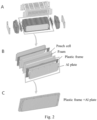
- picture A in Fig. 2 is an exploded view of the pouch cell module
- picture B in Fig. 2 is the core structure of the module including aluminum plate ⁇ plastic frame ⁇ pouch cell ⁇ foam ⁇ pouch cell ⁇ plastic frame ⁇ aluminum plate in order
- picture C in Fig. 2 is the aluminum plate and frame in picture B, which were prepared with the composite thermal insulation material.
- a battery module with 4 pouch cells 250 Wh/kg, 550 Wh/L was used as the test carrier.
- Cell 1, cell 2, cell 3 and cell 4 were arranged in parallel as shown in Fig. 3 .
- the composite thermal insulation sheet was inserted as a thermal insulation sheet between two cells. A total of 3 composite thermal insulation sheets were used in this module.
- the composite thermal insulation material of Example 2 with a thickness of 2 mm was used as a thermal insulation sheet.
- a battery module with 4 pouch cells 250 Wh/kg, 550 Wh/L was used as the test carrier.
- Cell 1, cell 2, cell 3 and cell 4 were arranged in parallel as shown in Fig. 3 .
- the composite thermal insulation sheet was inserted as a thermal insulation sheet between two cells. A total of 3 composite thermal insulation sheets were used in this module.
- the module component formed from the thermal insulation composition of the present disclosure when used in lithium-ion batteries, not only has both mechanical strength and functionality, but also can play the role of fire prevention and thermal insulation when thermal runaway occurs, blocking heat propagation and greatly improving the safety performance of the batteries.
Landscapes
- Chemical & Material Sciences (AREA)
- Organic Chemistry (AREA)
- Chemical Kinetics & Catalysis (AREA)
- Dispersion Chemistry (AREA)
- Engineering & Computer Science (AREA)
- Polymers & Plastics (AREA)
- Health & Medical Sciences (AREA)
- Medicinal Chemistry (AREA)
- Inorganic Chemistry (AREA)
- Electrochemistry (AREA)
- General Chemical & Material Sciences (AREA)
- Manufacturing & Machinery (AREA)
- Materials Engineering (AREA)
- Composite Materials (AREA)
- Ceramic Engineering (AREA)
- Compositions Of Macromolecular Compounds (AREA)
- Secondary Cells (AREA)
Claims (10)
- Composition d'isolation thermique, dans laquelle la composition d'isolation thermique comprend un composite d'un matériau d'aérogel et d'une résine organique, et le rapport massique de composite du matériau d'aérogel à la résine organique est de 5 % en poids:95 % en poids à 50 % en poids:50 % en poids ;la porosité du matériau d'aérogel est supérieure à 95 %, la taille de pore du matériau d'aérogel est inférieure ou égale à 100 nm, et la taille de particule de chaque particule du matériau d'aérogel est de 5 nm à 20 nm, ladite taille de particule étant mesurée selon un procédé divulgué dans la description ;les pores du matériau d'aérogel sont remplis de la résine organique ;caractérisée en ce quela résine organique est un quelconque ou deux parmi le carbonate de polypropylène et le carbonate de polypropylène modifié par un groupe fonctionnel.
- Composition d'isolation thermique selon la revendication 1, dans laquelle le matériau d'aérogel peut être obtenu par un procédé comprenant les étapes consistant à :préparer une solution de précurseur pour former le matériau d'aérogel ;transformer en sol la solution de précurseur par l'intermédiaire d'une réaction de polycondensation ;faire vieillir la solution de précurseur transformée en sol à une température de 45°C à 60°C pendant 8 à 24 heures ; et effectuer un séchage supercritique pour obtenir le matériau d'aérogel.
- Composition d'isolation thermique selon la revendication 2, dans laquelle le matériau d'aérogel peut être obtenu dès lors que le séchage supercritique est effectué à une température de 30°C à 60°C ;de préférence, le milieu pour le séchage supercritique est du dioxyde de carbone, du méthanol ou de l'éthanol ;de préférence, la durée du séchage supercritique est de 2 à 5 heures ;de préférence, le séchage supercritique est effectué sous une pression supérieure à 1,01 MPa.
- Composition d'isolation thermique selon la revendication 2, dans laquelle le solvant utilisé dans la solution de précurseur pour former le matériau d'aérogel est de l'eau, un mélange d'eau et d'éthanol, du carbonate de propylène, du carbonate d'éthylène, du carbonate de diéthyle, du carbonate de diméthyle ou du bis(trifluorométhanesulfonyl)imide de 1-éthyl-3-méthylimidazolium.
- Composition d'isolation thermique selon la revendication 1, dans laquelle la matière première du matériau d'aérogel comprend un précurseur ; le précurseur est un ou deux ou plus parmi la silice, l'oxyde de titane, l'oxyde de chrome, l'oxyde de fer, l'oxyde de vanadium, l'oxyde de néodyme, le carbone et des oxydes de carbone présentant une taille de particule inférieure à 500 nm, ladite taille de particule étant mesurée selon un procédé décrit dans la description ;de préférence, le précurseur comprend un ou deux ou plus parmi la silice, l'oxyde de titane et le carbone avec une taille de particule inférieure à 500 nm ;de manière plus préférée, le précurseur comprend de la silice avec une taille de particule inférieure à 500 nm.
- Composition d'isolation thermique selon la revendication 5, dans laquelle la matière première du matériau d'aérogel comprend en outre un additif, et le précurseur est ajouté en une quantité de 60 à 90 % en poids dans le matériau d'aérogel lorsque l'additif est compris ;
de préférence, l'additif est un ou deux ou plus parmi une fibre de verre et un opacifiant. - Composition d'isolation thermique selon la revendication 1, dans laquelle le groupe fonctionnel comprend un hydroxyle, un carboxyle, un halogène ou un oxyde de propylène.
- Procédé de préparation de la composition d'isolation thermique selon l'une quelconque des revendications 1 à 7, comprenant les étapes consistant à :chauffer la résine organique à la température de traitement à l'état fondu ou plus ;imprégner complètement le matériau d'aérogel dans la résine organique sous vide ;infiltrer complètement la résine organique dans le matériau d'aérogel sous 0,5 MPa à 2 MPa, maintenir la pression pendant 10 à 60 minutes, et récupérer l'excès de résine organique ;répéter de manière cyclique les opérations d'imprégnation, d'infiltration et de récupération afin que la résine organique soit complètement infiltrée dans le matériau d'aérogel ; etretirer un échantillon et le durcir à température normale pour obtenir la composition d'isolation thermique.
- Composant de module d'isolation thermique, dans lequel le composant de module d'isolation thermique est préparé à partir de la composition d'isolation thermique selon l'une quelconque des revendications 1 à 7.
- Batterie lithium-ion, dans laquelle la batterie lithium-ion comprend le composant de module d'isolation thermique selon la revendication 9.
Applications Claiming Priority (1)
| Application Number | Priority Date | Filing Date | Title |
|---|---|---|---|
| PCT/CN2019/098101 WO2021016780A1 (fr) | 2019-07-29 | 2019-07-29 | Composition d'isolation thermique et son procédé de préparation et son application |
Publications (4)
| Publication Number | Publication Date |
|---|---|
| EP4007006A1 EP4007006A1 (fr) | 2022-06-01 |
| EP4007006A4 EP4007006A4 (fr) | 2022-08-17 |
| EP4007006C0 EP4007006C0 (fr) | 2023-09-06 |
| EP4007006B1 true EP4007006B1 (fr) | 2023-09-06 |
Family
ID=74228263
Family Applications (1)
| Application Number | Title | Priority Date | Filing Date |
|---|---|---|---|
| EP19939144.2A Active EP4007006B1 (fr) | 2019-07-29 | 2019-07-29 | Composition d'isolation thermique et son procédé de préparation et son application |
Country Status (5)
| Country | Link |
|---|---|
| US (1) | US12325785B2 (fr) |
| EP (1) | EP4007006B1 (fr) |
| CN (1) | CN114096616B (fr) |
| ES (1) | ES2958966T3 (fr) |
| WO (1) | WO2021016780A1 (fr) |
Families Citing this family (5)
| Publication number | Priority date | Publication date | Assignee | Title |
|---|---|---|---|---|
| CN113045284A (zh) * | 2021-03-11 | 2021-06-29 | 山东茂盛管业有限公司 | 一种基于纳米气凝胶颗粒的隔热铺垫瓦块及其制备方法 |
| JP7750996B2 (ja) * | 2021-06-11 | 2025-10-07 | ダブリュ.エル.ゴア アンド アソシエイツ,インコーポレイティド | 高温断熱性複合材及びその物品 |
| MX2023011025A (es) * | 2021-07-02 | 2023-11-22 | Aspen Aerogels Inc | Materiales, sistemas y métodos para mitigar incidentes térmicos del almacenamiento de energía eléctrica. |
| EP4261187A1 (fr) * | 2022-04-14 | 2023-10-18 | Taiwan Aerogel Technology Material Co., Ltd. | Aérogel et son procédé de préparation |
| CN115449194B (zh) * | 2022-08-12 | 2023-08-04 | 湖北硅金凝节能减排科技有限公司 | 一种气凝胶电芯隔热片及其制备方法 |
Family Cites Families (14)
| Publication number | Priority date | Publication date | Assignee | Title |
|---|---|---|---|---|
| US5443746A (en) * | 1994-02-14 | 1995-08-22 | Hughes Aircraft Company | Ferroelectric aerogel composites for voltage-variable dielectric tuning, and method for making the same |
| US5731360A (en) * | 1996-03-05 | 1998-03-24 | Regents Of The University Of California | Compression molding of aerogel microspheres |
| US8871821B2 (en) * | 2008-12-04 | 2014-10-28 | Tyco Electronics Corporation | Graphene and graphene oxide aerogels |
| CN101880418B (zh) * | 2010-06-30 | 2012-08-22 | 华南理工大学 | 一种透明eva隔热材料及其制备方法 |
| US9725601B2 (en) * | 2011-04-04 | 2017-08-08 | Carnegie Mellon University | Carbon nanotube aerogels, composites including the same, and devices formed therefrom |
| KR101804345B1 (ko) * | 2013-07-04 | 2017-12-06 | 알이엠텍 주식회사 | 단열 조성물, 이의 제조방법 및 이를 이용한 단열 소재 |
| CN104029429A (zh) * | 2014-06-18 | 2014-09-10 | 航天海鹰(镇江)特种材料有限公司 | 一种以热熔胶为粘结剂的气凝胶复合布料及其制备方法 |
| KR102023531B1 (ko) * | 2015-04-07 | 2019-09-24 | 주식회사 엘지화학 | 에어로겔 함유 조성물 및 이를 이용하여 제조된 단열 블랑켓 |
| CN106422995B (zh) * | 2015-08-11 | 2019-07-02 | 中国科学院化学研究所 | 一种石墨烯气凝胶和其杂化复合材料及其制备方法与应用 |
| KR101854673B1 (ko) * | 2015-10-01 | 2018-05-04 | 한국과학기술연구원 | 휘발성 용매를 이용한 에어로겔 기공 보존 방법을 적용한 에어로겔 단열 복합 재료 및 그 제조 방법 |
| KR102171649B1 (ko) * | 2015-12-15 | 2020-10-29 | 애플 인크. | 미세다공성 절연체 |
| WO2017116598A1 (fr) * | 2015-12-30 | 2017-07-06 | The Regents Of The University Of Michigan | Gels et nanocomposites contenant des nanofibres d'aramide |
| CN107099117A (zh) * | 2016-02-20 | 2017-08-29 | 金承黎 | 一种纤维增强气凝胶-聚合物复合材料及其制备方法 |
| CN107286491B (zh) * | 2017-06-16 | 2020-02-07 | 青岛大学 | 一种高导电性碳纳米管/石墨烯气凝胶/聚苯乙烯复合材料及其制备方法 |
-
2019
- 2019-07-29 CN CN201980098360.0A patent/CN114096616B/zh active Active
- 2019-07-29 EP EP19939144.2A patent/EP4007006B1/fr active Active
- 2019-07-29 WO PCT/CN2019/098101 patent/WO2021016780A1/fr not_active Ceased
- 2019-07-29 ES ES19939144T patent/ES2958966T3/es active Active
-
2022
- 2022-01-31 US US17/589,733 patent/US12325785B2/en active Active
Also Published As
| Publication number | Publication date |
|---|---|
| EP4007006A4 (fr) | 2022-08-17 |
| WO2021016780A1 (fr) | 2021-02-04 |
| EP4007006C0 (fr) | 2023-09-06 |
| CN114096616B (zh) | 2024-03-08 |
| US12325785B2 (en) | 2025-06-10 |
| US20220153958A1 (en) | 2022-05-19 |
| ES2958966T3 (es) | 2024-02-16 |
| CN114096616A (zh) | 2022-02-25 |
| EP4007006A1 (fr) | 2022-06-01 |
Similar Documents
| Publication | Publication Date | Title |
|---|---|---|
| US12325785B2 (en) | Thermal insulation composition and preparation method and application | |
| EP3942215B1 (fr) | Matériaux composites de barrière thermique | |
| CN103746098B (zh) | 一种富氮多模蜂窝碳-硫复合正极材料的制备方法 | |
| CN105470515B (zh) | 一种安全型锂离子动力电池正极及含有该正极的锂离子电池 | |
| WO2021189836A1 (fr) | Materiau d'électrode négative de graphite pour batterie au lithium-ion à haute performance et sa méthode de préparation | |
| CN112635731B (zh) | 一种基于导电碳气凝胶复合纳米硅负极材料的制备方法及其产品 | |
| CN112072168B (zh) | 一种半固态锂电池电解质及制备方法 | |
| CN104900848A (zh) | 长寿命锂硫电池正极及锂硫电池的制备方法 | |
| CN117438577A (zh) | 废旧硅碳负极材料脱硅再生制备的石墨负极活性材料及其制备方法和应用 | |
| CN111613796B (zh) | 负应变材料包覆硅碳的负极材料及其制备方法、锂离子电池 | |
| CN106783209A (zh) | 一种葡萄糖基多孔碳超级电容器电极材料的制备方法和应用 | |
| CN103311524A (zh) | 一种碳硅包覆LiAlO2复合负极材料的制备方法 | |
| CN115706230B (zh) | 一种复合石墨负极材料、负极片和锂离子电池 | |
| CN121617931A (zh) | 负极材料、负极极片及二次电池 | |
| CN106784764A (zh) | 以含氮碳担载纳米硼锂合金为阳极材料的锂氧电池 | |
| CN113611864A (zh) | 炭气凝胶包覆氧化亚硅中空微球负极材料 | |
| CN120534954A (zh) | 一种石墨化分级多孔碳骨架及其制备方法与应用 | |
| WO2025134161A1 (fr) | Composite carbone dur-graphite haute capacité en tant que matériau d'anode pour batteries secondaires | |
| KR102697267B1 (ko) | 리튬-황 배터리용 양극재 제조방법 및 이에 의하여 제조되는 리튬-황 배터리용 양극재 | |
| KR100817009B1 (ko) | 리튬 이차전지용 음극 활물질 | |
| CN112490586B (zh) | 具有防止热失控功能的复合隔膜和锂离子电池 | |
| CN118538904A (zh) | 磷酸焦磷酸铁钠复合正极材料及其制备方法与应用 | |
| CN116969438A (zh) | 复合树脂基硬碳材料、钠离子电池及其制备方法 | |
| CN113964297A (zh) | 一种锂离子电池多孔硅负极材料及其制备方法与应用 | |
| CN109659468A (zh) | 一种具有热断功能的复合隔膜及其制备和应用 |
Legal Events
| Date | Code | Title | Description |
|---|---|---|---|
| STAA | Information on the status of an ep patent application or granted ep patent |
Free format text: STATUS: THE INTERNATIONAL PUBLICATION HAS BEEN MADE |
|
| PUAI | Public reference made under article 153(3) epc to a published international application that has entered the european phase |
Free format text: ORIGINAL CODE: 0009012 |
|
| STAA | Information on the status of an ep patent application or granted ep patent |
Free format text: STATUS: REQUEST FOR EXAMINATION WAS MADE |
|
| 17P | Request for examination filed |
Effective date: 20220214 |
|
| AK | Designated contracting states |
Kind code of ref document: A1 Designated state(s): AL AT BE BG CH CY CZ DE DK EE ES FI FR GB GR HR HU IE IS IT LI LT LU LV MC MK MT NL NO PL PT RO RS SE SI SK SM TR |
|
| REG | Reference to a national code |
Ref country code: DE Ref legal event code: R079 Free format text: PREVIOUS MAIN CLASS: H99Z9999999999 Ipc: C08K0007260000 Ref country code: DE Ref legal event code: R079 Ref document number: 602019037172 Country of ref document: DE Free format text: PREVIOUS MAIN CLASS: H99Z9999999999 Ipc: C08K0007260000 |
|
| A4 | Supplementary search report drawn up and despatched |
Effective date: 20220714 |
|
| RIC1 | Information provided on ipc code assigned before grant |
Ipc: H01M 10/658 20140101ALI20220711BHEP Ipc: C08K 7/26 20060101AFI20220711BHEP |
|
| DAV | Request for validation of the european patent (deleted) | ||
| DAX | Request for extension of the european patent (deleted) | ||
| GRAP | Despatch of communication of intention to grant a patent |
Free format text: ORIGINAL CODE: EPIDOSNIGR1 |
|
| STAA | Information on the status of an ep patent application or granted ep patent |
Free format text: STATUS: GRANT OF PATENT IS INTENDED |
|
| INTG | Intention to grant announced |
Effective date: 20230517 |
|
| GRAS | Grant fee paid |
Free format text: ORIGINAL CODE: EPIDOSNIGR3 |
|
| GRAA | (expected) grant |
Free format text: ORIGINAL CODE: 0009210 |
|
| STAA | Information on the status of an ep patent application or granted ep patent |
Free format text: STATUS: THE PATENT HAS BEEN GRANTED |
|
| AK | Designated contracting states |
Kind code of ref document: B1 Designated state(s): AL AT BE BG CH CY CZ DE DK EE ES FI FR GB GR HR HU IE IS IT LI LT LU LV MC MK MT NL NO PL PT RO RS SE SI SK SM TR |
|
| REG | Reference to a national code |
Ref country code: GB Ref legal event code: FG4D |
|
| REG | Reference to a national code |
Ref country code: CH Ref legal event code: EP |
|
| REG | Reference to a national code |
Ref country code: IE Ref legal event code: FG4D |
|
| REG | Reference to a national code |
Ref country code: DE Ref legal event code: R096 Ref document number: 602019037172 Country of ref document: DE |
|
| U01 | Request for unitary effect filed |
Effective date: 20231003 |
|
| U07 | Unitary effect registered |
Designated state(s): AT BE BG DE DK EE FI FR IT LT LU LV MT NL PT SE SI Effective date: 20231013 |
|
| REG | Reference to a national code |
Ref country code: NO Ref legal event code: T2 Effective date: 20230906 |
|
| PG25 | Lapsed in a contracting state [announced via postgrant information from national office to epo] |
Ref country code: GR Free format text: LAPSE BECAUSE OF FAILURE TO SUBMIT A TRANSLATION OF THE DESCRIPTION OR TO PAY THE FEE WITHIN THE PRESCRIBED TIME-LIMIT Effective date: 20231207 |
|
| PG25 | Lapsed in a contracting state [announced via postgrant information from national office to epo] |
Ref country code: RS Free format text: LAPSE BECAUSE OF FAILURE TO SUBMIT A TRANSLATION OF THE DESCRIPTION OR TO PAY THE FEE WITHIN THE PRESCRIBED TIME-LIMIT Effective date: 20230906 Ref country code: HR Free format text: LAPSE BECAUSE OF FAILURE TO SUBMIT A TRANSLATION OF THE DESCRIPTION OR TO PAY THE FEE WITHIN THE PRESCRIBED TIME-LIMIT Effective date: 20230906 Ref country code: GR Free format text: LAPSE BECAUSE OF FAILURE TO SUBMIT A TRANSLATION OF THE DESCRIPTION OR TO PAY THE FEE WITHIN THE PRESCRIBED TIME-LIMIT Effective date: 20231207 |
|
| REG | Reference to a national code |
Ref country code: ES Ref legal event code: FG2A Ref document number: 2958966 Country of ref document: ES Kind code of ref document: T3 Effective date: 20240216 |
|
| PG25 | Lapsed in a contracting state [announced via postgrant information from national office to epo] |
Ref country code: IS Free format text: LAPSE BECAUSE OF FAILURE TO SUBMIT A TRANSLATION OF THE DESCRIPTION OR TO PAY THE FEE WITHIN THE PRESCRIBED TIME-LIMIT Effective date: 20240106 |
|
| PG25 | Lapsed in a contracting state [announced via postgrant information from national office to epo] |
Ref country code: SM Free format text: LAPSE BECAUSE OF FAILURE TO SUBMIT A TRANSLATION OF THE DESCRIPTION OR TO PAY THE FEE WITHIN THE PRESCRIBED TIME-LIMIT Effective date: 20230906 Ref country code: RO Free format text: LAPSE BECAUSE OF FAILURE TO SUBMIT A TRANSLATION OF THE DESCRIPTION OR TO PAY THE FEE WITHIN THE PRESCRIBED TIME-LIMIT Effective date: 20230906 Ref country code: IS Free format text: LAPSE BECAUSE OF FAILURE TO SUBMIT A TRANSLATION OF THE DESCRIPTION OR TO PAY THE FEE WITHIN THE PRESCRIBED TIME-LIMIT Effective date: 20240106 Ref country code: SK Free format text: LAPSE BECAUSE OF FAILURE TO SUBMIT A TRANSLATION OF THE DESCRIPTION OR TO PAY THE FEE WITHIN THE PRESCRIBED TIME-LIMIT Effective date: 20230906 |
|
| PG25 | Lapsed in a contracting state [announced via postgrant information from national office to epo] |
Ref country code: PL Free format text: LAPSE BECAUSE OF FAILURE TO SUBMIT A TRANSLATION OF THE DESCRIPTION OR TO PAY THE FEE WITHIN THE PRESCRIBED TIME-LIMIT Effective date: 20230906 |
|
| REG | Reference to a national code |
Ref country code: DE Ref legal event code: R097 Ref document number: 602019037172 Country of ref document: DE |
|
| PLBE | No opposition filed within time limit |
Free format text: ORIGINAL CODE: 0009261 |
|
| STAA | Information on the status of an ep patent application or granted ep patent |
Free format text: STATUS: NO OPPOSITION FILED WITHIN TIME LIMIT |
|
| 26N | No opposition filed |
Effective date: 20240607 |
|
| U20 | Renewal fee for the european patent with unitary effect paid |
Year of fee payment: 6 Effective date: 20240705 |
|
| PG25 | Lapsed in a contracting state [announced via postgrant information from national office to epo] |
Ref country code: MC Free format text: LAPSE BECAUSE OF FAILURE TO SUBMIT A TRANSLATION OF THE DESCRIPTION OR TO PAY THE FEE WITHIN THE PRESCRIBED TIME-LIMIT Effective date: 20230906 |
|
| REG | Reference to a national code |
Ref country code: CH Ref legal event code: PL |
|
| PG25 | Lapsed in a contracting state [announced via postgrant information from national office to epo] |
Ref country code: CH Free format text: LAPSE BECAUSE OF NON-PAYMENT OF DUE FEES Effective date: 20240731 |
|
| PG25 | Lapsed in a contracting state [announced via postgrant information from national office to epo] |
Ref country code: IE Free format text: LAPSE BECAUSE OF NON-PAYMENT OF DUE FEES Effective date: 20240729 |
|
| U20 | Renewal fee for the european patent with unitary effect paid |
Year of fee payment: 7 Effective date: 20250621 |
|
| PGFP | Annual fee paid to national office [announced via postgrant information from national office to epo] |
Ref country code: ES Payment date: 20250804 Year of fee payment: 7 |
|
| PGFP | Annual fee paid to national office [announced via postgrant information from national office to epo] |
Ref country code: NO Payment date: 20250709 Year of fee payment: 7 |
|
| PGFP | Annual fee paid to national office [announced via postgrant information from national office to epo] |
Ref country code: CZ Payment date: 20250718 Year of fee payment: 7 |
|
| PG25 | Lapsed in a contracting state [announced via postgrant information from national office to epo] |
Ref country code: CY Free format text: LAPSE BECAUSE OF FAILURE TO SUBMIT A TRANSLATION OF THE DESCRIPTION OR TO PAY THE FEE WITHIN THE PRESCRIBED TIME-LIMIT; INVALID AB INITIO Effective date: 20190729 |
|
| PG25 | Lapsed in a contracting state [announced via postgrant information from national office to epo] |
Ref country code: HU Free format text: LAPSE BECAUSE OF FAILURE TO SUBMIT A TRANSLATION OF THE DESCRIPTION OR TO PAY THE FEE WITHIN THE PRESCRIBED TIME-LIMIT; INVALID AB INITIO Effective date: 20190729 |
|
| PG25 | Lapsed in a contracting state [announced via postgrant information from national office to epo] |
Ref country code: TR Free format text: LAPSE BECAUSE OF FAILURE TO SUBMIT A TRANSLATION OF THE DESCRIPTION OR TO PAY THE FEE WITHIN THE PRESCRIBED TIME-LIMIT Effective date: 20230906 |
|
| PGFP | Annual fee paid to national office [announced via postgrant information from national office to epo] |
Ref country code: GB Payment date: 20260608 Year of fee payment: 8 |
|
| U20 | Renewal fee for the european patent with unitary effect paid |
Year of fee payment: 8 Effective date: 20260608 |