EP4007189A1 - Urls zur erfassung oder übertragung von daten - Google Patents
Urls zur erfassung oder übertragung von daten Download PDFInfo
- Publication number
- EP4007189A1 EP4007189A1 EP21200617.5A EP21200617A EP4007189A1 EP 4007189 A1 EP4007189 A1 EP 4007189A1 EP 21200617 A EP21200617 A EP 21200617A EP 4007189 A1 EP4007189 A1 EP 4007189A1
- Authority
- EP
- European Patent Office
- Prior art keywords
- uri
- url
- domain name
- server
- reception apparatus
- Prior art date
- Legal status (The legal status is an assumption and is not a legal conclusion. Google has not performed a legal analysis and makes no representation as to the accuracy of the status listed.)
- Pending
Links
Images





Classifications
-
- H—ELECTRICITY
- H04—ELECTRIC COMMUNICATION TECHNIQUE
- H04H—BROADCAST COMMUNICATION
- H04H20/00—Arrangements for broadcast or for distribution combined with broadcast
- H04H20/86—Arrangements characterised by the broadcast information itself
- H04H20/93—Arrangements characterised by the broadcast information itself which locates resources of other pieces of information, e.g. URL [Uniform Resource Locator]
-
- H—ELECTRICITY
- H04—ELECTRIC COMMUNICATION TECHNIQUE
- H04L—TRANSMISSION OF DIGITAL INFORMATION, e.g. TELEGRAPHIC COMMUNICATION
- H04L67/00—Network arrangements or protocols for supporting network services or applications
- H04L67/14—Session management
- H04L67/146—Markers for unambiguous identification of a particular session, e.g. session cookie or URL-encoding
-
- H—ELECTRICITY
- H04—ELECTRIC COMMUNICATION TECHNIQUE
- H04L—TRANSMISSION OF DIGITAL INFORMATION, e.g. TELEGRAPHIC COMMUNICATION
- H04L61/00—Network arrangements, protocols or services for addressing or naming
- H04L61/45—Network directories; Name-to-address mapping
- H04L61/4505—Network directories; Name-to-address mapping using standardised directories; using standardised directory access protocols
- H04L61/4511—Network directories; Name-to-address mapping using standardised directories; using standardised directory access protocols using domain name system [DNS]
-
- H—ELECTRICITY
- H04—ELECTRIC COMMUNICATION TECHNIQUE
- H04L—TRANSMISSION OF DIGITAL INFORMATION, e.g. TELEGRAPHIC COMMUNICATION
- H04L65/00—Network arrangements, protocols or services for supporting real-time applications in data packet communication
- H04L65/40—Support for services or applications
- H04L65/402—Support for services or applications wherein the services involve a main real-time session and one or more additional parallel non-real time sessions, e.g. downloading a file in a parallel FTP session, initiating an email or combinational services
- H04L65/4025—Support for services or applications wherein the services involve a main real-time session and one or more additional parallel non-real time sessions, e.g. downloading a file in a parallel FTP session, initiating an email or combinational services where none of the additional parallel sessions is real time or time sensitive, e.g. downloading a file in a parallel FTP session, initiating an email or combinational services
-
- H—ELECTRICITY
- H04—ELECTRIC COMMUNICATION TECHNIQUE
- H04L—TRANSMISSION OF DIGITAL INFORMATION, e.g. TELEGRAPHIC COMMUNICATION
- H04L67/00—Network arrangements or protocols for supporting network services or applications
- H04L67/01—Protocols
- H04L67/10—Protocols in which an application is distributed across nodes in the network
- H04L67/1095—Replication or mirroring of data, e.g. scheduling or transport for data synchronisation between network nodes
-
- H—ELECTRICITY
- H04—ELECTRIC COMMUNICATION TECHNIQUE
- H04L—TRANSMISSION OF DIGITAL INFORMATION, e.g. TELEGRAPHIC COMMUNICATION
- H04L67/00—Network arrangements or protocols for supporting network services or applications
- H04L67/34—Network arrangements or protocols for supporting network services or applications involving the movement of software or configuration parameters
-
- H—ELECTRICITY
- H04—ELECTRIC COMMUNICATION TECHNIQUE
- H04L—TRANSMISSION OF DIGITAL INFORMATION, e.g. TELEGRAPHIC COMMUNICATION
- H04L2101/00—Indexing scheme associated with group H04L61/00
- H04L2101/30—Types of network names
- H04L2101/33—Types of network names containing protocol addresses or telephone numbers
-
- H—ELECTRICITY
- H04—ELECTRIC COMMUNICATION TECHNIQUE
- H04L—TRANSMISSION OF DIGITAL INFORMATION, e.g. TELEGRAPHIC COMMUNICATION
- H04L2101/00—Indexing scheme associated with group H04L61/00
- H04L2101/30—Types of network names
- H04L2101/385—Uniform resource identifier for session initiation protocol [SIP URI]
Definitions
- Embodiments described herein relate generally to URLs (Uniform Resource Locators) that are used to acquire or transmit data.
- URLs Uniform Resource Locators
- Modern televisions are capable of accessing and presenting content from various sources (e.g., broadcast and Internet sources).
- sources e.g., broadcast and Internet sources.
- accessing content over the Internet based on URLs delivered, for example, in the broadcast signal increases the risk of malicious or otherwise unauthorized content being accessed by the television.
- a method of a reception apparatus for communicating with a server to download or upload data includes receiving a URI (Uniform Resource Identifier) message that includes a DNS (Domain Name System) name registered with the IANA (Internet Assigned Numbers Authority).
- a URL Uniform Resource Locator
- the data is downloaded from, or uploaded to, the server using the generated URL.
- the predetermined domain name includes a top-level domain name and a second-level domain name of the URL
- a non-transitory computer-readable medium storing instructions which when executed by a computer causes the computer to perform the method for communication with the server to download or upload data, as described above.
- a reception apparatus including circuitry configured to receive a URI message that includes a DNS name registered with the IANA.
- the circuitry generates a URL based on the registered DNS name in the received URI message and a predetermined domain name. Further, the circuitry downloads the data from, or uploads the data to, the server using the generated URL
- the predetermined domain name includes a top-level domain name and a second-level domain name of the URL
- the terms “a” or “an”, as used herein, are defined as one or more than one.
- the term “plurality”, as used herein, is defined as two or more than two.
- the term “another”, as used herein, is defined as at least a second or more.
- the terms “including” and/or “having”, as used herein, are defined as comprising (i.e., open language).
- the term “coupled”, as used herein, is defined as connected, although not necessarily directly, and not necessarily mechanically.
- program or “computer program” or similar terms, as used herein, is defined as a sequence of instructions designed for execution on a computer system.
- a "program”, or “computer program” may include a subroutine, a program module, a script, a function, a procedure, an object method, an object implementation, in an executable application, an applet, a servlet, a source code, an object code, a shared library/dynamic load library and/or other sequence of instructions designed for execution on a computer system.
- program may also be used in a second context (the above definition being for the first context).
- the term is used in the sense of a "television program”.
- the term is used to mean any coherent sequence of audio/video content such as those which would be interpreted as and reported in an (EPG) electronic program guide or (ESG) electronic service guide as a single television program, without regard for whether the content is a movie, sporting event, segment of a multi-part series, news broadcast, etc.
- EPG electronic program guide
- ESG electronic service guide
- the term may also be interpreted to encompass commercial spots and other program-like content which may not be reported as a program in an EPG or ESG.
- Embodiments of the present disclosure are directed to downloading (or otherwise acquiring) data from, or uploading (or otherwise transmitting) the data to, a server based on a URL.
- the URL is defined in or determined based on URL information received by a reception apparatus (e.g., a television).
- the URL information is delivered with content (e.g., broadcast television content) that is processed for display to a user.
- the URL information may be delivered in audio or video watermarks embedded in the content itself, closed captioning, or other portions of a broadcast emission.
- URL information may also be provided in information downloaded from a server or received from other external sources in certain embodiments.
- the URL in certain embodiments, references an object, file, or any other data to be downloaded from a broadband server or references a server to which data (e.g., user information) is to be uploaded.
- an unauthorized party is able to tamper with the URL information that is used by the reception apparatus to download or upload data.
- an unauthorized party could tamper with an audio or video watermark, or the content (e.g., by inserting a new unauthorized watermark), before it arrives at the reception apparatus by placing a box between a set-top box and the reception apparatus to intercept and alter an HDMI (High-Definition Multimedia Interface) signal.
- Such tampering could result in the reception apparatus accessing content (e.g., malicious executable code) that was not authorized by a broadcaster of the content, or reporting data (e.g., user information) to an unauthorized party.
- Unauthorized parties in some scenarios, can tamper with a broadcast signal and redistribute it to a number of reception devices in a local area. Such tampering can include alteration of watermarks carrying URL information.
- the reception apparatus to reduce the risk of the reception apparatus using a URL that has been tampered with and communicating with an unauthorized server, the reception apparatus generates the URL based in part on URL information that is received from an external source. For example, the URL is also generated based on predetermined URL information such as a predetermined domain name, which directs the reception apparatus to a trusted domain name or server. This limits an unauthorized party's ability to tamper with a URL to direct the reception apparatus to an unauthorized server.
- the URL should contain unique identification information.
- the identified information is globally unique to allow reception apparatuses to operate worldwide.
- the globally unique identification information may be included in the URL information delivered with the content.
- the URL information includes other globally unique and/or registered values such as an IPv4 (Internet Protocol version 4) address, an IPv6 (Internet Protocol version 6) address, a CA (Certificate Authority) certificate serial number, or unique characteristics of the content (such as a fingerprint).
- IPv4 Internet Protocol version 4
- IPv6 Internet Protocol version 6
- CA Certificate Authority
- FIG. 1 is a block diagram that shows an exemplary content distribution system 2.
- the content distribution system 2 includes a service provider 10, a reception apparatus 20, and one or more servers 40.
- the reception apparatus 20 accesses the one or more servers 40 via one or more communication networks such as the Internet 30.
- the service provider 10 which may be a broadcaster entity, station, or other content provider, provides content and/or other services to the reception apparatus 20 via a terrestrial broadcast according to one embodiment.
- the service provider 10 provides the content and/or other services via at least one of a satellite broadcast, a cable television transmission, the terrestrial television broadcast, cellular network, and data communication network such as a local area network (LAN), wide area network (WAN), or the Internet 30.
- the content provided by the service provider 10 includes one or more television programs, without regard to whether the content is a movie, sporting event, segment of a multi-part series, news broadcast, etc. Further, the content provided by the service provider 10 may also include advertisements, infomercials, and other program-like content which may not be reported as a program in an EPG or ESG.
- the service provider 10 may also provide content that contains only audio or only video.
- the content, service, or broadcast stream is associated with URL information in certain embodiments, and may be provided in an audio or video watermark in certain embodiments.
- the URL information may be embedded in an audio signal, as specified in ATSC Candidate Standard: Audio Watermark Emission (A/334 - Doc. S33-160r1, 27 November 2015), or embedded in transmitted pixels of a video signal, as specified in ATSC Candidate Standard: Video Watermark Emission (A/335 - Doc. S33-156r1, 30 November 2015).
- ATSC A/334 and A/335 are incorporated herein by reference in their entirety.
- the service provider 10 includes a transmission apparatus with a transmitter that is configured to transmit one or more services (e.g., including content) to the reception apparatus 20.
- the transmitter may include a source encoder, a channel encoder, and a modulator.
- the source encoder may include data, audio, and video encoders to compress the audio, video, signaling, control or other data received from a source.
- the channel encoder may randomize, interlace, channel code, and frame map the compressed and signaling data.
- the channel encoder may include a frame builder that forms many data cells into sequences to be conveyed on OFDM (Orthogonal frequency-division multiplexing) symbols.
- OFDM Orthogonal frequency-division multiplexing
- the modulator converts the processed digital data into modulation symbols, which can be, for example OFDM symbols (e.g., in the case of the proposed ATSC 3.0 standard).
- the multiplexed data is then passed to an inverse fast Fourier transformer (IFFT) which transforms a frequency domain signal into a time domain signal.
- IFFT inverse fast Fourier transformer
- the time domain signal is fed to a guard insertion module for generating a guard interval (GI) between symbols and then to a digital to analog (D/A) converter.
- antenna 104 may perform up-conversion, RF amplification and over-the air broadcasting.
- some of the components of the transmission apparatus or the reception apparatus 20 may not be necessary.
- the antennas are not required when the transmission system is not over-the-air but over cable.
- Details of an exemplary OFDM transmitter and receiver may be found, for example, in the DVB-T2 standard (ETSI EN 302 755), ATSC Proposed Standard: Physical Layer Protocol (A/322 - Doc. S32-230r56, 29 June 2016), and ATSC Standard: A/321, System Discovery and Signaling (Doc. A/321:2016, 23 March 2016), which are incorporated herein by reference in their entirety.
- the reception apparatus 20 may be a television set, mobile handset, personal video recorder, set-top box, or other device configured to receive the content (other service) from the service provider 10.
- each reception apparatus 20 includes an antenna to receive the content.
- the reception apparatus 20 includes reception circuitry, as illustrated for example in FIG. 2A .
- the reception apparatus 20 may also be included in a vehicle or a computer.
- the reception apparatus 20 processes the content provided by the service provider 10 and displays the content on a display (e.g., a liquid crystal or organic light-emitting diode display), for example the display 350 illustrated in FIG. 2B .
- the display 350 may be an integral part of the reception apparatus 20 such as a television set. Alternatively, the display 350 may be external to the reception apparatus 20 such as a television set connected to a set top box.
- the reception apparatus 20 generates a URL based on the URL information to communicate with one or more servers 40 to download or upload data. For example, the reception apparatus 20 uses the generated URL to access a signaling server, which provides signaling metadata (e.g., MPDs (Media Presentation Descriptions), AEIs (Application Event Information) for requested service(s)) needed to access and present supplementary content). Desired signaling metadata objects may be indicated by appended path terms in the generated URL. Examples of metadata object types include those specified in ATSC Candidate Standard: Signaling, Delivery, Synchronization, and Error Protection (A/331 - Doc. S33-174r3, 21 June 2016), which is incorporated herein by reference in its entirety.
- signaling metadata e.g., MPDs (Media Presentation Descriptions), AEIs (Application Event Information) for requested service(s)
- Desired signaling metadata objects may be indicated by appended path terms in the generated URL. Examples of metadata object types include those specified in ATSC Candidate Standard: Signaling, Delivery
- the MPD corresponds to a linear service of a given duration defined by the service provider 10 (e.g., a single television program, or the set of contiguous linear television programs over a period of time).
- the contents of the MPD provide the resource identifiers for segments and the context for the identified resources within a MP (media presentation).
- the one or more servers 40 provide the data to be downloaded by the reception apparatus 20 or receive the data to be uploaded by the reception apparatus 20.
- the one or more servers 40 may include a signaling server, an electronic service guide server, a service usage data gathering report server, an emergency information server, an application server, an application manifest server, or other data servers.
- the signaling server may be a Service Layer Signaling server, as specified in A/331.
- the Service Layer Signaling server provides access to the Service Layer Signaling, as defined in Section 7 of A/331.
- the electronic service guide server may provide access to service guide data, as specified in ATSC Candidate Standard: Service Announcement (A/332 - Doc. S33-159r1, 24 November 2015), which is incorporated herein by reference in its entirety.
- the service usage data gathering report server may be operated by (or on behalf of) service providers, either individually or in groups, and as specified in ATSC Candidate Standard: Service Usage Reporting (A/333 - Doc. S33-170r3, 16 May 2016), which is incorporated herein by reference in its entirety.
- the reception apparatus 20 reports service usage data to the service usage data server when a URL to be used for transmitting the service usage data, or URL information that can be used to generate the URL, is provided to the reception apparatus 20.
- the application server may store one or more applications to support app-based enhancements to a linear service (e.g., television program).
- the application is an HTML5 app that can be executed by a browser in the reception apparatus 20.
- the app-based enhancement may be an app that runs in the background and manages the insertion of targeted ads or a collection of apps that provide an interactive viewing experience to enhance the audio/video program.
- the application is executed in synchronization with the display of the content.
- the emergency information server may store emergency alert information (e.g., a message based on CAP (Common Alerting Protocol) message).
- CAP Common Alerting Protocol
- the OASIS CAP standard Common Alerting Protocol Version 1.2, 1 July 2010
- the application manifest server may store a manifest file that identifies application packages (e.g., an HTML5 app and images).
- the service usage data may identify one or a combination of a reporting interval during which a service is accessed, a service identifier, the time the service access started, and the time the service access ended. Further, if any applications were active during the report interval, the service usage data also records when the applications are active (whether on a primary device or a "second screen", companion device), including the application identifier, the time the application started being active, and the time it stopped being active.
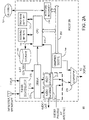
- FIG. 2A illustrates an embodiment of the reception apparatus 20.
- the reception apparatus 20 may be implemented in or connected to a fixed device such as a television set or desktop computer, or a mobile device such as a device on a vehicle, a portable computer, smart phone, tablet, etc.
- the reception apparatus 20 is a digital television receiver device that may be incorporated into a television set or a set top box connected to the television set.
- the reception apparatus 20 includes a tuner/demodulator 202, which receives content from one or more service providers via a terrestrial broadcast or a cable television transmission.
- the reception apparatus 20 may also, or alternatively, receive content from a satellite broadcast.
- the tuner/demodulator 202 receives a packet stream (PS) such as a transport stream (TS) or IP packet stream, which is demultiplexed by the demultiplexer 206 into audio and video (A/V) streams.
- PS packet stream
- TS transport stream
- A/V audio and video
- Exemplary IP packet streams are described in the ATSC Mobile DTV standard ATSC-M/H (A/153), the Enhanced Multicast Multimedia Broadcast (eMBMS) standard 3GPP: TS 26.346 V12.4.0 (2014-12), "3rd Generation Partnership Project; Technical Specification Group Services and System Aspects; Multimedia Broadcast/Multicast Service (MBMS); Protocols and codecs (Release 12), ATSC Proposed Standard: A/322, and ATSC Candidate Standard: Link-Layer Protocol (A/330 - Doc. S33-169r5, 5 July 2016), which are incorporated herein by reference in their entirety.
- the audio is decoded by an audio decoder 210 and the video is decoded by a video decoder 214.
- uncompressed A/V data may be received via an uncompressed A/V interface (e.g., a HDMI interface) that can be selectively utilized.
- the uncompressed A/V data may be received from a set-top box, digital video recorder, DVD player, or any other consumer electronics device connected to the reception apparatus 20 via the uncompressed A/V interface.
- the uncompressed A/V data contains audio/video watermarks embedded therein.
- the watermarks are used to provide URL information to allow the reception apparatus 20 to communicate with a server to download or upload data.
- the IP packet stream may include the URL information separately, caption data, alternate content (e.g., alternate advertisements), one or more MPDs, broadcast and/or other applications, metadata, etc.
- One or more of the content, the URL information, the caption data, the alternate content, the one or more MPDs, the broadcast and/or other applications, metadata, etc. may also be receivable via the Internet 30 and a network interface 226.
- the caption data, or other metadata, in addition to the URL information is embedded or otherwise inserted in an audio and/or video portion of the content.
- a CPU Central Processing Unit
- a CPU Central Processing Unit 238 extracts the embedded information from the audio and/or video portions of the content and performs one or more processes (e.g., generation of a URL) based on the extracted information.
- a storage unit 230 such as a hard disc drive or solid state memory, is provided to store the alternate content or other recorded content.
- the alternate or stored content can be played by demultiplexing the content stored in the storage unit 230 by the demultiplexer 206 in a manner similar to that of other sources of content.
- the storage unit 230 may also store downloaded applications (e.g., downloaded from the Internet) in certain embodiments.
- the reception apparatus 20 generally operates under control of at least one processor, such as the CPU 238, which is coupled to a working memory 240, program memory 242, and a graphics subsystem 244 via one or more buses (e.g., bus 250).
- the CPU 238 receives closed caption data from the demultiplexer 206 as well as any other information such as EPGs or ESGs used for rendering graphics, and passes the information to the graphics subsystem 244. Graphics outputted by the graphics subsystem 244 are combined with video images by the compositor and video interface 260 to produce an output suitable for display on a video display.
- the CPU 238 operates to carry out functions of the reception apparatus 20 including, for example, one or a combination of generation of the URL to download or upload data, controlling the download or upload of the data, execution of a downloaded application, other processing related to the downloaded data such as processing of an MPD to present a media presentation, etc.
- the CPU 238 may be coupled to any one or a combination of the reception apparatus 20 resources to centralize control of one or more functions. In one embodiment, the CPU 238 also operates to oversee control of the reception apparatus 20 including the tuner/demodulator 202 and other television resources.
- FIG. 2B A more processor-centric view of the reception apparatus 20 is illustrated in FIG. 2B .
- Memory and storage 230, 240, and 242 are depicted collectively as memory 310.
- a processor 300 includes one or more processing units such as CPU 238.
- the various demodulators, decoders, etc., that initially process digital television signals are collectively depicted as television receiver/tuner 320.
- the reception apparatus 20 further includes a remote controller 360 which communicates with a remote controller receiver interface 340.
- the display 350 is connected to a display interface 330, which includes for example the uncompressed A/V interface and/or compositor 260, and is either a display integral to the reception apparatus 20 as in a television set or a connected display device as in the case where the reception apparatus 20 is integrated into a set-top box.
- a display interface 330 which includes for example the uncompressed A/V interface and/or compositor 260, and is either a display integral to the reception apparatus 20 as in a television set or a connected display device as in the case where the reception apparatus 20 is integrated into a set-top box.
- Memory 310 contains various functional program modules and data.
- the memory 310 stores the data used by the reception apparatus 20.
- the memory 310 within the reception apparatus 20 can be implemented using disc storage form as well as other forms of storage such as non-transitory storage devices including for example network memory devices, magnetic storage elements, magneto-optical storage elements, flash memory, core memory and/or other non-volatile storage technologies.
- non-transitory is a limitation of the medium itself (i.e., tangible, not a signal) as opposed to a limitation on data storage persistency (e.g., RAM vs. ROM).
- the application 316 When an application 316 is received (e.g., downloaded using the generated URL), the application 316 is stored in the memory 310.
- the application 316 is executed by the processor 300 (e.g., using browser 312, such as an HTML5 browser), for example, in response to a trigger or other timing information associated with the application 316 or corresponding content.
- the application 316 may execute in response to a user request.
- the application 316 may cause the processor 300 to output supplementary content for concurrent display with the content already being displayed to the user.
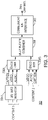
- FIG. 3 is a basic diagram of an exemplary information providing apparatus 352, which for example is utilized by the service provider 10.
- a single service provider may provide a plurality of content, (e.g., multiple programs), over one or more transport streams or IP packet streams.
- audio, video, and caption data for content 1 are provided to an encoder 356A while audio, video, and caption data for content 2 are provided to an encoder 356B.
- a transport stream multiplexer/combiner 358 receives the outputs from the encoders 356A, 356B and provides an output that can be distributed via a physical channel medium such as a terrestrial, cable, or satellite broadcast.
- a communication interface 360 (e.g., a broadcast transmitter) distributes the output from the transport stream multiplexer/combiner 358 via the physical channel medium.
- the information providing apparatus 352 includes a URL information inserter 354A.
- the URL information inserter 354A is configured to insert the URL information in a caption, audio, or video portion of the content 1.
- the URL information inserter 354A inserts an audio watermark in the audio portion and/or a video watermark in the video portion of the content 1.
- the URL information is pre-inserted into the caption, audio, or video portions before the content 1 is provided to the information providing apparatus 352.
- FIG. 4 provides an overview of an exemplary method of the reception apparatus 20 for communicating with a server to download (or otherwise acquire) or upload (or otherwise transmit) data.
- the data to be downloaded or uploaded may be associated with content that is processed for display to a user.
- the reception apparatus 20 communicates with the server using a URL that is constructed using predetermined URL information and URL information received from an external source (e.g., the service provider via a digital television broadcast or a server via the Internet).
- an external source e.g., the service provider via a digital television broadcast or a server via the Internet.
- the URL may direct the reception apparatus 20 to a signaling server to download data needed to access and/or present supplementary content, an electronic service guide data server to download service guide information, a service usage data gathering report server to upload service usage information, an application server to download applications that are to be executed, for example concurrently or in synchronization with content that is displayed to a user, an emergency information server to download emergency alert information, and/or an application manifest server to download a manifest file that identifies application packages for download.
- a signaling server to download data needed to access and/or present supplementary content
- an electronic service guide data server to download service guide information
- a service usage data gathering report server to upload service usage information
- an application server to download applications that are to be executed, for example concurrently or in synchronization with content that is displayed to a user
- an emergency information server to download emergency alert information
- an application manifest server to download a manifest file that identifies application packages for download.
- the reception apparatus 20 receives (or otherwise retrieves, e.g., in the case of previously recorded or downloaded content) the content to be output for display to the user.
- the tuner/demodulator 202 of the reception apparatus 20 receives a digital television broadcast signal including one or more services containing A/V content (e.g., audio or television programming).
- the tuner/demodulator 202 tunes to a broadcast channel to receive the digital television broadcast signal in response to, for example, a television channel selection by the user using the remote controller 360.
- the demultiplexer 206 may select the content from the one or more services in response to the television channel selection.
- the content may be received via an uncompressed A/V interface (e.g., an HDMI interface) or the network interface 226, etc.
- the content may also have been previously recorded or downloaded to the storage 230.
- the reception apparatus 20 receives URL information, which may be associated with the content.
- the URL information may be embedded as an audio or a video watermark in the content.
- the CPU 238 of the reception apparatus 20 receives the uncompressed or decoded audio and/or video of the content to determine if a watermark is embedded therein. When a watermark is detected, the CPU 238 processes the watermark to extract the URL information.
- the URL information is included in a URI message as illustrated in FIG. 5A .
- the URL information may be included in other types of messages such as a trigger for downloading an application, a service list table including URL information to make HTTP requests for signaling metadata, and an emergency alert message for delivering emergency alert information and including URL information to retrieve emergency alert information.
- the URL information includes information that the reception apparatus 20 uses to generate, in step S408, the URL for communicating with the server.
- the URL information includes a DNS name registered with the IANA.
- the URL information includes other globally unique and registered values such as an IPv4 address, an IPv6 address, or a CA certificate serial number. Since DNS names or the other globally unique values registered by the respective registration authorities are globally unique, this fulfills the requirement that the generated URL be globally unique.
- the URL information may include the DNS name, IP address, or CA certificate serial number of the originator of the watermark and/or the provider of the content.
- a registered name or value provides a further layer of security as a result of the process for registering the name or value itself. For example, in order to register a domain name with the IANA, information such as a contact person, e-mail address, and telephone number need to be provided to the registration entity. Thus, even if a third party were to register a domain name to conduct unauthorized activities, a record generated from the initial registration process would be available.
- the URL is generated in step 408 based on the received URL information and the predetermined URL information.
- the URL may be generated by the CPU 238 of the reception apparatus 20.
- the rule for formation of the URL is: https:// ⁇ entity>.vp1.tv/ ⁇ URI_string()>
- ⁇ entity> is a domain name included in the received URL information and registered with the IANA (or other unique value), for example by the originator or provider of the content or watermark. It should be noted that these domain names need not be human-friendly names. For example, six-character domain names such as "x-0.co" are available.
- vp1.tv corresponds to the predetermined URL information.
- other registered domain names may be used in other embodiments.
- the predetermined URL information is hard coded in the reception apparatus 20 according to one embodiment. In other embodiments, limited access may be provided to update the predetermined URL information, for example via firmware updates to the reception apparatus 20.
- the predetermined URL information corresponds to a top-level domain name and a second-level domain name of the generated URL.
- the received URL information may correspond to at least one lower-level domain name of the generated URL that is subordinate to the second-level domain name.
- ⁇ entity> is a registered DNS name such as "fbc.com”
- the registered DNS name includes a third-level ".com” and fourth-level "fbc” domain name.
- ⁇ entity> is a string such as "fbc-com” which is not separated by a period
- the string only includes a third-level domain name.
- the generated URL directs the reception apparatus 20 to a server whose IP address is established by the operator of the predetermined URL (e.g.
- the IP address and subdomain is provided to the operator of the predetermined URL.
- the operator sets up a redirect for the subdomain to the provided IP address by updating its DNS record (e.g., the DNS record for "vp1.tv”).
- the same server acts as a gatekeeper so that even if a malevolent third party were to register a domain name with that server, the registered domain name can be invalidated in a timely and efficient manner.
- the predetermined URL may be used in one or more other levels of the domain name of the generated URL in other embodiments.
- URI_string() may identify or otherwise correspond to the specific content associated with the URL information. For example, the URI_string() identifies a path or paths to a file on the identified server in which the data is stored or a web address where files are to be uploaded.
- the reception apparatus 20 communicates with the server using the URL generated in step 408 to download or upload data.
- the reception 20 communicates with the server via the Internet using the network interface 226.
- the reception apparatus 20 downloads the file or data stored at the location designated by the URL and/or uploads data from the reception apparatus 20 to the file or location designated by the URL
- the reception apparatus 20 further determines whether to download or upload data based on a URL information type (e.g., the URI type in the URI message) provided with or in the URL information.
- a URL information type e.g., the URI type in the URI message
- URI type value 0x01 may indicate that the URL is for a signaling server
- URI type value 0x02 may indicate that the URL is for an electronic service guide server
- URI type value 0x03 may indicate that the URL is for a service usage data gathering report server
- URI type value 0x04 may indicate an emergency information server
- 0x05 may indicate an application or application manifest server, as described above.
- the reception apparatus 20 may download the file or data stored at the location designated by the URL for the signaling server, service guide server, emergency information server, application server, or application manifest server.
- the reception apparatus 20 may upload data to the location or file designated by the URL for the service usage data gathering report server.
- the reception apparatus 20 processes the downloaded data.
- the data may include service signaling files or application-based enhancement signaling information (e.g., pertaining to the delivery of app-based enhancement components, such as an application logic file, locally-cached media files, a network content item, or a notification stream).
- the reception apparatus 20 may further download data (e.g., the app-based enhancement components) identified in the data downloaded from the signaling server.
- emergency alert information may be presented to a user based on an acquired emergency alert message.
- the service guide server provides service guide data regarding content and services being delivered, or scheduled for delivery, by the service provider 10.
- the reception apparatus 20 may provide an on-screen Service Guide based on the service guide data to allow a user to view and select from scheduled, on-demand, and/or other data services being provided by the service provider 10.
- the services may be a broad range of broadcast services, including scheduled television services, data services, and on-demand services.
- the service guide information provides descriptions of the content offerings and may also provide a filtering capability based on user preferences and content properties, such as the presence or absence of captioning, interactive enhancements, video formats (3D, SD, HD, UD), audio formats (stereo, 5.1, immersive), content advisory ratings, genre, etc.
- the service guide data may also provide information about the date and time each offering is scheduled to broadcast.
- the service guide data may also be transmitted by the service provider 10 along with the one or more services.
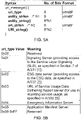
- FIG. 5A illustrates an exemplary URI message.
- the URI message may include the URL information described above according to one embodiment.
- the URI message is used to deliver information for URLs of various types and may be sent in fragments.
- the URI message may include the following fields:
- the reception apparatus 20 is expected to form the URL it will use to retrieve reference content and report data.
- the reception apparatus 20 form the URL, a security issue involved with the possible tampering of watermarks or other part of a data stream provided to the reception apparatus 20 to cause unauthorized URLs to be signaled in the uri_message (any other message) can be addressed.
- the reception apparatus 20 forms the URL by prepending the entity string, with the string ".vp1.tv/” followed by the URI_string string if applicable.
- the URL should be a valid URL per RFC 3986.
- the URL contains only the URI syntax components of path, query, and fragment per RFC 3986.
- the URI_string() may be used to construct an HTTPS request as follows: "https:// ⁇ entity>.vp1.tv/ ⁇ URI_string()>".
- the URI_string may not be required if the entity string provided can uniquely identify the referenced content or destination of the data to be reported in one embodiment.
- FIG. 5B illustrate exemplary types of URIs that can be identified by the field uri_type. Other possibilities include a path to application packages associated with the current program.
- FIG. 6 provides an overview of an exemplary method of the service provider 10 for causing the reception apparatus 20 to communicate with a server to download (or otherwise acquire) data.
- the service provider 10 loads the data to be acquired by the reception apparatus 20 in a server.
- an address associated with the server is known (e.g., previously registered) to a trusted operator linked to the domain name identified in the predetermined URL information described above.
- the service provider 10 may have previously registered the sub-domain "fbc.com” with the trusted provider, which causes the URL "https://fbc.com.vp1.tv" to be redirected to the server operated by the service provider or fbc.com.
- the service provider 10 may store the data in a path that is associated with specific content.
- the service provider 10 provides URL information associated with the loaded data to the reception apparatus 20 with or within the content of one or more services.
- the URL information inserter 354A of the service provider 10 inserts the URL information in a caption portion, video portion, or audio portion of the content (e.g., MP 1 in FIG. 3 ).
- the URL information inserter 354A inserts a watermark containing the URL information in the audio or video portion according to one embodiment.
- the URL information may include the registered sub-domain and the path in which the data is stored on the server.
- the path information may also be separate from the URL information.
- the URL information may be provided in information downloaded from a server.
- downloaded emergency alert information may contain URL information used to generate a URL to download a CAP message
- an application manifest file may contain URL information used to generate a URL to download an application or application pacakge.
- the service provider 10 need not load data in the server, as described above with respect to step 602. Instead, the service provider 10 designates a location or file within the server to which data uploaded to the service provider 10 is stored.
- the URL information transmitted to the reception apparatus 20 in step 604 may include a path in which the data is to be stored. The path information may also be separate from the URL information as in the case of the URL information used to download data.
- the predetermined URL information may be "vp1.tv". However, any other valid registered domain names could be selected for the predetermined URL information. Further, different predetermined domain names may be selected based on whether data is to be downloaded or uploaded, or based on the type of data to be downloaded or uploaded, according to certain embodiments.
- an operator of the trusted domain name or server used by the operator for the registration process may verify the validity of the registration in one embodiment.
- the trusted operator or server may limit redirects to a domain or IP address having a known association with the registered domain name. Similar look up processes or limitations on redirects can be implemented for the other registered values or unique identifies described above.
- FIG. 7 is a block diagram showing an example of a hardware configuration of a computer 700 configured to function as, or control, any one or a combination of the service provider 10 (e.g., information providing apparatus 352), reception apparatus 20, and/or the one or more servers 40.
- the service provider 10 e.g., information providing apparatus 352
- reception apparatus 20 e.g., the one or more servers 40.
- the computer 700 includes CPU 702, ROM (read only memory) 704, and a RAM (random access memory) 706 interconnected to each other via one or more buses 708.
- the one or more buses 708 is further connected with an input-output interface 710 (e.g., USB (Universal Serial Bus) interface).
- the input-output interface 710 is connected with an input portion 712 formed by a keyboard, a mouse, a microphone, remote controller, etc.
- the input-output interface 710 is also connected to a output portion 714 formed by an audio interface (e.g., analog-to-digital converter), video interface (e.g., video card), display, speaker, etc.; a recording portion 716 formed by a hard disk, a non-volatile memory, etc.; a communication portion 718 formed by a network interface, modem, USB interface, FireWire interface, etc.; and a drive 720 for driving removable media 722 such as a magnetic disk, an optical disk, a magneto-optical disk, a semiconductor memory, etc.
- an audio interface e.g., analog-to-digital converter
- video interface e.g., video card
- display e.g., speaker
- a recording portion 716 formed by a hard disk, a non-volatile memory, etc.
- a communication portion 718 formed by a network interface, modem, USB interface, FireWire interface, etc.
- a drive 720 for driving removable media 722 such
- the CPU 702 loads a program stored in the recording portion 716 into the RAM 806 via the input-output interface 710 and the bus 708, and then executes a program configured to provide the functionality of the one or combination of the service provider 10, reception apparatus 20, and one or more servers 40.
- programs may be processed by a single computer or by a plurality of computers on a distributed basis.
- the programs may also be transferred to a remote computer or computers for execution.
- system means an aggregate of a plurality of component elements (apparatuses, modules (parts), etc.). All component elements may or may not be housed in a single enclosure. Therefore, a plurality of apparatuses each housed in a separate enclosure and connected via a network are considered a network, and a single apparatus formed by a plurality of modules housed in a single enclosure are also regarded as a system.
- this technology may be structured for cloud computing whereby a single function is shared and processed in collaboration among a plurality of apparatuses via a network.
- each of the steps explained in reference to the above-described flowcharts may be executed not only by a single apparatus but also by a plurality of apparatuses in a shared manner.
- one step includes a plurality of processes
- these processes included in the step may be performed not only by a single apparatus but also by a plurality of apparatuses in a shared manner.
Landscapes
- Engineering & Computer Science (AREA)
- Signal Processing (AREA)
- Computer Networks & Wireless Communication (AREA)
- Multimedia (AREA)
- Two-Way Televisions, Distribution Of Moving Picture Or The Like (AREA)
- Information Transfer Between Computers (AREA)
- Computer And Data Communications (AREA)
Applications Claiming Priority (3)
| Application Number | Priority Date | Filing Date | Title |
|---|---|---|---|
| US15/237,083 US10681147B2 (en) | 2016-08-15 | 2016-08-15 | URLs for acquiring or transmitting data |
| EP17841896.8A EP3497579B1 (de) | 2016-08-15 | 2017-08-10 | Urls zur erfassung oder übertragung von daten |
| PCT/US2017/046331 WO2018034942A1 (en) | 2016-08-15 | 2017-08-10 | Urls for acquiring or transmitting data |
Related Parent Applications (1)
| Application Number | Title | Priority Date | Filing Date |
|---|---|---|---|
| EP17841896.8A Division EP3497579B1 (de) | 2016-08-15 | 2017-08-10 | Urls zur erfassung oder übertragung von daten |
Publications (1)
| Publication Number | Publication Date |
|---|---|
| EP4007189A1 true EP4007189A1 (de) | 2022-06-01 |
Family
ID=61159635
Family Applications (2)
| Application Number | Title | Priority Date | Filing Date |
|---|---|---|---|
| EP17841896.8A Active EP3497579B1 (de) | 2016-08-15 | 2017-08-10 | Urls zur erfassung oder übertragung von daten |
| EP21200617.5A Pending EP4007189A1 (de) | 2016-08-15 | 2017-08-10 | Urls zur erfassung oder übertragung von daten |
Family Applications Before (1)
| Application Number | Title | Priority Date | Filing Date |
|---|---|---|---|
| EP17841896.8A Active EP3497579B1 (de) | 2016-08-15 | 2017-08-10 | Urls zur erfassung oder übertragung von daten |
Country Status (6)
| Country | Link |
|---|---|
| US (2) | US10681147B2 (de) |
| EP (2) | EP3497579B1 (de) |
| KR (1) | KR102411878B1 (de) |
| BR (1) | BR112019002602A2 (de) |
| MX (1) | MX390979B (de) |
| WO (1) | WO2018034942A1 (de) |
Families Citing this family (8)
| Publication number | Priority date | Publication date | Assignee | Title |
|---|---|---|---|---|
| US20150261753A1 (en) * | 2014-03-13 | 2015-09-17 | Verance Corporation | Metadata acquisition using embedded codes |
| US10885555B2 (en) | 2015-06-09 | 2021-01-05 | Saturn Licensing Llc | Reception apparatus, transmission apparatus, and data processing method |
| US20180097820A1 (en) * | 2016-10-03 | 2018-04-05 | Adobe Systems Incorporated | Managing content upload and content retrieval |
| TWI640195B (zh) * | 2016-12-14 | 2018-11-01 | 日商夏普股份有限公司 | 具有統一資源識別符訊息浮水印有效負載之廣播系統 |
| KR102809534B1 (ko) * | 2019-02-14 | 2025-05-22 | 삼성전자주식회사 | 컨텐츠를 업로드 및/또는 다운로드하기 위한 전자 장치와 시스템 및 그의 동작 방법 |
| CN111669242A (zh) * | 2020-04-17 | 2020-09-15 | 贵州大学 | 一种传统村落手机应急通讯广播系统 |
| CN111711711A (zh) * | 2020-05-28 | 2020-09-25 | 北京邮电大学 | 基于区块链的顶级域名管理和解析方法及系统 |
| US20250021942A1 (en) * | 2023-07-10 | 2025-01-16 | Cisco Technology, Inc. | Tracking Network Devices in a Circular Economy with Green Passports |
Citations (2)
| Publication number | Priority date | Publication date | Assignee | Title |
|---|---|---|---|---|
| US7136932B1 (en) * | 1999-03-22 | 2006-11-14 | Eric Schneider | Fictitious domain name method, product, and apparatus |
| US20080016142A1 (en) * | 1999-03-22 | 2008-01-17 | Eric Schneider | Real-time communication processing method, product, and apparatus |
Family Cites Families (12)
| Publication number | Priority date | Publication date | Assignee | Title |
|---|---|---|---|---|
| US6760746B1 (en) * | 1999-09-01 | 2004-07-06 | Eric Schneider | Method, product, and apparatus for processing a data request |
| AU2001296774A1 (en) * | 2000-10-09 | 2002-04-22 | Enic Corporation | Registering and using multilingual domain names |
| US7216170B2 (en) * | 2002-05-22 | 2007-05-08 | Microsoft Corporation | Systems and methods to reference resources in a television-based entertainment system |
| US20080016124A1 (en) | 2006-07-12 | 2008-01-17 | International Business Machines Corporation | Enabling N-way Data Replication with a Two Way Data Replicator |
| US20100040048A1 (en) | 2006-09-14 | 2010-02-18 | Hannu Vormisto | Address Resolution in a Communication System |
| WO2011146276A2 (en) * | 2010-05-19 | 2011-11-24 | Google Inc. | Television related searching |
| JP5488349B2 (ja) * | 2010-08-30 | 2014-05-14 | 富士通株式会社 | 中継装置、中継方法及び中継プログラム |
| EP2511834A1 (de) * | 2011-04-11 | 2012-10-17 | Alcatel Lucent | Verfahren zur Codierung eines Datenidentifikatoren |
| CN103975602B (zh) | 2011-10-20 | 2017-06-09 | Lg电子株式会社 | 广播服务接收方法和广播服务接收装置 |
| EP2926568A4 (de) | 2012-11-28 | 2016-06-08 | Lg Electronics Inc | Vorrichtung und verfahren zur verarbeitung eines interaktiven dienstes |
| JP6348184B2 (ja) * | 2014-02-10 | 2018-06-27 | エルジー エレクトロニクス インコーポレイティド | 放送信号送信装置、放送信号受信装置、放送信号送信方法、及び放送信号受信方法 |
| US11076205B2 (en) * | 2014-03-07 | 2021-07-27 | Comcast Cable Communications, Llc | Retrieving supplemental content |
-
2016
- 2016-08-15 US US15/237,083 patent/US10681147B2/en active Active
-
2017
- 2017-08-10 EP EP17841896.8A patent/EP3497579B1/de active Active
- 2017-08-10 EP EP21200617.5A patent/EP4007189A1/de active Pending
- 2017-08-10 KR KR1020187034190A patent/KR102411878B1/ko active Active
- 2017-08-10 WO PCT/US2017/046331 patent/WO2018034942A1/en not_active Ceased
- 2017-08-10 MX MX2019001561A patent/MX390979B/es unknown
- 2017-08-10 BR BR112019002602A patent/BR112019002602A2/pt not_active Application Discontinuation
-
2019
- 2019-06-26 US US16/453,506 patent/US10917475B2/en active Active
Patent Citations (2)
| Publication number | Priority date | Publication date | Assignee | Title |
|---|---|---|---|---|
| US7136932B1 (en) * | 1999-03-22 | 2006-11-14 | Eric Schneider | Fictitious domain name method, product, and apparatus |
| US20080016142A1 (en) * | 1999-03-22 | 2008-01-17 | Eric Schneider | Real-time communication processing method, product, and apparatus |
Non-Patent Citations (2)
| Title |
|---|
| ANONYMOUS: "Reverse DNS lookup - Wikipedia", 14 August 2016 (2016-08-14), pages 1 - 3, XP055601206, Retrieved from the Internet <URL:https://en.wikipedia.org/w/index.php?title=Reverse_DNS_lookup&oldid=734435759> [retrieved on 20190701] * |
| HARDAKER PARSONS W ET AL: "Anonymizing and privatizing requests and responses in the DNS; draft-hardaker-dnse-split-key-dns-00.txt", ANONYMIZING AND PRIVATIZING REQUESTS AND RESPONSES IN THE DNS; DRAFT-HARDAKER-DNSE-SPLIT-KEY-DNS-00.TXT, INTERNET ENGINEERING TASK FORCE, IETF; STANDARDWORKINGDRAFT, INTERNET SOCIETY (ISOC) 4, RUE DES FALAISES CH- 1205 GENEVA, SWITZERLAND, 1 April 2014 (2014-04-01), pages 1 - 6, XP015098476 * |
Also Published As
| Publication number | Publication date |
|---|---|
| CA3033356A1 (en) | 2018-02-22 |
| EP3497579A4 (de) | 2019-08-07 |
| US20190320029A1 (en) | 2019-10-17 |
| WO2018034942A1 (en) | 2018-02-22 |
| US20180048719A1 (en) | 2018-02-15 |
| EP3497579B1 (de) | 2021-10-06 |
| KR20190033469A (ko) | 2019-03-29 |
| BR112019002602A2 (pt) | 2019-05-28 |
| MX2019001561A (es) | 2019-07-04 |
| EP3497579A1 (de) | 2019-06-19 |
| US10917475B2 (en) | 2021-02-09 |
| MX390979B (es) | 2025-03-21 |
| KR102411878B1 (ko) | 2022-06-23 |
| US10681147B2 (en) | 2020-06-09 |
Similar Documents
| Publication | Publication Date | Title |
|---|---|---|
| US10917475B2 (en) | URLs for acquiring or transmitting data | |
| US11750877B2 (en) | Identification of services containing the same or equivalent content | |
| CN105981393B (zh) | 发送广播信号的装置、接收广播信号的装置、发送广播信号的方法以及接收广播信号的方法 | |
| JP6474835B2 (ja) | ハイブリッド放送サービスを処理する装置、及びハイブリッド放送サービスを処理する方法 | |
| US11336937B2 (en) | Transport and acquisition of DRM-related information | |
| US12160631B2 (en) | Hidden replaceable media slots | |
| CA2874714A1 (en) | Broadband delivery of personalization information for advanced tv services | |
| JP6189546B2 (ja) | 放送コンテンツ及び放送コンテンツに関連したアプリケーションを含む放送信号を処理する方法及び装置 | |
| US20170164071A1 (en) | Broadcast signal transmission apparatus, broadcast signal reception apparatus, broadcast signal transmission method, and broadcast signal reception method | |
| CN105850141B (zh) | 发送广播信号的装置、接收广播信号的装置、发送广播信号的方法以及接收广播信号的方法 | |
| CA3033356C (en) | Urls for acquiring or transmitting data | |
| CA3072448C (en) | Transport and acquisition of drm-related information | |
| CA3035261C (en) | Identification of services containing the same or equivalent content |
Legal Events
| Date | Code | Title | Description |
|---|---|---|---|
| PUAI | Public reference made under article 153(3) epc to a published international application that has entered the european phase |
Free format text: ORIGINAL CODE: 0009012 |
|
| STAA | Information on the status of an ep patent application or granted ep patent |
Free format text: STATUS: THE APPLICATION HAS BEEN PUBLISHED |
|
| AC | Divisional application: reference to earlier application |
Ref document number: 3497579 Country of ref document: EP Kind code of ref document: P |
|
| AK | Designated contracting states |
Kind code of ref document: A1 Designated state(s): AL AT BE BG CH CY CZ DE DK EE ES FI FR GB GR HR HU IE IS IT LI LT LU LV MC MK MT NL NO PL PT RO RS SE SI SK SM TR |
|
| STAA | Information on the status of an ep patent application or granted ep patent |
Free format text: STATUS: REQUEST FOR EXAMINATION WAS MADE |
|
| 17P | Request for examination filed |
Effective date: 20221129 |
|
| RBV | Designated contracting states (corrected) |
Designated state(s): AL AT BE BG CH CY CZ DE DK EE ES FI FR GB GR HR HU IE IS IT LI LT LU LV MC MK MT NL NO PL PT RO RS SE SI SK SM TR |
|
| STAA | Information on the status of an ep patent application or granted ep patent |
Free format text: STATUS: EXAMINATION IS IN PROGRESS |
|
| 17Q | First examination report despatched |
Effective date: 20250930 |