EP4007199A1 - Procédé de transmission de signal, dispositif, noeud de communication et support de stockage - Google Patents
Procédé de transmission de signal, dispositif, noeud de communication et support de stockage Download PDFInfo
- Publication number
- EP4007199A1 EP4007199A1 EP20846778.7A EP20846778A EP4007199A1 EP 4007199 A1 EP4007199 A1 EP 4007199A1 EP 20846778 A EP20846778 A EP 20846778A EP 4007199 A1 EP4007199 A1 EP 4007199A1
- Authority
- EP
- European Patent Office
- Prior art keywords
- sequences
- sequence
- frequency domain
- offset value
- different
- Prior art date
- Legal status (The legal status is an assumption and is not a legal conclusion. Google has not performed a legal analysis and makes no representation as to the accuracy of the status listed.)
- Pending
Links
Images



Classifications
-
- H—ELECTRICITY
- H04—ELECTRIC COMMUNICATION TECHNIQUE
- H04L—TRANSMISSION OF DIGITAL INFORMATION, e.g. TELEGRAPHIC COMMUNICATION
- H04L5/00—Arrangements affording multiple use of the transmission path
- H04L5/003—Arrangements for allocating sub-channels of the transmission path
- H04L5/0053—Allocation of signalling, i.e. of overhead other than pilot signals
-
- H—ELECTRICITY
- H04—ELECTRIC COMMUNICATION TECHNIQUE
- H04L—TRANSMISSION OF DIGITAL INFORMATION, e.g. TELEGRAPHIC COMMUNICATION
- H04L5/00—Arrangements affording multiple use of the transmission path
- H04L5/003—Arrangements for allocating sub-channels of the transmission path
- H04L5/0044—Allocation of payload; Allocation of data channels, e.g. PDSCH or PUSCH
-
- H—ELECTRICITY
- H04—ELECTRIC COMMUNICATION TECHNIQUE
- H04L—TRANSMISSION OF DIGITAL INFORMATION, e.g. TELEGRAPHIC COMMUNICATION
- H04L5/00—Arrangements affording multiple use of the transmission path
- H04L5/003—Arrangements for allocating sub-channels of the transmission path
- H04L5/0048—Allocation of pilot signals, i.e. of signals known to the receiver
-
- H—ELECTRICITY
- H04—ELECTRIC COMMUNICATION TECHNIQUE
- H04W—WIRELESS COMMUNICATION NETWORKS
- H04W72/00—Local resource management
- H04W72/04—Wireless resource allocation
- H04W72/044—Wireless resource allocation based on the type of the allocated resource
- H04W72/0453—Resources in frequency domain, e.g. a carrier in FDMA
-
- H—ELECTRICITY
- H04—ELECTRIC COMMUNICATION TECHNIQUE
- H04L—TRANSMISSION OF DIGITAL INFORMATION, e.g. TELEGRAPHIC COMMUNICATION
- H04L5/00—Arrangements affording multiple use of the transmission path
- H04L5/0001—Arrangements for dividing the transmission path
- H04L5/0003—Two-dimensional division
- H04L5/0005—Time-frequency
-
- H—ELECTRICITY
- H04—ELECTRIC COMMUNICATION TECHNIQUE
- H04W—WIRELESS COMMUNICATION NETWORKS
- H04W74/00—Wireless channel access
- H04W74/08—Non-scheduled access, e.g. ALOHA
- H04W74/0833—Random access procedures, e.g. with 4-step access
Definitions
- the present application relates to the field of communications, and for example, to a signal transmission method and device, a communication node and a storage medium.
- Embodiments of the present application provide the following schemes.
- An embodiment of the present application provides a signal transmission method.
- the signal transmission method includes the following, a configuration manner of sequences is determined, where the configuration manner includes at least one of the number of the sequences, the length of the sequences, or a phase rotation angle of an element in the sequences; the sequences are generated according to the configuration manner; and the sequences are mapped to channel resources and the mapped sequences are transmitted.
- An embodiment of the present application provides a signal transmission device.
- the signal transmission device includes a determination module, a generation module and a mapping and transmission module.
- the determination module is configured to determine a configuration manner of sequences, where the configuration manner includes at least one of a number of the sequences, a length of the sequences, or a phase rotation angle of an element in the sequences.
- the generation module is configured to generate the sequences according to the configuration manner.
- the mapping and transmission module is configured to map the sequences to channel resources and transmit the mapped sequences.
- An embodiment of the present application provides a communication node for a signal transmission.
- the communication node includes a processor and a memory.
- the memory is configured to store an instruction.
- the processor is configured to read the instruction to perform any of the embodiments of the signal transmission method described above.
- An embodiment of the present application provides a storage medium.
- the storage medium stores a computer program, and the computer program, when executed by a processor, implements any of the methods in the embodiments of the present application.
- the sequence is generated according to the configuration manner, and the sequence is mapped and transmitted, so as to transmit a signal by using a new sequence transmission structure.
- FIG. 1 is a flowchart for implementing a signal transmission method according to an embodiment of the present application, the method includes the following.
- a configuration manner of sequences is determined.
- the configuration manner includes at least one of the number of the sequences, the length of the sequences, or a phase rotation angle of an element in the sequences.
- the sequences are mapped to channel resources and the mapped sequences are transmitted.
- the above configuration manner may refer to a feasible or appropriate configuration manner.
- the phase rotation angle of the element in the sequences is one of the following: a phase rotation angle of each element in the sequences relative to an element which corresponds to the each element and is in an initial sequence; or a phase rotation angle of each element in the sequences relative to an element which corresponds to the each element and is in one of other sequences, where the other sequences are any other sequences except the one sequence in a signal.
- phase rotation angle of the element in the sequences included in the above-described configuration manner may include at least one of the following information:
- the "initial sequence” is a sequence generated according to a certain rule, or a sequence obtained by performing a corresponding operation on the generated sequence, or a predefined sequence.
- the above configuration manner further includes at least one of a frequency domain starting position, a frequency domain offset value, or a frequency domain spacing between different sequences.
- Mapping the sequences to the channel resources includes that the sequences are mapped to the channel resource according to at least one of the frequency domain starting position, the frequency domain offset value, or the frequency domain spacing between different sequences.
- mapping the sequences to the channel resources includes one of: the generated sequences are mapped to all or part of frequency domain resources of any interlace of the channel resources; or the generated sequences are mapped to all or part of frequency domain resources of multiple interlaces of the channel resources.
- the frequency domain resources are one of M1 data subcarriers, 1/M1data subcarrier, M1 random access channel (RACH) subcarriers, 1/M1 RACH subcarrier, M1 resource blocks (RBs), or 1/M1 RB; where M1 is a positive integer, and / represents division.
- the frequency domain starting position, the frequency domain offset value, or the frequency domain spacing between the different sequences is informed by control signaling, or predefined a combination for a communication node to select, or pre-stored in a communication node and triggered by control signaling, or informed by a control channel, or configured by a higher layer.
- the number of sequences, the length of the sequences, or the phase rotation angle of the element in the sequences is determined in the following manners: informing by control signaling, predefining a combination for a communication node to select, pre-storing in a communication node and triggering by control signaling, informing by a control channel, or configuring by a higher layer.
- the manner of informing by the control signaling may include at least one of the following: informing indication information of the information by the control signaling, and determining the information by the communication node receiving the control signaling according to the indication information; or directly informing the information by the control signaling.
- the precision of the frequency domain starting position is one of H1 data subcarriers, or 1/H1 data subcarrier, H1 random access channel (RACH) subcarriers, 1/H1 RACH subcarrier, H1 RBs, or 1/H1 RB; where H1 is a positive integer, and / represents division.
- RACH random access channel
- the precision of the frequency domain offset value is one of H2 data subcarriers, 1/H2 data subcarrier, H2 RACH subcarriers, 1/H2 RACH subcarrier, H2 RBs, or 1/H2 RB; where H2 is a positive integer, and / represents division.
- the precision of the frequency domain spacing between the different sequences is one of H3 data subcarriers, 1/H3 data subcarrier, H3 RACH subcarriers, 1/H3 RACH subcarrier, H3 RBs, or 1/H3 RB; where H3 is a positive integer, and / represents division.
- the length of one of the sequences is 6, 12, 18, 24, 139, 283, 571, 1151, or any number less than a product of H4 and one of the number of RACH subcarriers or the number of available data subcarriers in a system; where H4 is a positive integer.
- the frequency domain offset value is 0 or a positive integer.
- the frequency domain offset value is 0 or less than or equal to the length of the sequences.
- the frequency domain offset value is 0, 1, 2, 3, 4, or 5; in the case where the length of one of the sequences is 1151, the frequency domain offset value is 0 or 1; in the case where the length of one of the sequences is 6, 18, or 24, the frequency domain offset value is 0, 1, 2, 3, 4, 5, or 6; and in the case where the length of one of the sequences is 12, the frequency domain offset value is 0 or 1.
- the phase rotation angle of the element in the sequences is one of the following: a phase rotation angle of each element in the sequences relative to an element which corresponds to the each element and is in an initial sequence; or a phase rotation angle of each element in the sequences relative to an element which corresponds to the each element and is in one of other sequences, where the other sequences are sequences except the one sequence in a signal.
- the initial sequence is one of a sequence generated according to a predetermined rule, or a sequence obtained by performing a corresponding operation on the generated sequence, or a predefined sequence.
- each sequence corresponds to the same or different initial sequence.
- the configuration manner includes the number of sequences being 1, and the phase rotation angle of each element in the sequence; where the phase rotation angle of each element is the same or different.
- the configuration manner includes the number of sequences being 2 or more, and a phase rotation angle of each element in each sequence; where phase rotation angles of each element in the same sequence are the same or different; and phase rotation angles of elements in different sequences are the same or different.
- the configuration manner includes the number of sequences being 2; a frequency domain starting position of the first sequence of the two sequences and a frequency domain offset value of each of the two sequences; and one of a frequency domain spacing between different sequences or a frequency domain starting position of the second sequence of the two sequences.
- the configuration manner includes the number of sequences being more than one; a frequency domain starting position of the first sequence of the more than one sequence and a frequency domain offset value of each of the more than one sequence; and a frequency domain spacing between adjacent ones of the more than one sequence.
- the configuration manner includes the number of sequences being more than one; and a frequency domain starting position and a frequency domain offset value of each of the more than one sequence.
- the configuration manner includes the number of sequences being more than one; a frequency domain starting position of the first sequence of the more than one sequence and a frequency domain offset value of each of the more than one sequence; and one of frequency domain starting positions of other sequences except the first sequence, or frequency domain spacings of other sequences except the first sequence relative to the first sequence, or frequency domain spacings between a specified sequence and other sequences except the first sequence .
- the configuration manner includes the number of sequences being 2 or more; and the length of the at least two sequences; where lengths of the at least two sequences are the same or different.
- the number of sequences is 2, and the communication node determines at least one of a frequency domain starting position of each sequence, a frequency domain offset value of each sequence, or a frequency domain spacing between different sequences.
- a manner in which the communication node determines the at least one of the frequency domain starting position of each sequence, the frequency domain offset value of each sequence, or the frequency domain spacing between different sequences may be informing by control signaling, predefining a combination for a communication node to select, pre-storing in a communication node and triggering by control signaling, informing by a control channel, or configuring by a higher layer.
- the communication node may be a base station or a terminal.
- the two sequences have the same length and correspond to the same initial sequence; alternatively, the two sequences may correspond to different sequences obtained by different cyclic shifts of the same initial sequence; or, the two sequences may correspond to different initial sequences; alternatively, there may be a certain phase relationship between the two sequences, or a certain phase relationship between multiple elements within one sequence.
- the two sequences may be composed in several manners: the two sequences are composed of the same initial sequence; one sequence is a sequence obtained by rotating the phase of each element of the other sequence by the same angle (that is, rotating an overall phase of the sequence by a certain angle); or, one sequence is a sequence obtained by rotating the phase of each element of the other sequence by different angles; or, one sequence is a sequence obtained by rotating the phase of each element in the initial sequence by the same angle, and the other sequence is a sequence obtained by rotating the phase of each element in the initial sequence by different angles.
- phase rotation angle of each element may have a certain phase relationship.
- the phase rotation angle has a gradually rising trend; or, the phase rotation angle has a gradually decreasing trend.
- FIG. 2A is a schematic diagram showing an overall phase rotation of pi/4 between sequence 1 and sequence 2.
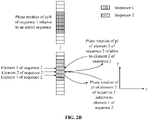
- FIG. 2B is a schematic diagram showing a phase rotation of pi/4 of sequence 1 relative to an initial sequence and a certain phase relationship between elements in sequence 2.
- FIG. 2B there is a phase offset of pi/2 between each element in sequence 2.
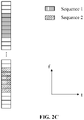
- FIG. 2C is a schematic diagram showing sequence 1 and sequence 2 corresponding to different initial sequences, or corresponding to sequences obtained by performing the cyclic shift on different initial sequences. In FIG. 2C , there is no phase relationship between the two sequences.
- FIG. 2A There are two sequences in each of FIG. 2A , FIG. 2B , and FIG. 2C .
- the two sequences described above corresponding to the same initial sequence may represent that the two sequences are generated by the same initial sequence.
- the generation manner may include: being equivalent to the initial sequence, rotating the phase of each element in the initial sequence by the same angle, or rotating the phase of each element in the initial sequence by different angles.
- the two sequences described above corresponding to different sequences obtained by performing the cyclic shift on the same initial sequence may represent that the two sequences are generated from different initial sequences, respectively, and these different initial sequences described above are sequences obtained by performing the cyclic shift on the same sequence, or these different initial sequences are equivalent to the sequence.
- the generation manner may include: being equivalent to the sequence, rotating the phase of each element in the sequence by the same angle, or rotating the phase of each element in the sequence by different angles.
- the two sequences corresponding to different initial sequences obtained by performing the cyclic shift on the same sequence may also be referred to as the two sequences consisting of the same sequence.
- the communication node informs, through the control signaling, another communication node of at least one of the frequency domain starting position of the sequence, the frequency domain offset value of the sequence, or the frequency domain spacing between different sequences.
- the precision (or referred to as unit) of the frequency domain starting position is one of H1 data subcarriers, 1/H1 data subcarrier, H1 RACH subcarriers, 1/H1 RACH subcarrier, H1 RBs, or 1/H1 RB; where H1 is a positive integer, and / represents division.
- the precision (or referred to as unit) of the frequency domain offset value is one of H2 data subcarriers, 1/H2 data subcarrier, H2 RACH subcarriers, 1/H2 RACH subcarrier, H2 RBs, or 1/H2 RB; where H2 is a positive integer, and / represents division.
- the precision (or referred to as unit) of the frequency domain spacing between different sequences is one of H3 data subcarriers, 1/H3 data subcarrier, H3 RACH subcarriers, 1/H3 RACH subcarrier, H3 RBs, or 1/H3 RB; where H3 is a positive integer, and / represents division.
- the frequency domain starting position and the frequency domain offset value of each sequence may also be included except the number of sequences, the length of the sequences, or the phase rotation angle of each element in each sequence.
- frequency domain offset values of the two sequences may be the same or different.
- the configuration manner of the above sequences may further include the frequency domain offset value of the other sequence.
- the spacing between the two sequences may be a distance between starting point positions of the two sequences; or a distance between final positions of the two sequences; or a distance between one end of one sequence and the other end of the other sequence.
- the spacing between the two sequences may be determined by the communication node in the following manners: informing by control signaling, predefining a combination for a communication node to select, pre-storing in a communication node and triggering by control signaling, informing by a control channel, or configuring by a higher layer.
- the corresponding frequency domain offset value length may be one of ⁇ 0, 1, 2, 3, 4, 5 ⁇ .
- Two sequences with the length 139 may be mapped to both ends of the entire frequency domain, and may correspond to different frequency domain offset values, respectively, or the same frequency domain offset value.
- the number of corresponding frequency domain offset values of the sequences is less than or equal to S, and the number of the corresponding lengths of the sequences is less than or equal to S.
- a phase rotation of C exists between a phase rotation angle of an element in each sequence and a phase rotation angle of an element in the specified sequence, and the value range of C is 0 to 360°.
- the communication node may be a base station or a terminal.
- X frequency domain units 1 are in the system, the spacing of sequences is Y frequency domain units 2, the system includes Z spacings, and the sequences are transmitted by occupying H frequency domain starting positions; where H positions are arbitrary.
- the H positions may be equally spaced, or occupied at both ends, or occupied in the middle.
- the H positions may be equally spaced so that the mapping of the sequences in the frequency domain is consecutive.
- the frequency domain unit 1 and the frequency domain unit 2 may each have the unit of one of K1 data sub carriers, 1/K1 data subcarrier, K2 RACH subcarriers, 1/K2 RACH subcarrier, K3 RBs, or 1/K3 RB, where K1, K2 and K3 are positive integers, and / represents division.
- the system may contain 51 RBs at spacings of 5 RBs (the spacing of each sequence starting point position), and the system may contain 10 spacings (50 consecutive RBs).
- one sequence has the length of 12 and occupies 12 data subcarriers/REs (subcarriers and resource elements (REs) are equivalent, 12 REs may be considered as one RB), the number of transmitted sequences is 10, each sequence corresponds to the same frequency domain offset value of 0 (less than the length 12 of the sequence), the phase rotation angle of the element in the sequence is 0, and over 10 transmittable opportunities, RBs having any number of less than or equal to 10 RBs are occupied for mapping the sequences and transmitting the sequences.
- sequences are equally spaced and there may be a certain cyclic shift or a phase rotation or other variation among the sequences.
- the available RBs in the frequency domain may be divided into 5 interlaces, where RB indexes contained in the first interlace are a set of ⁇ 1, 6, 11, 16, 21, 26, 31, 36, 41, 46 ⁇ ; RB indexes contained in the second interlace are a set of ⁇ 2, 7, 12, 17, 22, 27, 32, 37, 42, 47 ⁇ ; RB indexes contained in the third interlace are a set of ⁇ 3, 8, 13, 18, 23, 28, 33, 38, 43, 48 ⁇ ; RB indexes contained in the fourth interlace are a set of ⁇ 4, 9, 14, 19, 24, 29, 34, 39, 44, 49 ⁇ ; and RB indexes contained in the fifth interlace are a set of ⁇ 5, 10, 15, 40, 25, 40, 35, 40, 45, 50 ⁇ .
- the above sequences may be mapped in all or part of RBs of any interlace.
- the above RB indexes may correspond to frequency domain starting positions of 10 sequences.
- the RB indexes occupied by the sequences are elements in the set of ⁇ 1, 6, 11, 16, 21, 26, 31, 36, 41, 46 ⁇ ; or the set of ⁇ 2, 7, 12, 17, 22, 27, 32, 37, 42, 47 ⁇ ; or the set of ⁇ 3, 8, 13, 18,23, 28, 33, 38, 43, 48 ⁇ ; or the set of ⁇ 4, 9, 14, 19, 24, 29, 34, 39, 44, 49 ⁇ ; or the set of ⁇ 5, 10, 15, 40, 25, 40, 35, 40, 45, 50 ⁇ ; or the set of ⁇ 5, 50 ⁇ ; or the set of ⁇ 5, 15 ⁇ ; or the set of ⁇ 4, 9 ⁇ ; or the set of ⁇ 1, 41 ⁇ ; or the set of ⁇ 1, 45 ⁇ .
- the above sequences may be mapped to any combination of available RBs.
- the number of sequences is more than one.
- a mapping manner of the sequences in the frequency domain is determined through the frequency domain starting position, the frequency domain offset value and the frequency domain spacing (optional) between different sequences included in the above configuration manner.
- the number of sequences is related to the subcarrier spacing and the bandwidth.
- the bandwidth is 20 MHz and the length of the sequences is 139
- the multiple sequences may have the same length and correspond to the same initial sequence, or the multiple sequences may correspond to different initial sequences obtained by performing the cyclic shift on the same sequence.
- the initial sequence is a sequence generated by a certain rule, or a sequence obtained by performing a corresponding operation on the generated sequence, or a predefined sequence.
- corresponding operation refers to, but is not merely limited to, a cyclic shift, a phase rotation, and the like.
- the four sequences may correspond to 1, 2, 3, or 4 initial sequences; when the number of sequences is 8, the 8 sequences may correspond to 1, 2, 3, 4, 5, 6, 7, or 8 initial sequences; and there may be a certain phase relationship among multiple sequences to ensure that a cubic metric (CM) value is at a relatively low level, but not limited to this.
- CM cubic metric
- each sequence may be one of the following: an initial sequence; a sequence obtained by rotating the phase of each element in the initial sequence by the same angle (that is, rotating an overall phase of the initial sequence by a certain angle); or a sequence obtained by rotating the phase of each element in the initial sequence by different angles.
- phase rotation angle of each element may have a certain phase relationship.
- the phase rotation angle has a gradually rising trend; or the phase rotation angle has a gradually decreasing trend.
- FIG. 3 is a schematic diagram showing an overall phase rotation of pi/4 between sequence 1 and sequence 2 and an overall phase rotation of pi/2 between sequence 2 and sequence 3.
- the communication node informs, through the control signaling, another communication node of at least one of the frequency domain starting position of the sequence, the frequency domain offset value of the sequence, or the frequency domain spacing between different sequences.
- the precision (or referred to as unit) of the frequency domain starting position is one of H1 data subcarriers, 1/H1 data subcarrier, H1 random access channel (RACH) subcarriers, 1/H1 RACH subcarrier, H1 RBs, or 1/H1 RB; where H1 is a positive integer, and / represents division.
- RACH random access channel
- the precision (or referred to as unit) of the frequency domain offset value is one of H2 data subcarriers, 1/H2 data subcarrier, H2 RACH subcarriers, 1/H2 RACH subcarrier, H2 RBs, or 1/H2 RB; where H2 is a positive integer, and / represents division.
- the precision (or referred to as a unit) of the frequency domain spacing between different sequences is one of H3 data subcarriers, 1/H3 data subcarrier, H3 RACH subcarriers, 1/H3 RACH subcarrier, H3 RBs, or 1/H3 RB; where H3 is a positive integer, and / represents division.
- sequences are mapped consecutively in the frequency domain; or the sequences are mapped at equal spacings in the frequency domain; or the sequences are mapped at non-equally spacings in the frequency domain.
- the configuration manner of the sequences may include the frequency domain starting position of the first sequence without frequency domain starting positions of subsequent sequences and the frequency domain spacing between sequences.
- the frequency domain starting position and the frequency domain offset value of the first sequence, and frequency domain offset values of other sequences may also be included except the at least one of the number of sequences, the length of the sequences, or the phase rotation angle of the element in the sequences.
- the configuration manner of the sequences may include the frequency domain starting position of the first sequence and the frequency domain spacing between two adjacent sequences.
- the configuration manner of the sequences may further include the frequency domain starting position of each sequence.
- the frequency domain starting position and the frequency domain offset value of the first sequence, the frequency domain spacing between sequences, and frequency domain offset values of other sequences may also be included except at least one of the number of sequences, the length of the sequences, or the phase rotation angle of the element in the sequences.
- the configuration manner of the sequences may include the frequency domain starting position of the first sequence and the frequency domain spacings of other sequences relative to the previous sequence.
- the previous sequence may refer to a previous sequence, previous multiple, the first sequence, or the like.
- the configuration manner of the sequences may further include the frequency domain starting position of each sequence.
- mapping positions of part of the sequences are represented by the frequency domain starting positions, and mapping positions of the other part of sequences are represented by the frequency domain spacings relative to the previous sequence.
- the frequency domain starting position and the frequency domain offset value of the first sequence, a frequency domain offset value of the second sequence and a frequency domain spacing of the second sequence relative to the first sequence, a frequency domain offset value of the third sequence and a frequency domain spacing of the third sequence relative to the second sequence, ..., up to a frequency domain offset value of the last sequence and the frequency domain spacing of the last sequence relative to the previous sequence may also be included except at least one of the number of sequences, the length of the sequences, or the phase rotation angle of each element in each sequence.
- frequency domain offset value of each sequence may be the same or different.
- the corresponding frequency domain offset value is one of ⁇ 0, 1, 2, 3, 4, 5 ⁇ .
- the spacing between two sequences may be a distance between starting point positions of the two sequences; or a distance between final positions of the two sequences; or a distance between one end of one sequence and the other end of the other sequence.
- the spacing between the two sequences may be determined by the communication node in the following manners: informing by control signaling, or predefining a combination for a communication node to select, or pre-storing in a communication node.
- the number of sequences is 1.
- the length of the sequence may be any number less than a product of H4 and one of the number of RACH subcarriers or the number of available data subcarriers, where H4 is a positive integer, that is, the length of the sequence is different from the length of the sequence in a set of ⁇ 139, 839 ⁇ in the long term evolution (LTE) technology and new radio (NR) technology.
- LTE long term evolution
- NR new radio
- the length of the sequence may be 12, 18, 24, 36, 283, 571, or 1151.
- the communication node may select different sequence lengths at different moments.
- Multiple sequence lengths may be supported by the same communication node.
- the communication node may be multiplexed with data information while transmitting a relatively long sequence.
- the communication node may transmit sequences with the same length or different lengths in different spatial directions at the same moment.
- the communication node may transmit sequences with the same length or different lengths in different spatial directions at different moments.
- the frequency domain starting position and the frequency domain offset value of the sequence may be included except the length of the sequence.
- the above communication node may be a base station or a terminal device.
- the sequence with a length of 12 may be mapped to one RB, the sequence with a length of 283 may be mapped to 24 RBs, the sequence with a length of 571 may be mapped to 48 RBs, and the sequence with a length of 1151 may be mapped to 96 RBs.
- the sequence with the length of 12 takes the frequency domain offset value of the following value: ⁇ 0 ⁇ .
- the value range of the frequency domain offset value of the sequence with the length of 283 is: ⁇ 0, 1, 2, 3, 4, 5 ⁇ .
- the value range of the frequency domain offset value of the sequence with the length of 571 is: ⁇ 0, 1, 2, 3, 4, 5 ⁇ .
- the value range of the frequency domain offset value of the sequence with the length of 1151 is: ⁇ 0, 1 ⁇ .
- the length of the sequence may be 1151, and the frequency domain offset value is one of ⁇ 0, 1 ⁇ ; in the case where the bandwidth is 20MHz and the subcarrier spacing is 30KHz, the length of the sequence may be 571, and the frequency domain offset value is one of ⁇ 0, 1, 2, 3, 4, 5 ⁇ ; and in the case where the bandwidth is 20MHz and the subcarrier spacing is 60KHz, the length of the sequence may be 283, and the frequency domain offset value is one of ⁇ 0, 1, 2, 3, 4, 5 ⁇ .
- the frequency domain offset value may be implicitly or explicitly indicated to a communication node at the other side by the communication node through control signaling.
- the frequency domain offset value may also be determined by the communication node itself.
- the precision (or referred to as unit) of the frequency domain starting position may be M1 data subcarriers, N1 RACH subcarriers, or L1 RBs; where M1, N1 and L1 are positive integers; and the precision (or referred to as unit) of the frequency domain offset value may be M2 data subcarriers, N2 RACH subcarriers, or L2 RBs; where M2, N2 and L2 are positive integers.
- the number of sequences is 2.
- the length of the sequences may be any number less than a product of H4 and one of the number of RACH subcarriers or the number of available data subcarriers, where H4 is a positive integer, that is, the length of the sequences is different from the length of the sequence in the set of ⁇ 139, 839 ⁇ in the LTE technology and NR technology.
- the length of the sequences may be 6, 12, 18, 24, 139, 283, 571, 1151, or any number less than one of the number of available data subcarriers or the number of RACH subcarriers in the system.
- the lengths of the two sequences may be the same or different.
- mapping information including the frequency domain starting position, the frequency domain offset value, or the frequency domain spacing between different sequences in the configuration manner of the sequences is consistent with that in the embodiment one described above, which is not repeated here.
- the length of each of the sequences may be 571, and the two sequences may be mapped consecutively or non-consecutively; in the case where the bandwidth is 20 MHz and the subcarrier spacing is 15 kHz, when the number of sequences is 4, the length of each of the sequences may be 283, and the four sequences may be consecutively mapped or non-consecutively mapped; and in the case where the bandwidth is 20 MHz and the subcarrier spacing is 30 kHz, when the number of sequences is 2, the length of each of the sequences may be 283, and the two sequences may be consecutively mapped or non-consecutively mapped.
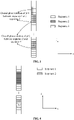
- FIG. 4 is a schematic diagram showing two sequences with different lengths. As shown in FIG. 4 , the two sequences correspond to initial sequences with different lengths. Any of the two sequences may be: an initial sequence; or a sequence obtained by rotating the phase of each element in the initial sequence by the same angle (that is, rotating an overall phase of the initial sequence by a certain angle); or a sequence obtained by rotating the phase of each element in the initial sequence by different angles. There is no phase relationship between the two sequences.
- the length of one sequence may be 283 and the length of the other sequence may be 571.
- the communication node informs, through the control signaling, a communication node at the other side of the frequency domain starting position and the frequency domain offset value of the sequence.
- the communication node informs, through the control signaling, another communication node of at least one of the frequency domain starting position of the sequence, the frequency domain offset value, or the frequency domain spacing between different sequences.
- the precision (or referred to as unit) of the frequency domain starting position is one of H1 data subcarriers, 1/H1 data subcarrier, H1 random access channel (RACH) subcarriers, 1/H1 RACH subcarrier, H1 RBs, or 1/H1 RB; where H1 is a positive integer, and / represents division.
- RACH random access channel
- the precision (or referred to as unit) of the frequency domain offset value is one of H2 data subcarriers, 1/H2 data subcarrier, H2 RACH subcarriers, 1/H2 RACH subcarrier, H2 RBs, or 1/H2 RB; where H2 is a positive integer, and / represents division.
- the precision (or referred to as unit) of the frequency domain spacing between the different sequences is one of H3 data subcarriers, 1/H3 data subcarrier, H3 RACH subcarriers, 1/H3 RACH subcarrier, H3 RBs, or 1/H3 RB; where H3 is a positive integer, and / represents division.
- the frequency domain starting position and the frequency domain offset value of each sequence may also be included except at least one of the number of sequences, the length of the sequences, or the phase rotation angle of each element in each sequence.
- frequency domain offset values of the two sequences may be the same or different.
- the configuration manner of the above sequences may further include the frequency domain offset value of the other sequence.
- the spacing between the sequences may be a distance between starting point positions of the sequences; or a distance between final positions of the sequences; or a distance between one end of one sequence and the other end of the other sequence.
- the frequency domain spacing between the sequences may be determined by the communication node in the following manners: informing by the control signaling to a communicate node at the other side, or predefining a combination for the communication node at another side to select, pre-storing in the communication node at another side, or determining by the communication node itself.
- the frequency domain offset value corresponding to each sequence is one of ⁇ 0, 1, 2, 3, 4, 5 ⁇ .
- the number of sequences is more than one.
- the length of the sequences may be any number less than a product of H4 and one of the number of RACH subcarriers or the number of available data subcarriers, where H4 is a positive integer, that is, the length of the sequence is different from the length of the sequence in the set of ⁇ 139, 839 ⁇ in the LTE technology and NR technology.
- the length of the sequences may be 283, 571, or 1151.
- Any of the sequences may be an initial sequence; or a sequence obtained by rotating the phase of each element in the initial sequence by the same angle (that is, rotating an overall phase of the initial sequence by a certain angle); or a sequence obtained by rotating the phase of each element in the initial sequence by different angles.
- the lengths of the multiple sequences may be the same or different.
- mapping information such as, the frequency domain starting position, the frequency domain offset value, or the frequency domain spacing between different sequences
- mapping information in the configuration manner of the sequences is consistent with those in embodiment one and embodiment three described above, which is not repeated here.
- FIG. 5 is a schematic diagram showing three sequences with different lengths. As shown in FIG. 5 , the three sequences correspond to initial sequences with different lengths, and there is no phase relationship among the sequences.
- the lengths of the four sequences may be four cases including 1, 2, 3 and 4 lengths.
- the lengths of the four sequences are the same.
- the lengths of two of the four sequences are both X, and the lengths of the other two sequences are both Y; alternatively, the lengths of three sequences are each X, and the length of the other sequence is Y; where X is not equal to Y.
- the lengths of two of the four sequences are both X
- the length of one of the four sequences is Y
- the length of the last one sequence is Z; where X, Y and Z are different.
- the lengths of the four sequences are different.
- lengths of the eight sequences may be eight cases including 1, 2, 3, 4, 5, 6, 7 and 8 lengths.
- the communication node may inform a communication node at the other side of all or part of contents in the configuration manners described above by adopting the control signaling.
- sequence described in the present application may be a random access sequence, a transmission sequence of an uplink/downlink reference signal, a sequence of a discovery signal, a synchronization signal sequence, a transmission sequence of an uplink control channel or a measurement signal, a transmission sequence of a downlink control channel, other signal transmissions, or the like.
- a new sequence is composed of two initial sequences, and an overall phase relationship exists between the two sequences, so that four points with relatively good phase values are provided, that is, [0, 90°, 180°, 270°], respectively.
- Embodiments of the present application may be configured in the following two manners.
- a configuration manner two '00' represents that a 0° phase relationship exists between the two sequences; '01' represents that a 90° phase relationship exists between the two sequences; '10' represents that a 180° phase relationship exists between the two sequences; and '11' represents that a 270° phase relationship exists between the two sequences.
- the configuration manner one may be selected for the case where the system has a low requirement for the phase precision or the system load is relatively large or other conditions; while the configuration manner two may be selected for the case where the system has a high requirement for the phase precision or the system load is relatively small or other conditions.
- FIG. 6 is a schematic structural diagram of a signal transmission device according to an embodiment of the present application, and the signal transmission device includes a determination module 610, a generation module 620 and a mapping and transmission module 630.
- the determination module 610 is configured to determine a configuration manner of sequences, where the configuration manner includes at least one of the number of the sequences, the length of the sequences, or a phase rotation angle of an element in the sequences.
- the generation module 620 is configured to generate the sequences according to the configuration manner.
- the mapping and transmission module 630 is configured to map the sequences to channel resources and transmit the mapped sequences.
- the configuration further includes at least one of a frequency domain starting position, a frequency domain offset value, or a frequency domain spacing between different sequences; the mapping and transmission module 630 is configured to map the sequences to the channel resources according to the at least one of the frequency domain starting position, the frequency domain offset value, or the frequency domain spacing between the different sequences.
- random access sequences are different in length and may correspond to different mapping rules or the same mapping rule (including the frequency domain starting position, the frequency domain offset value, or the frequency domain spacing between different random access sequences). For multiple random access sequences, there may be a certain phase relationship between random access sequences.
- FIG. 7 is a schematic structural diagram of a communication node for a signal transmission according to an embodiment of the present application, as shown in FIG. 7 , and the communication node 70 provided in an embodiment of the present disclosure includes a memory 703 and a processor 704.
- the communication node 70 may further include an interface 701 and a bus 702.
- the interface 701, the memory 703 and the processor 704 are connected through the bus 702.
- the memory 703 is configured to store an instruction.
- the processor 704 is configured to read the instruction to execute the above described technical scheme of the method embodiment applied to the communication node, the implementation principles and technical effects of the processor 704 are similar, which are not repeated here.
- the present application provides a storage medium, the storage medium stores a computer program, and when the computer program is executed by a processor, the method in the embodiments described above is implemented.
- embodiments of the present application may be provided as a method, a system, or a computer program product. Therefore, the present application may take a form of a hardware embodiment, a software embodiment, or an embodiment combining software and hardware aspects. Furthermore, the present application may take a form of a computer program product embodied on one or more computer usable storage media (including but not limited to a disk storage, an optical storage, and the like) having a computer usable program code embodied therein.
- These computer program instructions may also be stored in a computer-readable memory that can direct a computer or other programmable data processing apparatus to function in a particular manner, so that an instruction stored in the computer-readable memory generates an article of manufacture including an instruction device, the instruction device implements functions specified in one flow or multiple flows in the flowchart and/or in one block or multiple blocks in the block diagrams.
- These computer program instructions may also be loaded onto a computer or other programmable data processing apparatus to cause a series of operations to be performed on the computer or other programmable apparatus so that the computer-implemented processing is generated, therefore, an instruction executed on the computer or other programmable apparatus provides operations for implementing functions specified in one flow or multiple flows in the flowchart and/or in one block or multiple blocks in the block diagrams.
Landscapes
- Engineering & Computer Science (AREA)
- Signal Processing (AREA)
- Computer Networks & Wireless Communication (AREA)
- Mobile Radio Communication Systems (AREA)
Applications Claiming Priority (2)
| Application Number | Priority Date | Filing Date | Title |
|---|---|---|---|
| CN201910684543.2A CN111092703A (zh) | 2019-07-26 | 2019-07-26 | 一种信号发送方法、装置、通讯节点及存储介质 |
| PCT/CN2020/104509 WO2021018041A1 (fr) | 2019-07-26 | 2020-07-24 | Procédé de transmission de signal, dispositif, nœud de communication et support de stockage |
Publications (2)
| Publication Number | Publication Date |
|---|---|
| EP4007199A1 true EP4007199A1 (fr) | 2022-06-01 |
| EP4007199A4 EP4007199A4 (fr) | 2024-05-15 |
Family
ID=70393408
Family Applications (1)
| Application Number | Title | Priority Date | Filing Date |
|---|---|---|---|
| EP20846778.7A Pending EP4007199A4 (fr) | 2019-07-26 | 2020-07-24 | Procédé de transmission de signal, dispositif, noeud de communication et support de stockage |
Country Status (6)
| Country | Link |
|---|---|
| US (1) | US20220286259A1 (fr) |
| EP (1) | EP4007199A4 (fr) |
| JP (1) | JP7427765B2 (fr) |
| KR (1) | KR102949870B1 (fr) |
| CN (1) | CN111092703A (fr) |
| WO (1) | WO2021018041A1 (fr) |
Families Citing this family (5)
| Publication number | Priority date | Publication date | Assignee | Title |
|---|---|---|---|---|
| CN111092691B (zh) * | 2019-07-26 | 2024-07-30 | 中兴通讯股份有限公司 | 一种信号发送方法、装置、通讯节点及存储介质 |
| CN111092703A (zh) * | 2019-07-26 | 2020-05-01 | 中兴通讯股份有限公司 | 一种信号发送方法、装置、通讯节点及存储介质 |
| WO2021168670A1 (fr) * | 2020-02-25 | 2021-09-02 | 华为技术有限公司 | Procédé et appareil de communication |
| CN115226207A (zh) * | 2021-04-15 | 2022-10-21 | 华为技术有限公司 | 一种随机接入的方法、通信装置及通信系统 |
| CN115250220B (zh) * | 2021-04-26 | 2024-06-18 | 华为技术有限公司 | 无线局域网中的通信方法及相关装置 |
Family Cites Families (50)
| Publication number | Priority date | Publication date | Assignee | Title |
|---|---|---|---|---|
| US6891792B1 (en) * | 1999-05-14 | 2005-05-10 | At&T Corp. | Method for estimating time and frequency offset in an OFDM system |
| US7535950B2 (en) * | 2004-12-15 | 2009-05-19 | Georgia Tech Research Corp. | Blind selected mapping techniques for crest factor reduction of forward link CDMA signals |
| WO2007040218A1 (fr) * | 2005-10-03 | 2007-04-12 | Sharp Kabushiki Kaisha | Émetteur, système de communication ofdm et méthode d’émission |
| GB2458418B (en) * | 2006-12-19 | 2011-08-03 | Lg Electronics Inc | Sequence generating method for efficient detection and method for transmitting and receiving signals using the same |
| US8699595B2 (en) * | 2009-06-29 | 2014-04-15 | Freescale Semiconductor, Inc. | Integrated circuit with channel estimation module and method therefor |
| KR101652251B1 (ko) * | 2010-02-23 | 2016-08-30 | 주식회사 팬택 | 기준신호 확장 전송 방법 및 장치와, 그를 위한 사이클릭 시프트 파라미터 전송 방법 및 장치 |
| US20110222519A1 (en) * | 2010-03-15 | 2011-09-15 | Yen-Chin Liao | Phase Rotating Method and Wireless Local Area Network Device |
| CN101808409B (zh) * | 2010-04-01 | 2015-03-25 | 中兴通讯股份有限公司 | 一种lte-a系统中测量参考信号的配置方法和系统 |
| CN102934404B (zh) * | 2010-05-04 | 2015-12-16 | Lg电子株式会社 | 用于在无线通信系统中发送参考信号的方法和装置 |
| CN101860395B (zh) * | 2010-05-31 | 2012-05-30 | 合肥东芯通信股份有限公司 | 一种前导preamble序列的生成方法和设备 |
| KR101791987B1 (ko) * | 2010-12-07 | 2017-11-20 | 한국전자통신연구원 | 무선 통신 시스템에서 프리앰블 전송 방법 및 장치 |
| CN103107857B (zh) * | 2011-11-14 | 2017-02-08 | 中兴通讯股份有限公司 | 增强物理下行控制信道的发送方法及装置 |
| WO2014023026A1 (fr) * | 2012-08-10 | 2014-02-13 | 华为技术有限公司 | Procédé, station de base et équipement d'utilisateur pour un accès aléatoire |
| KR101975551B1 (ko) * | 2014-04-16 | 2019-08-28 | 상하이 내셔널 엔지니어링 리서치 센터 오브 디지털 텔레비전 컴퍼니, 리미티드 | 프리앰블 심볼의 생성 및 수신방법과 주파수 영역 심볼의 생성방법 및 장치 |
| US10334633B2 (en) * | 2016-01-07 | 2019-06-25 | Qualcomm Incorporated | Narrow band physical random access channel frequency hopping patterns and detection schemes |
| CN107294674B (zh) * | 2016-03-31 | 2020-11-06 | 电信科学技术研究院 | 传输方法、设备及系统 |
| WO2017193586A1 (fr) * | 2016-05-11 | 2017-11-16 | 华为技术有限公司 | Procédé de transmission de signaux et extrémité d'envoi et extrémité de réception |
| US10863489B2 (en) * | 2016-07-07 | 2020-12-08 | Lg Electronics Inc. | Method for transmitting uplink control information in wireless communication system and device therefor |
| WO2018018628A1 (fr) * | 2016-07-29 | 2018-02-01 | 华为技术有限公司 | Procédé de mise en correspondance de séquence de signaux de référence, procédé de configuration, station de base et équipement utilisateur |
| CN107888352B (zh) * | 2016-09-29 | 2020-06-02 | 华为技术有限公司 | 参考信号的处理方法、用户设备和基站 |
| WO2018063062A1 (fr) * | 2016-09-30 | 2018-04-05 | Telefonaktiebolaget Lm Ericsson (Publ) | Procédés et appareils d'adaptation d'interruption de cellule de desserte sur la base d'une numérologie |
| MX2019007569A (es) * | 2016-12-23 | 2019-08-16 | Guangdong Oppo Mobile Telecommunications Corp Ltd | Metodo de transmision de datos, dispositivo de red y dispositivo terminal. |
| CN108282312B (zh) * | 2017-01-06 | 2020-09-01 | 电信科学技术研究院 | 一种上行传输方法、终端及基站 |
| CN108307506B (zh) * | 2017-01-13 | 2023-08-29 | 北京三星通信技术研究有限公司 | 配置随机接入资源的方法和装置及随机接入方法和装置 |
| CN108365910B (zh) * | 2017-01-26 | 2020-03-10 | 华为技术有限公司 | 一种信号的发射方法,接收方法及设备 |
| WO2018143394A1 (fr) * | 2017-02-02 | 2018-08-09 | 株式会社Nttドコモ | Terminal utilisateur et procédé de communications sans fil |
| EP3582461B1 (fr) * | 2017-02-11 | 2022-09-28 | LG Electronics Inc. | Procédé d'émission/réception de canal de commande de liaison montante physique entre un terminal et une station de base dans un système de communication sans fil et appareil le prenant en charge |
| WO2018160046A1 (fr) * | 2017-03-03 | 2018-09-07 | 엘지전자 주식회사 | Procédé et équipement d'utilisateur pour transmettre un préambule d'accès aléatoire, et procédé et station de base pour recevoir un préambule d'accès aléatoire |
| CN108633038B (zh) * | 2017-03-24 | 2020-05-08 | 电信科学技术研究院 | 下行资源集合的确定、资源位置信息的发送方法和设备 |
| CN108809587B (zh) * | 2017-05-05 | 2021-06-08 | 华为技术有限公司 | 确定参考信号序列的方法、终端设备、网络设备 |
| KR102354591B1 (ko) * | 2017-05-18 | 2022-01-24 | 삼성전자 주식회사 | 무선 통신 시스템에서 단말의 초기 접속 방법 및 장치 |
| CN109150464B (zh) * | 2017-06-16 | 2020-09-29 | 华为技术有限公司 | 无线通信方法和无线通信装置 |
| CN116582941A (zh) * | 2017-08-11 | 2023-08-11 | 华为技术有限公司 | 一种资源分配的方法,终端以及网络设备 |
| CN109391448B (zh) * | 2017-08-11 | 2021-10-01 | 华为技术有限公司 | 一种信息传输方法及装置 |
| CN109429337B (zh) * | 2017-08-24 | 2023-04-07 | 上海诺基亚贝尔股份有限公司 | 用于非授权频带通信的方法、设备及计算机可读介质 |
| CN109510693B (zh) * | 2017-09-11 | 2020-11-24 | 电信科学技术研究院 | 一种生成前导码序列的方法、基站及终端 |
| CN109802907B (zh) * | 2017-11-16 | 2020-10-30 | 维沃移动通信有限公司 | Ofdm符号生成方法和通信设备 |
| CN112532368B (zh) * | 2017-11-16 | 2021-08-20 | 华为技术有限公司 | 基于序列的信号处理方法及信号处理装置 |
| EP3697127B1 (fr) * | 2017-11-16 | 2023-08-30 | Huawei Technologies Co., Ltd. | Procédé de communication et dispositif terminal |
| CN109802792B (zh) * | 2017-11-17 | 2021-09-21 | 华为技术有限公司 | 接收参考信号的方法和发送参考信号的方法 |
| EP3698595B1 (fr) * | 2018-01-11 | 2025-03-19 | Samsung Electronics Co., Ltd. | Procédé de détermination de paramètre de décalage de domaine fréquentiel, équipement d'utilisateur (ue), procédé destiné à la configuration d'informations d'accès aléatoire et dispositif correspondant. |
| KR102537515B1 (ko) * | 2018-02-14 | 2023-05-30 | 광동 오포 모바일 텔레커뮤니케이션즈 코포레이션 리미티드 | 지시 방법, 탐지 방법 및 관련 장치 |
| WO2019213955A1 (fr) * | 2018-05-11 | 2019-11-14 | Oppo广东移动通信有限公司 | Procédé et dispositif d'indication d'informations, et support de stockage informatique |
| CN113015130B (zh) * | 2018-07-05 | 2023-03-24 | Oppo广东移动通信有限公司 | 一种车联网中传输数据的方法、终端设备、芯片和存储介质 |
| US10893547B2 (en) * | 2019-01-22 | 2021-01-12 | Qualcomm Incorporated | Configuration of a first message for a two-step random access channel procedure |
| MX2021012938A (es) * | 2019-04-23 | 2021-11-25 | Ntt Docomo Inc | Terminal de usuario y metodo de comunicacion por radio. |
| WO2020226265A1 (fr) * | 2019-05-03 | 2020-11-12 | 엘지전자 주식회사 | Procédé d'émission ou de réception de bloc de signaux de synchronisation dans une bande sans licence et appareil associé |
| US11234136B2 (en) * | 2019-07-10 | 2022-01-25 | Samsung Electronics Co., Ltd. | Method and apparatus for wideband PRACH configuration for NR unlicensed |
| CN111092703A (zh) * | 2019-07-26 | 2020-05-01 | 中兴通讯股份有限公司 | 一种信号发送方法、装置、通讯节点及存储介质 |
| CN110535613A (zh) * | 2019-08-16 | 2019-12-03 | 中兴通讯股份有限公司 | 信号处理方法、装置、设备及存储介质 |
-
2019
- 2019-07-26 CN CN201910684543.2A patent/CN111092703A/zh active Pending
-
2020
- 2020-07-24 US US17/626,471 patent/US20220286259A1/en active Pending
- 2020-07-24 EP EP20846778.7A patent/EP4007199A4/fr active Pending
- 2020-07-24 KR KR1020227001435A patent/KR102949870B1/ko active Active
- 2020-07-24 WO PCT/CN2020/104509 patent/WO2021018041A1/fr not_active Ceased
- 2020-07-24 JP JP2022504735A patent/JP7427765B2/ja active Active
Also Published As
| Publication number | Publication date |
|---|---|
| JP2022541946A (ja) | 2022-09-28 |
| KR20220019821A (ko) | 2022-02-17 |
| EP4007199A4 (fr) | 2024-05-15 |
| WO2021018041A1 (fr) | 2021-02-04 |
| CN111092703A (zh) | 2020-05-01 |
| KR102949870B1 (ko) | 2026-04-07 |
| JP7427765B2 (ja) | 2024-02-05 |
| US20220286259A1 (en) | 2022-09-08 |
Similar Documents
| Publication | Publication Date | Title |
|---|---|---|
| EP4007199A1 (fr) | Procédé de transmission de signal, dispositif, noeud de communication et support de stockage | |
| US11831482B2 (en) | Method and device for transmitting measurement reference signal | |
| EP4033798B1 (fr) | Procédé et appareil d'indication d'informations ainsi que support d'informations | |
| KR102899490B1 (ko) | 데이터 전송 방법 및 디바이스, 사용자 장비, 기지국, 통신 시스템, 그리고 저장 매체 | |
| KR102578527B1 (ko) | 정보 송신 및 수신 방법들 및 장치들 | |
| CN110582952B (zh) | 用于无线通信系统中发送和接收控制信道的方法、装置和系统 | |
| EP3934357B1 (fr) | Procédé et appareil de transmission de données dans des réseaux cellulaires de nouvelle génération | |
| CN106332286B (zh) | 频谱资源分配方法及装置 | |
| KR20220075385A (ko) | 제2단계 sci의 송수신 방법 및 장치, 저장 매체, 송신 ue 및 수신 ue | |
| US11177992B2 (en) | Sequence-based signal processing method and signal processing apparatus | |
| US11083002B2 (en) | Channel state information-reference signal transmission method and device | |
| EP3291622B1 (fr) | Procédé et dispositif de mappage de ressources | |
| KR102434932B1 (ko) | 자원 위치 결정 방법 및 장치, 그리고 자원 결정 방법 및 장치 | |
| GB2565344A (en) | Slot aggregation | |
| CN112584512A (zh) | Sps pdsch的harq-ack传输方法 | |
| CN112511987B (zh) | 无线传输方法和装置、信息确定方法和装置、电子设备 | |
| CN110351046A (zh) | 通信方法、通信装置和系统 | |
| CN113711679B (zh) | 随机接入中的信息传输 | |
| CN111092691B (zh) | 一种信号发送方法、装置、通讯节点及存储介质 | |
| WO2019160468A1 (fr) | Fourniture d'autorisation de ressources à un dispositif sans fil | |
| WO2026000975A1 (fr) | Procédé de transmission de données, dispositif de communication et support de stockage | |
| CN117641386A (zh) | 参考单元确定方法、配置方法、装置、终端及网络侧设备 |
Legal Events
| Date | Code | Title | Description |
|---|---|---|---|
| STAA | Information on the status of an ep patent application or granted ep patent |
Free format text: STATUS: THE INTERNATIONAL PUBLICATION HAS BEEN MADE |
|
| PUAI | Public reference made under article 153(3) epc to a published international application that has entered the european phase |
Free format text: ORIGINAL CODE: 0009012 |
|
| STAA | Information on the status of an ep patent application or granted ep patent |
Free format text: STATUS: REQUEST FOR EXAMINATION WAS MADE |
|
| 17P | Request for examination filed |
Effective date: 20220112 |
|
| AK | Designated contracting states |
Kind code of ref document: A1 Designated state(s): AL AT BE BG CH CY CZ DE DK EE ES FI FR GB GR HR HU IE IS IT LI LT LU LV MC MK MT NL NO PL PT RO RS SE SI SK SM TR |
|
| DAV | Request for validation of the european patent (deleted) | ||
| DAX | Request for extension of the european patent (deleted) | ||
| RIC1 | Information provided on ipc code assigned before grant |
Ipc: H04W 72/04 20090101ALI20231214BHEP Ipc: H04W 74/08 20090101ALI20231214BHEP Ipc: H04L 5/00 20060101AFI20231214BHEP |
|
| A4 | Supplementary search report drawn up and despatched |
Effective date: 20240411 |
|
| RIC1 | Information provided on ipc code assigned before grant |
Ipc: H04W 72/04 20090101ALI20240405BHEP Ipc: H04W 74/08 20090101ALI20240405BHEP Ipc: H04L 5/00 20060101AFI20240405BHEP |