EP4007285A1 - Verfahren und vorrichtung zur bestimmung der videobitrate, elektronische vorrichtung und speichermedium - Google Patents
Verfahren und vorrichtung zur bestimmung der videobitrate, elektronische vorrichtung und speichermedium Download PDFInfo
- Publication number
- EP4007285A1 EP4007285A1 EP20844386.1A EP20844386A EP4007285A1 EP 4007285 A1 EP4007285 A1 EP 4007285A1 EP 20844386 A EP20844386 A EP 20844386A EP 4007285 A1 EP4007285 A1 EP 4007285A1
- Authority
- EP
- European Patent Office
- Prior art keywords
- video block
- video
- prediction value
- value
- bit rate
- Prior art date
- Legal status (The legal status is an assumption and is not a legal conclusion. Google has not performed a legal analysis and makes no representation as to the accuracy of the status listed.)
- Withdrawn
Links
- 238000000034 method Methods 0.000 title claims abstract description 31
- 230000008859 change Effects 0.000 claims abstract description 31
- 230000004044 response Effects 0.000 claims description 8
- 238000004590 computer program Methods 0.000 claims description 2
- 208000003028 Stuttering Diseases 0.000 abstract description 37
- 238000004422 calculation algorithm Methods 0.000 description 47
- 238000010586 diagram Methods 0.000 description 15
- 230000006870 function Effects 0.000 description 15
- 230000008569 process Effects 0.000 description 7
- 239000011159 matrix material Substances 0.000 description 6
- 230000003044 adaptive effect Effects 0.000 description 5
- 238000005457 optimization Methods 0.000 description 5
- 240000007839 Kleinhovia hospita Species 0.000 description 4
- 230000006978 adaptation Effects 0.000 description 4
- 230000008901 benefit Effects 0.000 description 4
- 238000004364 calculation method Methods 0.000 description 4
- 238000005516 engineering process Methods 0.000 description 3
- 238000004088 simulation Methods 0.000 description 3
- 238000012360 testing method Methods 0.000 description 3
- 101000802640 Homo sapiens Lactosylceramide 4-alpha-galactosyltransferase Proteins 0.000 description 2
- 102100035838 Lactosylceramide 4-alpha-galactosyltransferase Human genes 0.000 description 2
- 238000010187 selection method Methods 0.000 description 2
- 230000006399 behavior Effects 0.000 description 1
- 230000009286 beneficial effect Effects 0.000 description 1
- 230000015556 catabolic process Effects 0.000 description 1
- 238000004891 communication Methods 0.000 description 1
- 238000010276 construction Methods 0.000 description 1
- 230000001186 cumulative effect Effects 0.000 description 1
- 238000013500 data storage Methods 0.000 description 1
- 238000006731 degradation reaction Methods 0.000 description 1
- 238000005315 distribution function Methods 0.000 description 1
- 238000011156 evaluation Methods 0.000 description 1
- 238000013507 mapping Methods 0.000 description 1
- 238000012986 modification Methods 0.000 description 1
- 230000004048 modification Effects 0.000 description 1
- 230000003287 optical effect Effects 0.000 description 1
- 238000012545 processing Methods 0.000 description 1
Images





Classifications
-
- H—ELECTRICITY
- H04—ELECTRIC COMMUNICATION TECHNIQUE
- H04N—PICTORIAL COMMUNICATION, e.g. TELEVISION
- H04N19/00—Methods or arrangements for coding, decoding, compressing or decompressing digital video signals
- H04N19/10—Methods or arrangements for coding, decoding, compressing or decompressing digital video signals using adaptive coding
- H04N19/102—Methods or arrangements for coding, decoding, compressing or decompressing digital video signals using adaptive coding characterised by the element, parameter or selection affected or controlled by the adaptive coding
- H04N19/103—Selection of coding mode or of prediction mode
-
- H—ELECTRICITY
- H04—ELECTRIC COMMUNICATION TECHNIQUE
- H04N—PICTORIAL COMMUNICATION, e.g. TELEVISION
- H04N19/00—Methods or arrangements for coding, decoding, compressing or decompressing digital video signals
- H04N19/10—Methods or arrangements for coding, decoding, compressing or decompressing digital video signals using adaptive coding
- H04N19/134—Methods or arrangements for coding, decoding, compressing or decompressing digital video signals using adaptive coding characterised by the element, parameter or criterion affecting or controlling the adaptive coding
- H04N19/146—Data rate or code amount at the encoder output
- H04N19/15—Data rate or code amount at the encoder output by monitoring actual compressed data size at the memory before deciding storage at the transmission buffer
-
- H—ELECTRICITY
- H04—ELECTRIC COMMUNICATION TECHNIQUE
- H04N—PICTORIAL COMMUNICATION, e.g. TELEVISION
- H04N17/00—Diagnosis, testing or measuring for television systems or their details
- H04N17/004—Diagnosis, testing or measuring for television systems or their details for digital television systems
-
- H—ELECTRICITY
- H04—ELECTRIC COMMUNICATION TECHNIQUE
- H04N—PICTORIAL COMMUNICATION, e.g. TELEVISION
- H04N19/00—Methods or arrangements for coding, decoding, compressing or decompressing digital video signals
- H04N19/10—Methods or arrangements for coding, decoding, compressing or decompressing digital video signals using adaptive coding
- H04N19/169—Methods or arrangements for coding, decoding, compressing or decompressing digital video signals using adaptive coding characterised by the coding unit, i.e. the structural portion or semantic portion of the video signal being the object or the subject of the adaptive coding
- H04N19/17—Methods or arrangements for coding, decoding, compressing or decompressing digital video signals using adaptive coding characterised by the coding unit, i.e. the structural portion or semantic portion of the video signal being the object or the subject of the adaptive coding the unit being an image region, e.g. an object
- H04N19/176—Methods or arrangements for coding, decoding, compressing or decompressing digital video signals using adaptive coding characterised by the coding unit, i.e. the structural portion or semantic portion of the video signal being the object or the subject of the adaptive coding the unit being an image region, e.g. an object the region being a block, e.g. a macroblock
-
- H—ELECTRICITY
- H04—ELECTRIC COMMUNICATION TECHNIQUE
- H04N—PICTORIAL COMMUNICATION, e.g. TELEVISION
- H04N19/00—Methods or arrangements for coding, decoding, compressing or decompressing digital video signals
- H04N19/10—Methods or arrangements for coding, decoding, compressing or decompressing digital video signals using adaptive coding
- H04N19/189—Methods or arrangements for coding, decoding, compressing or decompressing digital video signals using adaptive coding characterised by the adaptation method, adaptation tool or adaptation type used for the adaptive coding
-
- H—ELECTRICITY
- H04—ELECTRIC COMMUNICATION TECHNIQUE
- H04N—PICTORIAL COMMUNICATION, e.g. TELEVISION
- H04N19/00—Methods or arrangements for coding, decoding, compressing or decompressing digital video signals
- H04N19/10—Methods or arrangements for coding, decoding, compressing or decompressing digital video signals using adaptive coding
- H04N19/189—Methods or arrangements for coding, decoding, compressing or decompressing digital video signals using adaptive coding characterised by the adaptation method, adaptation tool or adaptation type used for the adaptive coding
- H04N19/192—Methods or arrangements for coding, decoding, compressing or decompressing digital video signals using adaptive coding characterised by the adaptation method, adaptation tool or adaptation type used for the adaptive coding the adaptation method, adaptation tool or adaptation type being iterative or recursive
-
- H—ELECTRICITY
- H04—ELECTRIC COMMUNICATION TECHNIQUE
- H04N—PICTORIAL COMMUNICATION, e.g. TELEVISION
- H04N21/00—Selective content distribution, e.g. interactive television or video on demand [VOD]
- H04N21/20—Servers specifically adapted for the distribution of content, e.g. VOD servers; Operations thereof
- H04N21/25—Management operations performed by the server for facilitating the content distribution or administrating data related to end-users or client devices, e.g. end-user or client device authentication, learning user preferences for recommending movies
- H04N21/266—Channel or content management, e.g. generation and management of keys and entitlement messages in a conditional access system, merging a VOD unicast channel into a multicast channel
- H04N21/2662—Controlling the complexity of the video stream, e.g. by scaling the resolution or bitrate of the video stream based on the client capabilities
-
- H—ELECTRICITY
- H04—ELECTRIC COMMUNICATION TECHNIQUE
- H04N—PICTORIAL COMMUNICATION, e.g. TELEVISION
- H04N21/00—Selective content distribution, e.g. interactive television or video on demand [VOD]
- H04N21/40—Client devices specifically adapted for the reception of or interaction with content, e.g. set-top-box [STB]; Operations thereof
- H04N21/41—Structure of client; Structure of client peripherals
- H04N21/426—Internal components of the client ; Characteristics thereof
- H04N21/42607—Internal components of the client ; Characteristics thereof for processing the incoming bitstream
-
- H—ELECTRICITY
- H04—ELECTRIC COMMUNICATION TECHNIQUE
- H04N—PICTORIAL COMMUNICATION, e.g. TELEVISION
- H04N21/00—Selective content distribution, e.g. interactive television or video on demand [VOD]
- H04N21/40—Client devices specifically adapted for the reception of or interaction with content, e.g. set-top-box [STB]; Operations thereof
- H04N21/43—Processing of content or additional data, e.g. demultiplexing additional data from a digital video stream; Elementary client operations, e.g. monitoring of home network or synchronising decoder's clock; Client middleware
- H04N21/44—Processing of video elementary streams, e.g. splicing a video clip retrieved from local storage with an incoming video stream or rendering scenes according to encoded video stream scene graphs
- H04N21/44004—Processing of video elementary streams, e.g. splicing a video clip retrieved from local storage with an incoming video stream or rendering scenes according to encoded video stream scene graphs involving video buffer management, e.g. video decoder buffer or video display buffer
-
- H—ELECTRICITY
- H04—ELECTRIC COMMUNICATION TECHNIQUE
- H04N—PICTORIAL COMMUNICATION, e.g. TELEVISION
- H04N21/00—Selective content distribution, e.g. interactive television or video on demand [VOD]
- H04N21/40—Client devices specifically adapted for the reception of or interaction with content, e.g. set-top-box [STB]; Operations thereof
- H04N21/43—Processing of content or additional data, e.g. demultiplexing additional data from a digital video stream; Elementary client operations, e.g. monitoring of home network or synchronising decoder's clock; Client middleware
- H04N21/442—Monitoring of processes or resources, e.g. detecting the failure of a recording device, monitoring the downstream bandwidth, the number of times a movie has been viewed, the storage space available from the internal hard disk
-
- H—ELECTRICITY
- H04—ELECTRIC COMMUNICATION TECHNIQUE
- H04N—PICTORIAL COMMUNICATION, e.g. TELEVISION
- H04N21/00—Selective content distribution, e.g. interactive television or video on demand [VOD]
- H04N21/80—Generation or processing of content or additional data by content creator independently of the distribution process; Content per se
- H04N21/83—Generation or processing of protective or descriptive data associated with content; Content structuring
- H04N21/845—Structuring of content, e.g. decomposing content into time segments
-
- H—ELECTRICITY
- H04—ELECTRIC COMMUNICATION TECHNIQUE
- H04N—PICTORIAL COMMUNICATION, e.g. TELEVISION
- H04N21/00—Selective content distribution, e.g. interactive television or video on demand [VOD]
- H04N21/80—Generation or processing of content or additional data by content creator independently of the distribution process; Content per se
- H04N21/83—Generation or processing of protective or descriptive data associated with content; Content structuring
- H04N21/845—Structuring of content, e.g. decomposing content into time segments
- H04N21/8456—Structuring of content, e.g. decomposing content into time segments by decomposing the content in the time domain, e.g. in time segments
Definitions
- the present disclosure relates to the technical field of video playback, in particular to a method and apparatus for determining a video bit rate, an electronic device, and a storage medium.
- the purpose of the adaptive bit rate algorithm is to provide a good QoE, which mainly includes three parts: a high video bit rate, less playback stuttering, and less bit rate switching.
- the adaptive bit rate (ABR) algorithm is often used to switch the bit rate.
- the algorithm predicts a future throughput when selecting a bit rate for each video block, and maximizes a defined QoE factor in a prediction space.
- the inventor found that in a network condition with drastic bandwidth changes, there is a large error in throughput prediction, and the bit rate selected based on a throughput inaccurately predicted may cause a serious stuttering problem.
- MPC model predictive control
- the present disclosure provides a method and apparatus for determining a video bit rate, an electronic device, and a storage medium, for use in solving the problem that in the related art. Due to incorrect prediction of a video playback control algorithm or an insufficient cache of a player, stuttering in video playback is caused, and a good quality of experience cannot be provided for users.
- an embodiment of the present disclosure provides a method for determining a video bit rate.
- the method is applied in a device for playing a video based on consecutively numbered video blocks, and includes:
- the present disclosure provides an apparatus for determining a video bit rate.
- the apparatus is applied in a device for playing a video based on consecutively numbered video blocks, and includes a throughput-prediction-error cancellation parameter determining unit, a cache amount determining unit, a bit rate determining unit and a video requesting unit;
- the present disclosure provides an electronic device, including a processor and a memory configured to store an executable instruction of the processor: the processor is configured to execute followings:
- the present disclosure further provides a non-transitory computer storage medium, on which a computer program is stored, and the method described in the first aspect of the present disclosure are implemented in response to the program being executed by a processing unit.
- the cache amount at the end of download of future N video blocks starting from a current video block is estimated, the error between the cache amount prediction value and the cache amount target value is minimized to achieve the goals of minimizing stuttering in video playback and maximizing the video bit rate, and a bit rate change amount between adjacent video blocks is minimized to achieve the goal of the minimum bit rate change; and through the minimum video playback quality loss value, the video blocks are requested at the bit rate of the optimal benefit of comprehensive factors of the minimum stuttering, the maximum bit rate and the minimum bit rate change, the optimal benefit of the comprehensive factors of the minimum stuttering and the minimum bit rate change in video playback is achieved, and the best video playback experience is provided for the users.
- the cancellation parameter ⁇ (k) corresponding to the video block will be re-determined, so that the cache amount prediction value of each of the video blocks in the future N video blocks from the current video block at the end of download thereof can be accurately estimated through ⁇ (k).
- DASH dynamic adaptive streaming over HTTP
- HTTP hypertext transport protocol
- each video is cut into many blocks, each block is encoded with a different bit rate, and the video players apply an adaptive bit rate algorithm to switch the video bit rate in units of blocks to adapt to the current network conditions.
- the purpose of bit rate adaptation is to provide good QoE, which mainly includes three goals: a high video bit rate, less playback stuttering, and less bit rate switching.
- ABR average bit rate
- bit rate is selected by maximizing a QoE function of future 5 video blocks, and a QoE model is as shown in formula 1.
- Fig. 1 shows a cache amount change condition of an MPC algorithm in a video session. It can be seen that MPC has a serious risk of stuttering: the cache amount in a player jitters greatly, the cache amount is often small, and once a prediction error or throughput jitter occurs, the cache will be easily drained, so stuttering is caused.
- the algorithm uses the same bit rate selection method as MPC, and is still based on the current cache amount and the predicted throughput to select the bit rate by maximizing the QoE function of future 5 video blocks.
- Robust MPC divides a throughput prediction value by the maximum prediction error observed in 5 historical video blocks, thereby making the bit rate selection more conservative.
- Fig. 2 shows a cache amount change condition of the Robust MPC algorithm in a video session. It can be seen that Robust MPC maintains a large cache amount, and has greater resistance to throughput jitter, and the caused stuttering time is reduced, but the drastic fluctuation of the cache amount is likely to cause stuttering events.
- the inventor found that the current optimization-based method lacks control over the evolution of the cache amount, that is, when the throughput changes drastically, the cache amount of the videos jitters greatly, there is often a small cache amount left in the video cache, and there is a great risk of draining.
- currently commonly used video playback algorithms such as the ABR algorithm, the MPC algorithm and the Robust MPC algorithm all have the problem of cache amount draining, video playback stuttering, and incapability of taking three goals of QoE into account. Therefore, a video playback model needs to be redesigned.
- the cache amount in the video playback process may be described as filling the videos at the throughput rate and excluding the videos at the bit rate. If the cache amount is kept at a constant level, the selected bit matches the throughput, and in the video playback process, playback stuttering is avoided. Therefore, the minimum cache amount prediction value is equivalent to the maximum bit rate, and the error of the cache amount target value is equivalent to the stuttering minimization.
- the present disclosure provides a video bit rate determining method and apparatus, an electronic device, and a storage medium.
- the video playback quality loss value is determined according to a weight value of a bit rate change between adjacent video blocks requested, a cache amount prediction value of each of video blocks in future N (for example, the value of N is 5) video blocks from the current video block at the end of download thereof, and a cache prediction error of a preset cache amount target value, based on the principle of the minimum video playback quality loss value, a bit rate when the video playback quality loss value is minimum is determined, and the video block is requested at a bit rate that does not exceed the determined bit rate.
- the cache amount prediction value of each of the video blocks in the future N video blocks from the current video block at the end of download thereof is determined on the basis of a throughput prediction value of each of the video blocks in the future N video blocks from the current video block and a cancellation parameter ⁇ (k) configured to cancel a throughput prediction error of the current video block, the throughput prediction value of the current video block is determined on the basis of a download speed of each of the video blocks in historical M video blocks from the current video block, and then a throughput prediction value of each of the video blocks in the future N video blocks from the current video blocks is determined.
- the corresponding cancellation parameter ⁇ (k) is determined for each current video block. Compared with the use of the same cancellation parameter for each current video block in the related art, the estimation accuracy of the maximum bit rate of the current video block can be ensured.
- k is a serial number of the current video block
- k is a positive integer
- N is a positive integer greater than 1
- M is a positive integer greater than 1 and less than k.
- a video block duration of each video block is the same
- L represents the video block duration of each video block
- b(k + 1) represents a cache amount of a k-th video block F k at the end of download thereof
- r(k) represents a bit rate selected by the video block F k
- c(k) represents a download speed of the video block F k
- k is a serial number of consecutively numbered video blocks, and those skilled in the art may set the value range of k to be a positive integer set, and may also set the value range of k be a non-negative integer set.
- the cancellation parameter is used in the embodiment of the present disclosure to represent the fluctuation of the cache amount caused by the throughput prediction error
- the bit rate selection may be defined as a randomized control problem, that is, following QoE-related objectives need to be considered when the bit rate is selected.
- the bit rate When an available bandwidth is fully utilized, the bit rate reaches the maximum, and the network bandwidth utilization rate may be modeled as r k c k ; according to the cache evolution model (formula 2), it can be obtained, for the video block F k , the smaller b(k + 1) (the cache amount at the end of download of the video block F k ) i, the greater the broadband utilization rate achieved is.
- a value of the cache amount b(k + 1) at the end of download of the video block F k is L (that is, the video block duration. Therefore, b(k + 1) may be controlled to be greater than L to select the bit rate, so that no video playback stuttering occurs in the process of downloading the video block F k .
- the minimum bit rate change may be realized by minimizing ⁇
- the value of ⁇ may be, but is not limited to, set to be (10/Rmax), and Rmax is the maximum selectable bit rate.
- formula 4 and the strategy of the condition (that is, formula 3) satisfied by the cache amount may be used to select the bit rate r(k) for the current video block F k , and as shown in Fig. 3 , main steps are as follows.
- Step S1 determining the cancellation parameter ⁇ (k) configured to cancel the throughput prediction error of the k-th video block F k .
- the video block F k is the current to-be-downloaded video block.
- the cancellation parameter ⁇ (k) of the video block F k may be determined by, but not limited to, a manner of matrix estimation.
- an opposite number of a third term in the parameter matrix estimation value ⁇ (k) is determined as the cancellation parameter ⁇ (k) of the video block F k .
- Step S2 determining a throughput prediction value of each of video blocks from the video block F k to a (k+N-1)-th video block F k+N-1 .
- a throughput prediction value ⁇ (k) of the video block F k is determined according to a download speed of each of video blocks from a (k-M)-th video block F k-M to the (k-1)-th video block F k-1 in the history, and M is a positive integer greater than 1 and less than k.
- a throughput prediction value of each of the video blocks from a (k+1)-th video block F k+1 to the video block F k+N-1 is determined according to the throughput prediction value ⁇ (k) of the video block F k .
- step S1 and step S2 there is no fixed execution sequence for step S1 and step S2, and those skilled in the art may flexibly set according to actual needs.
- Step S3 determining a cache amount prediction value of each of the video blocks from the video block F k to the video block F k+N-1 at the end of download thereof, based on the throughput prediction value of each of the video blocks from the video block F k to the (k+N-1)-th video block F k+N-1 and ⁇ (k).
- the cache amount prediction value b ⁇ (k + j) of any video block F k+j-1 from the video block F k to the video block F k+N-1 at the end of download thereof is determined based on the throughput prediction value of each of the video blocks from the video block F k to the video block F k+N-1 and the cancellation parameter ⁇ (k), a following preset cache amount recursive formula (namely, Formula 10 and Formula 11), the bit rate r(k) of the video block F k , and a throughput prediction value of each of video blocks from the video block F k to a (k+j-1)-th video block F k+j-1 and ⁇ (k).
- bit rate r(k) of the video block F k and the cache amount prediction value b ⁇ (k + 1) ⁇ b ⁇ (k + N) of each of the video blocks from the video block F k to the video block F k+N-1 at the end of download thereof may be derived based on the throughput prediction value ⁇ (k) ⁇ (k + N - 1) determined in step S2, the ⁇ (k) value determined in step S1, and formula 10 and formula 11.
- Step S4 determining the bit rate r(k) when the video playback quality loss value is the minimum, based on the principle of the minimum video playback quality loss value.
- step S4 it is necessary to determine the cache amount target value b r of each of the video blocks from the video block F k to the video block F k+N-1 at the end of download thereof.
- the cache amount prediction value b ⁇ (k + 1) ⁇ b ⁇ (k + N) of each of the video blocks from the video block F k to the video block F k+N-1 at the end of download thereof, and the corresponding cache amount target value b r (k + 1) ⁇ b r (k + N) are substituted into the bit rate cost function (that is, Formula 4 or Formula 5) to obtain the video playback quality loss value.
- Step S5 requesting the video block F k at a bit rate that does not exceed determined r(k).
- the video block F k is requested at the bit rate that does not exceed r(k).
- a simulation system DASH includes an Nginx server and a player based on Dash.js, and the maximum cache amount of videos is set to be 30 seconds.
- RBC Robust Bitrate Control
- bit rate selection strategy designed in embodiments of the present disclosure, and is implemented by modifying functions AbrController and BufferController in Dash.js, and a link capacity is set by Linux tc tool according to actual measured bandwidth data.
- test bandwidth trajectory generated on the basis of a Federal Communications Commission (FCC) network data set and a high speed downlink packet access (HSDPA) network data set.
- FCC Federal Communications Commission
- HSDPA high speed downlink packet access
- the penalty factor ⁇ for switching the bit rates may be set to be 2.5 ⁇ 10 -3 , and when predicting ⁇ (k) in step S1, a value of a system prediction error P(k) may be set to be 1.
- the algorithm mainly estimates the subsequent network bandwidth based on the user's network changes in the previous period of time, and then selects a bit rate suitable for the user according to the estimated bandwidth, and the selected bit rate does not exceed the maximum selectable bit rate of the current bandwidth.
- a cache-based bit rate selection strategy such as a buffer based algorithm (BBA).
- a cache-based bit rate selection strategy such as near-optimal bitrate adaptation for online videos, referred to as BOLA for short.
- the strategies are cache-based because changes in a user's network environment will eventually be reflected in the user's cache, which is a cache-based ABR algorithm designed using Lyapunov optimization.
- the BOLA bit rate selection strategy is a mapping from the current cache amount to the optional bit rate.
- a bit rate selection strategy MPC based on the current cache amount and the predicted throughput.
- the bit rate is selected by maximizing the QoE function of future 5 video blocks.
- a bit rate selection strategy Robust MPC based on the current cache amount and the predicted throughput.
- Evaluation indicators of embodiments of the present disclosure performance is evaluated from QoE influencing factors and comprehensive QoE, and QoE influencing factors include: the video bit rate, the stuttering time, and bit rate switching.
- the embodiment of the present disclosure adopts the QoE model defined by the MPC, and the model is shown in formula 1.
- Fig. 4 compares the average QoE realized by each bit rate selection strategy on the HSDPA and FCC networks, and normalizes the results of different algorithms on the basis of RBC.
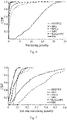
- Figs. 5 to 7 show the detailed performance of each algorithm on the QoE influencing factors on the FCC network data set in the form of a cumulative distribution function (CDF); and Figs. 8 to 10 show the detailed performance of each algorithm on the QoE influencing factors on the HSDPA network data set in the form of a CDF graph. It can be seen from the performance of each algorithm on various QoE influencing factors that RBC provides the best comprehensive QoE under all test network conditions, and by combining QoE optimization and cache control, RBC can achieve less stuttering time than optimization-based algorithms (Robust MPC and MPC) and achieve a better balance between the QoE influencing factors than buffer-based methods (BBA and BOLA).
- optimization-based algorithms Robot MPC and MPC
- BBA and BOLA buffer-based methods
- the simulation results based on a real video player and a real throughput trajectory show that the method RBC provided by the embodiment of the present disclosure can accurately control the cache amount at the target level, and can simultaneously achieve low time delay, less stuttering and high bit rate.
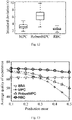
- Figs. 11 and 12 compare the statistical characteristics of the cache amount changes realized by the algorithms on a bandwidth data set. It can be seen that the average cache amount of MPC is very small, and therefore, any prediction error and throughput burst jitter will cause stuttering. Although Robust MPC maintains a large cache amount, the cache amount fluctuates very sharply and the standard deviation is large, so stuttering events still occur frequently. By combining cache control and QoE optimization, only RBC can accurately control the cache amount at a desired level.
- an embodiment of the present disclosure also provides a video bit rate determining apparatus, applied in a device for playing a video on the basis of consecutively numbered video blocks.
- the apparatus includes a throughput-prediction-error cancellation parameter determining unit 1401, a cache amount determining unit 1402, a bit rate determining unit 1403 and a video requesting unit 1404.
- the throughput-prediction-error cancellation parameter determining unit 1401 is configured to determine a cancellation parameter ⁇ (k) configured to cancel a throughput prediction error of a k-th video block F k , and k is a positive integer.
- the cache amount determining unit 1402 is configured to determine, on the basis of a throughput prediction value of each of video blocks from the video block F k to a (k+N-1)-th video block F k+N-1 and the cancellation parameter ⁇ (k), a cache amount prediction value of each of the video blocks from the video block F k to the video block F k+N-1 at the end of download thereof, and N is a positive integer greater than 1.
- the bit rate determining unit 1403 is configured to determine a video playback quality loss value according to a weight value of a bit rate change between adjacent video blocks requested and a cache prediction error between the cache amount prediction value and a preset cache amount target value of each of the video blocks from the video block F k to the video block F k+N-1 at the end of download thereof, and determine a bit rate r(k) when the video playback quality loss value is minimum.
- the video requesting unit 1404 is configured to request the video block F k at a bit rate that does not exceed r(k).
- the cache amount determining unit is configured to determine the throughput prediction value of each of the video blocks from the video block F k to the video block F k+N-1 according to the following steps:
- the cache amount determining unit is configured to:
- an embodiment of the present disclosure also provides an electronic device, including a processor 1501 and a memory 1502 configured to store an executable instruction of the processor.
- the processor is configured to execute the following processes:
- the processor is configured to execute: determining the throughput prediction value of each of the video blocks from the video block F k to the video block F k+N-1 according to the following steps:
- the processor is configured to execute:
- an embodiment of the present disclosure also provides a storage medium including instructions, such as a memory including instructions, and the instructions may be executed by a processor of the electronic device to complete the above-mentioned method.
- the storage medium may be a computer readable non-volatile storage medium, for example, the computer readable non-volatile storage medium may be a ROM, a random access memory (RAM), a CD-ROM, a magnetic tape, a floppy disk, and an optical data storage device, etc.
Landscapes
- Engineering & Computer Science (AREA)
- Multimedia (AREA)
- Signal Processing (AREA)
- Databases & Information Systems (AREA)
- Computer Networks & Wireless Communication (AREA)
- Health & Medical Sciences (AREA)
- Biomedical Technology (AREA)
- General Health & Medical Sciences (AREA)
- Compression Or Coding Systems Of Tv Signals (AREA)
- Two-Way Televisions, Distribution Of Moving Picture Or The Like (AREA)
Applications Claiming Priority (2)
| Application Number | Priority Date | Filing Date | Title |
|---|---|---|---|
| CN201910672469.2A CN110300315B (zh) | 2019-07-24 | 2019-07-24 | 一种视频码率确定方法、装置、电子设备及存储介质 |
| PCT/CN2020/100737 WO2021012946A1 (zh) | 2019-07-24 | 2020-07-07 | 一种视频码率确定方法、装置、电子设备及存储介质 |
Publications (2)
| Publication Number | Publication Date |
|---|---|
| EP4007285A1 true EP4007285A1 (de) | 2022-06-01 |
| EP4007285A4 EP4007285A4 (de) | 2022-09-28 |
Family
ID=68031812
Family Applications (1)
| Application Number | Title | Priority Date | Filing Date |
|---|---|---|---|
| EP20844386.1A Withdrawn EP4007285A4 (de) | 2019-07-24 | 2020-07-07 | Verfahren und vorrichtung zur bestimmung der videobitrate, elektronische vorrichtung und speichermedium |
Country Status (4)
| Country | Link |
|---|---|
| US (1) | US11425394B2 (de) |
| EP (1) | EP4007285A4 (de) |
| CN (1) | CN110300315B (de) |
| WO (1) | WO2021012946A1 (de) |
Families Citing this family (20)
| Publication number | Priority date | Publication date | Assignee | Title |
|---|---|---|---|---|
| CN110300315B (zh) * | 2019-07-24 | 2021-08-13 | 北京达佳互联信息技术有限公司 | 一种视频码率确定方法、装置、电子设备及存储介质 |
| CN110996038B (zh) | 2019-11-19 | 2020-11-10 | 清华大学 | 一种面向多人互动直播的自适应码率调节方法 |
| CN111031347A (zh) * | 2019-11-29 | 2020-04-17 | 广州市百果园信息技术有限公司 | 一种视频处理的方法及装置、电子设备、存储介质 |
| CN111263225A (zh) * | 2020-01-08 | 2020-06-09 | 恒安嘉新(北京)科技股份公司 | 视频卡顿预测方法、装置、计算机设备及存储介质 |
| CN111277870B (zh) * | 2020-03-05 | 2022-09-30 | 广州市百果园信息技术有限公司 | 带宽预测方法、装置、服务器及存储介质 |
| CN111447448B (zh) * | 2020-04-13 | 2022-02-01 | 武汉理工大学 | 一种基于用户体验与终端能耗的dash视频码率选择方法 |
| CN111862995A (zh) * | 2020-06-22 | 2020-10-30 | 北京达佳互联信息技术有限公司 | 一种码率确定模型训练方法、码率确定方法及装置 |
| CN111669627B (zh) * | 2020-06-30 | 2022-02-15 | 广州市百果园信息技术有限公司 | 一种视频码率的确定方法、装置、服务器和存储介质 |
| CN112637631B (zh) * | 2020-12-17 | 2022-04-26 | 清华大学 | 码率确定方法、装置、电子设备和存储介质 |
| CN112752117B (zh) * | 2020-12-30 | 2023-03-28 | 百果园技术(新加坡)有限公司 | 一种视频缓存方法、装置、设备及存储介质 |
| CN113038187B (zh) * | 2021-02-28 | 2022-04-08 | 中南大学 | 视频体验质量公平的实用网络带宽分配方法、设备及介质 |
| CN116132717B (zh) * | 2021-11-12 | 2025-10-03 | 中兴通讯股份有限公司 | 入向码流码率获取方法、收流处理方法、电子设备、介质 |
| CN114979660B (zh) * | 2021-12-16 | 2025-12-30 | 北方信息控制研究院集团有限公司 | 面向可伸缩编码视频的码率联合决策方法 |
| CN114630150A (zh) * | 2022-02-17 | 2022-06-14 | 儒安物联科技集团有限公司 | 一种适应用户多样性的视频流abr算法 |
| US12556778B2 (en) * | 2022-03-23 | 2026-02-17 | Ntt, Inc. | Video player, video playback method, and program |
| CN114900732B (zh) * | 2022-04-25 | 2024-01-12 | 北京奇艺世纪科技有限公司 | 视频缓存方法、装置、电子设备及存储介质 |
| CN116112740B (zh) * | 2023-01-19 | 2024-10-01 | 深圳大学 | 一种视频播放方法、装置、电子设备及存储介质 |
| CN116366885B (zh) * | 2023-02-20 | 2025-09-30 | 北京达佳互联信息技术有限公司 | 多媒体资源的码率确定方法、装置、电子设备及存储介质 |
| WO2024261800A1 (ja) * | 2023-06-19 | 2024-12-26 | 富士通株式会社 | 制御装置、無線通信システム、制御方法 |
| CN118524217B (zh) * | 2024-07-22 | 2024-12-03 | 宁波康达凯能医疗科技有限公司 | 一种基于李雅普诺夫稳定性的帧间图像码率控制方法 |
Family Cites Families (22)
| Publication number | Priority date | Publication date | Assignee | Title |
|---|---|---|---|---|
| US6310857B1 (en) * | 1997-06-16 | 2001-10-30 | At&T Corp. | Method and apparatus for smoothing and multiplexing video data flows |
| JP2005503722A (ja) * | 2001-09-21 | 2005-02-03 | ブリティッシュ・テレコミュニケーションズ・パブリック・リミテッド・カンパニー | 輻輳制御用に伝送レートを計算するためにバッファサイズの受領を用いるデータ通信方法とシステム |
| FR2863130A1 (fr) | 2003-12-01 | 2005-06-03 | Thomson Licensing Sa | Dispositif et procede de preparation de donnees d'emission et produits correspondants |
| JP4643330B2 (ja) * | 2005-03-28 | 2011-03-02 | ソニー株式会社 | 通信処理装置、データ通信システム、および通信処理方法、並びにコンピュータ・プログラム |
| JP4730427B2 (ja) * | 2008-11-21 | 2011-07-20 | ソニー株式会社 | 通信処理装置、データ通信システム、および通信処理方法、並びにコンピュータ・プログラム |
| US8494075B2 (en) * | 2010-08-26 | 2013-07-23 | Qualcomm Incorporated | Single stream phase tracking during channel estimation in a very high throughput wireless MIMO communication system |
| US20140282792A1 (en) * | 2013-03-15 | 2014-09-18 | Cygnus Broadband, Inc. | Video streaming with buffer occupancy prediction based quality adaptation |
| CN106464601B (zh) * | 2014-03-28 | 2020-05-19 | 维格尔传播公司 | 信道捆绑 |
| EP3210384B1 (de) * | 2014-10-20 | 2020-05-20 | Telefonaktiebolaget LM Ericsson (publ) | Netzwerkknoten und verfahren zur handhabung eines verfahrens zur steuerung einer datenübertragung im zusammenhang mit videodaten eines video-streaming-diensts |
| US9756112B2 (en) * | 2015-02-11 | 2017-09-05 | At&T Intellectual Property I, L.P. | Method and system for managing service quality according to network status predictions |
| US10271112B2 (en) * | 2015-03-26 | 2019-04-23 | Carnegie Mellon University | System and method for dynamic adaptive video streaming using model predictive control |
| WO2016080884A1 (en) * | 2015-06-03 | 2016-05-26 | Telefonaktiebolaget L M Ericsson (Publ) | Methods, radio communication device and base station device for managing a media stream |
| JP2017069849A (ja) * | 2015-09-30 | 2017-04-06 | パナソニック インテレクチュアル プロパティ コーポレーション オブ アメリカPanasonic Intellectual Property Corporation of America | 映像制御装置、映像配信システムおよび映像制御方法 |
| US10771833B2 (en) * | 2016-05-31 | 2020-09-08 | The Trustees Of Princeton University | System and method for improving streaming video via better buffer management |
| CN106453270B (zh) * | 2016-09-20 | 2019-04-23 | 天津大学 | 基于pi控制流媒体的自适应传输算法 |
| EP3520420B1 (de) * | 2016-09-30 | 2022-11-02 | British Telecommunications public limited company | An die bedeutung für den betrachter anpassbare bitratenbereitstellung |
| KR101837637B1 (ko) * | 2016-12-08 | 2018-03-13 | 서울대학교산학협력단 | 클라이언트 측 ack 조정 기반 적응 스트리밍 방법 및 장치 |
| US10348796B2 (en) * | 2016-12-09 | 2019-07-09 | At&T Intellectual Property I, L.P. | Adaptive video streaming over preference-aware multipath |
| CN109218781A (zh) * | 2017-07-07 | 2019-01-15 | 华为软件技术有限公司 | 视频码率控制方法和装置 |
| CN107613330B (zh) * | 2017-10-20 | 2019-09-20 | 清华大学 | 一种视频码率自适应方法 |
| US11201901B2 (en) * | 2018-04-30 | 2021-12-14 | Dolby International Ab | Methods and systems for streaming media data over a content delivery network |
| CN110300315B (zh) * | 2019-07-24 | 2021-08-13 | 北京达佳互联信息技术有限公司 | 一种视频码率确定方法、装置、电子设备及存储介质 |
-
2019
- 2019-07-24 CN CN201910672469.2A patent/CN110300315B/zh active Active
-
2020
- 2020-07-07 WO PCT/CN2020/100737 patent/WO2021012946A1/zh not_active Ceased
- 2020-07-07 EP EP20844386.1A patent/EP4007285A4/de not_active Withdrawn
-
2022
- 2022-01-06 US US17/570,137 patent/US11425394B2/en active Active
Also Published As
| Publication number | Publication date |
|---|---|
| EP4007285A4 (de) | 2022-09-28 |
| CN110300315A (zh) | 2019-10-01 |
| US11425394B2 (en) | 2022-08-23 |
| WO2021012946A1 (zh) | 2021-01-28 |
| CN110300315B (zh) | 2021-08-13 |
| US20220132139A1 (en) | 2022-04-28 |
Similar Documents
| Publication | Publication Date | Title |
|---|---|---|
| EP4007285A1 (de) | Verfahren und vorrichtung zur bestimmung der videobitrate, elektronische vorrichtung und speichermedium | |
| Mao et al. | Neural adaptive video streaming with pensieve | |
| Yadav et al. | Quetra: A queuing theory approach to dash rate adaptation | |
| Bentaleb et al. | Data-driven bandwidth prediction models and automated model selection for low latency | |
| WO2018161447A1 (zh) | 一种cdn客户源站的防护方法和系统 | |
| Yoshida et al. | Constructing stochastic model of TCP throughput on basis of stationarity analysis | |
| CN111031347A (zh) | 一种视频处理的方法及装置、电子设备、存储介质 | |
| US20140258382A1 (en) | Application congestion control | |
| WO2023053115A1 (en) | System and method for adapting transmission rate computation by a content transmitter | |
| Wisniewski et al. | On delimiting video rebuffering for stream-switching adaptive applications | |
| CN111311286A (zh) | 一种智能客服数据处理方法、装置及计算设备、存储介质 | |
| Wang et al. | Towards forward-looking online bitrate adaptation for dash | |
| Vega et al. | Cognitive streaming on android devices | |
| Wei et al. | A history-based tcp throughput prediction incorporating communication quality features by support vector regression for mobile network | |
| US9537740B2 (en) | Monitoring device usage | |
| Modi et al. | QoS driven channel selection algorithm for opportunistic spectrum access | |
| DK2941857T3 (en) | SITE BASED SERVER SELECTION | |
| US9998347B2 (en) | Monitoring device usage | |
| Noh et al. | Congestion‐aware HTTP adaptive streaming system over SDN‐enabled Wi‐Fi network | |
| CN117880118A (zh) | 基于XGBoost集成算法与核岭回归融合的实时带宽预测方法 | |
| Xu et al. | Predictive prefetching for MPEG DASH over LTE networks | |
| CN117971484A (zh) | 一种交易限流控制的阈值调整方法及电子设备 | |
| Sharif et al. | Ortia: An algorithm to improve quality of experience in http adaptive bitrate streaming sessions | |
| Marquez et al. | An intelligent technique for controlling web prefetching costs at the server side | |
| Wang et al. | Improving robustness of dash against network uncertainty |
Legal Events
| Date | Code | Title | Description |
|---|---|---|---|
| STAA | Information on the status of an ep patent application or granted ep patent |
Free format text: STATUS: THE INTERNATIONAL PUBLICATION HAS BEEN MADE |
|
| PUAI | Public reference made under article 153(3) epc to a published international application that has entered the european phase |
Free format text: ORIGINAL CODE: 0009012 |
|
| STAA | Information on the status of an ep patent application or granted ep patent |
Free format text: STATUS: REQUEST FOR EXAMINATION WAS MADE |
|
| 17P | Request for examination filed |
Effective date: 20220127 |
|
| AK | Designated contracting states |
Kind code of ref document: A1 Designated state(s): AL AT BE BG CH CY CZ DE DK EE ES FI FR GB GR HR HU IE IS IT LI LT LU LV MC MK MT NL NO PL PT RO RS SE SI SK SM TR |
|
| A4 | Supplementary search report drawn up and despatched |
Effective date: 20220826 |
|
| RIC1 | Information provided on ipc code assigned before grant |
Ipc: H04N 19/103 20140101ALI20220822BHEP Ipc: H04N 21/845 20110101ALI20220822BHEP Ipc: H04N 21/442 20110101ALI20220822BHEP Ipc: H04N 21/44 20110101ALI20220822BHEP Ipc: H04N 21/426 20110101ALI20220822BHEP Ipc: H04N 21/2662 20110101AFI20220822BHEP |
|
| DAV | Request for validation of the european patent (deleted) | ||
| DAX | Request for extension of the european patent (deleted) | ||
| STAA | Information on the status of an ep patent application or granted ep patent |
Free format text: STATUS: THE APPLICATION HAS BEEN WITHDRAWN |
|
| 18W | Application withdrawn |
Effective date: 20230117 |