EP4007350A1 - Dispositif de communication, procédé d'enregistrement de données et support non transitoire lisible par ordinateur - Google Patents
Dispositif de communication, procédé d'enregistrement de données et support non transitoire lisible par ordinateur Download PDFInfo
- Publication number
- EP4007350A1 EP4007350A1 EP21768337.4A EP21768337A EP4007350A1 EP 4007350 A1 EP4007350 A1 EP 4007350A1 EP 21768337 A EP21768337 A EP 21768337A EP 4007350 A1 EP4007350 A1 EP 4007350A1
- Authority
- EP
- European Patent Office
- Prior art keywords
- data
- plane
- communication
- wireless
- proxy
- Prior art date
- Legal status (The legal status is an assumption and is not a legal conclusion. Google has not performed a legal analysis and makes no representation as to the accuracy of the status listed.)
- Withdrawn
Links
- 238000004891 communication Methods 0.000 title claims abstract description 105
- 238000000034 method Methods 0.000 title claims abstract description 56
- 230000001052 transient effect Effects 0.000 title 1
- 230000008569 process Effects 0.000 claims abstract description 42
- 238000012795 verification Methods 0.000 claims description 30
- 230000008859 change Effects 0.000 claims description 5
- 238000010586 diagram Methods 0.000 description 19
- 230000015654 memory Effects 0.000 description 12
- 238000004458 analytical method Methods 0.000 description 8
- 230000006835 compression Effects 0.000 description 3
- 238000007906 compression Methods 0.000 description 3
- 230000006870 function Effects 0.000 description 3
- 238000012544 monitoring process Methods 0.000 description 2
- 230000003287 optical effect Effects 0.000 description 2
- 238000012545 processing Methods 0.000 description 2
- 230000008901 benefit Effects 0.000 description 1
- 230000005540 biological transmission Effects 0.000 description 1
- 238000004590 computer program Methods 0.000 description 1
- 230000000694 effects Effects 0.000 description 1
- 238000012986 modification Methods 0.000 description 1
- 230000004048 modification Effects 0.000 description 1
- 239000013307 optical fiber Substances 0.000 description 1
- 239000004065 semiconductor Substances 0.000 description 1
- 238000012360 testing method Methods 0.000 description 1
Images








Classifications
-
- H—ELECTRICITY
- H04—ELECTRIC COMMUNICATION TECHNIQUE
- H04L—TRANSMISSION OF DIGITAL INFORMATION, e.g. TELEGRAPHIC COMMUNICATION
- H04L43/00—Arrangements for monitoring or testing data switching networks
- H04L43/06—Generation of reports
- H04L43/062—Generation of reports related to network traffic
-
- H—ELECTRICITY
- H04—ELECTRIC COMMUNICATION TECHNIQUE
- H04L—TRANSMISSION OF DIGITAL INFORMATION, e.g. TELEGRAPHIC COMMUNICATION
- H04L41/00—Arrangements for maintenance, administration or management of data switching networks, e.g. of packet switching networks
- H04L41/08—Configuration management of networks or network elements
- H04L41/0866—Checking the configuration
-
- H—ELECTRICITY
- H04—ELECTRIC COMMUNICATION TECHNIQUE
- H04L—TRANSMISSION OF DIGITAL INFORMATION, e.g. TELEGRAPHIC COMMUNICATION
- H04L43/00—Arrangements for monitoring or testing data switching networks
- H04L43/12—Network monitoring probes
-
- H—ELECTRICITY
- H04—ELECTRIC COMMUNICATION TECHNIQUE
- H04L—TRANSMISSION OF DIGITAL INFORMATION, e.g. TELEGRAPHIC COMMUNICATION
- H04L63/00—Network architectures or network communication protocols for network security
- H04L63/04—Network architectures or network communication protocols for network security for providing a confidential data exchange among entities communicating through data packet networks
- H04L63/0428—Network architectures or network communication protocols for network security for providing a confidential data exchange among entities communicating through data packet networks wherein the data content is protected, e.g. by encrypting or encapsulating the payload
-
- H—ELECTRICITY
- H04—ELECTRIC COMMUNICATION TECHNIQUE
- H04L—TRANSMISSION OF DIGITAL INFORMATION, e.g. TELEGRAPHIC COMMUNICATION
- H04L67/00—Network arrangements or protocols for supporting network services or applications
- H04L67/2866—Architectures; Arrangements
- H04L67/2885—Hierarchically arranged intermediate devices, e.g. for hierarchical caching
-
- H—ELECTRICITY
- H04—ELECTRIC COMMUNICATION TECHNIQUE
- H04W—WIRELESS COMMUNICATION NETWORKS
- H04W24/00—Supervisory, monitoring or testing arrangements
- H04W24/06—Testing, supervising or monitoring using simulated traffic
-
- H—ELECTRICITY
- H04—ELECTRIC COMMUNICATION TECHNIQUE
- H04L—TRANSMISSION OF DIGITAL INFORMATION, e.g. TELEGRAPHIC COMMUNICATION
- H04L41/00—Arrangements for maintenance, administration or management of data switching networks, e.g. of packet switching networks
- H04L41/34—Signalling channels for network management communication
-
- H—ELECTRICITY
- H04—ELECTRIC COMMUNICATION TECHNIQUE
- H04L—TRANSMISSION OF DIGITAL INFORMATION, e.g. TELEGRAPHIC COMMUNICATION
- H04L63/00—Network architectures or network communication protocols for network security
- H04L63/16—Implementing security features at a particular protocol layer
- H04L63/168—Implementing security features at a particular protocol layer above the transport layer
-
- H—ELECTRICITY
- H04—ELECTRIC COMMUNICATION TECHNIQUE
- H04W—WIRELESS COMMUNICATION NETWORKS
- H04W88/00—Devices specially adapted for wireless communication networks, e.g. terminals, base stations or access point devices
- H04W88/08—Access point devices
- H04W88/085—Access point devices with remote components
Definitions
- Non Patent Literature 1 discloses a procedure, an analysis method, and the like for verifying interconnectivity between an O-DU and an O-RU.
- Non Patent Literature 1 discloses that a Fronthaul (FH) Protocol analyzer is connected between the O-DU and the O-RU to analyze data to be sent between the O-DU and the O-RU with the FH Protocol analyzer.
- FH Fronthaul
- Non Patent Literature 1 can only analyze data that can be acquired before a Secure Shell (SSH) connection between the O-DU and the O-RU is established. That is, the FH Protocol analyzer cannot acquire information sent through the SSH after the SSH connection between the O-DU and the O-RU is established. Thus, the FH Protocol analyzer has a problem of being unable to analyze data to be sent between the O-DU and the O-RU through the SSH connection.
- SSH Secure Shell
- a communication apparatus includes a communication unit that establishes a first Secure Shell (SSH) connection with a wireless apparatus that performs wireless communication with a communication terminal, and establishes a second SSH connection with a control apparatus that performs a baseband process related to a signal used in the wireless communication, and a data recording unit that records data of a management plane received from the wireless apparatus through the first SSH connection or the data of the management plane received from the control apparatus through the second SSH connection.
- SSH Secure Shell
- a program causes a computer to execute establishing a first Secure Shell (SSH) connection with a wireless apparatus that performs wireless communication with a communication terminal, establishing a second SSH connection with a control apparatus that performs a baseband process related to a signal used in the wireless communication, and recording data of a management plane received from the wireless apparatus through the first SSH connection or the data of the management plane received from the control apparatus through the second SSH connection.
- SSH Secure Shell
- the communication apparatus 10 may be a computer apparatus that operates by executing a program.
- the communication unit 11 establishes a first SSH connection with a wireless apparatus 20 that performs wireless communication with a communication terminal 40, and establishes a second SSH connection with a control apparatus 30 that performs a baseband process related to signals used by the wireless apparatus 20.
- the communication terminal 40 may be, for example, a smartphone terminal, an Internet of Things (IoT) terminal, a Machine Type Communication (MTC) device, or the like.
- the wireless apparatus 20 may be, for example, an O-RU entity (hereinafter, referred to as an O-RU) specified in the O-RAN alliance.
- the control apparatus 30 may be, for example, an O-DU entity (hereinafter, referred to as an O-DU) specified in the O-RAN alliance.
- An entity may be referred to as a node or a node apparatus.
- the communication unit 11 authenticates the wireless apparatus 20 with the public key A to establish the first SSH connection with the wireless apparatus 20.
- the communication unit 11 authenticates the control apparatus 30 with the public key B to establish the second SSH connection with the control apparatus 30.
- the establishment of an SSH connection is not limited to a method with a public key and may be performed by other methods.
- the data recording unit 12 records data of a management plane received from the wireless apparatus 20 through the first SSH connection.
- the data recording unit 12 further records the data of the management plane received from the control apparatus 30 through the second SSH connection.
- the communication apparatus 10 terminates the first SSH connection and the second SSH connection.
- the data recording unit 12 can decrypt encrypted data received through the first SSH connection or the second SSH connection. That is, the data recording unit 12 holds data in a format that allows the header and payload in each layer of the data to be analyzed.
- the management plane handles, for example, data or messages used by the control apparatus 30 or a Network Management System (NMS) to maintain or monitor the wireless apparatus 20.
- the data of the management plane is data that is sent and received in the management plane.
- the communication apparatus 10 can establish an SSH connection with each of the wireless apparatus 20 and the control apparatus 30.
- the data of the management plane to be generally sent between the wireless apparatus 20 and the control apparatus 30 through the SSH connection can be held in a format that allows the header and payload to be analyzed.
- the communication apparatus 10 can acquire data to be sent after an SSH connection between the wireless apparatus 20 and the control apparatus 30 is established and analyze the acquired data.
- the communication system shown in Fig. 2 is a system configuration specified mainly in the O-RAN alliance.
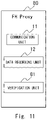
- the communication system in Fig. 2 includes a Fronthaul (FH)-Proxy entity (hereinafter, referred to as an FH-Proxy) 50, an O-RU 60, and an O-DU 70.
- FH-Proxy Fronthaul-Proxy entity
- a Management (M)-Plane a Control (C)-Plane, a User (U)-Plane, and a Synchronization (S)-Plane are configured.
- M-Plane a Management (M)-Plane
- C Control
- U User
- S Synchronization
- an M-Plane, a C-Plane, a U-Plane, and an S-Plane are also configured.
- the FH-Proxy 50 behaves pseudo as an O-DU to the O-RU 60, and behaves pseudo as an O-RU to the O-DU 70.
- the C-Plane is a protocol for transferring control signals.
- the U-Plane is a protocol for transferring user data.
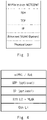
- a protocol stack of the C-Plane and the U-Plane is shown in Fig. 4 .
- the C-Plane and the U-Plane support a protocol stack for transmitting signals used in enhanced Common Public Radio Interface (eCPRI) or Radio over Ethernet (RoE) using Ethernet/IP/User Datagram Protocol (UDP).
- eCPRI enhanced Common Public Radio Interface
- RoE Radio over Ethernet
- UDP Ethernet/IP/User Datagram Protocol
- the C-Plane and the U-Plane may support a protocol stack for transmitting signals used in eCPRI or RoE directly using Ethernet.
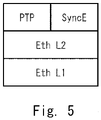
- the S-Plane is a protocol for achieving synchronization between apparatuses. Specifically, a protocol stack of the S-Plane is shown in Fig. 5 .
- the S-Plane supports a protocol stack for transmitting signals used in Precision Time Protocol (PTP) and SyncE using Ethernet.
- PTP Precision Time Protocol
- SyncE SyncE using Ethernet.
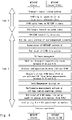
- Fig. 6 shows a procedure, for example, from the start of the O-RU 60 to be managed by the O-DU 70 until the management of the O-RU 60 by the O-DU 70 becomes possible. Management may be rephrased as monitoring.
- the O-DU 70 which is a network apparatus that manages the O-RU 60, corresponds to a NETCONF client, and the O-RU 60 to be managed corresponds to a NETCONF server.
- Fig. 6 shows that processes are performed between the NETCONF client corresponding to the O-DU 70 and the NETCONF server corresponding to the O-RU 60.
- the communication system used in the second example embodiment has a configuration in which the FH-Proxy 50 is arranged between the O-DU 70 and the O-RU 60.
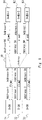
- Fig. 6 shows Start-up processes to be performed among the NETCONF client, the FH-Proxy 50, and the NETCONF server.
- the FH-Proxy 50, the O-RU 60, and the O-DU 70 performs processes from "Transport Layer Initialization" to "SSH Secure Connection Established" that are classified as Type A shown in Fig. 6 .
- the processes classified as Type A are the processes between the O-RU 60 and the FH-Proxy 50 and the processes between the O-DU 70 and the FH-Proxy 50, which are performed independently.
- the FH-Proxy 50 operates as the NETCONF client when communicating with the O-RU 60 that is the NETCONF server.
- the FH-Proxy 50 operates as the NETCONF server when communicating with the O-DU 70 that is the NETCONF client.
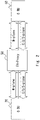
- SSH connections are established between the FH-Proxy 50 and the O-RU 60 and between the FH-Proxy 50 and the O-DU 70 as shown in Fig. 7 .
- the FH-Proxy 50, the O-RU 60, and the O-DU 70 also perform the configuration of Transport Layer.
- the configuration of Transport Layer may be, for example, to configure an IP address or an Ethernet address, which is a Transport Layer address, for each apparatus.
- the FH-Proxy 50 sets a Transport Layer address for communicating with the O-DU 70 to be different from a Transport Layer address for communicating with the O-RU 60.
- the configuration of Transport Layer and the establishment of the SSH connection are performed independently in the link between the O-RU 60 and the FH-Proxy 50 and the link between the O-DU 70 and the FH-Proxy 50.
- the FH-Proxy 50, the O-RU 60, and the O-DU 70 perform processes from "NETCONF Capability discovery" to "Configuration the O-RU operational parameters" that are classified as Type B shown in Fig. 6 .
- the processes classified as Type B are processes performed between the O-RU 60 that is the NETCONF server and the O-DU 70 that is the NETCONF client via the FH-Proxy 50.
- Each process of the Start-up sequence shown in Fig. 6 is performed using a message specified in NETCONF.
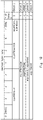
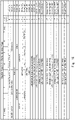
- the set of parameters configured in the message is specified in the Yang module shown in Fig. 8 .
- the parameters labeled "A" are the parameters used in the processes classified as Type A, and the other parameters are used in the processes classified as Type B.
- the parameters labeled "O-RU Capability" indicate Capability information supported by the O-RU 60.
- an rpc message, an rpc-reply message, or a notification message is used, for example.
- the O-DU 70 and the O-RU 60 use these messages to configure parameters (edit-config), to acquire parameters (get-config), or the like.
- the O-RU 60 and the FH-Proxy 50 configure MAC addresses designated in a Transport flow of "o-ran-processing element" of the Yang module. This defines the addresses of both ends of the flow defined between the O-RU 60 and the FH-Proxy 50. Each address can be a Source address and a Destination Address of data to be sent between the O-RU 60 and the FH-Proxy 50.
- the O-DU 70 and the FH-Proxy 50 similarly configure MAC addresses designated in the Transport flow of "o-ran-processing element" of the Yang module. This defines the addresses of both ends of the flow defined between the O-RU 60 and the FH-Proxy 50. Each address can be a Source address and a Destination Address of data to be sent between the O-DU 70 and the FH-Proxy 50.
- Fig. 9 shows a flow defined using address information designated in "o-ran-processing-element".
- Fig. 9 shows that the FH-Proxy 50 is arranged between an O-RU 61, an O-RU 62, and an O-RU 63 and an O-DU 71, an O-DU 72, and an O-DU 73.
- Each of the number of O-DUs and the number of O-RUs connected to the FH-Proxy 50 is not one, but multiple as shown in Fig. 9 , and the numbers of O-DUs and O-RUs may not be the same.
- the FH-Proxy 50 defines an Address-1 of the O-DU 71 and an address-1A of the FH-Proxy 50 as a flow1 and communicates with the O-DU 71.
- the flow may be referred to as a Transport flow.
- the FH-Proxy 50 defines an Address-2 of the O-DU 72 and an address-2A of the FH-Proxy 50 as a flow2 and communicates with the O-DU 72.
- the FH-Proxy 50 defines an Address-3 of the O-DU 73 and an address-3A of the FH-Proxy 50 as a flow3 and communicates with the O-DU 73.
- the FH-Proxy 50 defines an Address-4 of the O-RU 61 and an address-4A of the FH-Proxy 50 as a flow4 and communicates with the O-RU 61.
- the FH-Proxy 50 defines an Address-5 of the O-RU 62 and an address-5A of the FH-Proxy 50 as a flow5 and communicates with the O-RU 62.
- the FH-Proxy 50 defines an Address-6 of the O-RU 63 and an address-6A of the FH-Proxy 50 as a flow6 and communicates with the O-RU 63.
- the interconnectivity between any O-DU and any O-RU connected to the FH-Proxy 50 can be verified by configuring the FH-Proxy 50 without physically plugging and unplugging the O-DUs and the O-RUs.
- the FH-Proxy 50 uses the Address-1A and the Address-4A for the verification.
- the FH-Proxy 50 uses the flow1 and the flow4 for the verification.
- the FH-Proxy 50 uses the Address-2A and the Address-6A for the verification.
- the FH-Proxy 50 When performing a Type B process, the FH-Proxy 50 terminates and converts the Transport Layer address as shown in Fig. 9 , but allows the NETCONF layer, which is an upper layer, to be transparent.
- the FH-Proxy 50 records information transmitted in the NETCONF layer. In other words, the FH-Proxy 50 records information transmitted in the NETCONF layer as a log and visualizes the information transmitted in the NETCONF layer.
- the FH-Proxy 50 when performing a Type A process, the FH-Proxy 50 records information transmitted in the NETCONF layer as a log and visualizes the information transmitted in the NETCONF layer.
- the process related to "Retrieval of O-RU Information” is a process to be performed by the O-DU 70 to acquire a parameter related to the O-RU 60.
- the O-DU 70 sends, to the FH-Proxy 50, a rpc message in which "get-config" for acquiring a parameter and "ru-id” indicating the parameter to be acquired are set (S11).
- the FH-Proxy 50 changes the Transport Layer address of the received rpc message (S12). Specifically, the FH-Proxy 50 changes the destination MAC address of the rpc message to the MAC address of the O-RU 60 and changes the source MAC address to the MAC address of the FH-Proxy 50.
- the FH-Proxy 50 changes "ietf-interface", "o-ran-interface", "o-ran-processing-element" used in the processes classified as Type A.
- the FH-Proxy 50 transfers, to the O-RU 60, the rpc message whose Transport Layer address has been changed (S13). At this time, the FH-Proxy 50 allows the information in the NETCONF layer of the rpc message to be transparent.
- the FH-Proxy 50 records the rpc message (S14).
- the FH-Proxy 50 may record the header and payload of the rpc message.
- the FH-Proxy 50 changes the Transport Layer address of the received rpc-reply message (S16). Specifically, the FH-Proxy 50 changes the destination MAC address of the rpc-reply message to the MAC address of the O-DU 70 and changes the source MAC address to the MAC address of the FH-Proxy 50.
- the parameters of the Yang module used to change the Transport Layer address are similar to those in step S12.
- the FH-Proxy 50 transfers, to the O-DU 70, the rpc-reply message whose Transport Layer address has been changed (S17).
- the FH-Proxy 50 records the rpc-reply message (S18).
- the FH-Proxy 50 may record the header and payload of the rpc-reply message.
- the FH-Proxy 50 records the header and payload of the rpc-reply message, and thereby can record "ru-id_A" that is the information about the O-RU 60 configured in the rpc-reply message as information designated in the M-Plane.
- Fig. 10 the flow of data to be sent in the M-Plane is described, but the similar flow applies to data in the C-Plane, the U-Plane, and the S-Plane. That is, the FH-Proxy 50 convers the Transport Layer address of data in the C-Plane, the U-Plane, and the S-Plane and records information to be sent in each layer.
- the FH-Proxy 50 can record messages related to the M-Plane, the C-Plane, the U-Plane, and the S-Plane. Accordingly, the administrator or the like who manages the FH-Proxy 50 can use the recorded messages for an analysis process.
- a data recording unit 12 records, as data related to the M-Plane, Capability information about an O-RU 60, parameter values configured by an O-DU 70 to the O-RU 60, and the like, for example.
- the data recording unit 12 records the header and payload in each layer of a message related to each of the C-Plane, the U-Plane, and the S-Plane.
- the data recording unit 12 may convert the Transport Layer address of the message related to each of the C-Plane, the U-Plane, and the S-Plane and record the header and payload of each message when transferring it, similarly to the sequence in Fig. 10 .
- the verification unit 81 determines whether the information designated in the M-Plane matches the information set in the Ethernet header. When determining that they do not match, the verification unit 81 may output, to a display unit such as a display connected to the FH-Proxy 80, an analysis result indicating that the information set in the Ethernet header and the information designated in the M-Plane are different values.
- the data recording unit 12 records the eCPRI Transport header contained in the Ethernet payload of the message related to the C-Plane.
- the data recording unit 12 records a Section Type 1 message in the Application layer of the C-Plane.
- the Section Type 1 message is a message to be sent from the O-DU 70 to the O-RU 60 when the Capability information designated by the O-RU 60 in the M-Plane indicates that the message is supported by the O-RU 60.
- “symInc” contained in the Section Type 1 message is set to 1 when the Capability information designated by the O-RU 60 in the M-Plane indicates the parameter is supported by the O-RU 60.
- "beamID” is "Beam id” contained in the Capability information designated by the O-RU 60 in the M-Plane.
- "udCompHdr” is set based on Compression method contained in the Capability information designated by the O-RU 60 in the M-Plane.
- the verification unit 81 determines whether the information designated in the M-Plane matches the information set in the Section Type 1 message. Alternatively, the verification unit 81 may determine whether information to be set based on the information designated in the M-Plane matches the information set in the Section Type 1 message. When determining that they do not match, the verification unit 81 may output, to a display unit such as a display connected to the FH-Proxy 80, an analysis result indicating that the information set in the Section Type 1 message and the information designated in the M-Plane are different values.
- the verification unit 81 determines whether the information designated in the M-Plane matches the information set in the Section Type 3 message. Alternatively, the verification unit 81 may determine whether information to be set based on the information designated in the M-Plane matches the information set in the Section Type 3 message. When determining that they do not match, the verification unit 81 may output, to a display unit such as a display connected to the FH-Proxy 80, an analysis result indicating that the information set in the Section Type 3 message and the information designated in the M-Plane are different values.
- the verification unit 81 determines whether the information designated in the M-Plane matches the information set in the Section Type 1 and 3 message. Alternatively, the verification unit 81 may determine whether information to be set based on the information designated in the M-Plane matches the information set in the Section Type 1 and 3 message. When determining that they do not match, the verification unit 81 may output, to a display unit such as a display connected to the FH-Proxy 80, an analysis result indicating that the information set in the Section Type 1 and 3 message and the information designated in the M-Plane are different values.
- the FH-Proxy 80 analyzes the message recorded by the data recording unit 12 to determine whether the information designated in the M-Plane matches the information set in the C-Plane and the U-Plane. Accordingly, the FH-Proxy 80 can determine whether the information designated in the M-Plane is correctly set to data to be sent from the O-RU 60 or the O-DU 70. In addition, when it is determined that the information designated in the M-Plane is not correctly set, the administrator or the like of the FH-Proxy 80 can analyze the configuration of the O-RU 60 or the O-DU 70 that is the source of the message to determine which apparatus has a problem. Alternatively, the FH-Proxy 80 may autonomously analyze which apparatus has a problem in accordance with a predetermined scenario. In addition, messages that can be analyzed by the verification unit 81 are not limited to the above messages.
- the FH-Proxy 50 or the FH-Proxy 80 is arranged between the O-RU 60 and the O-DU 70, and the FH-Proxy 50 or FH-Proxy 80 acquires a message to be transmitted between the O-RU 60 and the O-DU 70.
- an FH-Proxy 100 may be arranged between the O-RU 60 and an NMS 90 as shown in Fig. 17 , and the FH-Proxy 100 may acquire a message to be transmitted between the O-RU 60 and the NMS 90.
- the O-DU 70 in Fig. 17 controls a part of parameters or functions of the O-RU 60, and the NMS 90 controls the rest of the parameters or functions.
- Any of nodes such as a network switch, a bridge, a router, and a Fronthaul Multiplexer connected between the O-RU 60 and the O-DU 70 or the NMS 90 may be equipped with all or a part of the communication unit, the data recording unit, and the verification unit of the FH-Proxy 80.
- Fig. 18 is a block diagram showing a configuration example of the communication apparatus 10, the FH-Proxy 50, the FH-Proxy 80, and the FH-Proxy 100 (hereinafter, referred to as the communication apparatus 10 or the like).
- the communication apparatus 10 or the like includes a network interface 1201, a processor 1202, and a memory 1203.
- the network interface 1201 is used to communicate with a network node (e.g., eNB, MME, P-GW).
- the network interface 1201 may include, for example, a network interface card (NIC) in compliance with the IEEE 802.3 series.
- eNB represents evolved Node B
- MME Mobility Management Entity
- P-GW represents Packet Data Network Gateway.
- IEEE represents Institute of Electrical and Electronics Engineers.
- the processor 1202 loads software (a computer program) from the memory 1203 and executes it to perform the processes of the communication apparatus 10 or the like that are described with reference to the flowchart in the above example embodiments.
- the processor 1202 may be, for example, microprocessor, an MPU or a CPU.
- the processor 1202 may include a plurality of processors.
- the memory 1203 is configured by a combination of a volatile memory and a non-volatile memory.
- the memory 1203 may include a storage arranged away from the processor 1202.
- the processor 1202 may access the memory 1203 via an Input/Output (I/O) interface that is not illustrated.
- I/O Input/Output
- the memory 1203 is used to store a group of software modules.
- the processor 1202 loads the group of software modules from the memory 1203 and executes them to perform the processes of the communication apparatus 10 or the like described in the above example embodiments.
- each processor included in the communication apparatus 10 or the like in the above example embodiments executes one or more programs containing a set of instructions for causing a computer to execute the algorithms described with reference to the drawings.
- Non-transitory computer-readable media include any type of tangible storage media.
- Examples of non-transitory computer-readable media include magnetic storage media (such as flexible disks, magnetic tapes, and hard disk drives), optical magnetic storage media (such as magneto-optical disks), Compact Disc Read Only Memory (CD-ROM), CD-R, CD-R/W, and semiconductor memories (such as mask ROM, Programmable ROM (PROM), Erasable PROM (EPROM), flash ROM, and Random Access Memory (RAM)).
- the one or more programs may be provided to a computer using any type of transitory computer-readable media.
- Transitory computer-readable media examples include electric signals, optical signals, and electromagnetic waves.
- Transitory computer readable media can provide the one or more programs to a computer through a wired communication line (such as electric wires, and optical fibers) or a wireless communication line.
- a communication apparatus comprising:
- the communication apparatus changes a destination address of first data of the management plane received from the wireless apparatus to a first address indicating the control apparatus to send the first data to the control apparatus, and changes a destination address of second data of the management plane received from the control apparatus to a second address indicating the wireless apparatus to send the second data to the wireless apparatus.
- the communication apparatus changes a source address of the first data to be sent to the control apparatus to a third address indicating the communication apparatus, and changes a source address of the second data to be sent to the wireless apparatus to a fourth address indicating the communication apparatus.
- an address to be set for each of the first data and the second data is a Media Access Control (MAC) address.
- MAC Media Access Control
- the communication apparatus according to any one of Supplementary notes 1 to 5, wherein the data recording means records the data of at least one of the control plane, the user plane, or the synchronization plane received from the wireless apparatus or the control apparatus, and the communication apparatus further includes a verification means for determining, using the data of the management plane, whether correct information is set for the data of at least one of the control plane, the user plane, or the synchronization plane.
- a data recording method comprising:
- a non-transitory computer-readable medium storing a program causing a computer to execute:
Landscapes
- Engineering & Computer Science (AREA)
- Computer Networks & Wireless Communication (AREA)
- Signal Processing (AREA)
- Computer Security & Cryptography (AREA)
- Computer Hardware Design (AREA)
- Computing Systems (AREA)
- General Engineering & Computer Science (AREA)
- Mobile Radio Communication Systems (AREA)
Applications Claiming Priority (2)
| Application Number | Priority Date | Filing Date | Title |
|---|---|---|---|
| JP2020042467 | 2020-03-11 | ||
| PCT/JP2021/002237 WO2021181910A1 (fr) | 2020-03-11 | 2021-01-22 | Dispositif de communication, procédé d'enregistrement de données et support non transitoire lisible par ordinateur |
Publications (2)
| Publication Number | Publication Date |
|---|---|
| EP4007350A1 true EP4007350A1 (fr) | 2022-06-01 |
| EP4007350A4 EP4007350A4 (fr) | 2022-11-23 |
Family
ID=77671399
Family Applications (1)
| Application Number | Title | Priority Date | Filing Date |
|---|---|---|---|
| EP21768337.4A Withdrawn EP4007350A4 (fr) | 2020-03-11 | 2021-01-22 | Dispositif de communication, procédé d'enregistrement de données et support non transitoire lisible par ordinateur |
Country Status (5)
| Country | Link |
|---|---|
| US (1) | US12015523B2 (fr) |
| EP (1) | EP4007350A4 (fr) |
| JP (1) | JP7287569B2 (fr) |
| CN (1) | CN115280736A (fr) |
| WO (1) | WO2021181910A1 (fr) |
Cited By (3)
| Publication number | Priority date | Publication date | Assignee | Title |
|---|---|---|---|---|
| US20230069921A1 (en) * | 2021-01-07 | 2023-03-09 | T-Mobile Usa, Inc. | Selection of open radio access network (ran) components |
| WO2024049218A1 (fr) * | 2022-08-30 | 2024-03-07 | 주식회사 쏠리드랩스 | Procédé et appareil de configuration de paramètres de synchronisation dans un système de communication |
| WO2025133249A1 (fr) * | 2023-12-22 | 2025-06-26 | Telefonaktiebolaget Lm Ericsson (Publ) | Premier nœud de réseau, second nœud de réseau et procédés mis en œuvre par ceux-ci, pour gérer des informations de capacité |
Families Citing this family (3)
| Publication number | Priority date | Publication date | Assignee | Title |
|---|---|---|---|---|
| US12289137B2 (en) * | 2021-08-12 | 2025-04-29 | Viavi Solutions Inc. | Test device with distributed unit emulation for testing in open radio access network |
| EP4723803A1 (fr) | 2023-05-31 | 2026-04-08 | 1FINITY Inc. | Dispositif de communication, dispositif radio, dispositif de commande, système de communication radio et procédé de commande |
| WO2025080033A1 (fr) * | 2023-10-12 | 2025-04-17 | 주식회사 쏠리드랩스 | Procédé et appareil pour prendre en charge l'utilisation de numérologies mixtes dans un système de communication |
Family Cites Families (23)
| Publication number | Priority date | Publication date | Assignee | Title |
|---|---|---|---|---|
| JP2012064007A (ja) * | 2010-09-16 | 2012-03-29 | Daiwa Institute Of Research Business Innovation Ltd | 情報処理装置、通信中継方法およびプログラム |
| US9003057B2 (en) * | 2011-01-04 | 2015-04-07 | Cisco Technology, Inc. | System and method for exchanging information in a mobile wireless network environment |
| US8856910B1 (en) * | 2011-08-31 | 2014-10-07 | Palo Alto Networks, Inc. | Detecting encrypted tunneling traffic |
| WO2013087116A1 (fr) * | 2011-12-15 | 2013-06-20 | Telefonaktiebolaget L M Ericsson (Publ) | Procédé et nœud de réseau permettant de prendre en charge un trafic tcp |
| US8817733B2 (en) * | 2012-08-16 | 2014-08-26 | Intel Corporation | Mobile proxy for cloud radio access network |
| US8539567B1 (en) * | 2012-09-22 | 2013-09-17 | Nest Labs, Inc. | Multi-tiered authentication methods for facilitating communications amongst smart home devices and cloud-based servers |
| WO2016154248A1 (fr) * | 2015-03-25 | 2016-09-29 | Tevetron, Llc | Réseau de communication utilisant des dispositifs de réseau avec une distribution de paquet sur des canaux optiques pré-affectés |
| WO2017101084A1 (fr) * | 2015-12-17 | 2017-06-22 | 华为技术有限公司 | Procédé et dispositif servant à une conversion de protocole |
| US10165459B2 (en) * | 2016-09-07 | 2018-12-25 | Verizon Patent And Licensing Inc. | Remote monitoring of fronthaul radio signals |
| US10498758B1 (en) * | 2017-06-28 | 2019-12-03 | Armis Security Ltd. | Network sensor and method thereof for wireless network vulnerability detection |
| US10587434B2 (en) * | 2017-07-14 | 2020-03-10 | Nicira, Inc. | In-band management interface with user space datapath |
| CN109803453B (zh) | 2017-11-17 | 2023-07-07 | 华为技术有限公司 | 一种通信方法,通信设备及其通信系统 |
| DE102019103055B4 (de) * | 2018-02-07 | 2024-06-06 | Mavenir Systems Inc. | Management von funkeinheiten in cloud radio access netzwerken |
| US10645603B2 (en) * | 2018-03-12 | 2020-05-05 | Wing Aviation Llc | Portable autonomous vehicle connectivity platform |
| JP6598953B1 (ja) | 2018-09-10 | 2019-10-30 | トモソウ・ジャパン株式会社 | 機器最適化配置システム、機器最適化配置支援システム、市場及び機器最適化配置システムによる市場の運営方法 |
| CN112640362A (zh) * | 2018-09-13 | 2021-04-09 | 康普技术有限责任公司 | 用于c-ran的前传即插即用配置 |
| CN112913278B (zh) * | 2018-10-25 | 2023-08-01 | 康普技术有限责任公司 | 用于集中式无线电接入网络的多载波无线电点 |
| US10992554B2 (en) * | 2018-12-07 | 2021-04-27 | At&T Intellectual Property I, L.P. | Intelligent data analytics collectors |
| US11368471B2 (en) * | 2019-07-01 | 2022-06-21 | Beijing Voyager Technology Co., Ltd. | Security gateway for autonomous or connected vehicles |
| CN114128224B (zh) * | 2019-07-26 | 2023-08-29 | 株式会社Ntt都科摩 | 通信装置以及通信方法 |
| CA3178890A1 (fr) * | 2020-05-18 | 2021-11-25 | SimpliSafe, Inc. | Fonctionnement de dispositifs sans fil et de systemes de donnees d'image |
| US20230096929A1 (en) * | 2021-09-29 | 2023-03-30 | Sage Electrochromics, Inc. | System and method for long-term benchmarking for electrochromic glass |
| US12249180B2 (en) * | 2021-10-29 | 2025-03-11 | Centre For Intelligent Multidimensional Data Analysis Limited | System and method for detecting a facial apparatus |
-
2021
- 2021-01-22 CN CN202180020566.9A patent/CN115280736A/zh active Pending
- 2021-01-22 JP JP2022505816A patent/JP7287569B2/ja active Active
- 2021-01-22 WO PCT/JP2021/002237 patent/WO2021181910A1/fr not_active Ceased
- 2021-01-22 US US17/637,159 patent/US12015523B2/en active Active
- 2021-01-22 EP EP21768337.4A patent/EP4007350A4/fr not_active Withdrawn
Cited By (4)
| Publication number | Priority date | Publication date | Assignee | Title |
|---|---|---|---|---|
| US20230069921A1 (en) * | 2021-01-07 | 2023-03-09 | T-Mobile Usa, Inc. | Selection of open radio access network (ran) components |
| US12324008B2 (en) * | 2021-01-07 | 2025-06-03 | T-Mobile Usa, Inc. | Selection of open radio access network (RAN) components |
| WO2024049218A1 (fr) * | 2022-08-30 | 2024-03-07 | 주식회사 쏠리드랩스 | Procédé et appareil de configuration de paramètres de synchronisation dans un système de communication |
| WO2025133249A1 (fr) * | 2023-12-22 | 2025-06-26 | Telefonaktiebolaget Lm Ericsson (Publ) | Premier nœud de réseau, second nœud de réseau et procédés mis en œuvre par ceux-ci, pour gérer des informations de capacité |
Also Published As
| Publication number | Publication date |
|---|---|
| CN115280736A (zh) | 2022-11-01 |
| US12015523B2 (en) | 2024-06-18 |
| JPWO2021181910A1 (fr) | 2021-09-16 |
| WO2021181910A1 (fr) | 2021-09-16 |
| EP4007350A4 (fr) | 2022-11-23 |
| US20220417097A1 (en) | 2022-12-29 |
| JP7287569B2 (ja) | 2023-06-06 |
Similar Documents
| Publication | Publication Date | Title |
|---|---|---|
| US12015523B2 (en) | Communication apparatus, data recording method, and non-transitory computer-readable medium | |
| US10986677B2 (en) | Method and apparatus for connecting to access point in WLAN network | |
| US10897509B2 (en) | Dynamic detection of inactive virtual private network clients | |
| US9743338B2 (en) | Methods and systems for communications through a slave gateway | |
| US12166745B2 (en) | Performance improvement for encrypted traffic over IPSEC | |
| US12380179B2 (en) | HTTP/3 and QUIC-based device and application characterization | |
| US10485043B2 (en) | Multi-connection access point | |
| US11671410B2 (en) | Providing enrichment information using hypertext transfer protocol secure (HTTPS) | |
| CN111541556B (zh) | 使用FlexE客户端OAM监控及隔离层1路径上问题的方法及系统 | |
| US11706644B2 (en) | Access points with virtual clients | |
| US11671830B2 (en) | Connecting access point to wireless multi-hop network based on a network role of the access point | |
| US20200374957A1 (en) | Multi-connection access point | |
| CN112217685A (zh) | 隧道探测方法、终端设备、系统、计算机设备和存储介质 | |
| CN103067243A (zh) | 通信方法及相关设备 | |
| US12278905B2 (en) | Automatic distribution of dynamic host configuration protocol (DHCP) keys via link layer discovery protocol (LLDP) | |
| US9992083B1 (en) | System to detect network egress points | |
| Lundrigan et al. | Strap: Secure transfer of association protocol | |
| US11924190B2 (en) | Service assurance via federation-based network during roaming | |
| Corici et al. | Enabling dynamic IoT security domains: Cellular core network and device management meet authentication framework | |
| US12273708B2 (en) | BSS (basic service set) fast transitions between access points using opportunistic key generation | |
| US12069475B2 (en) | Methods and systems of head end based wireless device authentication | |
| US12184494B2 (en) | Methods and systems for automatic open shortest path first (OSPF) configuration | |
| CN113301070B (zh) | 数据传输通道的建立方法及装置 | |
| WO2026019668A1 (fr) | Distribution de charge de tunnel de sécurité de protocole internet pour un traitement multicœur | |
| CN119316876A (zh) | 网络链路复用方法、装置及计算机存储介质 |
Legal Events
| Date | Code | Title | Description |
|---|---|---|---|
| STAA | Information on the status of an ep patent application or granted ep patent |
Free format text: STATUS: THE INTERNATIONAL PUBLICATION HAS BEEN MADE |
|
| PUAI | Public reference made under article 153(3) epc to a published international application that has entered the european phase |
Free format text: ORIGINAL CODE: 0009012 |
|
| STAA | Information on the status of an ep patent application or granted ep patent |
Free format text: STATUS: REQUEST FOR EXAMINATION WAS MADE |
|
| 17P | Request for examination filed |
Effective date: 20220225 |
|
| AK | Designated contracting states |
Kind code of ref document: A1 Designated state(s): AL AT BE BG CH CY CZ DE DK EE ES FI FR GB GR HR HU IE IS IT LI LT LU LV MC MK MT NL NO PL PT RO RS SE SI SK SM TR |
|
| REG | Reference to a national code |
Ref country code: DE Ref legal event code: R079 Free format text: PREVIOUS MAIN CLASS: H04W0024080000 Ipc: H04L0043062000 |
|
| A4 | Supplementary search report drawn up and despatched |
Effective date: 20221021 |
|
| RIC1 | Information provided on ipc code assigned before grant |
Ipc: H04L 41/0866 20220101ALN20221017BHEP Ipc: H04W 88/08 20090101ALN20221017BHEP Ipc: H04W 80/08 20090101ALI20221017BHEP Ipc: H04W 24/06 20090101ALI20221017BHEP Ipc: H04L 67/2866 20220101ALI20221017BHEP Ipc: H04L 43/12 20220101ALI20221017BHEP Ipc: H04L 43/062 20220101AFI20221017BHEP |
|
| DAV | Request for validation of the european patent (deleted) | ||
| DAX | Request for extension of the european patent (deleted) | ||
| STAA | Information on the status of an ep patent application or granted ep patent |
Free format text: STATUS: THE APPLICATION HAS BEEN WITHDRAWN |
|
| 18W | Application withdrawn |
Effective date: 20241015 |