EP4007406A1 - Procédé de transmission pour informations latérales, terminal et noeud de commande - Google Patents
Procédé de transmission pour informations latérales, terminal et noeud de commande Download PDFInfo
- Publication number
- EP4007406A1 EP4007406A1 EP20844808.4A EP20844808A EP4007406A1 EP 4007406 A1 EP4007406 A1 EP 4007406A1 EP 20844808 A EP20844808 A EP 20844808A EP 4007406 A1 EP4007406 A1 EP 4007406A1
- Authority
- EP
- European Patent Office
- Prior art keywords
- bits
- sidelink
- bit
- information
- mapping
- Prior art date
- Legal status (The legal status is an assumption and is not a legal conclusion. Google has not performed a legal analysis and makes no representation as to the accuracy of the status listed.)
- Granted
Links
Images

Classifications
-
- H—ELECTRICITY
- H04—ELECTRIC COMMUNICATION TECHNIQUE
- H04L—TRANSMISSION OF DIGITAL INFORMATION, e.g. TELEGRAPHIC COMMUNICATION
- H04L1/00—Arrangements for detecting or preventing errors in the information received
- H04L1/12—Arrangements for detecting or preventing errors in the information received by using return channel
- H04L1/16—Arrangements for detecting or preventing errors in the information received by using return channel in which the return channel carries supervisory signals, e.g. repetition request signals
- H04L1/18—Automatic repetition systems, e.g. Van Duuren systems
- H04L1/1829—Arrangements specially adapted for the receiver end
- H04L1/1861—Physical mapping arrangements
-
- H—ELECTRICITY
- H04—ELECTRIC COMMUNICATION TECHNIQUE
- H04L—TRANSMISSION OF DIGITAL INFORMATION, e.g. TELEGRAPHIC COMMUNICATION
- H04L1/00—Arrangements for detecting or preventing errors in the information received
- H04L1/12—Arrangements for detecting or preventing errors in the information received by using return channel
- H04L1/16—Arrangements for detecting or preventing errors in the information received by using return channel in which the return channel carries supervisory signals, e.g. repetition request signals
- H04L1/18—Automatic repetition systems, e.g. Van Duuren systems
- H04L1/1812—Hybrid protocols; Hybrid automatic repeat request [HARQ]
-
- H—ELECTRICITY
- H04—ELECTRIC COMMUNICATION TECHNIQUE
- H04L—TRANSMISSION OF DIGITAL INFORMATION, e.g. TELEGRAPHIC COMMUNICATION
- H04L1/00—Arrangements for detecting or preventing errors in the information received
- H04L1/12—Arrangements for detecting or preventing errors in the information received by using return channel
- H04L1/16—Arrangements for detecting or preventing errors in the information received by using return channel in which the return channel carries supervisory signals, e.g. repetition request signals
- H04L1/18—Automatic repetition systems, e.g. Van Duuren systems
- H04L1/1829—Arrangements specially adapted for the receiver end
- H04L1/1854—Scheduling and prioritising arrangements
-
- H—ELECTRICITY
- H04—ELECTRIC COMMUNICATION TECHNIQUE
- H04L—TRANSMISSION OF DIGITAL INFORMATION, e.g. TELEGRAPHIC COMMUNICATION
- H04L1/00—Arrangements for detecting or preventing errors in the information received
- H04L1/0001—Systems modifying transmission characteristics according to link quality, e.g. power backoff
- H04L1/0023—Systems modifying transmission characteristics according to link quality, e.g. power backoff characterised by the signalling
-
- H—ELECTRICITY
- H04—ELECTRIC COMMUNICATION TECHNIQUE
- H04L—TRANSMISSION OF DIGITAL INFORMATION, e.g. TELEGRAPHIC COMMUNICATION
- H04L1/00—Arrangements for detecting or preventing errors in the information received
- H04L1/0001—Systems modifying transmission characteristics according to link quality, e.g. power backoff
- H04L1/0023—Systems modifying transmission characteristics according to link quality, e.g. power backoff characterised by the signalling
- H04L1/0028—Formatting
-
- H—ELECTRICITY
- H04—ELECTRIC COMMUNICATION TECHNIQUE
- H04L—TRANSMISSION OF DIGITAL INFORMATION, e.g. TELEGRAPHIC COMMUNICATION
- H04L1/00—Arrangements for detecting or preventing errors in the information received
- H04L1/12—Arrangements for detecting or preventing errors in the information received by using return channel
- H04L1/16—Arrangements for detecting or preventing errors in the information received by using return channel in which the return channel carries supervisory signals, e.g. repetition request signals
- H04L1/1607—Details of the supervisory signal
-
- H—ELECTRICITY
- H04—ELECTRIC COMMUNICATION TECHNIQUE
- H04L—TRANSMISSION OF DIGITAL INFORMATION, e.g. TELEGRAPHIC COMMUNICATION
- H04L1/00—Arrangements for detecting or preventing errors in the information received
- H04L1/12—Arrangements for detecting or preventing errors in the information received by using return channel
- H04L1/16—Arrangements for detecting or preventing errors in the information received by using return channel in which the return channel carries supervisory signals, e.g. repetition request signals
- H04L1/1607—Details of the supervisory signal
- H04L1/1671—Details of the supervisory signal the supervisory signal being transmitted together with control information
-
- H—ELECTRICITY
- H04—ELECTRIC COMMUNICATION TECHNIQUE
- H04L—TRANSMISSION OF DIGITAL INFORMATION, e.g. TELEGRAPHIC COMMUNICATION
- H04L1/00—Arrangements for detecting or preventing errors in the information received
- H04L1/12—Arrangements for detecting or preventing errors in the information received by using return channel
- H04L1/16—Arrangements for detecting or preventing errors in the information received by using return channel in which the return channel carries supervisory signals, e.g. repetition request signals
- H04L1/18—Automatic repetition systems, e.g. Van Duuren systems
- H04L1/1829—Arrangements specially adapted for the receiver end
-
- H—ELECTRICITY
- H04—ELECTRIC COMMUNICATION TECHNIQUE
- H04L—TRANSMISSION OF DIGITAL INFORMATION, e.g. TELEGRAPHIC COMMUNICATION
- H04L1/00—Arrangements for detecting or preventing errors in the information received
- H04L1/12—Arrangements for detecting or preventing errors in the information received by using return channel
- H04L1/16—Arrangements for detecting or preventing errors in the information received by using return channel in which the return channel carries supervisory signals, e.g. repetition request signals
- H04L1/18—Automatic repetition systems, e.g. Van Duuren systems
- H04L1/1867—Arrangements specially adapted for the transmitter end
- H04L1/1896—ARQ related signaling
-
- H—ELECTRICITY
- H04—ELECTRIC COMMUNICATION TECHNIQUE
- H04W—WIRELESS COMMUNICATION NETWORKS
- H04W72/00—Local resource management
- H04W72/20—Control channels or signalling for resource management
-
- H—ELECTRICITY
- H04—ELECTRIC COMMUNICATION TECHNIQUE
- H04L—TRANSMISSION OF DIGITAL INFORMATION, e.g. TELEGRAPHIC COMMUNICATION
- H04L1/00—Arrangements for detecting or preventing errors in the information received
- H04L1/0001—Systems modifying transmission characteristics according to link quality, e.g. power backoff
- H04L1/0023—Systems modifying transmission characteristics according to link quality, e.g. power backoff characterised by the signalling
- H04L1/0026—Transmission of channel quality indication
-
- H—ELECTRICITY
- H04—ELECTRIC COMMUNICATION TECHNIQUE
- H04L—TRANSMISSION OF DIGITAL INFORMATION, e.g. TELEGRAPHIC COMMUNICATION
- H04L1/00—Arrangements for detecting or preventing errors in the information received
- H04L2001/0092—Error control systems characterised by the topology of the transmission link
-
- H—ELECTRICITY
- H04—ELECTRIC COMMUNICATION TECHNIQUE
- H04W—WIRELESS COMMUNICATION NETWORKS
- H04W92/00—Interfaces specially adapted for wireless communication networks
- H04W92/16—Interfaces between hierarchically similar devices
- H04W92/18—Interfaces between hierarchically similar devices between terminal devices
Definitions
- This disclosure relates to the field of communications technologies, and in particular, to a sidelink information transmission method, a terminal, and a control node.
- a terminal may feed back, according to reception and decoding statuses of the terminal, hybrid automatic repeat request acknowledgement (Hybrid Automatic Repeat reQuest-Acknowledgement, HARQ-ACK) information (that is, negative acknowledgement character NACK or acknowledgement character ACK) on a physical uplink control channel (Physical Uplink Control Channel, PUCCH) or physical uplink shared channel (Physical Uplink Shared Channel, PUCCH), to inform a control node whether the transmission of the downlink data packet is successful, thereby helping the control node to decide whether retransmission is required.
- Hybrid Automatic Repeat reQuest-Acknowledgement Hybrid Automatic Repeat reQuest-Acknowledgement, HARQ-ACK
- HARQ-ACK Hybrid Automatic Repeat reQuest-Acknowledgement
- a terminal On a sidelink (sidelink), a terminal transmits sidelink control information (Sidelink Control Information, SCI) over a physical sidelink control channel (Physical Sidelink Control Channel, PSCCH), and schedules transmission of a physical sidelink shared channel (Physical Sidelink Shared Channel, PSSCH) to transmit sidelink data.
- SCI Sidelink Control Information
- PSCCH Physical Sidelink Control Channel
- PSSCH Physical Sidelink Shared Channel
- a HARQ feedback mechanism is also introduced in NR sidelink technology: After receiving sidelink data, a sidelink receiving terminal may feed back sidelink HARQ-ACK information to indicate a transmission success or failure on a sidelink, where a HARQ acknowledgement is transmitted over a physical sidelink feedback channel (Physical Sidelink Feedback Channel, PSFCH).
- PSFCH Physical Sidelink Feedback Channel
- sidelink transmission may be carried out not between a control node and a terminal, but on a sidelink between terminals. Therefore, the control node cannot directly know whether a transmission of a sidelink data packet is successful, the terminal needs to transmit sidelink HARQ-ACK information to the control node, so that the control node can further determine whether the transmission on the sidelink is successful, and finally determine whether then the transmitting terminal needs to be scheduled to perform retransmission on the sidelink.
- Embodiments of this disclosure provide a sidelink information transmission method, a terminal, and a control node, to address an issue on sidelink information transmission.
- some embodiments of this disclosure provide a sidelink information transmission method, applied to a terminal and including:
- some embodiments of this disclosure further provide a sidelink information transmission method, applied to a control node and including: receiving, on a target resource, target notification information transmitted by a terminal, where the target notification information is target notification information mapped from sidelink information.
- some embodiments of this disclosure further provide a terminal, including:
- some embodiments of this disclosure further provide a control node, including: a second transmission module, configured to receive, on a target resource, target notification information transmitted by a terminal, where the target notification information is target notification information mapped from sidelink information.
- some embodiments of this disclosure further provide a terminal, including a memory, a processor, and a program stored in the memory and capable of running on the processor, where when the program is executed by the processor, the steps of the foregoing sidelink information transmission method are implemented.
- some embodiments of this disclosure further provide a control node, including a memory, a processor, and a program stored in the memory and capable of running on the processor, where when the program is executed by the processor, the steps of the foregoing sidelink information transmission method are implemented.
- some embodiments of this disclosure further provide a readable storage medium, where the readable storage medium stores a program, and when the program is executed by a processor, the steps of the foregoing sidelink information transmission method are implemented.
- mapping the sidelink information to the target notification information can help a control node understand the sidelink information, implementing transmission of the sidelink information.
- the word such as “exemplary” or “for example” is used to represent giving an example, an instance, or an illustration. Any embodiment or design scheme described as “an example” or “for example” in some embodiments of this disclosure should not be construed as being more preferred or advantageous than other embodiments or design schemes. Specifically, the terms such as “an example” or “for example” are intended to present related concepts in a specific manner.
- a sidelink information transmission method, a terminal, and a control node provided in some embodiments of this disclosure may be applied to a wireless communications system.
- the wireless communications system may be a 5G system, or an evolved long term evolution (Evolved Long Term Evolution, eLTE) system, or a later evolved communications system.
- eLTE evolved Long Term Evolution
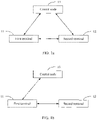
- FIG. 1a and FIG. 1b are structural diagrams of a network system to which some embodiment of this disclosure may be applied.
- the network system includes a first terminal 11, a second terminal 12, and a control node 13.
- the first terminal 11 and the second terminal 12 may be user terminals or other terminal-side devices such as mobile phones, tablet personal computers (Tablet Personal Computer), laptop computers (Laptop Computer), personal digital assistant (personal digital assistant, PDA), mobile Internet devices (Mobile Internet Device, MID), or wearable devices (Wearable Device).
- specific types of the first terminal 11 and the second terminal 12 are not limited in some embodiments of this disclosure.
- the control node 13 may be a network device or a terminal.
- the network device may be a 5G base station, a base station of a later version, or a base station in other communications systems, or may be referred to as a NodeB, an evolved NodeB, a transmission reception point (Transmission Reception Point, TRP), an access point (Access Point, AP), or other terms in the field.
- TRP Transmission Reception Point
- AP Access Point
- the network device is not limited to a specific technical term.
- the network device may be a master node (Master Node, MN) or a secondary node (Secondary Node, SN).
- the 5G base station is used as only an example, but the network device is not limited to any specific type.
- FIG. 2 is a flowchart of a sidelink information transmission method according to some embodiments of this disclosure. The method is applied to a terminal. As shown in FIG. 2 , the method includes the following steps:
- the terminal is a terminal other than the control node in a sidelink transmission system.
- the terminal may be a transmitting terminal that transmits a sidelink transmission, or a receiving terminal that receives a sidelink transmission, or an intermediate terminal, where the intermediate terminal is an intermediate transmission node through which the transmitting terminal or the receiving terminal transmits data to the control node, and the intermediate transmission node includes no transmitting terminal.
- the terminal is taken as an example of a transmitting terminal of a sidelink transmission and an example of a receiving terminal of a sidelink transmission for description.
- a receiver of the target notification message may be the control node, or the intermediate terminal.
- the control node is taken as an example of the receiver of the target notification information for description.
- the transmitting terminal may receive the sidelink information through a PSFCH or PSSCH.
- the sidelink information may be determined based on a receiving status of the sidelink transmission. For ease of understanding, hereinafter, reception of the sidelink information by the transmitting terminal and determination of the sidelink information by the receiving terminal are collectively referred to as obtaining of the sidelink information by the terminal.
- the terminal may map the sidelink information to target notification information, and transmit the target notification information to a control node by using a target resource.
- the sidelink information includes at least one of sidelink HARQ-ACK information corresponding to one or more sidelink transmissions, a sidelink scheduling request (Scheduling request, SR), channel state information (Channel State Information, CSI), and the like.
- the control node may support a sidelink link and/or a Uu link, where the terminal maps the sidelink information to the target notification information.
- the control node may be referred to as a sidelink control node; and if the target notification information is transmitted to a control node through the Uu link, the control node may be referred to as a Uu control node.
- the target resource may be a PUCCH or PUSCH.
- the target resource may be a PSFCH or PSSCH.
- mapping the sidelink information to the target notification information can help a control node to understand the sidelink information, implementing transmission of the sidelink information.
- a mode of mapping the sidelink information to the target notification information may be set based on an actual requirement, which is described in detail below.
- a mode of mapping the sidelink information to the target notification information includes at least one of the following:
- mapping modes may correspond to different parts of the sidelink information.
- first N bits and last M bits of the sidelink information correspond to different mapping modes; or different information types may correspond to different mapping modes, for example, CSI and HARQ-ACK correspond to different mapping modes. Details are not further limited herein.
- bits in the sidelink information and the target notification information are in a one-to-one mapping relationship.
- a state indicated by the first bit is the same as a state indicated by the corresponding second bit.
- a state indicated by the first bit is the same as a state indicated by the corresponding second bit.
- the second bit in the corresponding target notification information indicates ACK; and if the first bit in the sidelink information indicates NACK, the second bit in the corresponding target notification information indicates NACK.
- mapping N2 first bits to M1 second bits includes any one of the following:
- the second bit sequence may be any one of the following:
- the second bit sequence may be configured by a network side, pre-configured by the network side, prescribed by a protocol, negotiated between terminals, indicated by another terminal, or the like, which is not further limited herein.
- one or more second bit sequences are inserted into the M2 second bits.
- the second bit sequence may be located before or after the M2 second bits, or may be located between any two second bits of the M2 second bits.
- the second bit sequence is 11, the M2 second bits are 0000, and the M1 second bits formed by inserting a second bit sequence into the M2 second bits may be 110000, 000011, 001100, or the like.
- the M1 second bits formed by inserting two second bit sequences into the M2 second bits may be 11000011, 00001111, 01100110, 00110011, or the like.
- the second bit sequence may be one or more bits, which is not further limited herein.
- the third bit sequence and the fourth bit sequence may be consistent with the second bit sequence in form.
- reference may be made to the description of the second bit sequence, and description is not repeated herein.
- the M1 second bits are 11001100XX, where M1 second bits include two fourth bit sequences "X", and the "X" may be a fixed value.
- the fourth bit sequence may also be set in other positions.
- the M1 second bits may also be X11001100X, 1100X1100X, or X1X1001100.
- mapping N2 first bits to M2 second bits includes:
- the N2 first bits may include one or more mapping units, the number of bits in each mapping unit may be the same or different, and a value of N3 is a smallest value of the numbers of bits in the mapping units.
- mapping combined bits of the N2 first bits and the third bit sequence to the M1 second bits includes:
- the N2 first bits may include one or more mapping units, the number of bits in each mapping unit may be the same or different, and a value of N3 is a smallest value of the numbers of bits in the mapping units.
- the preset mode can be understood as a compression mode, and the specific compression calculation mode may be set according to an actual requirement.
- the following takes mapping of four first bits to one second bit as an example for description.
- the preset mode includes at least one of the following compression modes:
- AND operation may include two operation types: AND and Bitwise AND.
- AND operation if the AND operation is performed on 1100, one second bit is obtained, and the second bit is 0.
- the N3 bits may include one or more mapping units, the number of bits in each of the mapping units may be the same or different, and the value of the N3 is a smallest value of the numbers of bits in the mapping units.
- a value of P may be set according to an actual requirement, which is not further limited herein.
- a corresponding W is 1; and when the value of P is 3 or 4, a corresponding W is 2.
- one or more of the preset modes may be used for mapping.
- different parts or different types of information may be mapped in different modes, which is not further limited herein.
- the method further includes:
- control node may determine whether the sidelink resource indicated in the scheduling signaling is used for initial transmission or retransmission.
- the scheduling signaling may further be used to indicate whether the sidelink resource is used for retransmission or initial transmission.
- the terminal can perform a retransmission operation based on the sidelink information or the target notification information.
- the sidelink transmission for which the scheduling signaling indicates a retransmission may also be retransmitted.
- the sidelink resource may include resources for one or more sidelink transmissions.
- the sidelink resource includes resources for four sidelink transmissions, four resources may be indicated by one piece of DCI, or four resources may be indicated by four pieces of DCI, where each piece of DCI indicates one resource.
- a retransmission may be performed according to an indication from a network device for retransmitting the sidelink transmission; or a retransmission may be performed based on the sidelink HARQ-ACK information in the sidelink information; or a retransmission may be performed according to an indicator status of a specific bit in the target notification information, where the specific bit refers to a bit in the target notification information mapped from the sidelink HARQ-ACK information.
- a retransmission may be performed for the sidelink transmission corresponding to a specific bit that has an indicator status of NACK. If a specific bit corresponds to sidelink HARQ-ACK information of four sidelink transmissions, that is, the specific bit corresponds to a 4-bit sidelink HARQ-ACK (for example, 0011) and the specific bit is a result of an AND operation on the 4-bit sidelink HARQ-ACK, the obtained specific bit is 0.
- the terminal may perform retransmission of the two sidelink transmissions corresponding to the non-acknowledgement characters indicated in the 4-bit sidelink HARQ-ACK, or may perform retransmission of the four sidelink transmissions corresponding to the 4-bit sidelink HARQ-ACK.
- a retransmission when a retransmission is performed based on the sidelink HARQ-ACK information in the sidelink information, only a sidelink transmission that actually has failed to be transmitted may be retransmitted. If there are actually three sidelink transmissions that have failed to be transmitted, and each sidelink transmission corresponds to one resource, in this case, retransmission may be performed on the resources corresponding to the three sidelink transmissions that have failed to be transmitted, and on another resource, no transmission or an initial transmission of other TBs is performed.
- the scheduling signaling indicates, in resource allocation, whether an allocated resource can be used for retransmission.
- the terminal may perform retransmission according to an indication in the scheduling signaling. For example, if the scheduling signaling indicates to retransmit TB1, the terminal retransmits the TB1, regardless of whether the status indicated by the bit corresponding to TB1 in the target notification information and the sidelink information is NACK or ACK.
- the performing sidelink transmission on the sidelink resource includes one of the following:
- the transmitting the target notification information on a target resource includes: transmitting the target notification information on the plurality of target resources.
- the transmitting the target notification information on the plurality of target resources can be understood as repeatedly transmitting the target notification information, which can improve reliability of transmitting the target notification information, and avoid a situation in which the terminal transmits the target notification information to a control node only once when the terminal is at a cell edge or suddenly suffers from channel degradation may not guarantee that the target notification information is surly detected and correctly decoded by the control node. As a result, a sidelink process is suspended, and a traffic latency requirement cannot be satisfied.
- a sidelink terminal (hereinafter referred to as a terminal) transmits sidelink information (using sidelink HARQ-ACK information as an example for description) to a control node.
- the terminal may include a transmitting terminal (a terminal transmitting a sidelink transmission) and a receiving terminal (a terminal receiving the sidelink transmission).
- the control node may support a sidelink link and/or a Uu link, where the terminal maps the sidelink information to the target notification information. If the target notification information is transmitted to the control node through the sidelink link, the control node may be referred to as a sidelink control node, and the target notification information can be understood as sidelink HARQ-ACK information; and if the target notification information is transmitted to a control node through the Uu link, the control node may be referred to as a Uu control node, and the target notification information can be understood as Uu HARQ-ACK information.
- the sidelink HARQ-ACK information and the Uu HARQ-ACK information are only used for distinguishing HARQ-ACK information that is transmitted by the terminal through different links, and not for limiting transmission content. It is also possible that the sidelink HARQ-ACK information and the Uu HARQ-ACK information are collectively referred to as HARQ-ACK information.
- cases in which the terminal obtains the sidelink information include:
- the transmitting terminal or the receiving terminal maps the sidelink information to the target notification information.
- the control node is a Uu control node
- the mapped information is reported to a base station through the target resource (uplink resource); and when the control node is a sidelink control node, the mapped information is reported to the sidelink control node through the target resource (sidelink resource).
- control node being a Uu control node is used as an example for description, and the steps of mapping the sidelink information to the target notification information and transmitting by a terminal specifically include: Step 1: After obtaining the sidelink HARQ-ACK information, the terminal maps the K-bit sidelink HARQ-ACK information obtained by the terminal to Uu HARQ-ACK information, according to at least one of the following methods.
- Method 1 (one-to-one correspondence): Each sidelink HARQ-ACK bit corresponds to one Uu HARQ-ACK bit.
- this does not mean that the terminal receives only one sidelink HARQ-ACK bit or that the terminal transmits only one Uu HARQ-ACK bit, and that these different sidelink HARQ-ACK bits may come from different feedback resources (for example, PSFCH or PSSCH) or correspond to different sidelink transmissions.
- these different sidelink HARQ-ACK bits may come from different feedback resources (for example, PSFCH or PSSCH) or correspond to different sidelink transmissions.
- one sidelink HARQ-ACK bit in the received sidelink HARQ-ACK information indicates ACK, it is considered that the bit corresponds to a Uu HARQ-ACK bit and that the Uu HARQ-ACK bit indicates ACK; and if one sidelink HARQ-ACK bit in the sidelink HARQ-ACK information received on the sidelink indicates NACK, it is considered that the sidelink HARQ-ACK bit corresponds to a Uu HARQ-ACK bit and that the Uu HARQ-ACK bit indicates NACK.
- the terminal after receiving N-bit sidelink HARQ-ACK information, the terminal determines corresponding N-bit Uu HARQ-ACK information and transmits the N-bit Uu HARQ-ACK information to the control node on a corresponding PUCCH resource.
- one PSFCH resource corresponds to one PUCCH resource, which means that after receiving the N-bit sidelink HARQ-ACK information on a PSFCH resource, the terminal determines corresponding N-bit Uu HARQ-ACK information and transmits the N-bit Uu HARQ-ACK information to the control node on a corresponding PUCCH resource.
- the PSFCH it may also be a PSSCH that carries the sidelink HARQ-ACK information
- it may also be a PUSCH that carries UCI. Any combination can be made, and details are not described.
- K1 sidelink HARQ-ACK bits may come from different feedback resources (for example, PSFCH or PSSCH) or correspond to different sidelink transmissions.
- the method 2 includes method 2.1 and method 2.2.
- Method 2.1 For K1>T1, calculation is performed on K1 sidelink HARQ-ACK bits according to a preset method to obtain a T1-bit result. If one bit in the result indicates ACK, it is considered that the bit corresponds to a Uu HARQ-ACK bit, and that the Uu HARQ-ACK bit indicates ACK; and if one bit in the result indicates NACK, it is considered that the bit corresponds to a Uu HARQ-ACK bit, and that the Uu HARQ-ACK bit indicates NACK. Based on this principle, T1-bit Uu HARQ-ACK information is determined.
- the terminal After receiving K1-bit sidelink HARQ-ACK information, the terminal determines corresponding T1-bit Uu HARQ-ACK and transmits the T1-bit Uu HARQ-ACK to the control node on a corresponding PUCCH resource, where T1 is not equal to K1. In this case, every K1/T1 sidelink transmissions correspond to one Uu HARQ-ACK bit.
- control node After the control node receives the T1-bit Uu HARQ-ACK information, its behavior includes at least one of the following: For K1/T1 sidelink transmissions corresponding to bits indicated as NACKs, it is considered that the transmissions have failed, and the control node can transmit scheduling signaling to schedule the terminal to perform retransmission.
- the terminal determines corresponding 1-bit Uu HARQ-ACK information and transmits the 1-bit Uu HARQ-ACK information to the control node on a corresponding PUCCH resource.
- every K1 sidelink transmissions correspond to one Uu HARQ-ACK bit.
- the control node receives the 1-bit Uu HARQ-ACK information, its behavior includes at least one of the following: If the bit indicates NACK, the control node considers that the K1 sidelink transmissions have failed. Further optionally, the control node may schedule the terminal to retransmit the K1 sidelink transmissions by transmitting scheduling signaling.
- the PSFCH it may also be a PSSCH that carries the sidelink information
- the PUCCH it may also be a PUSCH that carries UCI. Any combination can be made, and details are not described.
- the preset method may include at least one of the following:
- AND operation is performed. It should be understood that the foregoing AND operation may include two operation types: AND and Bitwise AND. Taking the AND as an example, if an AND operation is performed on consecutive K1/T1 sidelink HARQ-ACK bits, a calculated result corresponds to one Uu HARQ-ACK bit, and concatenation is performed on all calculated bits, to finally obtain corresponding M-bit Uu HARQ-ACK.
- a modulo 2 operation is performed on a sum. For example, a modulo 2 operation is performed on a bitwise sum of every consecutive K1/T1 sidelink HARQ-ACK bits, a calculated result corresponds to one Uu HARQ-ACK bit, to finally obtain corresponding M-bit Uu HARQ-ACK.
- An OR operation is performed. For example, an OR operation is performed on every consecutive K1/T1 sidelink HARQ-ACK bits, a calculated result corresponds to one Uu HARQ-ACK bit, to finally obtain corresponding M-bit Uu HARQ-ACK.
- An XOR operation is performed. For example, an XOR operation is performed on every consecutive K1/T1 sidelink HARQ-ACK bits, a calculated result corresponds to one Uu HARQ-ACK bit, to finally obtain corresponding M-bit Uu HARQ-ACK.
- a value taken corresponds to a range. For example, when a value of K1/T1 bits is in a range, one corresponding Uu HARQ-ACK bit indicates ACK; and for example, when a value of K1/T1 bits is in another range, one corresponding Uu HARQ-ACK bit indicates NACK.
- Method 2.2 For K1 ⁇ T1, the method 2.2 includes method 2.2.1 and method 2.2.2.
- Method 2.2.1 an O-bit fix state is added to K1 sidelink HARQ-ACK bits to obtain a T1-bit result. If one bit in the result indicates ACK, it is considered that the bit corresponds to a Uu HARQ-ACK bit, and that the bit indicates ACK; and if the result indicates NACK, it is considered that the bit corresponds to a Uu HARQ-ACK bit, and the bit indicates NACK. Based on this principle, T1-bit Uu HARQ-ACK information is determined.
- K1 sidelink HARQ-ACK bits may be first mapped to K1-bit Uu HARQ-ACK information according to the description in method 1, and then padded with O bits.
- K1 sidelink HARQ-ACK bits may be first mapped to one- or more-bit Uu HARQ-ACK information according to the description in the method 2.1, and then padded with O bits.
- K1 sidelink HARQ-ACK bits may be first padded with O bits, and then mapped to T1-bit Uu HARQ-ACK information according to the description in the method 2.1.
- the additional O bits indicate an O-bit 0, or an O-bit NACK, or an O-bit other fixed state, or O-bit redundant bits, or O-bit parity bits.
- T1 Q ⁇ K1.
- the terminal After receiving the N-bit sidelink HARQ-ACK information, the terminal determines corresponding M-bit Uu HARQ-ACK and transmits the M-bit Uu HARQ-ACK to the control node on a corresponding PUCCH resource, where T1 is not equal to K1.
- each sidelink transmission corresponds to T1/K1 Uu HARQ-ACK bits.
- control node After the control node receives the T1-bit Uu HARQ-ACK information, its behavior includes at least one of the following:
- control node may schedule the terminal to retransmit the sidelink transmission by transmitting scheduling signaling.
- Q equals to 1, 2, 4, or 8.
- mapping methods are described when T1 is divisible by K1.
- mapping can be further implemented by inserting one or more bits.
- Method 2.2.2 A T1-bit result is obtained by repeating (repeat) K1 sidelink HARQ-ACK bits. If one bit in the result indicates ACK, it is considered that the bit corresponds to a Uu HARQ-ACK bit, and that the bit indicates ACK; and if the result indicates NACK, it is considered that the bit corresponds to a Uu HARQ-ACK bit, and that the bit indicates NACK. Based on this principle, T1-bit Uu HARQ-ACK information is determined.
- T1 Q ⁇ K1
- the foregoing repeating method may include the following two options:
- the first bit sequence may be obtained in a form of a look-up table.
- a mapping relationship between the first bit sequence and another bit sequence may be stored in the table.
- the mapping relationship may be a one-to-one mapping or a one-to-many mapping relationship, that is, one first bit sequence corresponds to a plurality of another bit sequences.
- the another bit sequence may be regarded as a bit sequence formed by K1 sidelink HARQ-ACK bits.
- a relationship between the number of bits in the bit sequence formed by the K1 sidelink HARQ-ACK bits and the number of bits in the first bit sequence may be set according to an actual requirement, which is not further limited herein. For example, when the bit sequence formed by the K1 sidelink HARQ-ACK bits is 01, the associated first bit sequence is 0000.
- the mapping relationship between the first bit sequence and another bit sequence may be configured by a network side, pre-configured by the network side, prescribed by a protocol, negotiated between terminals, or indicated by another terminal.
- Step 2 Determine a target resource for transmitting the Uu HARQ-ACK information, where the target resource may be one or more resources.
- Step 3 Transmit Uu HARQ-ACK information on the determined target resource.
- a PSFCH resource corresponds to L PUCCH resource.
- the terminal After receiving the sidelink HARQ-ACK bit information on A PSFCHs, the terminal determines corresponding Uu HARQ-ACK bit information and PUCCH resources, and transmits the Uu HARQ-ACK bit information on the A ⁇ L PUCCH resources. Transmitting methods include one of the following:
- Step 4 The terminal receives scheduling signaling that indicates to perform sidelink resource allocation.
- the scheduling signaling indicates a plurality of sidelink transmissions to be retransmitted (in this case, in addition to resource allocation, the scheduling signaling indicates whether the resource is used for initial transmission or retransmission).
- the scheduling signaling includes at least a new data indicator (new data indicator, NDI), indicating whether the terminal performs retransmission.
- NDI new data indicator
- Possible behaviors by the terminal may include:
- one implementation is to repeat the determined T1-bit Uu HARQ-ACK information K1/T1 times, and perform an XOR, or OR, or AND operation on corresponding bits of the repeated bits and the K1-bit sidelink HARQ-ACK information.
- the terminal For an SL transmission corresponding to a bit with a specific value in the calculation result, the terminal perform retransmission, otherwise it performs no retransmission.
- a resource allocated to a sidelink transmission corresponding to a bit with a non-specific value in the scheduling signaling may be used by the terminal for transmission of other transmission blocks, or for retransmission of a sidelink transmission that the terminal determines necessary to be retransmitted.
- Transport Block Transport Block
- the terminal retransmits TB3 in this case, and performs no retransmission of TB1, TB2, and TB4 that are indicated for retransmission in the scheduling signaling.
- resources allocated to TB1, TB2, and TB4 in the scheduling signaling may also be used for retransmission of TB3, or may be used for transmission of a new TB.
- the sidelink transmission includes at least one of a transmission that actually has occurred and a transmission that has not occurred, where the transmission is transmitting or receiving.
- mapping and transmission of sidelink information is basically the same as the mapping and transmission of a Uu control node, except that the target resources used are different and Uu HARQ-ACK information is replaced with sidelink HARQ-ACK information.
- Uu HARQ-ACK information is replaced with sidelink HARQ-ACK information.
- FIG. 3 is a flowchart of another sidelink information transmission method according to some embodiments of this disclosure.
- the method is applied to a control node.
- the method includes the following step: Step 301.
- a mode of mapping the sidelink information to the target notification information includes at least one of the following:
- mapping N2 first bits to M1 second bits includes any one of the following:
- the second bit sequence is any one of the following:
- mapping N2 first bits to M2 second bits includes:
- mapping combined bits of the N2 first bits and the third bit sequence to the M1 second bits includes:
- the preset mode includes at least one of the following:
- the method further includes: transmitting scheduling signaling to the terminal, where the scheduling signaling is used to indicate a sidelink resource.
- the scheduling signaling is further used to indicate whether the sidelink resource is used for retransmission or initial transmission.
- the receiving, on a target resource, target notification information transmitted by a terminal includes: receiving the target notification information on the plurality of target resources.
- this embodiment is used as an embodiment of a control node corresponding to the embodiment shown in FIG. 2 , and for specific implementations of this embodiment, reference may be made to the relevant descriptions about the embodiment shown in FIG. 2 , with the same beneficial effects achieved. To avoid repetition, details are not described herein again.
- FIG. 4 is a structural diagram of a terminal according to some embodiments of this disclosure. As shown in FIG. 4 , the terminal 400 includes:
- a mode of mapping the sidelink information to the target notification information includes at least one of the following:
- mapping N2 first bits to M1 second bits includes any one of the following:
- the second bit sequence is any one of the following:
- mapping N2 first bits to M2 second bits includes:
- mapping combined bits of the N2 first bits and the third bit sequence to the M1 second bits includes:
- the preset mode includes at least one of the following:
- the first transmission module 402 is further configured to:
- the scheduling signaling is further used to indicate whether the sidelink resource is used for retransmission or initial transmission.
- the performing sidelink transmission on the sidelink resource includes one of the following:
- the first transmission module 402 is specifically configured to transmitting the target notification information on the plurality of target resources.
- the terminal provided in some embodiments of this disclosure can implement the processes implemented by the terminal in the method embodiment in FIG. 4 . To avoid repetition, details are not described herein again.
- FIG. 5 is a schematic structural diagram of a control node according to some embodiments of this disclosure.
- the control node 500 includes: a second transmission module 501, configured to receive, on a target resource, target notification information transmitted by a terminal, where the target notification information is target notification information mapped from sidelink information.
- a mode of mapping the sidelink information to the target notification information includes at least one of the following:
- mapping N2 first bits to M1 second bits includes any one of the following:
- the second bit sequence is any one of the following:
- mapping N2 first bits to M2 second bits includes:
- mapping combined bits of the N2 first bits and the third bit sequence to the M1 second bits includes:
- the preset mode includes at least one of the following:
- the second transmission module 501 is further configured to transmit scheduling signaling to the terminal, where the scheduling signaling is used to indicate a sidelink resource.
- the scheduling signaling is further used to indicate whether the sidelink resource is used for retransmission or initial transmission.
- the second transmission module 501 is specifically configured to: receive the target notification information on the plurality of target resources.
- control node provided in some embodiments of this disclosure can implement the processes implemented by the control node in the method embodiment in FIG. 3 , and details are not described here again to avoid repetition.
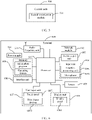
- FIG. 6 is a schematic diagram of a hardware structure of a terminal for implementing the embodiments of this disclosure.
- the terminal 600 includes but is not limited to components such as a radio frequency unit 601, a network module 602, an audio output unit 603, an input unit 604, a sensor 605, a display unit 606, a user input unit 607, an interface unit 608, a memory 609, a processor 610, and a power supply 611.
- a radio frequency unit 601 such as a radio frequency unit 601, a network module 602, an audio output unit 603, an input unit 604, a sensor 605, a display unit 606, a user input unit 607, an interface unit 608, a memory 609, a processor 610, and a power supply 611.
- the terminal may include more or fewer components than those shown in the figure, or a combination of some components, or the components disposed differently.
- the terminal includes but is not limited to a mobile phone, a tablet computer, a laptop computer, a palmtop computer, an in-vehicle terminal, a wearable device, a pedometer, and the like.
- the processor 610 is configured to map sidelink information to target notification information.
- the radio frequency unit 601 is configured to transmit the target notification information on a target resource.
- mapping the sidelink information to the target notification information can help a control node to understand the sidelink information, implementing transmission of the sidelink information.
- the radio frequency unit 601 may be configured to: receive and transmit signals in an information receiving/sending process or a call process; and specifically, after receiving downlink data from a base station, transmit the downlink data to the processor 610 for processing; and in addition, transmit uplink data to the base station.
- the radio frequency unit 601 includes but is not limited to an antenna, at least one amplifier, a transceiver, a coupler, a low noise amplifier, a duplexer, and the like.
- the radio frequency unit 601 may further communicate with a network and another device through a wireless communications system.
- the terminal provides a user with wireless broadband internet access through the network module 602, for example, helping the user to transmit and receive e-mails, browse web pages, and access streaming media.
- the audio output unit 603 may convert audio data received by the radio frequency unit 601 or the network module 602 or stored in the memory 609 into an audio signal, and output the audio signal as a sound.
- the audio output unit 603 may further provide audio output (for example, a call signal reception tone or a message reception tone) that is related to a specific function performed by the terminal 600.
- the audio output unit 603 includes a speaker, a buzzer, a receiver, and the like.
- the input unit 604 is configured to receive an audio or video signal.
- the input unit 604 may include a graphics processing unit (Graphics Processing Unit, GPU) 6041 and a microphone 6042, and the graphics processing unit 6041 processes image data of a still picture or a video obtained by an image capture apparatus (for example, a camera) in an image capture mode or a video capture mode.
- a processed image frame may be displayed on the display unit 606.
- An image frame processed by the graphics processing unit 6041 may be stored in the memory 609 (or another storage medium) or transmitted by the radio frequency unit 601 or the network module 602.
- the microphone 6042 can receive sounds and processing such sounds into audio data.
- the processed audio data may be converted in a telephone call mode into a format that can be transmitted by the radio frequency unit 601 to a mobile communications base station, for outputting.
- the terminal 600 further includes at least one sensor 605, for example, an optical sensor, a motion sensor, and other sensors.
- the optical sensor may include an ambient light sensor and a proximity sensor.
- the ambient light sensor may adjust luminance of the display panel 6061 based on brightness of ambient light
- the proximity sensor may turn off a display panel 6061 and/or backlight when the terminal 600 moves close to an ear.
- an accelerometer sensor may detect a value of an acceleration in various directions (there are usually three axes), may detect a value and a direction of gravity when the terminal is still, and may be applied to terminal posture recognition (for example, landscape/portrait mode switching, related games, and magnetometer posture calibration), functions related to vibration recognition (for example, a pedometer or a tapping), and the like.
- the sensor 605 may further include a fingerprint sensor, a pressure sensor, an iris sensor, a molecular sensor, a gyroscope, a barometer, a hygrometer, a thermometer, or an infrared sensor. Details are not described herein.
- the display unit 606 is configured to display information input by the user or information provided for the user.
- the display unit 606 may include the display panel 6061.
- the display panel 6061 may be configured in a form of a liquid crystal display (Liquid Crystal Display, LCD), an organic light-emitting diode (Organic Light-Emitting Diode, OLED), or the like.
- the user input unit 607 may be used to receive input digit or character information, and generate key signal input that is related to user setting and function control of the terminal.
- the user input unit 607 includes a touch panel 6071 and other input devices 6072.
- the touch panel 6071 also referred to as a touchscreen, may capture a touch operation performed by a user on or near the touch panel 6071 (for example, an operation performed by the user on the touch panel 6071 or near the touch panel 6071 by using a finger or any appropriate object or accessory such as a stylus).
- the touch panel 6071 may include two parts: a touch detection apparatus and a touch controller.
- the touch detection apparatus detects a touch position of the user, detects a signal carried by a touch operation, and transmits the signal to the touch controller.
- the touch controller receives touch information from the touch detection apparatus, converts the touch information into point coordinates, transmits the point coordinates to the processor 610, and receives and executes a command transmitted by the processor 610.
- the touch panel 6071 may be implemented in a plurality of forms, for example, as a resistive, capacitive, infrared, or surface acoustic wave touch panel.
- the user input unit 607 may further include other input devices 6072.
- the other input devices 6072 may include but are not limited to a physical keyboard, a function key (for example, a volume control key or a switch key), a trackball, a mouse, and a joystick. Details are not described herein.
- the touch panel 6071 may cover the display panel 6061.
- the touch panel 6071 transmits the touch operation to the processor 610 for determining a type of the touch event. Then, the processor 610 provides a corresponding visual output on the display panel 6061 based on the type of the touch event.
- the touch panel 6071 and the display panel 6061 act as two independent parts to implement input and output functions of the terminal, in some embodiments, the touch panel 6071 and the display panel 6061 may be integrated to implement the input and output functions of the terminal. This is not specifically limited herein.
- the interface unit 608 is an interface for connecting an external apparatus to the terminal 600.
- the external apparatus may include a wired or wireless headphone port, an external power (or battery charger) port, a wired or wireless data port, a memory card port, a port for connecting an apparatus provided with a recognition module, an audio input/output (I/O) port, a video I/O port, an earphone port, and the like.
- the interface unit 608 may be used to receive input (for example, data information and electric power) from the external apparatus, and transmit the received input to one or more elements in the terminal 600; or may be used to transmit data between the terminal 600 and the external apparatus.
- the memory 609 may be configured to store a software program and various data.
- the memory 609 may mainly include a program storage area and a data storage area.
- the program storage area may store an operating system, an application program required for at least one function (such as a sound play function and an image play function), and the like.
- the data storage area may store data created based on use of the mobile phone (such as audio data and a phone book), and the like.
- the memory 609 may include a high-speed random access memory, and may further include a non-volatile memory such as a disk storage device, a flash memory device, or another volatile solid-state storage device.
- the processor 610 is a control center of the terminal, and is connected to all components of the terminal by using various interfaces and lines. By running or executing a software program and/or a module stored in the memory 609 and invoking data stored in the memory 609, the processor 610 executes various functions of the terminal and processes data, so as to perform overall monitoring on the terminal.
- the processor 610 may include one or more processing units.
- the processor 610 may integrate an application processor and a modem processor.
- the application processor mainly processes an operating system, a user interface, an application program, and the like.
- the modem processor mainly processes wireless communication. It can be understood that the modem processor may alternatively be not integrated in the processor 610.
- the terminal 600 may further include a power supply 611 (for example, a battery) that supplies power to the components.
- a power supply 611 for example, a battery
- the power supply 611 may be logically connected to the processor 610 by using a power management system, so as to implement functions such as charging management, discharging management, and power consumption management by using the power management system.
- the terminal 600 includes some functional modules that are not shown. Details are not described herein again.
- some embodiments of this disclosure further provide a terminal, including a processor 610, a memory 609, and a program stored in the memory 609 and capable of running on the processor 610.
- a terminal including a processor 610, a memory 609, and a program stored in the memory 609 and capable of running on the processor 610.
- the program is executed by the processor 610, the processes of the foregoing embodiments of the sidelink information transmission method are implemented, with same technical effects achieved. To avoid repetition, details are not described herein again.
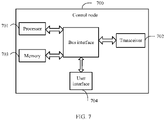
- FIG. 7 is a structural diagram of another control node according to some embodiments of this disclosure.
- the control node 700 includes a processor 701, a transceiver 702, a memory 703, and a bus interface.
- the transceiver 702 is configured to receive, on a target resource, target notification information transmitted by a terminal, where the target notification information is target notification information mapped from sidelink information.
- mapping the sidelink information to the target notification information can help a control node to understand the sidelink information, implementing transmission of the sidelink information.
- a bus architecture may include any quantity of interconnected buses and bridges, and specifically connect together various circuits of one or more processors represented by the processor 701 and a memory represented by the memory 703.
- the bus architecture may further interconnect various other circuits such as a peripheral device, a voltage regulator, and a power management circuit.
- the bus interface provides interfaces.
- the transceiver 702 may be a plurality of components, including a transmitter and a receiver, and provides units for communicating with a variety of other apparatuses on a transmission medium.
- the user interface 704 may also be an interface capable of externally or internally connecting a required device, and the connected device includes but is not limited to a keypad, a display, a speaker, a microphone, a joystick, and the like.
- the processor 701 is responsible for management of the bus architecture and general processing, and the memory 703 may store data used by the processor 701 when the processor 701 performs an operation.
- some embodiments of this disclosure further provide a control node, including a processor 701, a memory 703, and a program stored in the memory 703 and capable of running on the processor 701.
- a control node including a processor 701, a memory 703, and a program stored in the memory 703 and capable of running on the processor 701.
- the program is executed by the processor 701
- the processes of the foregoing embodiments of the sidelink information transmission method are implemented, with same technical effects achieved. To avoid repetition, details are not described herein again.
- Some embodiments of this disclosure further provide a readable storage medium, where the readable storage medium stores a program, and when the program is executed by a processor, the processes in the embodiments of the sidelink information transmission method provided in some embodiments of this disclosure are implemented, with same technical effects achieved. To avoid repetition, details are not described herein again.
- the readable storage medium is a read-only memory (Read-Only Memory, ROM for short), a random access memory (Random Access Memory, RAM for short), a magnetic disk, an optical disc, or the like.
- the method in the foregoing embodiments may be implemented by software in addition to a necessary universal hardware platform or by hardware only. In most cases, the former is a preferred implementation.
- the technical solutions of this disclosure essentially, or the part contributing to the prior art may be implemented in a form of a software product.
- the computer software product is stored in a storage medium (for example, a ROM/RAM, a magnetic disk, or an optical disc), and includes several instructions for instructing a terminal (which may be a mobile phone, a computer, a server, an air conditioner, a base station, or the like) to perform the method described in the embodiments of this disclosure.
- a module, a unit, a sub-module, a sub-unit, or the like may be implemented in one or more application-specific integrated circuits (Application Specific Integrated Circuits, ASIC), digital signal processors (Digital Signal Processing, DSP), digital signal processing devices (DSP Device, DSPD), programmable logic devices (Programmable Logic Device, PLD), field-programmable gate arrays (Field-Programmable Gate Array, FPGA), general-purpose processors, controllers, microcontrollers, microprocessors, and other electronic units for performing the functions described in this application, or a combination thereof.
- ASIC Application Specific Integrated Circuits
- DSP Digital Signal Processing
- DSP Device digital signal processing devices
- PLD programmable logic devices
- FPGA field-programmable gate array
- general-purpose processors controllers, microcontrollers, microprocessors, and other electronic units for performing the functions described in this application, or a combination thereof.
- the technologies described in some embodiments of the present disclosure may be implemented by modules (such as processes and functions) that perform the functions described in some embodiments of the present disclosure.
- Software code may be stored in the memory and executed by the processor.
- the memory may be implemented in the processor or external to the processor.
- the objectives of this disclosure can also be implemented by running a program or a set of programs on any computing apparatus.
- the computing apparatus may be a well-known general-purpose apparatus. Therefore, the objective of this disclosure may also be achieved by merely providing a program product including program code for implementing the method or apparatus. Therefore, such program product also constitutes this disclosure, and a storage medium storing such program product also constitutes this disclosure.
- the storage medium may be any storage medium of common sense or any storage medium that will be developed in the future.
- the components or steps may be decomposed and/or recombined. The decomposition and/or recombination should be considered as an equivalent solution of this disclosure.
- steps for performing the foregoing series of processing may be naturally performed in time sequence following the order of description, but are not necessarily performed in time sequence. Some steps may be performed in parallel or separate from each other.
Landscapes
- Engineering & Computer Science (AREA)
- Computer Networks & Wireless Communication (AREA)
- Signal Processing (AREA)
- Quality & Reliability (AREA)
- Mobile Radio Communication Systems (AREA)
- Detection And Prevention Of Errors In Transmission (AREA)
Applications Claiming Priority (2)
| Application Number | Priority Date | Filing Date | Title |
|---|---|---|---|
| CN201910673801.7A CN111817827B (zh) | 2019-07-24 | 2019-07-24 | 旁链路信息的传输方法、终端和控制节点 |
| PCT/CN2020/102330 WO2021013036A1 (fr) | 2019-07-24 | 2020-07-16 | Procédé de transmission pour informations latérales, terminal et nœud de commande |
Publications (3)
| Publication Number | Publication Date |
|---|---|
| EP4007406A1 true EP4007406A1 (fr) | 2022-06-01 |
| EP4007406A4 EP4007406A4 (fr) | 2022-08-17 |
| EP4007406B1 EP4007406B1 (fr) | 2024-09-11 |
Family
ID=72844024
Family Applications (1)
| Application Number | Title | Priority Date | Filing Date |
|---|---|---|---|
| EP20844808.4A Active EP4007406B1 (fr) | 2019-07-24 | 2020-07-16 | Procédé de transmission pour informations latérales, terminal et noeud de commande |
Country Status (9)
| Country | Link |
|---|---|
| US (1) | US12267176B2 (fr) |
| EP (1) | EP4007406B1 (fr) |
| JP (2) | JP7390468B2 (fr) |
| KR (1) | KR102753887B1 (fr) |
| CN (1) | CN111817827B (fr) |
| ES (1) | ES2991443T3 (fr) |
| HU (1) | HUE068766T2 (fr) |
| PT (1) | PT4007406T (fr) |
| WO (1) | WO2021013036A1 (fr) |
Families Citing this family (4)
| Publication number | Priority date | Publication date | Assignee | Title |
|---|---|---|---|---|
| CN111817827B (zh) * | 2019-07-24 | 2022-03-15 | 维沃移动通信有限公司 | 旁链路信息的传输方法、终端和控制节点 |
| US11728940B2 (en) * | 2020-04-01 | 2023-08-15 | Qualcomm Incorporated | Communication sequencing |
| CN121174292A (zh) * | 2020-10-16 | 2025-12-19 | 苹果公司 | 用于资源分配和ue间协调消息的编码的系统和方法 |
| US12256398B2 (en) * | 2021-05-10 | 2025-03-18 | Qualcomm Incorporated | Techniques for collecting sidelink channel feedback from a receiving UE |
Family Cites Families (12)
| Publication number | Priority date | Publication date | Assignee | Title |
|---|---|---|---|---|
| JP4948671B1 (ja) * | 2010-10-29 | 2012-06-06 | シャープ株式会社 | 移動局装置、処理方法および集積回路 |
| US10512065B2 (en) * | 2016-05-31 | 2019-12-17 | Qualcomm Incorporated | Flexible control information reporting |
| US11576059B2 (en) | 2017-12-19 | 2023-02-07 | Sony Corporation | Communication device, communication method, and communication system |
| CN109792369B (zh) * | 2018-12-29 | 2021-11-23 | 北京小米移动软件有限公司 | 直连通信的数据传输方法、装置、设备及系统 |
| CN109792326B (zh) * | 2018-12-29 | 2021-11-02 | 北京小米移动软件有限公司 | 直连通信的数据传输方法、装置、设备及系统 |
| WO2020133504A1 (fr) * | 2018-12-29 | 2020-07-02 | 北京小米移动软件有限公司 | Procédé et appareil de transmission de données pour communication directe, dispositif et système de transmission de données pour communication directe |
| WO2020144261A1 (fr) * | 2019-01-10 | 2020-07-16 | Fraunhofer-Gesellschaft zur Förderung der angewandten Forschung e.V. | Rétroaction avancée de liaison latérale |
| CN114145061A (zh) * | 2019-07-23 | 2022-03-04 | 鸿颖创新有限公司 | 确定用于混合自动重传请求反馈的物理侧链路反馈信道资源的方法及相关装置 |
| CN111817827B (zh) * | 2019-07-24 | 2022-03-15 | 维沃移动通信有限公司 | 旁链路信息的传输方法、终端和控制节点 |
| CN114762279B (zh) * | 2019-10-06 | 2023-12-12 | Lg电子株式会社 | 在nr v2x中用于向基站报告harq反馈的方法和装置 |
| CN118678469A (zh) * | 2019-12-03 | 2024-09-20 | 华硕电脑股份有限公司 | 产生侧链路混合自动重复请求确认的方法和装置 |
| US12610377B2 (en) * | 2020-06-09 | 2026-04-21 | Lg Electronics Inc. | Resource selection for multiple sidelink processes |
-
2019
- 2019-07-24 CN CN201910673801.7A patent/CN111817827B/zh active Active
-
2020
- 2020-07-16 PT PT208448084T patent/PT4007406T/pt unknown
- 2020-07-16 HU HUE20844808A patent/HUE068766T2/hu unknown
- 2020-07-16 WO PCT/CN2020/102330 patent/WO2021013036A1/fr not_active Ceased
- 2020-07-16 JP JP2022504194A patent/JP7390468B2/ja active Active
- 2020-07-16 ES ES20844808T patent/ES2991443T3/es active Active
- 2020-07-16 KR KR1020227003849A patent/KR102753887B1/ko active Active
- 2020-07-16 EP EP20844808.4A patent/EP4007406B1/fr active Active
-
2022
- 2022-01-19 US US17/578,746 patent/US12267176B2/en active Active
-
2023
- 2023-11-20 JP JP2023196785A patent/JP7596490B2/ja active Active
Also Published As
| Publication number | Publication date |
|---|---|
| JP7390468B2 (ja) | 2023-12-01 |
| WO2021013036A1 (fr) | 2021-01-28 |
| JP2024020475A (ja) | 2024-02-14 |
| US20220140955A1 (en) | 2022-05-05 |
| CN111817827A (zh) | 2020-10-23 |
| PT4007406T (pt) | 2024-09-24 |
| KR20220028107A (ko) | 2022-03-08 |
| ES2991443T3 (es) | 2024-12-03 |
| EP4007406A4 (fr) | 2022-08-17 |
| HUE068766T2 (hu) | 2025-01-28 |
| JP2022542256A (ja) | 2022-09-30 |
| US12267176B2 (en) | 2025-04-01 |
| KR102753887B1 (ko) | 2025-01-14 |
| EP4007406B1 (fr) | 2024-09-11 |
| JP7596490B2 (ja) | 2024-12-09 |
| CN111817827B (zh) | 2022-03-15 |
Similar Documents
| Publication | Publication Date | Title |
|---|---|---|
| US12323992B2 (en) | HARQ-ACK codebook generation method, information transmitting method, and device | |
| US12113622B2 (en) | Method for feedback control, UE, and network device | |
| US12267176B2 (en) | Sidelink information transmission method, terminal, and control node | |
| US12389266B2 (en) | Sidelink information transmission method, terminal, and control node | |
| EP3911078A1 (fr) | Procédé et terminal d'envoi d'un accusé de réception de demande de répétition automatique hybride | |
| EP3952155A1 (fr) | Procédé de détermination de taille de bloc de transport et dispositif de communication | |
| US12501441B2 (en) | DAI counting method, DAI counting control method, terminal, and network device | |
| CN113497680B (zh) | 混合自动重传请求应答反馈方法、终端及网络节点 | |
| CN112929138B (zh) | 码本发送方法、接收方法、终端及网络设备 | |
| CN113225162B (zh) | 信道状态信息csi上报方法、终端及计算机可读存储介质 | |
| CN112804033B (zh) | 一种harq-ack处理方法及相关设备 | |
| HK40065568A (en) | Transmission method for sidelink information, terminal, and control node | |
| HK40065568B (en) | Transmission method for sidelink information, terminal, and control node | |
| WO2020156473A1 (fr) | Procédé de transmission et terminal | |
| CN112825495B (zh) | Harq-ack处理方法及相关设备 | |
| HK40081958A (en) | Dai counting method, dai counting control method, terminal and network device | |
| HK40072154A (en) | Harq-ack codebook generation method, information transmission method, and device | |
| HK40069462A (en) | Sidelink information transmission method, terminal, and control node |
Legal Events
| Date | Code | Title | Description |
|---|---|---|---|
| STAA | Information on the status of an ep patent application or granted ep patent |
Free format text: STATUS: THE INTERNATIONAL PUBLICATION HAS BEEN MADE |
|
| PUAI | Public reference made under article 153(3) epc to a published international application that has entered the european phase |
Free format text: ORIGINAL CODE: 0009012 |
|
| STAA | Information on the status of an ep patent application or granted ep patent |
Free format text: STATUS: REQUEST FOR EXAMINATION WAS MADE |
|
| 17P | Request for examination filed |
Effective date: 20220203 |
|
| AK | Designated contracting states |
Kind code of ref document: A1 Designated state(s): AL AT BE BG CH CY CZ DE DK EE ES FI FR GB GR HR HU IE IS IT LI LT LU LV MC MK MT NL NO PL PT RO RS SE SI SK SM TR |
|
| REG | Reference to a national code |
Ref country code: HK Ref legal event code: DE Ref document number: 40065568 Country of ref document: HK |
|
| A4 | Supplementary search report drawn up and despatched |
Effective date: 20220718 |
|
| RIC1 | Information provided on ipc code assigned before grant |
Ipc: H04L 1/00 20060101ALN20220712BHEP Ipc: H04W 92/18 20090101ALN20220712BHEP Ipc: H04L 1/18 20060101ALI20220712BHEP Ipc: H04L 1/16 20060101AFI20220712BHEP |
|
| DAV | Request for validation of the european patent (deleted) | ||
| DAX | Request for extension of the european patent (deleted) | ||
| REG | Reference to a national code |
Ref country code: DE Ref legal event code: R079 Ipc: H04L0001160700 Ref country code: DE Ref legal event code: R079 Ref document number: 602020037694 Country of ref document: DE Free format text: PREVIOUS MAIN CLASS: H04W0072040000 Ipc: H04L0001160700 |
|
| GRAP | Despatch of communication of intention to grant a patent |
Free format text: ORIGINAL CODE: EPIDOSNIGR1 |
|
| STAA | Information on the status of an ep patent application or granted ep patent |
Free format text: STATUS: GRANT OF PATENT IS INTENDED |
|
| RIC1 | Information provided on ipc code assigned before grant |
Ipc: H04L 1/00 20060101ALN20240304BHEP Ipc: H04W 92/18 20090101ALN20240304BHEP Ipc: H04W 72/20 20230101ALI20240304BHEP Ipc: H04L 1/1829 20230101ALI20240304BHEP Ipc: H04L 1/1607 20230101AFI20240304BHEP |
|
| INTG | Intention to grant announced |
Effective date: 20240405 |
|
| GRAS | Grant fee paid |
Free format text: ORIGINAL CODE: EPIDOSNIGR3 |
|
| GRAA | (expected) grant |
Free format text: ORIGINAL CODE: 0009210 |
|
| STAA | Information on the status of an ep patent application or granted ep patent |
Free format text: STATUS: THE PATENT HAS BEEN GRANTED |
|
| AK | Designated contracting states |
Kind code of ref document: B1 Designated state(s): AL AT BE BG CH CY CZ DE DK EE ES FI FR GB GR HR HU IE IS IT LI LT LU LV MC MK MT NL NO PL PT RO RS SE SI SK SM TR |
|
| REG | Reference to a national code |
Ref country code: GB Ref legal event code: FG4D |
|
| REG | Reference to a national code |
Ref country code: CH Ref legal event code: EP |
|
| REG | Reference to a national code |
Ref country code: PT Ref legal event code: SC4A Ref document number: 4007406 Country of ref document: PT Date of ref document: 20240924 Kind code of ref document: T Free format text: AVAILABILITY OF NATIONAL TRANSLATION Effective date: 20240918 |
|
| REG | Reference to a national code |
Ref country code: DE Ref legal event code: R096 Ref document number: 602020037694 Country of ref document: DE |
|
| REG | Reference to a national code |
Ref country code: NL Ref legal event code: FP Ref country code: IE Ref legal event code: FG4D |
|
| REG | Reference to a national code |
Ref country code: ES Ref legal event code: FG2A Ref document number: 2991443 Country of ref document: ES Kind code of ref document: T3 Effective date: 20241203 |
|
| REG | Reference to a national code |
Ref country code: LT Ref legal event code: MG9D |
|
| PG25 | Lapsed in a contracting state [announced via postgrant information from national office to epo] |
Ref country code: NO Free format text: LAPSE BECAUSE OF FAILURE TO SUBMIT A TRANSLATION OF THE DESCRIPTION OR TO PAY THE FEE WITHIN THE PRESCRIBED TIME-LIMIT Effective date: 20241211 |
|
| PG25 | Lapsed in a contracting state [announced via postgrant information from national office to epo] |
Ref country code: GR Free format text: LAPSE BECAUSE OF FAILURE TO SUBMIT A TRANSLATION OF THE DESCRIPTION OR TO PAY THE FEE WITHIN THE PRESCRIBED TIME-LIMIT Effective date: 20241212 Ref country code: FI Free format text: LAPSE BECAUSE OF FAILURE TO SUBMIT A TRANSLATION OF THE DESCRIPTION OR TO PAY THE FEE WITHIN THE PRESCRIBED TIME-LIMIT Effective date: 20240911 |
|
| PG25 | Lapsed in a contracting state [announced via postgrant information from national office to epo] |
Ref country code: BG Free format text: LAPSE BECAUSE OF FAILURE TO SUBMIT A TRANSLATION OF THE DESCRIPTION OR TO PAY THE FEE WITHIN THE PRESCRIBED TIME-LIMIT Effective date: 20240911 |
|
| PG25 | Lapsed in a contracting state [announced via postgrant information from national office to epo] |
Ref country code: LV Free format text: LAPSE BECAUSE OF FAILURE TO SUBMIT A TRANSLATION OF THE DESCRIPTION OR TO PAY THE FEE WITHIN THE PRESCRIBED TIME-LIMIT Effective date: 20240911 |
|
| PG25 | Lapsed in a contracting state [announced via postgrant information from national office to epo] |
Ref country code: HR Free format text: LAPSE BECAUSE OF FAILURE TO SUBMIT A TRANSLATION OF THE DESCRIPTION OR TO PAY THE FEE WITHIN THE PRESCRIBED TIME-LIMIT Effective date: 20240911 |
|
| PG25 | Lapsed in a contracting state [announced via postgrant information from national office to epo] |
Ref country code: RS Free format text: LAPSE BECAUSE OF FAILURE TO SUBMIT A TRANSLATION OF THE DESCRIPTION OR TO PAY THE FEE WITHIN THE PRESCRIBED TIME-LIMIT Effective date: 20241211 |
|
| REG | Reference to a national code |
Ref country code: HU Ref legal event code: AG4A Ref document number: E068766 Country of ref document: HU |
|
| PG25 | Lapsed in a contracting state [announced via postgrant information from national office to epo] |
Ref country code: RS Free format text: LAPSE BECAUSE OF FAILURE TO SUBMIT A TRANSLATION OF THE DESCRIPTION OR TO PAY THE FEE WITHIN THE PRESCRIBED TIME-LIMIT Effective date: 20241211 Ref country code: NO Free format text: LAPSE BECAUSE OF FAILURE TO SUBMIT A TRANSLATION OF THE DESCRIPTION OR TO PAY THE FEE WITHIN THE PRESCRIBED TIME-LIMIT Effective date: 20241211 Ref country code: LV Free format text: LAPSE BECAUSE OF FAILURE TO SUBMIT A TRANSLATION OF THE DESCRIPTION OR TO PAY THE FEE WITHIN THE PRESCRIBED TIME-LIMIT Effective date: 20240911 Ref country code: HR Free format text: LAPSE BECAUSE OF FAILURE TO SUBMIT A TRANSLATION OF THE DESCRIPTION OR TO PAY THE FEE WITHIN THE PRESCRIBED TIME-LIMIT Effective date: 20240911 Ref country code: GR Free format text: LAPSE BECAUSE OF FAILURE TO SUBMIT A TRANSLATION OF THE DESCRIPTION OR TO PAY THE FEE WITHIN THE PRESCRIBED TIME-LIMIT Effective date: 20241212 Ref country code: FI Free format text: LAPSE BECAUSE OF FAILURE TO SUBMIT A TRANSLATION OF THE DESCRIPTION OR TO PAY THE FEE WITHIN THE PRESCRIBED TIME-LIMIT Effective date: 20240911 Ref country code: BG Free format text: LAPSE BECAUSE OF FAILURE TO SUBMIT A TRANSLATION OF THE DESCRIPTION OR TO PAY THE FEE WITHIN THE PRESCRIBED TIME-LIMIT Effective date: 20240911 |
|
| REG | Reference to a national code |
Ref country code: AT Ref legal event code: MK05 Ref document number: 1723619 Country of ref document: AT Kind code of ref document: T Effective date: 20240911 |
|
| PG25 | Lapsed in a contracting state [announced via postgrant information from national office to epo] |
Ref country code: IS Free format text: LAPSE BECAUSE OF FAILURE TO SUBMIT A TRANSLATION OF THE DESCRIPTION OR TO PAY THE FEE WITHIN THE PRESCRIBED TIME-LIMIT Effective date: 20250111 |
|
| PG25 | Lapsed in a contracting state [announced via postgrant information from national office to epo] |
Ref country code: SM Free format text: LAPSE BECAUSE OF FAILURE TO SUBMIT A TRANSLATION OF THE DESCRIPTION OR TO PAY THE FEE WITHIN THE PRESCRIBED TIME-LIMIT Effective date: 20240911 Ref country code: RO Free format text: LAPSE BECAUSE OF FAILURE TO SUBMIT A TRANSLATION OF THE DESCRIPTION OR TO PAY THE FEE WITHIN THE PRESCRIBED TIME-LIMIT Effective date: 20240911 |
|
| PG25 | Lapsed in a contracting state [announced via postgrant information from national office to epo] |
Ref country code: EE Free format text: LAPSE BECAUSE OF FAILURE TO SUBMIT A TRANSLATION OF THE DESCRIPTION OR TO PAY THE FEE WITHIN THE PRESCRIBED TIME-LIMIT Effective date: 20240911 Ref country code: AT Free format text: LAPSE BECAUSE OF FAILURE TO SUBMIT A TRANSLATION OF THE DESCRIPTION OR TO PAY THE FEE WITHIN THE PRESCRIBED TIME-LIMIT Effective date: 20240911 |
|
| PG25 | Lapsed in a contracting state [announced via postgrant information from national office to epo] |
Ref country code: CZ Free format text: LAPSE BECAUSE OF FAILURE TO SUBMIT A TRANSLATION OF THE DESCRIPTION OR TO PAY THE FEE WITHIN THE PRESCRIBED TIME-LIMIT Effective date: 20240911 Ref country code: PL Free format text: LAPSE BECAUSE OF FAILURE TO SUBMIT A TRANSLATION OF THE DESCRIPTION OR TO PAY THE FEE WITHIN THE PRESCRIBED TIME-LIMIT Effective date: 20240911 |
|
| PG25 | Lapsed in a contracting state [announced via postgrant information from national office to epo] |
Ref country code: SK Free format text: LAPSE BECAUSE OF FAILURE TO SUBMIT A TRANSLATION OF THE DESCRIPTION OR TO PAY THE FEE WITHIN THE PRESCRIBED TIME-LIMIT Effective date: 20240911 |
|
| REG | Reference to a national code |
Ref country code: DE Ref legal event code: R097 Ref document number: 602020037694 Country of ref document: DE |
|
| PG25 | Lapsed in a contracting state [announced via postgrant information from national office to epo] |
Ref country code: DK Free format text: LAPSE BECAUSE OF FAILURE TO SUBMIT A TRANSLATION OF THE DESCRIPTION OR TO PAY THE FEE WITHIN THE PRESCRIBED TIME-LIMIT Effective date: 20240911 |
|
| PGFP | Annual fee paid to national office [announced via postgrant information from national office to epo] |
Ref country code: GB Payment date: 20250529 Year of fee payment: 6 |
|
| PGFP | Annual fee paid to national office [announced via postgrant information from national office to epo] |
Ref country code: NL Payment date: 20250613 Year of fee payment: 6 |
|
| PGFP | Annual fee paid to national office [announced via postgrant information from national office to epo] |
Ref country code: PT Payment date: 20250630 Year of fee payment: 6 |
|
| PGFP | Annual fee paid to national office [announced via postgrant information from national office to epo] |
Ref country code: FR Payment date: 20250610 Year of fee payment: 6 |
|
| PLBE | No opposition filed within time limit |
Free format text: ORIGINAL CODE: 0009261 |
|
| STAA | Information on the status of an ep patent application or granted ep patent |
Free format text: STATUS: NO OPPOSITION FILED WITHIN TIME LIMIT |
|
| PGFP | Annual fee paid to national office [announced via postgrant information from national office to epo] |
Ref country code: HU Payment date: 20250630 Year of fee payment: 6 |
|
| 26N | No opposition filed |
Effective date: 20250612 |
|
| PG25 | Lapsed in a contracting state [announced via postgrant information from national office to epo] |
Ref country code: SE Free format text: LAPSE BECAUSE OF FAILURE TO SUBMIT A TRANSLATION OF THE DESCRIPTION OR TO PAY THE FEE WITHIN THE PRESCRIBED TIME-LIMIT Effective date: 20240911 |
|
| PGFP | Annual fee paid to national office [announced via postgrant information from national office to epo] |
Ref country code: ES Payment date: 20250805 Year of fee payment: 6 |
|
| PGFP | Annual fee paid to national office [announced via postgrant information from national office to epo] |
Ref country code: DE Payment date: 20250528 Year of fee payment: 6 |
|
| PGFP | Annual fee paid to national office [announced via postgrant information from national office to epo] |
Ref country code: IT Payment date: 20250623 Year of fee payment: 6 |
|
| REG | Reference to a national code |
Ref country code: CH Ref legal event code: H13 Free format text: ST27 STATUS EVENT CODE: U-0-0-H10-H13 (AS PROVIDED BY THE NATIONAL OFFICE) Effective date: 20260224 |
|
| PG25 | Lapsed in a contracting state [announced via postgrant information from national office to epo] |
Ref country code: LU Free format text: LAPSE BECAUSE OF NON-PAYMENT OF DUE FEES Effective date: 20250716 |
|
| REG | Reference to a national code |
Ref country code: BE Ref legal event code: MM Effective date: 20250731 |
|
| PG25 | Lapsed in a contracting state [announced via postgrant information from national office to epo] |
Ref country code: BE Free format text: LAPSE BECAUSE OF NON-PAYMENT OF DUE FEES Effective date: 20250731 |
|
| PG25 | Lapsed in a contracting state [announced via postgrant information from national office to epo] |
Ref country code: CH Free format text: LAPSE BECAUSE OF NON-PAYMENT OF DUE FEES Effective date: 20250731 |