EP4007909B1 - Détecteur colorimétrique destiné à des mesures de ph - Google Patents
Détecteur colorimétrique destiné à des mesures de ph Download PDFInfo
- Publication number
- EP4007909B1 EP4007909B1 EP20764450.1A EP20764450A EP4007909B1 EP 4007909 B1 EP4007909 B1 EP 4007909B1 EP 20764450 A EP20764450 A EP 20764450A EP 4007909 B1 EP4007909 B1 EP 4007909B1
- Authority
- EP
- European Patent Office
- Prior art keywords
- colorimetric sensor
- sensor array
- indicator
- array according
- surfactant
- Prior art date
- Legal status (The legal status is an assumption and is not a legal conclusion. Google has not performed a legal analysis and makes no representation as to the accuracy of the status listed.)
- Active
Links
Images

Classifications
-
- G—PHYSICS
- G01—MEASURING; TESTING
- G01N—INVESTIGATING OR ANALYSING MATERIALS BY DETERMINING THEIR CHEMICAL OR PHYSICAL PROPERTIES
- G01N21/00—Investigating or analysing materials by the use of optical means, i.e. using sub-millimetre waves, infrared, visible or ultraviolet light
- G01N21/75—Systems in which material is subjected to a chemical reaction, the progress or the result of the reaction being investigated
- G01N21/77—Systems in which material is subjected to a chemical reaction, the progress or the result of the reaction being investigated by observing the effect on a chemical indicator
- G01N21/78—Systems in which material is subjected to a chemical reaction, the progress or the result of the reaction being investigated by observing the effect on a chemical indicator producing a change of colour
- G01N21/80—Indicating pH value
-
- G—PHYSICS
- G01—MEASURING; TESTING
- G01N—INVESTIGATING OR ANALYSING MATERIALS BY DETERMINING THEIR CHEMICAL OR PHYSICAL PROPERTIES
- G01N21/00—Investigating or analysing materials by the use of optical means, i.e. using sub-millimetre waves, infrared, visible or ultraviolet light
- G01N21/75—Systems in which material is subjected to a chemical reaction, the progress or the result of the reaction being investigated
- G01N21/77—Systems in which material is subjected to a chemical reaction, the progress or the result of the reaction being investigated by observing the effect on a chemical indicator
- G01N21/78—Systems in which material is subjected to a chemical reaction, the progress or the result of the reaction being investigated by observing the effect on a chemical indicator producing a change of colour
-
- G—PHYSICS
- G01—MEASURING; TESTING
- G01N—INVESTIGATING OR ANALYSING MATERIALS BY DETERMINING THEIR CHEMICAL OR PHYSICAL PROPERTIES
- G01N21/00—Investigating or analysing materials by the use of optical means, i.e. using sub-millimetre waves, infrared, visible or ultraviolet light
- G01N21/75—Systems in which material is subjected to a chemical reaction, the progress or the result of the reaction being investigated
- G01N21/77—Systems in which material is subjected to a chemical reaction, the progress or the result of the reaction being investigated by observing the effect on a chemical indicator
- G01N21/78—Systems in which material is subjected to a chemical reaction, the progress or the result of the reaction being investigated by observing the effect on a chemical indicator producing a change of colour
- G01N21/783—Systems in which material is subjected to a chemical reaction, the progress or the result of the reaction being investigated by observing the effect on a chemical indicator producing a change of colour for analysing gases
-
- G—PHYSICS
- G01—MEASURING; TESTING
- G01N—INVESTIGATING OR ANALYSING MATERIALS BY DETERMINING THEIR CHEMICAL OR PHYSICAL PROPERTIES
- G01N31/00—Investigating or analysing non-biological materials by the use of the chemical methods specified in the subgroup; Apparatus specially adapted for such methods
- G01N31/22—Investigating or analysing non-biological materials by the use of the chemical methods specified in the subgroup; Apparatus specially adapted for such methods using chemical indicators
- G01N31/221—Investigating or analysing non-biological materials by the use of the chemical methods specified in the subgroup; Apparatus specially adapted for such methods using chemical indicators for investigating pH value
-
- G—PHYSICS
- G01—MEASURING; TESTING
- G01N—INVESTIGATING OR ANALYSING MATERIALS BY DETERMINING THEIR CHEMICAL OR PHYSICAL PROPERTIES
- G01N31/00—Investigating or analysing non-biological materials by the use of the chemical methods specified in the subgroup; Apparatus specially adapted for such methods
- G01N31/22—Investigating or analysing non-biological materials by the use of the chemical methods specified in the subgroup; Apparatus specially adapted for such methods using chemical indicators
- G01N31/223—Investigating or analysing non-biological materials by the use of the chemical methods specified in the subgroup; Apparatus specially adapted for such methods using chemical indicators for investigating presence of specific gases or aerosols
Definitions
- the present invention finds application in the field of optoelectronic sensors.
- the immobilization of indicator molecules plays a key role in the analytical performance of a CSA.
- the arrays used include: cellulose acetate, sol-gel, PVC, acrylic-methacrylic copolymer and different compounds based on the system SiO 2 /ZrO 2 -styrene.
- the various strategies used include the retention of the dye on ion exchange resins such as Amberlite or adsorption on materials such as styrene/divinylbenzene copolymer, cellulose, or cellulose acetate.
- This aspect is very useful because it allows to minimize the problems associated with the acquisition of images by the device, the problem of sensor non-homogeneity due to the deposition technique used and the variation in the concentration of the indicator due to leaching.
- a first object of the present invention is a colorimetric sensor array as defined in claim 1.
- the invention describes a process for preparing the colorimetric sensor array as defined in claim 13.
- a method for measuring an analyte is defined in claim 17.
- spot is intended as an area, preferably circular, resulting from the application of a preparation comprising an indicator and a surfactant on a support. In fact, it represents a single sensor.
- a first object of the invention is a colorimetric sensor comprising a preparation of a colorimetric indicator and a surfactant.
- this sensor is in the form of a polymeric membrane of organic-inorganic nature.
- This preparation is deposited and adsorbed on a solid porous support, in particular shortly after having been prepared in the form of sol, as detailed below.
- the described sensor comprises a preparation of an indicator, a dye (which could also be an indicator) and a surfactant.
- the dyes used may be Bromocresol Green and Methyl Red.
- the support for the deposit is a porous PVDF membrane, having for example an average porosity of 0.2 um (for example sold by Bio-Rad).
- this comprises: precursors, an indicator with the solvent thereof, a surfactant and acid or basic water (milli-Q).
- TEOS tetraethyl orthosilicate
- MTES methyltrimethoxysilane
- ETES ethyltriethoxysilane
- FTMS phenyltrimethoxysilane
- octyl-TEOS dodecyltriethoxysilane
- dodecyl-TEOS dodecyltriethoxysilane
- At least two precursors are used for the preparation of the membrane, one of which is TEOS.
- the membranes are prepared starting from TEOS/octyl-TEOS.
- the preparation is also referred to as OrMoSil.
- the calibration sensitivity of a single sensor depends on the ratio ⁇ H / ⁇ p H , where ⁇ H is the difference value between the H values of the dissociated and undissociated form of the indicator and ⁇ pH is the pH range within which the H coordinate varies.
- ⁇ H The maximum possible value of ⁇ H depends on the choice of the indicator but hardly exceeds the value of 0.55.
- an indicator is selected from the group comprising: Cresol Red; Metacresol Purple; Thymol Blue; Carmine; Tetrabromophenol Blue; Methyl Orange; 2-4-dinitrophenol; Bromophenol Blue; Congo Red; Ethyl Orange; Alizarin Violet N; Bromocresol Green; Methyl Red; Propyl Red; Chlorophenol Red; Basic Green 4; Bromophenol Red; Nitrazine Yellow; Purple Pyrocatecol Violet; Bright Yellow; Nile Red; Resazurin; Aurin; Bromothymol Blue; Phenol Red; Orange II; Phenolphthalein; Xylenol Blue; Nile Blue; Thiazole Yellow.
- the solvent is ethanol for almost all the indicators.
- Nitrazine Yellow and Bright Yellow instead require 2-methoxy-ethanol.
- the surfactant is a cationic surfactant, therefore capable of minimizing the repulsions between silanol groups and negatively charged indicator molecules, especially in basic environments.
- surfactants having a chain of 16 carbon atoms are advantageously capable of preventing smoothing and irreversibility phenomena, such as, for example, hexadecyltrimethylammonium p-toluenesulfonate (CTApTs).
- CTApTs hexadecyltrimethylammonium p-toluenesulfonate
- C18 surfactants have an equally optimal sensitivity but the modulation of the H profile position occurs in a smaller pH range with respect to C16.
- the surfactant/precursor ratio and preferably of CTApTs/precursors, must be comprised between 0.05 and 0.40 g CTApTS /g precursor , and preferably between about 0.11 and 0.38 g CTApTs /g precursor .
- Dyes which may be used for the purposes of the present invention are selected from the group comprising: Acid Green 25, Direct Blue 15, Trypan Blue, Methylene Blue.
- dyes which by their nature are also indicators, such as, for example: Tetrabromophenol Blue (TBB), Indigo Carmine (IC).
- the preparation of the sensor is obtained with a process comprising the steps of:
- step a) preferably the above-mentioned precursors are added to water in the presence of hydrochloric acid.
- two precursors are added to water, one of which is TEOS.
- hydrolysis catalyst hydrochloric acid is preferably added up to a pH of about 2.00.
- the two precursors are TEOS and Ottil-TEOS.
- the hydrolysis is carried out until the phase separation disappears; for this purpose, vigorous magnetic stirring may be required for about an hour.
- step b) the surfactant is added in an amount such that the surfactant/precursor ratio is between about 0.11 and 0.38 g CTApTs /g precursor .
- the solvent preferably is ethanol or 2-methoxy-ethanol, conveniently chosen as a function of the indicator.
- step d) there may be two or more than two added dyes.
- the dyes used may be Bromocresol Green and Methyl Red.
- the indicator concentration (in mg) for each gram of sol comprising precursors, water, hydrochloric acid, and surfactant (excluding the indicator solvent) is approximately: Indicator Range (mg) Amount (mg) Bromochlorophenol blue (BCPB) 6.5-6.7 6.61 Bromocresol green (BCG) 7.5-8.1 7.94 Thymol blue (TB) 0.80-1.0 0.90 Bromothymol blue (BB) 6.90-7.20 7.10 Nitrazine yellow (NY) 6.10-6.22 6.17 Tetrabromophenol blue (TBB) 8.9-9.1 8.97 Bright yellow (BY) 7.0-7.2 7.10 Methyl red (MR) 2.9-3.1 3.06 M-cresol purple (CP) 4.30-4.4 4.35 Phenol red (PR) 3.9-4.1 4.03 Cresol red (CR) 3.4-3.55 3.48 Xylenol blue (XB) 0.80-1.0 0.90 Cresol purple (CP) 3.4-3.55 3.48
- the preparation of a colorimetric sensor may be prepared starting from: Precursors 5.0-6.0 g Water 2.0-2.5 g Hydrochloric acid as needed up to approx. pH 2.00 Surfactant 0.4-2.1 g Indicator 0.8-9.1 mg Solvent 6.3-8.1 g Dye 0-3.0 mg
- step d) in which a solution of one or two dyes (which could be, by their nature, independently of each other, indicators) is added to the sol of the indicator; in this way a preparation comprising an indicator and one or two dyes (or dye(s)/indicator) is obtained.
- a solution of one or two dyes which could be, by their nature, independently of each other, indicators
- the ratios between the indicator the performance of which is to be improved and the dye may be those reported in the following table: 0.01 ⁇ n TBB /n XB ⁇ 0.19 0.18 ⁇ n TBB /n MR ⁇ 0.35 0.186 ⁇ n TBB/ n PR ⁇ 0.324
- step c) or d) one or more additives capable of giving rise to chemical reactions with variation of pH may be added.
- palladium chloride (II) and/or diethylethanolamine (DEEA) may be added.
- the solution obtained (from step c) or from step d)) is then deposited on the support membrane, preferably PVDF, and is stored in a dry place protected from light for a period, for example three days, until completion of the polymerization.
- the support membrane preferably PVDF
- the deposition is carried so as to form spots with a diameter of a few mm.
- the amount of sol deposited for each spot is about 90-105 ⁇ g, preferably about 95 ⁇ g.
- a plurality of spots (thus forming the colorimetric sensor array), each of which comprises an indicator, is deposited on the support.
- each spot stands out from the other spots for the concentration of surfactant.
- the CSA preparation process may end, after step c) or step d), with the calibration step; this step is carried out by the manufacturer, since the deposition procedure is reproducible in time and space.
- the support is then subjected to the steps of:
- the support is immersed in various acid pH to basic pH buffer solutions for approximately 30-40 seconds, until equilibrium is reached for the H coordinate of the HSV color space.
- the colorimetric sensor of the invention is suitable not only for measuring pH but also for measuring for example: amines, ethylene, carbon monoxide, carbon dioxide, sulfur dioxide, glucose, sugars.
- the described method allows to detect pH, presence of carbon dioxide, carbon monoxide, sulfur dioxide, amines, ethylene, sulfur dioxide, glucose, sugars.
- the described sensor is a pH sensor.
- the pH measurements are based on the Hue profile (H) of the HSV color space.
- a photographic image of said sensor or said array (i.e., of each sensor of said array) is acquired.
- the H coordinate of a portion of each image is acquired, preferably as the median value of the pixels of the most homogeneous and saturated portion of each spot.
- the acquisition of the color coordinates is preferably optimized if constant illumination is maintained with a D65 LED (medium sunlight).
- Two vials are prepared, of which one corresponding to the lowest surfactant concentration (about 0.11 g CTApTs /g precursor ; LOW) and one corresponding to the highest surfactant concentration (about 0.38 g CTApTs /g precursor ; HIGH) starting from: Component LOW HIGH grams Water 1.82 1.82 HCl 0.64 0.64 CTApTS 2.01 0.60 Octyl-TEOS 0.75 0.75 TEOS 4.64 4.64 Gel/portion 9.86 8.45 Solvent 7.36 6.35
- Indicator Range (mg) Amount (mg) Bromochlorophenol blue (BCPB) 6.5-6.7 6.61 Bromocresol green (BCG) 7.5-8.1 7.94 Thymol blue (TB) 0.8-1.0 0.9 Bromothymol blue (BB) 6.90-7.20 7.10 Nitrazine yellow (NY) 6.10-6.22 6.17 Tetrabromophenol blue (TBB) 8.9-9.1 8.97 Bright yellow (BY) 7.0-7.2 7.10 Methyl red (MR) 2.9-3.1 3.06 M-cresol purple (CP) 4.30-4.4 4.35 Phenol red (PR) 3.9-4.1 4.03 Cresol red (CR) 3.4-3.55 3.48 Xylenol blue (XB) 0.8-1.0 0.9 Cresol purple (CP) 3.4-3.55 3.48
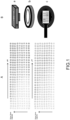
- Figure 2 shows the results of an assay to verify the reversibility of the system of the present invention.
- the profiles have already undergone a conditioning cycle demonstrating the high system reversibility.
- the experimental data are obtained by immersing the sensor in different buffers from pH 1 to 12.
- BB bromothymol blue
- TBB tetrabromophenol blue
- PR phenol red
- the amount of sol TBB added to the PR and BB vials corresponds to: 0 g, 0.3 g, 0.7 g, 1.1 g, 1.6 g, 2.1 g, 2.7 g, 3.7 g, and 5.4 g corresponding to a TBB molar/indicator ratio of: 0, 0.026, 0.061, 0.096, 0.140,0.184, 0.236, 0.324, 0.473, respectively.
- PVDF supports (6 x 3.5 x 0.1 cm) were used as solid supports on which the OrMoSil sol was deposited through a steel bar (filed base with 1.6 mm diameter) at 20 ⁇ 2°C. The calibration was carried out in accordance with the description in the present patent application.
- the sensor described considerably reduces the prediction error associated with the pH measurement, which is comparable with that typical of potentiometric measurements ( ⁇ 0.02 pH units) due to the modulation of the surfactant concentration.
- a sensor was obtained capable of providing high accuracy in a wide pH range (up to 7 pH units), due to the modulation of the pKa of the indicator used.
- the senor is reversible and may therefore be reused.
- the pH measurement is carried out with response times around ten seconds.
- the H coordinate (hue) of the HSV color space (hue, saturation, value) used for the measurements is stable, simple to calculate and easily obtainable from commercial devices, maintaining better accuracy with variations in indicator concentration, membrane thickness and illumination, compared to the other color spaces.
- the device also lends itself to online measurements due to the use of a porous support such as PVDF; in fact, the permeation of Ormosil also from the opposite side of the PVDF sheet is possible due to the surfactant which reduces the surface tension, also allowing the pH measurement of turbid samples.
- the size of the spots is very small (around 1 mm in diameter), allowing to prepare portable, low-cost sensors.
Landscapes
- Life Sciences & Earth Sciences (AREA)
- Chemical & Material Sciences (AREA)
- Physics & Mathematics (AREA)
- Health & Medical Sciences (AREA)
- Pathology (AREA)
- Immunology (AREA)
- General Physics & Mathematics (AREA)
- Analytical Chemistry (AREA)
- Biochemistry (AREA)
- General Health & Medical Sciences (AREA)
- Chemical Kinetics & Catalysis (AREA)
- Plasma & Fusion (AREA)
- Engineering & Computer Science (AREA)
- Biophysics (AREA)
- Molecular Biology (AREA)
- Dispersion Chemistry (AREA)
- Investigating Or Analysing Materials By The Use Of Chemical Reactions (AREA)
- Investigating Or Analyzing Non-Biological Materials By The Use Of Chemical Means (AREA)
- Spectrometry And Color Measurement (AREA)
Claims (18)
- Réseau de capteurs colorimétriques comprenant un support et une pluralité de capteurs colorimétriques déposés sur le support, dans lequel chaque capteur colorimétrique comprend au moins un indicateur caractérisé en ce qu'il comprend un tensioactif cationique, et en ce que chaque capteur colorimétrique comprend une concentration différente du tensioactif.
- Réseau de capteurs colorimétriques selon la revendication 1, dans lequel le réseau de capteurs colorimétriques est un capteur de pH.
- Réseau de capteurs colorimétriques selon l'une quelconque des revendications précédentes, dans lequel chaque capteur est sous la forme d'une membrane polymère de nature organique-inorganique, comprenant une préparation d'un indicateur dans un solvant approprié et un tensioactif cationique, des précurseurs et une eau acide ou basique.
- Réseau de capteurs colorimétriques selon la revendication précédente, dans lequel le rapport tensioactif/précurseur est compris entre 0,05 et 0,40.
- Réseau de capteurs colorimétriques selon la revendication 3, dans lequel le rapport tensioactif/précurseur est compris entre 0,11 et 0,38.
- Réseau de capteurs colorimétriques selon l'une quelconque des revendications précédentes, dans lequel le tensioactif a une chaîne de 16 atomes de carbone.
- Réseau de capteurs colorimétriques selon l'une quelconque des revendications 1 à 5, dans lequel le tensioactif a une chaîne de 18 atomes de carbone.
- Réseau de capteurs colorimétriques selon l'une quelconque des revendications précédentes, dans lequel chaque capteur colorimétrique comprend en outre un colorant ou une combinaison de deux colorants ou plus.
- Réseau de capteurs colorimétriques selon la revendication précédente, dans lequel chaque capteur colorimétrique comprend un indicateur différent et/ou un colorant différent ou des colorants différents par rapport aux autres capteurs.
- Réseau de capteurs colorimétriques selon l'une quelconque des revendications précédentes, dans lequel ledit indicateur est choisi dans le groupe comprenant : Rouge de crésol ; Violet de métacrésol ; Bleu de thymol ; Carmin ; Bleu de tétrabromophénol ; Méthylorange ; 2-4-dinitrophénol ; Bleu de bromophénol ; Rouge Congo ; Orange d'éthyle ; Violet d'alizarine N ; Vert de bromocrésol ; Rouge de méthyle ; Rouge de propyle ; Rouge de chlorophénol ; Vert basique 4 ; Rouge de bromophénol Jaune de nitrazine ; Violet de Pyrocatéchol ; Jaune vif ; Rouge de Nil ; Résazurine ; Aurine ; Bleu de bromothymol ; Rouge de phénol ; Orange II ; Phénolphthaléine ; Bleu de xylénol ; Bleu de Nil ; Jaune thiazol.
- Réseau de capteurs colorimétriques selon l'une quelconque des revendications précédentes, dans lequel ledit tensioactif est le p-toluènesulfonate d'hexadécyltriméthylammonium (CTApTs).
- Réseau de capteurs colorimétriques selon l'une quelconque des revendications précédentes, comprenant en outre un ou plusieurs additifs capables de donner lieu à des réactions chimiques avec variation de pH.
- Procédé d'obtention du réseau de capteurs colorimétriques selon l'une quelconque des revendications précédentes, dans lequel pour chaque capteur le procédé d'obtention de la membrane polymère comprend les étapes consistant à :a) hydrolyser les précurseurs,b) ajouter le tensioactif cationique,c) ajouter une solution de l'indicateur dissous dans un solvant approprié, sous agitation, oud) ajouter une solution d'un indicateur dissous dans un solvant approprié et une solution d'un ou deux colorants ou plus dissous dans un solvant approprié.
- Procédé selon la revendication précédente, dans lequel lesdits précurseurs sont choisis dans le groupe comprenant : TEOS (orthosilicate de tétraéthyle), méthyltriméthoxysilane (MTES), éthyltriéthoxysilane (ETES), phényltriméthoxysilane (FTMS), octyltriéthoxysilane (octyl-TEOS), dodécyltriéthoxysilane (dodécyl-TEOS), hexadécyltriméthoxysilane, tétrapropoxyde de zirconium (ZTP), 3-méthacryloxypropyl-triméthoxysilane (MAPTMS), tétrapropoxyde de titane (TTP), isopropoxyde de titane (TTIP).
- Procédé selon la revendication 13 ou 14, dans lequel ladite étape a) comprend l'ajout d'un acide jusqu'à un pH d'environ 2,00.
- Procédé selon l'une quelconque des revendications 12 à 15, dans lequel à l'étape c) ou à l'étape d) un ou plusieurs additifs susceptibles de donner lieu à des réactions chimiques avec variation de pH sont ajoutés.
- Procédé pour mesurer pH, dioxyde de carbone, monoxyde de carbone, dioxyde de soufre, amines, éthylène, dioxyde de soufre, glucose ou sucres d'une solution comprenant les étapes consistant à :- placer la solution en contact avec le réseau de capteurs colorimétriques selon l'une quelconque des revendications 1 à 11,- acquérir une image photographique dudit capteur ou dudit réseau,- acquérir la coordonnée H d'une partie de chaque image.
- Procédé selon la revendication précédente, dans lequel ladite étape d'acquisition de la coordonnée H est effectuée en ligne.
Applications Claiming Priority (2)
| Application Number | Priority Date | Filing Date | Title |
|---|---|---|---|
| IT102019000013878A IT201900013878A1 (it) | 2019-08-02 | 2019-08-02 | Sensore colorimetrico per misure di ph |
| PCT/IB2020/057318 WO2021024156A1 (fr) | 2019-08-02 | 2020-08-03 | Détecteur colorimétrique destiné à des mesures de ph |
Publications (3)
| Publication Number | Publication Date |
|---|---|
| EP4007909A1 EP4007909A1 (fr) | 2022-06-08 |
| EP4007909C0 EP4007909C0 (fr) | 2024-04-03 |
| EP4007909B1 true EP4007909B1 (fr) | 2024-04-03 |
Family
ID=69024502
Family Applications (1)
| Application Number | Title | Priority Date | Filing Date |
|---|---|---|---|
| EP20764450.1A Active EP4007909B1 (fr) | 2019-08-02 | 2020-08-03 | Détecteur colorimétrique destiné à des mesures de ph |
Country Status (7)
| Country | Link |
|---|---|
| US (1) | US20220276177A1 (fr) |
| EP (1) | EP4007909B1 (fr) |
| JP (1) | JP2022542709A (fr) |
| KR (1) | KR20220041895A (fr) |
| CN (1) | CN114222912A (fr) |
| IT (1) | IT201900013878A1 (fr) |
| WO (1) | WO2021024156A1 (fr) |
Families Citing this family (1)
| Publication number | Priority date | Publication date | Assignee | Title |
|---|---|---|---|---|
| IT202300023679A1 (it) | 2023-11-09 | 2025-05-09 | Univ Degli Studi Padova | Sensore colorimetrico per la misura del ph, particolarmente per soluzioni acquose, matrice di sensori colorimetrici, apparecchio per la misura del ph e metodo di preparazione di tale matrice di sensori colorimetrici |
Family Cites Families (4)
| Publication number | Priority date | Publication date | Assignee | Title |
|---|---|---|---|---|
| US20160327491A1 (en) * | 2014-01-06 | 2016-11-10 | 3M Innovative Properties Company | Colorimetric indicator responsive to air flow |
| CN105044321A (zh) * | 2015-06-23 | 2015-11-11 | 上海交通大学 | 基于表面活性剂聚集纳米金的17β-雌二醇比色检测法 |
| CN106706612B (zh) * | 2015-11-12 | 2020-08-28 | 中国科学院大连化学物理研究所 | 提高气体比色传感器对酸/碱性气体检测灵敏度的方法 |
| EP3579982A4 (fr) * | 2017-02-16 | 2021-03-31 | Isense LLC | Réseaux de capteurs à indicateurs nucléophiles |
-
2019
- 2019-08-02 IT IT102019000013878A patent/IT201900013878A1/it unknown
-
2020
- 2020-08-03 EP EP20764450.1A patent/EP4007909B1/fr active Active
- 2020-08-03 US US17/632,103 patent/US20220276177A1/en not_active Abandoned
- 2020-08-03 WO PCT/IB2020/057318 patent/WO2021024156A1/fr not_active Ceased
- 2020-08-03 JP JP2022506742A patent/JP2022542709A/ja active Pending
- 2020-08-03 KR KR1020227006878A patent/KR20220041895A/ko not_active Withdrawn
- 2020-08-03 CN CN202080055343.1A patent/CN114222912A/zh active Pending
Also Published As
| Publication number | Publication date |
|---|---|
| IT201900013878A1 (it) | 2021-02-02 |
| JP2022542709A (ja) | 2022-10-06 |
| EP4007909C0 (fr) | 2024-04-03 |
| US20220276177A1 (en) | 2022-09-01 |
| KR20220041895A (ko) | 2022-04-01 |
| CN114222912A (zh) | 2022-03-22 |
| WO2021024156A1 (fr) | 2021-02-11 |
| EP4007909A1 (fr) | 2022-06-08 |
Similar Documents
| Publication | Publication Date | Title |
|---|---|---|
| Werner et al. | Optical sensor for the pH 10–13 range using a new support material | |
| ES2592205T3 (es) | Matrices de sensores colorimétricos basados en pigmentos nanoporosos | |
| CN101675331B (zh) | 测量低碱度溶液pH的方法和设备 | |
| Fernández-Ramos et al. | Optical humidity sensor using methylene blue immobilized on a hydrophilic polymer | |
| JP2010527001A5 (fr) | ||
| Supian et al. | Quantitative determination of Al (III) ion by using Alizarin Red S including its microspheres optical sensing material | |
| Janata | Ion optodes | |
| Bacci et al. | Spectrophotometric investigations on immobilized acid-base indicators | |
| EP3184994A1 (fr) | Capteur optique pour détecter une espèce chimique, le système comprenant ce capteur et son procédé de fabrication | |
| Jerónimo et al. | Colorimetric bismuth determination in pharmaceuticals using a xylenol orange sol–gel sensor coupled to a multicommutated flow system | |
| KR100940513B1 (ko) | 용존산소, pH 및 온도의 2종 이상의 변수의 동시 검출용광학 센서막, 장치 및 방법 | |
| US20220276177A1 (en) | Colorimetric sensor for ph measurements | |
| Ando et al. | A highly Li+-selective glass optode based on fluorescence ratiometry | |
| Rajendraprasad et al. | Highly sensitive spectrophotometric determination of olanzapine using cerium (IV) and iron (II) complexes of 1, 10-phenanthroline and 2, 2′-bipyridyl | |
| Mohr et al. | Synthesis and characterization of fluorophore-absorber pairs for sensing of ammonia based on fluorescence | |
| RU2391659C1 (ru) | Способ определения серебра с использованием полиметакрилатной матрицы | |
| Kang et al. | Rapid response optical ion/gas sensors using dimer–monomer metalloporphyrin equilibrium in ultrathin polymeric films coated on waveguides | |
| Mohr et al. | Effects of the polymer matrix on an optical nitrate sensor based on a polarity-sensitive dye | |
| RU2428686C1 (ru) | Способ определения кобальта (ii) c использованием полиметакрилатной матрицы | |
| Brigo et al. | Natively porous films as halide anion fluorescence optical sensors | |
| IT202300023679A1 (it) | Sensore colorimetrico per la misura del ph, particolarmente per soluzioni acquose, matrice di sensori colorimetrici, apparecchio per la misura del ph e metodo di preparazione di tale matrice di sensori colorimetrici | |
| US20130251594A1 (en) | Sol-Gel Based Optical Chemical Sensor For Detection of Organophosphates and Method For Preparation Thereof | |
| RU149409U1 (ru) | Оптический чувствительный элемент для определения ионов металлов в жидких средах | |
| Pastore | pH Colorimetric Sensor Arrays: Preparation, Characterization, and Application | |
| Sadaoka et al. | Optical humidity sensor using Nafion-dye composite thin films. |
Legal Events
| Date | Code | Title | Description |
|---|---|---|---|
| STAA | Information on the status of an ep patent application or granted ep patent |
Free format text: STATUS: UNKNOWN |
|
| STAA | Information on the status of an ep patent application or granted ep patent |
Free format text: STATUS: THE INTERNATIONAL PUBLICATION HAS BEEN MADE |
|
| PUAI | Public reference made under article 153(3) epc to a published international application that has entered the european phase |
Free format text: ORIGINAL CODE: 0009012 |
|
| STAA | Information on the status of an ep patent application or granted ep patent |
Free format text: STATUS: REQUEST FOR EXAMINATION WAS MADE |
|
| 17P | Request for examination filed |
Effective date: 20220301 |
|
| AK | Designated contracting states |
Kind code of ref document: A1 Designated state(s): AL AT BE BG CH CY CZ DE DK EE ES FI FR GB GR HR HU IE IS IT LI LT LU LV MC MK MT NL NO PL PT RO RS SE SI SK SM TR |
|
| DAV | Request for validation of the european patent (deleted) | ||
| DAX | Request for extension of the european patent (deleted) | ||
| GRAP | Despatch of communication of intention to grant a patent |
Free format text: ORIGINAL CODE: EPIDOSNIGR1 |
|
| STAA | Information on the status of an ep patent application or granted ep patent |
Free format text: STATUS: GRANT OF PATENT IS INTENDED |
|
| INTG | Intention to grant announced |
Effective date: 20231016 |
|
| GRAS | Grant fee paid |
Free format text: ORIGINAL CODE: EPIDOSNIGR3 |
|
| GRAA | (expected) grant |
Free format text: ORIGINAL CODE: 0009210 |
|
| STAA | Information on the status of an ep patent application or granted ep patent |
Free format text: STATUS: THE PATENT HAS BEEN GRANTED |
|
| AK | Designated contracting states |
Kind code of ref document: B1 Designated state(s): AL AT BE BG CH CY CZ DE DK EE ES FI FR GB GR HR HU IE IS IT LI LT LU LV MC MK MT NL NO PL PT RO RS SE SI SK SM TR |
|
| REG | Reference to a national code |
Ref country code: CH Ref legal event code: EP |
|
| REG | Reference to a national code |
Ref country code: DE Ref legal event code: R096 Ref document number: 602020028400 Country of ref document: DE |
|
| REG | Reference to a national code |
Ref country code: IE Ref legal event code: FG4D |
|
| U01 | Request for unitary effect filed |
Effective date: 20240424 |
|
| U07 | Unitary effect registered |
Designated state(s): AT BE BG DE DK EE FI FR IT LT LU LV MT NL PT SE SI Effective date: 20240430 |
|
| U20 | Renewal fee for the european patent with unitary effect paid |
Year of fee payment: 5 Effective date: 20240807 |
|
| PG25 | Lapsed in a contracting state [announced via postgrant information from national office to epo] |
Ref country code: IS Free format text: LAPSE BECAUSE OF FAILURE TO SUBMIT A TRANSLATION OF THE DESCRIPTION OR TO PAY THE FEE WITHIN THE PRESCRIBED TIME-LIMIT Effective date: 20240803 |
|
| PG25 | Lapsed in a contracting state [announced via postgrant information from national office to epo] |
Ref country code: HR Free format text: LAPSE BECAUSE OF FAILURE TO SUBMIT A TRANSLATION OF THE DESCRIPTION OR TO PAY THE FEE WITHIN THE PRESCRIBED TIME-LIMIT Effective date: 20240403 |
|
| PG25 | Lapsed in a contracting state [announced via postgrant information from national office to epo] |
Ref country code: GR Free format text: LAPSE BECAUSE OF FAILURE TO SUBMIT A TRANSLATION OF THE DESCRIPTION OR TO PAY THE FEE WITHIN THE PRESCRIBED TIME-LIMIT Effective date: 20240704 |
|
| PG25 | Lapsed in a contracting state [announced via postgrant information from national office to epo] |
Ref country code: ES Free format text: LAPSE BECAUSE OF FAILURE TO SUBMIT A TRANSLATION OF THE DESCRIPTION OR TO PAY THE FEE WITHIN THE PRESCRIBED TIME-LIMIT Effective date: 20240403 |
|
| PG25 | Lapsed in a contracting state [announced via postgrant information from national office to epo] |
Ref country code: CZ Free format text: LAPSE BECAUSE OF FAILURE TO SUBMIT A TRANSLATION OF THE DESCRIPTION OR TO PAY THE FEE WITHIN THE PRESCRIBED TIME-LIMIT Effective date: 20240403 |
|
| PG25 | Lapsed in a contracting state [announced via postgrant information from national office to epo] |
Ref country code: PL Free format text: LAPSE BECAUSE OF FAILURE TO SUBMIT A TRANSLATION OF THE DESCRIPTION OR TO PAY THE FEE WITHIN THE PRESCRIBED TIME-LIMIT Effective date: 20240403 |
|
| PG25 | Lapsed in a contracting state [announced via postgrant information from national office to epo] |
Ref country code: PL Free format text: LAPSE BECAUSE OF FAILURE TO SUBMIT A TRANSLATION OF THE DESCRIPTION OR TO PAY THE FEE WITHIN THE PRESCRIBED TIME-LIMIT Effective date: 20240403 Ref country code: NO Free format text: LAPSE BECAUSE OF FAILURE TO SUBMIT A TRANSLATION OF THE DESCRIPTION OR TO PAY THE FEE WITHIN THE PRESCRIBED TIME-LIMIT Effective date: 20240703 Ref country code: IS Free format text: LAPSE BECAUSE OF FAILURE TO SUBMIT A TRANSLATION OF THE DESCRIPTION OR TO PAY THE FEE WITHIN THE PRESCRIBED TIME-LIMIT Effective date: 20240803 Ref country code: HR Free format text: LAPSE BECAUSE OF FAILURE TO SUBMIT A TRANSLATION OF THE DESCRIPTION OR TO PAY THE FEE WITHIN THE PRESCRIBED TIME-LIMIT Effective date: 20240403 Ref country code: GR Free format text: LAPSE BECAUSE OF FAILURE TO SUBMIT A TRANSLATION OF THE DESCRIPTION OR TO PAY THE FEE WITHIN THE PRESCRIBED TIME-LIMIT Effective date: 20240704 Ref country code: ES Free format text: LAPSE BECAUSE OF FAILURE TO SUBMIT A TRANSLATION OF THE DESCRIPTION OR TO PAY THE FEE WITHIN THE PRESCRIBED TIME-LIMIT Effective date: 20240403 Ref country code: CZ Free format text: LAPSE BECAUSE OF FAILURE TO SUBMIT A TRANSLATION OF THE DESCRIPTION OR TO PAY THE FEE WITHIN THE PRESCRIBED TIME-LIMIT Effective date: 20240403 Ref country code: RS Free format text: LAPSE BECAUSE OF FAILURE TO SUBMIT A TRANSLATION OF THE DESCRIPTION OR TO PAY THE FEE WITHIN THE PRESCRIBED TIME-LIMIT Effective date: 20240703 |
|
| REG | Reference to a national code |
Ref country code: DE Ref legal event code: R097 Ref document number: 602020028400 Country of ref document: DE |
|
| PG25 | Lapsed in a contracting state [announced via postgrant information from national office to epo] |
Ref country code: RO Free format text: LAPSE BECAUSE OF FAILURE TO SUBMIT A TRANSLATION OF THE DESCRIPTION OR TO PAY THE FEE WITHIN THE PRESCRIBED TIME-LIMIT Effective date: 20240403 Ref country code: SK Free format text: LAPSE BECAUSE OF FAILURE TO SUBMIT A TRANSLATION OF THE DESCRIPTION OR TO PAY THE FEE WITHIN THE PRESCRIBED TIME-LIMIT Effective date: 20240403 |
|
| PG25 | Lapsed in a contracting state [announced via postgrant information from national office to epo] |
Ref country code: SM Free format text: LAPSE BECAUSE OF FAILURE TO SUBMIT A TRANSLATION OF THE DESCRIPTION OR TO PAY THE FEE WITHIN THE PRESCRIBED TIME-LIMIT Effective date: 20240403 |
|
| PG25 | Lapsed in a contracting state [announced via postgrant information from national office to epo] |
Ref country code: SM Free format text: LAPSE BECAUSE OF FAILURE TO SUBMIT A TRANSLATION OF THE DESCRIPTION OR TO PAY THE FEE WITHIN THE PRESCRIBED TIME-LIMIT Effective date: 20240403 Ref country code: SK Free format text: LAPSE BECAUSE OF FAILURE TO SUBMIT A TRANSLATION OF THE DESCRIPTION OR TO PAY THE FEE WITHIN THE PRESCRIBED TIME-LIMIT Effective date: 20240403 Ref country code: RO Free format text: LAPSE BECAUSE OF FAILURE TO SUBMIT A TRANSLATION OF THE DESCRIPTION OR TO PAY THE FEE WITHIN THE PRESCRIBED TIME-LIMIT Effective date: 20240403 |
|
| PLBE | No opposition filed within time limit |
Free format text: ORIGINAL CODE: 0009261 |
|
| STAA | Information on the status of an ep patent application or granted ep patent |
Free format text: STATUS: NO OPPOSITION FILED WITHIN TIME LIMIT |
|
| 26N | No opposition filed |
Effective date: 20250106 |
|
| REG | Reference to a national code |
Ref country code: CH Ref legal event code: PL |
|
| GBPC | Gb: european patent ceased through non-payment of renewal fee |
Effective date: 20240803 |
|
| PG25 | Lapsed in a contracting state [announced via postgrant information from national office to epo] |
Ref country code: CH Free format text: LAPSE BECAUSE OF NON-PAYMENT OF DUE FEES Effective date: 20240831 Ref country code: MC Free format text: LAPSE BECAUSE OF FAILURE TO SUBMIT A TRANSLATION OF THE DESCRIPTION OR TO PAY THE FEE WITHIN THE PRESCRIBED TIME-LIMIT Effective date: 20240403 |
|
| PG25 | Lapsed in a contracting state [announced via postgrant information from national office to epo] |
Ref country code: GB Free format text: LAPSE BECAUSE OF NON-PAYMENT OF DUE FEES Effective date: 20240803 |
|
| PG25 | Lapsed in a contracting state [announced via postgrant information from national office to epo] |
Ref country code: IE Free format text: LAPSE BECAUSE OF NON-PAYMENT OF DUE FEES Effective date: 20240803 |
|
| U20 | Renewal fee for the european patent with unitary effect paid |
Year of fee payment: 6 Effective date: 20250806 |
|
| PG25 | Lapsed in a contracting state [announced via postgrant information from national office to epo] |
Ref country code: CY Free format text: LAPSE BECAUSE OF FAILURE TO SUBMIT A TRANSLATION OF THE DESCRIPTION OR TO PAY THE FEE WITHIN THE PRESCRIBED TIME-LIMIT; INVALID AB INITIO Effective date: 20200803 |
|
| U1N | Appointed representative for the unitary patent procedure changed after the registration of the unitary effect |
Representative=s name: SORANZO, BENEDETTA; IT |
|
| PG25 | Lapsed in a contracting state [announced via postgrant information from national office to epo] |
Ref country code: HU Free format text: LAPSE BECAUSE OF FAILURE TO SUBMIT A TRANSLATION OF THE DESCRIPTION OR TO PAY THE FEE WITHIN THE PRESCRIBED TIME-LIMIT; INVALID AB INITIO Effective date: 20200803 |
|
| PG25 | Lapsed in a contracting state [announced via postgrant information from national office to epo] |
Ref country code: TR Free format text: LAPSE BECAUSE OF FAILURE TO SUBMIT A TRANSLATION OF THE DESCRIPTION OR TO PAY THE FEE WITHIN THE PRESCRIBED TIME-LIMIT Effective date: 20240403 |
|
| U20 | Renewal fee for the european patent with unitary effect paid |
Year of fee payment: 7 Effective date: 20260706 |