EP4008115B1 - Configuration de multiples identités d'embrouillage - Google Patents
Configuration de multiples identités d'embrouillage Download PDFInfo
- Publication number
- EP4008115B1 EP4008115B1 EP19940343.7A EP19940343A EP4008115B1 EP 4008115 B1 EP4008115 B1 EP 4008115B1 EP 19940343 A EP19940343 A EP 19940343A EP 4008115 B1 EP4008115 B1 EP 4008115B1
- Authority
- EP
- European Patent Office
- Prior art keywords
- coreset
- scrambling
- coresets
- trp
- same
- Prior art date
- Legal status (The legal status is an assumption and is not a legal conclusion. Google has not performed a legal analysis and makes no representation as to the accuracy of the status listed.)
- Active
Links
Images



Classifications
-
- H—ELECTRICITY
- H04—ELECTRIC COMMUNICATION TECHNIQUE
- H04L—TRANSMISSION OF DIGITAL INFORMATION, e.g. TELEGRAPHIC COMMUNICATION
- H04L5/00—Arrangements affording multiple use of the transmission path
- H04L5/003—Arrangements for allocating sub-channels of the transmission path
- H04L5/0053—Allocation of signalling, i.e. of overhead other than pilot signals
-
- H—ELECTRICITY
- H04—ELECTRIC COMMUNICATION TECHNIQUE
- H04L—TRANSMISSION OF DIGITAL INFORMATION, e.g. TELEGRAPHIC COMMUNICATION
- H04L5/00—Arrangements affording multiple use of the transmission path
- H04L5/003—Arrangements for allocating sub-channels of the transmission path
- H04L5/0044—Allocation of payload; Allocation of data channels, e.g. PDSCH or PUSCH
-
- H—ELECTRICITY
- H04—ELECTRIC COMMUNICATION TECHNIQUE
- H04L—TRANSMISSION OF DIGITAL INFORMATION, e.g. TELEGRAPHIC COMMUNICATION
- H04L5/00—Arrangements affording multiple use of the transmission path
- H04L5/0091—Signalling for the administration of the divided path, e.g. signalling of configuration information
- H04L5/0094—Indication of how sub-channels of the path are allocated
-
- H—ELECTRICITY
- H04—ELECTRIC COMMUNICATION TECHNIQUE
- H04W—WIRELESS COMMUNICATION NETWORKS
- H04W72/00—Local resource management
- H04W72/20—Control channels or signalling for resource management
- H04W72/23—Control channels or signalling for resource management in the downlink direction of a wireless link, i.e. towards a terminal
Definitions
- the subject matter disclosed herein generally relates to wireless communications, and more particularly relates to configuring multiple scrambling IDs.
- a UE can only communicate with one TRP.
- the UE is configured with a PDSCH scrambling ID used for PDSCH scrambling for interference randomization.
- the UE receives PDSCH(s) scrambled by a sequence initialized with the PDSCH scrambling ID, the UE descrambles the received PDSCH(s) with the same sequence initialized with the PDSCH scrambling ID.
- different TRPs can simultaneously transmit multiple DCIs to schedule multiple PDSCHs transmitted in one slot.
- the gNB could configure multiple scrambling IDs to generate different PDSCH scrambling sequences for one UE.
- XP051727739 and XP051555437 discuss designs for multiple-PDCCH and single-PDCCH based M-TRP/panel transmission as well as enhancement for URLLC.
- embodiments may be embodied as a system, apparatus, method, or program product. Accordingly, embodiments may take the form of an entirely hardware embodiment, an entirely software embodiment (including firmware, resident software, micro-code, etc.) or an embodiment combining software and hardware aspects that may generally all be referred to herein as a "circuit", "module” or “system”. Furthermore, embodiments may take the form of a program product embodied in one or more computer readable storage devices storing machine-readable code, computer readable code, and/or program code, referred to hereafter as "code”.
- code computer readable storage devices storing machine-readable code, computer readable code, and/or program code, referred to hereafter as "code”.
- code computer readable storage devices storing machine-readable code, computer readable code, and/or program code, referred to hereafter as "code”.
- the storage devices may be tangible, non-transitory, and/or non-transmission.
- the storage devices may not embody signals. In a certain embodiment, the storage devices only employ
- modules may be implemented as a hardware circuit comprising custom very-large-scale integration (VLSI) circuits or gate arrays, off-the-shelf semiconductors such as logic chips, transistors, or other discrete components.
- VLSI very-large-scale integration
- a module may also be implemented in programmable hardware devices such as field programmable gate arrays, programmable array logic, programmable logic devices or the like.
- Modules may also be implemented in code and/or software for execution by various types of processors.
- An identified module of code may, for instance, include one or more physical or logical blocks of executable code which may, for instance, be organized as an object, procedure, or function. Nevertheless, the executables of an identified module need not be physically located together, but, may include disparate instructions stored in different locations which, when joined logically together, include the module and achieve the stated purpose for the module.
- a module of code may contain a single instruction, or many instructions, and may even be distributed over several different code segments, among different programs, and across several memory devices.
- operational data may be identified and illustrated herein within modules and may be embodied in any suitable form and organized within any suitable type of data structure. This operational data may be collected as a single data set, or may be distributed over different locations including over different computer readable storage devices.
- the software portions are stored on one or more computer readable storage devices.
- the computer readable medium may be a computer readable storage medium.
- the computer readable storage medium may be a storage device storing code.
- the storage device may be, for example, but need not necessarily be, an electronic, magnetic, optical, electromagnetic, infrared, holographic, micromechanical, or semiconductor system, apparatus, or device, or any suitable combination of the foregoing.
- a storage device would include the following: an electrical connection having one or more wires, a portable computer diskette, a hard disk, random access memory (RAM), read-only memory (ROM), erasable programmable read-only memory (EPROM or Flash Memory), portable compact disc read-only memory (CD-ROM), an optical storage device, a magnetic storage device, or any suitable combination of the foregoing.
- a computer-readable storage medium may be any tangible medium that can contain or store a program for use by or in connection with an instruction execution system, apparatus, or device.
- Code for carrying out operations for embodiments may include any number of lines and may be written in any combination of one or more programming languages including an object-oriented programming language such as Python, Ruby, Java, Smalltalk, C++, or the like, and conventional procedural programming languages, such as the "C" programming language, or the like, and/or machine languages such as assembly languages.
- the code may be executed entirely on the user's computer, partly on the user's computer, as a stand-alone software package, partly on the user's computer and partly on a remote computer or entirely on the remote computer or server.
- the remote computer may be connected to the user's computer through any type of network, including a local area network (LAN) or a wide area network (WAN), or the connection may be made to an external computer (for example, through the Internet using an Internet Service Provider).
- LAN local area network
- WAN wide area network
- the code may also be stored in a storage device that can direct a computer, other programmable data processing apparatus, or other devices, to function in a particular manner, such that the instructions stored in the storage device produce an article of manufacture including instructions which implement the function specified in the schematic flowchart diagrams and/or schematic block diagrams block or blocks.
- the code may also be loaded onto a computer, other programmable data processing apparatus, or other devices, to cause a series of operational steps to be performed on the computer, other programmable apparatus or other devices to produce a computer implemented process such that the code executed on the computer or other programmable apparatus provides processes for implementing the functions specified in the flowchart and/or block diagram block or blocks.
- each block in the schematic flowchart diagrams and/or schematic block diagrams may represent a module, segment, or portion of code, which includes one or more executable instructions of the code for implementing the specified logical function(s).
- a UE can only communicate with one TRP.
- PDSCHs scheduled by DCI(s) transmitted on the time-frequency resources identified by the CORESETs for the one TRP may be scrambled by the sequence initialized by the same scrambling ID. That is, only one scrambling ID is configured for one UE.
- a UE may be configured to have 5 CORESETs per BWP.
- a UE may communicate with multiple TRPs, and each TRP may independently transmit DCI(s) to the UE to schedule PDSCHs transmitted from said TRP.
- the gNB may configure multiple scrambling IDs for PDSCHs transmitted from different TRPs to whiten the interference between the simultaneously received PDSCHs.
- the PDSCHs transmitted from different TRPs are scrambled according to different scrambling IDs.
- the PDSCHs transmitted from a specific TRP are scrambled according to a scrambling ID associated with the specific TRP.
- TRP ID may not be explicitly configured. Therefore, it may not be possible to configure a scrambling ID to be directly associated with a TRP based on the TRP ID.
- CORESET contains one or more RBs in frequency domain and one or more symbols in the time domain.
- the time-frequency resources identified by the CORESET may be used to transmit a DCI.
- the CORESETs may be configured by higher layer signaling to be associated with different TRPs using the additional indices configured for each CORESET. That is, CORESETs for one specific TRP may be configured with the same index value by higher layers from gNB.
- the index values configured for the CORESETs are traditionally used for the purpose of separating HARQ feedback for different TRPs. Therefore, the CORESETs configured with the same index value are considered as being associated with the same TRP.
- the indices of CORESETs may also be used for associating scrambling IDs to CORESETs. That is, the CORESETs with the same index value will be associated with the same scrambling ID. In this manner, each TRP can be associated with a corresponding scrambling ID.
- Figure 1 illustrates an example of configuring scrambling IDs according to the first embodiment.
- the same number (as the number of TRPs) of scrambling IDs may be configured.
- TRP #0 and TRP #1 are shown.
- three or more TRPs may be configured, in which each TRP is associated with one or more CORESETs.
- two PDSCH scrambling IDs are configured by higher layer signaling as follows:
- the two PDSCH scrambling IDs are associated with the CORESETs according to the two index values, respectively.
- the first PDSCH scrambling ID i.e. dataScramblingIdentityPDSCH0
- the second PDSCH scrambling ID i.e. dataScramblingIdentityPDSCH1
- the CORESETs #3 and #4 may be associated with the CORESETs with a larger index value (i.e. CORESETs #3 and #4 that have the index #1).
- PDSCHs scheduled by DCIs transmitted from CORESETs #0, #1 and #2 will be scrambled by the sequence initialized by dataScramblingIdentityPDSCH0 while PDSCHs scheduled by DCIs transmitted from CORESETs #3 and #4 will be scrambled by the sequence initialized by dataScramblingIdentityPDSCH1.
- the scrambled PDSCHs are transmitted to the UE.
- the UE descrambles the received PDSCHs with the same sequence for scrambling the PDSCHs.
- the PDSCHs received from TRP #0 that are scheduled by DCIs transmitted from CORESETS having the index #0
- the PDSCHs received from TRP #1 that are scheduled by DCIs transmitted from CORESETS having the index #1
- are descrambled with the sequence initialized by dataScramblingIdentityPDSCH1 which is associated with index #1).
- the PDSCHs scheduled by DCIs transmitted from different CORESETs may be scrambled respectively by sequences initialized by different scrambling IDs associated with the multiple indices.
- the CORESETs from a specific TRP may have the same index, the PDSCHs transmitted from the specific TRP will be scrambled by a sequence initialized by the same scrambling ID corresponding to the specific TRP.
- all the configured CORESETs may have the same index value. That is, CORESETs from different TRPs may be configured with the same index value. Furthermore, no index may be configured to CORESETs at all. In this condition, the scrambling ID can NOT be associated with the index values of the CORESETs.
- a CORESET group may be introduced to be associated with the scrambling ID.
- the CORESET group may be configured by higher layer signaling.
- Each CORESET group includes one or more CORESETs.
- Each CORESET group may be associated with a different scrambling ID.
- the PDSCHs scheduled by DCIs transmitted from CORESETs contained in a CORESET group may be scrambled by a sequence initialized by a scrambling ID associated with the CORESET group.
- the CORESETs contained in one CORESET group may be associated with one TRP. That is, each CORESET group is associated with one TRP.
- Each CORESET group may be associated with one scrambling ID. Therefore, each scrambling ID can be associated with one TRP.
- Two or more scrambling IDs may be configured to be associated with the same number of CORESET groups.
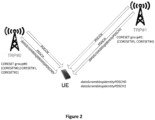
- Figure 2 illustrates an example of configuring scrambling IDs according to the second embodiment.
- the CORESET group#0 includes CORESETS #0, #1 and #2 for TRP #0.
- the CORESET group#1 includes CORESETS #3 and #4 for TRP #1.
- Two scrambling IDs i.e. dataScramblingIdentityPDSCH0 and dataScramblingIdentityPDSCH1, may be configured by higher layer signaling.
- the two scrambling IDs are associated with the two CORESET groups.
- dataScramblingldentityPDSCHO may be associated with CORESET group #0 and dataScramblingIdentityPDSCH1 will be associated with CORESET group #1.
- the associated dataScramblingIdentityPDSCH can also be directly configured in the configuration of the CORESET group. That is, when two CORESET groups are configured for the UE, their associated dataScramblingIdentityPDSCH may be configured at the same time.
- PDSCHs scheduled by DCIs transmitted from CORESETs contained in the CORESET group #0 may be scrambled by the sequence initialized by dataScramblingldentityPDSCHO and PDSCHs scheduled by DCIs transmitted from CORESETs contained in the CORESET group #1 may be scrambled by the sequence initialized by dataScramblingIdentityPDSCH1.
- the CORESET group can be defined by using the following higher layer signaling: ControlResourceSetGroup field descriptions controlResourceSetList This list contains a list of controlResourceSet IDs belongs to the corresponding group. maxNrofcontrolResourceSetPerGroup The maximum number of CORESETs per group. maxNrofControlResourceSetGroups The maximum number of CORESET groups configured for one UE.
- each CORESET group is associated with a scrambling ID. Therefore, each TRP is associated with a scrambling ID.
- PDSCHs scheduled by DCIs transmitted from CORESETs contained in a CORESET group are scrambled by the sequence initialized by the scrambling ID associated with the CORESET group, i.e. with the TRP for the CORESET group.
- the scrambled PDSCHs are transmitted to the UE.
- the UE descrambled the received PDSCHs with the same sequence for scrambling the PDSCHs.
- the PDSCHs received from TRP #0 are descrambled with the sequence initialized by dataScramblingldentityPDSCHO (which is associated with CORESET group #0).
- the PDSCHs received from TRP #1 are descrambled with the sequence initialized by dataScramblingIdentityPDSCH1 (which is associated with CORESET group #1).
- Figure 3 is a schematic flow chart diagram illustrating an embodiment of a method 300 for configuring multiple scrambling IDs.
- the method 300 is performed by an apparatus, such as a base unit.
- the method 300 may be performed by a processor executing program code, for example, a microcontroller, a microprocessor, a CPU, a GPU, an auxiliary processing unit, a FPGA, or the like.
- the method 300 may include 302 grouping CORESETs into two or more CORESET groups, in which each CORESET group includes one or more CORESETs; and 304 configuring the same number as the number of the CORESET groups of scrambling IDs associated with two or more CORESET groups.
- the method 300 may further include step of scrambling PDSCH(s) scheduled by DCI(s) transmitted in the CORESETs in a CORESET group with a scrambling sequence initialized with the scrambling ID associated with the CORESET group, and step of transmitting the scrambled PDSCH(s).
- Figure 4 is a schematic flow chart diagram illustrating an embodiment of a method 400 for configuring multiple scrambling IDs.
- the method 400 is performed by an apparatus, such as a remote unit (UE).
- the method 400 may be performed by a processor executing program code, for example, a microcontroller, a microprocessor, a CPU, a GPU, an auxiliary processing unit, a FPGA, or the like.
- the method 400 may include 402 receiving scrambled PDSCH(s) scheduled by DCI(s) transmitted from CORESET(s) in a CORESET group; and 404 descrambling the scrambled PDSCH(s) with a scrambling sequence initialized with a scrambling ID associated with the CORESET group.
- Figure 5 is a schematic block diagram illustrating apparatuses according to one embodiment.
- the UE i.e. the remote unit
- the UE includes a processor, a memory, and a transceiver.
- the processor implements a function, a process, and/or a method which are proposed in Figure 4 .
- the gNB i.e. base unit
- the processors implement a function, a process, and/or a method which are proposed in Figure 3 .
- Layers of a radio interface protocol may be implemented by the processors.
- the memories are connected with the processors to store various pieces of information for driving the processors.
- the transceivers are connected with the processors to transmit and/or receive a radio signal. Needless to say, the transceiver may be implemented as a transmitter to transmit the radio signal and a receiver to receive the radio signal.
- the memories may be positioned inside or outside the processors and connected with the processors by various well-known means.
- each component or feature should be considered as an option unless otherwise expressly stated.
- Each component or feature may be implemented not to be associated with other components or features.
- the embodiment may be configured by associating some components and/or features. The order of the operations described in the embodiments may be changed. Some components or features of any embodiment may be included in another embodiment or replaced with the component and the feature corresponding to another embodiment. It is apparent that the claims that are not expressly cited in the claims are combined to form an embodiment or be included in a new claim.
- the embodiments may be implemented by hardware, firmware, software, or combinations thereof.
- the exemplary embodiment described herein may be implemented by using one or more application-specific integrated circuits (ASICs), digital signal processors (DSPs), digital signal processing devices (DSPDs), programmable logic devices (PLDs), field programmable gate arrays (FPGAs), processors, controllers, micro-controllers, microprocessors, and the like.
- ASICs application-specific integrated circuits
- DSPs digital signal processors
- DSPDs digital signal processing devices
- PLDs programmable logic devices
- FPGAs field programmable gate arrays
- processors controllers, micro-controllers, microprocessors, and the like.
Landscapes
- Engineering & Computer Science (AREA)
- Signal Processing (AREA)
- Computer Networks & Wireless Communication (AREA)
- Mobile Radio Communication Systems (AREA)
Claims (12)
- Procédé (300) comprenant :le groupement (302) de CORESET dans deux groupes de CORESET ou plus, chaque groupe de CORESET comporte un ou plusieurs CORESET ; etla configuration (304) du même nombre que le nombre des groupes de CORESET d'ID de brouillage associés à deux groupes de CORESET ou plus,dans lequel le(s) CORESET ayant la même valeur d'indice sont groupés dans le même groupe de CORESET.
- Procédé (300) selon la revendication 1, dans lequel le(s) CORESET transmis à partir du même TRP sont groupés dans le même groupe de CORESET.
- Procédé (300) selon la revendication 1, comprenant en outre :
le brouillage d'un ou plusieurs PDSCH planifié(s) par une ou des DCI transmise(s) dans les CORESET dans un groupe de CORESET avec une séquence de brouillage initialisée avec l'ID de brouillage associé au groupe de CORESET. - Procédé (300) selon la revendication 3, comprenant en outre :
la transmission du ou des PDSCH brouillé(s). - Procédé (400) comprenant :la réception (402) de PDSCH brouillé(s) planifié(s) par une ou des DCI transmise(s) à partir d'un ou plusieurs CORESET dans un groupe de CORESET ; etle désembrouillage (404) du ou des PDSCH brouillé(s) avec une séquence de brouillage initialisée avec un ID de brouillage associé au groupe de CORESET,dans lequel le(s) CORESET dans le groupe de CORESET ont une même valeur d'indice.
- Procédé (400) selon la revendication 5, dans lequel le(s) CORESET dans le groupe de CORESET sont associés à un même TRP.
- Unité de base, comprenant un processeur qui :groupe des CORESET dans deux groupes de CORESET ou plus, dans lequel chaque groupe de CORESET comporte un ou plusieurs CORESET ; etconfigure le même nombre que le nombre des groupes de CORESET d'ID de brouillage associés à deux groupes de CORESET ou plus,dans lequel le(s) CORESET ayant la même valeur d'indice sont groupés dans le même groupe de CORESET.
- Unité de base selon la revendication 7, dans laquelle le(s) CORESET transmis à partir du même TRP sont groupés dans le même groupe de CORESET.
- Unité de base selon la revendication 7, dans laquelle le processeur brouille en outre un ou des PDSCH planifié(s) par une ou des DCI transmise(s) dans les CORESET dans un groupe de CORESET avec une séquence de brouillage initialisée avec l'ID de brouillage associé au groupe de CORESET.
- Unité de base selon la revendication 9, comprenant en outre un transmetteur qui transmet le(s) PDSCH brouillé(s).
- Unité distante, comprenant :un récepteur qui reçoit un ou des PDSCH brouillé(s) planifié(s) par une ou des DCI transmise(s) à partir d'un ou plusieurs CORESET dans un groupe de CORESET ; etun processeur qui désembrouille le(s) PDSCH brouillé(s) avec une séquence de brouillage initialisée avec un ID de brouillage associé au groupe de CORESET,dans laquelle le(s) CORESET dans le groupe de CORESET ont une même valeur d'indice.
- Unité distante selon la revendication 11, dans laquelle le(s) CORESET dans le groupe de CORESET sont associés à un même TRP.
Applications Claiming Priority (1)
| Application Number | Priority Date | Filing Date | Title |
|---|---|---|---|
| PCT/CN2019/099011 WO2021022400A1 (fr) | 2019-08-02 | 2019-08-02 | Configuration de multiples identités d'embrouillage |
Publications (4)
| Publication Number | Publication Date |
|---|---|
| EP4008115A1 EP4008115A1 (fr) | 2022-06-08 |
| EP4008115A4 EP4008115A4 (fr) | 2023-01-25 |
| EP4008115C0 EP4008115C0 (fr) | 2024-11-13 |
| EP4008115B1 true EP4008115B1 (fr) | 2024-11-13 |
Family
ID=74502453
Family Applications (1)
| Application Number | Title | Priority Date | Filing Date |
|---|---|---|---|
| EP19940343.7A Active EP4008115B1 (fr) | 2019-08-02 | 2019-08-02 | Configuration de multiples identités d'embrouillage |
Country Status (4)
| Country | Link |
|---|---|
| US (1) | US20220329385A1 (fr) |
| EP (1) | EP4008115B1 (fr) |
| CN (1) | CN114175553B (fr) |
| WO (1) | WO2021022400A1 (fr) |
Families Citing this family (1)
| Publication number | Priority date | Publication date | Assignee | Title |
|---|---|---|---|---|
| CN114866203B (zh) * | 2019-08-16 | 2024-10-22 | 华为技术有限公司 | 一种通信方法及装置 |
Family Cites Families (11)
| Publication number | Priority date | Publication date | Assignee | Title |
|---|---|---|---|---|
| US10856280B2 (en) * | 2017-03-15 | 2020-12-01 | Samsung Electronics Co., Ltd. | Method and apparatus for downlink control information design for network coordination |
| WO2019090774A1 (fr) * | 2017-11-13 | 2019-05-16 | Nec Corporation | Procédés et appareils de configuration de signal de référence de démodulation |
| CN110661606B (zh) * | 2018-06-29 | 2022-05-10 | 华为技术有限公司 | 数据加扰方法及相关设备 |
| WO2020145797A1 (fr) * | 2019-01-11 | 2020-07-16 | 엘지전자 주식회사 | Procédé de réglage de partie de bande passante et d'émission et de réception de données dans un système de communication sans fil et dispositif associé |
| US11997675B2 (en) * | 2019-03-14 | 2024-05-28 | Ntt Docomo, Inc. | User terminal and radio communication method |
| EP3962197A4 (fr) * | 2019-04-26 | 2023-01-11 | Ntt Docomo, Inc. | Terminal utilisateur et procédé de communication sans fil |
| US11211990B2 (en) * | 2019-05-01 | 2021-12-28 | Ofinno, Llc | Beam failure recovery in multi-TRP scenarios |
| CN114128378A (zh) * | 2019-05-15 | 2022-03-01 | 株式会社Ntt都科摩 | 终端以及无线通信方法 |
| WO2020245973A1 (fr) * | 2019-06-06 | 2020-12-10 | 株式会社Nttドコモ | Terminal et procédé de communication sans fil |
| US11350419B2 (en) * | 2019-06-28 | 2022-05-31 | Qualcomm Incorporated | Semi-persistent scheduling (SPS) for multi-DCI based multi-transmitter receiver point (TRP) |
| WO2021011174A1 (fr) * | 2019-07-18 | 2021-01-21 | Qualcomm Incorporated | Règles de priorité associées à un quasi colocalisation de point d'émission/réception multiple basé sur des informations de commande de liaison descendante multiples |
-
2019
- 2019-08-02 CN CN201980098991.2A patent/CN114175553B/zh active Active
- 2019-08-02 US US17/630,858 patent/US20220329385A1/en active Pending
- 2019-08-02 EP EP19940343.7A patent/EP4008115B1/fr active Active
- 2019-08-02 WO PCT/CN2019/099011 patent/WO2021022400A1/fr not_active Ceased
Also Published As
| Publication number | Publication date |
|---|---|
| CN114175553B (zh) | 2024-02-13 |
| EP4008115A4 (fr) | 2023-01-25 |
| CN114175553A (zh) | 2022-03-11 |
| WO2021022400A1 (fr) | 2021-02-11 |
| EP4008115C0 (fr) | 2024-11-13 |
| US20220329385A1 (en) | 2022-10-13 |
| EP4008115A1 (fr) | 2022-06-08 |
Similar Documents
| Publication | Publication Date | Title |
|---|---|---|
| WO2022073189A1 (fr) | Activation simultanée d'états tci pour une liaison montante (ul) et une liaison descendante (dl) | |
| US12470281B2 (en) | Default beam determination for uplink signal transmission | |
| WO2023137654A1 (fr) | Transmission ul basée sur trp multiples à dci uniques dans une structure de tci unifiée | |
| US12489595B2 (en) | Aperiodic SRS triggering and transmission | |
| US12549309B2 (en) | Phase tracking reference signal for SFN based PDSCH transmission | |
| US12316565B2 (en) | Media Access Control (MAC) Control Element (CE) for configuring pathloss reference signal for Sounding Reference Signal (SRS) | |
| WO2021022398A1 (fr) | Configuration et indication de relation spatiale pour des ressources pucch | |
| EP4008115B1 (fr) | Configuration de multiples identités d'embrouillage | |
| WO2023004740A1 (fr) | Commande tpc commune de groupe pour transmission ul en multi-trp | |
| US12557099B2 (en) | Default beam determination in cross-carrier scheduling | |
| US12273865B2 (en) | NBIOT frequency hopping | |
| US20230254856A1 (en) | Default beam determination for reception of pdsch transmissions with repetition | |
| WO2021051379A1 (fr) | Signal de synchronisation de porteuse non d'ancrage | |
| WO2023236009A1 (fr) | Désactivation de harq ido ntn à indication de dci | |
| US20250047443A1 (en) | Multi-dci multi-trp based ul transmission in unified tci framework | |
| WO2023115447A1 (fr) | Désactivation de harq ido ntn | |
| WO2021155572A1 (fr) | Relation spatiale par défaut destinée à la transmission de ressources srs | |
| EP4278770A1 (fr) | Fonctionnement multi-trp entre cellules | |
| US12302263B2 (en) | Transmission of power control command | |
| US20250219793A1 (en) | Pdcch and csi-rs reception in multi-trp scenario with unified tci framework | |
| WO2023060531A1 (fr) | Configuration de transmissions active/à l'arrêt dans le domaine temporel |
Legal Events
| Date | Code | Title | Description |
|---|---|---|---|
| STAA | Information on the status of an ep patent application or granted ep patent |
Free format text: STATUS: THE INTERNATIONAL PUBLICATION HAS BEEN MADE |
|
| PUAI | Public reference made under article 153(3) epc to a published international application that has entered the european phase |
Free format text: ORIGINAL CODE: 0009012 |
|
| STAA | Information on the status of an ep patent application or granted ep patent |
Free format text: STATUS: REQUEST FOR EXAMINATION WAS MADE |
|
| 17P | Request for examination filed |
Effective date: 20220119 |
|
| AK | Designated contracting states |
Kind code of ref document: A1 Designated state(s): AL AT BE BG CH CY CZ DE DK EE ES FI FR GB GR HR HU IE IS IT LI LT LU LV MC MK MT NL NO PL PT RO RS SE SI SK SM TR |
|
| DAV | Request for validation of the european patent (deleted) | ||
| DAX | Request for extension of the european patent (deleted) | ||
| A4 | Supplementary search report drawn up and despatched |
Effective date: 20230104 |
|
| RIC1 | Information provided on ipc code assigned before grant |
Ipc: H04W 4/20 20180101AFI20221222BHEP |
|
| GRAP | Despatch of communication of intention to grant a patent |
Free format text: ORIGINAL CODE: EPIDOSNIGR1 |
|
| STAA | Information on the status of an ep patent application or granted ep patent |
Free format text: STATUS: GRANT OF PATENT IS INTENDED |
|
| INTG | Intention to grant announced |
Effective date: 20240513 |
|
| GRAS | Grant fee paid |
Free format text: ORIGINAL CODE: EPIDOSNIGR3 |
|
| GRAA | (expected) grant |
Free format text: ORIGINAL CODE: 0009210 |
|
| STAA | Information on the status of an ep patent application or granted ep patent |
Free format text: STATUS: THE PATENT HAS BEEN GRANTED |
|
| AK | Designated contracting states |
Kind code of ref document: B1 Designated state(s): AL AT BE BG CH CY CZ DE DK EE ES FI FR GB GR HR HU IE IS IT LI LT LU LV MC MK MT NL NO PL PT RO RS SE SI SK SM TR |
|
| REG | Reference to a national code |
Ref country code: GB Ref legal event code: FG4D |
|
| REG | Reference to a national code |
Ref country code: CH Ref legal event code: EP |
|
| REG | Reference to a national code |
Ref country code: DE Ref legal event code: R096 Ref document number: 602019062099 Country of ref document: DE |
|
| REG | Reference to a national code |
Ref country code: IE Ref legal event code: FG4D |
|
| U01 | Request for unitary effect filed |
Effective date: 20241128 |
|
| U07 | Unitary effect registered |
Designated state(s): AT BE BG DE DK EE FI FR IT LT LU LV MT NL PT RO SE SI Effective date: 20241210 |
|
| PG25 | Lapsed in a contracting state [announced via postgrant information from national office to epo] |
Ref country code: HR Free format text: LAPSE BECAUSE OF FAILURE TO SUBMIT A TRANSLATION OF THE DESCRIPTION OR TO PAY THE FEE WITHIN THE PRESCRIBED TIME-LIMIT Effective date: 20241113 Ref country code: IS Free format text: LAPSE BECAUSE OF FAILURE TO SUBMIT A TRANSLATION OF THE DESCRIPTION OR TO PAY THE FEE WITHIN THE PRESCRIBED TIME-LIMIT Effective date: 20250313 |
|
| PG25 | Lapsed in a contracting state [announced via postgrant information from national office to epo] |
Ref country code: ES Free format text: LAPSE BECAUSE OF FAILURE TO SUBMIT A TRANSLATION OF THE DESCRIPTION OR TO PAY THE FEE WITHIN THE PRESCRIBED TIME-LIMIT Effective date: 20241113 |
|
| PG25 | Lapsed in a contracting state [announced via postgrant information from national office to epo] |
Ref country code: NO Free format text: LAPSE BECAUSE OF FAILURE TO SUBMIT A TRANSLATION OF THE DESCRIPTION OR TO PAY THE FEE WITHIN THE PRESCRIBED TIME-LIMIT Effective date: 20250213 |
|
| PG25 | Lapsed in a contracting state [announced via postgrant information from national office to epo] |
Ref country code: GR Free format text: LAPSE BECAUSE OF FAILURE TO SUBMIT A TRANSLATION OF THE DESCRIPTION OR TO PAY THE FEE WITHIN THE PRESCRIBED TIME-LIMIT Effective date: 20250214 |
|
| PG25 | Lapsed in a contracting state [announced via postgrant information from national office to epo] |
Ref country code: PL Free format text: LAPSE BECAUSE OF FAILURE TO SUBMIT A TRANSLATION OF THE DESCRIPTION OR TO PAY THE FEE WITHIN THE PRESCRIBED TIME-LIMIT Effective date: 20241113 |
|
| PG25 | Lapsed in a contracting state [announced via postgrant information from national office to epo] |
Ref country code: RS Free format text: LAPSE BECAUSE OF FAILURE TO SUBMIT A TRANSLATION OF THE DESCRIPTION OR TO PAY THE FEE WITHIN THE PRESCRIBED TIME-LIMIT Effective date: 20250213 |
|
| PG25 | Lapsed in a contracting state [announced via postgrant information from national office to epo] |
Ref country code: SM Free format text: LAPSE BECAUSE OF FAILURE TO SUBMIT A TRANSLATION OF THE DESCRIPTION OR TO PAY THE FEE WITHIN THE PRESCRIBED TIME-LIMIT Effective date: 20241113 |
|
| PG25 | Lapsed in a contracting state [announced via postgrant information from national office to epo] |
Ref country code: SK Free format text: LAPSE BECAUSE OF FAILURE TO SUBMIT A TRANSLATION OF THE DESCRIPTION OR TO PAY THE FEE WITHIN THE PRESCRIBED TIME-LIMIT Effective date: 20241113 |
|
| PG25 | Lapsed in a contracting state [announced via postgrant information from national office to epo] |
Ref country code: CZ Free format text: LAPSE BECAUSE OF FAILURE TO SUBMIT A TRANSLATION OF THE DESCRIPTION OR TO PAY THE FEE WITHIN THE PRESCRIBED TIME-LIMIT Effective date: 20241113 |
|
| PLBE | No opposition filed within time limit |
Free format text: ORIGINAL CODE: 0009261 |
|
| STAA | Information on the status of an ep patent application or granted ep patent |
Free format text: STATUS: NO OPPOSITION FILED WITHIN TIME LIMIT |
|
| U20 | Renewal fee for the european patent with unitary effect paid |
Year of fee payment: 7 Effective date: 20250825 |
|
| PGFP | Annual fee paid to national office [announced via postgrant information from national office to epo] |
Ref country code: GB Payment date: 20250826 Year of fee payment: 7 |
|
| 26N | No opposition filed |
Effective date: 20250814 |
|
| REG | Reference to a national code |
Ref country code: CH Ref legal event code: H13 Free format text: ST27 STATUS EVENT CODE: U-0-0-H10-H13 (AS PROVIDED BY THE NATIONAL OFFICE) Effective date: 20260324 |
|
| PG25 | Lapsed in a contracting state [announced via postgrant information from national office to epo] |
Ref country code: MC Free format text: LAPSE BECAUSE OF FAILURE TO SUBMIT A TRANSLATION OF THE DESCRIPTION OR TO PAY THE FEE WITHIN THE PRESCRIBED TIME-LIMIT Effective date: 20241113 |
|
| PG25 | Lapsed in a contracting state [announced via postgrant information from national office to epo] |
Ref country code: CH Free format text: LAPSE BECAUSE OF NON-PAYMENT OF DUE FEES Effective date: 20250831 |