EP4008182B1 - Procédé d'application des agents d'aspersion - Google Patents
Procédé d'application des agents d'aspersion Download PDFInfo
- Publication number
- EP4008182B1 EP4008182B1 EP21401050.6A EP21401050A EP4008182B1 EP 4008182 B1 EP4008182 B1 EP 4008182B1 EP 21401050 A EP21401050 A EP 21401050A EP 4008182 B1 EP4008182 B1 EP 4008182B1
- Authority
- EP
- European Patent Office
- Prior art keywords
- detection device
- sprayer
- setting parameter
- deviation
- plant population
- Prior art date
- Legal status (The legal status is an assumption and is not a legal conclusion. Google has not performed a legal analysis and makes no representation as to the accuracy of the status listed.)
- Active
Links
Images


Classifications
-
- A—HUMAN NECESSITIES
- A01—AGRICULTURE; FORESTRY; ANIMAL HUSBANDRY; HUNTING; TRAPPING; FISHING
- A01M—CATCHING, TRAPPING OR SCARING OF ANIMALS; APPARATUS FOR THE DESTRUCTION OF NOXIOUS ANIMALS OR NOXIOUS PLANTS
- A01M7/00—Special adaptations or arrangements of liquid-spraying apparatus for purposes covered by this subclass
- A01M7/0089—Regulating or controlling systems
Definitions
- the invention relates to a method for applying a spray agent according to the preamble of patent claim 1 and an agricultural sprayer for applying a spray agent according to the preamble of patent claim 9.
- a large number of towed, mounted and/or self-propelled implements are known in agriculture.
- Such implements include, among others, agricultural sprayers for applying pesticides, whereby the pesticides include plant protection, weed control and/or fertilizers, depending on the type of cultivation and/or treatment of an agricultural area and/or its crops.
- Sprayers of this type comprise at least one storage container for storing the spraying agent and at least one spraying agent-conducting and/or conveying system for supplying the spraying agent from the at least one storage container to a plurality of application elements, in particular spray nozzles.
- the sprayer further comprises at least one rod that can be folded out or folded in transversely to a direction of travel of the sprayer, wherein the plurality of application elements are arranged next to one another along the rod, in particular individual sections of the rod.
- such a sprayer is assigned at least one control and/or regulating system, which is designed to control and/or regulate the application elements and/or at least one device within the conveyor system depending on at least one setting parameter in such a way that the spray can be applied to the plant population via the application elements as required, in particular individually and/or in groups.
- the spray is thus applied to the plant population and at least one surface of at least one crop, in particular a leaf, plant stem and/or a fruit, is wetted with the spray.
- the spray is applied to an agricultural area and/or its crop using an agricultural sprayer with at least one set setting parameter.
- At least one surface is wetted with the spray.
- the at least one wetted surface is detected using at least one detection device assigned to the sprayer.
- An actual wetting quality is determined based on the at least one detected surface. Then at least one deviation of the actual wetting quality from a retrievable and/or predeterminable target wetting quality is determined.
- a disadvantage of such methods is, among other things, that the transmission of data between the at least one detection device and the syringe, in particular a control and/or regulating system, for adjusting the setting parameter is particularly complex and the necessary Devices are therefore associated with high costs. Furthermore, an arrangement of at least one detection device on the sprayer, in particular in the area of the boom that is movable relative to the sprayer, is only possible to a limited extent due to the necessary wired signal lines, despite the high outlay. Furthermore, the outlay for retrofitting such detection devices to carry out such methods on existing sprayers is disproportionately high and is therefore often particularly problematic or not feasible. In particular, an arrangement of such detection devices on the movable sprayer, in particular the boom, leads to the achievable detection quality or detection accuracy and thus the benefit of such detection methods being severely limited due to the relative movement to the agricultural area and/or the crop.
- setting parameter refers to a setting and/or parameterization of at least one device within the syringe, which at least partially influences a flow, in particular a flow rate, a discharge rate and/or a pressure within the at least one conveyor system, discharge element and/or in the area of the discharge element.
- a device can control at least one discharge element, valve and/or at least a conveying device, in particular a pump.
- this is to be understood as a setting and/or parameterization that influences a discharge direction, in particular alignment and/or angle of at least one discharge element and/or an exit direction of the spray.
- this is preferably to be understood as a setting and/or parameterization that influences a dischargeable droplet spectrum and/or a dischargeable exit speed of the spray from the at least one discharge element.
- the at least one detection device can be attached to at least almost any position, in particular on the sprayer or on and/or next to the agricultural area.
- a particularly favorable position of the detection device can thus be used to detect the at least partially wetted surface.
- the at least one detection device can be arranged along the sprayer, in particular the boom, depending on the plant size, the plant type, the stage of development and/or the type of spray agent.
- the adjustment of the at least one setting parameter is preferably carried out automatically by the detection device and/or by the syringe, in particular by a control and/or regulating system assigned to the syringe.
- an at least partially manual or partially automated adjustment in which the operator is presented with at least one suggestion for a change and/or an optimal value for the at least one setting parameter visually and/or acoustically, in particular by means of an operating and/or display means.
- a new setting parameter determined on the basis of the deviation is automatically preselected, which is then confirmed by the operator, in particular by operating the operating and/or display means.
- the previously set setting parameter preferably by the operator, the control and/or regulating system and/or the detection device, can also be taken into account to determine the new setting parameter.
- the detection device is preferably designed to detect the at least one wetted surface without contact, in particular optically, although detection by means of contact is also conceivable alternatively or additionally.
- a temperature in particular temperature difference
- a color value in particular color spectrum
- a surface structure and/or an electrical variable for example a resistance
- a drop size in particular a drop spectrum, a drop shape, in particular a drop shape spectrum, and/or a drop density of the spray agent on the surface is preferably detected and/or evaluated.
- the signals are transmitted and/or exchanged at least partially by radio between the detection device and the syringe, in particular the control and/or regulating system, and/or a server, in particular a decentralized control and/or regulating system.
- the radio connection can be at least partially designed as Bluetooth, Wi-Fi, mobile radio, GSM, radio or similar connections.
- the determination of the actual wetting quality and/or the deviation between the actual and target wetting quality for improved resource utilization and/or capacity can be carried out at least partially by the detection device, the syringe and/or the server, in particular the decentralized control and/or regulating system.
- At least one additional substance in particular a dye or tracer tailored to the detection device, can preferably be added to the spray agent to increase the detection quality or detection accuracy, with a fluorescent substance, in particular uranine, being particularly preferred.
- the target wetting quality represents a wetting of the at least one surface, in particular the plant, that can be called up and/or specified by the operator, the control and/or regulating system of the sprayer and/or the detection device.
- the target wetting quality is calculated and/or determined taking into account the at least one setting parameter and/or the at least one application element.
- an application map in particular the spray requirement of at least one surface of the plant population, is taken into account to calculate and/or determine the target wetting quality.
- a wetting of the at least one surface achieved in the past is taken into account.
- the spray applied in particular at least one property or wetting property of the spray that influences the wetting, such as surface tension, adhesion, etc.
- the target wetting quality is determined and/or specified depending on the recorded and/or specified plant population, in particular its type, size and/or stage of development.
- the actual wetting quality is determined based on the at least one detected surface by the detection device.
- the detection device determines the at least one deviation of the actual wetting quality from the retrievable and/or predeterminable target wetting quality.
- the detection device adjusts the at least one setting parameter on the basis of the at least one deviation.
- the computing capacity of the detection device can thus be used, whereby the requirements for the sprayer, in particular its control and/or regulating system, in terms of computing power for carrying out the method according to the invention are particularly low.
- the at least one detection device is arranged along the agricultural area and/or the Plant population is carried by the operator.
- the detection device is designed to be mobile and/or portable by the operator.
- the at least one surface is preferably laid out and/or attached along the agricultural area and/or the plant population. The attachment and/or laying out takes place in an area on the agricultural area and/or the plant population that is to be wetted with spray.
- the at least one surface is to be understood as a lay-out collecting surface that catches and/or holds impinging spray essentially at the point of impact.
- the drops of the spray are preferably caught and/or held individually and/or in small groups, in particular in such a way that the drops can be recognized and evaluated individually and/or in small groups.
- This embodiment makes it possible to determine and/or monitor the wetting quality at particularly relevant positions on the agricultural area and/or, in particular on a crop, of the plant population.
- wetted surfaces in areas located in deeper regions along a crop can be particularly well detected with such an embodiment, since the detection device can be aligned at least almost individually to the respective wetted surface.
- a mobile detection device enables the method according to the invention and/or the agricultural sprayer to be adapted particularly easily.
- a respective detection device can be replaced by another detection device with different specifications in order to adapt the detection to the respective requirements, in particular the spray agent and/or the crop.
- At least one target position along the agricultural area and/or the plant population is determined and/or retrieved.
- the at least one target position is determined and/or specified based on the agricultural area and/or the plant population, in particular their geometry and/or dimensions. This can be done manually, for example, by the operator, in particular his Experience, and/or automated by the detection device, the sprayer, in particular the control and/or regulating system and/or the server.
- the at least one target position is visualized for the operator, whereby the operator takes into account the target position for carrying and/or laying out and/or attaching the at least one surface along the agricultural area and/or the plant population.
- the positioning of the at least one surface takes place at least substantially in the area of the determined and/or visualized target position.
- different positions are determined and/or visualized for several surfaces to be wetted, based on which the operator can distribute the surfaces on the agricultural area and/or the plant population.
- the at least one deviation is visualized for the operator.
- at least one new setting parameter determined and/or retrieved on the basis of the deviation is visualized.
- the operator is shown a difference between the target and actual wetting quality and/or the previously set setting parameter and the newly determined setting parameter.
- the operator is informed visually or acoustically in the event of a deviation or difference, in particular one that exceeds a predefined tolerance range.
- the visualization of the deviation and/or the setting parameter preferably takes place on an operating and/or display means associated with the detection device and/or the syringe, in particular a display.
- the at least one setting parameter is preferably replaced by the setting parameter determined and/or retrieved by the operator.
- the determined and/or retrieved new setting parameter in particular the difference to the previously set setting parameter, is suggested to the operator, whereby the operator can adjust the setting parameter by manual operation.
- an automated adjustment of the setting parameter by the detection device and/or the decentralized server is also conceivable. With such an embodiment, the handling and/or operational reliability of such methods are increased even further.
- Such information can include data about the sprayer, in particular the settings and/or parameterizations, about the environment, in particular temperature, humidity, wind direction and/or strength, and/or about the plant population, in particular its type, size and/or stage of development.
- the at least one piece of information is retrieved via the sprayer, in particular the control and/or regulating system, the decentralized server and/or online from the detection device. Alternatively or additionally, at least one piece of information can be added manually by the operator to the detection device.
- the at least one piece of information can thus be taken into account when determining the at least one setting parameter.
- a larger amount of information can thus be taken into account for determining the at least one setting parameter. This embodiment thus achieves an even further increased detection quality and detection accuracy of the wetting with particularly low equipment expenditure.
- At least one characteristic map preferably with at least one function curve, which contains a dependency of the at least one setting parameter on the actual wetting quality, in particular the deviation, is retrieved and/or used, wherein the at least one setting parameter is preferably adapted as a function of the characteristic map, in particular the at least one function curve.
- the characteristic map is preferably used by the control and/or regulating system or the detection device calculated, retrieved and/or used. In particular, a comparison is made as to which wetting quality can be achieved with which setting parameter.
- the at least one characteristic map in particular the at least one function curve, is preferably adapted taking into account at least one piece of information on the environment, the spray agent, the plant population, the application element or the spray nozzle and/or the sprayer.
- This embodiment allows a particularly low computing power of the control and/or regulating system and/or the detection device, since the at least one setting parameter to be set is at least partially predetermined by the characteristic map, in particular the function curve.
- the at least one characteristic map in particular the at least one function curve, is used to check whether the at least one setting parameter can be adjusted in such a way that the target wetting quality can be at least substantially achieved.
- the control and/or regulating system and/or the detection device checks in advance whether a combined adjustment of several setting parameters to achieve the target wetting quality is possible based on the actual wetting quality, the at least one set setting parameter and/or the characteristic map, in particular the function curve.
- an operator is preferably informed and/or alerted if a target wetting quality cannot be achieved by adjusting the at least one setting parameter.
- At least one setting recommendation is called up and/or determined, in particular by the control and/or regulating system and/or the detection device, for the spray agent and/or the sprayer.
- the setting recommendation is preferably visualized for the operator.
- the setting recommendation is preferably retrieved and/or calculated by means of the control and/or regulating system and/or the detection device.
- the setting recommendation can, for example, be an adjustment to influence the spray agent, a pre-treatment to influence the wettability of the plant population and/or to influence the sprayer, in particular the driving speed.
- At least one additive and/or auxiliary substance is added to the spray to influence the wettability of the plant population and/or the wetting properties of the spray.
- the object underlying the invention is also achieved with an agricultural sprayer, in particular with a control and/or regulating system for applying spraying agent, wherein the at least one setting parameter can be adjusted on the basis of the deviation, and that in order to adjust the at least one setting parameter, data can be transmitted wirelessly, in particular via radio, between the at least one detection device and the sprayer.
- the detection device is designed as a mobile radio device with at least one optical detection means.
- the mobile radio device preferably designed as a smartphone, has a corresponding application, in particular an app, for at least partially carrying out the method according to the invention.
- the mobile radio device is preferably set up to detect the at least one surface, in particular by means of a camera, to determine the actual wetting quality and/or a deviation of the actual wetting quality from the target wetting quality, and/or to adapt the at least one setting parameter of the syringe.
- the detection device is set up to generate an image recording and/or to evaluate the at least one detected surface, in particular a photo of the at least one surface, with regard to the wetting quality.
- Detection devices designed as mobile radio devices are particularly well suited for at least partially implementing the method according to the invention.
- Mobile radio devices typically have advantages over conventional agricultural sprayers, in particular their control and/or regulation systems, have higher computing power or computing capacity.
- a mobile detection device makes it particularly easy to adapt the detection device.
- a respective detection device can be replaced by another detection device with different specifications in order to adapt the detection to the respective requirements, in particular the spray and/or the plant population.
- the detection device designed as a mobile device can be expanded by means of optional and/or externally connectable detection means. This, for example, further increases the area of application of such detection means in a simple manner.
- the at least one detection means is preferably designed to generate a thermal image, in particular an infrared and/or thermal image, a 3D image, a spectral and/or stereoscopic image of the at least one wetted surface.
- an internal and/or external lighting means is preferred, which is designed to illuminate the at least one wetted surface for detection.
- the lighting means and the spraying agent, in particular an added additive are coordinated with one another in such a way that the spraying agent, in particular the additive, reacts on the at least one surface for detection in the manner of fluorescence.
- an embodiment is preferred in which it can be checked whether a spray agent is stored in a spray agent database for a drop size determined by means of the detection device, the determined drop spectrum, the determined drop shape and/or the determined drop shape spectrum.
- the detection device preferably as a sensor arrangement, is formed at least partially from the surface.
- the at least one surface is at least a part of the detection device, which preferably has at least one Sensor surface of the detection device.
- the detection device itself is also at least partially wetted with spray.
- the detection device is preferably designed in the manner of a, in particular mobile, radio sensor, with several radio sensors being particularly preferred.
- the detection device is particularly preferably set up to detect an electrical resistance of the at least one wetted surface, in particular a change in resistance between an unwetted and wetted state of the at least one surface.
- the detection device is set up to detect a change in temperature, at least one component of the spray and/or an image of the at least one surface.
- detection devices are characterized in particular by their particularly simple manufacture.
- the detection devices which are preferably designed as radio sensors, can be designed and/or tailored to their particularly specific areas of application, which in turn further increases the detection quality and detection accuracy.
- the detection device can be laid out and/or attached to the agricultural area and/or the crop.
- the at least one surface at least partially forms a lay-out and/or attachable adhesive and/or collecting element.
- the material from which the adhesive and/or collecting element is formed is preferably paper and/or plastic, in particular with and/or without an additional coating.
- a spray-sensitive material, in particular water-sensitive material, is particularly preferred, which causes at least partial discoloration of the material upon contact with the spray and/or an additive.
- the surface has a roughness and/or shape, in particular tailored to the leaf structure and/or leaf geometry of the plant population, in particular in order to at least substantially replicate the leaves.
- the at least one surface is along the agricultural area, in particular on the arable land, and/or on the plant population.
- the stem and/or leaf in particular on the stem and/or leaf.
- several surfaces, in particular adhesive and/or collecting elements can be positioned on one plant in each plant.
- several surfaces can be positioned along the stem at different heights in order to determine not only the wetting but also, for example, the penetration of the spray.
- the properties of the surface to be detected, in particular the adhesive and/or collecting element are at least essentially the same. This means that when several surfaces are detected, an improved comparability of the wetting and thus an increased detection quality or detection accuracy is achieved.
- the at least one detection device and/or the surface can be laid out and/or attached next to the agricultural area in order to determine, for example, drift of the spray agent.
- an agricultural sprayer is preferably one which alternatively or additionally comprises at least one sensor unit, in particular arranged on the boom, and which is designed to detect at least one surface of the plant, in particular during application, in a wetted state and thus a wetting quality, in particular a first wetting quality, can be determined.
- the actual wetting quality, in particular the deviation can be determined on the basis of the surfaces that can be detected by means of the at least one sensor unit and the detection device.
- an actual wetting quality or the actual wetting quality is determined both from the data of the detection device and the surface that can be laid out and/or attached and from the data of the sensor unit, in particular arranged on the sprayer or on the boom, in particular the first wetting quality.
- both the data of the sensor unit on the sprayer and the mobile detection device can be taken into account.
- the at least one sensor unit is connected to the at least one Detection device, in particular on the basis of the at least one surface that can be detected by means of the detection device, can be calibrated.
- the agricultural sprayer in particular the control and/or regulating system, is designed to carry out the method according to the invention for applying spraying agent.
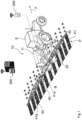
- An agricultural sprayer 10 pulled by a tractor S is in the Fig.1 shown.
- the agricultural sprayer 10 can also be self-propelled or designed to be carried by the tractor S.
- the sprayer 10 comprises a rod 12 that can be folded out transversely to a direction of travel F and arranged thereon.
- the sprayer 10 also comprises a spray agent-conducting and/or conveying conveyor system (not shown in the figures) for supplying a spray agent 30, in particular plant protection agent and/or fertilizer, from a storage container 11 of the sprayer 10 to several application elements 20, in particular spray nozzles 21, arranged next to one another on the rod 12.
- the application elements 20, in particular spray nozzles 21, are designed to apply the spray agent 30 to a plant population P of an agricultural area N on the basis of at least one setting parameter. At least one surface P1 of the plant population P is at least partially wetted with the spray agent 30.
- the syringe 10 comprises a plurality of detection devices 40 designed according to a first embodiment of the invention, which are designed to detect the at least one surface P1 of the plant population P in a wetted state. Furthermore, a deviation in the wetting quality is determined taking into account an actual wetting quality determined by means of the detected surface P1 and a predefinable and/or retrievable target wetting quality of the at least one surface P1.
- the at least one setting parameter is then adjusted, wherein the data for determining this deviation are transmitted at least partially wirelessly, in particular via radio, between the at least one detection device 40 and the syringe 10, in particular a control and/or regulating system 200 assigned to the syringe 10.
- the at least one setting parameter represents a setting and/or parameterization of the sprayer 10, in particular of at least one device of the conveying system and/or the application element 20, which at least partially influences a flow, in particular a flow rate, an application rate and/or a pressure of the spray agent 30 within the at least one conveying system, application element 20 and/or in the region of the application element 20.
- a decentralized computer unit or a server 300 in particular a decentralized control and/or regulating system.
- the server 300 is used alternatively or additionally to transmit the data, in particular to retrieve and/or specify the target wetting quality and/or to determine the actual wetting quality and/or the deviation in the wetting quality.
- the data can be transmitted at least partially wirelessly between the detection device 40, the syringe 10, in particular the control and/or regulating system 200, and the server 300.
- the detection device 40 is designed as a sensor unit 41a for contactless detection of the at least one wetted surface P1. Furthermore, several detection devices 40, each designed as a sensor unit 41a, are arranged on the sprayer 10, in particular along the boom 12, and are aligned with the plant population P.
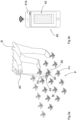
- the Fig.2a and 2b show an exemplary second embodiment of the detection device 40 according to the invention, in which the detection device 40 is designed as a mobile radio device 41b, in particular a smartphone.
- the detection device 40 is designed as a mobile radio device 41b, in particular a smartphone.
- an operator B or user can be seen at a plant stand P, the surface P1 of the plant stand P being wetted with spray 30.
- the user B carries the detection device 40 along the agricultural area N and/or the plant stand P and aligns the detection device 40 with the surface P1, in particular the wetted leaf, and generates an image recording 42 of the at least one surface P1 by means of an optical detection means arranged in the detection device 40, in particular a camera.
- the Fig.2b shows the generated image recording 42 of the surface P1 on the detection device 40, in particular the mobile device 41b.
- the Fig.3a and 3b further show an exemplary third embodiment of the detection device 40 according to the invention, in which the detection device 40 is designed as a mobile radio device 41b, in particular a smartphone.
- a surface P2 to be wetted with spray agent 30 forms a layable and/or attachable adhesive and/or collecting element 43 such as in the Fig.3a is shown.
- the adhesive and/or collecting element 43 represents a paper strip, in particular a water-sensitive one, which can be attached to the plant stem and/or the plant leaf of at least one crop.
- other types and/or forms of adhesive and/or collecting elements 43 with a wettable surface P2 for the spray 30 are also conceivable, which are designed to at least partially collect and/or absorb the spray 30, in particular individual drops.
- the adhesive and/or collecting element 43 in particular the surface P2, is positioned or attached and/or laid out on the agricultural area N, in particular on at least one crop of the plant population P, before the spray 30 is applied.
- the adhesive and/or collecting element 43 in particular the at least one surface P2, is thus at least partially wetted with spray 30 during the application process.
- the user B carries the detection device 40 to the wetted adhesive and/or collecting element 43.
- the wetted surface P2 is detected by the user using the detection device 40, in particular by means of the camera.
- the image recording 42 of the adhesive and/or collecting element 43, in particular the surface P2, thus generated, as in Fig.3b can be seen, is thus used to determine the actual wetting quality.
- the actual wetting quality of the at least one surface P1, in particular of the plant population P is determined on the basis of the detected wetting of the at least one surface P2, in particular of the adhesive and/or collecting element 43.
- the detection device 40 shown is designed to detect the wetted surface P1, P2, in particular the individual drops of the spray agent 30 located thereon, without contact.
- the detection can alternatively or additionally be carried out by thermal, in particular infrared and/or thermal, 3D, spectral and/or stereoscopic recordings. It is conceivable that the actual wetting quality of the surface P1 can be determined, for example, by detectable temperature, color and/or structural differences of the surface P1, P2.
- an additive tailored to the detection device 40 is added to the spray agent 30 before and/or during application.
- the additive can be designed in the manner of fluorescence. In this way, for example, a higher detection accuracy of the wetted surface P1, P2 can be achieved by the detection device 40.
- the Fig.4 an exemplary fourth embodiment of the detection device 40 according to the invention during the application of the spray agent 30.
- the detection device 40 is formed at least partially from the surface P2.
- the detection device 40 is designed as a sensor arrangement 41c, in particular as a radio sensor.
- the radio sensor 41c is laid out and/or attached to the agricultural area N before application, in particular between individual crops of the plant population P. Alternatively or additionally, radio sensors 41c are also conceivable that can be attached to the plant population P.
- the detection device 40 in particular the radio sensor 41c, is designed to detect the spray 30 located on the surface P2, in particular the individual drops.
- an electrical quantity in particular a change in an electrical quantity, due to the spray 30 applied to the surface P2 is detected by the radio sensor 41c.
- an electrical quantity can be an electrical voltage, current or resistance.
- the radio sensor 41c detects the surface P2 and the spray 30 applied to it by means of image, heat, in particular infrared and/or thermal, 3D, spectral and/or stereoscopic recordings.
- At least one target position 50 along the agricultural area N and/or the plant population P is determined and/or retrieved beforehand.
- the determination and/or retrieval of the target position 50 is carried out by the detection device 40.
- the at least one target position 50 is visualized to the operator B or user, in particular by means of the detection device 40 and/or an operating and/or display means assigned to the sprayer 10.
- the target position 50 is then taken into account for carrying the detection device 40 and/or for laying out and/or attaching the at least one surface P1, P2. It is conceivable that the target position 50 is specified and/or suggested to the user B based on coordinates and/or grids of the agricultural area N.
- the user B determines and/or sets the at least one target position 50 for the at least one surface P1, P2 based on experience or arbitrarily.
- the at least one target position 50 is also determined, retrieved and/or visualized by means of the syringe 10, in particular the control and/or regulating system 200, and/or the server 300.
- the determination of the actual wetting quality and/or the deviation between the actual wetting quality and the target wetting quality is carried out by the detection device 40 in the embodiments shown.
- the target wetting quality is called up and/or specified by the detection device 40 depending on the plant population P, the spray agent 30 and/or the application elements 20.
- Information, in particular from the sprayer 10 and/or the server 300, is transmitted to the detection device 40.
- Such information includes data on the sprayer 10, in particular the settings and/or parameterizations, on the environment, in particular temperature, humidity, wind direction and/or strength, and/or on the plant population P, in particular its type, size and/or stage of development.
- the determination of the deviation between the actual wetting quality and the target wetting quality is carried out at least partially by the syringe 10, in particular the control and/or regulating system 200 assigned thereto, and/or the decentralized server 300.
- the at least one previously set setting parameter of the syringe 10 is adapted to the newly determined setting parameter by the detection device 40 on the basis of the actual wetting quality and the determined deviation from the target wetting quality.
- the previously set setting parameter is taken into account when determining the new setting parameter.
- the determined deviation in the wetting quality and/or the newly determined and/or retrieved setting parameter is also visualized to the operator B or user via the detection device 40 and/or the syringe 10, in particular the associated operating and/or display means.
- the user B replaces at least one of the nine previously set setting parameters.
- the newly determined setting parameter is suggested to the user B and adopted by manual actuation as a new setting parameter for the syringe 10, in particular at least one device of the syringe 10.
- the detection device 40 can also automatically adjust the setting parameter based on the deviation in the wetting quality.
- the detection device 40 arranged on the syringe 10 and designed as a sensor unit 41a can be connected to the portable detection device 40 and the extendable and/or attachable surfaces P2 from the Fig.2a - 4 combined, and in particular calibrated by means of these.
- the actual wetting quality in particular the deviation between the actual wetting quality and the target wetting quality, is determined on the basis of the detection device 40 designed as a sensor unit 41a and as a mobile radio device 41b.
- a characteristic map in particular with at least one function curve, can be stored on the control and/or regulating system 200 and/or the detection device 40, in particular the mobile radio device 41b, and/or can be called up by them.
- the characteristic map, in particular the at least one function curve can be calculated and used by the control and/or regulating system 200 and/or the detection device 40, in particular the mobile radio device 41b.
- the characteristic map, in particular the at least one function curve contains and/or reflects a dependency of the at least one setting parameter on the actual wetting quality, in particular the deviation.
- the characteristic map in particular the at least one function curve
- the characteristic map is taken into account by the control and/or regulating system 200 and/or the detection device 40 to adapt the at least one setting parameter.
- the characteristic map, in particular the at least one function curve can be adapted by the control and/or regulating system 200 and/or the detection device 40, taking into account at least one piece of information on the environment, the spray agent 30, the plant population P, the spray nozzle 21 and/or the sprayer 10.
- the characteristic map, in particular the function curve is thus at least partially and/or within a predetermined range.
- the respective characteristic map, in particular the functional curve can be called up and/or adapted depending on an activated spray nozzle 21.
- the at least one setting parameter can be adjusted by the control and/or regulating system 200 and/or the detection device 40 based on the characteristic map, in particular the at least one function curve, in such a way that the target wetting quality is at least substantially achieved.
- a setting recommendation for the spray agent 30 and/or the sprayer 10 can be called up and/or determined by the control and/or regulating system 200 and/or the detection device 40 based on the characteristic map, in particular the function curve.
- a determined or calculated setting recommendation is visualized for the operator B.
- the operator B is alternatively or additionally informed or alerted in a case in which a target wetting quality cannot be achieved by adjusting the at least one setting parameter.
Landscapes
- Life Sciences & Earth Sciences (AREA)
- Engineering & Computer Science (AREA)
- Insects & Arthropods (AREA)
- Pest Control & Pesticides (AREA)
- Wood Science & Technology (AREA)
- Zoology (AREA)
- Environmental Sciences (AREA)
- Catching Or Destruction (AREA)
Claims (13)
- Procédé pour l'épandage d'un produit de pulvérisation (30), en particulier d'un produit phytosanitaire et/ou d'engrais, comportant les étapes consistant à :a) épandre le produit de pulvérisation (30) à l'aide d'un pulvérisateur agricole (10), sur une surface agricole utile (N) et/ou sa population végétale (P), avec au moins un paramètre de réglage réglé ;b) mouiller au moins une surface (P1) avec le produit de pulvérisation (30) ;c) détecter au moins une surface mouillée (P1) à l'aide d'au moins un dispositif de détection (40) associé au pulvérisateur (10) ;d) déterminer une qualité de mouillage réelle à l'aide de ladite au moins une surface détectée (P1) ;e) déterminer au moins un écart de la qualité de mouillage réelle par rapport à une qualité de mouillage de consigne pouvant être appelée et/ou prédéfinie ;caractérisé par les étapes suivantes :f) adaptation de l'au moins un paramètre de réglage sur la base de l'au moins un écart ; dans lequel, pour l'adaptation de l'au moins un paramètre de réglage, des données sont transmises au moins partiellement sans fil, en particulier par radio, entre l'au moins un dispositif de détection (40) et le pulvérisateur (10), en particulier un système de commande et/ou de régulation (200),g) détection de l'au moins une surface mouillée (P1) en portant l'au moins un dispositif de détection (40) le long de la surface agricole utile (N) et/ou de la population végétale (P) par un opérateur (B).
- Procédé selon la revendication 1, caractérisé en ce qu'au moins une des étapes d) à f) est réalisée par l'au moins un dispositif de détection (40).
- Procédé selon au moins l'une des revendications précédentes,
caractérisé par au moins l'une des étapes suivantes :
h) dépôt et/ou application de l'au moins une surface (P2) le long de la surface agricole utile (N) et/ou de la population végétale (P). - Procédé selon la revendication 3, caractérisé par l'étape consistant à :i) déterminer et/ou appeler au moins une position de consigne (50) le long de la surface agricole utile (N) et/ou la population végétale (P) ; etj) visualiser au moins une position de consigne (50) pour un opérateur ; dans lequel la position de consigne (50) est prise en compte pour la réalisation d'au moins l'une des étapes g) et h).
- Procédé selon au moins l'une des revendications précédentes, caractérisé par au moins l'une des étapes suivantes :k) visualisation de l'au moins un écart pour un opérateur ; et/oul) visualisation d'au moins un nouveau paramètre de réglage déterminé et/ou appelé sur la base de l'écart ; etm) remplacement de l'au moins un paramètre de réglage par le paramètre de réglage déterminé et/ou appelé par l'opérateur.
- Procédé selon au moins l'une des revendications précédentes,
caractérisé par l'étape consistant à :
n) transférer au moins une information concernant l'environnement, le produit de pulvérisation (30), la population végétale (P) et/ou le pulvérisateur (10), en particulier le paramètre de réglage, à l'au moins un dispositif de détection (40). - Procédé selon au moins l'une des revendications précédentes, caractérisé par au moins l'une des étapes suivantes :o) appel et/ou utilisation d'au moins un champ caractéristique, de préférence avec au moins une courbe de fonction, qui contient une dépendance de l'au moins un paramètre de réglage par rapport à la qualité de mouillage réelle, en particulier l'écart ; dans lequel l'au moins un paramètre de réglage est adapté de préférence en fonction du champ caractéristique, en particulier de l'au moins une courbe de fonction ; et/oup) adaptation de l'au moins un champ caractéristique, de préférence l'au moins une courbe de fonction, en tenant compte d'au moins une information concernant l'environnement, le produit de pulvérisation, la population végétale, la buse de pulvérisation et/ou le pulvérisateur.
- Procédé selon la revendication 7, caractérisé par les étapes consistant à :q) vérifier à l'aide de l'au moins un champ caractéristique, en particulier de l'au moins une courbe de fonction, si l'au moins un paramètre de réglage peut être adapté de telle sorte que la qualité de mouillage de consigne peut être atteinte au moins sensiblement ; etr) informer et/ou alerter un opérateur lorsqu'une qualité de mouillage de consigne ne peut pas être atteinte par adaptation de l'au moins un paramètre de réglage ; et/ous) appeler et/ou déterminer au moins une recommandation de réglage, en particulier par le système de commande et/ou de régulation et/ou le dispositif de détection, pour le produit de pulvérisation et/ou le pulvérisateur ; ett) visualiser la recommandation de réglage pour un opérateur.
- Pulvérisateur agricole (10), en particulier comportant un système de commande et/ou de régulation (200) associé, pour l'épandage d'un produit de pulvérisation (30), comprenant,- au moins une rampe (12), en particulier déployable transversalement à une direction de déplacement (F), disposée sur le pulvérisateur agricole (10),- plusieurs éléments d'épandage (20) disposés les uns à côté des autres sur la rampe (12), en particulier des buses de pulvérisation (21), qui sont conçues pour appliquer le produit de pulvérisation (30) sur la surface agricole utile (N) et/ou la population végétale (P) sur la base d'un paramètre de réglage réglable et pour mouiller au moins partiellement au moins une surface (P1) avec le produit de pulvérisation (30), et- au moins un dispositif de détection (40) associé au pulvérisateur (10) qui, pour la détermination d'une qualité de mouillage réelle, est conçu pour détecter l'au moins une surface (P1) dans un état mouillé, dans lequel un écart peut être déterminé à l'aide de la qualité de mouillage réelle et d'une qualité de mouillage de consigne pouvant être prédéfinie et/ou appelée,caractérisé en ce que l'au moins un paramètre de réglage peut être adapté sur la base de l'écart ; et en ce que, pour l'adaptation de l'au moins un paramètre de réglage, des données peuvent être transmises sans fil, en particulier par radio, entre l'au moins un dispositif de détection (40) et le pulvérisateur (10), dans lequel le dispositif de détection (40) peut être porté par l'opérateur (B) le long de la surface agricole utile (N) et/ou de la population végétale (P), et dans lequel le dispositif de détection (40) est réalisé sous la forme d'un appareil de radiotéléphonie mobile (41b) comportant au moins un moyen de détection optique ou est formé, de préférence sous la forme d'un agencement de capteurs (41c), au moins partiellement à partir de la surface (P2).
- Pulvérisateur (10) selon la revendication 9, caractérisé en ce que l'au moins une surface (P2) forme au moins partiellement un élément d'adhérence et/ou d'accrochage (43) pouvant être déployé et/ou appliqué.
- Pulvérisateur (10) selon au moins l'une des revendications 9 ou 10 précitées, comportant au moins une unité de capteur (41a) disposée en particulier sur la rampe (12), qui est conçue pour détecter au moins une surface (P1) de la population végétale (P) dans un état mouillé, caractérisé en ce que la qualité réelle du mouillage, en particulier l'écart, peut être déterminée sur la base des surfaces (P1, P2) pouvant être détectées à l'aide de l'au moins une unité de capteur (41a) et du dispositif de détection (40).
- Pulvérisateur (10) selon la revendication 11, caractérisé en ce que l'au moins une unité de capteur (41a) peut être calibrée à l'aide de l'au moins un dispositif de détection (40), en particulier sur la base de l'au moins une surface (P2) pouvant être détectée à l'aide du dispositif de détection (40).
- Pulvérisateur (10) selon au moins l'une des revendications 9 à 12 précitées, caractérisé en ce que le pulvérisateur agricole (10), en particulier le système de commande et/ou de régulation (200), est conçu pour mettre en oeuvre le procédé d'épandage d'un produit de pulvérisation (30) selon au moins l'une des revendications 1 à 8.
Applications Claiming Priority (1)
| Application Number | Priority Date | Filing Date | Title |
|---|---|---|---|
| DE102020132127.9A DE102020132127A1 (de) | 2020-12-03 | 2020-12-03 | Verfahren zum Ausbringen von Spritzmittel |
Publications (2)
| Publication Number | Publication Date |
|---|---|
| EP4008182A1 EP4008182A1 (fr) | 2022-06-08 |
| EP4008182B1 true EP4008182B1 (fr) | 2024-10-23 |
Family
ID=78851316
Family Applications (1)
| Application Number | Title | Priority Date | Filing Date |
|---|---|---|---|
| EP21401050.6A Active EP4008182B1 (fr) | 2020-12-03 | 2021-11-29 | Procédé d'application des agents d'aspersion |
Country Status (3)
| Country | Link |
|---|---|
| EP (1) | EP4008182B1 (fr) |
| DE (1) | DE102020132127A1 (fr) |
| DK (1) | DK4008182T3 (fr) |
Family Cites Families (4)
| Publication number | Priority date | Publication date | Assignee | Title |
|---|---|---|---|---|
| PL2186405T3 (pl) | 2008-11-12 | 2017-08-31 | Horsch Leeb Application Systems Gmbh | Zestaw drążków natryskowych i sposób sterowania nimi |
| DE102014100829A1 (de) | 2014-01-24 | 2015-07-30 | Horsch Leeb Application Systems Gmbh | Verfahren zum gesteuerten und/oder geregelten Ausbringen von Pflanzenschutzmittel sowie landwirtschaftliche Verteilmaschine zur Anwendung des Verfahrens |
| DE102015122148A1 (de) * | 2015-12-17 | 2017-06-22 | Horsch Leeb Application Systems Gmbh | Landwirtschaftliche Verteilmaschine mit System zur Auswertung und Ausgabe der Verteilqualität |
| DE102017112052A1 (de) | 2017-06-01 | 2018-12-06 | Amazonen-Werke H. Dreyer Gmbh & Co. Kg | Verfahren und Vorrichtung zur Ermittlung des Taubedeckungsgrades einer landwirtschaftlichen Fläche und landwirtschaftliche Verteilmaschine |
-
2020
- 2020-12-03 DE DE102020132127.9A patent/DE102020132127A1/de active Pending
-
2021
- 2021-11-29 DK DK21401050.6T patent/DK4008182T3/da active
- 2021-11-29 EP EP21401050.6A patent/EP4008182B1/fr active Active
Also Published As
| Publication number | Publication date |
|---|---|
| EP4008182A1 (fr) | 2022-06-08 |
| DK4008182T3 (da) | 2024-11-25 |
| DE102020132127A1 (de) | 2022-06-09 |
Similar Documents
| Publication | Publication Date | Title |
|---|---|---|
| EP3700337B1 (fr) | Dispositif avec un système de désherbage semi-automatique et/ou automatique | |
| EP3185680B1 (fr) | Pulvérisateur agricole comprenant un système pour le control automatique des profiles de pulvérisation | |
| WO2013087052A1 (fr) | Procédé et dispositif de détermination sans contact des paramètres de plantes et de traitement de ces informations | |
| EP2898773B1 (fr) | Procédé d'épandage contrôlé et/ou régulé de produits phytosanitaires ainsi qu'épandeur agricole pour l'application du procédé | |
| EP2921050B1 (fr) | Procédé d'épandage de produits phytosanitaires | |
| DE102017213601A1 (de) | Verfahren zum Erstellen einer Objektkarte für eine Fabrikumgebung | |
| DE102021110287A1 (de) | Verfahren und System zum automatisierten Kalibrieren von Sensoren | |
| DE102020108500A1 (de) | Landwirtschaftliches Spritzgerät und Verfahren zum Applizieren von Spritzflüssigkeit auf einer landwirtschaftlichen Nutzfläche | |
| DE102021107320A1 (de) | Informationenbereitstellungsvorrichtung, mähfahrzeug und mähverwaltungssystem | |
| EP3150037B1 (fr) | Procédé et système de gestion d'un terrain agricole utilisant des capteurs | |
| DE102016224781A1 (de) | Verfahren zum Betreiben eines Pflanzenschutzsystems, Pflanzenschutzsystem | |
| WO2021105014A1 (fr) | Procédé de traitement de plantes dans un champ | |
| DE102017103486A1 (de) | System zur automatischen Erkennung von Pflanzen | |
| DE102014108644A1 (de) | Elektronisches Zeitmanagementsystem einer landwirtschaftlichen Arbeitsmaschine | |
| EP4008182B1 (fr) | Procédé d'application des agents d'aspersion | |
| EP3376447A1 (fr) | Système de traitement de données agricoles et procédé de stockage de données d'un processus de travail | |
| EP3653052A1 (fr) | Procédé de détection de la distance d'une tige par rapport à une surface agricole et à sa végétation | |
| EP3575912A1 (fr) | Tondeuse robotisée | |
| DE102019103923B4 (de) | Verfahren zum Einstellen einer Maschinenkomponente einer landwirtschaftlichen Arbeitsmaschine mit zugehöriger Bedienungsvorrichtung, landwirtschaftliche Arbeitsmaschine und Datenspeichereinrichtung | |
| DE102018222623A1 (de) | Verfahren zur automatisierten Bewässerung von Pflanzen | |
| EP4270135A1 (fr) | Système d'assistance pour générer des limites de champ virtuel pour des machines agricoles autonomes | |
| EP4268558A1 (fr) | Système d'assistance pour générer des plans de route pour des machines agricoles autonomes | |
| DE102022110116A1 (de) | Verfahren zum Erzeugen von Daten zum Steuern einer autonomen landwirtschaftlichen Arbeitsmaschine | |
| DE102020128075A1 (de) | Verfahren zum Ausbringen von Spritzmittel mittels einer landwirtschaftlichen Spritze | |
| DE102024128776A1 (de) | System und Verfahren zum Verteilen von landwirtschaftlichem Verteilgut, und landwirtschaftliche Maschine |
Legal Events
| Date | Code | Title | Description |
|---|---|---|---|
| PUAI | Public reference made under article 153(3) epc to a published international application that has entered the european phase |
Free format text: ORIGINAL CODE: 0009012 |
|
| STAA | Information on the status of an ep patent application or granted ep patent |
Free format text: STATUS: THE APPLICATION HAS BEEN PUBLISHED |
|
| AK | Designated contracting states |
Kind code of ref document: A1 Designated state(s): AL AT BE BG CH CY CZ DE DK EE ES FI FR GB GR HR HU IE IS IT LI LT LU LV MC MK MT NL NO PL PT RO RS SE SI SK SM TR |
|
| STAA | Information on the status of an ep patent application or granted ep patent |
Free format text: STATUS: REQUEST FOR EXAMINATION WAS MADE |
|
| 17P | Request for examination filed |
Effective date: 20221101 |
|
| RBV | Designated contracting states (corrected) |
Designated state(s): AL AT BE BG CH CY CZ DE DK EE ES FI FR GB GR HR HU IE IS IT LI LT LU LV MC MK MT NL NO PL PT RO RS SE SI SK SM TR |
|
| P01 | Opt-out of the competence of the unified patent court (upc) registered |
Effective date: 20230523 |
|
| GRAP | Despatch of communication of intention to grant a patent |
Free format text: ORIGINAL CODE: EPIDOSNIGR1 |
|
| STAA | Information on the status of an ep patent application or granted ep patent |
Free format text: STATUS: GRANT OF PATENT IS INTENDED |
|
| INTG | Intention to grant announced |
Effective date: 20240314 |
|
| GRAJ | Information related to disapproval of communication of intention to grant by the applicant or resumption of examination proceedings by the epo deleted |
Free format text: ORIGINAL CODE: EPIDOSDIGR1 |
|
| STAA | Information on the status of an ep patent application or granted ep patent |
Free format text: STATUS: REQUEST FOR EXAMINATION WAS MADE |
|
| INTC | Intention to grant announced (deleted) | ||
| GRAP | Despatch of communication of intention to grant a patent |
Free format text: ORIGINAL CODE: EPIDOSNIGR1 |
|
| STAA | Information on the status of an ep patent application or granted ep patent |
Free format text: STATUS: GRANT OF PATENT IS INTENDED |
|
| INTG | Intention to grant announced |
Effective date: 20240717 |
|
| GRAS | Grant fee paid |
Free format text: ORIGINAL CODE: EPIDOSNIGR3 |
|
| GRAA | (expected) grant |
Free format text: ORIGINAL CODE: 0009210 |
|
| STAA | Information on the status of an ep patent application or granted ep patent |
Free format text: STATUS: THE PATENT HAS BEEN GRANTED |
|
| AK | Designated contracting states |
Kind code of ref document: B1 Designated state(s): AL AT BE BG CH CY CZ DE DK EE ES FI FR GB GR HR HU IE IS IT LI LT LU LV MC MK MT NL NO PL PT RO RS SE SI SK SM TR |
|
| REG | Reference to a national code |
Ref country code: GB Ref legal event code: FG4D Free format text: NOT ENGLISH |
|
| REG | Reference to a national code |
Ref country code: CH Ref legal event code: EP |
|
| REG | Reference to a national code |
Ref country code: DE Ref legal event code: R096 Ref document number: 502021005560 Country of ref document: DE |
|
| REG | Reference to a national code |
Ref country code: IE Ref legal event code: FG4D Free format text: LANGUAGE OF EP DOCUMENT: GERMAN |
|
| REG | Reference to a national code |
Ref country code: DK Ref legal event code: T3 Effective date: 20241122 |
|
| REG | Reference to a national code |
Ref country code: NL Ref legal event code: FP |
|
| REG | Reference to a national code |
Ref country code: LT Ref legal event code: MG9D |
|
| PG25 | Lapsed in a contracting state [announced via postgrant information from national office to epo] |
Ref country code: HR Free format text: LAPSE BECAUSE OF FAILURE TO SUBMIT A TRANSLATION OF THE DESCRIPTION OR TO PAY THE FEE WITHIN THE PRESCRIBED TIME-LIMIT Effective date: 20241023 Ref country code: PT Free format text: LAPSE BECAUSE OF FAILURE TO SUBMIT A TRANSLATION OF THE DESCRIPTION OR TO PAY THE FEE WITHIN THE PRESCRIBED TIME-LIMIT Effective date: 20250224 Ref country code: IS Free format text: LAPSE BECAUSE OF FAILURE TO SUBMIT A TRANSLATION OF THE DESCRIPTION OR TO PAY THE FEE WITHIN THE PRESCRIBED TIME-LIMIT Effective date: 20250223 |
|
| PG25 | Lapsed in a contracting state [announced via postgrant information from national office to epo] |
Ref country code: FI Free format text: LAPSE BECAUSE OF FAILURE TO SUBMIT A TRANSLATION OF THE DESCRIPTION OR TO PAY THE FEE WITHIN THE PRESCRIBED TIME-LIMIT Effective date: 20241023 |
|
| PG25 | Lapsed in a contracting state [announced via postgrant information from national office to epo] |
Ref country code: BG Free format text: LAPSE BECAUSE OF FAILURE TO SUBMIT A TRANSLATION OF THE DESCRIPTION OR TO PAY THE FEE WITHIN THE PRESCRIBED TIME-LIMIT Effective date: 20241023 |
|
| PG25 | Lapsed in a contracting state [announced via postgrant information from national office to epo] |
Ref country code: ES Free format text: LAPSE BECAUSE OF FAILURE TO SUBMIT A TRANSLATION OF THE DESCRIPTION OR TO PAY THE FEE WITHIN THE PRESCRIBED TIME-LIMIT Effective date: 20241023 |
|
| PG25 | Lapsed in a contracting state [announced via postgrant information from national office to epo] |
Ref country code: NO Free format text: LAPSE BECAUSE OF FAILURE TO SUBMIT A TRANSLATION OF THE DESCRIPTION OR TO PAY THE FEE WITHIN THE PRESCRIBED TIME-LIMIT Effective date: 20250123 |
|
| PG25 | Lapsed in a contracting state [announced via postgrant information from national office to epo] |
Ref country code: LV Free format text: LAPSE BECAUSE OF FAILURE TO SUBMIT A TRANSLATION OF THE DESCRIPTION OR TO PAY THE FEE WITHIN THE PRESCRIBED TIME-LIMIT Effective date: 20241023 Ref country code: GR Free format text: LAPSE BECAUSE OF FAILURE TO SUBMIT A TRANSLATION OF THE DESCRIPTION OR TO PAY THE FEE WITHIN THE PRESCRIBED TIME-LIMIT Effective date: 20250124 |
|
| PG25 | Lapsed in a contracting state [announced via postgrant information from national office to epo] |
Ref country code: PL Free format text: LAPSE BECAUSE OF FAILURE TO SUBMIT A TRANSLATION OF THE DESCRIPTION OR TO PAY THE FEE WITHIN THE PRESCRIBED TIME-LIMIT Effective date: 20241023 |
|
| PG25 | Lapsed in a contracting state [announced via postgrant information from national office to epo] |
Ref country code: RS Free format text: LAPSE BECAUSE OF FAILURE TO SUBMIT A TRANSLATION OF THE DESCRIPTION OR TO PAY THE FEE WITHIN THE PRESCRIBED TIME-LIMIT Effective date: 20250123 |
|
| REG | Reference to a national code |
Ref country code: CH Ref legal event code: PL |
|
| PG25 | Lapsed in a contracting state [announced via postgrant information from national office to epo] |
Ref country code: SM Free format text: LAPSE BECAUSE OF FAILURE TO SUBMIT A TRANSLATION OF THE DESCRIPTION OR TO PAY THE FEE WITHIN THE PRESCRIBED TIME-LIMIT Effective date: 20241023 |
|
| PG25 | Lapsed in a contracting state [announced via postgrant information from national office to epo] |
Ref country code: MC Free format text: LAPSE BECAUSE OF FAILURE TO SUBMIT A TRANSLATION OF THE DESCRIPTION OR TO PAY THE FEE WITHIN THE PRESCRIBED TIME-LIMIT Effective date: 20241023 |
|
| PG25 | Lapsed in a contracting state [announced via postgrant information from national office to epo] |
Ref country code: LU Free format text: LAPSE BECAUSE OF NON-PAYMENT OF DUE FEES Effective date: 20241129 |
|
| REG | Reference to a national code |
Ref country code: CH Ref legal event code: PL |
|
| PG25 | Lapsed in a contracting state [announced via postgrant information from national office to epo] |
Ref country code: EE Free format text: LAPSE BECAUSE OF FAILURE TO SUBMIT A TRANSLATION OF THE DESCRIPTION OR TO PAY THE FEE WITHIN THE PRESCRIBED TIME-LIMIT Effective date: 20241023 |
|
| PG25 | Lapsed in a contracting state [announced via postgrant information from national office to epo] |
Ref country code: CH Free format text: LAPSE BECAUSE OF NON-PAYMENT OF DUE FEES Effective date: 20241130 |
|
| PG25 | Lapsed in a contracting state [announced via postgrant information from national office to epo] |
Ref country code: RO Free format text: LAPSE BECAUSE OF FAILURE TO SUBMIT A TRANSLATION OF THE DESCRIPTION OR TO PAY THE FEE WITHIN THE PRESCRIBED TIME-LIMIT Effective date: 20241023 |
|
| REG | Reference to a national code |
Ref country code: DE Ref legal event code: R097 Ref document number: 502021005560 Country of ref document: DE |
|
| PG25 | Lapsed in a contracting state [announced via postgrant information from national office to epo] |
Ref country code: SK Free format text: LAPSE BECAUSE OF FAILURE TO SUBMIT A TRANSLATION OF THE DESCRIPTION OR TO PAY THE FEE WITHIN THE PRESCRIBED TIME-LIMIT Effective date: 20241023 |
|
| PG25 | Lapsed in a contracting state [announced via postgrant information from national office to epo] |
Ref country code: CZ Free format text: LAPSE BECAUSE OF FAILURE TO SUBMIT A TRANSLATION OF THE DESCRIPTION OR TO PAY THE FEE WITHIN THE PRESCRIBED TIME-LIMIT Effective date: 20241023 |
|
| PG25 | Lapsed in a contracting state [announced via postgrant information from national office to epo] |
Ref country code: IT Free format text: LAPSE BECAUSE OF FAILURE TO SUBMIT A TRANSLATION OF THE DESCRIPTION OR TO PAY THE FEE WITHIN THE PRESCRIBED TIME-LIMIT Effective date: 20241023 |
|
| REG | Reference to a national code |
Ref country code: BE Ref legal event code: MM Effective date: 20241130 |
|
| PLBE | No opposition filed within time limit |
Free format text: ORIGINAL CODE: 0009261 |
|
| STAA | Information on the status of an ep patent application or granted ep patent |
Free format text: STATUS: NO OPPOSITION FILED WITHIN TIME LIMIT |
|
| PG25 | Lapsed in a contracting state [announced via postgrant information from national office to epo] |
Ref country code: SE Free format text: LAPSE BECAUSE OF FAILURE TO SUBMIT A TRANSLATION OF THE DESCRIPTION OR TO PAY THE FEE WITHIN THE PRESCRIBED TIME-LIMIT Effective date: 20241023 |
|
| 26N | No opposition filed |
Effective date: 20250724 |
|
| PG25 | Lapsed in a contracting state [announced via postgrant information from national office to epo] |
Ref country code: BE Free format text: LAPSE BECAUSE OF NON-PAYMENT OF DUE FEES Effective date: 20241130 |
|
| PGFP | Annual fee paid to national office [announced via postgrant information from national office to epo] |
Ref country code: FR Payment date: 20250930 Year of fee payment: 5 |
|
| PG25 | Lapsed in a contracting state [announced via postgrant information from national office to epo] |
Ref country code: IE Free format text: LAPSE BECAUSE OF NON-PAYMENT OF DUE FEES Effective date: 20241129 |
|
| PGFP | Annual fee paid to national office [announced via postgrant information from national office to epo] |
Ref country code: NL Payment date: 20251003 Year of fee payment: 5 |
|
| PGFP | Annual fee paid to national office [announced via postgrant information from national office to epo] |
Ref country code: DE Payment date: 20250930 Year of fee payment: 5 |
|
| PGFP | Annual fee paid to national office [announced via postgrant information from national office to epo] |
Ref country code: GB Payment date: 20251001 Year of fee payment: 5 |
|
| PGFP | Annual fee paid to national office [announced via postgrant information from national office to epo] |
Ref country code: AT Payment date: 20260113 Year of fee payment: 5 |
|
| PGFP | Annual fee paid to national office [announced via postgrant information from national office to epo] |
Ref country code: DK Payment date: 20251112 Year of fee payment: 5 |
|
| PG25 | Lapsed in a contracting state [announced via postgrant information from national office to epo] |
Ref country code: HU Free format text: LAPSE BECAUSE OF FAILURE TO SUBMIT A TRANSLATION OF THE DESCRIPTION OR TO PAY THE FEE WITHIN THE PRESCRIBED TIME-LIMIT; INVALID AB INITIO Effective date: 20211129 |
|
| PG25 | Lapsed in a contracting state [announced via postgrant information from national office to epo] |
Ref country code: CY Free format text: LAPSE BECAUSE OF FAILURE TO SUBMIT A TRANSLATION OF THE DESCRIPTION OR TO PAY THE FEE WITHIN THE PRESCRIBED TIME-LIMIT; INVALID AB INITIO Effective date: 20211129 |